تخطَّ إلى المحتوى

برومبتات الصور

برومبتات لمولدات الصور: بورتريهات وفن وتصوير.

تم العثور على 4209
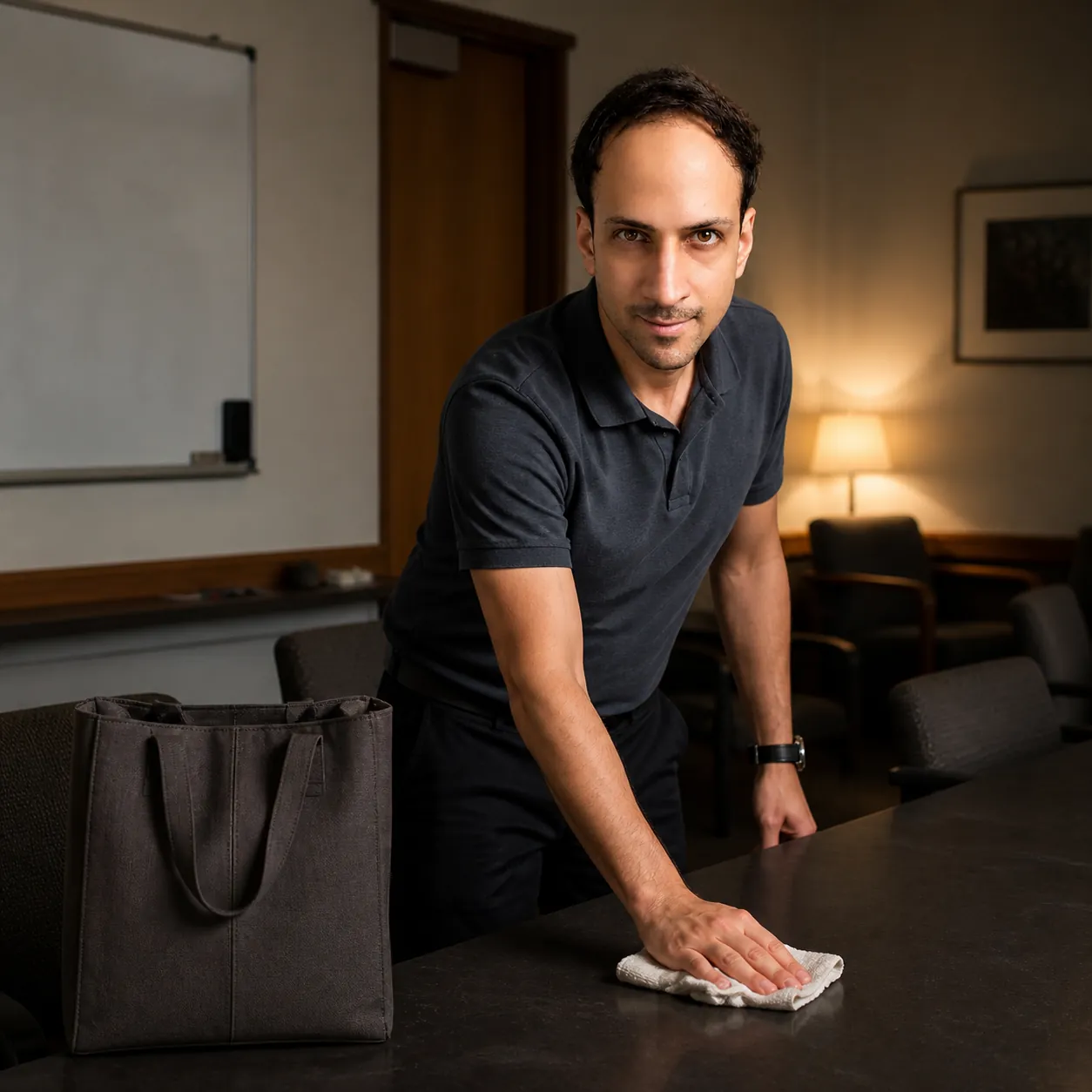
Wiping the Far End of the Table — AI Portrait Prompt
صورةAI Portraits

Turn your own photo into a museum-scale contemporary portrait in a university staff room emptying out after a long afternoon meeting. Keeps your face unchanged.

من نص البرومبت

Use the attached reference photo as the identity reference: keep the same face, skin tone, hair and features as the person in that photo, without beautifying, aging or altering them. Create a square 1:1 museum-catalog frame with a strong first read and a slower second read at exactly 2880x2880 pixels. Location: a university staff room emptying out after a long afternoon meeting. Show the subject in a slate knit polo tucked into dark chinos, wiping the table's far end with a folded cloth. Build the frame on this unremarkable detail: a bag set down upright and squared to the surface, whose handles still hold the shape their grip pressed into them prices a calm that everyone else has always mistaken for a personality. Explore whether equanimity is a trait they have or a purchase they keep making; expression composed and unremarkable, carrying quiet competence, the weight held somewhere after this hour. Shoot at 85mm from standing height so the surface near their hand stays fully readable. Make the composition read as an ordinary photograph until the second look. Render it as museum-scale contemporary portraiture combining sober documentary craft, accurate everyday surfaces, believable clothing weight, and emotionally intelligent restraint, using one warm lamp near the seating with the rest of the room dim and a palette of warm grey, unbleached linen, and one muted brass accent. Photorealistic: this must read as a real photograph from a physical camera, never an illustration, painting, or 3D render. Resolve real surface detail: label-free packaging showing carton fibre, cardboard bruised at the corners, and tape lifting slightly at one end. Keep one identity-locked person, credible hands and fingers, natural fabric, and coherent scale, contact, reflections, shadows, airflow, deformation, and materials. Background people only when essential, always secondary and clearly different. Avoid head in hands, slumped shoulders, staring out of windows, visible tears, and sad-eyed lighting. No text, labels, logos, signatures, watermarks, random symbols, plastic skin, excessive bloom, or glossy AI finish.
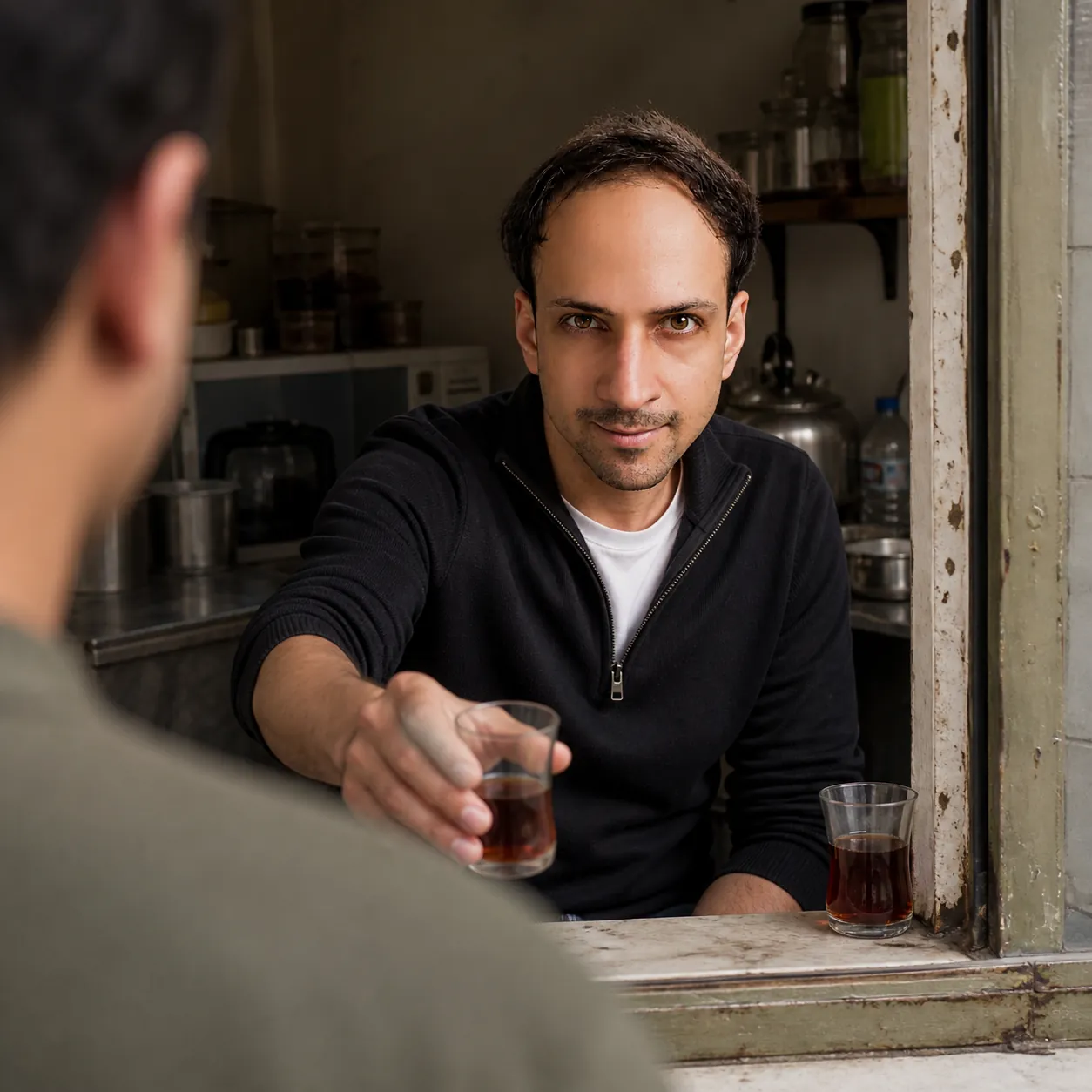
Hot Glass at the Tea Stall — AI Portrait Prompt
صورةAI Portraits

Turn your own photo into a photorealistic portrait in a pavement tea stall window where the seller works just inside. Keeps your face unchanged.

من نص البرومبت

Use the attached reference photo as the identity reference: keep the same face, skin tone, hair and features as the person in that photo, without beautifying, aging or altering them. Create a square 1:1 museum-catalog frame with a strong first read and a slower second read at exactly 2880x2880 pixels. Location: a pavement tea stall window where the seller works just inside. Show the subject in a black quarter-zip over a plain white tee with sleeves pushed back, taking a hot glass by its rim between finger and thumb. Make this the only tell, easy to miss: a glass set down beside them, its surface gone still, inside a pause that has outlasted the exchange it belongs to spends time where a sentence should have gone and loses nothing. Explore how courtesy and accuracy can both be satisfied by one short reply; expression composed and unremarkable, carrying relaxed readiness, the weight held just behind the courtesy. Place the lens slightly behind a second person's shoulder, keeping that shoulder soft and never blocking them. Make the composition give the delayed hand as much space as the face. Render it as plain reportage photography made from ordinary contemporary Saudi interiors, believable props, natural posture, and completely undramatic lighting choices, using flat afternoon daylight through a plain window, shadows soft and unremarkable and a palette of warm grey, pale plaster, and one muted olive accent. Photorealistic: this must read as a real photograph from a physical camera, never an illustration, painting, or 3D render. Resolve real surface detail: floor finish worn along the walked line, skirting marked at shoe height, and corners darker than the open floor. Keep one identity-locked person, credible hands and fingers, natural fabric, and coherent scale, contact, reflections, shadows, airflow, deformation, and materials. Background people only when essential, always secondary and clearly different. Avoid rain-streaked glass, shadow-bar drama, clasped praying hands, symbolic empty chairs, and heroic poster framing. No text, labels, logos, signatures, watermarks, random symbols, plastic skin, excessive bloom, or glossy AI finish.
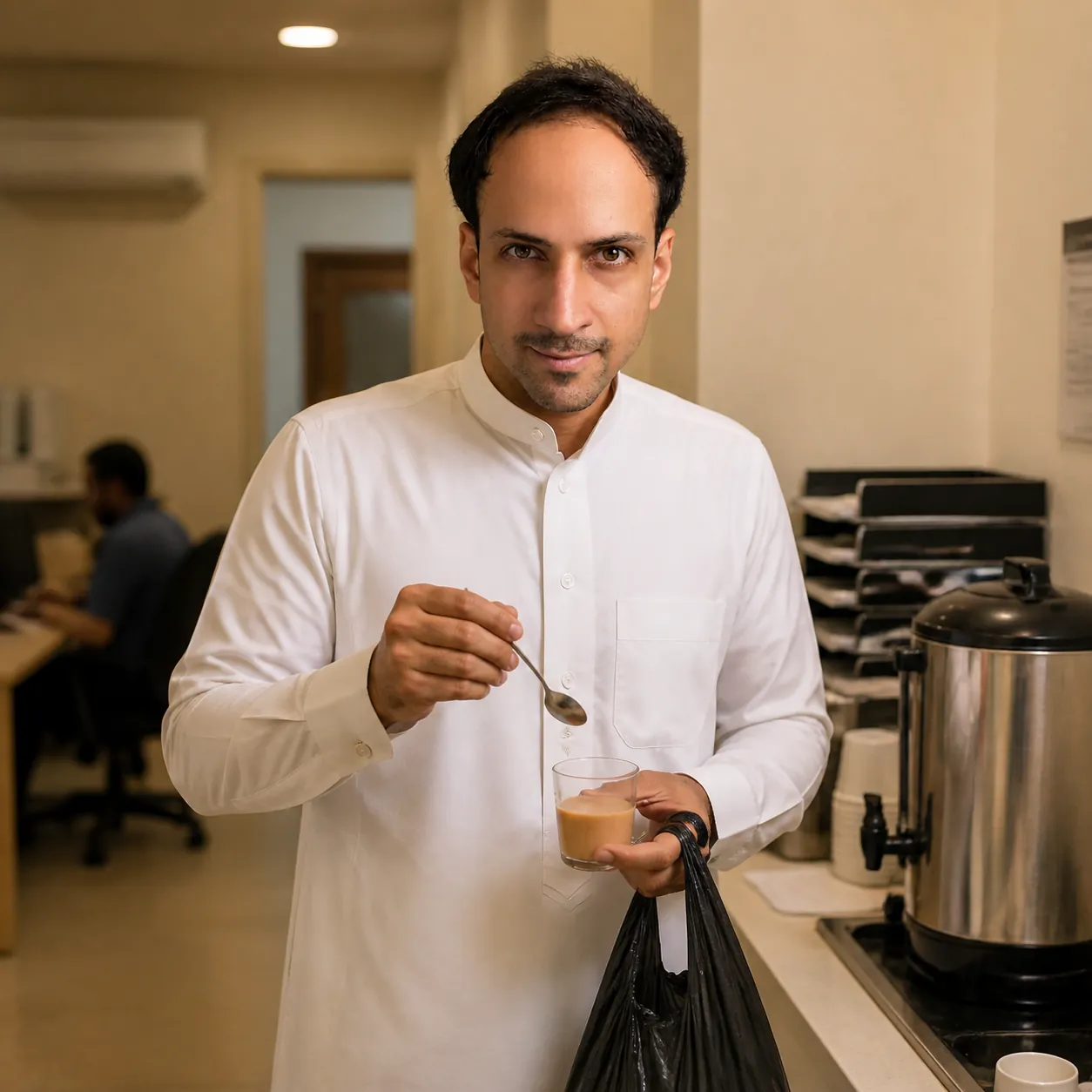
Sugar Stirred at the Tea Point — AI Portrait Prompt
صورةAI Portraits

Turn your own photo into a photorealistic portrait in a shared office tea point with a boiler urn and stacked trays. Keeps your face unchanged.

من نص البرومبت

Use the attached reference photo as the identity reference: keep the same face, skin tone, hair and features as the person in that photo, without beautifying, aging or altering them. Create a square 1:1 museum-catalog frame with a strong first read and a slower second read at exactly 2880x2880 pixels. Location: a shared office tea point with a boiler urn and stacked trays. Show the subject in a pressed white traditional Gulf outfit with its cuffs buttoned and sleeves unrolled, stirring sugar into a glass and lifting the spoon clear. Build the frame on this unremarkable detail: a bag still hanging from two fingers beside a clear surface that has been free since well before they stopped walking spends time where a sentence should have gone and loses nothing. Explore why the smallest polite word is sometimes the most exact one available; expression composed and unremarkable, carrying ordinary politeness, the weight held under a level, unhurried voice. Shoot a quiet 85mm portrait from standing height, with the room's ordinary depth left intact behind them. Make the composition leave the strongest evidence at the edge of the frame. Render it as gallery-grade quiet realism assembling lived-in rooms, precise gesture observation, muted material texture, and framing that never announces its subject, using one warm ceiling fitting doing all the work in an ordinary room and a palette of soft bone, dark charcoal, and a low amber note. Photorealistic: this must read as a real photograph from a physical camera, never an illustration, painting, or 3D render. Resolve real surface detail: cotton that hangs by its own weight, seams that pucker very slightly, and collars softened by washing. Keep one identity-locked person, credible hands and fingers, natural fabric, and coherent scale, contact, reflections, shadows, airflow, deformation, and materials. Background people only when essential, always secondary and clearly different. Avoid rain-streaked glass, shadow-bar drama, clasped praying hands, symbolic empty chairs, and heroic poster framing. No text, labels, logos, signatures, watermarks, random symbols, plastic skin, excessive bloom, or glossy AI finish.
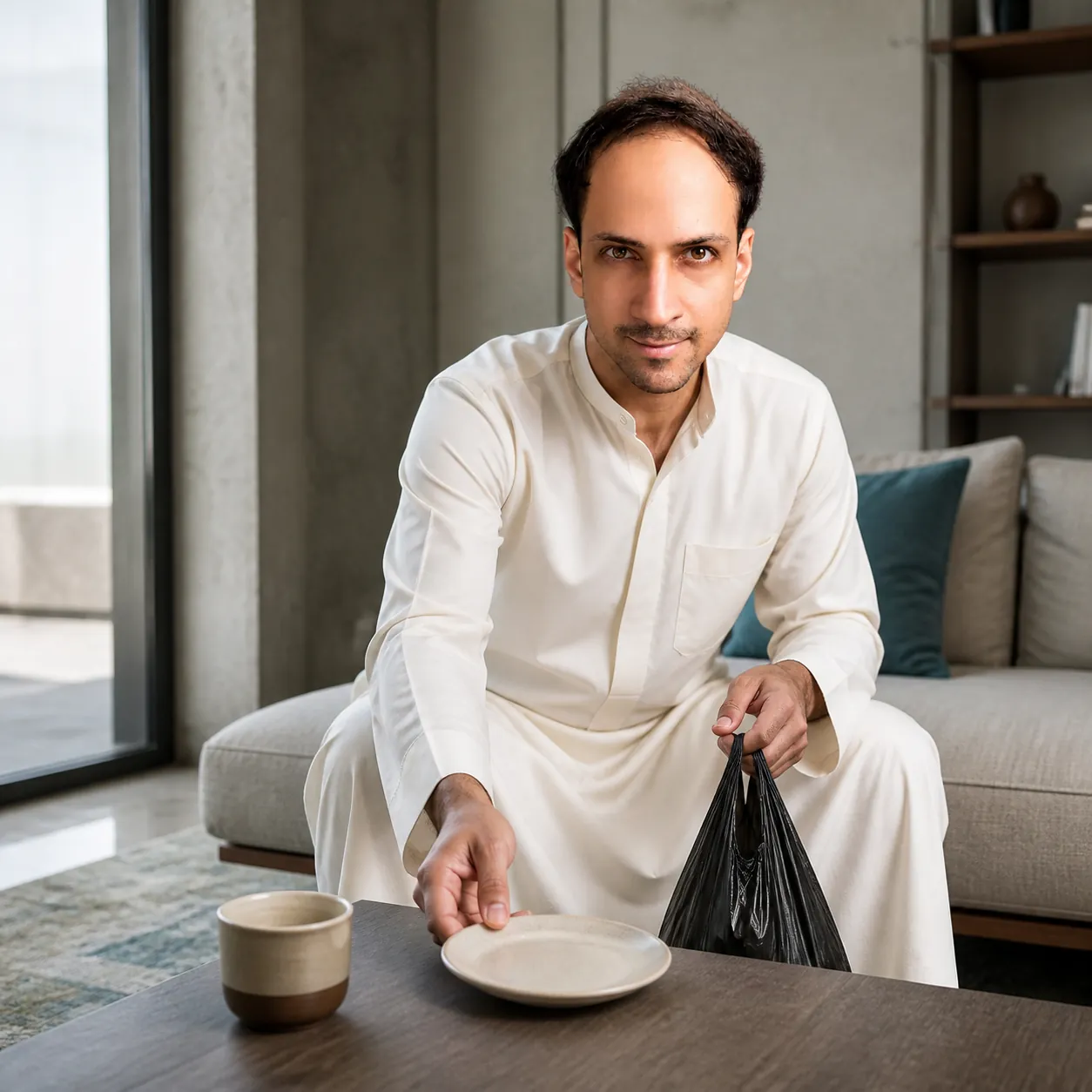
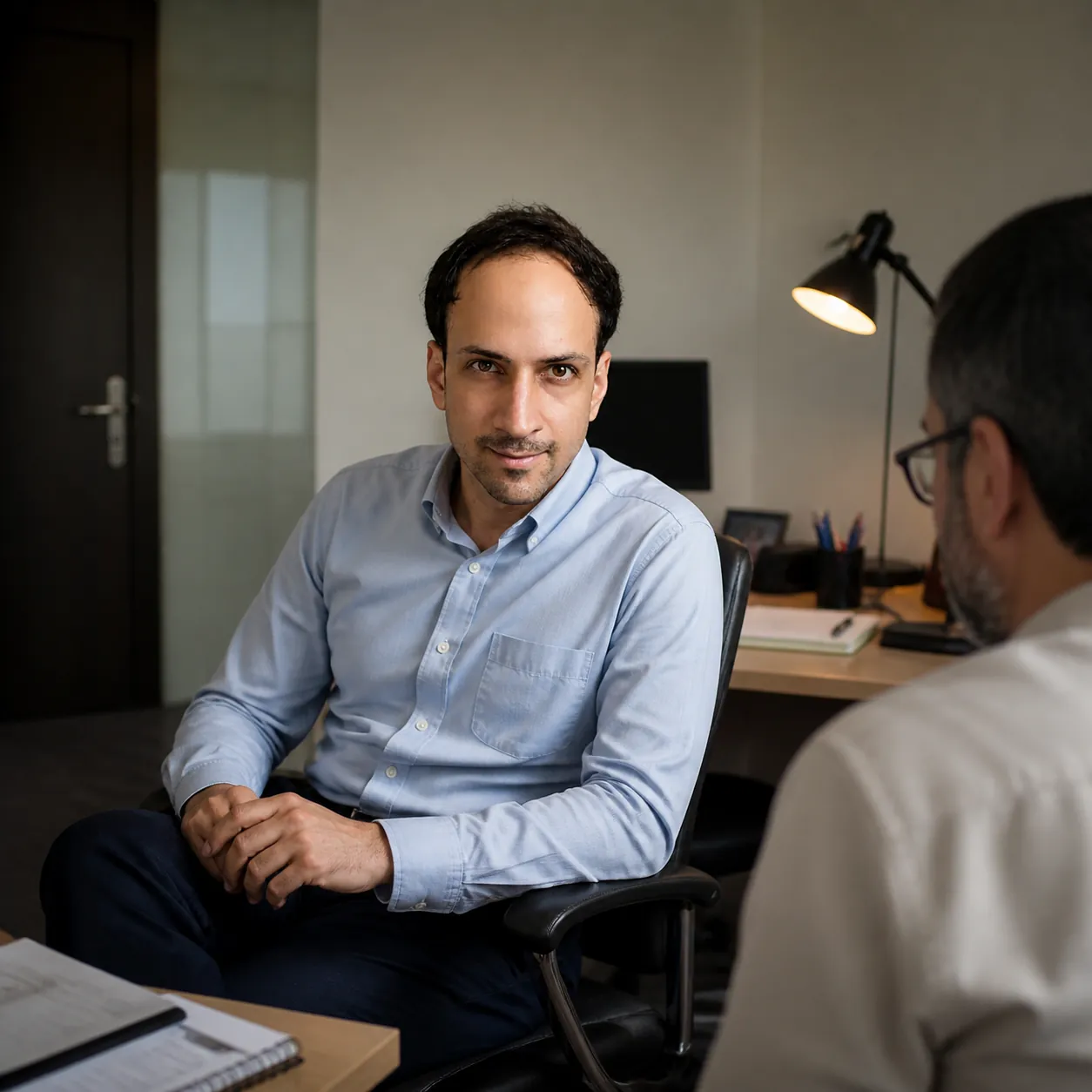
A Quarter Turn Toward the Door — AI Portrait Prompt
صورةAI Portraits

Turn your own photo into a photorealistic portrait in a shared university office where a colleague's desk faces the far wall. Keeps your face unchanged.

من نص البرومبت

Use the attached reference photo as the identity reference: keep the same face, skin tone, hair and features as the person in that photo, without beautifying, aging or altering them. Create a square 1:1 museum-catalog frame with a strong first read and a slower second read at exactly 2880x2880 pixels. Location: a shared university office where a colleague's desk faces the far wall. Show the subject in a light blue oxford shirt tucked into pressed navy trousers, turning their chair a quarter turn toward the open door. Photograph this as though nothing were happening: a chin still lowered from a second nod the moment never required, the first already taken as a complete answer spends time where a sentence should have gone and loses nothing. Explore whether a state without a name is any less real for lacking one; expression composed and unremarkable, carrying everyday warmth, the weight held inside the ordinary tempo. Frame the subject at chest height so their hands and face stay equally readable in one plane. Make the composition keep the second person partial and never the focus. Render it as plain reportage photography made from ordinary contemporary Saudi interiors, believable props, natural posture, and completely undramatic lighting choices, using late-day interior light already turning grey, with one lamp switched on early and a palette of soft bone, dark charcoal, and a low amber note. Photorealistic: this must read as a real photograph from a physical camera, never an illustration, painting, or 3D render. Resolve real surface detail: skin that reddens slightly under pressure, nail beds with honest colour, and knuckle creases that fold rather than blur. Keep one identity-locked person, credible hands and fingers, natural fabric, and coherent scale, contact, reflections, shadows, airflow, deformation, and materials. Background people only when essential, always secondary and clearly different. Avoid rain-streaked glass, shadow-bar drama, clasped praying hands, symbolic empty chairs, and heroic poster framing. No text, labels, logos, signatures, watermarks, random symbols, plastic skin, excessive bloom, or glossy AI finish.
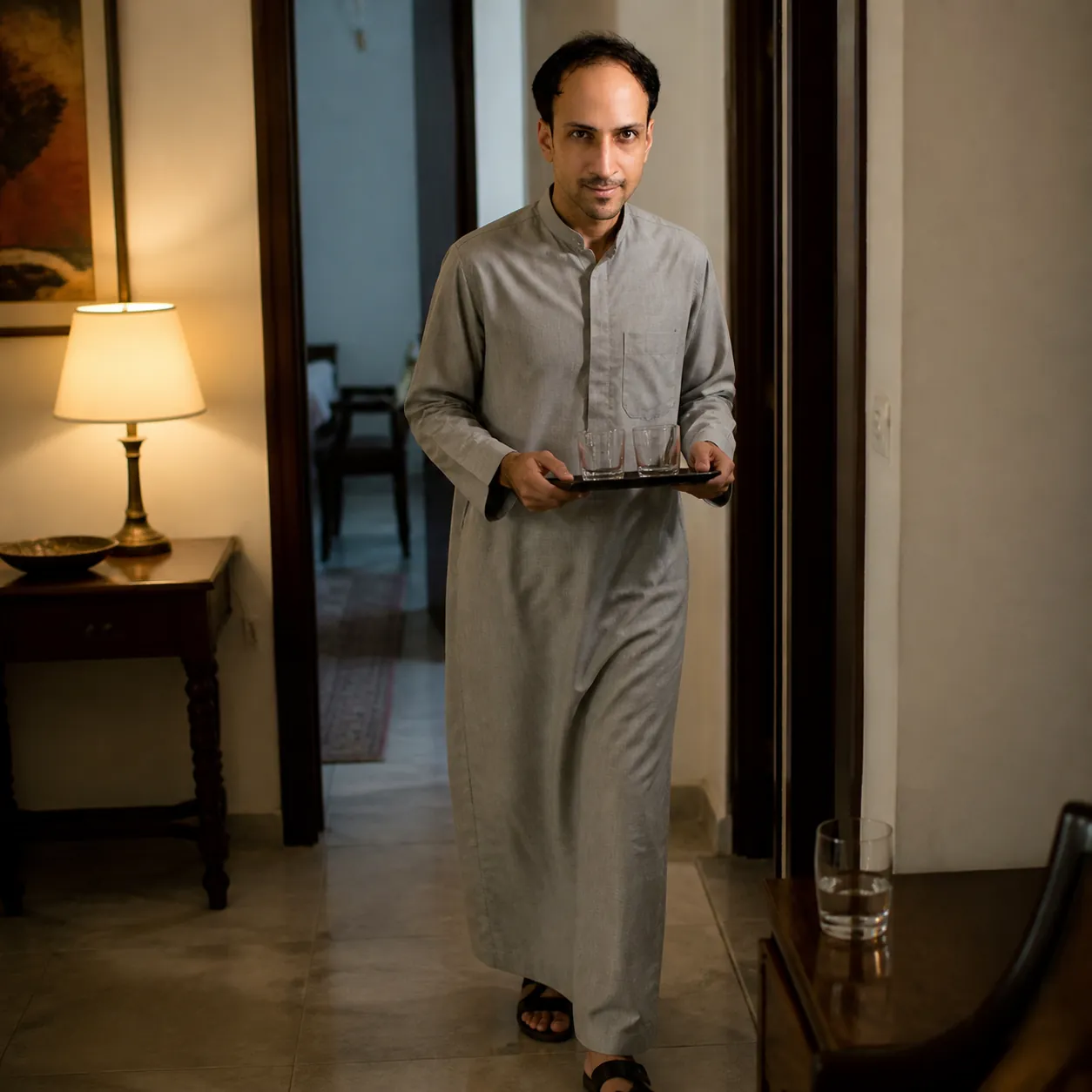
Gathering the Empty Plate — AI Portrait Prompt
صورةAI Portraits

Turn your own photo into a quiet editorial portrait in a family sitting room with another cup already on the low table. Keeps your face unchanged.

من نص البرومبت

Use the attached reference photo as the identity reference: keep the same face, skin tone, hair and features as the person in that photo, without beautifying, aging or altering them. Create a square 1:1 museum-catalog frame with a strong first read and a slower second read at exactly 2880x2880 pixels. Location: a family sitting room with another cup already on the low table. Show the subject in an ivory traditional Gulf outfit with the collar open and no ghutra, gathering an empty plate from the low table. Let the weight sit here and look like nothing: a bag still hanging from two fingers beside a clear surface that has been free since well before they stopped walking says the closest true thing the available language will actually hold. Explore why the smallest polite word is sometimes the most exact one available; expression composed and unremarkable, carrying mild attentiveness, the weight held below the reach of words. Use an eye-level 50mm view at conversational distance, natural perspective and a shallow but honest depth. Make the composition read as an unremarkable snapshot until the timing detail registers. Render it as quiet editorial realism combining true-to-life interiors, accurate everyday clothing, unposed body language, and photography that refuses to dramatize, using open shade from a covered walkway, contrast low and skin texture visible and a palette of cool concrete, off-white, and a single dusty teal. Photorealistic: this must read as a real photograph from a physical camera, never an illustration, painting, or 3D render. Resolve real surface detail: fine grit in the texture of concrete, efflorescence at damp edges, and hairline cracks that follow stress. Keep one identity-locked person, credible hands and fingers, natural fabric, and coherent scale, contact, reflections, shadows, airflow, deformation, and materials. Background people only when essential, always secondary and clearly different. Avoid tears, head in hands, staring through windows, hunched silhouettes, and any object announcing illness. No text, labels, logos, signatures, watermarks, random symbols, plastic skin, excessive bloom, or glossy AI finish.
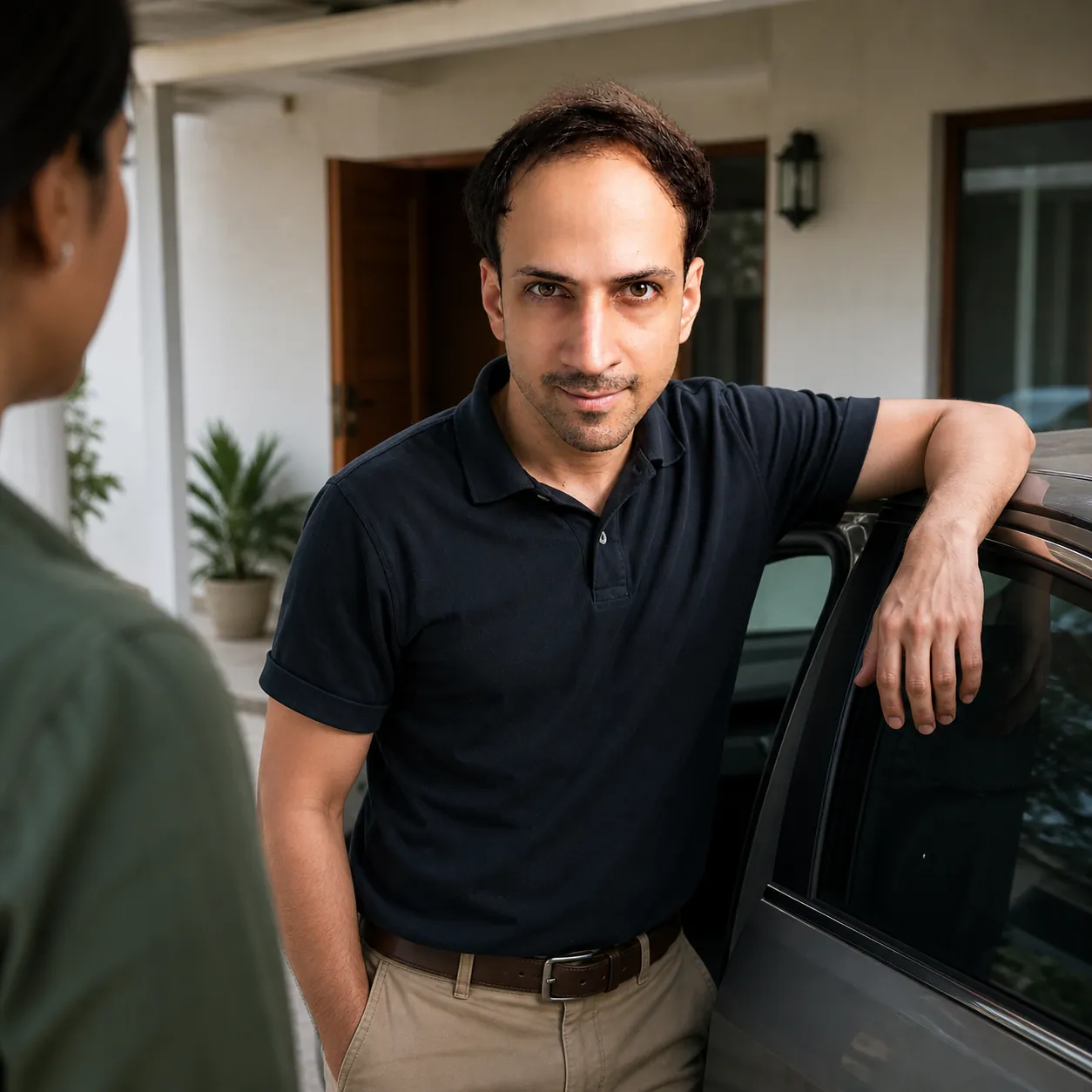
Two Glasses Down the Hallway — AI Portrait Prompt
صورةAI Portraits

Turn your own photo into an unforced documentary portrait in a hallway outside a room where an unseen conversation keeps going. Keeps your face unchanged.

من نص البرومبت

Use the attached reference photo as the identity reference: keep the same face, skin tone, hair and features as the person in that photo, without beautifying, aging or altering them. Create a square 1:1 museum-catalog frame with a strong first read and a slower second read at exactly 2880x2880 pixels. Location: a hallway outside a room where an unseen conversation keeps going. Show the subject in a soft cotton traditional Gulf house outfit in pale grey with plain sandals, carrying two glasses on a small tray toward the room. Let the weight sit here and look like nothing: a glass set down beside them, its surface gone still, inside a pause that has outlasted the exchange it belongs to says the closest true thing the available language will actually hold. Explore how courtesy and accuracy can both be satisfied by one short reply; expression composed and unremarkable, carrying practical calm, the weight held inside the ordinary tempo. Use an eye-level 50mm view at conversational distance, natural perspective and a shallow but honest depth. Make the composition read as an unremarkable snapshot until the timing detail registers. Render it as unforced documentary portraiture built from natural domestic staging, honest skin rendering, restrained contemporary styling, and patient observational timing, using late-day interior light already turning grey, with one lamp switched on early and a palette of steel grey, milk white, and a quiet mustard accent. Photorealistic: this must read as a real photograph from a physical camera, never an illustration, painting, or 3D render. Resolve real surface detail: the difference between a wiped surface and a clean one, faint tide marks on ceramic, and metal dulled unevenly by touch. Keep one identity-locked person, credible hands and fingers, natural fabric, and coherent scale, contact, reflections, shadows, airflow, deformation, and materials. Background people only when essential, always secondary and clearly different. Avoid tears, head in hands, staring through windows, hunched silhouettes, and any object announcing illness. No text, labels, logos, signatures, watermarks, random symbols, plastic skin, excessive bloom, or glossy AI finish.
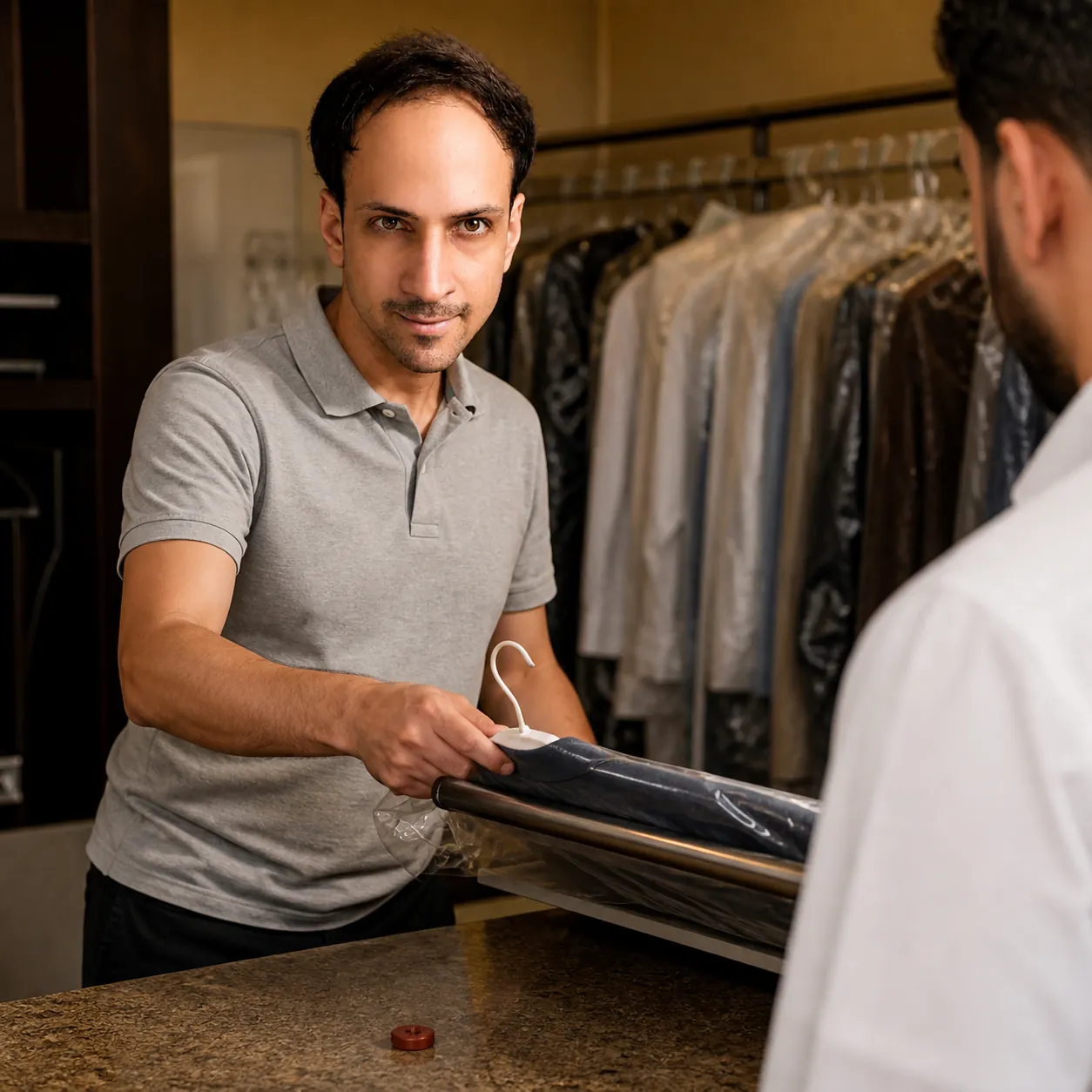
Hand on the Open Car Door — AI Portrait Prompt
صورةAI Portraits

Turn your own photo into an unforced documentary portrait in a parked car in the family driveway, house door open behind. Keeps your face unchanged.

من نص البرومبت

Use the attached reference photo as the identity reference: keep the same face, skin tone, hair and features as the person in that photo, without beautifying, aging or altering them. Create a square 1:1 museum-catalog frame with a strong first read and a slower second read at exactly 2880x2880 pixels. Location: a parked car in the family driveway, house door open behind. Show the subject in a dark polo shirt with straight khaki trousers and rolled sleeves, resting one hand on the open car door's upper edge. Hide the whole argument in this ordinary moment: a chin still lowered from a second nod the moment never required, the first already taken as a complete answer says the closest true thing the available language will actually hold. Explore whether a state without a name is any less real for lacking one; expression composed and unremarkable, carrying quiet competence, the weight held below the reach of words. Use a 35mm three-quarter view close enough to include one nearby sleeve that is not theirs. Make the composition hold one area of stillness inside an otherwise ordinary room. Render it as unforced documentary portraiture built from natural domestic staging, honest skin rendering, restrained contemporary styling, and patient observational timing, using open shade from a covered walkway, contrast low and skin texture visible and a palette of warm grey, pale plaster, and one muted olive accent. Photorealistic: this must read as a real photograph from a physical camera, never an illustration, painting, or 3D render. Resolve real surface detail: wood grain read at honest scale, matte and gloss clearly separated, and no surface uniformly clean. Keep one identity-locked person, credible hands and fingers, natural fabric, and coherent scale, contact, reflections, shadows, airflow, deformation, and materials. Background people only when essential, always secondary and clearly different. Avoid tears, head in hands, staring through windows, hunched silhouettes, and any object announcing illness. No text, labels, logos, signatures, watermarks, random symbols, plastic skin, excessive bloom, or glossy AI finish.
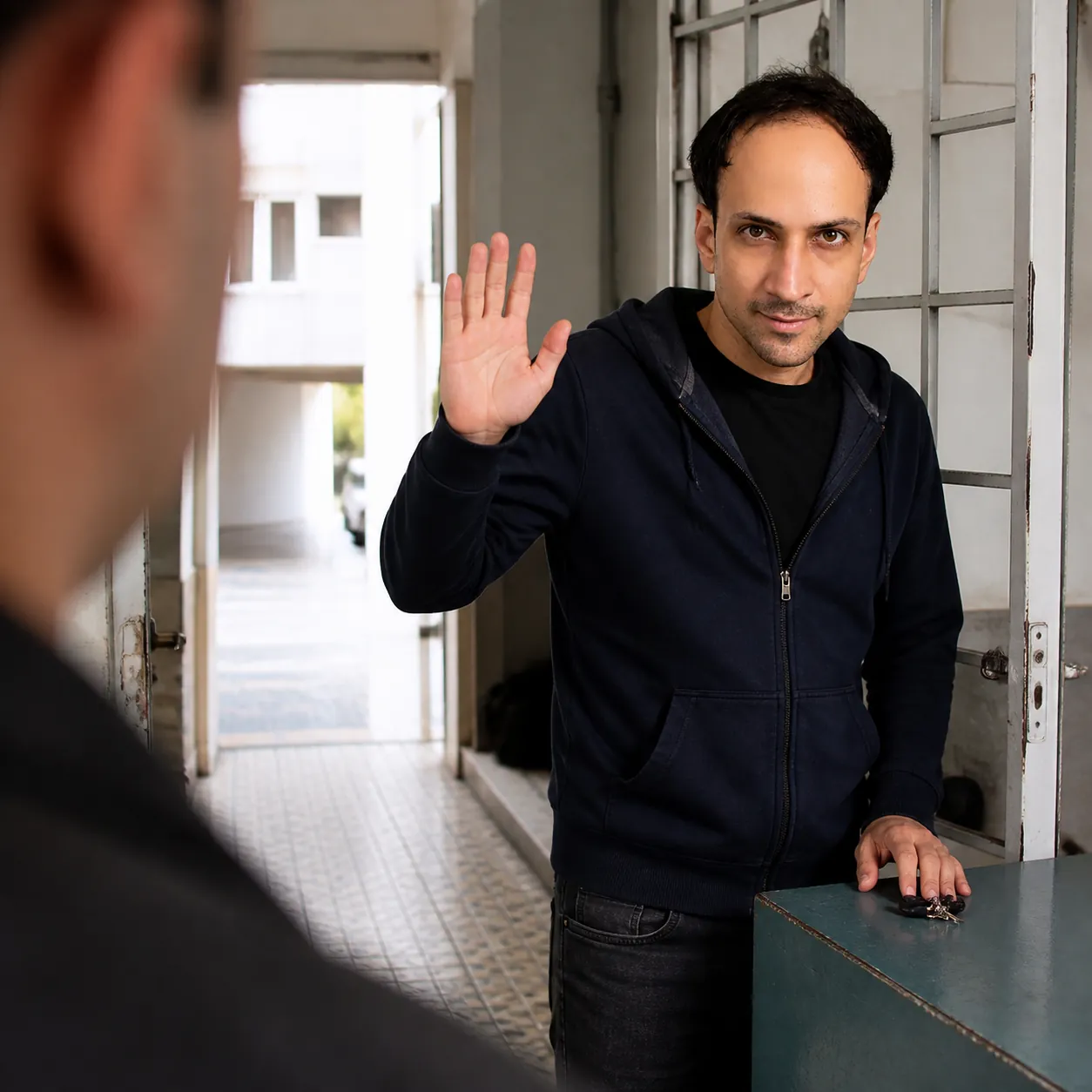
Hanger Along the Counter Rail — AI Portrait Prompt
صورةAI Portraits

Turn your own photo into a photorealistic portrait in a dry cleaner's counter where pressed garments turn on the rail behind. Keeps your face unchanged.

من نص البرومبت

Use the attached reference photo as the identity reference: keep the same face, skin tone, hair and features as the person in that photo, without beautifying, aging or altering them. Create a square 1:1 museum-catalog frame with a strong first read and a slower second read at exactly 2880x2880 pixels. Location: a dry cleaner's counter where pressed garments turn on the rail behind. Show the subject in a stone-grey polo and dark trousers with one folded cuff, sliding a hanger along the counter rail toward the attendant. Hide the whole argument in this ordinary moment: a small object their hand lifted and returned to the same patch of surface it had occupied a moment earlier spends time where a sentence should have gone and loses nothing. Explore what the timing of an answer reports that its wording never could; expression composed and unremarkable, carrying workaday patience, the weight held under a level, unhurried voice. Use a 35mm three-quarter view close enough to include one nearby sleeve that is not theirs. Make the composition hold one area of stillness inside an otherwise ordinary room. Render it as plain reportage photography made from ordinary contemporary Saudi interiors, believable props, natural posture, and completely undramatic lighting choices, using one warm ceiling fitting doing all the work in an ordinary room and a palette of sand beige, dark brown, and one brick-red thread. Photorealistic: this must read as a real photograph from a physical camera, never an illustration, painting, or 3D render. Resolve real surface detail: rubber gone chalky with age, painted metal chipped to primer, and plastic yellowed only where light reaches it. Keep one identity-locked person, credible hands and fingers, natural fabric, and coherent scale, contact, reflections, shadows, airflow, deformation, and materials. Background people only when essential, always secondary and clearly different. Avoid rain-streaked glass, shadow-bar drama, clasped praying hands, symbolic empty chairs, and heroic poster framing. No text, labels, logos, signatures, watermarks, random symbols, plastic skin, excessive bloom, or glossy AI finish.
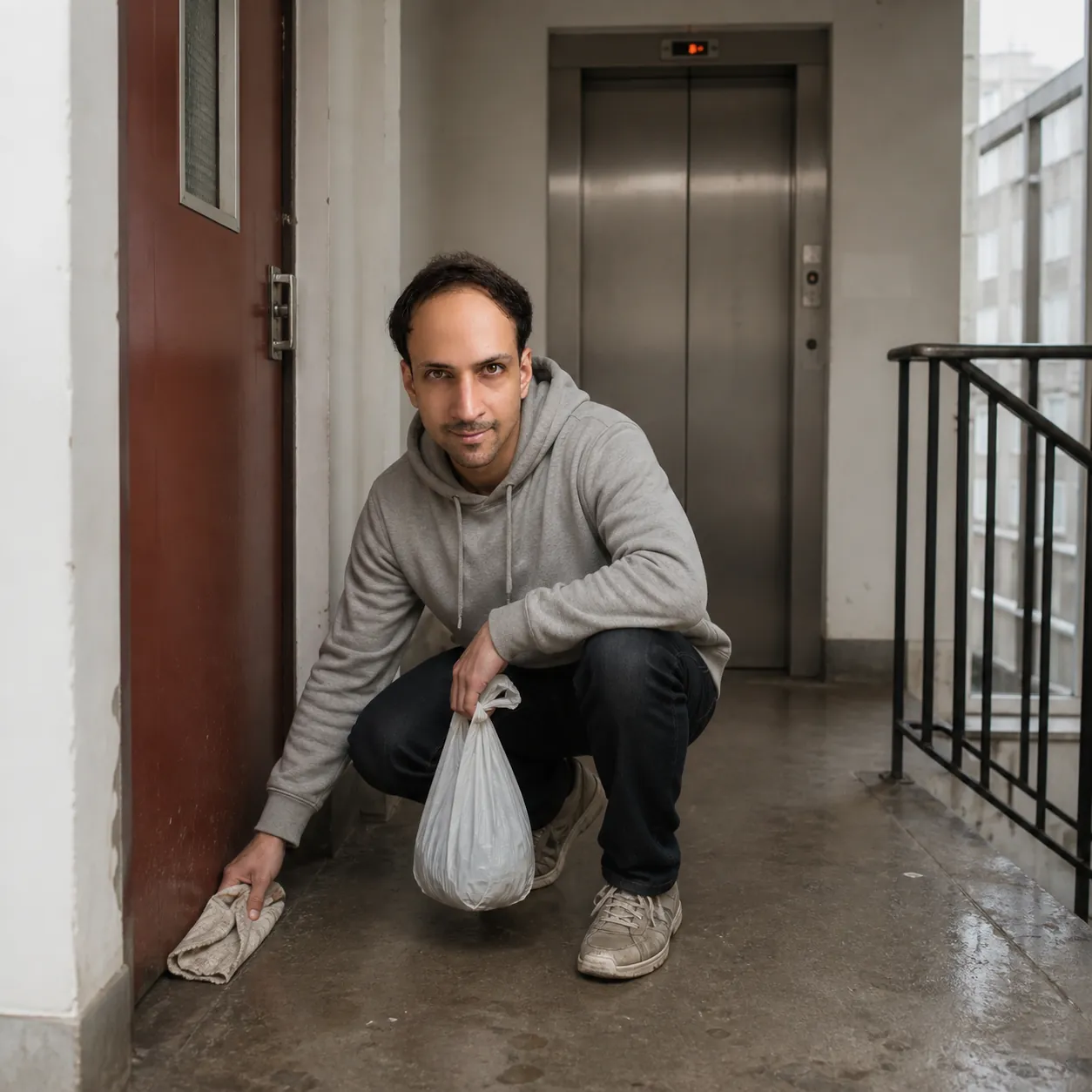
A Greeting Without Breaking Stride — AI Portrait Prompt
صورةAI Portraits

Turn your own photo into a portrait in a residential building entrance where the guard's chair stands beside the door. Keeps your face unchanged.

من نص البرومبت

Use the attached reference photo as the identity reference: keep the same face, skin tone, hair and features as the person in that photo, without beautifying, aging or altering them. Create a square 1:1 museum-catalog frame with a strong first read and a slower second read at exactly 2880x2880 pixels. Location: a residential building entrance where the guard's chair stands beside the door. Show the subject in a navy zip-up hoodie over a plain tee and dark jeans, lifting one hand in greeting without breaking stride. Make this the only tell, easy to miss: a small object their hand lifted and returned to the same patch of surface it had occupied a moment earlier says the closest true thing the available language will actually hold. Explore what the timing of an answer reports that its wording never could; expression composed and unremarkable, carrying steady friendliness, the weight held without disturbing the exchange. Place the lens slightly behind a second person's shoulder, keeping that shoulder soft and never blocking them. Make the composition give the delayed hand as much space as the face. Render it as unforced documentary portraiture built from natural domestic staging, honest skin rendering, restrained contemporary styling, and patient observational timing, using overhead office fluorescents evened out by daylight from the corridor beyond and a palette of cool concrete, off-white, and a single dusty teal. Photorealistic: this must read as a real photograph from a physical camera, never an illustration, painting, or 3D render. Resolve real surface detail: grout darker than tile, sealant slightly yellowed, and every joint showing a real tolerance gap. Keep one identity-locked person, credible hands and fingers, natural fabric, and coherent scale, contact, reflections, shadows, airflow, deformation, and materials. Background people only when essential, always secondary and clearly different. Avoid tears, head in hands, staring through windows, hunched silhouettes, and any object announcing illness. No text, labels, logos, signatures, watermarks, random symbols, plastic skin, excessive bloom, or glossy AI finish.
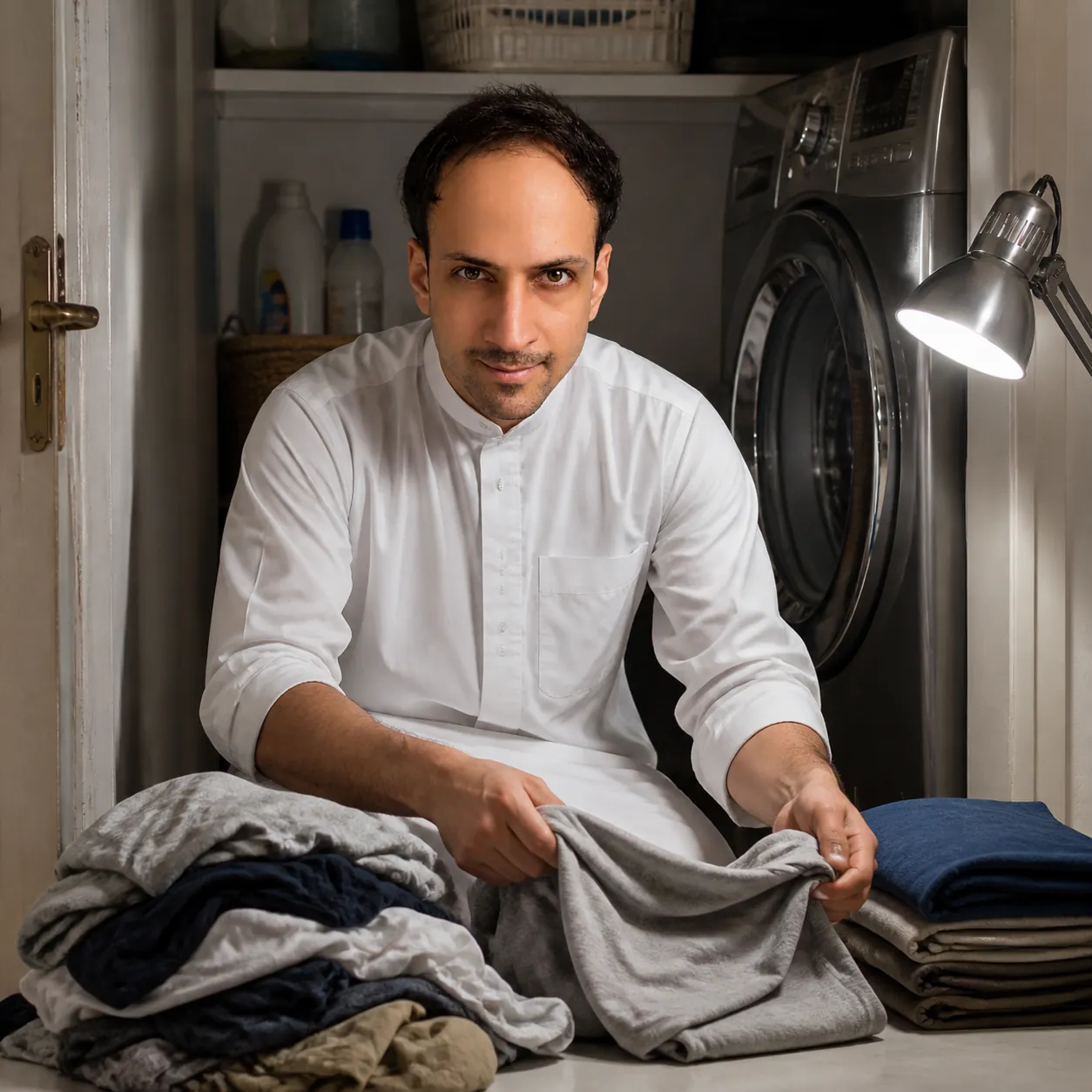
Cloth Under the Fire Door — AI Portrait Prompt
صورةAI Portraits

Turn your own photo into a portrait in a tower block's upper stairwell landing beside a closed lift lobby. Keeps your face unchanged.

من نص البرومبت

Use the attached reference photo as the identity reference: keep the same face, skin tone, hair and features as the person in that photo, without beautifying, aging or altering them. Create a square 1:1 museum-catalog frame with a strong first read and a slower second read at exactly 2880x2880 pixels. Location: a tower block's upper stairwell landing beside a closed lift lobby. Show the subject in a light grey hoodie over dark jeans and worn trainers, wedging a folded cloth under the fire door. Let one honest object carry what the face will not: a single bought item in a bag folded small, carried from a shop that was entered and left inside its quietest minutes turns an ordinary errand into the day's largest piece of engineering. Explore why an exit has to be located before an errand can begin; expression occupied, not expressive, carrying earned matter-of-factness, difficulty stated quietly enough to require attention. Use a 50mm eye-level view from inside the room with the doorway kept at the edge. Make the composition give the object they are handling more acuity than the room. Render it as gallery-scale observational realism combining tactile household objects, truthful stairwell and forecourt materials, natural fabric behaviour, and calm human-centred composition, using even overcast daylight entering a shopfront with no warm colour push and a palette of smoke grey, bone white, and one faded shopfront red. Photorealistic: this must read as a real photograph from a physical camera, never an illustration, painting, or 3D render. Resolve real surface detail: fine lint on dark fabric, water spotting on steel, and the soft rounding of edges that have been used for years. Keep one identity-locked person, credible hands and fingers, natural fabric, and coherent scale, contact, reflections, shadows, airflow, deformation, and materials. Background people only when essential, always secondary and clearly different. Avoid hero-poster stances, golden-hour wellness glow, posing at camera, and chest-clutching gestures. No text, labels, logos, signatures, watermarks, random symbols, plastic skin, excessive bloom, or glossy AI finish.
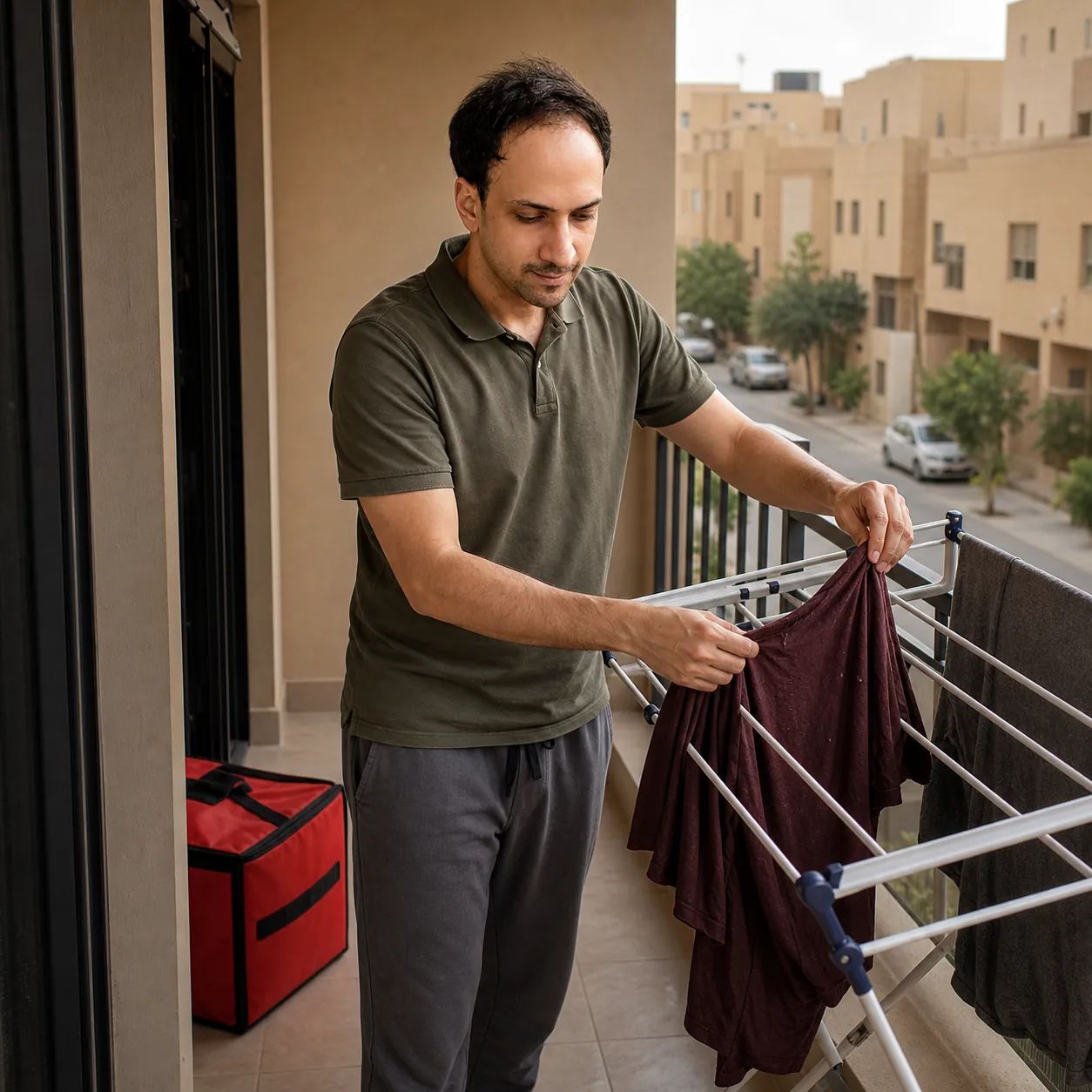
Sorting Laundry by Lamplight — AI Portrait Prompt
صورةAI Portraits

Turn your own photo into a quiet domestic documentary portrait in a utility alcove off the hallway with a front-loading machine. Keeps your face unchanged.

من نص البرومبت

Use the attached reference photo as the identity reference: keep the same face, skin tone, hair and features as the person in that photo, without beautifying, aging or altering them. Create a square 1:1 museum-catalog frame with a strong first read and a slower second read at exactly 2880x2880 pixels. Location: a utility alcove off the hallway with a front-loading machine. Show the subject in a plain white traditional Gulf outfit with both sleeves folded once, dividing a laundry pile into two stacks by feel. Build the image around this small, exact tableau: an overhead fitting switched off in favour of one low lamp aimed at the work, brightness treated as a variable makes the cost of an ordinary chore visible without making it a complaint. Explore how a private adaptation stops being remarkable once it simply works; expression occupied, not expressive, carrying quiet efficiency, difficulty stated without inviting sympathy. Frame at chest height so the accommodation and their occupied face share one honest plane. Make the composition keep the finished part of the chore visible at one edge. Render it as quiet domestic documentary realism combining unstyled interior photography, tactile household materials, honest working light, and unhurried observational framing, using flat retail fluorescent with a cool cast and unflattering falloff and a palette of washed beige, slate grey, and worn brass. Photorealistic: this must read as a real photograph from a physical camera, never an illustration, painting, or 3D render. Resolve real surface detail: brass darkened in the recesses and bright where thumbs land, and lacquer crazed rather than perfect. Keep one identity-locked person, credible hands and fingers, natural fabric, and coherent scale, contact, reflections, shadows, airflow, deformation, and materials. Background people only when essential, always secondary and clearly different. Avoid hands clamped over ears, meltdown theatrics, and hero poses at camera. No text, labels, logos, signatures, watermarks, random symbols, plastic skin, excessive bloom, or glossy AI finish.
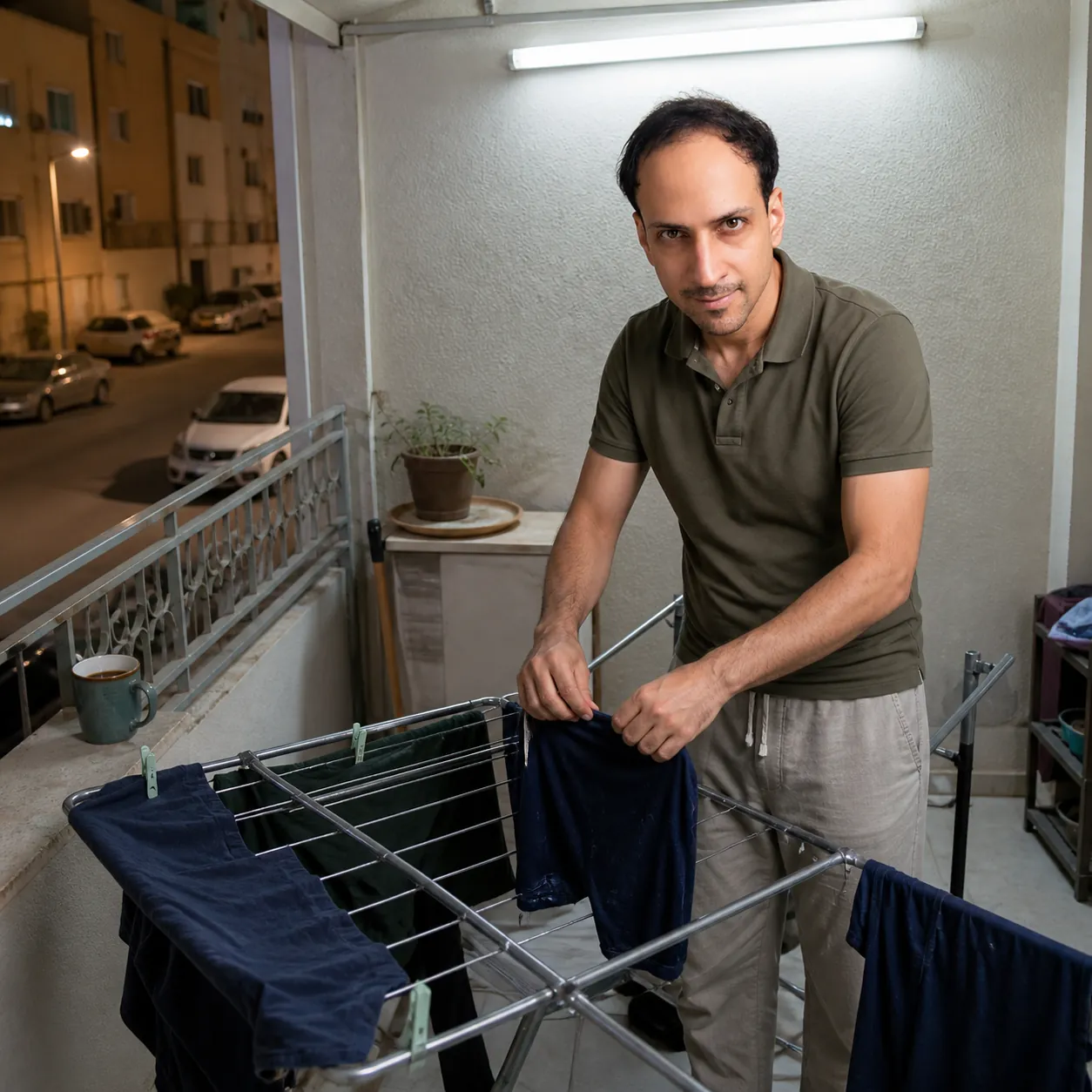
The Delivery Box Mid-Floor — AI Portrait Prompt
صورةAI Portraits

Turn your own photo into a quiet domestic documentary portrait in a shaded apartment balcony overlooking a quiet Riyadh side street. Keeps your face unchanged.

من نص البرومبت

Use the attached reference photo as the identity reference: keep the same face, skin tone, hair and features as the person in that photo, without beautifying, aging or altering them. Create a square 1:1 museum-catalog frame with a strong first read and a slower second read at exactly 2880x2880 pixels. Location: a shaded apartment balcony overlooking a quiet Riyadh side street. Show the subject in a faded olive polo and soft drawstring trousers, clipping a damp shirt onto a folding rack. Let one honest object carry what the face will not: a delivery box set down mid-floor at an hour that belongs to a different part of the evening's run turns a five-minute job into an hour of starting the order again. Explore what work is happening while nothing appears to be happening; expression occupied, not expressive, carrying dry persistence, difficulty stated as ordinary fact. Use a 50mm eye-level view with the object nearer than their hands. Make the composition show the gap in the order, not the objects. Render it as quiet domestic documentary realism built from unposed observation, honest household materials, accurate skin rendering, and restrained contemporary art direction, using even mid-morning shade with bounced floor light filling the lower half and a palette of flat beige, deep brown, and one red accent. Photorealistic: this must read as a real photograph from a physical camera, never an illustration, painting, or 3D render. Resolve real surface detail: the difference between a wiped surface and a clean one, faint tide marks on ceramic, and metal dulled unevenly by touch. Keep one identity-locked person, credible hands and fingers, natural fabric, and coherent scale, contact, reflections, shadows, airflow, deformation, and materials. Background people only when essential, always secondary and clearly different. Avoid hero poses, golden-hour wellness glow, eye contact with the lens, minimalist styling, and puzzle-piece symbolism. No text, labels, logos, signatures, watermarks, random symbols, plastic skin, excessive bloom, or glossy AI finish.
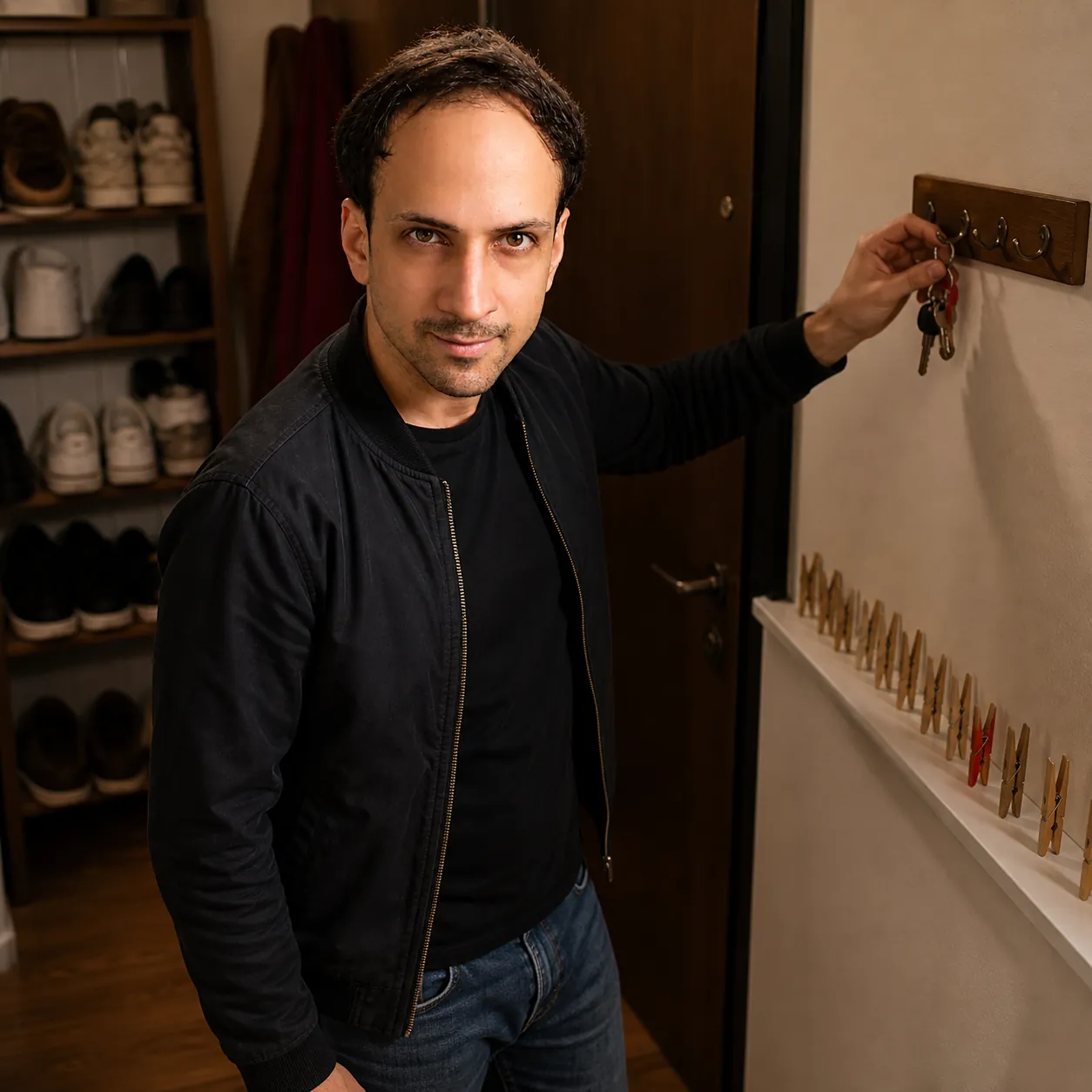
Steps Worked Out From Scratch — AI Portrait Prompt
صورةAI Portraits

Turn your own photo into an observational still-life portrait in an apartment entryway with a shoe rack and wall hook. Keeps your face unchanged.

من نص البرومبت

Use the attached reference photo as the identity reference: keep the same face, skin tone, hair and features as the person in that photo, without beautifying, aging or altering them. Create a square 1:1 museum-catalog frame with a strong first read and a slower second read at exactly 2880x2880 pixels. Location: an apartment entryway with a shoe rack and wall hook. Show the subject in a lightweight zip jacket over a plain crew-neck and jeans, hanging a set of keys on the wall hook. Anchor the frame to this piece of ordinary evidence: a line of clothes pegs along a ledge that mark the steps they have had to work out from scratch carries a whole routine on one part that nobody outside would notice. Explore whether a rebuilt routine can ever feel as cheap as the original; expression occupied, not expressive, carrying level determination, difficulty stated without inviting pity. Place the camera at standing height, close enough that one arm's reach fills it. Make the composition weight the small object above the whole room. Render it as observational still-life portraiture built from real household objects, matter-of-fact framing, accurate fabric behavior, and gallery-scale detail without polish, using one ceiling fitting doing all the work, shadows soft and low and a palette of flat beige, deep brown, and one red accent. Photorealistic: this must read as a real photograph from a physical camera, never an illustration, painting, or 3D render. Resolve real surface detail: hair with individual strands catching light, short hairs of uneven length, and skin oil giving a low uneven sheen. Keep one identity-locked person, credible hands and fingers, natural fabric, and coherent scale, contact, reflections, shadows, airflow, deformation, and materials. Background people only when essential, always secondary and clearly different. Avoid melancholy posed at windows, showroom kitchens, hands clutching the head, inspirational lighting, and clockwork-brain imagery. No text, labels, logos, signatures, watermarks, random symbols, plastic skin, excessive bloom, or glossy AI finish.
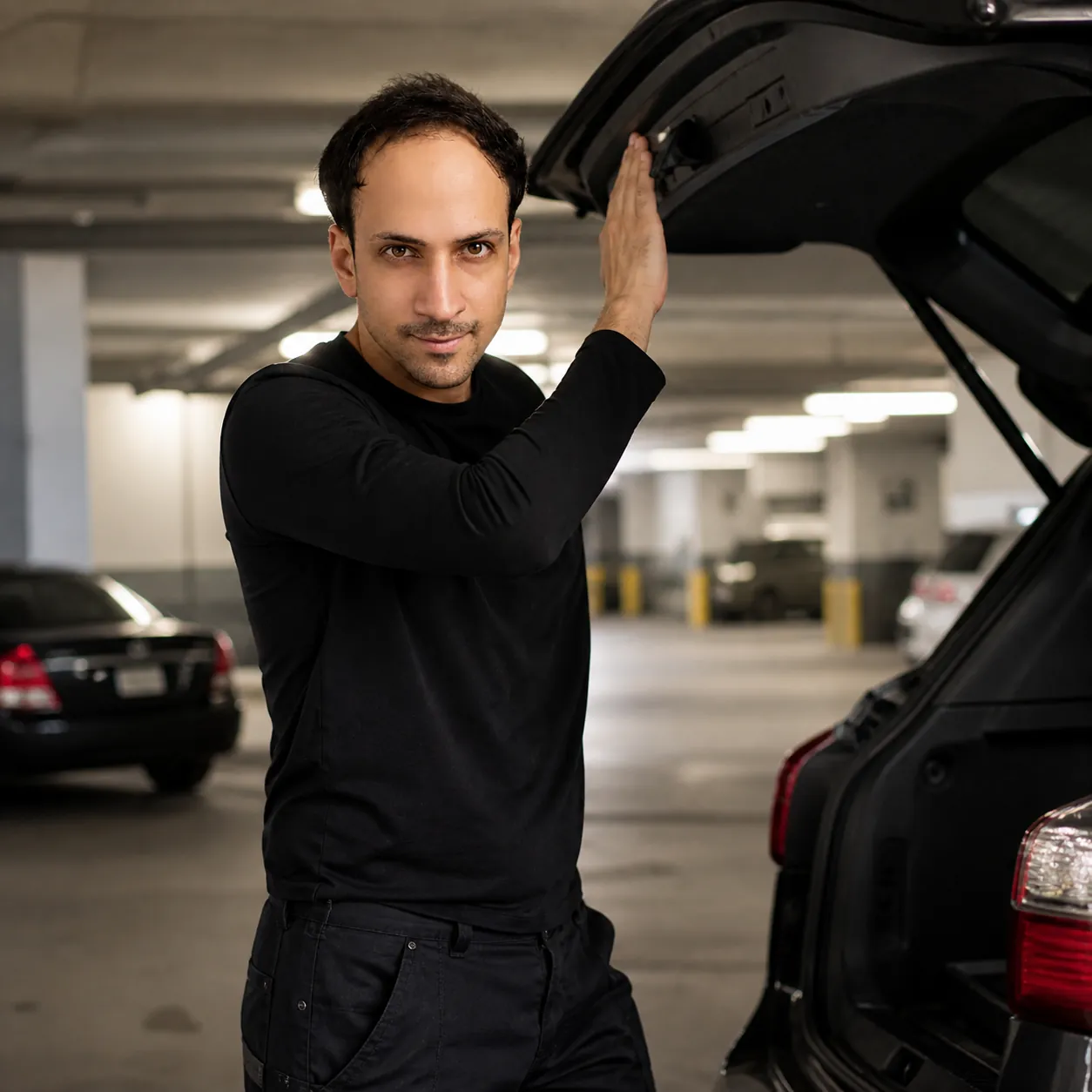
An Accepted Substitution — AI Portrait Prompt
صورةAI Portraits

Turn your own photo into an observational still-life portrait in a residential parking garage level lit by strip fittings overhead. Keeps your face unchanged.

من نص البرومبت

Use the attached reference photo as the identity reference: keep the same face, skin tone, hair and features as the person in that photo, without beautifying, aging or altering them. Create a square 1:1 museum-catalog frame with a strong first read and a slower second read at exactly 2880x2880 pixels. Location: a residential parking garage level lit by strip fittings overhead. Show the subject in a plain black long-sleeve tee and dark workwear trousers, closing a car's rear hatch with one flat hand. Build the image around this small, exact tableau: a new packet emptied into the old container that the sequence recognizes, an accepted substitution bought with a whole afternoon carries a whole routine on one part that nobody outside would notice. Explore where the labor sits when the hands have nothing left to do; expression occupied, not expressive, carrying stalled concentration, difficulty stated as ordinary fact. Frame at chest height so the object and their working hands share one plane. Make the composition keep the changed object sharp and everything habitual soft. Render it as observational still-life portraiture built from real household objects, matter-of-fact framing, accurate fabric behavior, and gallery-scale detail without polish, using even mid-morning shade with bounced floor light filling the lower half and a palette of pale sand, soft charcoal, and faded plastic green. Photorealistic: this must read as a real photograph from a physical camera, never an illustration, painting, or 3D render. Resolve real surface detail: skin that reddens slightly under pressure, nail beds with honest colour, and knuckle creases that fold rather than blur. Keep one identity-locked person, credible hands and fingers, natural fabric, and coherent scale, contact, reflections, shadows, airflow, deformation, and materials. Background people only when essential, always secondary and clearly different. Avoid melancholy posed at windows, showroom kitchens, hands clutching the head, inspirational lighting, and clockwork-brain imagery. No text, labels, logos, signatures, watermarks, random symbols, plastic skin, excessive bloom, or glossy AI finish.
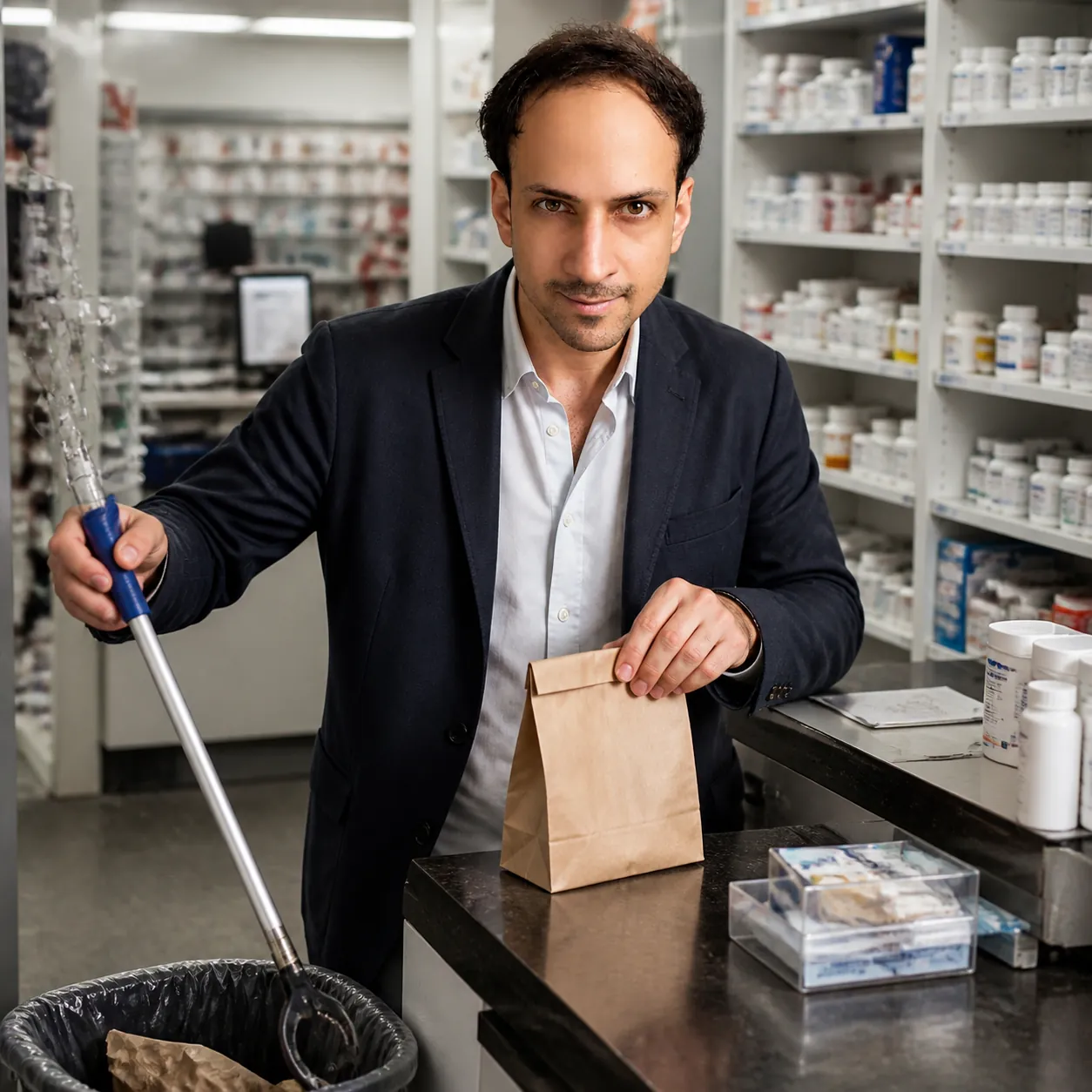
Folding the Pharmacy Bag — AI Portrait Prompt
صورةAI Portraits

Turn your own photo into a portrait in a neighbourhood pharmacy's side counter under unbroken ceiling light. Keeps your face unchanged.

من نص البرومبت

Use the attached reference photo as the identity reference: keep the same face, skin tone, hair and features as the person in that photo, without beautifying, aging or altering them. Create a square 1:1 museum-catalog frame with a strong first read and a slower second read at exactly 2880x2880 pixels. Location: a neighbourhood pharmacy's side counter under unbroken ceiling light. Show the subject in a navy unstructured jacket over an open-collar pale shirt, folding a paper pharmacy bag closed along its crease. Let one honest object carry what the face will not: a long-handled implement gripped at its very end so wet waste never reaches skin, the job finished at that distance makes the cost of an ordinary chore visible without making it a complaint. Explore why the cheapest fix is often a thirty-second adjustment made before starting; expression occupied, not expressive, carrying practical stubbornness, difficulty stated as ordinary upkeep. Use a 50mm eye-level view at working distance, the nearest object rendered as plainly as their hands. Make the composition let one unfinished half of the task stay honestly in frame. Render it as quiet domestic documentary realism combining unstyled interior photography, tactile household materials, honest working light, and unhurried observational framing, using even overcast light with accurate skin tone and no bloom and a palette of chalk white, deep charcoal, and one faded indigo. Photorealistic: this must read as a real photograph from a physical camera, never an illustration, painting, or 3D render. Resolve real surface detail: the difference between a wiped surface and a clean one, faint tide marks on ceramic, and metal dulled unevenly by touch. Keep one identity-locked person, credible hands and fingers, natural fabric, and coherent scale, contact, reflections, shadows, airflow, deformation, and materials. Background people only when essential, always secondary and clearly different. Avoid hands clamped over ears, meltdown theatrics, and hero poses at camera. No text, labels, logos, signatures, watermarks, random symbols, plastic skin, excessive bloom, or glossy AI finish.
The Mug in the Wrong Slot — AI Portrait Prompt
صورةAI Portraits

Turn your own photo into a museum-grade domestic portrait in a shaded apartment balcony overlooking a quiet Riyadh side street. Keeps your face unchanged.

من نص البرومبت

Use the attached reference photo as the identity reference: keep the same face, skin tone, hair and features as the person in that photo, without beautifying, aging or altering them. Create a square 1:1 museum-catalog frame with a strong first read and a slower second read at exactly 2880x2880 pixels. Location: a shaded apartment balcony overlooking a quiet Riyadh side street. Show the subject in a faded olive polo and soft drawstring trousers, clipping a damp shirt onto a folding rack. Make this piece of unglamorous evidence the whole argument: a mug that sits in the wrong slot, a clean ring in the dust still holding its true position carries a whole routine on one part that nobody outside would notice. Explore how much unseen structure a routine holds before anyone notices; expression occupied, not expressive, carrying sober adaptation, difficulty stated without inviting pity. Use a slightly high 40mm angle that shows the whole interrupted arrangement at once. Make the composition let the routine's line visibly break at one point. Render it as museum-grade domestic portraiture combining plain reportage framing, truthful worn surfaces, physically correct contact shadows, and unhurried everyday staging, using cool fluorescent tube light with honest color and visible skin texture and a palette of muted olive, chalk white, and dulled brushed steel. Photorealistic: this must read as a real photograph from a physical camera, never an illustration, painting, or 3D render. Resolve real surface detail: leather creased along the lines of use, stitching slightly irregular, and edges burnished from contact. Keep one identity-locked person, credible hands and fingers, natural fabric, and coherent scale, contact, reflections, shadows, airflow, deformation, and materials. Background people only when essential, always secondary and clearly different. Avoid melancholy posed at windows, showroom kitchens, hands clutching the head, inspirational lighting, and clockwork-brain imagery. No text, labels, logos, signatures, watermarks, random symbols, plastic skin, excessive bloom, or glossy AI finish.
The Heavy Towel on the Line — AI Portrait Prompt
صورةAI Portraits

Turn your own photo into a portrait in an enclosed service balcony where a washing line crosses at head height. Keeps your face unchanged.

من نص البرومبت

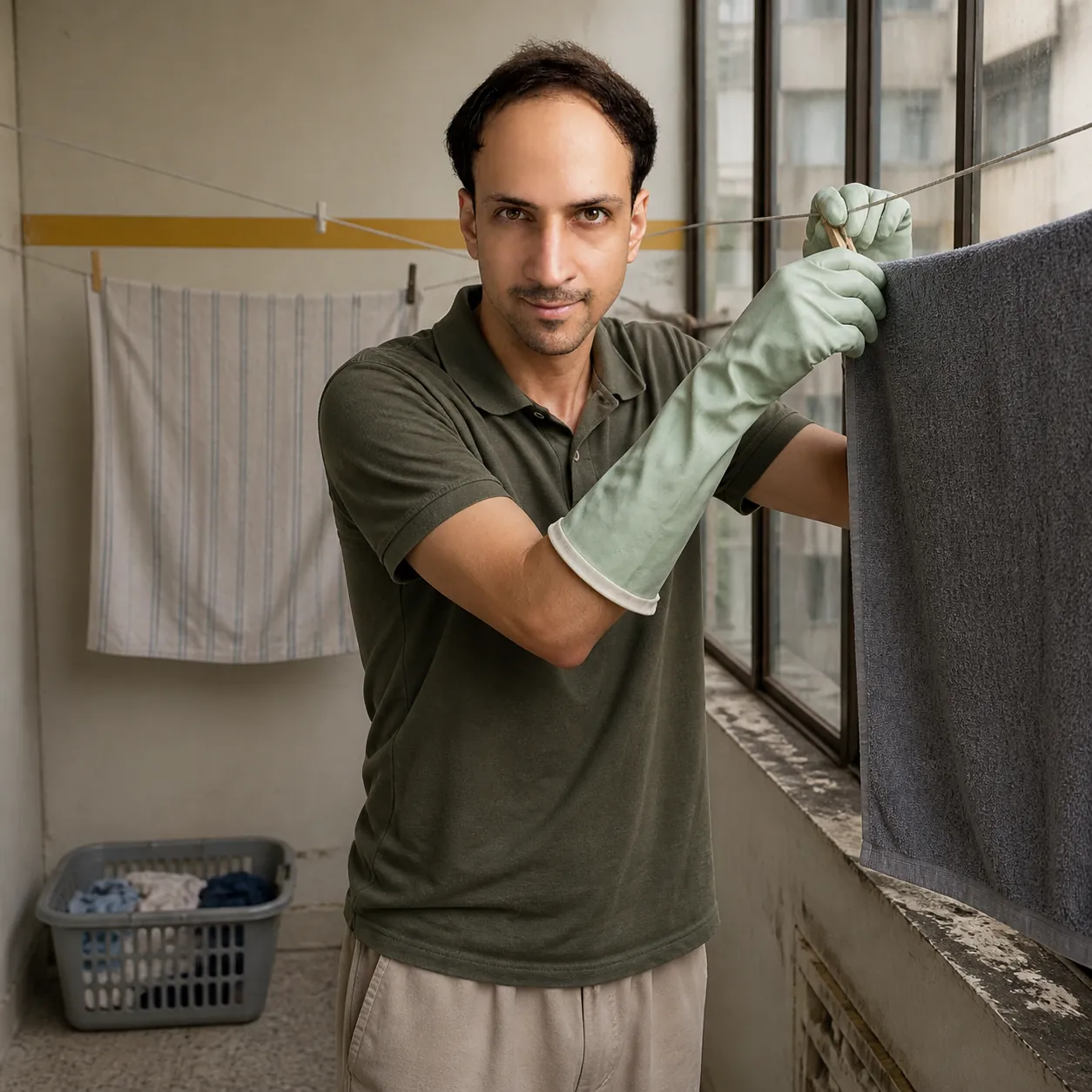
Use the attached reference photo as the identity reference: keep the same face, skin tone, hair and features as the person in that photo, without beautifying, aging or altering them. Create a square 1:1 museum-catalog frame with a strong first read and a slower second read at exactly 2880x2880 pixels. Location: an enclosed service balcony where a washing line crosses at head height. Show them in a faded olive polo shirt and loose cotton trousers, pegging one heavy towel along the line's near end. The difficulty must be visible in this, not in their expression: a pair of long rubber gloves pulled on for a job that does not need them, cuffs turned back at the forearm shows competence and difficulty occupying the same square metre of floor. Explore what a completed chore is worth when the route to it was expensive; expression occupied, not expressive, carrying sober persistence, difficulty stated as one more logistical fact. Use a 35mm standing viewpoint with true proportions and no wide-angle distortion at the edges. Make the composition keep the finished part of the chore visible at one edge. Render it as museum-grade observational portraiture built from ordinary domestic labour, accurate surface texture, plain interior architecture, and restrained contemporary art direction, using even overcast light with accurate skin tone and no bloom and a palette of soap grey, warm plaster, and one ochre band. Photorealistic: this must read as a real photograph from a physical camera, never an illustration, painting, or 3D render. Resolve real surface detail: thread ends and slight pilling on worn cloth, hairline chips at every hard corner, and stone that is porous rather than smooth. Keep one identity-locked person, credible hands and fingers, natural fabric, and coherent scale, contact, reflections, shadows, airflow, deformation, and materials. Background people only when essential, always secondary and clearly different. Avoid glowing sound waves, sensory-overload blur effects, and mood portraits without labour. No text, labels, logos, signatures, watermarks, random symbols, plastic skin, excessive bloom, or glossy AI finish.
Back Toward the Entry — AI Portrait Prompt
صورةAI Portraits

Turn your own photo into a quiet domestic documentary portrait in a laundry alcove off the kitchen behind a folding louvered door. Keeps your face unchanged.

من نص البرومبت

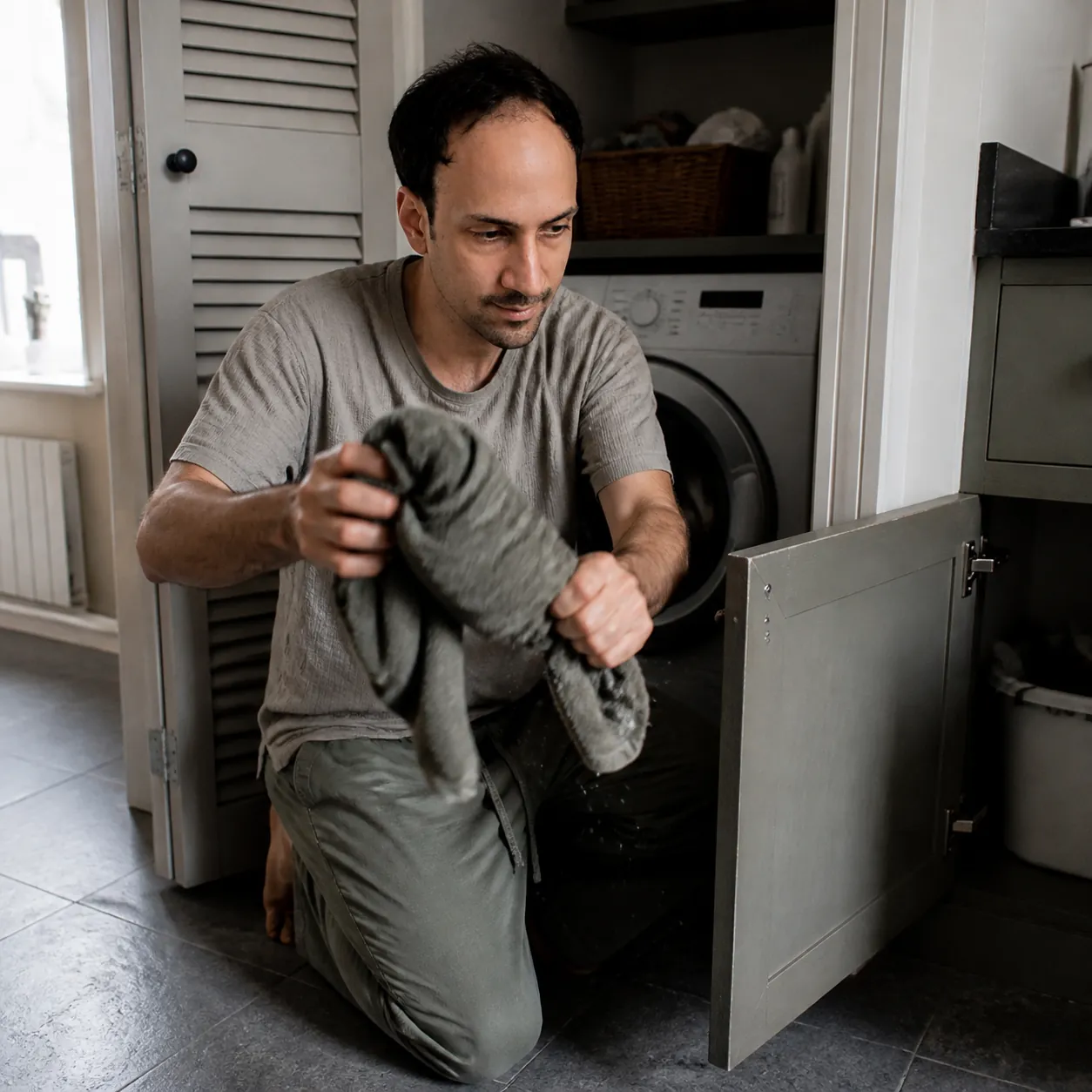
Use the attached reference photo as the identity reference: keep the same face, skin tone, hair and features as the person in that photo, without beautifying, aging or altering them. Create a square 1:1 museum-catalog frame with a strong first read and a slower second read at exactly 2880x2880 pixels. Location: a laundry alcove off the kitchen behind a folding louvered door. Show them in a loose cotton house shirt and soft drawstring trousers, shaking a wet towel out with one sharp snap. The difficulty must be visible in this, not in their expression: a low cupboard opened from a kneel, their back set deliberately toward the entry while they reach inside turns an ordinary chore into a problem of position and sound. Explore whether the extra effort ever stops feeling like the reasonable option; expression occupied, not expressive, carrying matter-of-fact care, difficulty stated without ever naming a reason. Frame from the near corner at standing height with their hands closest to camera. Make the composition place the one opening off-center without letting it dominate. Render it as quiet domestic documentary realism combining unposed portrait photography, honest interior materials, accurate household light, and unhurried observational framing, using overcast daylight from one side with no fill on the other and a palette of plaster white, worn grey tile, and one olive accent. Photorealistic: this must read as a real photograph from a physical camera, never an illustration, painting, or 3D render. Resolve real surface detail: wood grain read at honest scale, matte and gloss clearly separated, and no surface uniformly clean. Keep one identity-locked person, credible hands and fingers, natural fabric, and coherent scale, contact, reflections, shadows, airflow, deformation, and materials. Background people only when essential, always secondary and clearly different. Avoid hero poses, golden-hour wellness glow, eye contact with the lens, and tear-streaked faces. No text, labels, logos, signatures, watermarks, random symbols, plastic skin, excessive bloom, or glossy AI finish.
The Liner That Will Not Fit — AI Portrait Prompt
صورةAI Portraits

Turn your own photo into a museum-grade domestic portrait in a concrete apartment stairwell landing between two upper floors. Keeps your face unchanged.

من نص البرومبت

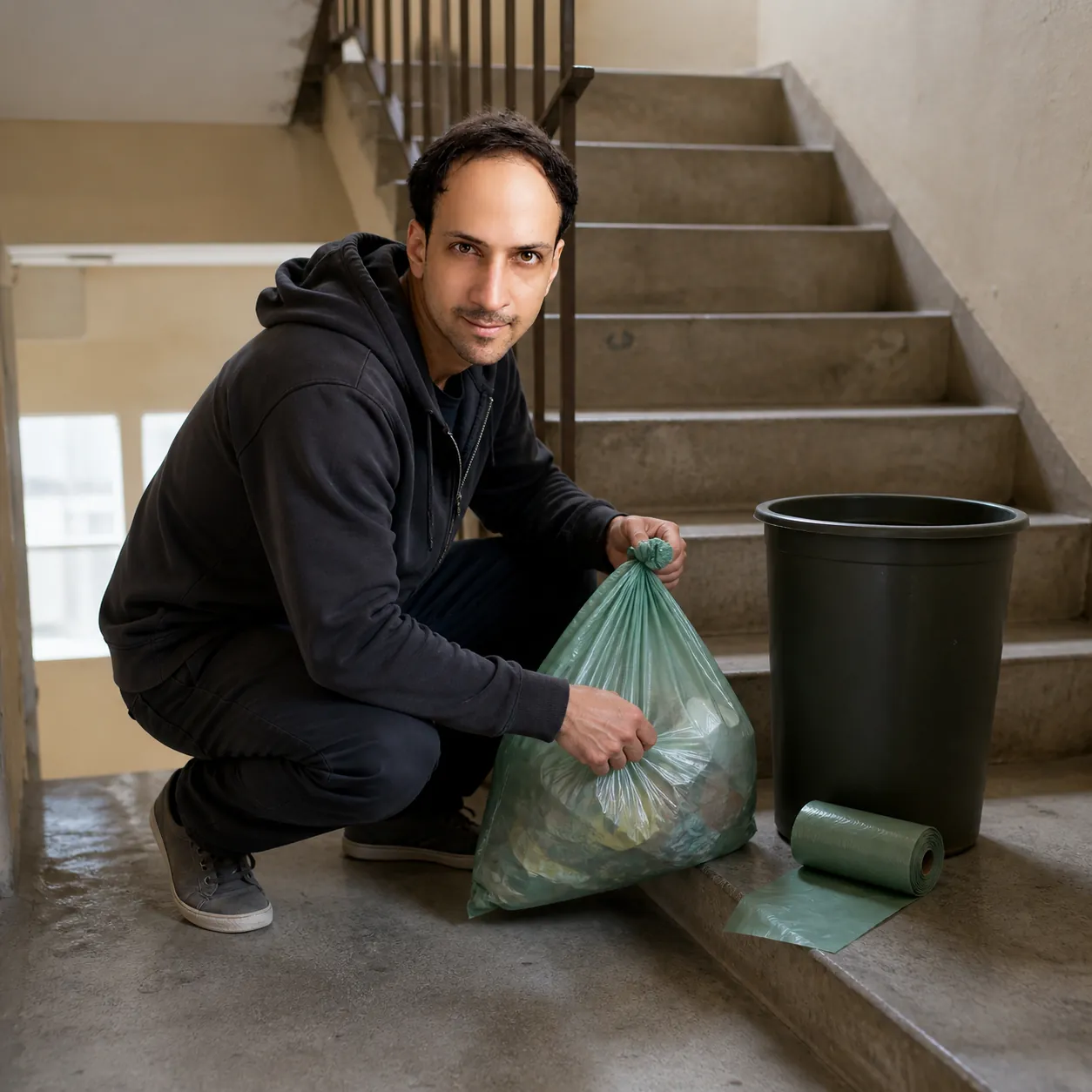
Use the attached reference photo as the identity reference: keep the same face, skin tone, hair and features as the person in that photo, without beautifying, aging or altering them. Create a square 1:1 museum-catalog frame with a strong first read and a slower second read at exactly 2880x2880 pixels. Location: a concrete apartment stairwell landing between two upper floors. Show the subject in a dark hooded sweatshirt over plain trousers and canvas shoes, setting a full carrier bag down on the step. The difficulty must be visible in this, not in their expression: an unlined bin standing open beside a roll of liners that run two fingers narrow of its rim carries a whole routine on one part that nobody outside would notice. Explore what it costs to rebuild an order that already worked well; expression occupied, not expressive, carrying working composure, difficulty stated at its actual scale. Hold a static 45mm viewpoint just behind their shoulder with the object fully legible. Make the composition keep the changed object sharp and everything habitual soft. Render it as museum-grade domestic portraiture combining plain reportage framing, truthful worn surfaces, physically correct contact shadows, and unhurried everyday staging, using even mid-morning shade with bounced floor light filling the lower half and a palette of pale sand, soft charcoal, and faded plastic green. Photorealistic: this must read as a real photograph from a physical camera, never an illustration, painting, or 3D render. Resolve real surface detail: thread ends and slight pilling on worn cloth, hairline chips at every hard corner, and stone that is porous rather than smooth. Keep one identity-locked person, credible hands and fingers, natural fabric, and coherent scale, contact, reflections, shadows, airflow, deformation, and materials. Background people only when essential, always secondary and clearly different. Avoid melancholy posed at windows, showroom kitchens, hands clutching the head, inspirational lighting, and clockwork-brain imagery. No text, labels, logos, signatures, watermarks, random symbols, plastic skin, excessive bloom, or glossy AI finish.
Screwdrivers on a Cloth — AI Portrait Prompt
صورةAI Portraits

Turn your own photo into a quiet domestic documentary portrait in a hallway console drawer pulled right out onto its runners. Keeps your face unchanged.

من نص البرومبت

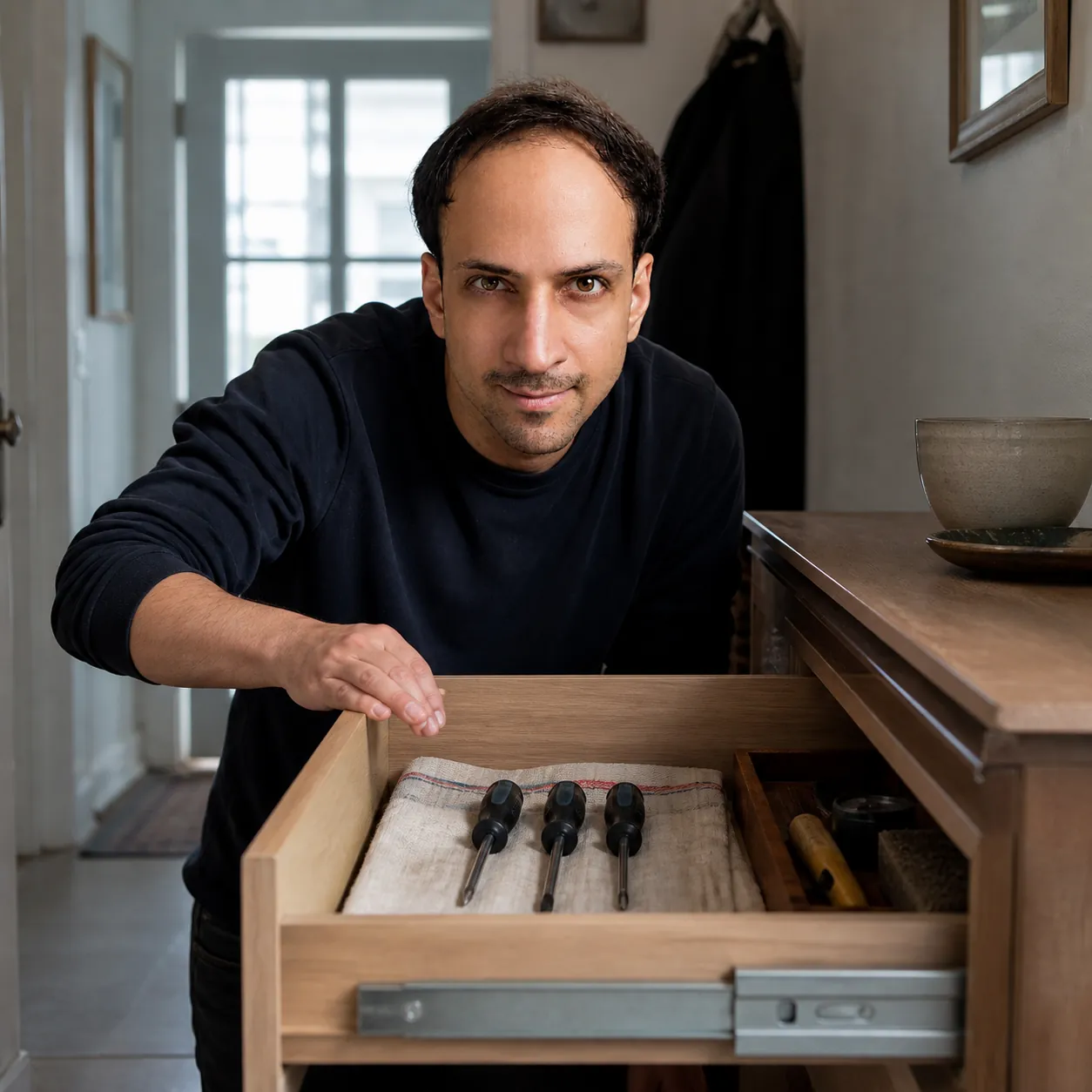
Use the attached reference photo as the identity reference: keep the same face, skin tone, hair and features as the person in that photo, without beautifying, aging or altering them. Create a square 1:1 museum-catalog frame with a strong first read and a slower second read at exactly 2880x2880 pixels. Location: a hallway console drawer pulled right out onto its runners. Show the subject in a dark navy sweatshirt with the sleeves pushed up, steadying the open drawer with one flat hand. Let one honest object carry what the face will not: a row of three identical screwdrivers on a cloth, each bought on a day the others could not be found turns a small errand into the longest decision of the week. Explore why an object with a use left in it refuses to become rubbish; expression occupied, not expressive, carrying careful reckoning, difficulty stated as household fact. Use an eye-level 50mm view with kept objects and hands on one plane. Make the composition keep every stacked edge parallel and every surface visibly clean. Render it as quiet domestic documentary realism combining unstyled interior photography, honest household materials, precise object description, and unhurried observational framing, using unglamorous garage strip lighting balanced by pale daylight at the entrance and a palette of pale gypsum, tea-stained paper, and a narrow rust accent. Photorealistic: this must read as a real photograph from a physical camera, never an illustration, painting, or 3D render. Resolve real surface detail: the difference between a wiped surface and a clean one, faint tide marks on ceramic, and metal dulled unevenly by touch. Keep one identity-locked person, credible hands and fingers, natural fabric, and coherent scale, contact, reflections, shadows, airflow, deformation, and materials. Background people only when essential, always secondary and clearly different. Avoid squalor, vermin, rotting food, hero-poster staging, and any wellness-aesthetic glow that replaces visible work. No text, labels, logos, signatures, watermarks, random symbols, plastic skin, excessive bloom, or glossy AI finish.
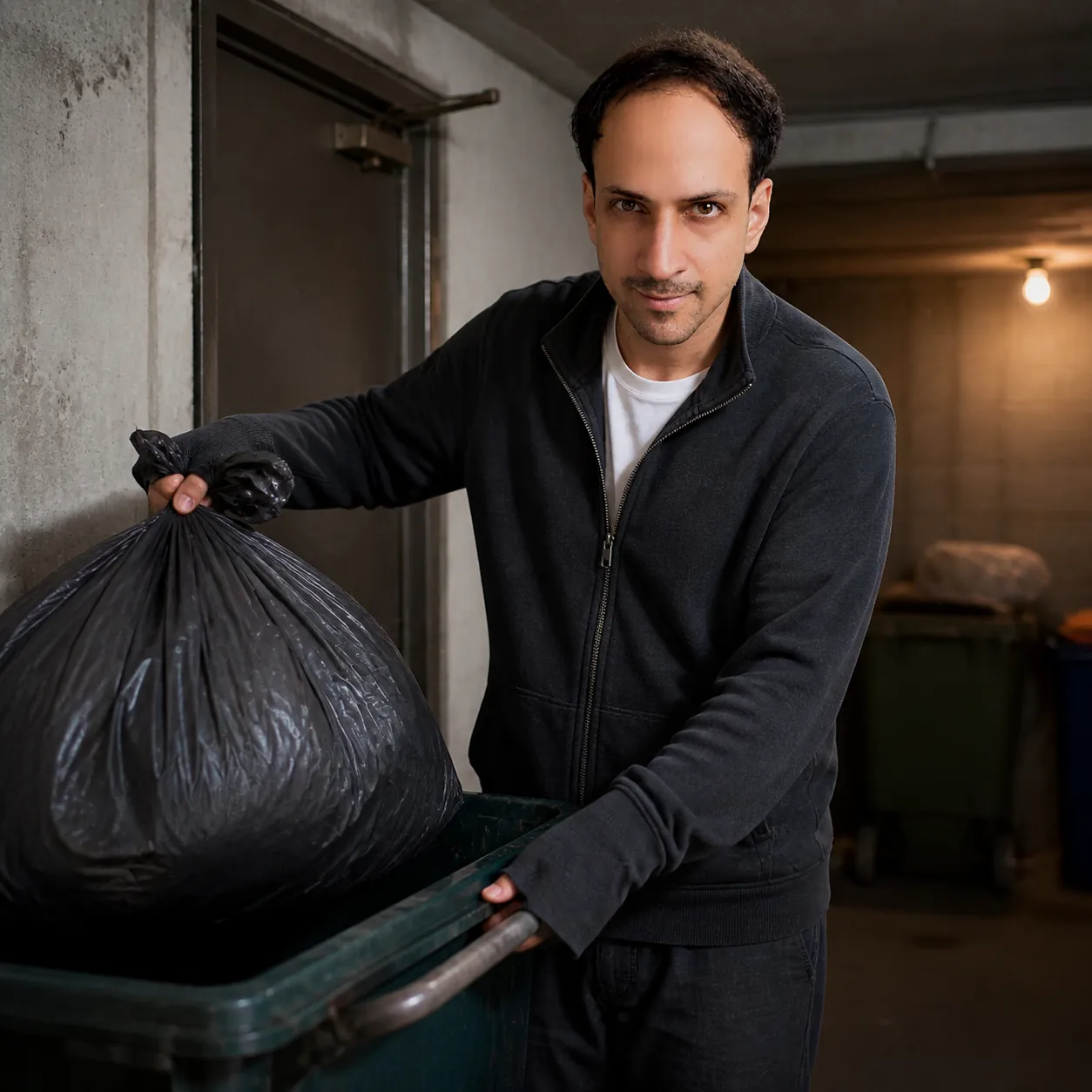
A Sleeve Over the Palm — AI Portrait Prompt
صورةAI Portraits

Turn your own photo into a quiet domestic documentary portrait in a ground-floor bin store behind an apartment block's rear door. Keeps your face unchanged.

من نص البرومبت

Use the attached reference photo as the identity reference: keep the same face, skin tone, hair and features as the person in that photo, without beautifying, aging or altering them. Create a square 1:1 museum-catalog frame with a strong first read and a slower second read at exactly 2880x2880 pixels. Location: a ground-floor bin store behind an apartment block's rear door. Show the subject in a dark grey zip-front sweatshirt over a white tee, setting a knotted liner down beside the wheeled bin. The difficulty must be visible in this, not in their expression: a sleeve pulled down over the palm before a cold metal handle is taken, cotton standing in for bare skin makes the cost of an ordinary chore visible without making it a complaint. Explore whether the work should be measured by its result or by its price; expression occupied, not expressive, carrying measured endurance, difficulty stated as one more logistical fact. Use a 35mm standing viewpoint with true proportions and no wide-angle distortion at the edges. Make the composition weight the near object heavier than the room behind it. Render it as quiet domestic documentary realism combining unstyled interior photography, tactile household materials, honest working light, and unhurried observational framing, using a single low lamp against an otherwise dim room and a palette of cool white, pale concrete, and one muted teal. Photorealistic: this must read as a real photograph from a physical camera, never an illustration, painting, or 3D render. Resolve real surface detail: wood grain read at honest scale, matte and gloss clearly separated, and no surface uniformly clean. Keep one identity-locked person, credible hands and fingers, natural fabric, and coherent scale, contact, reflections, shadows, airflow, deformation, and materials. Background people only when essential, always secondary and clearly different. Avoid hands clamped over ears, meltdown theatrics, and hero poses at camera. No text, labels, logos, signatures, watermarks, random symbols, plastic skin, excessive bloom, or glossy AI finish.
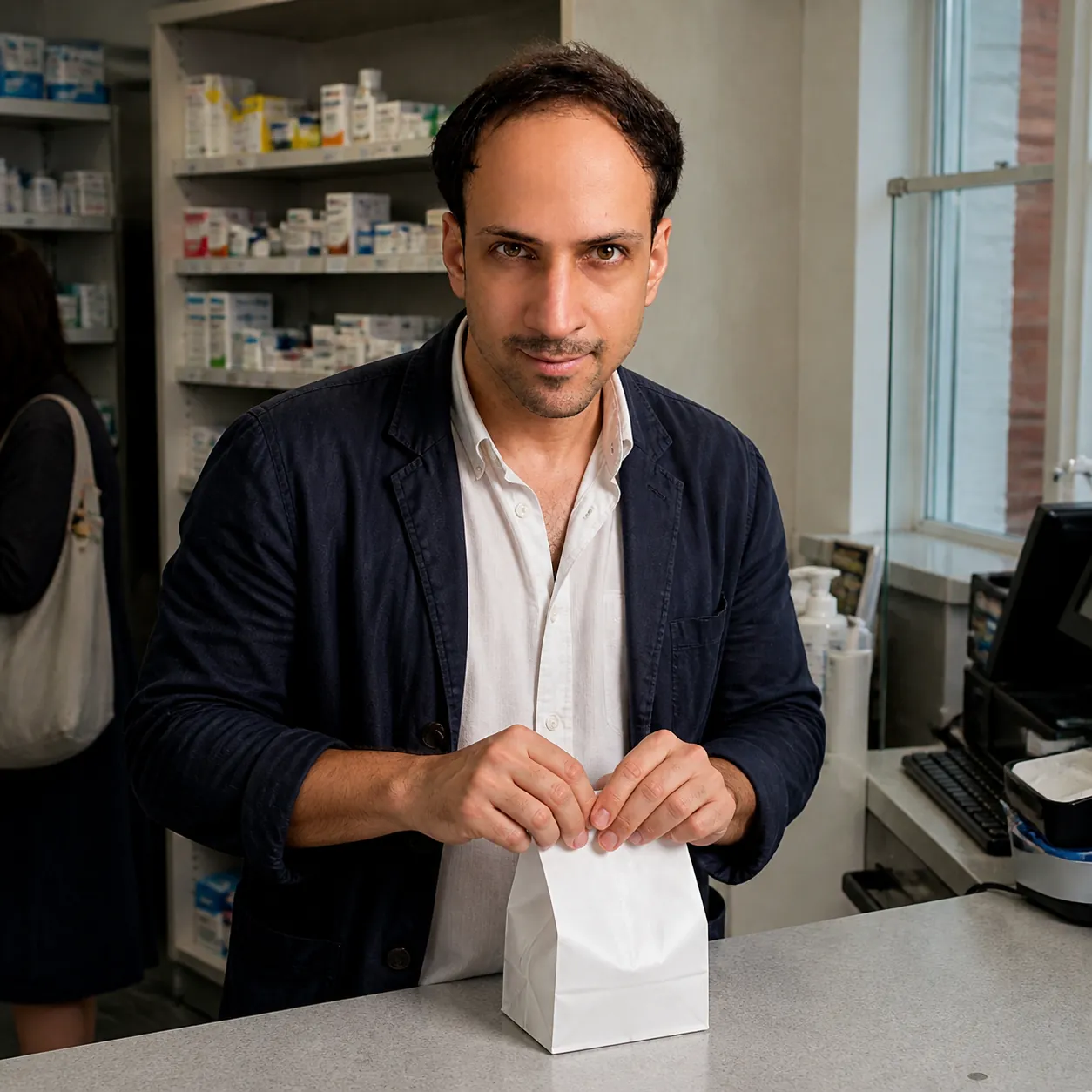
At the Pharmacy Counter — AI Portrait Prompt
صورةAI Portraits

Turn your own photo into a portrait in a neighbourhood pharmacy's side counter under unbroken ceiling light. Keeps your face unchanged.

من نص البرومبت

Use the attached reference photo as the identity reference: keep the same face, skin tone, hair and features as the person in that photo, without beautifying, aging or altering them. Create a square 1:1 museum-catalog frame with a strong first read and a slower second read at exactly 2880x2880 pixels. Location: a neighbourhood pharmacy's side counter under unbroken ceiling light. Show them in a navy unstructured jacket over an open-collar pale shirt, folding a paper pharmacy bag closed along its crease. Make this piece of unglamorous evidence the whole argument: a shirt collar whose stitched label has been cut away, leaving two short threads standing at the inside seam shows competence and difficulty occupying the same square metre of floor. Explore how a room's light and sound become physical obstacles between them and the work; expression occupied, not expressive, carrying matter-of-fact resolve, difficulty stated quietly enough to be missed. Use an 85mm portrait length with the room compressed just enough to feel enclosed. Make the composition weight the near object heavier than the room behind it. Render it as museum-grade observational portraiture built from ordinary domestic labour, accurate surface texture, plain interior architecture, and restrained contemporary art direction, using grey daylight through a service window with weak bounced fill and a palette of washed beige, slate grey, and worn brass. Photorealistic: this must read as a real photograph from a physical camera, never an illustration, painting, or 3D render. Resolve real surface detail: leather creased along the lines of use, stitching slightly irregular, and edges burnished from contact. Keep one identity-locked person, credible hands and fingers, natural fabric, and coherent scale, contact, reflections, shadows, airflow, deformation, and materials. Background people only when essential, always secondary and clearly different. Avoid glowing sound waves, sensory-overload blur effects, and mood portraits without labour. No text, labels, logos, signatures, watermarks, random symbols, plastic skin, excessive bloom, or glossy AI finish.
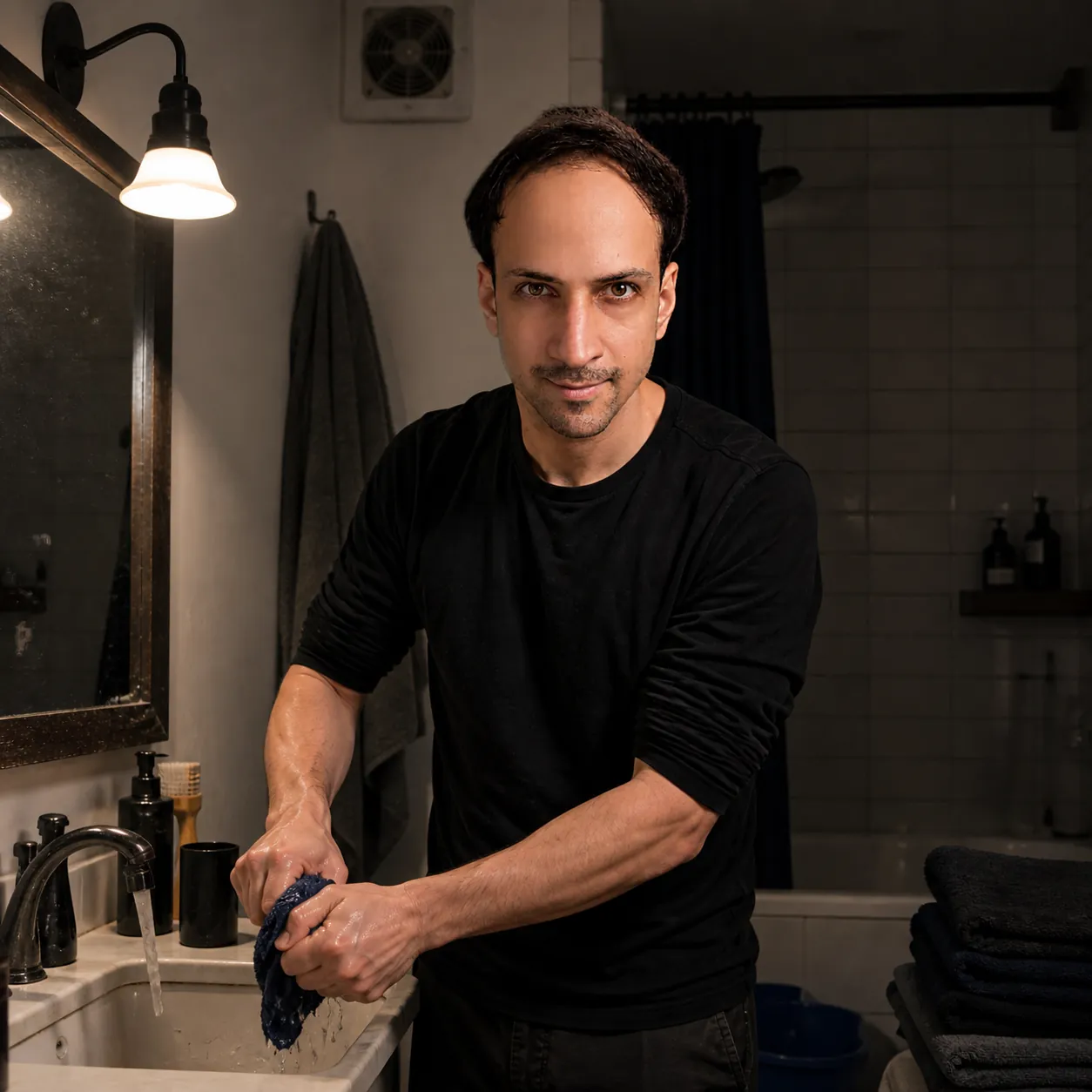
Wringing Out the Cloth — AI Portrait Prompt
صورةAI Portraits

Turn your own photo into a restrained editorial portrait in an apartment bathroom mid-clean with the extractor fan still running. Keeps your face unchanged.

من نص البرومبت

Use the attached reference photo as the identity reference: keep the same face, skin tone, hair and features as the person in that photo, without beautifying, aging or altering them. Create a square 1:1 museum-catalog frame with a strong first read and a slower second read at exactly 2880x2880 pixels. Location: an apartment bathroom mid-clean with the extractor fan still running. Show them in a plain black tee with sleeves pushed above the elbow, wringing a cloth out over the running tap. The difficulty must be visible in this, not in their expression: a shirt collar whose stitched label has been cut away, leaving two short threads standing at the inside seam makes the cost of an ordinary chore visible without making it a complaint. Explore how a room's light and sound become physical obstacles between them and the work; expression occupied, not expressive, carrying practical stubbornness, difficulty stated in the flattest possible voice. Use a 35mm standing viewpoint with true proportions and no wide-angle distortion at the edges. Make the composition keep the finished part of the chore visible at one edge. Render it as restrained editorial realism built from real chore apparatus, believable domestic wear, exact fabric and metal texture, and unsentimental framing, using a single low lamp against an otherwise dim room and a palette of chalk white, deep charcoal, and one faded indigo. Photorealistic: this must read as a real photograph from a physical camera, never an illustration, painting, or 3D render. Resolve real surface detail: visible weave in cloth, fine scratches on metal, and the faint unevenness of painted walls. Keep one identity-locked person, credible hands and fingers, natural fabric, and coherent scale, contact, reflections, shadows, airflow, deformation, and materials. Background people only when essential, always secondary and clearly different. Avoid hands clamped over ears, meltdown theatrics, and hero poses at camera. No text, labels, logos, signatures, watermarks, random symbols, plastic skin, excessive bloom, or glossy AI finish.

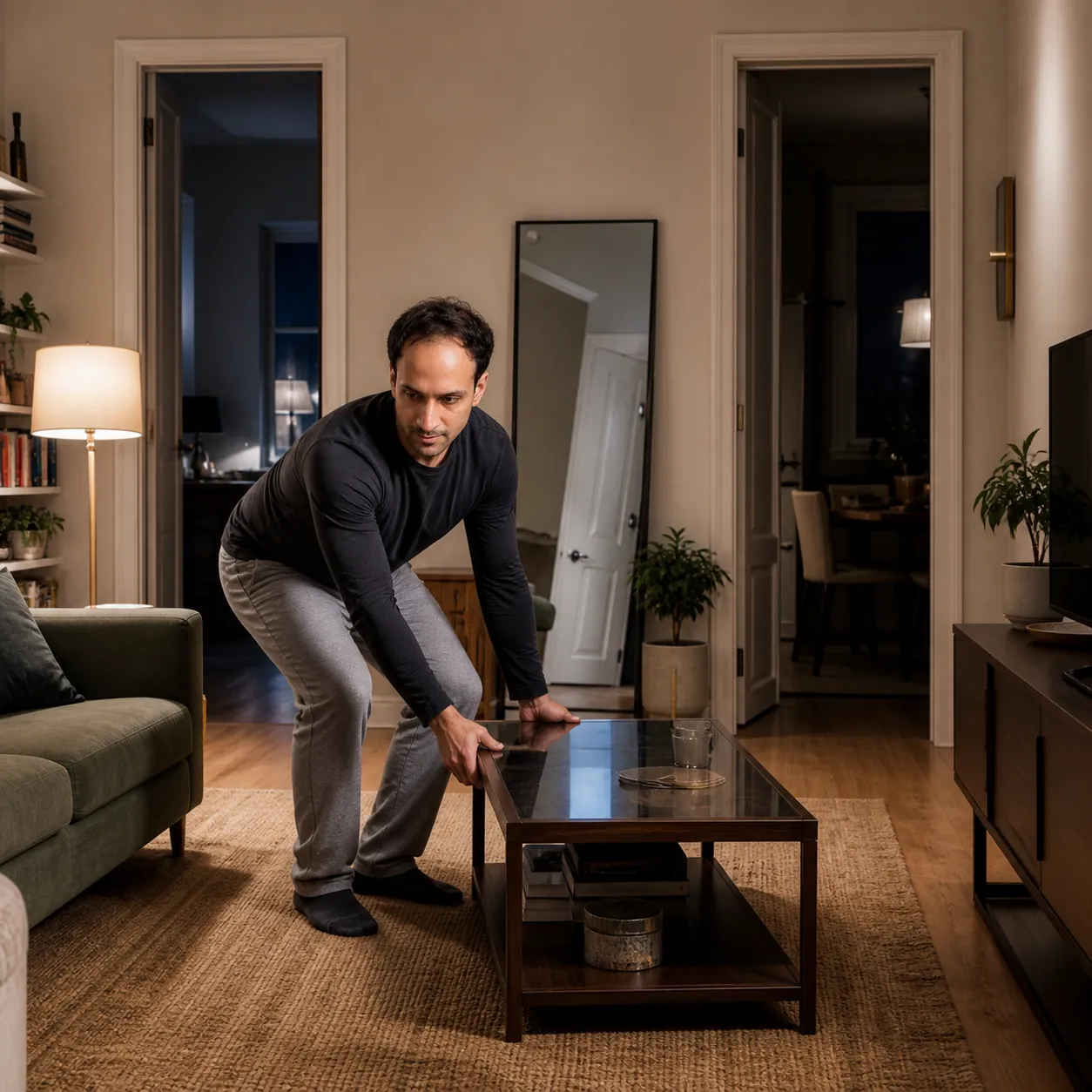
The Off-Square Mirror — AI Portrait Prompt
صورةAI Portraits

Turn your own photo into a quiet domestic documentary portrait in a sitting room where two doorways face each other across the rug. Keeps your face unchanged.

من نص البرومبت

Use the attached reference photo as the identity reference: keep the same face, skin tone, hair and features as the person in that photo, without beautifying, aging or altering them. Create a square 1:1 museum-catalog frame with a strong first read and a slower second read at exactly 2880x2880 pixels. Location: a sitting room where two doorways face each other across the rug. Show them in a charcoal long-sleeve tee and soft grey lounge trousers, nudging a low table back onto its floor marks. Let one honest object carry what the face will not: a shaving mirror turned off-square to the wall so the open door stays in the glass beside their jaw turns an ordinary chore into a problem of position and sound. Explore what it costs to keep a whole flat accounted for while working; expression occupied, not expressive, carrying quiet stubbornness, difficulty stated as arrangement rather than distress. Use a 50mm eye-level view from the side of the room they left open. Make the composition keep the far end as legible as their hands. Render it as quiet domestic documentary realism combining unposed portrait photography, honest interior materials, accurate household light, and unhurried observational framing, using low evening interior light with the far rooms left dimmer and a palette of off-white paint, brushed steel, and dull brass fittings. Photorealistic: this must read as a real photograph from a physical camera, never an illustration, painting, or 3D render. Resolve real surface detail: the difference between a wiped surface and a clean one, faint tide marks on ceramic, and metal dulled unevenly by touch. Keep one identity-locked person, credible hands and fingers, natural fabric, and coherent scale, contact, reflections, shadows, airflow, deformation, and materials. Background people only when essential, always secondary and clearly different. Avoid hero poses, golden-hour wellness glow, eye contact with the lens, and tear-streaked faces. No text, labels, logos, signatures, watermarks, random symbols, plastic skin, excessive bloom, or glossy AI finish.
