تخطَّ إلى المحتوى

برومبتات الصور

برومبتات لمولدات الصور: بورتريهات وفن وتصوير.

تم العثور على 4209
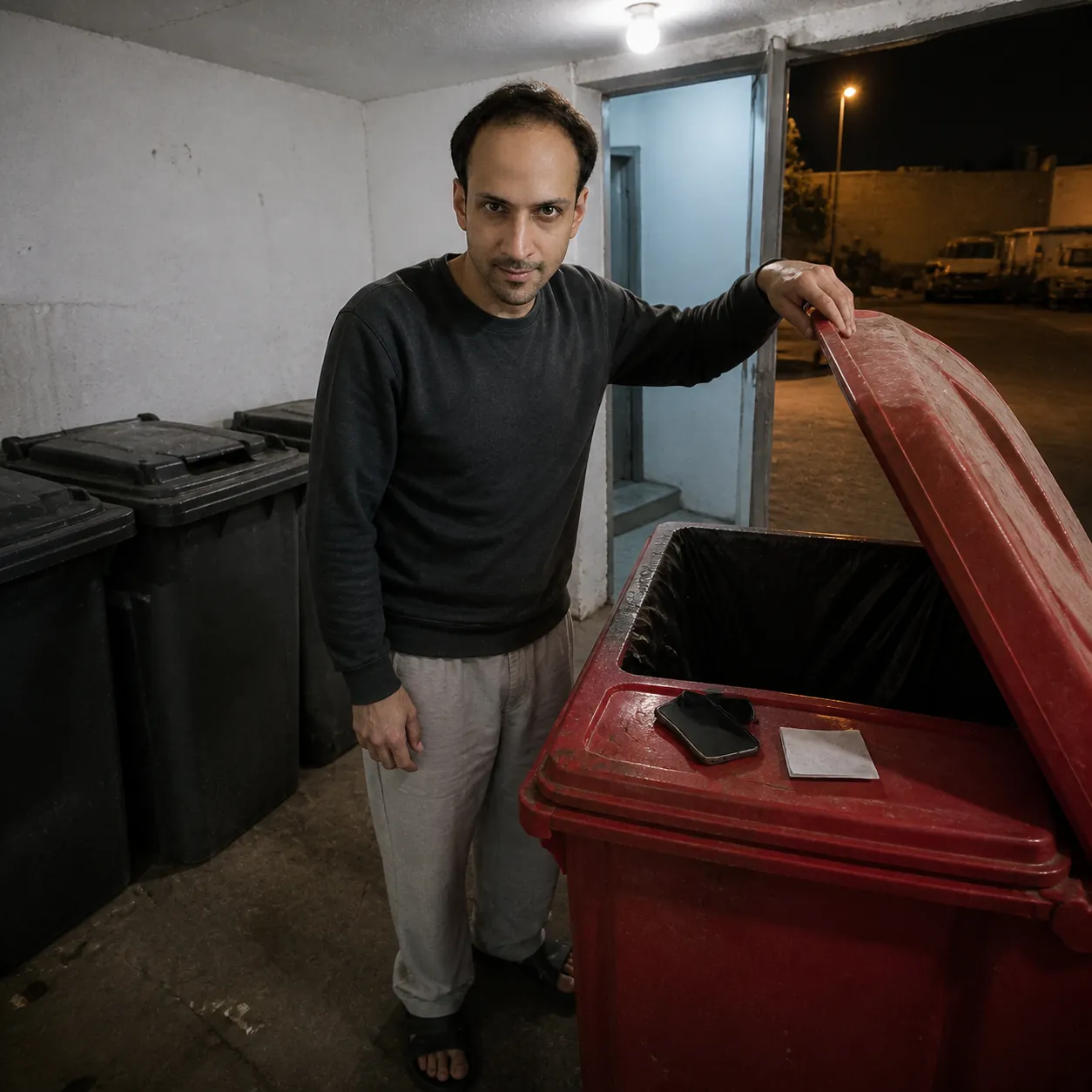
Bin Store After the Call — AI Portrait Prompt
صورةAI Portraits

Turn your own photo into a quiet civic-documentary portrait in a building's ground-floor bin store lit by one bare fitting. Keeps your face unchanged.

من نص البرومبت

Use the attached reference photo as the identity reference: keep the same face, skin tone, hair and features as the person in that photo, without beautifying, aging or altering them. Create a square 1:1 museum-catalog frame with a strong first read and a slower second read at exactly 2880x2880 pixels. Location: a building's ground-floor bin store lit by one bare fitting. Show the subject in a dark grey sweatshirt over loose cotton trousers and slip-on sandals, tipping a lid open with the back of one wrist. Build the image around this small, exact tableau: a pharmacy collection slip that lies face-down beside a silent phone, the call already made so the counter visit stays brief turns an ordinary errand into the day's largest piece of engineering. Explore whether timing a chore to an empty street is strategy or surrender; expression occupied, not expressive, carrying earned matter-of-factness, difficulty stated with the flatness of routine. Frame at chest height so their hands and their eyes sit on one focal plane. Make the composition keep the way out visible without letting it dominate. Render it as quiet civic-documentary portraiture built from real errand logistics, contemporary Saudi street texture, honest domestic materials, and unhurried observational framing, using one sodium streetlight reaching a doorway with cool interior spill behind them and a palette of smoke grey, bone white, and one faded shopfront red. Photorealistic: this must read as a real photograph from a physical camera, never an illustration, painting, or 3D render. Resolve real surface detail: brass darkened in the recesses and bright where thumbs land, and lacquer crazed rather than perfect. Keep one identity-locked person, credible hands and fingers, natural fabric, and coherent scale, contact, reflections, shadows, airflow, deformation, and materials. Background people only when essential, always secondary and clearly different. Avoid hero-poster stances, golden-hour wellness glow, posing at camera, and chest-clutching gestures. No text, labels, logos, signatures, watermarks, random symbols, plastic skin, excessive bloom, or glossy AI finish.
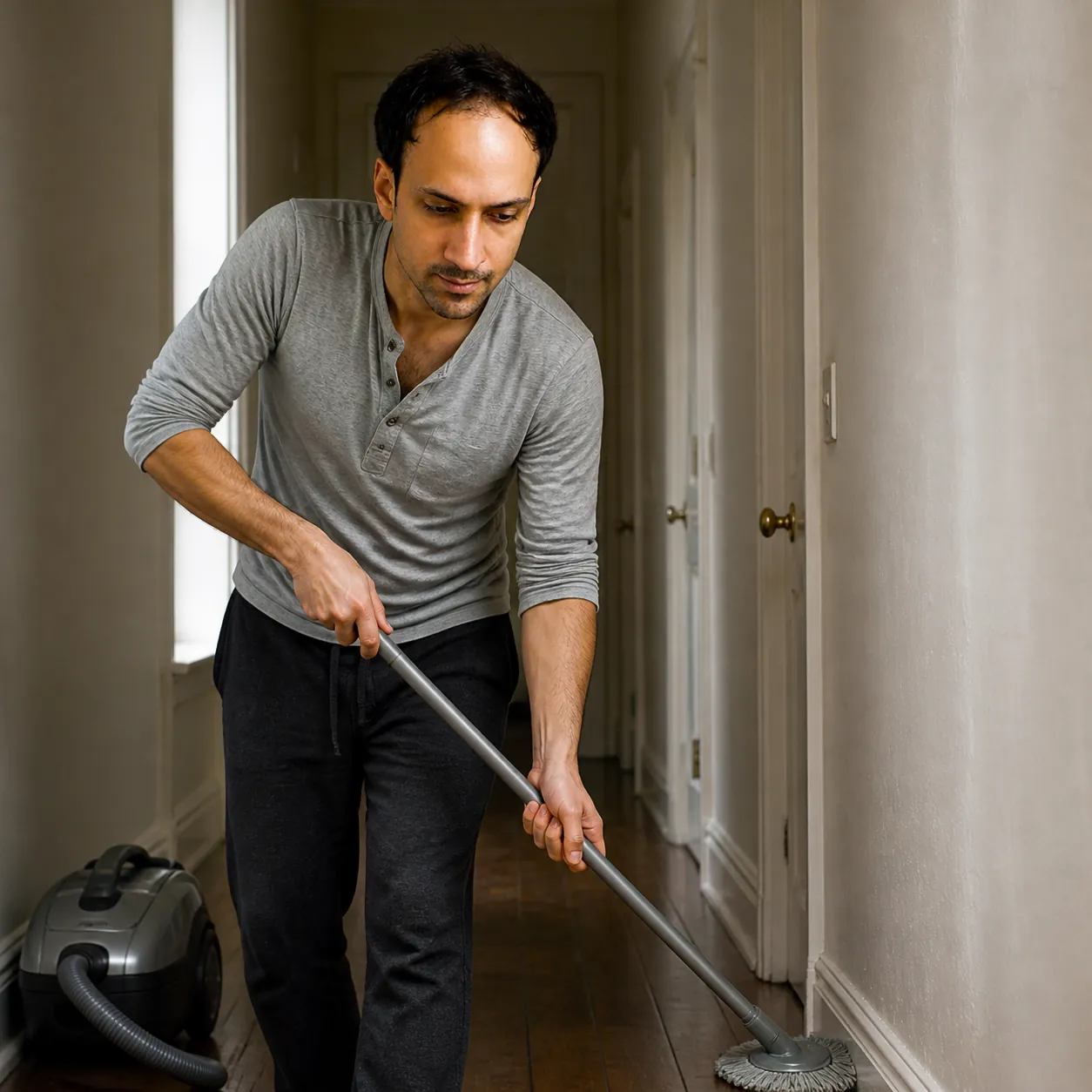
Mopping the Long Corridor — AI Portrait Prompt
صورةAI Portraits

Turn your own photo into an observational domestic portrait in a long inner corridor of the flat with doors along one side. Keeps your face unchanged.

من نص البرومبت

Use the attached reference photo as the identity reference: keep the same face, skin tone, hair and features as the person in that photo, without beautifying, aging or altering them. Create a square 1:1 museum-catalog frame with a strong first read and a slower second read at exactly 2880x2880 pixels. Location: a long inner corridor of the flat with doors along one side. Show them in a heather-grey henley with the sleeves shoved to the elbow, trailing a dust mop along the base of the wall. The difficulty must be visible in this, not in their expression: a vacuum cleaner switched off mid-strip while they identify a sound that turned out to be the building itself turns an ordinary chore into a problem of position and sound. Explore how much extra walking one unbroken sightline is worth to them; expression occupied, not expressive, carrying quiet stubbornness, difficulty stated in the geometry alone. Frame from the near corner at standing height with their hands closest to camera. Make the composition let their standing position read before the chore does. Render it as observational domestic portraiture built from truthful chore staging, exact material texture, ordinary architectural geometry, and quietly unsentimental framing, using overcast daylight from one side with no fill on the other and a palette of off-white paint, brushed steel, and dull brass fittings. Photorealistic: this must read as a real photograph from a physical camera, never an illustration, painting, or 3D render. Resolve real surface detail: visible weave in cloth, fine scratches on metal, and the faint unevenness of painted walls. Keep one identity-locked person, credible hands and fingers, natural fabric, and coherent scale, contact, reflections, shadows, airflow, deformation, and materials. Background people only when essential, always secondary and clearly different. Avoid hero poses, golden-hour wellness glow, eye contact with the lens, and tear-streaked faces. No text, labels, logos, signatures, watermarks, random symbols, plastic skin, excessive bloom, or glossy AI finish.
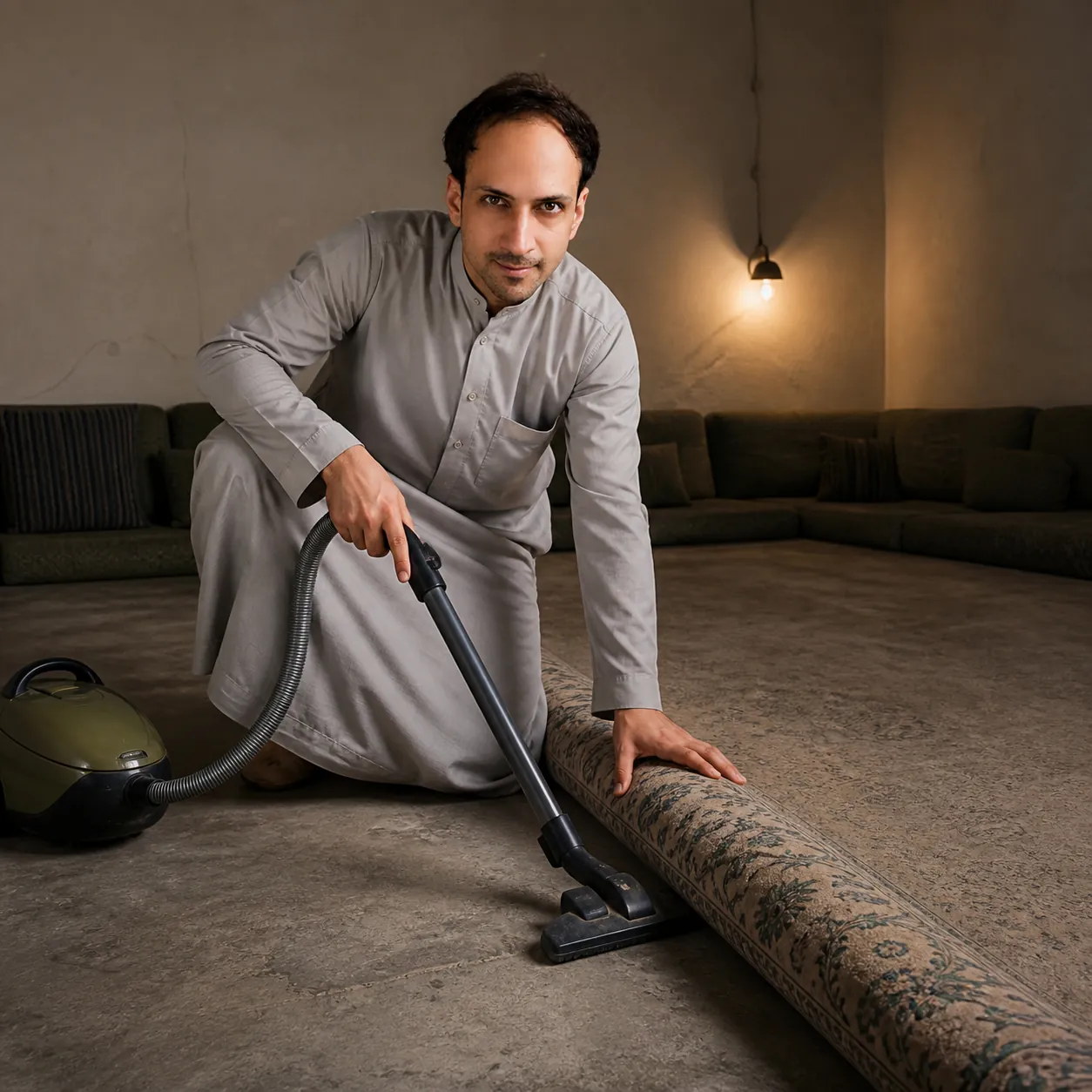
Vacuuming the Majlis Floor — AI Portrait Prompt
صورةAI Portraits

Turn your own photo into a museum-grade observational portrait in a majlis floor mid-clean with its long rug rolled back. Keeps your face unchanged.

من نص البرومبت

Use the attached reference photo as the identity reference: keep the same face, skin tone, hair and features as the person in that photo, without beautifying, aging or altering them. Create a square 1:1 museum-catalog frame with a strong first read and a slower second read at exactly 2880x2880 pixels. Location: a majlis floor mid-clean with its long rug rolled back. Show the subject in a light grey traditional Gulf outfit with the hem gathered clear, guiding a vacuum head along one rolled-back rug edge. Let one honest object carry what the face will not: a ceiling tube whose stutter arrives as rhythm rather than glow, timed around by a person who has learned its interval makes the cost of an ordinary chore visible without making it a complaint. Explore how competence looks when it has to route around a texture nobody else notices; expression occupied, not expressive, carrying working patience, difficulty stated as one more logistical fact. Use a 50mm eye-level view at working distance, the nearest object rendered as plainly as their hands. Make the composition let one unfinished half of the task stay honestly in frame. Render it as museum-grade observational portraiture built from ordinary domestic labour, accurate surface texture, plain interior architecture, and restrained contemporary art direction, using a single low lamp against an otherwise dim room and a palette of unbleached cotton, dull steel, and one olive note. Photorealistic: this must read as a real photograph from a physical camera, never an illustration, painting, or 3D render. Resolve real surface detail: fine grit in the texture of concrete, efflorescence at damp edges, and hairline cracks that follow stress. Keep one identity-locked person, credible hands and fingers, natural fabric, and coherent scale, contact, reflections, shadows, airflow, deformation, and materials. Background people only when essential, always secondary and clearly different. Avoid hands clamped over ears, meltdown theatrics, and hero poses at camera. No text, labels, logos, signatures, watermarks, random symbols, plastic skin, excessive bloom, or glossy AI finish.
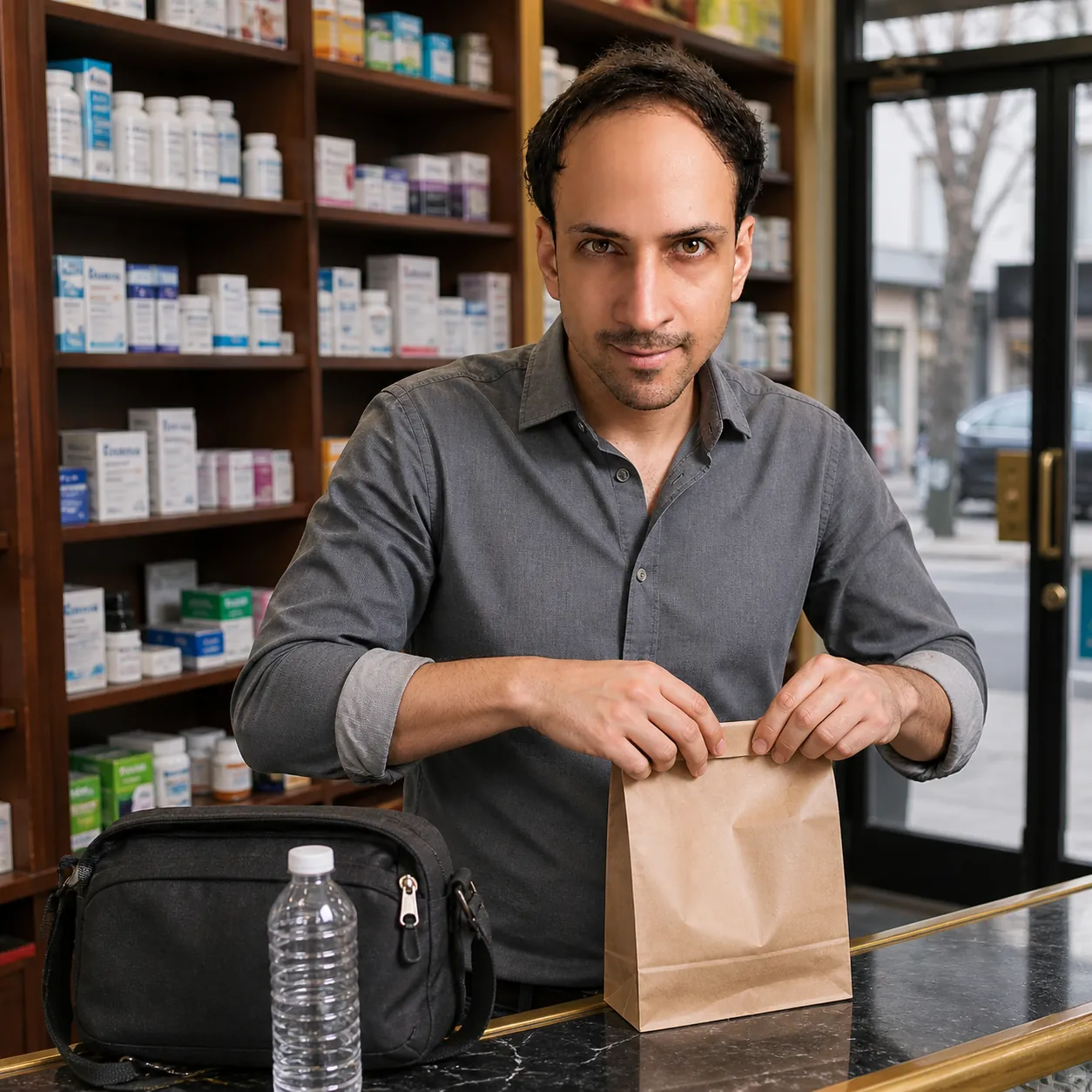
Pharmacy Bag at Chest Height — AI Portrait Prompt
صورةAI Portraits

Turn your own photo into a portrait in a neighbourhood pharmacy's collection end, shelves ranked behind the counter. Keeps your face unchanged.

من نص البرومبت

Use the attached reference photo as the identity reference: keep the same face, skin tone, hair and features as the person in that photo, without beautifying, aging or altering them. Create a square 1:1 museum-catalog frame with a strong first read and a slower second read at exactly 2880x2880 pixels. Location: a neighbourhood pharmacy's collection end, shelves ranked behind the counter. Show the subject in a stone-grey button-down with cuffs turned back twice, creasing a paper pharmacy bag shut along its fold. Build the image around this small, exact tableau: a small shoulder bag that is packed for twelve minutes outside as though for a journey, its water and keys checked twice spends a whole morning's calculation on something a neighbour does absently. Explore how a win too small to mention still costs an entire day; expression occupied, not expressive, carrying worn competence, difficulty stated as logistics rather than lament. Frame at chest height so their hands and their eyes sit on one focal plane. Make the composition keep the way out visible without letting it dominate. Render it as reportage-grade threshold photography built from ordinary retail surfaces, credible packaging materials, physically correct shadow behaviour, and patient non-theatrical staging, using even overcast daylight entering a shopfront with no warm colour push and a palette of warm plaster, dark walnut, and one band of brass. Photorealistic: this must read as a real photograph from a physical camera, never an illustration, painting, or 3D render. Resolve real surface detail: skin that reddens slightly under pressure, nail beds with honest colour, and knuckle creases that fold rather than blur. Keep one identity-locked person, credible hands and fingers, natural fabric, and coherent scale, contact, reflections, shadows, airflow, deformation, and materials. Background people only when essential, always secondary and clearly different. Avoid rain-streaked window sorrow, huddled foetal poses, blurred crowd chaos, and curtain-peeking paranoia. No text, labels, logos, signatures, watermarks, random symbols, plastic skin, excessive bloom, or glossy AI finish.
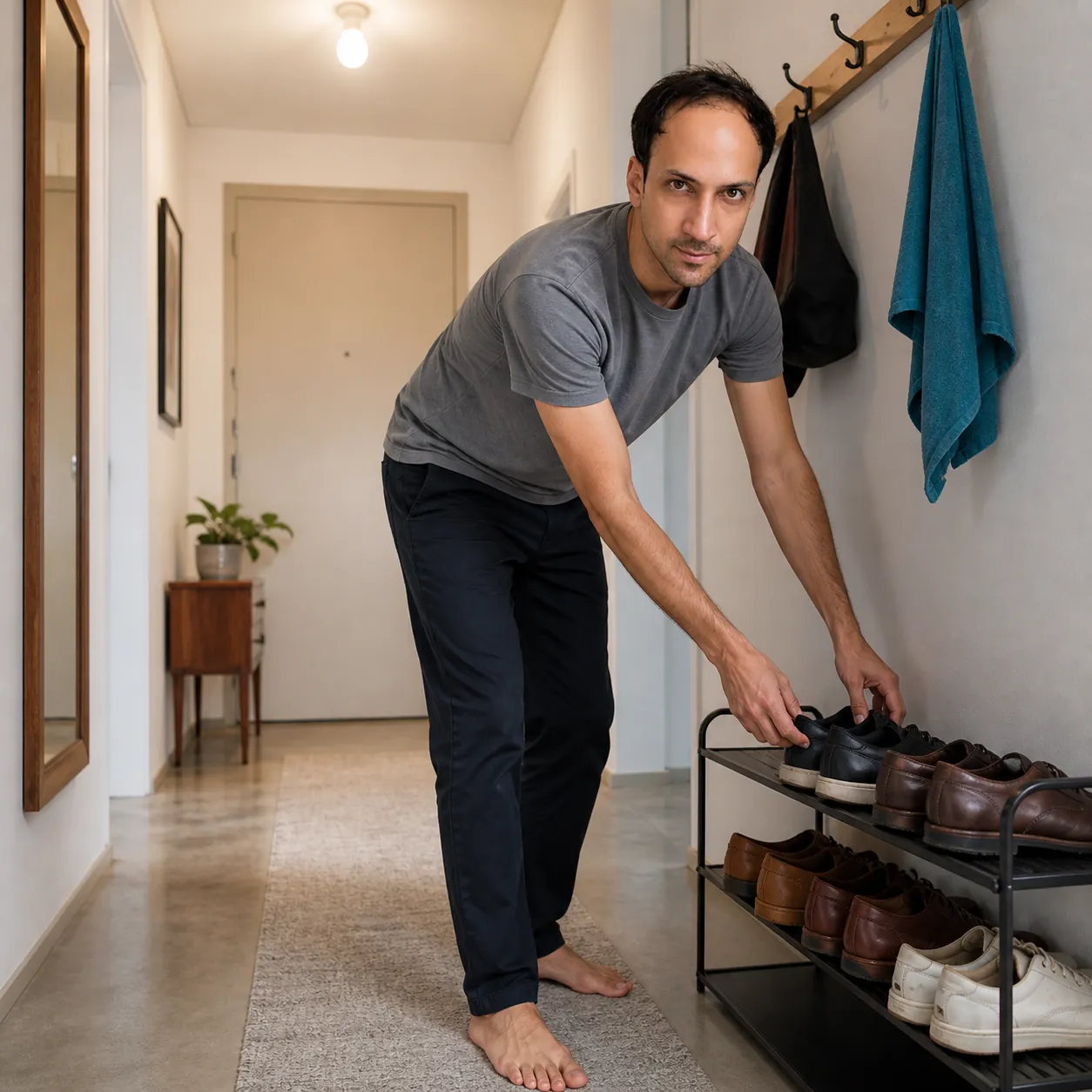
A Bulb Left Burning — AI Portrait Prompt
صورةAI Portraits

Turn your own photo into an observational domestic portrait in a flat's entrance hall with a shoe rack and a hook rail. Keeps your face unchanged.

من نص البرومبت

Use the attached reference photo as the identity reference: keep the same face, skin tone, hair and features as the person in that photo, without beautifying, aging or altering them. Create a square 1:1 museum-catalog frame with a strong first read and a slower second read at exactly 2880x2880 pixels. Location: a flat's entrance hall with a shoe rack and a hook rail. Show them in a plain grey crew-neck, dark cotton trousers, and bare feet, straightening a row of shoes along the rack. Anchor the frame to this piece of ordinary evidence: a corridor bulb left burning all through a bright afternoon, its switch passed again and again and never touched holds an ordinary task open a moment longer than the task requires. Explore how a private precaution turns into ordinary housekeeping without anyone noticing; expression occupied, not expressive, carrying unhurried caution, difficulty stated in the geometry alone. Place the lens beside the task at working height with the far wall sharp. Make the composition show the extra distance their arrangement adds. Render it as observational domestic portraiture built from truthful chore staging, exact material texture, ordinary architectural geometry, and quietly unsentimental framing, using even ceiling light with a second lamp filling the far end and a palette of sand beige, concrete grey, and one teal towel. Photorealistic: this must read as a real photograph from a physical camera, never an illustration, painting, or 3D render. Resolve real surface detail: cotton that hangs by its own weight, seams that pucker very slightly, and collars softened by washing. Keep one identity-locked person, credible hands and fingers, natural fabric, and coherent scale, contact, reflections, shadows, airflow, deformation, and materials. Background people only when essential, always secondary and clearly different. Avoid thriller shadows, keyhole peering, weapons or uniforms, and staged startle reactions. No text, labels, logos, signatures, watermarks, random symbols, plastic skin, excessive bloom, or glossy AI finish.
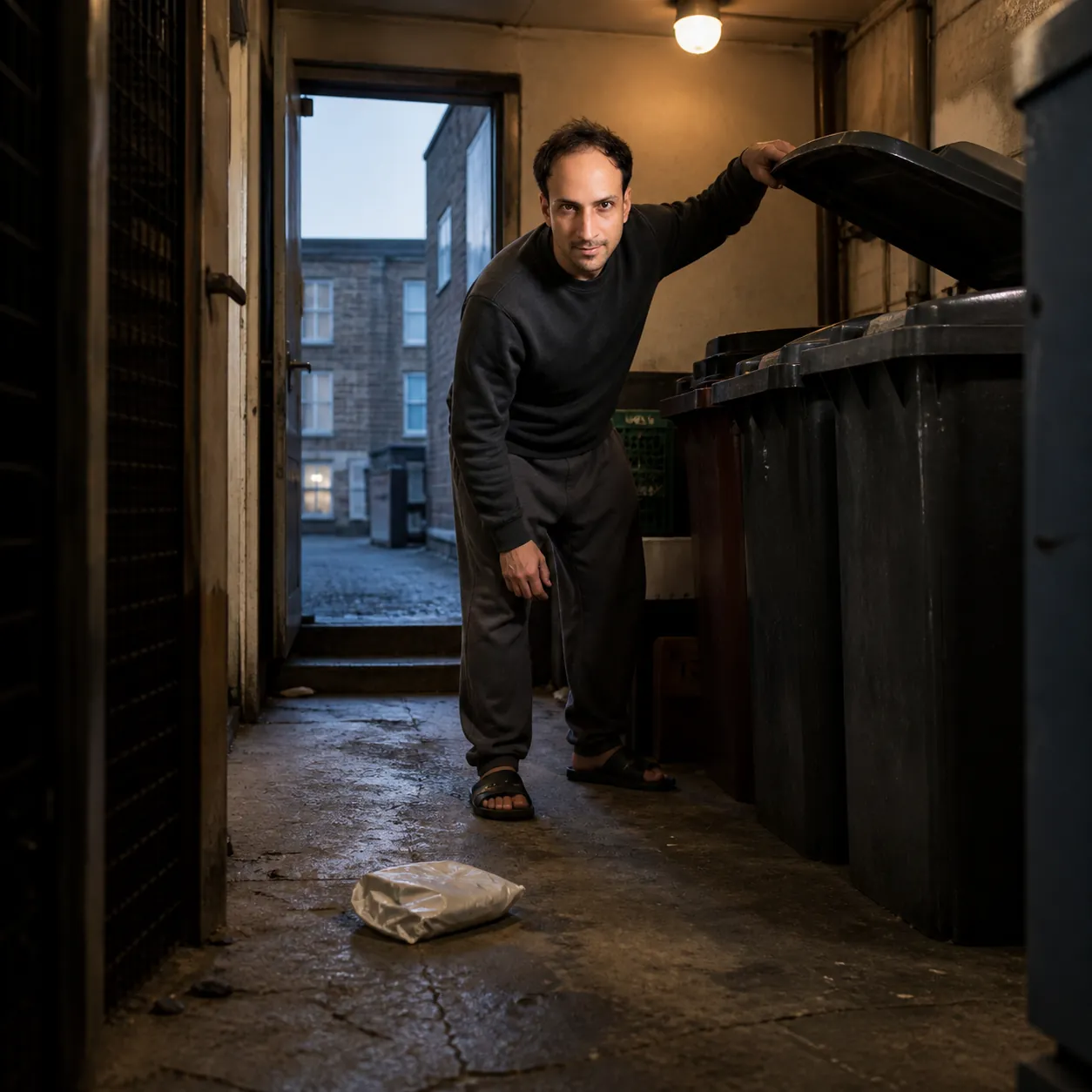
The Bin Store Under One Bulb — AI Portrait Prompt
صورةAI Portraits

Turn your own photo into a museum-grade domestic portrait in a building's ground-floor bin store lit by one bare fitting. Keeps your face unchanged.

من نص البرومبت

Use the attached reference photo as the identity reference: keep the same face, skin tone, hair and features as the person in that photo, without beautifying, aging or altering them. Create a square 1:1 museum-catalog frame with a strong first read and a slower second read at exactly 2880x2880 pixels. Location: a building's ground-floor bin store lit by one bare fitting. Show the subject in a dark grey sweatshirt over loose cotton trousers and slip-on sandals, tipping a lid open with the back of one wrist. Anchor the frame to this piece of ordinary evidence: a single bought item in a bag folded small, carried from a shop that was entered and left inside its quietest minutes spends a whole morning's calculation on something a neighbour does absently. Explore why an exit has to be located before an errand can begin; expression occupied, not expressive, carrying flat determination, difficulty stated in plain working terms. Place the camera low at bag height so the floor and the threshold dominate. Make the composition hold measurable distance between their hands and the open air. Render it as museum-grade domestic realism combining high-fidelity portrait photography, plain hardware detail, accurate low-light response, and restrained editorial art direction, using pale pre-dawn daylight through a doorway, balanced by one weak interior lamp and a palette of matte navy, unbleached paper, and a single tile green. Photorealistic: this must read as a real photograph from a physical camera, never an illustration, painting, or 3D render. Resolve real surface detail: dust settled where nobody wipes, fingerprint haze on glass, and edges rubbed pale by handling. Keep one identity-locked person, credible hands and fingers, natural fabric, and coherent scale, contact, reflections, shadows, airflow, deformation, and materials. Background people only when essential, always secondary and clearly different. Avoid rain-streaked window sorrow, huddled foetal poses, blurred crowd chaos, and curtain-peeking paranoia. No text, labels, logos, signatures, watermarks, random symbols, plastic skin, excessive bloom, or glossy AI finish.
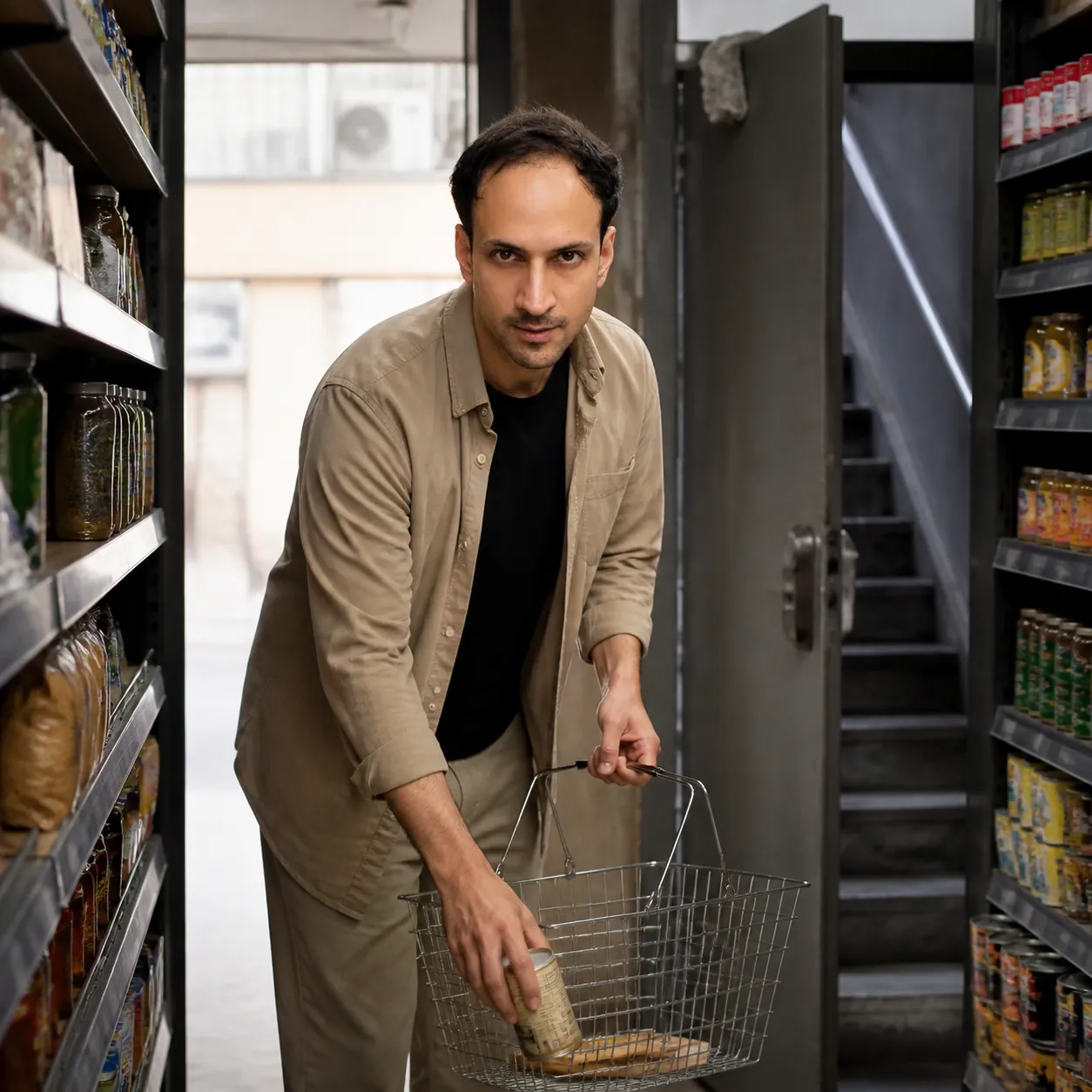
The Basket and the Back Door — AI Portrait Prompt
صورةAI Portraits

Turn your own photo into a portrait in a corner grocery's narrow aisle twenty minutes before its evening rush. Keeps your face unchanged.

من نص البرومبت

Use the attached reference photo as the identity reference: keep the same face, skin tone, hair and features as the person in that photo, without beautifying, aging or altering them. Create a square 1:1 museum-catalog frame with a strong first read and a slower second read at exactly 2880x2880 pixels. Location: a corner grocery's narrow aisle twenty minutes before its evening rush. Show the subject in a sand-coloured overshirt over a dark tee and canvas trousers, lowering one item into a wire hand basket. Let one honest object carry what the face will not: a stairwell fire door that is held open a hand's width by a folded cloth, the lift's call button passed unpressed turns an ordinary errand into the day's largest piece of engineering. Explore what an ordinary threshold weighs once it has been measured this carefully; expression occupied, not expressive, carrying rehearsed steadiness, difficulty stated as logistics rather than lament. Use a 50mm eye-level view from inside the room with the doorway kept at the edge. Make the composition hold measurable distance between their hands and the open air. Render it as quiet civic-documentary portraiture built from real errand logistics, contemporary Saudi street texture, honest domestic materials, and unhurried observational framing, using even overcast daylight entering a shopfront with no warm colour push and a palette of sand beige, iron grey, and one fluorescent blue-white. Photorealistic: this must read as a real photograph from a physical camera, never an illustration, painting, or 3D render. Resolve real surface detail: the difference between a wiped surface and a clean one, faint tide marks on ceramic, and metal dulled unevenly by touch. Keep one identity-locked person, credible hands and fingers, natural fabric, and coherent scale, contact, reflections, shadows, airflow, deformation, and materials. Background people only when essential, always secondary and clearly different. Avoid hero-poster stances, golden-hour wellness glow, posing at camera, and chest-clutching gestures. No text, labels, logos, signatures, watermarks, random symbols, plastic skin, excessive bloom, or glossy AI finish.
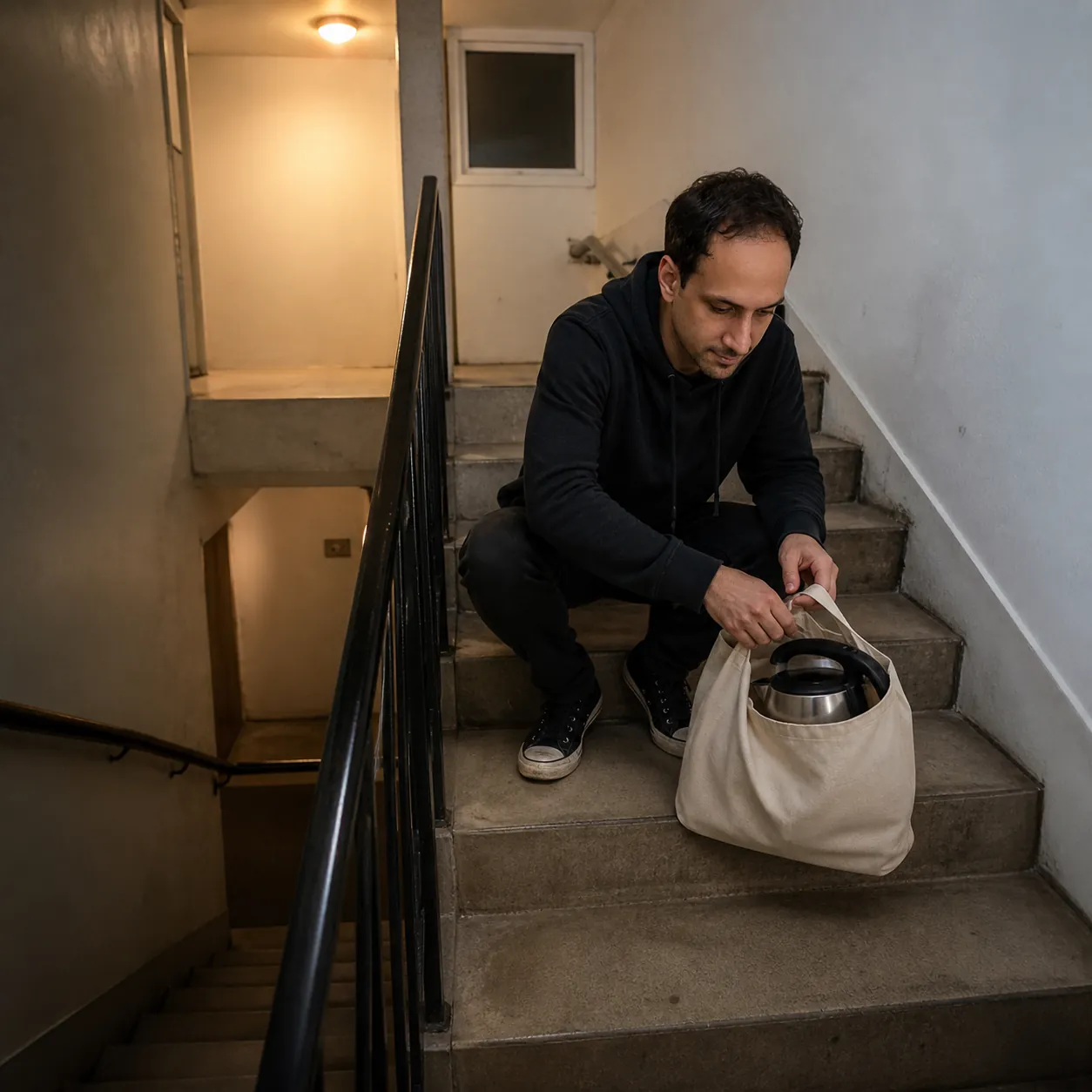
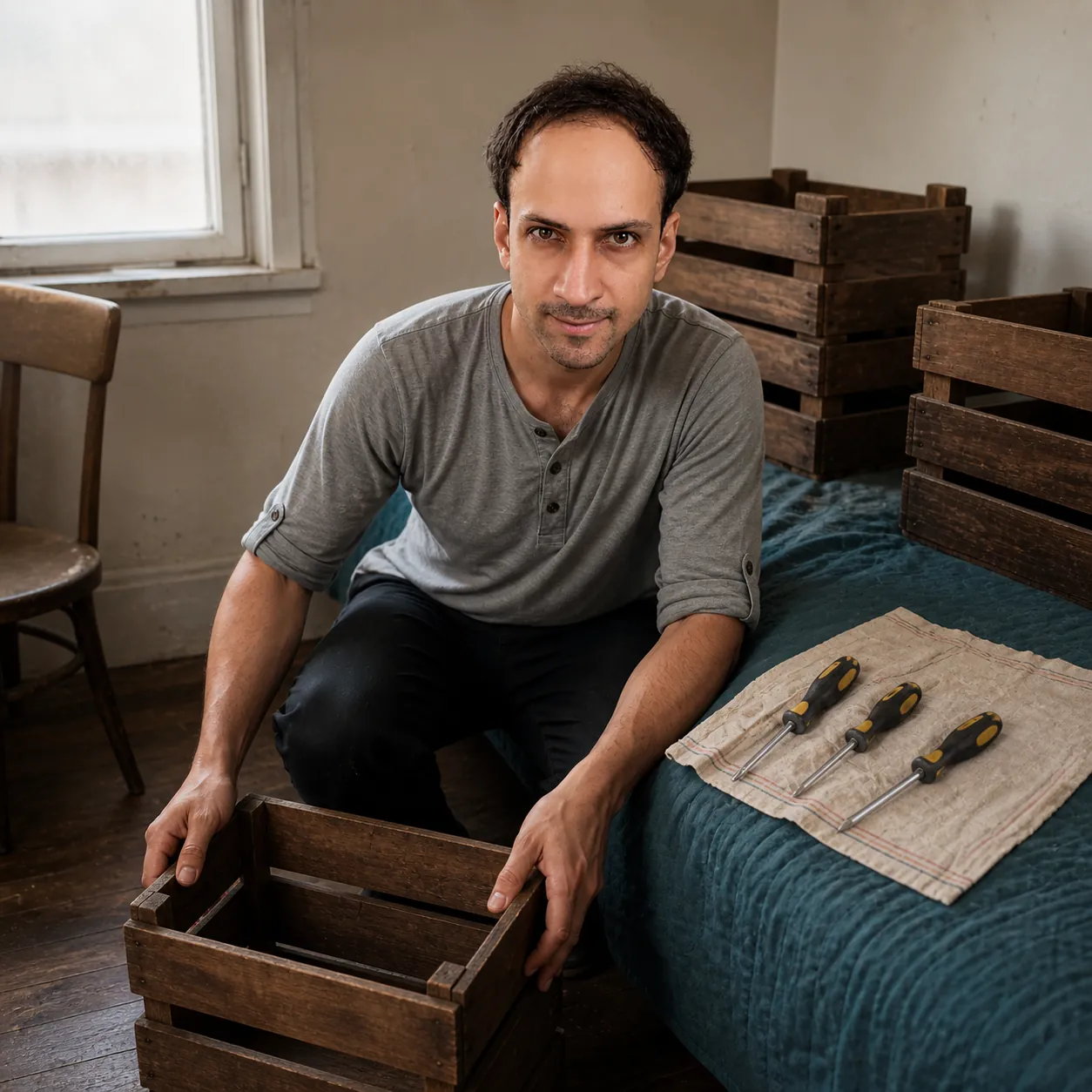
The Crate With Worn Handles — AI Portrait Prompt
صورةAI Portraits

Turn your own photo into an archival still-life portrait in a guest room where the spare bed carries stacked crates. Keeps your face unchanged.

من نص البرومبت

Use the attached reference photo as the identity reference: keep the same face, skin tone, hair and features as the person in that photo, without beautifying, aging or altering them. Create a square 1:1 museum-catalog frame with a strong first read and a slower second read at exactly 2880x2880 pixels. Location: a guest room where the spare bed carries stacked crates. Show the subject in a soft grey henley with sleeves at the elbow, lowering one crate from the bed to the floor. Make this piece of unglamorous evidence the whole argument: a row of three identical screwdrivers on a cloth, each bought on a day the others could not be found shows care and accumulation arriving from exactly the same impulse. Explore why an object with a use left in it refuses to become rubbish; expression occupied, not expressive, carrying sober economy, difficulty stated in the register of ordinary work. Use an 85mm portrait length compressing the kept things gently behind their shoulder. Make the composition give the kept object more definition than the surrounding room. Render it as archival still-life portraiture combining catalogue-clear object rendering, believable domestic wear, controlled neutral colour, and patient unstyled editorial realism, using flat overcast daylight through a dusty window with soft, even falloff and a palette of kraft brown, plaster white, and one faded teal. Photorealistic: this must read as a real photograph from a physical camera, never an illustration, painting, or 3D render. Resolve real surface detail: floor finish worn along the walked line, skirting marked at shoe height, and corners darker than the open floor. Keep one identity-locked person, credible hands and fingers, natural fabric, and coherent scale, contact, reflections, shadows, airflow, deformation, and materials. Background people only when essential, always secondary and clearly different. Avoid clear-out crews, shame poses, posing at camera, teetering junk towers, and melancholy without labour. No text, labels, logos, signatures, watermarks, random symbols, plastic skin, excessive bloom, or glossy AI finish.
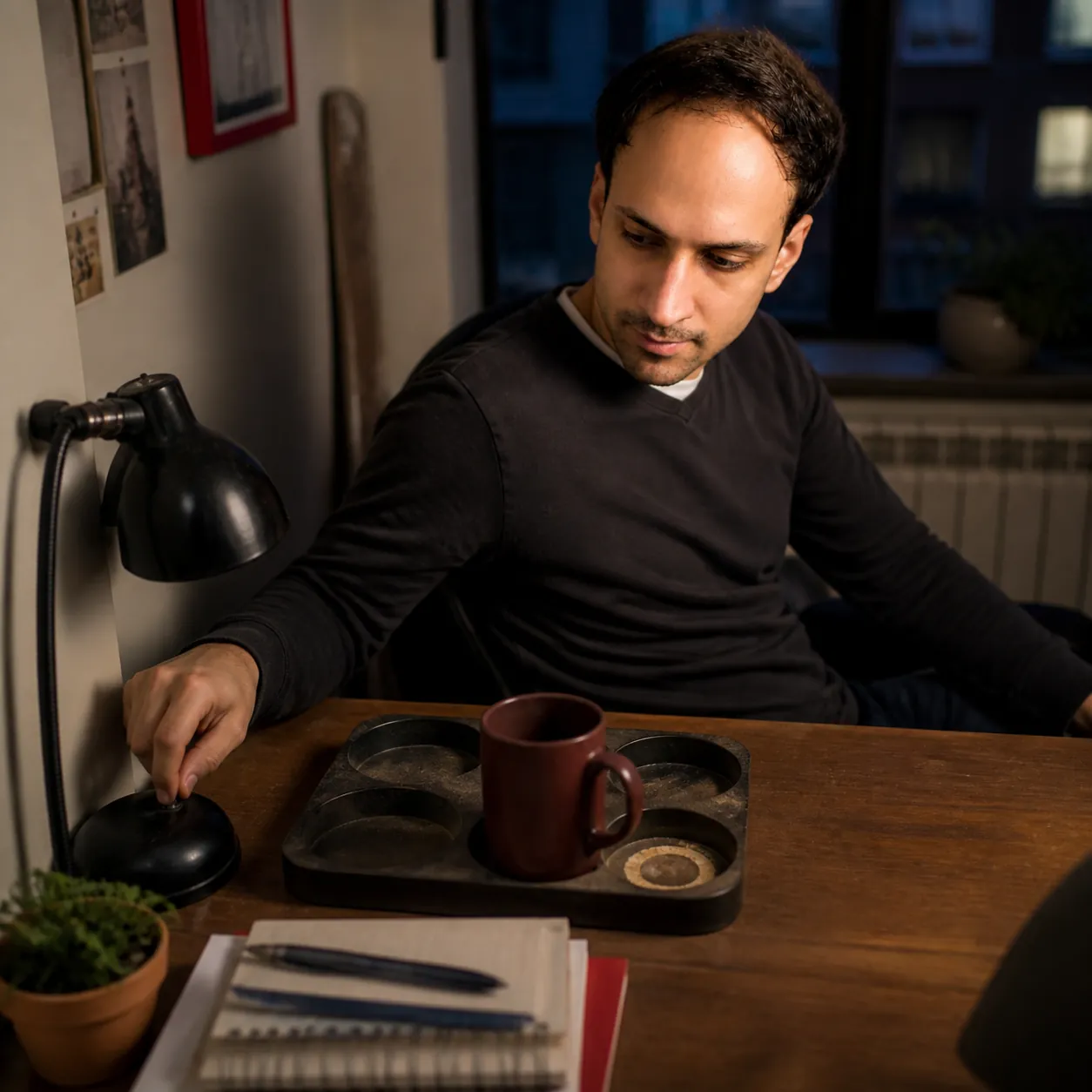
The Kettle That Clicks Too Soon — AI Portrait Prompt
صورةAI Portraits

Turn your own photo into a quiet domestic documentary portrait in a concrete apartment stairwell landing between two upper floors. Keeps your face unchanged.

من نص البرومبت

Use the attached reference photo as the identity reference: keep the same face, skin tone, hair and features as the person in that photo, without beautifying, aging or altering them. Create a square 1:1 museum-catalog frame with a strong first read and a slower second read at exactly 2880x2880 pixels. Location: a concrete apartment stairwell landing between two upper floors. Show the subject in a dark hooded sweatshirt over plain trousers and canvas shoes, setting a full carrier bag down on the step. Make this piece of unglamorous evidence the whole argument: a replacement kettle that cuts out at a different moment, leaving the routine around the old click without an anchor turns a five-minute job into an hour of starting the order again. Explore how a private ordering system earns its keep on a difficult day; expression occupied, not expressive, carrying unhurried recalculation, difficulty stated without inviting pity. Use a slightly high 40mm angle that shows the whole interrupted arrangement at once. Make the composition give the unfinished part more frame than the finished. Render it as quiet domestic documentary realism built from unposed observation, honest household materials, accurate skin rendering, and restrained contemporary art direction, using one ceiling fitting doing all the work, shadows soft and low and a palette of concrete grey, bone white, and one amber lamp glow. Photorealistic: this must read as a real photograph from a physical camera, never an illustration, painting, or 3D render. Resolve real surface detail: grout darker than tile, sealant slightly yellowed, and every joint showing a real tolerance gap. Keep one identity-locked person, credible hands and fingers, natural fabric, and coherent scale, contact, reflections, shadows, airflow, deformation, and materials. Background people only when essential, always secondary and clearly different. Avoid hero poses, golden-hour wellness glow, eye contact with the lens, minimalist styling, and puzzle-piece symbolism. No text, labels, logos, signatures, watermarks, random symbols, plastic skin, excessive bloom, or glossy AI finish.
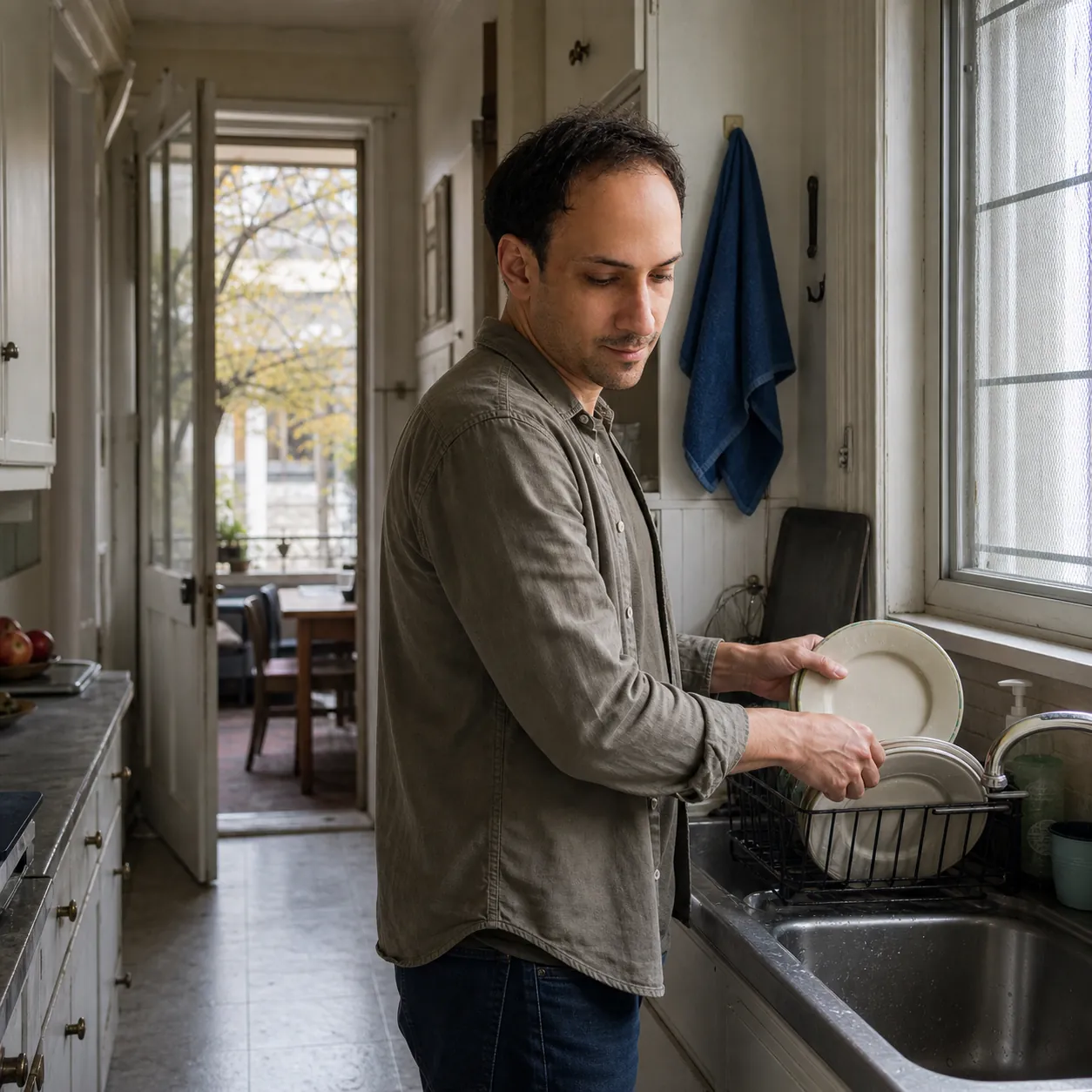
Lamp Off at the Desk Corner — AI Portrait Prompt
صورةAI Portraits

Turn your own photo into a photorealistic portrait in a desk corner in a shared apartment room, lamp on. Keeps your face unchanged.

من نص البرومبت

Use the attached reference photo as the identity reference: keep the same face, skin tone, hair and features as the person in that photo, without beautifying, aging or altering them. Create a square 1:1 museum-catalog frame with a strong first read and a slower second read at exactly 2880x2880 pixels. Location: a desk corner in a shared apartment room, lamp on. Show the subject in a thin charcoal sweatshirt worn over a plain white undershirt, switching the desk lamp off with one knuckle. The difficulty must be visible in this, not in their expression: a mug that sits in the wrong slot, a clean ring in the dust still holding its true position turns a five-minute job into an hour of starting the order again. Explore how much unseen structure a routine holds before anyone notices; expression occupied, not expressive, carrying dry persistence, difficulty stated without making it a story. Hold a static 45mm viewpoint just behind their shoulder with the object fully legible. Make the composition keep the changed object sharp and everything habitual soft. Render it as restrained editorial realism assembled from ordinary interiors, credible domestic clutter, exact material weight, and composition that refuses to dramatize, using late-evening interior lamplight balanced against the dim blue outside the glass and a palette of flat beige, deep brown, and one red accent. Photorealistic: this must read as a real photograph from a physical camera, never an illustration, painting, or 3D render. Resolve real surface detail: visible weave in cloth, fine scratches on metal, and the faint unevenness of painted walls. Keep one identity-locked person, credible hands and fingers, natural fabric, and coherent scale, contact, reflections, shadows, airflow, deformation, and materials. Background people only when essential, always secondary and clearly different. Avoid hero poses, golden-hour wellness glow, eye contact with the lens, minimalist styling, and puzzle-piece symbolism. No text, labels, logos, signatures, watermarks, random symbols, plastic skin, excessive bloom, or glossy AI finish.
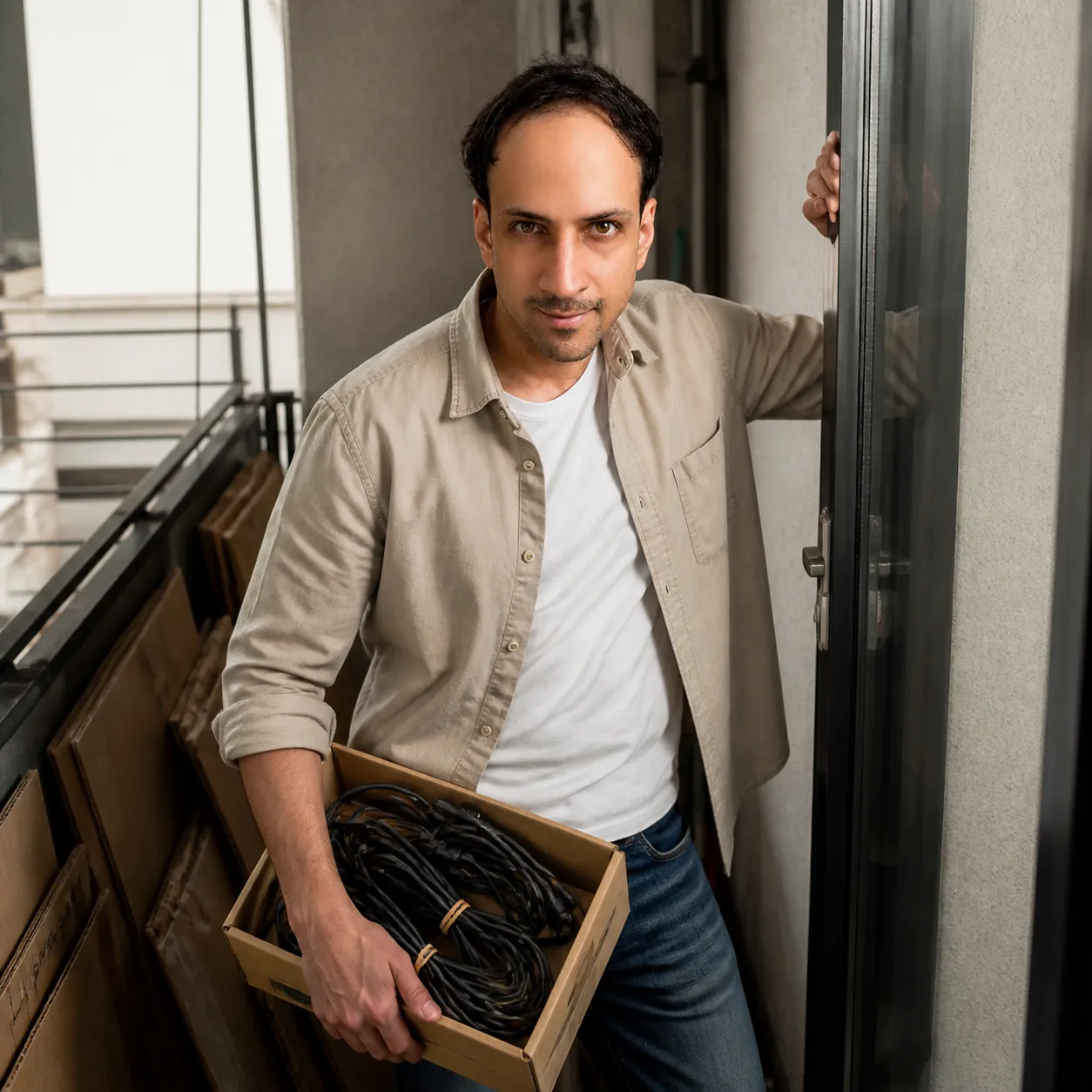
A Door Propped Wide — AI Portrait Prompt
صورةAI Portraits

Turn your own photo into a quiet domestic documentary portrait in a narrow galley kitchen open at both ends to the flat. Keeps your face unchanged.

من نص البرومبت

Use the attached reference photo as the identity reference: keep the same face, skin tone, hair and features as the person in that photo, without beautifying, aging or altering them. Create a square 1:1 museum-catalog frame with a strong first read and a slower second read at exactly 2880x2880 pixels. Location: a narrow galley kitchen open at both ends to the flat. Show them in a soft olive t-shirt under an unbuttoned cotton overshirt, stacking rinsed plates into the draining rack. Build the image around this small, exact tableau: an outer door propped wide in cold weather so the rooms behind them are never shut out turns an ordinary chore into a problem of position and sound. Explore how one small allowance can cost more than the whole precaution; expression occupied, not expressive, carrying borrowed calm, difficulty stated as a bill quietly paid. Frame them three-quarters from behind with both their hands and the far end readable. Make the composition let their standing position read before the chore does. Render it as quiet domestic documentary realism combining unposed portrait photography, honest interior materials, accurate household light, and unhurried observational framing, using flat mid-afternoon daylight through a screened window with no direct sun and a palette of pale limestone, iron grey, and one faded indigo cloth. Photorealistic: this must read as a real photograph from a physical camera, never an illustration, painting, or 3D render. Resolve real surface detail: brass darkened in the recesses and bright where thumbs land, and lacquer crazed rather than perfect. Keep one identity-locked person, credible hands and fingers, natural fabric, and coherent scale, contact, reflections, shadows, airflow, deformation, and materials. Background people only when essential, always secondary and clearly different. Avoid hero poses, golden-hour wellness glow, eye contact with the lens, and tear-streaked faces. No text, labels, logos, signatures, watermarks, random symbols, plastic skin, excessive bloom, or glossy AI finish.
A Shoebox of Coiled Cables — AI Portrait Prompt
صورةAI Portraits

Turn your own photo into a museum-grade domestic portrait in a service balcony with flattened cardboard leaning against the rail. Keeps your face unchanged.

من نص البرومبت

Use the attached reference photo as the identity reference: keep the same face, skin tone, hair and features as the person in that photo, without beautifying, aging or altering them. Create a square 1:1 museum-catalog frame with a strong first read and a slower second read at exactly 2880x2880 pixels. Location: a service balcony with flattened cardboard leaning against the rail. Show the subject in a light sand overshirt over a white tee and jeans, hooking the balcony door open against the wall. The difficulty must be visible in this, not in their expression: a shoebox of coiled cables, wound and banded, in which every plug still has a machine somewhere in the flat shows care and accumulation arriving from exactly the same impulse. Explore what it costs to let go of something that still works perfectly; expression occupied, not expressive, carrying plain persistence, difficulty stated quietly enough to be missed once. Hold a static 40mm frame at standing height with their working hand visible. Make the composition let one emptied gap sit at the frame's quietest point. Render it as museum-grade domestic portraiture built from plain-room reportage, accurate cardboard and glass materiality, restrained art direction, and unsentimental observation, using unglamorous garage strip lighting balanced by pale daylight at the entrance and a palette of warm cardboard tan, cool grey, and dulled brass. Photorealistic: this must read as a real photograph from a physical camera, never an illustration, painting, or 3D render. Resolve real surface detail: thread ends and slight pilling on worn cloth, hairline chips at every hard corner, and stone that is porous rather than smooth. Keep one identity-locked person, credible hands and fingers, natural fabric, and coherent scale, contact, reflections, shadows, airflow, deformation, and materials. Background people only when essential, always secondary and clearly different. Avoid clear-out crews, shame poses, posing at camera, teetering junk towers, and melancholy without labour. No text, labels, logos, signatures, watermarks, random symbols, plastic skin, excessive bloom, or glossy AI finish.
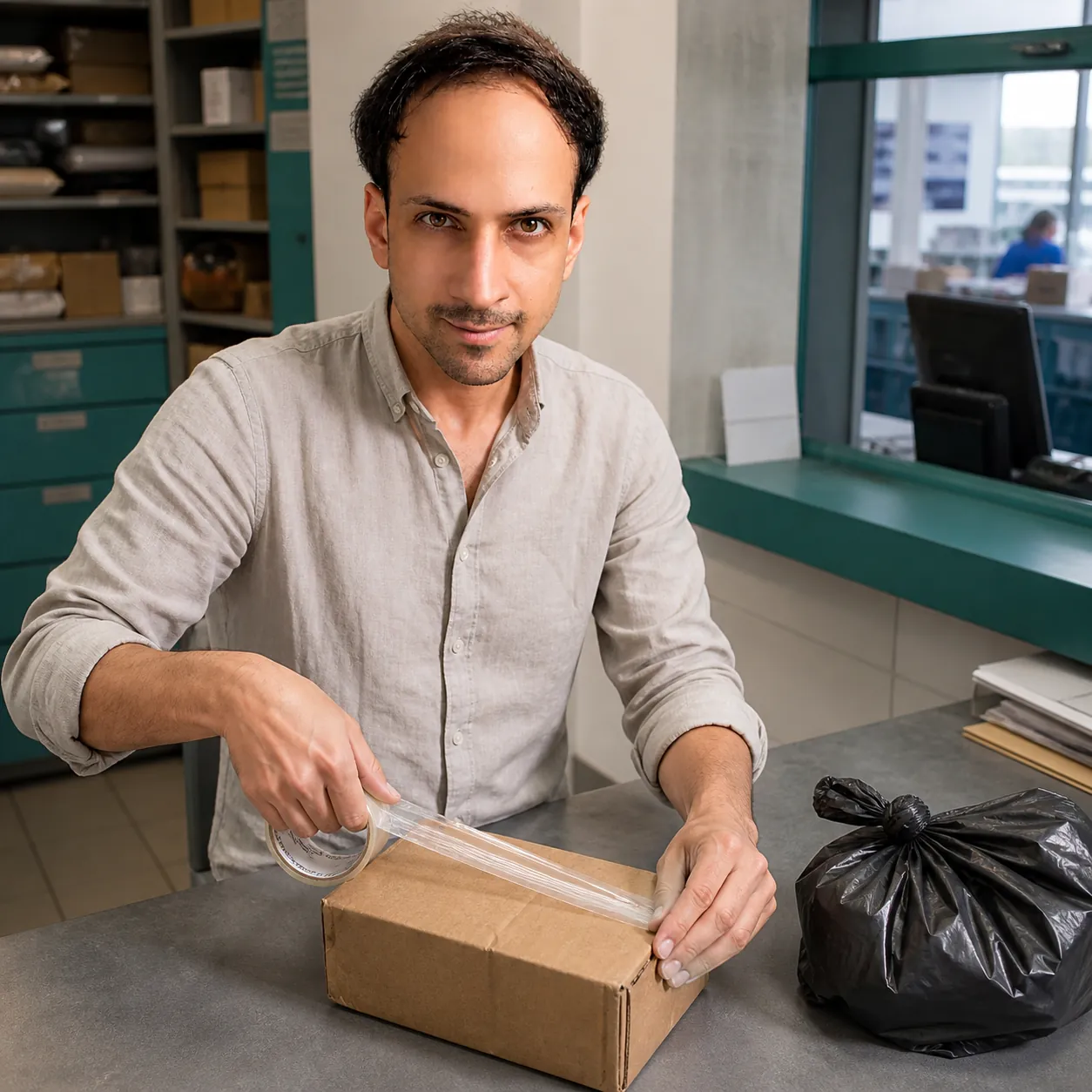
Taping the Parcel Seam — AI Portrait Prompt
صورةAI Portraits

Turn your own photo into a restrained editorial portrait in a small post office's parcel counter after the queue has gone. Keeps your face unchanged.

من نص البرومبت

Use the attached reference photo as the identity reference: keep the same face, skin tone, hair and features as the person in that photo, without beautifying, aging or altering them. Create a square 1:1 museum-catalog frame with a strong first read and a slower second read at exactly 2880x2880 pixels. Location: a small post office's parcel counter after the queue has gone. Show them in a stone-coloured linen shirt with cuffs turned back twice, smoothing tape flat across a small parcel's open seam. Anchor the frame to this piece of ordinary evidence: a bin liner given a second knot before it leaves the cupboard, one knot never being enough against the smell makes the cost of an ordinary chore visible without making it a complaint. Explore whether an accommodation is a limitation or simply the correct tool selected; expression occupied, not expressive, carrying measured endurance, difficulty stated quietly enough to be missed. Frame slightly above the work surface so the task, not the person, occupies the centre. Make the composition let one unfinished half of the task stay honestly in frame. Render it as restrained editorial realism built from real chore apparatus, believable domestic wear, exact fabric and metal texture, and unsentimental framing, using grey daylight through a service window with weak bounced fill and a palette of cool white, pale concrete, and one muted teal. Photorealistic: this must read as a real photograph from a physical camera, never an illustration, painting, or 3D render. Resolve real surface detail: label-free packaging showing carton fibre, cardboard bruised at the corners, and tape lifting slightly at one end. Keep one identity-locked person, credible hands and fingers, natural fabric, and coherent scale, contact, reflections, shadows, airflow, deformation, and materials. Background people only when essential, always secondary and clearly different. Avoid hands clamped over ears, meltdown theatrics, and hero poses at camera. No text, labels, logos, signatures, watermarks, random symbols, plastic skin, excessive bloom, or glossy AI finish.
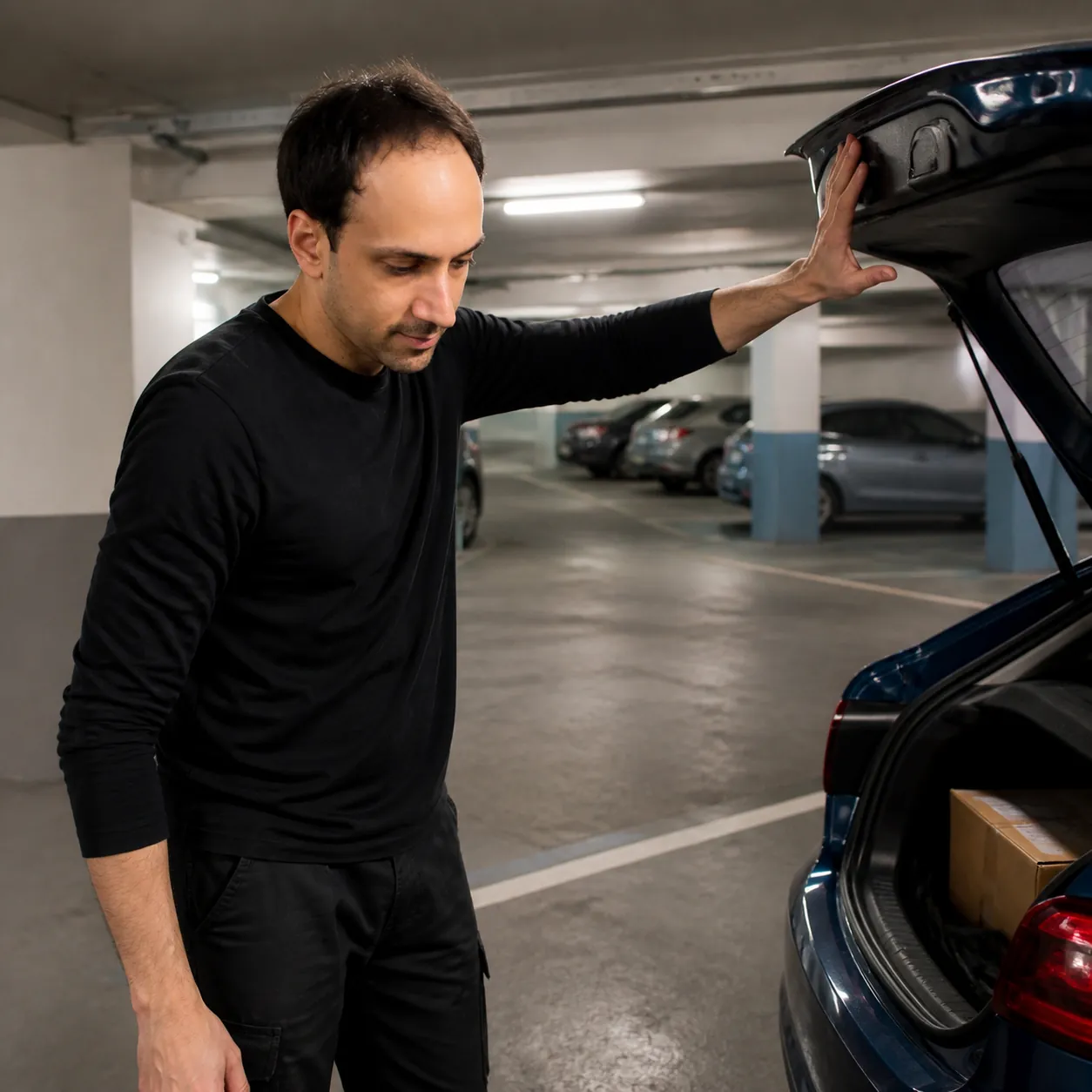
Closing the Hatch in the Garage — AI Portrait Prompt
صورةAI Portraits

Turn your own photo into a photorealistic portrait in a residential parking garage level lit by strip fittings overhead. Keeps your face unchanged.

من نص البرومبت

Use the attached reference photo as the identity reference: keep the same face, skin tone, hair and features as the person in that photo, without beautifying, aging or altering them. Create a square 1:1 museum-catalog frame with a strong first read and a slower second read at exactly 2880x2880 pixels. Location: a residential parking garage level lit by strip fittings overhead. Show the subject in a plain black long-sleeve tee and dark workwear trousers, closing a car's rear hatch with one flat hand. Anchor the frame to this piece of ordinary evidence: a repaired machine whose replacement dial turns the opposite way, leaving the notch they always used in a new position turns a five-minute job into an hour of starting the order again. Explore whether flexibility is a virtue or simply a different skill; expression occupied, not expressive, carrying held focus, difficulty stated without inviting pity. Place the camera at standing height, close enough that one arm's reach fills it. Make the composition show the gap in the order, not the objects. Render it as restrained editorial realism assembled from ordinary interiors, credible domestic clutter, exact material weight, and composition that refuses to dramatize, using cool fluorescent tube light with honest color and visible skin texture and a palette of warm grey, off-white, and worn enamel blue. Photorealistic: this must read as a real photograph from a physical camera, never an illustration, painting, or 3D render. Resolve real surface detail: label-free packaging showing carton fibre, cardboard bruised at the corners, and tape lifting slightly at one end. Keep one identity-locked person, credible hands and fingers, natural fabric, and coherent scale, contact, reflections, shadows, airflow, deformation, and materials. Background people only when essential, always secondary and clearly different. Avoid hero poses, golden-hour wellness glow, eye contact with the lens, minimalist styling, and puzzle-piece symbolism. No text, labels, logos, signatures, watermarks, random symbols, plastic skin, excessive bloom, or glossy AI finish.
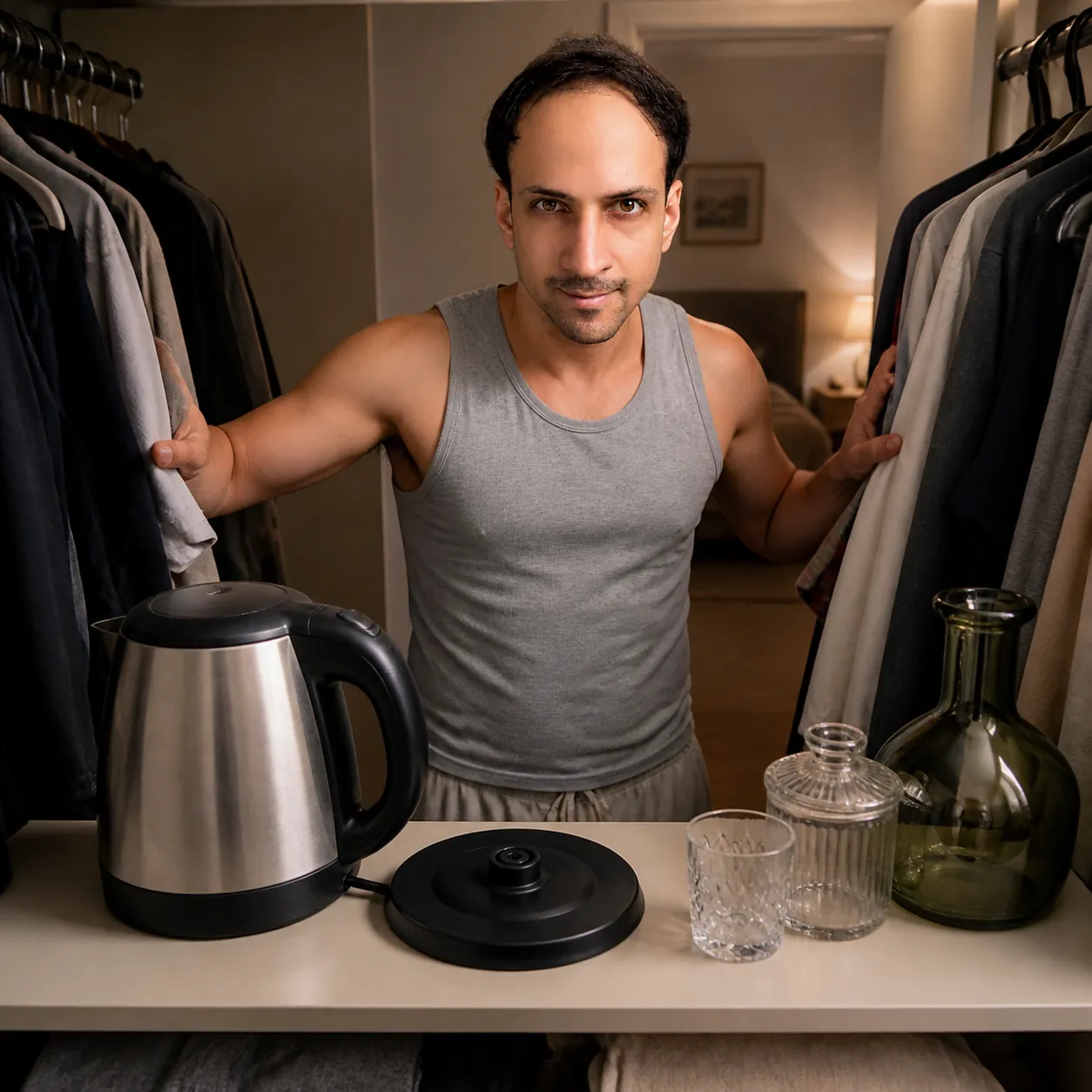
The Kettle Kept for Its Element — AI Portrait Prompt
صورةAI Portraits

Turn your own photo into a museum-grade domestic portrait in a bedroom wardrobe standing open on its two hanging rails. Keeps your face unchanged.

من نص البرومبت

Use the attached reference photo as the identity reference: keep the same face, skin tone, hair and features as the person in that photo, without beautifying, aging or altering them. Create a square 1:1 museum-catalog frame with a strong first read and a slower second read at exactly 2880x2880 pixels. Location: a bedroom wardrobe standing open on its two hanging rails. Show the subject in a grey cotton undershirt and loose drawstring house trousers, sliding hangers apart to reach the shelf behind. Anchor the frame to this piece of ordinary evidence: a stopped electric kettle whose base plate is off because the element inside it is still a perfectly good element shows care and accumulation arriving from exactly the same impulse. Explore how carrying, re-shelving, and re-deciding can fill an afternoon and leave no trace; expression occupied, not expressive, carrying worn diligence, difficulty stated without any note of shame. Place the camera at shelf height so held objects meet the lens squarely. Make the composition keep every stacked edge parallel and every surface visibly clean. Render it as museum-grade domestic portraiture built from plain-room reportage, accurate cardboard and glass materiality, restrained art direction, and unsentimental observation, using a low domestic lamp plus spill from the corridor, both plainly motivated and a palette of bleached linen, concrete grey, and a single olive accent. Photorealistic: this must read as a real photograph from a physical camera, never an illustration, painting, or 3D render. Resolve real surface detail: dust settled where nobody wipes, fingerprint haze on glass, and edges rubbed pale by handling. Keep one identity-locked person, credible hands and fingers, natural fabric, and coherent scale, contact, reflections, shadows, airflow, deformation, and materials. Background people only when essential, always secondary and clearly different. Avoid clear-out crews, shame poses, posing at camera, teetering junk towers, and melancholy without labour. No text, labels, logos, signatures, watermarks, random symbols, plastic skin, excessive bloom, or glossy AI finish.
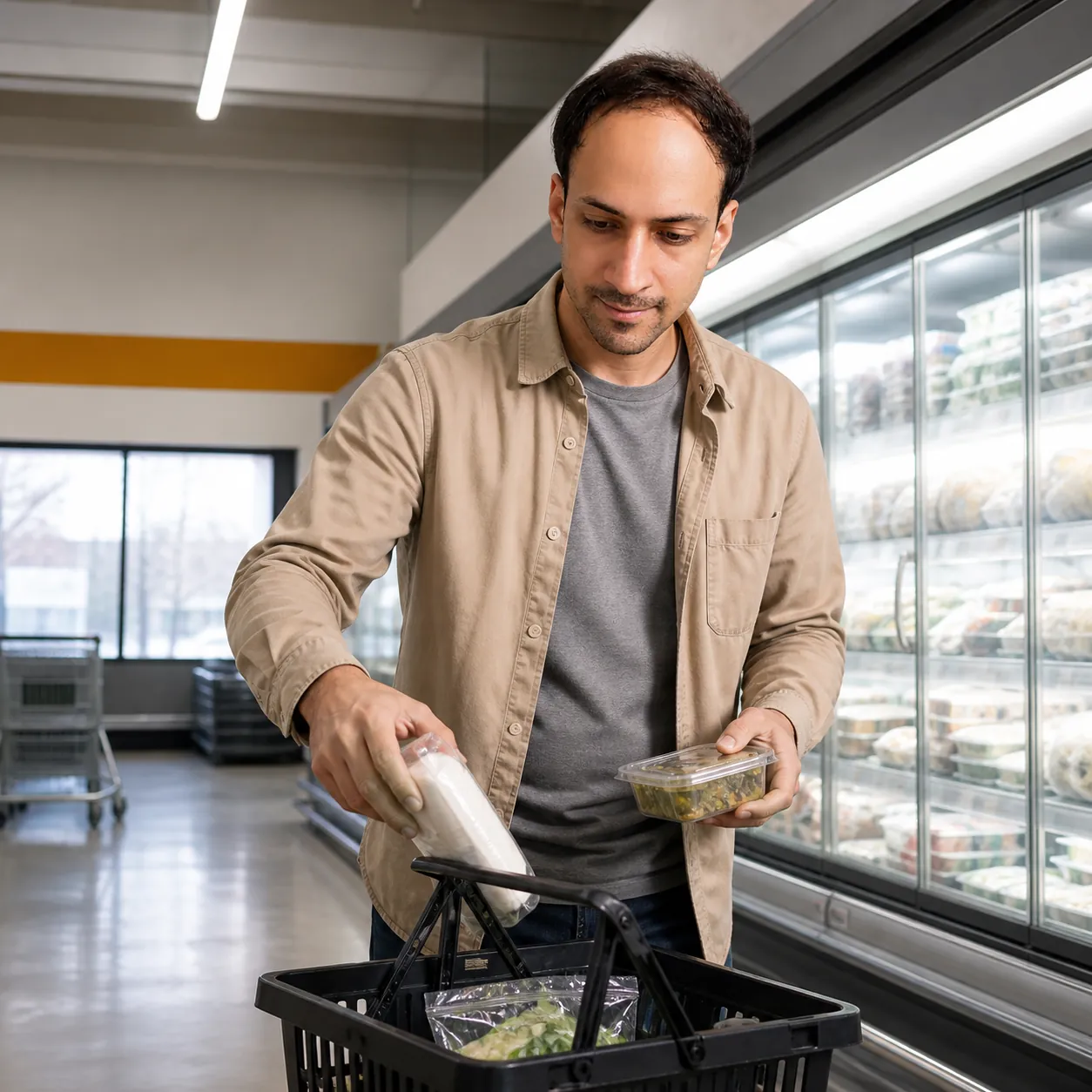
Flicker in the Chill Aisle — AI Portrait Prompt
صورةAI Portraits

Turn your own photo into a restrained editorial portrait in a neighbourhood supermarket's chill aisle at its emptiest hour. Keeps your face unchanged.

من نص البرومبت

Use the attached reference photo as the identity reference: keep the same face, skin tone, hair and features as the person in that photo, without beautifying, aging or altering them. Create a square 1:1 museum-catalog frame with a strong first read and a slower second read at exactly 2880x2880 pixels. Location: a neighbourhood supermarket's chill aisle at its emptiest hour. Show the subject in a sand-coloured overshirt over a grey tee and dark jeans, lowering the last two items into a half-filled basket. Anchor the frame to this piece of ordinary evidence: a ceiling tube whose stutter arrives as rhythm rather than glow, timed around by a person who has learned its interval shows competence and difficulty occupying the same square metre of floor. Explore how competence looks when it has to route around a texture nobody else notices; expression occupied, not expressive, carrying plain diligence, difficulty stated in the flattest possible voice. Frame slightly above the work surface so the task, not the person, occupies the centre. Make the composition place the source of the load outside their line of sight. Render it as restrained editorial realism built from real chore apparatus, believable domestic wear, exact fabric and metal texture, and unsentimental framing, using grey daylight through a service window with weak bounced fill and a palette of soap grey, warm plaster, and one ochre band. Photorealistic: this must read as a real photograph from a physical camera, never an illustration, painting, or 3D render. Resolve real surface detail: cotton that hangs by its own weight, seams that pucker very slightly, and collars softened by washing. Keep one identity-locked person, credible hands and fingers, natural fabric, and coherent scale, contact, reflections, shadows, airflow, deformation, and materials. Background people only when essential, always secondary and clearly different. Avoid glowing sound waves, sensory-overload blur effects, and mood portraits without labour. No text, labels, logos, signatures, watermarks, random symbols, plastic skin, excessive bloom, or glossy AI finish.
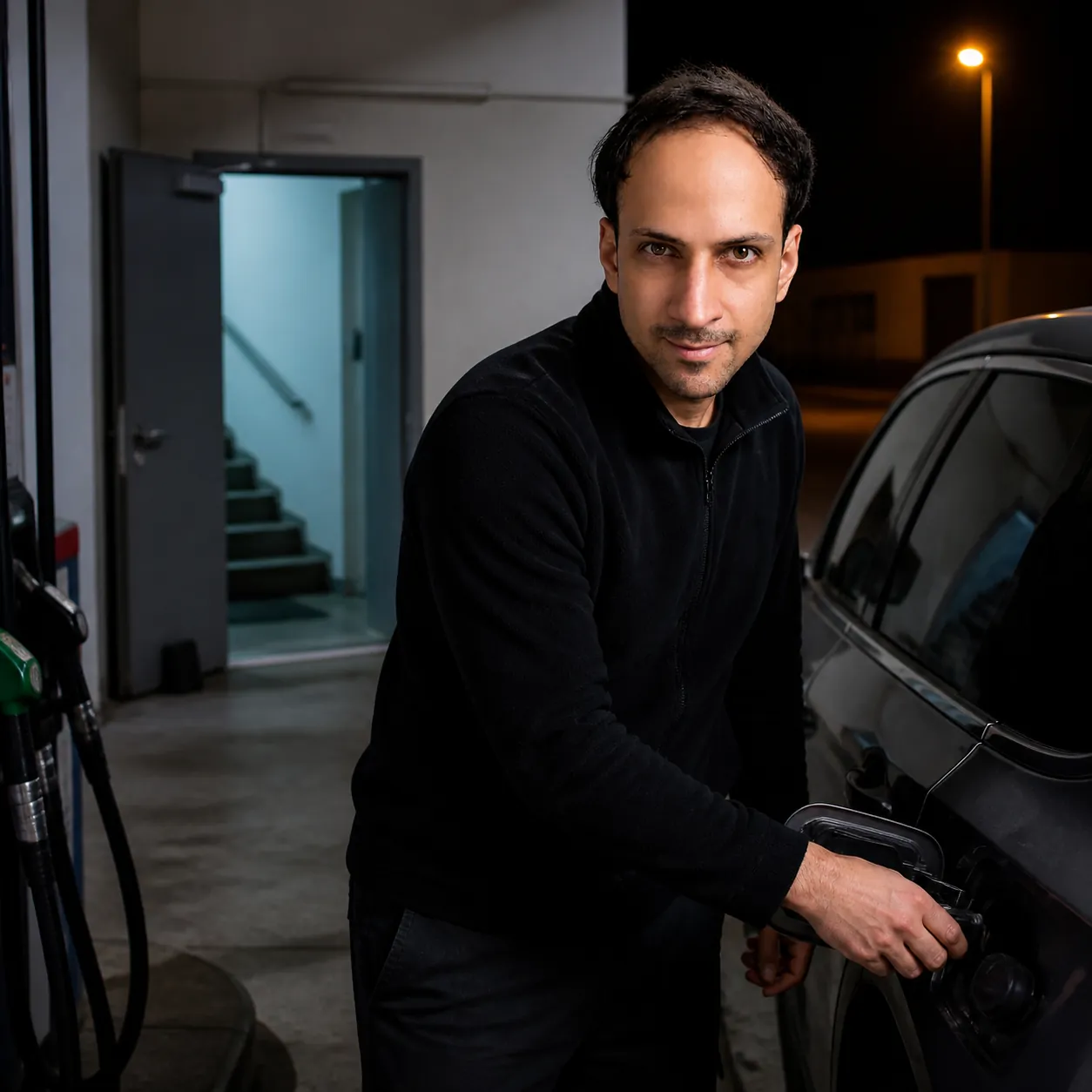
Last Quarter Turn — AI Portrait Prompt
صورةAI Portraits

Turn your own photo into a reportage-grade threshold portrait in a quiet petrol station forecourt in the slack hour before dawn. Keeps your face unchanged.

من نص البرومبت

Use the attached reference photo as the identity reference: keep the same face, skin tone, hair and features as the person in that photo, without beautifying, aging or altering them. Create a square 1:1 museum-catalog frame with a strong first read and a slower second read at exactly 2880x2880 pixels. Location: a quiet petrol station forecourt in the slack hour before dawn. Show the subject in a black fleece half-zip over plain dark trousers, twisting a fuel cap closed a final quarter turn. Make this piece of unglamorous evidence the whole argument: a stairwell fire door that is held open a hand's width by a folded cloth, the lift's call button passed unpressed spends a whole morning's calculation on something a neighbour does absently. Explore what an ordinary threshold weighs once it has been measured this carefully; expression occupied, not expressive, carrying practical wariness, difficulty stated with the flatness of routine. Use an 85mm view from just off their shoulder, keeping the face readable in three-quarter turn. Make the composition give the object they are handling more acuity than the room. Render it as reportage-grade threshold photography built from ordinary retail surfaces, credible packaging materials, physically correct shadow behaviour, and patient non-theatrical staging, using one sodium streetlight reaching a doorway with cool interior spill behind them and a palette of concrete grey, cold white, and one sodium-orange accent. Photorealistic: this must read as a real photograph from a physical camera, never an illustration, painting, or 3D render. Resolve real surface detail: floor finish worn along the walked line, skirting marked at shoe height, and corners darker than the open floor. Keep one identity-locked person, credible hands and fingers, natural fabric, and coherent scale, contact, reflections, shadows, airflow, deformation, and materials. Background people only when essential, always secondary and clearly different. Avoid rain-streaked window sorrow, huddled foetal poses, blurred crowd chaos, and curtain-peeking paranoia. No text, labels, logos, signatures, watermarks, random symbols, plastic skin, excessive bloom, or glossy AI finish.
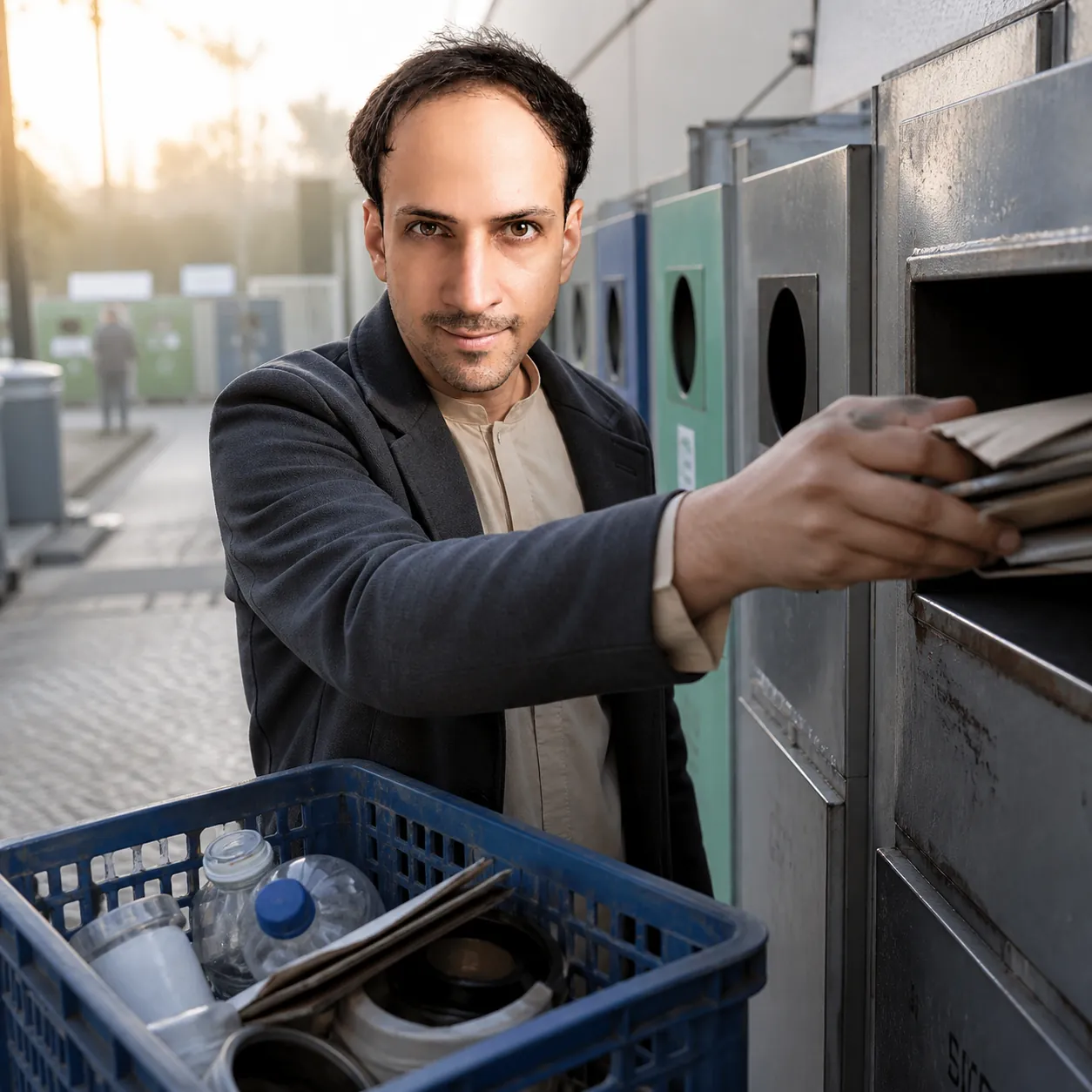
The Bag Not to Be Reopened — AI Portrait Prompt
صورةAI Portraits

Turn your own photo into an archival still-life portrait in a neighbourhood recycling bay at early morning, bins in line. Keeps your face unchanged.

من نص البرومبت

Use the attached reference photo as the identity reference: keep the same face, skin tone, hair and features as the person in that photo, without beautifying, aging or altering them. Create a square 1:1 museum-catalog frame with a strong first read and a slower second read at exactly 2880x2880 pixels. Location: a neighbourhood recycling bay at early morning, bins in line. Show the subject in a plain beige traditional Gulf outfit under a thin dark overcoat, posting a folded bundle through a steel hatch. The difficulty must be visible in this, not in their expression: a plastic crate of things still to be sorted, its handles worn smooth from being carried into a fourth room shows care and accumulation arriving from exactly the same impulse. Explore how order can grow steadily heavier without ever becoming any kind of mess; expression occupied, not expressive, carrying plain persistence, difficulty stated without any note of shame. Hold a static 40mm frame at standing height with their working hand visible. Make the composition put their working hand nearer the lens than their face. Render it as archival still-life portraiture combining catalogue-clear object rendering, believable domestic wear, controlled neutral colour, and patient unstyled editorial realism, using cool morning ambience from an open door, warmed slightly by interior walls and a palette of dust beige, cold steel, and one worn indigo note. Photorealistic: this must read as a real photograph from a physical camera, never an illustration, painting, or 3D render. Resolve real surface detail: rubber gone chalky with age, painted metal chipped to primer, and plastic yellowed only where light reaches it. Keep one identity-locked person, credible hands and fingers, natural fabric, and coherent scale, contact, reflections, shadows, airflow, deformation, and materials. Background people only when essential, always secondary and clearly different. Avoid clear-out crews, shame poses, posing at camera, teetering junk towers, and melancholy without labour. No text, labels, logos, signatures, watermarks, random symbols, plastic skin, excessive bloom, or glossy AI finish.
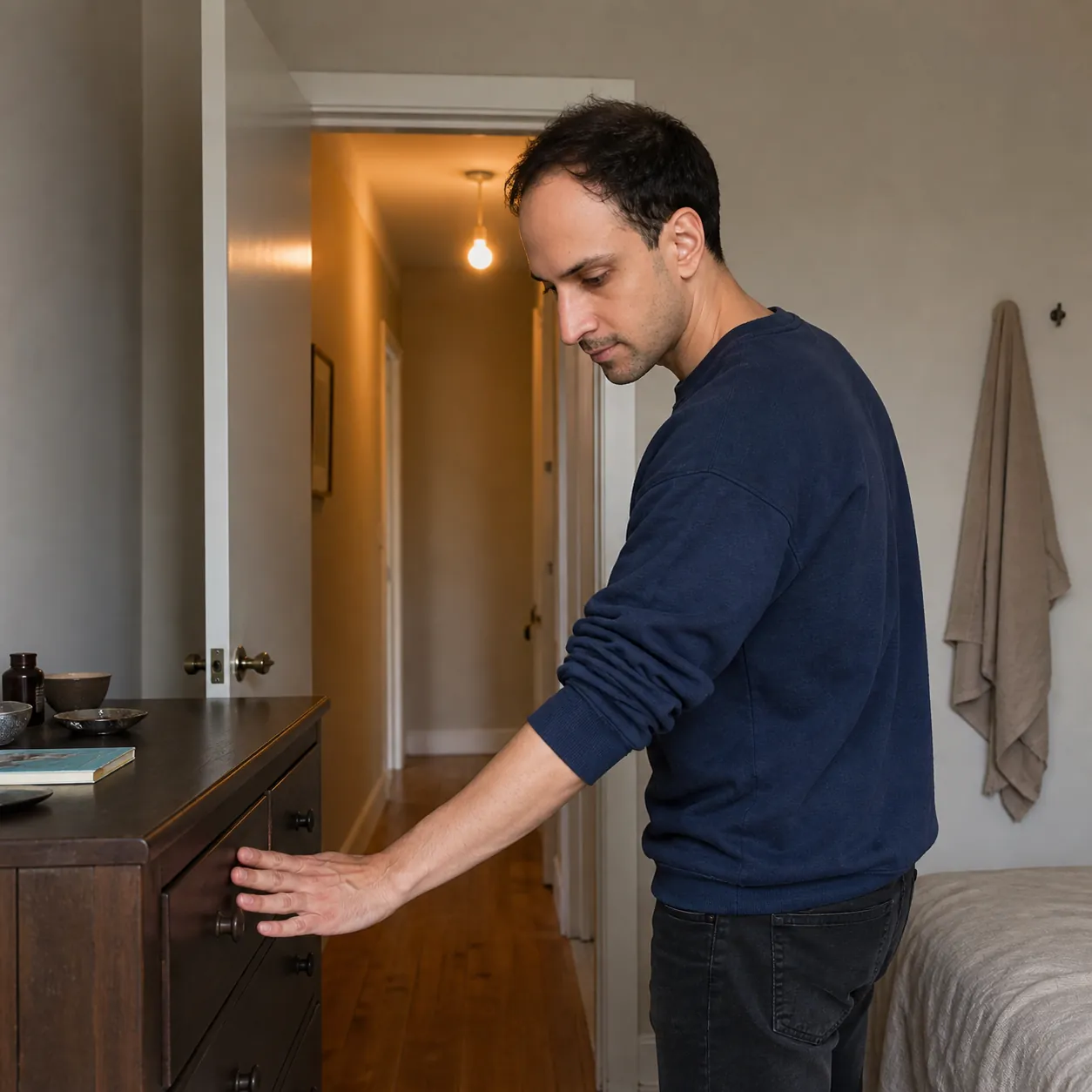
A Drawer, a Palm, a Door — AI Portrait Prompt
صورةAI Portraits

Turn your own photo into a museum-grade domestic portrait in a bedroom corner with a chest of drawers beside the door. Keeps your face unchanged.

من نص البرومبت

Use the attached reference photo as the identity reference: keep the same face, skin tone, hair and features as the person in that photo, without beautifying, aging or altering them. Create a square 1:1 museum-catalog frame with a strong first read and a slower second read at exactly 2880x2880 pixels. Location: a bedroom corner with a chest of drawers beside the door. Show them in a faded navy sweatshirt with the cuffs pushed up, closing a drawer with the flat of one palm. Let one honest object carry what the face will not: a corridor bulb left burning all through a bright afternoon, its switch passed again and again and never touched turns an ordinary chore into a problem of position and sound. Explore how a private precaution turns into ordinary housekeeping without anyone noticing; expression occupied, not expressive, carrying flat competence, difficulty stated without ever naming a reason. Use a 50mm eye-level view from the side of the room they left open. Make the composition keep the far end as legible as their hands. Render it as museum-grade domestic realism built from reportage portraiture, true material response, plain interior architecture, and restrained contemporary art direction, using overcast daylight from one side with no fill on the other and a palette of chalk cream, dark walnut, and low amber lamplight. Photorealistic: this must read as a real photograph from a physical camera, never an illustration, painting, or 3D render. Resolve real surface detail: fine grit in the texture of concrete, efflorescence at damp edges, and hairline cracks that follow stress. Keep one identity-locked person, credible hands and fingers, natural fabric, and coherent scale, contact, reflections, shadows, airflow, deformation, and materials. Background people only when essential, always secondary and clearly different. Avoid hero poses, golden-hour wellness glow, eye contact with the lens, and tear-streaked faces. No text, labels, logos, signatures, watermarks, random symbols, plastic skin, excessive bloom, or glossy AI finish.
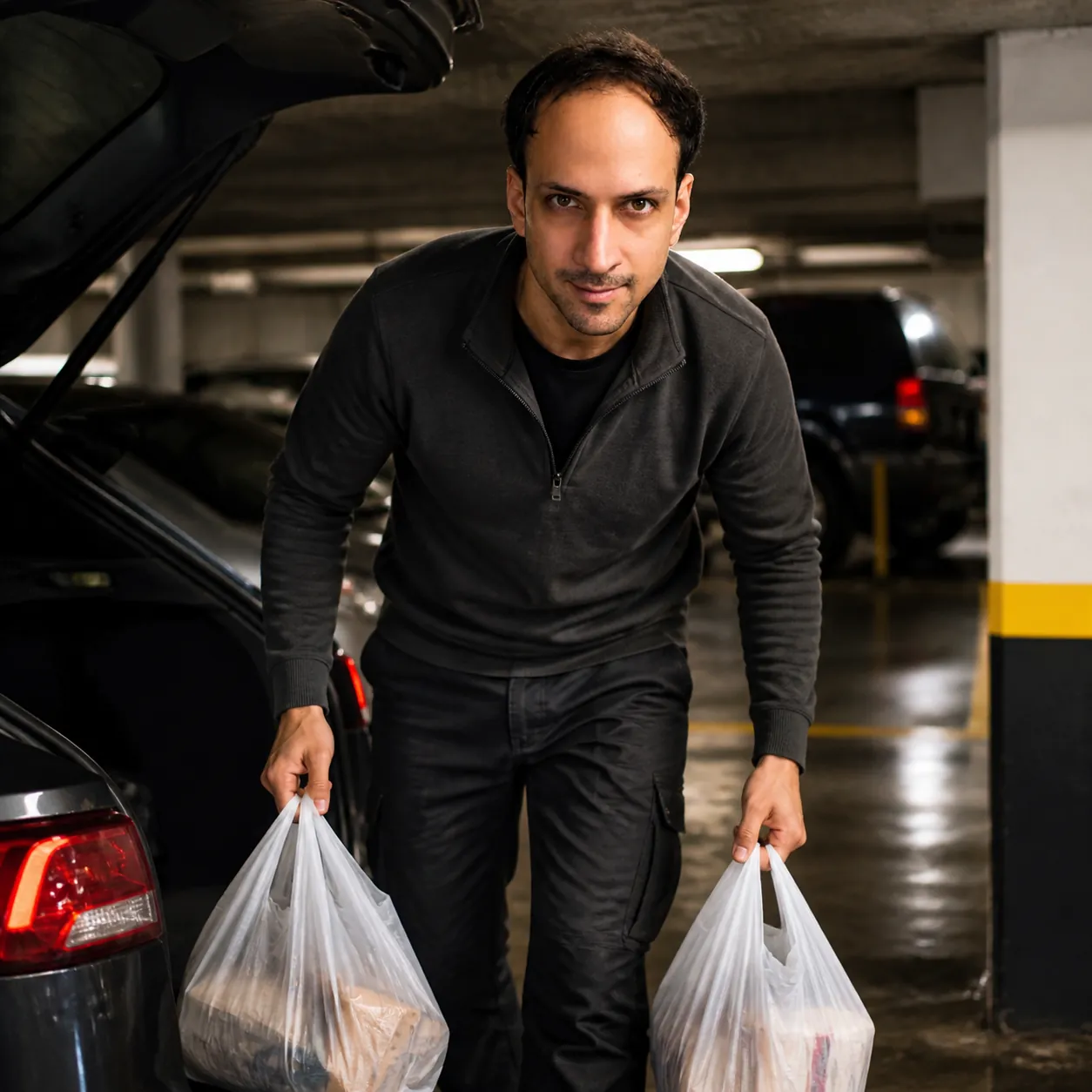
Groceries in the Basement Garage — AI Portrait Prompt
صورةAI Portraits

Turn your own photo into a contemporary reportage portrait in a basement parking level where the ventilation fans never stop. Keeps your face unchanged.

من نص البرومبت

Use the attached reference photo as the identity reference: keep the same face, skin tone, hair and features as the person in that photo, without beautifying, aging or altering them. Create a square 1:1 museum-catalog frame with a strong first read and a slower second read at exactly 2880x2880 pixels. Location: a basement parking level where the ventilation fans never stop. Show the subject in a charcoal quarter-zip over a plain tee and work trousers, lifting two shopping bags clear of the open boot. Anchor the frame to this piece of ordinary evidence: an overhead fitting switched off in favour of one low lamp aimed at the work, brightness treated as a variable shows competence and difficulty occupying the same square metre of floor. Explore how a private adaptation stops being remarkable once it simply works; expression occupied, not expressive, carrying unhurried method, difficulty stated quietly enough to be missed. Frame slightly above the work surface so the task, not the person, occupies the centre. Make the composition place the source of the load outside their line of sight. Render it as contemporary reportage realism combining plain civic interiors, physically accurate material response, working household equipment, and calm documentary distance, using one ceiling fitting doing all the work, shadows short and plain and a palette of chalk white, deep charcoal, and one faded indigo. Photorealistic: this must read as a real photograph from a physical camera, never an illustration, painting, or 3D render. Resolve real surface detail: hair with individual strands catching light, short hairs of uneven length, and skin oil giving a low uneven sheen. Keep one identity-locked person, credible hands and fingers, natural fabric, and coherent scale, contact, reflections, shadows, airflow, deformation, and materials. Background people only when essential, always secondary and clearly different. Avoid glowing sound waves, sensory-overload blur effects, and mood portraits without labour. No text, labels, logos, signatures, watermarks, random symbols, plastic skin, excessive bloom, or glossy AI finish.
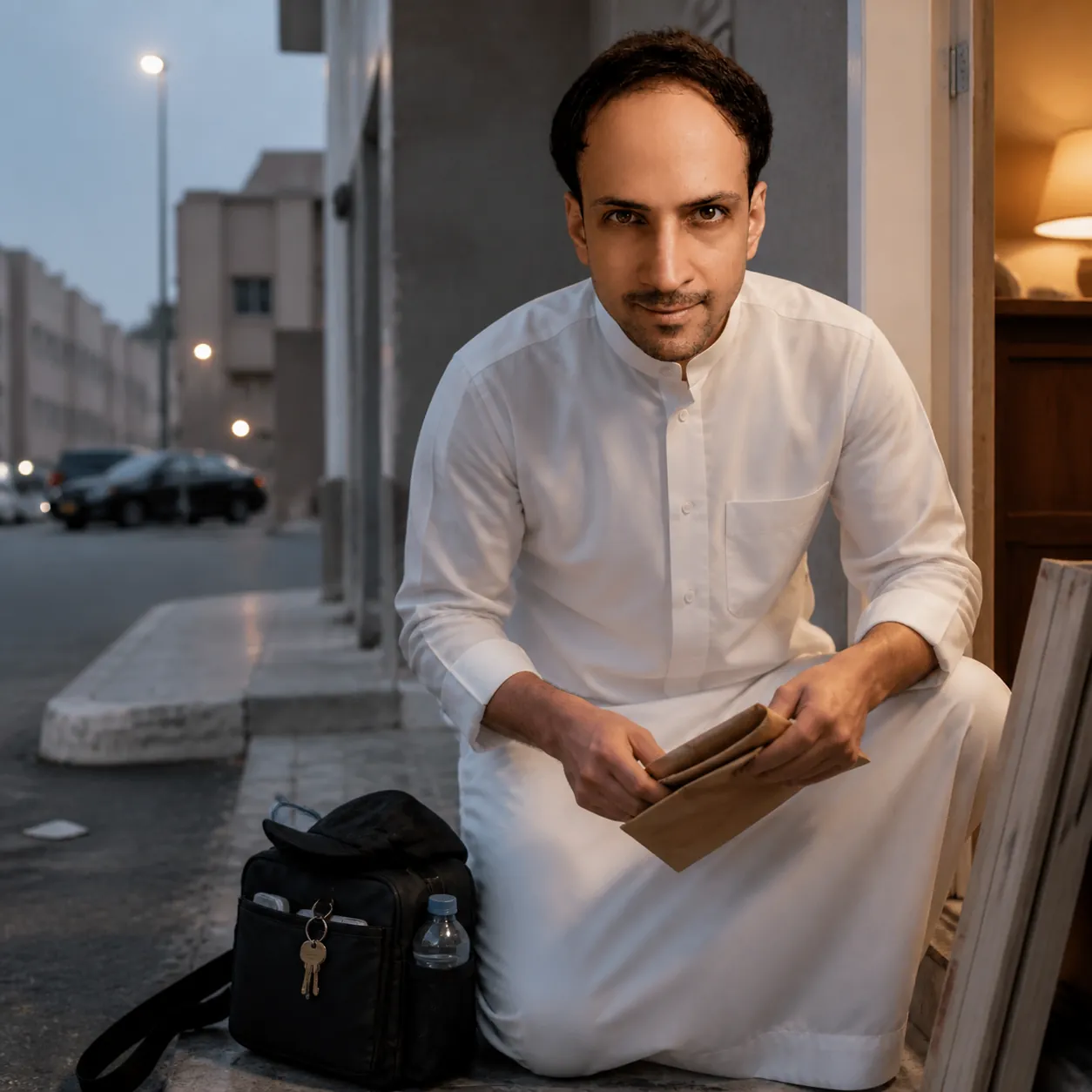
Packed for Twelve Minutes Outside — AI Portrait Prompt
صورةAI Portraits

Turn your own photo into a quiet civic-documentary portrait in the street kerb outside your building where the pavement lights end. Keeps your face unchanged.

من نص البرومبت

Use the attached reference photo as the identity reference: keep the same face, skin tone, hair and features as the person in that photo, without beautifying, aging or altering them. Create a square 1:1 museum-catalog frame with a strong first read and a slower second read at exactly 2880x2880 pixels. Location: the street kerb outside their building where the pavement lights end. Show the subject in a plain white traditional Gulf outfit with the sleeves pushed back once, folding a shopping bag into a tight square. The difficulty must be visible in this, not in their expression: a small shoulder bag that is packed for twelve minutes outside as though for a journey, its water and keys checked twice turns an ordinary errand into the day's largest piece of engineering. Explore how a win too small to mention still costs an entire day; expression occupied, not expressive, carrying measured willingness, difficulty stated quietly enough to require attention. Use a modest 35mm from just inside the door, subject held slightly right of centre. Make the composition let the prepared object outweigh the unfinished journey behind it. Render it as quiet civic-documentary portraiture built from real errand logistics, contemporary Saudi street texture, honest domestic materials, and unhurried observational framing, using pale pre-dawn daylight through a doorway, balanced by one weak interior lamp and a palette of concrete grey, cold white, and one sodium-orange accent. Photorealistic: this must read as a real photograph from a physical camera, never an illustration, painting, or 3D render. Resolve real surface detail: wood grain read at honest scale, matte and gloss clearly separated, and no surface uniformly clean. Keep one identity-locked person, credible hands and fingers, natural fabric, and coherent scale, contact, reflections, shadows, airflow, deformation, and materials. Background people only when essential, always secondary and clearly different. Avoid hero-poster stances, golden-hour wellness glow, posing at camera, and chest-clutching gestures. No text, labels, logos, signatures, watermarks, random symbols, plastic skin, excessive bloom, or glossy AI finish.
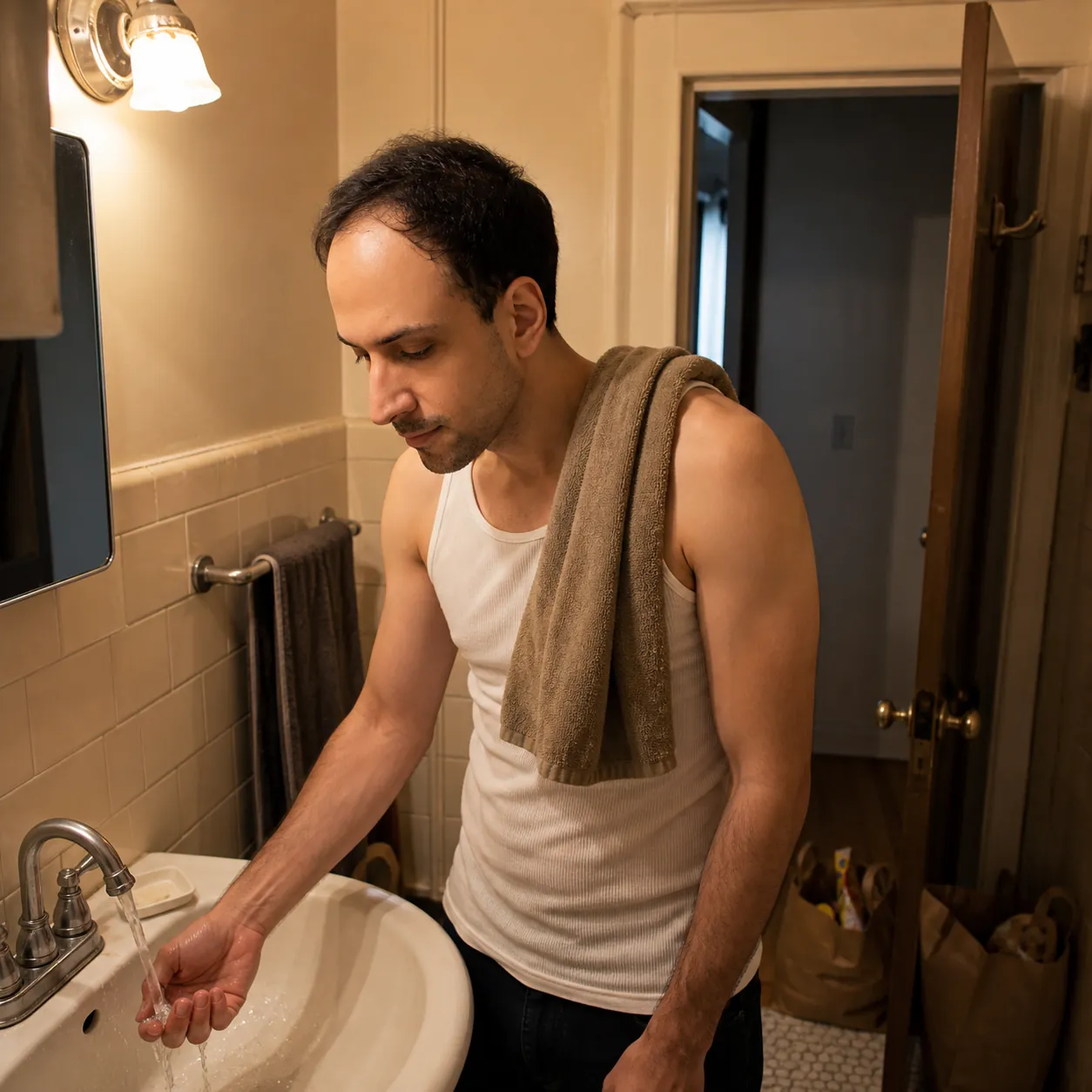
Knowing the Room First — AI Portrait Prompt
صورةAI Portraits

Turn your own photo into a quiet domestic documentary portrait in a bathroom lit by one wall lamp, its door hooked open. Keeps your face unchanged.

من نص البرومبت

Use the attached reference photo as the identity reference: keep the same face, skin tone, hair and features as the person in that photo, without beautifying, aging or altering them. Create a square 1:1 museum-catalog frame with a strong first read and a slower second read at exactly 2880x2880 pixels. Location: a bathroom lit by one wall lamp, its door hooked open. Show them in a plain white undershirt with a towel across one shoulder, rinsing the basin down with one cupped hand. Make this piece of unglamorous evidence the whole argument: a pair of grocery bags left just inside the door and emptied one item at a time from there turns an ordinary chore into a problem of position and sound. Explore why finishing the task matters less to them than knowing the room; expression occupied, not expressive, carrying steady alertness, difficulty stated the way furniture states itself. Use a 40mm chest-height viewpoint that includes the room's depth without dramatizing it. Make the composition give the room's emptiest part the sharpest detail. Render it as quiet domestic documentary realism combining unposed portrait photography, honest interior materials, accurate household light, and unhurried observational framing, using one corridor bulb doing most of the work with soft ambient spill and a palette of chalk cream, dark walnut, and low amber lamplight. Photorealistic: this must read as a real photograph from a physical camera, never an illustration, painting, or 3D render. Resolve real surface detail: grout darker than tile, sealant slightly yellowed, and every joint showing a real tolerance gap. Keep one identity-locked person, credible hands and fingers, natural fabric, and coherent scale, contact, reflections, shadows, airflow, deformation, and materials. Background people only when essential, always secondary and clearly different. Avoid hero poses, golden-hour wellness glow, eye contact with the lens, and tear-streaked faces. No text, labels, logos, signatures, watermarks, random symbols, plastic skin, excessive bloom, or glossy AI finish.
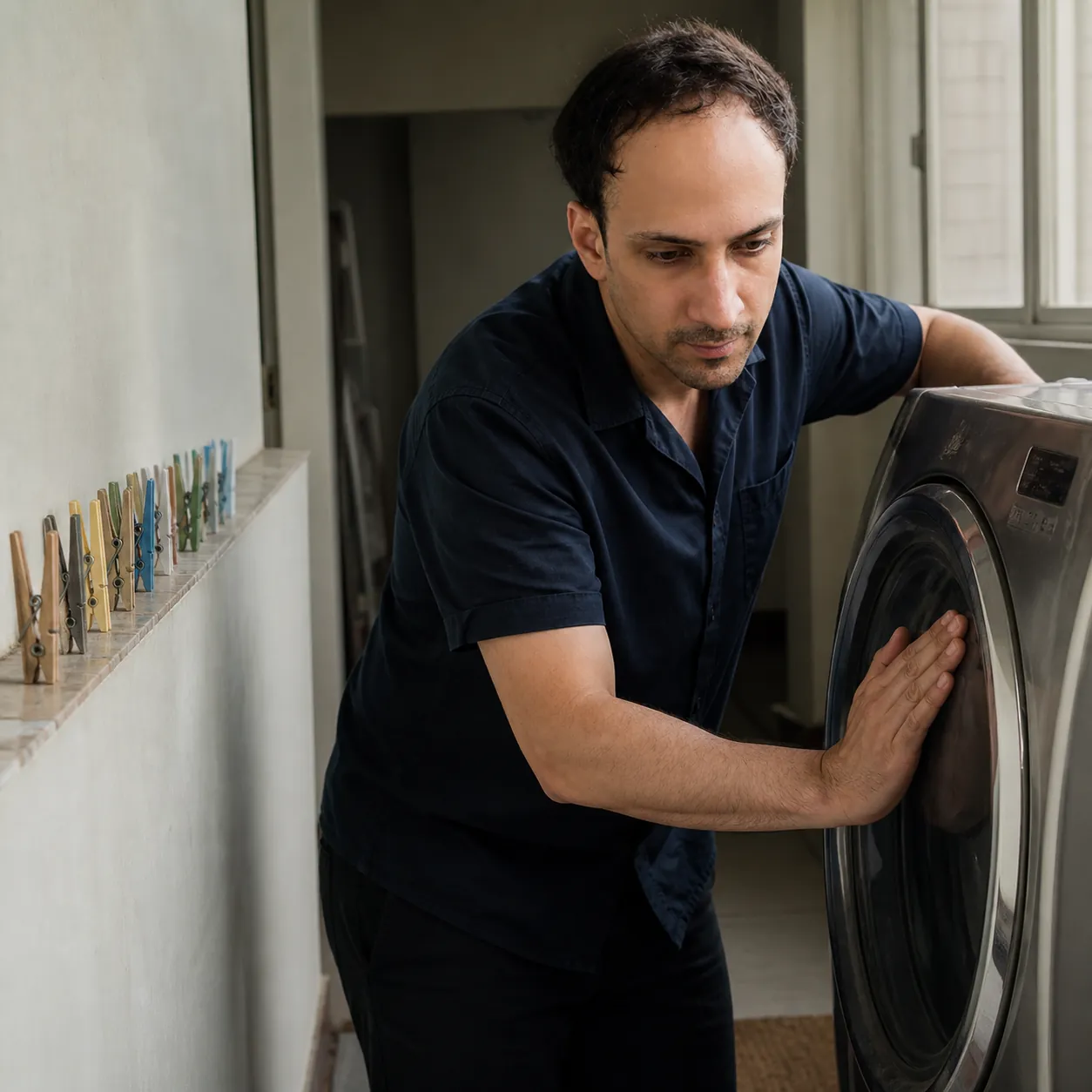
Pegs That Mark the Steps — AI Portrait Prompt
صورةAI Portraits

Turn your own photo into a quiet domestic documentary portrait in a small utility room off a Jeddah apartment hallway. Keeps your face unchanged.

من نص البرومبت

Use the attached reference photo as the identity reference: keep the same face, skin tone, hair and features as the person in that photo, without beautifying, aging or altering them. Create a square 1:1 museum-catalog frame with a strong first read and a slower second read at exactly 2880x2880 pixels. Location: a small utility room off a Jeddah apartment hallway. Show the subject in a short-sleeved navy shirt worn loose over dark cotton trousers, pressing a machine door shut with one palm. Build the image around this small, exact tableau: a line of clothes pegs along a ledge that mark the steps they have had to work out from scratch turns a five-minute job into an hour of starting the order again. Explore whether a rebuilt routine can ever feel as cheap as the original; expression occupied, not expressive, carrying steady insistence, difficulty stated quietly, in the objects alone. Frame at chest height so the object and their working hands share one plane. Make the composition keep the changed object sharp and everything habitual soft. Render it as quiet domestic documentary realism built from unposed observation, honest household materials, accurate skin rendering, and restrained contemporary art direction, using flat overcast daylight through one window, no shaped highlights and a palette of muted olive, chalk white, and dulled brushed steel. Photorealistic: this must read as a real photograph from a physical camera, never an illustration, painting, or 3D render. Resolve real surface detail: brass darkened in the recesses and bright where thumbs land, and lacquer crazed rather than perfect. Keep one identity-locked person, credible hands and fingers, natural fabric, and coherent scale, contact, reflections, shadows, airflow, deformation, and materials. Background people only when essential, always secondary and clearly different. Avoid hero poses, golden-hour wellness glow, eye contact with the lens, minimalist styling, and puzzle-piece symbolism. No text, labels, logos, signatures, watermarks, random symbols, plastic skin, excessive bloom, or glossy AI finish.

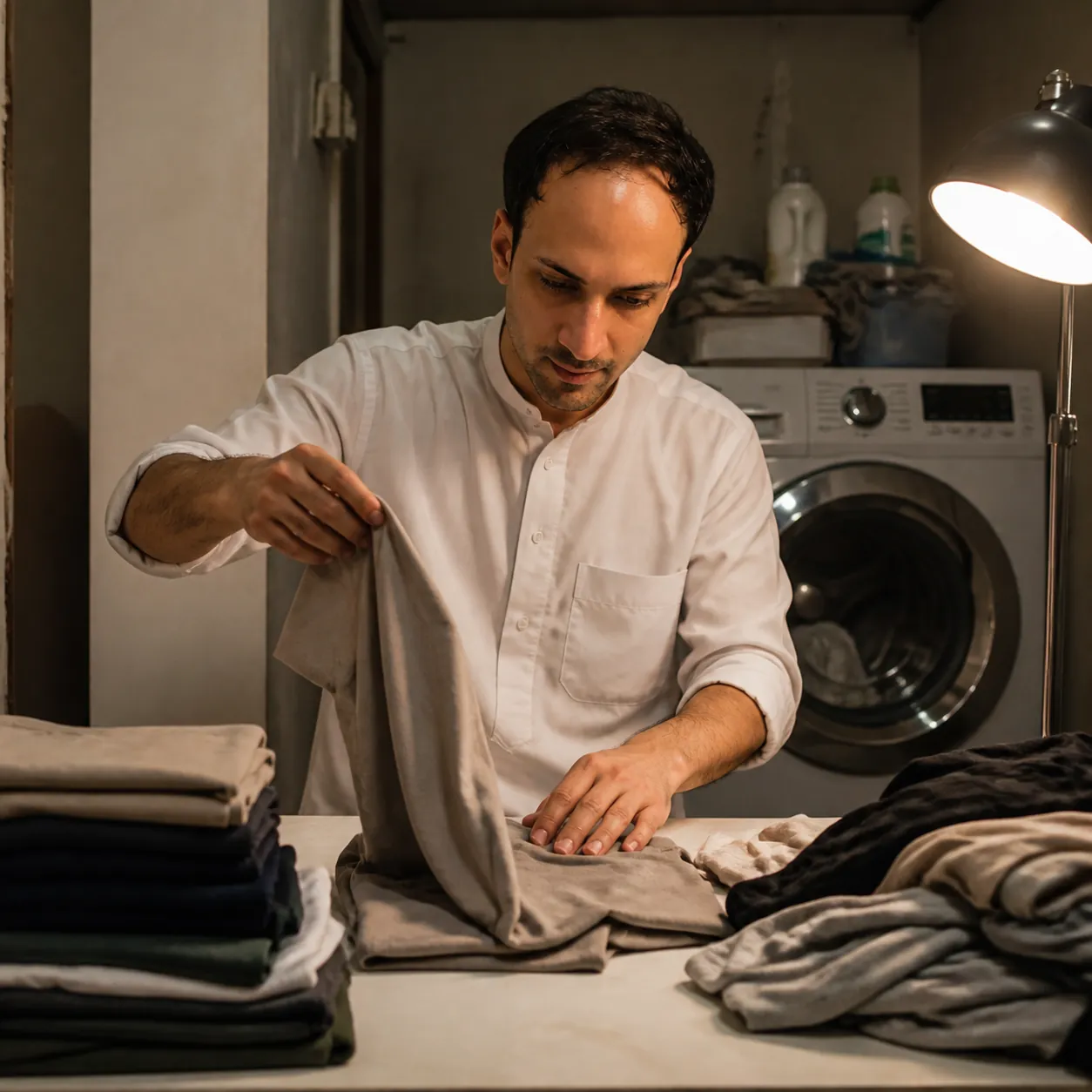
Sorting Laundry by Feel — AI Portrait Prompt
صورةAI Portraits

Turn your own photo into a museum-grade observational portrait in a utility alcove off the hallway with a front-loading machine. Keeps your face unchanged.

من نص البرومبت

Use the attached reference photo as the identity reference: keep the same face, skin tone, hair and features as the person in that photo, without beautifying, aging or altering them. Create a square 1:1 museum-catalog frame with a strong first read and a slower second read at exactly 2880x2880 pixels. Location: a utility alcove off the hallway with a front-loading machine. Show them in a plain white traditional Gulf outfit with both sleeves folded once, dividing a laundry pile into two stacks by feel. Anchor the frame to this piece of ordinary evidence: a room running three sounds at once with one switch already chosen, the least necessary source picked to stop first shows competence and difficulty occupying the same square metre of floor. Explore where the difficulty actually sits when the finished result looks entirely unremarkable; expression occupied, not expressive, carrying unhurried method, difficulty stated in the flattest possible voice. Frame slightly above the work surface so the task, not the person, occupies the centre. Make the composition let one unfinished half of the task stay honestly in frame. Render it as museum-grade observational portraiture built from ordinary domestic labour, accurate surface texture, plain interior architecture, and restrained contemporary art direction, using a single low lamp against an otherwise dim room and a palette of unbleached cotton, dull steel, and one olive note. Photorealistic: this must read as a real photograph from a physical camera, never an illustration, painting, or 3D render. Resolve real surface detail: dust settled where nobody wipes, fingerprint haze on glass, and edges rubbed pale by handling. Keep one identity-locked person, credible hands and fingers, natural fabric, and coherent scale, contact, reflections, shadows, airflow, deformation, and materials. Background people only when essential, always secondary and clearly different. Avoid glowing sound waves, sensory-overload blur effects, and mood portraits without labour. No text, labels, logos, signatures, watermarks, random symbols, plastic skin, excessive bloom, or glossy AI finish.
