جاري التحميل...


جاري التحميل...
Create a square 1:1 museum-catalog frame with a strong first read and a slower second read at exactly 2880x2880 pixels. Location: an enclosed service...
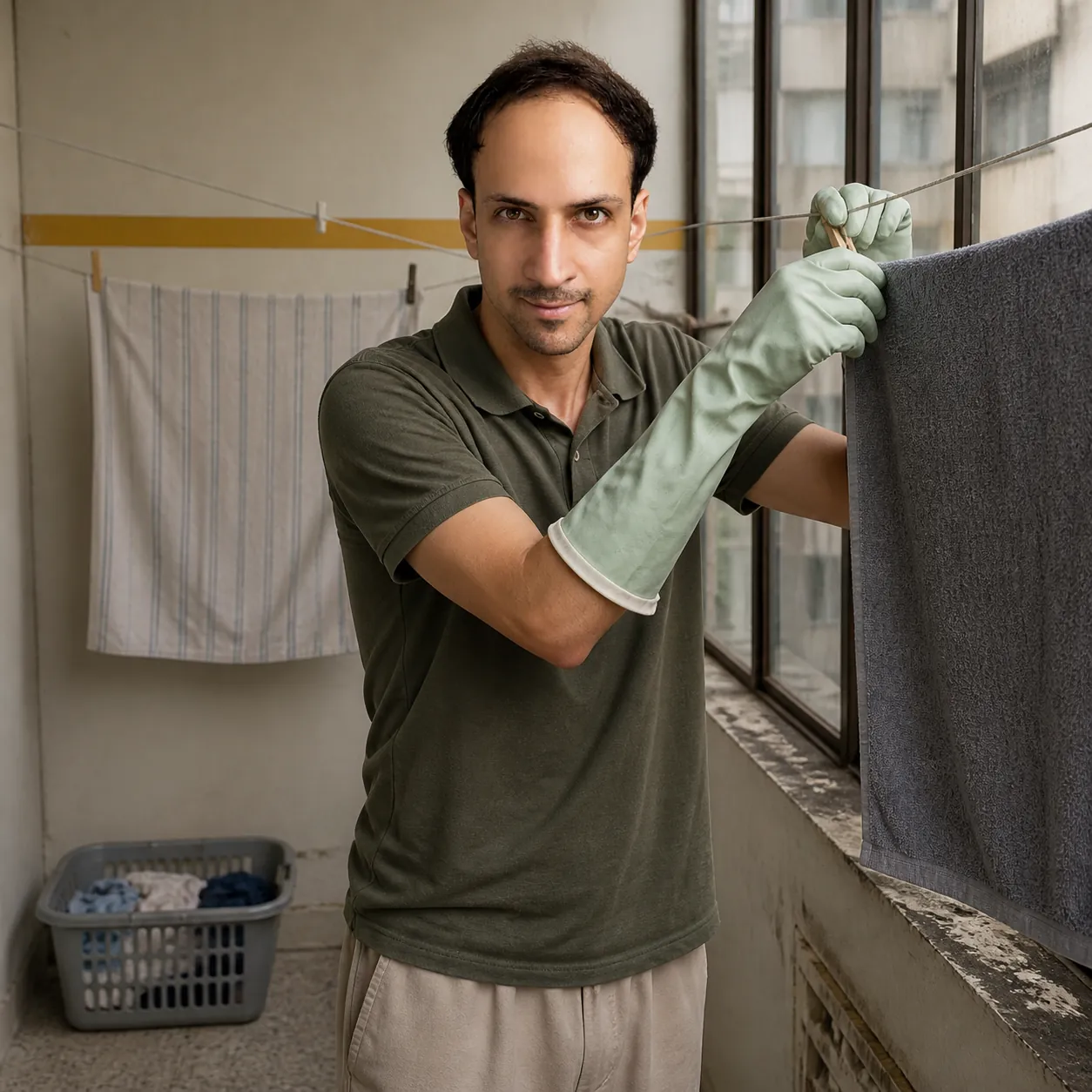
Use the attached reference photo as the identity reference: keep the same face, skin tone, hair and features as the person in that photo, without beautifying, aging or altering them. Create a square 1:1 museum-catalog frame with a strong first read and a slower second read at exactly 2880x2880 pixels. Location: an enclosed service balcony where a washing line crosses at head height. Show them in a faded olive polo shirt and loose cotton trousers, pegging one heavy towel along the line's near end. The difficulty must be visible in this, not in their expression: a pair of long rubber gloves pulled on for a job that does not need them, cuffs turned back at the forearm shows competence and difficulty occupying the same square metre of floor. Explore what a completed chore is worth when the route to it was expensive; expression occupied, not expressive, carrying sober persistence, difficulty stated as one more logistical fact. Use a 35mm standing viewpoint with true proportions and no wide-angle distortion at the edges. Make the composition keep the finished part of the chore visible at one edge. Render it as museum-grade observational portraiture built from ordinary domestic labour, accurate surface texture, plain interior architecture, and restrained contemporary art direction, using even overcast light with accurate skin tone and no bloom and a palette of soap grey, warm plaster, and one ochre band. Photorealistic: this must read as a real photograph from a physical camera, never an illustration, painting, or 3D render. Resolve real surface detail: thread ends and slight pilling on worn cloth, hairline chips at every hard corner, and stone that is porous rather than smooth. Keep one identity-locked person, credible hands and fingers, natural fabric, and coherent scale, contact, reflections, shadows, airflow, deformation, and materials. Background people only when essential, always secondary and clearly different. Avoid glowing sound waves, sensory-overload blur effects, and mood portraits without labour. No text, labels, logos, signatures, watermarks, random symbols, plastic skin, excessive bloom, or glossy AI finish.
Treat that reference as the character anchor and change only the scene. Create a square 1:1 museum-catalog frame with a strong first read and a slower...
Treat that reference as the character anchor and change only the scene. Create a square 1:1 museum-catalog frame with a strong first read and a slower...
Treat that reference as the character anchor and change only the scene. Create a square 1:1 museum-catalog frame with a strong first read and a slower...
Treat that reference as the character anchor and change only the scene. Create a square 1:1 museum-catalog frame with a strong first read and a slower...
Treat that reference as the character anchor and change only the scene. Create a square 1:1 museum-catalog frame with a strong first read and a slower...
Treat that reference as the character anchor and change only the scene. Create a square 1:1 museum-catalog frame with a strong first read and a slower...
Treat that reference as the character anchor and change only the scene. Create a square 1:1 museum-catalog frame with a strong first read and a slower...
Treat that reference as the character anchor and change only the scene. Create a square 1:1 museum-catalog frame with a strong first read and a slower...
Treat that reference as the character anchor and change only the scene. Create a square 1:1 museum-catalog frame with a strong first read and a slower...
Treat that reference as the character anchor and change only the scene. Create a square 1:1 museum-catalog frame with a strong first read and a slower...
Treat that reference as the character anchor and change only the scene. Create a square 1:1 museum-catalog frame with a strong first read and a slower...
Treat that reference as the character anchor and change only the scene. Create a square 1:1 museum-catalog frame with a strong first read and a slower...