جاري التحميل...


جاري التحميل...
Treat that reference as the character anchor and change only the scene. Create a square 1:1 museum-catalog frame with a strong first read and a slower...
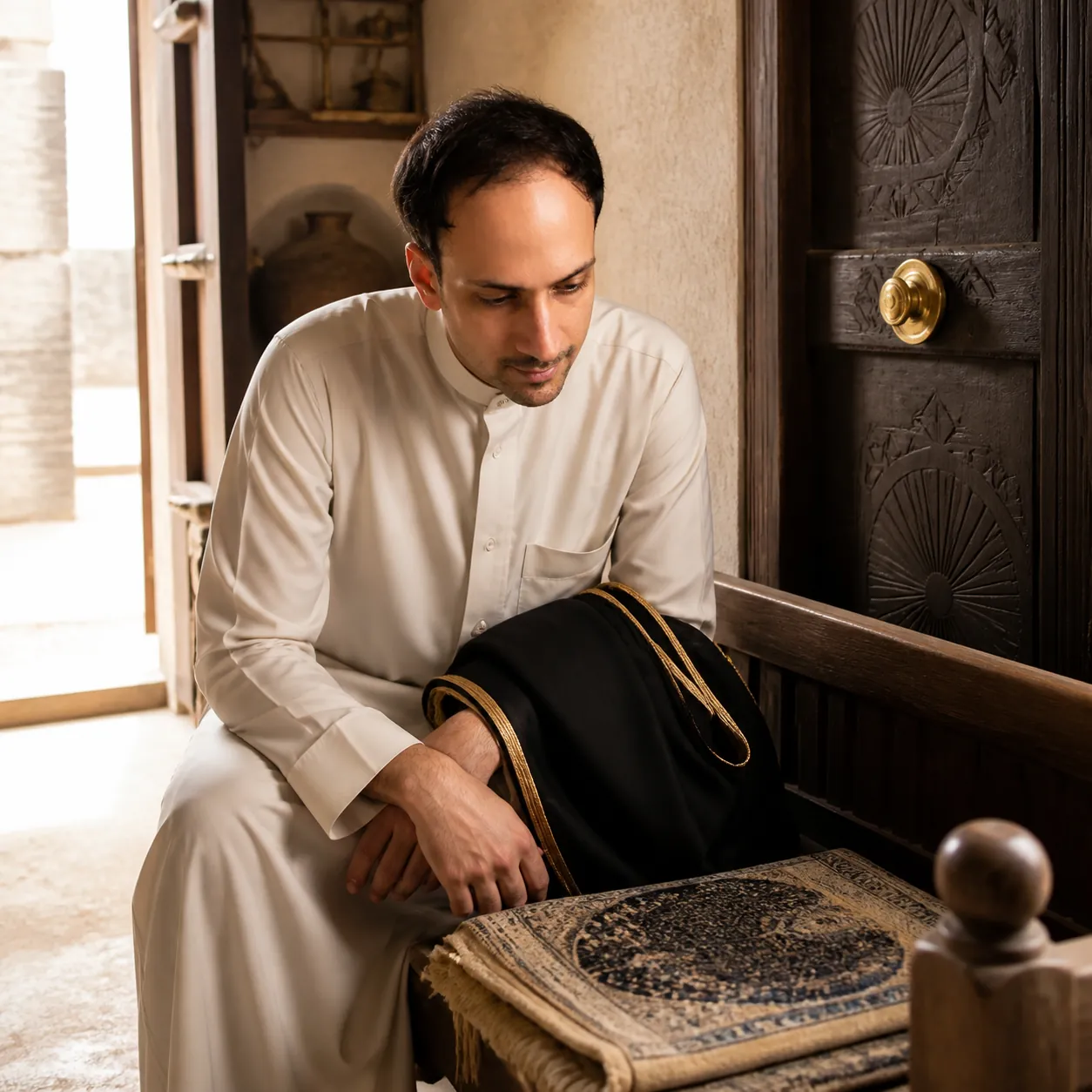
Use the attached reference photo as the identity reference: keep the same face, skin tone, hair and features as the person in that photo, without beautifying, aging or altering them. Treat that reference as the character anchor and change only the scene. Create a square 1:1 museum-catalog frame with a strong first read and a slower second read at exactly 2880x2880 pixels. Location: a bench beside a carved door whose brass pull shines from a century of palms. Show the subject in a cream traditional Gulf outfit with a dark bisht folded over their arm, sitting forward, forearms on knees, facing the old door. Read this small surface as the document it is: a folded prayer rug whose pile carries two soft flattened ovals pressed in by decades of kneeling testifies to constancy more credibly than any spoken claim. Explore what it means to inherit an object already shaped by another person's constancy; expression open and unforced, carrying settled fondness, the attention held without ceremony or announcement. Take a 35mm three-quarter view from inside the room, doorway light behind them. Make the composition bury the brightest wear at an edge where patience finds it. Render it as quiet archival realism combining lived-in Saudi interiors, generational objects, natural handling marks, and light that respects age, using open-door daylight laying a long bright wedge across the floor and a palette of sunburnt beige, iron black, and one soft leather tan. Photorealistic: this must read as a real photograph from a physical camera, never an illustration, painting, or 3D render. Keep one identity-locked person, credible hands and fingers, natural fabric, and coherent scale, contact, reflections, shadows, airflow, deformation, and materials. Background people only when essential, always secondary and clearly different. Avoid museum vitrines, white gloves, catalogue cards, dramatic spotlighting, and any restoration gloss. No text, labels, logos, signatures, watermarks, random symbols, plastic skin, excessive bloom, or glossy AI finish.
Treat that reference as the character anchor and change only the scene. Create a square 1:1 museum-catalog frame with a strong first read and a slower...
Treat that reference as the character anchor and change only the scene. Create a square 1:1 museum-catalog frame with a strong first read and a slower...
Treat that reference as the character anchor and change only the scene. Create a square 1:1 museum-catalog frame with a strong first read and a slower...
Treat that reference as the character anchor and change only the scene. Create a square 1:1 museum-catalog frame with a strong first read and a slower...
Treat that reference as the character anchor and change only the scene. Create a square 1:1 museum-catalog frame with a strong first read and a slower...
Treat that reference as the character anchor and change only the scene. Create a square 1:1 museum-catalog frame with a strong first read and a slower...
Treat that reference as the character anchor and change only the scene. Create a square 1:1 museum-catalog frame with a strong first read and a slower...
Treat that reference as the character anchor and change only the scene. Create a square 1:1 museum-catalog frame with a strong first read and a slower...
Treat that reference as the character anchor and change only the scene. Create a square 1:1 museum-catalog frame with a strong first read and a slower...
Treat that reference as the character anchor and change only the scene. Create a square 1:1 museum-catalog frame with a strong first read and a slower...
Treat that reference as the character anchor and change only the scene. Create a square 1:1 museum-catalog frame with a strong first read and a slower...
Treat that reference as the character anchor and change only the scene. Create a square 1:1 museum-catalog frame with a strong first read and a slower...