جاري التحميل...


جاري التحميل...
Treat that reference as the character anchor and change only the scene. Create a square 1:1 museum-catalog frame with a strong first read and a slower...
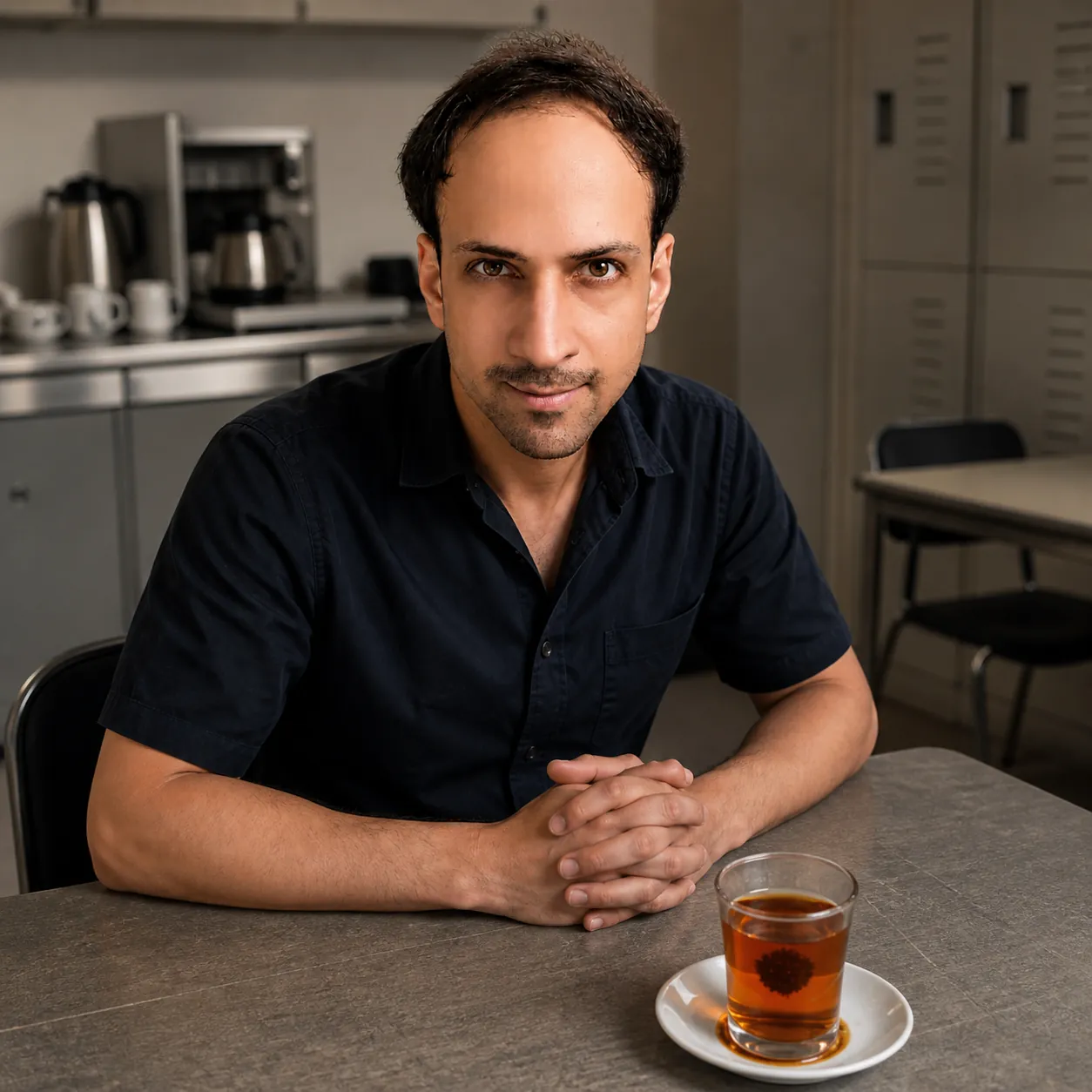
Use the attached reference photo as the identity reference: keep the same face, skin tone, hair and features as the person in that photo, without beautifying, aging or altering them. Treat that reference as the character anchor and change only the scene. Create a square 1:1 museum-catalog frame with a strong first read and a slower second read at exactly 2880x2880 pixels. Location: a staff-room table in the slow hour of a night shift. Show them in a plain dark uniform shirt with the top button open, sitting square to the table, hands loosely clasped before them. Make this the discovery a viewer earns: a stirred glass of tea in which every loose leaf has abandoned the rim and gathered at the exact center runs a law of nature at the scale of one saucer. Explore how a saucer can run the same physics a laboratory pays millions to watch; expression open and unforced, carrying settled interest, the attention held without any announcement of wonder. Take a 35mm three-quarter view running a diagonal from their gaze to the saucer. Make the composition lead the eye from their gaze down to the glass and back. Render it as gallery-grade still-life realism assembling worn table surfaces, precise liquid rendering, soft believable reflections, and a sitter who belongs to the room, using clean even daylight from a light well, shadowless and honest and a palette of brushed steel, off-white, and one quiet brass warmth. Photorealistic: this must read as a real photograph from a physical camera, never an illustration, painting, or 3D render. Keep one identity-locked person, credible hands and fingers, natural fabric, and coherent scale, contact, reflections, shadows, airflow, deformation, and materials. Background people only when essential, always secondary and clearly different. Avoid splash spectacle, staged laboratory glassware, magnified insets, diagram overlays, and any hint of demonstration setup. No text, labels, logos, signatures, watermarks, random symbols, plastic skin, excessive bloom, or glossy AI finish.
Treat that reference as the character anchor and change only the scene. Create a square 1:1 museum-catalog frame with a strong first read and a slower...
Treat that reference as the character anchor and change only the scene. Create a square 1:1 museum-catalog frame with a strong first read and a slower...
Treat that reference as the character anchor and change only the scene. Create a square 1:1 museum-catalog frame with a strong first read and a slower...
Treat that reference as the character anchor and change only the scene. Create a square 1:1 museum-catalog frame with a strong first read and a slower...
Treat that reference as the character anchor and change only the scene. Create a square 1:1 museum-catalog frame with a strong first read and a slower...
Treat that reference as the character anchor and change only the scene. Create a square 1:1 museum-catalog frame with a strong first read and a slower...
Treat that reference as the character anchor and change only the scene. Create a square 1:1 museum-catalog frame with a strong first read and a slower...
Treat that reference as the character anchor and change only the scene. Create a square 1:1 museum-catalog frame with a strong first read and a slower...
Treat that reference as the character anchor and change only the scene. Create a square 1:1 museum-catalog frame with a strong first read and a slower...
Treat that reference as the character anchor and change only the scene. Create a square 1:1 museum-catalog frame with a strong first read and a slower...
Treat that reference as the character anchor and change only the scene. Create a square 1:1 museum-catalog frame with a strong first read and a slower...
Treat that reference as the character anchor and change only the scene. Create a square 1:1 museum-catalog frame with a strong first read and a slower...