جاري التحميل...

جاري التحميل...
Convert the implementation brief into a visual interface system for a quiet Taif workspace.
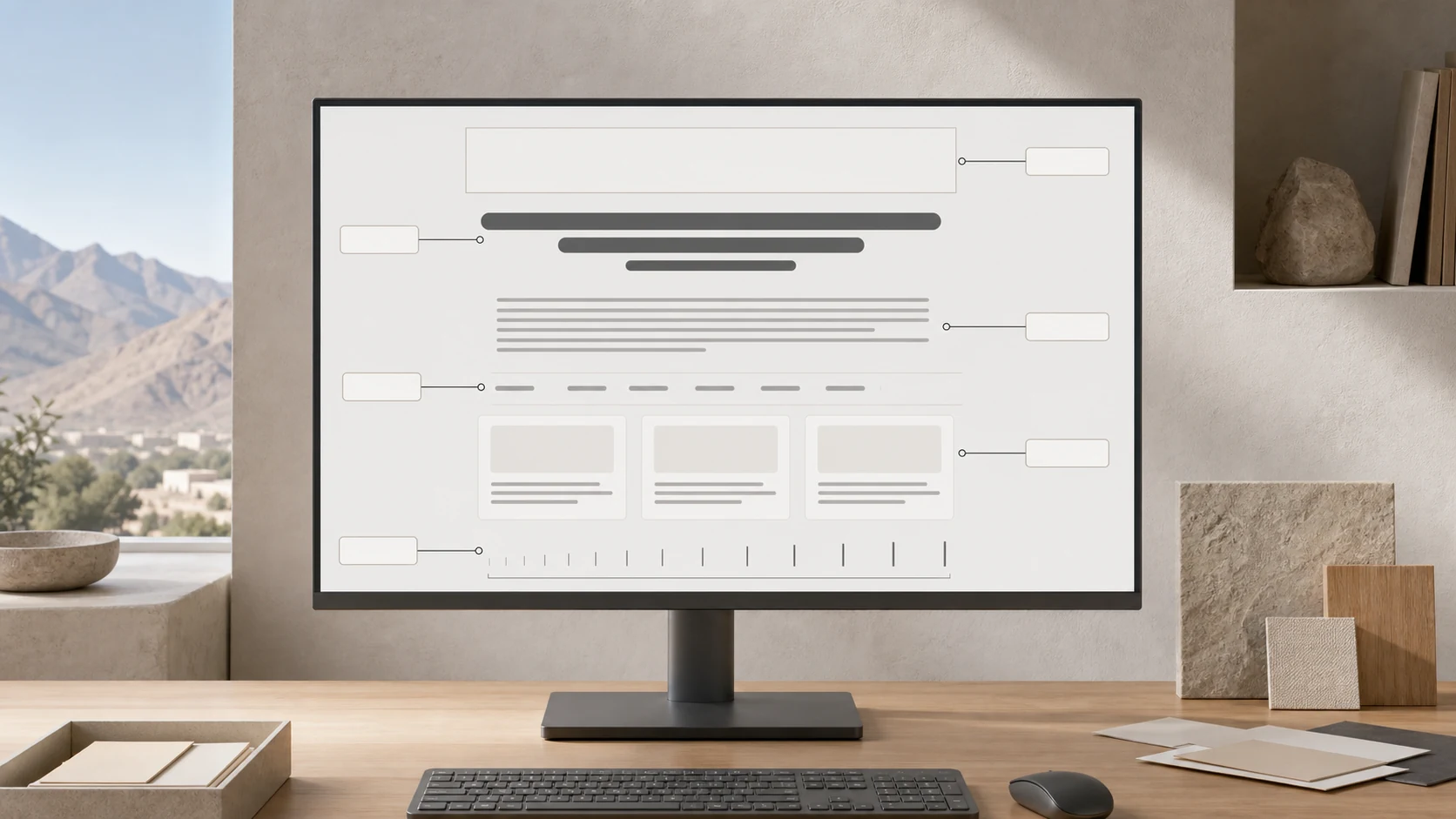
Convert the source implementation brief into a contemporary Hejaz UI mockup in 16:9, shown within a quiet Taif workspace. Visualize a coherent Arabic-first web type system through an unbranded desktop interface with a strong display tier, calm reading tier, compact navigation tier, reusable cards, and consistent spacing rhythm. Use an architectural frame, pale highland daylight, restrained stone, wood, paper, and matte metal, with clear hierarchy and accessible contrast. Reserve one clean blank title area and six clean blank numbered callout label slots; place each blank callout target beside its corresponding leader line for professional post-typesetting after generation. Do not generate text, letters, numbers, labels, logos, wordmarks, readable interfaces, or code. Include no people.
A prompt to kick start a web design project. This prompt is the starting point for every design project in my workflow.
Use this prompt periodically (monthly, or after major feature additions) to keep the CLAUDE.md in sync with the actual codebase. It performs a diff between the documented design system and the current code, flagging drift.
Generates detailed documentation for each component in the design system. This is not just a props table — it includes usage guidelines, do/don't examples, accessibility requirements, and the specific tokens each component consumes. The output becomes the component section of the CLAUDE.md.
Transforms any idea into a clean, premium, Apple-inspired UI system with real design discipline and production-ready structure. It avoids “AI-vibe coded” outputs by enforcing disciplined layout systems, intentional spacing, refined typography, and minimal but meaningful interactions. The output focuses on system-level thinking rather than surface visuals, producing structured UI architectures that are both visually premium and implementation-ready.
Systematically checks a built design against its intended specification across browsers, devices, and edge cases. This is the designer's QA not functional testing, but visual fidelity and interaction quality. Produces a categorized issue list with exact reproduction steps and suggested fixes
Generates a design handoff document that serves as direct implementation instructions for AI coding agents. Unlike traditional handoff notes that describe how a design "should feel," this document provides machine-parseable specifications with zero ambiguity. Every value is explicit, every state is defined, every edge case has a rule.
Generates a comprehensive, project-specific pre-launch checklist covering every category a designer should verify before going live. Not a generic list it's tailored to the specific project's tech stack, features, and requirements.
Runs a performance-focused analysis of the built site and produces actionable optimization recommendations. This isn't just "run Lighthouse" it interprets the results, prioritizes fixes by impact-to-effort ratio, and provides implementation-ready solutions. Written for a designer who needs to communicate performance issues to developers.
senior market research analyst specializing in digital advertising and cross-border e-commerce.
Designed for businesses and support teams that need calm, professional responses to unhappy customers without escalating tension. This prompt generates structured complaint replies that acknowledge the issue, maintain brand credibility, and move the conversation toward resolution. Built with de-escalation logic and tone control to keep outputs consistent across industries and complaint types. The final response is concise, customer-safe, and ready to send.
An assistant that establishes a session goal, utilizes browser context, and confirms user input when uncertain.
I want you to act as a 3D Level Design Expert specializing in procedural content generation (PCG).