جاري التحميل...


جاري التحميل...
Create a square 1:1 museum-catalog frame with a strong first read and a slower second read at exactly 2880x2880 pixels. Location: a traditional tea house an...
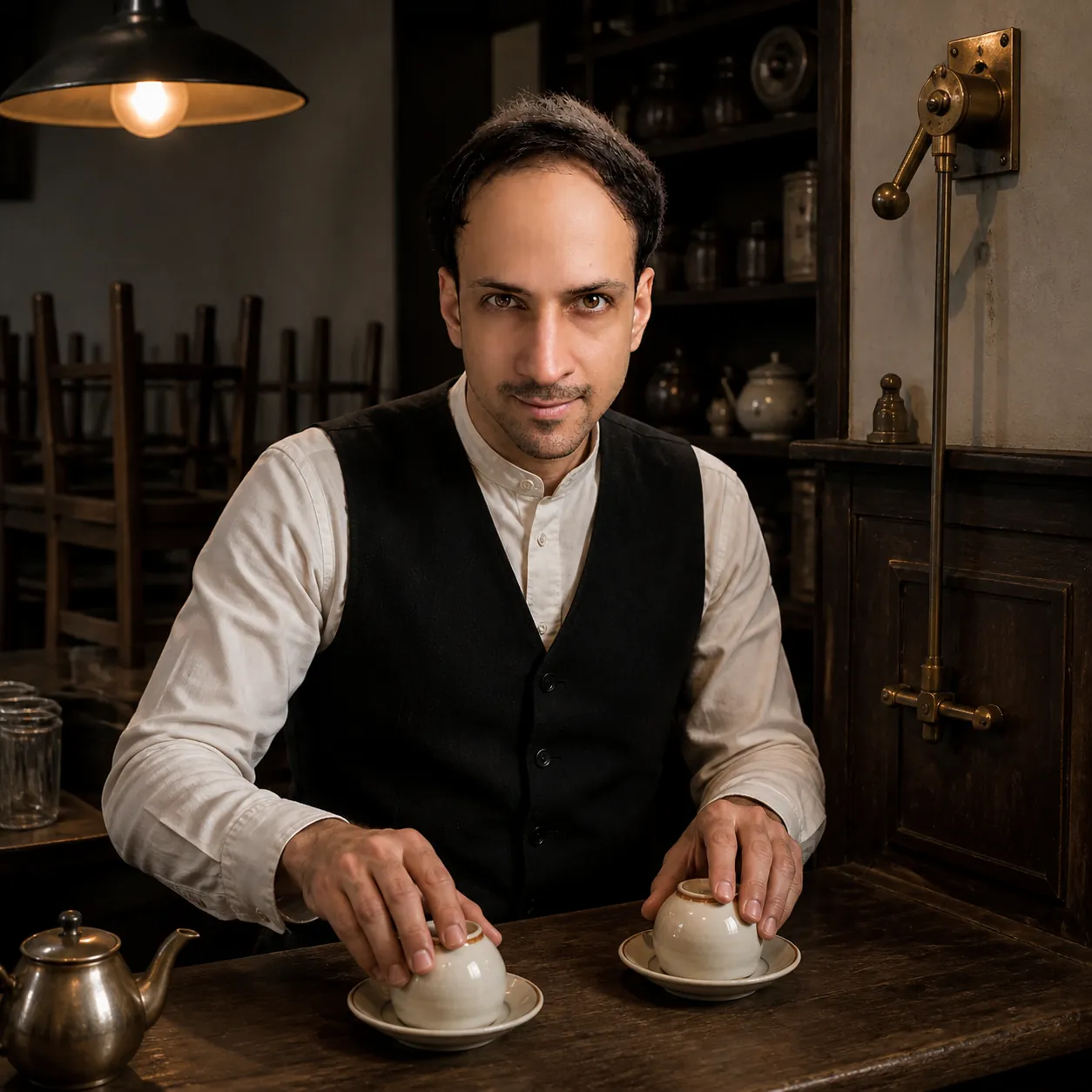
Use the attached reference photo as the identity reference: keep the same face, skin tone, hair and features as the person in that photo, without beautifying, aging or altering them. Create a square 1:1 museum-catalog frame with a strong first read and a slower second read at exactly 2880x2880 pixels. Location: a traditional tea house an hour before opening, chairs down. Show the subject in a collarless off-white shirt under a dark waistcoat, sleeves neat, turning two cups mouth-down on their saucers. The impossible-looking event must obey this clear system: a two-position brass wall lever resting in its first detent, its linkage rod running down to a still-latched cupboard door lets the turn from appetite to steadiness be read like plain machinery. Explore what changes in a meal that has been promised rather than merely delayed; direct expression and posture toward unhurried resolve, never melodrama or ad-like confidence. Use an 85mm near-portrait distance, the nearest staged detail sharp low in frame while their expression carries the far plane. Make the composition leave deliberate distance between them and what waits. Render it as restrained interior photography combining honest mechanical staging, tactile everyday objects, disciplined negative space, and documentary-grade skin and fabric rendering, using one low-hung shaded lamp holding a tight warm circle around them and a palette of chalk, dark tea brown, and a thread of copper. Photorealistic: this must read as a real photograph from a physical camera, never an illustration, painting, or 3D render. Resolve real surface detail: condensation beading at true size, liquid meniscus curving against glass, and wet surfaces darker than dry ones. Keep one identity-locked person, credible hands and fingers, natural fabric, and coherent scale, contact, reflections, shadows, airflow, deformation, and materials. Background people only when essential, always secondary and clearly different. Avoid tape-measure diet props, empty-fridge gloom, ringing alarm clocks, glossy food-commercial styling, and gravity-defying hourglass sand. No text, labels, logos, signatures, watermarks, random symbols, plastic skin, excessive bloom, or glossy AI finish.
Treat that reference as the character anchor and change only the scene. Create a square 1:1 museum-catalog frame with a strong first read and a slower...
Treat that reference as the character anchor and change only the scene. Create a square 1:1 museum-catalog frame with a strong first read and a slower...
Treat that reference as the character anchor and change only the scene. Create a square 1:1 museum-catalog frame with a strong first read and a slower...
Treat that reference as the character anchor and change only the scene. Create a square 1:1 museum-catalog frame with a strong first read and a slower...
Treat that reference as the character anchor and change only the scene. Create a square 1:1 museum-catalog frame with a strong first read and a slower...
Treat that reference as the character anchor and change only the scene. Create a square 1:1 museum-catalog frame with a strong first read and a slower...
Treat that reference as the character anchor and change only the scene. Create a square 1:1 museum-catalog frame with a strong first read and a slower...
Treat that reference as the character anchor and change only the scene. Create a square 1:1 museum-catalog frame with a strong first read and a slower...
Treat that reference as the character anchor and change only the scene. Create a square 1:1 museum-catalog frame with a strong first read and a slower...
Treat that reference as the character anchor and change only the scene. Create a square 1:1 museum-catalog frame with a strong first read and a slower...
Treat that reference as the character anchor and change only the scene. Create a square 1:1 museum-catalog frame with a strong first read and a slower...
Treat that reference as the character anchor and change only the scene. Create a square 1:1 museum-catalog frame with a strong first read and a slower...