جاري التحميل...


جاري التحميل...
Create a square 1:1 museum-catalog frame with a strong first read and a slower second read. Location: an optician's backroom with trays of unmounted lenses....
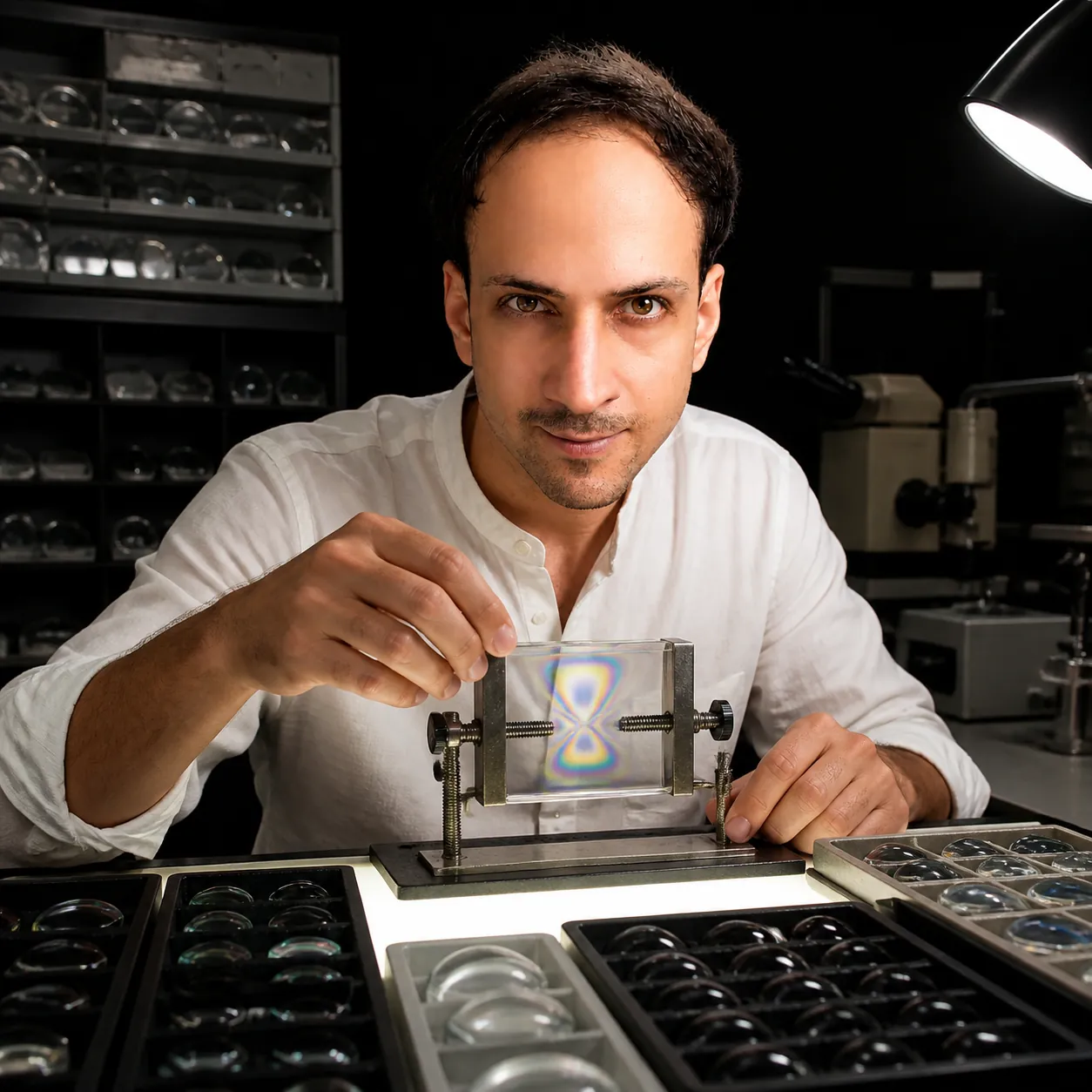
Use the attached reference photo as the identity reference: keep the same face, skin tone, hair and features as the person in that photo, without beautifying, aging or altering them. Create a square 1:1 museum-catalog frame with a strong first read and a slower second read. Location: an optician's backroom with trays of unmounted lenses. Show the subject in a clean white overshirt buttoned once at the sternum, seating a lens gently into a padded tray. Treat this mechanism as the frame’s governing rule: a clear acrylic block in a steel clamp, blooming with banded interior color exactly where the jaws press, under crossed polarizing filters turns a vague mechanical complaint into a precise, radiating diagram. Explore what apparently calm materials are privately enduring right now; direct expression and posture toward patient interrogation, never melodrama or ad-like confidence. Frame across the light table at chest height so the lit interior and their eyes share one focal plane. Make the composition keep the light source honest and visible at frame's edge. Render it as conceptual stress-analysis portraiture combining transparent engineering models, restrained contemporary art direction, believable apparatus, and human-centered editorial realism, using clean laboratory illumination shaped into directional zones rather than flat brightness and a palette of deep matte black, clean white, and lawful prismatic accents only inside the material. Keep one identity-locked person, credible hands and fingers, natural fabric, and coherent scale, contact, reflections, shadows, airflow, deformation, and materials. Background people only when essential, always secondary and clearly different. Avoid psychedelic color washes, chakra imagery, aura photography styling, iridescent vaporwave gloss, and randomly tinted glass. No text, labels, logos, signatures, watermarks, random symbols, plastic skin, excessive bloom, or glossy AI finish.
Treat that reference as the character anchor and change only the scene. Create a square 1:1 museum-catalog frame with a strong first read and a slower...
Treat that reference as the character anchor and change only the scene. Create a square 1:1 museum-catalog frame with a strong first read and a slower...
Treat that reference as the character anchor and change only the scene. Create a square 1:1 museum-catalog frame with a strong first read and a slower...
Treat that reference as the character anchor and change only the scene. Create a square 1:1 museum-catalog frame with a strong first read and a slower...
Treat that reference as the character anchor and change only the scene. Create a square 1:1 museum-catalog frame with a strong first read and a slower...
Treat that reference as the character anchor and change only the scene. Create a square 1:1 museum-catalog frame with a strong first read and a slower...
Treat that reference as the character anchor and change only the scene. Create a square 1:1 museum-catalog frame with a strong first read and a slower...
Treat that reference as the character anchor and change only the scene. Create a square 1:1 museum-catalog frame with a strong first read and a slower...
Treat that reference as the character anchor and change only the scene. Create a square 1:1 museum-catalog frame with a strong first read and a slower...
Treat that reference as the character anchor and change only the scene. Create a square 1:1 museum-catalog frame with a strong first read and a slower...
Treat that reference as the character anchor and change only the scene. Create a square 1:1 museum-catalog frame with a strong first read and a slower...
Treat that reference as the character anchor and change only the scene. Create a square 1:1 museum-catalog frame with a strong first read and a slower...