جاري التحميل...


جاري التحميل...
Create a square 1:1 museum-catalog frame with a strong first read and a slower second read. Location: a museum prep room beside an empty vitrine on a padded...
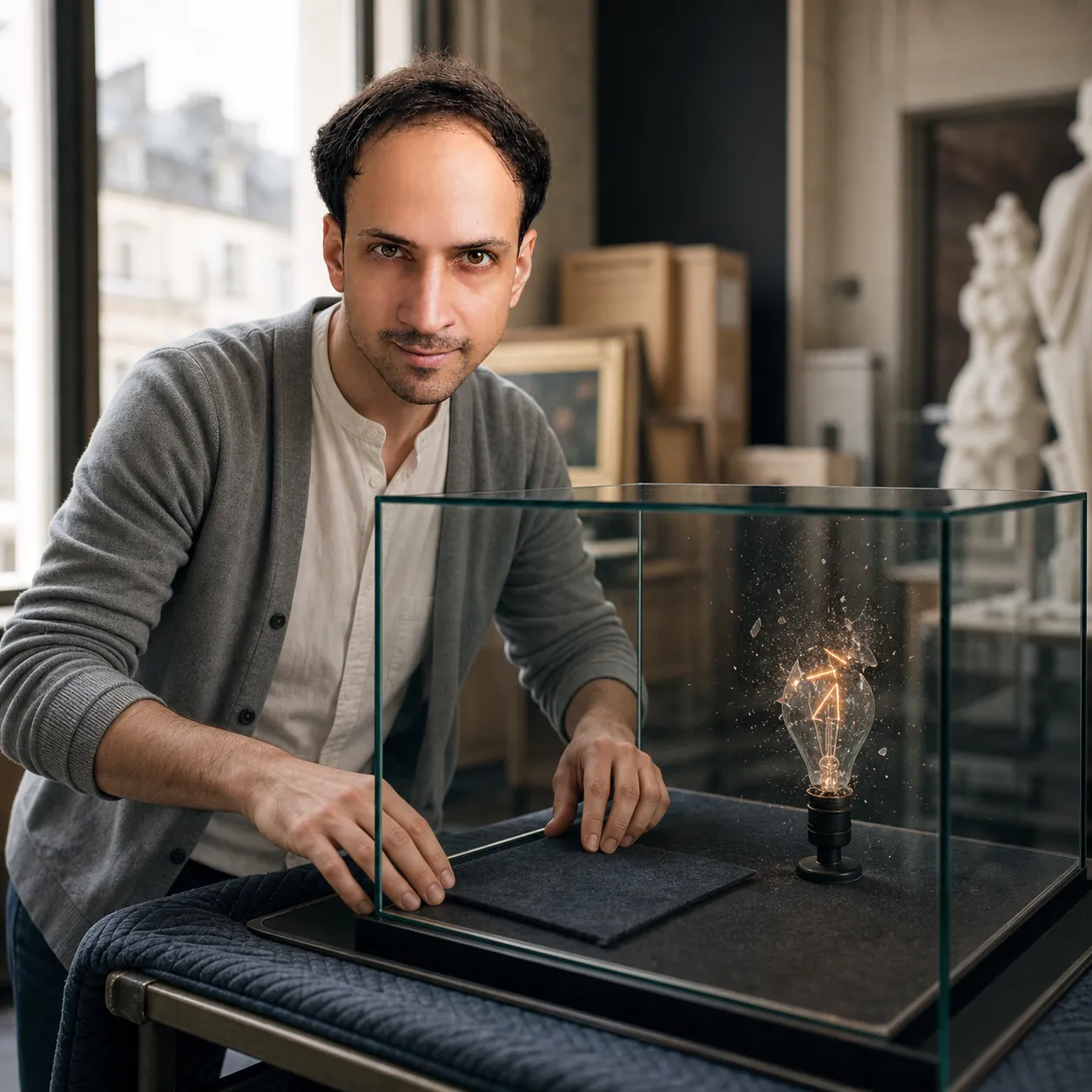
Use the attached reference photo as the identity reference: keep the same face, skin tone, hair and features as the person in that photo, without beautifying, aging or altering them. Create a square 1:1 museum-catalog frame with a strong first read and a slower second read. Location: a museum prep room beside an empty vitrine on a padded cart. Show the subject in a fine grey cardigan over a white collarless shirt, laying a felt square flat inside the vitrine. Make one rigorous physical condition the conceptual engine: a clear bulb photographed at the instant its filament fails, the last orange thread still written in place reveals strict geometric order inside an event filed under chaos. Explore why some collisions build fabric before they permit destruction; direct expression and posture toward quiet vigilance, never melodrama or ad-like confidence. Use an eye-level 65mm medium-format viewpoint with natural perspective and restrained depth of field. Make the composition keep the frozen event smaller than their calm, and sharper than everything. Render it as gallery-grade instant photography built from real released tension, quiet technical staging, accurate material behavior, and unhurried observational framing, using soft north-facing daylight with restrained contrast and visible skin texture and a palette of midnight blue, silver, and warm sandstone. Keep one identity-locked person, credible hands and fingers, natural fabric, and coherent scale, contact, reflections, shadows, airflow, deformation, and materials. Background people only when essential, always secondary and clearly different. Avoid bullet-time camera clichés, action-movie explosions, shattering-face effects, frozen gunfire, and dramatic debris storms. No text, labels, logos, signatures, watermarks, random symbols, plastic skin, excessive bloom, or glossy AI finish.
Treat that reference as the character anchor and change only the scene. Create a square 1:1 museum-catalog frame with a strong first read and a slower...
Treat that reference as the character anchor and change only the scene. Create a square 1:1 museum-catalog frame with a strong first read and a slower...
Treat that reference as the character anchor and change only the scene. Create a square 1:1 museum-catalog frame with a strong first read and a slower...
Treat that reference as the character anchor and change only the scene. Create a square 1:1 museum-catalog frame with a strong first read and a slower...
Treat that reference as the character anchor and change only the scene. Create a square 1:1 museum-catalog frame with a strong first read and a slower...
Treat that reference as the character anchor and change only the scene. Create a square 1:1 museum-catalog frame with a strong first read and a slower...
Treat that reference as the character anchor and change only the scene. Create a square 1:1 museum-catalog frame with a strong first read and a slower...
Treat that reference as the character anchor and change only the scene. Create a square 1:1 museum-catalog frame with a strong first read and a slower...
Treat that reference as the character anchor and change only the scene. Create a square 1:1 museum-catalog frame with a strong first read and a slower...
Treat that reference as the character anchor and change only the scene. Create a square 1:1 museum-catalog frame with a strong first read and a slower...
Treat that reference as the character anchor and change only the scene. Create a square 1:1 museum-catalog frame with a strong first read and a slower...
Treat that reference as the character anchor and change only the scene. Create a square 1:1 museum-catalog frame with a strong first read and a slower...