جاري التحميل...


جاري التحميل...
Treat that reference as the character anchor and change only the scene. Create a square 1:1 museum-catalog frame with a strong first read and a slower...
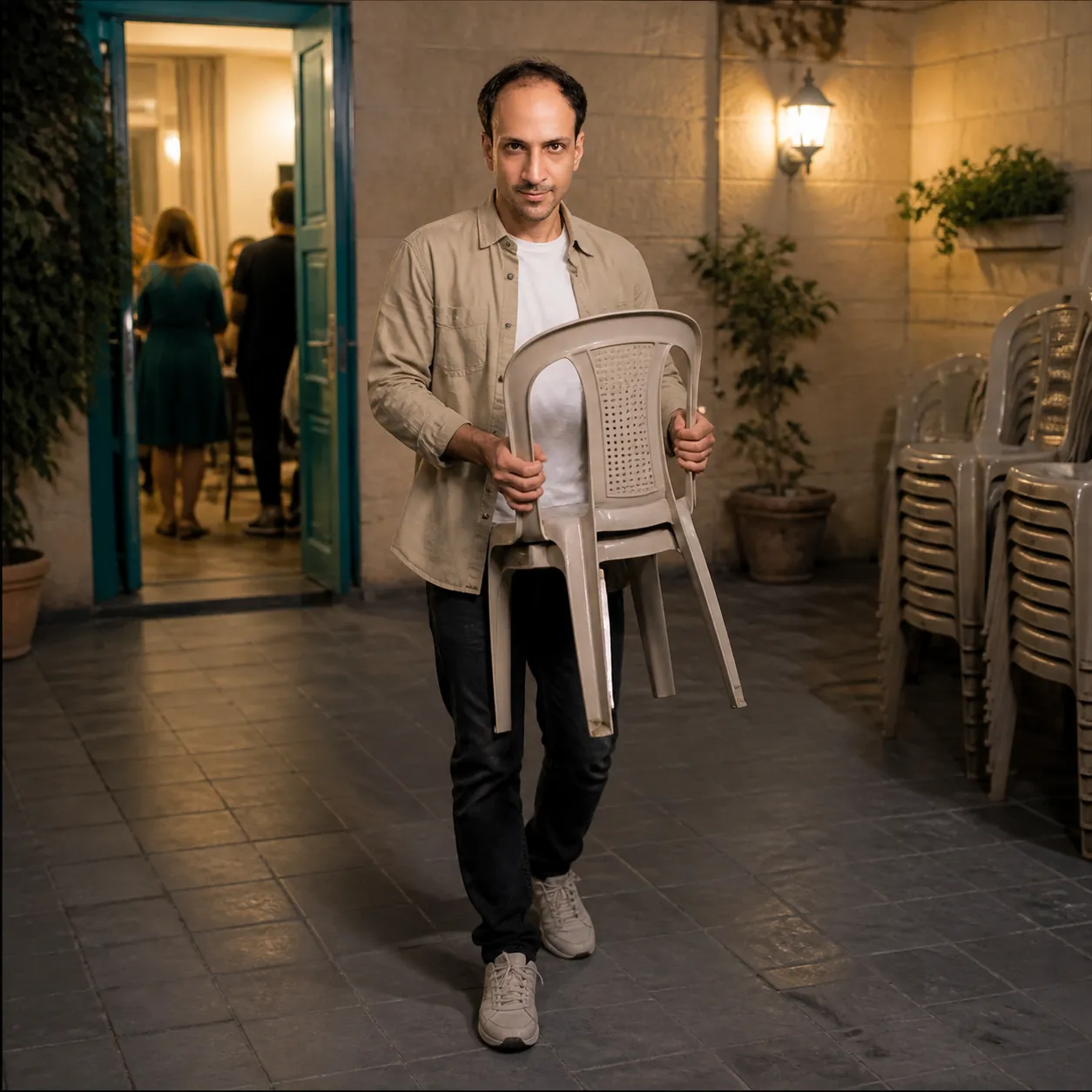
Use the attached reference photo as the identity reference: keep the same face, skin tone, hair and features as the person in that photo, without beautifying, aging or altering them. Treat that reference as the character anchor and change only the scene. Create a square 1:1 museum-catalog frame with a strong first read and a slower second read at exactly 2880x2880 pixels. Location: a walled house courtyard where extra chairs are stacked for guests. Show them in a light khaki overshirt over a plain tee and trainers, carrying a stacked pair of plastic chairs outside. Hide the whole argument in this ordinary moment: a grip set further out along a shared load than the other pair of hands, adjusted too quietly for anyone to notice trades a chance of being known for one more proof of competence. Explore whether competence can be withdrawn once other people have built around it; expression composed and unremarkable, carrying mild good cheer, the weight held well below anyone's notice. Use a calm 35mm framing that includes the room's second occupied edge. Make the composition hold one ordinary gap of stillness inside continuing activity. Render it as gallery-scale documentary portraiture combining ordinary interior architecture, accurate material response, credible hands, and emotionally intelligent restraint, using one warm household lamp balanced against dim ambient light from the hall and a palette of pale limestone, slate grey, and a small teal accent. Photorealistic: this must read as a real photograph from a physical camera, never an illustration, painting, or 3D render. Resolve real surface detail: rubber gone chalky with age, painted metal chipped to primer, and plastic yellowed only where light reaches it. Keep one identity-locked person, credible hands and fingers, natural fabric, and coherent scale, contact, reflections, shadows, airflow, deformation, and materials. Background people only when essential, always secondary and clearly different. Avoid wistful window-staring, two-faced staging, pill bottles, hero-poster captions, and objects that announce mental illness. No text, labels, logos, signatures, watermarks, random symbols, plastic skin, excessive bloom, or glossy AI finish.
Treat that reference as the character anchor and change only the scene. Create a square 1:1 museum-catalog frame with a strong first read and a slower...
Treat that reference as the character anchor and change only the scene. Create a square 1:1 museum-catalog frame with a strong first read and a slower...
Treat that reference as the character anchor and change only the scene. Create a square 1:1 museum-catalog frame with a strong first read and a slower...
Treat that reference as the character anchor and change only the scene. Create a square 1:1 museum-catalog frame with a strong first read and a slower...
Treat that reference as the character anchor and change only the scene. Create a square 1:1 museum-catalog frame with a strong first read and a slower...
Treat that reference as the character anchor and change only the scene. Create a square 1:1 museum-catalog frame with a strong first read and a slower...
Treat that reference as the character anchor and change only the scene. Create a square 1:1 museum-catalog frame with a strong first read and a slower...
Treat that reference as the character anchor and change only the scene. Create a square 1:1 museum-catalog frame with a strong first read and a slower...
Treat that reference as the character anchor and change only the scene. Create a square 1:1 museum-catalog frame with a strong first read and a slower...
Treat that reference as the character anchor and change only the scene. Create a square 1:1 museum-catalog frame with a strong first read and a slower...
Treat that reference as the character anchor and change only the scene. Create a square 1:1 museum-catalog frame with a strong first read and a slower...
Treat that reference as the character anchor and change only the scene. Create a square 1:1 museum-catalog frame with a strong first read and a slower...