جاري التحميل...


جاري التحميل...
Create a square 1:1 museum-catalog frame with a strong first read and a slower second read at exactly 2880x2880 pixels. Location: a walled front yard with a...
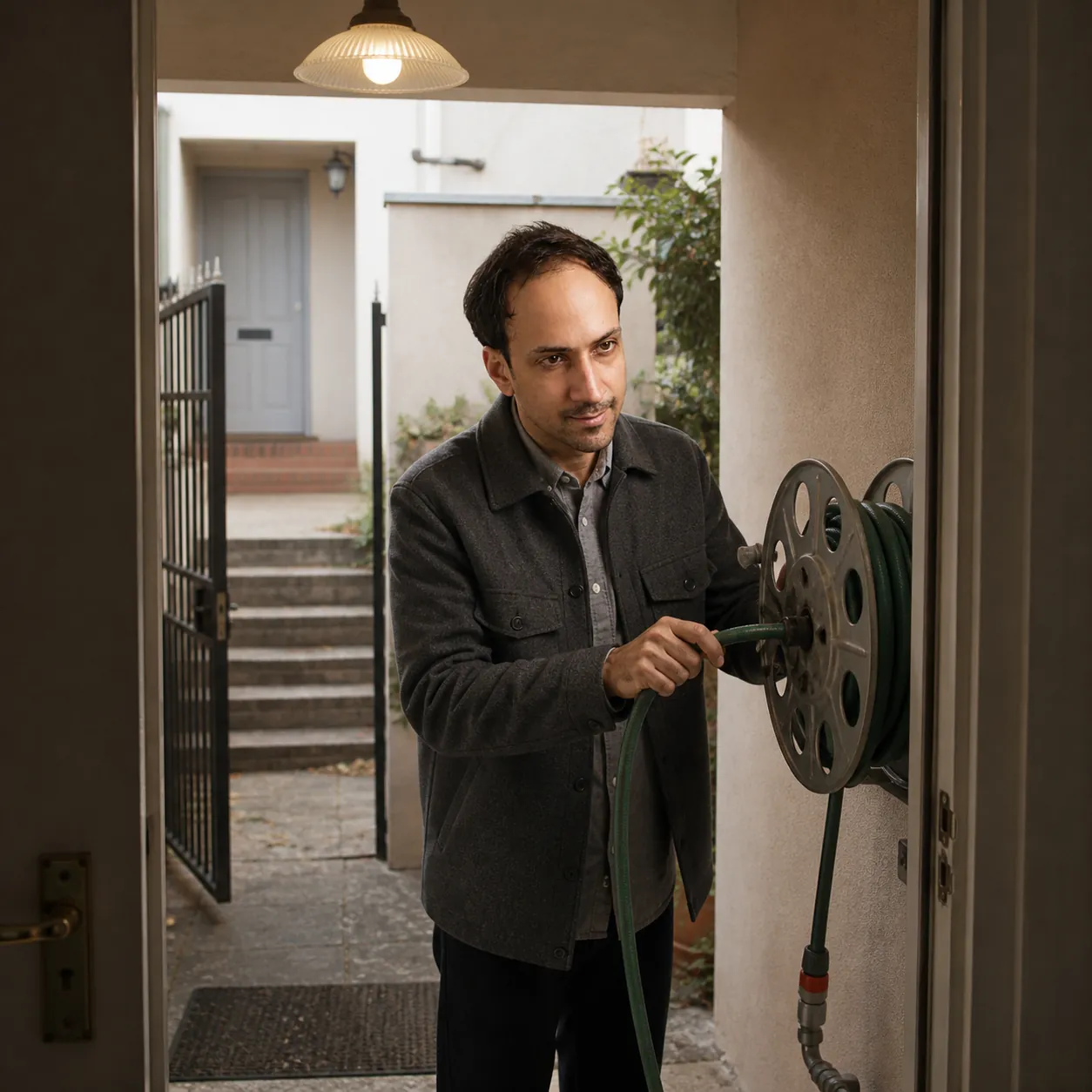
Use the attached reference photo as the identity reference: keep the same face, skin tone, hair and features as the person in that photo, without beautifying, aging or altering them. Create a square 1:1 museum-catalog frame with a strong first read and a slower second read at exactly 2880x2880 pixels. Location: a walled front yard with a metal gate standing open. Show the subject in a mid-grey wool overshirt over a plain buttoned shirt, coiling a garden hose onto its wall reel. The difficulty must be visible in this, not in their expression: a flat door already locked that they have climbed one flight back to try again, their coat still buttoned weighs a two-minute job against everything it can quietly become. Explore how many minutes an ordinary leaving can quietly take from a day; expression occupied, not expressive, carrying worn method, difficulty stated in the object alone. Hold a static wide view from just inside the room they are leaving. Make the composition leave the route they already walked open behind them. Render it as museum-catalog realism combining editorial portrait craft, accurate metal and plastic surfaces, ordinary interior finishes, and emotionally literate restraint, using an overhead fitting diffused by its plain glass shade and a palette of unbleached linen, charcoal, and a low ember orange. Photorealistic: this must read as a real photograph from a physical camera, never an illustration, painting, or 3D render. Resolve real surface detail: visible weave in cloth, fine scratches on metal, and the faint unevenness of painted walls. Keep one identity-locked person, credible hands and fingers, natural fabric, and coherent scale, contact, reflections, shadows, airflow, deformation, and materials. Background people only when essential, always secondary and clearly different. Avoid hand-washing imagery, tally marks, symmetrical object grids, hero poses at camera, and wellness glow. No text, labels, logos, signatures, watermarks, random symbols, plastic skin, excessive bloom, or glossy AI finish.
Treat that reference as the character anchor and change only the scene. Create a square 1:1 museum-catalog frame with a strong first read and a slower...
Treat that reference as the character anchor and change only the scene. Create a square 1:1 museum-catalog frame with a strong first read and a slower...
Treat that reference as the character anchor and change only the scene. Create a square 1:1 museum-catalog frame with a strong first read and a slower...
Treat that reference as the character anchor and change only the scene. Create a square 1:1 museum-catalog frame with a strong first read and a slower...
Treat that reference as the character anchor and change only the scene. Create a square 1:1 museum-catalog frame with a strong first read and a slower...
Treat that reference as the character anchor and change only the scene. Create a square 1:1 museum-catalog frame with a strong first read and a slower...
Treat that reference as the character anchor and change only the scene. Create a square 1:1 museum-catalog frame with a strong first read and a slower...
Treat that reference as the character anchor and change only the scene. Create a square 1:1 museum-catalog frame with a strong first read and a slower...
Treat that reference as the character anchor and change only the scene. Create a square 1:1 museum-catalog frame with a strong first read and a slower...
Treat that reference as the character anchor and change only the scene. Create a square 1:1 museum-catalog frame with a strong first read and a slower...
Treat that reference as the character anchor and change only the scene. Create a square 1:1 museum-catalog frame with a strong first read and a slower...
Treat that reference as the character anchor and change only the scene. Create a square 1:1 museum-catalog frame with a strong first read and a slower...