جاري التحميل...


جاري التحميل...
Create a square 1:1 museum-catalog frame with a strong first read and a slower second read at exactly 2880x2880 pixels. Location: a small tiled kitchen...
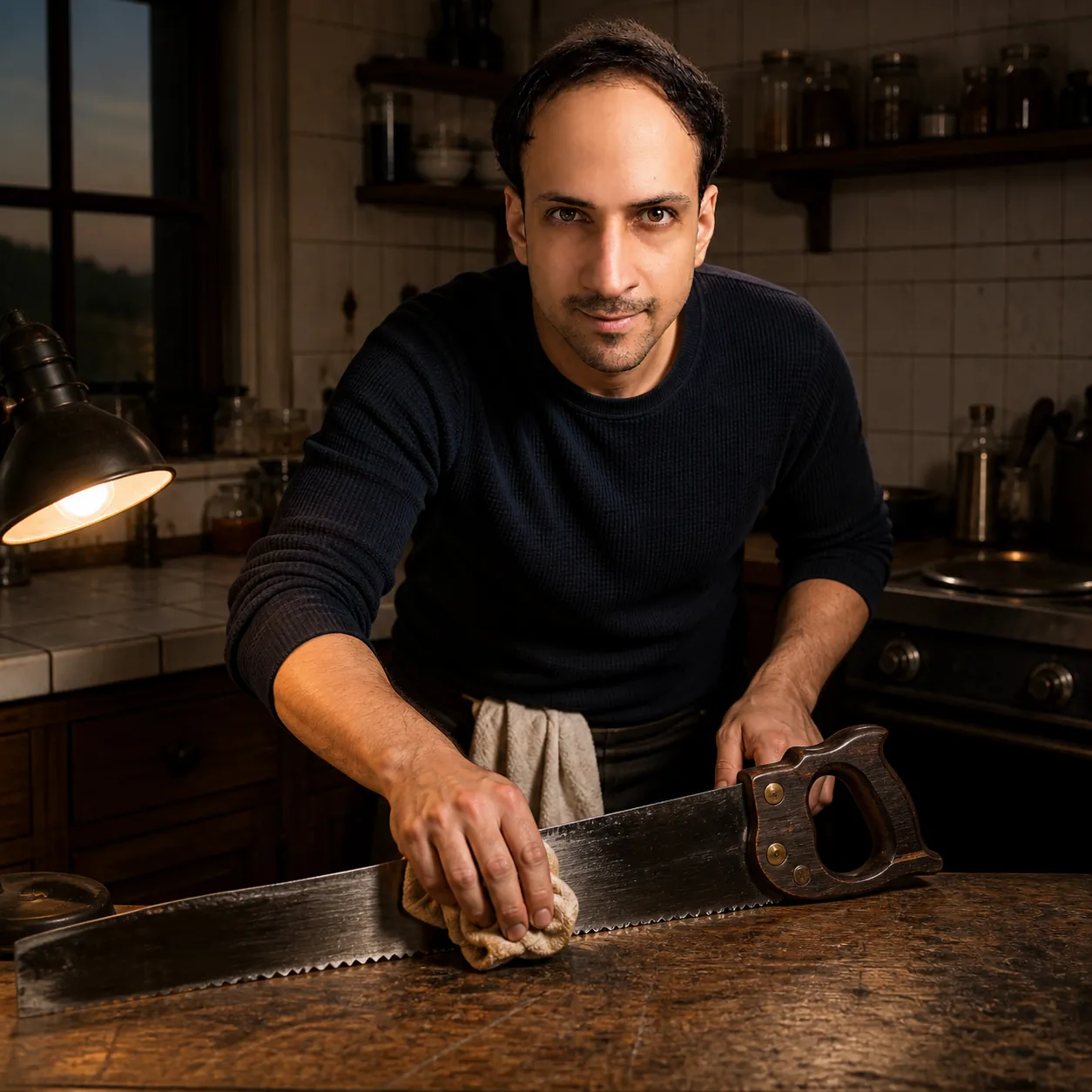
Use the attached reference photo as the identity reference: keep the same face, skin tone, hair and features as the person in that photo, without beautifying, aging or altering them. Create a square 1:1 museum-catalog frame with a strong first read and a slower second read at exactly 2880x2880 pixels. Location: a small tiled kitchen before dawn, one burner ring still cooling. Show the subject in a navy waffle-knit shirt with a plain towel tucked at the waist, wiping a thin sheen of oil across black iron. Treat this mechanism as the frame’s governing rule: a hand saw whose plate has narrowed a full inch under a century of sharpenings, its tooth line still straight and counted turns a hundred years of use into polish instead of ruin. Explore what disposable things forfeit that a kept tool quietly retains; direct expression and posture toward attentive stillness, never melodrama or ad-like confidence. Frame level with the benchtop so the tool's brightest wear and their steady gaze share focus. Make the composition give the brightest polish the smallest area of the frame. Render it as heritage-craft documentary portraiture built from truthful tool wear, oiled-wood and carbon-steel materiality, museum-conservation lighting discipline, and unhurried editorial composition, using a single warm workbench lamp pooled tight, the room falling to umber and a palette of bone-white stone, deep hickory, and a thread of amber. Photorealistic: this must read as a real photograph from a physical camera, never an illustration, painting, or 3D render. Resolve real surface detail: grout darker than tile, sealant slightly yellowed, and every joint showing a real tolerance gap. Keep one identity-locked person, credible hands and fingers, natural fabric, and coherent scale, contact, reflections, shadows, airflow, deformation, and materials. Background people only when essential, always secondary and clearly different. Avoid rusty antique-shop clutter, sepia nostalgia filters, cobwebbed barn walls, staged distressed props, and heroic blacksmith sparks. No text, labels, logos, signatures, watermarks, random symbols, plastic skin, excessive bloom, or glossy AI finish.
Treat that reference as the character anchor and change only the scene. Create a square 1:1 museum-catalog frame with a strong first read and a slower...
Treat that reference as the character anchor and change only the scene. Create a square 1:1 museum-catalog frame with a strong first read and a slower...
Treat that reference as the character anchor and change only the scene. Create a square 1:1 museum-catalog frame with a strong first read and a slower...
Treat that reference as the character anchor and change only the scene. Create a square 1:1 museum-catalog frame with a strong first read and a slower...
Treat that reference as the character anchor and change only the scene. Create a square 1:1 museum-catalog frame with a strong first read and a slower...
Treat that reference as the character anchor and change only the scene. Create a square 1:1 museum-catalog frame with a strong first read and a slower...
Treat that reference as the character anchor and change only the scene. Create a square 1:1 museum-catalog frame with a strong first read and a slower...
Treat that reference as the character anchor and change only the scene. Create a square 1:1 museum-catalog frame with a strong first read and a slower...
Treat that reference as the character anchor and change only the scene. Create a square 1:1 museum-catalog frame with a strong first read and a slower...
Treat that reference as the character anchor and change only the scene. Create a square 1:1 museum-catalog frame with a strong first read and a slower...
Treat that reference as the character anchor and change only the scene. Create a square 1:1 museum-catalog frame with a strong first read and a slower...
Treat that reference as the character anchor and change only the scene. Create a square 1:1 museum-catalog frame with a strong first read and a slower...