جاري التحميل...


جاري التحميل...
Treat that reference as the character anchor and change only the scene. Create a square 1:1 museum-catalog frame with a strong first read and a slower...
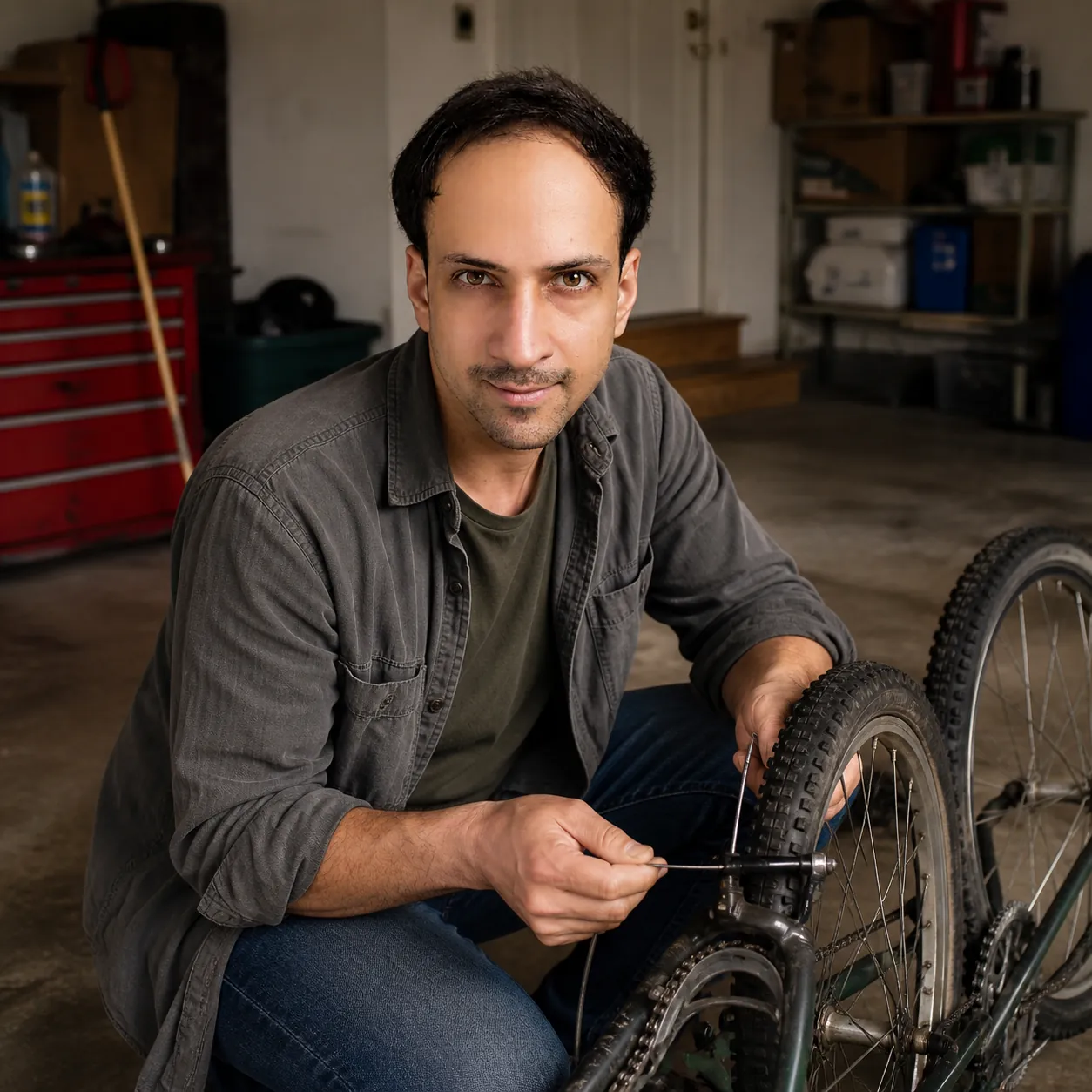
Use the attached reference photo as the identity reference: keep the same face, skin tone, hair and features as the person in that photo, without beautifying, aging or altering them. Treat that reference as the character anchor and change only the scene. Create a square 1:1 museum-catalog frame with a strong first read and a slower second read at exactly 2880x2880 pixels. Location: a home garage with a friend's bicycle upended on the floor. Show them in a faded work shirt over an old tee and jeans, tightening a brake cable a quarter turn. Make this the only tell, easy to miss: a small job left where only they will find it, without a note, the leaving of it already counted as agreement trades a chance of being known for one more proof of competence. Explore what happens to a truth that gets less sayable every time it is not said; expression composed and unremarkable, carrying relaxed readiness, the weight held under a completely believable calm. Place the lens where a second person would naturally stand, without their presence. Make the composition give the object they were handed no special emphasis. Render it as gallery-scale documentary portraiture combining ordinary interior architecture, accurate material response, credible hands, and emotionally intelligent restraint, using even domestic ceiling light softened by pale walls, with readable shadow detail and a palette of warm plaster, soft grey, and one muted olive accent. Photorealistic: this must read as a real photograph from a physical camera, never an illustration, painting, or 3D render. Resolve real surface detail: floor finish worn along the walked line, skirting marked at shoe height, and corners darker than the open floor. Keep one identity-locked person, credible hands and fingers, natural fabric, and coherent scale, contact, reflections, shadows, airflow, deformation, and materials. Background people only when essential, always secondary and clearly different. Avoid wistful window-staring, two-faced staging, pill bottles, hero-poster captions, and objects that announce mental illness. No text, labels, logos, signatures, watermarks, random symbols, plastic skin, excessive bloom, or glossy AI finish.
Treat that reference as the character anchor and change only the scene. Create a square 1:1 museum-catalog frame with a strong first read and a slower...
Treat that reference as the character anchor and change only the scene. Create a square 1:1 museum-catalog frame with a strong first read and a slower...
Treat that reference as the character anchor and change only the scene. Create a square 1:1 museum-catalog frame with a strong first read and a slower...
Treat that reference as the character anchor and change only the scene. Create a square 1:1 museum-catalog frame with a strong first read and a slower...
Treat that reference as the character anchor and change only the scene. Create a square 1:1 museum-catalog frame with a strong first read and a slower...
Treat that reference as the character anchor and change only the scene. Create a square 1:1 museum-catalog frame with a strong first read and a slower...
Treat that reference as the character anchor and change only the scene. Create a square 1:1 museum-catalog frame with a strong first read and a slower...
Treat that reference as the character anchor and change only the scene. Create a square 1:1 museum-catalog frame with a strong first read and a slower...
Treat that reference as the character anchor and change only the scene. Create a square 1:1 museum-catalog frame with a strong first read and a slower...
Treat that reference as the character anchor and change only the scene. Create a square 1:1 museum-catalog frame with a strong first read and a slower...
Treat that reference as the character anchor and change only the scene. Create a square 1:1 museum-catalog frame with a strong first read and a slower...
Treat that reference as the character anchor and change only the scene. Create a square 1:1 museum-catalog frame with a strong first read and a slower...