جاري التحميل...


جاري التحميل...
Create a square 1:1 museum-catalog frame with a strong first read and a slower second read. Location: a home study with a drawer of clear rulers tipped onto...
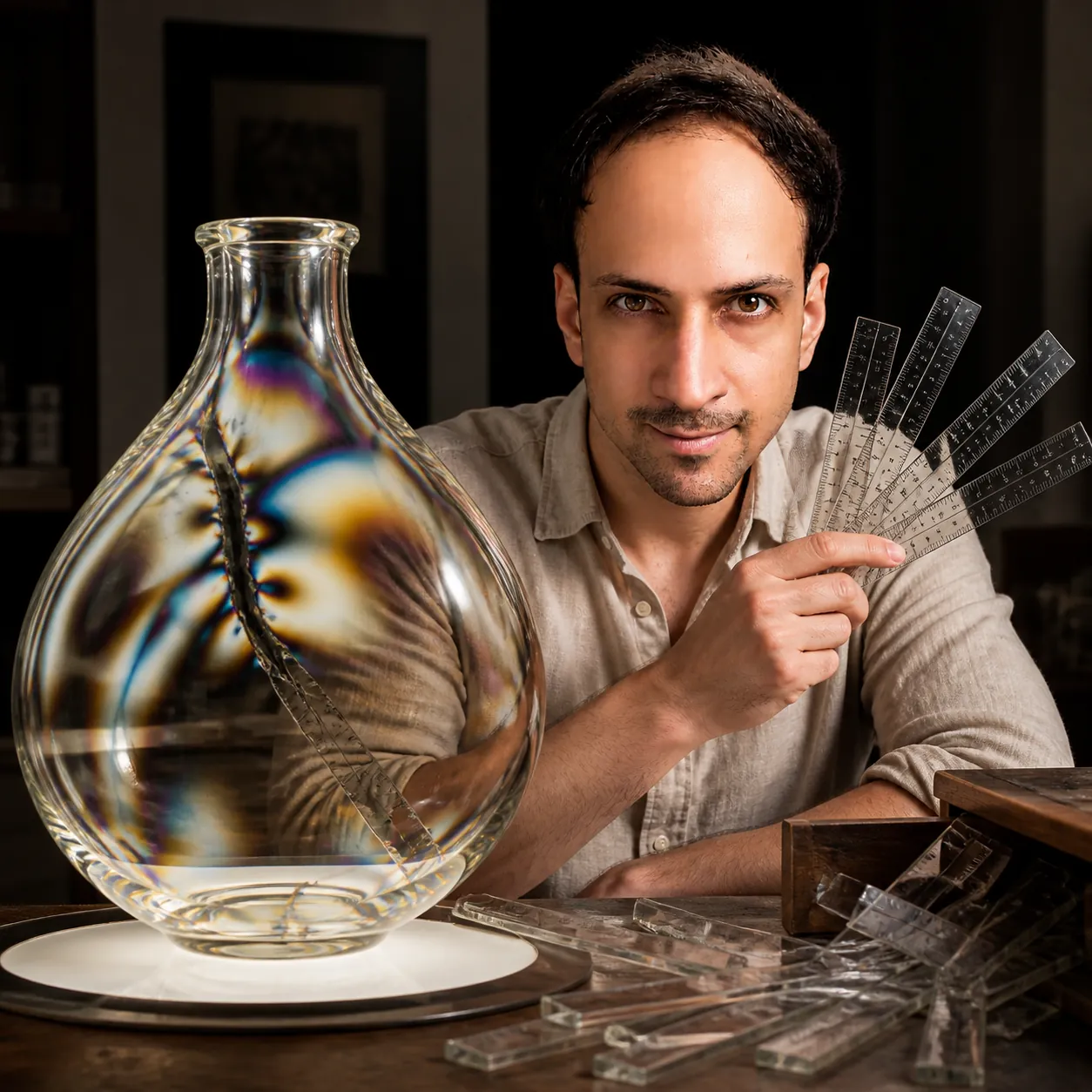
Use the attached reference photo as the identity reference: keep the same face, skin tone, hair and features as the person in that photo, without beautifying, aging or altering them. Create a square 1:1 museum-catalog frame with a strong first read and a slower second read. Location: a home study with a drawer of clear rulers tipped onto the desk. Show the subject in an untucked oatmeal linen shirt with sleeves pushed up, fanning a handful of clear rulers like cards. The impossible-looking event must obey this clear system: a hand-blown glass vessel between polarizers, revealing dark cooling scars and bright halos its clarity always concealed reveals a weather system of stress living inside apparently calm material. Explore what clarity is hiding, and what light can make it admit; direct expression and posture toward sober wonder, never melodrama or ad-like confidence. Use a 100mm macro-to-portrait hybrid: one glowing stress pattern near the lens and the subject's face readable beyond it, both physically plausible. Make the composition let one fringe system exit the frame before it completes. Render it as gallery-grade polarization photography built from genuine internal-strain color, quiet technical furniture, accurate material response, and unhurried observational framing, using a broad backlit polarized field with the room held in soft darkness and a palette of warm grey, parchment, and a contained field of spectral color. Keep one identity-locked person, credible hands and fingers, natural fabric, and coherent scale, contact, reflections, shadows, airflow, deformation, and materials. Background people only when essential, always secondary and clearly different. Avoid rainbow lens flares, oil-slick gradients, holographic foil textures, neon cyberpunk glow, and decorative prism spam. No text, labels, logos, signatures, watermarks, random symbols, plastic skin, excessive bloom, or glossy AI finish.
Treat that reference as the character anchor and change only the scene. Create a square 1:1 museum-catalog frame with a strong first read and a slower...
Treat that reference as the character anchor and change only the scene. Create a square 1:1 museum-catalog frame with a strong first read and a slower...
Treat that reference as the character anchor and change only the scene. Create a square 1:1 museum-catalog frame with a strong first read and a slower...
Treat that reference as the character anchor and change only the scene. Create a square 1:1 museum-catalog frame with a strong first read and a slower...
Treat that reference as the character anchor and change only the scene. Create a square 1:1 museum-catalog frame with a strong first read and a slower...
Treat that reference as the character anchor and change only the scene. Create a square 1:1 museum-catalog frame with a strong first read and a slower...
Treat that reference as the character anchor and change only the scene. Create a square 1:1 museum-catalog frame with a strong first read and a slower...
Treat that reference as the character anchor and change only the scene. Create a square 1:1 museum-catalog frame with a strong first read and a slower...
Treat that reference as the character anchor and change only the scene. Create a square 1:1 museum-catalog frame with a strong first read and a slower...
Treat that reference as the character anchor and change only the scene. Create a square 1:1 museum-catalog frame with a strong first read and a slower...
Treat that reference as the character anchor and change only the scene. Create a square 1:1 museum-catalog frame with a strong first read and a slower...
Treat that reference as the character anchor and change only the scene. Create a square 1:1 museum-catalog frame with a strong first read and a slower...