جاري التحميل...


جاري التحميل...
Create a square 1:1 museum-catalog frame with a strong first read and a slower second read at exactly 2880x2880 pixels. Location: a restored stone gristmill...
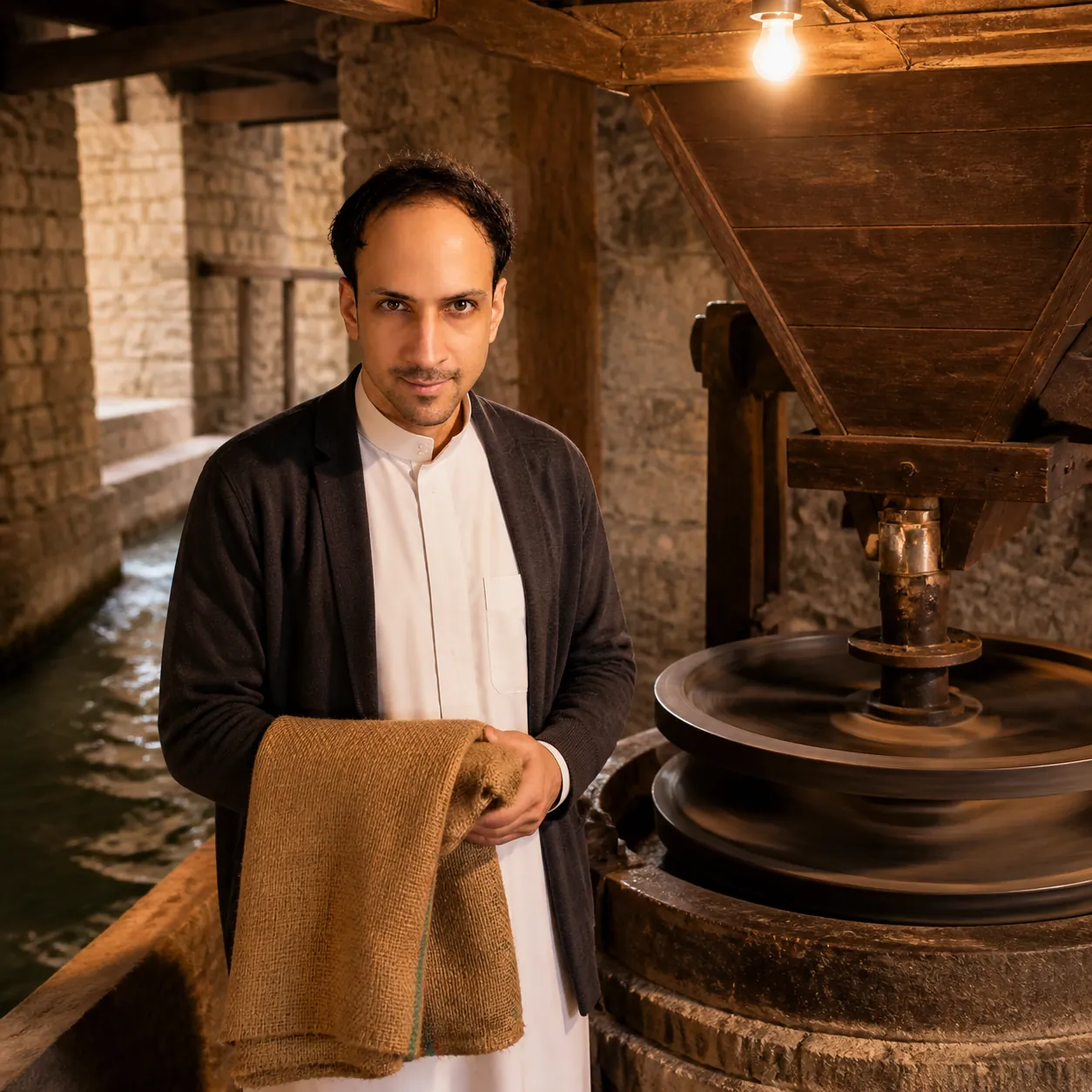
Use the attached reference photo as the identity reference: keep the same face, skin tone, hair and features as the person in that photo, without beautifying, aging or altering them. Create a square 1:1 museum-catalog frame with a strong first read and a slower second read at exactly 2880x2880 pixels. Location: a restored stone gristmill in Al-Ahsa beside its quiet channel. Show the subject in a crisp white traditional Gulf outfit under an open charcoal cardigan, folding an empty jute sack squarely over one forearm. Build the artwork around this material rule: a waist-high cast flywheel brought to speed by many light palm pushes, now coasting on its own banked momentum pays out only what was honestly deposited, yet the timing feels generous. Explore why small efforts stop feeling small the moment something visibly keeps them; direct expression and posture toward steady anticipation, never melodrama or ad-like confidence. Use a restrained 35mm view placing them beside the machine, neither dominating the other. Make the composition give the smallest moving part more presence than anything still. Render it as museum-demonstration realism combining truthful mechanical detail, high-fidelity portrait photography, audible-seeming moments of metal contact, and quietly restrained editorial art direction, using a single practical bulb above the mechanism with gentle ambient spill and a palette of raw pine, graphite, and a narrow copper gleam. Photorealistic: this must read as a real photograph from a physical camera, never an illustration, painting, or 3D render. Resolve real surface detail: dust settled where nobody wipes, fingerprint haze on glass, and edges rubbed pale by handling. Keep one identity-locked person, credible hands and fingers, natural fabric, and coherent scale, contact, reflections, shadows, airflow, deformation, and materials. Background people only when essential, always secondary and clearly different. Avoid Rube Goldberg clutter, floating holographic interfaces, trophy-shelf staging, neon motivational glow, and impossibly frictionless chrome machinery. No text, labels, logos, signatures, watermarks, random symbols, plastic skin, excessive bloom, or glossy AI finish.
Treat that reference as the character anchor and change only the scene. Create a square 1:1 museum-catalog frame with a strong first read and a slower...
Treat that reference as the character anchor and change only the scene. Create a square 1:1 museum-catalog frame with a strong first read and a slower...
Treat that reference as the character anchor and change only the scene. Create a square 1:1 museum-catalog frame with a strong first read and a slower...
Treat that reference as the character anchor and change only the scene. Create a square 1:1 museum-catalog frame with a strong first read and a slower...
Treat that reference as the character anchor and change only the scene. Create a square 1:1 museum-catalog frame with a strong first read and a slower...
Treat that reference as the character anchor and change only the scene. Create a square 1:1 museum-catalog frame with a strong first read and a slower...
Treat that reference as the character anchor and change only the scene. Create a square 1:1 museum-catalog frame with a strong first read and a slower...
Treat that reference as the character anchor and change only the scene. Create a square 1:1 museum-catalog frame with a strong first read and a slower...
Treat that reference as the character anchor and change only the scene. Create a square 1:1 museum-catalog frame with a strong first read and a slower...
Treat that reference as the character anchor and change only the scene. Create a square 1:1 museum-catalog frame with a strong first read and a slower...
Treat that reference as the character anchor and change only the scene. Create a square 1:1 museum-catalog frame with a strong first read and a slower...
Treat that reference as the character anchor and change only the scene. Create a square 1:1 museum-catalog frame with a strong first read and a slower...