جاري التحميل...


جاري التحميل...
Design a square 1:1 image containing exactly 7 panels, read left to right. Keep the same wardrobe, facial features, apparent age, hair, and environmental...
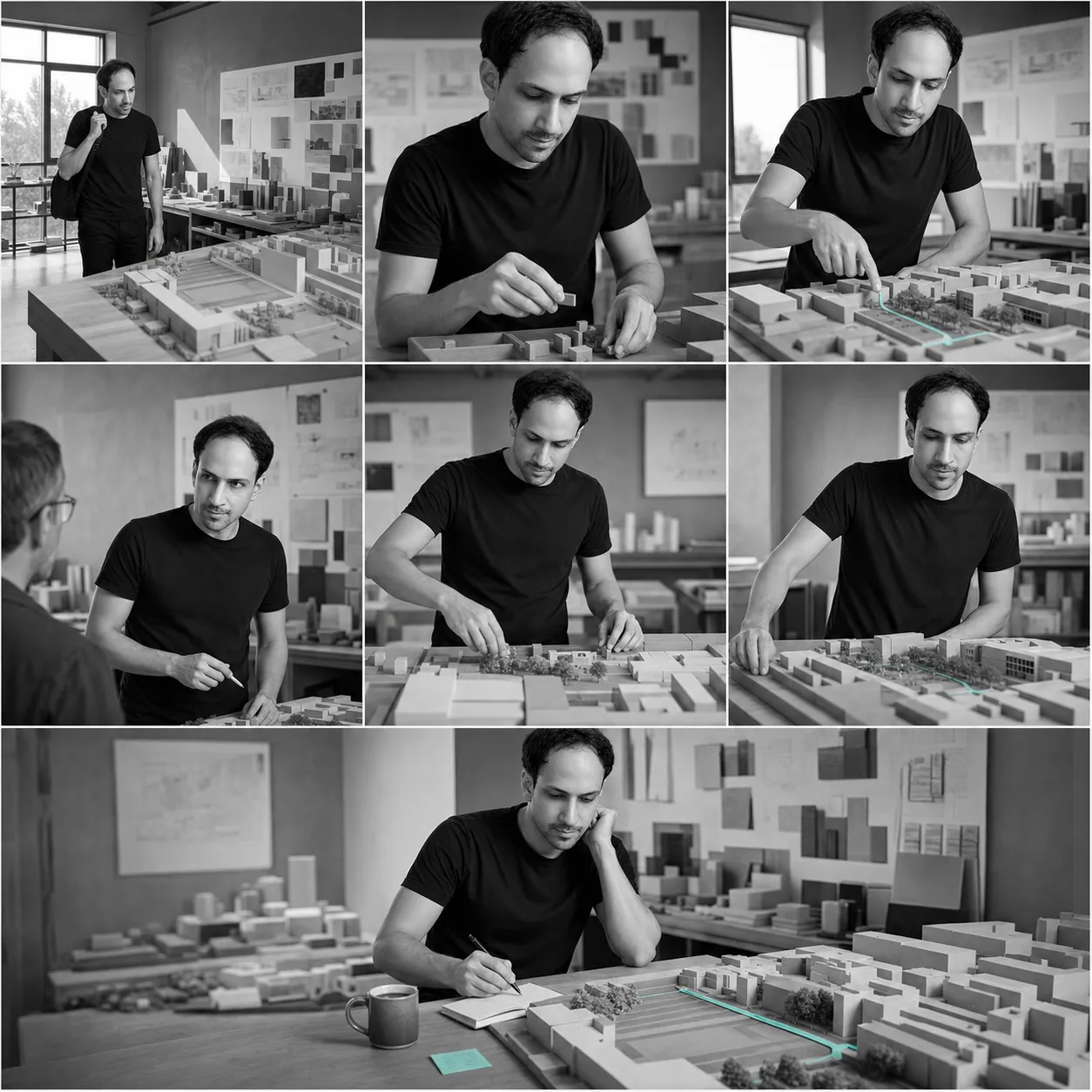
Use the attached reference photo as the identity reference: keep the same face, skin tone, hair and features as the person in that photo, without beautifying, aging or altering them. Design a square 1:1 image containing exactly 7 panels, read left to right. Keep the same wardrobe, facial features, apparent age, hair, and environmental continuity across every panel unless a panel description explicitly changes a prop. Panel 1: establish a sunlit architectural model workshop before the main action, with the subject entering or settling into the space and the visual problem clearly readable. Panel 2: move closer to their hands as they prepare for the task, preserving wardrobe and object continuity. Panel 3: show the exact moment of the subject standing beside a scale model and tracing one route with a fingertip, keeping their recognizable face and natural posture consistent. Panel 4: introduce a modest complication or second person’s response, never changing the subject’s identity or wardrobe. Panel 5: show the adjustment they make after noticing what the situation actually needs. Panel 6: capture the immediate result: the environment becomes part of the subject’s argument. Panel 7: end on a quiet coda in the same environment, with one changed object or gesture proving that the sequence has moved forward. Use clean, consistent gutters and no accidental extra frames, repeated panels, or duplicated versions of the subject. Render the sequence as modern black-and-white portraiture with full tonal detail with soft bedside lamplight with the room kept gentle rather than gloomy and date-brown, stone grey, and a small turquoise note. The emotional progression should move toward patient resilience through posture and action, not facial redesign. Make the posture asymmetrical in a believable way, with weight settled on one leg. Do not include captions or any other text. Keep hands, object continuity, body scale, and perspective believable.
Treat that reference as the character anchor and change only the scene. Create a square 1:1 museum-catalog frame with a strong first read and a slower...
Treat that reference as the character anchor and change only the scene. Create a square 1:1 museum-catalog frame with a strong first read and a slower...
Treat that reference as the character anchor and change only the scene. Create a square 1:1 museum-catalog frame with a strong first read and a slower...
Treat that reference as the character anchor and change only the scene. Create a square 1:1 museum-catalog frame with a strong first read and a slower...
Treat that reference as the character anchor and change only the scene. Create a square 1:1 museum-catalog frame with a strong first read and a slower...
Treat that reference as the character anchor and change only the scene. Create a square 1:1 museum-catalog frame with a strong first read and a slower...
Treat that reference as the character anchor and change only the scene. Create a square 1:1 museum-catalog frame with a strong first read and a slower...
Treat that reference as the character anchor and change only the scene. Create a square 1:1 museum-catalog frame with a strong first read and a slower...
Treat that reference as the character anchor and change only the scene. Create a square 1:1 museum-catalog frame with a strong first read and a slower...
Treat that reference as the character anchor and change only the scene. Create a square 1:1 museum-catalog frame with a strong first read and a slower...
Treat that reference as the character anchor and change only the scene. Create a square 1:1 museum-catalog frame with a strong first read and a slower...
Treat that reference as the character anchor and change only the scene. Create a square 1:1 museum-catalog frame with a strong first read and a slower...