تخطَّ إلى المحتوى

برومبتات الصور

برومبتات لمولدات الصور: بورتريهات وفن وتصوير.

تم العثور على 814
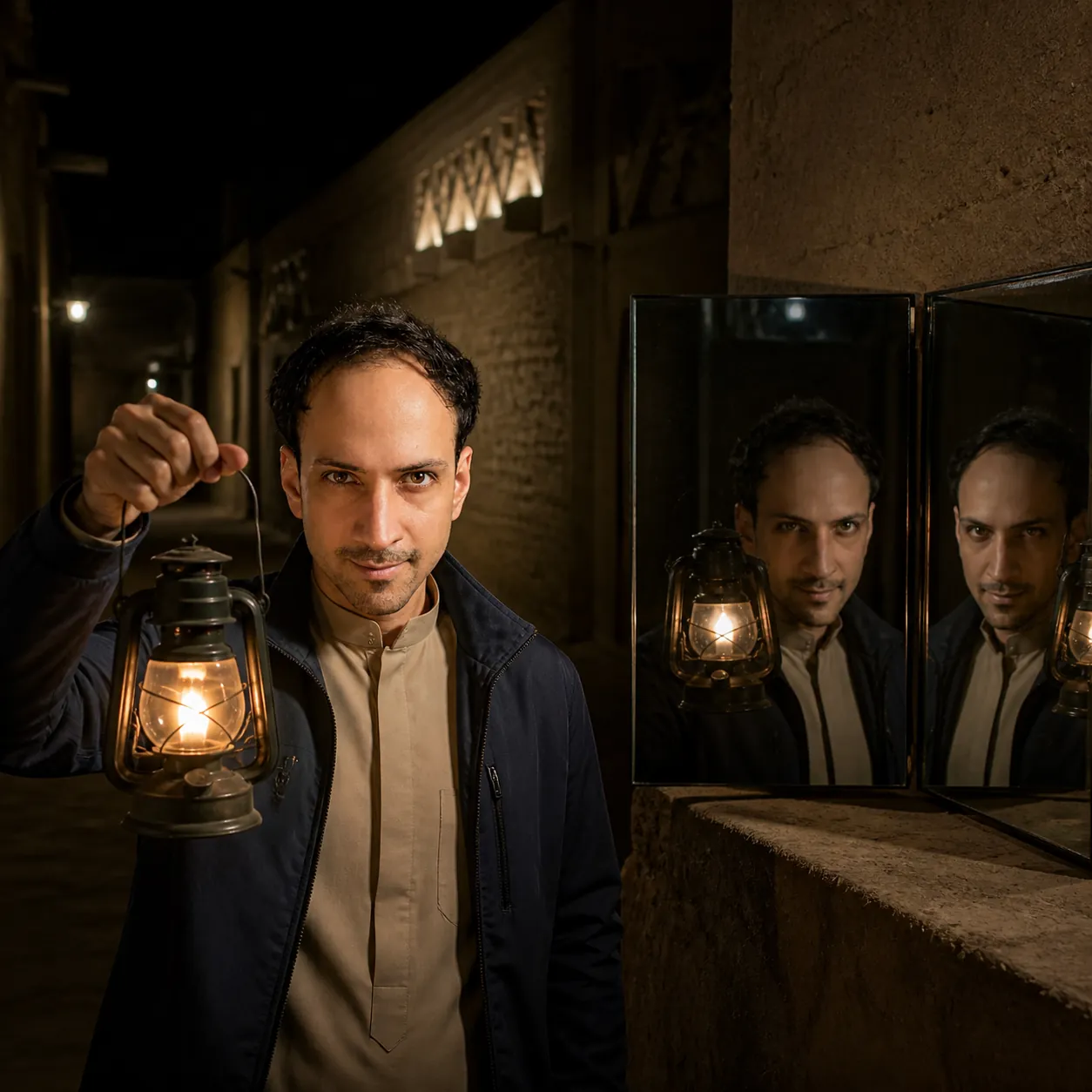
The Way Home: Apex Gaze Audience of One — Diriyah Alley
صورةAI Portraits

Create a square 1:1 museum-catalog frame with a strong first read and a slower second read at exactly 2880x2880 pixels. Location: a mud-brick alley in old...

من نص البرومبت

Use the attached reference photo as the identity reference: keep the same face, skin tone, hair and features as the person in that photo, without beautifying, aging or altering them. Create a square 1:1 museum-catalog frame with a strong first read and a slower second read at exactly 2880x2880 pixels. Location: a mud-brick alley in old Diriyah after nightfall. Show the subject in a light navy jacket worn open over a sand-toned traditional Gulf outfit, raising a hand lantern slowly to shoulder height. Use this advanced image-making device as the core logic: a hollow corner of three mirrors that pins their reflected gaze to its apex no matter where they move their head keeps its full brightness for the one standing at the light's source. Explore how a surface can be truthfully dark and truthfully blazing in the same minute; direct expression and posture toward sober delight, never melodrama or ad-like confidence. Frame from slightly low in the dark, their face lit by spill rather than beam. Make the composition hold the dark version and the blazing version inside one frame. Render it as quiet experimental gallery photography built around one working retroreflector, disciplined single-source lighting, true-to-life surface response, and patient observational framing, using cool moonless darkness broken by one narrow torch beam and faint spill and a palette of graphite, dusty sand, and one pale gold star. Photorealistic: this must read as a real photograph from a physical camera, never an illustration, painting, or 3D render. Resolve real surface detail: visible weave in cloth, fine scratches on metal, and the faint unevenness of painted walls. Keep one identity-locked subject, credible hands and fingers, natural fabric, and coherent scale, contact, reflections, shadows, airflow, deformation, and materials. Background people only when essential, always secondary and clearly different. Avoid glowing sci-fi visors, hi-vis vest advertising poses, lens-flare starbursts, and neon cyberpunk streets. No text, labels, logos, signatures, watermarks, random symbols, plastic skin, excessive bloom, or glossy AI finish.
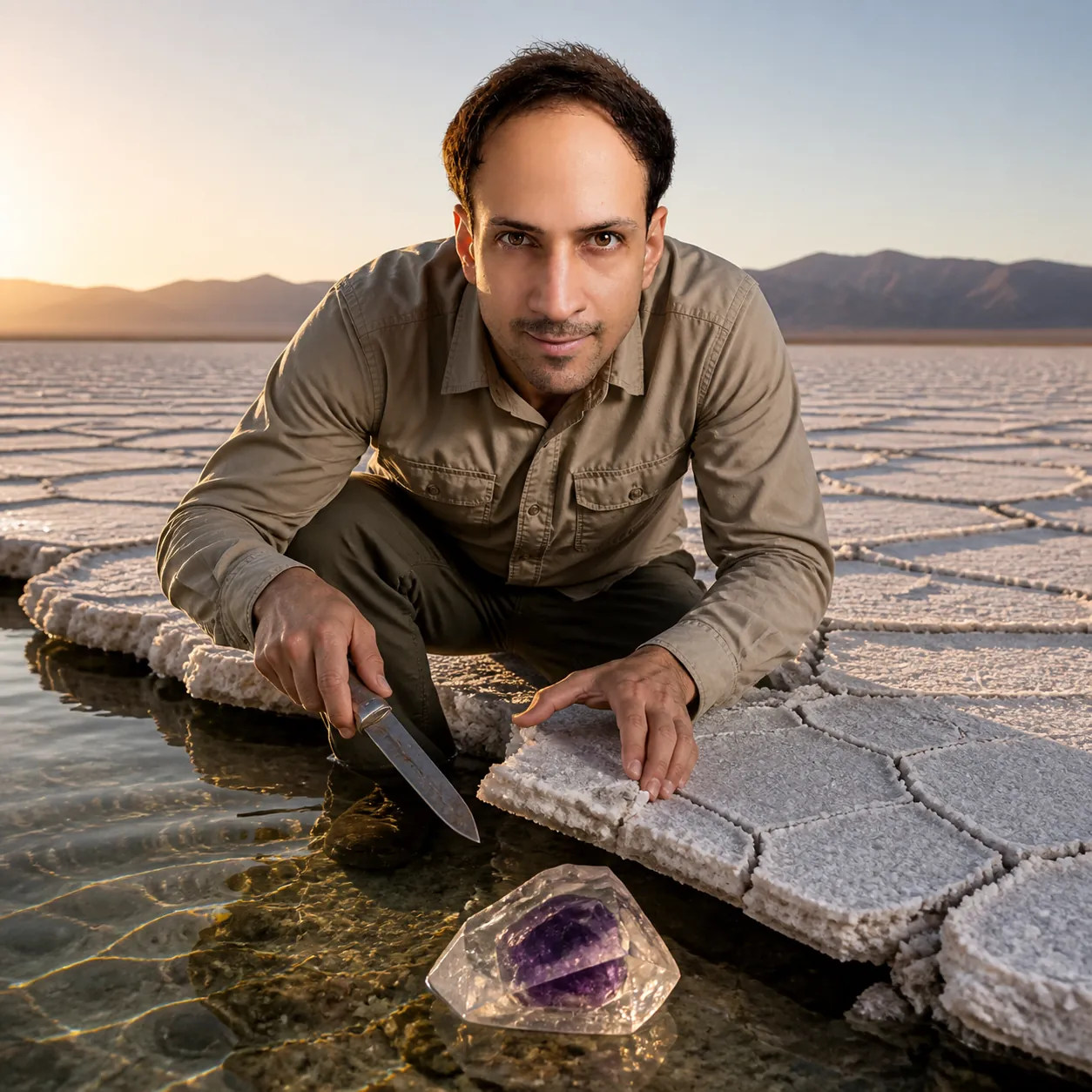
Out of Solution: Two-Tone Lattice Liquid Architecture — Salt Flat
صورةAI Portraits

Treat that reference as the character anchor and change only the scene. Create a square 1:1 museum-catalog frame with a strong first read and a slower...

من نص البرومبت

Use the attached reference photo as the identity reference: keep the same face, skin tone, hair and features as the person in that photo, without beautifying, aging or altering them. Treat that reference as the character anchor and change only the scene. Create a square 1:1 museum-catalog frame with a strong first read and a slower second read at exactly 2880x2880 pixels. Location: the cracked white edge of a sabkha salt flat at low sun. Show the subject in a dust-toned field shirt with sleeves buttoned at the wrist, crouching to free one salt plate with a flat knife. The impossible-looking event must obey this clear system: a two-tone crystal with a violet chrome-alum heart jacketed in clear potassium alum, one lattice continued across two different chemistries turns a liquid's dissolved cargo into architecture a hand could rest on. Explore how much of building is simply removing the reasons not to begin; direct expression and posture toward unhurried focus, never melodrama or ad-like confidence. Use a 90mm framing that holds the grown geometry and their face in one plane of focus. Make the composition set liquid and solid on opposite sides of one clean diagonal. Render it as high-concept chemistry portraiture built from real supersaturation phenomena, true laboratory-glass materiality, restrained documentary honesty, and quietly monumental still-life composition, using hard low window sun refracted through glassware into small honest caustics and a palette of putty, brushed steel, and one violet chrome-alum note. Photorealistic: this must read as a real photograph from a physical camera, never an illustration, painting, or 3D render. Resolve real surface detail: brass darkened in the recesses and bright where thumbs land, and lacquer crazed rather than perfect. Keep one identity-locked person, credible hands and fingers, natural fabric, and coherent scale, contact, reflections, shadows, airflow, deformation, and materials. Background people only when essential, always secondary and clearly different. Avoid glowing magic crystals, amethyst geode caves, gemstone treasure piles, frosted window fakery, and CGI diamond shards. No text, labels, logos, signatures, watermarks, random symbols, plastic skin, excessive bloom, or glossy AI finish.
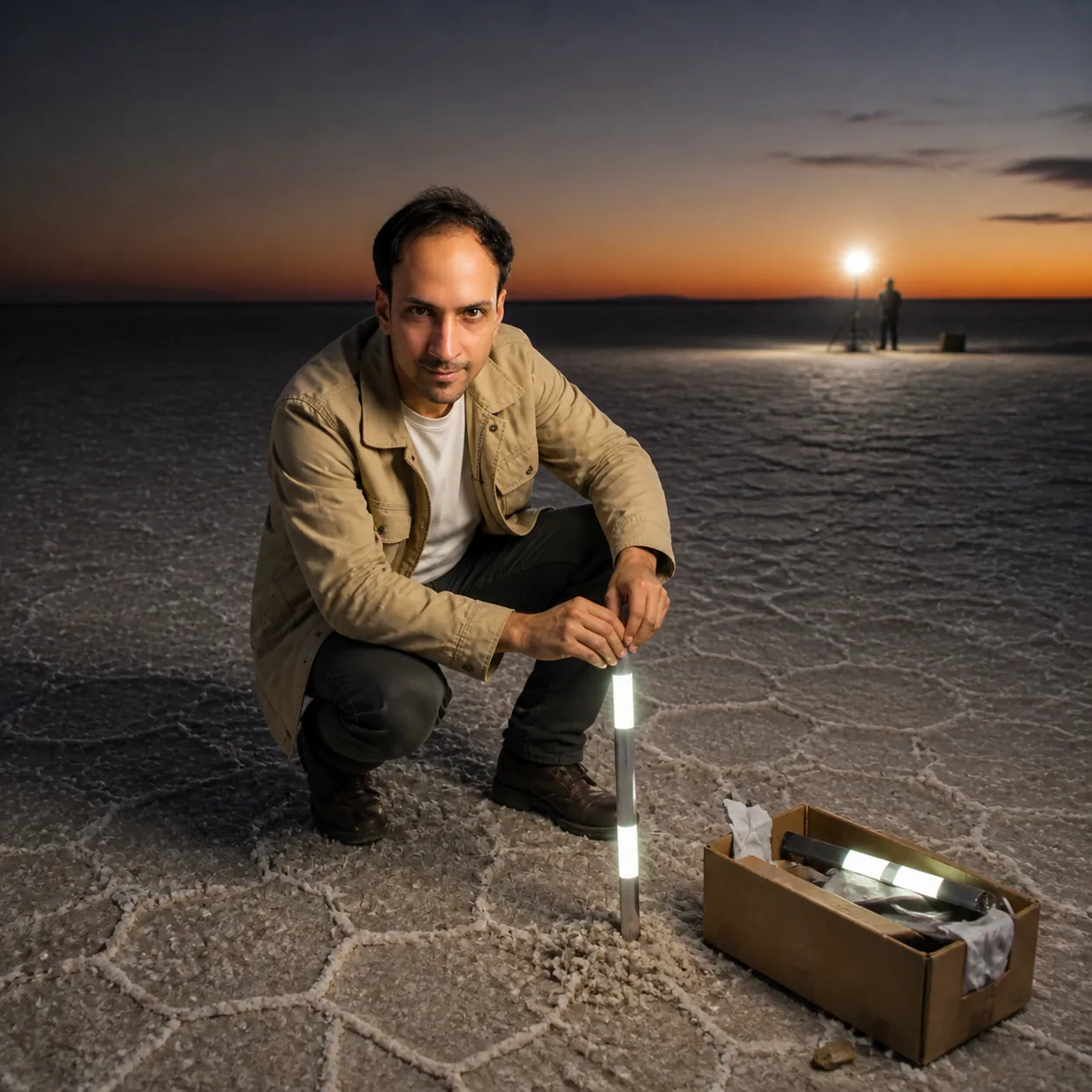
Private Fire: Two-Truth Cloth Audience of One — Salt Flat
صورةAI Portraits

Create a square 1:1 museum-catalog frame with a strong first read and a slower second read at exactly 2880x2880 pixels. Location: a sabkha salt flat at...

من نص البرومبت

Use the attached reference photo as the identity reference: keep the same face, skin tone, hair and features as the person in that photo, without beautifying, aging or altering them. Create a square 1:1 museum-catalog frame with a strong first read and a slower second read at exactly 2880x2880 pixels. Location: a sabkha salt flat at dusk, horizon one unbroken line. Show the subject in a beige field jacket over a white tee, pressing a survey stake flush with the crust. Build the artwork around this material rule: a swatch of retroreflective cloth that photographs as grey fabric or white fire depending on where the flash stands keeps its full brightness for the one standing at the light's source. Explore whether an answer that only the asker can see still counts as public truth; direct expression and posture toward humbled precision, never melodrama or ad-like confidence. Use a measured 35mm environmental view, the subject at one-third, the returning light deeper in frame. Make the composition align lamp, eye, and return along one legible line. Render it as quiet experimental gallery photography built around one working retroreflector, disciplined single-source lighting, true-to-life surface response, and patient observational framing, using soft overhead work light dimmed until the answering shine can dominate honestly and a palette of lamp black, slate grey, and one pale-fire cone. Photorealistic: this must read as a real photograph from a physical camera, never an illustration, painting, or 3D render. Resolve real surface detail: label-free packaging showing carton fibre, cardboard bruised at the corners, and tape lifting slightly at one end. Keep one identity-locked subject, credible hands and fingers, natural fabric, and coherent scale, contact, reflections, shadows, airflow, deformation, and materials. Background people only when essential, always secondary and clearly different. Avoid glowing sci-fi visors, hi-vis vest advertising poses, lens-flare starbursts, and neon cyberpunk streets. No text, labels, logos, signatures, watermarks, random symbols, plastic skin, excessive bloom, or glossy AI finish.
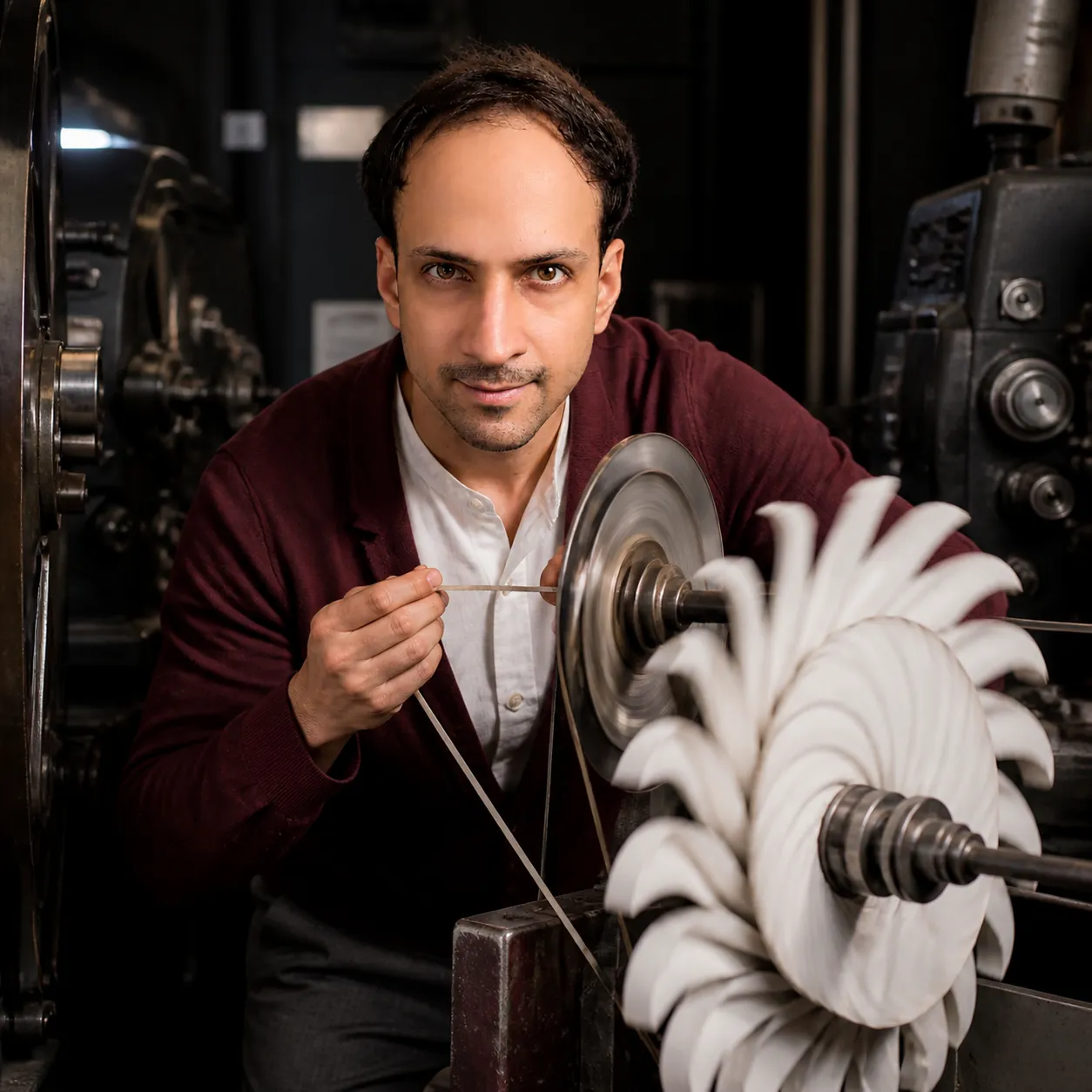
Assembled Motion: Strobed Bloom Eye Recruited — Cinema Loft
صورةAI Portraits

Create a square 1:1 museum-catalog frame with a strong first read and a slower second read at exactly 2880x2880 pixels. Location: a repertory cinema's...

من نص البرومبت

Use the attached reference photo as the identity reference: keep the same face, skin tone, hair and features as the person in that photo, without beautifying, aging or altering them. Create a square 1:1 museum-catalog frame with a strong first read and a slower second read at exactly 2880x2880 pixels. Location: a repertory cinema's projection loft between two resting projectors. Show the subject in a maroon cardigan over a white collarless shirt and grey trousers, threading a cotton strap over a bare drive pulley. Make one rigorous physical condition the conceptual engine: a sculpted gypsum bloom whose petals, arranged at the golden angle, cascade outward forever while the spinning form is strobed recruits the viewer's own persistence of vision as its final moving part. Explore why motion the eye assembles itself feels more alive than motion merely present; direct expression and posture toward quiet astonishment, never melodrama or ad-like confidence. Use an eye-level 85mm portrait view with the apparatus sharing their focal plane at honest scale. Make the composition oppose the machine's blur against their perfectly still attention. Render it as pre-cinema apparatus portraiture built from working persistence-of-vision machines, archival mechanical detail, truthful motion blur, and calm documentary observation, using one cool low-angle key with soft continuous fill and honest shadows and a palette of lamp black, worn tin, and one arc of verdigris. Photorealistic: this must read as a real photograph from a physical camera, never an illustration, painting, or 3D render. Resolve real surface detail: true skin texture with pores and fine hair at the hairline, and fabric that creases where it is actually stressed. Keep one identity-locked subject, credible hands and fingers, natural fabric, and coherent scale, contact, reflections, shadows, airflow, deformation, and materials. Background people only when essential, always secondary and clearly different. Avoid film-strip borders, cartoon motion lines, ghosted multiple faces, glowing hologram spin, and sparks flying off machinery. No text, labels, logos, signatures, watermarks, random symbols, plastic skin, excessive bloom, or glossy AI finish.
The Quiet Reply: Distant Answer Private Channel — Observatory
صورةAI Portraits

Create a square 1:1 museum-catalog frame with a strong first read and a slower second read at exactly 2880x2880 pixels. Location: the catwalk of a small...

من نص البرومبت

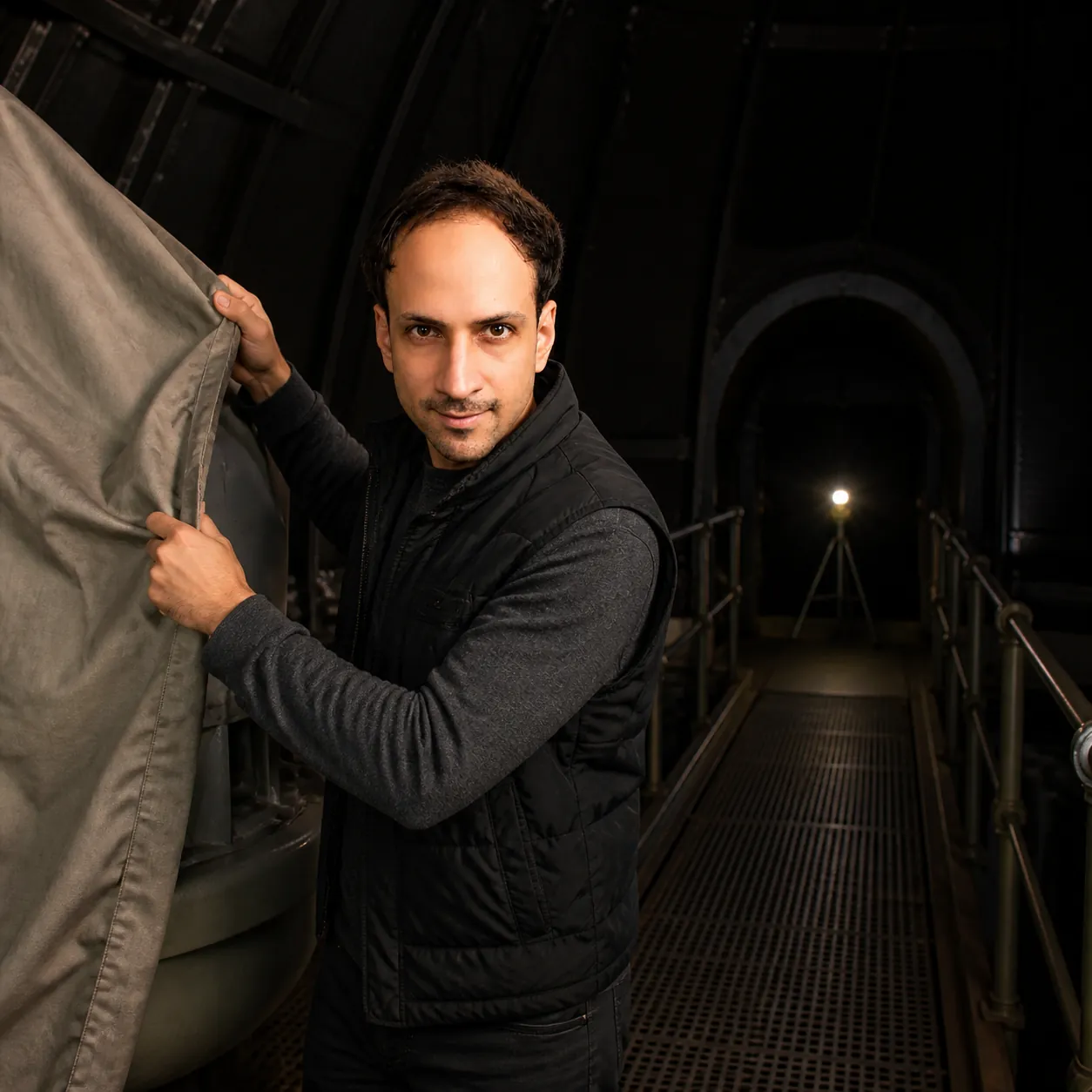
Use the attached reference photo as the identity reference: keep the same face, skin tone, hair and features as the person in that photo, without beautifying, aging or altering them. Create a square 1:1 museum-catalog frame with a strong first read and a slower second read at exactly 2880x2880 pixels. Location: the catwalk of a small university observatory under a closed dome. Show the subject in a quilted charcoal gilet over a slate flannel shirt, drawing a canvas dust cover back with both hands. Build the artwork around this material rule: a surveyor's corner prism stationed far down the dark that answers their small torch with one clean star of returned light turns the open air into a private channel between lamp and eye. Explore how geometry alone can address a reply to one eye and no other; direct expression and posture toward earned conviction, never melodrama or ad-like confidence. Use a measured 35mm environmental view, the subject at one-third, the returning light deeper in frame. Make the composition let the off-axis dullness occupy most of the frame. Render it as quiet experimental gallery photography built around one working retroreflector, disciplined single-source lighting, true-to-life surface response, and patient observational framing, using soft overhead work light dimmed until the answering shine can dominate honestly and a palette of charcoal, unpolished brass, and one warm white blaze. Photorealistic: this must read as a real photograph from a physical camera, never an illustration, painting, or 3D render. Resolve real surface detail: cotton that hangs by its own weight, seams that pucker very slightly, and collars softened by washing. Keep one identity-locked subject, credible hands and fingers, natural fabric, and coherent scale, contact, reflections, shadows, airflow, deformation, and materials. Background people only when essential, always secondary and clearly different. Avoid laser-show haze walls, glowing animal eyes, CGI light tunnels, painted halos, and highway signage. No text, labels, logos, signatures, watermarks, random symbols, plastic skin, excessive bloom, or glossy AI finish.
Strict Rhythm: Flip-Card Drum Eye Recruited — Fountain Court
صورةAI Portraits

Create a square 1:1 museum-catalog frame with a strong first read and a slower second read at exactly 2880x2880 pixels. Location: a tiled hotel courtyard...

من نص البرومبت

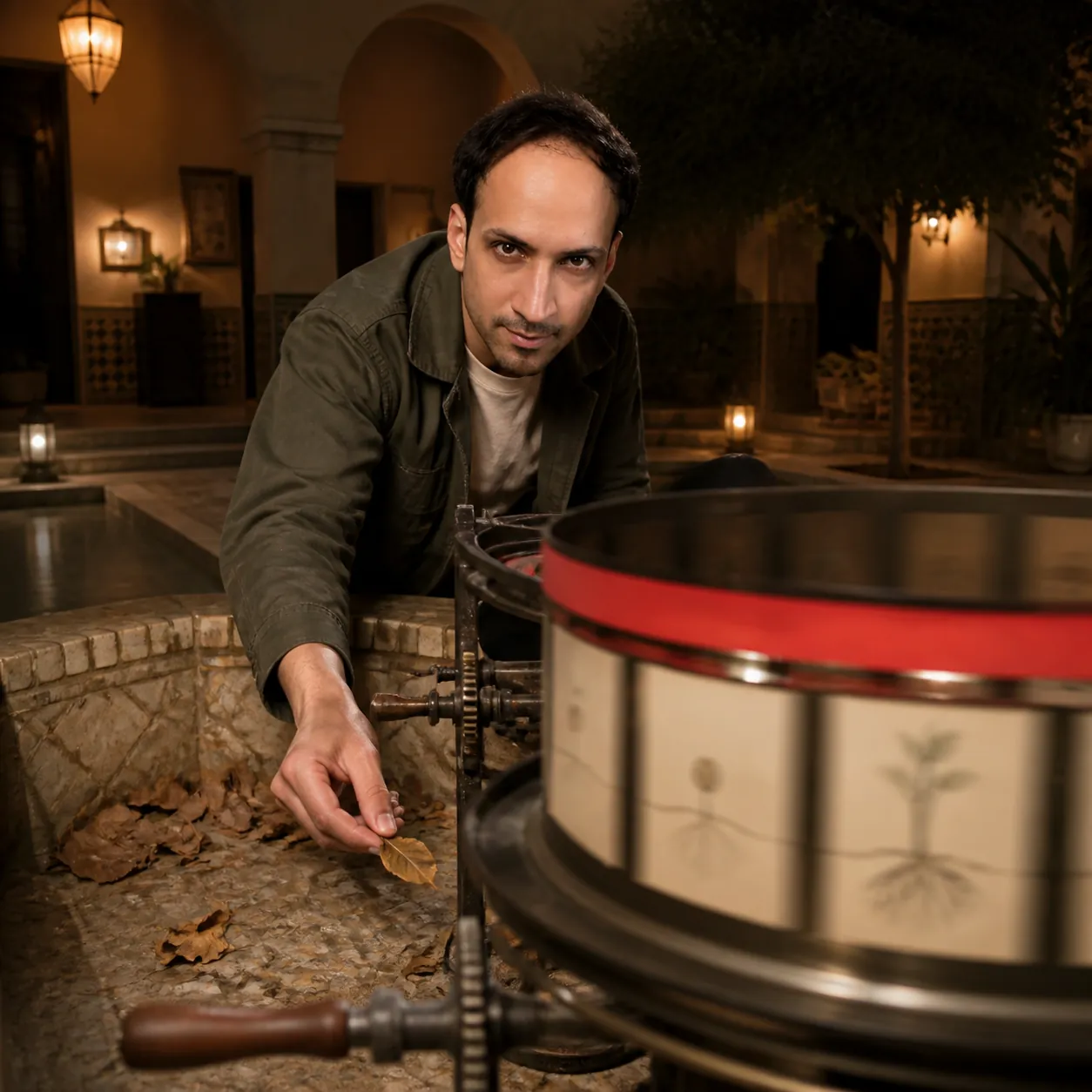
Use the attached reference photo as the identity reference: keep the same face, skin tone, hair and features as the person in that photo, without beautifying, aging or altering them. Create a square 1:1 museum-catalog frame with a strong first read and a slower second read at exactly 2880x2880 pixels. Location: a tiled hotel courtyard whose fountain is switched off for the night. Show the subject in a dark olive field jacket over an off-white crew-neck, lifting a fallen leaf from the dry fountain basin. Treat this mechanism as the frame’s governing rule: a hand-cranked mutoscope drum whose ring of ink-drawn cards flips a single seed through its whole germination in seconds recruits the viewer's own persistence of vision as its final moving part. Explore whether an illusion that confesses its whole mechanism still deserves the name; direct expression and posture toward grounded wonder, never melodrama or ad-like confidence. Frame past the working apparatus from slightly behind it, keeping their attentive face sharp beyond the blur. Make the composition oppose the machine's blur against their perfectly still attention. Render it as pre-cinema apparatus portraiture built from working persistence-of-vision machines, archival mechanical detail, truthful motion blur, and calm documentary observation, using dim amber house light holding steady while the mechanism supplies all urgency and a palette of soot grey, unpainted card, and one band of vermilion. Photorealistic: this must read as a real photograph from a physical camera, never an illustration, painting, or 3D render. Resolve real surface detail: grout darker than tile, sealant slightly yellowed, and every joint showing a real tolerance gap. Keep one identity-locked subject, credible hands and fingers, natural fabric, and coherent scale, contact, reflections, shadows, airflow, deformation, and materials. Background people only when essential, always secondary and clearly different. Avoid film-strip borders, cartoon motion lines, ghosted multiple faces, glowing hologram spin, and sparks flying off machinery. No text, labels, logos, signatures, watermarks, random symbols, plastic skin, excessive bloom, or glossy AI finish.
Quiet Emergence: Climbing Crust Default Precision — Old Darkroom
صورةAI Portraits

Treat that reference as the character anchor and change only the scene. Create a square 1:1 museum-catalog frame with a strong first read and a slower...

من نص البرومبت

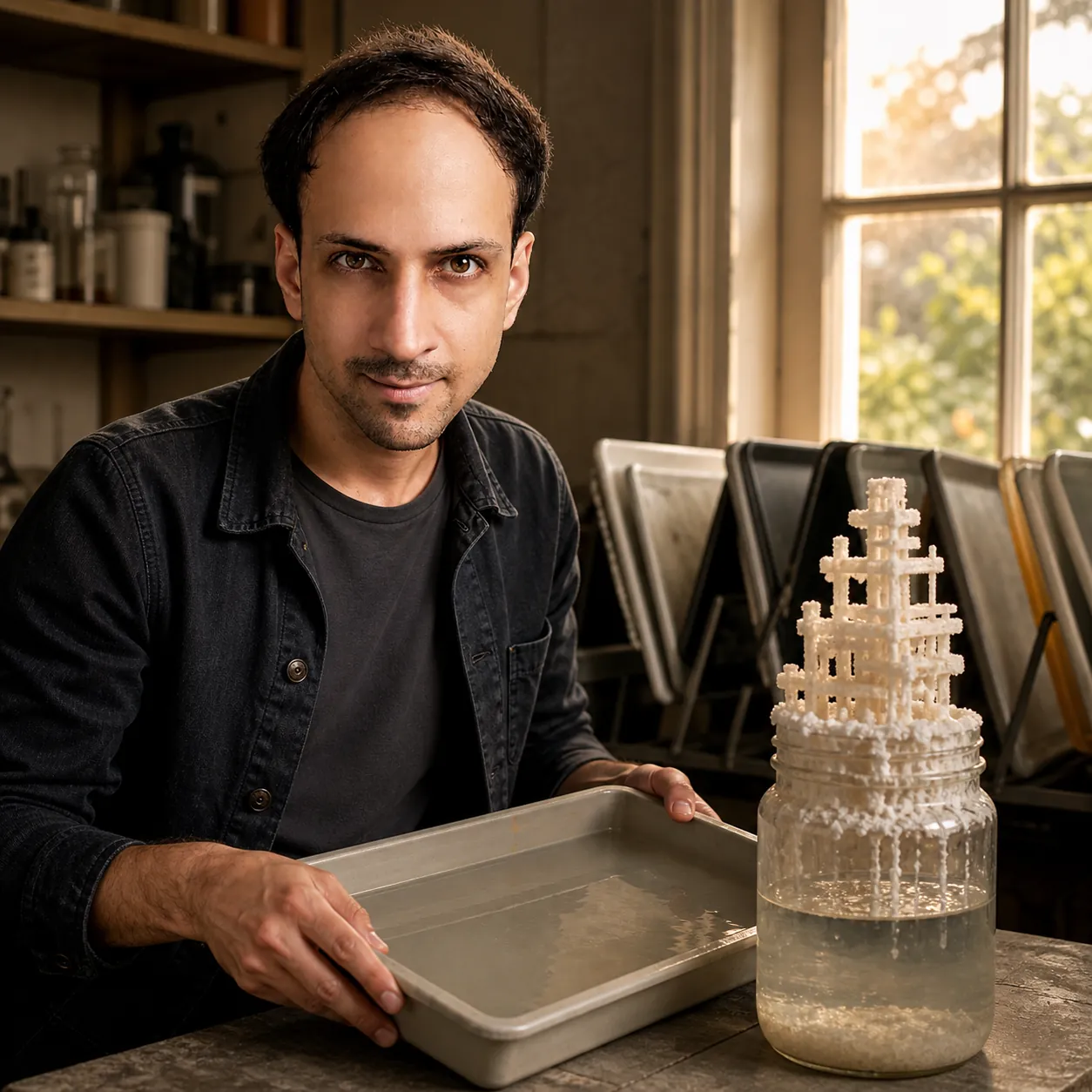
Use the attached reference photo as the identity reference: keep the same face, skin tone, hair and features as the person in that photo, without beautifying, aging or altering them. Treat that reference as the character anchor and change only the scene. Create a square 1:1 museum-catalog frame with a strong first read and a slower second read at exactly 2880x2880 pixels. Location: a darkroom opened to daylight, its rinse trays racked to dry. Show the subject in a dark denim jacket over a plain slate tee, rocking one shallow tray gently by its rim. The impossible-looking event must obey this clear system: a brine jar whose salt has climbed above its own waterline, a white crust wicking solution upward to build itself higher produces confident geometry in a place where nobody asked for any. Explore whether commitment deferred this long arrives all the stronger for the delay; direct expression and posture toward patient scrutiny, never melodrama or ad-like confidence. Use a 90mm framing that holds the grown geometry and their face in one plane of focus. Make the composition set liquid and solid on opposite sides of one clean diagonal. Render it as conceptual bench-science photography combining believable grown geometry, honest hand-and-glass interaction, precise material response, and quiet contemporary gallery restraint, using late golden side-light warming the whites while the room stays neutral and a palette of warm plaster, pale brine grey, and one date-brown accent. Photorealistic: this must read as a real photograph from a physical camera, never an illustration, painting, or 3D render. Resolve real surface detail: skin that reddens slightly under pressure, nail beds with honest colour, and knuckle creases that fold rather than blur. Keep one identity-locked person, credible hands and fingers, natural fabric, and coherent scale, contact, reflections, shadows, airflow, deformation, and materials. Background people only when essential, always secondary and clearly different. Avoid wizard-laboratory props, neon translucent minerals, floating crystal shards, motion-smeared growth trails, and jewelry-advert sparkle. No text, labels, logos, signatures, watermarks, random symbols, plastic skin, excessive bloom, or glossy AI finish.
Sent Back: Opposition Surge Private Channel — Lighthouse
صورةAI Portraits

Create a square 1:1 museum-catalog frame with a strong first read and a slower second read at exactly 2880x2880 pixels. Location: the lamp room of a...

من نص البرومبت

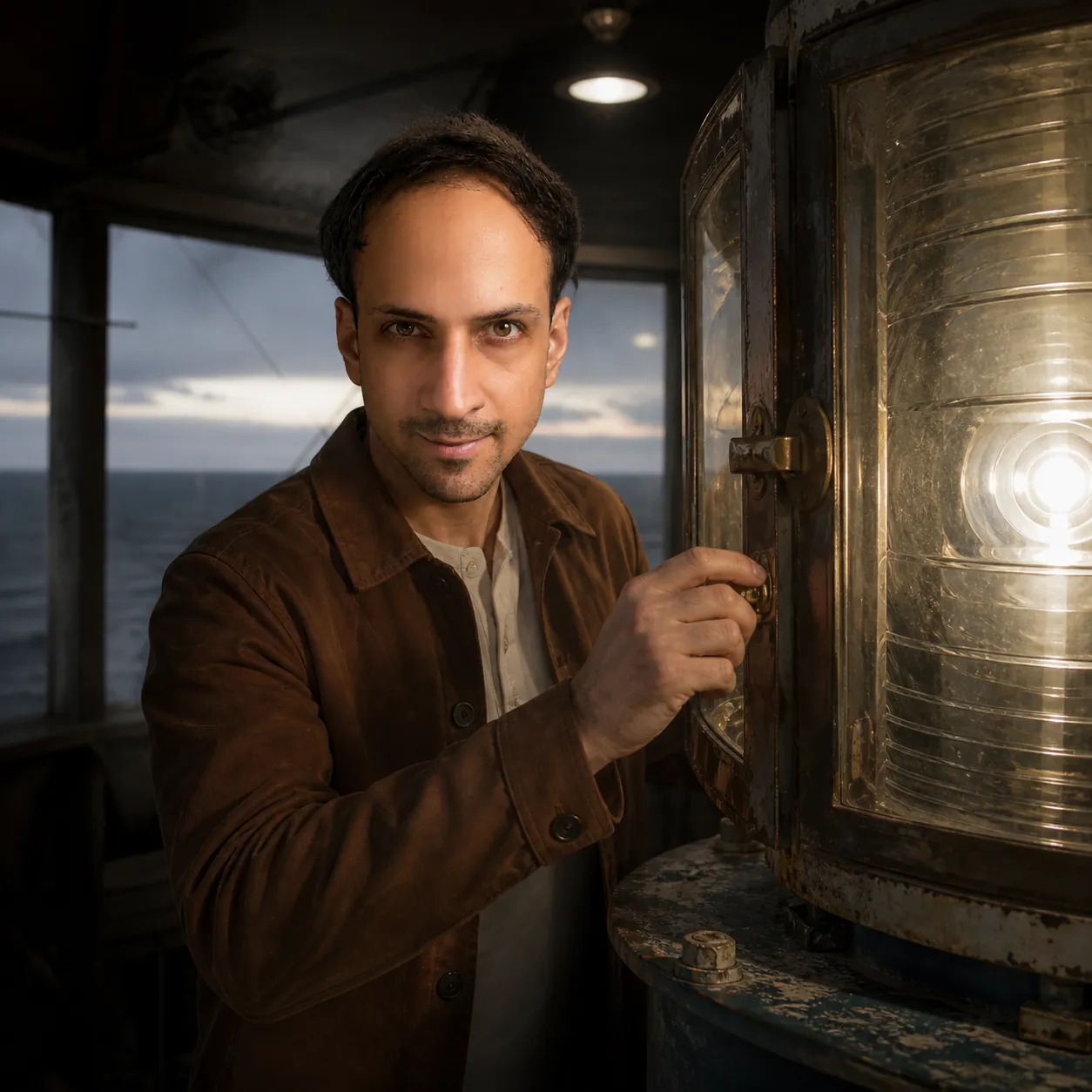
Use the attached reference photo as the identity reference: keep the same face, skin tone, hair and features as the person in that photo, without beautifying, aging or altering them. Create a square 1:1 museum-catalog frame with a strong first read and a slower second read at exactly 2880x2880 pixels. Location: the lamp room of a decommissioned coastal lighthouse. Show the subject in a rust-brown chore coat over a cream henley, latching the brass door of the lamp cage shut. Use this advanced image-making device as the core logic: a shallow tray of dull volcanic dust that surges visibly brighter the instant their lamp is raised beside their eye turns the open air into a private channel between lamp and eye. Explore why distance loses its power over light that refuses to scatter on the way; direct expression and posture toward watchful calm, never melodrama or ad-like confidence. Frame from slightly low in the dark, their face lit by spill rather than beam. Make the composition surround one small blaze with generous, honest darkness. Render it as conceptual field-optics realism blending honest low-light exposure, physically accurate retroreflection, quiet darkened-space atmosphere, and calm human-scale editorial framing, using soft overhead work light dimmed until the answering shine can dominate honestly and a palette of night blue, bone grey, and one silver pinprick. Photorealistic: this must read as a real photograph from a physical camera, never an illustration, painting, or 3D render. Resolve real surface detail: rubber gone chalky with age, painted metal chipped to primer, and plastic yellowed only where light reaches it. Keep one identity-locked subject, credible hands and fingers, natural fabric, and coherent scale, contact, reflections, shadows, airflow, deformation, and materials. Background people only when essential, always secondary and clearly different. Avoid laser-show haze walls, glowing animal eyes, CGI light tunnels, painted halos, and highway signage. No text, labels, logos, signatures, watermarks, random symbols, plastic skin, excessive bloom, or glossy AI finish.
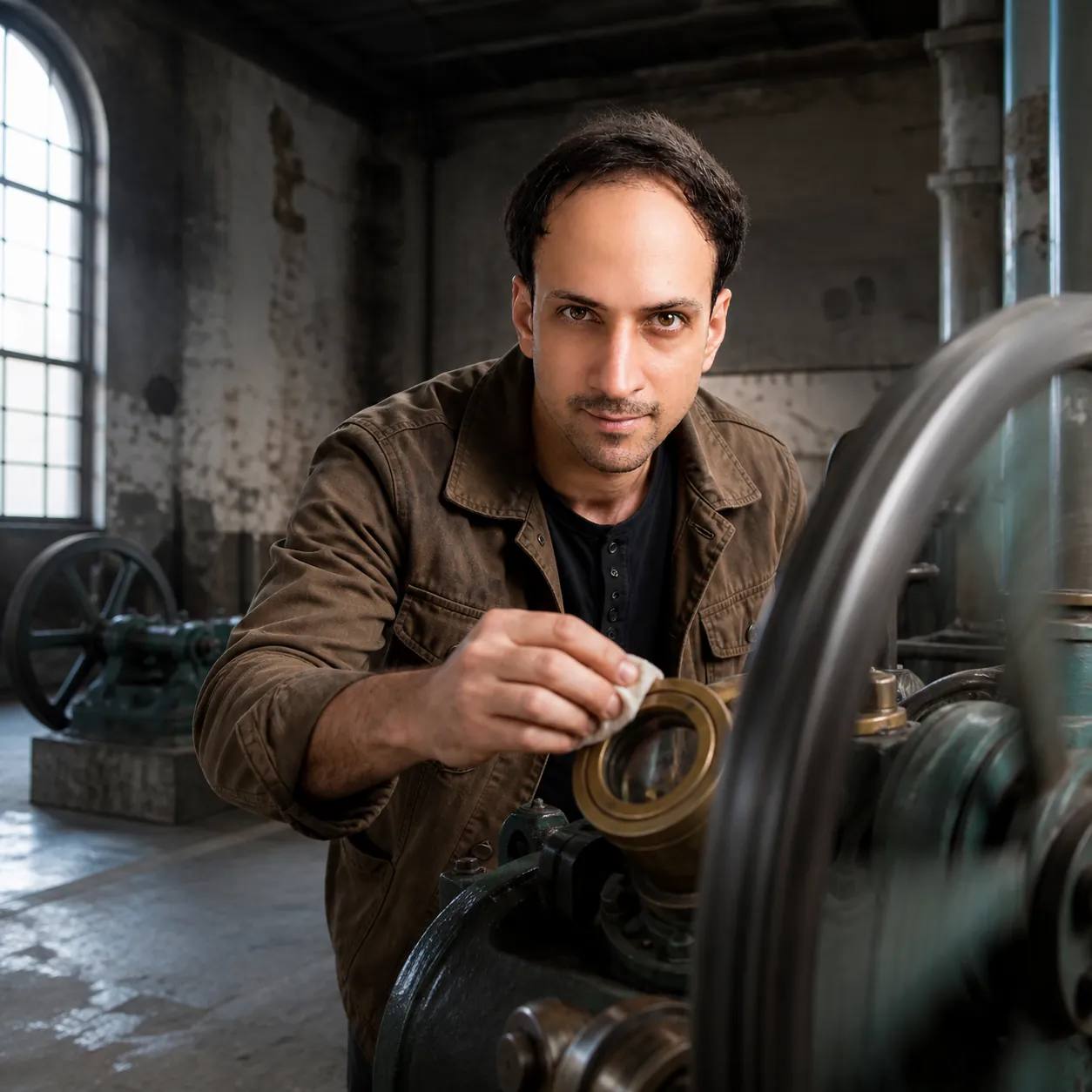
Between Frames: Reversing Wheel Seamless Loop — Pump Hall
صورةAI Portraits

Create a square 1:1 museum-catalog frame with a strong first read and a slower second read at exactly 2880x2880 pixels. Location: a decommissioned pump...

من نص البرومبت

Use the attached reference photo as the identity reference: keep the same face, skin tone, hair and features as the person in that photo, without beautifying, aging or altering them. Create a square 1:1 museum-catalog frame with a strong first read and a slower second read at exactly 2880x2880 pixels. Location: a decommissioned pump hall, its painted machinery bolted to concrete plinths. Show the subject in a brown canvas jacket over a faded black henley, polishing a brass sight-glass clear with one slow thumb. Treat this mechanism as the frame’s governing rule: a spoked flywheel spinning at full speed that their strobe knob walks from a standstill into slow, deliberate reverse turns strict mechanical repetition into one seamless appearance the eye trusts. Explore how strict repetition can impersonate growth while nothing on the table grows; direct expression and posture toward collected surprise, never melodrama or ad-like confidence. Frame past the working apparatus from slightly behind it, keeping their attentive face sharp beyond the blur. Make the composition oppose the machine's blur against their perfectly still attention. Render it as kinetic-sculpture photography grounded in believable machinery, honest depth of field, accurate frozen-motion physics, and unhurried editorial portrait craft, using one cool low-angle key with soft continuous fill and honest shadows and a palette of lamp black, worn tin, and one arc of verdigris. Photorealistic: this must read as a real photograph from a physical camera, never an illustration, painting, or 3D render. Resolve real surface detail: floor finish worn along the walked line, skirting marked at shoe height, and corners darker than the open floor. Keep one identity-locked subject, credible hands and fingers, natural fabric, and coherent scale, contact, reflections, shadows, airflow, deformation, and materials. Background people only when essential, always secondary and clearly different. Avoid steampunk goggles and gears, CGI slow-motion splashes, projected film beams, carnival colors, and duplicated human figures. No text, labels, logos, signatures, watermarks, random symbols, plastic skin, excessive bloom, or glossy AI finish.
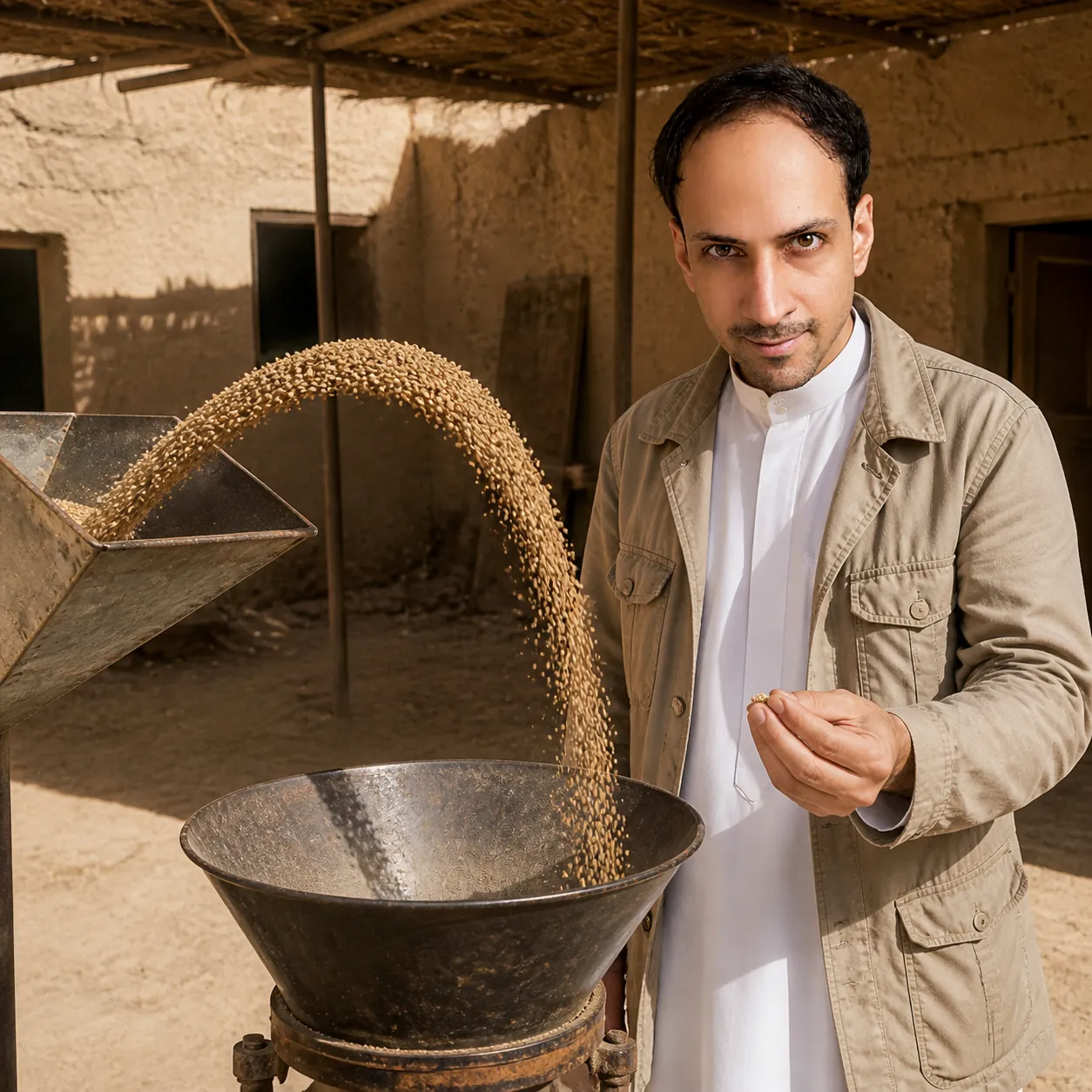
Grains Deciding: Frozen Arch Refuses Both States — Farm Courtyard
صورةAI Portraits

Create a square 1:1 museum-catalog frame with a strong first read and a slower second read at exactly 2880x2880 pixels. Location: the swept courtyard of a...

من نص البرومبت

Use the attached reference photo as the identity reference: keep the same face, skin tone, hair and features as the person in that photo, without beautifying, aging or altering them. Create a square 1:1 museum-catalog frame with a strong first read and a slower second read at exactly 2880x2880 pixels. Location: the swept courtyard of a mud-brick farmhouse at the desert's edge. Show the subject in a plain white traditional Gulf outfit under a light tan field jacket, rolling three test grains between thumb and forefinger. Build the artwork around this material rule: a clear funnel of coarse grains whose pour has locked itself into a stable arch bridging the open throat shows dry grains refusing to be fully solid or fully liquid. Explore what the desert has been quietly demonstrating beside every road for centuries; direct expression and posture toward earned familiarity, never melodrama or ad-like confidence. Use a composed 35mm environmental view that gives the apparatus and the subject equal standing. Make the composition keep the background silent so the grains do the talking. Render it as gallery-grade experimental photography built from working sand demonstrations, sun-bleached field styling, honest grain-level physics, and calm scientific candor, using soft canvas-filtered shade cut by one hard sliver of noon and a palette of warm quartz beige, gunmetal grey, and one oxide-red seam. Photorealistic: this must read as a real photograph from a physical camera, never an illustration, painting, or 3D render. Resolve real surface detail: label-free packaging showing carton fibre, cardboard bruised at the corners, and tape lifting slightly at one end. Keep one identity-locked subject, credible hands and fingers, natural fabric, and coherent scale, contact, reflections, shadows, airflow, deformation, and materials. Background people only when essential, always secondary and clearly different. Avoid swirling sandstorm vortices, glowing hourglass fantasy, levitating sand spirals, cymatic pattern plates, and heroic dune-top silhouettes. No text, labels, logos, signatures, watermarks, random symbols, plastic skin, excessive bloom, or glossy AI finish.
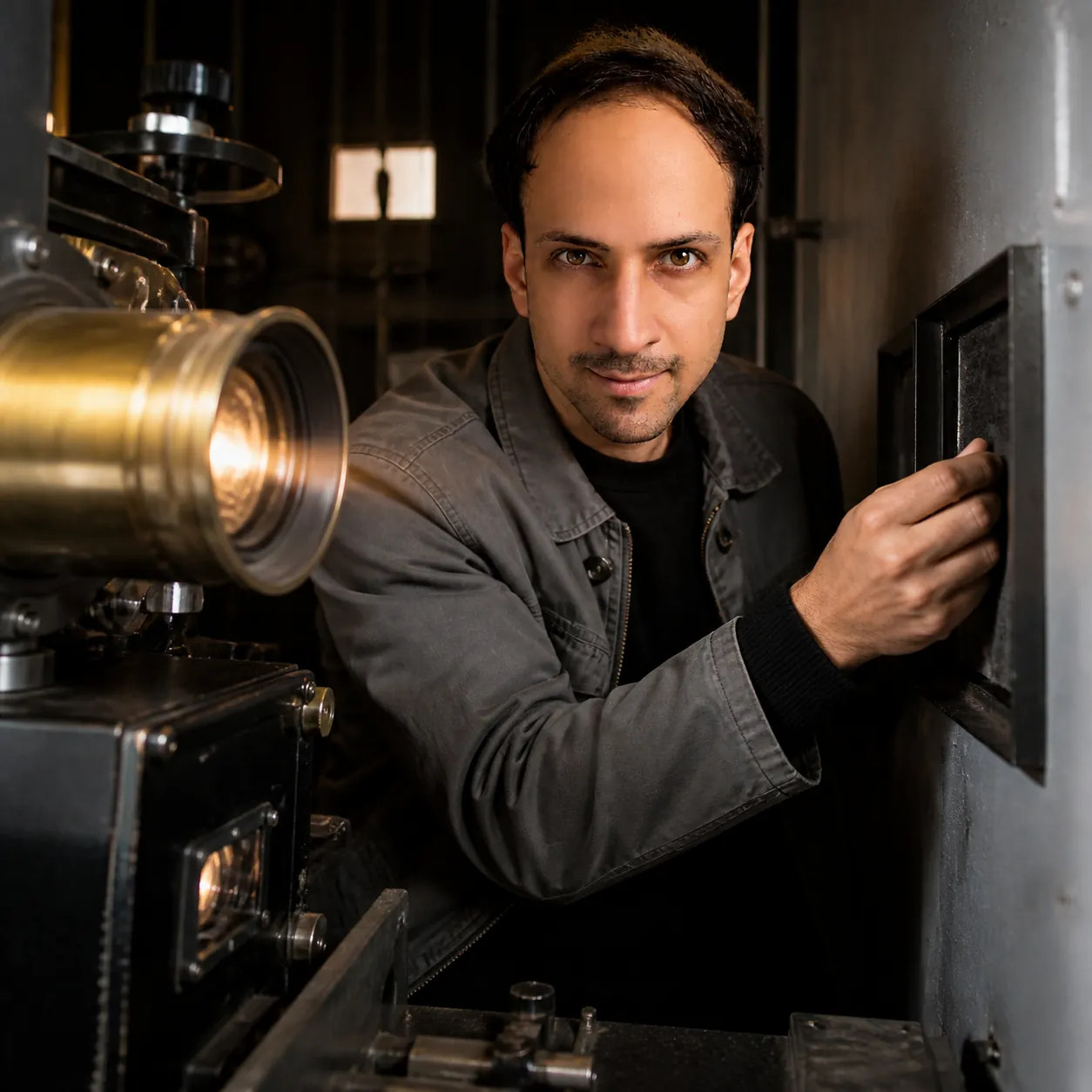
One Witness: Forgiving Cat's-Eye Audience of One — Projection Booth
صورةAI Portraits

Create a square 1:1 museum-catalog frame with a strong first read and a slower second read at exactly 2880x2880 pixels. Location: the projection booth of a...

من نص البرومبت

Use the attached reference photo as the identity reference: keep the same face, skin tone, hair and features as the person in that photo, without beautifying, aging or altering them. Create a square 1:1 museum-catalog frame with a strong first read and a slower second read at exactly 2880x2880 pixels. Location: the projection booth of a shuttered single-screen cinema. Show the subject in a black crew-neck sweater under an open grey utility jacket, pressing the felt door seal flat with one thumb. Make one rigorous physical condition the conceptual engine: a brass cat's-eye cell, a lens over a mirror, that keeps sending their beam home even as they tilt it keeps its full brightness for the one standing at the light's source. Explore where the boundary lies between observing a phenomenon and being part of its optics; direct expression and posture toward sober delight, never melodrama or ad-like confidence. Use an eye-level 80mm medium-format viewpoint with natural perspective and deep honest blacks. Make the composition align lamp, eye, and return along one legible line. Render it as high-concept optical portraiture built from real return-path geometry, documentary night realism, precision lamp discipline, and emotionally restrained composition, using late window light kept low so on-axis return outshines every ordinary reflection and a palette of graphite, dusty sand, and one pale gold star. Photorealistic: this must read as a real photograph from a physical camera, never an illustration, painting, or 3D render. Resolve real surface detail: the difference between a wiped surface and a clean one, faint tide marks on ceramic, and metal dulled unevenly by touch. Keep one identity-locked subject, credible hands and fingers, natural fabric, and coherent scale, contact, reflections, shadows, airflow, deformation, and materials. Background people only when essential, always secondary and clearly different. Avoid glowing sci-fi visors, hi-vis vest advertising poses, lens-flare starbursts, and neon cyberpunk streets. No text, labels, logos, signatures, watermarks, random symbols, plastic skin, excessive bloom, or glossy AI finish.
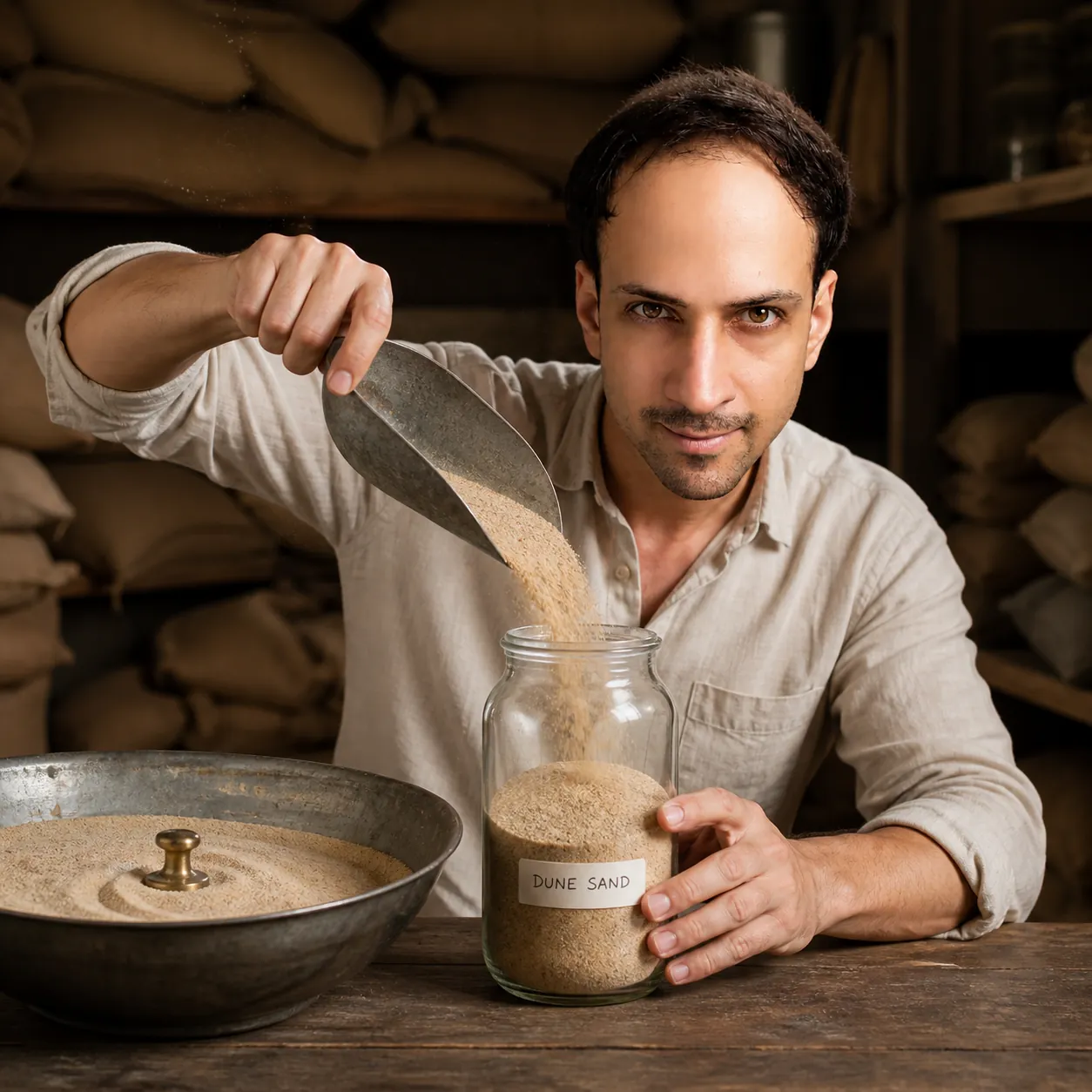
The Dry Tide: Fluidized Basin Refuses Both States — Grain Store
صورةAI Portraits

Create a square 1:1 museum-catalog frame with a strong first read and a slower second read at exactly 2880x2880 pixels. Location: a date-farm storehouse...

من نص البرومبت

Use the attached reference photo as the identity reference: keep the same face, skin tone, hair and features as the person in that photo, without beautifying, aging or altering them. Create a square 1:1 museum-catalog frame with a strong first read and a slower second read at exactly 2880x2880 pixels. Location: a date-farm storehouse with burlap sacks and one cleared plank table. Show the subject in an oatmeal linen shirt buttoned to one below the collar, funneling dune sand into a labeled glass jar. The impossible-looking event must obey this clear system: a basin of dune sand fed by hidden air through its floor, simmering like a liquid a brass weight sinks into shows dry grains refusing to be fully solid or fully liquid. Explore whether a heap that sorts, sings, and locks deserves the word inert; direct expression and posture toward quiet reckoning, never melodrama or ad-like confidence. Use a 90mm close-portrait framing where single airborne grains near the lens stay physically plausible against their focused face. Make the composition place their hands and the demonstration inside one unbroken triangle. Render it as gallery-grade experimental photography built from working sand demonstrations, sun-bleached field styling, honest grain-level physics, and calm scientific candor, using low raking desert sun that turns every ridge of grains into relief and a palette of sifted taupe, worn steel, and a low amber accent. Photorealistic: this must read as a real photograph from a physical camera, never an illustration, painting, or 3D render. Resolve real surface detail: glass with real thickness at its edge, reflections that carry the room's actual colour, and dust visible only at grazing angles. Keep one identity-locked subject, credible hands and fingers, natural fabric, and coherent scale, contact, reflections, shadows, airflow, deformation, and materials. Background people only when essential, always secondary and clearly different. Avoid swirling sandstorm vortices, glowing hourglass fantasy, levitating sand spirals, cymatic pattern plates, and heroic dune-top silhouettes. No text, labels, logos, signatures, watermarks, random symbols, plastic skin, excessive bloom, or glossy AI finish.
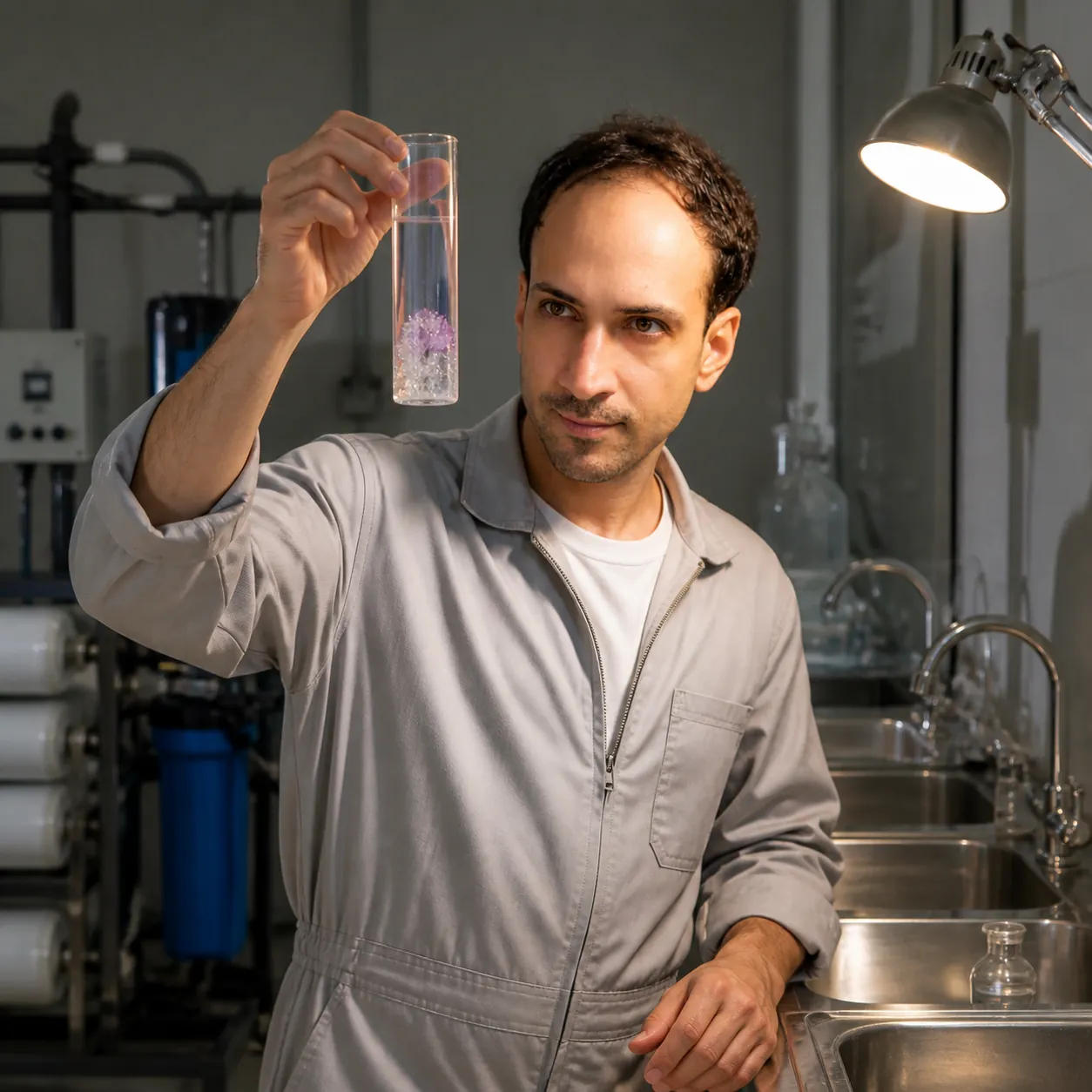
Out of Solution: Two-Tone Lattice Default Precision — Desalination Room
صورةAI Portraits

Treat that reference as the character anchor and change only the scene. Create a square 1:1 museum-catalog frame with a strong first read and a slower...

من نص البرومبت

Use the attached reference photo as the identity reference: keep the same face, skin tone, hair and features as the person in that photo, without beautifying, aging or altering them. Treat that reference as the character anchor and change only the scene. Create a square 1:1 museum-catalog frame with a strong first read and a slower second read at exactly 2880x2880 pixels. Location: the sampling room of a small desalination plant, steel sinks gleaming. Show the subject in a light grey coverall unzipped to a clean white crew-neck, raising a clear sample cylinder to eye level. Build the artwork around this material rule: a two-tone crystal with a violet chrome-alum heart jacketed in clear potassium alum, one lattice continued across two different chemistries produces confident geometry in a place where nobody asked for any. Explore how much of building is simply removing the reasons not to begin; direct expression and posture toward measured reverence, never melodrama or ad-like confidence. Use a measured 32mm wide view from respectful distance with all verticals kept straight. Make the composition hold one large calm emptiness against the crowded crystalline detail. Render it as conceptual bench-science photography combining believable grown geometry, honest hand-and-glass interaction, precise material response, and quiet contemporary gallery restraint, using one raking bench lamp that turns every crystal edge into a drawn line and a palette of raw cotton, dim pewter, and clear sugar amber. Photorealistic: this must read as a real photograph from a physical camera, never an illustration, painting, or 3D render. Resolve real surface detail: hair with individual strands catching light, fine hair of uneven length, and skin oil giving a low uneven sheen. Keep one identity-locked person, credible hands and fingers, natural fabric, and coherent scale, contact, reflections, shadows, airflow, deformation, and materials. Background people only when essential, always secondary and clearly different. Avoid wizard-laboratory props, neon translucent minerals, floating crystal shards, motion-smeared growth trails, and jewelry-advert sparkle. No text, labels, logos, signatures, watermarks, random symbols, plastic skin, excessive bloom, or glossy AI finish.
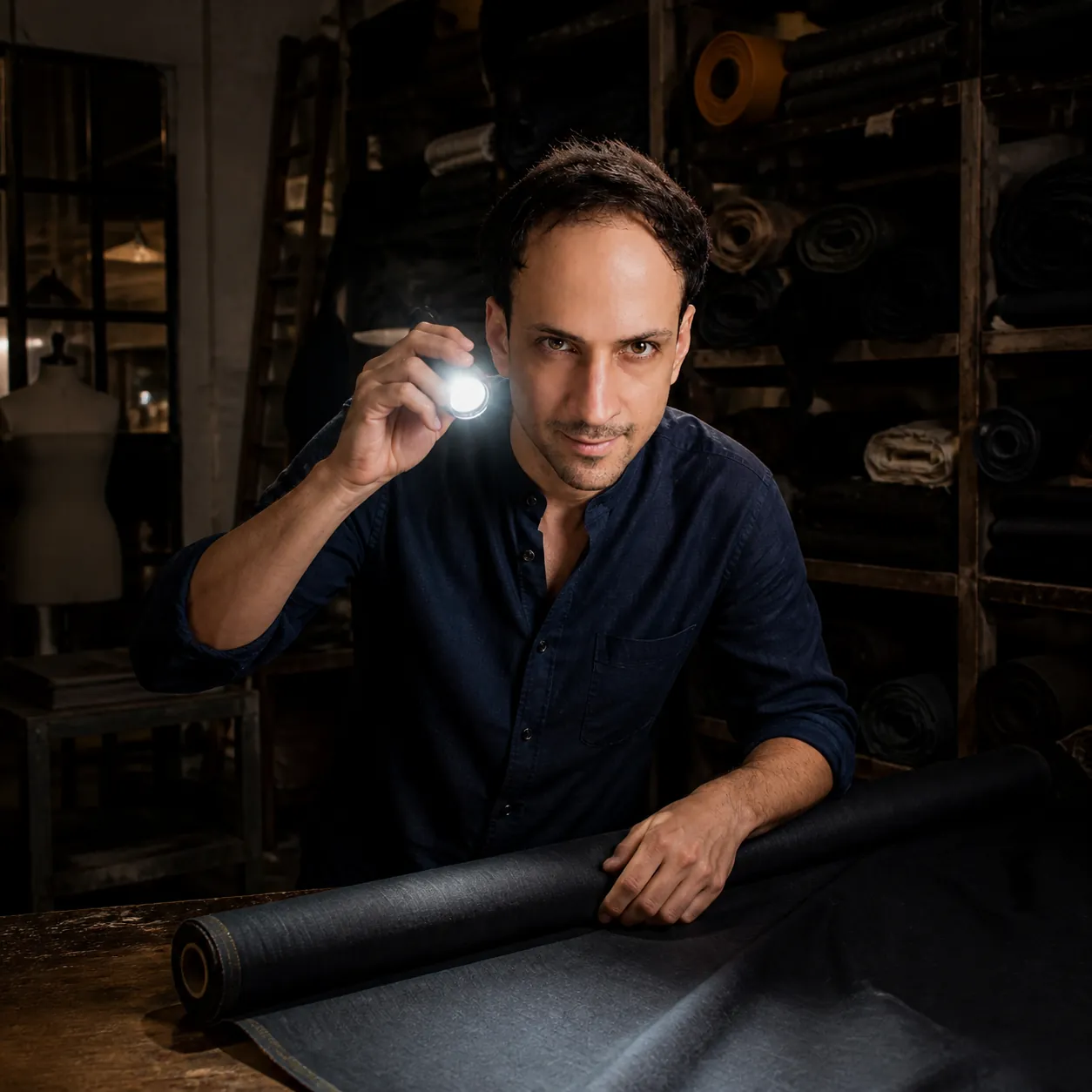
Sent Back: Opposition Surge Audience of One — Tailor's Atelier
صورةAI Portraits

Create a square 1:1 museum-catalog frame with a strong first read and a slower second read at exactly 2880x2880 pixels. Location: a tailor's atelier after...

من نص البرومبت

Use the attached reference photo as the identity reference: keep the same face, skin tone, hair and features as the person in that photo, without beautifying, aging or altering them. Create a square 1:1 museum-catalog frame with a strong first read and a slower second read at exactly 2880x2880 pixels. Location: a tailor's atelier after closing, cloth bolts racked high. Show the subject in a collarless indigo work shirt with sleeves rolled twice, unrolling a dark bolt one turn across the table. Treat this mechanism as the frame’s governing rule: a shallow tray of dull volcanic dust that surges visibly brighter the instant their lamp is raised beside their eye keeps its full brightness for the one standing at the light's source. Explore why distance loses its power over light that refuses to scatter on the way; direct expression and posture toward steady curiosity, never melodrama or ad-like confidence. Frame in half-profile at chest height so the subject and the answering light stay equally readable. Make the composition point the strongest return at the lens, their face kept quiet. Render it as high-concept optical portraiture built from real return-path geometry, documentary night realism, precision lamp discipline, and emotionally restrained composition, using low ambient dusk with a single handheld beam as the only key and a palette of asphalt grey, faded canvas, and one amber thread. Photorealistic: this must read as a real photograph from a physical camera, never an illustration, painting, or 3D render. Resolve real surface detail: grout darker than tile, sealant slightly yellowed, and every joint showing a real tolerance gap. Keep one identity-locked subject, credible hands and fingers, natural fabric, and coherent scale, contact, reflections, shadows, airflow, deformation, and materials. Background people only when essential, always secondary and clearly different. Avoid glowing sci-fi visors, hi-vis vest advertising poses, lens-flare starbursts, and neon cyberpunk streets. No text, labels, logos, signatures, watermarks, random symbols, plastic skin, excessive bloom, or glossy AI finish.
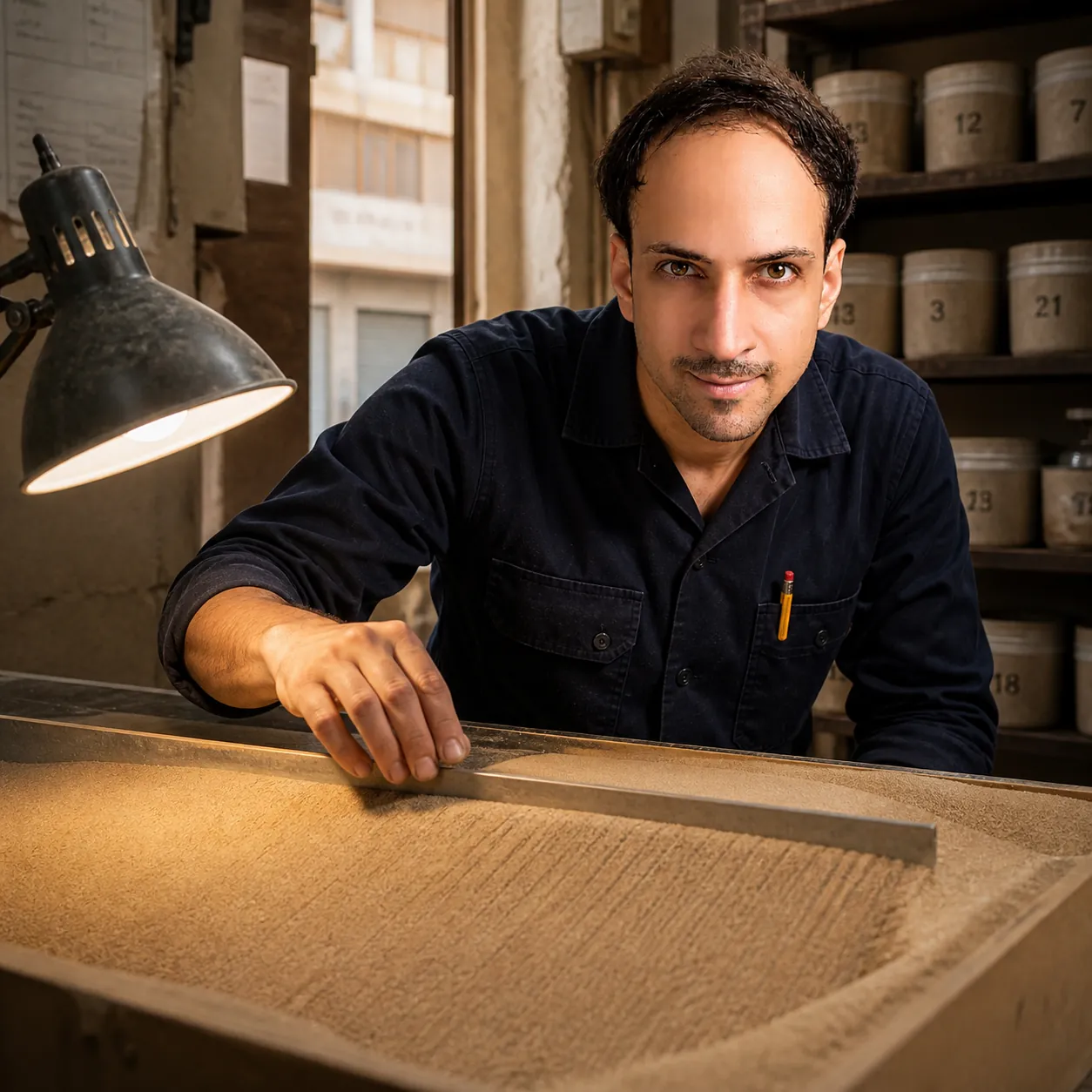
Fifth State: Singing Slip Face Ordinary Made Exact — Riyadh Workshop
صورةAI Portraits

Treat that reference as the character anchor and change only the scene. Create a square 1:1 museum-catalog frame with a strong first read and a slower...

من نص البرومبت

Use the attached reference photo as the identity reference: keep the same face, skin tone, hair and features as the person in that photo, without beautifying, aging or altering them. Treat that reference as the character anchor and change only the scene. Create a square 1:1 museum-catalog frame with a strong first read and a slower second read at exactly 2880x2880 pixels. Location: a back-street Riyadh workshop with sand samples in numbered tins. Show the subject in a navy work shirt with a pencil clipped at the chest, drawing a straightedge slowly across a bed of grains. Treat this mechanism as the frame’s governing rule: a booming dune face whose sheared upper layer they release with one slow hand-drag, avalanching as a single humming sheet gives the desert's most ordinary material the standing of an exact instrument. Explore why a material older than the mountains still refuses to pick a state; direct expression and posture toward attentive calm, never melodrama or ad-like confidence. Frame from just above the sand's surface so its grain-scale horizon leads to their level gaze. Make the composition let one sharp edge of settled grains cross the frame diagonally. Render it as conceptual earth-science portraiture combining tactile working apparatus, believable granular flow, restrained contemporary art direction, and unhurried human presence, using one bare work lamp angled low across the sand's textured surface and a palette of dune ivory, matte charcoal, and one indigo band. Photorealistic: this must read as a real photograph from a physical camera, never an illustration, painting, or 3D render. Resolve real surface detail: paper fibre visible at cut edges, plastic that shows mould lines, and paint thicker where a brush turned. Keep one identity-locked person, credible hands and fingers, natural fabric, and coherent scale, contact, reflections, shadows, airflow, deformation, and materials. Background people only when essential, always secondary and clearly different. Avoid falconry props, camel caravans, CGI sand tornadoes, face-morphing sand sculptures, and endless untouched postcard dunes. No text, labels, logos, signatures, watermarks, random symbols, plastic skin, excessive bloom, or glossy AI finish.
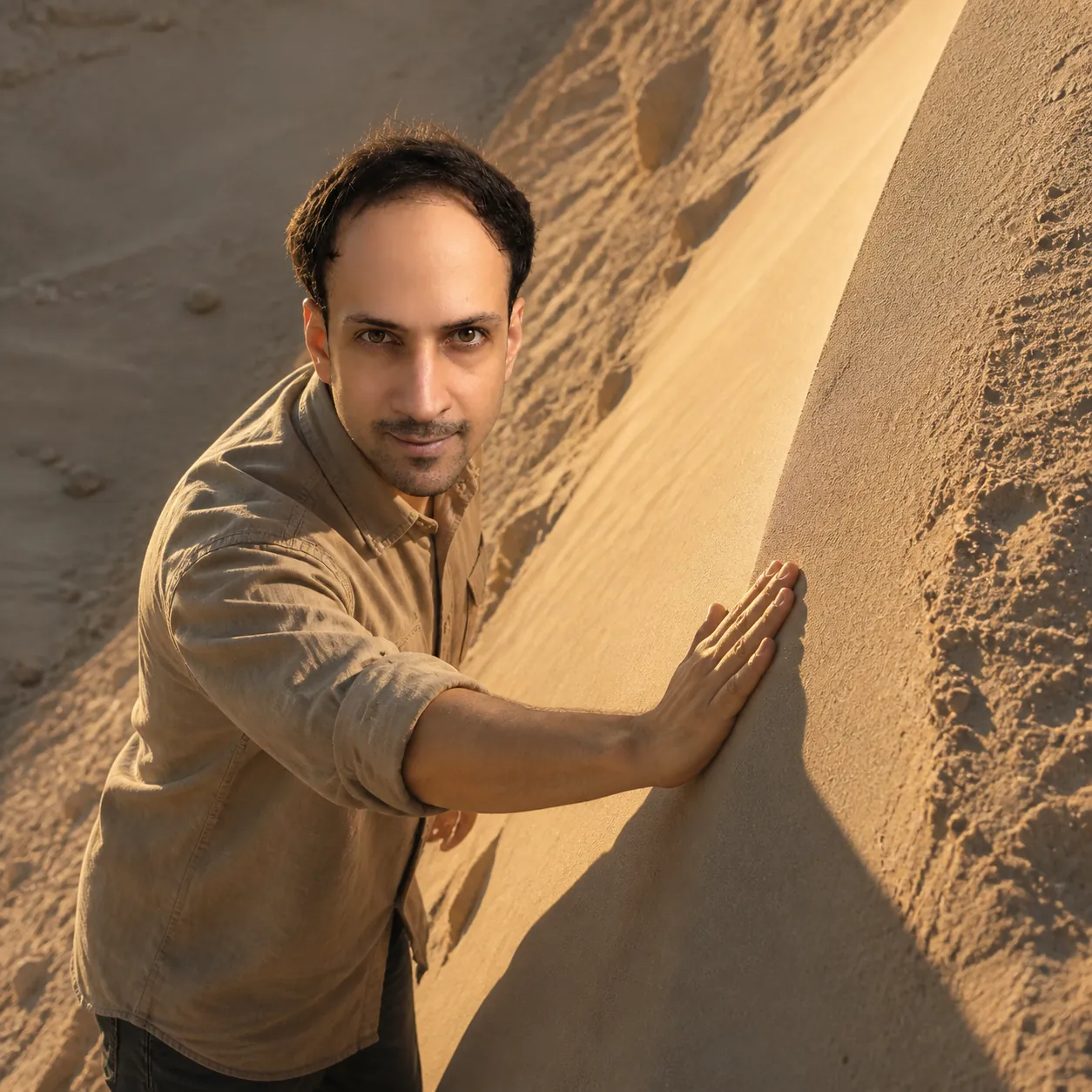
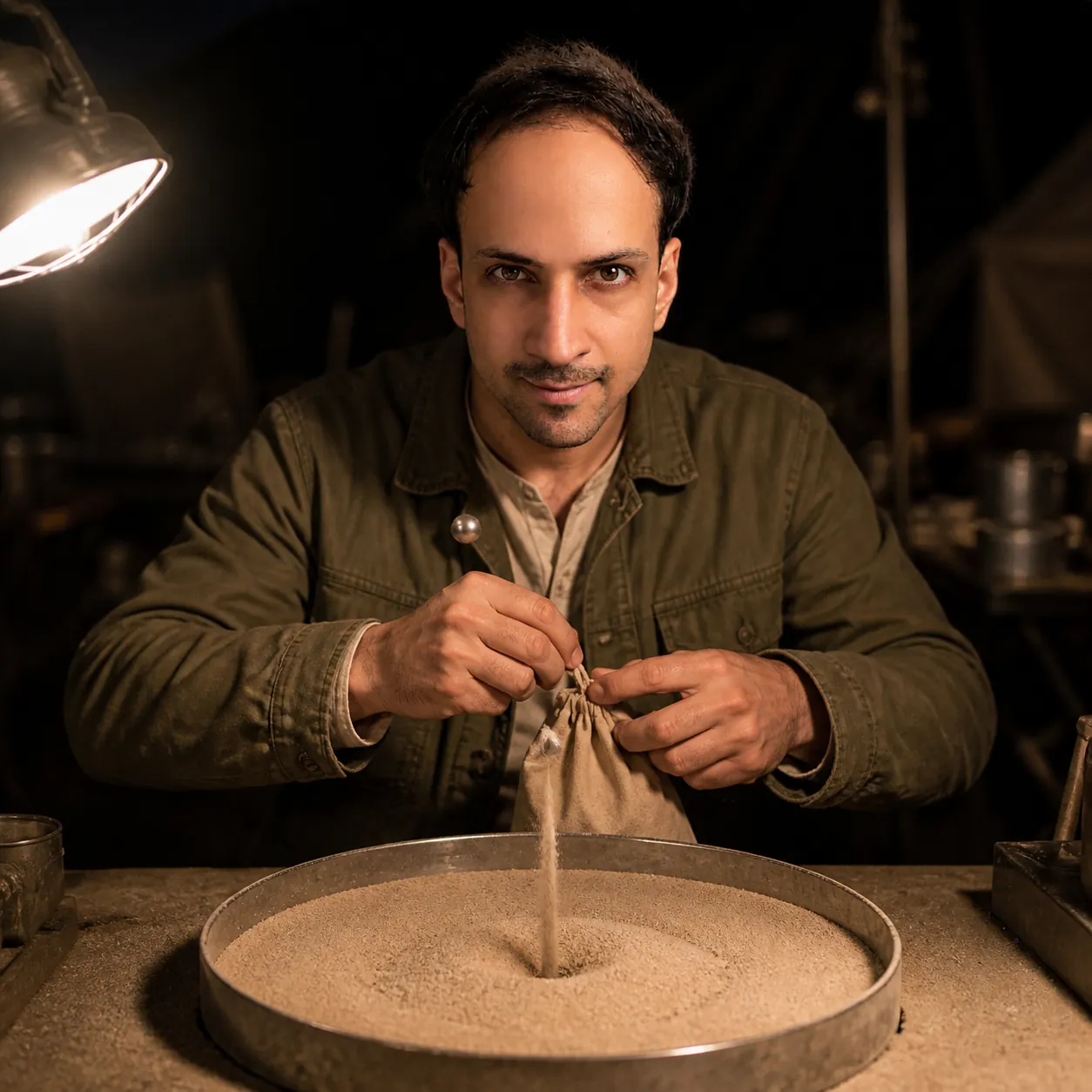
Sand's Grammar: Rebound Jet Refuses Both States — Night Camp
صورةAI Portraits

Create a square 1:1 museum-catalog frame with a strong first read and a slower second read at exactly 2880x2880 pixels. Location: a field camp under one...

من نص البرومبت

Use the attached reference photo as the identity reference: keep the same face, skin tone, hair and features as the person in that photo, without beautifying, aging or altering them. Create a square 1:1 museum-catalog frame with a strong first read and a slower second read at exactly 2880x2880 pixels. Location: a field camp under one work lamp after the wind has died. Show the subject in an olive chore coat buttoned over a collarless cotton shirt, knotting the drawstring of a small canvas sample bag. Treat this mechanism as the frame’s governing rule: a dish of loose fine sand firing a narrow vertical jet back up along the path of a dropped steel ball shows dry grains refusing to be fully solid or fully liquid. Explore whether they are conducting the demonstration or merely giving the sand its cue; direct expression and posture toward quiet reckoning, never melodrama or ad-like confidence. Frame from just above the sand's surface so its grain-scale horizon leads to their level gaze. Make the composition render grains near the action sharper than their skin. Render it as high-concept field-physics portraiture built from real granular mechanics, documentary desert realism, instrument-grade experimental staging, and emotionally restrained observational lighting, using one bare work lamp angled low across the sand's textured surface and a palette of sifted taupe, worn steel, and a low amber accent. Photorealistic: this must read as a real photograph from a physical camera, never an illustration, painting, or 3D render. Resolve real surface detail: grout darker than tile, sealant slightly yellowed, and every joint showing a real tolerance gap. Keep one identity-locked subject, credible hands and fingers, natural fabric, and coherent scale, contact, reflections, shadows, airflow, deformation, and materials. Background people only when essential, always secondary and clearly different. Avoid swirling sandstorm vortices, glowing hourglass fantasy, levitating sand spirals, cymatic pattern plates, and heroic dune-top silhouettes. No text, labels, logos, signatures, watermarks, random symbols, plastic skin, excessive bloom, or glossy AI finish.
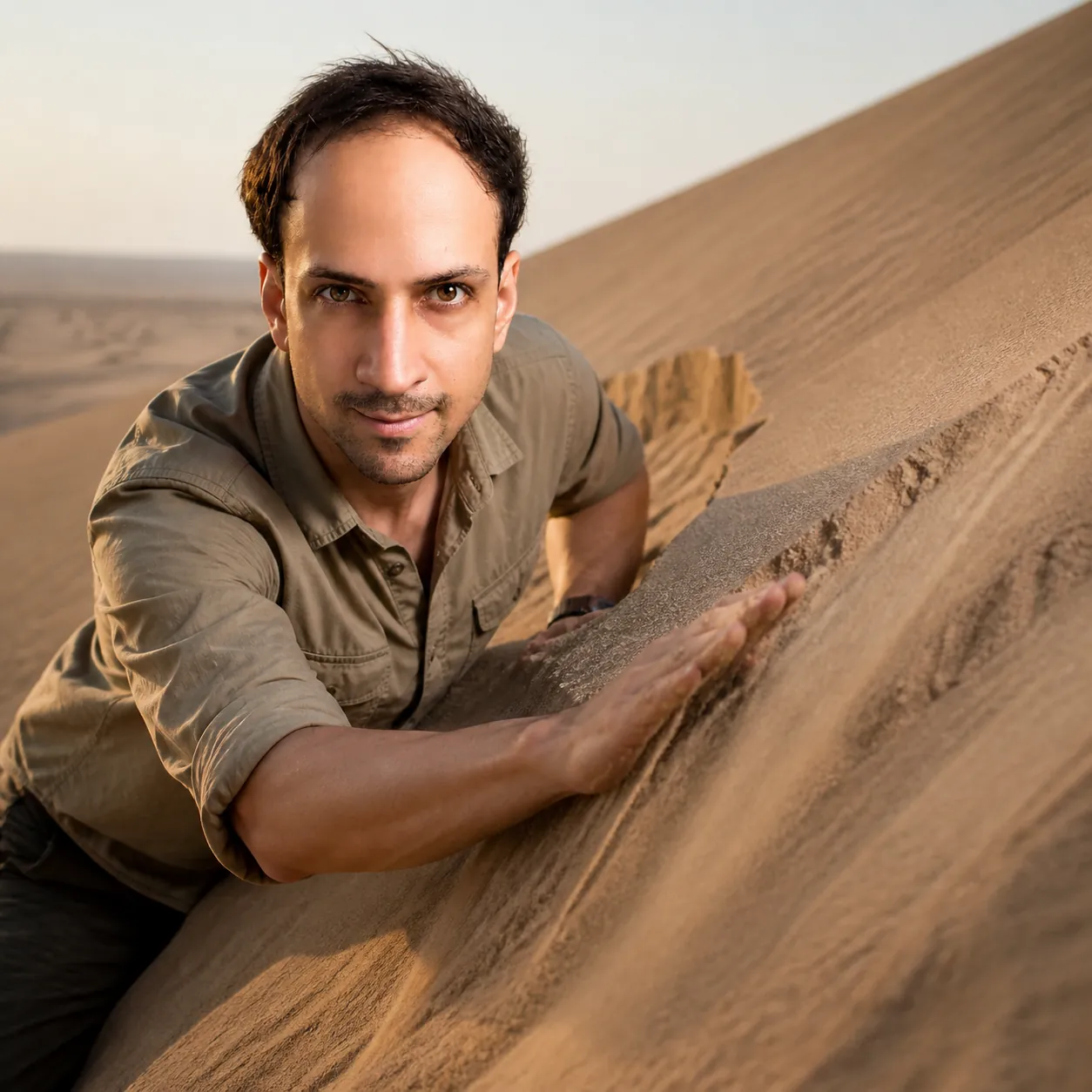
Grain Treaty: Vacuum Grip Ordinary Made Exact — Slip Face
صورةAI Portraits

Create a square 1:1 museum-catalog frame with a strong first read and a slower second read at exactly 2880x2880 pixels. Location: the steep leeward face of...

من نص البرومبت

Use the attached reference photo as the identity reference: keep the same face, skin tone, hair and features as the person in that photo, without beautifying, aging or altering them. Create a square 1:1 museum-catalog frame with a strong first read and a slower second read at exactly 2880x2880 pixels. Location: the steep leeward face of an isolated dune in late afternoon. Show the subject in a dust-toned field shirt with sleeves rolled past the forearms, pressing one flat palm slowly along the slope's brink. Build the artwork around this material rule: a soft canvas cushion of loose grains that turns rigid as fired brick the moment they draw its air out gives the desert's most ordinary material the standing of an exact instrument. Explore how order can rise out of shaking, spilling, and other engines of disorder; direct expression and posture toward attentive calm, never melodrama or ad-like confidence. Use a composed 35mm environmental view that gives the apparatus and the subject equal standing. Make the composition place their hands and the demonstration inside one unbroken triangle. Render it as gallery-grade experimental photography built from working sand demonstrations, sun-bleached field styling, honest grain-level physics, and calm scientific candor, using soft canvas-filtered shade cut by one hard sliver of noon and a palette of dune ivory, matte charcoal, and one indigo band. Photorealistic: this must read as a real photograph from a physical camera, never an illustration, painting, or 3D render. Resolve real surface detail: cotton that hangs by its own weight, seams that pucker very slightly, and collars softened by washing. Keep one identity-locked subject, credible hands and fingers, natural fabric, and coherent scale, contact, reflections, shadows, airflow, deformation, and materials. Background people only when essential, always secondary and clearly different. Avoid falconry props, camel caravans, CGI sand tornadoes, face-morphing sand sculptures, and endless untouched postcard dunes. No text, labels, logos, signatures, watermarks, random symbols, plastic skin, excessive bloom, or glossy AI finish.
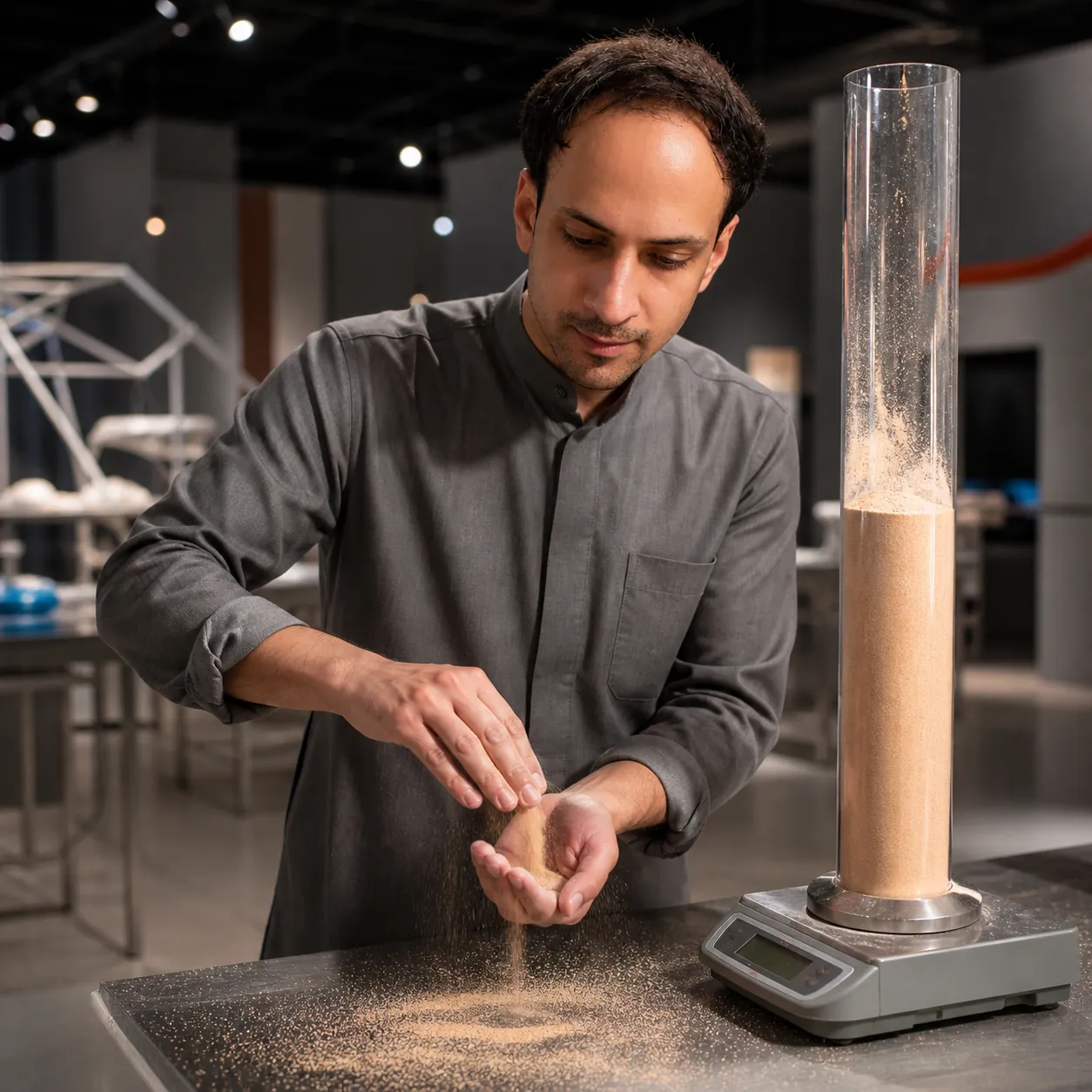
Fifth State: Singing Slip Face Refuses Both States — Slip Face
صورةAI Portraits

Treat that reference as the character anchor and change only the scene. Create a square 1:1 museum-catalog frame with a strong first read and a slower...

من نص البرومبت

Use the attached reference photo as the identity reference: keep the same face, skin tone, hair and features as the person in that photo, without beautifying, aging or altering them. Treat that reference as the character anchor and change only the scene. Create a square 1:1 museum-catalog frame with a strong first read and a slower second read at exactly 2880x2880 pixels. Location: the steep leeward face of an isolated dune in late afternoon. Show the subject in a dust-toned field shirt with sleeves rolled past the forearms, pressing one flat palm slowly along the slope's brink. Make one rigorous physical condition the conceptual engine: a booming dune face whose sheared upper layer they release with one slow hand-drag, avalanching as a single humming sheet shows dry grains refusing to be fully solid or fully liquid. Explore why a material older than the mountains still refuses to pick a state; direct expression and posture toward listening stillness, never melodrama or ad-like confidence. Use an eye-level 50mm view with natural perspective and both of their hands kept readable. Make the composition render grains near the action sharper than their skin. Render it as high-concept field-physics portraiture built from real granular mechanics, documentary desert realism, instrument-grade experimental staging, and emotionally restrained observational lighting, using low raking desert sun that turns every ridge of grains into relief and a palette of warm quartz beige, gunmetal grey, and one oxide-red seam. Photorealistic: this must read as a real photograph from a physical camera, never an illustration, painting, or 3D render. Resolve real surface detail: true skin texture with pores and fine hair at the hairline, and fabric that creases where it is actually stressed. Keep one identity-locked person, credible hands and fingers, natural fabric, and coherent scale, contact, reflections, shadows, airflow, deformation, and materials. Background people only when essential, always secondary and clearly different. Avoid swirling sandstorm vortices, glowing hourglass fantasy, levitating sand spirals, cymatic pattern plates, and heroic dune-top silhouettes. No text, labels, logos, signatures, watermarks, random symbols, plastic skin, excessive bloom, or glossy AI finish.
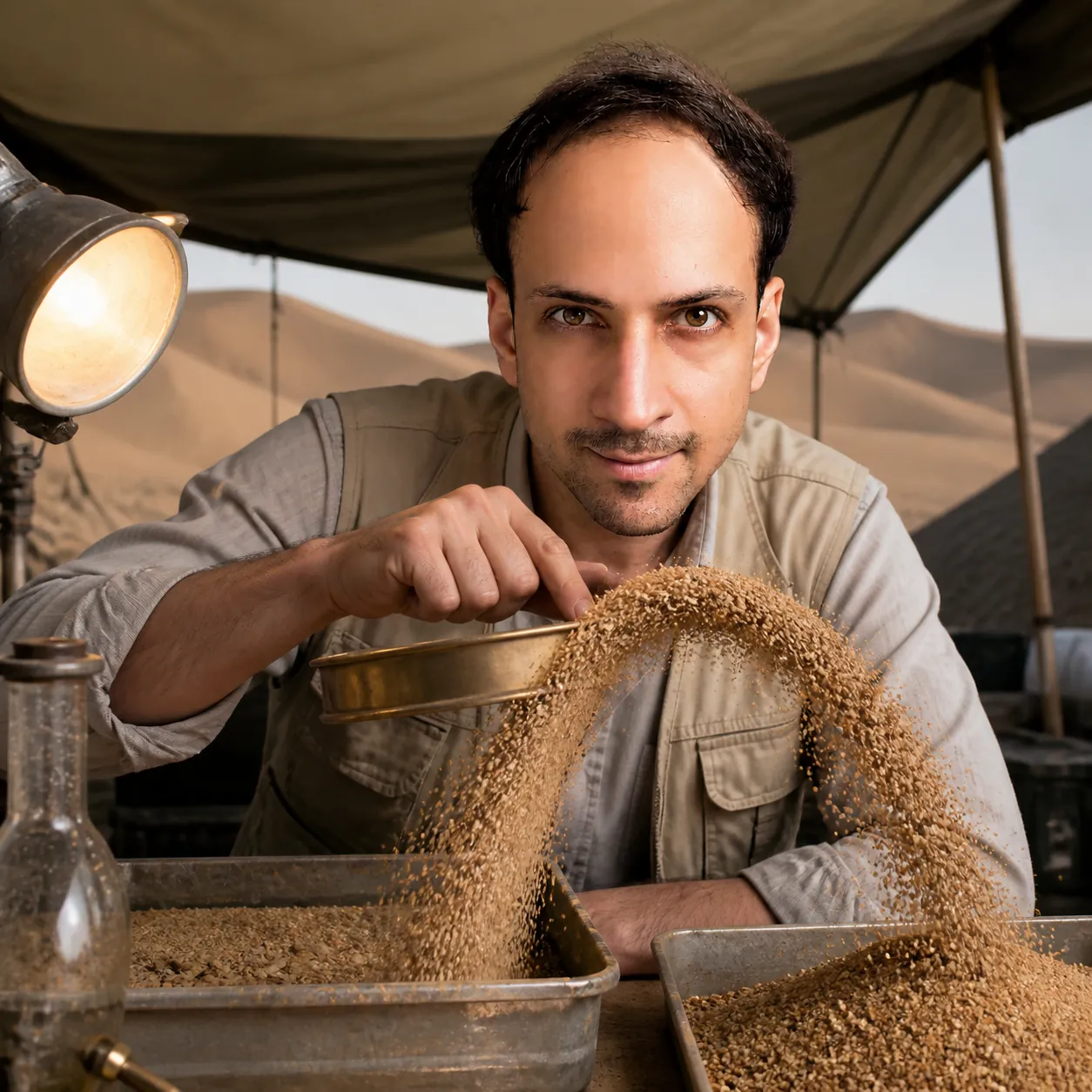
Shear Song: Weightless Column Refuses Both States — Demo Hall
صورةAI Portraits

Create a square 1:1 museum-catalog frame with a strong first read and a slower second read at exactly 2880x2880 pixels. Location: a science-center...

من نص البرومبت

Use the attached reference photo as the identity reference: keep the same face, skin tone, hair and features as the person in that photo, without beautifying, aging or altering them. Create a square 1:1 museum-catalog frame with a strong first read and a slower second read at exactly 2880x2880 pixels. Location: a science-center demonstration hall an hour before the doors open. Show the subject in a pressed grey traditional Gulf outfit with sleeves folded once at the wrists, brushing stray grains from the benchtop into one cupped hand. Make one rigorous physical condition the conceptual engine: a tall glass tube of sand standing on a scale that reads only a fraction of what they poured in shows dry grains refusing to be fully solid or fully liquid. Explore why the simplest materials hide the physics that resists every clean equation; direct expression and posture toward unhurried awe, never melodrama or ad-like confidence. Use an eye-level 50mm view with natural perspective and both of their hands kept readable. Make the composition render grains near the action sharper than their skin. Render it as gallery-grade experimental photography built from working sand demonstrations, sun-bleached field styling, honest grain-level physics, and calm scientific candor, using clean directional laboratory light shaped to keep single falling grains visible and a palette of bleached bone, shadow grey, and one line of terracotta. Photorealistic: this must read as a real photograph from a physical camera, never an illustration, painting, or 3D render. Resolve real surface detail: fine lint on dark fabric, water spotting on steel, and the soft rounding of edges that have been used for years. Keep one identity-locked subject, credible hands and fingers, natural fabric, and coherent scale, contact, reflections, shadows, airflow, deformation, and materials. Background people only when essential, always secondary and clearly different. Avoid swirling sandstorm vortices, glowing hourglass fantasy, levitating sand spirals, cymatic pattern plates, and heroic dune-top silhouettes. No text, labels, logos, signatures, watermarks, random symbols, plastic skin, excessive bloom, or glossy AI finish.
Grains Deciding: Frozen Arch Ordinary Made Exact — Tarp Station
صورةAI Portraits

Create a square 1:1 museum-catalog frame with a strong first read and a slower second read at exactly 2880x2880 pixels. Location: a canvas-shaded field...

من نص البرومبت

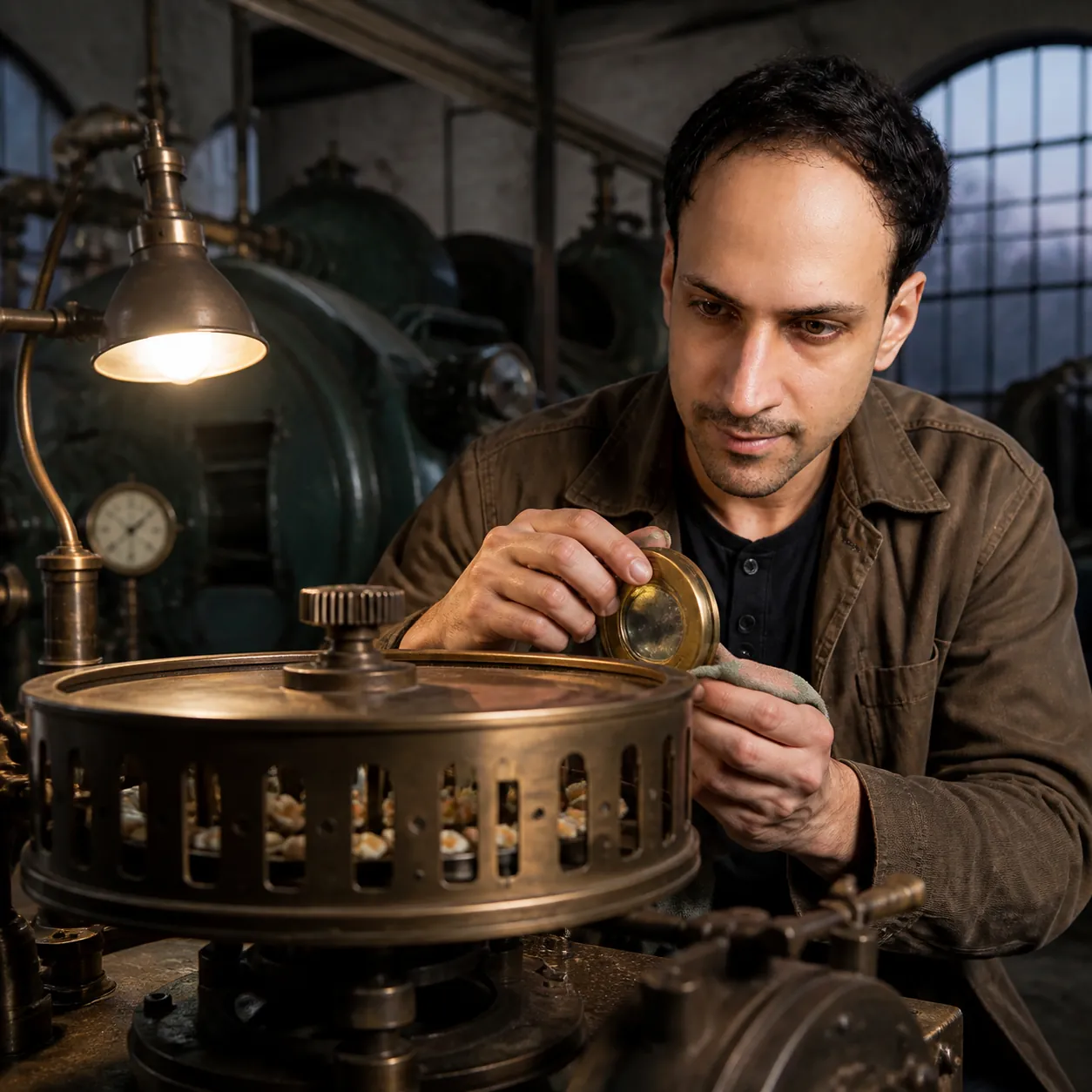
Use the attached reference photo as the identity reference: keep the same face, skin tone, hair and features as the person in that photo, without beautifying, aging or altering them. Create a square 1:1 museum-catalog frame with a strong first read and a slower second read at exactly 2880x2880 pixels. Location: a canvas-shaded field station rigged in the trough between two dunes. Show the subject in a light khaki field vest over a long-sleeved cotton shirt, tapping a brass sieve's rim with two measured knuckles. The impossible-looking event must obey this clear system: a clear funnel of coarse grains whose pour has locked itself into a stable arch bridging the open throat gives the desert's most ordinary material the standing of an exact instrument. Explore what the desert has been quietly demonstrating beside every road for centuries; direct expression and posture toward grounded wonder, never melodrama or ad-like confidence. Use a 90mm close-portrait framing where single airborne grains near the lens stay physically plausible against their focused face. Make the composition place their hands and the demonstration inside one unbroken triangle. Render it as museum-grade demonstration realism combining truthful sand behavior, high-fidelity portrait photography, weathered field-equipment materiality, and physically exact grain-scale detail, using one bare work lamp angled low across the sand's textured surface and a palette of soft ochre, cool slate, and one deep olive note. Photorealistic: this must read as a real photograph from a physical camera, never an illustration, painting, or 3D render. Resolve real surface detail: condensation beading at true size, liquid meniscus curving against glass, and wet surfaces darker than dry ones. Keep one identity-locked subject, credible hands and fingers, natural fabric, and coherent scale, contact, reflections, shadows, airflow, deformation, and materials. Background people only when essential, always secondary and clearly different. Avoid falconry props, camel caravans, CGI sand tornadoes, face-morphing sand sculptures, and endless untouched postcard dunes. No text, labels, logos, signatures, watermarks, random symbols, plastic skin, excessive bloom, or glossy AI finish.
Borrowed Shutter: Slotted Drum Eye Recruited — Pump Hall
صورةAI Portraits

Create a square 1:1 museum-catalog frame with a strong first read and a slower second read at exactly 2880x2880 pixels. Location: a decommissioned pump...

من نص البرومبت

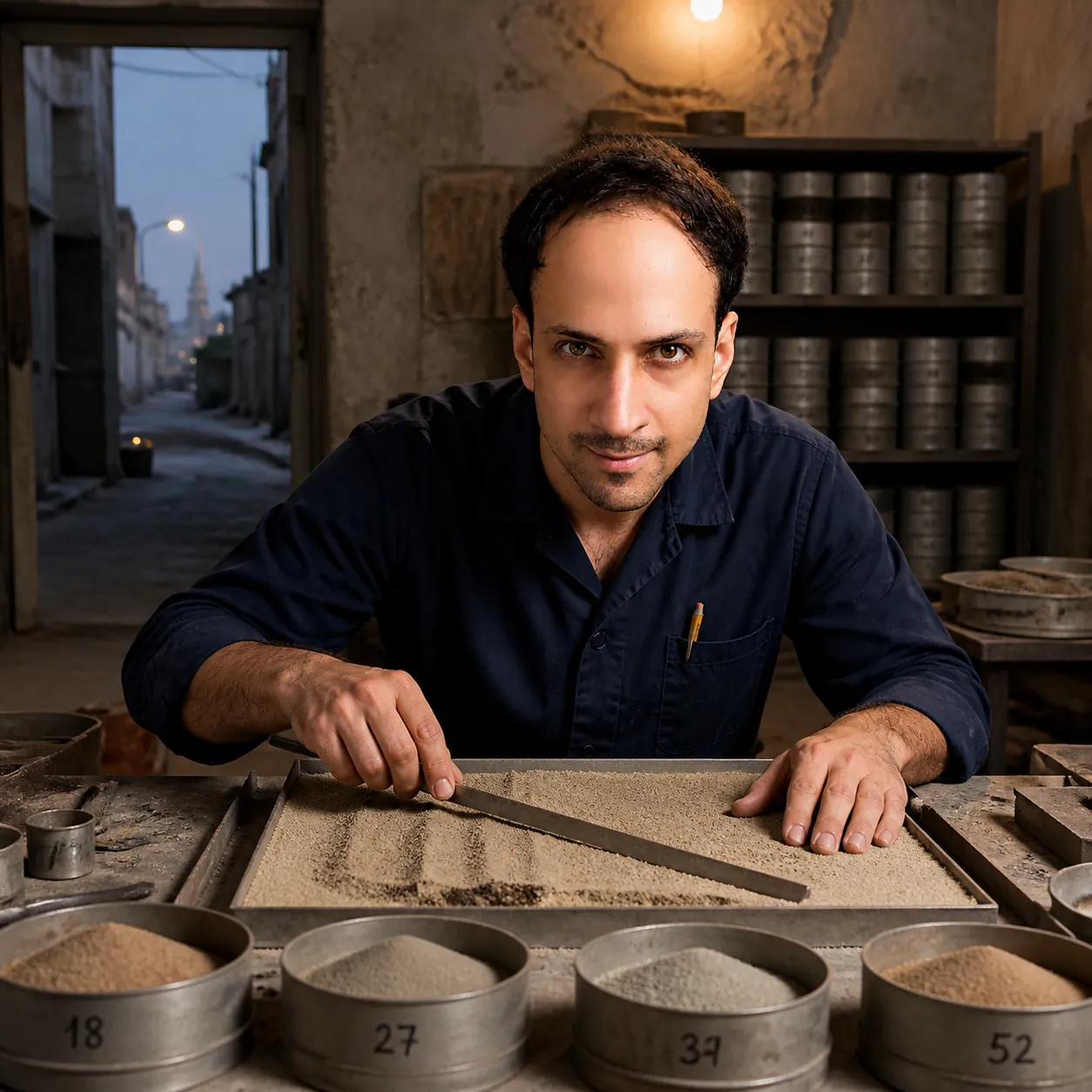
Use the attached reference photo as the identity reference: keep the same face, skin tone, hair and features as the person in that photo, without beautifying, aging or altering them. Create a square 1:1 museum-catalog frame with a strong first read and a slower second read at exactly 2880x2880 pixels. Location: a decommissioned pump hall, its painted machinery bolted to concrete plinths. Show the subject in a brown canvas jacket over a faded black henley, polishing a brass sight-glass clear with one slow thumb. Use this advanced image-making device as the core logic: a slotted tin zoetrope drum whose ring of small clay desert-flowers opens and closes only when watched through the moving slits recruits the viewer's own persistence of vision as its final moving part. Explore how a machine can lend the eye a shutter it never owned; direct expression and posture toward sober delight, never melodrama or ad-like confidence. Frame from across the bench at the machine's own height so person and mechanism meet as equals. Make the composition let one sharp resolved detail ride inside surrounding motion blur. Render it as workshop-theater realism made of practical light, era-true optical instruments, credible material wear, and quietly composed human-scale theatrical staging, using cool dusk ambience balanced by a single warm practical near the machine and a palette of iron black, aged ivory, and one dull copper accent. Photorealistic: this must read as a real photograph from a physical camera, never an illustration, painting, or 3D render. Resolve real surface detail: visible weave in cloth, fine scratches on metal, and the faint unevenness of painted walls. Keep one identity-locked subject, credible hands and fingers, natural fabric, and coherent scale, contact, reflections, shadows, airflow, deformation, and materials. Background people only when essential, always secondary and clearly different. Avoid film-strip borders, cartoon motion lines, ghosted multiple faces, glowing hologram spin, and sparks flying off machinery. No text, labels, logos, signatures, watermarks, random symbols, plastic skin, excessive bloom, or glossy AI finish.
Grain Treaty: Vacuum Grip Refuses Both States — Riyadh Workshop
صورةAI Portraits

Create a square 1:1 museum-catalog frame with a strong first read and a slower second read at exactly 2880x2880 pixels. Location: a back-street Riyadh...

من نص البرومبت

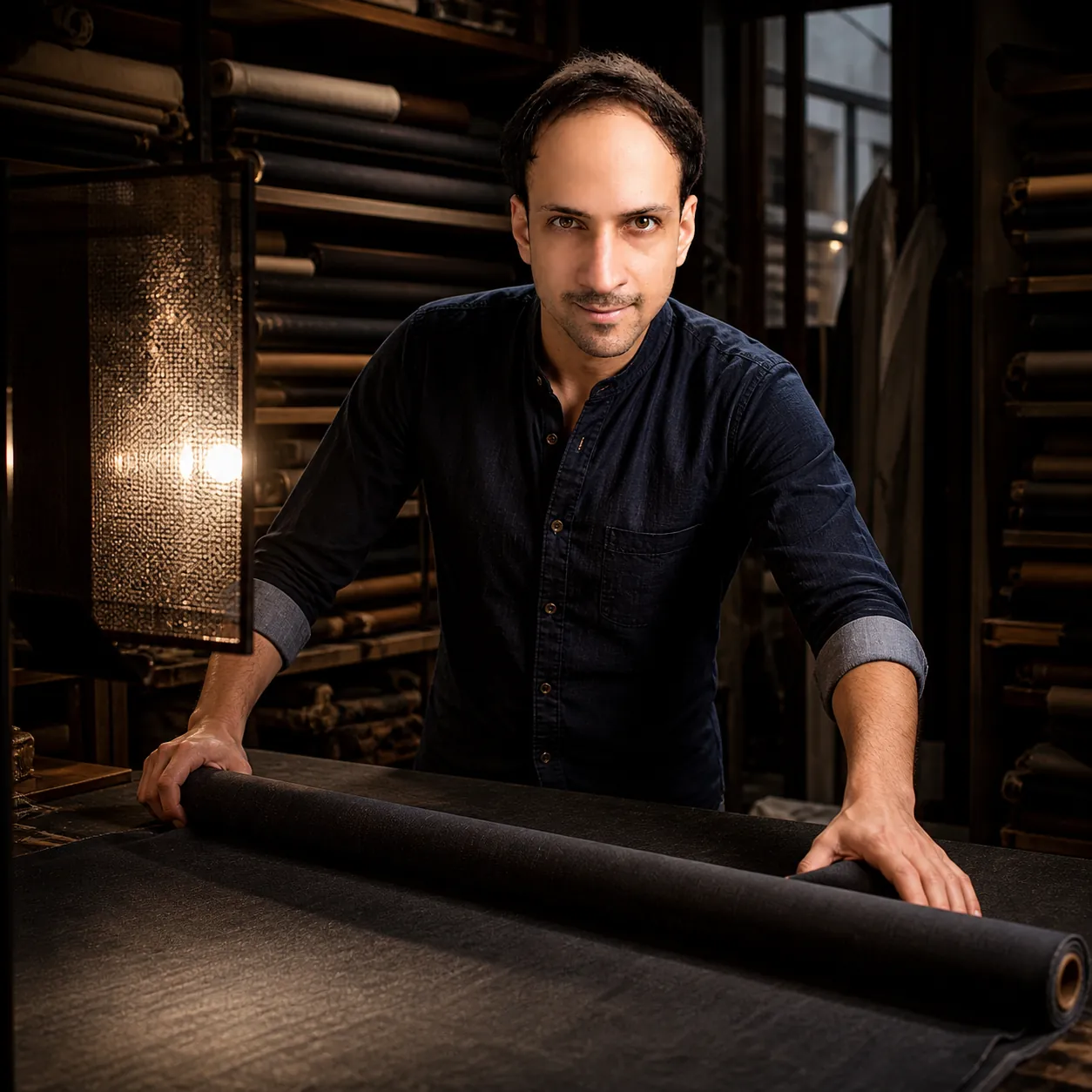
Use the attached reference photo as the identity reference: keep the same face, skin tone, hair and features as the person in that photo, without beautifying, aging or altering them. Create a square 1:1 museum-catalog frame with a strong first read and a slower second read at exactly 2880x2880 pixels. Location: a back-street Riyadh workshop with sand samples in numbered tins. Show the subject in a navy work shirt with a pencil clipped at the chest, drawing a straightedge slowly across a bed of grains. Make one rigorous physical condition the conceptual engine: a soft canvas cushion of loose grains that turns rigid as fired brick the moment they draw its air out shows dry grains refusing to be fully solid or fully liquid. Explore how order can rise out of shaking, spilling, and other engines of disorder; direct expression and posture toward listening stillness, never melodrama or ad-like confidence. Use an eye-level 50mm view with natural perspective and both of their hands kept readable. Make the composition keep the background silent so the grains do the talking. Render it as museum-grade demonstration realism combining truthful sand behavior, high-fidelity portrait photography, weathered field-equipment materiality, and physically exact grain-scale detail, using cool pre-sunrise sky light balanced against one warm tungsten practical and a palette of sifted taupe, worn steel, and a low amber accent. Photorealistic: this must read as a real photograph from a physical camera, never an illustration, painting, or 3D render. Resolve real surface detail: fine grit in the texture of concrete, efflorescence at damp edges, and hairline cracks that follow stress. Keep one identity-locked subject, credible hands and fingers, natural fabric, and coherent scale, contact, reflections, shadows, airflow, deformation, and materials. Background people only when essential, always secondary and clearly different. Avoid swirling sandstorm vortices, glowing hourglass fantasy, levitating sand spirals, cymatic pattern plates, and heroic dune-top silhouettes. No text, labels, logos, signatures, watermarks, random symbols, plastic skin, excessive bloom, or glossy AI finish.
Asked and Answered: Bead Screen Private Channel — Tailor's Atelier
صورةAI Portraits

Create a square 1:1 museum-catalog frame with a strong first read and a slower second read at exactly 2880x2880 pixels. Location: a tailor's atelier after...

من نص البرومبت

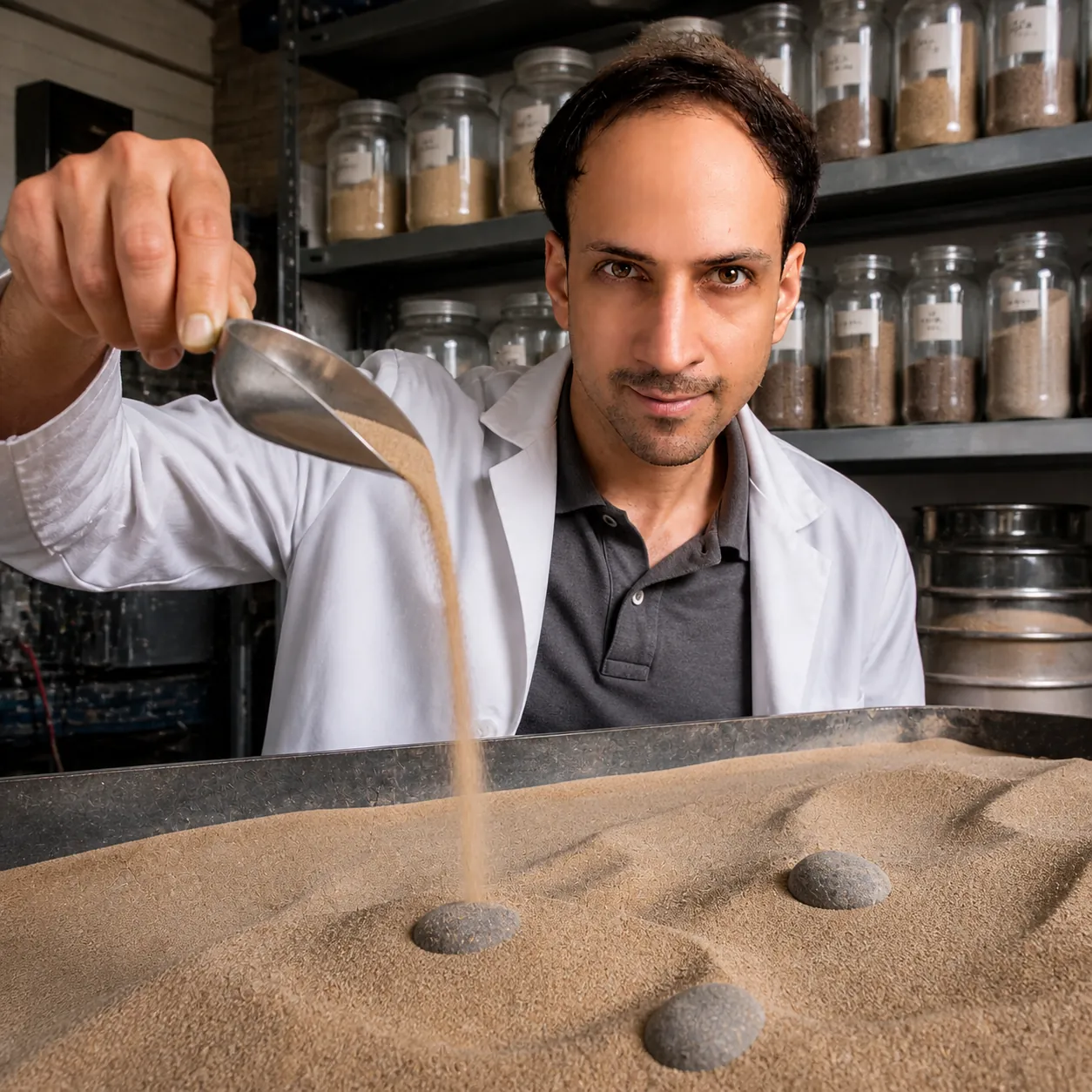
Use the attached reference photo as the identity reference: keep the same face, skin tone, hair and features as the person in that photo, without beautifying, aging or altering them. Create a square 1:1 museum-catalog frame with a strong first read and a slower second read at exactly 2880x2880 pixels. Location: a tailor's atelier after closing, cloth bolts racked high. Show the subject in a collarless indigo work shirt with sleeves rolled twice, unrolling a dark bolt one turn across the table. Use this advanced image-making device as the core logic: a glass-bead screen that blazes furnace-bright along their lamp's axis and shows dull grey one step aside turns the open air into a private channel between lamp and eye. Explore what it means to receive back exactly what was sent and nothing else; direct expression and posture toward watchful calm, never melodrama or ad-like confidence. Frame from slightly low in the dark, their face lit by spill rather than beam. Make the composition hold the dark version and the blazing version inside one frame. Render it as museum-grade demonstration photography combining truthful on-axis brilliance, deep readable shadow detail, tactile instrument surfaces, and unhurried human presence, using late window light kept low so on-axis return outshines every ordinary reflection and a palette of charcoal, unpolished brass, and one warm white blaze. Photorealistic: this must read as a real photograph from a physical camera, never an illustration, painting, or 3D render. Resolve real surface detail: thread ends and slight pilling on worn cloth, hairline chips at every hard corner, and stone that is porous rather than smooth. Keep one identity-locked subject, credible hands and fingers, natural fabric, and coherent scale, contact, reflections, shadows, airflow, deformation, and materials. Background people only when essential, always secondary and clearly different. Avoid laser-show haze walls, glowing animal eyes, CGI light tunnels, painted halos, and highway signage. No text, labels, logos, signatures, watermarks, random symbols, plastic skin, excessive bloom, or glossy AI finish.
Lawful Avalanche: Convection Tray Ordinary Made Exact — Sand Lab
صورةAI Portraits

Treat that reference as the character anchor and change only the scene. Create a square 1:1 museum-catalog frame with a strong first read and a slower...

من نص البرومبت

Use the attached reference photo as the identity reference: keep the same face, skin tone, hair and features as the person in that photo, without beautifying, aging or altering them. Treat that reference as the character anchor and change only the scene. Create a square 1:1 museum-catalog frame with a strong first read and a slower second read at exactly 2880x2880 pixels. Location: a granular-physics lab with labeled sand jars on steel shelving. Show the subject in a white lab coat worn open over a slate-grey polo, pouring a thin ribbon of sand from a steel scoop. Treat this mechanism as the frame’s governing rule: a shaken tray of fine sand whose slow convection cells carry three buried grey stones steadily up to the surface gives the desert's most ordinary material the standing of an exact instrument. Explore how billions of grains agree on anything without a single signal passing between them; direct expression and posture toward modest rigor, never melodrama or ad-like confidence. Frame from just above the sand's surface so its grain-scale horizon leads to their level gaze. Make the composition let one sharp edge of settled grains cross the frame diagonally. Render it as museum-grade demonstration realism combining truthful sand behavior, high-fidelity portrait photography, weathered field-equipment materiality, and physically exact grain-scale detail, using soft canvas-filtered shade cut by one hard sliver of noon and a palette of bleached bone, shadow grey, and one line of terracotta. Photorealistic: this must read as a real photograph from a physical camera, never an illustration, painting, or 3D render. Resolve real surface detail: leather creased along the lines of use, stitching slightly irregular, and edges burnished from contact. Keep one identity-locked person, credible hands and fingers, natural fabric, and coherent scale, contact, reflections, shadows, airflow, deformation, and materials. Background people only when essential, always secondary and clearly different. Avoid falconry props, camel caravans, CGI sand tornadoes, face-morphing sand sculptures, and endless untouched postcard dunes. No text, labels, logos, signatures, watermarks, random symbols, plastic skin, excessive bloom, or glossy AI finish.