جاري التحميل...


جاري التحميل...
Treat that reference as the character anchor and change only the scene. Create a square 1:1 museum-catalog frame with a strong first read and a slower...
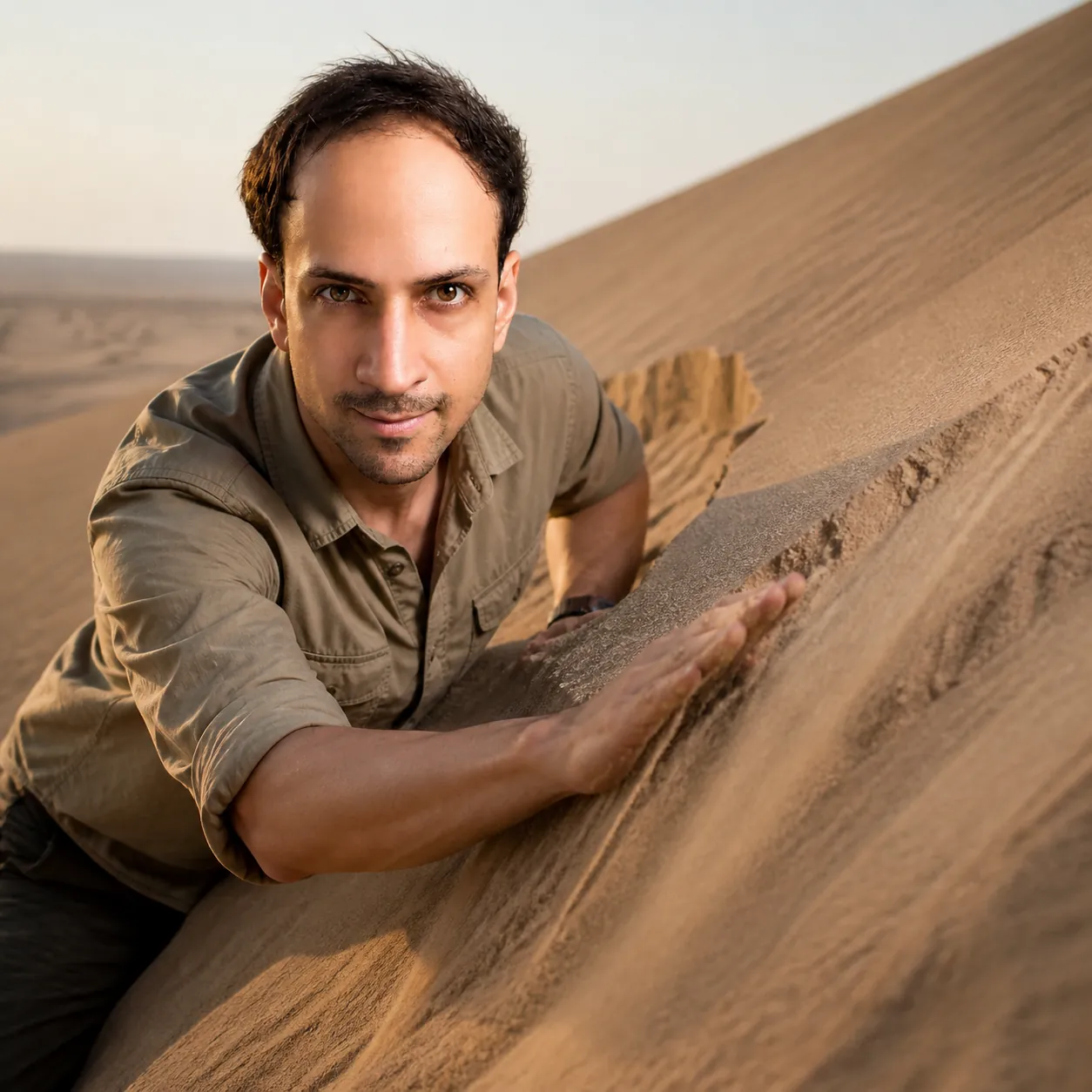
Use the attached reference photo as the identity reference: keep the same face, skin tone, hair and features as the person in that photo, without beautifying, aging or altering them. Treat that reference as the character anchor and change only the scene. Create a square 1:1 museum-catalog frame with a strong first read and a slower second read at exactly 2880x2880 pixels. Location: the steep leeward face of an isolated dune in late afternoon. Show the subject in a dust-toned field shirt with sleeves rolled past the forearms, pressing one flat palm slowly along the slope's brink. Make one rigorous physical condition the conceptual engine: a booming dune face whose sheared upper layer they release with one slow hand-drag, avalanching as a single humming sheet shows dry grains refusing to be fully solid or fully liquid. Explore why a material older than the mountains still refuses to pick a state; direct expression and posture toward listening stillness, never melodrama or ad-like confidence. Use an eye-level 50mm view with natural perspective and both of their hands kept readable. Make the composition render grains near the action sharper than their skin. Render it as high-concept field-physics portraiture built from real granular mechanics, documentary desert realism, instrument-grade experimental staging, and emotionally restrained observational lighting, using low raking desert sun that turns every ridge of grains into relief and a palette of warm quartz beige, gunmetal grey, and one oxide-red seam. Photorealistic: this must read as a real photograph from a physical camera, never an illustration, painting, or 3D render. Resolve real surface detail: true skin texture with pores and fine hair at the hairline, and fabric that creases where it is actually stressed. Keep one identity-locked person, credible hands and fingers, natural fabric, and coherent scale, contact, reflections, shadows, airflow, deformation, and materials. Background people only when essential, always secondary and clearly different. Avoid swirling sandstorm vortices, glowing hourglass fantasy, levitating sand spirals, cymatic pattern plates, and heroic dune-top silhouettes. No text, labels, logos, signatures, watermarks, random symbols, plastic skin, excessive bloom, or glossy AI finish.
Create a square 1:1 museum-catalog frame with a strong first read and a slower second read at exactly 2880x2880 pixels. Location: a tailor's atelier after...
Treat that reference as the character anchor and change only the scene. Create a square 1:1 museum-catalog frame with a strong first read and a slower...
Create a square 1:1 museum-catalog frame with a strong first read and a slower second read at exactly 2880x2880 pixels. Location: the lamp room of a...
Create a square 1:1 museum-catalog frame with a strong first read and a slower second read at exactly 2880x2880 pixels. Location: a decommissioned pump...
Create a square 1:1 museum-catalog frame with a strong first read and a slower second read at exactly 2880x2880 pixels. Location: the projection booth of a...
Create a square 1:1 museum-catalog frame with a strong first read and a slower second read at exactly 2880x2880 pixels. Location: a firm interdune corridor...
Create a square 1:1 museum-catalog frame with a strong first read and a slower second read at exactly 2880x2880 pixels. Location: a canvas-shaded field...
Create a square 1:1 museum-catalog frame with a strong first read and a slower second read at exactly 2880x2880 pixels. Location: a field camp under one...
Create a square 1:1 museum-catalog frame with a strong first read and a slower second read at exactly 2880x2880 pixels. Location: a sabkha salt flat at...
Create a square 1:1 museum-catalog frame with a strong first read and a slower second read at exactly 2880x2880 pixels. Location: a mud-brick alley in old...
Create a square 1:1 museum-catalog frame with a strong first read and a slower second read at exactly 2880x2880 pixels. Location: a tiled hotel courtyard...
Treat that reference as the character anchor and change only the scene. Create a square 1:1 museum-catalog frame with a strong first read and a slower...