تخطَّ إلى المحتوى

برومبتات الصور

برومبتات لمولدات الصور: بورتريهات وفن وتصوير.

تم العثور على 4209
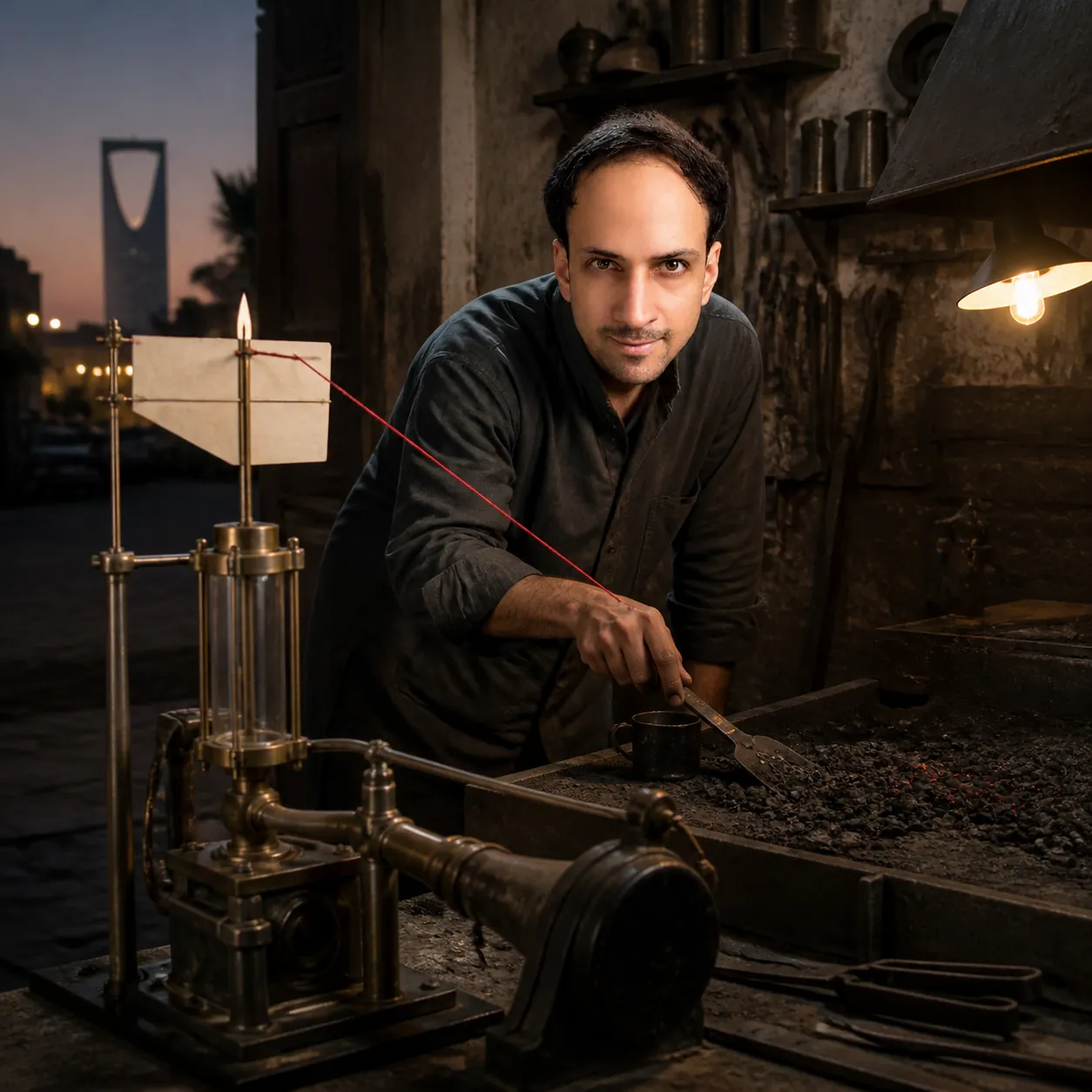
Slow Instrument: Small Riyadh Smithy — AI Portrait Prompt
صورةAI Portraits

Turn your own photo into a museum-demonstration portrait in a small Riyadh smithy at dusk, its forge banked low and quiet. Keeps your face unchanged.

من نص البرومبت

Use the attached reference photo as the identity reference: keep the same face, skin tone, hair and features as the person in that photo, without beautifying, aging or altering them. Create a square 1:1 museum-catalog frame with a strong first read and a slower second read at exactly 2880x2880 pixels. Location: a small Riyadh smithy at dusk, its forge banked low and quiet. Show the subject in a heavy cotton smock in iron grey over dark work trousers, banking the coals level with a flat iron blade. Build the artwork around this material rule: a counterweighted paper vane on a polished needle pivot that swings a marked arc and returns with every measured breath trains the breather as surely as the breather drives the machine. Explore why a steady small force outworks a strong unsteady one; direct expression and posture toward level patience, never melodrama or ad-like confidence. Frame from a few steps back through soft foreground objects, keeping their face and the mechanism sharp. Make the composition trace the air's path from source to reading in one line. Render it as museum-demonstration realism combining true fluid and pressure physics, brass-and-glass instrument finish, quiet editorial portrait light, and unexaggerated human presence, using quiet dusk ambience lifted by one warm tungsten practical near the work and a palette of slate grey, clear glass, and a madder-red thread. Photorealistic: this must read as a real photograph from a physical camera, never an illustration, painting, or 3D render. Resolve real surface detail: dust settled where nobody wipes, fingerprint haze on glass, and edges rubbed pale by handling. Keep one identity-locked person, credible hands and fingers, natural fabric, and coherent scale, contact, reflections, shadows, airflow, deformation, and materials. Background people only when essential, always secondary and clearly different. Avoid spa-candle arrangements, incense smoke spirals, neon waveform overlays, and saxophone music-video haze. No text, labels, logos, signatures, watermarks, random symbols, plastic skin, excessive bloom, or glossy AI finish.
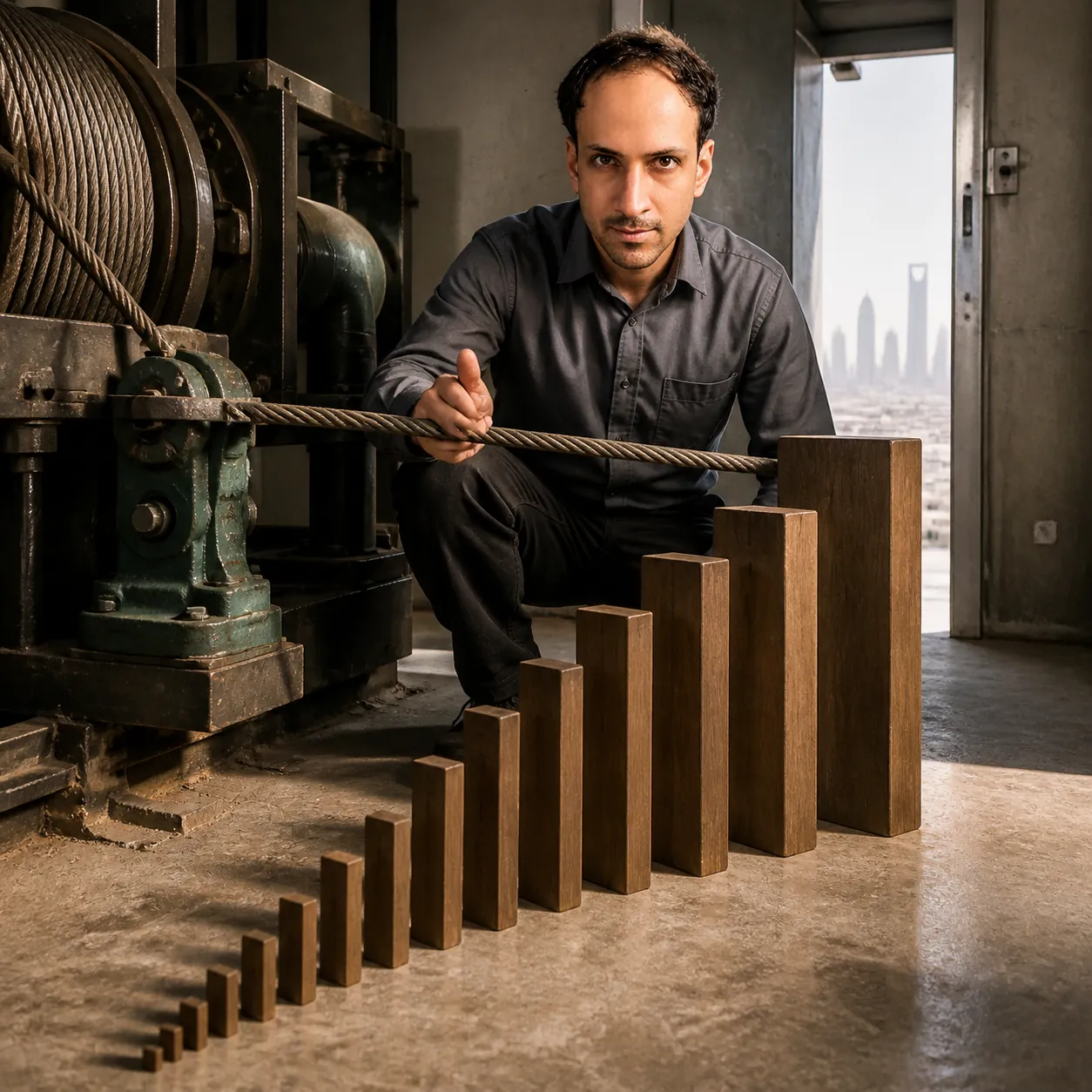
Patient Machinery: Freight Elevator Machine Room — AI Portrait Prompt
صورةAI Portraits

Turn your own photo into a kinetic-mechanism portrait in a freight elevator machine room at the top of a Riyadh tower. Keeps your face unchanged.

من نص البرومبت

Use the attached reference photo as the identity reference: keep the same face, skin tone, hair and features as the person in that photo, without beautifying, aging or altering them. Create a square 1:1 museum-catalog frame with a strong first read and a slower second read at exactly 2880x2880 pixels. Location: a freight elevator machine room at the top of a Riyadh tower. Show the subject in a steel-grey work shirt buttoned to the second button, testing a taut hoist rope with one careful thumb. Make one rigorous physical condition the conceptual engine: a run of thirteen wooden dominoes, each half again larger than the last, ending in a slab as tall as their knee turns effort already spent into motion the body can plainly feel. Explore where motivation actually lives when the machinery does the remembering for them; direct expression and posture toward patient resolve, never melodrama or ad-like confidence. Use an eye-level 50mm perspective that keeps both the mechanism and their hands honestly proportioned. Make the composition give the smallest moving part more presence than anything still. Render it as kinetic-mechanism portraiture built from real working machines, documentary patience, warm workshop materiality, and composition that honors cause before effect, using clean directional daylight from one open door, falling off into readable shadow and a palette of bone ivory, oiled walnut, and a single verdigris accent. Photorealistic: this must read as a real photograph from a physical camera, never an illustration, painting, or 3D render. Resolve real surface detail: the difference between a wiped surface and a clean one, faint tide marks on ceramic, and metal dulled unevenly by touch. Keep one identity-locked person, credible hands and fingers, natural fabric, and coherent scale, contact, reflections, shadows, airflow, deformation, and materials. Background people only when essential, always secondary and clearly different. Avoid slot-machine iconography, glowing progress bars, cascading gold coins, cartoon gear mandalas, and confetti-burst celebration effects. No text, labels, logos, signatures, watermarks, random symbols, plastic skin, excessive bloom, or glossy AI finish.
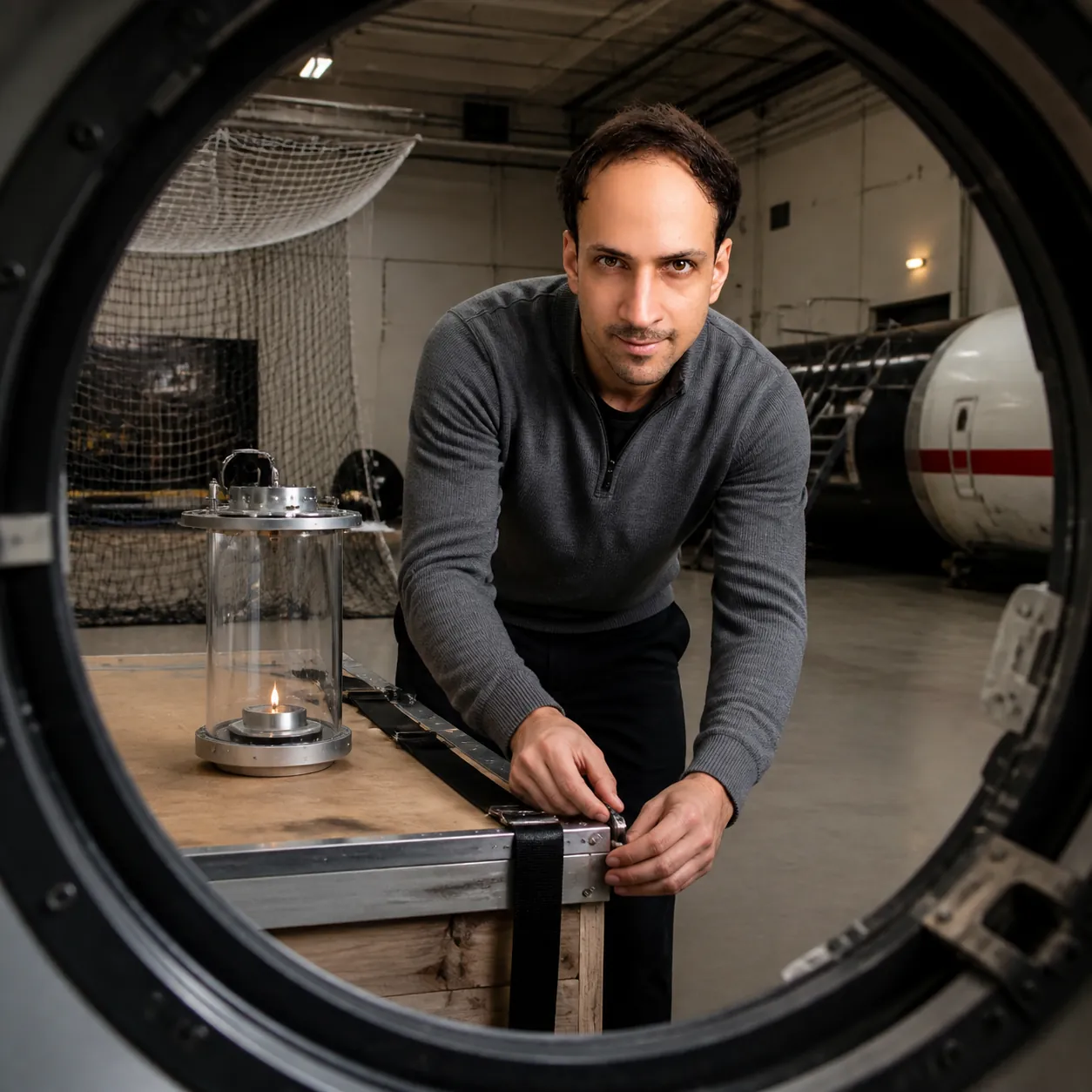
Borrowed Second: Quiet Hangar Corner — AI Portrait Prompt
صورةAI Portraits

Turn your own photo into a photorealistic portrait in a quiet hangar corner where a parabolic-flight prep table stands ready. Keeps your face unchanged.

من نص البرومبت

Use the attached reference photo as the identity reference: keep the same face, skin tone, hair and features as the person in that photo, without beautifying, aging or altering them. Create a square 1:1 museum-catalog frame with a strong first read and a slower second read at exactly 2880x2880 pixels. Location: a quiet hangar corner where a parabolic-flight prep table stands ready. Show the subject in a mid-grey flight-crew sweater over pressed dark trousers, buckling a loose strap flat against the table edge. Use this advanced image-making device as the core logic: a small candle flame inside the falling capsule that loses its teardrop and settles into a dim blue hemisphere turns one honestly borrowed second into proof that weight is circumstance, not essence. Explore how stillness and free fall can be the same event described twice; direct expression and posture toward watchful calm, never melodrama or ad-like confidence. Frame through the capsule's open hatch ring, its rim softly defocused and never crossing their face. Make the composition keep the catch nets visible without ever letting them dominate. Render it as conceptual physics portraiture pairing genuine microgravity evidence, a falling-camera perspective, restrained contemporary art direction, and grounded human dignity, using even technical illumination shaped by the capsule's own interior fixtures, shadows kept readable and a palette of charcoal, unpainted plywood, and one band of safety red. Photorealistic: this must read as a real photograph from a physical camera, never an illustration, painting, or 3D render. Resolve real surface detail: visible weave in cloth, fine scratches on metal, and the faint unevenness of painted walls. Keep one identity-locked person, credible hands and fingers, natural fabric, and coherent scale, contact, reflections, shadows, airflow, deformation, and materials. Background people only when essential, always secondary and clearly different. Avoid floating-hair astronaut poses, levitating people, swirling CGI water tentacles, and sci-fi antigravity glow. No text, labels, logos, signatures, watermarks, random symbols, plastic skin, excessive bloom, or glossy AI finish.
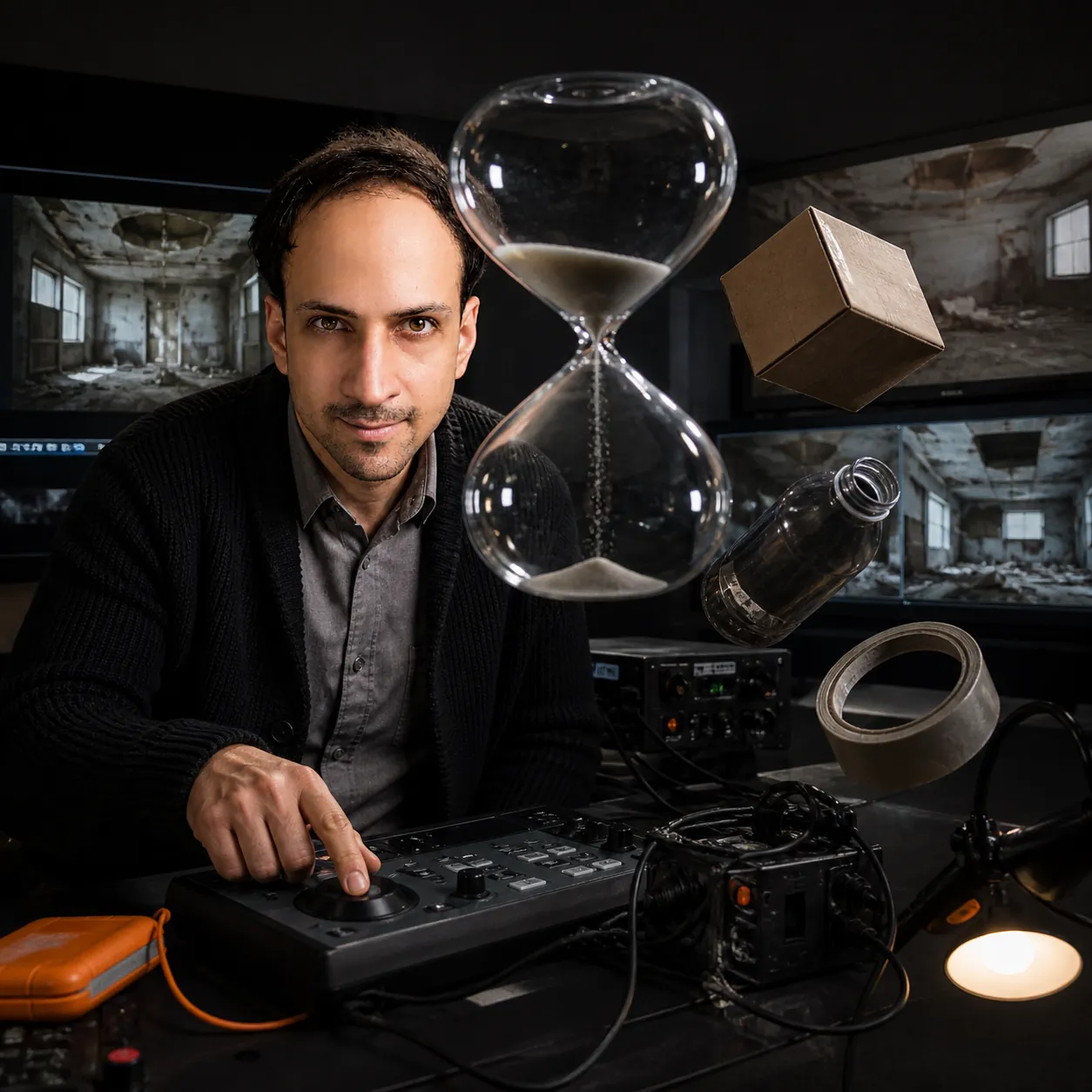
Shared Fall: Small Footage-Review Room — AI Portrait Prompt
صورةAI Portraits

Turn your own photo into a photorealistic portrait in a small footage-review room, monitors paused on the falling interior. Keeps your face unchanged.

من نص البرومبت

Use the attached reference photo as the identity reference: keep the same face, skin tone, hair and features as the person in that photo, without beautifying, aging or altering them. Create a square 1:1 museum-catalog frame with a strong first read and a slower second read at exactly 2880x2880 pixels. Location: a small footage-review room, monitors paused on the falling interior. Show the subject in a black knit cardigan over an ash-grey collared shirt, holding a frame still with one finger on the jog wheel. Build the artwork around this material rule: a large glass hourglass whose sand stops pouring mid-drop, the falling grains hanging in a paused column below the neck turns one honestly borrowed second into proof that weight is circumstance, not essence. Explore whether weight belongs to objects or to the situation holding them up; direct expression and posture toward gentle rigor, never melodrama or ad-like confidence. Frame at the height of the floating objects so their stillness and their weight-bearing posture share one focal plane. Make the composition give the suspended matter stillness and the cables all the tension. Render it as conceptual physics portraiture pairing genuine microgravity evidence, a falling-camera perspective, restrained contemporary art direction, and grounded human dignity, using flat pre-dawn sky light with a single battery work lamp for warmth and a palette of gunmetal, foam white, and one signal-orange accent. Photorealistic: this must read as a real photograph from a physical camera, never an illustration, painting, or 3D render. Resolve real surface detail: label-free packaging showing carton fibre, cardboard bruised at the corners, and tape lifting slightly at one end. Keep one identity-locked person, credible hands and fingers, natural fabric, and coherent scale, contact, reflections, shadows, airflow, deformation, and materials. Background people only when essential, always secondary and clearly different. Avoid floating-hair astronaut poses, levitating people, swirling CGI water tentacles, and sci-fi antigravity glow. No text, labels, logos, signatures, watermarks, random symbols, plastic skin, excessive bloom, or glossy AI finish.
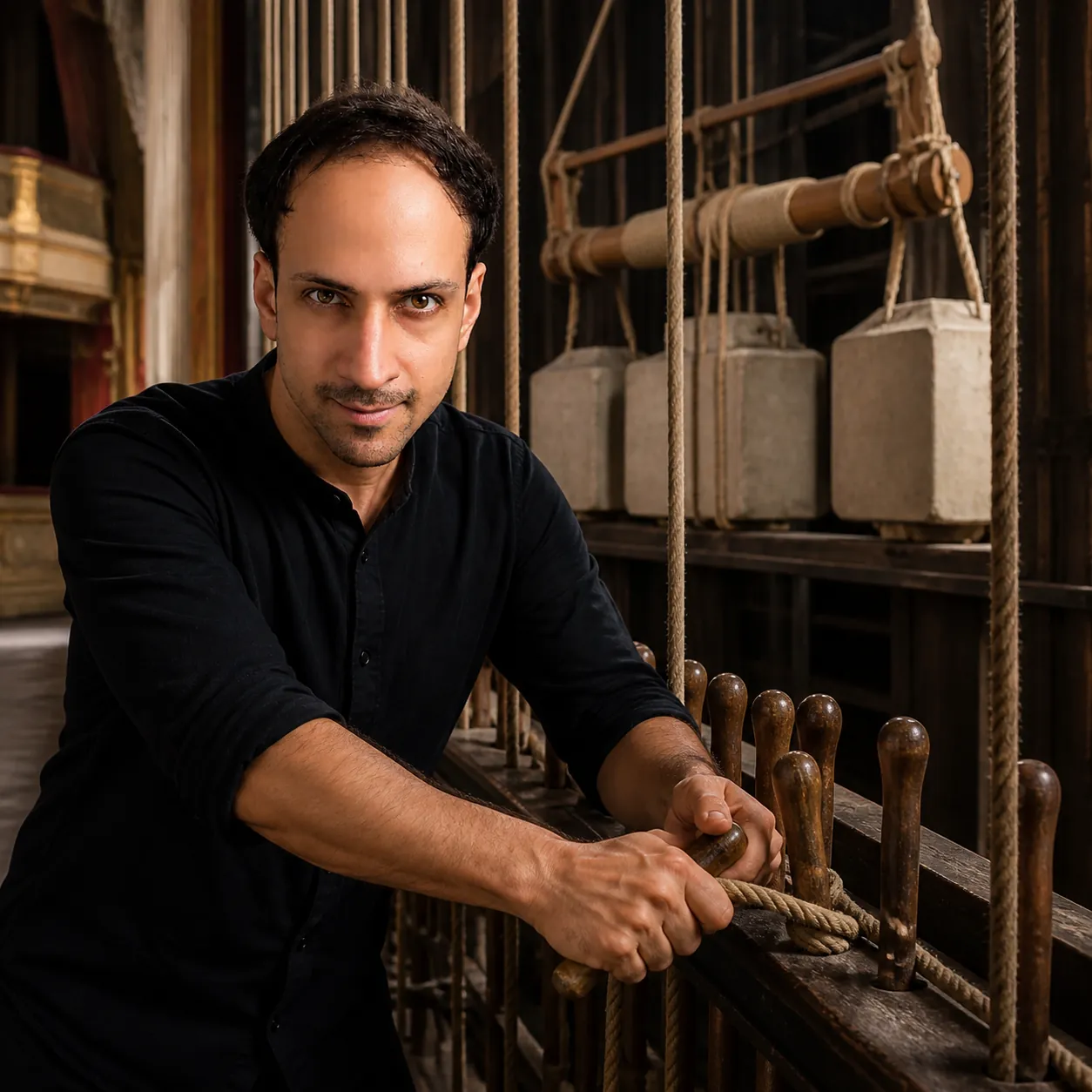
Held in Balance: High Fly Gallery of an Old Theater — AI Portrait Prompt
صورةAI Portraits

Turn your own photo into a quiet working-rigging portrait in the high fly gallery of an old theater, hemp lines belayed. Keeps your face unchanged.

من نص البرومبت

Use the attached reference photo as the identity reference: keep the same face, skin tone, hair and features as the person in that photo, without beautifying, aging or altering them. Create a square 1:1 museum-catalog frame with a strong first read and a slower second read at exactly 2880x2880 pixels. Location: the high fly gallery of an old theater, hemp lines belayed. Show the subject in a collarless black cotton shirt with sleeves rolled past the forearm, easing one hemp line off its wooden belay pin. The impossible-looking event must obey this clear system: a Spanish windlass of one hardwood bar twisted into a doubled rope, drawing two foundation stones together with immense slow force turns a small, steady effort into the equal of crushing weight. Explore what daily, repeatable ease reveals about decisions made long before today; direct expression and posture toward modest command, never melodrama or ad-like confidence. Use an 85mm portrait lens focused on their hands, with the balanced load readable just beyond them. Make the composition keep every working line and bearing point sharp and traceable. Render it as quiet working-rigging portraiture built from lawful mechanical advantage, heavy documentary realism, hand-worn rope-and-timber materiality, and patient large-format editorial composition, using low raking sunrise light that gives every rope fiber its own shadow and a palette of unbleached canvas, shadowed umber, and one line of brass. Photorealistic: this must read as a real photograph from a physical camera, never an illustration, painting, or 3D render. Resolve real surface detail: brass darkened in the recesses and bright where thumbs land, and lacquer crazed rather than perfect. Keep one identity-locked person, credible hands and fingers, natural fabric, and coherent scale, contact, reflections, shadows, airflow, deformation, and materials. Background people only when essential, always secondary and clearly different. Avoid gym equipment, heroic strongman poses, bulging-vein close-ups, snapped-rope drama, and impossibly floating boulders. No text, labels, logos, signatures, watermarks, random symbols, plastic skin, excessive bloom, or glossy AI finish.
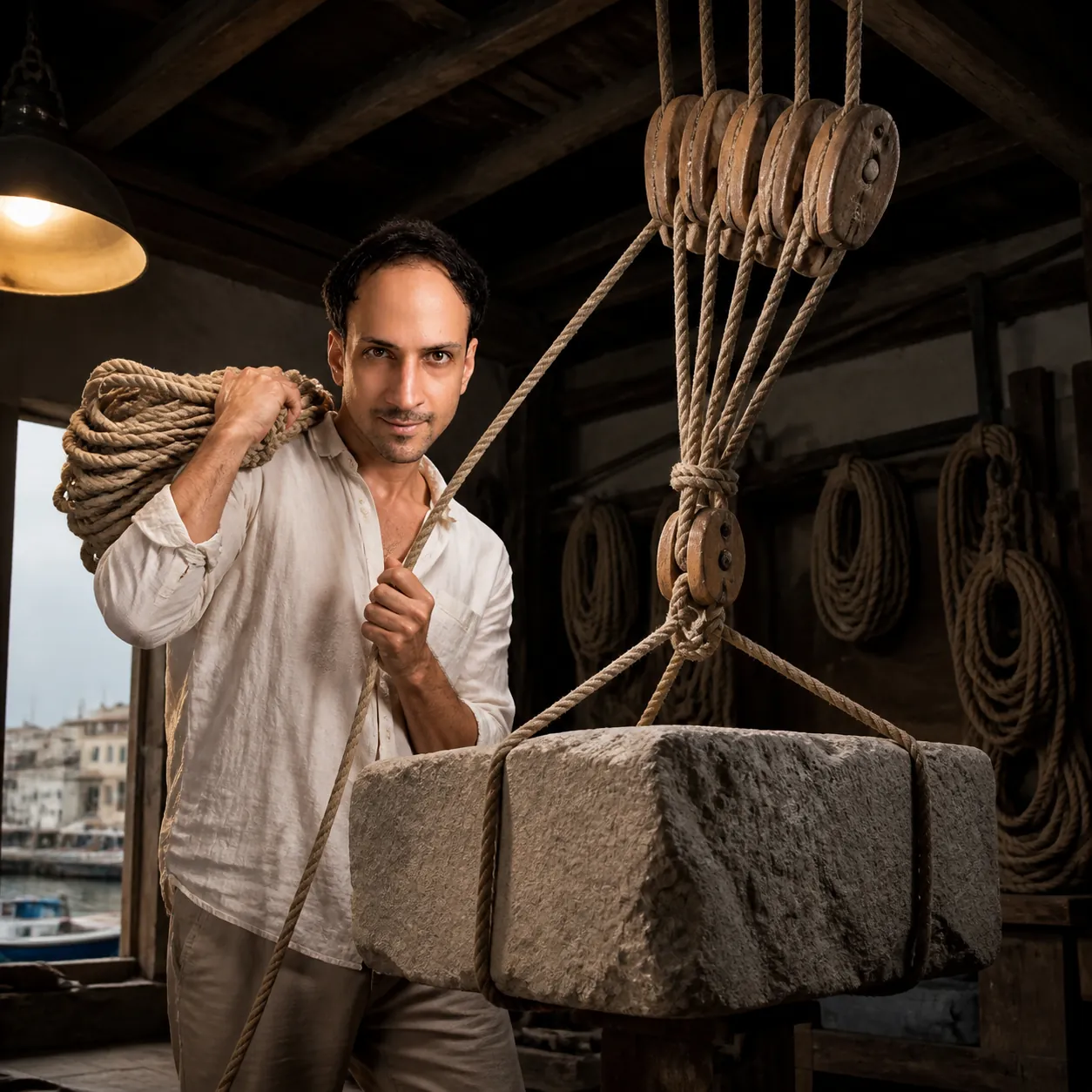
Quiet Leverage: Sail-Rigging Loft — AI Portrait Prompt
صورةAI Portraits

Turn your own photo into a heritage-engineering portrait in a sail-rigging loft above a Jeddah boatyard, coiled lines on pegs. Keeps your face unchanged.

من نص البرومبت

Use the attached reference photo as the identity reference: keep the same face, skin tone, hair and features as the person in that photo, without beautifying, aging or altering them. Create a square 1:1 museum-catalog frame with a strong first read and a slower second read at exactly 2880x2880 pixels. Location: a sail-rigging loft above a Jeddah boatyard, coiled lines on pegs. Show the subject in an open-weave cream shirt with both cuffs left unbuttoned, lifting a heavy coil of line onto one shoulder. Treat this mechanism as the frame’s governing rule: a five-sheave timber block-and-tackle through which their own seated bodyweight, applied to the fall rope, holds a quarried stone block level makes mechanical advantage visible enough to be read at a glance. Explore why a patient person with simple rigging outlifts a hurried, stronger one; direct expression and posture toward sober confidence, never melodrama or ad-like confidence. Use a low 35mm view from beside the load so its true scale presses against the frame. Make the composition place the balance point exactly on a third line. Render it as heritage-engineering realism built on accurate simple machines, tactile stone and hemp surfaces, deep architectural shadow, and slow considered framing, using one high work lamp shaded so the load sits in sculptural half-light and a palette of aged timber brown, chalk white, and deep tar black. Photorealistic: this must read as a real photograph from a physical camera, never an illustration, painting, or 3D render. Resolve real surface detail: paper fibre visible at cut edges, plastic that shows mould lines, and paint thicker where a brush turned. Keep one identity-locked person, credible hands and fingers, natural fabric, and coherent scale, contact, reflections, shadows, airflow, deformation, and materials. Background people only when essential, always secondary and clearly different. Avoid neon fitness styling, sweat-spray action shots, cartoon oversized pulleys, crumbling CGI stone, and triumphant summit gestures. No text, labels, logos, signatures, watermarks, random symbols, plastic skin, excessive bloom, or glossy AI finish.
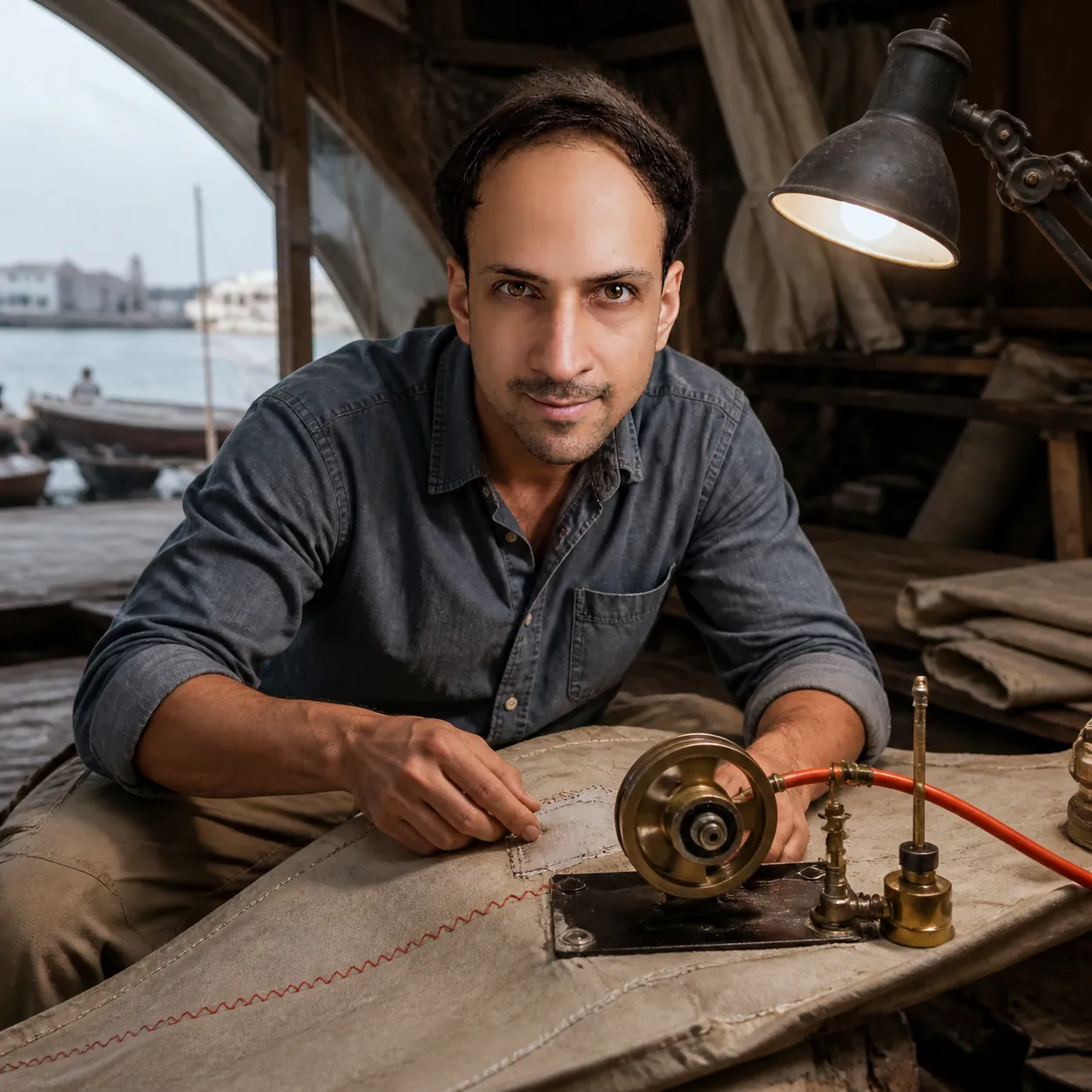
The Long Exhale: Sail-Repair Loft — AI Portrait Prompt
صورةAI Portraits

Turn your own photo into a workshop-instrument portrait in a sail-repair loft above a Jeddah boat shed, canvas rolled aside. Keeps your face unchanged.

من نص البرومبت

Use the attached reference photo as the identity reference: keep the same face, skin tone, hair and features as the person in that photo, without beautifying, aging or altering them. Create a square 1:1 museum-catalog frame with a strong first read and a slower second read at exactly 2880x2880 pixels. Location: a sail-repair loft above a Jeddah boat shed, canvas rolled aside. Show the subject in a faded chambray shirt rolled past the forearms over canvas trousers, pressing a patch seam flat with one slow thumbstroke. Treat this mechanism as the frame’s governing rule: a palm-sized brass turbine wheel that one smooth exhale spins up and leaves coasting on its jeweled bearing turns the body's most invisible act into a mechanism the eye can audit. Explore whether slowing the breath genuinely slows anything else worth naming; direct expression and posture toward steadied wonder, never melodrama or ad-like confidence. Frame at the instrument's working height so its smallest motion and their eyes read together. Make the composition center the instrument's stillest point and set them gently off-axis. Render it as workshop-instrument portraiture built from real pneumatic mechanisms, warm handcrafted materiality, patient documentary observation, and calibration marks rendered exactly legible, using a single hooded bench lamp pooling light around hands and instrument and a palette of slate grey, clear glass, and a madder-red thread. Photorealistic: this must read as a real photograph from a physical camera, never an illustration, painting, or 3D render. Resolve real surface detail: grout darker than tile, sealant slightly yellowed, and every joint showing a real tolerance gap. Keep one identity-locked person, credible hands and fingers, natural fabric, and coherent scale, contact, reflections, shadows, airflow, deformation, and materials. Background people only when essential, always secondary and clearly different. Avoid glowing breath vapor, swirling CGI air streaks, meditation-pose serenity, and dust motes in god rays. No text, labels, logos, signatures, watermarks, random symbols, plastic skin, excessive bloom, or glossy AI finish.
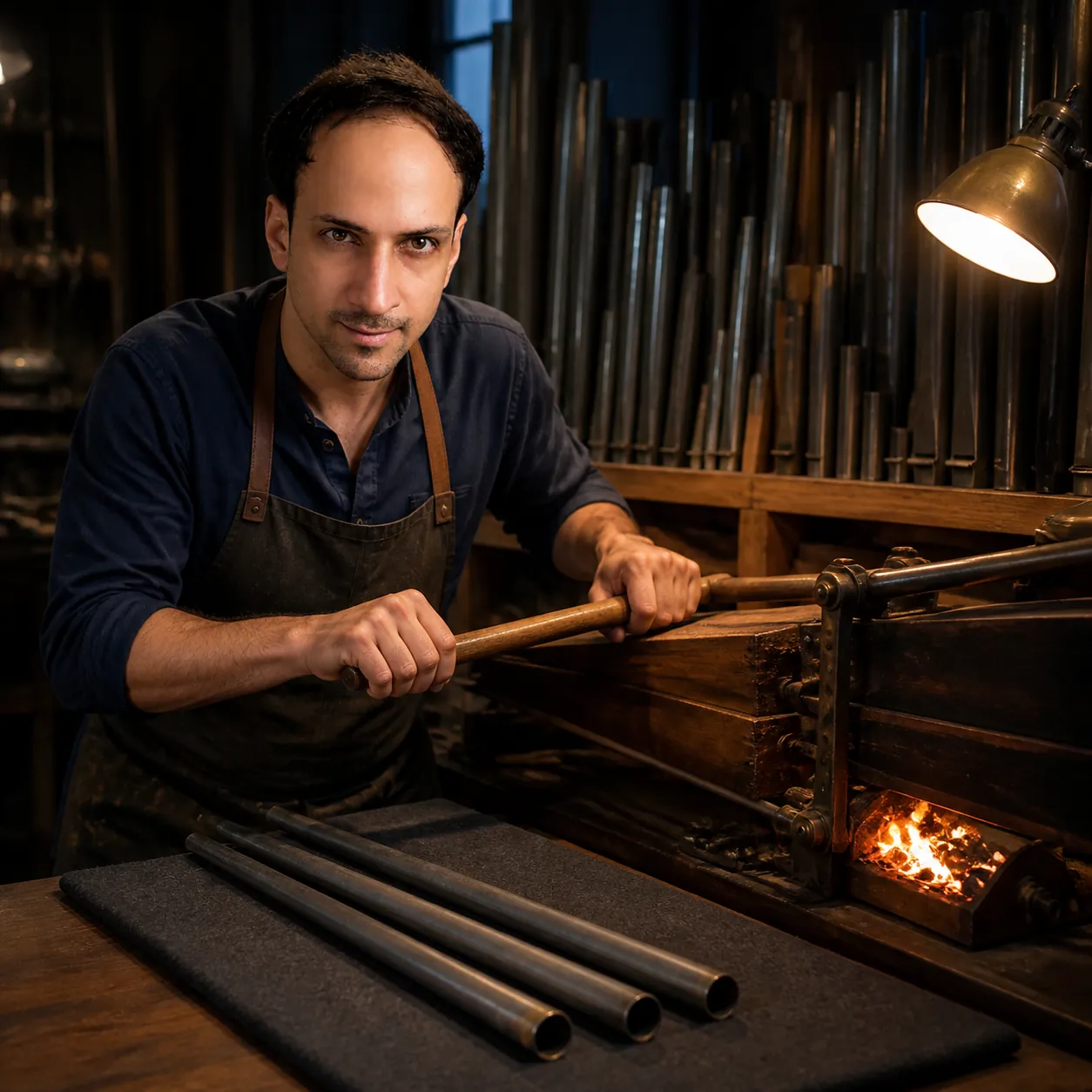
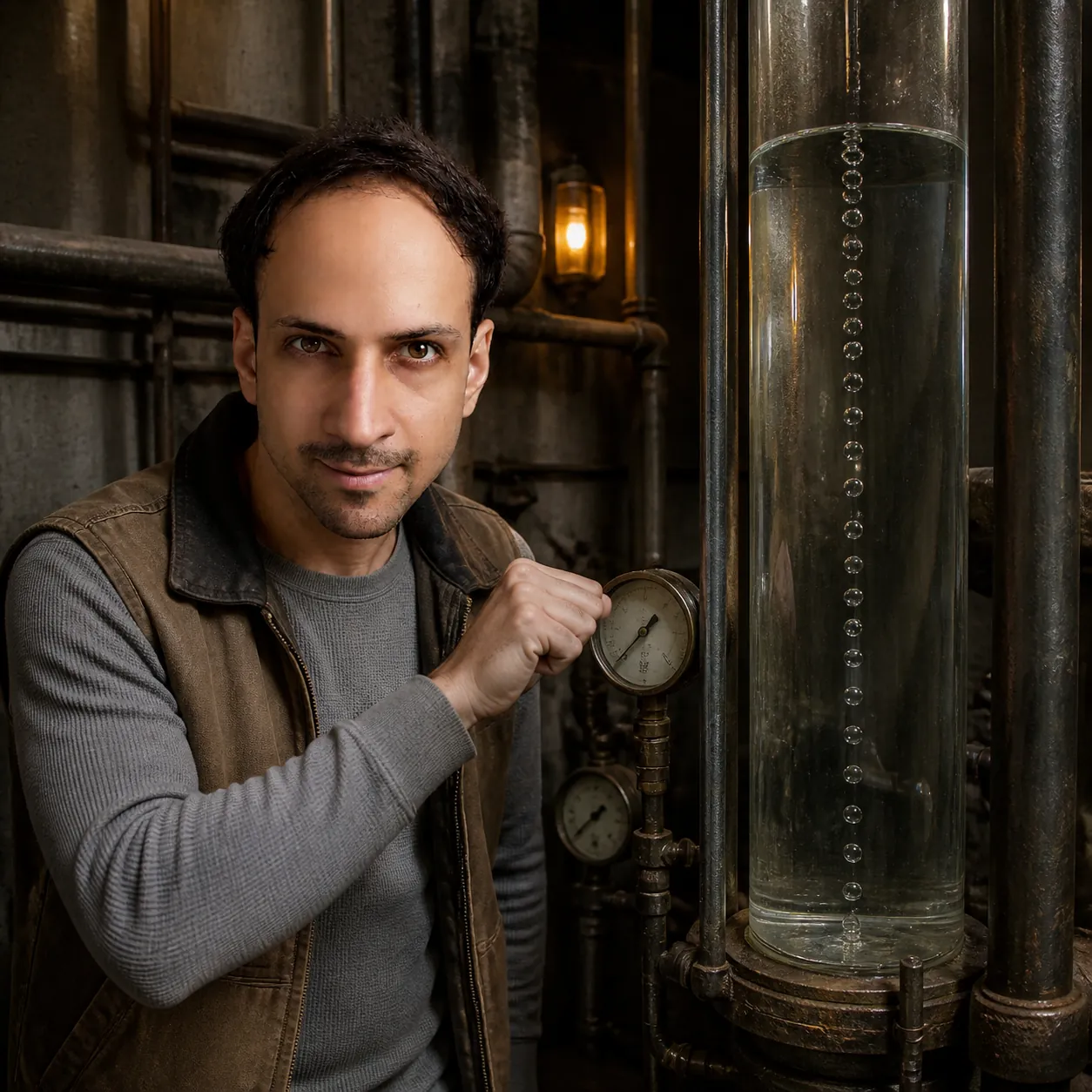
Still Descent: Vacuum-Pump Room — AI Portrait Prompt
صورةAI Portraits

Turn your own photo into a working research-facility portrait in the vacuum-pump room at the tower's base, gauges glowing dim. Keeps your face unchanged.

من نص البرومبت

Use the attached reference photo as the identity reference: keep the same face, skin tone, hair and features as the person in that photo, without beautifying, aging or altering them. Create a square 1:1 museum-catalog frame with a strong first read and a slower second read at exactly 2880x2880 pixels. Location: the vacuum-pump room at the tower's base, gauges glowing dim. Show the subject in a heather-grey thermal shirt under an open canvas work vest, tapping a vacuum gauge glass lightly with one knuckle. Make one rigorous physical condition the conceptual engine: a tall water column whose stream of rising air bubbles halts mid-climb and hangs like a string of glass beads turns one honestly borrowed second into proof that weight is circumstance, not essence. Explore how a camera must fall to tell the truth about falling; direct expression and posture toward grave delight, never melodrama or ad-like confidence. Use an eye-level 55mm viewpoint with natural perspective, their planted stance sharing the frame with the floating demonstration. Make the composition give the suspended matter stillness and the cables all the tension. Render it as working research-facility realism combining true free-fall fluid behavior, engineered-safety texture, unglamorous industrial surfaces, and quietly composed editorial portrait photography, using even technical illumination shaped by the capsule's own interior fixtures, shadows kept readable and a palette of bone grey, netting black, and a single amber lamp. Photorealistic: this must read as a real photograph from a physical camera, never an illustration, painting, or 3D render. Resolve real surface detail: fine grit in the texture of concrete, efflorescence at damp edges, and hairline cracks that follow stress. Keep one identity-locked person, credible hands and fingers, natural fabric, and coherent scale, contact, reflections, shadows, airflow, deformation, and materials. Background people only when essential, always secondary and clearly different. Avoid floating-hair astronaut poses, levitating people, swirling CGI water tentacles, and sci-fi antigravity glow. No text, labels, logos, signatures, watermarks, random symbols, plastic skin, excessive bloom, or glossy AI finish.
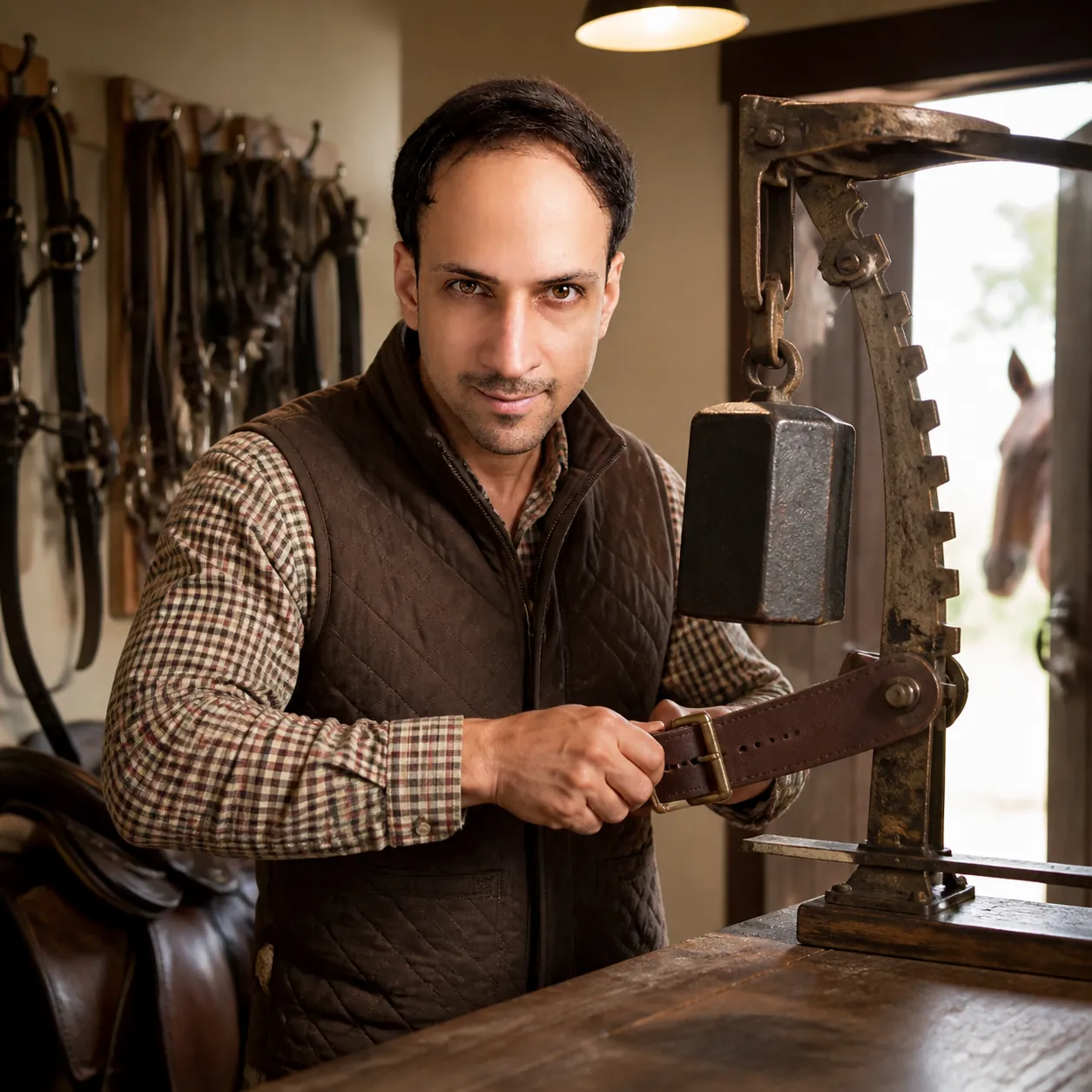
Mechanics of Calm: Instrument Maker's Voicing Room — AI Portrait Prompt
صورةAI Portraits

Turn your own photo into a workshop-instrument portrait in an instrument maker's voicing room with flue pipes racked by length. Keeps your face unchanged.

من نص البرومبت

Use the attached reference photo as the identity reference: keep the same face, skin tone, hair and features as the person in that photo, without beautifying, aging or altering them. Create a square 1:1 museum-catalog frame with a strong first read and a slower second read at exactly 2880x2880 pixels. Location: an instrument maker's voicing room with flue pipes racked by length. Show the subject in a collarless indigo work shirt under a waxed canvas apron, laying three flue pipes parallel on a felt runner. Make one rigorous physical condition the conceptual engine: a long two-handed workshop bellows whose ember bed brightens and dims in strict time with their slow, even strokes turns the body's most invisible act into a mechanism the eye can audit. Explore why the body's quietest function deserves instruments built to this exactness; direct expression and posture toward settled attention, never melodrama or ad-like confidence. Use a patient 85mm eye-level view with true perspective and a narrow, deliberate plane of focus. Make the composition center the instrument's stillest point and set them gently off-axis. Render it as workshop-instrument portraiture built from real pneumatic mechanisms, warm handcrafted materiality, patient documentary observation, and calibration marks rendered exactly legible, using one warm practical low beside the instrument answered by cool side ambient and a palette of soot black, worn brass, and one ember orange. Photorealistic: this must read as a real photograph from a physical camera, never an illustration, painting, or 3D render. Resolve real surface detail: true skin texture with pores and fine hair at the hairline, and fabric that creases where it is actually stressed. Keep one identity-locked person, credible hands and fingers, natural fabric, and coherent scale, contact, reflections, shadows, airflow, deformation, and materials. Background people only when essential, always secondary and clearly different. Avoid glowing breath vapor, swirling CGI air streaks, meditation-pose serenity, and dust motes in god rays. No text, labels, logos, signatures, watermarks, random symbols, plastic skin, excessive bloom, or glossy AI finish.
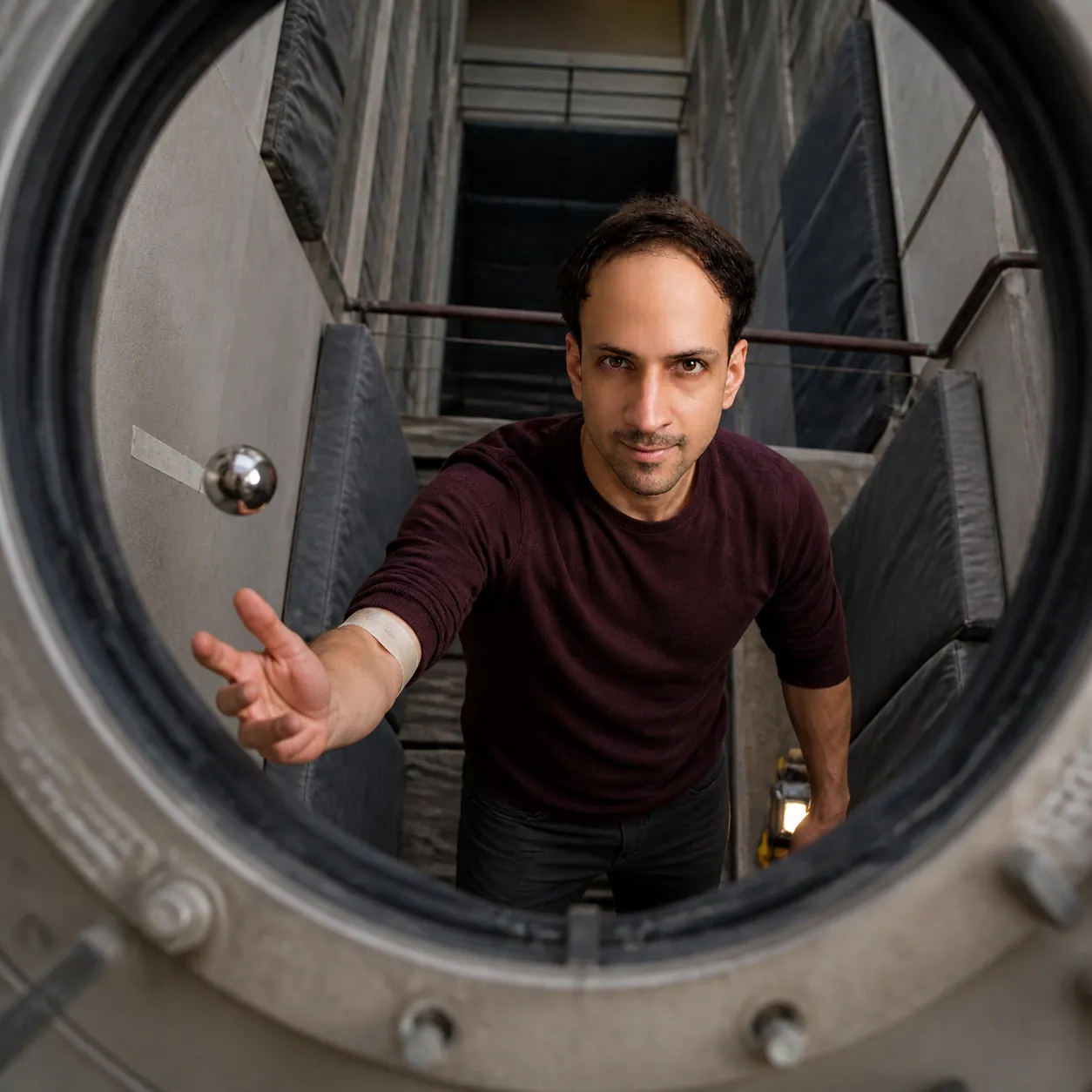
Forward Only: Tidy Stable Tack Room — AI Portrait Prompt
صورةAI Portraits

Turn your own photo into a conceptual workshop portrait in a tidy stable tack room with morning light through one door. Keeps your face unchanged.

من نص البرومبت

Use the attached reference photo as the identity reference: keep the same face, skin tone, hair and features as the person in that photo, without beautifying, aging or altering them. Create a square 1:1 museum-catalog frame with a strong first read and a slower second read at exactly 2880x2880 pixels. Location: a tidy stable tack room with morning light through one door. Show the subject in a quilted brown vest over a checked cotton shirt, buckling a leather strap one notch tighter. Use this advanced image-making device as the core logic: a workshop ratchet whose pawl drops into every fresh tooth with a bright click, holding its lifted iron weight against sliding back turns effort already spent into motion the body can plainly feel. Explore how a machine that cannot move backward changes what starting feels like; direct expression and posture toward patient resolve, never melodrama or ad-like confidence. Frame slightly below the action line so lifted weight and steady gaze read in one glance. Make the composition keep the next unmoved element sharpest, the frame's quiet promise. Render it as conceptual workshop portraiture combining engineered anticipation, tactile brass and timber apparatus, believable mechanical motion, and emotionally intelligent documentary framing, using a single practical bulb above the mechanism with gentle ambient spill and a palette of bone ivory, oiled walnut, and a single verdigris accent. Photorealistic: this must read as a real photograph from a physical camera, never an illustration, painting, or 3D render. Resolve real surface detail: visible weave in cloth, fine scratches on metal, and the faint unevenness of painted walls. Keep one identity-locked person, credible hands and fingers, natural fabric, and coherent scale, contact, reflections, shadows, airflow, deformation, and materials. Background people only when essential, always secondary and clearly different. Avoid slot-machine iconography, glowing progress bars, cascading gold coins, cartoon gear mandalas, and confetti-burst celebration effects. No text, labels, logos, signatures, watermarks, random symbols, plastic skin, excessive bloom, or glossy AI finish.
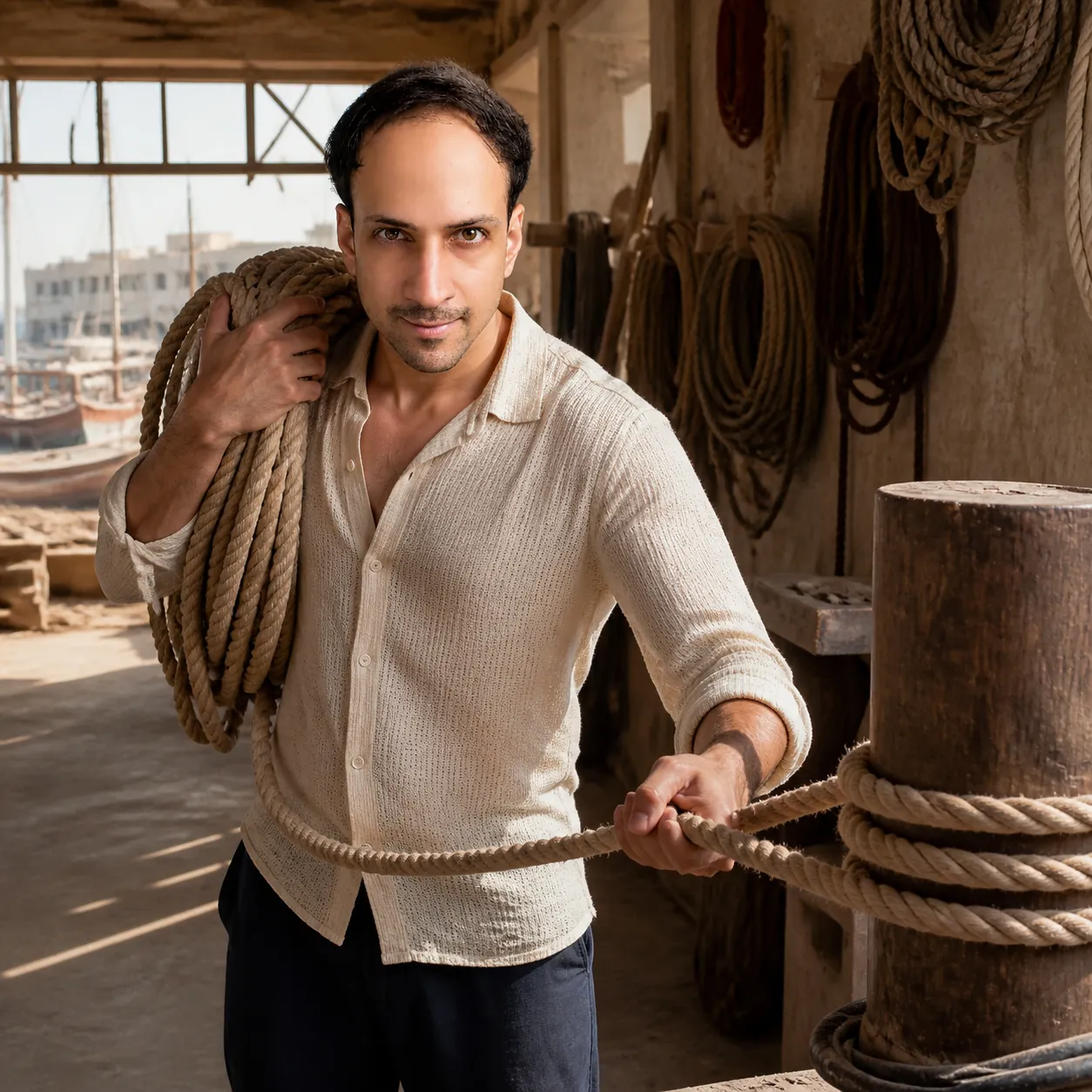
Honest Weightlessness: Campus Stairwell — AI Portrait Prompt
صورةAI Portraits

Turn your own photo into a museum-grade experiment portrait in a campus stairwell converted to a padded two-storey mini drop lane. Keeps your face unchanged.

من نص البرومبت

Use the attached reference photo as the identity reference: keep the same face, skin tone, hair and features as the person in that photo, without beautifying, aging or altering them. Create a square 1:1 museum-catalog frame with a strong first read and a slower second read at exactly 2880x2880 pixels. Location: a campus stairwell converted to a padded two-storey mini drop lane. Show the subject in a maroon rugby-knit pullover with sleeves pushed back to the elbow, marking the release height with one strip of tape. Use this advanced image-making device as the core logic: a polished steel ball released at the drop's start that floats fixed beside its painted mark, falling in perfect company holds steady in frame only because the witness is falling too. Explore where the difference lies between falling helplessly and falling by appointment; direct expression and posture toward settled curiosity, never melodrama or ad-like confidence. Frame through the capsule's open hatch ring, its rim softly defocused and never crossing their face. Make the composition let empty vertical shaft space press in from above. Render it as museum-grade experiment photography built from lawful weightless phenomena, visible catch systems, matte machined materials, and slow deliberate framing, using flat pre-dawn sky light with a single battery work lamp for warmth and a palette of desert dawn sand, steel grey, and muted teal. Photorealistic: this must read as a real photograph from a physical camera, never an illustration, painting, or 3D render. Resolve real surface detail: rubber gone chalky with age, painted metal chipped to primer, and plastic yellowed only where light reaches it. Keep one identity-locked person, credible hands and fingers, natural fabric, and coherent scale, contact, reflections, shadows, airflow, deformation, and materials. Background people only when essential, always secondary and clearly different. Avoid space-station porthole backdrops, cartoon up-arrows, magically hovering furniture, dramatic slow-motion glass shatters, and superhero mid-air heroics. No text, labels, logos, signatures, watermarks, random symbols, plastic skin, excessive bloom, or glossy AI finish.
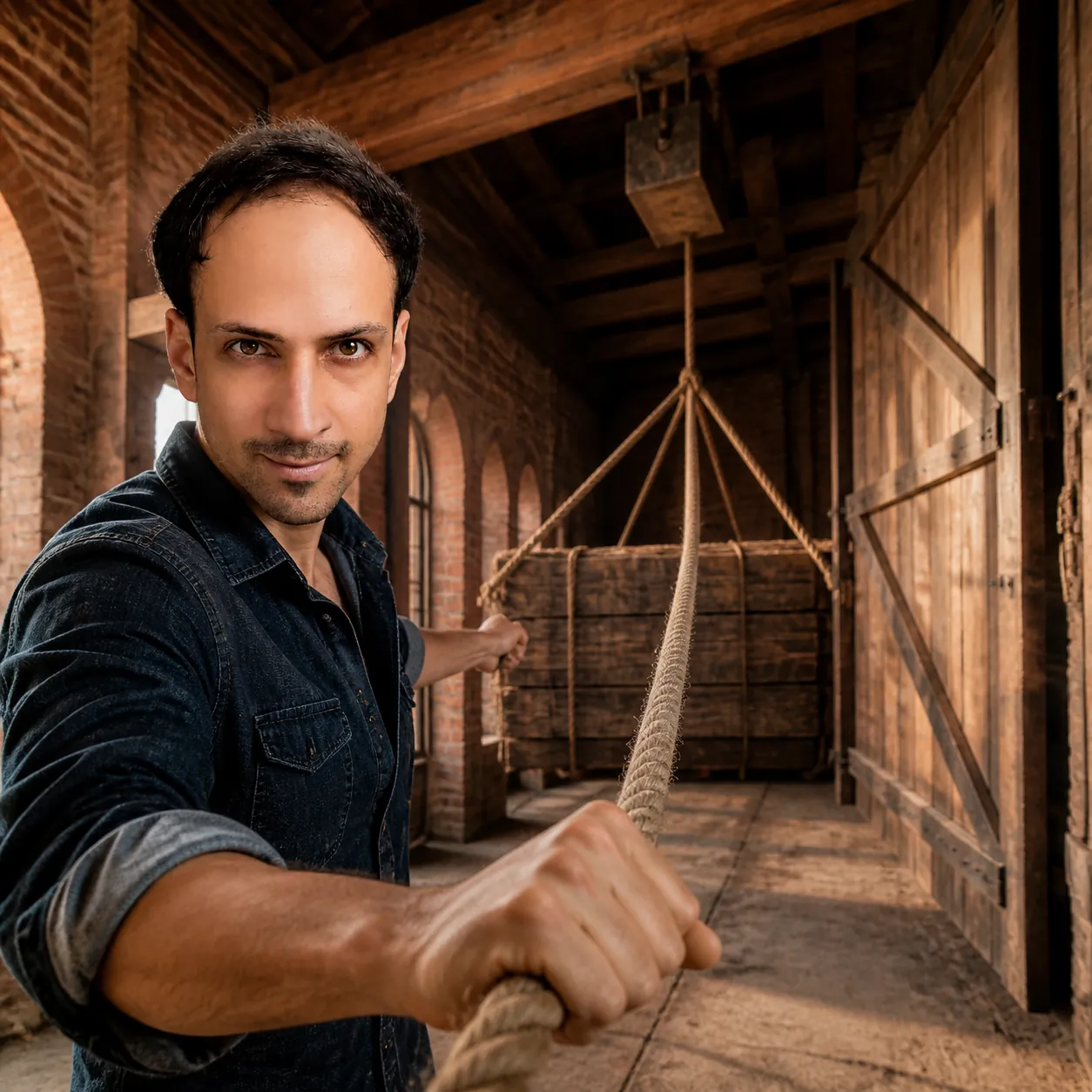
Small Force: Sail-Rigging Loft — AI Portrait Prompt
صورةAI Portraits

Turn your own photo into a museum-grade demonstration portrait in a sail-rigging loft above a Jeddah boatyard, coiled lines on pegs. Keeps your face unchanged.

من نص البرومبت

Use the attached reference photo as the identity reference: keep the same face, skin tone, hair and features as the person in that photo, without beautifying, aging or altering them. Create a square 1:1 museum-catalog frame with a strong first read and a slower second read at exactly 2880x2880 pixels. Location: a sail-rigging loft above a Jeddah boatyard, coiled lines on pegs. Show the subject in an open-weave cream shirt with both cuffs left unbuttoned, lifting a heavy coil of line onto one shoulder. Make one rigorous physical condition the conceptual engine: a hemp line taken three quiet turns around a timber bollard, whose friction lets two loose fingers hold a straining ton turns a small, steady effort into the equal of crushing weight. Explore how a burden turns weightless the moment its counterpoise comes true; direct expression and posture toward measured assurance, never melodrama or ad-like confidence. Use an eye-level 50mm viewpoint that keeps mechanism, load, and face in one honest perspective. Make the composition give the load more frame and give them the light. Render it as museum-grade demonstration photography combining true static balance, believable rigging detail, honest load-bearing structure, and restrained human-scale art direction, using dusty shafts of high window light cut into slow diagonal beams and a palette of sandstone buff, rope-shadow grey, and a single indigo accent. Photorealistic: this must read as a real photograph from a physical camera, never an illustration, painting, or 3D render. Resolve real surface detail: fine grit in the texture of concrete, efflorescence at damp edges, and hairline cracks that follow stress. Keep one identity-locked person, credible hands and fingers, natural fabric, and coherent scale, contact, reflections, shadows, airflow, deformation, and materials. Background people only when essential, always secondary and clearly different. Avoid gym equipment, heroic strongman poses, bulging-vein close-ups, snapped-rope drama, and impossibly floating boulders. No text, labels, logos, signatures, watermarks, random symbols, plastic skin, excessive bloom, or glossy AI finish.
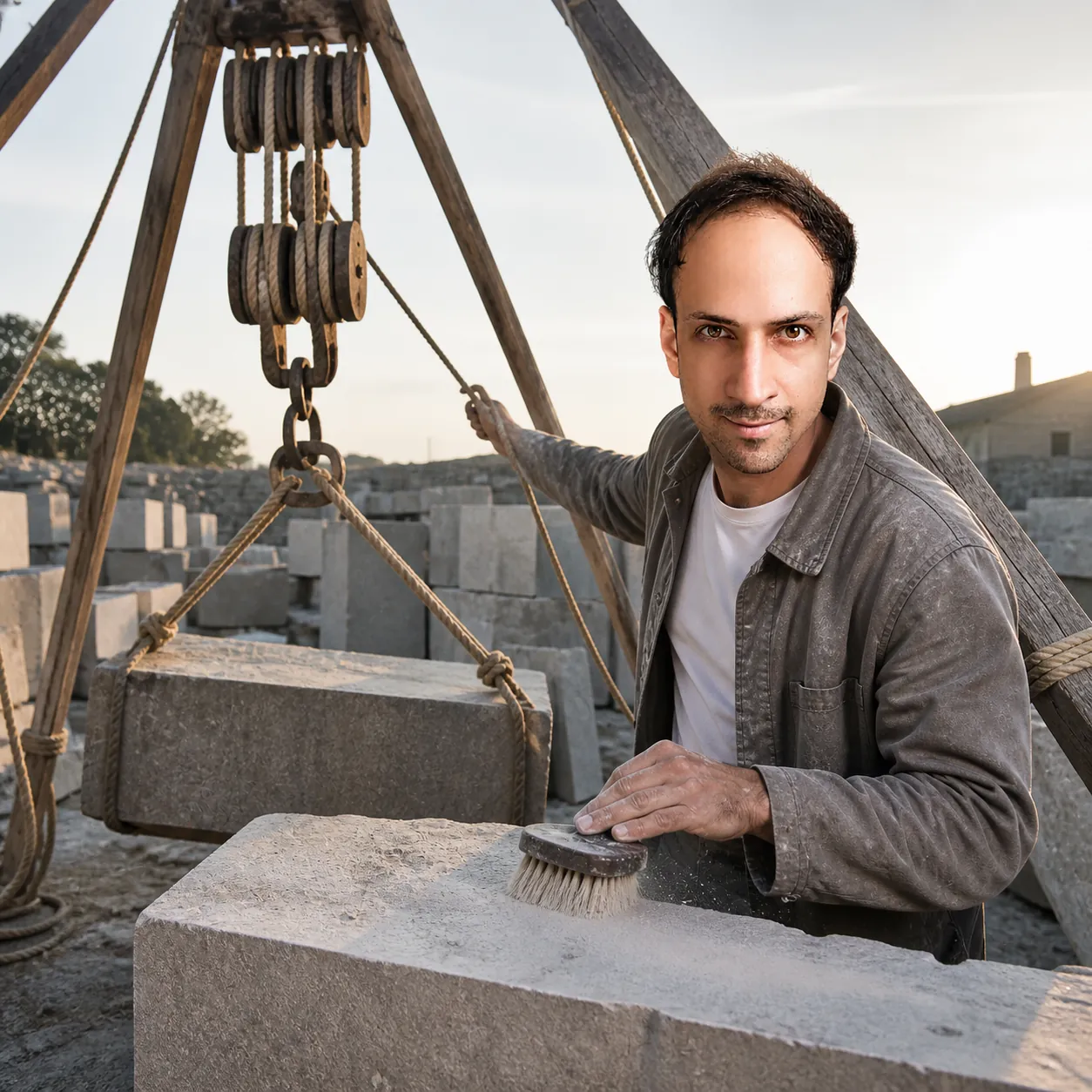
Patient Power: Brick Freight Depot Bay — AI Portrait Prompt
صورةAI Portraits

Turn your own photo into a conceptual labor portrait in a brick freight depot bay with a timber gantry beam overhead. Keeps your face unchanged.

من نص البرومبت

Use the attached reference photo as the identity reference: keep the same face, skin tone, hair and features as the person in that photo, without beautifying, aging or altering them. Create a square 1:1 museum-catalog frame with a strong first read and a slower second read at exactly 2880x2880 pixels. Location: a brick freight depot bay with a timber gantry beam overhead. Show the subject in a dark denim work shirt with both sleeves rolled twice, testing a cargo sling's bite with one firm tug. The impossible-looking event must obey this clear system: a massive timber door hung against a hidden counterweight, so finely balanced that one extended finger swings it through its arc turns a small, steady effort into the equal of crushing weight. Explore what a body is worth when geometry multiplies everything it gives; direct expression and posture toward grounded calm, never melodrama or ad-like confidence. Use an 85mm portrait lens focused on their hands, with the balanced load readable just beyond them. Make the composition run one unbroken structural line from hand to load. Render it as conceptual labor portraiture uniting real counterweight physics, timber-and-rope craft authenticity, measured cinematic stillness, and quietly dignified working-portrait realism, using low raking sunrise light that gives every rope fiber its own shadow and a palette of sandstone buff, rope-shadow grey, and a single indigo accent. Photorealistic: this must read as a real photograph from a physical camera, never an illustration, painting, or 3D render. Resolve real surface detail: glass with real thickness at its edge, reflections that carry the room's actual colour, and dust visible only at grazing angles. Keep one identity-locked person, credible hands and fingers, natural fabric, and coherent scale, contact, reflections, shadows, airflow, deformation, and materials. Background people only when essential, always secondary and clearly different. Avoid gym equipment, heroic strongman poses, bulging-vein close-ups, snapped-rope drama, and impossibly floating boulders. No text, labels, logos, signatures, watermarks, random symbols, plastic skin, excessive bloom, or glossy AI finish.
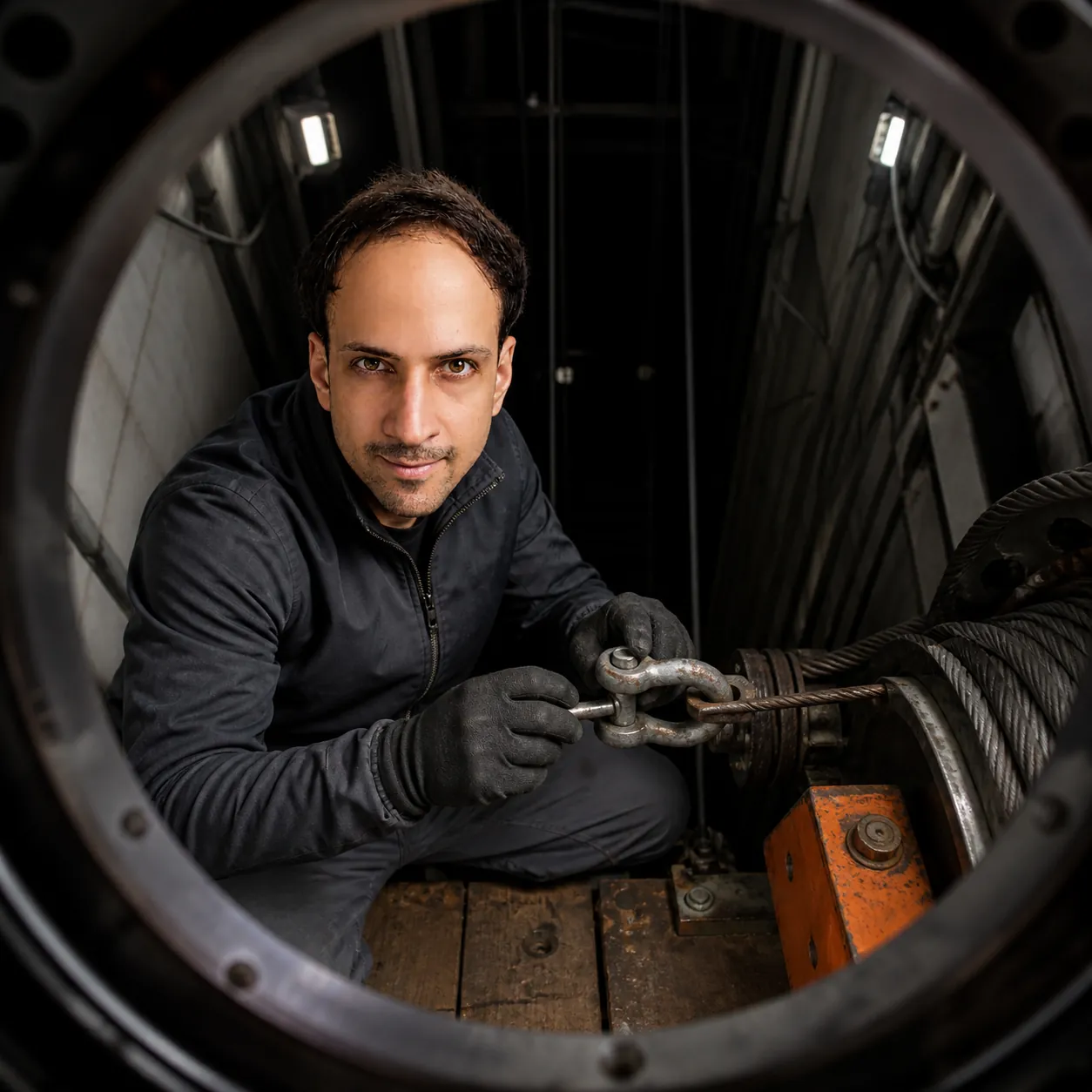
Quiet Leverage: Masons' Stone Yard — AI Portrait Prompt
صورةAI Portraits

Turn your own photo into a quiet working-rigging portrait in a masons' stone yard at first light, sawn blocks in squared rows. Keeps your face unchanged.

من نص البرومبت

Use the attached reference photo as the identity reference: keep the same face, skin tone, hair and features as the person in that photo, without beautifying, aging or altering them. Create a square 1:1 museum-catalog frame with a strong first read and a slower second read at exactly 2880x2880 pixels. Location: a masons' stone yard at first light, sawn blocks in squared rows. Show the subject in a dust-grey canvas work jacket over a plain white shirt, brushing stone dust from a block's sawn edge. Make one rigorous physical condition the conceptual engine: a five-sheave timber block-and-tackle through which their own seated bodyweight, applied to the fall rope, holds a quarried stone block level turns a small, steady effort into the equal of crushing weight. Explore why a patient person with simple rigging outlifts a hurried, stronger one; direct expression and posture toward measured assurance, never melodrama or ad-like confidence. Use an eye-level 50mm viewpoint that keeps mechanism, load, and face in one honest perspective. Make the composition weigh the huge load against their small, calm effort. Render it as quiet working-rigging portraiture built from lawful mechanical advantage, heavy documentary realism, hand-worn rope-and-timber materiality, and patient large-format editorial composition, using low raking sunrise light that gives every rope fiber its own shadow and a palette of raw hemp, limestone grey, and one oxide-red band. Photorealistic: this must read as a real photograph from a physical camera, never an illustration, painting, or 3D render. Resolve real surface detail: true skin texture with pores and fine hair at the hairline, and fabric that creases where it is actually stressed. Keep one identity-locked person, credible hands and fingers, natural fabric, and coherent scale, contact, reflections, shadows, airflow, deformation, and materials. Background people only when essential, always secondary and clearly different. Avoid gym equipment, heroic strongman poses, bulging-vein close-ups, snapped-rope drama, and impossibly floating boulders. No text, labels, logos, signatures, watermarks, random symbols, plastic skin, excessive bloom, or glossy AI finish.
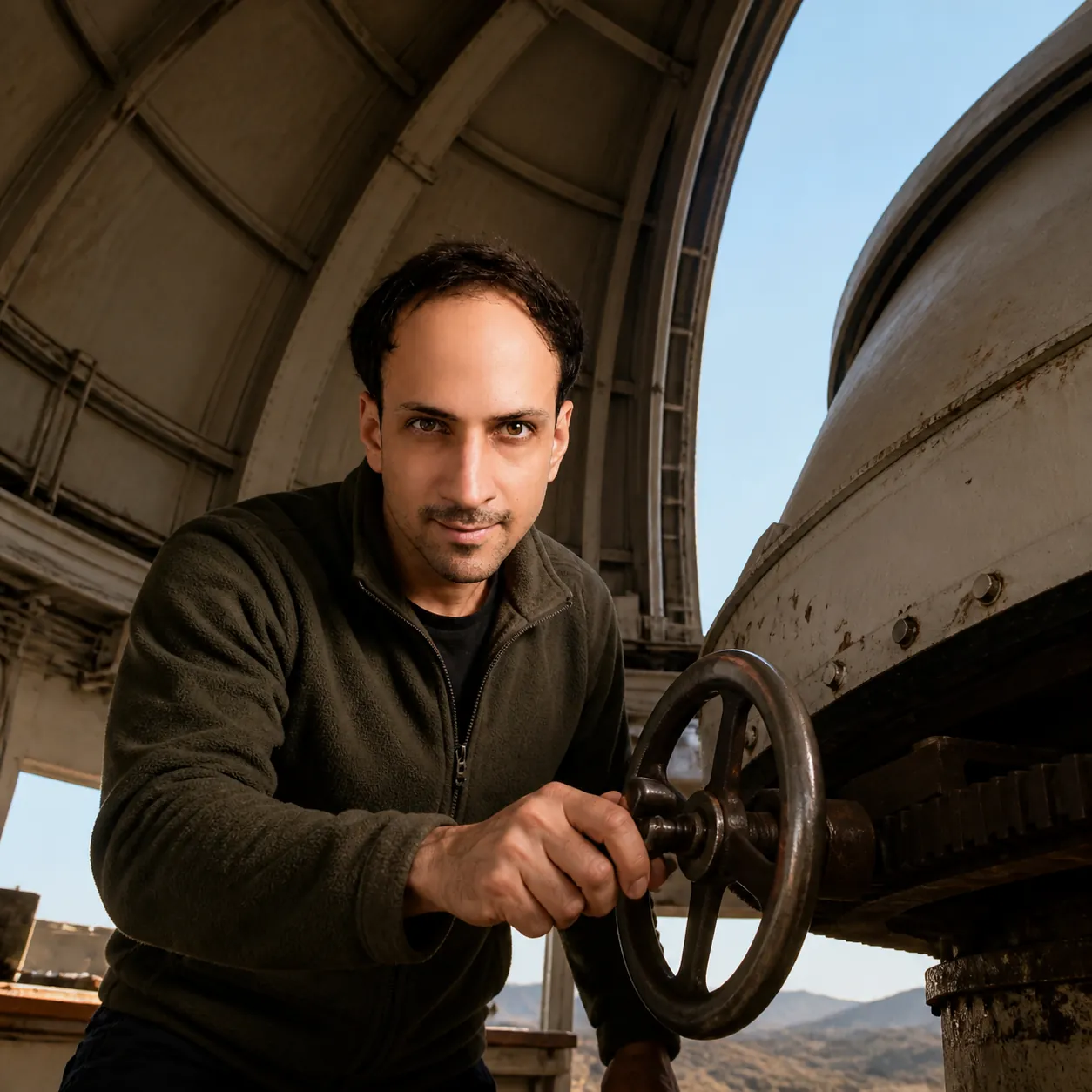
The Caught Fall: Winch Deck — AI Portrait Prompt
صورةAI Portraits

Turn your own photo into a portrait in the winch deck at the tower's top, cables dropping into darkness. Keeps your face unchanged.

من نص البرومبت

Use the attached reference photo as the identity reference: keep the same face, skin tone, hair and features as the person in that photo, without beautifying, aging or altering them. Create a square 1:1 museum-catalog frame with a strong first read and a slower second read at exactly 2880x2880 pixels. Location: the winch deck at the tower's top, cables dropping into darkness. Show the subject in a slate softshell jacket zipped to mid-chest over grey trousers, checking a shackle pin with one gloved thumb. Use this advanced image-making device as the core logic: a long brass pendulum that quits mid-swing as the drop begins, its cord bowing loose while the bob drifts free turns one honestly borrowed second into proof that weight is circumstance, not essence. Explore why gravity's absence reads on camera as gentleness rather than chaos; direct expression and posture toward gentle rigor, never melodrama or ad-like confidence. Frame through the capsule's open hatch ring, its rim softly defocused and never crossing their face. Make the composition let empty vertical shaft space press in from above. Render it as high-fidelity microgravity documentary portraiture built from real drop-tower physics, honest rigging detail, calm human presence, and precise mid-fall clarity, using even technical illumination shaped by the capsule's own interior fixtures, shadows kept readable and a palette of gunmetal, foam white, and one signal-orange accent. Photorealistic: this must read as a real photograph from a physical camera, never an illustration, painting, or 3D render. Resolve real surface detail: wood grain read at honest scale, matte and gloss clearly separated, and no surface uniformly clean. Keep one identity-locked person, credible hands and fingers, natural fabric, and coherent scale, contact, reflections, shadows, airflow, deformation, and materials. Background people only when essential, always secondary and clearly different. Avoid floating-hair astronaut poses, levitating people, swirling CGI water tentacles, and sci-fi antigravity glow. No text, labels, logos, signatures, watermarks, random symbols, plastic skin, excessive bloom, or glossy AI finish.
The Next Tooth: Hilltop Observatory Dome — AI Portrait Prompt
صورةAI Portraits

Turn your own photo into a gallery-grade process portrait in a hilltop observatory dome with its shutter cranked half open. Keeps your face unchanged.

من نص البرومبت

Use the attached reference photo as the identity reference: keep the same face, skin tone, hair and features as the person in that photo, without beautifying, aging or altering them. Create a square 1:1 museum-catalog frame with a strong first read and a slower second read at exactly 2880x2880 pixels. Location: a hilltop observatory dome with its shutter cranked half open. Show the subject in a dark olive fleece jacket zipped to mid-chest, cranking the dome shutter one steady half turn. Use this advanced image-making device as the core logic: a quarter-ton crate eased onto loose steel rollers that now follows two fingers across the floor it once refused pays out only what was honestly deposited, yet the timing feels generous. Explore whether momentum is a feeling or a quantity they can simply arrange; direct expression and posture toward unhurried conviction, never melodrama or ad-like confidence. Frame slightly below the action line so lifted weight and steady gaze read in one glance. Make the composition leave visible headroom where the mechanism has yet to arrive. Render it as gallery-grade process photography built from lawful moving apparatus, honest material wear, physically believable mass, and unhurried human observation, using cool even skylight softened by dust in the air, contrast restrained and a palette of warm dust, deep umber, and one polished steel highlight. Photorealistic: this must read as a real photograph from a physical camera, never an illustration, painting, or 3D render. Resolve real surface detail: rubber gone chalky with age, painted metal chipped to primer, and plastic yellowed only where light reaches it. Keep one identity-locked person, credible hands and fingers, natural fabric, and coherent scale, contact, reflections, shadows, airflow, deformation, and materials. Background people only when essential, always secondary and clearly different. Avoid Rube Goldberg clutter, floating holographic interfaces, trophy-shelf staging, neon motivational glow, and impossibly frictionless chrome machinery. No text, labels, logos, signatures, watermarks, random symbols, plastic skin, excessive bloom, or glossy AI finish.
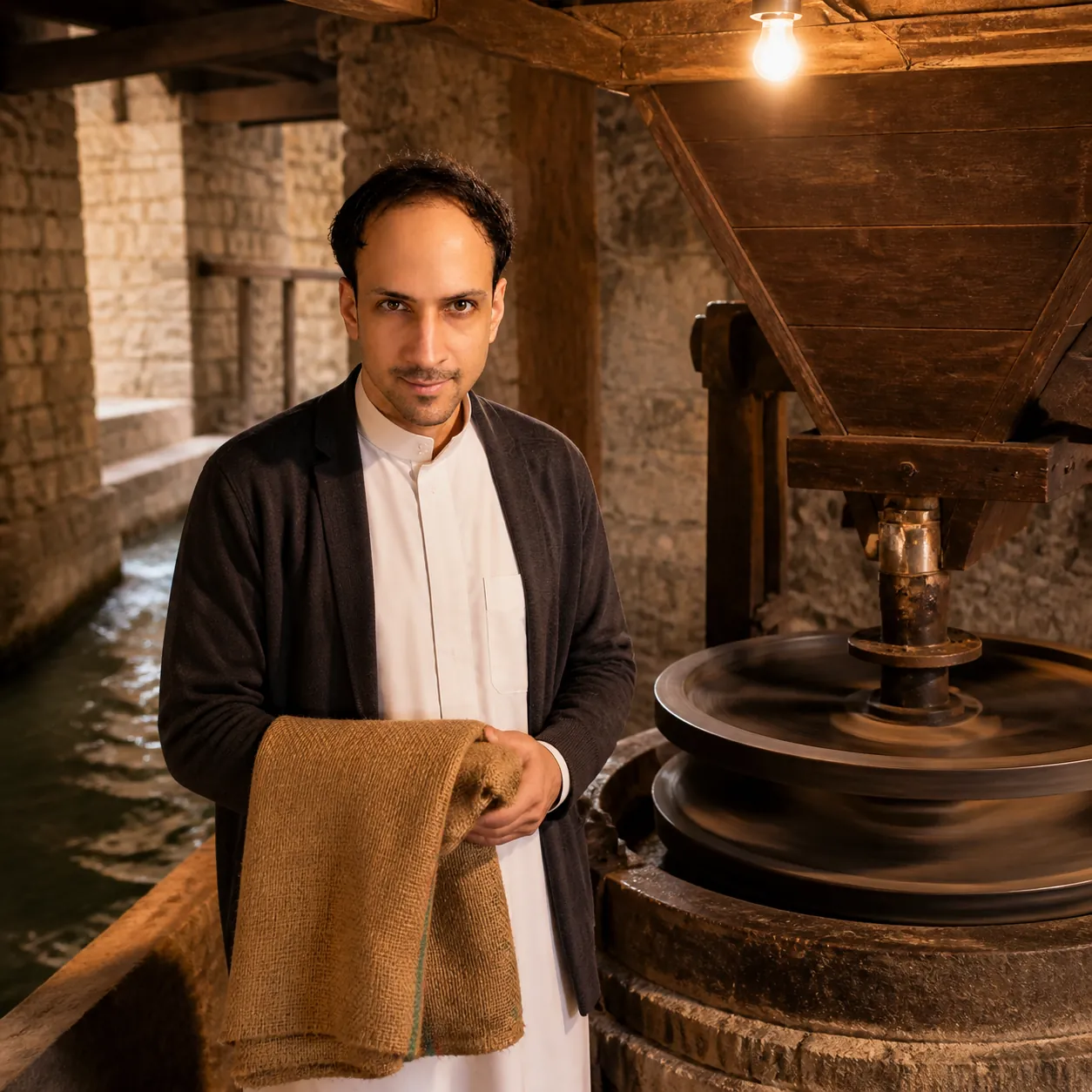
Banked Effort: Restored Stone Gristmill — AI Portrait Prompt
صورةAI Portraits

Turn your own photo into a museum-demonstration portrait in a restored stone gristmill in Al-Ahsa beside its quiet channel. Keeps your face unchanged.

من نص البرومبت

Use the attached reference photo as the identity reference: keep the same face, skin tone, hair and features as the person in that photo, without beautifying, aging or altering them. Create a square 1:1 museum-catalog frame with a strong first read and a slower second read at exactly 2880x2880 pixels. Location: a restored stone gristmill in Al-Ahsa beside its quiet channel. Show the subject in a crisp white traditional Gulf outfit under an open charcoal cardigan, folding an empty jute sack squarely over one forearm. Build the artwork around this material rule: a waist-high cast flywheel brought to speed by many light palm pushes, now coasting on its own banked momentum pays out only what was honestly deposited, yet the timing feels generous. Explore why small efforts stop feeling small the moment something visibly keeps them; direct expression and posture toward steady anticipation, never melodrama or ad-like confidence. Use a restrained 35mm view placing them beside the machine, neither dominating the other. Make the composition give the smallest moving part more presence than anything still. Render it as museum-demonstration realism combining truthful mechanical detail, high-fidelity portrait photography, audible-seeming moments of metal contact, and quietly restrained editorial art direction, using a single practical bulb above the mechanism with gentle ambient spill and a palette of raw pine, graphite, and a narrow copper gleam. Photorealistic: this must read as a real photograph from a physical camera, never an illustration, painting, or 3D render. Resolve real surface detail: dust settled where nobody wipes, fingerprint haze on glass, and edges rubbed pale by handling. Keep one identity-locked person, credible hands and fingers, natural fabric, and coherent scale, contact, reflections, shadows, airflow, deformation, and materials. Background people only when essential, always secondary and clearly different. Avoid Rube Goldberg clutter, floating holographic interfaces, trophy-shelf staging, neon motivational glow, and impossibly frictionless chrome machinery. No text, labels, logos, signatures, watermarks, random symbols, plastic skin, excessive bloom, or glossy AI finish.
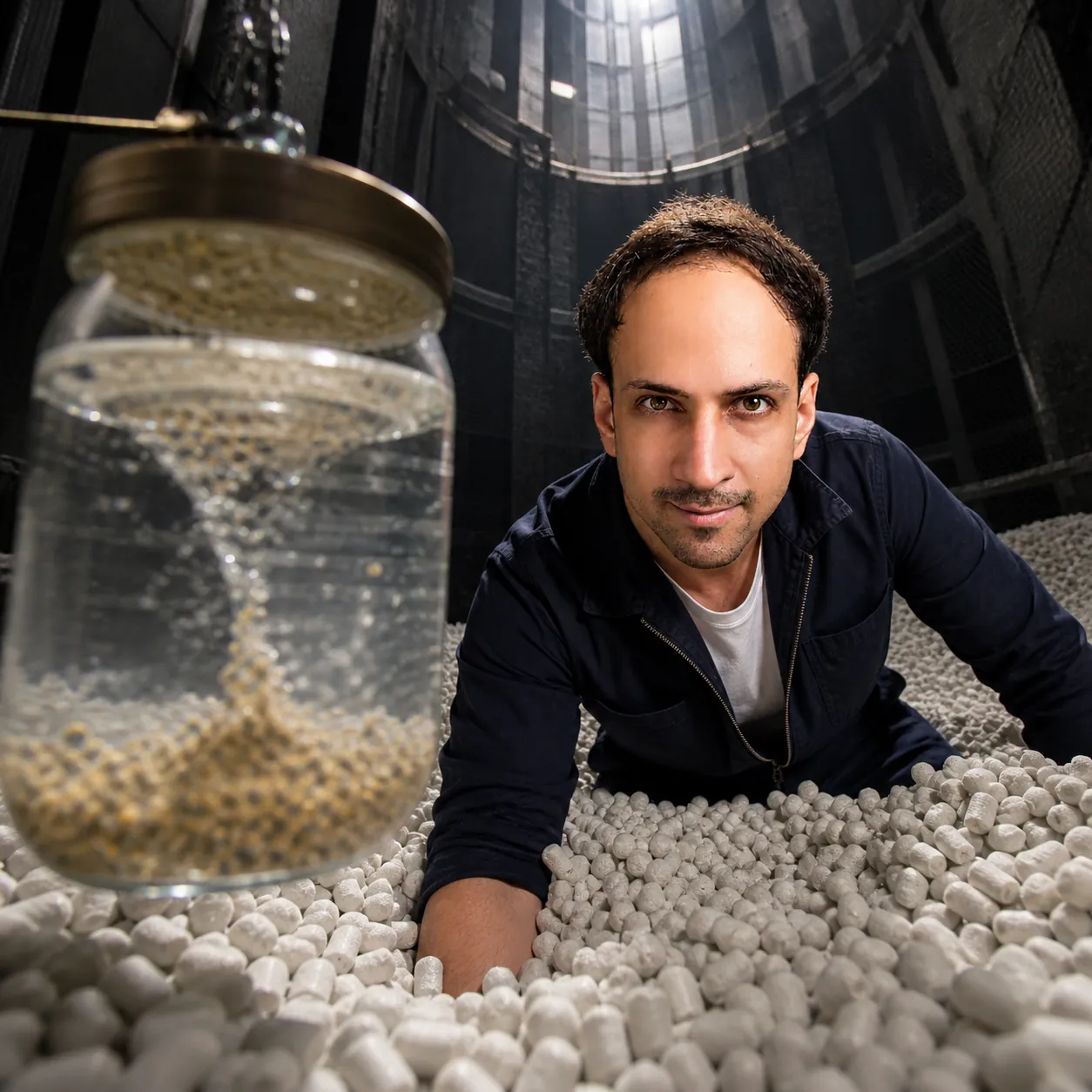
Falling Frame: Deep Catch Pit — AI Portrait Prompt
صورةAI Portraits

Turn your own photo into a portrait in the deep catch pit beneath the drop shaft, banked with foam pellets. Keeps your face unchanged.

من نص البرومبت

Use the attached reference photo as the identity reference: keep the same face, skin tone, hair and features as the person in that photo, without beautifying, aging or altering them. Create a square 1:1 museum-catalog frame with a strong first read and a slower second read at exactly 2880x2880 pixels. Location: the deep catch pit beneath the drop shaft, banked with foam pellets. Show the subject in a navy coverall unzipped to the waist over a clean white tee, sinking one testing hand into the pellet bank. The impossible-looking event must obey this clear system: a shaken jar of water and bright mineral grit whose settling stops the moment the fall begins, the swirl frozen mid-clearing turns one honestly borrowed second into proof that weight is circumstance, not essence. Explore how much of everyday order is gravity quietly doing the arranging; direct expression and posture toward disciplined awe, never melodrama or ad-like confidence. Use a 90mm near-far pairing: one suspended detail sharp near the lens and the person in the reference photo's grounded face readable beyond it. Make the composition keep the catch nets visible without ever letting them dominate. Render it as high-fidelity microgravity documentary portraiture built from real drop-tower physics, honest rigging detail, calm human presence, and precise mid-fall clarity, using cold shaft-light falling from far above, softened by dust in the air and a palette of desert dawn sand, steel grey, and muted teal. Photorealistic: this must read as a real photograph from a physical camera, never an illustration, painting, or 3D render. Resolve real surface detail: brass darkened in the recesses and bright where thumbs land, and lacquer crazed rather than perfect. Keep one identity-locked person, credible hands and fingers, natural fabric, and coherent scale, contact, reflections, shadows, airflow, deformation, and materials. Background people only when essential, always secondary and clearly different. Avoid floating-hair astronaut poses, levitating people, swirling CGI water tentacles, and sci-fi antigravity glow. No text, labels, logos, signatures, watermarks, random symbols, plastic skin, excessive bloom, or glossy AI finish.
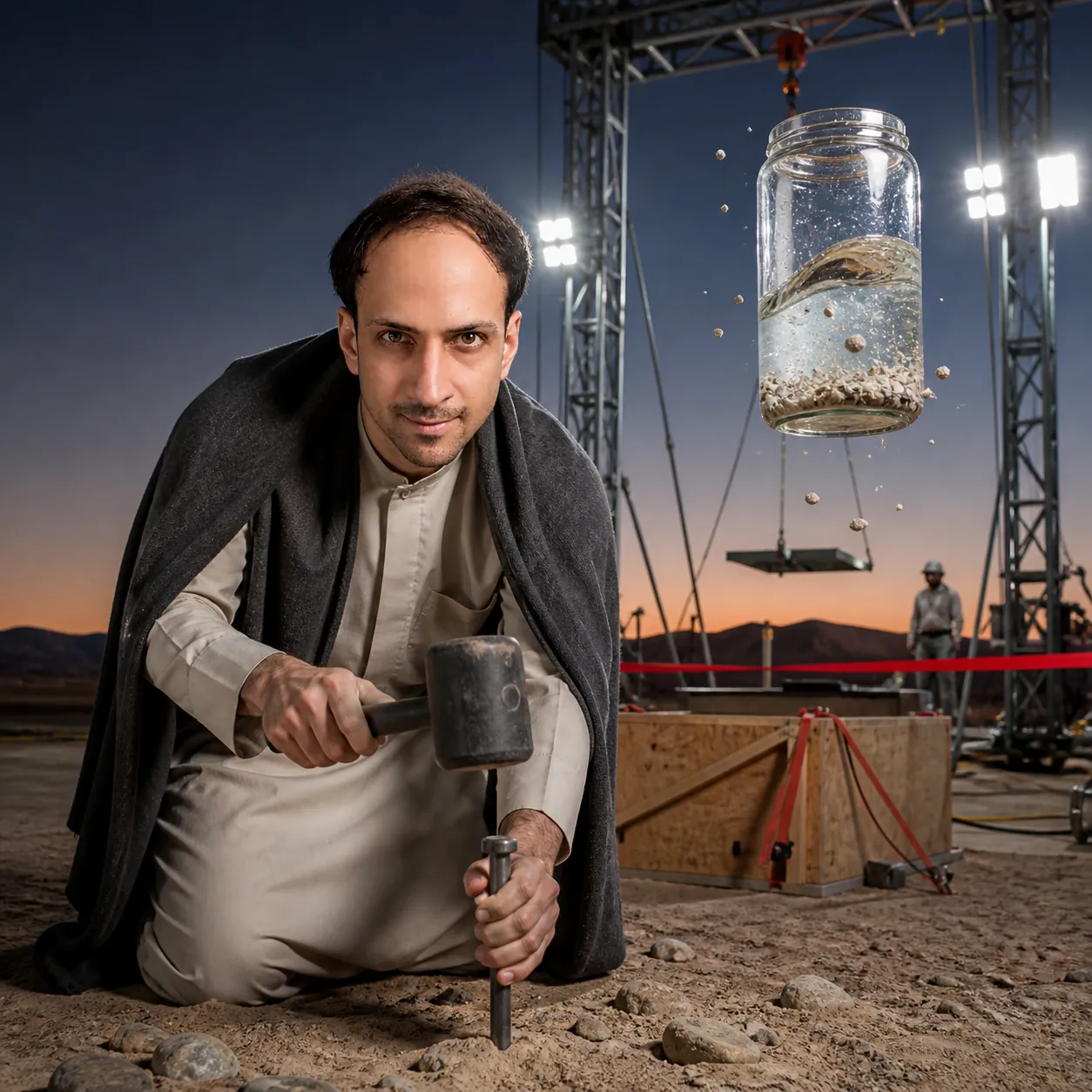
Falling Frame: Portable Drop-Test Gantry — AI Portrait Prompt
صورةAI Portraits

Turn your own photo into a museum-grade experiment portrait in a portable drop-test gantry staked at the desert edge before sunrise. Keeps your face unchanged.

من نص البرومبت

Use the attached reference photo as the identity reference: keep the same face, skin tone, hair and features as the person in that photo, without beautifying, aging or altering them. Create a square 1:1 museum-catalog frame with a strong first read and a slower second read at exactly 2880x2880 pixels. Location: a portable drop-test gantry staked at the desert edge before sunrise. Show the subject in a plain beige traditional Gulf outfit under a charcoal shawl folded once, driving a stake flush with two mallet taps. Build the artwork around this material rule: a shaken jar of water and bright mineral grit whose settling stops the moment the fall begins, the swirl frozen mid-clearing holds steady in frame only because the witness is falling too. Explore how much of everyday order is gravity quietly doing the arranging; direct expression and posture toward quiet vindication, never melodrama or ad-like confidence. Frame at the height of the floating objects so their stillness and their weight-bearing posture share one focal plane. Make the composition hold every floating edge sharper than any grounded surface. Render it as museum-grade experiment photography built from lawful weightless phenomena, visible catch systems, matte machined materials, and slow deliberate framing, using one warm console practical against cool ambient spill from high service lamps and a palette of charcoal, unpainted plywood, and one band of safety red. Photorealistic: this must read as a real photograph from a physical camera, never an illustration, painting, or 3D render. Resolve real surface detail: hair with individual strands catching light and skin oil giving a low uneven sheen. Keep one identity-locked person, credible hands and fingers, natural fabric, and coherent scale, contact, reflections, shadows, airflow, deformation, and materials. Background people only when essential, always secondary and clearly different. Avoid space-station porthole backdrops, cartoon up-arrows, magically hovering furniture, dramatic slow-motion glass shatters, and superhero mid-air heroics. No text, labels, logos, signatures, watermarks, random symbols, plastic skin, excessive bloom, or glossy AI finish.
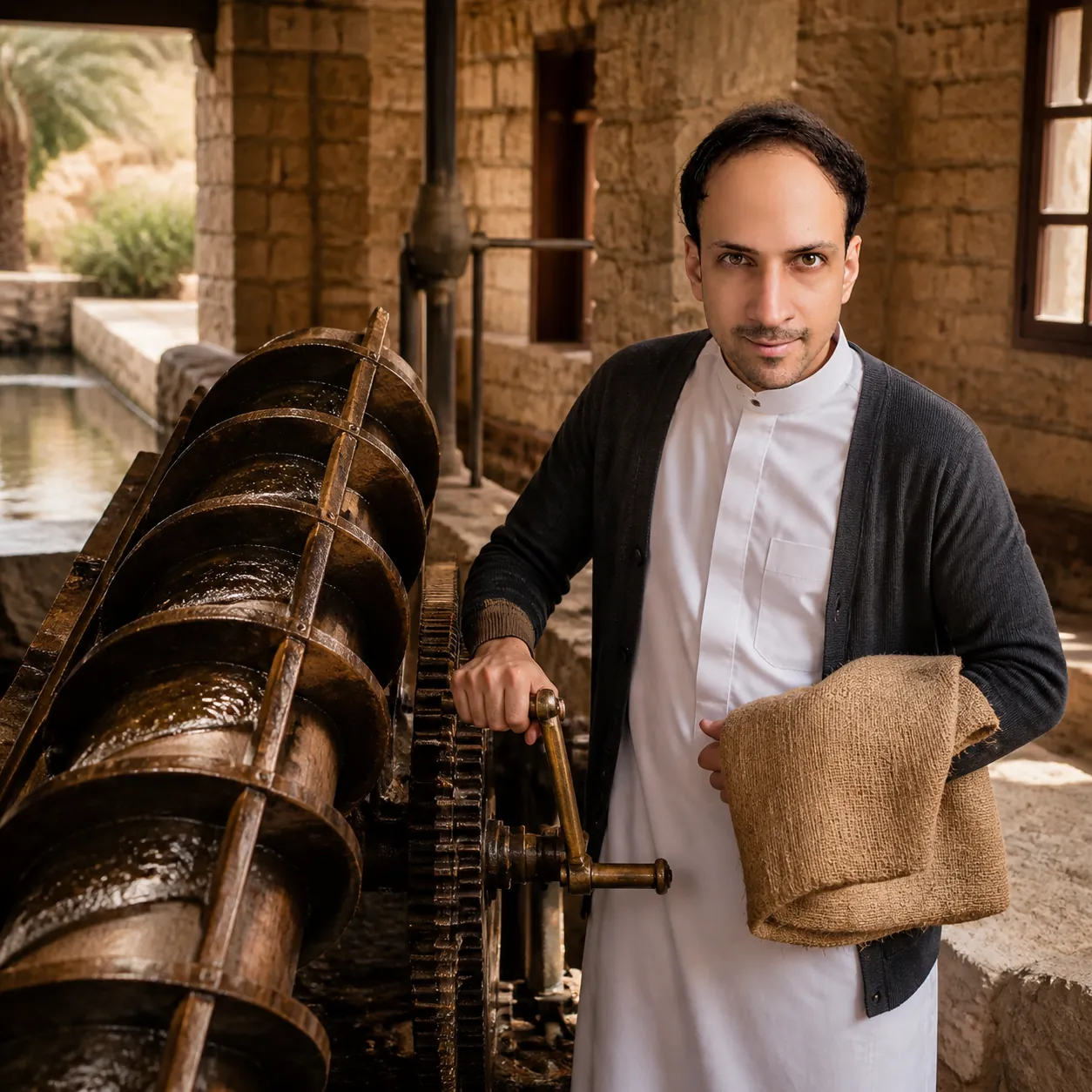
Progress You Hear: Restored Stone Gristmill — AI Portrait Prompt
صورةAI Portraits

Turn your own photo into a kinetic-mechanism portrait in a restored stone gristmill in Al-Ahsa beside its quiet channel. Keeps your face unchanged.

من نص البرومبت

Use the attached reference photo as the identity reference: keep the same face, skin tone, hair and features as the person in that photo, without beautifying, aging or altering them. Create a square 1:1 museum-catalog frame with a strong first read and a slower second read at exactly 2880x2880 pixels. Location: a restored stone gristmill in Al-Ahsa beside its quiet channel. Show the subject in a crisp white traditional Gulf outfit under an open charcoal cardigan, folding an empty jute sack squarely over one forearm. The impossible-looking event must obey this clear system: a wooden Archimedes screw that raises one resting pocket of water per unhurried crank turn, holding every pocket between turns turns effort already spent into motion the body can plainly feel. Explore why the pause before release can hold more power than release itself; direct expression and posture toward attentive calm, never melodrama or ad-like confidence. Use an 85mm portrait view with the machine's nearest moving part softly large in the foreground. Make the composition keep the next unmoved element sharpest, the frame's quiet promise. Render it as kinetic-mechanism portraiture built from real working machines, documentary patience, warm workshop materiality, and composition that honors cause before effect, using late-afternoon window light raking across moving parts with soft bounced fill and a palette of warm dust, deep umber, and one polished steel highlight. Photorealistic: this must read as a real photograph from a physical camera, never an illustration, painting, or 3D render. Resolve real surface detail: brass darkened in the recesses and bright where thumbs land, and lacquer crazed rather than perfect. Keep one identity-locked person, credible hands and fingers, natural fabric, and coherent scale, contact, reflections, shadows, airflow, deformation, and materials. Background people only when essential, always secondary and clearly different. Avoid slot-machine iconography, glowing progress bars, cascading gold coins, cartoon gear mandalas, and confetti-burst celebration effects. No text, labels, logos, signatures, watermarks, random symbols, plastic skin, excessive bloom, or glossy AI finish.
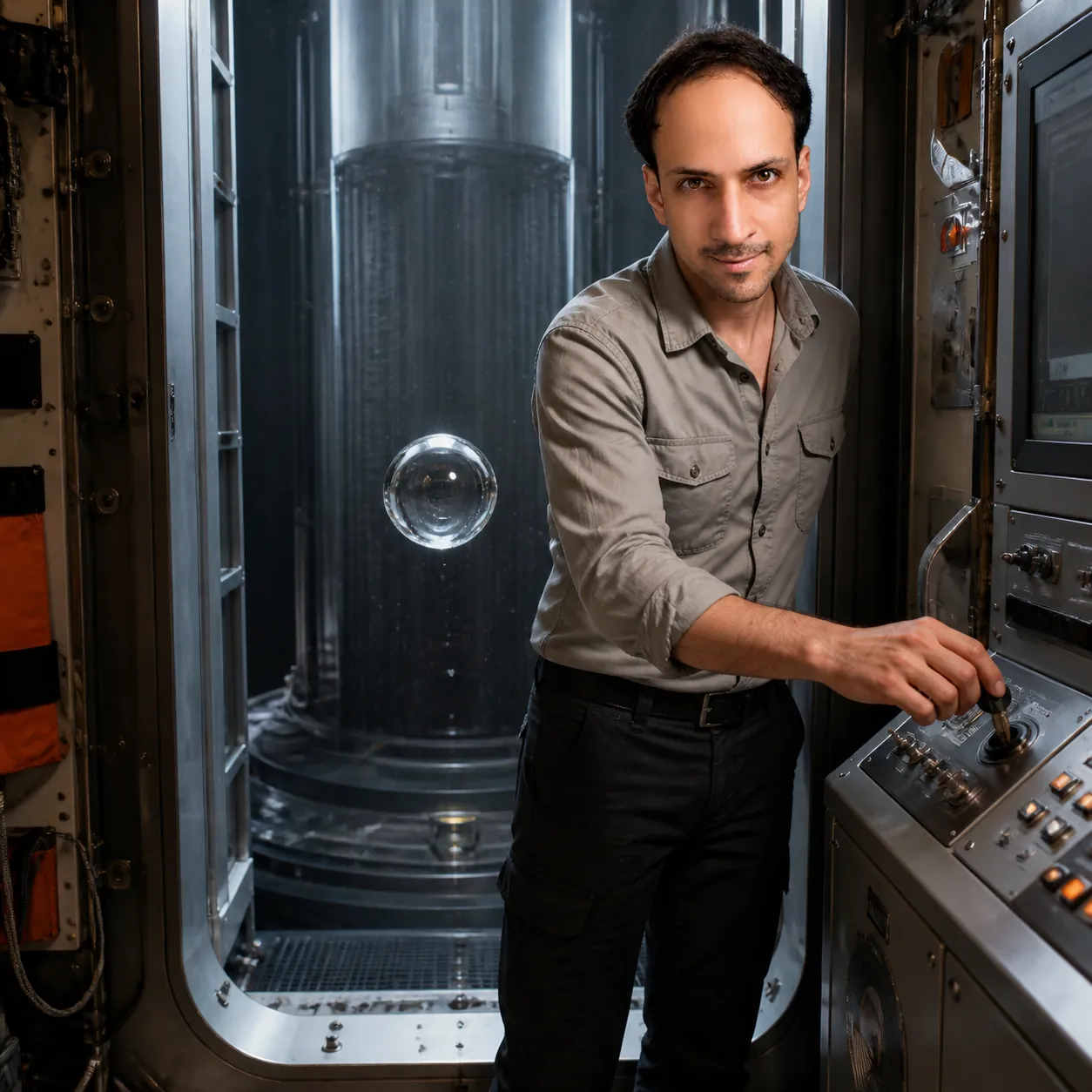
Lawful Float: Control Desk — AI Portrait Prompt
صورةAI Portraits

Turn your own photo into a portrait in the control desk of a research drop tower, countdown lamps unlit. Keeps your face unchanged.

من نص البرومبت

Use the attached reference photo as the identity reference: keep the same face, skin tone, hair and features as the person in that photo, without beautifying, aging or altering them. Create a square 1:1 museum-catalog frame with a strong first read and a slower second read at exactly 2880x2880 pixels. Location: the control desk of a research drop tower, countdown lamps unlit. Show the subject in a pressed sand-grey utility shirt over dark serviceable trousers, turning the release key one notch short of armed. Make one rigorous physical condition the conceptual engine: a fist of clear water that lets go of its container and gathers into one slow, wobbling sphere mid-capsule turns one honestly borrowed second into proof that weight is circumstance, not essence. Explore why a force is easiest to see in the moment it seems absent; direct expression and posture toward grave delight, never melodrama or ad-like confidence. Use an eye-level 55mm viewpoint with natural perspective, their planted stance sharing the frame with the floating demonstration. Make the composition stack one floating object directly above their planted feet. Render it as high-fidelity microgravity documentary portraiture built from real drop-tower physics, honest rigging detail, calm human presence, and precise mid-fall clarity, using cold shaft-light falling from far above, softened by dust in the air and a palette of gunmetal, foam white, and one signal-orange accent. Photorealistic: this must read as a real photograph from a physical camera, never an illustration, painting, or 3D render. Resolve real surface detail: true skin texture with pores and fine hair at the hairline, and fabric that creases where it is actually stressed. Keep one identity-locked person, credible hands and fingers, natural fabric, and coherent scale, contact, reflections, shadows, airflow, deformation, and materials. Background people only when essential, always secondary and clearly different. Avoid floating-hair astronaut poses, levitating people, swirling CGI water tentacles, and sci-fi antigravity glow. No text, labels, logos, signatures, watermarks, random symbols, plastic skin, excessive bloom, or glossy AI finish.
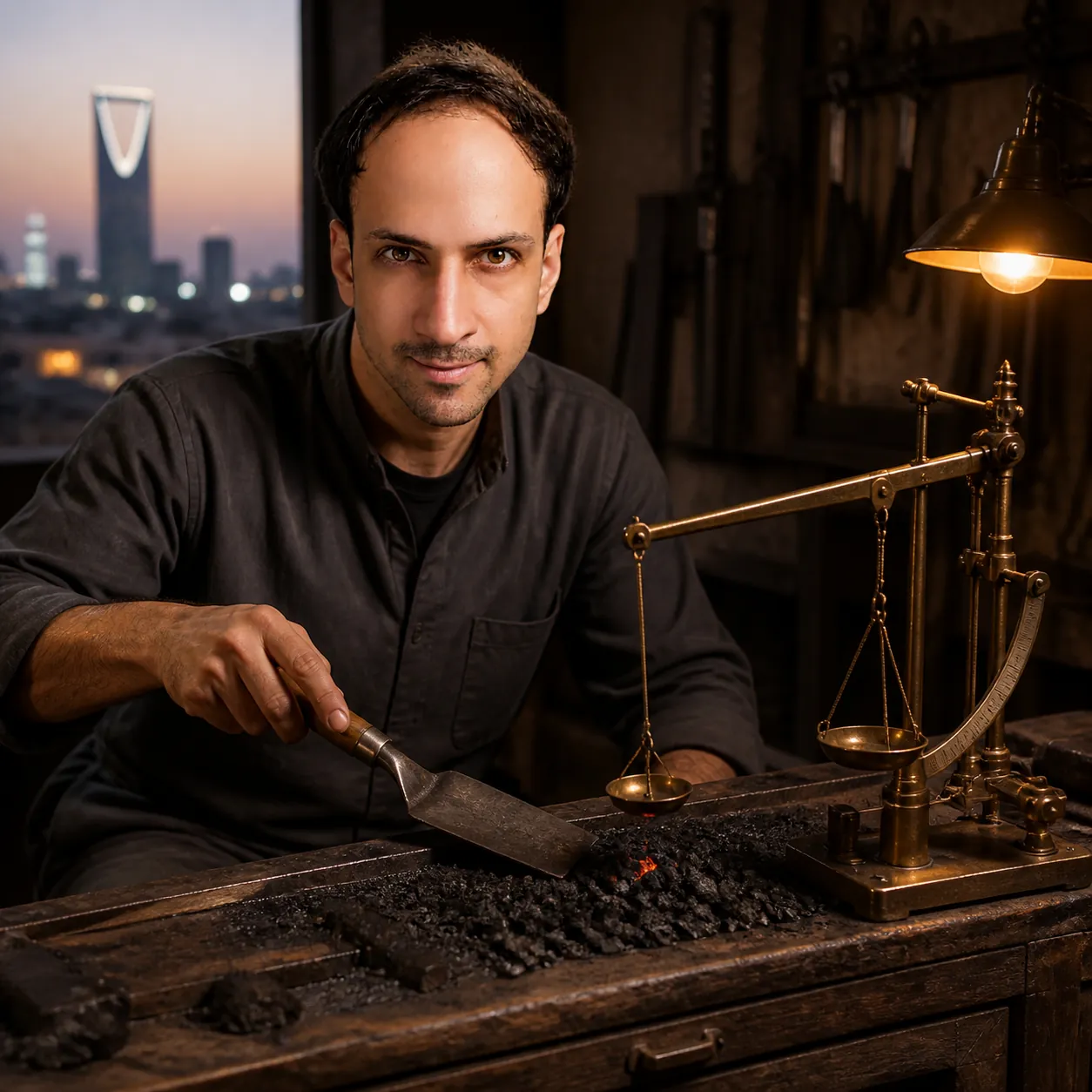
Kept Rhythm: Small Riyadh Smithy — AI Portrait Prompt
صورةAI Portraits

Turn your own photo into a workshop-instrument portrait in a small Riyadh smithy at dusk, its forge banked low and quiet. Keeps your face unchanged.

من نص البرومبت

Use the attached reference photo as the identity reference: keep the same face, skin tone, hair and features as the person in that photo, without beautifying, aging or altering them. Create a square 1:1 museum-catalog frame with a strong first read and a slower second read at exactly 2880x2880 pixels. Location: a small Riyadh smithy at dusk, its forge banked low and quiet. Show the subject in a heavy cotton smock in iron grey over dark work trousers, banking the coals level with a flat iron blade. The impossible-looking event must obey this clear system: a knife-edge beam balance so delicate that a single directed breath presses one pan down a legible degree turns the body's most invisible act into a mechanism the eye can audit. Explore how patience acquired at a bench travels home in the chest; direct expression and posture toward attentive ease, never melodrama or ad-like confidence. Use a 50mm view from just above the work surface so instrument and face share one honest space. Make the composition leave quiet air above the mechanism, as if the frame inhaled. Render it as workshop-instrument portraiture built from real pneumatic mechanisms, warm handcrafted materiality, patient documentary observation, and calibration marks rendered exactly legible, using one warm practical low beside the instrument answered by cool side ambient and a palette of warm oak, dull pewter, and muted bellows-leather tan. Photorealistic: this must read as a real photograph from a physical camera, never an illustration, painting, or 3D render. Resolve real surface detail: brass darkened in the recesses and bright where thumbs land, and lacquer crazed rather than perfect. Keep one identity-locked person, credible hands and fingers, natural fabric, and coherent scale, contact, reflections, shadows, airflow, deformation, and materials. Background people only when essential, always secondary and clearly different. Avoid glowing breath vapor, swirling CGI air streaks, meditation-pose serenity, and dust motes in god rays. No text, labels, logos, signatures, watermarks, random symbols, plastic skin, excessive bloom, or glossy AI finish.
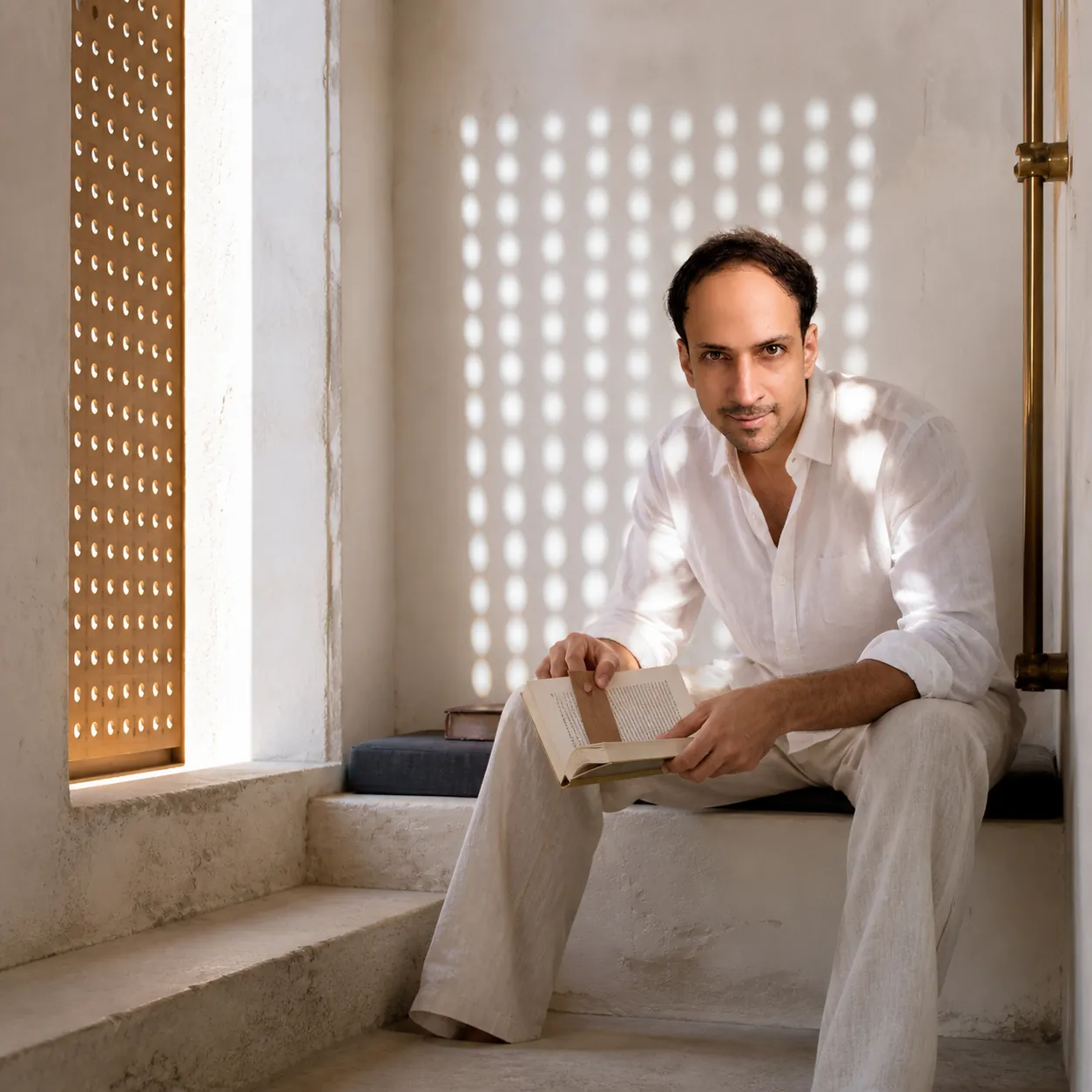
Architecture Prescribes: Whitewashed Reading Alcove — AI Portrait Prompt
صورةAI Portraits

Turn your own photo into a heliotherapy-room portrait in a whitewashed reading alcove reached by two steps beside a lightwell. Keeps your face unchanged.

من نص البرومبت

Use the attached reference photo as the identity reference: keep the same face, skin tone, hair and features as the person in that photo, without beautifying, aging or altering them. Create a square 1:1 museum-catalog frame with a strong first read and a slower second read at exactly 2880x2880 pixels. Location: a whitewashed reading alcove reached by two steps beside a lightwell. Show the subject in a relaxed white poplin shirt and stone linen trousers, marking their page with a flat cedar bookmark. Make one rigorous physical condition the conceptual engine: a cedar screen of hundreds of drilled holes that throws a lattice of identical round sun-images across one wall treats morning light as a nutrient with a dose, not a mood. Explore why geometry rather than tint is the honest way to meter a beam; direct expression and posture toward settled gratitude, never melodrama or ad-like confidence. Use an eye-level 80mm medium-format viewpoint that renders beam edges and skin texture equally truthfully. Make the composition keep the light's source small and its consequence large. Render it as heliotherapy-room realism combining truthful sun angles, museum-grade architectural photography, tactile limewash surfaces, and unforced human presence at treatment scale, using clean directional sunlight softened only by distance and one white ceiling bounce and a palette of chalk, unpolished brass, and deep shadow blue. Photorealistic: this must read as a real photograph from a physical camera, never an illustration, painting, or 3D render. Resolve real surface detail: fine grit in the texture of concrete, efflorescence at damp edges, and hairline cracks that follow stress. Keep one identity-locked person, credible hands and fingers, natural fabric, and coherent scale, contact, reflections, shadows, airflow, deformation, and materials. Background people only when essential, always secondary and clearly different. Avoid god-ray haze shafts, lens-flare starbursts, glowing dust volumetrics, stained-glass rainbows, and any halo behind their head. No text, labels, logos, signatures, watermarks, random symbols, plastic skin, excessive bloom, or glossy AI finish.

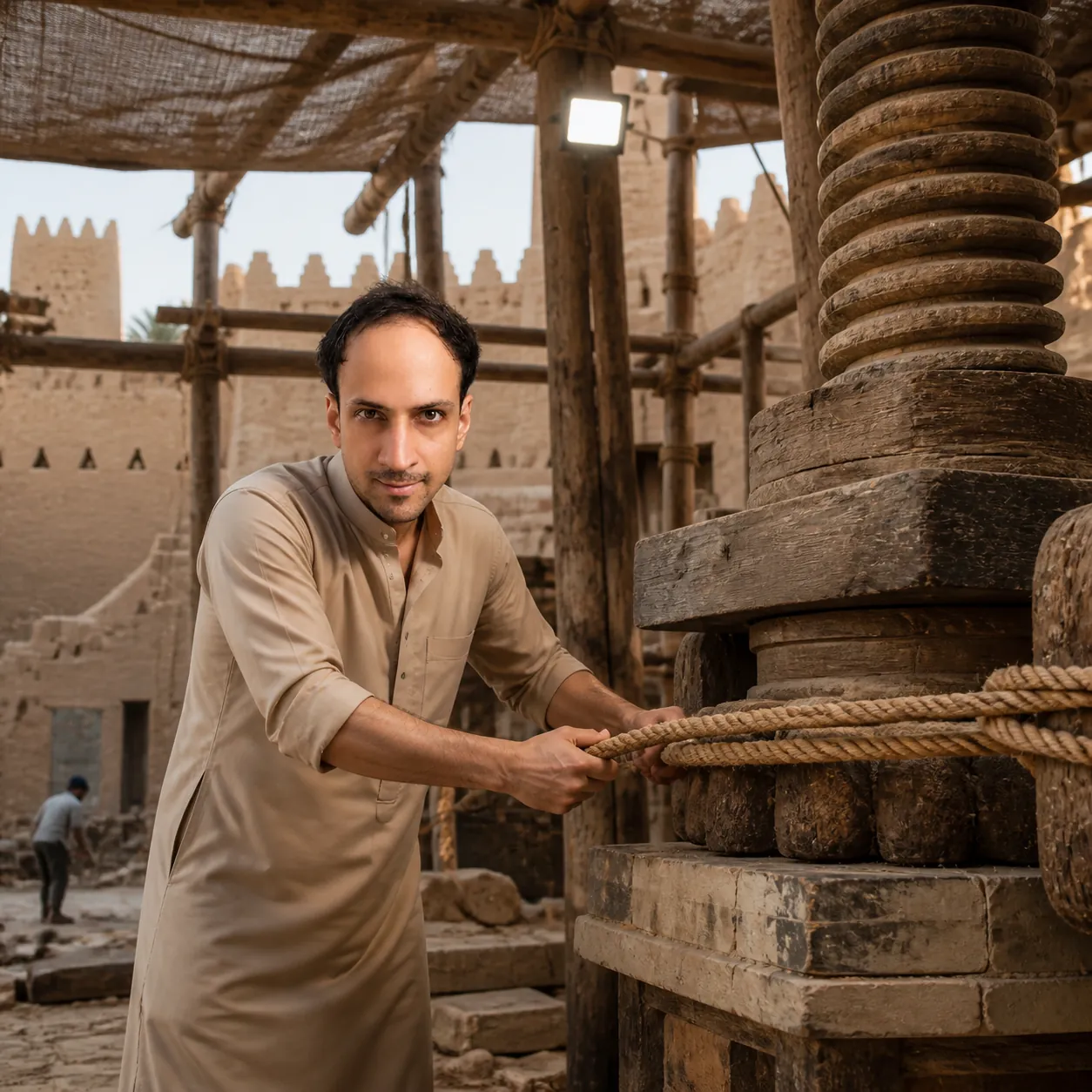
Slow Capital: Mud-Brick Restoration Terrace — AI Portrait Prompt
صورةAI Portraits

Turn your own photo into a portrait in a mud-brick restoration terrace in Diriyah, palm-trunk scaffolds in morning shade. Keeps your face unchanged.

من نص البرومبت

Use the attached reference photo as the identity reference: keep the same face, skin tone, hair and features as the person in that photo, without beautifying, aging or altering them. Create a square 1:1 museum-catalog frame with a strong first read and a slower second read at exactly 2880x2880 pixels. Location: a mud-brick restoration terrace in Diriyah, palm-trunk scaffolds in morning shade. Show the subject in a plain sand-toned traditional Gulf outfit with both sleeves folded back once, checking a scaffold lashing with one slow, deliberate pull. Treat this mechanism as the frame’s governing rule: a great timber screw press whose long bar, walked slowly through half a turn, sinks the platen with irresistible pressure turns a small, steady effort into the equal of crushing weight. Explore whether advantage borrowed from geometry must ever be paid back in strain; direct expression and posture toward grounded calm, never melodrama or ad-like confidence. Use a low 35mm view from beside the load so its true scale presses against the frame. Make the composition weigh the huge load against their small, calm effort. Render it as quiet working-rigging portraiture built from lawful mechanical advantage, heavy documentary realism, hand-worn rope-and-timber materiality, and patient large-format editorial composition, using one high work lamp shaded so the load sits in sculptural half-light and a palette of sandstone buff, rope-shadow grey, and a single indigo accent. Photorealistic: this must read as a real photograph from a physical camera, never an illustration, painting, or 3D render. Resolve real surface detail: grout darker than tile, sealant slightly yellowed, and every joint showing a real tolerance gap. Keep one identity-locked person, credible hands and fingers, natural fabric, and coherent scale, contact, reflections, shadows, airflow, deformation, and materials. Background people only when essential, always secondary and clearly different. Avoid gym equipment, heroic strongman poses, bulging-vein close-ups, snapped-rope drama, and impossibly floating boulders. No text, labels, logos, signatures, watermarks, random symbols, plastic skin, excessive bloom, or glossy AI finish.
