تخطَّ إلى المحتوى
جميع التصنيفات

AI Portraits

Portrait prompts you can use with your own photo.

3845 برومبتات•0 مشتركين
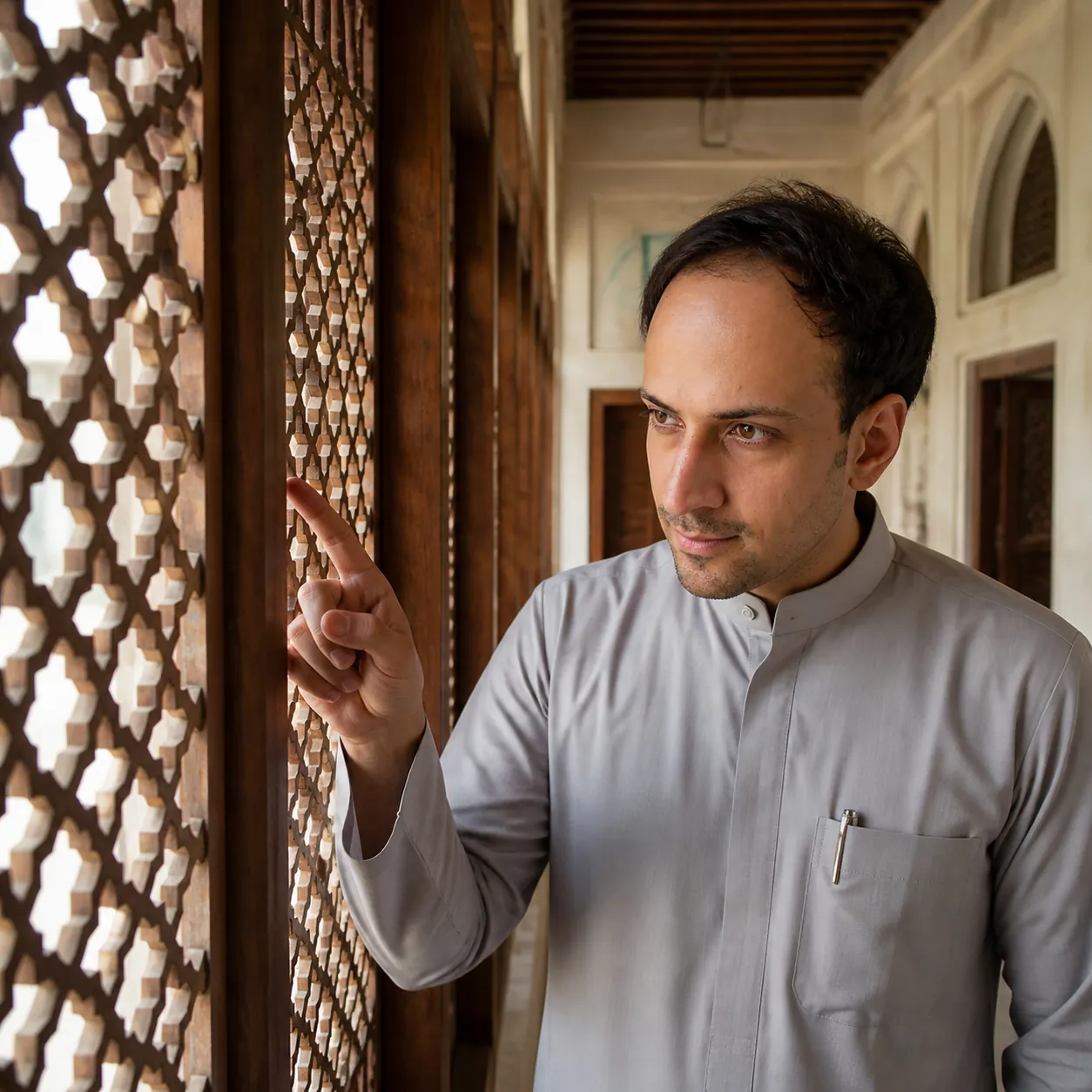
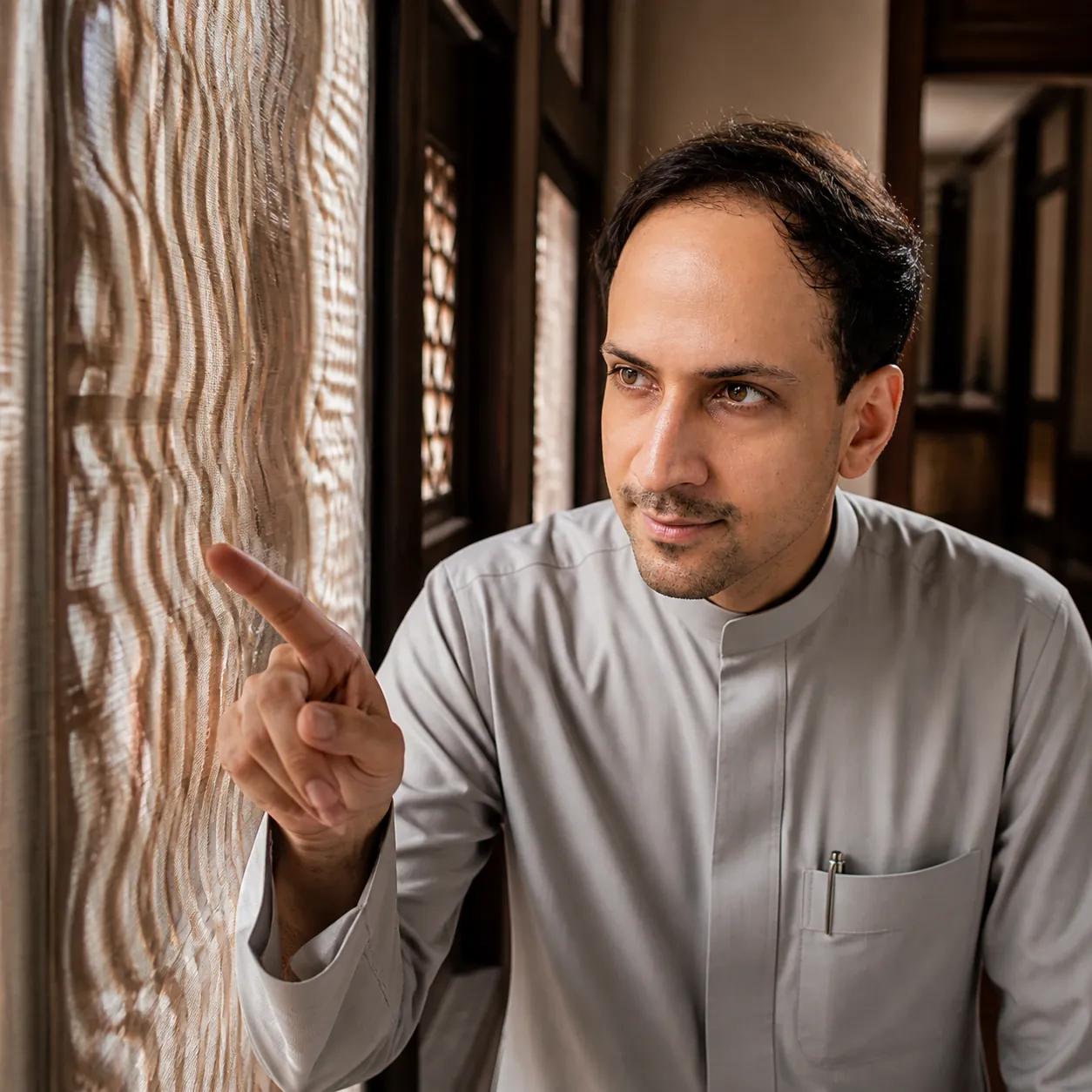
Lawful Shimmer: Restored Heritage House Hallway — AI Portrait Prompt
صورةAI Portraits

Turn your own photo into a portrait in a restored heritage house hallway with latticed windows along one side. Keeps your face unchanged.

من نص البرومبت

Use the attached reference photo as the identity reference: keep the same face, skin tone, hair and features as the person in that photo, without beautifying, aging or altering them. Treat that reference as the character anchor and change only the scene. Create a square 1:1 museum-catalog frame with a strong first read and a slower second read at exactly 2880x2880 pixels. Location: a restored heritage house hallway with latticed windows along one side. Show the subject in a plain pale-grey traditional Gulf outfit with one pen in the chest pocket, tracing one lattice opening lightly with an index finger. Use this advanced image-making device as the core logic: a nested pair of fine flour sieves that answers a slight relative turn with bold curved fringes swirling across both meshes summons a third pattern that belongs to neither layer alone. Explore whether the third pattern is discovered or invented at the moment of overlap; direct expression and posture toward held fascination, never melodrama or ad-like confidence. Use a restrained 35mm view with verticals kept true, the subject at one-third and the patterned field beyond. Make the composition crop one giant fringe mid-sweep so its scale stays unproven. Render it as high-concept interference portraiture built from genuinely overlapping physical patterns, large-format documentary clarity, hand-made material honesty, and patient architectural observation, using even mid-morning shade with just enough directionality to model their face and a palette of warm cedar, deep shadow, and one seam of saffron. Photorealistic: this must read as a real photograph from a physical camera, never an illustration, painting, or 3D render. Resolve real surface detail: wood grain read at honest scale, matte and gloss clearly separated, and no surface uniformly clean. Keep one identity-locked person, credible hands and fingers, natural fabric, and coherent scale, contact, reflections, shadows, airflow, deformation, and materials. Background people only when essential, always secondary and clearly different. Avoid op-art poster graphics, hypnotic spiral overlays, digital glitch scanlines, television static, and patterns projected across their face. No text, labels, logos, signatures, watermarks, random symbols, plastic skin, excessive bloom, or glossy AI finish.
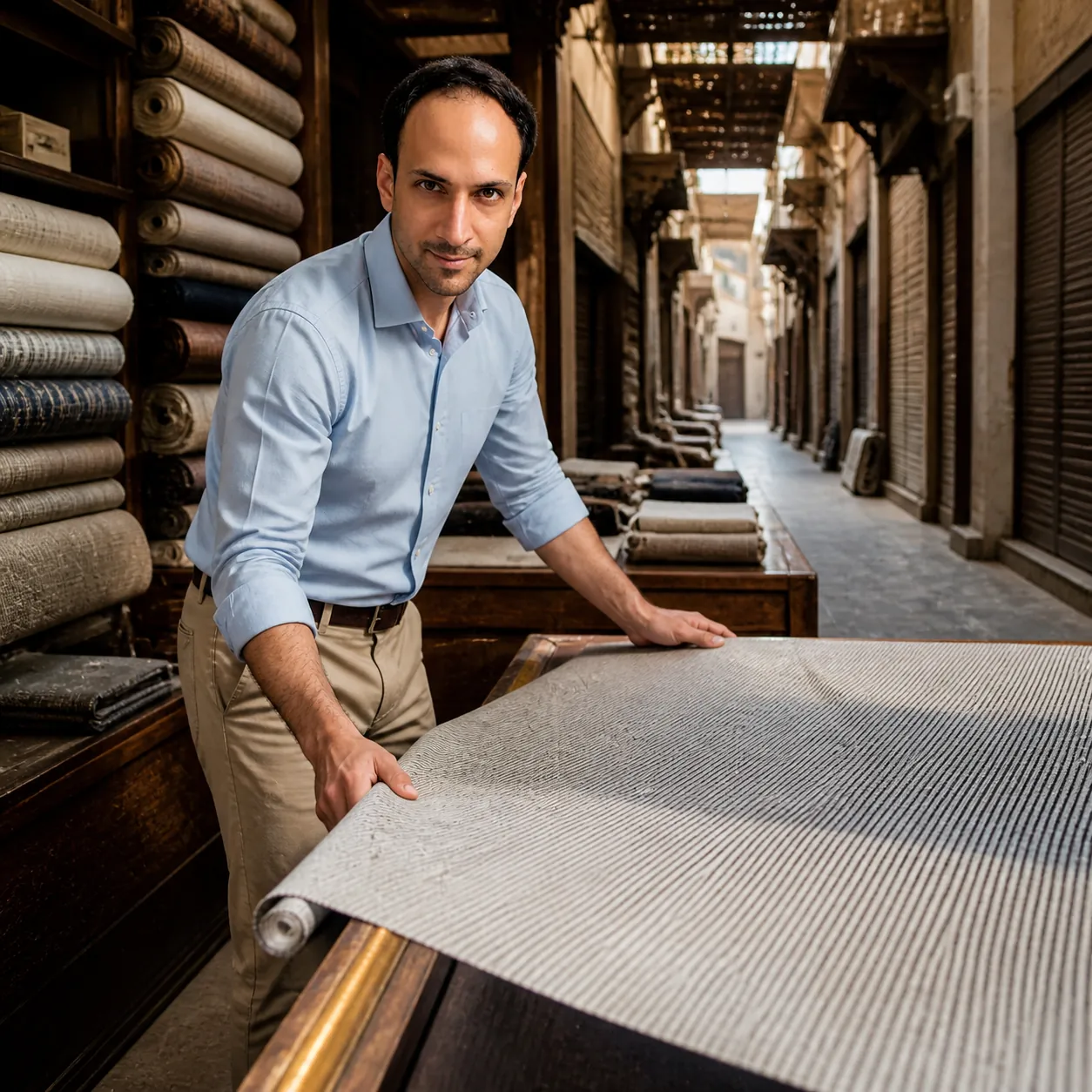
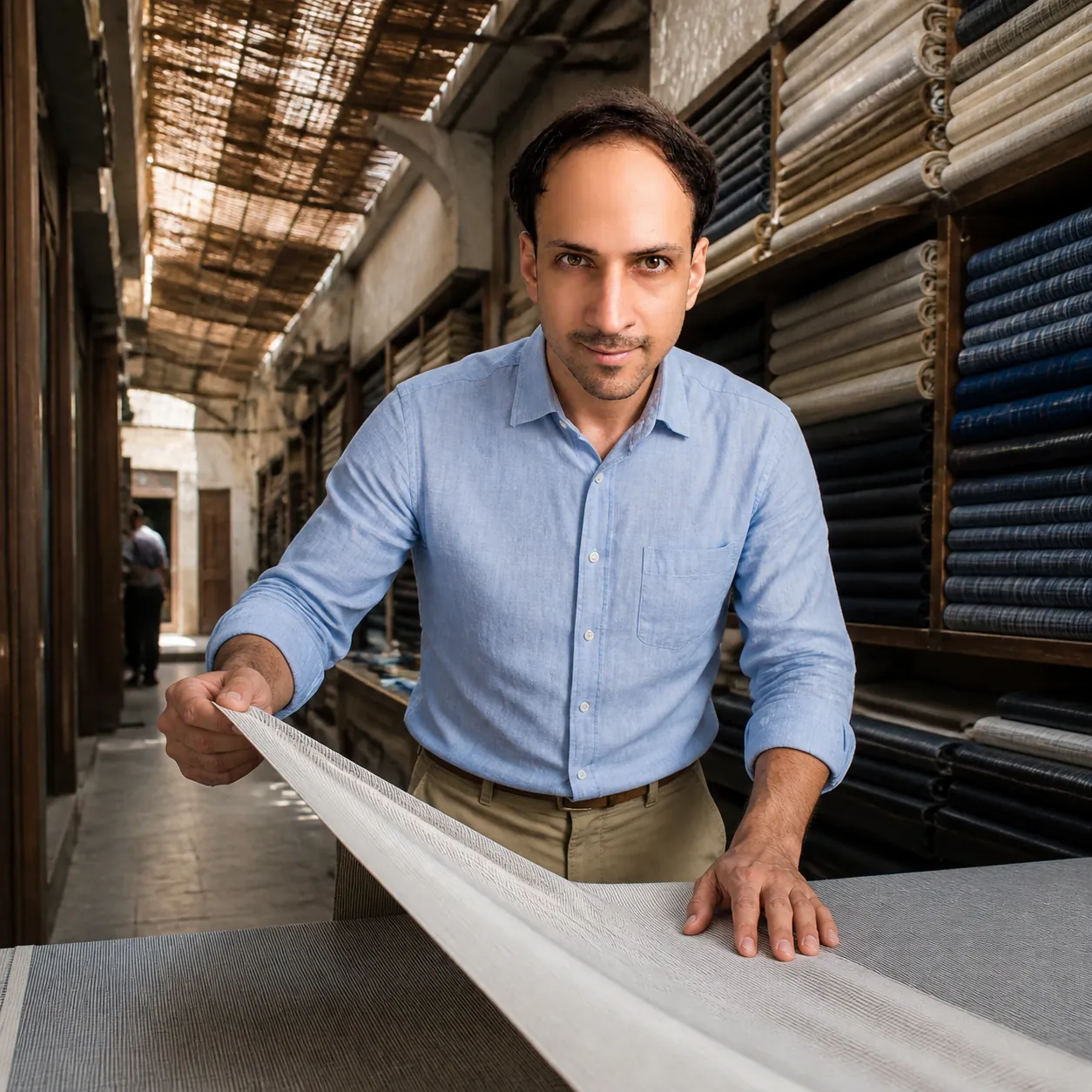
Woven Interference: Covered Textile Souq Aisle — AI Portrait Prompt
صورةAI Portraits

Turn your own photo into a portrait in a covered textile souq aisle before opening, bolts shelved high. Keeps your face unchanged.

من نص البرومبت

Use the attached reference photo as the identity reference: keep the same face, skin tone, hair and features as the person in that photo, without beautifying, aging or altering them. Treat that reference as the character anchor and change only the scene. Create a square 1:1 museum-catalog frame with a strong first read and a slower second read at exactly 2880x2880 pixels. Location: a covered textile souq aisle before opening, bolts shelved high. Show the subject in a light-blue casual shirt tucked into pressed sand chinos, unrolling a forearm's length of cloth across the counter. Use this advanced image-making device as the core logic: a corridor of two woven wire fences one stride apart, through which giant slow bands roll at any shift of viewpoint gives stillness a pulse the camera can record without any trick. Explore whether motion the eye reports but the world denies still counts as real; direct expression and posture toward still absorption, never melodrama or ad-like confidence. Use a restrained 35mm view with verticals kept true, the subject at one-third and the patterned field beyond. Make the composition give the emergent pattern more visual weight than either honest layer. Render it as museum-grade optical demonstration realism combining true moiré geometry, tactile weave detail, faithful shadow behavior, and calm editorial framing, using cool ambient daylight lifted by one warm bounce off nearby wood and a palette of bone linen, graphite line-work, and a low brass accent. Photorealistic: this must read as a real photograph from a physical camera, never an illustration, painting, or 3D render. Resolve real surface detail: thread ends and slight pilling on worn cloth, hairline chips at every hard corner, and stone that is porous rather than smooth. Keep one identity-locked person, credible hands and fingers, natural fabric, and coherent scale, contact, reflections, shadows, airflow, deformation, and materials. Background people only when essential, always secondary and clearly different. Avoid kaleidoscope symmetry, fake motion blur, rainbow chromatic fringing, and funhouse distortion of their features. No text, labels, logos, signatures, watermarks, random symbols, plastic skin, excessive bloom, or glossy AI finish.
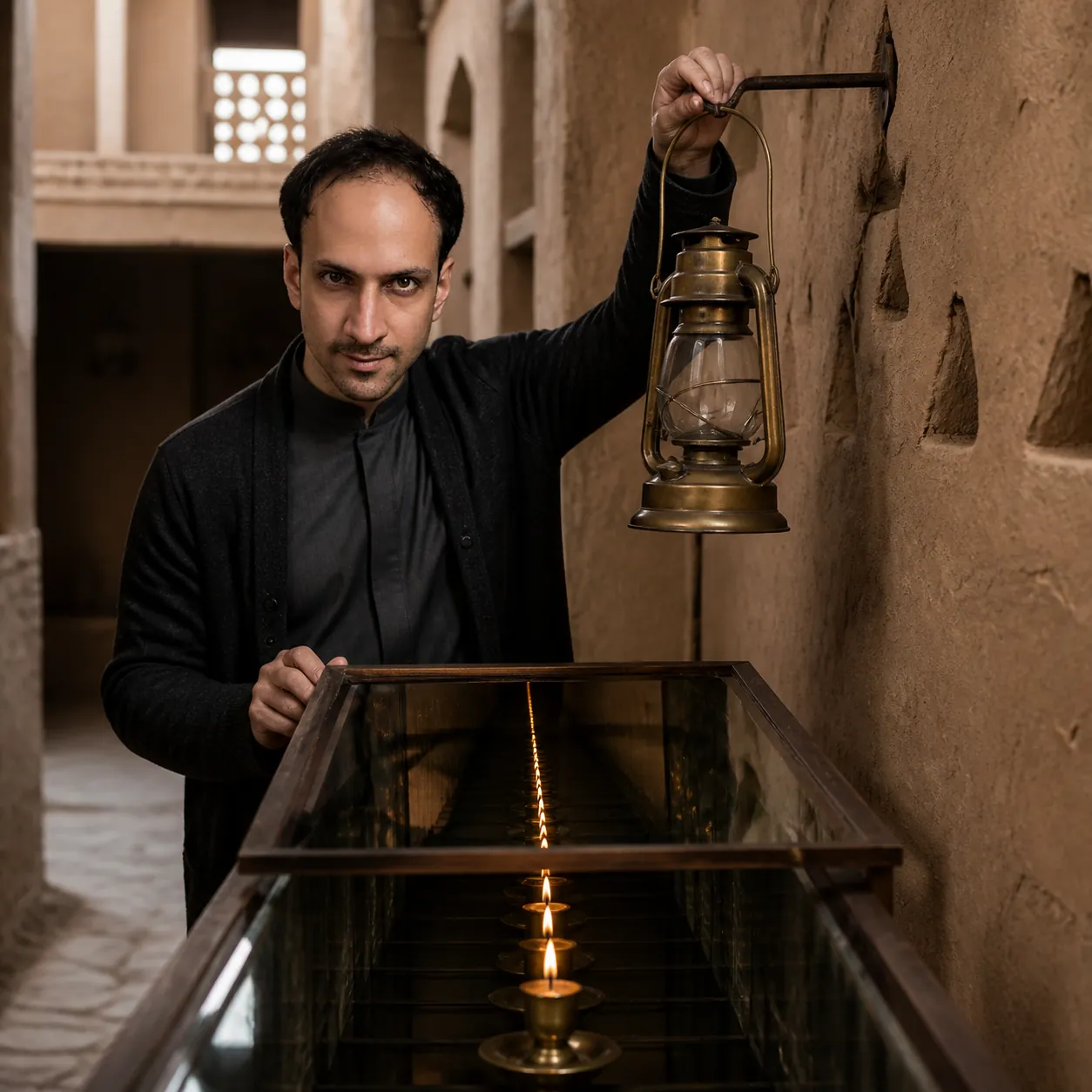
Honest Infinity: Restored Mud-Brick Passage — AI Portrait Prompt
صورةAI Portraits

Turn your own photo into a high-concept optical portrait in a restored mud-brick passage in old Diriyah, lanterns not yet lit. Keeps your face unchanged.

من نص البرومبت

Use the attached reference photo as the identity reference: keep the same face, skin tone, hair and features as the person in that photo, without beautifying, aging or altering them. Create a square 1:1 museum-catalog frame with a strong first read and a slower second read at exactly 2880x2880 pixels. Location: a restored mud-brick passage in old Diriyah, lanterns not yet lit. Show them in a winter-weight slate traditional Gulf outfit layered with a plain dark cardigan, lifting an unlit brass lantern down from its wall hook. Make one rigorous physical condition the conceptual engine: a narrow well of two horizontal mirrors, floor and lid, that repeats one candle flame into a colonnade sinking through the table turns one modest original into abundant company the eye can truly count. Explore why an honest repetition can astonish more than any invented spectacle; direct expression and posture toward level wonder, never melodrama or ad-like confidence. Use an eye-level 55mm medium-format viewpoint with natural perspective and quiet, honest depth of field. Make the composition let the recession deepen away from them, never toward their face. Render it as high-concept optical portraiture built from truthful mirror geometry, accurate reflection falloff, museum-demonstration staging, and calm documentary realism around one unrepeated person, using one small warm practical as key with deep protected shadow around it and a palette of deep black, aged silver, and one candleflame amber. Photorealistic: this must read as a real photograph from a physical camera, never an illustration, painting, or 3D render. Resolve real surface detail: true skin texture with pores and fine hair at the hairline, and fabric that creases where it is actually stressed. Keep one identity-locked person, credible hands and fingers, natural fabric, and coherent scale, contact, reflections, shadows, airflow, deformation, and materials. Background people only when essential, always secondary and clearly different. Avoid duplicated faces, funhouse warps, endless-clone selfies, glowing portal tunnels, and CGI mirror shards. No text, labels, logos, signatures, watermarks, random symbols, plastic skin, excessive bloom, or glossy AI finish.
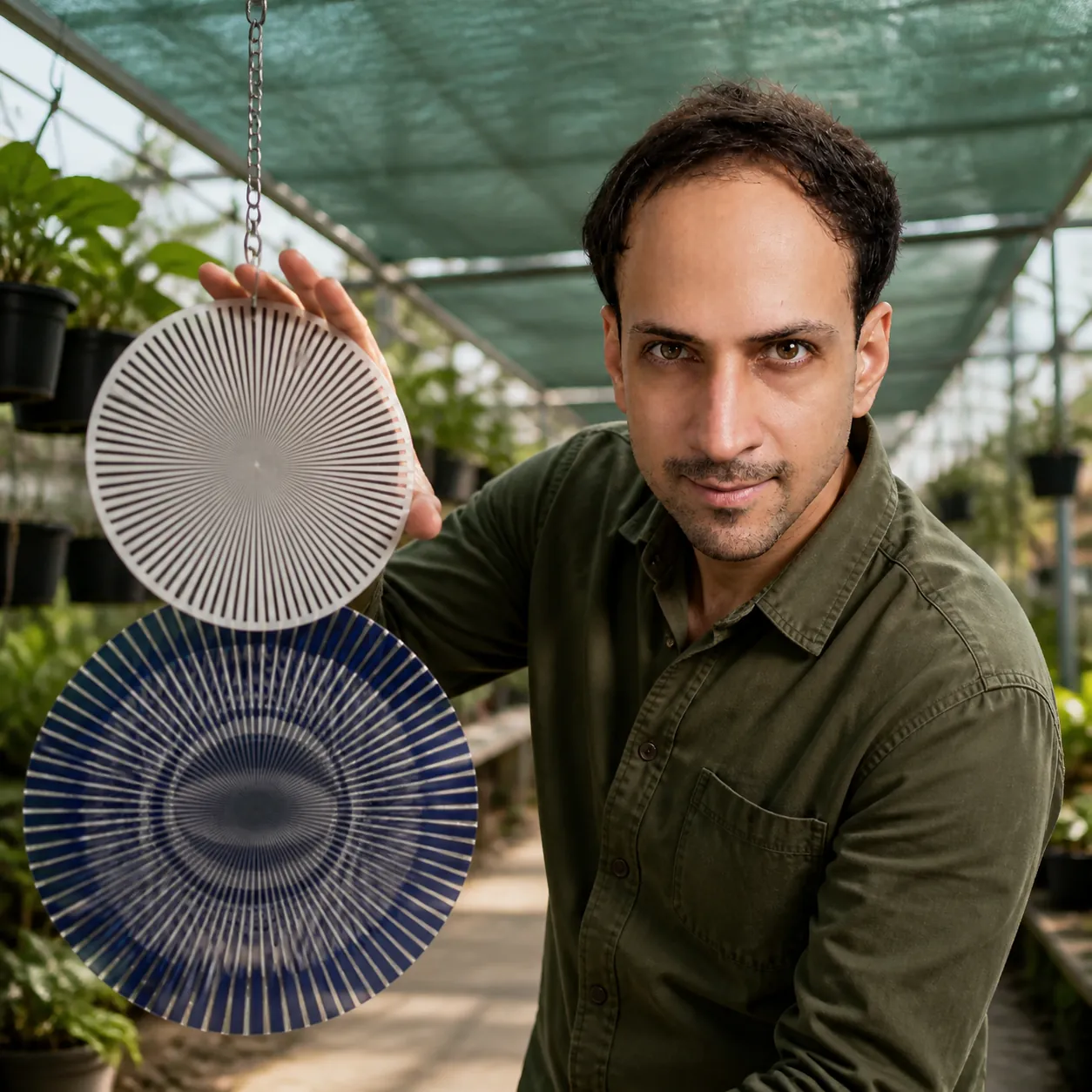
Almost Identical: Plant Nursery Aisle — AI Portrait Prompt
صورةAI Portraits

Turn your own photo into a portrait in a plant nursery aisle under doubled green shade netting at midmorning. Keeps your face unchanged.

من نص البرومبت

Use the attached reference photo as the identity reference: keep the same face, skin tone, hair and features as the person in that photo, without beautifying, aging or altering them. Treat that reference as the character anchor and change only the scene. Create a square 1:1 museum-catalog frame with a strong first read and a slower second read at exactly 2880x2880 pixels. Location: a plant nursery aisle under doubled green shade netting at midmorning. Show the subject in an olive utility overshirt with both cuffs buttoned closed, stilling a hanging pot's slow spin with one raised palm. Make one rigorous physical condition the conceptual engine: a face-to-face pair of radially ruled discs, whose fringe spokes wheel through many degrees for each single degree of the top disc summons a third pattern that belongs to neither layer alone. Explore why amplification built from spacing alone feels more trustworthy than machinery; direct expression and posture toward measured astonishment, never melodrama or ad-like confidence. Use an eye-level 85mm portrait view stopped down so both pattern layers stay equally sharp. Make the composition place their eyes in the one calm zone the fringes spare. Render it as museum-grade optical demonstration realism combining true moiré geometry, tactile weave detail, faithful shadow behavior, and calm editorial framing, using even mid-morning shade with just enough directionality to model their face and a palette of washed white, cool steel mesh, and one indigo band. Photorealistic: this must read as a real photograph from a physical camera, never an illustration, painting, or 3D render. Resolve real surface detail: fine grit in the texture of concrete, efflorescence at damp edges, and hairline cracks that follow stress. Keep one identity-locked person, credible hands and fingers, natural fabric, and coherent scale, contact, reflections, shadows, airflow, deformation, and materials. Background people only when essential, always secondary and clearly different. Avoid op-art poster graphics, hypnotic spiral overlays, digital glitch scanlines, television static, and patterns projected across their face. No text, labels, logos, signatures, watermarks, random symbols, plastic skin, excessive bloom, or glossy AI finish.
Slow Giant Bands: Covered Textile Souq Aisle — AI Portrait Prompt
صورةAI Portraits

Turn your own photo into a high-concept interference portrait in a covered textile souq aisle before opening, bolts shelved high. Keeps your face unchanged.

من نص البرومبت

Use the attached reference photo as the identity reference: keep the same face, skin tone, hair and features as the person in that photo, without beautifying, aging or altering them. Treat that reference as the character anchor and change only the scene. Create a square 1:1 museum-catalog frame with a strong first read and a slower second read at exactly 2880x2880 pixels. Location: a covered textile souq aisle before opening, bolts shelved high. Show the subject in a light-blue casual shirt tucked into pressed sand chinos, unrolling a forearm's length of cloth across the counter. Treat this mechanism as the frame’s governing rule: a clamped pair of perforated steel sheets whose hole pitches differ by a hairsbreadth, blooming into one cloudy pattern of beats summons a third pattern that belongs to neither layer alone. Explore what stillness is worth once it learns to carry a visible rhythm; direct expression and posture toward attentive calm, never melodrama or ad-like confidence. Frame from low tripod height so the layered patterns rise behind their shoulders without crowding the face. Make the composition run the interference bands diagonally while every real edge stays level. Render it as high-concept interference portraiture built from genuinely overlapping physical patterns, large-format documentary clarity, hand-made material honesty, and patient architectural observation, using one broad diffused window source held oblique so fine patterns stay resolvable and a palette of washed white, cool steel mesh, and one indigo band. Photorealistic: this must read as a real photograph from a physical camera, never an illustration, painting, or 3D render. Resolve real surface detail: grout darker than tile, sealant slightly yellowed, and every joint showing a real tolerance gap. Keep one identity-locked person, credible hands and fingers, natural fabric, and coherent scale, contact, reflections, shadows, airflow, deformation, and materials. Background people only when essential, always secondary and clearly different. Avoid op-art poster graphics, hypnotic spiral overlays, digital glitch scanlines, television static, and patterns projected across their face. No text, labels, logos, signatures, watermarks, random symbols, plastic skin, excessive bloom, or glossy AI finish.
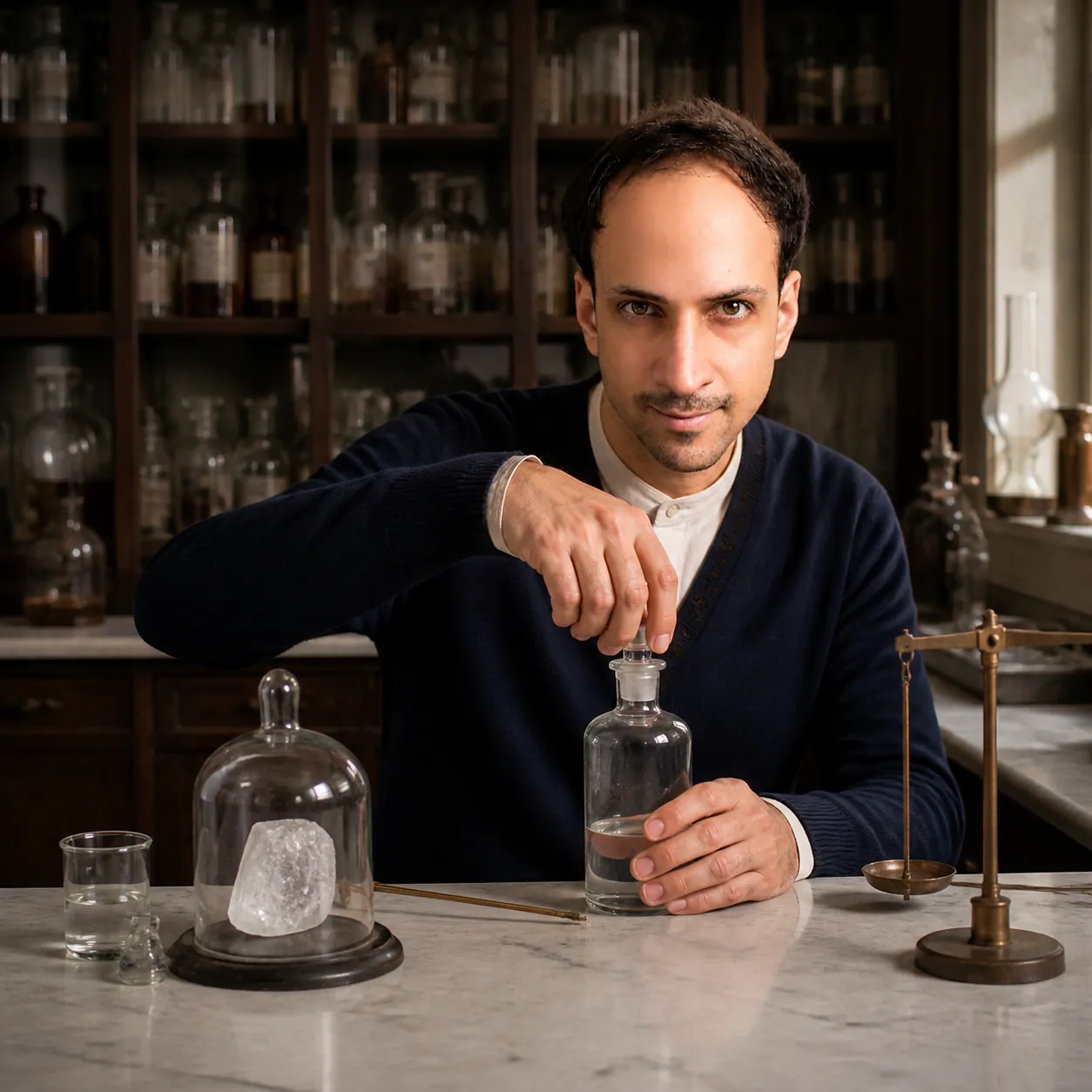
Geometry Unasked: Back Compounding Room — AI Portrait Prompt
صورةAI Portraits

Turn your own photo into a high-concept chemistry portrait in the back compounding room of an old pharmacy, marble counter cleared. Keeps your face unchanged.

من نص البرومبت

Use the attached reference photo as the identity reference: keep the same face, skin tone, hair and features as the person in that photo, without beautifying, aging or altering them. Treat that reference as the character anchor and change only the scene. Create a square 1:1 museum-catalog frame with a strong first read and a slower second read at exactly 2880x2880 pixels. Location: the back compounding room of an old pharmacy, marble counter cleared. Show the subject in a fine navy cardigan buttoned over a white band-collar shirt, twisting a glass stopper into a reagent bottle's neck. Make one rigorous physical condition the conceptual engine: a single alum crystal grown from a pinhead seed into a faceted block whose faces lie flat as instrument glass turns a liquid's dissolved cargo into architecture a hand could rest on. Explore how one law repeated without exception becomes something the eye calls beauty; direct expression and posture toward sober delight, never melodrama or ad-like confidence. Use an eye-level 50mm view with honest perspective and gentle depth of field. Make the composition keep their hands nearer the lens than the astonishment they tend. Render it as high-concept chemistry portraiture built from real supersaturation phenomena, true laboratory-glass materiality, restrained documentary honesty, and quietly monumental still-life composition, using late golden side-light warming the whites while the room stays neutral and a palette of raw cotton, dim pewter, and clear sugar amber. Photorealistic: this must read as a real photograph from a physical camera, never an illustration, painting, or 3D render. Resolve real surface detail: the difference between a wiped surface and a clean one, faint tide marks on ceramic, and metal dulled unevenly by touch. Keep one identity-locked person, credible hands and fingers, natural fabric, and coherent scale, contact, reflections, shadows, airflow, deformation, and materials. Background people only when essential, always secondary and clearly different. Avoid glowing magic crystals, amethyst geode caves, gemstone treasure piles, frosted window fakery, and CGI diamond shards. No text, labels, logos, signatures, watermarks, random symbols, plastic skin, excessive bloom, or glossy AI finish.
Layered Beat: Restored Heritage House Hallway — AI Portrait Prompt
صورةAI Portraits

Turn your own photo into a portrait in a restored heritage house hallway with latticed windows along one side. Keeps your face unchanged.

من نص البرومبت

Use the attached reference photo as the identity reference: keep the same face, skin tone, hair and features as the person in that photo, without beautifying, aging or altering them. Treat that reference as the character anchor and change only the scene. Create a square 1:1 museum-catalog frame with a strong first read and a slower second read at exactly 2880x2880 pixels. Location: a restored heritage house hallway with latticed windows along one side. Show the subject in a plain pale-grey traditional Gulf outfit with one pen in the chest pocket, tracing one lattice opening lightly with an index finger. The impossible-looking event must obey this clear system: a double layer of sheer silk stretched on one frame, whose riding weaves break into watered bands that gave moiré its name gives stillness a pulse the camera can record without any trick. Explore what it means that the boldest pattern present was authored by neither maker; direct expression and posture toward patient scrutiny, never melodrama or ad-like confidence. Use a 50mm standpoint set exactly where the bands read strongest, with their face just off that axis. Make the composition keep both source patterns readable at the edges as quiet evidence. Render it as museum-grade optical demonstration realism combining true moiré geometry, tactile weave detail, faithful shadow behavior, and calm editorial framing, using one broad diffused window source held oblique so fine patterns stay resolvable and a palette of soft sand, ink-lined shadow, and one quiet teal thread. Photorealistic: this must read as a real photograph from a physical camera, never an illustration, painting, or 3D render. Resolve real surface detail: condensation beading at true size, liquid meniscus curving against glass, and wet surfaces darker than dry ones. Keep one identity-locked person, credible hands and fingers, natural fabric, and coherent scale, contact, reflections, shadows, airflow, deformation, and materials. Background people only when essential, always secondary and clearly different. Avoid kaleidoscope symmetry, fake motion blur, rainbow chromatic fringing, and funhouse distortion of their features. No text, labels, logos, signatures, watermarks, random symbols, plastic skin, excessive bloom, or glossy AI finish.
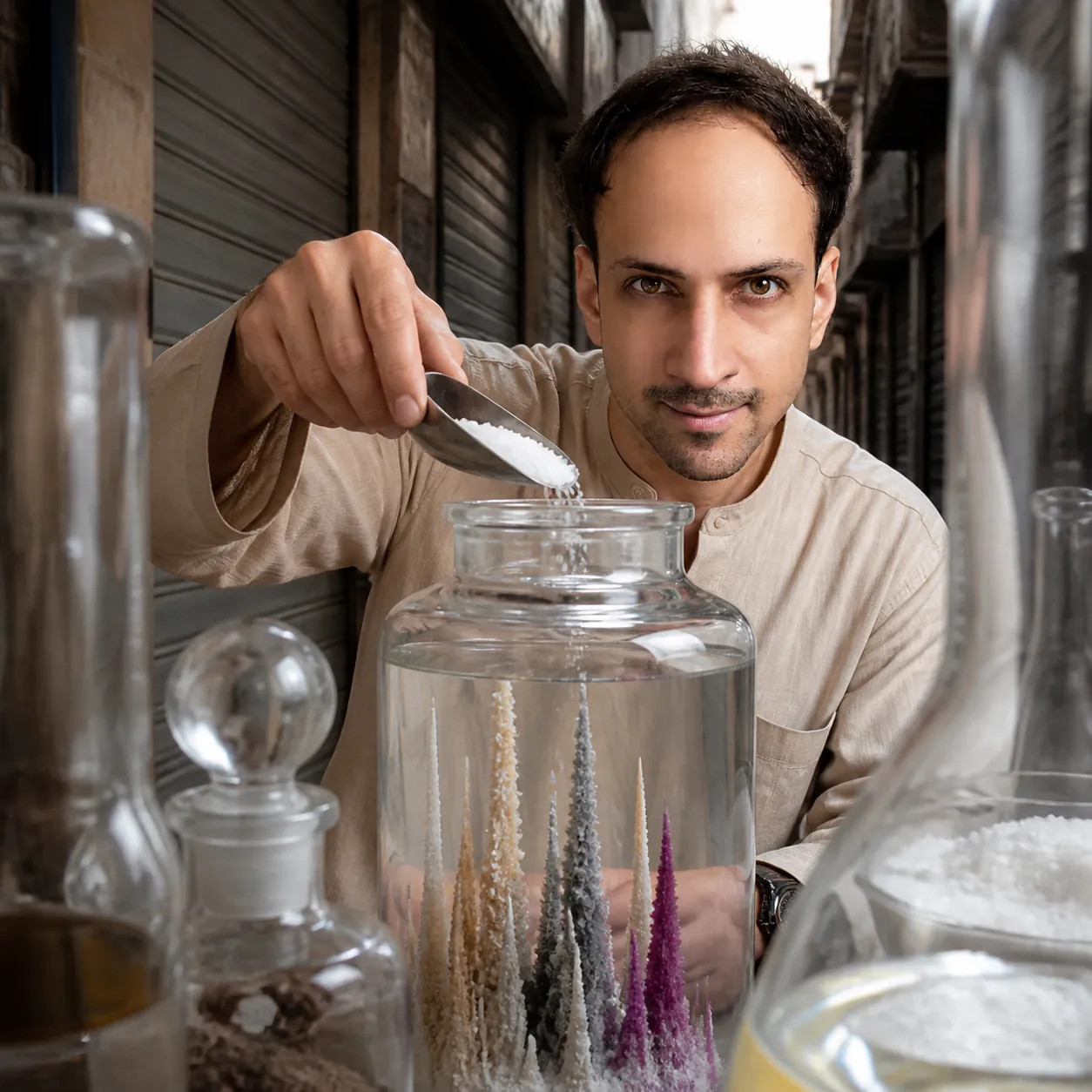
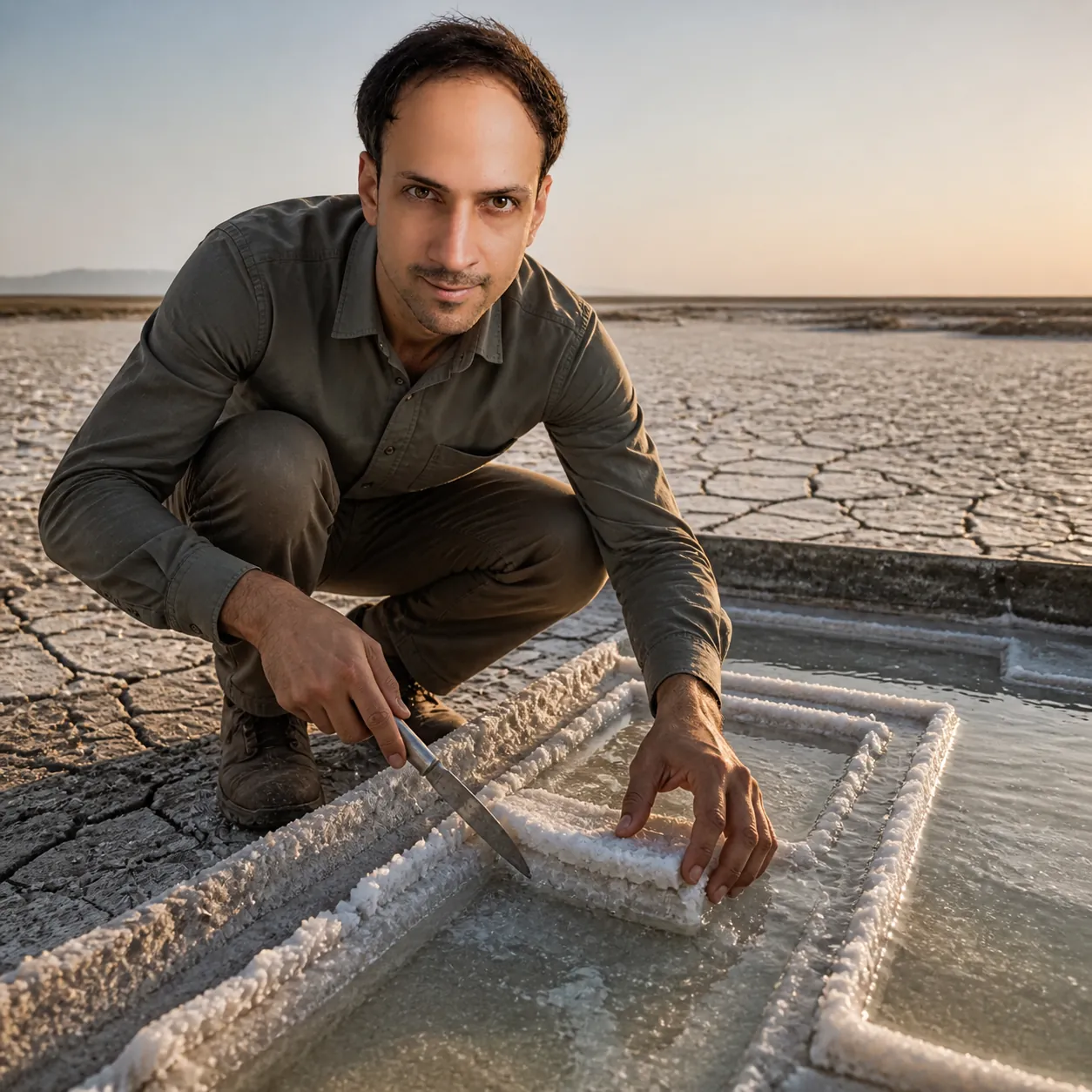
Seed and Verdict: Cracked White Edge — AI Portrait Prompt
صورةAI Portraits

Turn your own photo into a museum-demonstration portrait in the cracked white edge of a sabkha salt flat at low sun. Keeps your face unchanged.

من نص البرومبت

Use the attached reference photo as the identity reference: keep the same face, skin tone, hair and features as the person in that photo, without beautifying, aging or altering them. Treat that reference as the character anchor and change only the scene. Create a square 1:1 museum-catalog frame with a strong first read and a slower second read at exactly 2880x2880 pixels. Location: the cracked white edge of a sabkha salt flat at low sun. Show the subject in a dust-toned field shirt with sleeves buttoned at the wrist, crouching to free one salt plate with a flat knife. Build the artwork around this material rule: an open evaporation tray where drying brine has built stepped, hollow square terraces of salt that no hand ever arranged produces confident geometry in a place where nobody asked for any. Explore where the boundary runs between a substance dissolving and a substance deciding; direct expression and posture toward measured reverence, never melodrama or ad-like confidence. Use a measured 32mm wide view from respectful distance with all verticals kept straight. Make the composition keep their hands nearer the lens than the astonishment they tend. Render it as museum-demonstration realism combining faithful crystal optics, accurate refraction and caustics, patient editorial portrait craft, and unstyled working-room authenticity, using dim room light with one focused beam grazing the solution's surface and a palette of eggshell white, cool zinc grey, and one moss-green accent. Photorealistic: this must read as a real photograph from a physical camera, never an illustration, painting, or 3D render. Resolve real surface detail: dust settled where nobody wipes, fingerprint haze on glass, and edges rubbed pale by handling. Keep one identity-locked person, credible hands and fingers, natural fabric, and coherent scale, contact, reflections, shadows, airflow, deformation, and materials. Background people only when essential, always secondary and clearly different. Avoid wizard-laboratory props, neon translucent minerals, floating crystal shards, motion-smeared growth trails, and jewelry-advert sparkle. No text, labels, logos, signatures, watermarks, random symbols, plastic skin, excessive bloom, or glossy AI finish.
What Brine Knew: Salt Merchant's Stall — AI Portrait Prompt
صورةAI Portraits

Turn your own photo into a conceptual bench-science portrait in a salt merchant's stall in a shuttered souq lane, still cool. Keeps your face unchanged.

من نص البرومبت

Use the attached reference photo as the identity reference: keep the same face, skin tone, hair and features as the person in that photo, without beautifying, aging or altering them. Treat that reference as the character anchor and change only the scene. Create a square 1:1 museum-catalog frame with a strong first read and a slower second read at exactly 2880x2880 pixels. Location: a salt merchant's stall in a shuttered souq lane, still cool. Show the subject in a pale oat cotton traditional Gulf outfit with a dark wristwatch showing, cupping a scoop of coarse salt and tipping it back. Use this advanced image-making device as the core logic: a tall jar of sodium silicate in which dropped metal salts have raised slender mineral towers, each color naming its salt produces confident geometry in a place where nobody asked for any. Explore what a finished form can testify about the liquid that built it; direct expression and posture toward collected wonder, never melodrama or ad-like confidence. Frame through the nearest glassware so refraction bends the background while their face stays direct and sharp. Make the composition let ordinary glassware frame the geometry like museum casework. Render it as conceptual bench-science photography combining believable grown geometry, honest hand-and-glass interaction, precise material response, and quiet contemporary gallery restraint, using soft overcast daylight through high windows with shadows kept open and legible and a palette of putty, brushed steel, and one violet chrome-alum note. Photorealistic: this must read as a real photograph from a physical camera, never an illustration, painting, or 3D render. Resolve real surface detail: rubber gone chalky with age, painted metal chipped to primer, and plastic yellowed only where light reaches it. Keep one identity-locked person, credible hands and fingers, natural fabric, and coherent scale, contact, reflections, shadows, airflow, deformation, and materials. Background people only when essential, always secondary and clearly different. Avoid wizard-laboratory props, neon translucent minerals, floating crystal shards, motion-smeared growth trails, and jewelry-advert sparkle. No text, labels, logos, signatures, watermarks, random symbols, plastic skin, excessive bloom, or glossy AI finish.
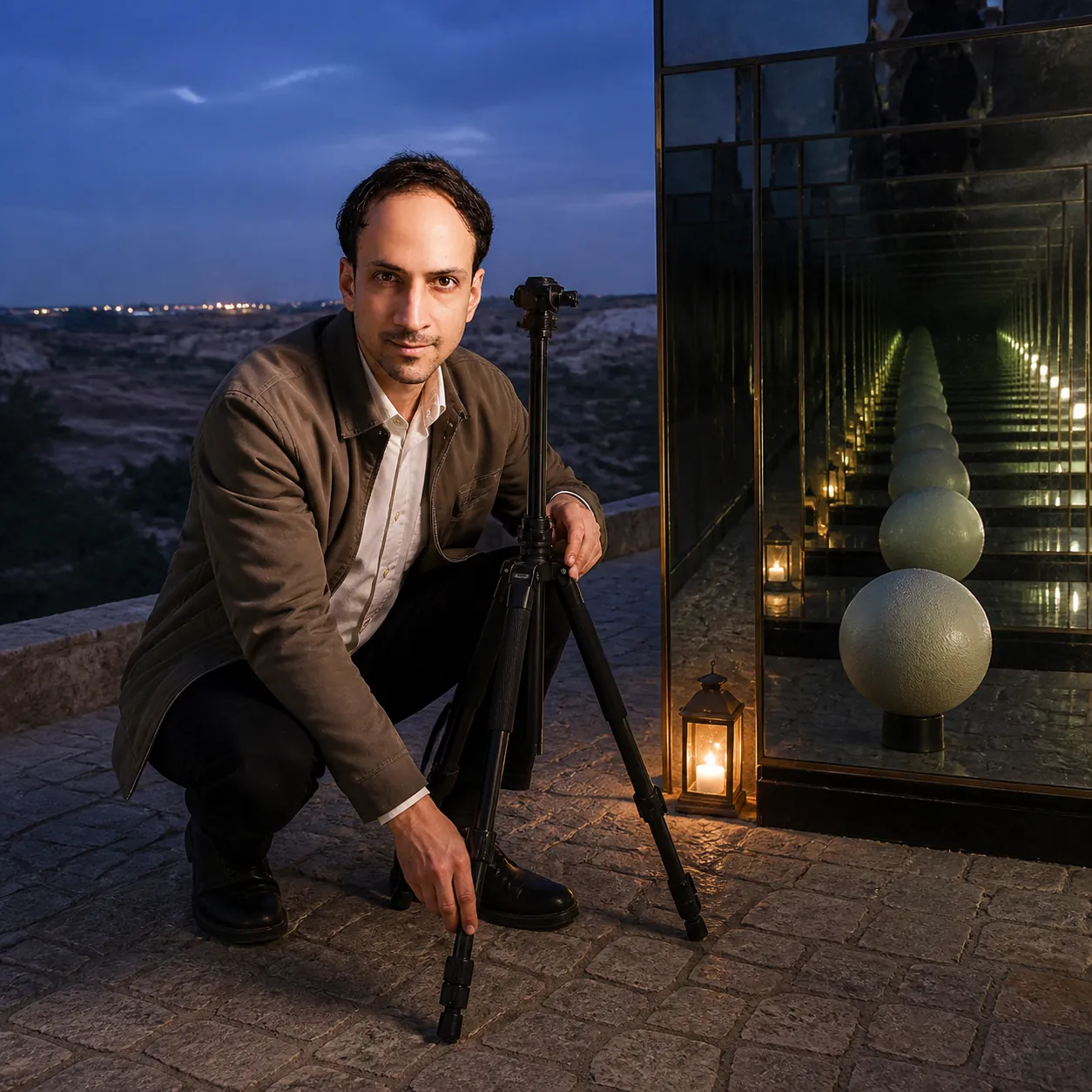
Nanosecond Archive: Paved Overlook — AI Portrait Prompt
صورةAI Portraits

Turn your own photo into a museum-scale demonstration portrait in a paved overlook above Wadi Hanifah in the last blue light. Keeps your face unchanged.

من نص البرومبت

Use the attached reference photo as the identity reference: keep the same face, skin tone, hair and features as the person in that photo, without beautifying, aging or altering them. Treat that reference as the character anchor and change only the scene. Create a square 1:1 museum-catalog frame with a strong first read and a slower second read at exactly 2880x2880 pixels. Location: a paved overlook above Wadi Hanifah in the last blue light. Show the subject in a taupe harrington jacket over an off-white oxford shirt, settling a folding tripod's third leg onto the paving. Treat this mechanism as the frame’s governing rule: a corridor of back-silvered facing mirrors whose copies of one white plaster sphere march away turning steadily greener and dimmer proves repetition can multiply spectacle without inventing one new fact. Explore how plain geometry manufactures plenty without inventing a single new fact; direct expression and posture toward attentive reserve, never melodrama or ad-like confidence. Frame from just off the mirror axis so the recession stays deep while their face appears exactly once. Make the composition let the recession deepen away from them, never toward their face. Render it as museum-scale demonstration realism uniting exact reflection optics, believable handmade apparatus, deep readable shadow, and editorial portrait fidelity keeping them singular, using one small warm practical as key with deep protected shadow around it and a palette of deep black, aged silver, and one candleflame amber. Photorealistic: this must read as a real photograph from a physical camera, never an illustration, painting, or 3D render. Resolve real surface detail: floor finish worn along the walked line, skirting marked at shoe height, and corners darker than the open floor. Keep one identity-locked person, credible hands and fingers, natural fabric, and coherent scale, contact, reflections, shadows, airflow, deformation, and materials. Background people only when essential, always secondary and clearly different. Avoid neon infinity-room installations, floating disembodied reflections, cracked-mirror symbolism, and impossible seamless recursion without dimming. No text, labels, logos, signatures, watermarks, random symbols, plastic skin, excessive bloom, or glossy AI finish.
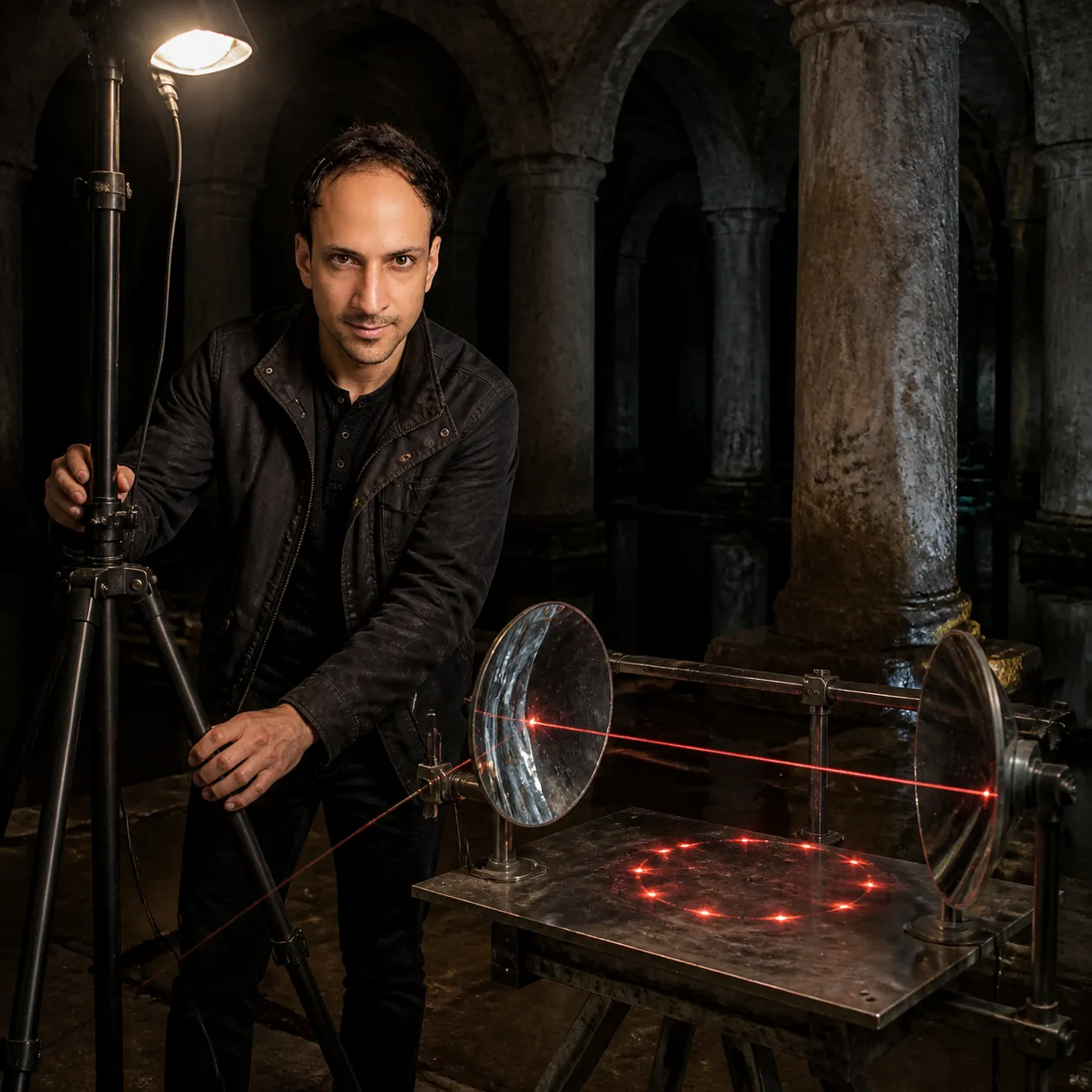
Lawful Recursion: Restored Underground Stone Cistern — AI Portrait Prompt
صورةAI Portraits

Turn your own photo into a museum-scale demonstration portrait in a restored underground stone cistern lit by one standing work lamp. Keeps your face unchanged.

من نص البرومبت

Use the attached reference photo as the identity reference: keep the same face, skin tone, hair and features as the person in that photo, without beautifying, aging or altering them. Treat that reference as the character anchor and change only the scene. Create a square 1:1 museum-catalog frame with a strong first read and a slower second read at exactly 2880x2880 pixels. Location: a restored underground stone cistern lit by one standing work lamp. Show the subject in a charcoal field jacket closed over a dark waffle henley, planting the work lamp's tripod firm on the uneven floor. Use this advanced image-making device as the core logic: a pair of concave laboratory mirrors that folds one thin laser beam into an oval constellation of glowing spots proves repetition can multiply spectacle without inventing one new fact. Explore where repetition actually ends, and what decides the final visible copy; direct expression and posture toward steady fascination, never melodrama or ad-like confidence. Use a measured 32mm wide view with them at one-third and the apparatus honest, unstretched, and fully in frame. Make the composition let darkness swallow the recession before the frame edge does. Render it as museum-scale demonstration realism uniting exact reflection optics, believable handmade apparatus, deep readable shadow, and editorial portrait fidelity keeping them singular, using a narrow hard key raked across the apparatus with soft ambient spill and a palette of graphite, chalk white, and one seam of oxide red. Photorealistic: this must read as a real photograph from a physical camera, never an illustration, painting, or 3D render. Resolve real surface detail: rubber gone chalky with age, painted metal chipped to primer, and plastic yellowed only where light reaches it. Keep one identity-locked person, credible hands and fingers, natural fabric, and coherent scale, contact, reflections, shadows, airflow, deformation, and materials. Background people only when essential, always secondary and clearly different. Avoid neon infinity-room installations, floating disembodied reflections, cracked-mirror symbolism, and impossible seamless recursion without dimming. No text, labels, logos, signatures, watermarks, random symbols, plastic skin, excessive bloom, or glossy AI finish.
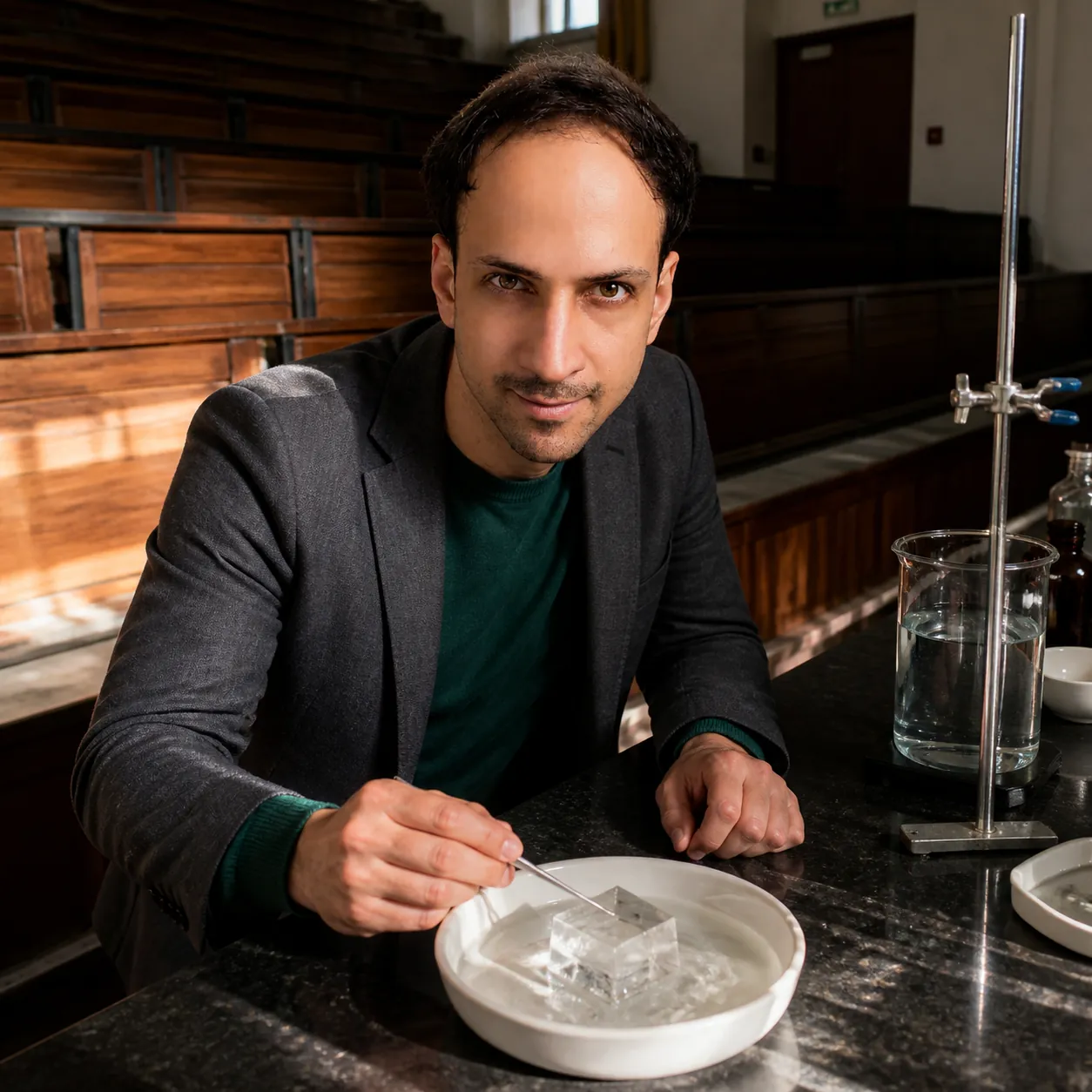
Geometry Unasked: Empty Raked Lecture Theatre — AI Portrait Prompt
صورةAI Portraits

Turn your own photo into a portrait in an empty raked lecture theatre with one long demonstration bench below. Keeps your face unchanged.

من نص البرومبت

Use the attached reference photo as the identity reference: keep the same face, skin tone, hair and features as the person in that photo, without beautifying, aging or altering them. Treat that reference as the character anchor and change only the scene. Create a square 1:1 museum-catalog frame with a strong first read and a slower second read at exactly 2880x2880 pixels. Location: an empty raked lecture theatre with one long demonstration bench below. Show the subject in a mid-grey blazer over a deep green crew-neck sweater, centering a white ceramic dish on the long bench. Treat this mechanism as the frame’s governing rule: a single alum crystal grown from a pinhead seed into a faceted block whose faces lie flat as instrument glass produces confident geometry in a place where nobody asked for any. Explore how one law repeated without exception becomes something the eye calls beauty; direct expression and posture toward watchful respect, never melodrama or ad-like confidence. Frame slightly above their hands so vessel, hands, and face stack in one calm diagonal. Make the composition give the newest crystal the frame's brightest square inch. Render it as conceptual bench-science photography combining believable grown geometry, honest hand-and-glass interaction, precise material response, and quiet contemporary gallery restraint, using hard low window sun refracted through glassware into small honest caustics and a palette of salt white, wet slate, and deep vitriol blue. Photorealistic: this must read as a real photograph from a physical camera, never an illustration, painting, or 3D render. Resolve real surface detail: floor finish worn along the walked line, skirting marked at shoe height, and corners darker than the open floor. Keep one identity-locked person, credible hands and fingers, natural fabric, and coherent scale, contact, reflections, shadows, airflow, deformation, and materials. Background people only when essential, always secondary and clearly different. Avoid wizard-laboratory props, neon translucent minerals, floating crystal shards, motion-smeared growth trails, and jewelry-advert sparkle. No text, labels, logos, signatures, watermarks, random symbols, plastic skin, excessive bloom, or glossy AI finish.

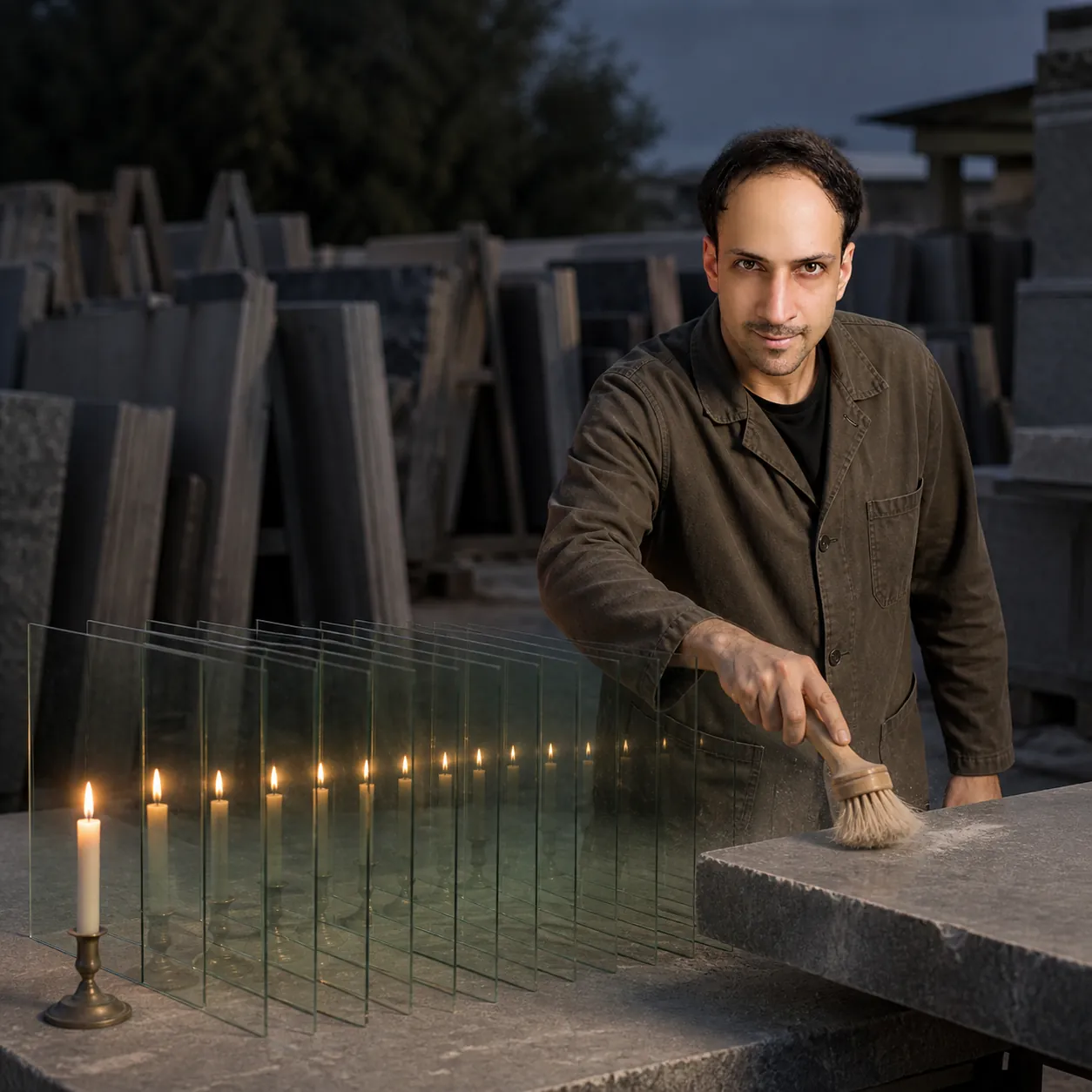
The Unrepeated: Stone Mason's Yard — AI Portrait Prompt
صورةAI Portraits

Turn your own photo into a gallery-grade catoptric portrait in a stone mason's yard at early light, slabs racked on A-frames. Keeps your face unchanged.

من نص البرومبت

Use the attached reference photo as the identity reference: keep the same face, skin tone, hair and features as the person in that photo, without beautifying, aging or altering them. Create a square 1:1 museum-catalog frame with a strong first read and a slower second read at exactly 2880x2880 pixels. Location: a stone mason's yard at early light, slabs racked on A-frames. Show them in a dust-toned work jacket buttoned over a plain black tee, brushing stone dust from one slab edge in a single stroke. Make one rigorous physical condition the conceptual engine: a stack of a dozen clear unsilvered panes that returns one candle flame as a train of ever-fainter twins turns one modest original into abundant company the eye can truly count. Explore what stays original about an object a room has agreed to repeat; direct expression and posture toward level wonder, never melodrama or ad-like confidence. Use an eye-level 55mm medium-format viewpoint with natural perspective and quiet, honest depth of field. Make the composition give the first copy and the last visible copy equal dignity. Render it as gallery-grade catoptric photography combining correct virtual-image spacing, honest generation-by-generation dimming, restrained art direction, and unhurried human presence, using cool dusk ambience balanced against one warm tungsten pool on the work and a palette of soot black, unpolished pewter, and one deep bottle green. Photorealistic: this must read as a real photograph from a physical camera, never an illustration, painting, or 3D render. Resolve real surface detail: fine grit in the texture of concrete, efflorescence at damp edges, and hairline cracks that follow stress. Keep one identity-locked person, credible hands and fingers, natural fabric, and coherent scale, contact, reflections, shadows, airflow, deformation, and materials. Background people only when essential, always secondary and clearly different. Avoid duplicated faces, funhouse warps, endless-clone selfies, glowing portal tunnels, and CGI mirror shards. No text, labels, logos, signatures, watermarks, random symbols, plastic skin, excessive bloom, or glossy AI finish.
Stream to Stone: Tiled Chemistry Bench — AI Portrait Prompt
صورةAI Portraits

Turn your own photo into a high-concept chemistry portrait in a tiled chemistry bench beneath the raised sash of a fume hood. Keeps your face unchanged.

من نص البرومبت

Use the attached reference photo as the identity reference: keep the same face, skin tone, hair and features as the person in that photo, without beautifying, aging or altering them. Treat that reference as the character anchor and change only the scene. Create a square 1:1 museum-catalog frame with a strong first read and a slower second read at exactly 2880x2880 pixels. Location: a tiled chemistry bench beneath the raised sash of a fume hood. Show the subject in a white lab coat open over a dark olive tee, decanting clear solution down a glass stirring rod. Make one rigorous physical condition the conceptual engine: a white column of sodium acetate that solidifies exactly where its own poured stream lands, stacking itself into a warm tower turns a liquid's dissolved cargo into architecture a hand could rest on. Explore why a liquid can carry a cathedral's worth of order without showing it; direct expression and posture toward quiet astonishment, never melodrama or ad-like confidence. Use an eye-level 50mm view with honest perspective and gentle depth of field. Make the composition give the newest crystal the frame's brightest square inch. Render it as high-concept chemistry portraiture built from real supersaturation phenomena, true laboratory-glass materiality, restrained documentary honesty, and quietly monumental still-life composition, using hard low window sun refracted through glassware into small honest caustics and a palette of salt white, wet slate, and deep vitriol blue. Photorealistic: this must read as a real photograph from a physical camera, never an illustration, painting, or 3D render. Resolve real surface detail: true skin texture with pores and fine hair at the hairline, and fabric that creases where it is actually stressed. Keep one identity-locked person, credible hands and fingers, natural fabric, and coherent scale, contact, reflections, shadows, airflow, deformation, and materials. Background people only when essential, always secondary and clearly different. Avoid glowing magic crystals, amethyst geode caves, gemstone treasure piles, frosted window fakery, and CGI diamond shards. No text, labels, logos, signatures, watermarks, random symbols, plastic skin, excessive bloom, or glossy AI finish.
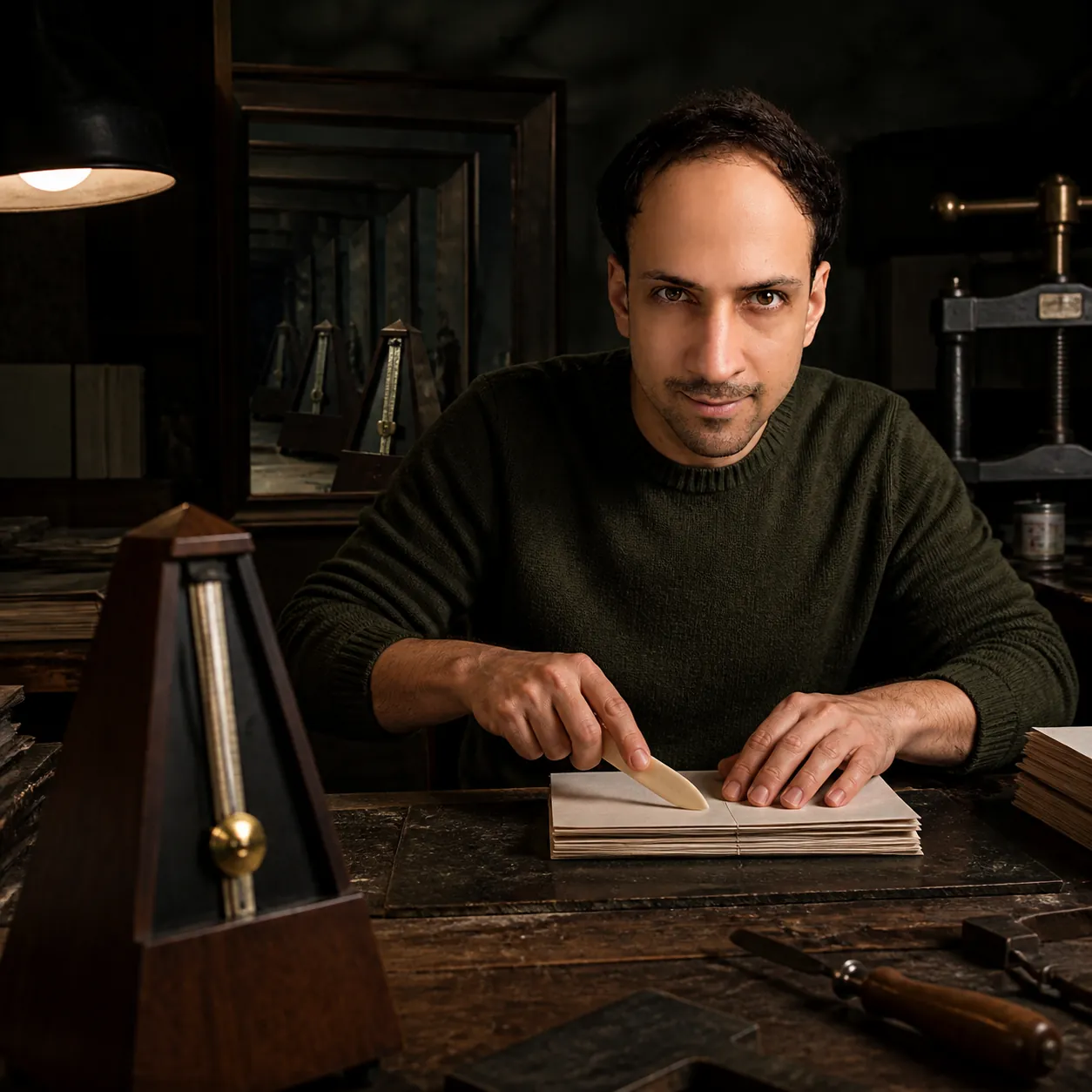
Repetition's Receipt: Bookbinder's Workshop Late — AI Portrait Prompt
صورةAI Portraits

Turn your own photo into a museum-scale demonstration portrait in a bookbinder's workshop late at night, its presses wound open. Keeps your face unchanged.

من نص البرومبت

Use the attached reference photo as the identity reference: keep the same face, skin tone, hair and features as the person in that photo, without beautifying, aging or altering them. Treat that reference as the character anchor and change only the scene. Create a square 1:1 museum-catalog frame with a strong first read and a slower second read at exactly 2880x2880 pixels. Location: a bookbinder's workshop late at night, its presses wound open. Show the subject in a moss-green lambswool jumper with sleeves pushed past the wrist, nipping a folded signature flat with a bone folder. The impossible-looking event must obey this clear system: a rectangle of four wall mirrors that passes one metronome's image around the room and back beside itself in laps proves repetition can multiply spectacle without inventing one new fact. Explore why refusing to enter a spectacle can be the strongest position in it; direct expression and posture toward patient scrutiny, never melodrama or ad-like confidence. Use a 90mm macro-to-portrait hybrid: one repeated object near the lens, their face beyond it and outside every reflection. Make the composition keep them fully outside every reflective sightline, present exactly once. Render it as museum-scale demonstration realism uniting exact reflection optics, believable handmade apparatus, deep readable shadow, and editorial portrait fidelity keeping them singular, using controlled darkness with a single shielded lamp placed to miss every mirror and a palette of charcoal, cool mirror grey, and a thread of brass. Photorealistic: this must read as a real photograph from a physical camera, never an illustration, painting, or 3D render. Resolve real surface detail: skin that reddens slightly under pressure, nail beds with honest colour, and knuckle creases that fold rather than blur. Keep one identity-locked person, credible hands and fingers, natural fabric, and coherent scale, contact, reflections, shadows, airflow, deformation, and materials. Background people only when essential, always secondary and clearly different. Avoid neon infinity-room installations, floating disembodied reflections, cracked-mirror symbolism, and impossible seamless recursion without dimming. No text, labels, logos, signatures, watermarks, random symbols, plastic skin, excessive bloom, or glossy AI finish.
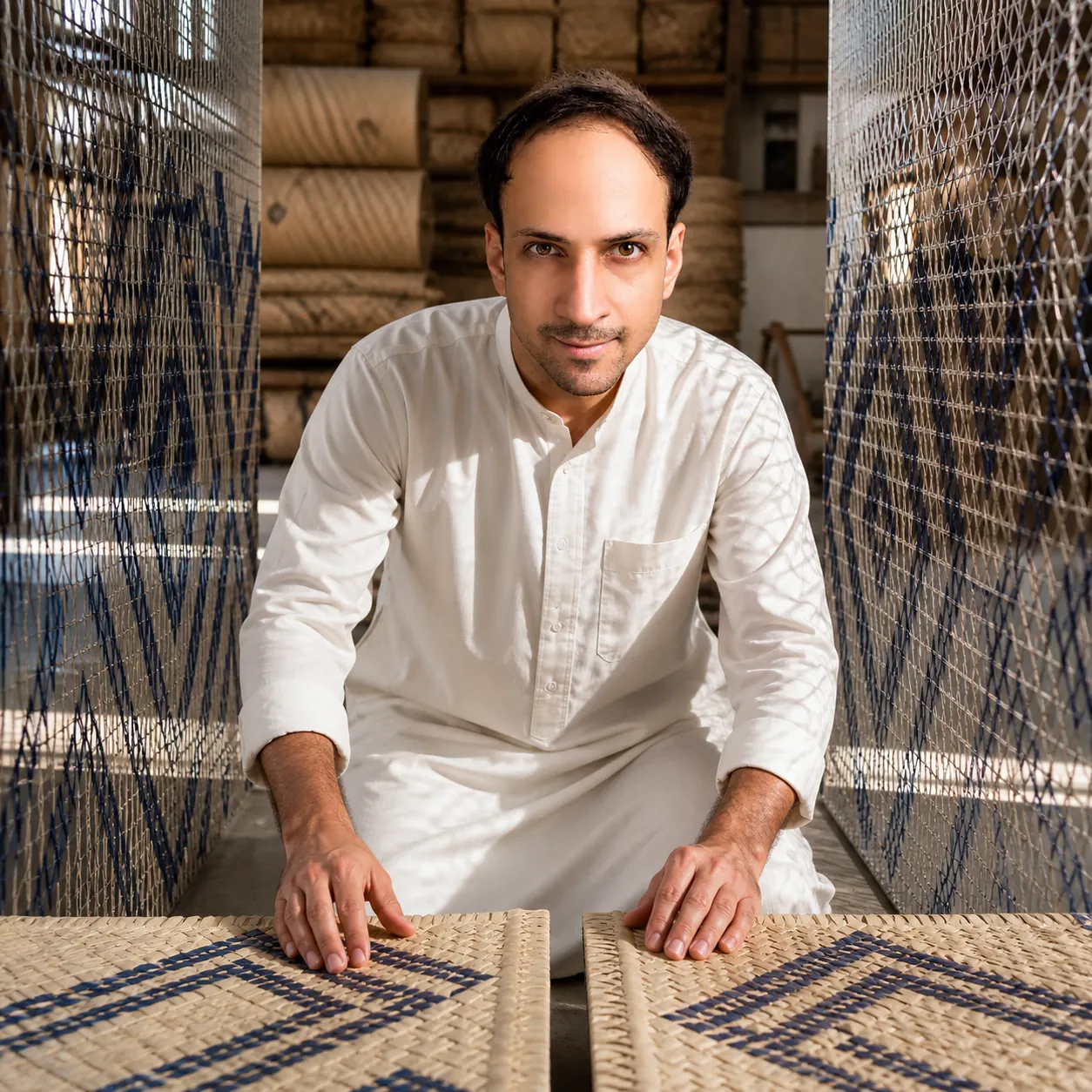
Woven Interference: Craft Cooperative Hall — AI Portrait Prompt
صورةAI Portraits

Turn your own photo into a quietly rigorous studio portrait in a craft cooperative hall stacked with woven palm-frond mats. Keeps your face unchanged.

من نص البرومبت

Use the attached reference photo as the identity reference: keep the same face, skin tone, hair and features as the person in that photo, without beautifying, aging or altering them. Treat that reference as the character anchor and change only the scene. Create a square 1:1 museum-catalog frame with a strong first read and a slower second read at exactly 2880x2880 pixels. Location: a craft cooperative hall stacked with woven palm-frond mats. Show the subject in an ivory cotton traditional Gulf outfit with both sleeves turned back once, matching two mat edges until their weaves sit square. The impossible-looking event must obey this clear system: a corridor of two woven wire fences one stride apart, through which giant slow bands roll at any shift of viewpoint summons a third pattern that belongs to neither layer alone. Explore whether motion the eye reports but the world denies still counts as real; direct expression and posture toward attentive calm, never melodrama or ad-like confidence. Use a 50mm standpoint set exactly where the bands read strongest, with their face just off that axis. Make the composition keep both source patterns readable at the edges as quiet evidence. Render it as quietly rigorous studio realism uniting layered handcrafted screens, physically exact interference behavior, restrained heritage styling, and dignified observational portraiture, using low raking sun that lets every layered shadow keep its true edge and a palette of washed white, cool steel mesh, and one indigo band. Photorealistic: this must read as a real photograph from a physical camera, never an illustration, painting, or 3D render. Resolve real surface detail: glass with real thickness at its edge, reflections that carry the room's actual colour, and dust visible only at grazing angles. Keep one identity-locked person, credible hands and fingers, natural fabric, and coherent scale, contact, reflections, shadows, airflow, deformation, and materials. Background people only when essential, always secondary and clearly different. Avoid op-art poster graphics, hypnotic spiral overlays, digital glitch scanlines, television static, and patterns projected across their face. No text, labels, logos, signatures, watermarks, random symbols, plastic skin, excessive bloom, or glossy AI finish.
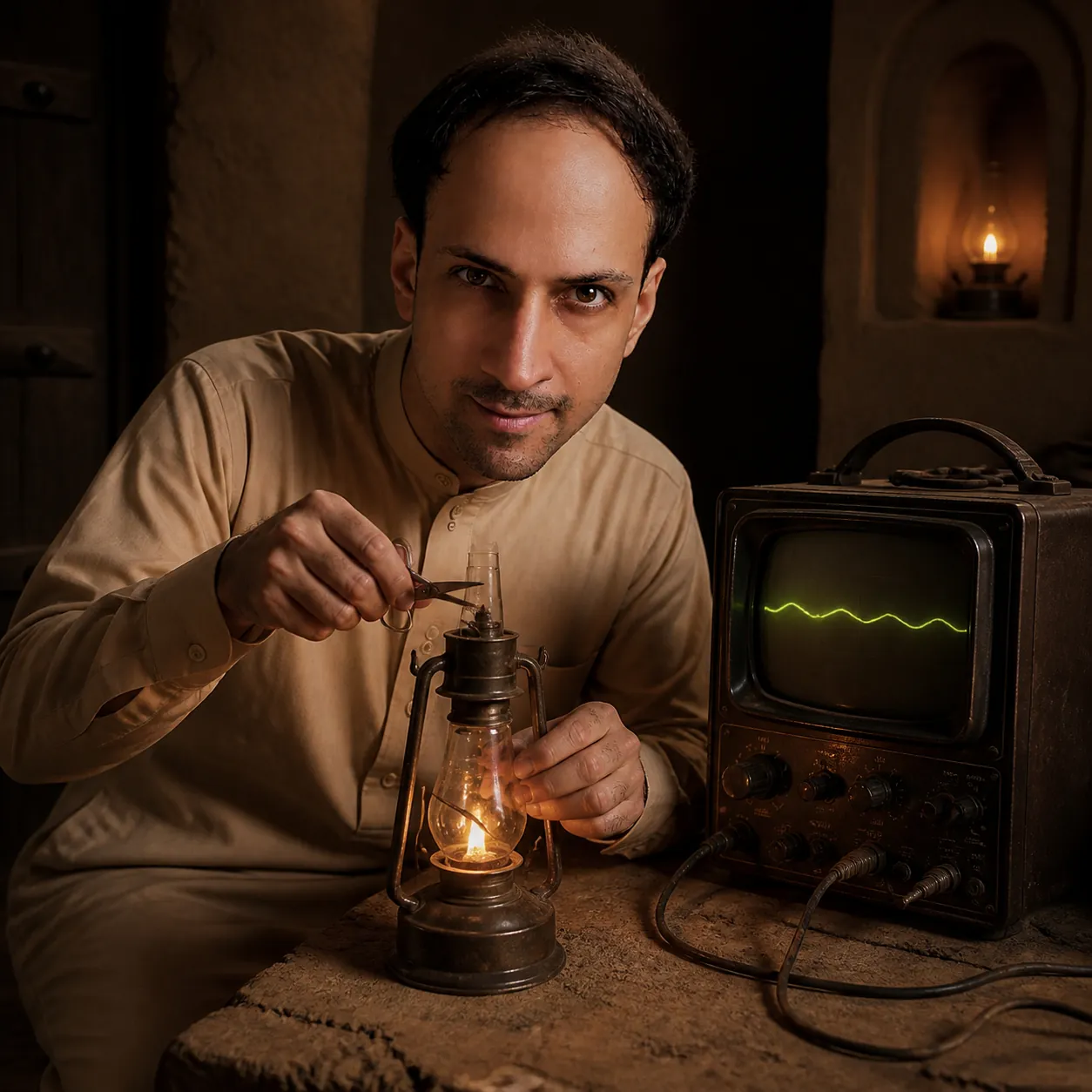
The Signed Event: Restored Najdi Mud-Brick Room — AI Portrait Prompt
صورةAI Portraits

Turn your own photo into a photorealistic portrait in a restored Najdi mud-brick room lit by one low lantern. Keeps your face unchanged.

من نص البرومبت

Use the attached reference photo as the identity reference: keep the same face, skin tone, hair and features as the person in that photo, without beautifying, aging or altering them. Create a square 1:1 museum-catalog frame with a strong first read and a slower second read at exactly 2880x2880 pixels. Location: a restored Najdi mud-brick room lit by one low lantern. Show them in a plain sand-colored traditional Gulf outfit, sleeves buttoned at the wrist, trimming a lantern wick to a lower flame. Build the artwork around this material rule: an analog oscilloscope whose sealed electron beam draws one slow green wave across the phosphor of a darkened screen brings a feared force close enough to study without any bravado. Explore how patience turns a feared phenomenon into a legible companion; direct expression and posture toward unhurried scrutiny, never melodrama or ad-like confidence. Use a restrained 35mm environmental view with the subject anchored off-center and hands never distorted. Make the composition hold the apparatus, their hands, and their gaze in one triangle. Render it as evidence-grade scientific photography pairing honest discharge phenomena, calibrated near-darkness exposure, believable period instrumentation, and quiet, unhurried human-scale storytelling, using one low practical lamp with the room allowed to fall away dark and a palette of soot black, aged bakelite brown, and dim neon amber. Photorealistic: this must read as a real photograph from a physical camera, never an illustration, painting, or 3D render. Resolve real surface detail: hair with individual strands catching light, fine flyaway hairs of uneven length, and skin oil giving a low uneven sheen. Keep one identity-locked person, credible hands and fingers, natural fabric, and coherent scale, contact, reflections, shadows, airflow, deformation, and materials. Background people only when essential, always secondary and clearly different. Avoid sci-fi energy balls, fractal screen-saver overlays, sparks showering from hands, wizard-lightning fingertips, and ultraviolet glow gimmicks. No text, labels, logos, signatures, watermarks, random symbols, plastic skin, excessive bloom, or glossy AI finish.
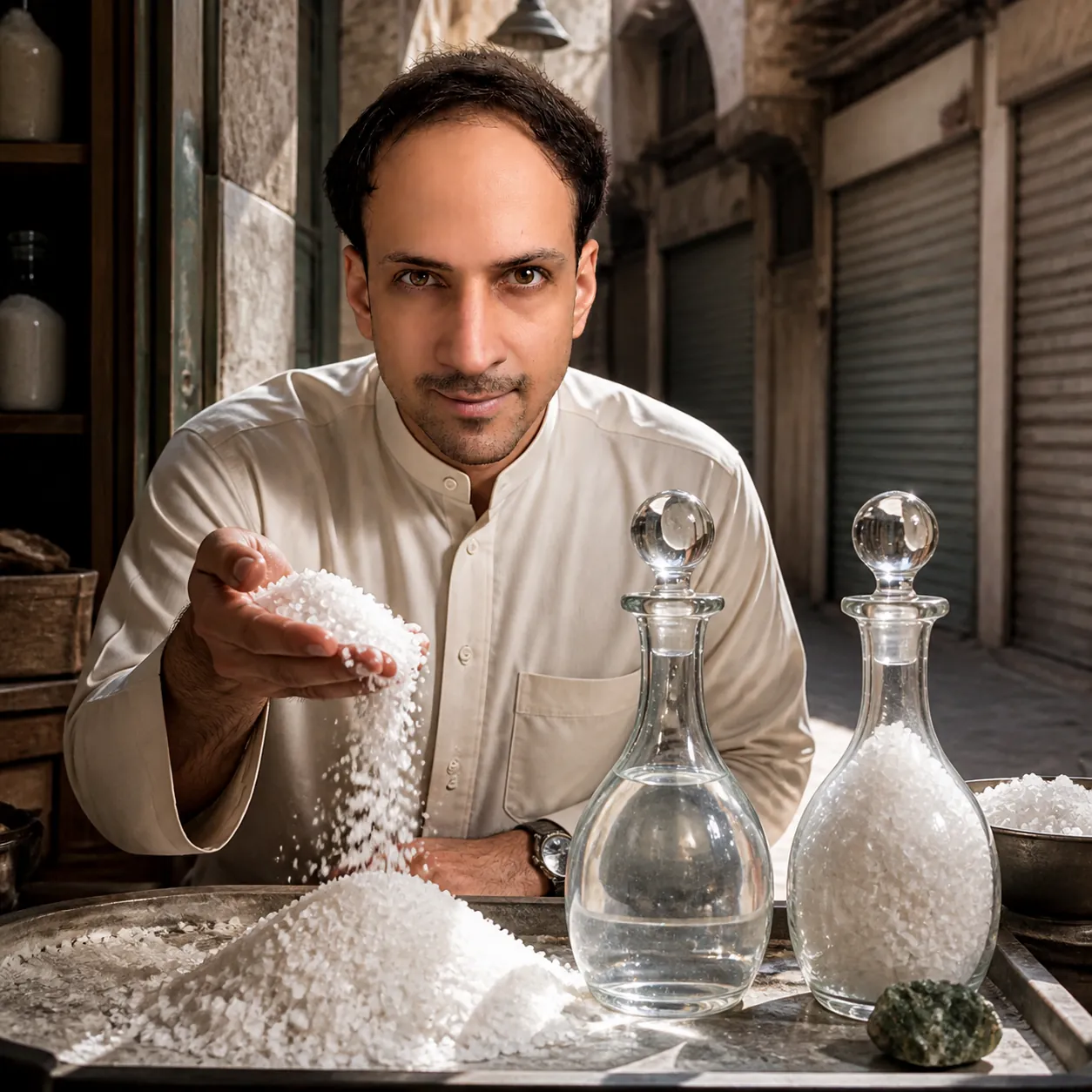
Dissolved Blueprint: Salt Merchant's Stall — AI Portrait Prompt
صورةAI Portraits

Turn your own photo into a gallery-grade process portrait in a salt merchant's stall in a shuttered souq lane, still cool. Keeps your face unchanged.

من نص البرومبت

Use the attached reference photo as the identity reference: keep the same face, skin tone, hair and features as the person in that photo, without beautifying, aging or altering them. Treat that reference as the character anchor and change only the scene. Create a square 1:1 museum-catalog frame with a strong first read and a slower second read at exactly 2880x2880 pixels. Location: a salt merchant's stall in a shuttered souq lane, still cool. Show the subject in a pale oat cotton traditional Gulf outfit with a dark wristwatch showing, cupping a scoop of coarse salt and tipping it back. The impossible-looking event must obey this clear system: a pair of identical stoppered flasks, one crystallized solid to the neck, its twin still liquid for want of one seed turns a liquid's dissolved cargo into architecture a hand could rest on. Explore what it means that precision is matter's default rather than an achievement; direct expression and posture toward attentive calm, never melodrama or ad-like confidence. Use a 90mm framing that holds the grown geometry and their face in one plane of focus. Make the composition hold one large calm emptiness against the crowded crystalline detail. Render it as gallery-grade process portraiture built from lawful crystallization, unexaggerated color, physically correct transparency and shadow, and unhurried human-scale observation, using hard low window sun refracted through glassware into small honest caustics and a palette of eggshell white, cool zinc grey, and one moss-green accent. Photorealistic: this must read as a real photograph from a physical camera, never an illustration, painting, or 3D render. Resolve real surface detail: glass with real thickness at its edge, reflections that carry the room's actual colour, and dust visible only at grazing angles. Keep one identity-locked person, credible hands and fingers, natural fabric, and coherent scale, contact, reflections, shadows, airflow, deformation, and materials. Background people only when essential, always secondary and clearly different. Avoid glowing magic crystals, amethyst geode caves, gemstone treasure piles, frosted window fakery, and CGI diamond shards. No text, labels, logos, signatures, watermarks, random symbols, plastic skin, excessive bloom, or glossy AI finish.
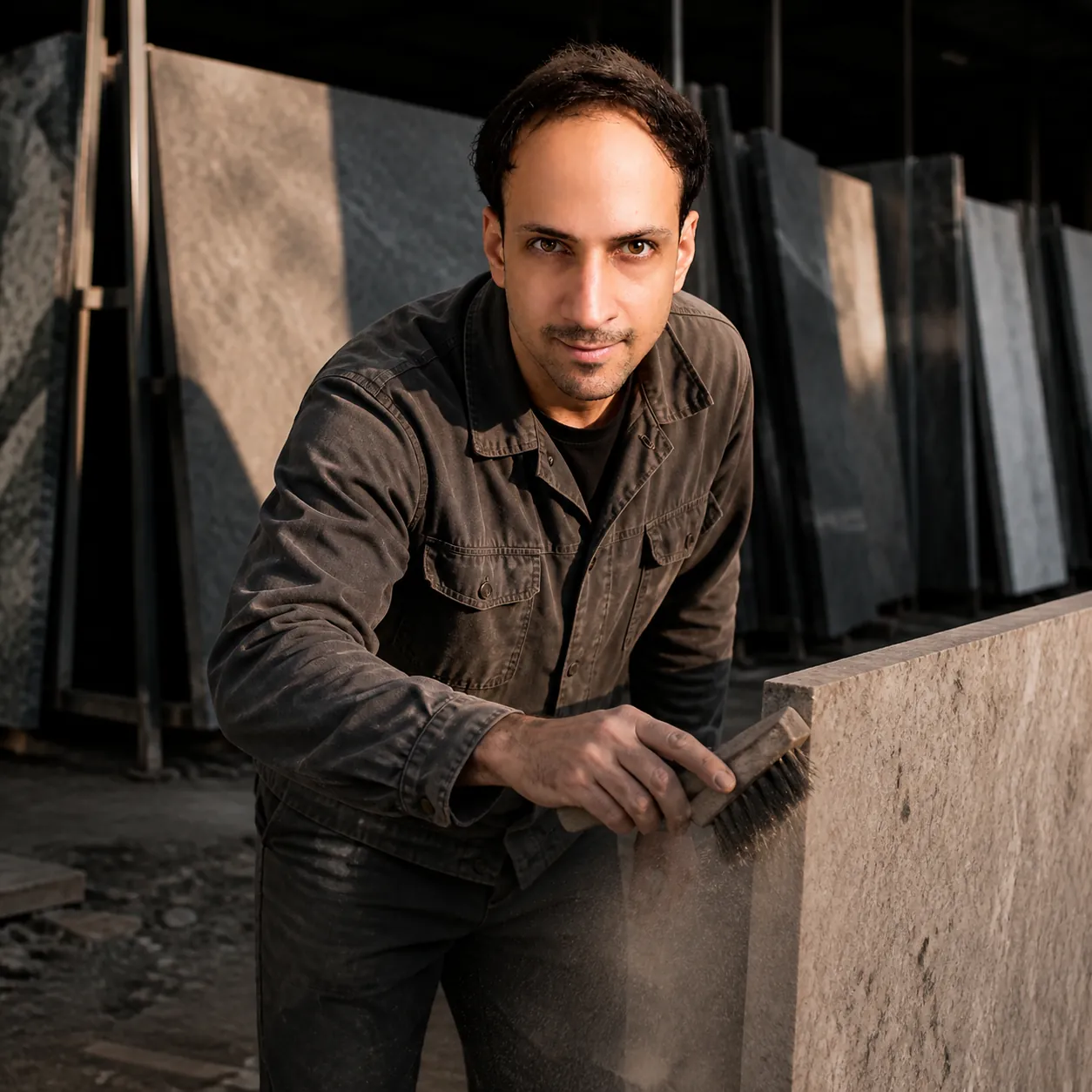
Honest Infinity: Stone Mason's Yard — AI Portrait Prompt
صورةAI Portraits

Turn your own photo into a museum-scale demonstration portrait in a stone mason's yard at early light, slabs racked on A-frames. Keeps your face unchanged.

من نص البرومبت

Use the attached reference photo as the identity reference: keep the same face, skin tone, hair and features as the person in that photo, without beautifying, aging or altering them. Create a square 1:1 museum-catalog frame with a strong first read and a slower second read at exactly 2880x2880 pixels. Location: a stone mason's yard at early light, slabs racked on A-frames. Show them in a dust-toned work jacket buttoned over a plain black tee, brushing stone dust from one slab edge in a single stroke. Treat this mechanism as the frame’s governing rule: a narrow well of two horizontal mirrors, floor and lid, that repeats one candle flame into a colonnade sinking through the table proves repetition can multiply spectacle without inventing one new fact. Explore why an honest repetition can astonish more than any invented spectacle; direct expression and posture toward unhurried certainty, never melodrama or ad-like confidence. Frame from just off the mirror axis so the recession stays deep while their face appears exactly once. Make the composition let darkness swallow the recession before the frame edge does. Render it as museum-scale demonstration realism uniting exact reflection optics, believable handmade apparatus, deep readable shadow, and editorial portrait fidelity keeping them singular, using low house light dimmed until the repeated images become the brightest things and a palette of charcoal, cool mirror grey, and a thread of brass. Photorealistic: this must read as a real photograph from a physical camera, never an illustration, painting, or 3D render. Resolve real surface detail: paper fibre visible at cut edges, plastic that shows mould lines, and paint thicker where a brush turned. Keep one identity-locked person, credible hands and fingers, natural fabric, and coherent scale, contact, reflections, shadows, airflow, deformation, and materials. Background people only when essential, always secondary and clearly different. Avoid neon infinity-room installations, floating disembodied reflections, cracked-mirror symbolism, and impossible seamless recursion without dimming. No text, labels, logos, signatures, watermarks, random symbols, plastic skin, excessive bloom, or glossy AI finish.
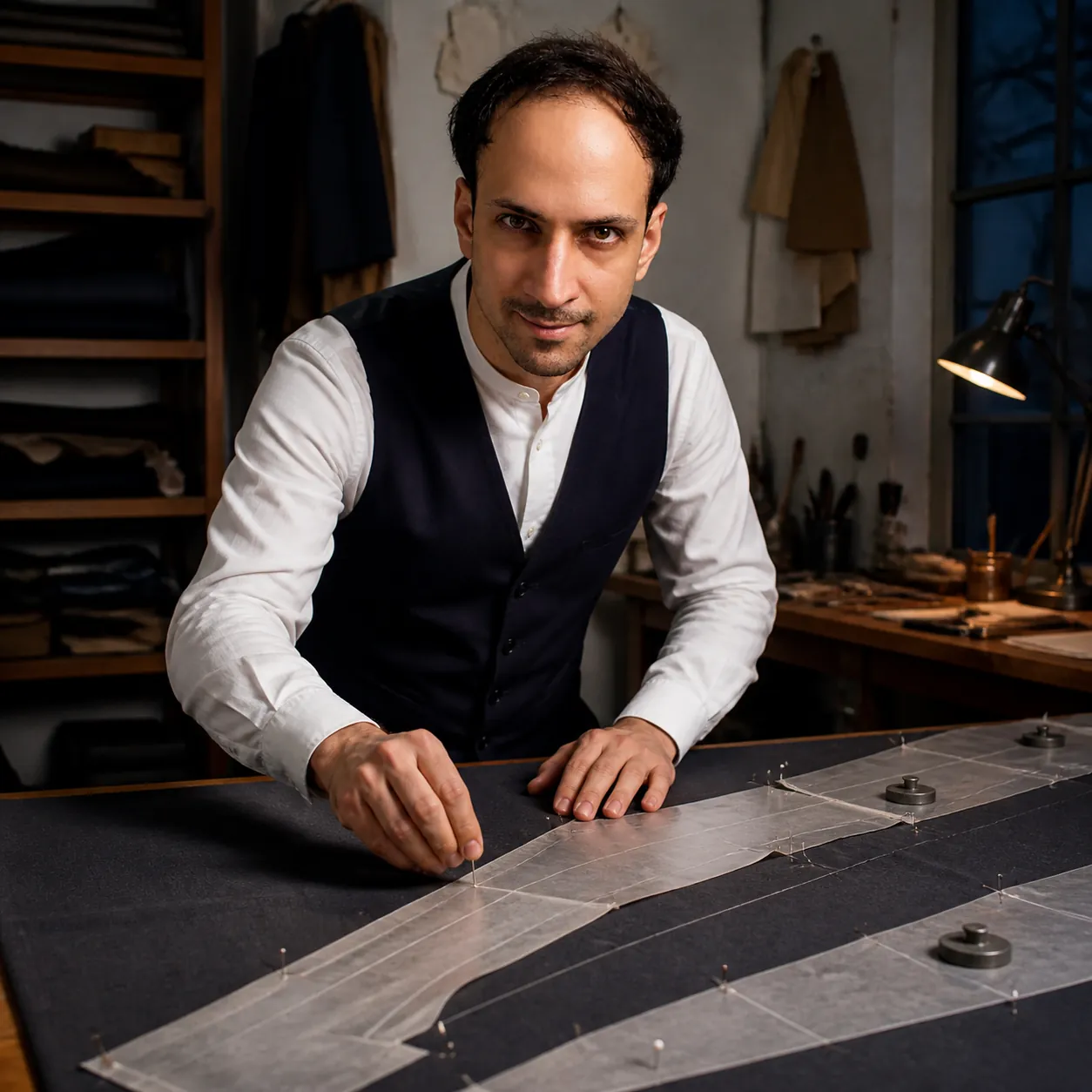
Quiet Leverage: Tailor's Workroom — AI Portrait Prompt
صورةAI Portraits

Turn your own photo into a quietly rigorous studio portrait in a tailor's workroom at night with one clear cutting table. Keeps your face unchanged.

من نص البرومبت

Use the attached reference photo as the identity reference: keep the same face, skin tone, hair and features as the person in that photo, without beautifying, aging or altering them. Treat that reference as the character anchor and change only the scene. Create a square 1:1 museum-catalog frame with a strong first read and a slower second read at exactly 2880x2880 pixels. Location: a tailor's workroom at night with one clear cutting table. Show the subject in a fitted navy waistcoat over a collarless white shirt, pinning one tissue pattern corner to the folded cloth. Make one rigorous physical condition the conceptual engine: a bench vernier of two printed scales, on which one dark fringe marches boldly for movements finer than a hair summons a third pattern that belongs to neither layer alone. Explore where a pattern lives when it exists only between two others; direct expression and posture toward grounded awe, never melodrama or ad-like confidence. Use an eye-level 85mm portrait view stopped down so both pattern layers stay equally sharp. Make the composition run the interference bands diagonally while every real edge stays level. Render it as quietly rigorous studio realism uniting layered handcrafted screens, physically exact interference behavior, restrained heritage styling, and dignified observational portraiture, using cool ambient daylight lifted by one warm bounce off nearby wood and a palette of pale plaster, carbon grey, and a muted date-brown. Photorealistic: this must read as a real photograph from a physical camera, never an illustration, painting, or 3D render. Resolve real surface detail: fine lint on dark fabric, water spotting on steel, and the soft rounding of edges that have been used for years. Keep one identity-locked person, credible hands and fingers, natural fabric, and coherent scale, contact, reflections, shadows, airflow, deformation, and materials. Background people only when essential, always secondary and clearly different. Avoid op-art poster graphics, hypnotic spiral overlays, digital glitch scanlines, television static, and patterns projected across their face. No text, labels, logos, signatures, watermarks, random symbols, plastic skin, excessive bloom, or glossy AI finish.
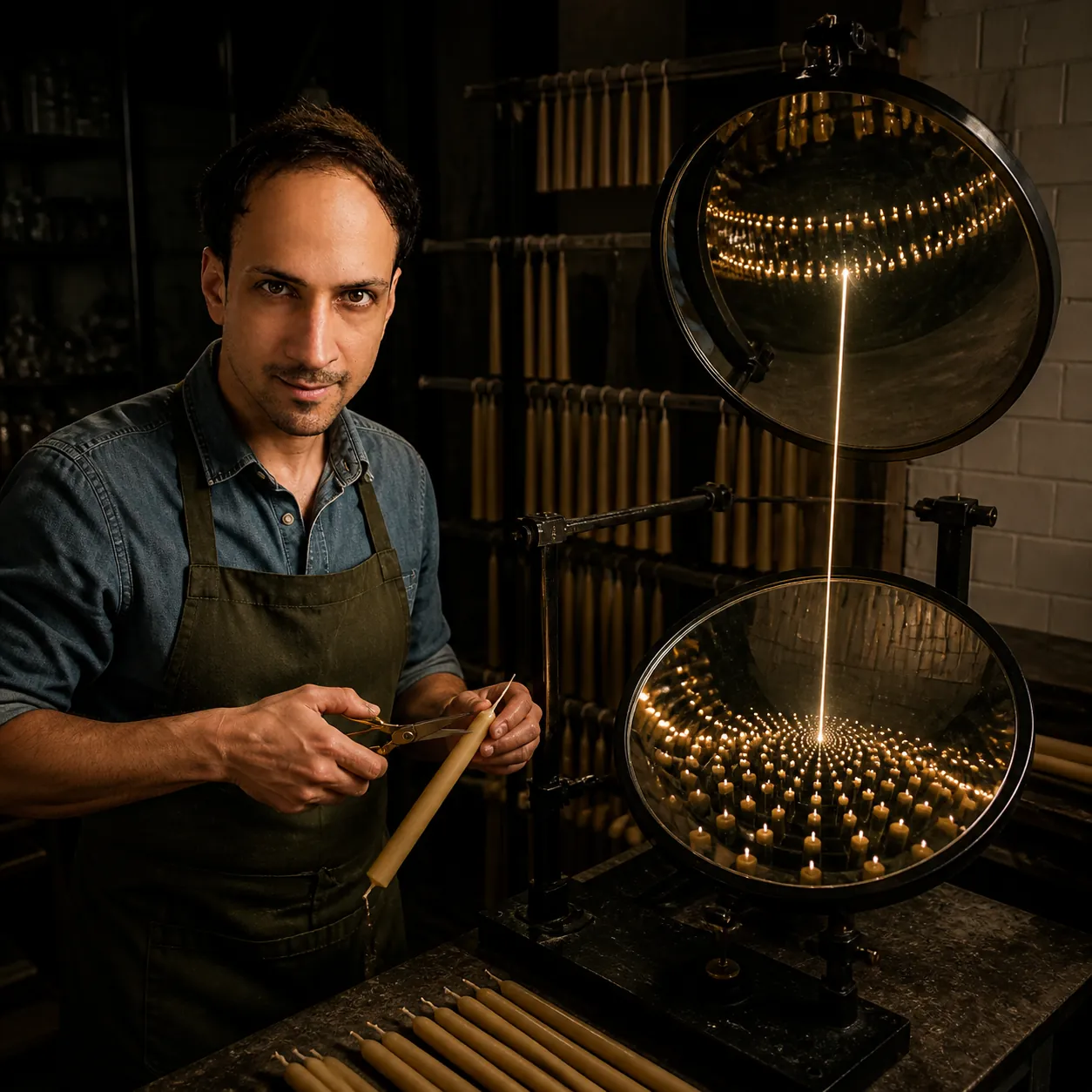
Lawful Recursion: Candle Maker's Back Room — AI Portrait Prompt
صورةAI Portraits

Turn your own photo into a high-concept optical portrait in a candle maker's back room with racked tapers cooling on rails. Keeps your face unchanged.

من نص البرومبت

Use the attached reference photo as the identity reference: keep the same face, skin tone, hair and features as the person in that photo, without beautifying, aging or altering them. Treat that reference as the character anchor and change only the scene. Create a square 1:1 museum-catalog frame with a strong first read and a slower second read at exactly 2880x2880 pixels. Location: a candle maker's back room with racked tapers cooling on rails. Show the subject in a waxed canvas apron over a rolled-sleeve chambray shirt, trimming one cooled wick square with small brass shears. Treat this mechanism as the frame’s governing rule: a pair of concave laboratory mirrors that folds one thin laser beam into an oval constellation of glowing spots turns one modest original into abundant company the eye can truly count. Explore where repetition actually ends, and what decides the final visible copy; direct expression and posture toward grounded awe, never melodrama or ad-like confidence. Frame from just off the mirror axis so the recession stays deep while their face appears exactly once. Make the composition let the recession deepen away from them, never toward their face. Render it as high-concept optical portraiture built from truthful mirror geometry, accurate reflection falloff, museum-demonstration staging, and calm documentary realism around one unrepeated person, using low house light dimmed until the repeated images become the brightest things and a palette of soot black, unpolished pewter, and one deep bottle green. Photorealistic: this must read as a real photograph from a physical camera, never an illustration, painting, or 3D render. Resolve real surface detail: grout darker than tile, sealant slightly yellowed, and every joint showing a real tolerance gap. Keep one identity-locked person, credible hands and fingers, natural fabric, and coherent scale, contact, reflections, shadows, airflow, deformation, and materials. Background people only when essential, always secondary and clearly different. Avoid duplicated faces, funhouse warps, endless-clone selfies, glowing portal tunnels, and CGI mirror shards. No text, labels, logos, signatures, watermarks, random symbols, plastic skin, excessive bloom, or glossy AI finish.

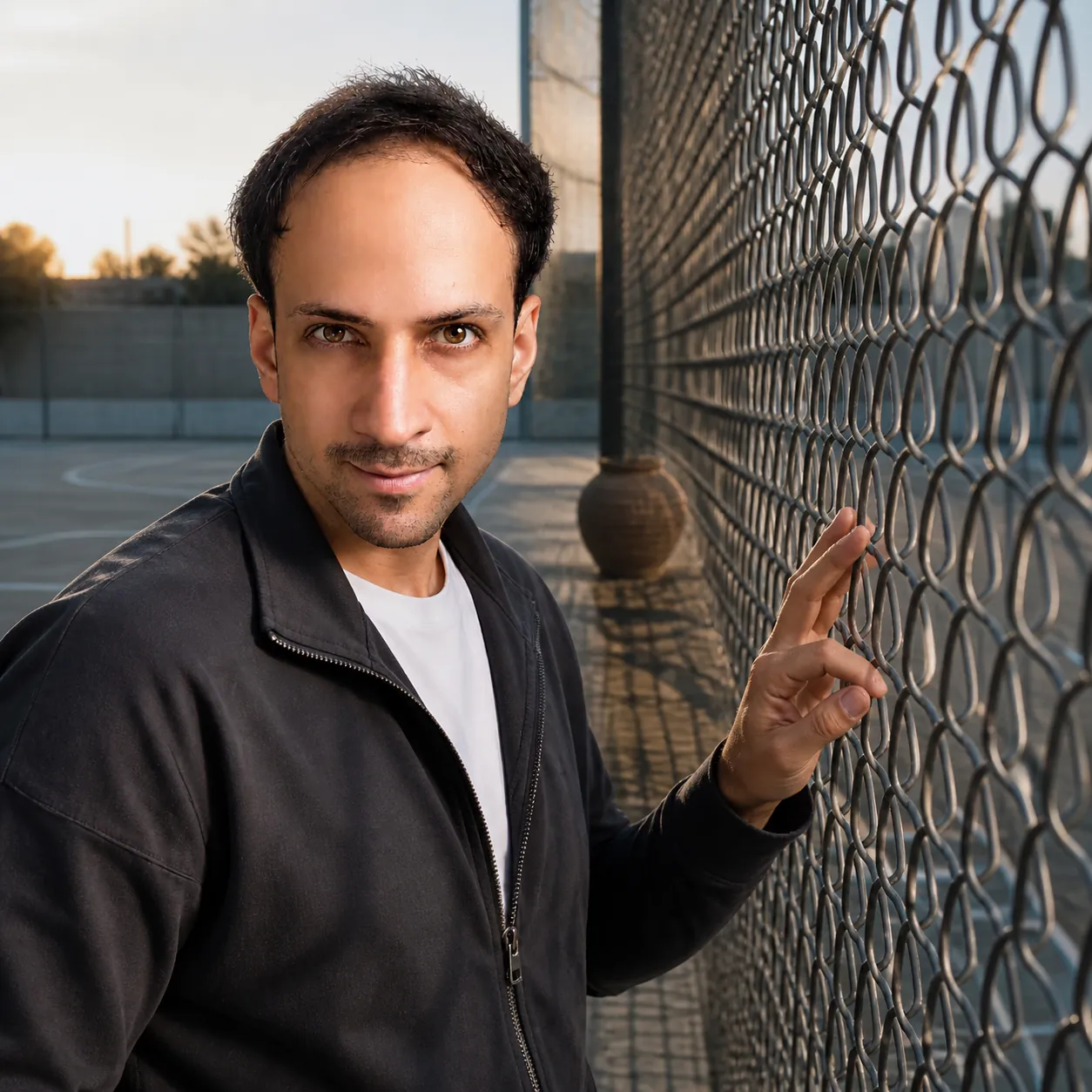
Between Two Layers: Empty Neighborhood Sports Court — AI Portrait Prompt
صورةAI Portraits

Turn your own photo into a portrait in an empty neighborhood sports court at dawn beside its tall woven fence. Keeps your face unchanged.

من نص البرومبت

Use the attached reference photo as the identity reference: keep the same face, skin tone, hair and features as the person in that photo, without beautifying, aging or altering them. Treat that reference as the character anchor and change only the scene. Create a square 1:1 museum-catalog frame with a strong first read and a slower second read at exactly 2880x2880 pixels. Location: an empty neighborhood sports court at dawn beside its tall woven fence. Show the subject in a zipped charcoal track jacket over a plain white tee, hooking two fingers loosely through the cool wire mesh. Make one rigorous physical condition the conceptual engine: a ruled grating standing before an unglazed clay jar, where the grating and its cast shadow interfere into true contour lines summons a third pattern that belongs to neither layer alone. Explore how near-identical things reveal each other more sharply than opposites ever could; direct expression and posture toward steadied wonder, never melodrama or ad-like confidence. Use an eye-level 85mm portrait view stopped down so both pattern layers stay equally sharp. Make the composition place their eyes in the one calm zone the fringes spare. Render it as high-concept interference portraiture built from genuinely overlapping physical patterns, large-format documentary clarity, hand-made material honesty, and patient architectural observation, using cool ambient daylight lifted by one warm bounce off nearby wood and a palette of soft sand, ink-lined shadow, and one quiet teal thread. Photorealistic: this must read as a real photograph from a physical camera, never an illustration, painting, or 3D render. Resolve real surface detail: the difference between a wiped surface and a clean one, faint tide marks on ceramic, and metal dulled unevenly by touch. Keep one identity-locked person, credible hands and fingers, natural fabric, and coherent scale, contact, reflections, shadows, airflow, deformation, and materials. Background people only when essential, always secondary and clearly different. Avoid op-art poster graphics, hypnotic spiral overlays, digital glitch scanlines, television static, and patterns projected across their face. No text, labels, logos, signatures, watermarks, random symbols, plastic skin, excessive bloom, or glossy AI finish.
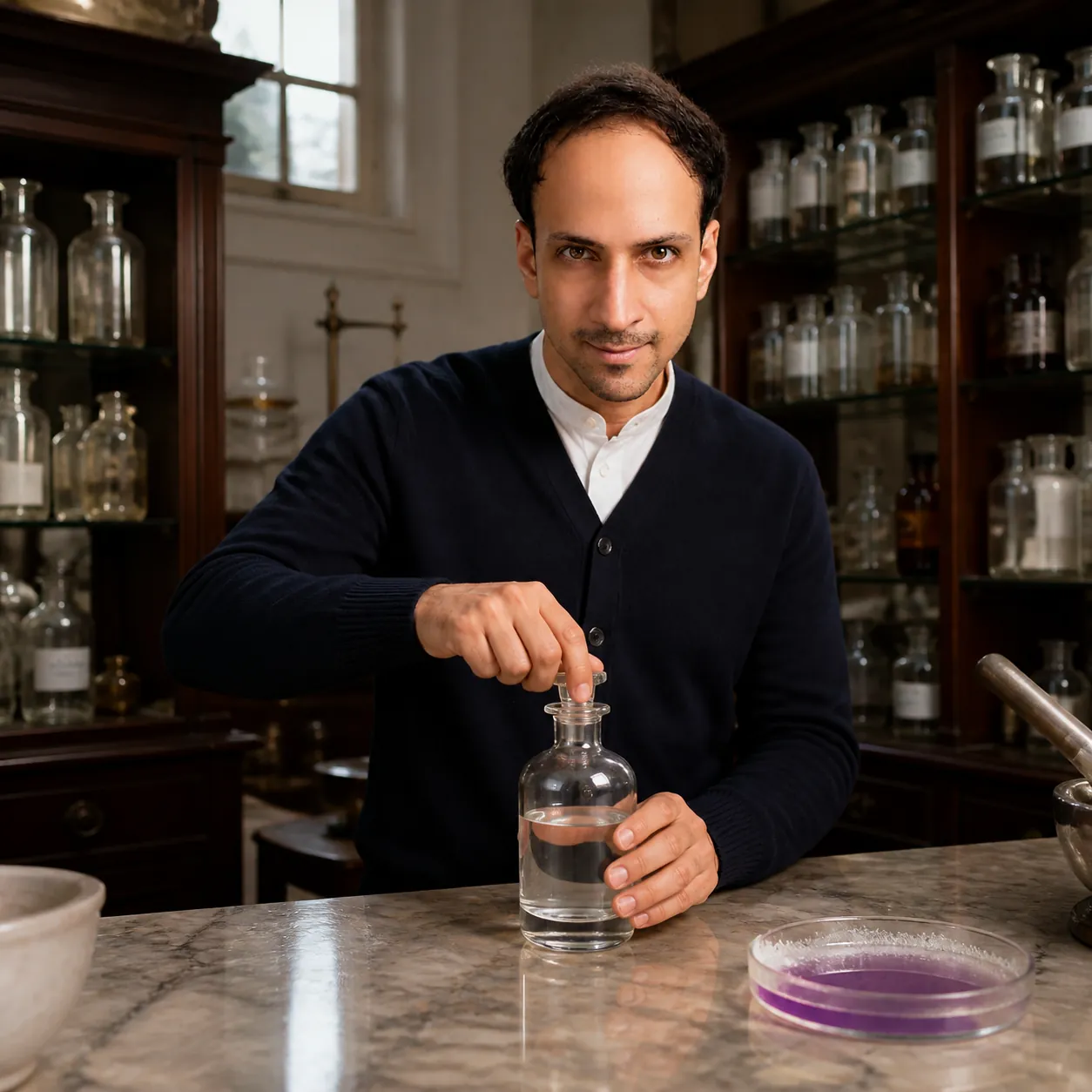
The Waiting Solid: Deep Majlis Windowsill Catching — AI Portrait Prompt
صورةAI Portraits

Turn your own photo into a museum-demonstration portrait in a deep majlis windowsill catching the first clean light of morning. Keeps your face unchanged.

من نص البرومبت

Use the attached reference photo as the identity reference: keep the same face, skin tone, hair and features as the person in that photo, without beautifying, aging or altering them. Treat that reference as the character anchor and change only the scene. Create a square 1:1 museum-catalog frame with a strong first read and a slower second read at exactly 2880x2880 pixels. Location: a deep majlis windowsill catching the first clean light of morning. Show the subject in a plain ash-grey traditional Gulf outfit pressed for the morning, setting a clear jar down onto a folded cloth. The impossible-looking event must obey this clear system: a cotton thread lifted dripping from a blue jar, strung with copper-sulfate crystals whose flat faces meet at identical angles produces confident geometry in a place where nobody asked for any. Explore whether a solution held past its limit is patient or merely undecided; direct expression and posture toward patient scrutiny, never melodrama or ad-like confidence. Use a 90mm framing that holds the grown geometry and their face in one plane of focus. Make the composition hold one large calm emptiness against the crowded crystalline detail. Render it as museum-demonstration realism combining faithful crystal optics, accurate refraction and caustics, patient editorial portrait craft, and unstyled working-room authenticity, using one raking bench lamp that turns every crystal edge into a drawn line and a palette of raw cotton, dim pewter, and clear sugar amber. Photorealistic: this must read as a real photograph from a physical camera, never an illustration, painting, or 3D render. Resolve real surface detail: condensation beading at true size, liquid meniscus curving against glass, and wet surfaces darker than dry ones. Keep one identity-locked person, credible hands and fingers, natural fabric, and coherent scale, contact, reflections, shadows, airflow, deformation, and materials. Background people only when essential, always secondary and clearly different. Avoid wizard-laboratory props, neon translucent minerals, floating crystal shards, motion-smeared growth trails, and jewelry-advert sparkle. No text, labels, logos, signatures, watermarks, random symbols, plastic skin, excessive bloom, or glossy AI finish.
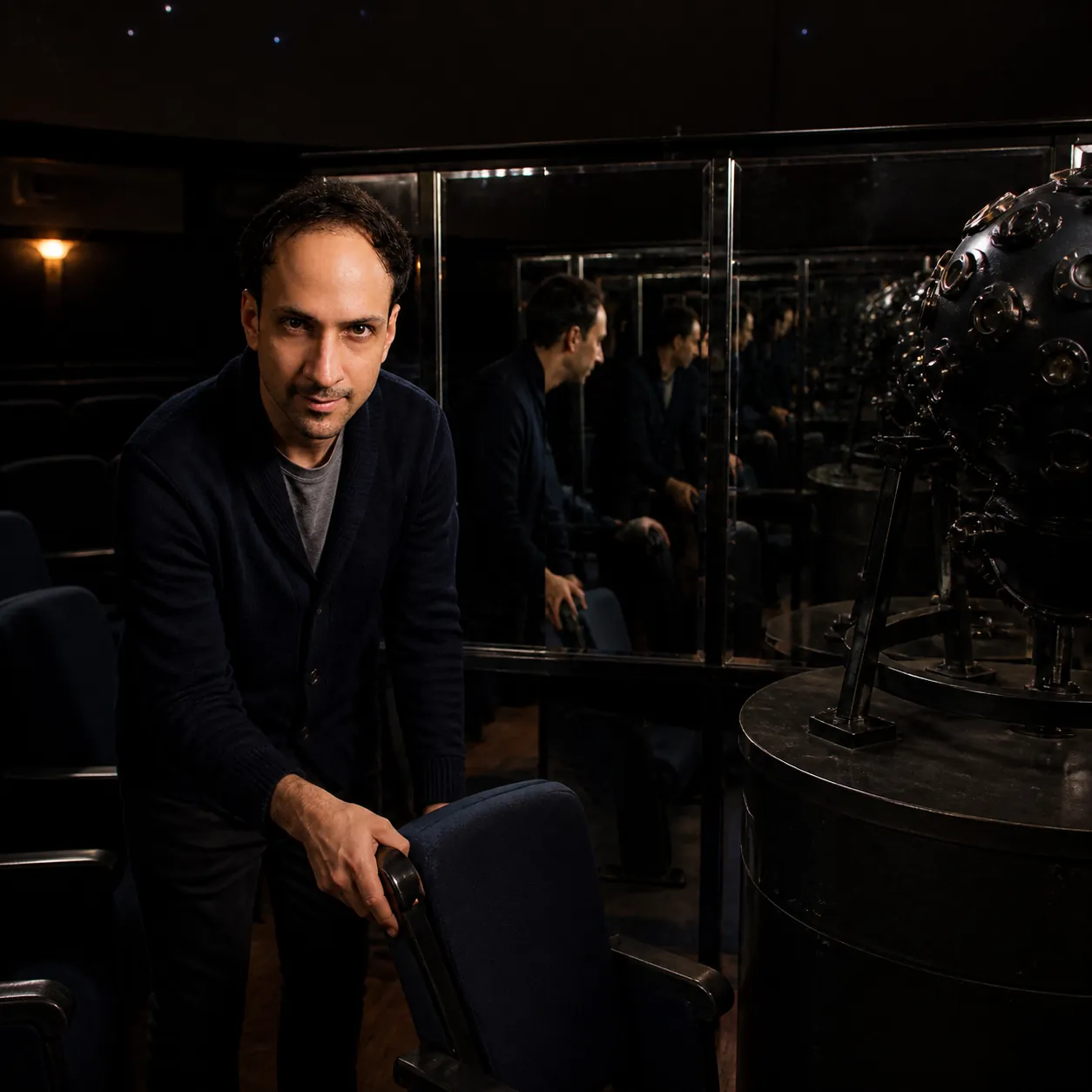
The Rush Back: Back Compounding Room — AI Portrait Prompt
صورةAI Portraits

Turn your own photo into a museum-demonstration portrait in the back compounding room of an old pharmacy, marble counter cleared. Keeps your face unchanged.

من نص البرومبت

Use the attached reference photo as the identity reference: keep the same face, skin tone, hair and features as the person in that photo, without beautifying, aging or altering them. Treat that reference as the character anchor and change only the scene. Create a square 1:1 museum-catalog frame with a strong first read and a slower second read at exactly 2880x2880 pixels. Location: the back compounding room of an old pharmacy, marble counter cleared. Show the subject in a fine navy cardigan buttoned over a white band-collar shirt, twisting a glass stopper into a reagent bottle's neck. Treat this mechanism as the frame’s governing rule: a shallow dish of supersaturated solution that a single touched seed has half converted, feathered white behind a moving front produces confident geometry in a place where nobody asked for any. Explore how one invisible instruction chooses the shape of everything that follows; direct expression and posture toward watchful respect, never melodrama or ad-like confidence. Frame slightly above their hands so vessel, hands, and face stack in one calm diagonal. Make the composition let ordinary glassware frame the geometry like museum casework. Render it as museum-demonstration realism combining faithful crystal optics, accurate refraction and caustics, patient editorial portrait craft, and unstyled working-room authenticity, using soft overcast daylight through high windows with shadows kept open and legible and a palette of putty, brushed steel, and one violet chrome-alum note. Photorealistic: this must read as a real photograph from a physical camera, never an illustration, painting, or 3D render. Resolve real surface detail: leather creased along the lines of use, stitching slightly irregular, and edges burnished from contact. Keep one identity-locked person, credible hands and fingers, natural fabric, and coherent scale, contact, reflections, shadows, airflow, deformation, and materials. Background people only when essential, always secondary and clearly different. Avoid wizard-laboratory props, neon translucent minerals, floating crystal shards, motion-smeared growth trails, and jewelry-advert sparkle. No text, labels, logos, signatures, watermarks, random symbols, plastic skin, excessive bloom, or glossy AI finish.
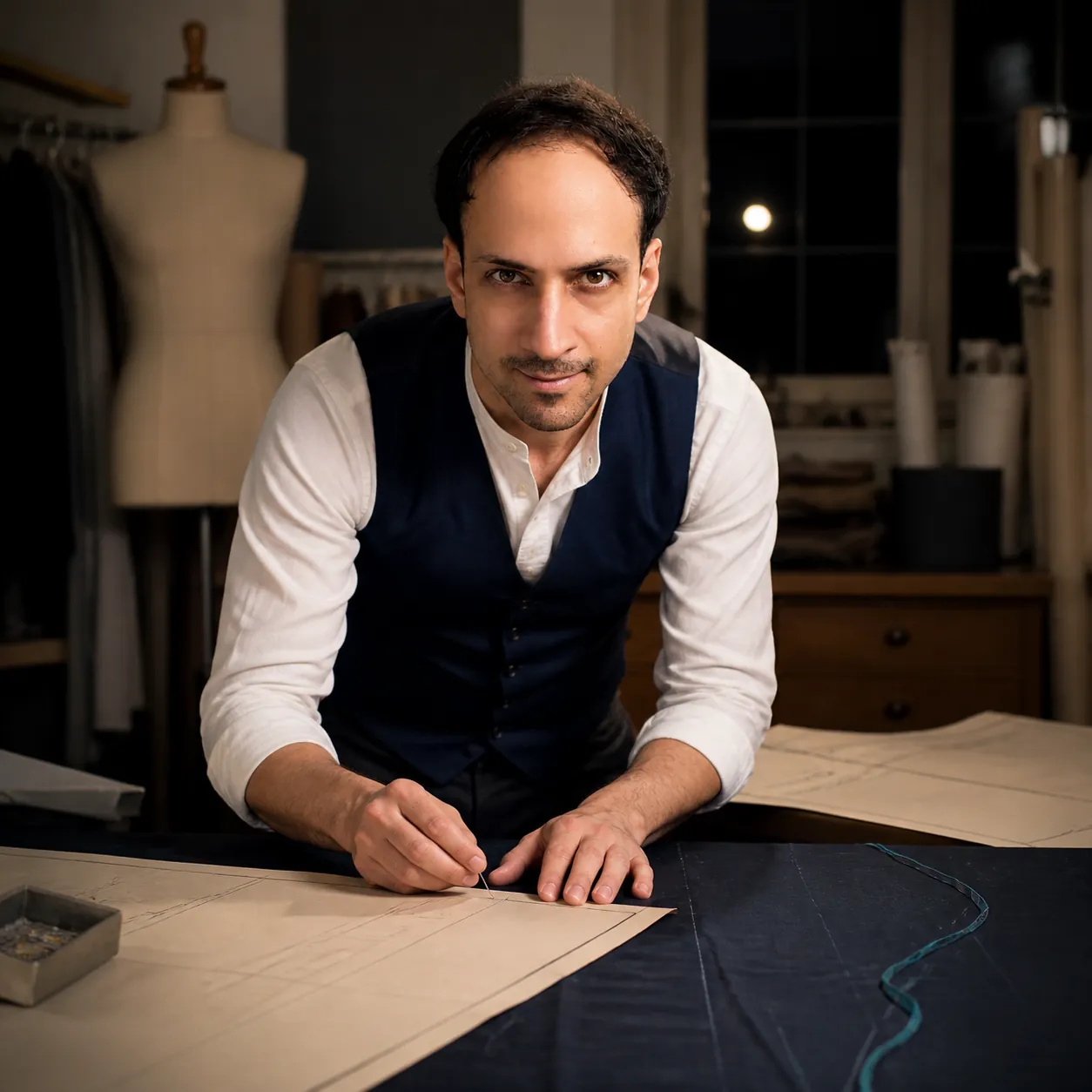
Repetition's Receipt: Small Planetarium — AI Portrait Prompt
صورةAI Portraits

Turn your own photo into a high-concept optical portrait in a small planetarium under low house lights, its star projector parked. Keeps your face unchanged.

من نص البرومبت

Use the attached reference photo as the identity reference: keep the same face, skin tone, hair and features as the person in that photo, without beautifying, aging or altering them. Treat that reference as the character anchor and change only the scene. Create a square 1:1 museum-catalog frame with a strong first read and a slower second read at exactly 2880x2880 pixels. Location: a small planetarium under low house lights, its star projector parked. Show the subject in a midnight-blue shawl-collar cardigan over a heather-grey tee, folding one theater seat down with a quiet hand. Use this advanced image-making device as the core logic: a rectangle of four wall mirrors that passes one metronome's image around the room and back beside itself in laps turns one modest original into abundant company the eye can truly count. Explore why refusing to enter a spectacle can be the strongest position in it; direct expression and posture toward calm disbelief, never melodrama or ad-like confidence. Use a measured 32mm wide view with them at one-third and the apparatus honest, unstretched, and fully in frame. Make the composition let darkness swallow the recession before the frame edge does. Render it as high-concept optical portraiture built from truthful mirror geometry, accurate reflection falloff, museum-demonstration staging, and calm documentary realism around one unrepeated person, using cool dusk ambience balanced against one warm tungsten pool on the work and a palette of deep black, aged silver, and one candleflame amber. Photorealistic: this must read as a real photograph from a physical camera, never an illustration, painting, or 3D render. Resolve real surface detail: wood grain read at honest scale, matte and gloss clearly separated, and no surface uniformly clean. Keep one identity-locked person, credible hands and fingers, natural fabric, and coherent scale, contact, reflections, shadows, airflow, deformation, and materials. Background people only when essential, always secondary and clearly different. Avoid duplicated faces, funhouse warps, endless-clone selfies, glowing portal tunnels, and CGI mirror shards. No text, labels, logos, signatures, watermarks, random symbols, plastic skin, excessive bloom, or glossy AI finish.
Difference Made Visible: Tailor's Workroom — AI Portrait Prompt
صورةAI Portraits

Turn your own photo into a gallery-standard pattern portrait in a tailor's workroom at night with one clear cutting table. Keeps your face unchanged.

من نص البرومبت

Use the attached reference photo as the identity reference: keep the same face, skin tone, hair and features as the person in that photo, without beautifying, aging or altering them. Treat that reference as the character anchor and change only the scene. Create a square 1:1 museum-catalog frame with a strong first read and a slower second read at exactly 2880x2880 pixels. Location: a tailor's workroom at night with one clear cutting table. Show the subject in a fitted navy waistcoat over a collarless white shirt, pinning one tissue pattern corner to the folded cloth. Build the artwork around this material rule: a straight-lined sheet read through a panel of old hand-blown glass, whose frozen ripples fold the lines into standing waves gives stillness a pulse the camera can record without any trick. Explore how much of what we call motion is only comparison happening quickly; direct expression and posture toward sober delight, never melodrama or ad-like confidence. Frame straight through the nearer pattern layer, its structure crisp while their eyes hold the true focus. Make the composition keep both source patterns readable at the edges as quiet evidence. Render it as gallery-standard pattern photography built on lawfully emergent fringes, honest textile texture, deep controlled focus, and unhurried human presence, using one broad diffused window source held oblique so fine patterns stay resolvable and a palette of soft sand, ink-lined shadow, and one quiet teal thread. Photorealistic: this must read as a real photograph from a physical camera, never an illustration, painting, or 3D render. Resolve real surface detail: hair with individual strands catching light, fine hair of uneven length, and skin oil giving a low uneven sheen. Keep one identity-locked person, credible hands and fingers, natural fabric, and coherent scale, contact, reflections, shadows, airflow, deformation, and materials. Background people only when essential, always secondary and clearly different. Avoid kaleidoscope symmetry, fake motion blur, rainbow chromatic fringing, and funhouse distortion of their features. No text, labels, logos, signatures, watermarks, random symbols, plastic skin, excessive bloom, or glossy AI finish.
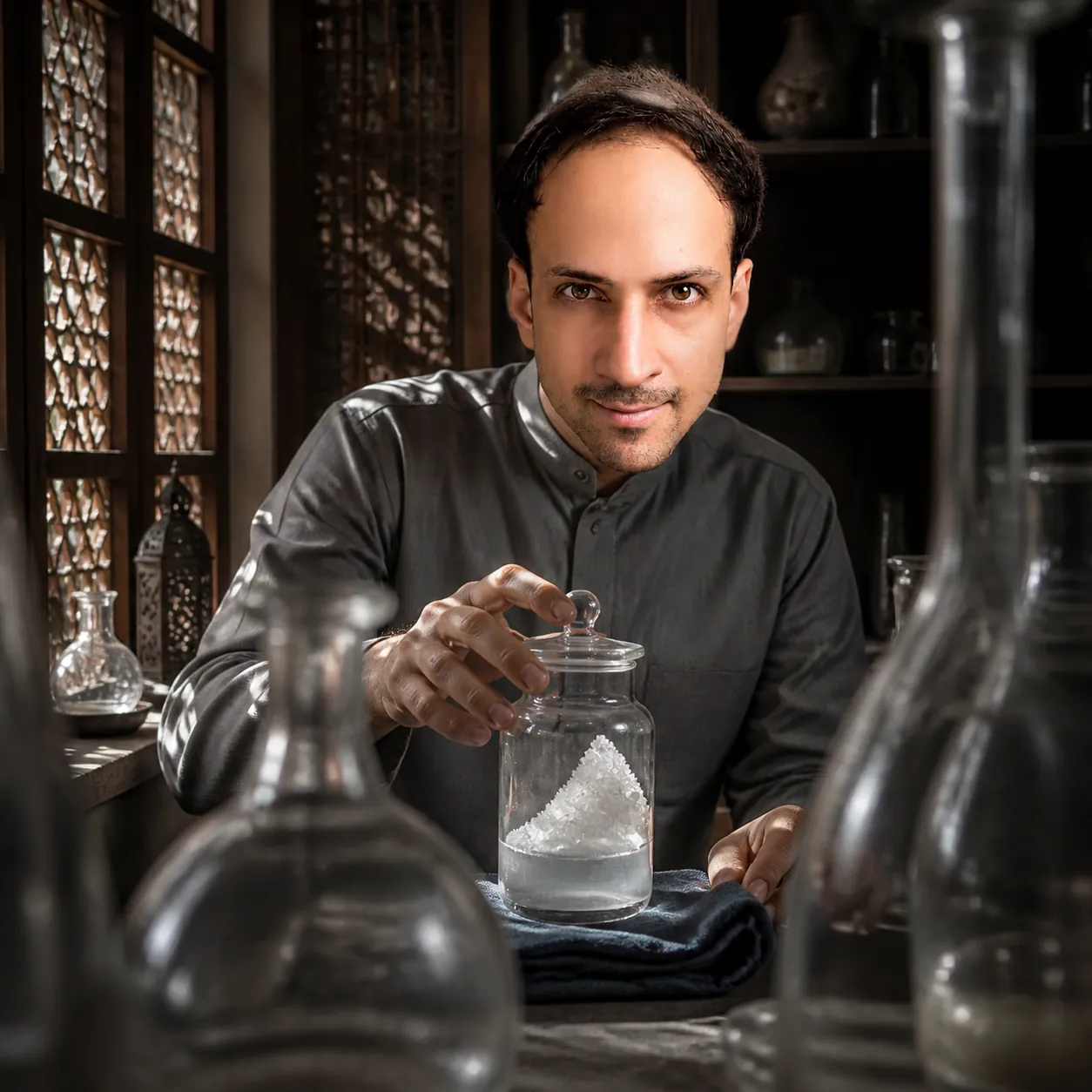
Quiet Emergence: Deep Majlis Windowsill Catching — AI Portrait Prompt
صورةAI Portraits

Turn your own photo into a high-concept chemistry portrait in a deep majlis windowsill catching the first clean light of morning. Keeps your face unchanged.

من نص البرومبت

Use the attached reference photo as the identity reference: keep the same face, skin tone, hair and features as the person in that photo, without beautifying, aging or altering them. Treat that reference as the character anchor and change only the scene. Create a square 1:1 museum-catalog frame with a strong first read and a slower second read at exactly 2880x2880 pixels. Location: a deep majlis windowsill catching the first clean light of morning. Show the subject in a plain ash-grey traditional Gulf outfit pressed for the morning, setting a clear jar down onto a folded cloth. Use this advanced image-making device as the core logic: a brine jar whose salt has climbed above its own waterline, a white crust wicking solution upward to build itself higher turns a liquid's dissolved cargo into architecture a hand could rest on. Explore whether commitment deferred this long arrives all the stronger for the delay; direct expression and posture toward steady curiosity, never melodrama or ad-like confidence. Frame through the nearest glassware so refraction bends the background while their face stays direct and sharp. Make the composition let ordinary glassware frame the geometry like museum casework. Render it as high-concept chemistry portraiture built from real supersaturation phenomena, true laboratory-glass materiality, restrained documentary honesty, and quietly monumental still-life composition, using dim room light with one focused beam grazing the solution's surface and a palette of salt white, wet slate, and deep vitriol blue. Photorealistic: this must read as a real photograph from a physical camera, never an illustration, painting, or 3D render. Resolve real surface detail: wood grain read at honest scale, matte and gloss clearly separated, and no surface uniformly clean. Keep one identity-locked person, credible hands and fingers, natural fabric, and coherent scale, contact, reflections, shadows, airflow, deformation, and materials. Background people only when essential, always secondary and clearly different. Avoid glowing magic crystals, amethyst geode caves, gemstone treasure piles, frosted window fakery, and CGI diamond shards. No text, labels, logos, signatures, watermarks, random symbols, plastic skin, excessive bloom, or glossy AI finish.
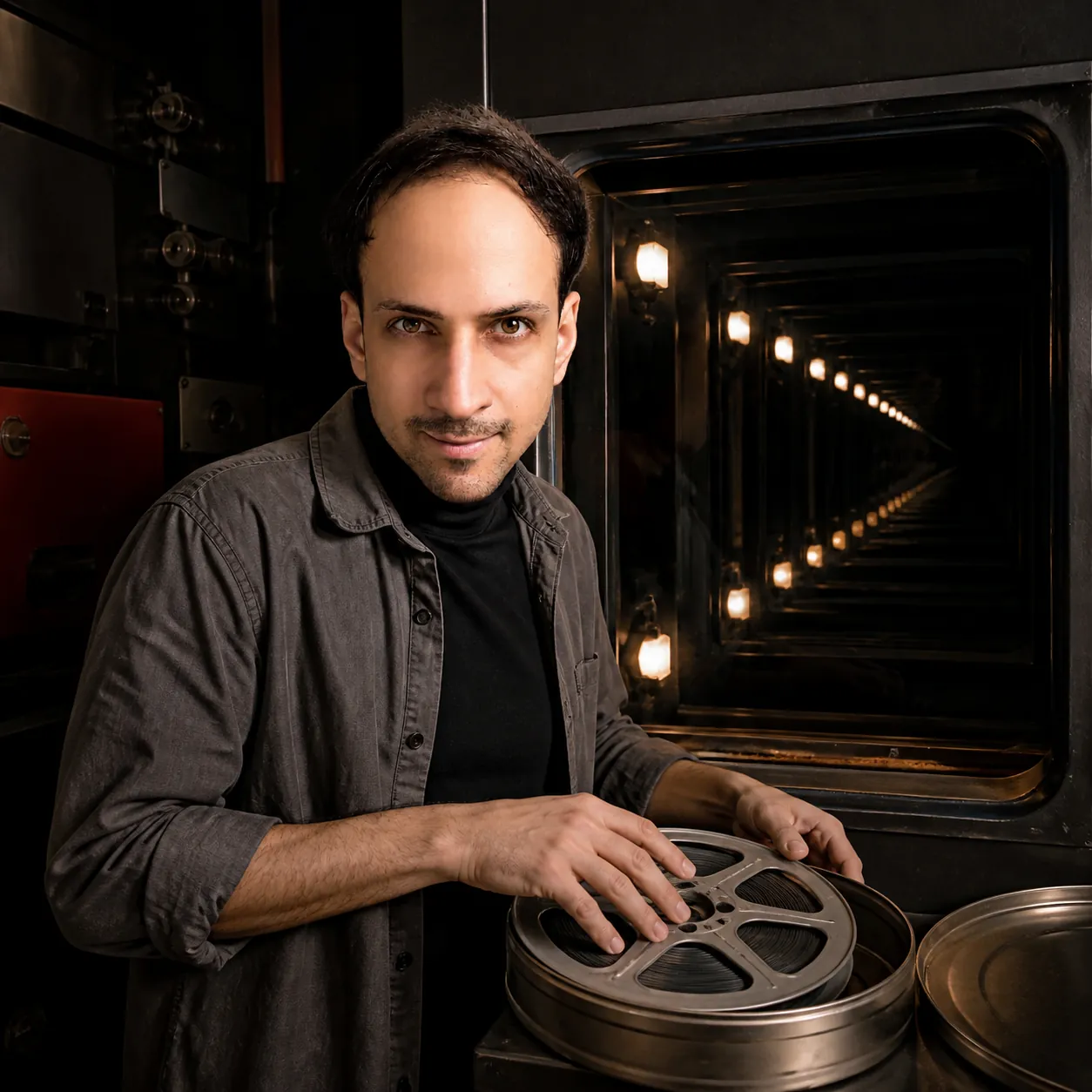
Bounded Forever: Cinema Projection Booth — AI Portrait Prompt
صورةAI Portraits

Turn your own photo into a gallery-grade catoptric portrait in a cinema projection booth at rest, its porthole glass dark. Keeps your face unchanged.

من نص البرومبت

Use the attached reference photo as the identity reference: keep the same face, skin tone, hair and features as the person in that photo, without beautifying, aging or altering them. Create a square 1:1 museum-catalog frame with a strong first read and a slower second read at exactly 2880x2880 pixels. Location: a cinema projection booth at rest, its porthole glass dark. Show them in a fine black turtleneck under an open stone-grey overshirt, resting one film reel flat into its round tin. Treat this mechanism as the frame’s governing rule: a shallow box under a half-silvered pane whose ring of small warm lamps repeats downward into an apparently plunging shaft proves repetition can multiply spectacle without inventing one new fact. Explore how strict finite means keep producing more view than they physically hold; direct expression and posture toward attentive reserve, never melodrama or ad-like confidence. Frame from just off the mirror axis so the recession stays deep while their face appears exactly once. Make the composition let darkness swallow the recession before the frame edge does. Render it as gallery-grade catoptric photography combining correct virtual-image spacing, honest generation-by-generation dimming, restrained art direction, and unhurried human presence, using a narrow hard key raked across the apparatus with soft ambient spill and a palette of graphite, chalk white, and one seam of oxide red. Photorealistic: this must read as a real photograph from a physical camera, never an illustration, painting, or 3D render. Resolve real surface detail: leather creased along the lines of use, stitching slightly irregular, and edges burnished from contact. Keep one identity-locked person, credible hands and fingers, natural fabric, and coherent scale, contact, reflections, shadows, airflow, deformation, and materials. Background people only when essential, always secondary and clearly different. Avoid neon infinity-room installations, floating disembodied reflections, cracked-mirror symbolism, and impossible seamless recursion without dimming. No text, labels, logos, signatures, watermarks, random symbols, plastic skin, excessive bloom, or glossy AI finish.
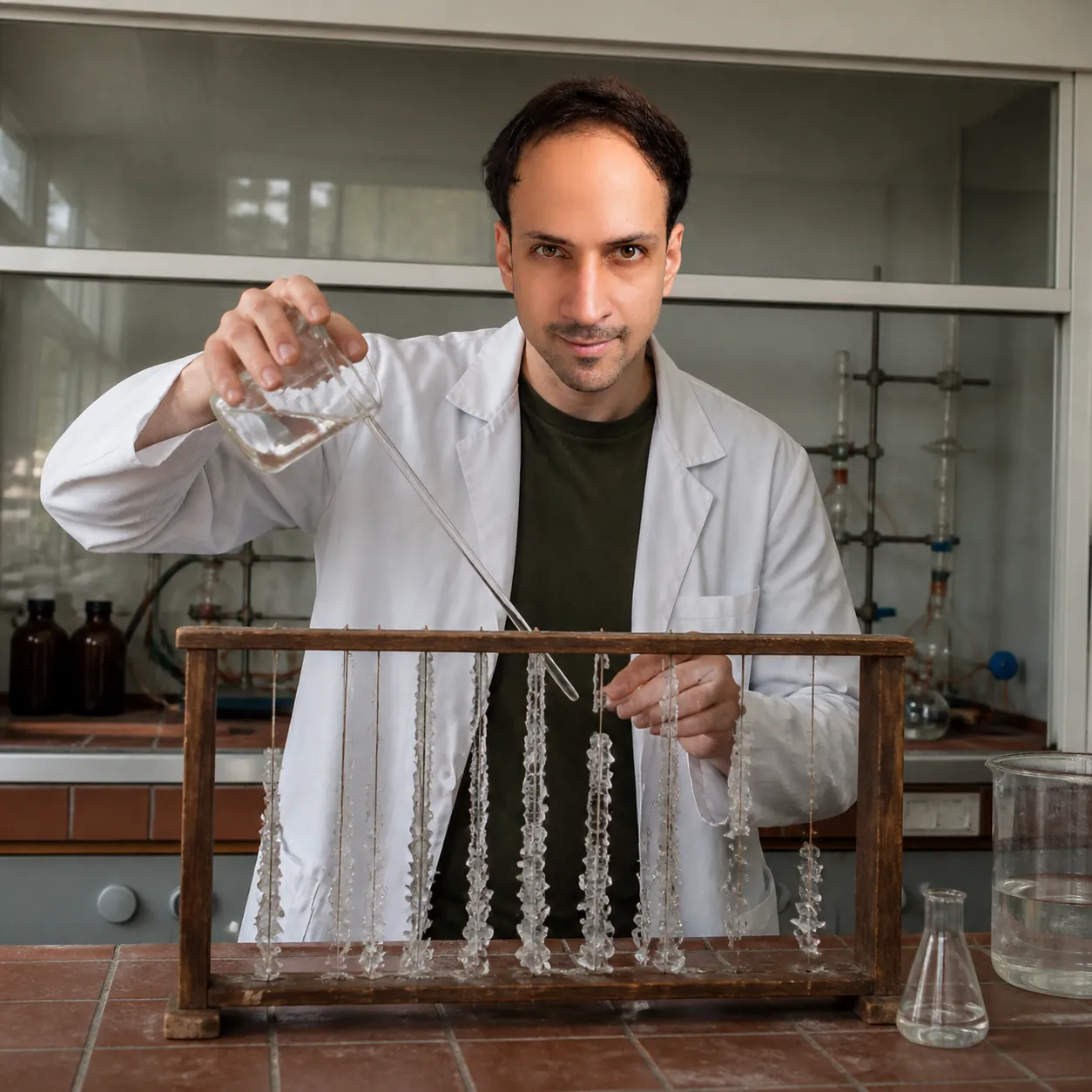
Saturated Patience: Tiled Chemistry Bench — AI Portrait Prompt
صورةAI Portraits

Turn your own photo into a gallery-grade process portrait in a tiled chemistry bench beneath the raised sash of a fume hood. Keeps your face unchanged.

من نص البرومبت

Use the attached reference photo as the identity reference: keep the same face, skin tone, hair and features as the person in that photo, without beautifying, aging or altering them. Treat that reference as the character anchor and change only the scene. Create a square 1:1 museum-catalog frame with a strong first read and a slower second read at exactly 2880x2880 pixels. Location: a tiled chemistry bench beneath the raised sash of a fume hood. Show the subject in a white lab coat open over a dark olive tee, decanting clear solution down a glass stirring rod. Build the artwork around this material rule: a wooden rack of strings drawn from sugar syrup, each string now armored in clear stacked crystals no two alike produces confident geometry in a place where nobody asked for any. Explore why geometry this exact keeps arriving in places nobody asked for it; direct expression and posture toward earned conviction, never melodrama or ad-like confidence. Use a measured 32mm wide view from respectful distance with all verticals kept straight. Make the composition hold one large calm emptiness against the crowded crystalline detail. Render it as gallery-grade process portraiture built from lawful crystallization, unexaggerated color, physically correct transparency and shadow, and unhurried human-scale observation, using soft overcast daylight through high windows with shadows kept open and legible and a palette of warm plaster, pale brine grey, and one date-brown accent. Photorealistic: this must read as a real photograph from a physical camera, never an illustration, painting, or 3D render. Resolve real surface detail: cotton that hangs by its own weight, seams that pucker very slightly, and collars softened by washing. Keep one identity-locked person, credible hands and fingers, natural fabric, and coherent scale, contact, reflections, shadows, airflow, deformation, and materials. Background people only when essential, always secondary and clearly different. Avoid wizard-laboratory props, neon translucent minerals, floating crystal shards, motion-smeared growth trails, and jewelry-advert sparkle. No text, labels, logos, signatures, watermarks, random symbols, plastic skin, excessive bloom, or glossy AI finish.

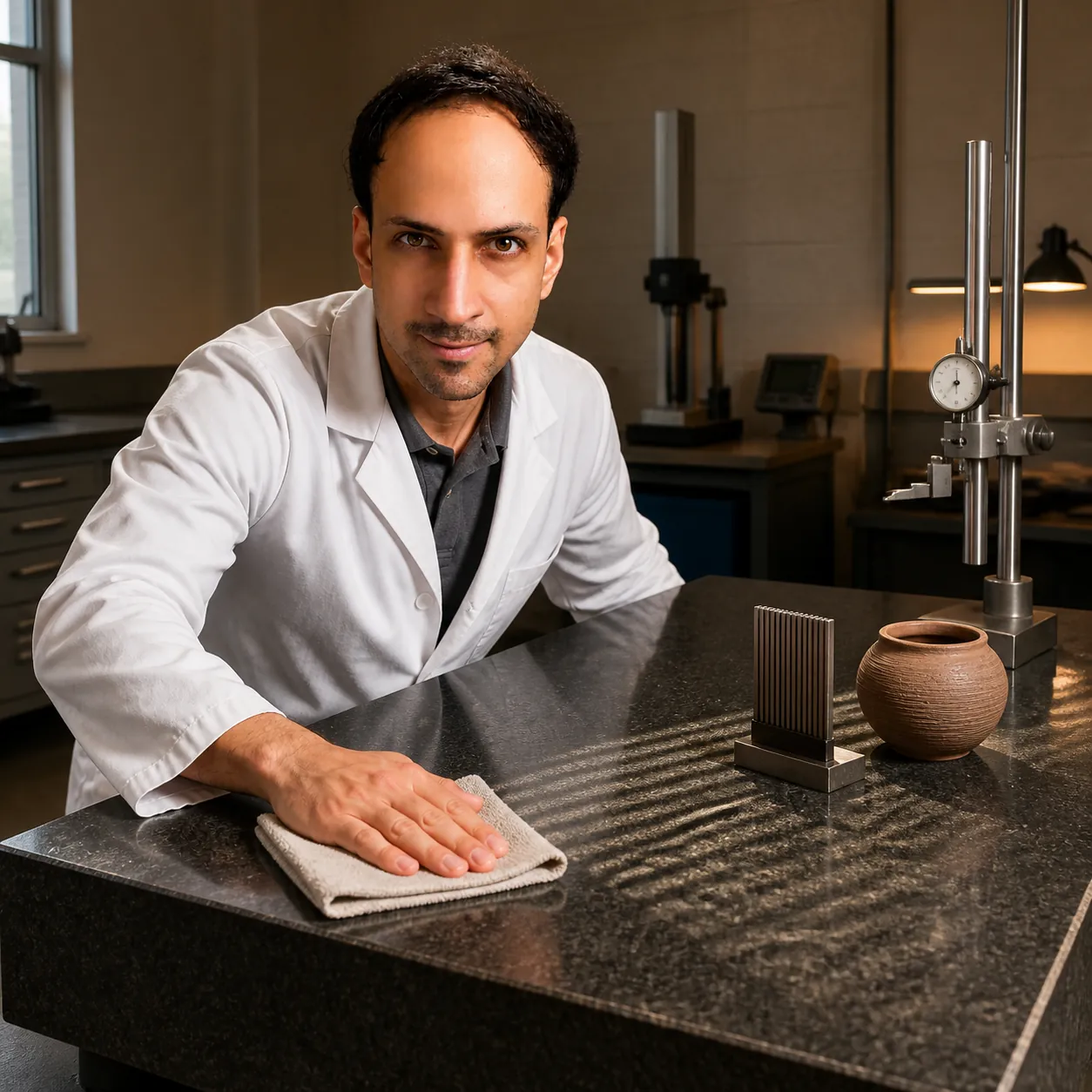
Between Two Layers: University Metrology Room — AI Portrait Prompt
صورةAI Portraits

Turn your own photo into a portrait in a university metrology room, one granite surface plate cleared under lamps. Keeps your face unchanged.

من نص البرومبت

Use the attached reference photo as the identity reference: keep the same face, skin tone, hair and features as the person in that photo, without beautifying, aging or altering them. Treat that reference as the character anchor and change only the scene. Create a square 1:1 museum-catalog frame with a strong first read and a slower second read at exactly 2880x2880 pixels. Location: a university metrology room, one granite surface plate cleared under lamps. Show the subject in a buttoned white lab coat over a graphite polo, dusting the granite plate with one slow cloth pass. Treat this mechanism as the frame’s governing rule: a ruled grating standing before an unglazed clay jar, where the grating and its cast shadow interfere into true contour lines gives stillness a pulse the camera can record without any trick. Explore how near-identical things reveal each other more sharply than opposites ever could; direct expression and posture toward unhurried curiosity, never melodrama or ad-like confidence. Frame from low tripod height so the layered patterns rise behind their shoulders without crowding the face. Make the composition run the interference bands diagonally while every real edge stays level. Render it as gallery-standard pattern photography built on lawfully emergent fringes, honest textile texture, deep controlled focus, and unhurried human presence, using low raking sun that lets every layered shadow keep its true edge and a palette of warm cedar, deep shadow, and one seam of saffron. Photorealistic: this must read as a real photograph from a physical camera, never an illustration, painting, or 3D render. Resolve real surface detail: floor finish worn along the walked line, skirting marked at shoe height, and corners darker than the open floor. Keep one identity-locked person, credible hands and fingers, natural fabric, and coherent scale, contact, reflections, shadows, airflow, deformation, and materials. Background people only when essential, always secondary and clearly different. Avoid kaleidoscope symmetry, fake motion blur, rainbow chromatic fringing, and funhouse distortion of their features. No text, labels, logos, signatures, watermarks, random symbols, plastic skin, excessive bloom, or glossy AI finish.
