جاري التحميل...


جاري التحميل...
Turn your own photo into a portrait in a restored heritage house hallway with latticed windows along one side. Keeps your face unchanged.
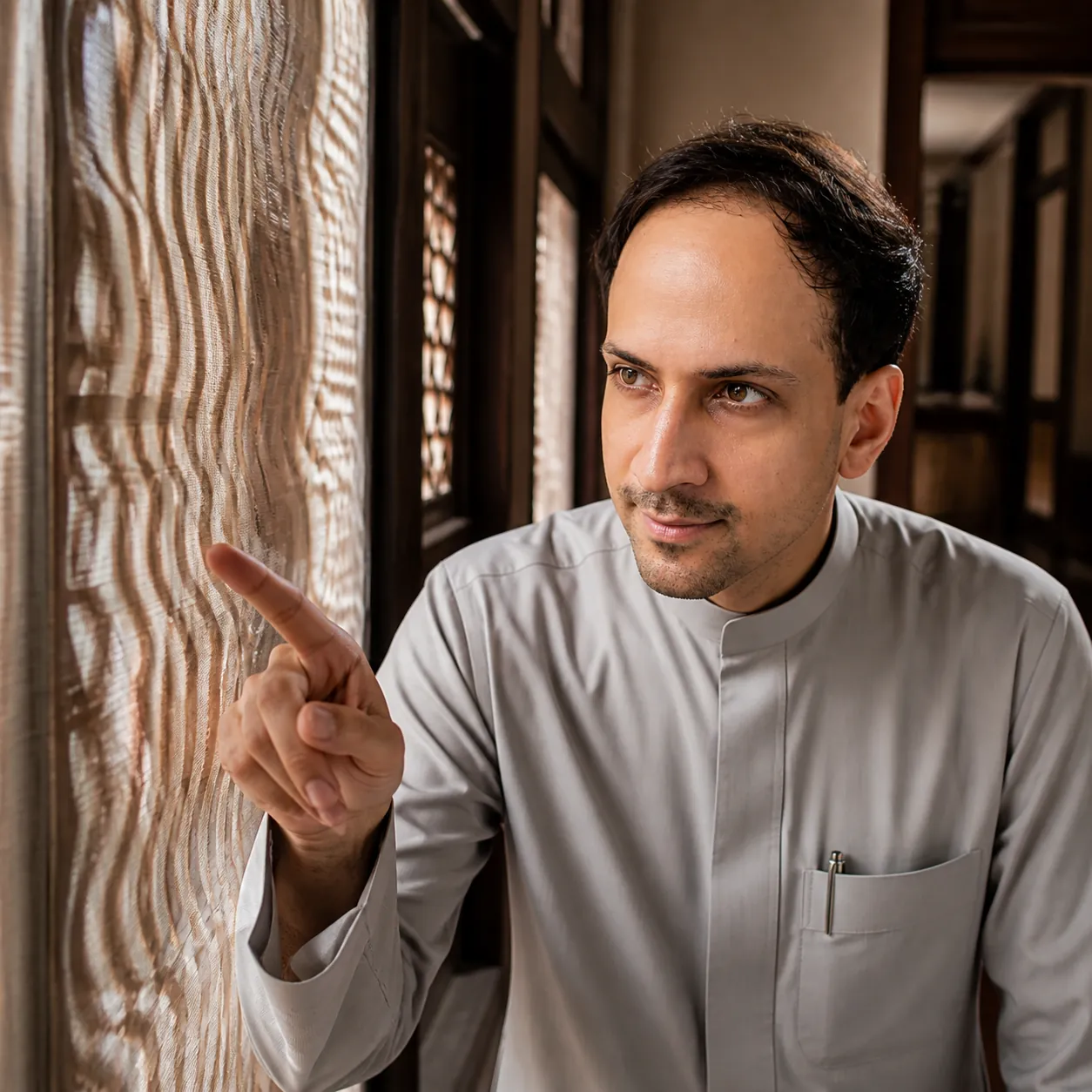
Use the attached reference photo as the identity reference: keep the same face, skin tone, hair and features as the person in that photo, without beautifying, aging or altering them. Treat that reference as the character anchor and change only the scene. Create a square 1:1 museum-catalog frame with a strong first read and a slower second read at exactly 2880x2880 pixels. Location: a restored heritage house hallway with latticed windows along one side. Show the subject in a plain pale-grey traditional Gulf outfit with one pen in the chest pocket, tracing one lattice opening lightly with an index finger. The impossible-looking event must obey this clear system: a double layer of sheer silk stretched on one frame, whose riding weaves break into watered bands that gave moiré its name gives stillness a pulse the camera can record without any trick. Explore what it means that the boldest pattern present was authored by neither maker; direct expression and posture toward patient scrutiny, never melodrama or ad-like confidence. Use a 50mm standpoint set exactly where the bands read strongest, with their face just off that axis. Make the composition keep both source patterns readable at the edges as quiet evidence. Render it as museum-grade optical demonstration realism combining true moiré geometry, tactile weave detail, faithful shadow behavior, and calm editorial framing, using one broad diffused window source held oblique so fine patterns stay resolvable and a palette of soft sand, ink-lined shadow, and one quiet teal thread. Photorealistic: this must read as a real photograph from a physical camera, never an illustration, painting, or 3D render. Resolve real surface detail: condensation beading at true size, liquid meniscus curving against glass, and wet surfaces darker than dry ones. Keep one identity-locked person, credible hands and fingers, natural fabric, and coherent scale, contact, reflections, shadows, airflow, deformation, and materials. Background people only when essential, always secondary and clearly different. Avoid kaleidoscope symmetry, fake motion blur, rainbow chromatic fringing, and funhouse distortion of their features. No text, labels, logos, signatures, watermarks, random symbols, plastic skin, excessive bloom, or glossy AI finish.
Turn your own photo into a photorealistic portrait in the hallway of your apartment between the bedroom and kitchen doors. Keeps your face unchanged.
Turn your own photo into a photorealistic portrait in a house courtyard at dusk with the heat lifting off the tiles. Keeps your face unchanged.
Turn your own photo into a quiet observational portrait in a low majlis table where a brass tray gathers glasses and dallah. Keeps your face unchanged.
Turn your own photo into a quiet archival portrait in a bench beside a carved door whose brass pull shines from a century of palms. Keeps your face unchanged.
Turn your own photo into a quiet cinematic portrait in a bus shelter's strip of shade on a wide afternoon road. Keeps your face unchanged.
Turn your own photo into a photorealistic portrait in your old school's corridor where the banister ends in a shine every pupil made. Keeps your face unchanged.
Turn your own photo into a candid reflex-moment portrait in a long office corridor of doors and cool fluorescent calm. Keeps your face unchanged.
Turn your own photo into a photorealistic portrait in the flat roof of the family house as the last daylight drains. Keeps your face unchanged.
Turn your own photo into an understated editorial portrait in the driver's seat of a parked family car with the engine off. Keeps your face unchanged.
Turn your own photo into a portrait in the corner of your kitchen where the kettle sits between window and sink. Keeps your face unchanged.
Turn your own photo into a gallery-scale documentary portrait in an office floor at the end of the day, most desks dark. Keeps your face unchanged.
Turn your own photo into a portrait in your grandfather's workshop where tool handles hang darkened at your grips. Keeps your face unchanged.