جاري التحميل...


جاري التحميل...
Turn the path from observed need to measured iteration into a restrained hand-drawn visual system.
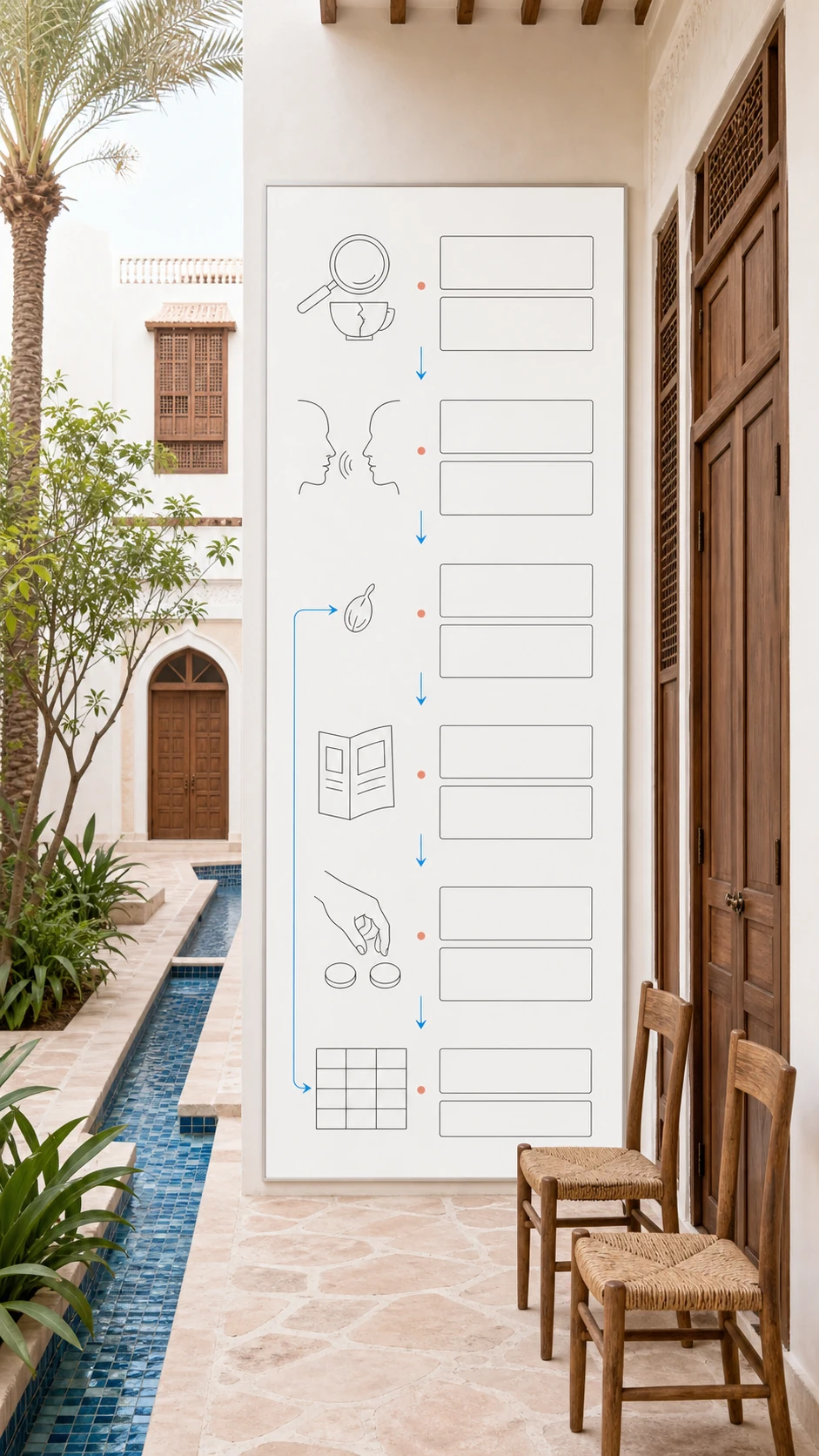
1Create a contemporary 9:16 Hejaz infographic as a large hand-drawn whiteboard in a planted Jeddah neighborhood courtyard with a narrow decorative water channel and soft Red Sea daylight. Use a balanced architectural frame with credible scale established by doors, shaded seating, paving joints, and the circulation path around the board. Organize six sequential, airy modules that communicate: observe a real problem, interview affected people, define the smallest useful promise, build the smallest testable prototype, test with real behavior, and measure evidence before iterating. Give every module one distinct thin-line symbol, one separate clean blank heading field, and one separate clean blank evidence-note field positioned beside its own symbol. Connect modules with delicate blue arrows, include one small empty evidence grid, and use warm coral only for restrained emphasis markers. Keep lines fine, slightly imperfect, and architectural; use generous white space, dark gray outlines, no shadows, no gradients, no clip art, and no heavy containers. Reserve all twelve module fields plus the grid cells as clean blank targets for professional post-typesetting after generation. Generate no text, letters, numerals, handwriting, labels, logos, wordmarks, readable interfaces, signatures, or watermarks. Every person shown anywhere in this image, including tiny, distant, or background figures, is an explicitly fictional adult aged 25 or older, does not resemble any real person, and wears modest, fully opaque clothing.
Analyze a company's fundraising rounds, including years, amounts, targeting strategies, and involvement of various investors. Provide insights into the company's profile, founder's background, and investor dynamics, along with references to relevant blogs and reports.
Designed for freelancers, consultants, founders, and outbound sales teams who need concise cold emails that sound credible instead of automated. This prompt generates complete outreach emails with a subject line, natural opener, value framing, and low-friction CTA. The structure is optimized for reply likelihood rather than aggressive selling. Outputs are short, professional, and ready to send without editing.