جاري التحميل...


جاري التحميل...
Create a square 1:1 museum-catalog frame with a strong first read and a slower second read. Location: a deep window bay facing west as the sun loses its...
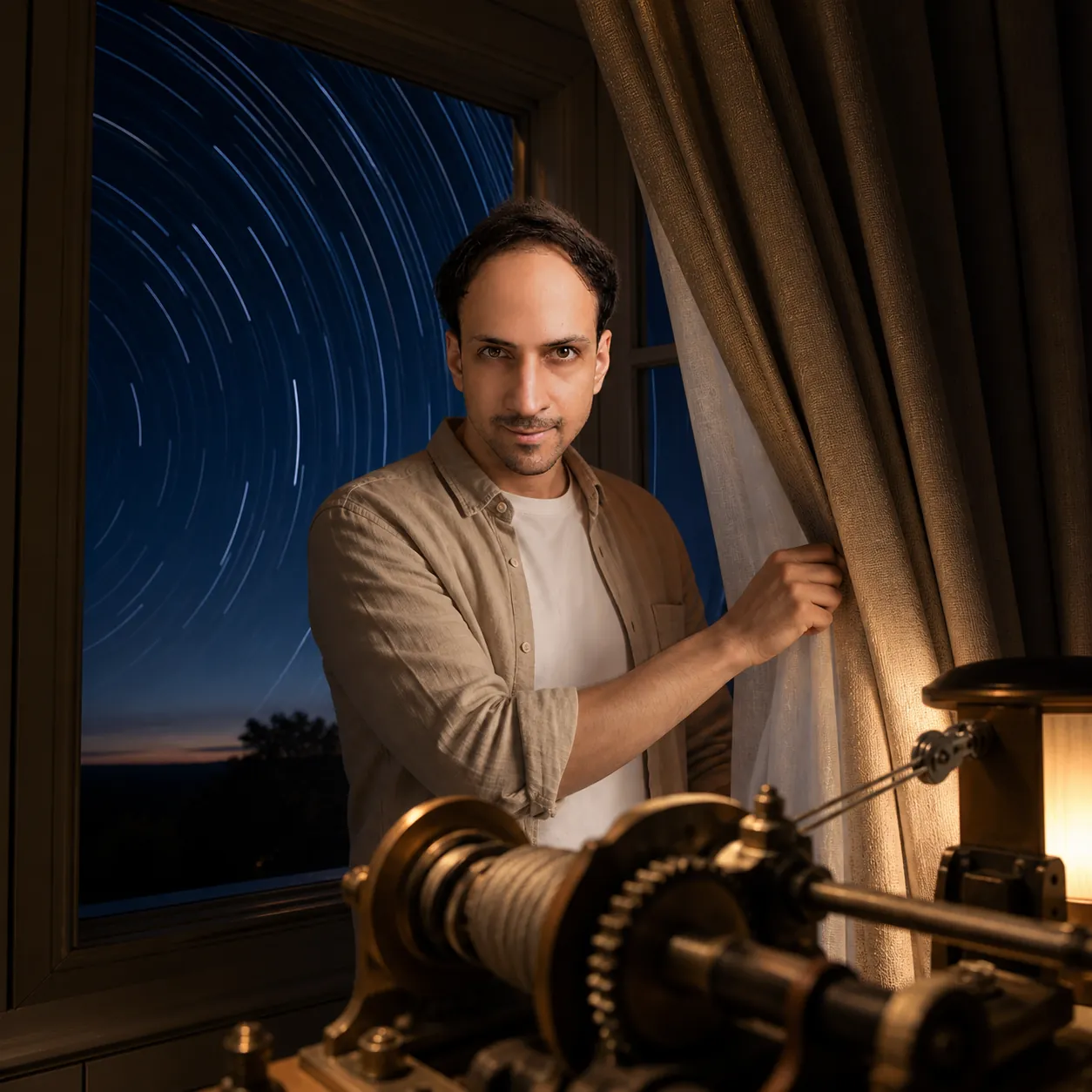
Use the attached reference photo as the identity reference: keep the same face, skin tone, hair and features as the person in that photo, without beautifying, aging or altering them. Create a square 1:1 museum-catalog frame with a strong first read and a slower second read. Location: a deep window bay facing west as the sun loses its height. Show the subject in an unbuttoned oatmeal linen shirt over a white tee, drawing a layered curtain to its halfway mark. The impossible-looking event must obey this clear system: a bedroom window whose long-exposure view has dragged the stars into one clean arc spanning the whole slept night gives the evening a working mechanism instead of a willpower test. Explore how far the stars travel across a night that was fully kept; direct expression and posture toward deliberate care, never melodrama or ad-like confidence. Use a 100mm macro-to-portrait hybrid: one clockwork detail near the lens and the person in the reference photo's face readable beyond it, both physically plausible. Make the composition place the brightest permitted light below their eye line. Render it as high-concept circadian portraiture built from working light-control mechanisms, documentary realism, warm horological detail, and emotionally intelligent composition, using quiet blue-hour ambient light with one low-intensity tungsten interior source and a palette of ember orange, soft black, and unbleached wool white. Keep one identity-locked person, credible hands and fingers, natural fabric, and coherent scale, contact, reflections, shadows, airflow, deformation, and materials. Background people only when essential, always secondary and clearly different. Avoid glowing smartphone screens, blue-lit doomscrolling, alarm-clock clichés, sleeping-pill imagery, and insomnia dramatics. No text, labels, logos, signatures, watermarks, random symbols, plastic skin, excessive bloom, or glossy AI finish.
Treat that reference as the character anchor and change only the scene. Create a square 1:1 museum-catalog frame with a strong first read and a slower...
Treat that reference as the character anchor and change only the scene. Create a square 1:1 museum-catalog frame with a strong first read and a slower...
Treat that reference as the character anchor and change only the scene. Create a square 1:1 museum-catalog frame with a strong first read and a slower...
Treat that reference as the character anchor and change only the scene. Create a square 1:1 museum-catalog frame with a strong first read and a slower...
Treat that reference as the character anchor and change only the scene. Create a square 1:1 museum-catalog frame with a strong first read and a slower...
Treat that reference as the character anchor and change only the scene. Create a square 1:1 museum-catalog frame with a strong first read and a slower...
Treat that reference as the character anchor and change only the scene. Create a square 1:1 museum-catalog frame with a strong first read and a slower...
Treat that reference as the character anchor and change only the scene. Create a square 1:1 museum-catalog frame with a strong first read and a slower...
Treat that reference as the character anchor and change only the scene. Create a square 1:1 museum-catalog frame with a strong first read and a slower...
Treat that reference as the character anchor and change only the scene. Create a square 1:1 museum-catalog frame with a strong first read and a slower...
Treat that reference as the character anchor and change only the scene. Create a square 1:1 museum-catalog frame with a strong first read and a slower...
Treat that reference as the character anchor and change only the scene. Create a square 1:1 museum-catalog frame with a strong first read and a slower...