جاري التحميل...


جاري التحميل...
Create a square 1:1 museum-catalog frame with a strong first read and a slower second read at exactly 2880x2880 pixels. Location: an architect's daylighting...
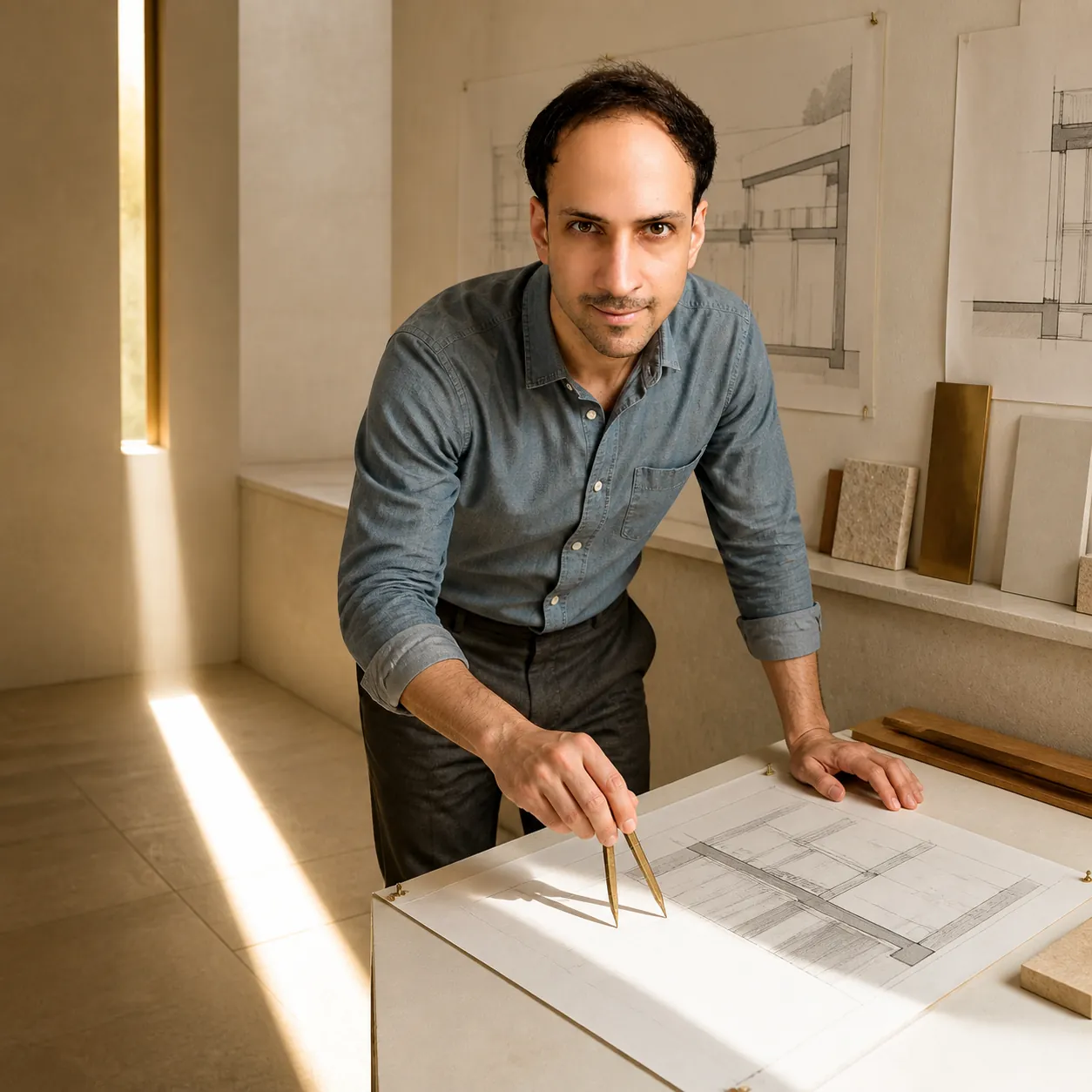
Use the attached reference photo as the identity reference: keep the same face, skin tone, hair and features as the person in that photo, without beautifying, aging or altering them. Create a square 1:1 museum-catalog frame with a strong first read and a slower second read at exactly 2880x2880 pixels. Location: an architect's daylighting office with section drawings pinned above a sill. Show the subject in a pressed chambray shirt tucked into charcoal wool trousers, walking a brass divider across a pinned section drawing. Use this advanced image-making device as the core logic: a milled brass wall slot whose admitted slab of morning light lands exactly between two lines incised in the floor makes the dose visible to the naked eye from across the room. Explore whether light that arrives on purpose feels different on the skin; direct expression and posture toward modest certainty, never melodrama or ad-like confidence. Frame along the light's travel so its entry, its path, and its landing all stay legible in one view. Make the composition give the beam one clean geometric edge that touches them. Render it as heliotherapy-room realism combining truthful sun angles, museum-grade architectural photography, tactile limewash surfaces, and unforced human presence at treatment scale, using true solar illumination metered by architecture, with no electric source anywhere visible and a palette of bone white, pale cedar, and a single amber slab. Photorealistic: this must read as a real photograph from a physical camera, never an illustration, painting, or 3D render. Resolve real surface detail: thread ends and slight pilling on worn cloth, hairline chips at every hard corner, and stone that is porous rather than smooth. Keep one identity-locked person, credible hands and fingers, natural fabric, and coherent scale, contact, reflections, shadows, airflow, deformation, and materials. Background people only when essential, always secondary and clearly different. Avoid tanning-salon imagery, golden-hour social-media grading, sunburst clock motifs, glowing skin retouching, and beams bending like spotlights. No text, labels, logos, signatures, watermarks, random symbols, plastic skin, excessive bloom, or glossy AI finish.
Treat that reference as the character anchor and change only the scene. Create a square 1:1 museum-catalog frame with a strong first read and a slower...
Treat that reference as the character anchor and change only the scene. Create a square 1:1 museum-catalog frame with a strong first read and a slower...
Treat that reference as the character anchor and change only the scene. Create a square 1:1 museum-catalog frame with a strong first read and a slower...
Treat that reference as the character anchor and change only the scene. Create a square 1:1 museum-catalog frame with a strong first read and a slower...
Treat that reference as the character anchor and change only the scene. Create a square 1:1 museum-catalog frame with a strong first read and a slower...
Treat that reference as the character anchor and change only the scene. Create a square 1:1 museum-catalog frame with a strong first read and a slower...
Treat that reference as the character anchor and change only the scene. Create a square 1:1 museum-catalog frame with a strong first read and a slower...
Treat that reference as the character anchor and change only the scene. Create a square 1:1 museum-catalog frame with a strong first read and a slower...
Treat that reference as the character anchor and change only the scene. Create a square 1:1 museum-catalog frame with a strong first read and a slower...
Treat that reference as the character anchor and change only the scene. Create a square 1:1 museum-catalog frame with a strong first read and a slower...
Treat that reference as the character anchor and change only the scene. Create a square 1:1 museum-catalog frame with a strong first read and a slower...
Treat that reference as the character anchor and change only the scene. Create a square 1:1 museum-catalog frame with a strong first read and a slower...