جاري التحميل...


جاري التحميل...
Create a square 1:1 museum-catalog frame with a strong first read and a slower second read. Location: a small museum rotunda with a center tile worn pale by...
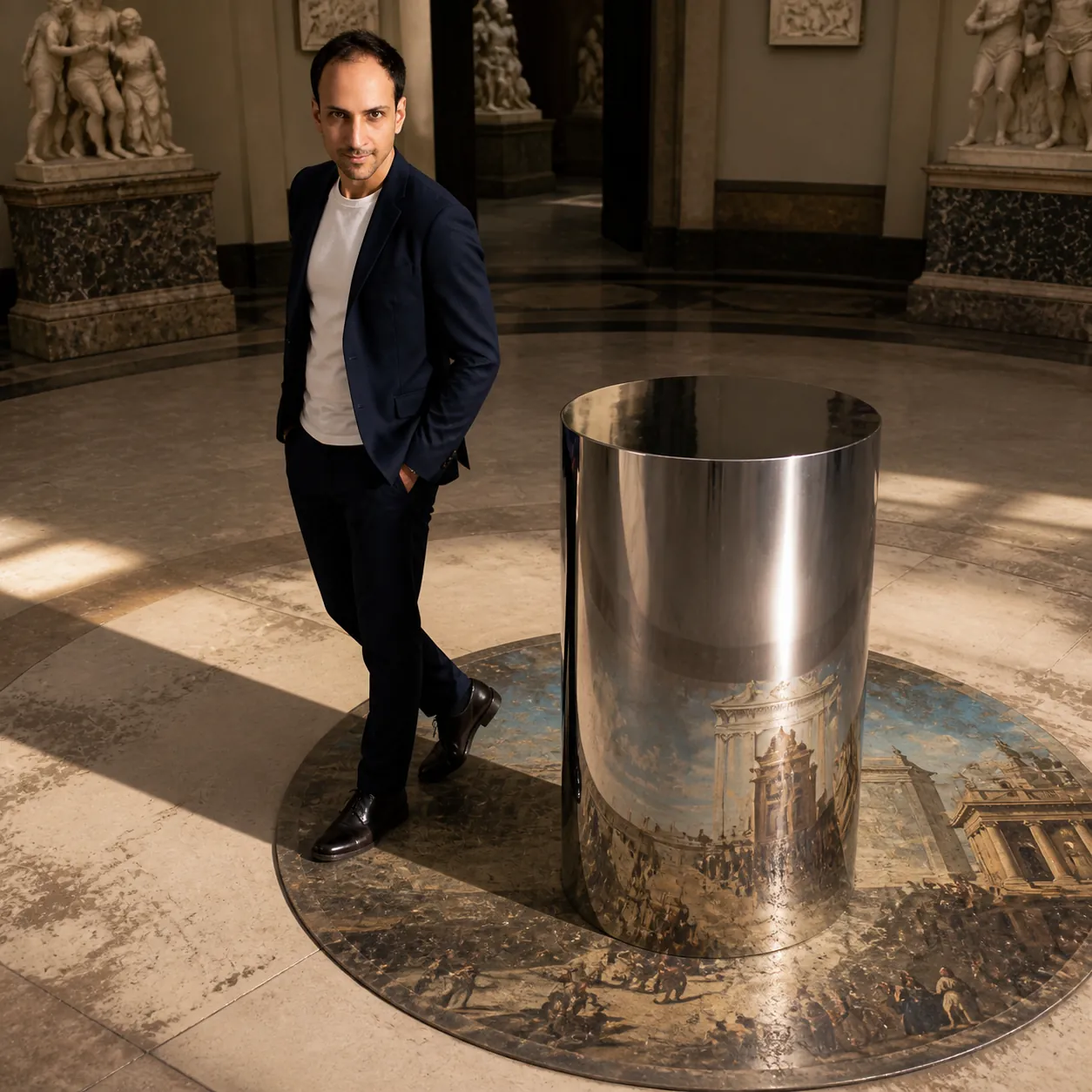
Use the attached reference photo as the identity reference: keep the same face, skin tone, hair and features as the person in that photo, without beautifying, aging or altering them. Create a square 1:1 museum-catalog frame with a strong first read and a slower second read. Location: a small museum rotunda with a center tile worn pale by visitors. Show the subject in a navy blazer over a fine white crew-neck, stepping their heel back onto the worn center tile. Use this advanced image-making device as the core logic: a polished steel cylinder standing on a smeared, unreadable painting that its curved reflection restores to a sharp scene lets true scale arrive gently and retire the illusion without breaking it. Explore whether a perfectly designed error is error or mastery; direct expression and posture toward earned trust, never melodrama or ad-like confidence. Use a 100mm macro-to-portrait hybrid: the illusion's telltale seam near the lens and the person in the reference photo's face readable beyond it, both physically plausible. Make the composition let their shadow obey the real room, not the painted one. Render it as museum-scale illusion realism combining high-fidelity portrait photography, truthful projective geometry, hand-made materiality, and physically accurate light agreement, using low-angle late-afternoon light creating long but physically coherent shadows and a palette of bone, graphite, and a single plane of cerulean. Keep one identity-locked person, credible hands and fingers, natural fabric, and coherent scale, contact, reflections, shadows, airflow, deformation, and materials. Background people only when essential, always secondary and clearly different. Avoid theme-park 3D chalk-art gimmicks, fisheye warping, kaleidoscope filters, dream-sequence blur, and gravity-defying poses. No text, labels, logos, signatures, watermarks, random symbols, plastic skin, excessive bloom, or glossy AI finish.
Treat that reference as the character anchor and change only the scene. Create a square 1:1 museum-catalog frame with a strong first read and a slower...
Treat that reference as the character anchor and change only the scene. Create a square 1:1 museum-catalog frame with a strong first read and a slower...
Treat that reference as the character anchor and change only the scene. Create a square 1:1 museum-catalog frame with a strong first read and a slower...
Treat that reference as the character anchor and change only the scene. Create a square 1:1 museum-catalog frame with a strong first read and a slower...
Treat that reference as the character anchor and change only the scene. Create a square 1:1 museum-catalog frame with a strong first read and a slower...
Treat that reference as the character anchor and change only the scene. Create a square 1:1 museum-catalog frame with a strong first read and a slower...
Treat that reference as the character anchor and change only the scene. Create a square 1:1 museum-catalog frame with a strong first read and a slower...
Treat that reference as the character anchor and change only the scene. Create a square 1:1 museum-catalog frame with a strong first read and a slower...
Treat that reference as the character anchor and change only the scene. Create a square 1:1 museum-catalog frame with a strong first read and a slower...
Treat that reference as the character anchor and change only the scene. Create a square 1:1 museum-catalog frame with a strong first read and a slower...
Treat that reference as the character anchor and change only the scene. Create a square 1:1 museum-catalog frame with a strong first read and a slower...
Treat that reference as the character anchor and change only the scene. Create a square 1:1 museum-catalog frame with a strong first read and a slower...