جاري التحميل...


جاري التحميل...
Create a square 1:1 museum-catalog frame with a strong first read and a slower second read at exactly 2880x2880 pixels. Location: a small footage-review...
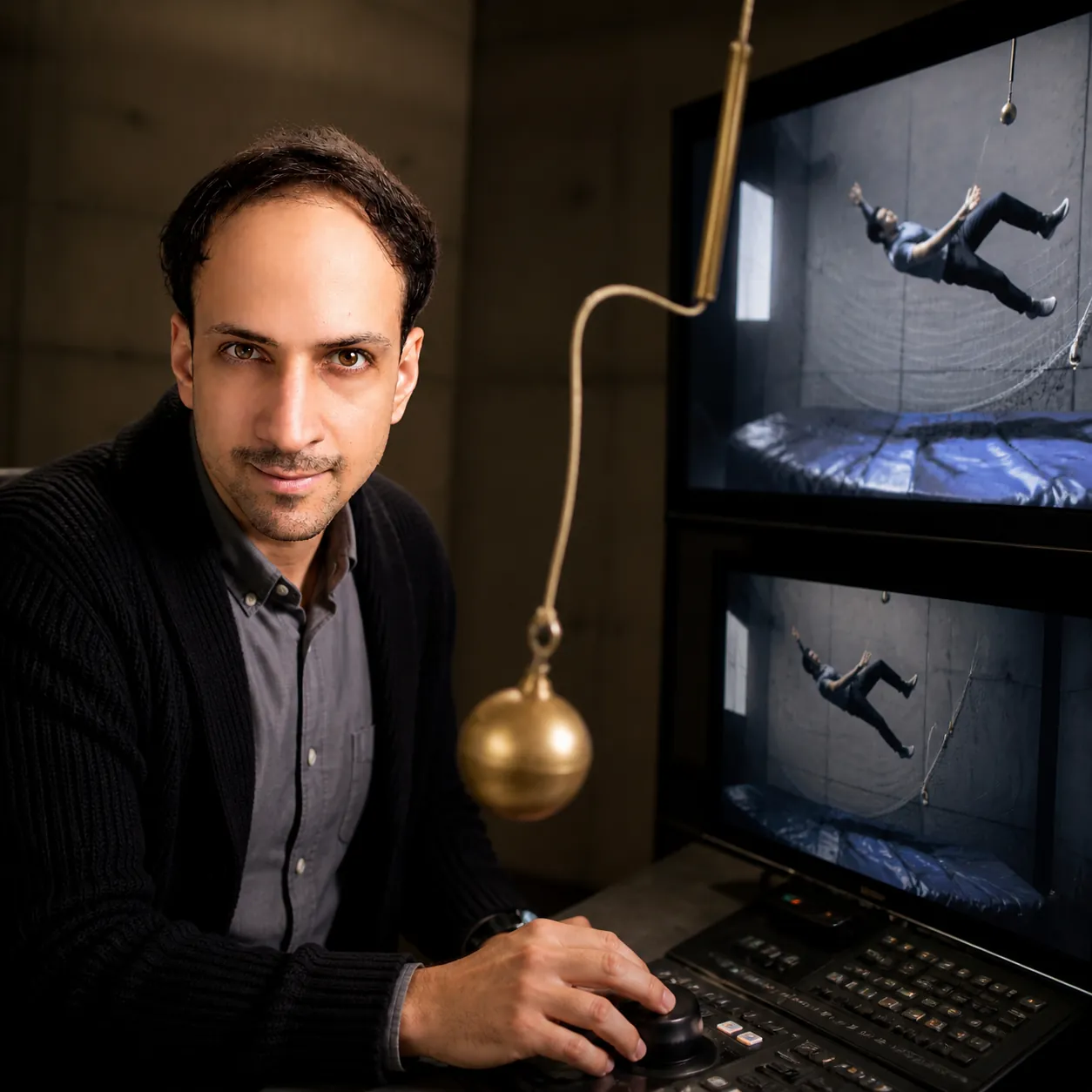
Use the attached reference photo as the identity reference: keep the same face, skin tone, hair and features as the person in that photo, without beautifying, aging or altering them. Create a square 1:1 museum-catalog frame with a strong first read and a slower second read at exactly 2880x2880 pixels. Location: a small footage-review room, monitors paused on the falling interior. Show the subject in a black knit cardigan over an ash-grey collared shirt, holding a frame still with one finger on the jog wheel. The impossible-looking event must obey this clear system: a long brass pendulum that quits mid-swing as the drop begins, its cord bowing loose while the bob drifts free holds steady in frame only because the witness is falling too. Explore why gravity's absence reads on camera as gentleness rather than chaos; direct expression and posture toward steady astonishment, never melodrama or ad-like confidence. Use a 90mm near-far pairing: one suspended detail sharp near the lens and the person in the reference photo's grounded face readable beyond it. Make the composition keep the catch nets visible without ever letting them dominate. Render it as museum-grade experiment photography built from lawful weightless phenomena, visible catch systems, matte machined materials, and slow deliberate framing, using low bounced tungsten off padded surfaces, holding gentle contrast on their face and a palette of matte aluminum, shadowed concrete, and pale flame blue. Photorealistic: this must read as a real photograph from a physical camera, never an illustration, painting, or 3D render. Resolve real surface detail: skin that reddens slightly under pressure, nail beds with honest colour, and knuckle creases that fold rather than blur. Keep one identity-locked person, credible hands and fingers, natural fabric, and coherent scale, contact, reflections, shadows, airflow, deformation, and materials. Background people only when essential, always secondary and clearly different. Avoid space-station porthole backdrops, cartoon up-arrows, magically hovering furniture, dramatic slow-motion glass shatters, and superhero mid-air heroics. No text, labels, logos, signatures, watermarks, random symbols, plastic skin, excessive bloom, or glossy AI finish.
Treat that reference as the character anchor and change only the scene. Create a square 1:1 museum-catalog frame with a strong first read and a slower...
Treat that reference as the character anchor and change only the scene. Create a square 1:1 museum-catalog frame with a strong first read and a slower...
Treat that reference as the character anchor and change only the scene. Create a square 1:1 museum-catalog frame with a strong first read and a slower...
Treat that reference as the character anchor and change only the scene. Create a square 1:1 museum-catalog frame with a strong first read and a slower...
Treat that reference as the character anchor and change only the scene. Create a square 1:1 museum-catalog frame with a strong first read and a slower...
Treat that reference as the character anchor and change only the scene. Create a square 1:1 museum-catalog frame with a strong first read and a slower...
Treat that reference as the character anchor and change only the scene. Create a square 1:1 museum-catalog frame with a strong first read and a slower...
Treat that reference as the character anchor and change only the scene. Create a square 1:1 museum-catalog frame with a strong first read and a slower...
Treat that reference as the character anchor and change only the scene. Create a square 1:1 museum-catalog frame with a strong first read and a slower...
Treat that reference as the character anchor and change only the scene. Create a square 1:1 museum-catalog frame with a strong first read and a slower...
Treat that reference as the character anchor and change only the scene. Create a square 1:1 museum-catalog frame with a strong first read and a slower...
Treat that reference as the character anchor and change only the scene. Create a square 1:1 museum-catalog frame with a strong first read and a slower...