جاري التحميل...


جاري التحميل...
Turn your own photo into a future-archaeology installation portrait in a half-renovated room with one tall dusty window. Keeps your face unchanged.
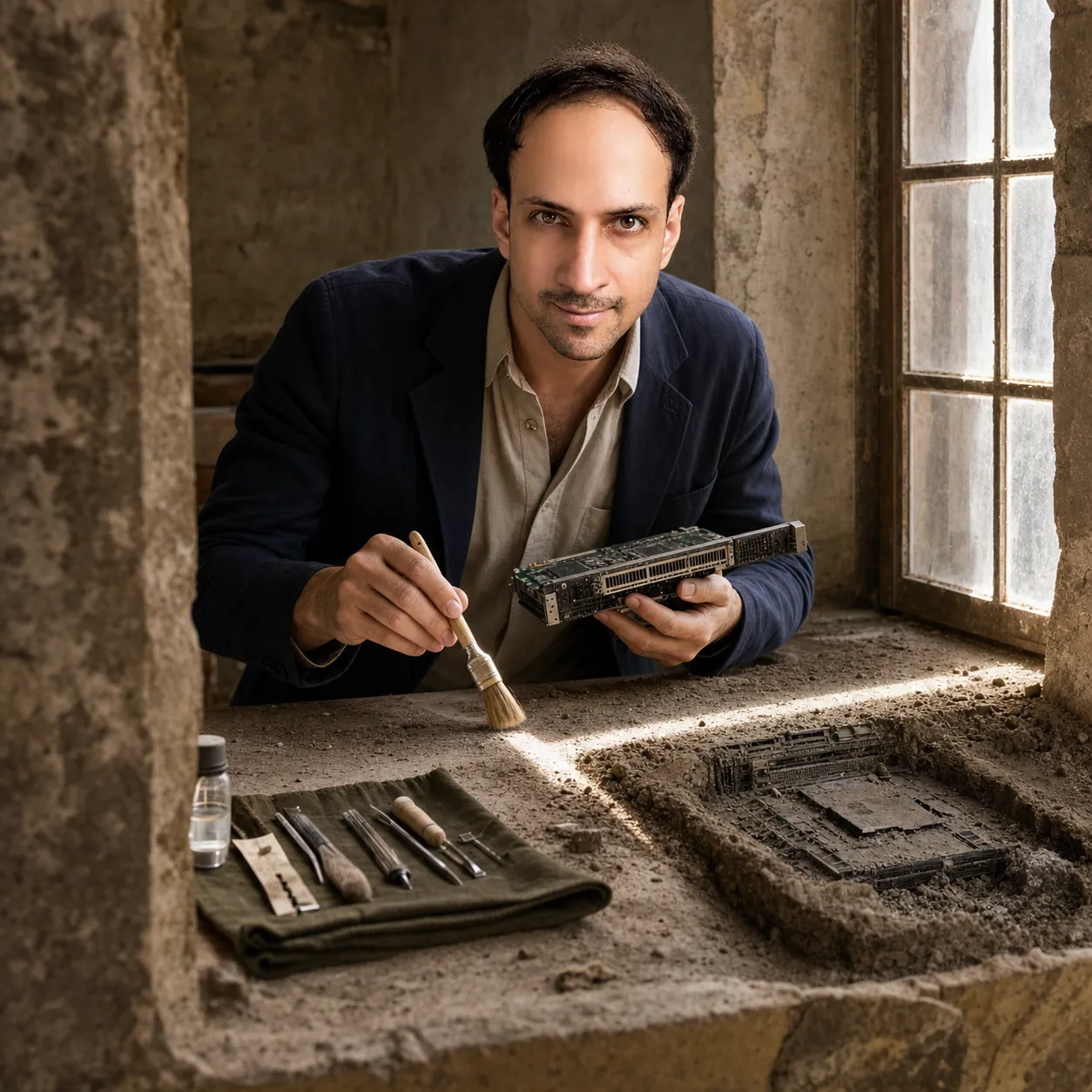
Use the attached reference photo as the identity reference: keep the same face, skin tone, hair and features as the person in that photo, without beautifying, aging or altering them. Create a square 1:1 museum-catalog frame with a strong first read and a slower second read. Location: a half-renovated room with one tall dusty window. Show the subject in a navy unstructured jacket over an open-collar shirt, cleaning one narrow strip of dust to test the incoming light. Make one rigorous physical condition the conceptual engine: a server component conserved like a fragile archaeological object is excavated from a future layer while the current-day version remains in their hand. Explore whether future people could restore what we failed to document; direct expression and posture toward hopeful responsibility, never melodrama or ad-like confidence. Frame through one real architectural opening, with the foreground sharp enough to feel physical but never covering the face. Make the composition include one repair path that is understandable without instructions. Render it as future-archaeology installation photography mixing conservation aesthetics, material aging, precise artifact staging, and emotionally restrained portraiture, using high, diffused desert daylight moderated by real shade and bounced warm ground light and a palette of warm stone, charcoal, and muted olive. Keep one identity-locked person, credible hands and fingers, natural fabric, and coherent scale, contact, reflections, shadows, airflow, deformation, and materials. Background people only when essential, always secondary and clearly different. Avoid generic post-apocalyptic ruins, skulls, neon dystopia, fake museum labels, and obvious time-machine imagery. No text, labels, logos, signatures, watermarks, random symbols, plastic skin, excessive bloom, or glossy AI finish.
Turn your own photo into a gallery-scale documentary portrait in an office floor at the end of the day, most desks dark. Keeps your face unchanged.
Turn your own photo into a photorealistic portrait in the family farm gate, its latch bright and its chain thinned link by link. Keeps your face unchanged.
Turn your own photo into a quiet cinematic portrait in a bus shelter's strip of shade on a wide afternoon road. Keeps your face unchanged.
Turn your own photo into a portrait in the corner of your kitchen where the kettle sits between window and sink. Keeps your face unchanged.
Turn your own photo into a photorealistic portrait in the hallway of your apartment between the bedroom and kitchen doors. Keeps your face unchanged.
Turn your own photo into a photorealistic portrait in a house courtyard at dusk with the heat lifting off the tiles. Keeps your face unchanged.
Turn your own photo into a quiet observational portrait in a low majlis table where a brass tray gathers glasses and dallah. Keeps your face unchanged.
Turn your own photo into an understated editorial portrait in the driver's seat of a parked family car with the engine off. Keeps your face unchanged.
Turn your own photo into a photorealistic portrait in the landing of your building's stairs, one floor short of home. Keeps your face unchanged.
Turn your own photo into a quiet archival portrait in a bench beside a carved door whose brass pull shines from a century of palms. Keeps your face unchanged.
Turn your own photo into a photorealistic portrait in a small tailor's shop while a hem is finished somewhere behind the counter. Keeps your face unchanged.
Turn your own photo into a candid reflex-moment portrait in a long office corridor of doors and cool fluorescent calm. Keeps your face unchanged.