جاري التحميل...


جاري التحميل...
Create a square 1:1 museum-catalog frame with a strong first read and a slower second read. Location: a structures lab bench with clamps and small hung...
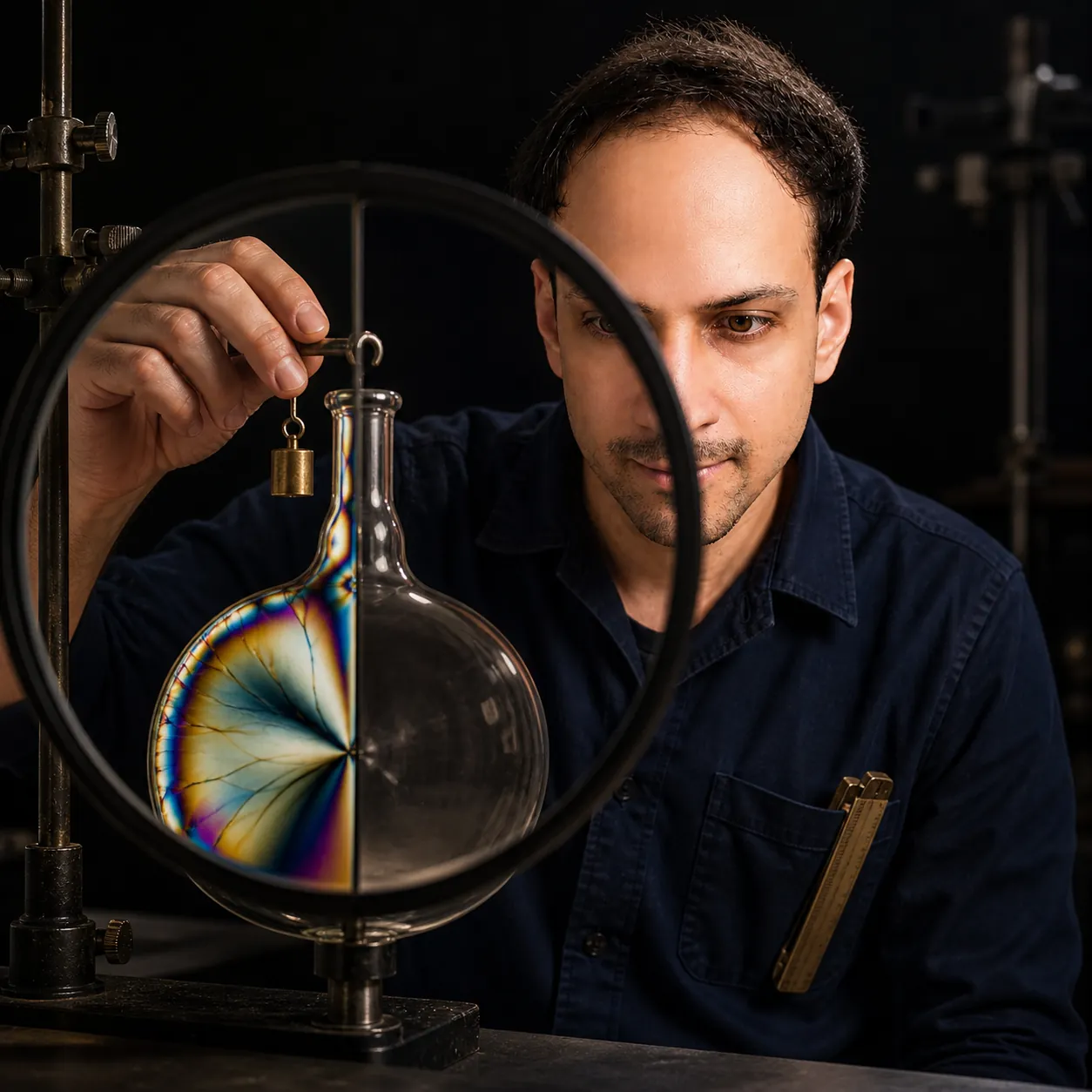
Use the attached reference photo as the identity reference: keep the same face, skin tone, hair and features as the person in that photo, without beautifying, aging or altering them. Create a square 1:1 museum-catalog frame with a strong first read and a slower second read. Location: a structures lab bench with clamps and small hung weights. Show the subject in a navy work shirt with a folded ruler in the chest pocket, hanging a small calibrated weight onto a hook. Use this advanced image-making device as the core logic: a hand-blown glass vessel between polarizers, revealing dark cooling scars and bright halos its clarity always concealed turns a vague mechanical complaint into a precise, radiating diagram. Explore what clarity is hiding, and what light can make it admit; direct expression and posture toward grounded reverence, never melodrama or ad-like confidence. Frame through the polarizer's edge so half the frame sees the hidden color and half stays ordinary. Make the composition let the most stressed point sit nearest their steadiest hand. Render it as museum-scale interference realism combining high-fidelity portrait photography, truthful birefringent color, deep black staging, and physically accurate optics, using a single overhead practical softened by the surrounding architecture, leaving readable shadow detail and a palette of deep matte black, clean white, and lawful prismatic accents only inside the material. Keep one identity-locked person, credible hands and fingers, natural fabric, and coherent scale, contact, reflections, shadows, airflow, deformation, and materials. Background people only when essential, always secondary and clearly different. Avoid psychedelic color washes, chakra imagery, aura photography styling, iridescent vaporwave gloss, and randomly tinted glass. No text, labels, logos, signatures, watermarks, random symbols, plastic skin, excessive bloom, or glossy AI finish.
Treat that reference as the character anchor and change only the scene. Create a square 1:1 museum-catalog frame with a strong first read and a slower...
Treat that reference as the character anchor and change only the scene. Create a square 1:1 museum-catalog frame with a strong first read and a slower...
Treat that reference as the character anchor and change only the scene. Create a square 1:1 museum-catalog frame with a strong first read and a slower...
Treat that reference as the character anchor and change only the scene. Create a square 1:1 museum-catalog frame with a strong first read and a slower...
Treat that reference as the character anchor and change only the scene. Create a square 1:1 museum-catalog frame with a strong first read and a slower...
Treat that reference as the character anchor and change only the scene. Create a square 1:1 museum-catalog frame with a strong first read and a slower...
Treat that reference as the character anchor and change only the scene. Create a square 1:1 museum-catalog frame with a strong first read and a slower...
Treat that reference as the character anchor and change only the scene. Create a square 1:1 museum-catalog frame with a strong first read and a slower...
Treat that reference as the character anchor and change only the scene. Create a square 1:1 museum-catalog frame with a strong first read and a slower...
Treat that reference as the character anchor and change only the scene. Create a square 1:1 museum-catalog frame with a strong first read and a slower...
Treat that reference as the character anchor and change only the scene. Create a square 1:1 museum-catalog frame with a strong first read and a slower...
Treat that reference as the character anchor and change only the scene. Create a square 1:1 museum-catalog frame with a strong first read and a slower...