جاري التحميل...


جاري التحميل...
Treat that reference as the character anchor and change only the scene. Create a square 1:1 museum-catalog frame with a strong first read and a slower...
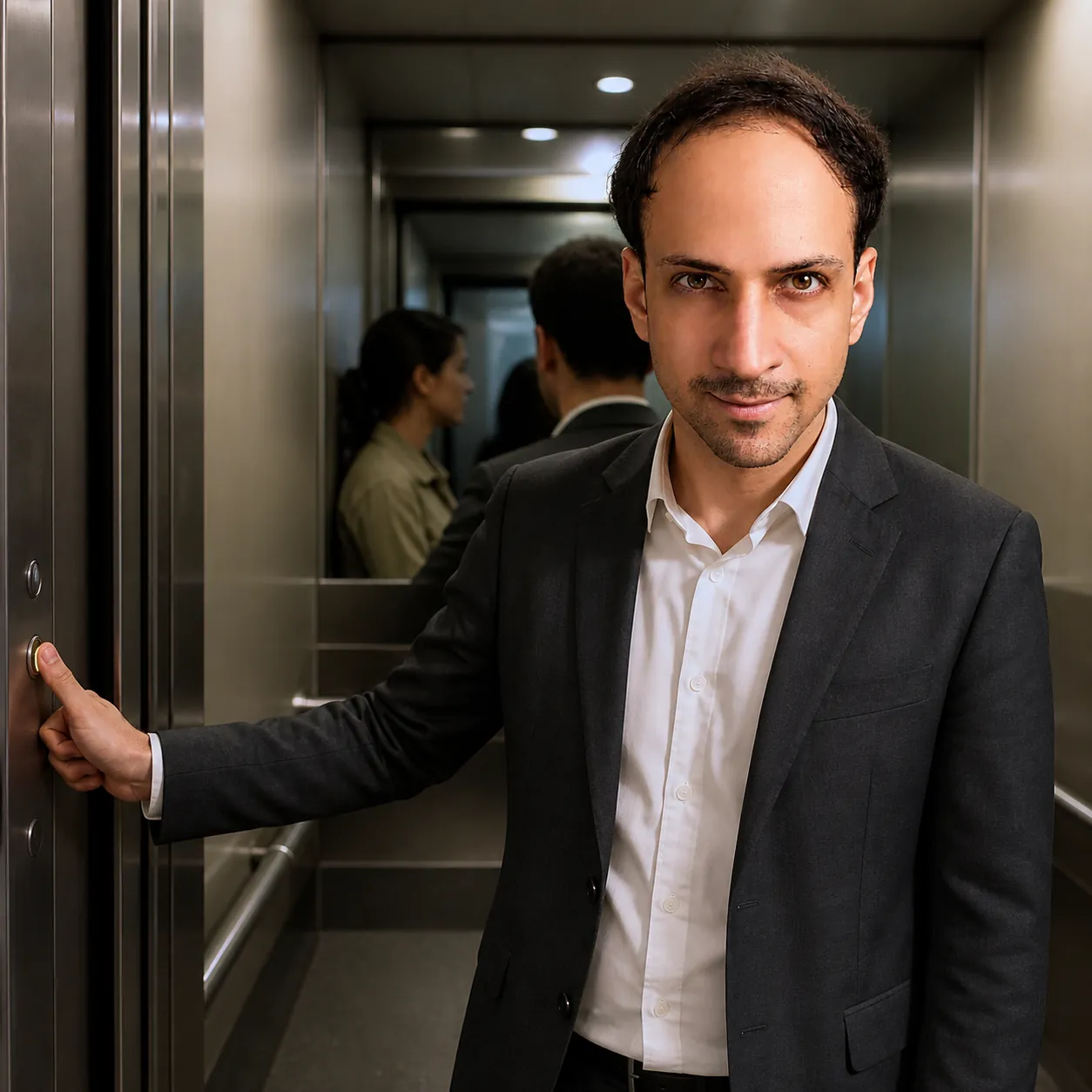
Use the attached reference photo as the identity reference: keep the same face, skin tone, hair and features as the person in that photo, without beautifying, aging or altering them. Treat that reference as the character anchor and change only the scene. Create a square 1:1 museum-catalog frame with a strong first read and a slower second read at exactly 2880x2880 pixels. Location: a small office lift carrying two people down to the ground floor. Show them in a charcoal blazer over a plain white shirt with no tie, holding the lift door button flat with one thumb. Make this the only tell, easy to miss: a seat at the end of a row of chairs, where one side holds a neighbour and the other holds open floor leaves being liked and being known separated by a distance nobody measures. Explore how a room full of goodwill still leaves one question permanently unasked; expression composed and unremarkable, carrying settled politeness, the weight held under the ordinary courtesy. Place the lens slightly below eye level at 40mm, keeping the arrangement of seats geometrically honest. Make the composition treat the empty distance beside them as a measured object. Render it as quiet observational photography built from real social settings, plain wardrobe truth, unstyled interiors, and calm human-scale composition, using flat overhead fluorescent tempered by a nearby wall of pale paint and a palette of cool concrete grey, oat linen, and a low amber. Photorealistic: this must read as a real photograph from a physical camera, never an illustration, painting, or 3D render. Resolve real surface detail: leather creased along the lines of use, stitching slightly irregular, and edges burnished from contact. Keep one identity-locked person, credible hands and fingers, natural fabric, and coherent scale, contact, reflections, shadows, airflow, deformation, and materials. Background people only when essential, always secondary and clearly different. Avoid party lighting, raised glasses, one lonely figure in a crowd, therapy props, and pill bottles. No text, labels, logos, signatures, watermarks, random symbols, plastic skin, excessive bloom, or glossy AI finish.
Treat that reference as the character anchor and change only the scene. Create a square 1:1 museum-catalog frame with a strong first read and a slower...
Treat that reference as the character anchor and change only the scene. Create a square 1:1 museum-catalog frame with a strong first read and a slower...
Treat that reference as the character anchor and change only the scene. Create a square 1:1 museum-catalog frame with a strong first read and a slower...
Treat that reference as the character anchor and change only the scene. Create a square 1:1 museum-catalog frame with a strong first read and a slower...
Treat that reference as the character anchor and change only the scene. Create a square 1:1 museum-catalog frame with a strong first read and a slower...
Treat that reference as the character anchor and change only the scene. Create a square 1:1 museum-catalog frame with a strong first read and a slower...
Treat that reference as the character anchor and change only the scene. Create a square 1:1 museum-catalog frame with a strong first read and a slower...
Treat that reference as the character anchor and change only the scene. Create a square 1:1 museum-catalog frame with a strong first read and a slower...
Treat that reference as the character anchor and change only the scene. Create a square 1:1 museum-catalog frame with a strong first read and a slower...
Treat that reference as the character anchor and change only the scene. Create a square 1:1 museum-catalog frame with a strong first read and a slower...
Treat that reference as the character anchor and change only the scene. Create a square 1:1 museum-catalog frame with a strong first read and a slower...
Treat that reference as the character anchor and change only the scene. Create a square 1:1 museum-catalog frame with a strong first read and a slower...