جاري التحميل...


جاري التحميل...
Build a vertical 4:5 layout containing exactly 7 panels, read top to bottom. Keep the same wardrobe, facial landmarks, apparent age, hairline, facial hair...
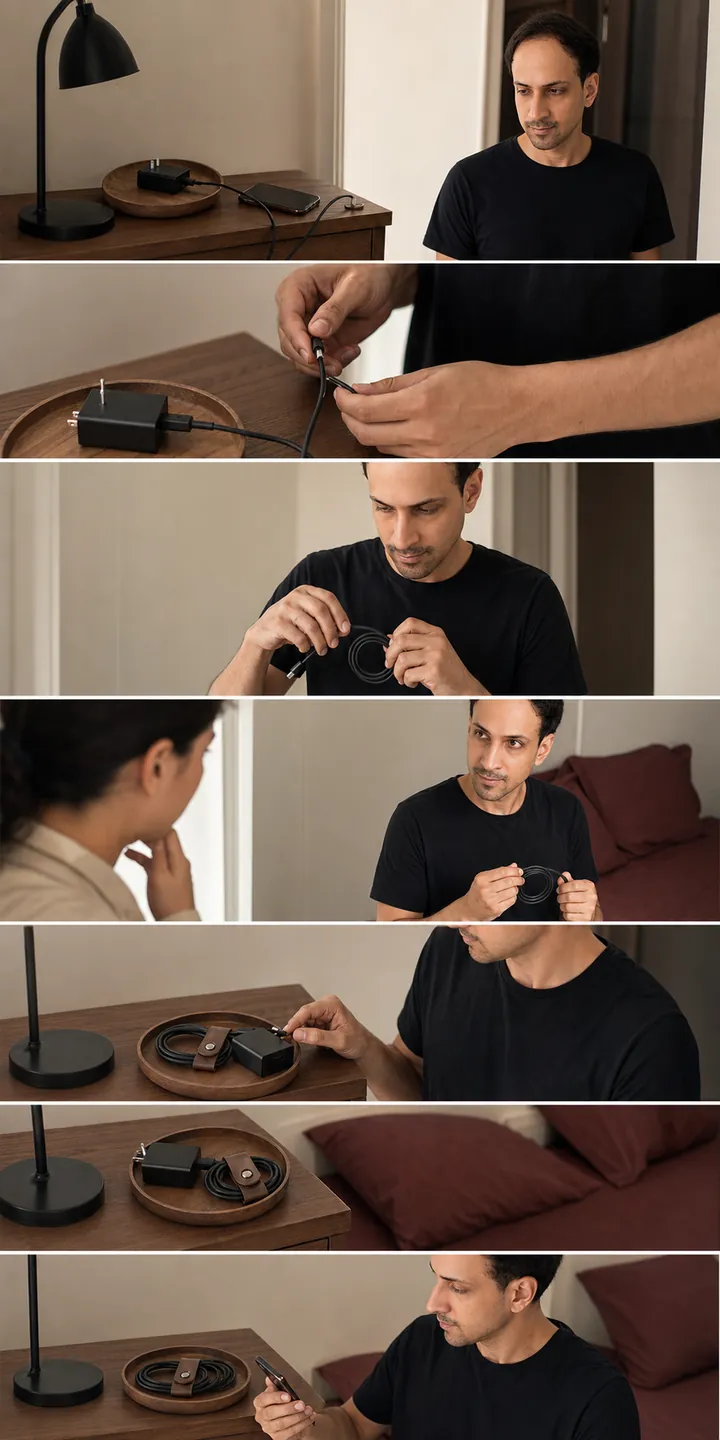
Use the attached reference photo as the identity reference: keep the same face, skin tone, hair and features as the person in that photo, without beautifying, aging or altering them. Build a vertical 4:5 layout containing exactly 7 panels, read top to bottom. Keep the same wardrobe, facial landmarks, apparent age, hairline, facial hair and environmental continuity across every panel unless a panel description explicitly changes a prop. Panel 1: establish a phone-charging station away from the bed before the main action, with the person entering or settling into the space and the visual problem clearly readable. Panel 2: move closer to their hands as they prepare for the task, preserving wardrobe and object continuity. Panel 3: show the exact moment of them coiling the charging cable so it cannot fall to the floor, keeping their recognizable face and natural posture consistent. Panel 4: introduce a modest complication or second person’s response, never changing the person’s identity or wardrobe. Panel 5: show the adjustment they make after noticing what the situation actually needs. Panel 6: capture the immediate result: the task leaves the room slightly more ready for the next person. Panel 7: end on a quiet coda in the same environment, with one changed object or gesture proving that the sequence has moved forward. Use clean, consistent gutters and no accidental extra frames, repeated panels, or duplicated versions of the person. Render the sequence as natural-light home documentary photography with clean studio light shaped like a broad window, with gentle falloff and no plastic retouching and cream, walnut, and faded burgundy. The emotional progression should move toward attentive curiosity through posture and action, not facial redesign. Let light reveal the material difference between clean, worn, dry, wet, folded, and used. Do not include captions or any other text. Keep hands, object continuity, body scale, and perspective believable.
Turn your own photo into a quiet observational portrait in the kitchen of your flat at night with one counter lamp on. Keeps your face unchanged.
Turn your own photo into a quiet cinematic portrait in a gym bench between sets with a towel folded over the bar. Keeps your face unchanged.
Turn your own photo into a photorealistic portrait in the landing of your building's stairs, one floor short of home. Keeps your face unchanged.
Turn your own photo into a quiet cinematic portrait in a bus shelter's strip of shade on a wide afternoon road. Keeps your face unchanged.
Turn your own photo into a photorealistic portrait in a staff-room table in the slow hour of a night shift. Keeps your face unchanged.
Turn your own photo into a photorealistic portrait in the family farm gate, its latch bright and its chain thinned link by link. Keeps your face unchanged.
Turn your own photo into a patient observational portrait in a bus shelter's strip of shade on a wide afternoon road. Keeps your face unchanged.
Turn your own photo into a photorealistic portrait in the flat roof of the family house as the last daylight drains. Keeps your face unchanged.
Turn your own photo into a quiet observational portrait in a small residential lift with another person's shoulder at the frame edge. Keeps your face unchanged.
Turn your own photo into a quiet archival portrait in a bench beside a carved door whose brass pull shines from a century of palms. Keeps your face unchanged.
Turn your own photo into a photorealistic portrait in a gym bench between sets with a towel folded over the bar. Keeps your face unchanged.
Turn your own photo into a portrait in your grandfather's workshop where tool handles hang darkened at your grips. Keeps your face unchanged.