جاري التحميل...


جاري التحميل...
Create a square 1:1 museum-catalog frame with a strong first read and a slower second read at exactly 2880x2880 pixels. Location: a whitewashed reading...
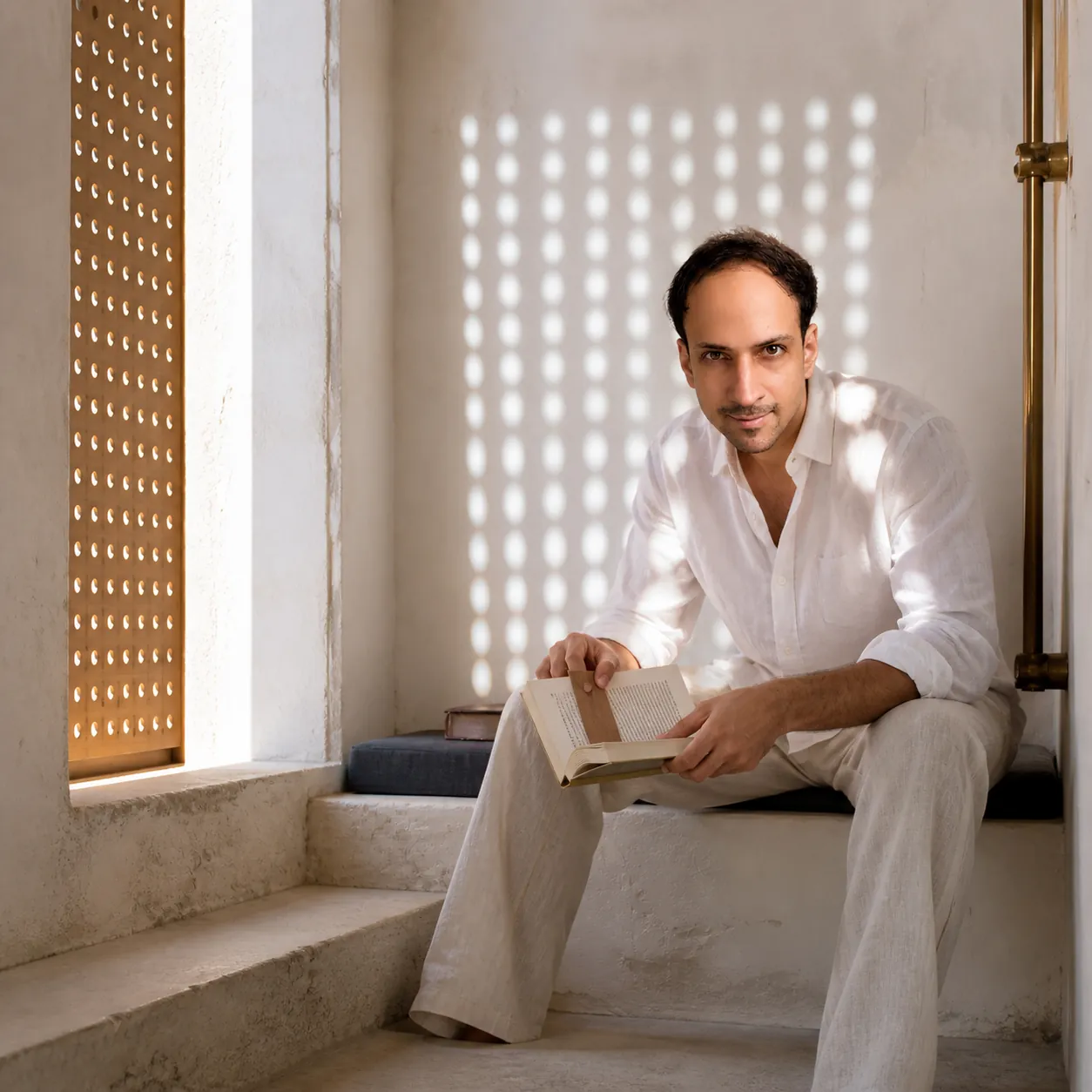
Use the attached reference photo as the identity reference: keep the same face, skin tone, hair and features as the person in that photo, without beautifying, aging or altering them. Create a square 1:1 museum-catalog frame with a strong first read and a slower second read at exactly 2880x2880 pixels. Location: a whitewashed reading alcove reached by two steps beside a lightwell. Show the subject in a relaxed white poplin shirt and stone linen trousers, marking their page with a flat cedar bookmark. Make one rigorous physical condition the conceptual engine: a cedar screen of hundreds of drilled holes that throws a lattice of identical round sun-images across one wall treats morning light as a nutrient with a dose, not a mood. Explore why geometry rather than tint is the honest way to meter a beam; direct expression and posture toward settled gratitude, never melodrama or ad-like confidence. Use an eye-level 80mm medium-format viewpoint that renders beam edges and skin texture equally truthfully. Make the composition keep the light's source small and its consequence large. Render it as heliotherapy-room realism combining truthful sun angles, museum-grade architectural photography, tactile limewash surfaces, and unforced human presence at treatment scale, using clean directional sunlight softened only by distance and one white ceiling bounce and a palette of chalk, unpolished brass, and deep shadow blue. Photorealistic: this must read as a real photograph from a physical camera, never an illustration, painting, or 3D render. Resolve real surface detail: fine grit in the texture of concrete, efflorescence at damp edges, and hairline cracks that follow stress. Keep one identity-locked person, credible hands and fingers, natural fabric, and coherent scale, contact, reflections, shadows, airflow, deformation, and materials. Background people only when essential, always secondary and clearly different. Avoid god-ray haze shafts, lens-flare starbursts, glowing dust volumetrics, stained-glass rainbows, and any halo behind their head. No text, labels, logos, signatures, watermarks, random symbols, plastic skin, excessive bloom, or glossy AI finish.
Treat that reference as the character anchor and change only the scene. Create a square 1:1 museum-catalog frame with a strong first read and a slower...
Treat that reference as the character anchor and change only the scene. Create a square 1:1 museum-catalog frame with a strong first read and a slower...
Treat that reference as the character anchor and change only the scene. Create a square 1:1 museum-catalog frame with a strong first read and a slower...
Treat that reference as the character anchor and change only the scene. Create a square 1:1 museum-catalog frame with a strong first read and a slower...
Treat that reference as the character anchor and change only the scene. Create a square 1:1 museum-catalog frame with a strong first read and a slower...
Treat that reference as the character anchor and change only the scene. Create a square 1:1 museum-catalog frame with a strong first read and a slower...
Treat that reference as the character anchor and change only the scene. Create a square 1:1 museum-catalog frame with a strong first read and a slower...
Treat that reference as the character anchor and change only the scene. Create a square 1:1 museum-catalog frame with a strong first read and a slower...
Treat that reference as the character anchor and change only the scene. Create a square 1:1 museum-catalog frame with a strong first read and a slower...
Treat that reference as the character anchor and change only the scene. Create a square 1:1 museum-catalog frame with a strong first read and a slower...
Treat that reference as the character anchor and change only the scene. Create a square 1:1 museum-catalog frame with a strong first read and a slower...
Treat that reference as the character anchor and change only the scene. Create a square 1:1 museum-catalog frame with a strong first read and a slower...