جاري التحميل...

جاري التحميل...
Turn your own photo into a conceptual stress-analysis portrait in a conservation lab with a stereo microscope parked at rest. Keeps your face unchanged.
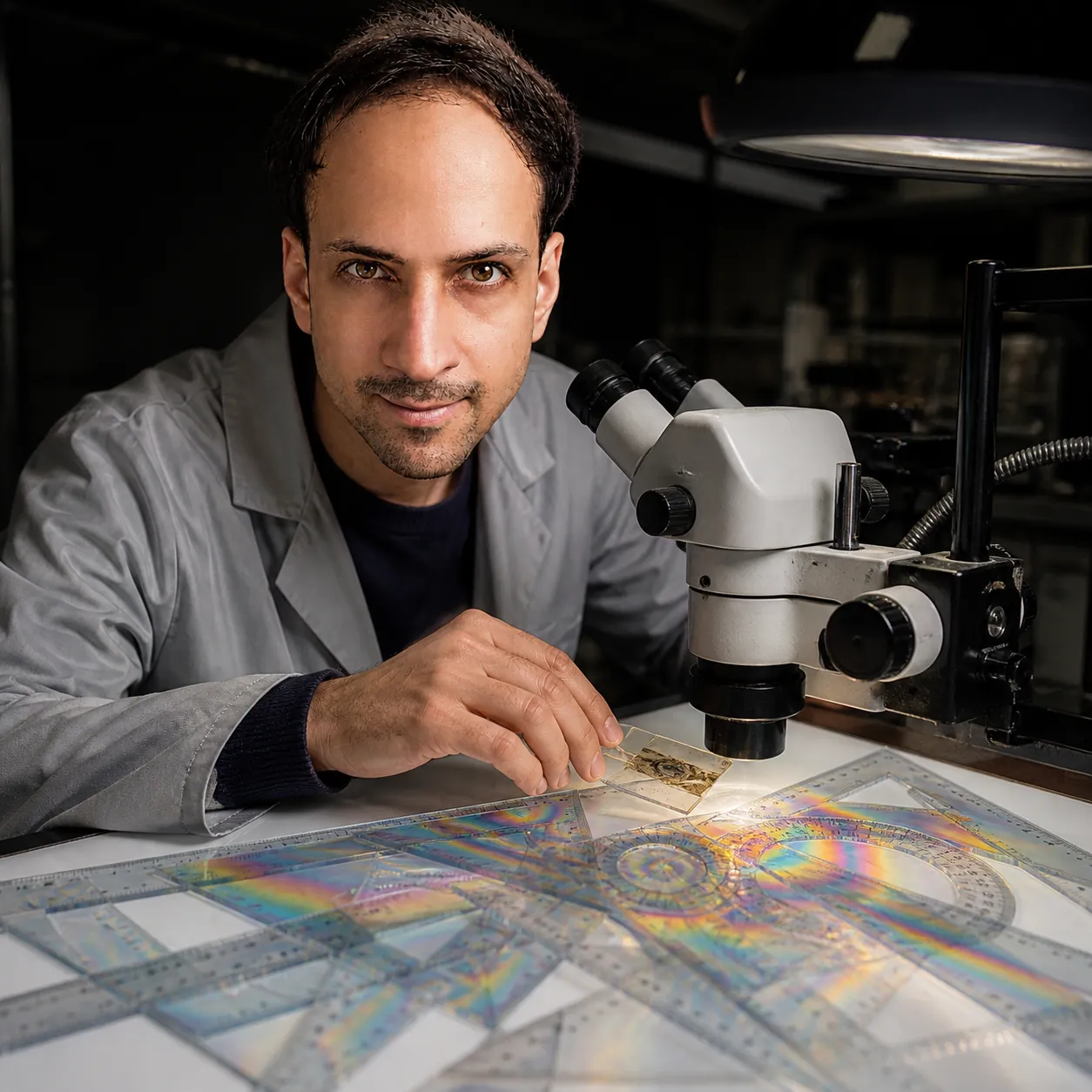
Use the attached reference photo as the identity reference: keep the same face, skin tone, hair and features as the person in that photo, without beautifying, aging or altering them. Create a square 1:1 museum-catalog frame with a strong first read and a slower second read. Location: a conservation lab with a stereo microscope parked at rest. Show them in a pale grey smock over a fine navy sweater, positioning a specimen card under the microscope arm. The impossible-looking event must obey this clear system: a fan of clear protractors and set squares overlapped on a light table, their intersections firing sharp interference colors turns a vague mechanical complaint into a precise, radiating diagram. Explore whether arrangement alone deserves to be called an author; direct expression and posture toward quiet astonishment, never melodrama or ad-like confidence. Use a 100mm macro-to-portrait hybrid: one glowing stress pattern near the lens and the subject's face readable beyond it, both physically plausible. Make the composition let the most stressed point sit nearest their steadiest hand. Render it as conceptual stress-analysis portraiture combining transparent engineering models, restrained contemporary art direction, believable apparatus, and human-centered editorial realism, using a single overhead practical softened by the surrounding architecture, leaving readable shadow detail and a palette of deep matte black, clean white, and lawful prismatic accents only inside the material. Keep one identity-locked person, credible hands and fingers, natural fabric, and coherent scale, contact, reflections, shadows, airflow, deformation, and materials. Background people only when essential, always secondary and clearly different. Avoid psychedelic color washes, chakra imagery, aura photography styling, iridescent vaporwave gloss, and randomly tinted glass. No text, labels, logos, signatures, watermarks, random symbols, plastic skin, excessive bloom, or glossy AI finish.
Turn your own photo into a quiet archival portrait in a bench beside a carved door whose brass pull shines from a century of palms. Keeps your face unchanged.
Turn your own photo into a gallery-scale documentary portrait in an office floor at the end of the day, most desks dark. Keeps your face unchanged.
Turn your own photo into a photorealistic portrait in a staff-room table in the slow hour of a night shift. Keeps your face unchanged.
Turn your own photo into a photorealistic portrait in your mother's kitchen table with its patterned oilcloth cover. Keeps your face unchanged.
Turn your own photo into a photorealistic portrait in a house courtyard at dusk with the heat lifting off the tiles. Keeps your face unchanged.
Turn your own photo into a photorealistic portrait in a gym bench between sets with a towel folded over the bar. Keeps your face unchanged.
Turn your own photo into a quiet cinematic portrait in a gym bench between sets with a towel folded over the bar. Keeps your face unchanged.
Turn your own photo into a photorealistic portrait in the hallway of your apartment between the bedroom and kitchen doors. Keeps your face unchanged.
Turn your own photo into a quiet observational portrait in a low majlis table where a brass tray gathers glasses and dallah. Keeps your face unchanged.
Turn your own photo into a quiet cinematic portrait in a bus shelter's strip of shade on a wide afternoon road. Keeps your face unchanged.
Turn your own photo into a photorealistic portrait in a mosque entrance where the shoe shelf's front edge is worn round. Keeps your face unchanged.
Turn your own photo into a quiet observational portrait in the kitchen of your flat at night with one counter lamp on. Keeps your face unchanged.