جاري التحميل...


جاري التحميل...
Create a square 1:1 museum-catalog frame with a strong first read and a slower second read. Location: an open tool cabinet where every outline is painted...
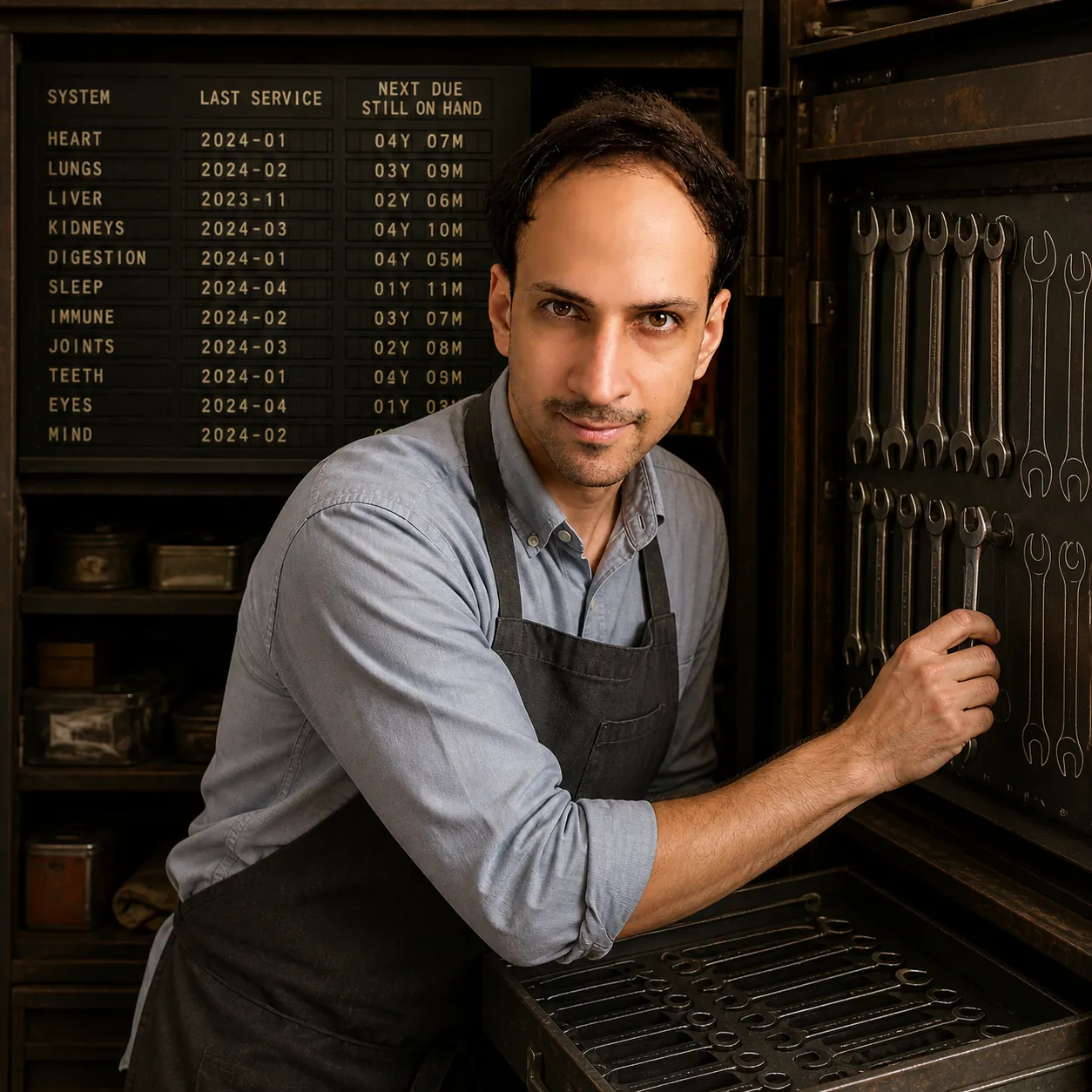
Use the attached reference photo as the identity reference: keep the same face, skin tone, hair and features as the person in that photo, without beautifying, aging or altering them. Create a square 1:1 museum-catalog frame with a strong first read and a slower second read. Location: an open tool cabinet where every outline is painted and filled. Show the subject in a slate apron over a rolled-sleeve oxford, returning one wrench exactly onto its painted outline. Make one rigorous physical condition the conceptual engine: a mechanical split-flap board listing the body's systems like departures, each row showing last service and next due counts the undecided time still on hand instead of the time spent. Explore what boring, dated care quietly prevents; direct expression and posture toward earned pride, never melodrama or ad-like confidence. Use an eye-level 65mm medium-format viewpoint with natural perspective and restrained depth of field. Make the composition keep every sign of care sharper than any sign of age. Render it as museum-scale archival realism combining high-fidelity portrait photography, truthful patina and wear, disciplined warm neutrals, and physically accurate aging of materials, using a broad window-shaped key with gentle falloff, soft negative fill, and no beauty-light flattening and a palette of walnut brown, pale parchment, and muted steel. Keep one identity-locked subject, credible hands and fingers, natural fabric, and coherent scale, contact, reflections, shadows, airflow, deformation, and materials. Background people only when essential, always secondary and clearly different. Avoid hourglass-and-skull vanitas clichés, anti-aging cream styling, wilting-rose metaphors, birthday-candle sentiment, and clock-face overlays. No text, labels, logos, signatures, watermarks, random symbols, plastic skin, excessive bloom, or glossy AI finish.
Treat that reference as the character anchor and change only the scene. Create a square 1:1 museum-catalog frame with a strong first read and a slower...
Treat that reference as the character anchor and change only the scene. Create a square 1:1 museum-catalog frame with a strong first read and a slower...
Treat that reference as the character anchor and change only the scene. Create a square 1:1 museum-catalog frame with a strong first read and a slower...
Treat that reference as the character anchor and change only the scene. Create a square 1:1 museum-catalog frame with a strong first read and a slower...
Treat that reference as the character anchor and change only the scene. Create a square 1:1 museum-catalog frame with a strong first read and a slower...
Treat that reference as the character anchor and change only the scene. Create a square 1:1 museum-catalog frame with a strong first read and a slower...
Treat that reference as the character anchor and change only the scene. Create a square 1:1 museum-catalog frame with a strong first read and a slower...
Treat that reference as the character anchor and change only the scene. Create a square 1:1 museum-catalog frame with a strong first read and a slower...
Treat that reference as the character anchor and change only the scene. Create a square 1:1 museum-catalog frame with a strong first read and a slower...
Treat that reference as the character anchor and change only the scene. Create a square 1:1 museum-catalog frame with a strong first read and a slower...
Treat that reference as the character anchor and change only the scene. Create a square 1:1 museum-catalog frame with a strong first read and a slower...
Treat that reference as the character anchor and change only the scene. Create a square 1:1 museum-catalog frame with a strong first read and a slower...