جاري التحميل...


جاري التحميل...
Create a square 1:1 museum-catalog frame with a strong first read and a slower second read. Location: a small museum rotunda with a center tile worn pale by...
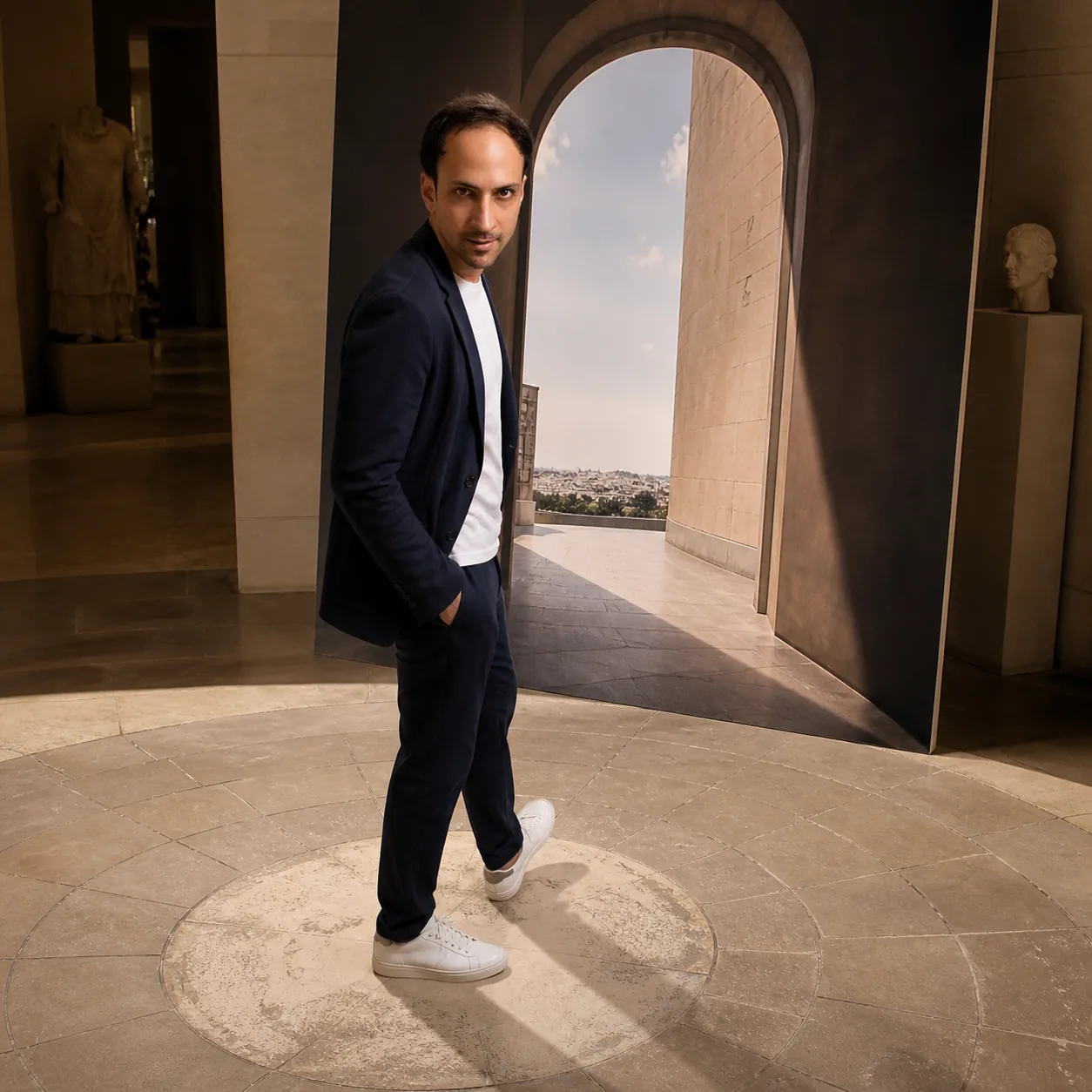
Use the attached reference photo as the identity reference: keep the same face, skin tone, hair and features as the person in that photo, without beautifying, aging or altering them. Create a square 1:1 museum-catalog frame with a strong first read and a slower second read. Location: a small museum rotunda with a center tile worn pale by visitors. Show the subject in a navy blazer over a fine white crew-neck, stepping their heel back onto the worn center tile. Treat this mechanism as the frame’s governing rule: a full-size printed doorway leaning against a wall, its printed light almost agreeing with the room's real light makes meaning appear only for the viewer willing to stand in the right place. Explore how small the difference between an image and an exit can get; direct expression and posture toward playful rigor, never melodrama or ad-like confidence. Frame from one step off the true station so the illusion is caught mid-collapse, still half convincing. Make the composition keep the illusion perfect and one clue to its making equally sharp. Render it as high-concept perspectival portraiture built from surveyed anamorphic construction, documentary realism, architectural draftsmanship, and emotionally intelligent composition, using a broad window-shaped key with gentle falloff, soft negative fill, and no beauty-light flattening and a palette of sandstone, deep shadow brown, and pale sky. Keep one identity-locked person, credible hands and fingers, natural fabric, and coherent scale, contact, reflections, shadows, airflow, deformation, and materials. Background people only when essential, always secondary and clearly different. Avoid melting-clock surrealism, endless staircases, floating islands, impossible Escher tributes played straight, and green-screen composites. No text, labels, logos, signatures, watermarks, random symbols, plastic skin, excessive bloom, or glossy AI finish.
Treat that reference as the character anchor and change only the scene. Create a square 1:1 museum-catalog frame with a strong first read and a slower...
Treat that reference as the character anchor and change only the scene. Create a square 1:1 museum-catalog frame with a strong first read and a slower...
Treat that reference as the character anchor and change only the scene. Create a square 1:1 museum-catalog frame with a strong first read and a slower...
Treat that reference as the character anchor and change only the scene. Create a square 1:1 museum-catalog frame with a strong first read and a slower...
Treat that reference as the character anchor and change only the scene. Create a square 1:1 museum-catalog frame with a strong first read and a slower...
Treat that reference as the character anchor and change only the scene. Create a square 1:1 museum-catalog frame with a strong first read and a slower...
Treat that reference as the character anchor and change only the scene. Create a square 1:1 museum-catalog frame with a strong first read and a slower...
Treat that reference as the character anchor and change only the scene. Create a square 1:1 museum-catalog frame with a strong first read and a slower...
Treat that reference as the character anchor and change only the scene. Create a square 1:1 museum-catalog frame with a strong first read and a slower...
Treat that reference as the character anchor and change only the scene. Create a square 1:1 museum-catalog frame with a strong first read and a slower...
Treat that reference as the character anchor and change only the scene. Create a square 1:1 museum-catalog frame with a strong first read and a slower...
Treat that reference as the character anchor and change only the scene. Create a square 1:1 museum-catalog frame with a strong first read and a slower...