جاري التحميل...


جاري التحميل...
Build an asymmetric editorial storyboard containing exactly 7 panels, read left to right. Keep the same wardrobe, facial landmarks, apparent age, hairline,...
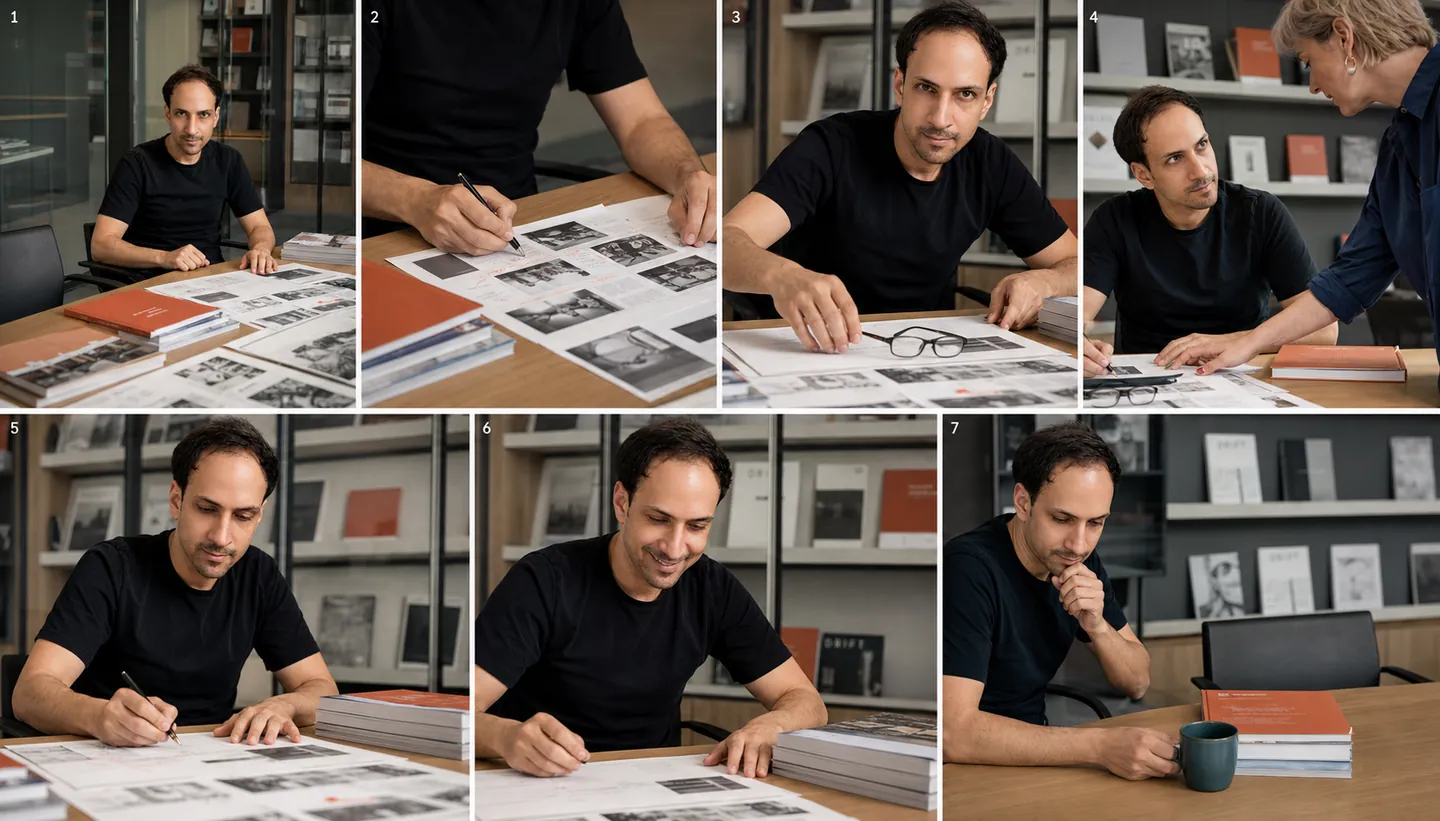
Use the attached reference photo as the identity reference: keep the same face, skin tone, hair and features as the person in that photo, without beautifying, aging or altering them. Build an asymmetric editorial storyboard containing exactly 7 panels, read left to right. Keep the same wardrobe, facial landmarks, apparent age, hairline, facial hair and environmental continuity across every panel unless a panel description explicitly changes a prop. Panel 1: establish a publisher’s meeting room with marked-up proofs before the main action, with the person entering or settling into the space and the visual problem clearly readable. Panel 2: move closer to their hands as they prepare for the task, preserving wardrobe and object continuity. Panel 3: show the exact moment of them placing reading glasses beside a finished page, keeping their recognizable face and natural posture consistent. Panel 4: introduce a modest complication or second person’s response, never changing the person’s identity or wardrobe. Panel 5: show the adjustment they make after noticing what the situation actually needs. Panel 6: capture the immediate result: the formal portrait relaxes into a candid human moment. Panel 7: end on a quiet coda in the same environment, with one changed object or gesture proving that the sequence has moved forward. Use clean, consistent gutters and no accidental extra frames, repeated panels, or duplicated versions of the person. Render the sequence as observational magazine photography with neutral retail lighting that renders skin, fabric, and product colors accurately and chalk white, terracotta, and desaturated blue. The emotional progression should move toward belonging through posture and action, not facial redesign. Use a shallow foreground edge as a visual pause, not a voyeuristic barrier. Permit only tiny panel numbers “1” through “7” in the upper-left corner of each panel; add no other wording. Keep hands, object continuity, body scale, and perspective believable.
Turn your own photo into a portrait in the corner of your kitchen where the kettle sits between window and sink. Keeps your face unchanged.
Turn your own photo into a quiet cinematic portrait in a gym bench between sets with a towel folded over the bar. Keeps your face unchanged.
Turn your own photo into a quiet cinematic portrait in a bus shelter's strip of shade on a wide afternoon road. Keeps your face unchanged.
Turn your own photo into a photorealistic portrait in the hallway of your apartment between the bedroom and kitchen doors. Keeps your face unchanged.
Turn your own photo into a photorealistic portrait in a small tailor's shop while a hem is finished somewhere behind the counter. Keeps your face unchanged.
Turn your own photo into a photorealistic portrait in a house courtyard at dusk with the heat lifting off the tiles. Keeps your face unchanged.
Turn your own photo into a quiet archival portrait in a bench beside a carved door whose brass pull shines from a century of palms. Keeps your face unchanged.
Turn your own photo into a photorealistic portrait in the family farm gate, its latch bright and its chain thinned link by link. Keeps your face unchanged.
Turn your own photo into a patient observational portrait in a bus shelter's strip of shade on a wide afternoon road. Keeps your face unchanged.
Turn your own photo into a photorealistic portrait in a gym bench between sets with a towel folded over the bar. Keeps your face unchanged.
Turn your own photo into a candid reflex-moment portrait in a supermarket aisle stacked to the ceiling under flat white light. Keeps your face unchanged.
Turn your own photo into a candid reflex-moment portrait in a long office corridor of doors and cool fluorescent calm. Keeps your face unchanged.