جاري التحميل...


جاري التحميل...
Create a square 1:1 museum-catalog frame with a strong first read and a slower second read. Location: an optician's backroom with trays of unmounted lenses....
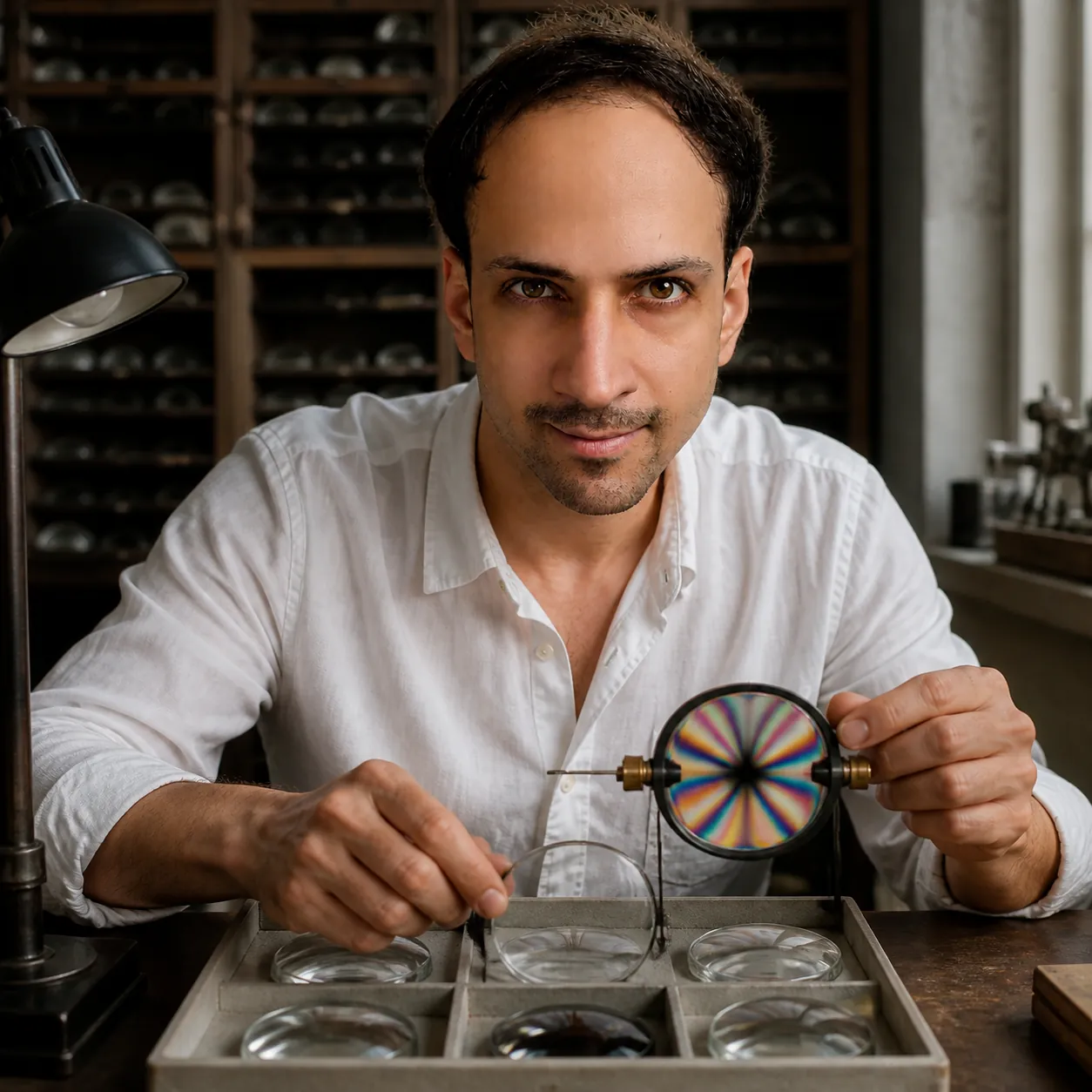
Use the attached reference photo as the identity reference: keep the same face, skin tone, hair and features as the person in that photo, without beautifying, aging or altering them. Create a square 1:1 museum-catalog frame with a strong first read and a slower second read. Location: an optician's backroom with trays of unmounted lenses. Show the subject in a clean white overshirt buttoned once at the sternum, seating a lens gently into a padded tray. Make one rigorous physical condition the conceptual engine: a clamped eyeglass lens showing a dark Maltese cross and colored rings radiating from the mounting point reveals a weather system of stress living inside apparently calm material. Explore what it takes to convert discomfort into coordinates; direct expression and posture toward focused uncertainty, never melodrama or ad-like confidence. Use an eye-level 65mm medium-format viewpoint with natural perspective and restrained depth of field. Make the composition show the same object once plain and once disclosed, together. Render it as museum-scale interference realism combining high-fidelity portrait photography, truthful birefringent color, deep black staging, and physically accurate optics, using soft north-facing daylight with restrained contrast and visible skin texture and a palette of warm grey, parchment, and a contained field of spectral color. Keep one identity-locked person, credible hands and fingers, natural fabric, and coherent scale, contact, reflections, shadows, airflow, deformation, and materials. Background people only when essential, always secondary and clearly different. Avoid rainbow lens flares, oil-slick gradients, holographic foil textures, neon cyberpunk glow, and decorative prism spam. No text, labels, logos, signatures, watermarks, random symbols, plastic skin, excessive bloom, or glossy AI finish.
Treat that reference as the character anchor and change only the scene. Create a square 1:1 museum-catalog frame with a strong first read and a slower...
Treat that reference as the character anchor and change only the scene. Create a square 1:1 museum-catalog frame with a strong first read and a slower...
Treat that reference as the character anchor and change only the scene. Create a square 1:1 museum-catalog frame with a strong first read and a slower...
Treat that reference as the character anchor and change only the scene. Create a square 1:1 museum-catalog frame with a strong first read and a slower...
Treat that reference as the character anchor and change only the scene. Create a square 1:1 museum-catalog frame with a strong first read and a slower...
Treat that reference as the character anchor and change only the scene. Create a square 1:1 museum-catalog frame with a strong first read and a slower...
Treat that reference as the character anchor and change only the scene. Create a square 1:1 museum-catalog frame with a strong first read and a slower...
Treat that reference as the character anchor and change only the scene. Create a square 1:1 museum-catalog frame with a strong first read and a slower...
Treat that reference as the character anchor and change only the scene. Create a square 1:1 museum-catalog frame with a strong first read and a slower...
Treat that reference as the character anchor and change only the scene. Create a square 1:1 museum-catalog frame with a strong first read and a slower...
Treat that reference as the character anchor and change only the scene. Create a square 1:1 museum-catalog frame with a strong first read and a slower...
Treat that reference as the character anchor and change only the scene. Create a square 1:1 museum-catalog frame with a strong first read and a slower...