جاري التحميل...


جاري التحميل...
Create a square 1:1 museum-catalog frame with a strong first read and a slower second read at exactly 2880x2880 pixels. Location: a freight elevator machine...
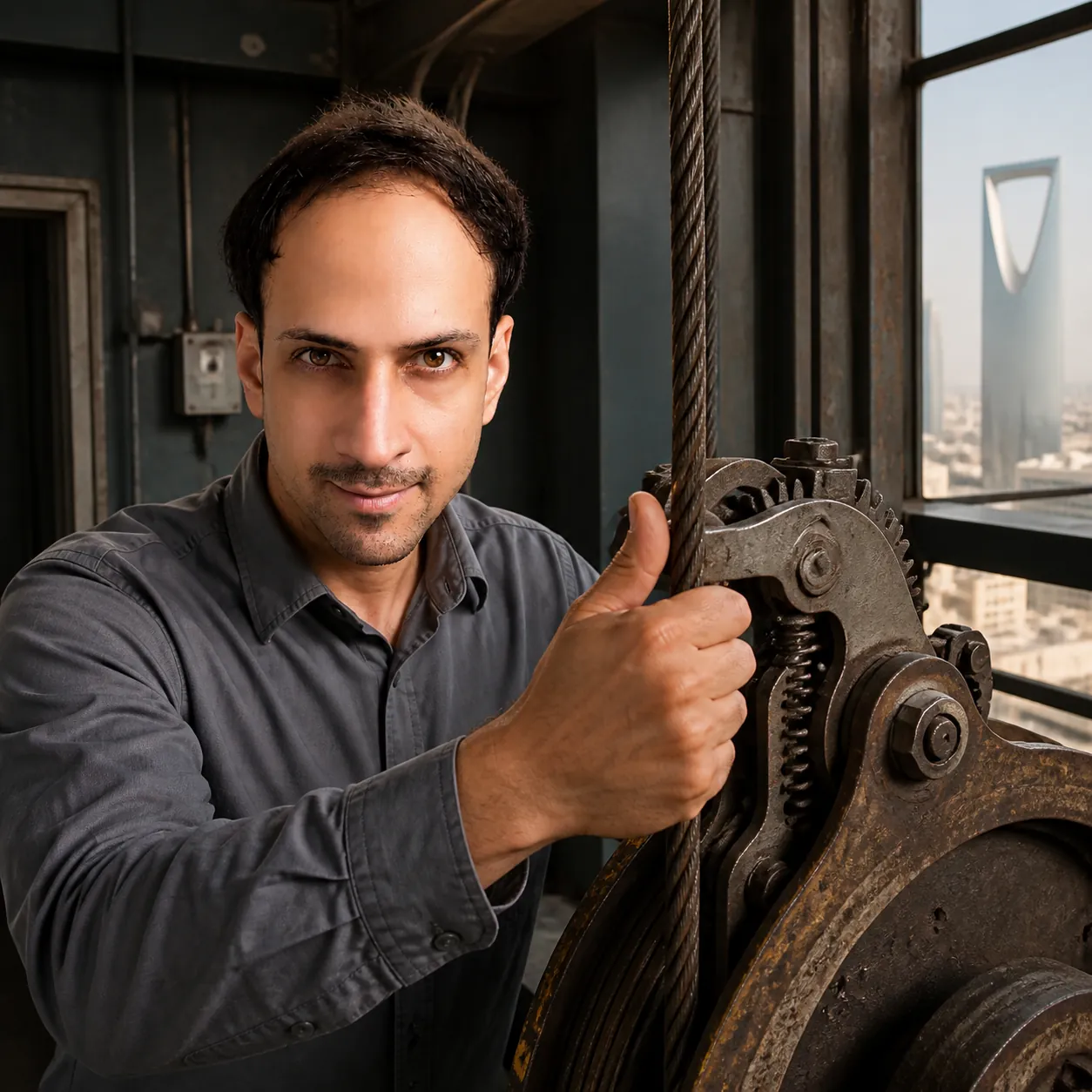
Use the attached reference photo as the identity reference: keep the same face, skin tone, hair and features as the person in that photo, without beautifying, aging or altering them. Create a square 1:1 museum-catalog frame with a strong first read and a slower second read at exactly 2880x2880 pixels. Location: a freight elevator machine room at the top of a Riyadh tower. Show the subject in a steel-grey work shirt buttoned to the second button, testing a taut hoist rope with one careful thumb. Treat this mechanism as the frame’s governing rule: a workshop ratchet whose pawl drops into every fresh tooth with a bright click, holding its lifted iron weight against sliding back pays out only what was honestly deposited, yet the timing feels generous. Explore how a machine that cannot move backward changes what starting feels like; direct expression and posture toward grounded confidence, never melodrama or ad-like confidence. Frame from across the mechanism at hand height so the device and their face share one plane of focus. Make the composition leave visible headroom where the mechanism has yet to arrive. Render it as museum-demonstration realism combining truthful mechanical detail, high-fidelity portrait photography, audible-seeming moments of metal contact, and quietly restrained editorial art direction, using cool even skylight softened by dust in the air, contrast restrained and a palette of warm dust, deep umber, and one polished steel highlight. Photorealistic: this must read as a real photograph from a physical camera, never an illustration, painting, or 3D render. Resolve real surface detail: leather creased along the lines of use, stitching slightly irregular, and edges burnished from contact. Keep one identity-locked person, credible hands and fingers, natural fabric, and coherent scale, contact, reflections, shadows, airflow, deformation, and materials. Background people only when essential, always secondary and clearly different. Avoid Rube Goldberg clutter, floating holographic interfaces, trophy-shelf staging, neon motivational glow, and impossibly frictionless chrome machinery. No text, labels, logos, signatures, watermarks, random symbols, plastic skin, excessive bloom, or glossy AI finish.
Treat that reference as the character anchor and change only the scene. Create a square 1:1 museum-catalog frame with a strong first read and a slower...
Treat that reference as the character anchor and change only the scene. Create a square 1:1 museum-catalog frame with a strong first read and a slower...
Treat that reference as the character anchor and change only the scene. Create a square 1:1 museum-catalog frame with a strong first read and a slower...
Treat that reference as the character anchor and change only the scene. Create a square 1:1 museum-catalog frame with a strong first read and a slower...
Treat that reference as the character anchor and change only the scene. Create a square 1:1 museum-catalog frame with a strong first read and a slower...
Treat that reference as the character anchor and change only the scene. Create a square 1:1 museum-catalog frame with a strong first read and a slower...
Treat that reference as the character anchor and change only the scene. Create a square 1:1 museum-catalog frame with a strong first read and a slower...
Treat that reference as the character anchor and change only the scene. Create a square 1:1 museum-catalog frame with a strong first read and a slower...
Treat that reference as the character anchor and change only the scene. Create a square 1:1 museum-catalog frame with a strong first read and a slower...
Treat that reference as the character anchor and change only the scene. Create a square 1:1 museum-catalog frame with a strong first read and a slower...
Treat that reference as the character anchor and change only the scene. Create a square 1:1 museum-catalog frame with a strong first read and a slower...
Treat that reference as the character anchor and change only the scene. Create a square 1:1 museum-catalog frame with a strong first read and a slower...