جاري التحميل...


جاري التحميل...
Create a square 1:1 museum-catalog frame with a strong first read and a slower second read at exactly 2880x2880 pixels. Location: a daylight weaving shed...
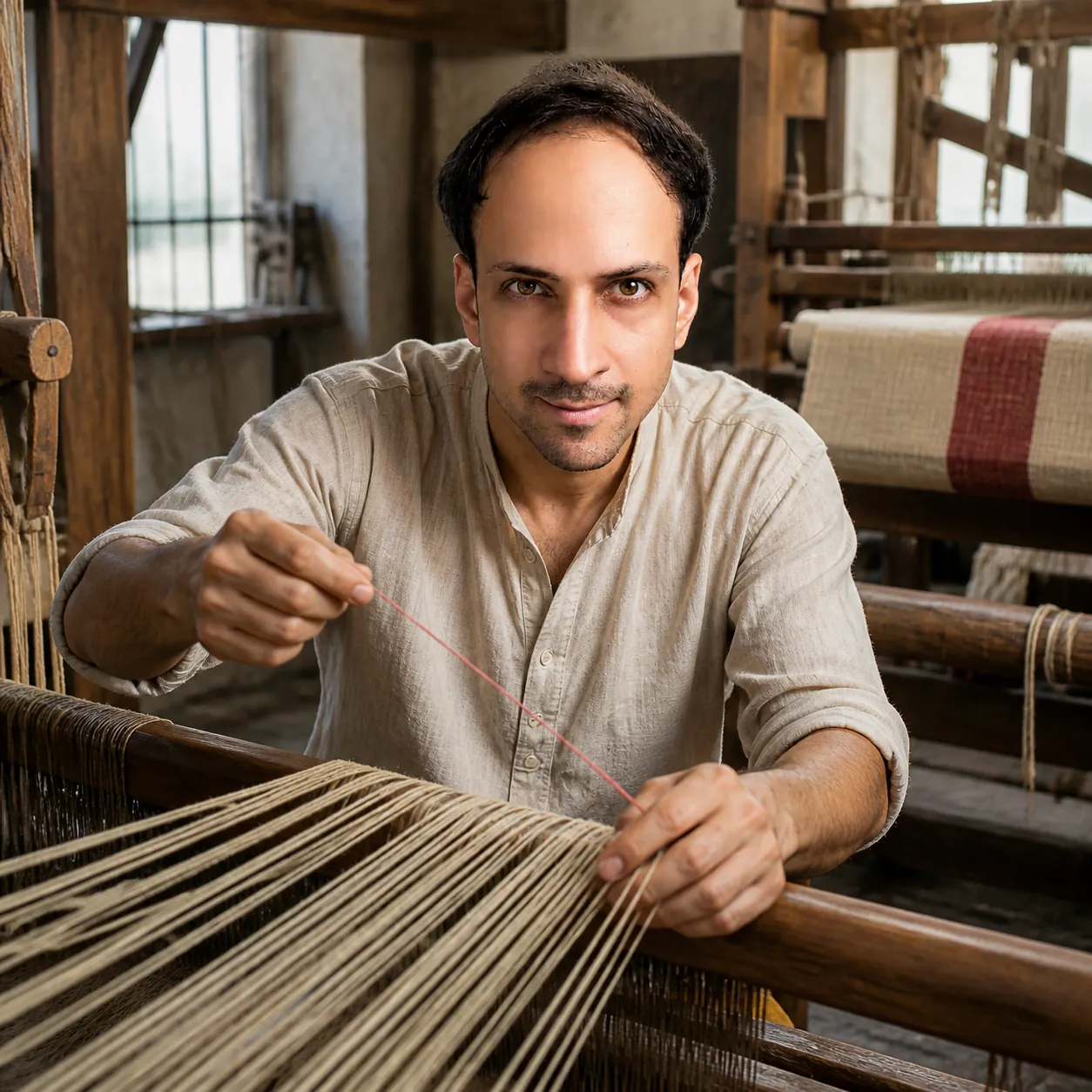
Use the attached reference photo as the identity reference: keep the same face, skin tone, hair and features as the person in that photo, without beautifying, aging or altering them. Create a square 1:1 museum-catalog frame with a strong first read and a slower second read at exactly 2880x2880 pixels. Location: a daylight weaving shed where two resting looms hold half-woven cloth. Show the subject in a collarless cotton shirt in undyed cloth with rolled sleeves, drawing one thread taut between spread fingers. Make one rigorous physical condition the conceptual engine: a small floor loom mid-rethread, every new warp thread knotted end-to-end onto the cut stub of the thread it replaces turns repeated effort into a physical route the hand can find again. Explore why new ability must be physically routed before it can be casually used; direct expression and posture toward patient resolve, never melodrama or ad-like confidence. Use an eye-level 55mm perspective that keeps their hands and the work equally credible. Make the composition let one bright new line cross a field of dulled ones. Render it as craft-documentary portraiture built from real fiber mechanics, patient workshop realism, archival material fidelity, and emotionally restrained editorial composition, using long window light raking across fiber so every twist reads and a palette of undyed flax, worn oak, and one madder-red line. Photorealistic: this must read as a real photograph from a physical camera, never an illustration, painting, or 3D render. Resolve real surface detail: true skin texture with pores and fine hair at the hairline, and fabric that creases where it is actually stressed. Keep one identity-locked person, credible hands and fingers, natural fabric, and coherent scale, contact, reflections, shadows, airflow, deformation, and materials. Background people only when essential, always secondary and clearly different. Avoid glowing neural filaments, brain-shaped tangles, circuit-board overlays, holographic wiring diagrams, and sparks jumping between cables. No text, labels, logos, signatures, watermarks, random symbols, plastic skin, excessive bloom, or glossy AI finish.
Treat that reference as the character anchor and change only the scene. Create a square 1:1 museum-catalog frame with a strong first read and a slower...
Treat that reference as the character anchor and change only the scene. Create a square 1:1 museum-catalog frame with a strong first read and a slower...
Treat that reference as the character anchor and change only the scene. Create a square 1:1 museum-catalog frame with a strong first read and a slower...
Treat that reference as the character anchor and change only the scene. Create a square 1:1 museum-catalog frame with a strong first read and a slower...
Treat that reference as the character anchor and change only the scene. Create a square 1:1 museum-catalog frame with a strong first read and a slower...
Treat that reference as the character anchor and change only the scene. Create a square 1:1 museum-catalog frame with a strong first read and a slower...
Treat that reference as the character anchor and change only the scene. Create a square 1:1 museum-catalog frame with a strong first read and a slower...
Treat that reference as the character anchor and change only the scene. Create a square 1:1 museum-catalog frame with a strong first read and a slower...
Treat that reference as the character anchor and change only the scene. Create a square 1:1 museum-catalog frame with a strong first read and a slower...
Treat that reference as the character anchor and change only the scene. Create a square 1:1 museum-catalog frame with a strong first read and a slower...
Treat that reference as the character anchor and change only the scene. Create a square 1:1 museum-catalog frame with a strong first read and a slower...
Treat that reference as the character anchor and change only the scene. Create a square 1:1 museum-catalog frame with a strong first read and a slower...