Convolutional Neural Networks
We have seen before that neural networks are quite good at dealing with images, and even one-layer perceptron is able to recognize handwritten digits from MNIST dataset with reasonable accuracy. However, the MNIST dataset is very special, and all digits are centered inside the image, which makes the task simpler.
In real life, we want to be able to recognize objects on a picture regardless of their exact location in the image. Computer vision is different from generic classification, because when we are trying to find a certain object in the picture, we are scanning the image looking for some specific patterns and their combinations. For example, when looking for a cat, we first may look for horizontal lines, which can form whiskers, and then certain a combination of whiskers can tell us that it is actually a picture of a cat. Relative position and presence of certain patterns is important, and not their exact position on the image.
To extract patterns, we will use the notion of convolutional filters. As you know, an image is represented by a 2D-matrix, or a 3D-tensor with color depth. Applying a filter means that we take relatively small filter kernel matrix, and for each pixel in the original image we compute the weighted average with neighboring points. We can view this like a small window sliding over the whole image, and averaging out all pixels according to the weights in the filter kernel matrix.
Figure description: Vertical Edge Filter | > Figure description: Horizontal Edge Filter
----|----
For example, if we apply 3x3 vertical edge and horizontal edge filters to the MNIST digits, we can get highlights (e.g. high values) where there are vertical and horizontal edges in our original image. Thus those two filters can be used to "look for" edges. Similarly, we can design different filters to look for other low-level patterns:
Figure description: The original was excluded because its reuse rights are not documented.
Image of Leung-Malik Filter Bank
However, while we can design the filters to extract some patterns manually, we can also design the network in such a way that it will learn the patterns automatically. It is one of the main ideas behind the CNN.
Main ideas behind CNN
The way CNNs work is based on the following important ideas:
- Convolutional filters can extract patterns
- We can design the network in such a way that filters are trained automatically
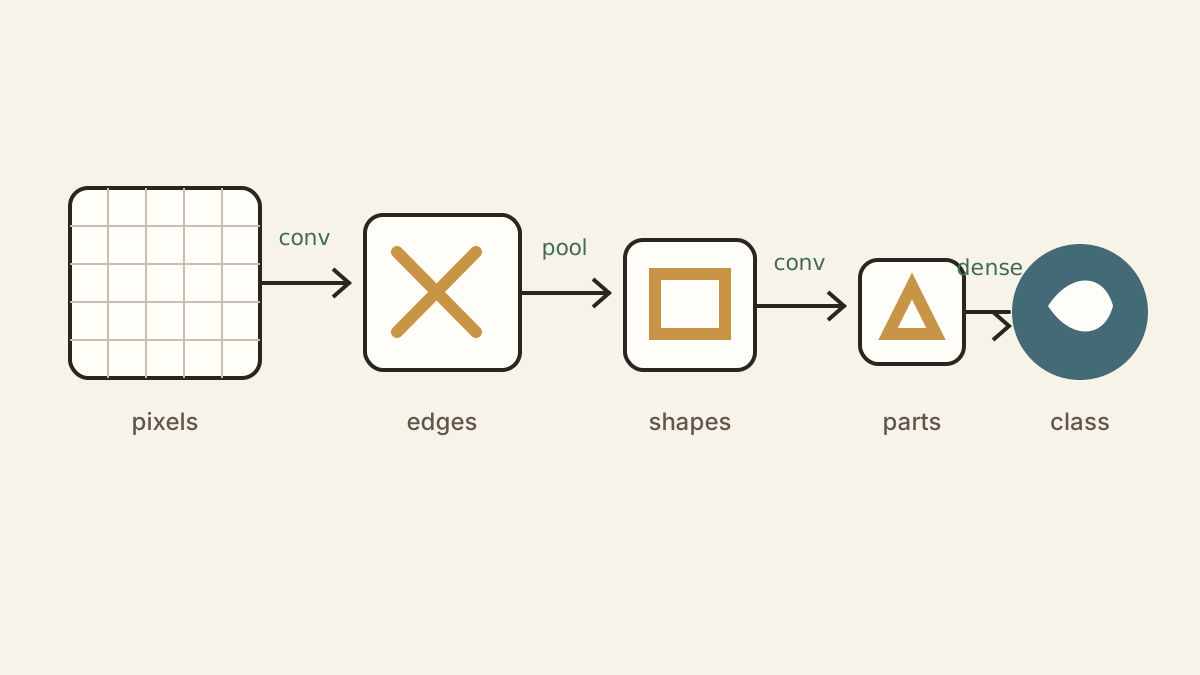
- We can use the same approach to find patterns in high-level features, not only in the original image. Thus CNN feature extraction work on a hierarchy of features, starting from low-level pixel combinations, up to higher level combination of picture parts.
✍️ Exercises: Convolutional Neural Networks
Let's continue exploring how convolutional neural networks work, and how we can achieve trainable filters, by working through the corresponding notebooks:
Pyramid Architecture
Most of the CNNs used for image processing follow a so-called pyramid architecture. The first convolutional layer applied to the original images typically has a relatively low number of filters (8-16), which correspond to different pixel combinations, such as horizontal/vertical lines of strokes. At the next level, we reduce the spatial dimension of the network, and increase the number of filters, which corresponds to more possible combinations of simple features. With each layer, as we move towards the final classifier, spatial dimensions of the image decrease, and the number of filters grow.
As an example, let's look at the architecture of VGG-16, a network that achieved 92.7% accuracy in ImageNet's top-5 classification in 2014:
Figure description: ImageNet Layers
Figure description: ImageNet Pyramid
Image from Researchgate
Best-Known CNN Architectures
Continue your study about the best-known CNN architectures
Well-Known CNN Architectures
Architectures such as VGG-16, ResNet, Inception, and MobileNet define how network layers and data flow are organized. TensorFlow is a software framework rather than a CNN architecture itself.
VGG-16
VGG-16 is a network that achieved 92.7% accuracy in ImageNet top-5 classification in 2014. It has the following layer structure:
Figure description: ImageNet Layers
As you can see, VGG follows a traditional pyramid architecture, which is a sequence of convolution-pooling layers.
Figure description: ImageNet Pyramid
Image from Researchgate
ResNet
ResNet is a family of models proposed by Microsoft Research in 2015. The main idea of ResNet is to use residual blocks:
Figure description: The original was excluded because its reuse rights are not documented.
Image from this paper
The reason for using identity pass-through is to have our layer predict the difference between the result of a previous layer and the output of the residual block - hence the name residual. Those blocks are much easier to train, and one can construct networks with several hundreds of those blocks (most common variants are ResNet-52, ResNet-101 and ResNet-152).
You can also think of this network as being able to adjust its complexity to the dataset. Initially, when you are starting to train the network, the weights values are small, and most of the signal goes through passthrough identity layers. As training progresses and weights become larger, the significance of network parameters grow, and the networks adjusts to accommodate required expressive power to correctly classify training images.
Google Inception
Google Inception architecture takes this idea one step further, and builds each network layer as a combination of several different paths:
Figure description: The original was excluded because its reuse rights are not documented.
Image from Researchgate
Here, we need to emphasize the role of 1x1 convolutions, because at first they do not make sense. Why would we need to run through the image with 1x1 filter? However, you need to remember that convolution filters also work with several depth channels (originally - RGB colors, in subsequent layers - channels for different filters), and 1x1 convolution is used to mix those input channels together using different trainable weights. It can be also viewed as downsampling (pooling) over channel dimension.
Here is a good blog post on the subject, and the original paper.
MobileNet
MobileNet is a family of models with reduced size, suitable for mobile devices. Use them if you are short in resources, and can sacrifice a little bit of accuracy. The main idea behind them is so-called depthwise separable convolution, which allows representing convolution filters by a composition of spatial convolutions and 1x1 convolution over depth channels. This significantly reduces the number of parameters, making the network smaller in size, and also easier to train with less data.
Here is a good blog post on MobileNet.
Conclusion
In this unit, you have learned the main concept behind computer vision neural networks - convolutional networks. Real-life architectures that power image classification, object detection, and even image generation networks are all based on CNNs, just with more layers and some additional training tricks.
🚀 Challenge
In the accompanying notebooks, there are notes at the bottom about how to obtain greater accuracy. Do some experiments to see if you can achieve higher accuracy.
Review & Self Study
While CNNs are most often used for Computer Vision tasks, they are generally good for extracting fixed-sized patterns. For example, if we are dealing with sounds, we may also want to use CNNs to look for some specific patterns in audio signal - in which case filters would be 1-dimensional (and this CNN would be called 1D-CNN). Also, sometimes 3D-CNN is used to extract features in multi-dimensional space, such as certain events occurring on video - CNN can capture certain patterns of feature changing over time. Do some review and self-study about other tasks that can be done with CNNs.
In this lab, you are tasked with classifying different cat and dog breeds. These images are more complex than the MNIST dataset and of higher dimensions, and there are more than 10 classes.