تخطَّ إلى المحتوى

برومبتات الصور

برومبتات لمولدات الصور: بورتريهات وفن وتصوير.

تم العثور على 4209
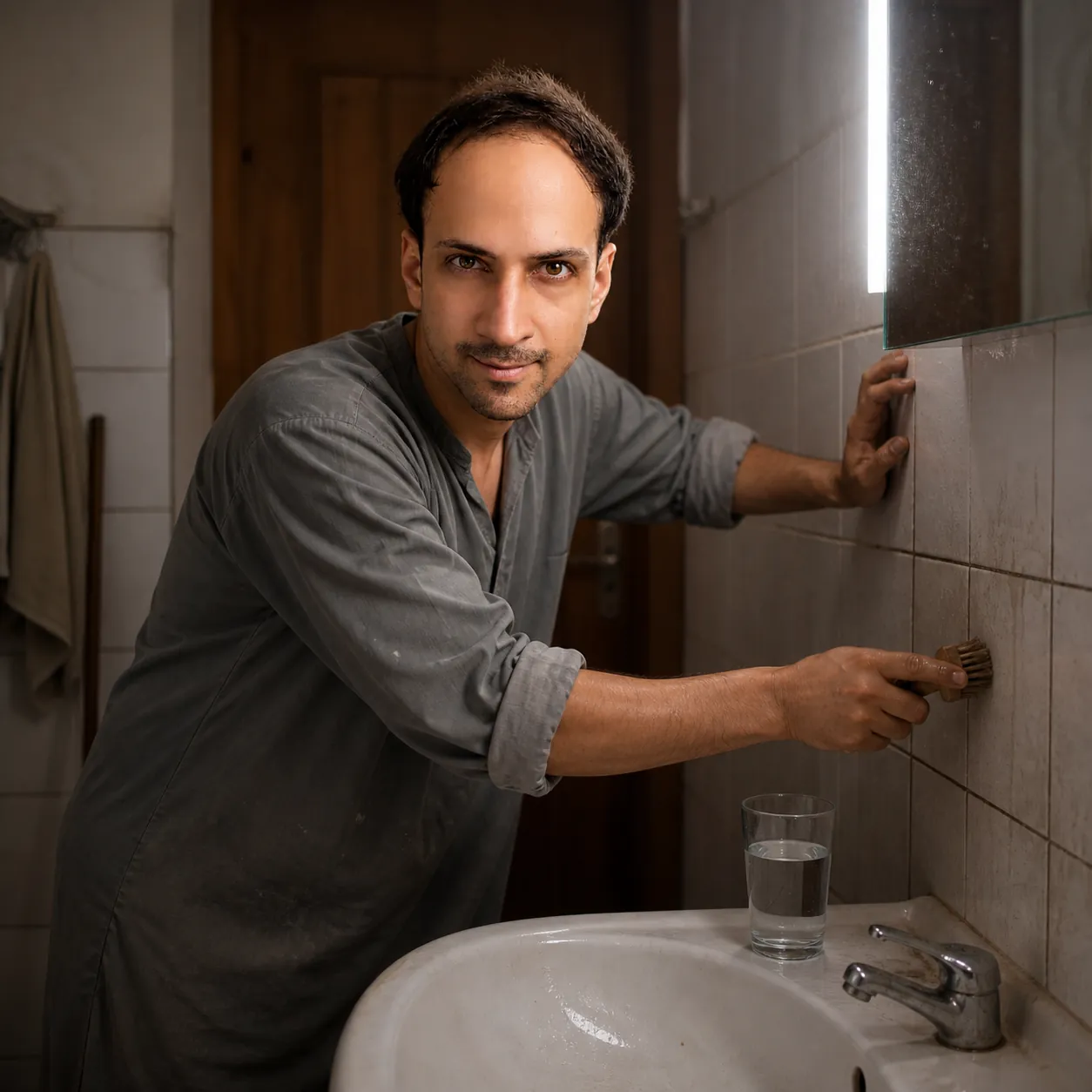
Tile Joint Under Mirror Light — AI Portrait Prompt
صورةAI Portraits

Turn your own photo into an unsentimental domestic documentary portrait in a small tiled bathroom lit by its mirror strip alone. Keeps your face unchanged.

من نص البرومبت

Use the attached reference photo as the identity reference: keep the same face, skin tone, hair and features as the person in that photo, without beautifying, aging or altering them. Create a square 1:1 museum-catalog frame with a strong first read and a slower second read at exactly 2880x2880 pixels. Location: a small tiled bathroom lit by its mirror strip alone. Show the subject in a faded grey traditional Gulf outfit with both sleeves rolled past the elbow, scrubbing one tile joint with short even strokes. The difficulty must be visible in this, not in their expression: a full glass of water that was set down when the job began and has kept its exact level since makes the scale of the night's work impossible to mistake for tidying. Explore how dignity survives work that nobody asked for and nobody will see; expression occupied, not expressive, carrying plain diligence, difficulty stated by scale rather than by mood. Use a 35mm three-quarter view with one near object kept physically convincing. Make the composition keep their hands and one clean surface brightest. Render it as unsentimental domestic documentary photography built from real household labour, plain interior styling, honest material texture, and unhurried observational framing, using a hand torch plus weak ambient, both sources clearly accounted for and a palette of cool white tile, warm plaster, and one amber lamp. Photorealistic: this must read as a real photograph from a physical camera, never an illustration, painting, or 3D render. Resolve real surface detail: wood grain read at honest scale, matte and gloss clearly separated, and no surface uniformly clean. Keep one identity-locked person, credible hands and fingers, natural fabric, and coherent scale, contact, reflections, shadows, airflow, deformation, and materials. Background people only when essential, always secondary and clearly different. Avoid heroic poster poses, glowing wellness interiors, and staring into the lens. No text, labels, logos, signatures, watermarks, random symbols, plastic skin, excessive bloom, or glossy AI finish.
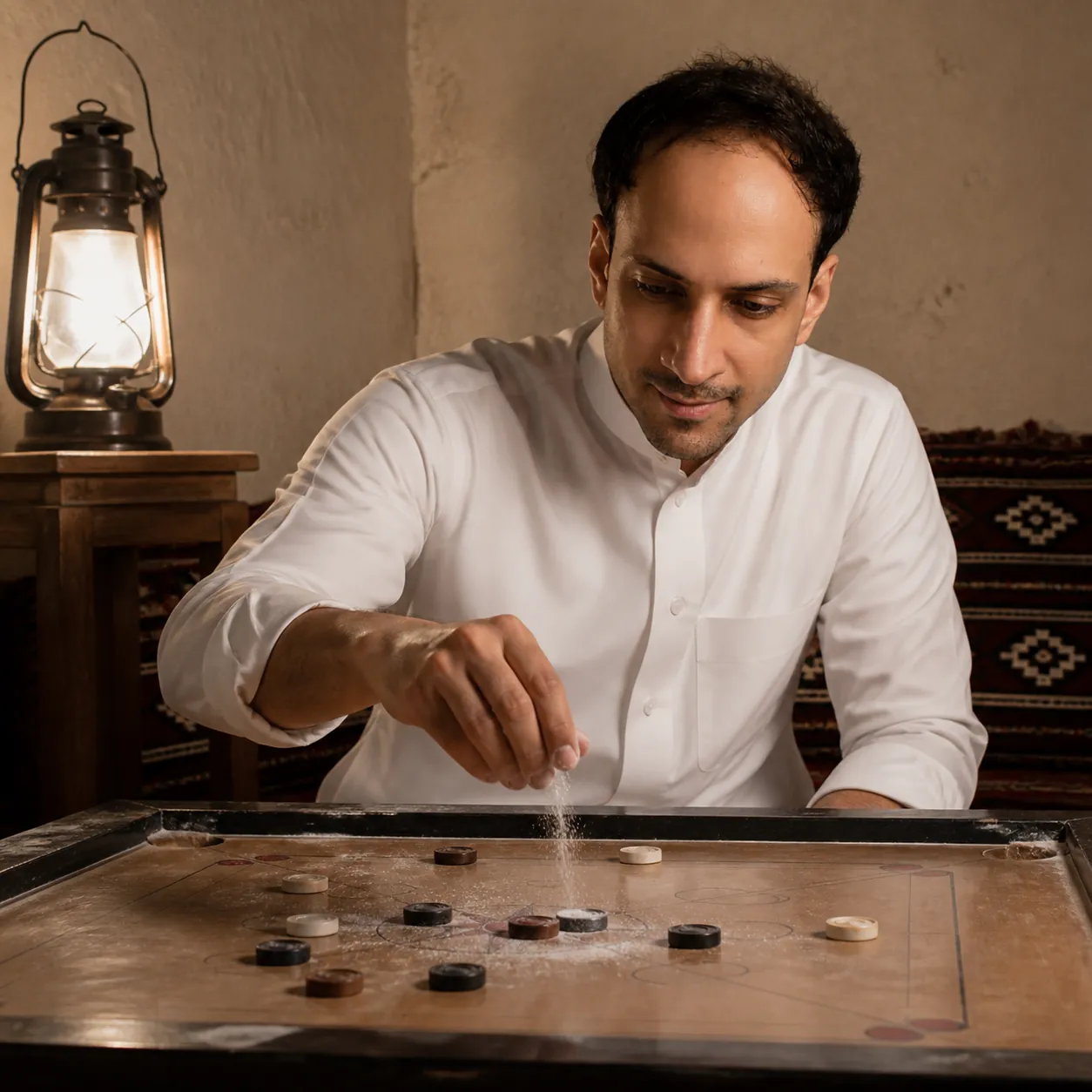
Undivided Rooms: Majlis Corner Given to a Carom Board — AI Portrait Prompt
صورةAI Portraits

Turn your own photo into a quiet domestic portrait in a majlis corner given to a carom board on a low stand. Keeps your face unchanged.

من نص البرومبت

Use the attached reference photo as the identity reference: keep the same face, skin tone, hair and features as the person in that photo, without beautifying, aging or altering them. Create a square 1:1 museum-catalog frame with a strong first read and a slower second read at exactly 2880x2880 pixels. Location: a majlis corner given to a carom board on a low stand. Show the subject in a plain white traditional Gulf outfit with both sleeves folded once at the wrist, dusting the board's lanes with a pinch of fine powder. Use this advanced image-making device as the core logic: a camp lantern whose knitted mineral-ash mantle glows moon-white above a modest flame, far brighter than the fire feeding it rewards the kind of attention that cannot be paid in passing. Explore whether a mechanism can teach the person using it how to be still; direct expression and posture toward gentle absorption, never melodrama or ad-like confidence. Frame along the table edge at forearm height so their hands and gaze read together without distortion. Make the composition keep every working surface honest, worn, and unstyled. Render it as quiet domestic realism built from believable flame-lit exposure, tactile wood and wool surfaces, documentary patience, and museum-grade portrait restraint, using a single lantern's white core softened by distance into readable half-tones and a palette of walnut, warm plaster, and one seam of lamp amber. Photorealistic: this must read as a real photograph from a physical camera, never an illustration, painting, or 3D render. Resolve real surface detail: wood grain read at honest scale, matte and gloss clearly separated, and no surface uniformly clean. Keep one identity-locked person, credible hands and fingers, natural fabric, and coherent scale, contact, reflections, shadows, airflow, deformation, and materials. Background people only when essential, always secondary and clearly different. Avoid sepia nostalgia filters, costume-drama props, candlelit romance styling, and staged rustic clutter. No text, labels, logos, signatures, watermarks, random symbols, plastic skin, excessive bloom, or glossy AI finish.
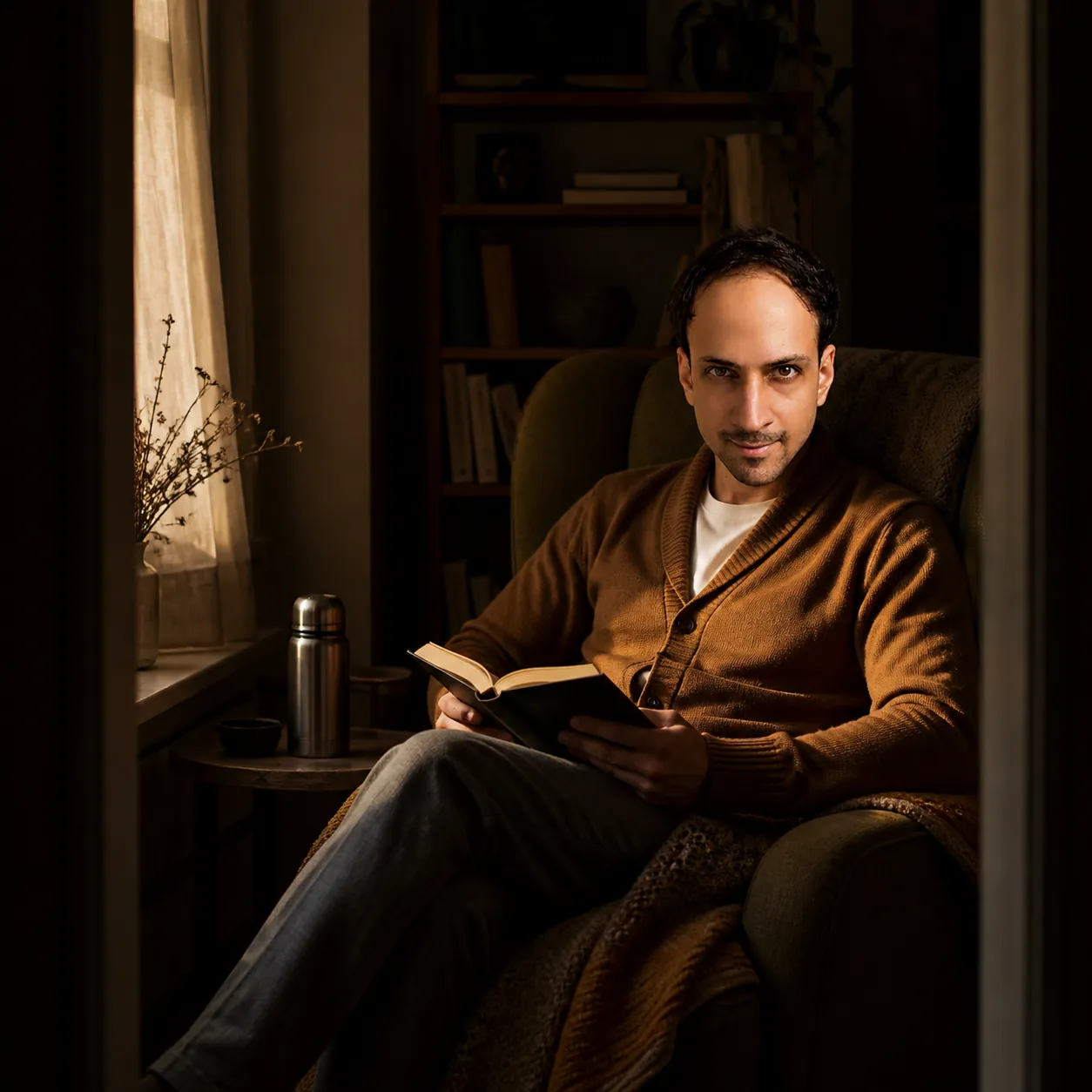
The Slow Center: Reading Nook — AI Portrait Prompt
صورةAI Portraits

Turn your own photo into a portrait in a reading nook with one armchair angled to the window's last light. Keeps your face unchanged.

من نص البرومبت

Use the attached reference photo as the identity reference: keep the same face, skin tone, hair and features as the person in that photo, without beautifying, aging or altering them. Create a square 1:1 museum-catalog frame with a strong first read and a slower second read at exactly 2880x2880 pixels. Location: a reading nook with one armchair angled to the window's last light. Show the subject in a camel-brown cardigan over a white crew-neck and grey wool trousers, drawing the armchair a hand-width closer to the window. Build the artwork around this material rule: a steel vacuum flask that keeps the evening's tea hot behind a double wall enclosing almost nothing at all trades spectacle for a fascination that deepens by the third look. Explore what full attention costs, and what it quietly buys back; direct expression and posture toward gathered calm, never melodrama or ad-like confidence. Use a 35mm doorway view with the room's single pool of light placed off-center and their figure inside it. Make the composition surround the action with generous, untroubled evening shadow. Render it as gallery-grade domestic still photography built from truthful household physics, restrained art direction, deep readable shadow, and companionable observational framing, using the last grey-gold daylight from one window, failing believably across the room and a palette of tea brown, raw linen, and one saffron thread. Photorealistic: this must read as a real photograph from a physical camera, never an illustration, painting, or 3D render. Resolve real surface detail: cotton that hangs by its own weight, seams that pucker very slightly, and collars softened by washing. Keep one identity-locked person, credible hands and fingers, natural fabric, and coherent scale, contact, reflections, shadows, airflow, deformation, and materials. Background people only when essential, always secondary and clearly different. Avoid orientalist lantern fantasies, floating dust-mote sunbeam overload, plastic-perfect wax flames, museum-diorama stiffness, and greeting-card coziness. No text, labels, logos, signatures, watermarks, random symbols, plastic skin, excessive bloom, or glossy AI finish.
A Private Rule: Larder Cupboard — AI Portrait Prompt
صورةAI Portraits

Turn your own photo into a photorealistic portrait in a larder cupboard beside the kitchen door, lower shelves half filled. Keeps your face unchanged.

من نص البرومبت

Use the attached reference photo as the identity reference: keep the same face, skin tone, hair and features as the person in that photo, without beautifying, aging or altering them. Create a square 1:1 museum-catalog frame with a strong first read and a slower second read at exactly 2880x2880 pixels. Location: a larder cupboard beside the kitchen door, lower shelves half filled. Show the subject in a plain grey crew-neck with sleeves pushed above the wrist, sliding a tin into the gap left for it. Anchor the frame to this piece of ordinary evidence: a cutlery tray sorted by a rule that only they can feel, one spoon lifted out again for breaking it shows care and compulsion using exactly the same pair of hands. Explore what the hands know about a rule the mouth cannot explain; expression occupied, not expressive, carrying unhurried insistence, difficulty stated in hours rather than in feeling. Frame slightly above the work so the judged row reads as one line. Make the composition let one hand rest just short of the object. Render it as gallery-scale everyday realism made from documentary portrait photography, exact household props, physically correct wear, and composed stillness, using one shaded ceiling fitting throwing even, slightly tired light and a palette of unbleached cotton, dark walnut, and an enamel-blue accent. Photorealistic: this must read as a real photograph from a physical camera, never an illustration, painting, or 3D render. Resolve real surface detail: cotton that hangs by its own weight, seams that pucker very slightly, and collars softened by washing. Keep one identity-locked person, credible hands and fingers, natural fabric, and coherent scale, contact, reflections, shadows, airflow, deformation, and materials. Background people only when essential, always secondary and clearly different. Avoid decorative symmetry, tidiness memes, gleaming surfaces, anguished faces, and pinned clinical checklists. No text, labels, logos, signatures, watermarks, random symbols, plastic skin, excessive bloom, or glossy AI finish.
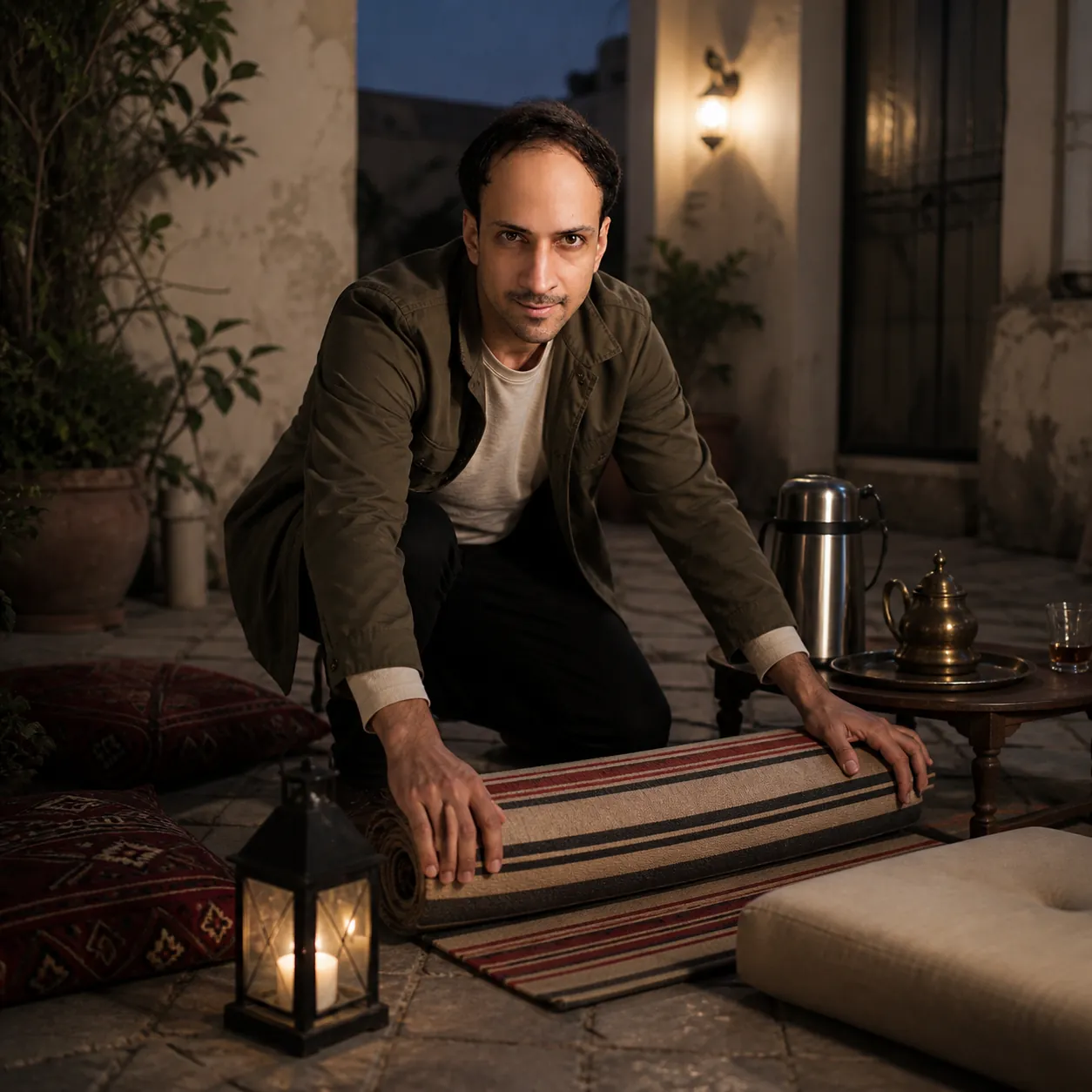
The Slow Center: Paved Courtyard — AI Portrait Prompt
صورةAI Portraits

Turn your own photo into a contemporary interior portrait in a paved courtyard at dusk, floor cushions ringed around one low table. Keeps your face unchanged.

من نص البرومبت

Use the attached reference photo as the identity reference: keep the same face, skin tone, hair and features as the person in that photo, without beautifying, aging or altering them. Create a square 1:1 museum-catalog frame with a strong first read and a slower second read at exactly 2880x2880 pixels. Location: a paved courtyard at dusk, floor cushions ringed around one low table. Show the subject in an olive field jacket over an off-white long-sleeved tee, unrolling a striped ground rug across the paving stones. Make one rigorous physical condition the conceptual engine: a steel vacuum flask that keeps the evening's tea hot behind a double wall enclosing almost nothing at all rewards the kind of attention that cannot be paid in passing. Explore what full attention costs, and what it quietly buys back; direct expression and posture toward settled attention, never melodrama or ad-like confidence. Use an eye-level 50mm viewpoint at seated height with natural perspective and restrained depth of field. Make the composition include one empty cushion or chair implying expected company. Render it as contemporary interior portraiture combining honest low-light photography, physically accurate flame behavior, lived-in Saudi domestic detail, and unhurried editorial composure, using a single lantern's white core softened by distance into readable half-tones and a palette of charcoal, aged brass, and one band of brick red. Photorealistic: this must read as a real photograph from a physical camera, never an illustration, painting, or 3D render. Resolve real surface detail: fine grit in the texture of concrete, efflorescence at damp edges, and hairline cracks that follow stress. Keep one identity-locked person, credible hands and fingers, natural fabric, and coherent scale, contact, reflections, shadows, airflow, deformation, and materials. Background people only when essential, always secondary and clearly different. Avoid sepia nostalgia filters, costume-drama props, candlelit romance styling, and staged rustic clutter. No text, labels, logos, signatures, watermarks, random symbols, plastic skin, excessive bloom, or glossy AI finish.
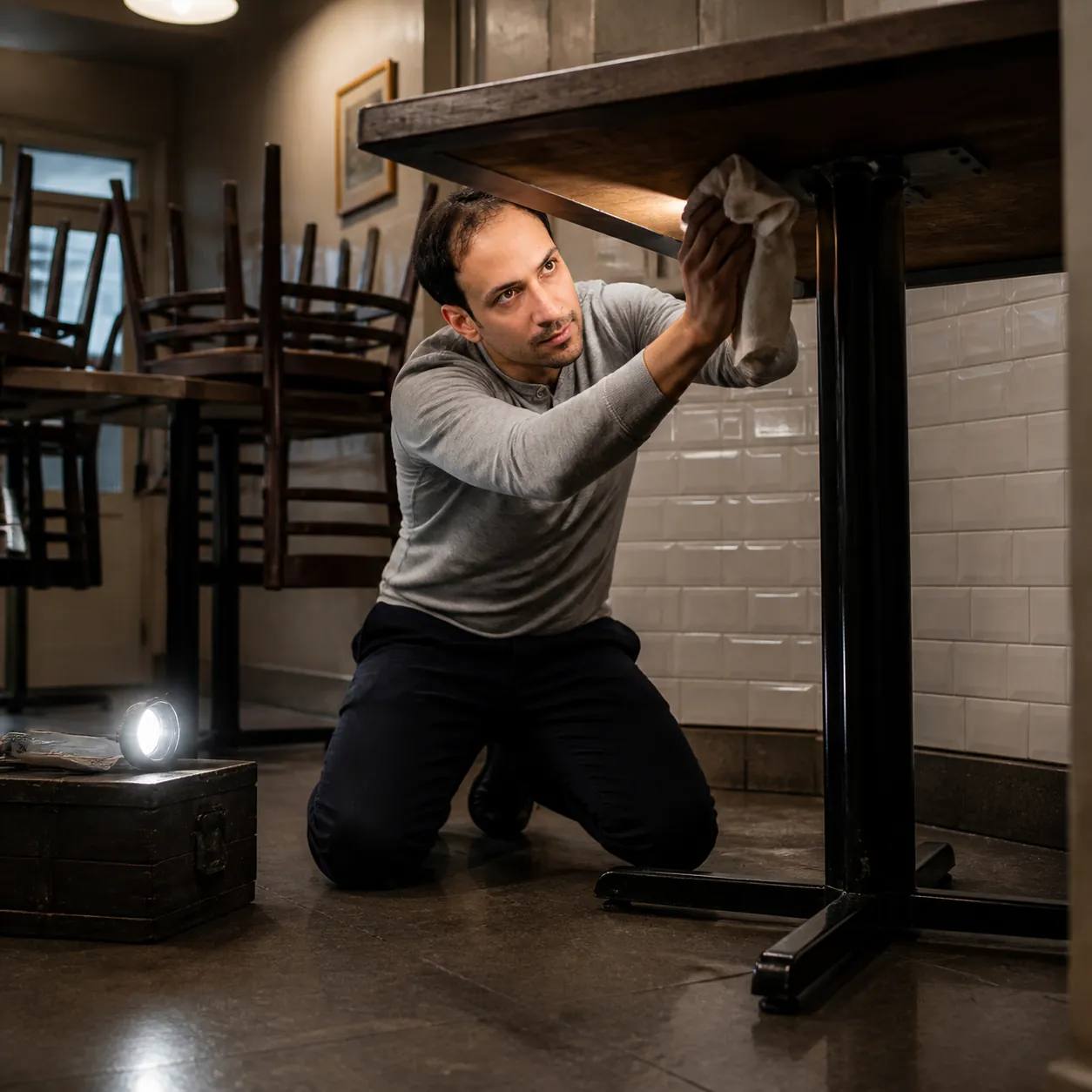
Dining Nook By Torchlight — AI Portrait Prompt
صورةAI Portraits

Turn your own photo into a photorealistic portrait in a dining nook with its table cleared and its chairs upended. Keeps your face unchanged.

من نص البرومبت

Use the attached reference photo as the identity reference: keep the same face, skin tone, hair and features as the person in that photo, without beautifying, aging or altering them. Create a square 1:1 museum-catalog frame with a strong first read and a slower second read at exactly 2880x2880 pixels. Location: a dining nook with its table cleared and its chairs upended. Show the subject in a soft grey henley and plain dark cotton trousers, running a cloth along the underside of the table. Make this piece of unglamorous evidence the whole argument: a torch propped on a crate so that both hands stay free for an inventory count nobody has requested keeps the labour honest while quietly naming what it is costing. Explore what a room looks like when energy arrives before any task needs it; expression occupied, not expressive, carrying sustained readiness, difficulty stated through the work alone. Use an 85mm from the room's threshold, compressing the scattered work behind them. Make the composition give the finished portion more sharpness than the rest. Render it as gallery-grade domestic realism assembled from ordinary cleaning apparatus, precise fabric and tile response, and natural skin rendering, using one ceiling panel doing all the work, with soft spill beneath and a palette of cool white tile, warm plaster, and one amber lamp. Photorealistic: this must read as a real photograph from a physical camera, never an illustration, painting, or 3D render. Resolve real surface detail: floor finish worn along the walked line, skirting marked at shoe height, and corners darker than the open floor. Keep one identity-locked person, credible hands and fingers, natural fabric, and coherent scale, contact, reflections, shadows, airflow, deformation, and materials. Background people only when essential, always secondary and clearly different. Avoid manic-eyed expressions, mess staged as spectacle, triumphant before-and-after framing, and golden window haze. No text, labels, logos, signatures, watermarks, random symbols, plastic skin, excessive bloom, or glossy AI finish.
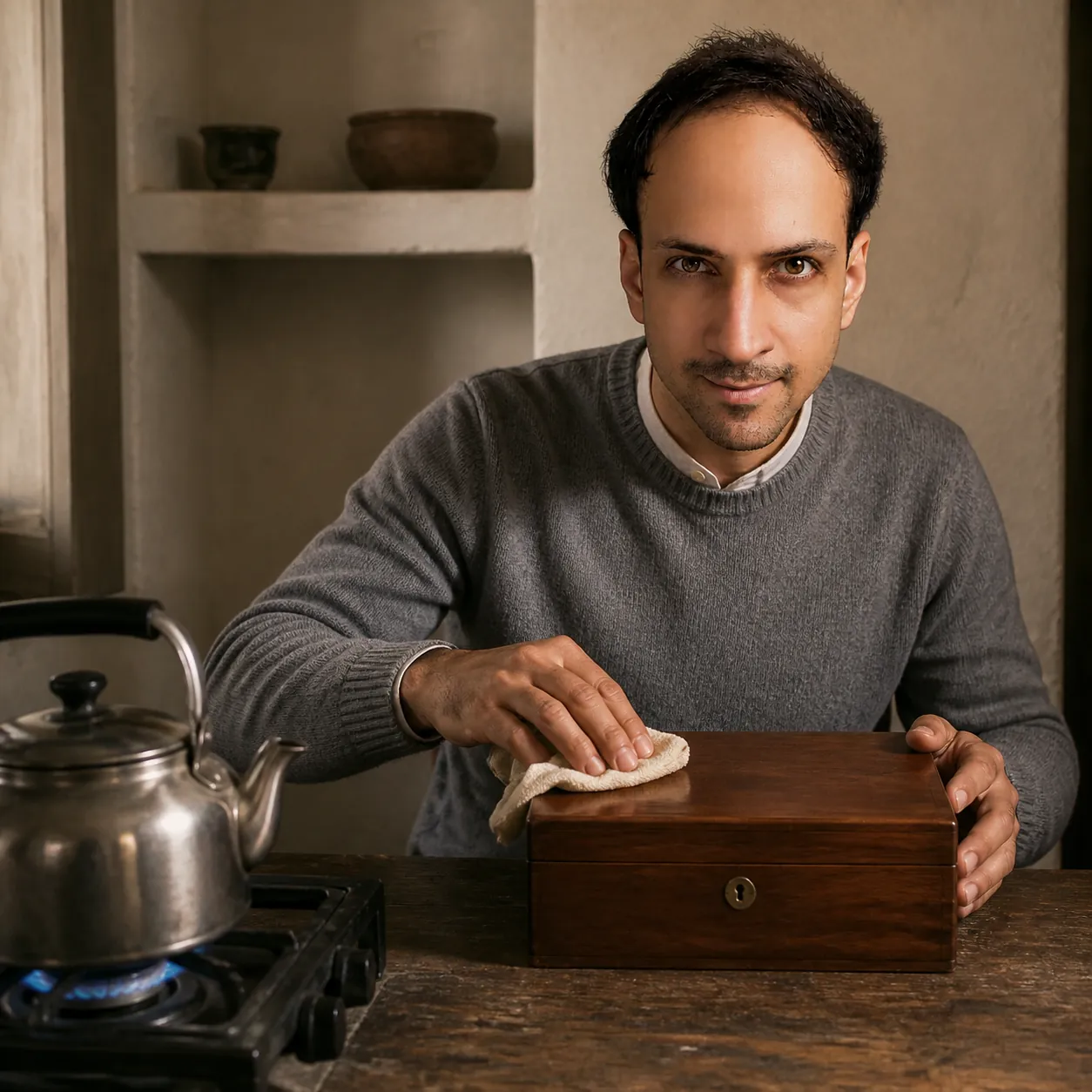
The Quiet Hours: Wall Niche — AI Portrait Prompt
صورةAI Portraits

Turn your own photo into a portrait in a wall niche holding one closed walnut case between bare plaster shelves. Keeps your face unchanged.

من نص البرومبت

Use the attached reference photo as the identity reference: keep the same face, skin tone, hair and features as the person in that photo, without beautifying, aging or altering them. Create a square 1:1 museum-catalog frame with a strong first read and a slower second read at exactly 2880x2880 pixels. Location: a wall niche holding one closed walnut case between bare plaster shelves. Show the subject in a heather-grey sweater with a band-collar shirt beneath it, buffing the case's lid along its grain with a soft cloth. Treat this mechanism as the frame’s governing rule: a stovetop kettle at its loud murmuring stage, when collapsing steam bubbles ring the water hardest just before the boil trades spectacle for a fascination that deepens by the third look. Explore why an evening feels longer when everything in it moves at hand speed; direct expression and posture toward attentive ease, never melodrama or ad-like confidence. Frame from the empty chair opposite them, the lens at a seated guest's eye height. Make the composition keep every working surface honest, worn, and unstyled. Render it as contemporary interior portraiture combining honest low-light photography, physically accurate flame behavior, lived-in Saudi domestic detail, and unhurried editorial composure, using the last grey-gold daylight from one window, failing believably across the room and a palette of soft olive, bone plaster, and a low flame-orange note. Photorealistic: this must read as a real photograph from a physical camera, never an illustration, painting, or 3D render. Resolve real surface detail: leather creased along the lines of use, stitching slightly irregular, and edges burnished from contact. Keep one identity-locked person, credible hands and fingers, natural fabric, and coherent scale, contact, reflections, shadows, airflow, deformation, and materials. Background people only when essential, always secondary and clearly different. Avoid orientalist lantern fantasies, floating dust-mote sunbeam overload, plastic-perfect wax flames, museum-diorama stiffness, and greeting-card coziness. No text, labels, logos, signatures, watermarks, random symbols, plastic skin, excessive bloom, or glossy AI finish.
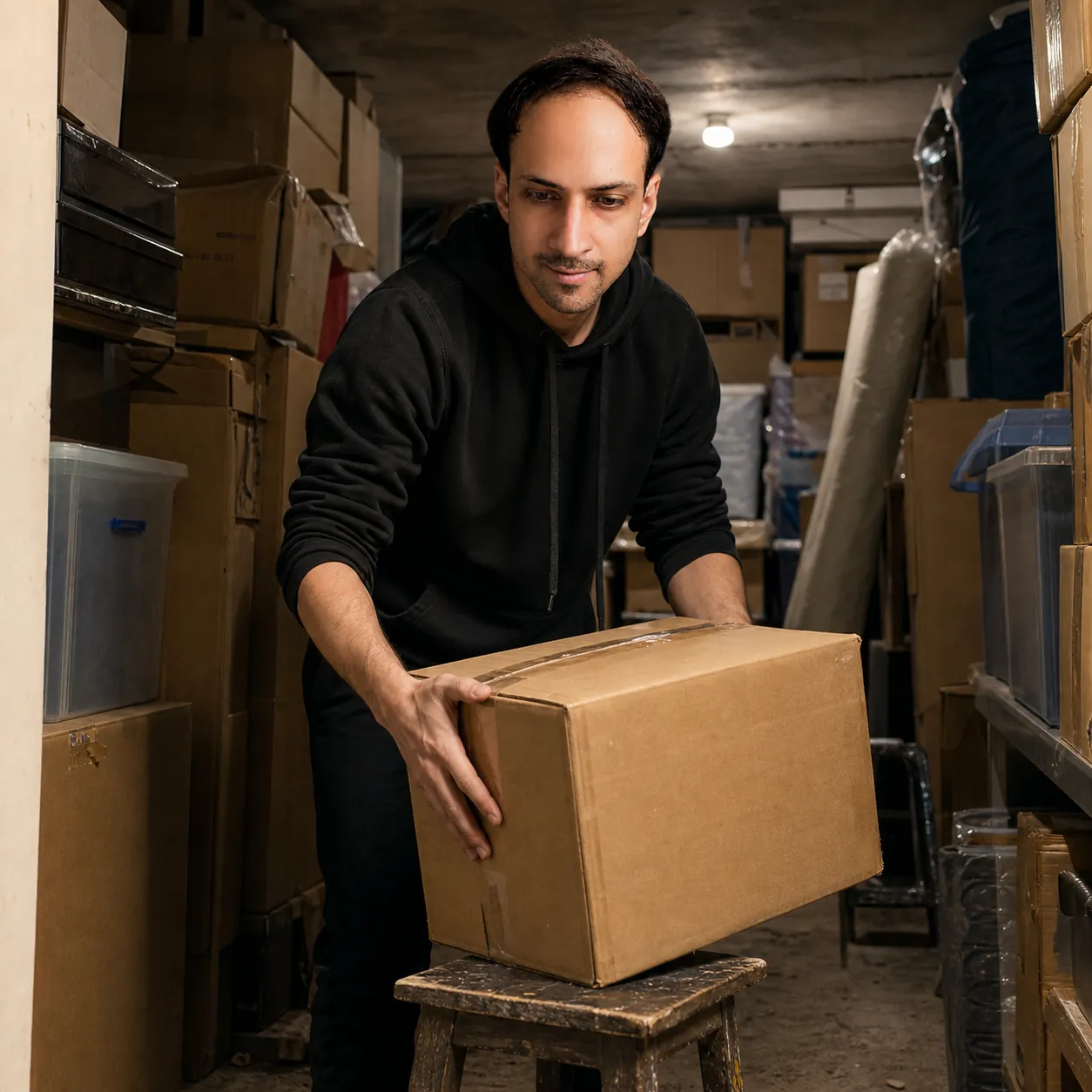
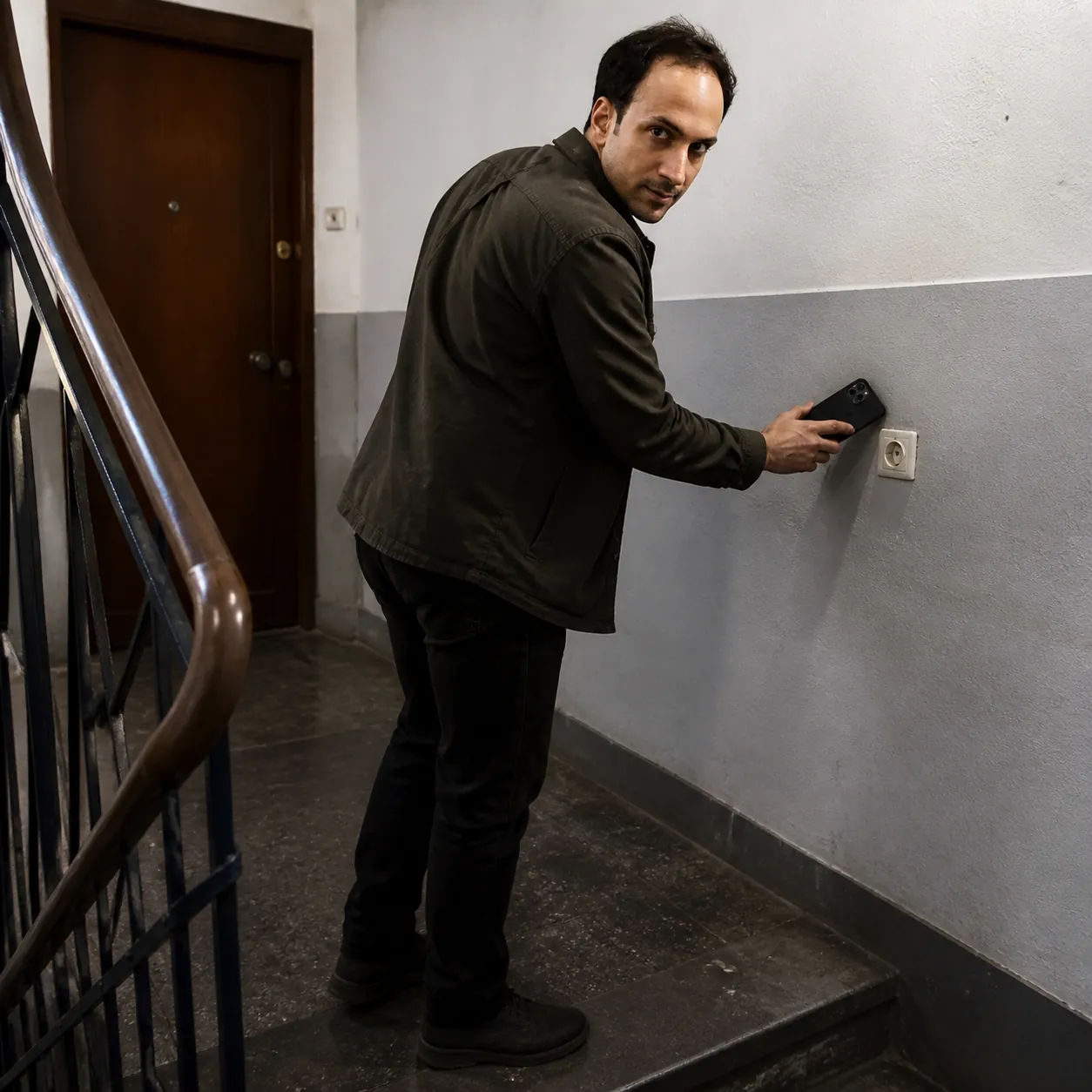
One More Test: Half-Landing Between Two Floors — AI Portrait Prompt
صورةAI Portraits

Turn your own photo into a quiet interior reportage portrait in the half-landing between two floors of a walk-up block. Keeps your face unchanged.

من نص البرومبت

Use the attached reference photo as the identity reference: keep the same face, skin tone, hair and features as the person in that photo, without beautifying, aging or altering them. Create a square 1:1 museum-catalog frame with a strong first read and a slower second read at exactly 2880x2880 pixels. Location: the half-landing between two floors of a walk-up block. Show the subject in a dark olive overshirt over a plain crew-neck, turning back down two steps toward the door. Build the image around this small, exact tableau: a wall socket standing empty beneath a phone they raise to it, camera side out, shutter never pressed spends real labour on a doubt that looking cannot settle. Explore whether checking twice is caution, labour, or a toll paid to leave; expression occupied, not expressive, carrying practised endurance, difficulty stated without inviting sympathy. Frame from waist height so the floor and their shoes hold the lower third. Make the composition let the tidiest area read as the least settled. Render it as quiet interior reportage combining high-fidelity portraiture, accurate fixture and fitting detail, plain lived-in surfaces, and unhurried near-natural lighting, using flat corridor fluorescence with soft bounce off pale painted walls and a palette of unbleached linen, charcoal, and a low ember orange. Photorealistic: this must read as a real photograph from a physical camera, never an illustration, painting, or 3D render. Resolve real surface detail: condensation beading at true size, liquid meniscus curving against glass, and wet surfaces darker than dry ones. Keep one identity-locked person, credible hands and fingers, natural fabric, and coherent scale, contact, reflections, shadows, airflow, deformation, and materials. Background people only when essential, always secondary and clearly different. Avoid clock close-ups, head-in-hands melancholy, mystical counting, inspirational calm, and beauty portraits without labour. No text, labels, logos, signatures, watermarks, random symbols, plastic skin, excessive bloom, or glossy AI finish.
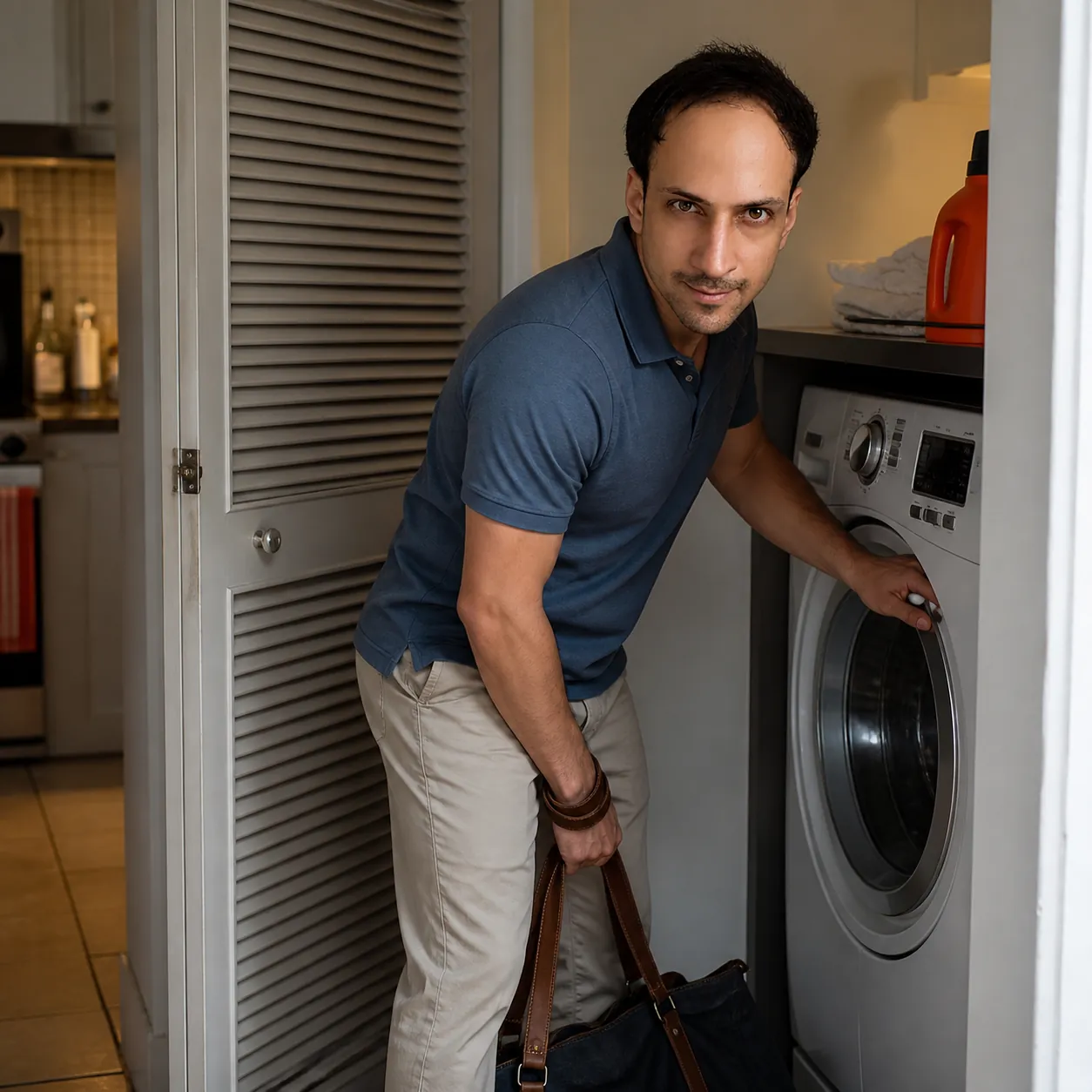
Real Progress: Windowless Flat Storeroom Stacked — AI Portrait Prompt
صورةAI Portraits

Turn your own photo into a portrait in a windowless flat storeroom stacked shoulder-high with sealed boxes. Keeps your face unchanged.

من نص البرومبت

Use the attached reference photo as the identity reference: keep the same face, skin tone, hair and features as the person in that photo, without beautifying, aging or altering them. Create a square 1:1 museum-catalog frame with a strong first read and a slower second read at exactly 2880x2880 pixels. Location: a windowless flat storeroom stacked shoulder-high with sealed boxes. Show the subject in a dark hooded sweatshirt with the sleeves shoved to the elbow, lifting one box down onto a low stool. Let one honest object carry what the face will not: a room where four separate jobs stand half-done at once with none of them anywhere near finished makes the scale of the night's work impossible to mistake for tidying. Explore how a household benefits from labour its owner cannot quite stop giving; expression occupied, not expressive, carrying working absorption, difficulty stated by scale rather than by mood. Use a 50mm eye-level view so the work and their hands stay legible. Make the composition run the sorted rows out of frame unresolved. Render it as quiet night-shift reportage combining accurate domestic detail, restrained contemporary portraiture, believable wet-and-dry surfaces, and composition that refuses to dramatise, using a hand torch plus weak ambient, both sources clearly accounted for and a palette of matte charcoal, pale wood, and dulled brass. Photorealistic: this must read as a real photograph from a physical camera, never an illustration, painting, or 3D render. Resolve real surface detail: fine grit in the texture of concrete, efflorescence at damp edges, and hairline cracks that follow stress. Keep one identity-locked person, credible hands and fingers, natural fabric, and coherent scale, contact, reflections, shadows, airflow, deformation, and materials. Background people only when essential, always secondary and clearly different. Avoid heroic poster poses, glowing wellness interiors, and staring into the lens. No text, labels, logos, signatures, watermarks, random symbols, plastic skin, excessive bloom, or glossy AI finish.
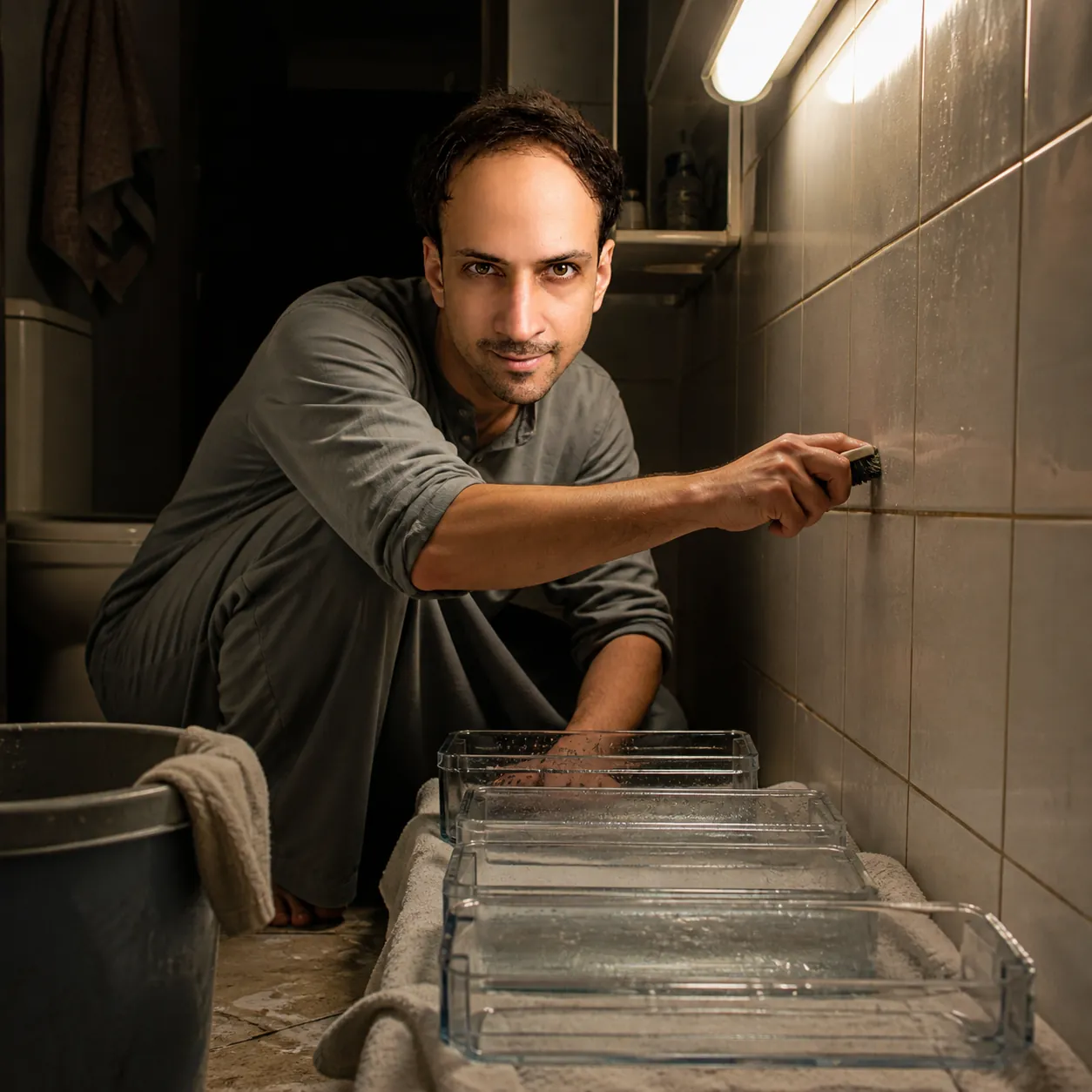
Proof Wanted: Small Laundry Alcove Off the Kitchen — AI Portrait Prompt
صورةAI Portraits

Turn your own photo into an unsentimental domestic portrait in a small laundry alcove off the kitchen behind a folding door. Keeps your face unchanged.

من نص البرومبت

Use the attached reference photo as the identity reference: keep the same face, skin tone, hair and features as the person in that photo, without beautifying, aging or altering them. Create a square 1:1 museum-catalog frame with a strong first read and a slower second read at exactly 2880x2880 pixels. Location: a small laundry alcove off the kitchen behind a folding door. Show the subject in a faded blue polo shirt and plain cotton trousers, pressing the machine door shut against its seal. Let one honest object carry what the face will not: a shoulder bag set back down on the floor, its strap still looped round a wrist that has not left weighs a two-minute job against everything it can quietly become. Explore what the body does with a doubt the eyes already answered; expression occupied, not expressive, carrying worn method, difficulty stated as ordinary maintenance. Use a 50mm eye-level view with the checked object nearer than their shoulder. Make the composition put their weight on the foot pointing away. Render it as unsentimental domestic realism built from documentary portrait photography, honest household materials, restrained art direction, and patient observational timing, using even overcast daylight through a doorway with mild interior fill and a palette of unbleached linen, charcoal, and a low ember orange. Photorealistic: this must read as a real photograph from a physical camera, never an illustration, painting, or 3D render. Resolve real surface detail: the difference between a wiped surface and a clean one, faint tide marks on ceramic, and metal dulled unevenly by touch. Keep one identity-locked person, credible hands and fingers, natural fabric, and coherent scale, contact, reflections, shadows, airflow, deformation, and materials. Background people only when essential, always secondary and clearly different. Avoid hand-washing imagery, tally marks, symmetrical object grids, hero poses at camera, and wellness glow. No text, labels, logos, signatures, watermarks, random symbols, plastic skin, excessive bloom, or glossy AI finish.
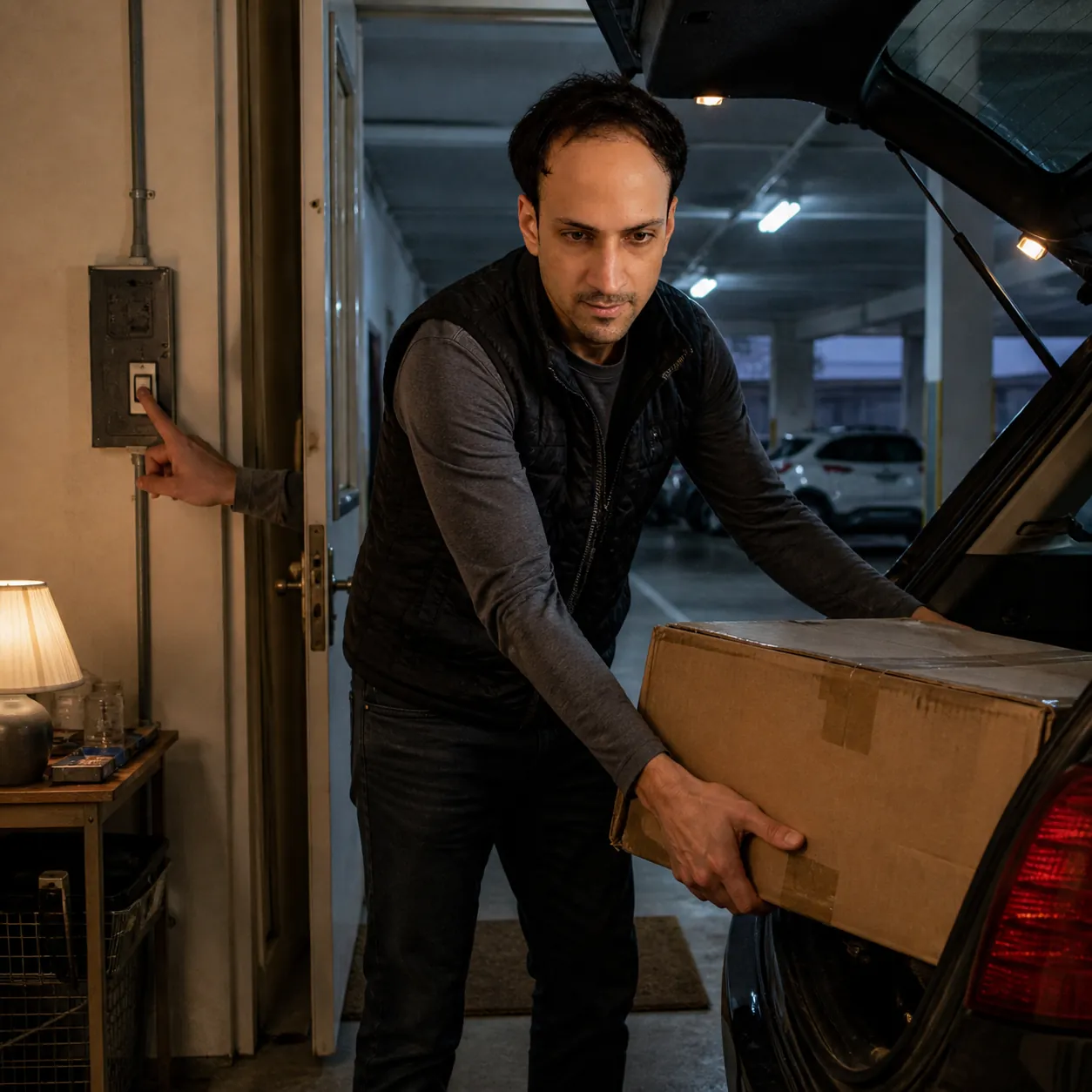
Full Capacity: Small Tiled Bathroom — AI Portrait Prompt
صورةAI Portraits

Turn your own photo into a quiet night-shift reportage portrait in a small tiled bathroom lit by its mirror strip alone. Keeps your face unchanged.

من نص البرومبت

Use the attached reference photo as the identity reference: keep the same face, skin tone, hair and features as the person in that photo, without beautifying, aging or altering them. Create a square 1:1 museum-catalog frame with a strong first read and a slower second read at exactly 2880x2880 pixels. Location: a small tiled bathroom lit by its mirror strip alone. Show the subject in a faded grey traditional Gulf outfit with both sleeves rolled past the elbow, scrubbing one tile joint with short even strokes. Build the image around this small, exact tableau: a set of refrigerator shelves that stand draining along a folded towel after being washed one at a time keeps the labour honest while quietly naming what it is costing. Explore whether a system built at three still makes sense by breakfast; expression occupied, not expressive, carrying level industry, difficulty stated through the work alone. Frame low from the floor, letting the sorted work run away in depth. Make the composition leave the room beyond the lamp completely unlit. Render it as quiet night-shift reportage combining accurate domestic detail, restrained contemporary portraiture, believable wet-and-dry surfaces, and composition that refuses to dramatise, using a bare overhead bulb, plain and slightly too bright for comfort and a palette of graphite shadow, oatmeal linen, and low sodium orange. Photorealistic: this must read as a real photograph from a physical camera, never an illustration, painting, or 3D render. Resolve real surface detail: condensation beading at true size, liquid meniscus curving against glass, and wet surfaces darker than dry ones. Keep one identity-locked person, credible hands and fingers, natural fabric, and coherent scale, contact, reflections, shadows, airflow, deformation, and materials. Background people only when essential, always secondary and clearly different. Avoid manic-eyed expressions, mess staged as spectacle, triumphant before-and-after framing, and golden window haze. No text, labels, logos, signatures, watermarks, random symbols, plastic skin, excessive bloom, or glossy AI finish.
Already Off: Covered Residential Parking Level — AI Portrait Prompt
صورةAI Portraits

Turn your own photo into a portrait in a covered residential parking level under long ceiling tubes. Keeps your face unchanged.

من نص البرومبت

Use the attached reference photo as the identity reference: keep the same face, skin tone, hair and features as the person in that photo, without beautifying, aging or altering them. Create a square 1:1 museum-catalog frame with a strong first read and a slower second read at exactly 2880x2880 pixels. Location: a covered residential parking level under long ceiling tubes. Show the subject in a dark quilted gilet over a long-sleeved grey tee, sliding a heavy carton across the car's boot lip. The difficulty must be visible in this, not in their expression: a switch already down that one finger presses again in passing, the room behind it staying exactly as dark spends real labour on a doubt that looking cannot settle. Explore where the labour sits when nothing in the room needs fixing; expression occupied, not expressive, carrying workmanlike restraint, difficulty stated in the object alone. Hold a static wide view from just inside the room they are leaving. Make the composition keep one hand fully visible and unambiguous throughout. Render it as gallery-grade domestic documentation built from truthful skin rendering, worn everyday objects, credible household architecture, and framing that refuses drama, using late blue window light thinned by one low interior lamp and a palette of smoke grey, pale sand, and one dulled copper. Photorealistic: this must read as a real photograph from a physical camera, never an illustration, painting, or 3D render. Resolve real surface detail: rubber gone chalky with age, painted metal chipped to primer, and plastic yellowed only where light reaches it. Keep one identity-locked person, credible hands and fingers, natural fabric, and coherent scale, contact, reflections, shadows, airflow, deformation, and materials. Background people only when essential, always secondary and clearly different. Avoid clock close-ups, head-in-hands melancholy, mystical counting, inspirational calm, and beauty portraits without labour. No text, labels, logos, signatures, watermarks, random symbols, plastic skin, excessive bloom, or glossy AI finish.
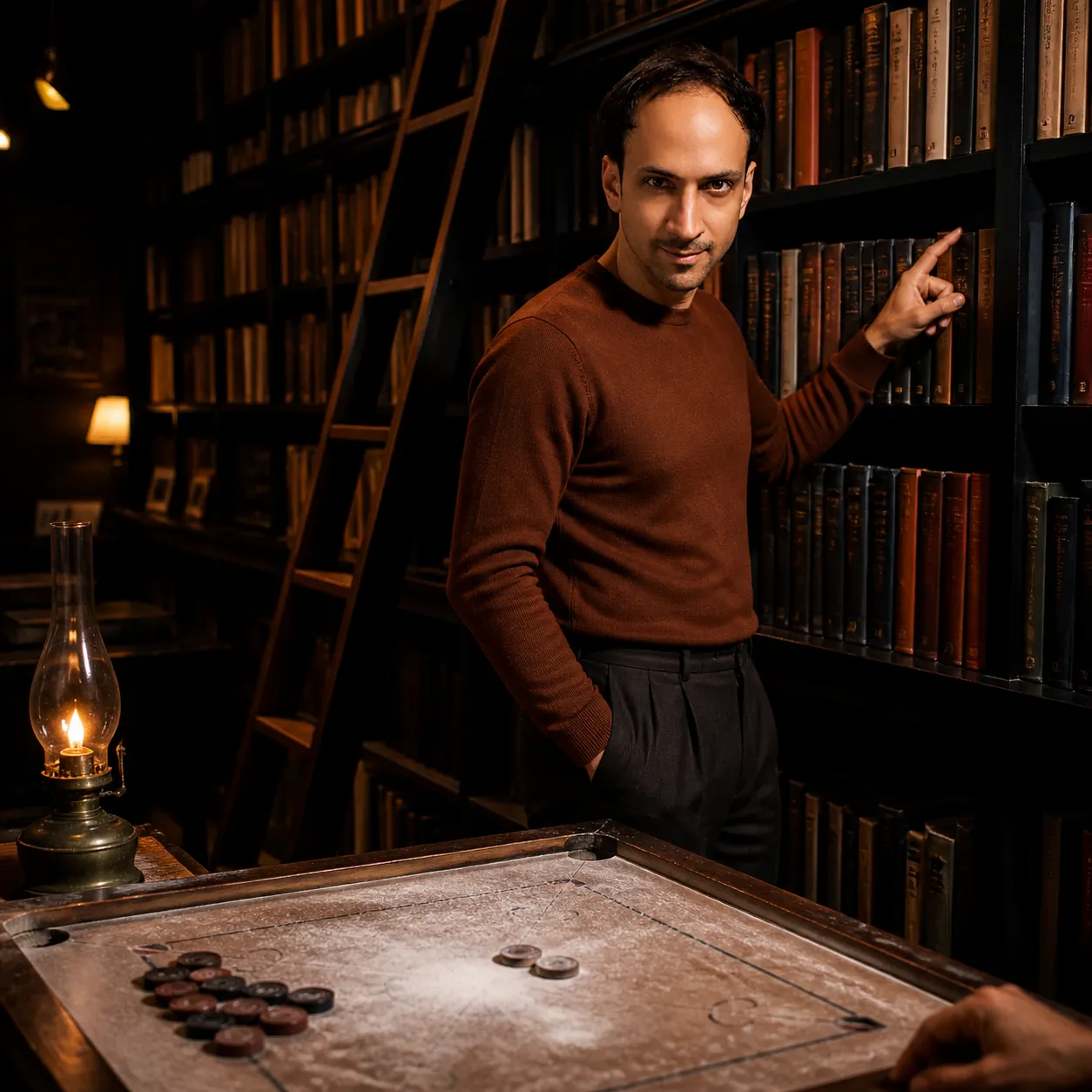
Hand Speed: Floor-To-Ceiling Home Library Wall — AI Portrait Prompt
صورةAI Portraits

Turn your own photo into a portrait in a floor-to-ceiling home library wall with a wheeled ladder, early evening. Keeps your face unchanged.

من نص البرومبت

Use the attached reference photo as the identity reference: keep the same face, skin tone, hair and features as the person in that photo, without beautifying, aging or altering them. Create a square 1:1 museum-catalog frame with a strong first read and a slower second read at exactly 2880x2880 pixels. Location: a floor-to-ceiling home library wall with a wheeled ladder, early evening. Show the subject in a rust-brown fine-knit shirt and pleated charcoal trousers, running one finger along the spines to a stopping place. The impossible-looking event must obey this clear system: a powder-slick carom board where one coin, squarely striking its identical twin, stops dead as the twin departs with its speed rewards the kind of attention that cannot be paid in passing. Explore what a household gains when its evenings are furnished for presence; direct expression and posture toward patient relish, never melodrama or ad-like confidence. Use an 85mm view from across the room, the evening's object resting in the same focal plane as their face. Make the composition surround the action with generous, untroubled evening shadow. Render it as gallery-grade domestic still photography built from truthful household physics, restrained art direction, deep readable shadow, and companionable observational framing, using one shaded oil-lamp pool with darkness allowed to stand in the corners and a palette of charcoal, aged brass, and one band of brick red. Photorealistic: this must read as a real photograph from a physical camera, never an illustration, painting, or 3D render. Resolve real surface detail: glass with real thickness at its edge, reflections that carry the room's actual colour, and dust visible only at grazing angles. Keep one identity-locked person, credible hands and fingers, natural fabric, and coherent scale, contact, reflections, shadows, airflow, deformation, and materials. Background people only when essential, always secondary and clearly different. Avoid sepia nostalgia filters, costume-drama props, candlelit romance styling, and staged rustic clutter. No text, labels, logos, signatures, watermarks, random symbols, plastic skin, excessive bloom, or glossy AI finish.
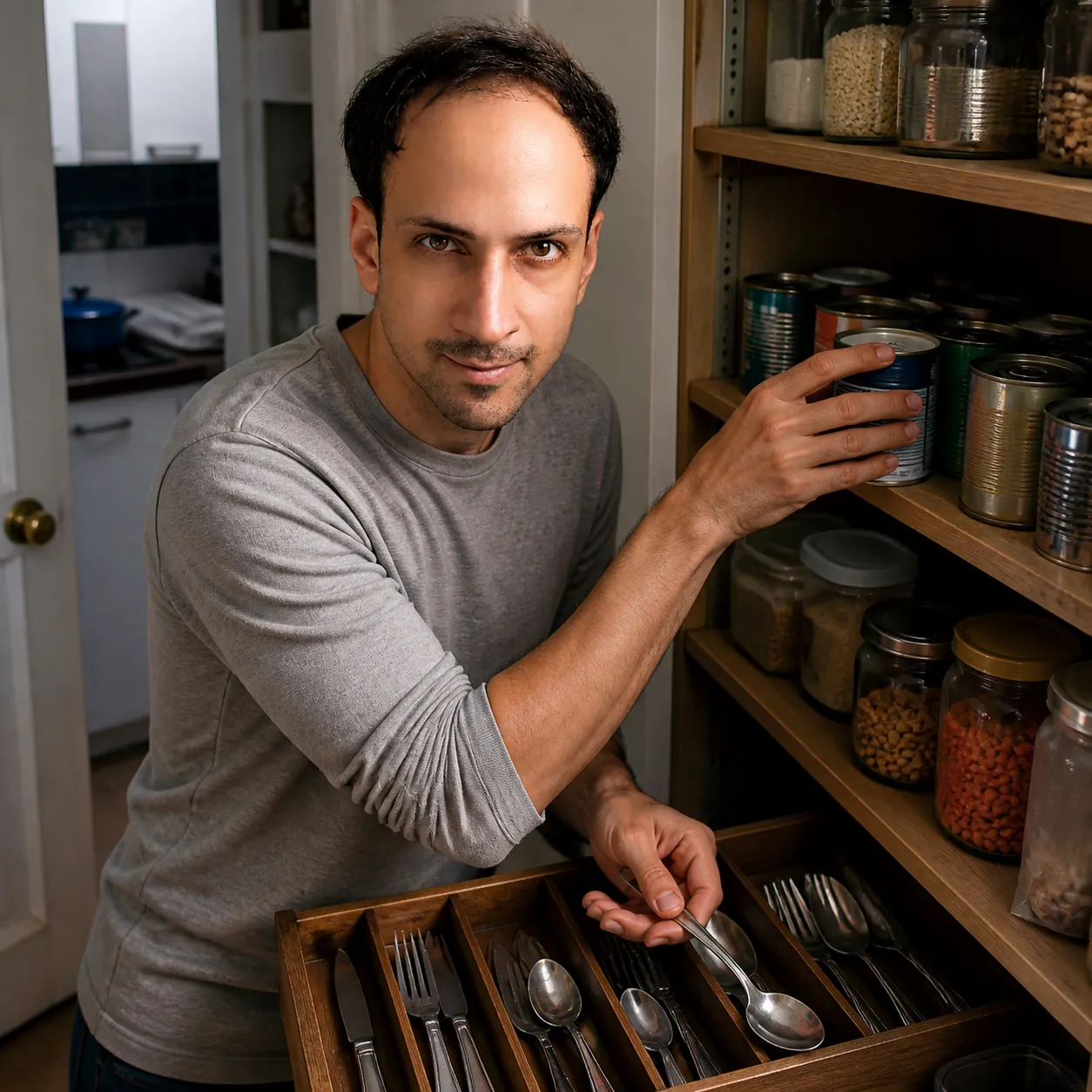
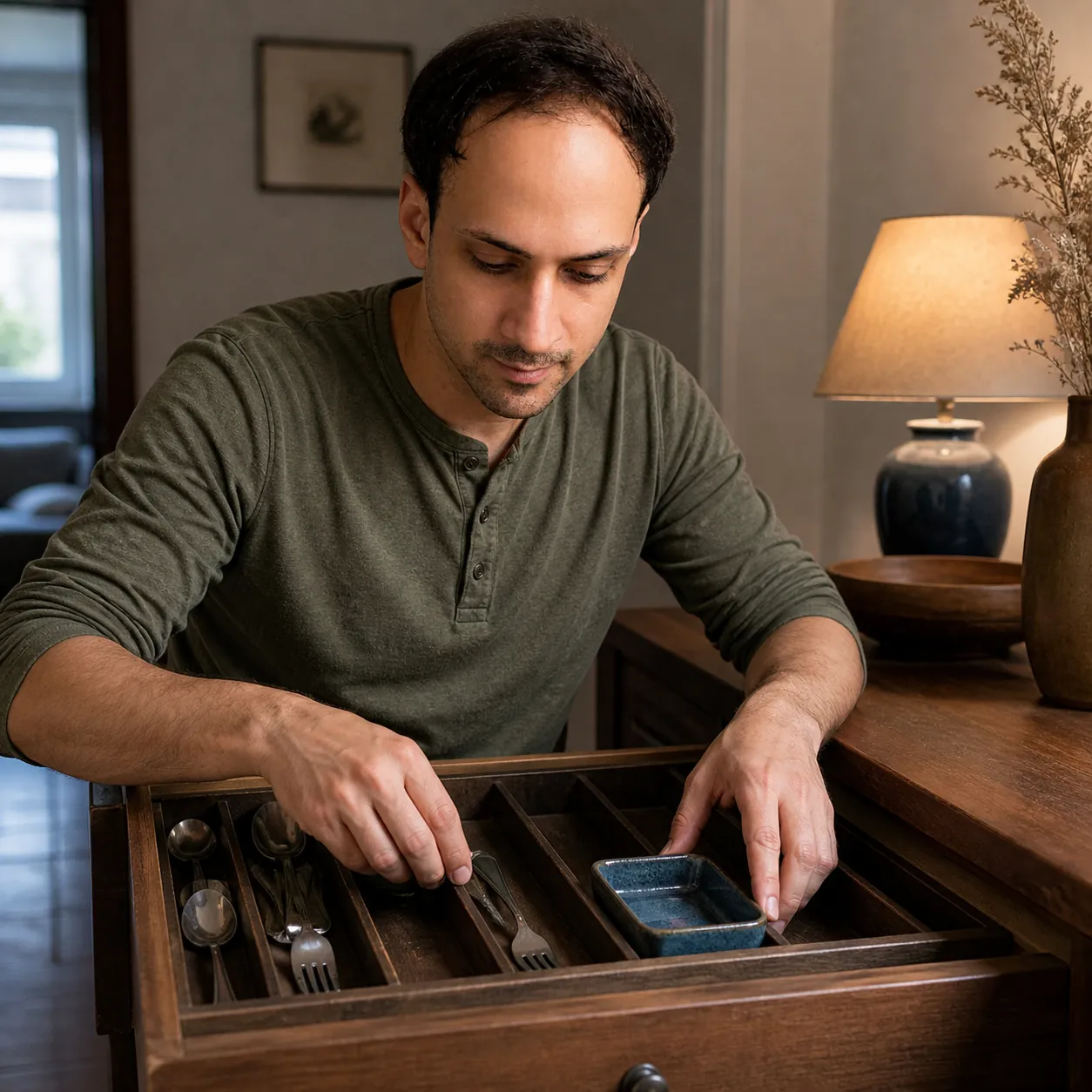
Almost Right: Dining Room Sideboard Drawer — AI Portrait Prompt
صورةAI Portraits

Turn your own photo into a museum-grade domestic portrait in a dining room sideboard drawer of cutlery pulled fully open. Keeps your face unchanged.

من نص البرومبت

Use the attached reference photo as the identity reference: keep the same face, skin tone, hair and features as the person in that photo, without beautifying, aging or altering them. Create a square 1:1 museum-catalog frame with a strong first read and a slower second read at exactly 2880x2880 pixels. Location: a dining room sideboard drawer of cutlery pulled fully open. Show the subject in a soft olive henley with sleeves rolled past the elbow, laying one fork parallel inside its shallow compartment. The difficulty must be visible in this, not in their expression: a soap dish that has been set down, considered, and moved two centimetres, its final position still not agreed shows care and compulsion using exactly the same pair of hands. Explore what it costs to keep a standard nobody else can see; expression occupied, not expressive, carrying dry method, difficulty stated as a cost already accepted. Use a plain 35mm three-quarter view with both hands complete inside the frame. Make the composition run one straight edge across the frame, broken once. Render it as museum-grade domestic realism built from unposed reportage technique, accurate fabric response, plain room architecture, and patient framing, using late window light already grey, helped by one warm lamp and a palette of unbleached cotton, dark walnut, and an enamel-blue accent. Photorealistic: this must read as a real photograph from a physical camera, never an illustration, painting, or 3D render. Resolve real surface detail: thread ends and slight pilling on worn cloth, hairline chips at every hard corner, and stone that is porous rather than smooth. Keep one identity-locked person, credible hands and fingers, natural fabric, and coherent scale, contact, reflections, shadows, airflow, deformation, and materials. Background people only when essential, always secondary and clearly different. Avoid decorative symmetry, tidiness memes, gleaming surfaces, anguished faces, and pinned clinical checklists. No text, labels, logos, signatures, watermarks, random symbols, plastic skin, excessive bloom, or glossy AI finish.
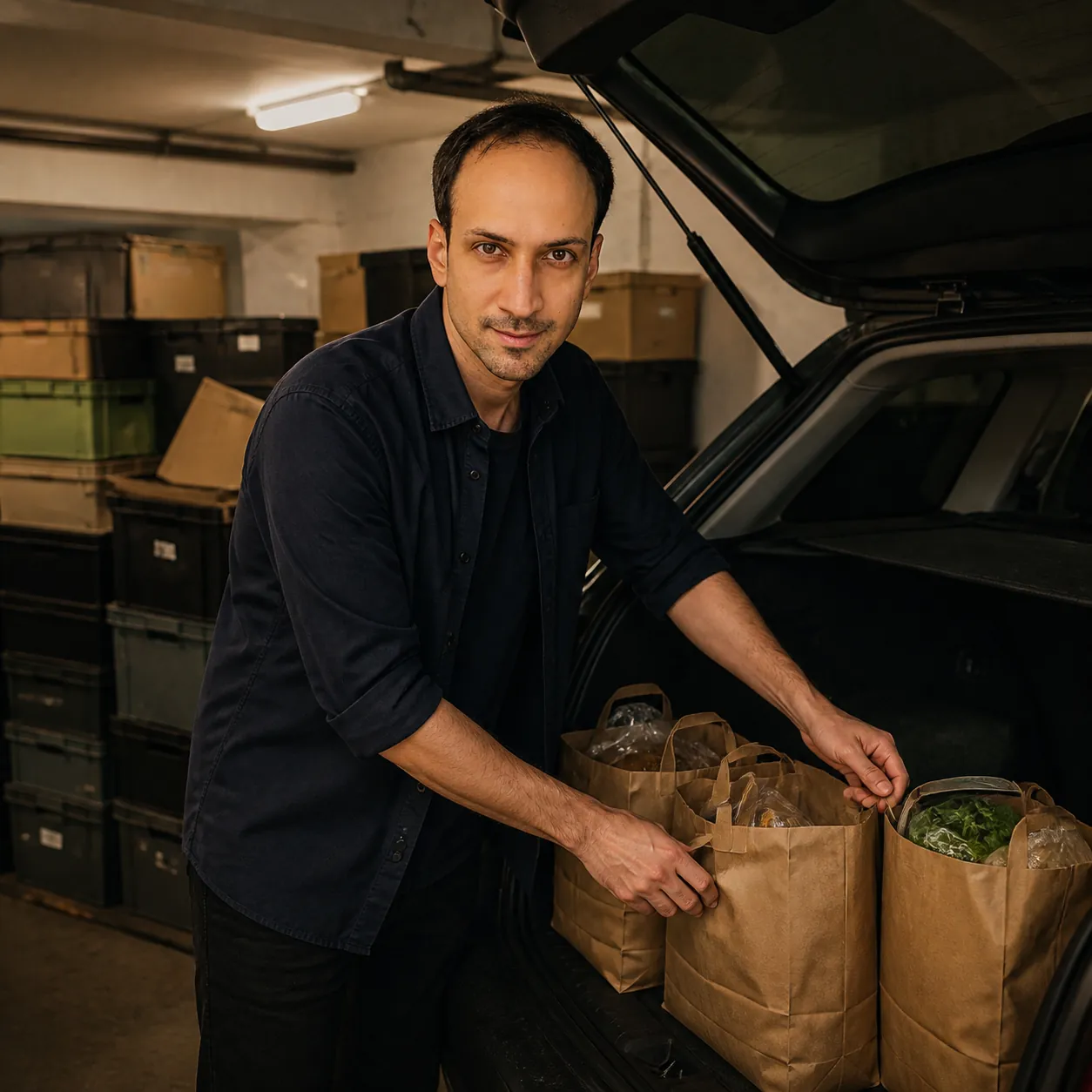
One Centimetre: Open Boot of a Parked Car — AI Portrait Prompt
صورةAI Portraits

Turn your own photo into an understated chore-portrait portrait in the open boot of a parked car in a residential garage. Keeps your face unchanged.

من نص البرومبت

Use the attached reference photo as the identity reference: keep the same face, skin tone, hair and features as the person in that photo, without beautifying, aging or altering them. Create a square 1:1 museum-catalog frame with a strong first read and a slower second read at exactly 2880x2880 pixels. Location: the open boot of a parked car in a residential garage. Show the subject in a dark blue overshirt over a tee, sleeves pushed up, standing four carrier bags upright side by side. The difficulty must be visible in this, not in their expression: a wall of stacked storage boxes that came down because one lid sat a centimetre proud of the rest shows care and compulsion using exactly the same pair of hands. Explore how many repetitions a surface absorbs before anyone would notice; expression occupied, not expressive, carrying dry method, difficulty stated in hours rather than in feeling. Use a plain 35mm three-quarter view with both hands complete inside the frame. Make the composition place the corrected half beside the uncorrected half. Render it as understated chore-portrait realism combining high-fidelity cloth rendering, real domestic surfaces, truthful contact shadows, and unhurried editorial calm, using one shaded ceiling fitting throwing even, slightly tired light and a palette of warm dust beige, matte black, and one olive band. Photorealistic: this must read as a real photograph from a physical camera, never an illustration, painting, or 3D render. Resolve real surface detail: rubber gone chalky with age, painted metal chipped to primer, and plastic yellowed only where light reaches it. Keep one identity-locked person, credible hands and fingers, natural fabric, and coherent scale, contact, reflections, shadows, airflow, deformation, and materials. Background people only when essential, always secondary and clearly different. Avoid decorative symmetry, tidiness memes, gleaming surfaces, anguished faces, and pinned clinical checklists. No text, labels, logos, signatures, watermarks, random symbols, plastic skin, excessive bloom, or glossy AI finish.

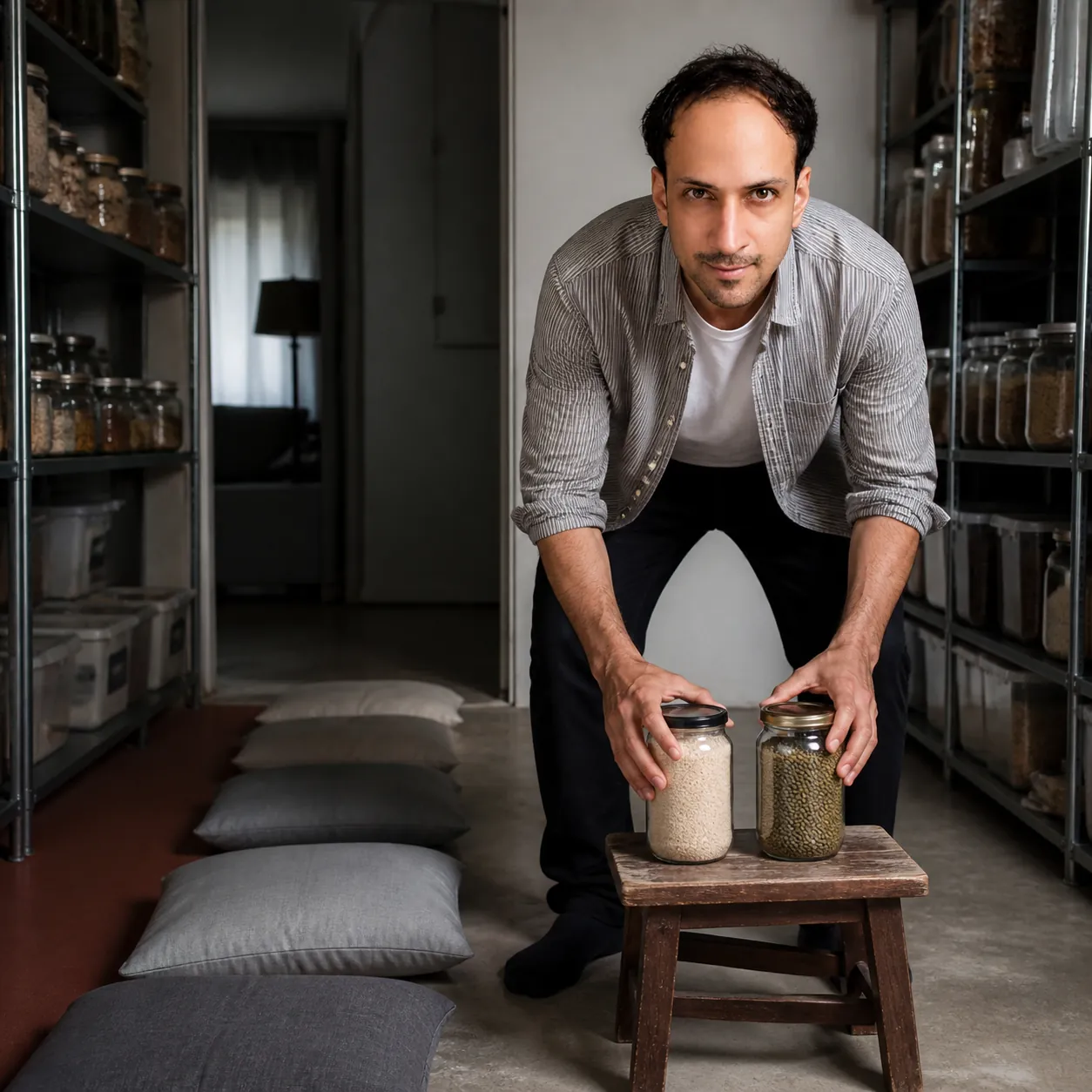
Stopping Short: Storage Room — AI Portrait Prompt
صورةAI Portraits

Turn your own photo into an understated chore-portrait portrait in a storage room with narrow shelves of ranged household jars. Keeps your face unchanged.

من نص البرومبت

Use the attached reference photo as the identity reference: keep the same face, skin tone, hair and features as the person in that photo, without beautifying, aging or altering them. Create a square 1:1 museum-catalog frame with a strong first read and a slower second read at exactly 2880x2880 pixels. Location: a storage room with narrow shelves of ranged household jars. Show the subject in a striped cotton overshirt open over a plain white tee, lifting two jars down onto a low stool. Anchor the frame to this piece of ordinary evidence: a half-aligned row of floor cushions that has been left mid-correction, the lamp switched off from the doorway behind them shows care and compulsion using exactly the same pair of hands. Explore where the effort goes when the finished room shows none; expression occupied, not expressive, carrying worn diligence, difficulty stated without inviting anyone to help. Frame slightly above the work so the judged row reads as one line. Make the composition let one hand rest just short of the object. Render it as understated chore-portrait realism combining high-fidelity cloth rendering, real domestic surfaces, truthful contact shadows, and unhurried editorial calm, using flat overcast daylight through a balcony door, no direct sun and a palette of laundered white, graphite, and one strip of terracotta floor. Photorealistic: this must read as a real photograph from a physical camera, never an illustration, painting, or 3D render. Resolve real surface detail: hair with individual strands catching light, short facial hair of uneven length, and skin oil giving a low uneven sheen. Keep one identity-locked person, credible hands and fingers, natural fabric, and coherent scale, contact, reflections, shadows, airflow, deformation, and materials. Background people only when essential, always secondary and clearly different. Avoid decorative symmetry, tidiness memes, gleaming surfaces, anguished faces, and pinned clinical checklists. No text, labels, logos, signatures, watermarks, random symbols, plastic skin, excessive bloom, or glossy AI finish.
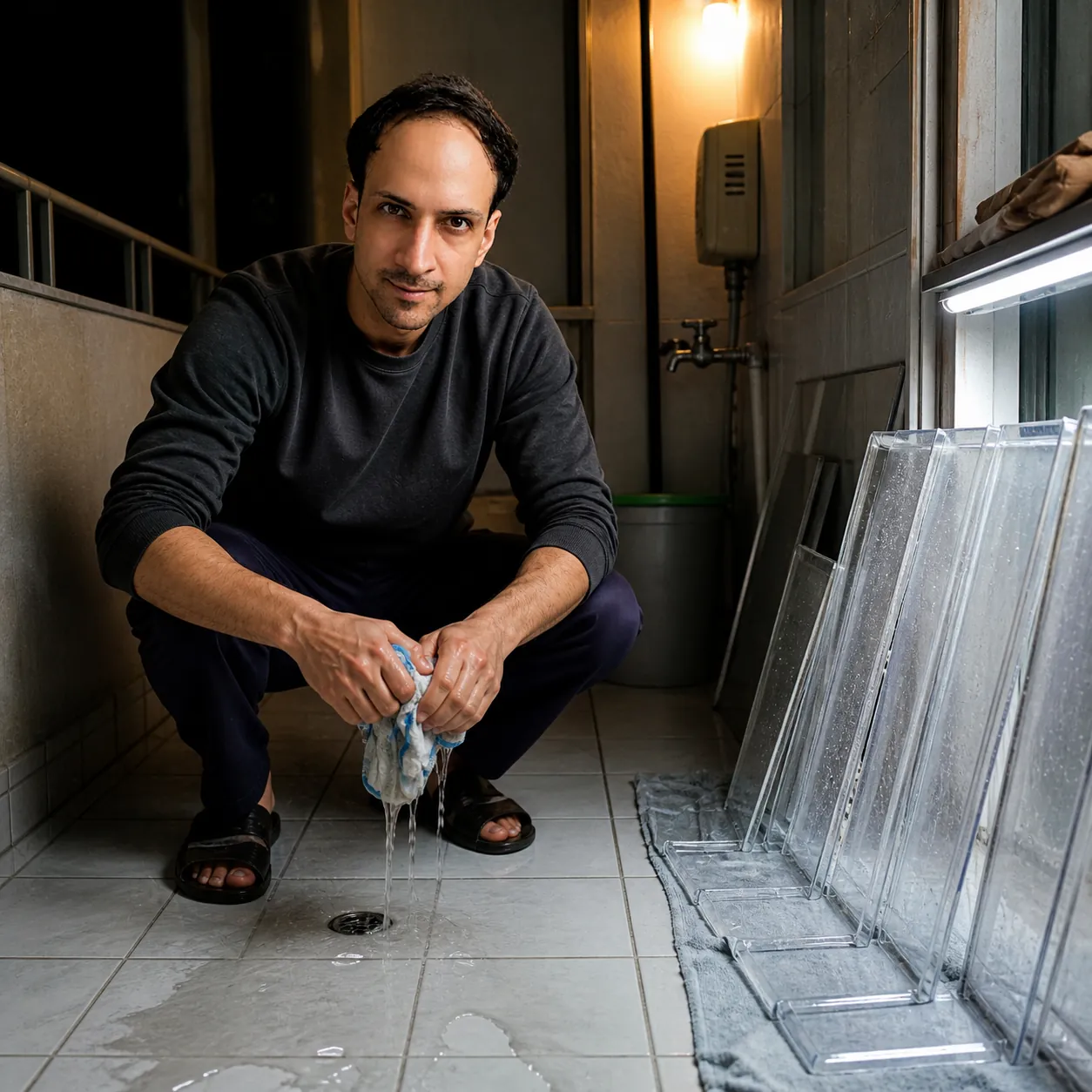
Evening Practice: Rooftop Sitting Area — AI Portrait Prompt
صورةAI Portraits

Turn your own photo into a portrait in a rooftop sitting area enclosed by canvas windbreaks, city glow beyond. Keeps your face unchanged.

من نص البرومبت

Use the attached reference photo as the identity reference: keep the same face, skin tone, hair and features as the person in that photo, without beautifying, aging or altering them. Create a square 1:1 museum-catalog frame with a strong first read and a slower second read at exactly 2880x2880 pixels. Location: a rooftop sitting area enclosed by canvas windbreaks, city glow beyond. Show the subject in a quilted charcoal jacket zipped over a plain winter traditional Gulf outfit, pegging one canvas corner taut against the evening breeze. Make one rigorous physical condition the conceptual engine: a coin of molten sealing wax that copies the brass die's finest scratches during the few seconds before it stiffens rewards the kind of attention that cannot be paid in passing. Explore how ordinary physics turns riveting once nothing louder competes for the eye; direct expression and posture toward quiet hospitality, never melodrama or ad-like confidence. Use an eye-level 50mm viewpoint at seated height with natural perspective and restrained depth of field. Make the composition let lamplight falloff decide what the frame may keep. Render it as gallery-grade domestic still photography built from truthful household physics, restrained art direction, deep readable shadow, and companionable observational framing, using small honest flame light with steep falloff and skin texture kept visible and a palette of soft olive, bone plaster, and a low flame-orange note. Photorealistic: this must read as a real photograph from a physical camera, never an illustration, painting, or 3D render. Resolve real surface detail: fine lint on dark fabric, water spotting on steel, and the soft rounding of edges that have been used for years. Keep one identity-locked person, credible hands and fingers, natural fabric, and coherent scale, contact, reflections, shadows, airflow, deformation, and materials. Background people only when essential, always secondary and clearly different. Avoid sepia nostalgia filters, costume-drama props, candlelit romance styling, and staged rustic clutter. No text, labels, logos, signatures, watermarks, random symbols, plastic skin, excessive bloom, or glossy AI finish.
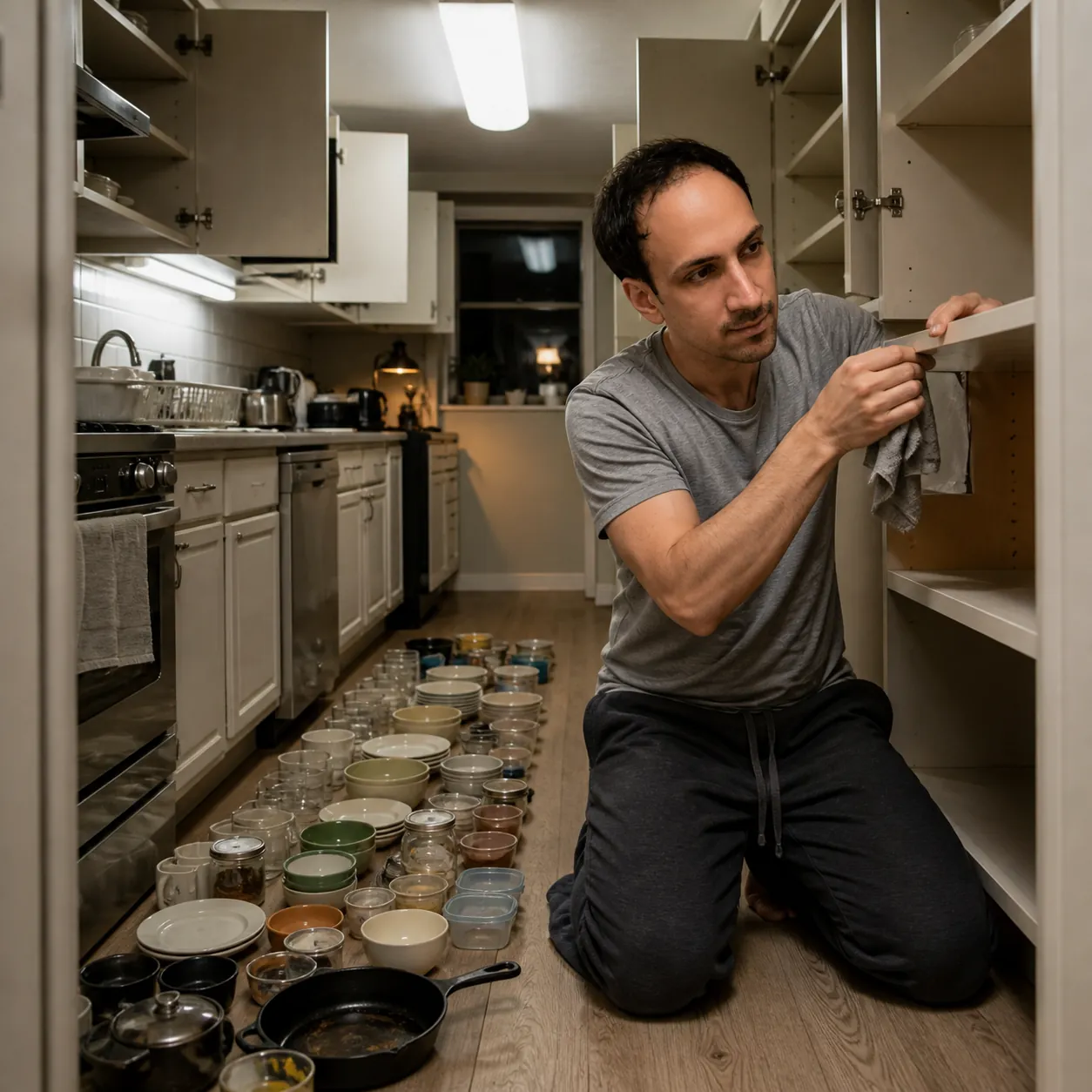
Full Capacity: Service Balcony — AI Portrait Prompt
صورةAI Portraits

Turn your own photo into a portrait in a service balcony behind the kitchen, its light on at three. Keeps your face unchanged.

من نص البرومبت

Use the attached reference photo as the identity reference: keep the same face, skin tone, hair and features as the person in that photo, without beautifying, aging or altering them. Create a square 1:1 museum-catalog frame with a strong first read and a slower second read at exactly 2880x2880 pixels. Location: a service balcony behind the kitchen, its light on at three. Show the subject in a charcoal sweatshirt over house trousers, sandals left indoors, wringing a cloth out over the floor drain. Anchor the frame to this piece of ordinary evidence: a set of refrigerator shelves that stand draining along a folded towel after being washed one at a time makes the scale of the night's work impossible to mistake for tidying. Explore whether a system built at three still makes sense by breakfast; expression occupied, not expressive, carrying plain diligence, difficulty stated without lifting its voice. Frame slightly above the tableau so their forearms and the surface share focus. Make the composition run the sorted rows out of frame unresolved. Render it as museum-scale portraiture of household work built from truthful low-light colour, tactile everyday objects, and unglamorised interiors, using a cold strip fitting bouncing evenly off wet tile and damp cloth and a palette of cool white tile, warm plaster, and one amber lamp. Photorealistic: this must read as a real photograph from a physical camera, never an illustration, painting, or 3D render. Resolve real surface detail: label-free packaging showing carton fibre, cardboard bruised at the corners, and tape lifting slightly at one end. Keep one identity-locked person, credible hands and fingers, natural fabric, and coherent scale, contact, reflections, shadows, airflow, deformation, and materials. Background people only when essential, always secondary and clearly different. Avoid heroic poster poses, glowing wellness interiors, and staring into the lens. No text, labels, logos, signatures, watermarks, random symbols, plastic skin, excessive bloom, or glossy AI finish.
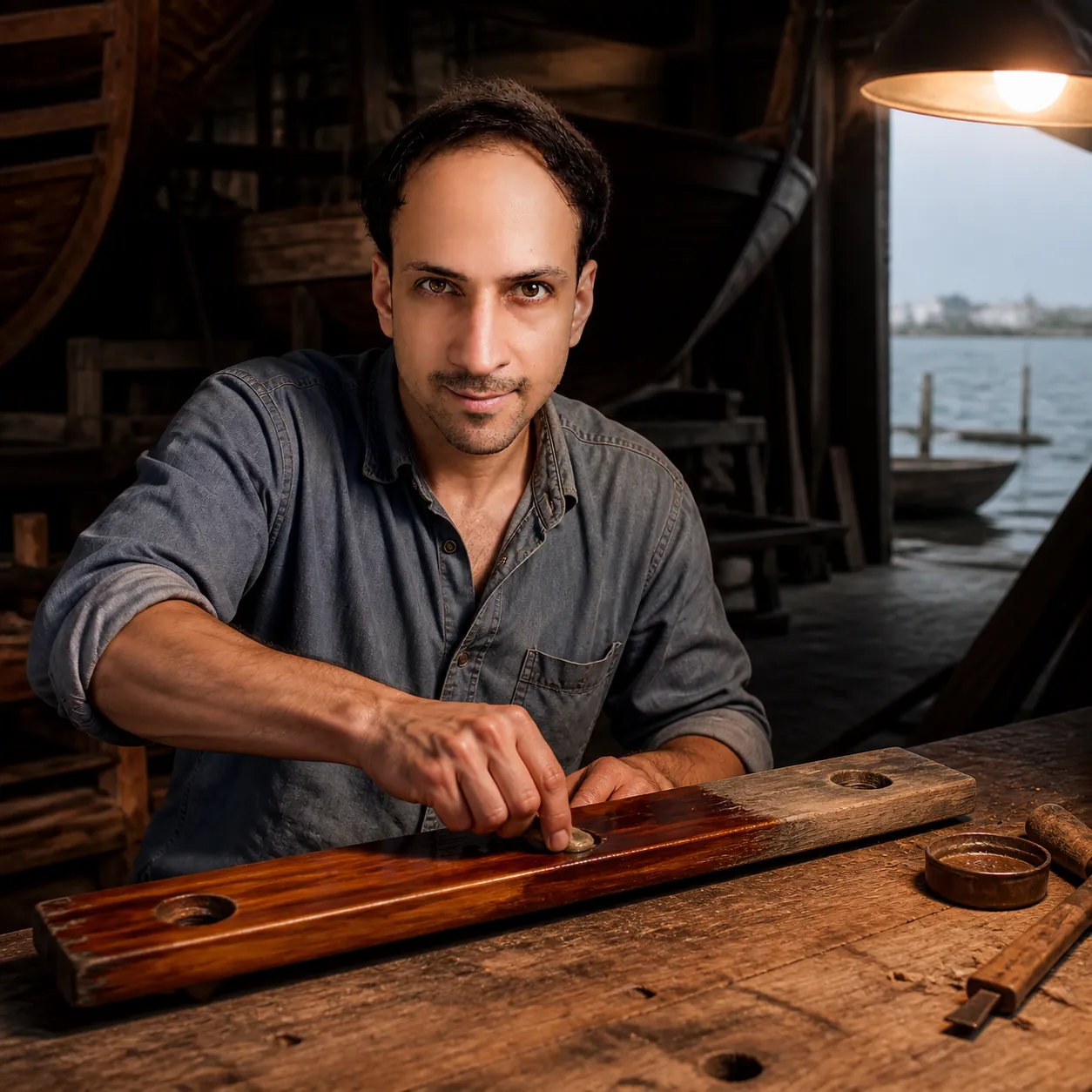
At Three: Galley Kitchen — AI Portrait Prompt
صورةAI Portraits

Turn your own photo into a portrait in a galley kitchen with every upper cupboard standing open at three. Keeps your face unchanged.

من نص البرومبت

Use the attached reference photo as the identity reference: keep the same face, skin tone, hair and features as the person in that photo, without beautifying, aging or altering them. Create a square 1:1 museum-catalog frame with a strong first read and a slower second read at exactly 2880x2880 pixels. Location: a galley kitchen with every upper cupboard standing open at three. Show the subject in a grey cotton tee, drawstring trousers, and bare working forearms, kneeling to wipe the last shelf edge dry. Let one honest object carry what the face will not: an expanse of bare floor that holds one cupboard's entire contents ranged in rows by height and by weight makes the scale of the night's work impossible to mistake for tidying. Explore why a genuinely useful job becomes suspect only because of its hour; expression occupied, not expressive, carrying working absorption, difficulty stated as ordinary maintenance. Use a 50mm eye-level view so the work and their hands stay legible. Make the composition give the finished portion more sharpness than the rest. Render it as unsentimental domestic documentary photography built from real household labour, plain interior styling, honest material texture, and unhurried observational framing, using one ceiling panel doing all the work, with soft spill beneath and a palette of cool white tile, warm plaster, and one amber lamp. Photorealistic: this must read as a real photograph from a physical camera, never an illustration, painting, or 3D render. Resolve real surface detail: true skin texture with pores and fine hair at the hairline, and fabric that creases where it is actually stressed. Keep one identity-locked person, credible hands and fingers, natural fabric, and coherent scale, contact, reflections, shadows, airflow, deformation, and materials. Background people only when essential, always secondary and clearly different. Avoid heroic poster poses, glowing wellness interiors, and staring into the lens. No text, labels, logos, signatures, watermarks, random symbols, plastic skin, excessive bloom, or glossy AI finish.
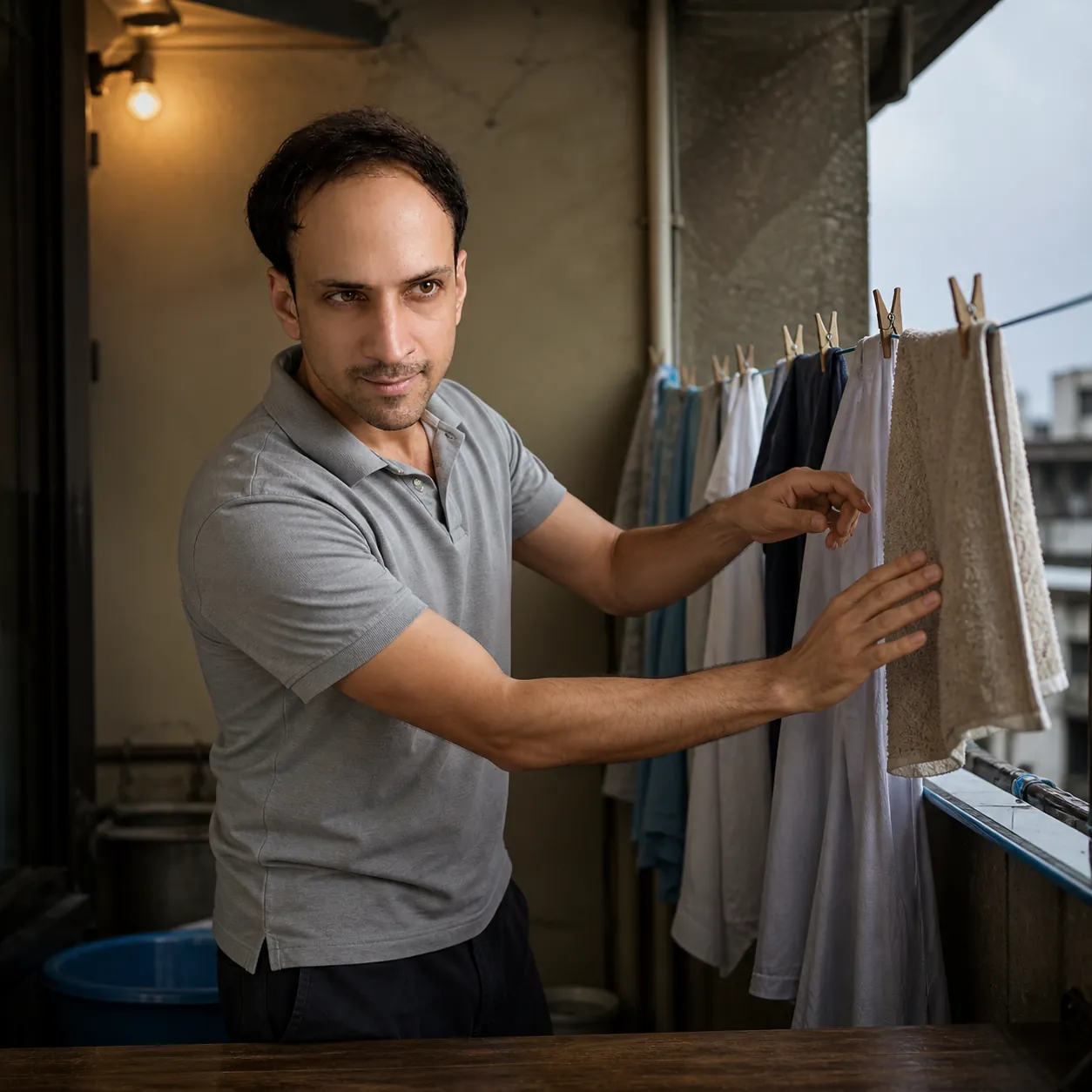
Quiet Longevity: Dim Dhow-Repair Shed — AI Portrait Prompt
صورةAI Portraits

Turn your own photo into a material-culture documentary portrait in a dim dhow-repair shed on the Gulf shore, tide sounding outside. Keeps your face unchanged.

من نص البرومبت

Use the attached reference photo as the identity reference: keep the same face, skin tone, hair and features as the person in that photo, without beautifying, aging or altering them. Create a square 1:1 museum-catalog frame with a strong first read and a slower second read at exactly 2880x2880 pixels. Location: a dim dhow-repair shed on the Gulf shore, tide sounding outside. Show the subject in a salt-faded blue overshirt with sleeves rolled past the elbow, pressing warmed wax into a seam with one thumb. Build the artwork around this material rule: a mahogany spirit level whose freshly oiled half glows with deep ribbon figure while its dry half stays dusty grey argues that upkeep, not replacement, is the true form of inheritance. Explore why time improves some surfaces and ruins all the rest; direct expression and posture toward sober gratitude, never melodrama or ad-like confidence. Use a restrained 35mm environmental view, the subject at one-third and the workspace honest around them. Make the composition hold empty bench space where a finished tool will rest. Render it as material-culture documentary photography combining believable century-old tools, honest maintenance evidence, restrained contemporary art direction, and calm human-scale observational framing, using a single warm workbench lamp pooled tight, the room falling to umber and a palette of seasoned black, beeswax cream, and a gleam of pewter. Photorealistic: this must read as a real photograph from a physical camera, never an illustration, painting, or 3D render. Resolve real surface detail: hair with individual strands catching light, fine hairs of uneven length, and skin oil giving a low uneven sheen. Keep one identity-locked person, credible hands and fingers, natural fabric, and coherent scale, contact, reflections, shadows, airflow, deformation, and materials. Background people only when essential, always secondary and clearly different. Avoid glowing forge montages, artificially weathered wood grain, hipster workshop styling, floating tool arrangements, and varnish-shiny fake patina. No text, labels, logos, signatures, watermarks, random symbols, plastic skin, excessive bloom, or glossy AI finish.
Costly Win: Service Balcony — AI Portrait Prompt
صورةAI Portraits

Turn your own photo into an understated chore-portrait portrait in a service balcony where a washing line runs to the parapet. Keeps your face unchanged.

من نص البرومبت

Use the attached reference photo as the identity reference: keep the same face, skin tone, hair and features as the person in that photo, without beautifying, aging or altering them. Create a square 1:1 museum-catalog frame with a strong first read and a slower second read at exactly 2880x2880 pixels. Location: a service balcony where a washing line runs to the parapet. Show the subject in a light grey polo shirt with dark canvas trousers, pegging shirts along the line in one order. Build the image around this small, exact tableau: a hand towel that has been left crooked on its hook on purpose, their open palm withdrawn beside it shows care and compulsion using exactly the same pair of hands. Explore what it takes to leave one thing deliberately unstraightened; expression occupied, not expressive, carrying flat competence, difficulty stated as routine rather than revelation. Frame from low counter height so the aligned edge crosses the picture level. Make the composition run one straight edge across the frame, broken once. Render it as understated chore-portrait realism combining high-fidelity cloth rendering, real domestic surfaces, truthful contact shadows, and unhurried editorial calm, using late window light already grey, helped by one warm lamp and a palette of unbleached cotton, dark walnut, and an enamel-blue accent. Photorealistic: this must read as a real photograph from a physical camera, never an illustration, painting, or 3D render. Resolve real surface detail: skin that reddens slightly under pressure, nail beds with honest colour, and knuckle creases that fold rather than blur. Keep one identity-locked person, credible hands and fingers, natural fabric, and coherent scale, contact, reflections, shadows, airflow, deformation, and materials. Background people only when essential, always secondary and clearly different. Avoid decorative symmetry, tidiness memes, gleaming surfaces, anguished faces, and pinned clinical checklists. No text, labels, logos, signatures, watermarks, random symbols, plastic skin, excessive bloom, or glossy AI finish.
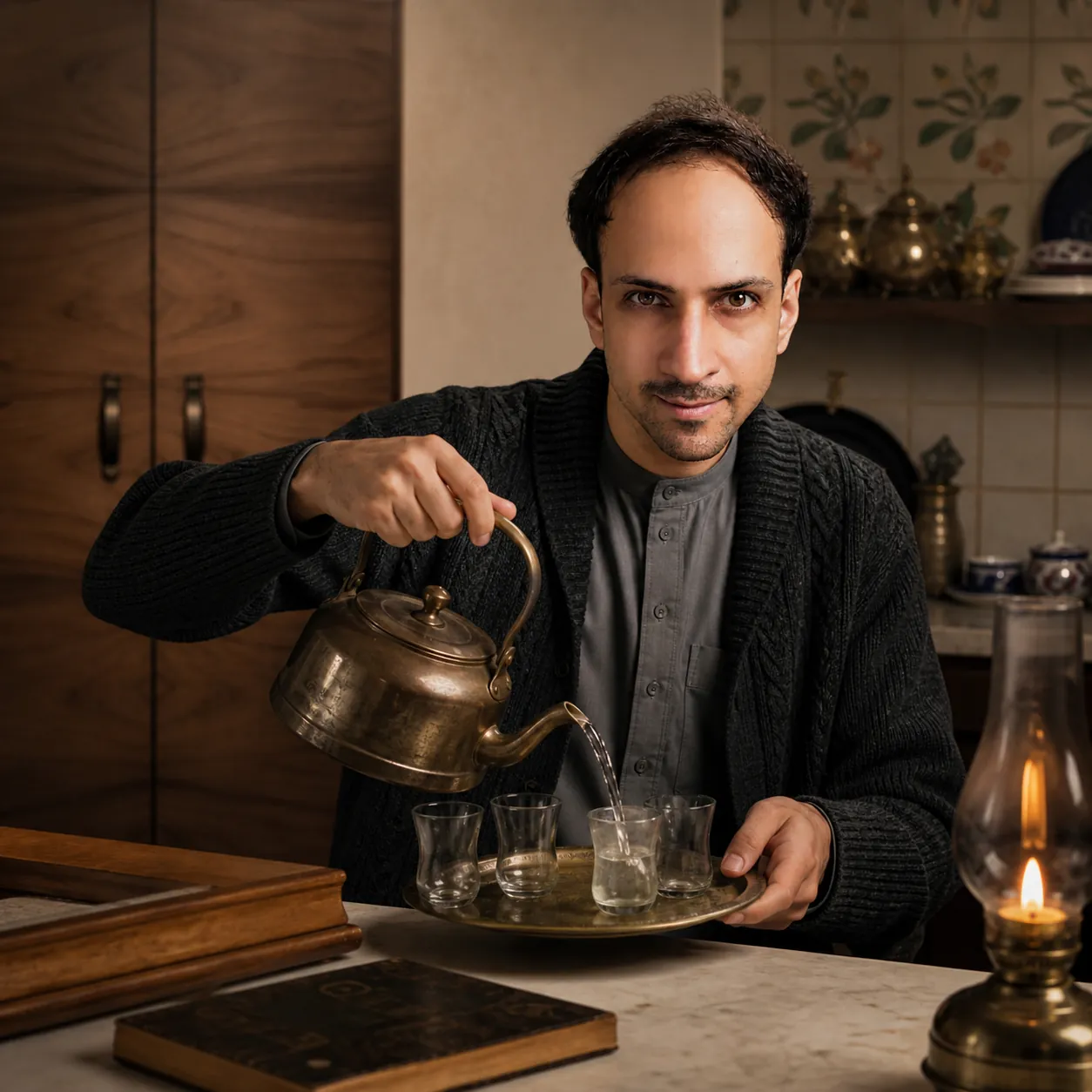
Analog Evening: Tiled Tea Alcove Off the Kitchen — AI Portrait Prompt
صورةAI Portraits

Turn your own photo into a quiet domestic portrait in a tiled tea alcove off the kitchen, its single shelf freshly wiped. Keeps your face unchanged.

من نص البرومبت

Use the attached reference photo as the identity reference: keep the same face, skin tone, hair and features as the person in that photo, without beautifying, aging or altering them. Create a square 1:1 museum-catalog frame with a strong first read and a slower second read at exactly 2880x2880 pixels. Location: a tiled tea alcove off the kitchen, its single shelf freshly wiped. Show the subject in an ash-grey traditional Gulf outfit under a dark knitted shawl-collar cardigan, warming empty tea glasses with a first rinse of hot water. The impossible-looking event must obey this clear system: a pair of book-matched walnut doors whose grain mirrors itself perfectly down the seam, cut from two consecutive slices of one tree rewards the kind of attention that cannot be paid in passing. Explore why company deepens around tasks that leave room for talk; direct expression and posture toward quiet hospitality, never melodrama or ad-like confidence. Use an 85mm view from across the room, the evening's object resting in the same focal plane as their face. Make the composition angle any written page so no single word stays legible. Render it as quiet domestic realism built from believable flame-lit exposure, tactile wood and wool surfaces, documentary patience, and museum-grade portrait restraint, using one shaded oil-lamp pool with darkness allowed to stand in the corners and a palette of soft olive, bone plaster, and a low flame-orange note. Photorealistic: this must read as a real photograph from a physical camera, never an illustration, painting, or 3D render. Resolve real surface detail: brass darkened in the recesses and bright where thumbs land, and lacquer crazed rather than perfect. Keep one identity-locked person, credible hands and fingers, natural fabric, and coherent scale, contact, reflections, shadows, airflow, deformation, and materials. Background people only when essential, always secondary and clearly different. Avoid sepia nostalgia filters, costume-drama props, candlelit romance styling, and staged rustic clutter. No text, labels, logos, signatures, watermarks, random symbols, plastic skin, excessive bloom, or glossy AI finish.
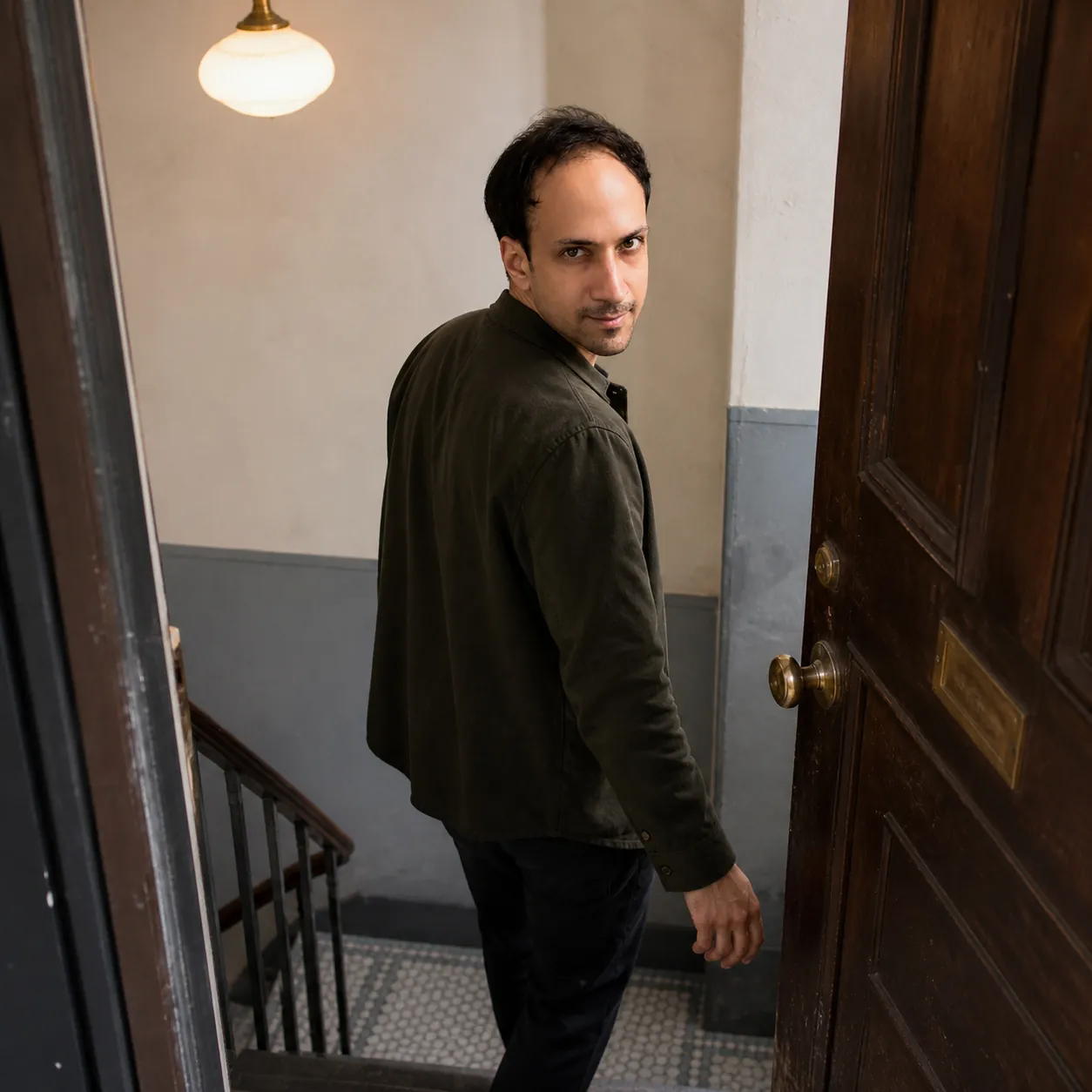
Leaving Once: Half-Landing Between Two Floors — AI Portrait Prompt
صورةAI Portraits

Turn your own photo into an unsentimental domestic portrait in the half-landing between two floors of a walk-up block. Keeps your face unchanged.

من نص البرومبت

Use the attached reference photo as the identity reference: keep the same face, skin tone, hair and features as the person in that photo, without beautifying, aging or altering them. Create a square 1:1 museum-catalog frame with a strong first read and a slower second read at exactly 2880x2880 pixels. Location: the half-landing between two floors of a walk-up block. Show the subject in a dark olive overshirt over a plain crew-neck, turning back down two steps toward the door. The difficulty must be visible in this, not in their expression: a doorway crossed and left behind by a person whose keys are already deep in a pocket, not the lock weighs a two-minute job against everything it can quietly become. Explore how closing-up chores acquire a second, longer version of themselves; expression occupied, not expressive, carrying steady attention, difficulty stated as a chore, not a confession. Hold a static wide view from just inside the room they are leaving. Make the composition keep one hand fully visible and unambiguous throughout. Render it as unsentimental domestic realism built from documentary portrait photography, honest household materials, restrained art direction, and patient observational timing, using an overhead fitting diffused by its plain glass shade and a palette of cool grey tile, bone plaster, and one brass accent. Photorealistic: this must read as a real photograph from a physical camera, never an illustration, painting, or 3D render. Resolve real surface detail: wood grain read at honest scale, matte and gloss clearly separated, and no surface uniformly clean. Keep one identity-locked person, credible hands and fingers, natural fabric, and coherent scale, contact, reflections, shadows, airflow, deformation, and materials. Background people only when essential, always secondary and clearly different. Avoid hand-washing imagery, tally marks, symmetrical object grids, hero poses at camera, and wellness glow. No text, labels, logos, signatures, watermarks, random symbols, plastic skin, excessive bloom, or glossy AI finish.

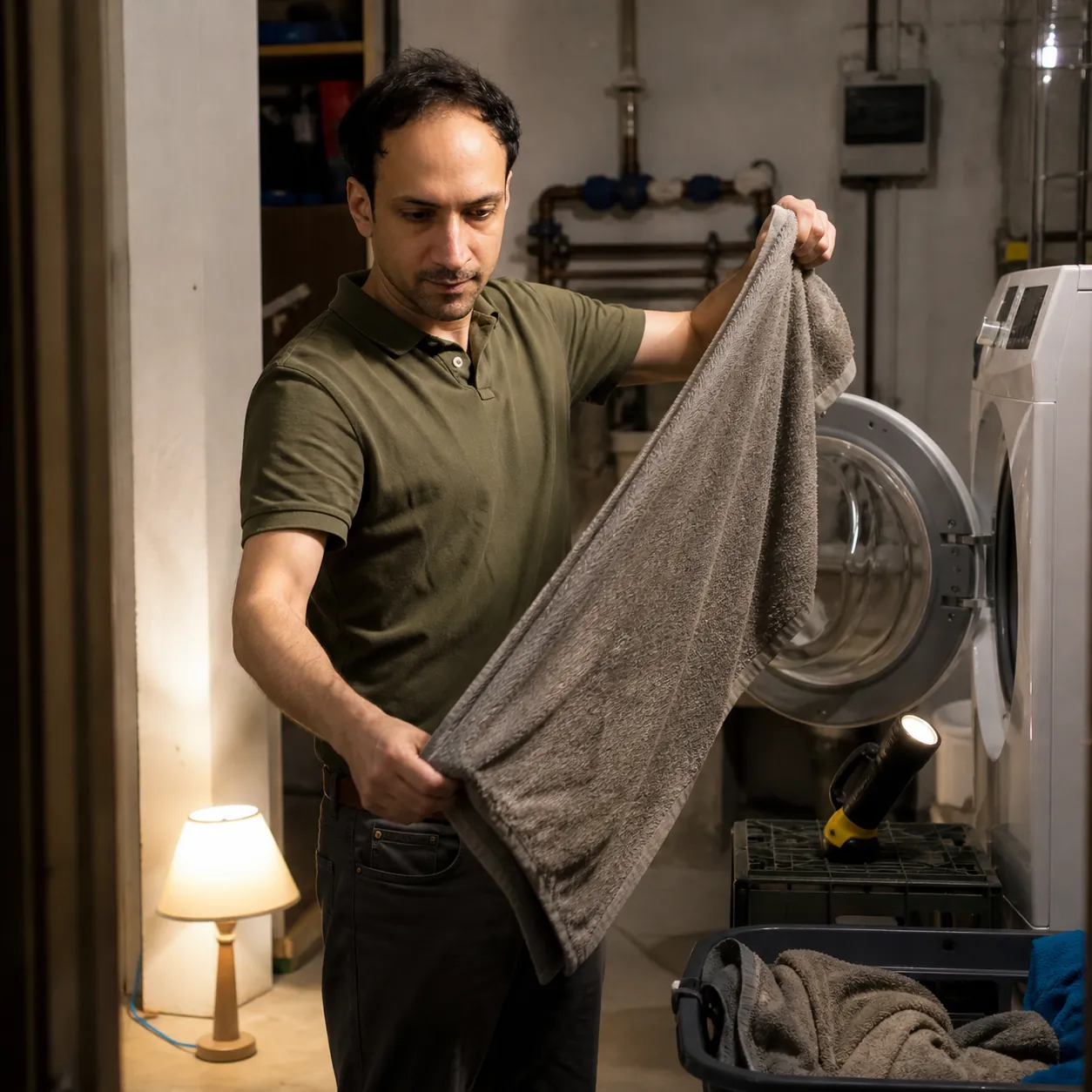
Still Going: Narrow Utility Room — AI Portrait Prompt
صورةAI Portraits

Turn your own photo into a portrait in a narrow utility room with both machine doors hanging open. Keeps your face unchanged.

من نص البرومبت

Use the attached reference photo as the identity reference: keep the same face, skin tone, hair and features as the person in that photo, without beautifying, aging or altering them. Create a square 1:1 museum-catalog frame with a strong first read and a slower second read at exactly 2880x2880 pixels. Location: a narrow utility room with both machine doors hanging open. Show the subject in a faded olive polo shirt and belted work trousers, shaking one damp towel out to its full length. Let one honest object carry what the face will not: a torch propped on a crate so that both hands stay free for an inventory count nobody has requested makes the scale of the night's work impossible to mistake for tidying. Explore what a room looks like when energy arrives before any task needs it; expression occupied, not expressive, carrying brisk composure, difficulty stated as ordinary maintenance. Use a 50mm eye-level view so the work and their hands stay legible. Make the composition run the sorted rows out of frame unresolved. Render it as unsentimental domestic documentary photography built from real household labour, plain interior styling, honest material texture, and unhurried observational framing, using one lamp carried in from another room and stood on the floor and a palette of graphite shadow, oatmeal linen, and low sodium orange. Photorealistic: this must read as a real photograph from a physical camera, never an illustration, painting, or 3D render. Resolve real surface detail: the difference between a wiped surface and a clean one, faint tide marks on ceramic, and metal dulled unevenly by touch. Keep one identity-locked person, credible hands and fingers, natural fabric, and coherent scale, contact, reflections, shadows, airflow, deformation, and materials. Background people only when essential, always secondary and clearly different. Avoid heroic poster poses, glowing wellness interiors, and staring into the lens. No text, labels, logos, signatures, watermarks, random symbols, plastic skin, excessive bloom, or glossy AI finish.
