جاري التحميل...


جاري التحميل...
Turn your own photo into a museum-grade domestic portrait in a dining room sideboard drawer of cutlery pulled fully open. Keeps your face unchanged.
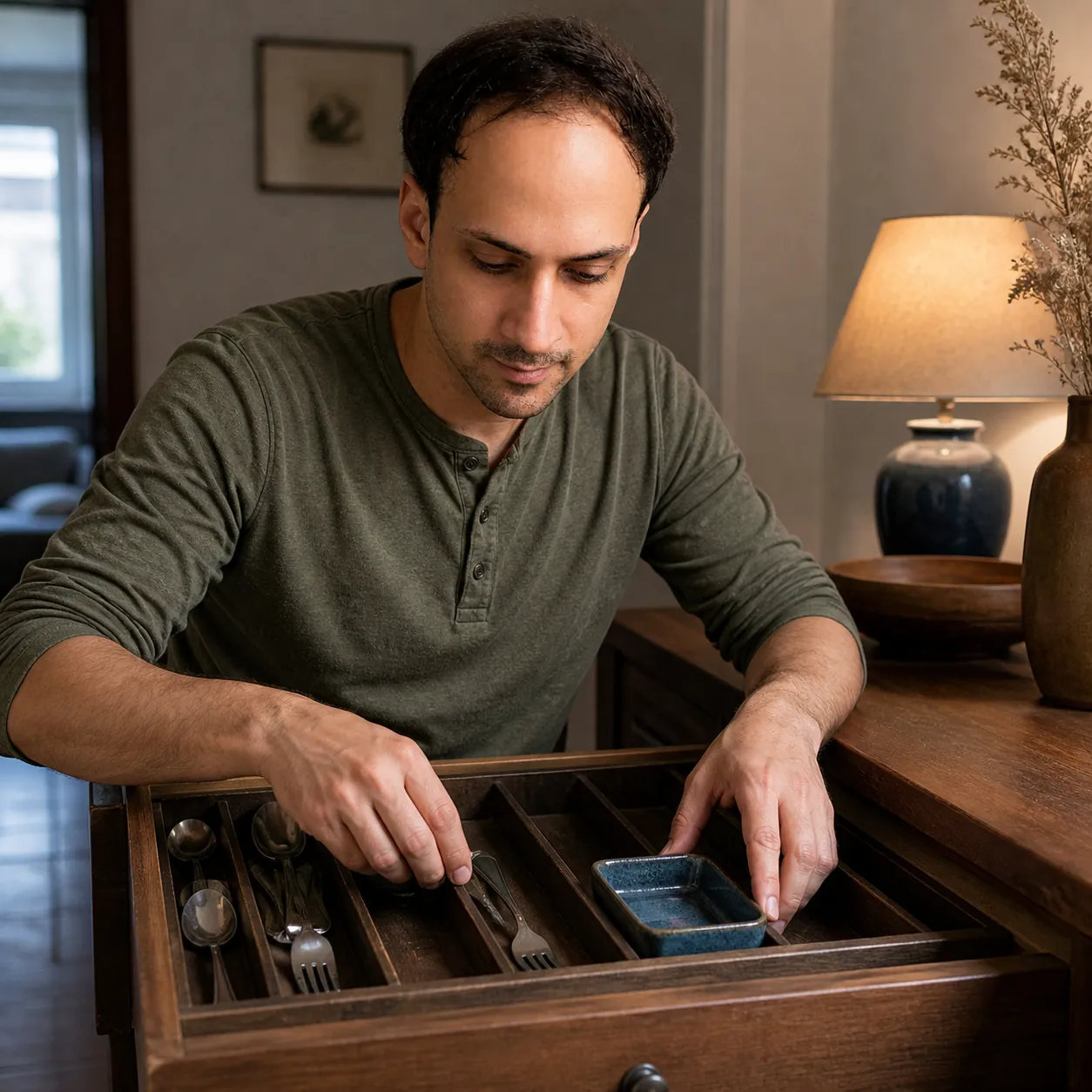
Use the attached reference photo as the identity reference: keep the same face, skin tone, hair and features as the person in that photo, without beautifying, aging or altering them. Create a square 1:1 museum-catalog frame with a strong first read and a slower second read at exactly 2880x2880 pixels. Location: a dining room sideboard drawer of cutlery pulled fully open. Show the subject in a soft olive henley with sleeves rolled past the elbow, laying one fork parallel inside its shallow compartment. The difficulty must be visible in this, not in their expression: a soap dish that has been set down, considered, and moved two centimetres, its final position still not agreed shows care and compulsion using exactly the same pair of hands. Explore what it costs to keep a standard nobody else can see; expression occupied, not expressive, carrying dry method, difficulty stated as a cost already accepted. Use a plain 35mm three-quarter view with both hands complete inside the frame. Make the composition run one straight edge across the frame, broken once. Render it as museum-grade domestic realism built from unposed reportage technique, accurate fabric response, plain room architecture, and patient framing, using late window light already grey, helped by one warm lamp and a palette of unbleached cotton, dark walnut, and an enamel-blue accent. Photorealistic: this must read as a real photograph from a physical camera, never an illustration, painting, or 3D render. Resolve real surface detail: thread ends and slight pilling on worn cloth, hairline chips at every hard corner, and stone that is porous rather than smooth. Keep one identity-locked person, credible hands and fingers, natural fabric, and coherent scale, contact, reflections, shadows, airflow, deformation, and materials. Background people only when essential, always secondary and clearly different. Avoid decorative symmetry, tidiness memes, gleaming surfaces, anguished faces, and pinned clinical checklists. No text, labels, logos, signatures, watermarks, random symbols, plastic skin, excessive bloom, or glossy AI finish.
Turn your own photo into a portrait in the corner of your kitchen where the kettle sits between window and sink. Keeps your face unchanged.
Turn your own photo into a quiet observational portrait in a low majlis table where a brass tray gathers glasses and dallah. Keeps your face unchanged.
Turn your own photo into a candid reflex-moment portrait in a supermarket aisle stacked to the ceiling under flat white light. Keeps your face unchanged.
Turn your own photo into a quiet observational portrait in a small residential lift with another person's shoulder at the frame edge. Keeps your face unchanged.
Turn your own photo into a photorealistic portrait in the flat roof of the family house as the last daylight drains. Keeps your face unchanged.
Turn your own photo into a quiet observational portrait in the kitchen of your flat at night with one counter lamp on. Keeps your face unchanged.
Turn your own photo into a patient observational portrait in a bus shelter's strip of shade on a wide afternoon road. Keeps your face unchanged.
Turn your own photo into an understated editorial portrait in the driver's seat of a parked family car with the engine off. Keeps your face unchanged.
Turn your own photo into a quiet cinematic portrait in a bus shelter's strip of shade on a wide afternoon road. Keeps your face unchanged.
Turn your own photo into a gallery-scale documentary portrait in an office floor at the end of the day, most desks dark. Keeps your face unchanged.
Turn your own photo into a photorealistic portrait in the hallway of your apartment between the bedroom and kitchen doors. Keeps your face unchanged.
Turn your own photo into a quiet cinematic portrait in a gym bench between sets with a towel folded over the bar. Keeps your face unchanged.