تخطَّ إلى المحتوى

برومبتات الصور

برومبتات لمولدات الصور: بورتريهات وفن وتصوير.

تم العثور على 664
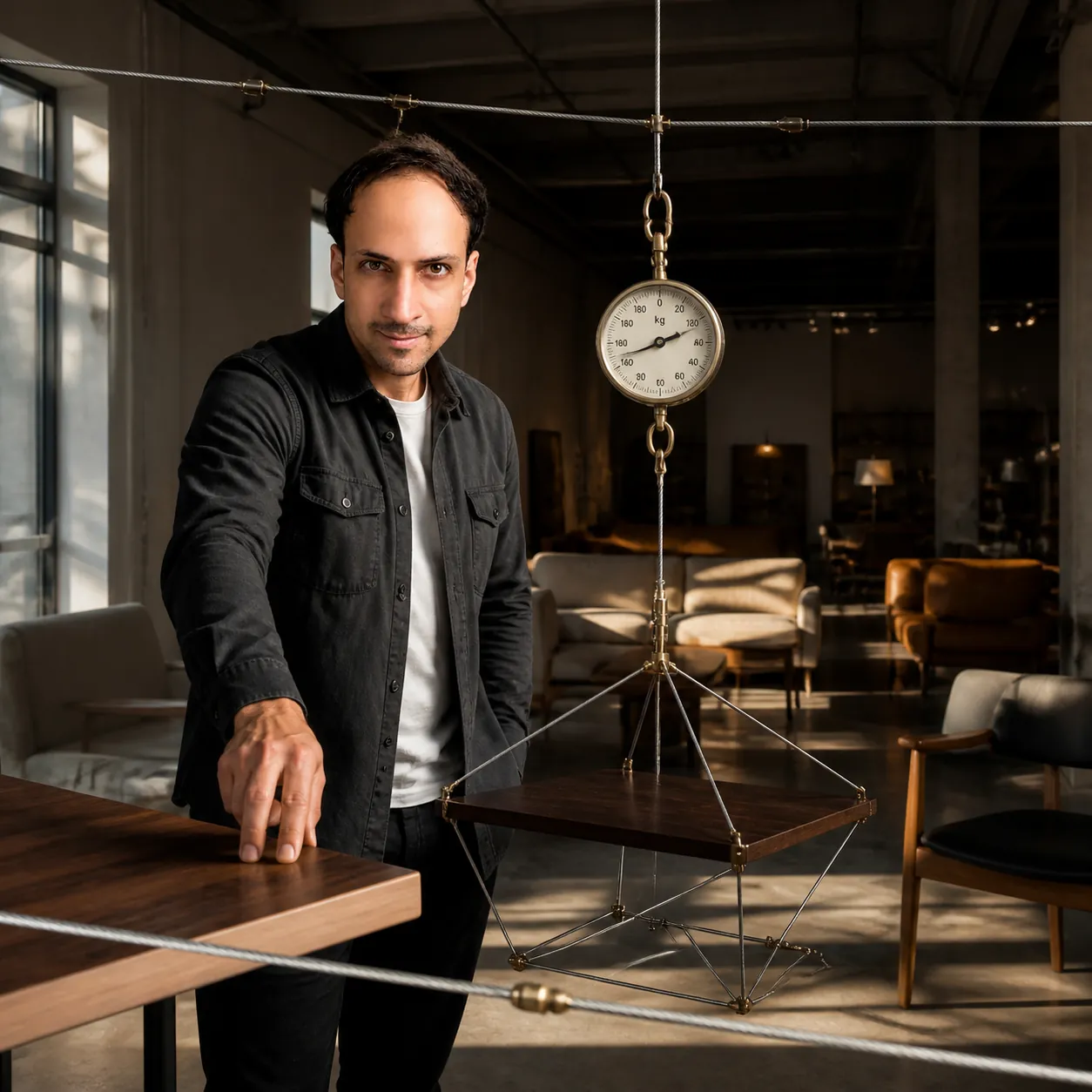
The Scale That Confesses the Load
صورةAI Portraits

Create a square 1:1 museum-catalog frame with a strong first read and a slower second read at exactly 2880x2880 pixels. Location: a closed furniture...

من نص البرومبت

Use the attached reference photo as the identity reference: keep the same face, skin tone, hair and features as the person in that photo, without beautifying, aging or altering them. Create a square 1:1 museum-catalog frame with a strong first read and a slower second read at exactly 2880x2880 pixels. Location: a closed furniture showroom lit only by its window displays. Show them in a pressed charcoal overshirt buttoned over a plain white tee, pressing two fingertips down on a tabletop corner. The impossible-looking event must obey this clear system: a knee-high floating stand whose one load cable passes through a brass spring scale, the needle confessing exact kilograms replaces the eye's first guess about what holds it with a stranger truth. Explore how disagreement, tuned precisely enough, becomes the most reliable form of holding still; direct expression and posture toward watchful respect, never melodrama or ad-like confidence. Use an 85mm portrait length that keeps their face sharp while a taut line crosses the near field, softly defocused. Make the composition set the widest impossible gap at the exact visual center. Render it as structural-portrait realism built from buildable tensegrity geometry, honest off-the-shelf cable hardware, warm wood-and-steel materiality, and calm long-take editorial observation, using late-afternoon window light crossing the frame low enough to pick out every cable and a palette of chalk white, desert tan, and one deep indigo strap. Photorealistic: this must read as a real photograph from a physical camera, never an illustration, painting, or 3D render. Resolve real surface detail: brass darkened in the recesses and bright where thumbs land, and lacquer crazed rather than perfect. Keep one identity-locked person, credible hands and fingers, natural fabric, and coherent scale, contact, reflections, shadows, airflow, deformation, and materials. Background people only when essential, always secondary and clearly different. Avoid floating objects with no visible cables, glowing wires, rubber-looking bent bars, and impossible knots. No text, labels, logos, signatures, watermarks, random symbols, plastic skin, excessive bloom, or glossy AI finish.
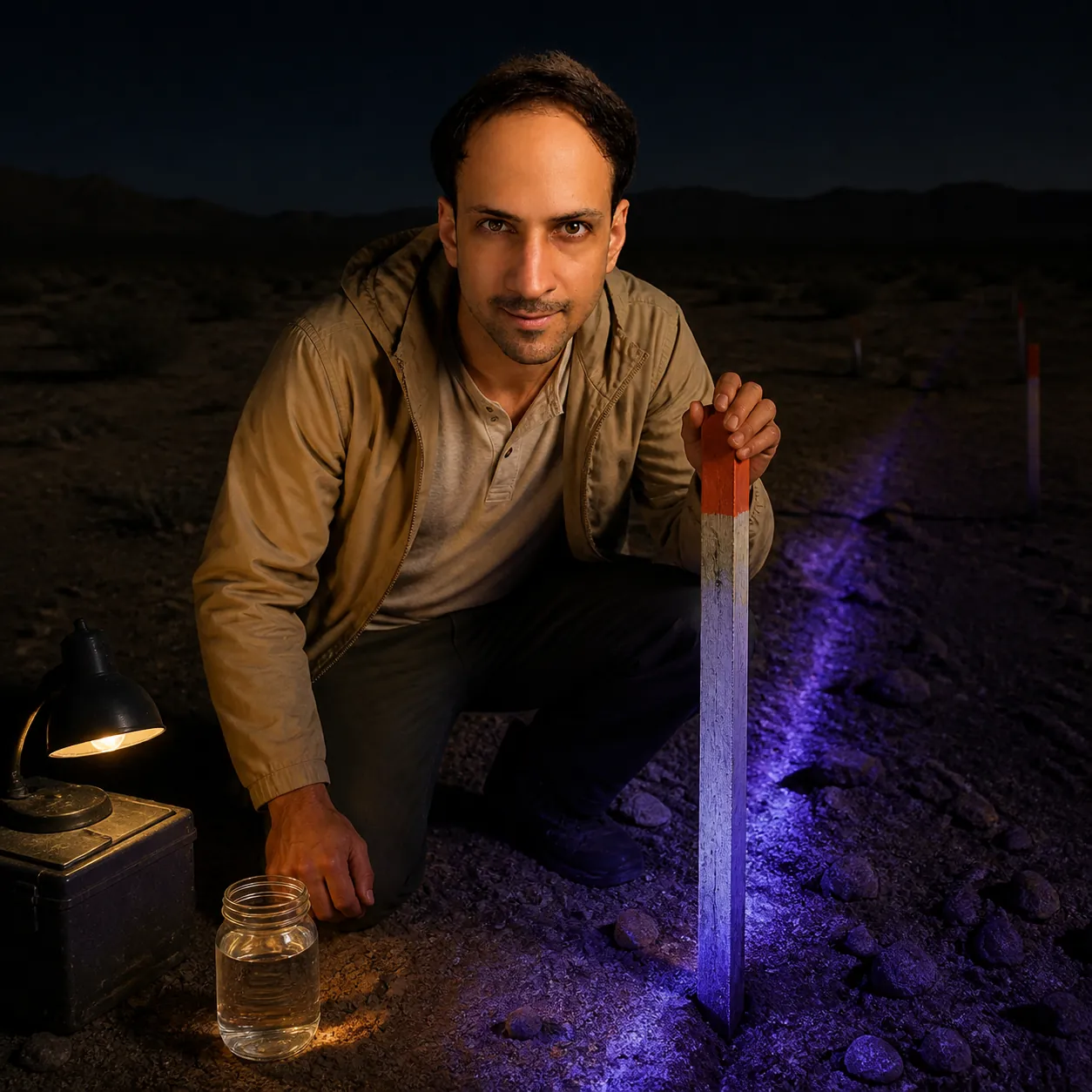
The Jar on the Night Plot
صورةAI Portraits

Create a square 1:1 museum-catalog frame with a strong first read and a slower second read at exactly 2880x2880 pixels. Location: a marked desert study plot...

من نص البرومبت

Use the attached reference photo as the identity reference: keep the same face, skin tone, hair and features as the person in that photo, without beautifying, aging or altering them. Create a square 1:1 museum-catalog frame with a strong first read and a slower second read at exactly 2880x2880 pixels. Location: a marked desert study plot an hour after the moon has set. Show them in a sand-colored windbreaker over a plain long-sleeved henley, pressing a survey stake upright with one palm. Build the artwork around this material rule: a jar of water carrying so little fluorescein that it reads as ordinary tap water until ultraviolet arrives takes its second color from light nobody in the room can see. Explore where the line falls between a thing's appearance and its actual properties; direct expression and posture toward attentive calm, never melodrama or ad-like confidence. Frame along the boundary of the ultraviolet light so both halves share one focal plane. Make the composition leave one edge of the object still unexplored by the light. Render it as conceptual laboratory portraiture assembled from working ultraviolet apparatus, restrained editorial art direction, believable surface response, and quiet observational framing, using a single low lamp holding the room while unseen ultraviolet does the rest and a palette of charcoal, bone grey, and one band of mineral orange. Photorealistic: this must read as a real photograph from a physical camera, never an illustration, painting, or 3D render. Resolve real surface detail: hair with individual strands catching light, fine hairs of uneven length, and skin oil giving a low uneven sheen. Keep one identity-locked person, credible hands and fingers, natural fabric, and coherent scale, contact, reflections, shadows, airflow, deformation, and materials. Background people only when essential, always secondary and clearly different. Avoid rave lighting rigs, uniform purple haze, CGI bioluminescent forests, and glowing eyes. No text, labels, logos, signatures, watermarks, random symbols, plastic skin, excessive bloom, or glossy AI finish.
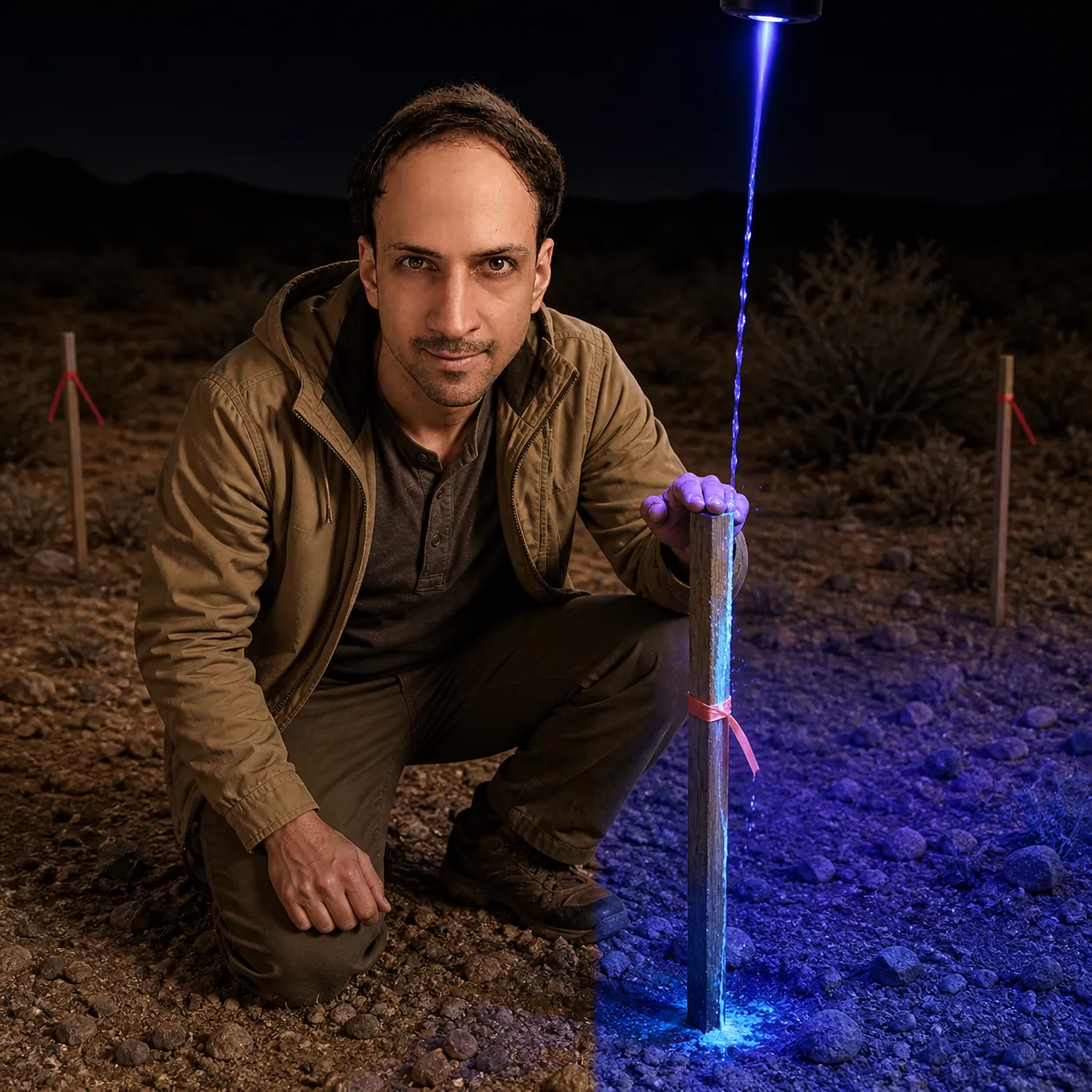
Blue Stream on the Desert Plot
صورةAI Portraits

Create a square 1:1 museum-catalog frame with a strong first read and a slower second read at exactly 2880x2880 pixels. Location: a marked desert study plot...

من نص البرومبت

Use the attached reference photo as the identity reference: keep the same face, skin tone, hair and features as the person in that photo, without beautifying, aging or altering them. Create a square 1:1 museum-catalog frame with a strong first read and a slower second read at exactly 2880x2880 pixels. Location: a marked desert study plot an hour after the moon has set. Show them in a sand-colored windbreaker over a plain long-sleeved henley, pressing a survey stake upright with one palm. Make one rigorous physical condition the conceptual engine: a thin poured stream of tonic water that turns pale luminous blue only in the narrow zone an ultraviolet beam crosses divides one honest frame into an ordinary half and a luminous half. Explore how a difference can stay invisible until something is asked to answer; direct expression and posture toward clear-eyed respect, never melodrama or ad-like confidence. Use an eye-level 55mm viewpoint with natural perspective and shadows kept open enough to read their face. Make the composition run the lamp's boundary through the frame as a quiet border. Render it as gallery-grade specimen photography built from genuine luminescent materials, sober collection-room styling, accurate dim-light color, and patient portrait attention, using cool ultraviolet from above the frame with enough bounce to keep faces readable and a palette of warm stone, walnut, and one flare of chlorophyll red. Photorealistic: this must read as a real photograph from a physical camera, never an illustration, painting, or 3D render. Resolve real surface detail: fine lint on dark fabric, water spotting on steel, and the soft rounding of edges that have been used for years. Keep one identity-locked person, credible hands and fingers, natural fabric, and coherent scale, contact, reflections, shadows, airflow, deformation, and materials. Background people only when essential, always secondary and clearly different. Avoid blacklight-party glow, neon signage, glowing body paint, radioactive-green fog, and cartoon toxic-waste barrels. No text, labels, logos, signatures, watermarks, random symbols, plastic skin, excessive bloom, or glossy AI finish.
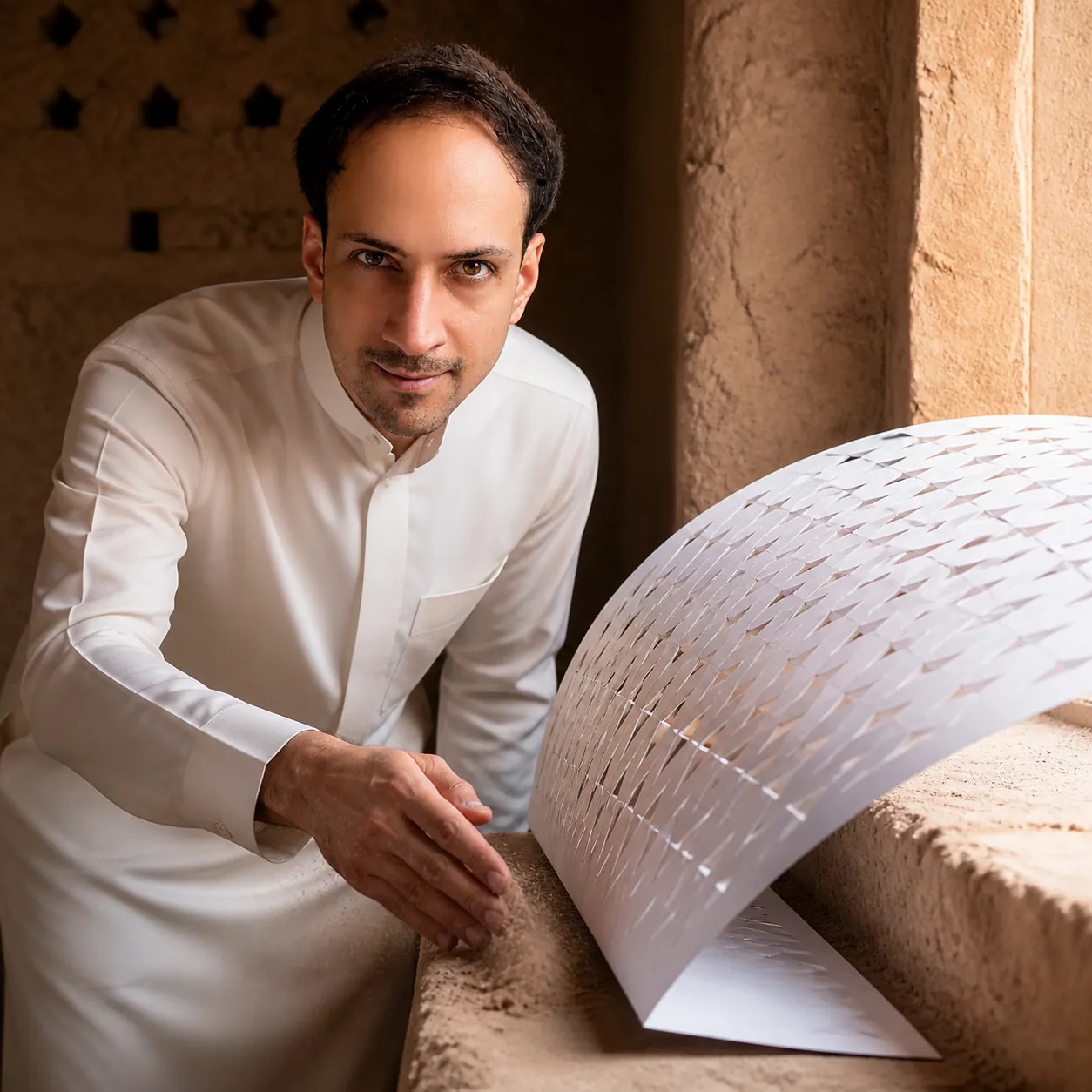
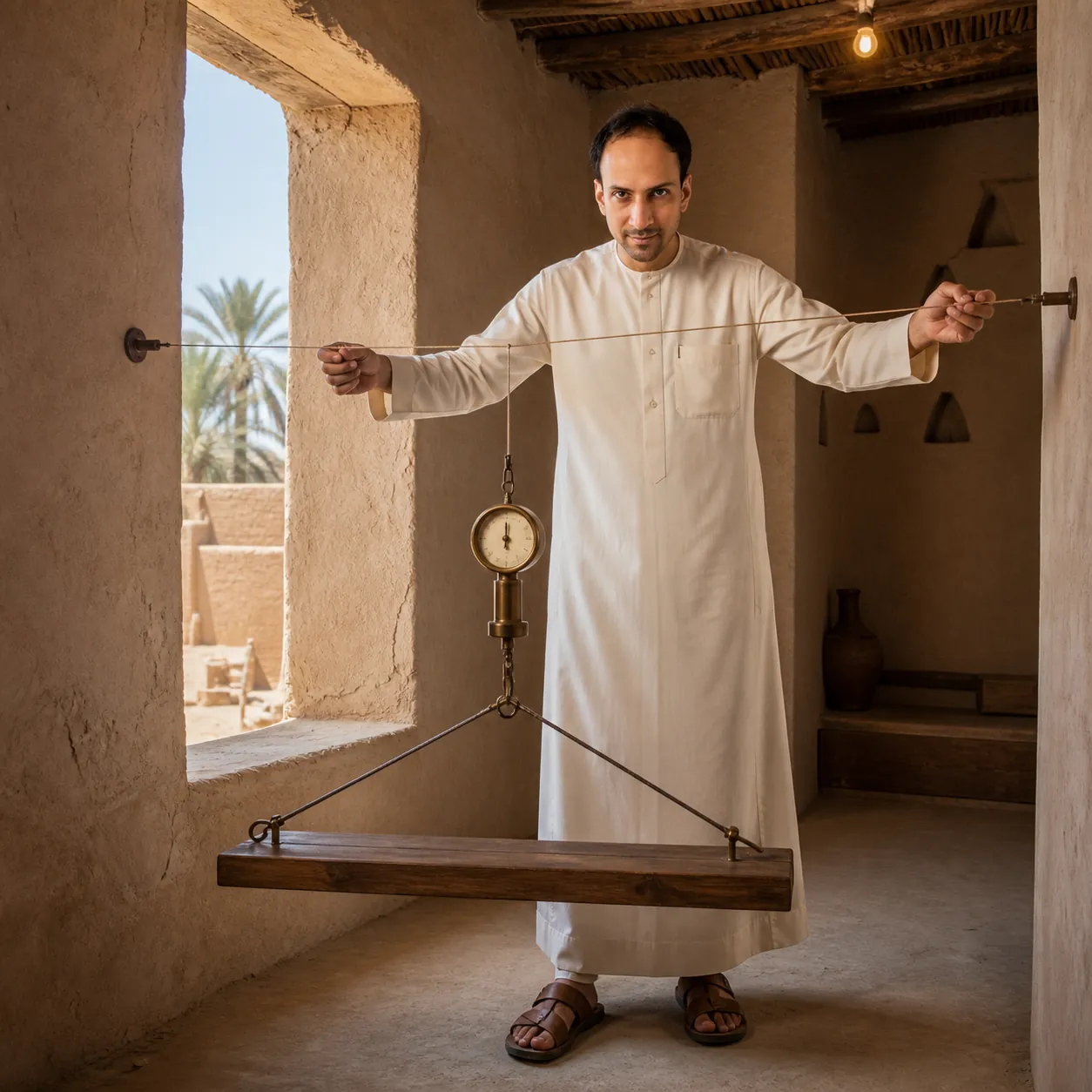
A Spring Scale in Diriyah
صورةAI Portraits

Create a square 1:1 museum-catalog frame with a strong first read and a slower second read at exactly 2880x2880 pixels. Location: a restored mud-brick room...

من نص البرومبت

Use the attached reference photo as the identity reference: keep the same face, skin tone, hair and features as the person in that photo, without beautifying, aging or altering them. Create a square 1:1 museum-catalog frame with a strong first read and a slower second read at exactly 2880x2880 pixels. Location: a restored mud-brick room in Diriyah with a palm-beam ceiling. Show them in an ecru cotton traditional Gulf outfit and dusty leather work sandals, stretching a builder's line taut between two wall pegs. Build the artwork around this material rule: a knee-high floating stand whose one load cable passes through a brass spring scale, the needle confessing exact kilograms reads as impossible from across the room and inevitable from a handspan. Explore how disagreement, tuned precisely enough, becomes the most reliable form of holding still; direct expression and posture toward attentive trust, never melodrama or ad-like confidence. Frame level with the widest gap in the structure so clear daylight through it sits beside their face. Make the composition weight the frame so stillness reads as tension, not rest. Render it as documentary workshop realism built from believable joinery, taut-line specularity, accurate gravity in every hanging element, and unhurried craftsman-portrait framing, using one bare overhead bulb tempered by white walls into soft, even evidence light and a palette of iron black, oiled cedar, and a muted terracotta accent. Photorealistic: this must read as a real photograph from a physical camera, never an illustration, painting, or 3D render. Resolve real surface detail: hair with individual strands catching light, any facial hair at its true uneven length, and skin oil giving a low uneven sheen. Keep one identity-locked person, credible hands and fingers, natural fabric, and coherent scale, contact, reflections, shadows, airflow, deformation, and materials. Background people only when essential, always secondary and clearly different. Avoid magician's-levitation staging, slack lines pretending to carry load, melted wood joints, and hovering furniture ads. No text, labels, logos, signatures, watermarks, random symbols, plastic skin, excessive bloom, or glossy AI finish.
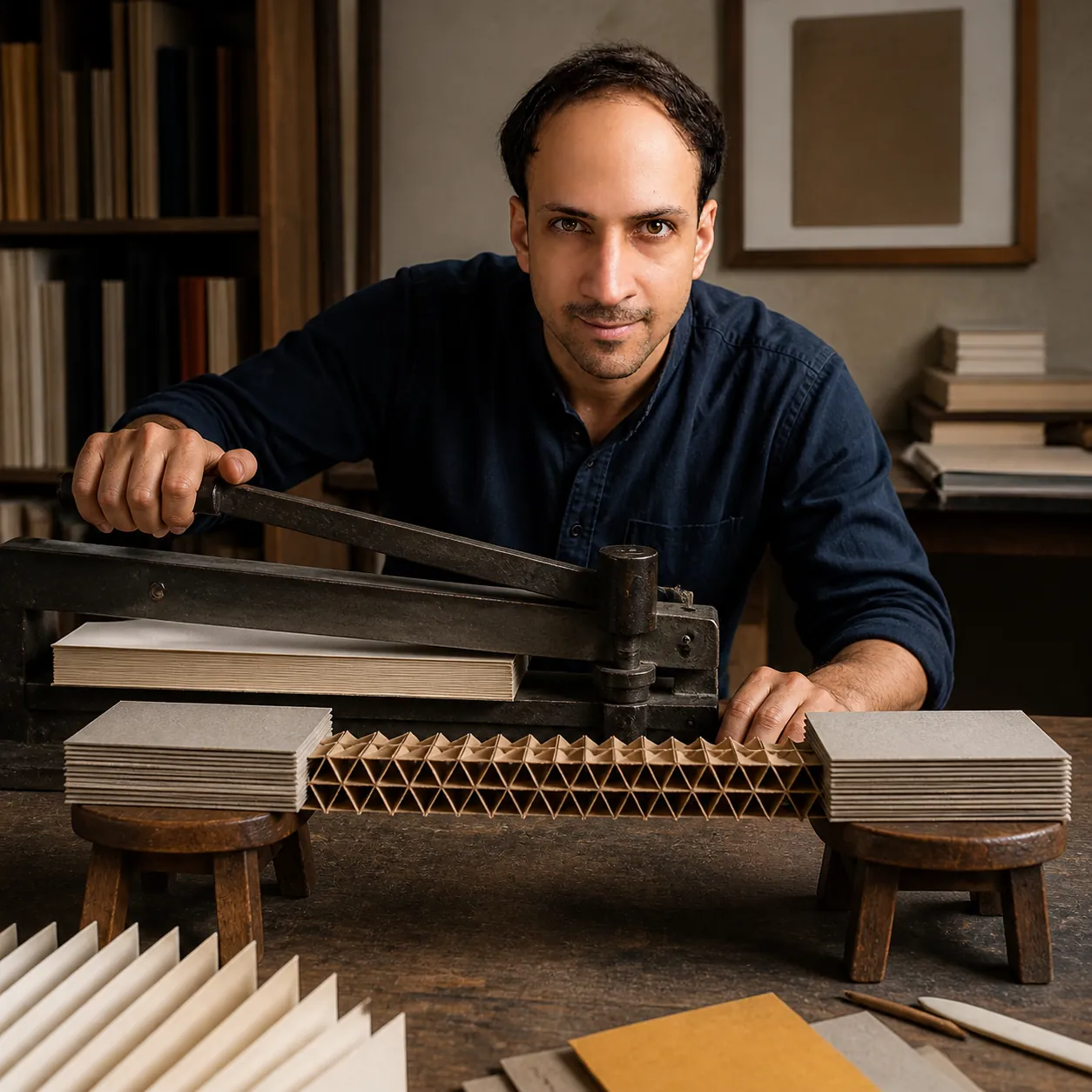
A Slit Sheet Becomes a Canopy
صورةAI Portraits

Create a square 1:1 museum-catalog frame with a strong first read and a slower second read at exactly 2880x2880 pixels. Location: a restored mud-brick room...

من نص البرومبت

Use the attached reference photo as the identity reference: keep the same face, skin tone, hair and features as the person in that photo, without beautifying, aging or altering them. Create a square 1:1 museum-catalog frame with a strong first read and a slower second read at exactly 2880x2880 pixels. Location: a restored mud-brick room in Diriyah with one deep window sill. Show them in a plain ivory traditional Gulf outfit worn without a headdress, cuffs buttoned, sweeping fine dust from the sill with one cupped hand. The impossible-looking event must obey this clear system: a flat white sheet whose staggered rows of fine slits let it stretch into a smoothly doubly curved canopy shell reads as an engineering proof while remaining an object of quiet beauty. Explore whether strength lives in a material or in the pattern given to it; direct expression and posture toward sober delight, never melodrama or ad-like confidence. Use a 90mm close-portrait hybrid: one crease edge razor sharp near the lens, their face readable beyond it. Make the composition place their hand near the structure without ever touching the load. Render it as museum-workshop realism combining honest fiber texture, accurate crease shadows, believable deflection under real weight, and restrained editorial lighting, using one low raking lamp that turns each fold into a drawn line and a palette of oat paper, cool slate, and one restrained saffron thread. Photorealistic: this must read as a real photograph from a physical camera, never an illustration, painting, or 3D render. Resolve real surface detail: condensation beading at true size, liquid meniscus curving against glass, and wet surfaces darker than dry ones. Keep one identity-locked person, credible hands and fingers, natural fabric, and coherent scale, contact, reflections, shadows, airflow, deformation, and materials. Background people only when essential, always secondary and clearly different. Avoid greeting-card kitsch, torn-edge scrapbook collage, cartoon pop-up books, and burning paper drama. No text, labels, logos, signatures, watermarks, random symbols, plastic skin, excessive bloom, or glossy AI finish.
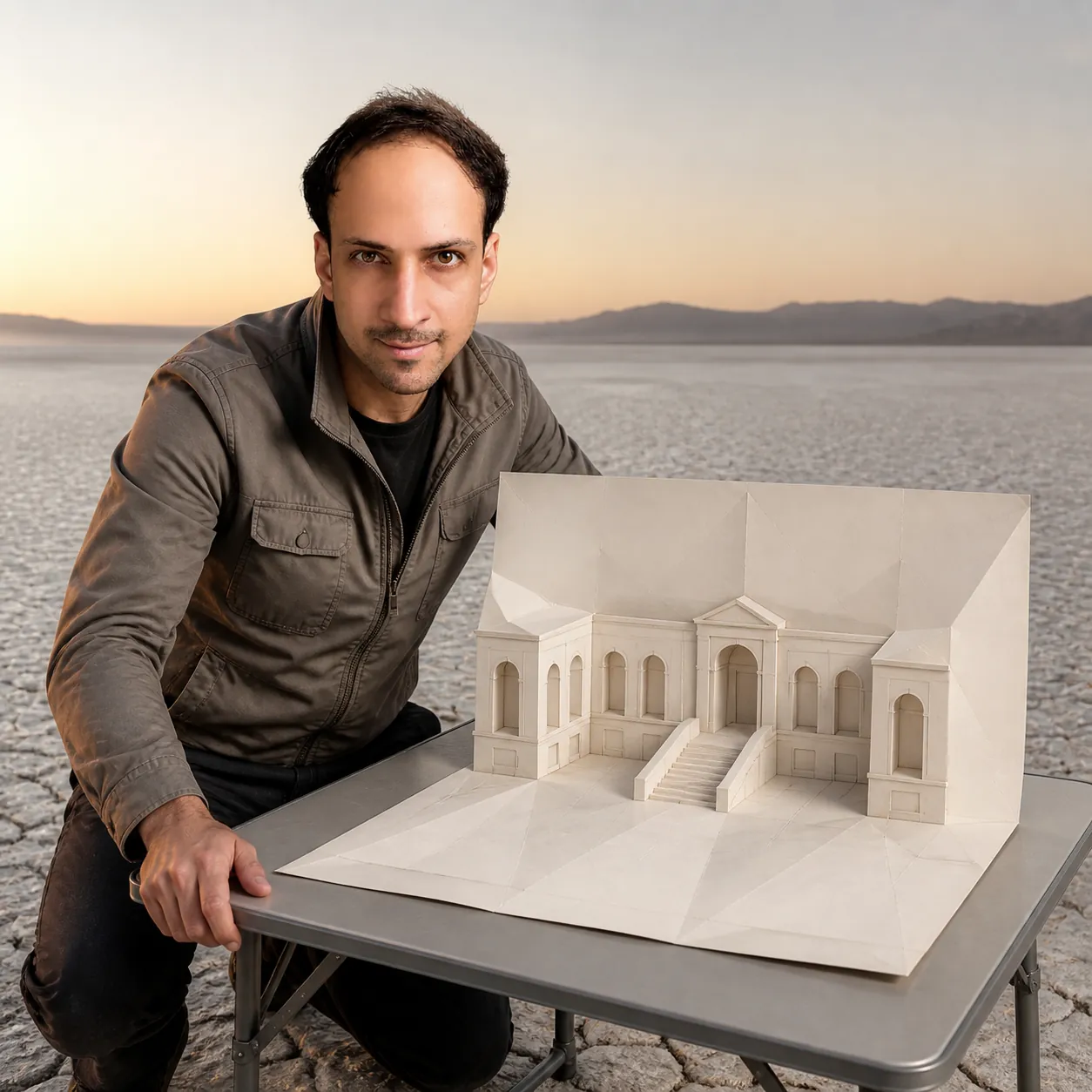
Honeycomb Beam in the Bindery
صورةAI Portraits

Create a square 1:1 museum-catalog frame with a strong first read and a slower second read at exactly 2880x2880 pixels. Location: a bookbinder's atelier...

من نص البرومبت

Use the attached reference photo as the identity reference: keep the same face, skin tone, hair and features as the person in that photo, without beautifying, aging or altering them. Create a square 1:1 museum-catalog frame with a strong first read and a slower second read at exactly 2880x2880 pixels. Location: a bookbinder's atelier with a hand guillotine and racked blank card. Show them in a collarless indigo work shirt with sleeves rolled past the elbow, settling the guillotine clamp onto a fresh stack of card. Build the artwork around this material rule: a honeycomb beam of glued kraft strips, expanded from a thin slab, that bridges two stools under stacked tiles reads as an engineering proof while remaining an object of quiet beauty. Explore how flatness can hold a finished structure the way a seed holds a tree; direct expression and posture toward attentive humility, never melodrama or ad-like confidence. Frame across the tabletop at the structure's own height so the span and their eyes share one focal plane. Make the composition place their hand near the structure without ever touching the load. Render it as gallery-grade structural still-life portraiture built from real folded spans, matte paper materiality, unexaggerated shadow logic, and patient architectural composition, using soft bounced daylight with one deeper shadow pocket beneath the structure and a palette of museum-board grey, soft ivory, and a single ochre accent. Photorealistic: this must read as a real photograph from a physical camera, never an illustration, painting, or 3D render. Resolve real surface detail: cotton that hangs by its own weight, seams that pucker very slightly, and collars softened by washing. Keep one identity-locked person, credible hands and fingers, natural fabric, and coherent scale, contact, reflections, shadows, airflow, deformation, and materials. Background people only when essential, always secondary and clearly different. Avoid greeting-card kitsch, torn-edge scrapbook collage, cartoon pop-up books, and burning paper drama. No text, labels, logos, signatures, watermarks, random symbols, plastic skin, excessive bloom, or glossy AI finish.
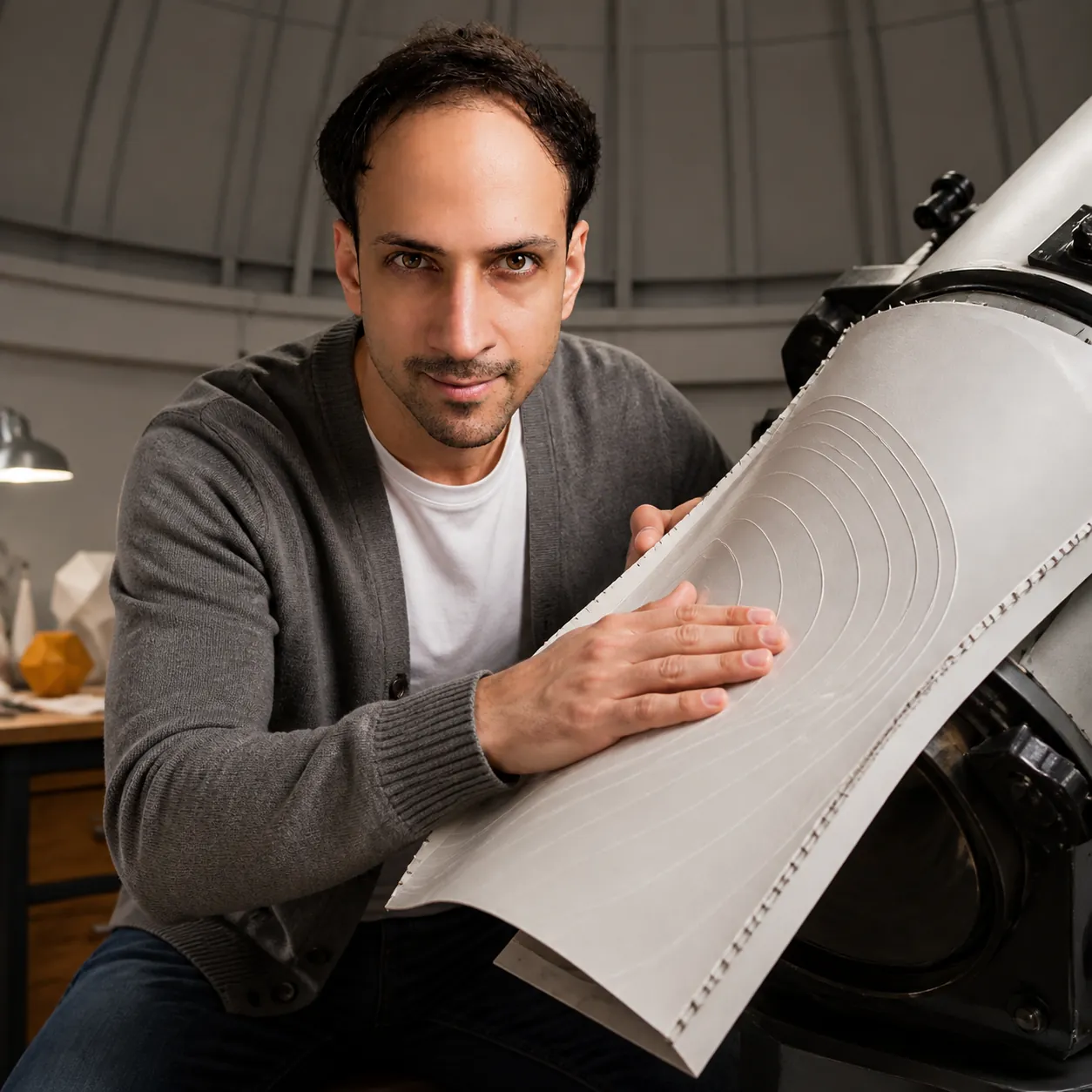
A Courtyard Rising from Paper
صورةAI Portraits

Create a square 1:1 museum-catalog frame with a strong first read and a slower second read at exactly 2880x2880 pixels. Location: the cracked bed of a dry...

من نص البرومبت

Use the attached reference photo as the identity reference: keep the same face, skin tone, hair and features as the person in that photo, without beautifying, aging or altering them. Create a square 1:1 museum-catalog frame with a strong first read and a slower second read at exactly 2880x2880 pixels. Location: the cracked bed of a dry salt flat at windless first light. Show them in a sand-grey field jacket zipped to mid-chest over dark trousers, bracing a folding camp table by one leg. Use this advanced image-making device as the core logic: a courtyard facade that rises fully formed, walls and stair together, as its folded base sheet opens to ninety degrees reads as an engineering proof while remaining an object of quiet beauty. Explore what it means that an entire building can wait inside a flat sheet; direct expression and posture toward unhurried focus, never melodrama or ad-like confidence. Frame from a low three-quarter angle so the paper structure gains quiet monumentality while their posture stays true. Make the composition keep every cut edge sharp while the room softens behind. Render it as museum-workshop realism combining honest fiber texture, accurate crease shadows, believable deflection under real weight, and restrained editorial lighting, using even overhead workroom light shaped so white surfaces hold visible tone steps and a palette of museum-board grey, soft ivory, and a single ochre accent. Photorealistic: this must read as a real photograph from a physical camera, never an illustration, painting, or 3D render. Resolve real surface detail: thread ends and slight pilling on worn cloth, hairline chips at every hard corner, and stone that is porous rather than smooth. Keep one identity-locked person, credible hands and fingers, natural fabric, and coherent scale, contact, reflections, shadows, airflow, deformation, and materials. Background people only when essential, always secondary and clearly different. Avoid greeting-card kitsch, torn-edge scrapbook collage, cartoon pop-up books, and burning paper drama. No text, labels, logos, signatures, watermarks, random symbols, plastic skin, excessive bloom, or glossy AI finish.
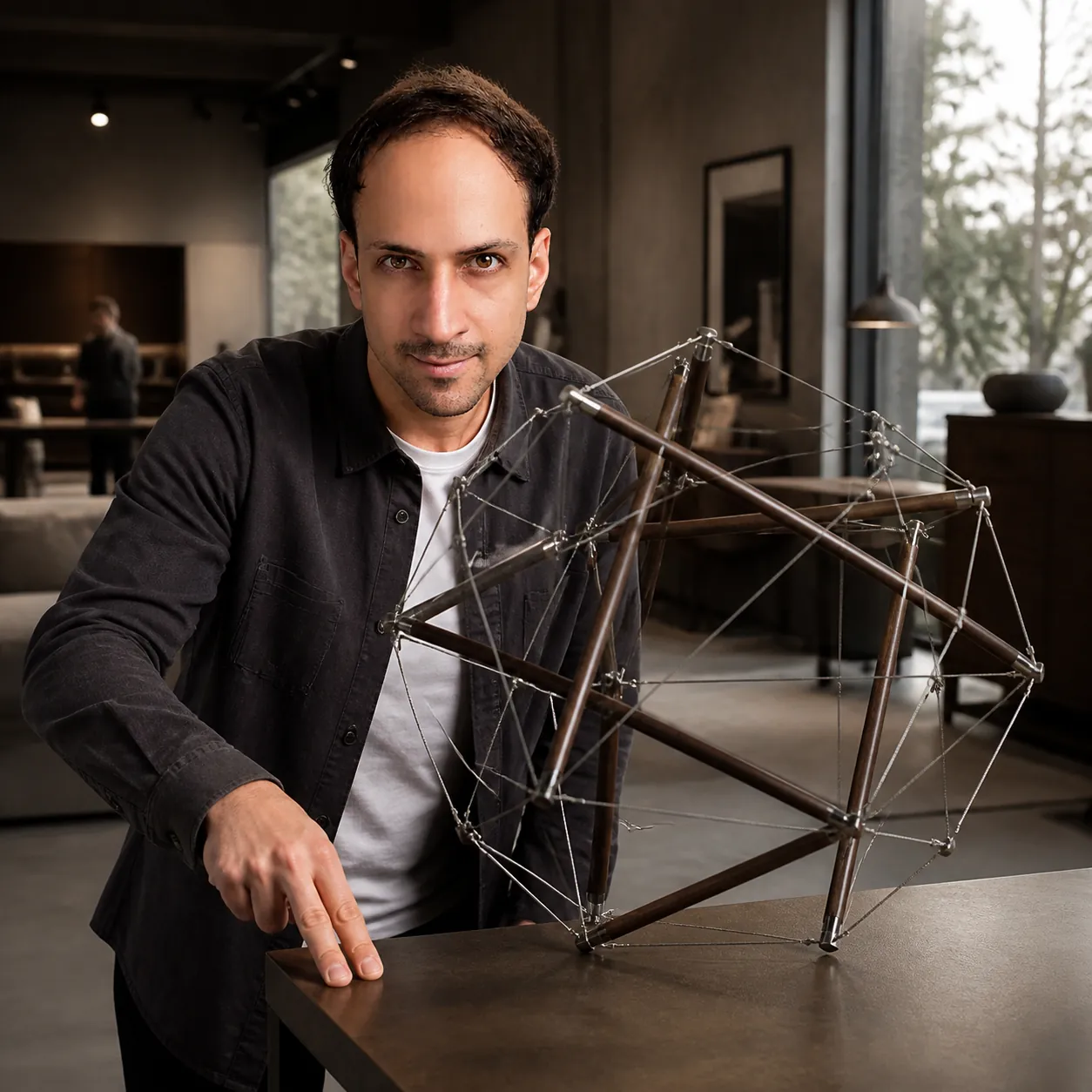
A Saddle Shell in the Observatory
صورةAI Portraits

Create a square 1:1 museum-catalog frame with a strong first read and a slower second read at exactly 2880x2880 pixels. Location: a small university...

من نص البرومبت

Use the attached reference photo as the identity reference: keep the same face, skin tone, hair and features as the person in that photo, without beautifying, aging or altering them. Create a square 1:1 museum-catalog frame with a strong first read and a slower second read at exactly 2880x2880 pixels. Location: a small university observatory with its dome slit closed for daylight. Show them in a heather-grey cardigan over a white crew-neck and dark denim, fitting the felt-lined cover over the telescope tube. The impossible-looking event must obey this clear system: a sheet scored along nested curved creases that springs into a rigid saddle shell resisting the press of their palm reads as an engineering proof while remaining an object of quiet beauty. Explore whether an honest machine can be made entirely of folded card; direct expression and posture toward sober delight, never melodrama or ad-like confidence. Use a 90mm close-portrait hybrid: one crease edge razor sharp near the lens, their face readable beyond it. Make the composition keep every cut edge sharp while the room softens behind. Render it as conceptual maker-bench photography uniting tactile card mechanisms, precise score-line detail, quiet contemporary art direction, and human-centered observational framing, using even overhead workroom light shaped so white surfaces hold visible tone steps and a palette of museum-board grey, soft ivory, and a single ochre accent. Photorealistic: this must read as a real photograph from a physical camera, never an illustration, painting, or 3D render. Resolve real surface detail: skin that reddens slightly under pressure, nail beds with honest colour, and knuckle creases that fold rather than blur. Keep one identity-locked person, credible hands and fingers, natural fabric, and coherent scale, contact, reflections, shadows, airflow, deformation, and materials. Background people only when essential, always secondary and clearly different. Avoid greeting-card kitsch, torn-edge scrapbook collage, cartoon pop-up books, and burning paper drama. No text, labels, logos, signatures, watermarks, random symbols, plastic skin, excessive bloom, or glossy AI finish.
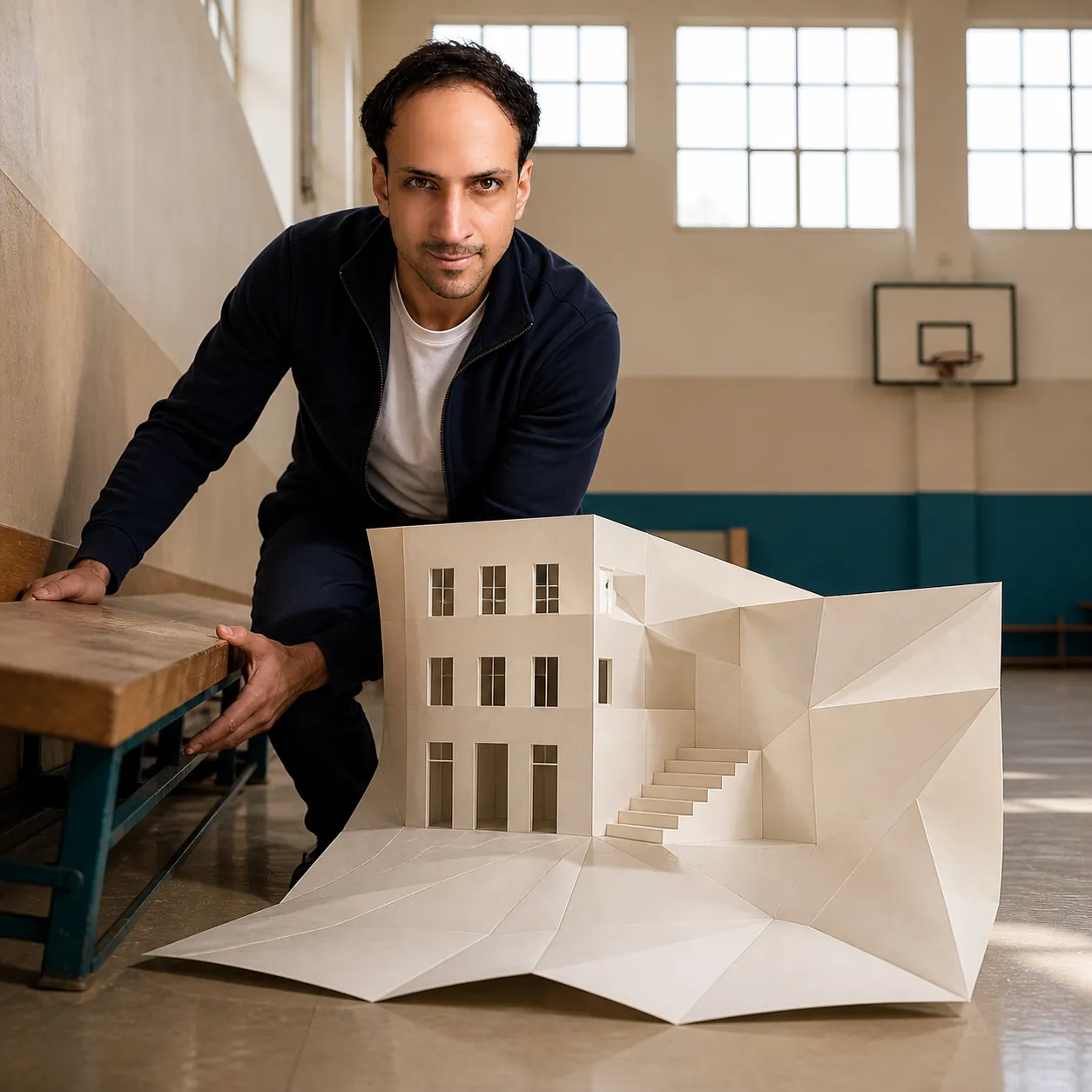
The Sphere That Springs Back
صورةAI Portraits

Create a square 1:1 museum-catalog frame with a strong first read and a slower second read at exactly 2880x2880 pixels. Location: a closed furniture...

من نص البرومبت

Use the attached reference photo as the identity reference: keep the same face, skin tone, hair and features as the person in that photo, without beautifying, aging or altering them. Create a square 1:1 museum-catalog frame with a strong first read and a slower second read at exactly 2880x2880 pixels. Location: a closed furniture showroom lit only by its window displays. Show them in a pressed charcoal overshirt buttoned over a plain white tee, pressing two fingertips down on a tabletop corner. Build the artwork around this material rule: a six-strut tensegrity sphere that springs back to perfect shape after they squeeze it flat between both palms reads as impossible from across the room and inevitable from a handspan. Explore where strength actually lives when rigid parts refuse to lean on each other; direct expression and posture toward attentive trust, never melodrama or ad-like confidence. Frame level with the widest gap in the structure so clear daylight through it sits beside their face. Make the composition let one taut line lead the eye to their hands. Render it as quiet museum-demonstration photography combining engineering-model exactness, visible fastener detail, true-to-load cable sag and straightness, and restrained human-scale staging, using diffused skylight from above that leaves thin cables bright against deeper shadow and a palette of warm concrete, dark walnut, and thin steel-cable silver. Photorealistic: this must read as a real photograph from a physical camera, never an illustration, painting, or 3D render. Resolve real surface detail: dust settled where nobody wipes, fingerprint haze on glass, and edges rubbed pale by handling. Keep one identity-locked person, credible hands and fingers, natural fabric, and coherent scale, contact, reflections, shadows, airflow, deformation, and materials. Background people only when essential, always secondary and clearly different. Avoid magician's-levitation staging, slack lines pretending to carry load, melted wood joints, and hovering furniture ads. No text, labels, logos, signatures, watermarks, random symbols, plastic skin, excessive bloom, or glossy AI finish.
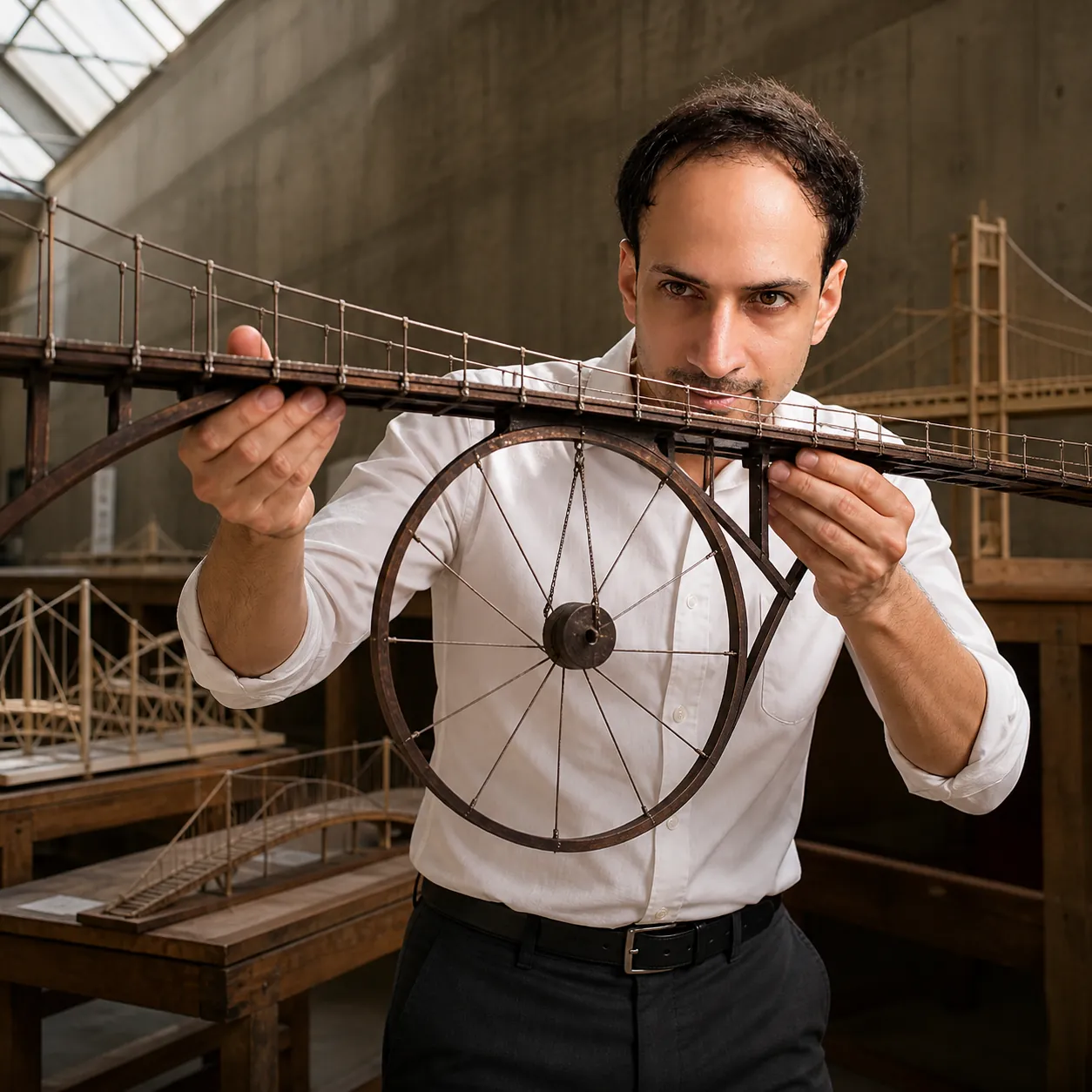
Pop-Up Courtyard in the Sports Hall
صورةAI Portraits

Create a square 1:1 museum-catalog frame with a strong first read and a slower second read at exactly 2880x2880 pixels. Location: an empty school sports...

من نص البرومبت

Use the attached reference photo as the identity reference: keep the same face, skin tone, hair and features as the person in that photo, without beautifying, aging or altering them. Create a square 1:1 museum-catalog frame with a strong first read and a slower second read at exactly 2880x2880 pixels. Location: an empty school sports hall under high morning windows. Show them in a zip-through navy track jacket over a plain white shirt, unstacking one low bench from the wall line. The impossible-looking event must obey this clear system: a courtyard facade that rises fully formed, walls and stair together, as its folded base sheet opens to ninety degrees puts work the eye reserves for steel onto material sold by the ream. Explore what it means that an entire building can wait inside a flat sheet; direct expression and posture toward quiet conviction, never melodrama or ad-like confidence. Use a 90mm close-portrait hybrid: one crease edge razor sharp near the lens, their face readable beyond it. Make the composition place their hand near the structure without ever touching the load. Render it as gallery-grade structural still-life portraiture built from real folded spans, matte paper materiality, unexaggerated shadow logic, and patient architectural composition, using flat north window light that keeps every crease edge legible and a palette of warm white, shadowed cream, and one edge of teal. Photorealistic: this must read as a real photograph from a physical camera, never an illustration, painting, or 3D render. Resolve real surface detail: glass with real thickness at its edge, reflections that carry the room's actual colour, and dust visible only at grazing angles. Keep one identity-locked person, credible hands and fingers, natural fabric, and coherent scale, contact, reflections, shadows, airflow, deformation, and materials. Background people only when essential, always secondary and clearly different. Avoid origami cranes, glowing magical paper, floating confetti, printed lettering on sheets, and weightless CGI folds. No text, labels, logos, signatures, watermarks, random symbols, plastic skin, excessive bloom, or glossy AI finish.
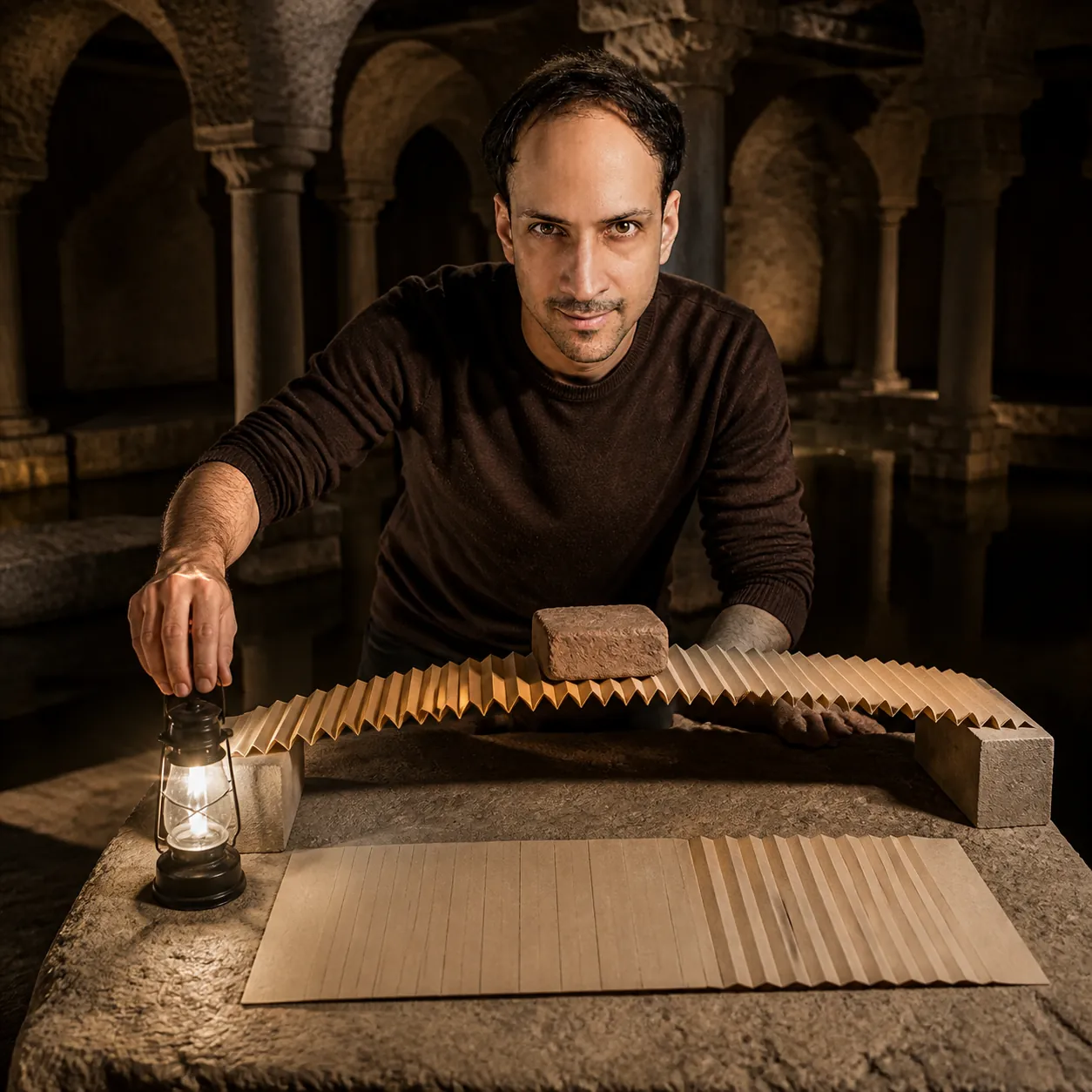
Spokes Among Student Bridges
صورةAI Portraits

Create a square 1:1 museum-catalog frame with a strong first read and a slower second read at exactly 2880x2880 pixels. Location: a university engineering...

من نص البرومبت

Use the attached reference photo as the identity reference: keep the same face, skin tone, hair and features as the person in that photo, without beautifying, aging or altering them. Create a square 1:1 museum-catalog frame with a strong first read and a slower second read at exactly 2880x2880 pixels. Location: a university engineering hall lined with student bridge models. Show them in a white dress shirt tucked into charcoal trousers, collar open, tilting one model bridge to sight along its deck. Make one rigorous physical condition the conceptual engine: a spoked wheel under a hung load whose hub hangs from its upper spokes instead of standing on the lower ones replaces the eye's first guess about what holds it with a stranger truth. Explore why a taut line feels more trustworthy than a solid post once understood; direct expression and posture toward steady wonder, never melodrama or ad-like confidence. Use an eye-level 50mm view with honest perspective so every cable angle stays measurably true. Make the composition let one taut line lead the eye to their hands. Render it as quiet museum-demonstration photography combining engineering-model exactness, visible fastener detail, true-to-load cable sag and straightness, and restrained human-scale staging, using diffused skylight from above that leaves thin cables bright against deeper shadow and a palette of warm concrete, dark walnut, and thin steel-cable silver. Photorealistic: this must read as a real photograph from a physical camera, never an illustration, painting, or 3D render. Resolve real surface detail: fine grit in the texture of concrete, efflorescence at damp edges, and hairline cracks that follow stress. Keep one identity-locked person, credible hands and fingers, natural fabric, and coherent scale, contact, reflections, shadows, airflow, deformation, and materials. Background people only when essential, always secondary and clearly different. Avoid floating objects with no visible cables, glowing wires, rubber-looking bent bars, and impossible knots. No text, labels, logos, signatures, watermarks, random symbols, plastic skin, excessive bloom, or glossy AI finish.
Paper Bridge in the Old Cistern
صورةAI Portraits

Create a square 1:1 museum-catalog frame with a strong first read and a slower second read at exactly 2880x2880 pixels. Location: a dry historic cistern...

من نص البرومبت

Use the attached reference photo as the identity reference: keep the same face, skin tone, hair and features as the person in that photo, without beautifying, aging or altering them. Create a square 1:1 museum-catalog frame with a strong first read and a slower second read at exactly 2880x2880 pixels. Location: a dry historic cistern beneath old Riyadh, cool and windless. Show them in a dark brown crew-neck sweater with sleeves pushed to mid-forearm, setting a battery lantern onto a stone ledge. Treat this mechanism as the frame’s governing rule: a bridge pleated from one kraft sheet whose deep accordion corrugations span two trestles beneath a single fired brick reads as an engineering proof while remaining an object of quiet beauty. Explore why a material that tears between two fingers can be trusted with real weight; direct expression and posture toward attentive humility, never melodrama or ad-like confidence. Use a composed wide 32mm view that gives the structure headroom without stretching their hands or face. Make the composition show the flat stock and the risen form in one frame. Render it as conceptual maker-bench photography uniting tactile card mechanisms, precise score-line detail, quiet contemporary art direction, and human-centered observational framing, using one low raking lamp that turns each fold into a drawn line and a palette of museum-board grey, soft ivory, and a single ochre accent. Photorealistic: this must read as a real photograph from a physical camera, never an illustration, painting, or 3D render. Resolve real surface detail: paper fibre visible at cut edges, plastic that shows mould lines, and paint thicker where a brush turned. Keep one identity-locked person, credible hands and fingers, natural fabric, and coherent scale, contact, reflections, shadows, airflow, deformation, and materials. Background people only when essential, always secondary and clearly different. Avoid greeting-card kitsch, torn-edge scrapbook collage, cartoon pop-up books, and burning paper drama. No text, labels, logos, signatures, watermarks, random symbols, plastic skin, excessive bloom, or glossy AI finish.
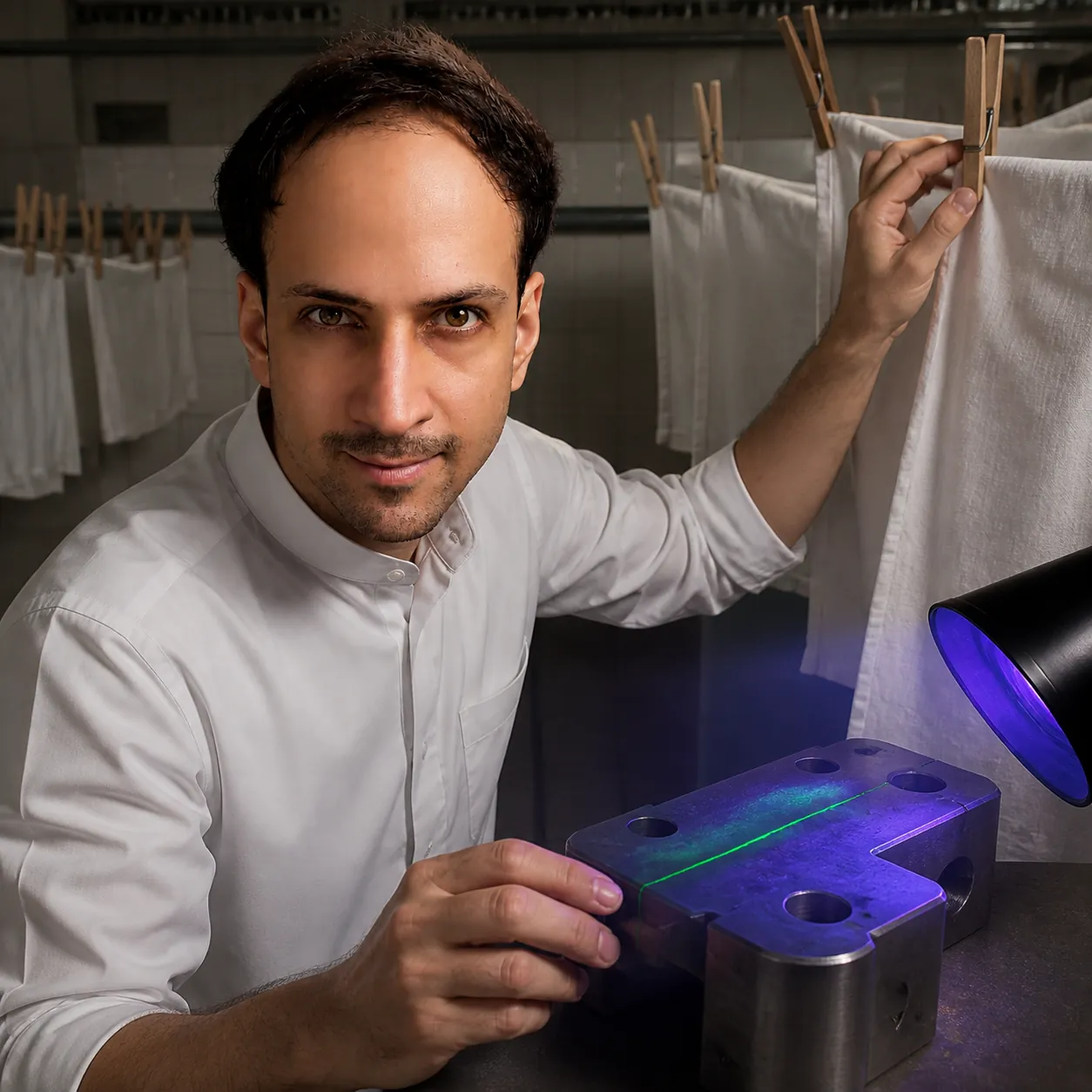
The Crack That Draws Itself
صورةAI Portraits

Create a square 1:1 museum-catalog frame with a strong first read and a slower second read at exactly 2880x2880 pixels. Location: a tiled drying room with...

من نص البرومبت

Use the attached reference photo as the identity reference: keep the same face, skin tone, hair and features as the person in that photo, without beautifying, aging or altering them. Create a square 1:1 museum-catalog frame with a strong first read and a slower second read at exactly 2880x2880 pixels. Location: a tiled drying room with line-dried whites hanging stiff on racks. Show them in a plain white summer traditional Gulf outfit with the sleeves folded once, unclipping one dried sheet from its wooden pegs. The impossible-looking event must obey this clear system: a machined aluminum bracket whose hairline crack draws itself as a bright green thread under ultraviolet once fluorescent penetrant has seeped in takes its second color from light nobody in the room can see. Explore whether a hidden property is real before anyone builds the lamp for it; direct expression and posture toward patient verification, never melodrama or ad-like confidence. Use a 90mm close-focus portrait lens so the emitting detail and their eyes both stay believable. Make the composition leave one edge of the object still unexplored by the light. Render it as museum demonstration realism combining honest low-light photography, spectrally plausible glow, plain material texture, and unhurried human presence in frame, using a single low lamp holding the room while unseen ultraviolet does the rest and a palette of charcoal, bone grey, and one band of mineral orange. Photorealistic: this must read as a real photograph from a physical camera, never an illustration, painting, or 3D render. Resolve real surface detail: condensation beading at true size, liquid meniscus curving against glass, and wet surfaces darker than dry ones. Keep one identity-locked person, credible hands and fingers, natural fabric, and coherent scale, contact, reflections, shadows, airflow, deformation, and materials. Background people only when essential, always secondary and clearly different. Avoid rave lighting rigs, uniform purple haze, CGI bioluminescent forests, and glowing eyes. No text, labels, logos, signatures, watermarks, random symbols, plastic skin, excessive bloom, or glossy AI finish.
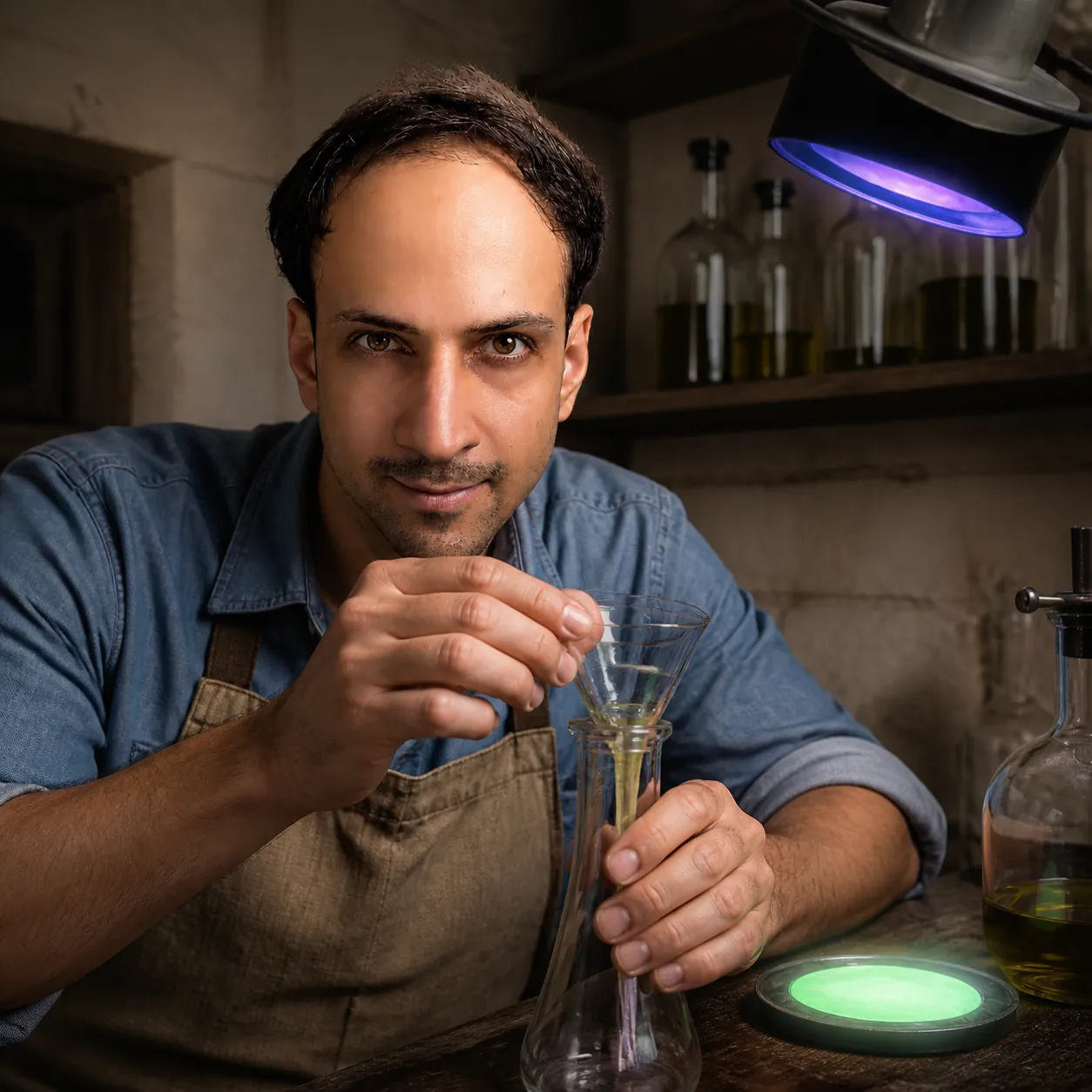
Afterglow in the Olive Press
صورةAI Portraits

Create a square 1:1 museum-catalog frame with a strong first read and a slower second read at exactly 2880x2880 pixels. Location: a small olive-pressing...

من نص البرومبت

Use the attached reference photo as the identity reference: keep the same face, skin tone, hair and features as the person in that photo, without beautifying, aging or altering them. Create a square 1:1 museum-catalog frame with a strong first read and a slower second read at exactly 2880x2880 pixels. Location: a small olive-pressing room with clean decanting bottles on a shelf. Show them in a heavy canvas apron over a rolled-sleeve chambray shirt, seating a glass funnel into a bottle's neck. The impossible-looking event must obey this clear system: a plain grey ceramic disc that keeps emitting green for minutes after the ultraviolet lamp above it is switched off takes its second color from light nobody in the room can see. Explore how something can be a signal long before anyone learns to read it; direct expression and posture toward patient verification, never melodrama or ad-like confidence. Use a 90mm close-focus portrait lens so the emitting detail and their eyes both stay believable. Make the composition keep the emitting detail sharpest while the room stays quietly dim. Render it as conceptual laboratory portraiture assembled from working ultraviolet apparatus, restrained editorial art direction, believable surface response, and quiet observational framing, using cool ultraviolet from above the frame with enough bounce to keep faces readable and a palette of unbleached linen, umber, and one stripe of quinine blue. Photorealistic: this must read as a real photograph from a physical camera, never an illustration, painting, or 3D render. Resolve real surface detail: skin that reddens slightly under pressure, nail beds with honest colour, and knuckle creases that fold rather than blur. Keep one identity-locked person, credible hands and fingers, natural fabric, and coherent scale, contact, reflections, shadows, airflow, deformation, and materials. Background people only when essential, always secondary and clearly different. Avoid rave lighting rigs, uniform purple haze, CGI bioluminescent forests, and glowing eyes. No text, labels, logos, signatures, watermarks, random symbols, plastic skin, excessive bloom, or glossy AI finish.
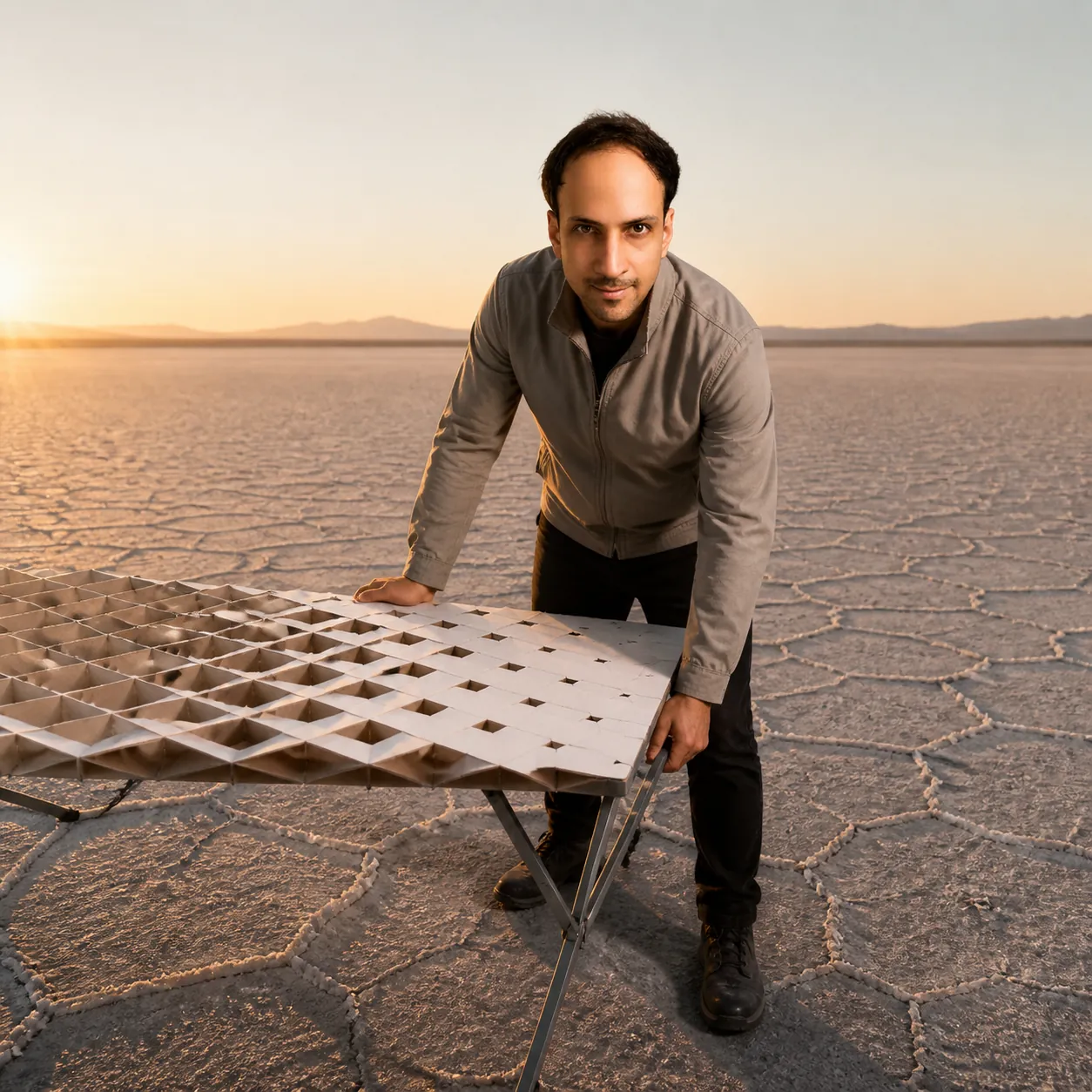
The Lattice That Grows Wider
صورةAI Portraits

Create a square 1:1 museum-catalog frame with a strong first read and a slower second read at exactly 2880x2880 pixels. Location: the cracked bed of a dry...

من نص البرومبت

Use the attached reference photo as the identity reference: keep the same face, skin tone, hair and features as the person in that photo, without beautifying, aging or altering them. Create a square 1:1 museum-catalog frame with a strong first read and a slower second read at exactly 2880x2880 pixels. Location: the cracked bed of a dry salt flat at windless first light. Show them in a sand-grey field jacket zipped to mid-chest over dark trousers, bracing a folding camp table by one leg. Treat this mechanism as the frame’s governing rule: a stretch lattice cut into hinged card squares that grows visibly wider the farther it is pulled lengthwise puts work the eye reserves for steel onto material sold by the ream. Explore what the eye owes a material it has underestimated its whole life; direct expression and posture toward quiet conviction, never melodrama or ad-like confidence. Use a composed wide 32mm view that gives the structure headroom without stretching their hands or face. Make the composition give the load path one clean diagonal from burden to bearing. Render it as high-concept paper-engineering portraiture built from working cut-and-fold structures, documentary realism, gallery-grade craft styling, and physically truthful load behavior, using one low raking lamp that turns each fold into a drawn line and a palette of warm white, shadowed cream, and one edge of teal. Photorealistic: this must read as a real photograph from a physical camera, never an illustration, painting, or 3D render. Resolve real surface detail: grout darker than tile, sealant slightly yellowed, and every joint showing a real tolerance gap. Keep one identity-locked person, credible hands and fingers, natural fabric, and coherent scale, contact, reflections, shadows, airflow, deformation, and materials. Background people only when essential, always secondary and clearly different. Avoid origami cranes, glowing magical paper, floating confetti, printed lettering on sheets, and weightless CGI folds. No text, labels, logos, signatures, watermarks, random symbols, plastic skin, excessive bloom, or glossy AI finish.
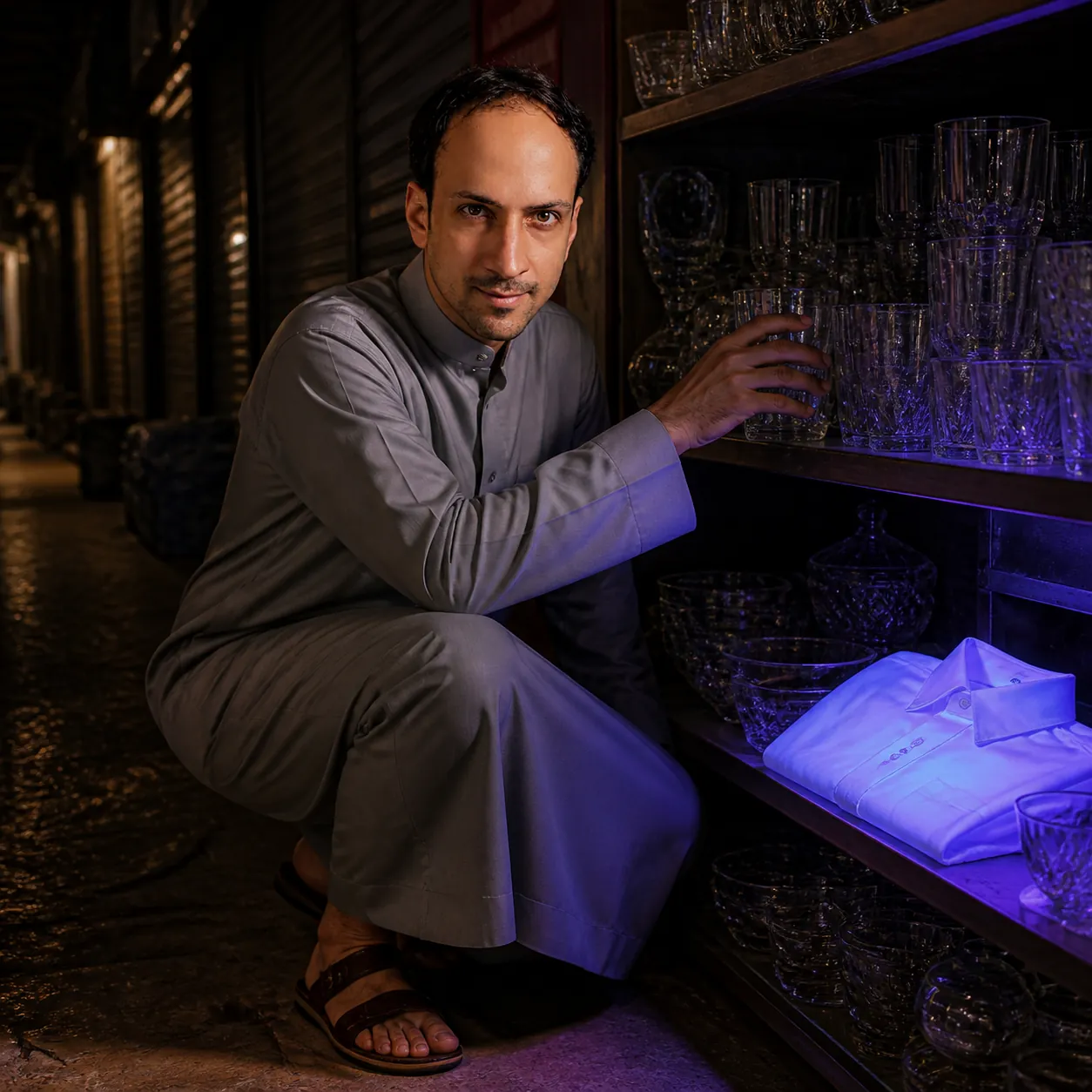
Violet Glow in a Shuttered Souq
صورةAI Portraits

Create a square 1:1 museum-catalog frame with a strong first read and a slower second read at exactly 2880x2880 pixels. Location: a shuttered souq glassware...

من نص البرومبت

Use the attached reference photo as the identity reference: keep the same face, skin tone, hair and features as the person in that photo, without beautifying, aging or altering them. Create a square 1:1 museum-catalog frame with a strong first read and a slower second read at exactly 2880x2880 pixels. Location: a shuttered souq glassware stall with the aisle lights already off. Show them in a lightweight grey traditional Gulf outfit worn with plain leather sandals, turning one stacked tumbler upright on the shelf. The impossible-looking event must obey this clear system: a folded white shirt whose fibers flare cold violet under ultraviolet, since the dye that makes cotton read as white also glows divides one honest frame into an ordinary half and a luminous half. Explore what honesty requires when one object has two equally true appearances; direct expression and posture toward restrained wonder, never melodrama or ad-like confidence. Use a 90mm close-focus portrait lens so the emitting detail and their eyes both stay believable. Make the composition leave one edge of the object still unexplored by the light. Render it as gallery-grade specimen photography built from genuine luminescent materials, sober collection-room styling, accurate dim-light color, and patient portrait attention, using one warm tungsten practical on one side and cool ultraviolet on the other and a palette of cool black, ash grey, and a thread of violet-white. Photorealistic: this must read as a real photograph from a physical camera, never an illustration, painting, or 3D render. Resolve real surface detail: glass with real thickness at its edge, reflections that carry the room's actual colour, and dust visible only at grazing angles. Keep one identity-locked person, credible hands and fingers, natural fabric, and coherent scale, contact, reflections, shadows, airflow, deformation, and materials. Background people only when essential, always secondary and clearly different. Avoid blacklight-party glow, neon signage, glowing body paint, radioactive-green fog, and cartoon toxic-waste barrels. No text, labels, logos, signatures, watermarks, random symbols, plastic skin, excessive bloom, or glossy AI finish.
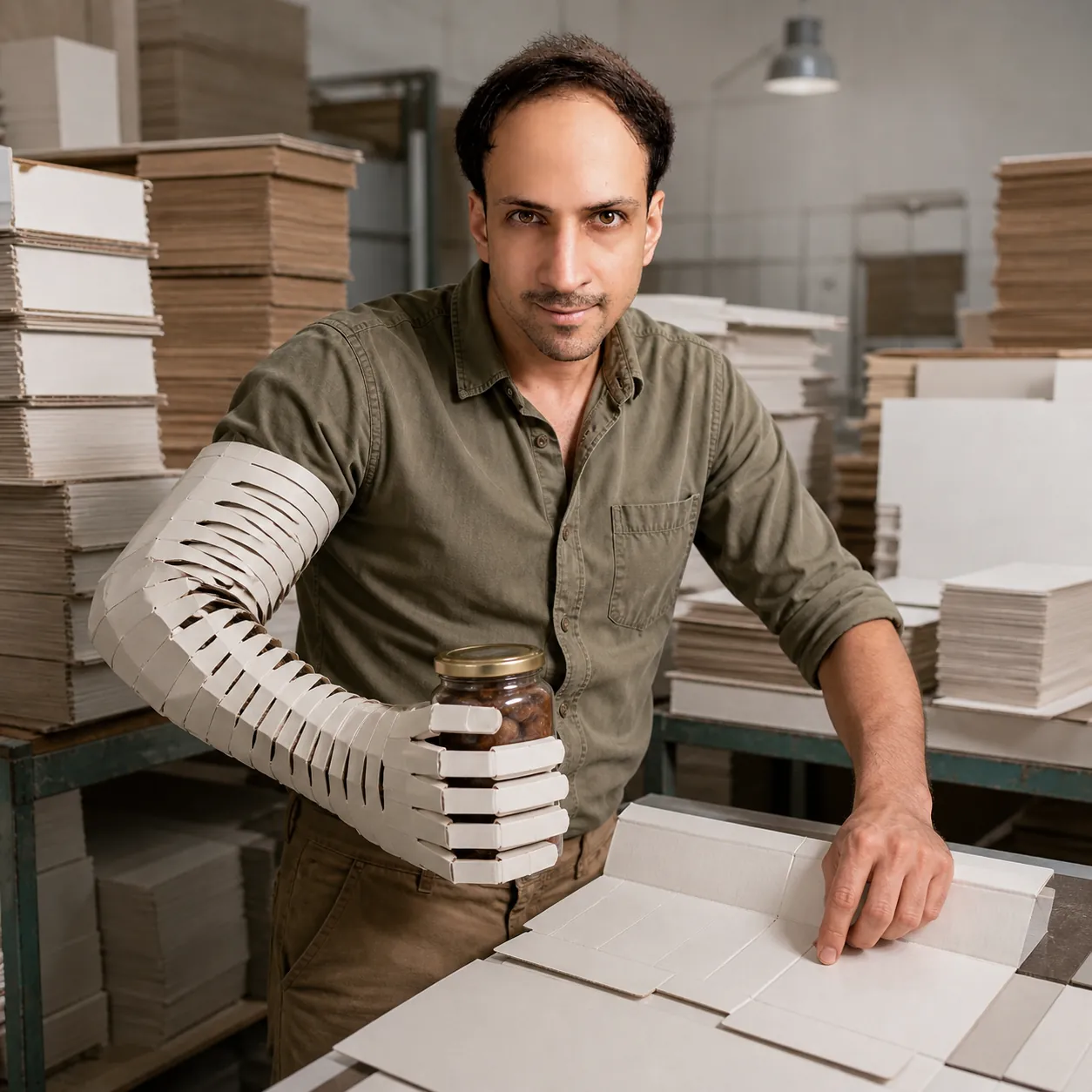
Paper Fingers Grip the Jar
صورةAI Portraits

Create a square 1:1 museum-catalog frame with a strong first read and a slower second read at exactly 2880x2880 pixels. Location: a date-packing shed...

من نص البرومبت

Use the attached reference photo as the identity reference: keep the same face, skin tone, hair and features as the person in that photo, without beautifying, aging or altering them. Create a square 1:1 museum-catalog frame with a strong first read and a slower second read at exactly 2880x2880 pixels. Location: a date-packing shed stacked chest-high with flattened new cartons. Show them in a washed olive utility shirt tucked into canvas work trousers, folding one carton up from flat with four practiced creases. Make one rigorous physical condition the conceptual engine: a kirigami sleeve whose parallel slits buckle into dozens of angled paper fingers that grip a filled glass jar puts work the eye reserves for steel onto material sold by the ream. Explore where the line runs between craft patience and structural engineering; direct expression and posture toward measured astonishment, never melodrama or ad-like confidence. Use an eye-level 58mm medium-format viewpoint with natural perspective and honest paper texture. Make the composition let white paper carry the frame's brightest and quietest values. Render it as high-concept paper-engineering portraiture built from working cut-and-fold structures, documentary realism, gallery-grade craft styling, and physically truthful load behavior, using even overhead workroom light shaped so white surfaces hold visible tone steps and a palette of oat paper, cool slate, and one restrained saffron thread. Photorealistic: this must read as a real photograph from a physical camera, never an illustration, painting, or 3D render. Resolve real surface detail: the difference between a wiped surface and a clean one, faint tide marks on ceramic, and metal dulled unevenly by touch. Keep one identity-locked person, credible hands and fingers, natural fabric, and coherent scale, contact, reflections, shadows, airflow, deformation, and materials. Background people only when essential, always secondary and clearly different. Avoid origami cranes, glowing magical paper, floating confetti, printed lettering on sheets, and weightless CGI folds. No text, labels, logos, signatures, watermarks, random symbols, plastic skin, excessive bloom, or glossy AI finish.
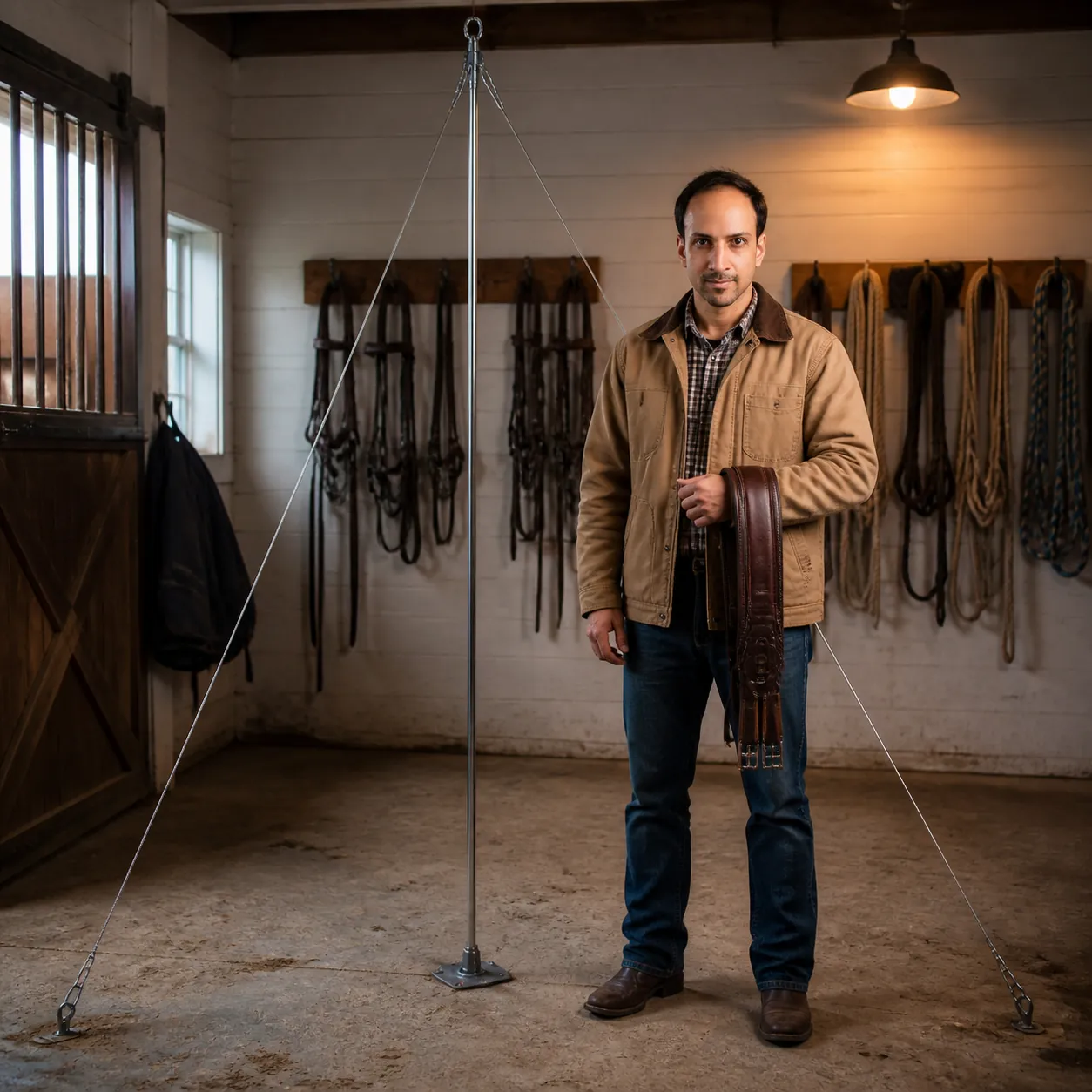
A Guyed Mast in the Tack Room
صورةAI Portraits

Create a square 1:1 museum-catalog frame with a strong first read and a slower second read at exactly 2880x2880 pixels. Location: a stable tack room hung...

من نص البرومبت

Use the attached reference photo as the identity reference: keep the same face, skin tone, hair and features as the person in that photo, without beautifying, aging or altering them. Create a square 1:1 museum-catalog frame with a strong first read and a slower second read at exactly 2880x2880 pixels. Location: a stable tack room hung with bridles and neat rope halters. Show them in a tan barn jacket over a small-checked flannel shirt, draping a leather girth strap over one forearm. Use this advanced image-making device as the core logic: a mast of slender aluminum rod that would buckle under its own height alone, standing dead straight inside three taut guy lines reads as impossible from across the room and inevitable from a handspan. Explore what changes in a person who learns that gaps can bear weight; direct expression and posture toward settled certainty, never melodrama or ad-like confidence. Use a 35mm environmental view that keeps the entire structure, its anchors, and the person inside one undistorted frame. Make the composition keep the background plain wherever a thin cable must read. Render it as documentary workshop realism built from believable joinery, taut-line specularity, accurate gravity in every hanging element, and unhurried craftsman-portrait framing, using first blue daylight with one warm tungsten pool held on the work and a palette of chalk white, desert tan, and one deep indigo strap. Photorealistic: this must read as a real photograph from a physical camera, never an illustration, painting, or 3D render. Resolve real surface detail: rubber gone chalky with age, painted metal chipped to primer, and plastic yellowed only where light reaches it. Keep one identity-locked person, credible hands and fingers, natural fabric, and coherent scale, contact, reflections, shadows, airflow, deformation, and materials. Background people only when essential, always secondary and clearly different. Avoid magician's-levitation staging, slack lines pretending to carry load, melted wood joints, and hovering furniture ads. No text, labels, logos, signatures, watermarks, random symbols, plastic skin, excessive bloom, or glossy AI finish.
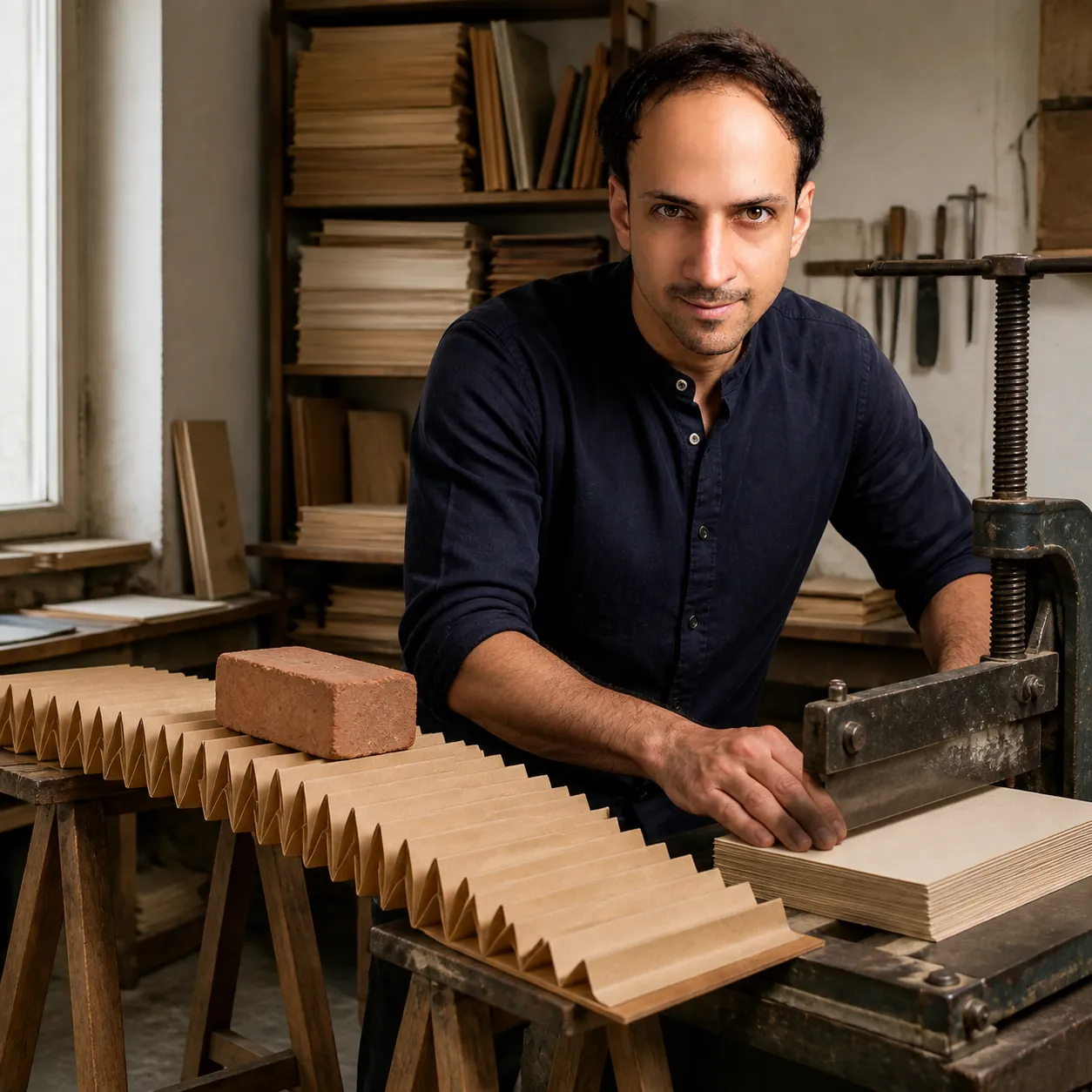
A Paper Bridge Under a Brick
صورةAI Portraits

Create a square 1:1 museum-catalog frame with a strong first read and a slower second read at exactly 2880x2880 pixels. Location: a bookbinder's atelier...

من نص البرومبت

Use the attached reference photo as the identity reference: keep the same face, skin tone, hair and features as the person in that photo, without beautifying, aging or altering them. Create a square 1:1 museum-catalog frame with a strong first read and a slower second read at exactly 2880x2880 pixels. Location: a bookbinder's atelier with a hand guillotine and racked blank card. Show them in a collarless indigo work shirt with sleeves rolled past the elbow, settling the guillotine clamp onto a fresh stack of card. Make one rigorous physical condition the conceptual engine: a bridge pleated from one kraft sheet whose deep accordion corrugations span two trestles beneath a single fired brick puts work the eye reserves for steel onto material sold by the ream. Explore why a material that tears between two fingers can be trusted with real weight; direct expression and posture toward patient exactness, never melodrama or ad-like confidence. Use an eye-level 58mm medium-format viewpoint with natural perspective and honest paper texture. Make the composition give the load path one clean diagonal from burden to bearing. Render it as high-concept paper-engineering portraiture built from working cut-and-fold structures, documentary realism, gallery-grade craft styling, and physically truthful load behavior, using flat north window light that keeps every crease edge legible and a palette of unbleached kraft, bone white, and one line of vermilion. Photorealistic: this must read as a real photograph from a physical camera, never an illustration, painting, or 3D render. Resolve real surface detail: true skin texture with pores and fine hair at the hairline, and fabric that creases where it is actually stressed. Keep one identity-locked person, credible hands and fingers, natural fabric, and coherent scale, contact, reflections, shadows, airflow, deformation, and materials. Background people only when essential, always secondary and clearly different. Avoid origami cranes, glowing magical paper, floating confetti, printed lettering on sheets, and weightless CGI folds. No text, labels, logos, signatures, watermarks, random symbols, plastic skin, excessive bloom, or glossy AI finish.
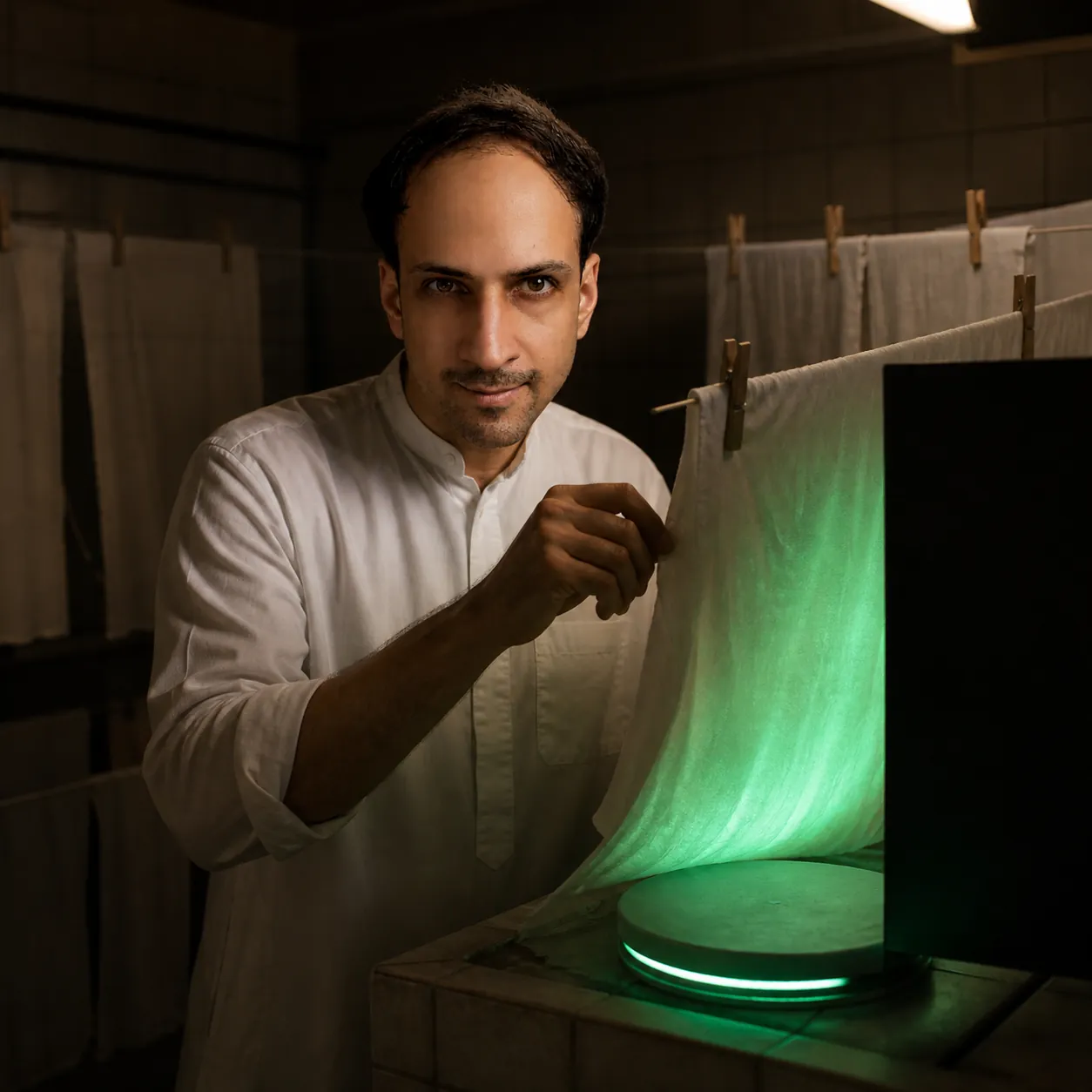
The Disc That Keeps Glowing
صورةAI Portraits

Create a square 1:1 museum-catalog frame with a strong first read and a slower second read at exactly 2880x2880 pixels. Location: a tiled drying room with...

من نص البرومبت

Use the attached reference photo as the identity reference: keep the same face, skin tone, hair and features as the person in that photo, without beautifying, aging or altering them. Create a square 1:1 museum-catalog frame with a strong first read and a slower second read at exactly 2880x2880 pixels. Location: a tiled drying room with line-dried whites hanging stiff on racks. Show them in a plain white summer traditional Gulf outfit with the sleeves folded once, unclipping one dried sheet from its wooden pegs. Use this advanced image-making device as the core logic: a plain grey ceramic disc that keeps emitting green for minutes after the ultraviolet lamp above it is switched off divides one honest frame into an ordinary half and a luminous half. Explore how something can be a signal long before anyone learns to read it; direct expression and posture toward unhurried attention, never melodrama or ad-like confidence. Frame past a matte black card at the frame's edge, physical but never crossing their face. Make the composition place the brightest emission off-center and let their attention answer it. Render it as high-fidelity fluorescence portraiture built from real emission behavior, documentary color accuracy, museum specimen staging, and emotionally restrained composition, using near-darkness carried mostly by emitted light and one weak amber practical and a palette of slate grey, pewter, and one seam of uranium green. Photorealistic: this must read as a real photograph from a physical camera, never an illustration, painting, or 3D render. Resolve real surface detail: wood grain read at honest scale, matte and gloss clearly separated, and no surface uniformly clean. Keep one identity-locked person, credible hands and fingers, natural fabric, and coherent scale, contact, reflections, shadows, airflow, deformation, and materials. Background people only when essential, always secondary and clearly different. Avoid blacklight-party glow, neon signage, glowing body paint, radioactive-green fog, and cartoon toxic-waste barrels. No text, labels, logos, signatures, watermarks, random symbols, plastic skin, excessive bloom, or glossy AI finish.
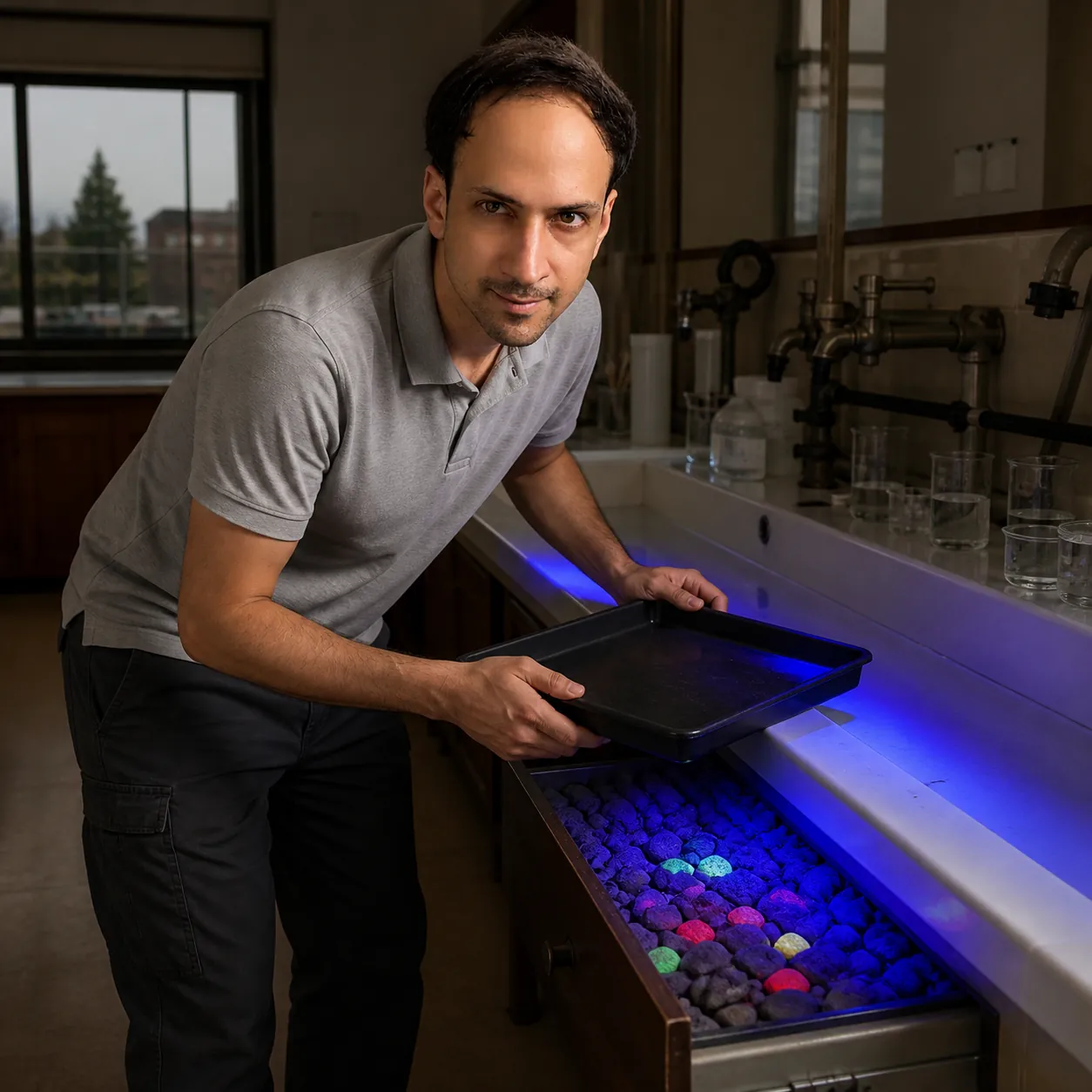
Pebbles That Blaze in the Dark
صورةAI Portraits

Create a square 1:1 museum-catalog frame with a strong first read and a slower second read at exactly 2880x2880 pixels. Location: a municipal water-testing...

من نص البرومبت

Use the attached reference photo as the identity reference: keep the same face, skin tone, hair and features as the person in that photo, without beautifying, aging or altering them. Create a square 1:1 museum-catalog frame with a strong first read and a slower second read at exactly 2880x2880 pixels. Location: a municipal water-testing station with one long white sampling sink. Show them in a pale grey polo shirt and dark utility trousers, setting a black tray square to the sink rim. Treat this mechanism as the frame’s governing rule: a pulled collection drawer of grey pebbles that blaze scarlet, cream, and green under shortwave ultraviolet because of a few trace impurities takes its second color from light nobody in the room can see. Explore how much of the ordinary world lies simply outside the eye's range; direct expression and posture toward steady disbelief, never melodrama or ad-like confidence. Use a calm 35mm view from just above the working surface with straight, undistorted edges. Make the composition place the brightest emission off-center and let their attention answer it. Render it as museum demonstration realism combining honest low-light photography, spectrally plausible glow, plain material texture, and unhurried human presence in frame, using dim ambient light with a hard ultraviolet edge crossing the working surface and a palette of warm stone, walnut, and one flare of chlorophyll red. Photorealistic: this must read as a real photograph from a physical camera, never an illustration, painting, or 3D render. Resolve real surface detail: leather creased along the lines of use, stitching slightly irregular, and edges burnished from contact. Keep one identity-locked person, credible hands and fingers, natural fabric, and coherent scale, contact, reflections, shadows, airflow, deformation, and materials. Background people only when essential, always secondary and clearly different. Avoid rave lighting rigs, uniform purple haze, CGI bioluminescent forests, and glowing eyes. No text, labels, logos, signatures, watermarks, random symbols, plastic skin, excessive bloom, or glossy AI finish.
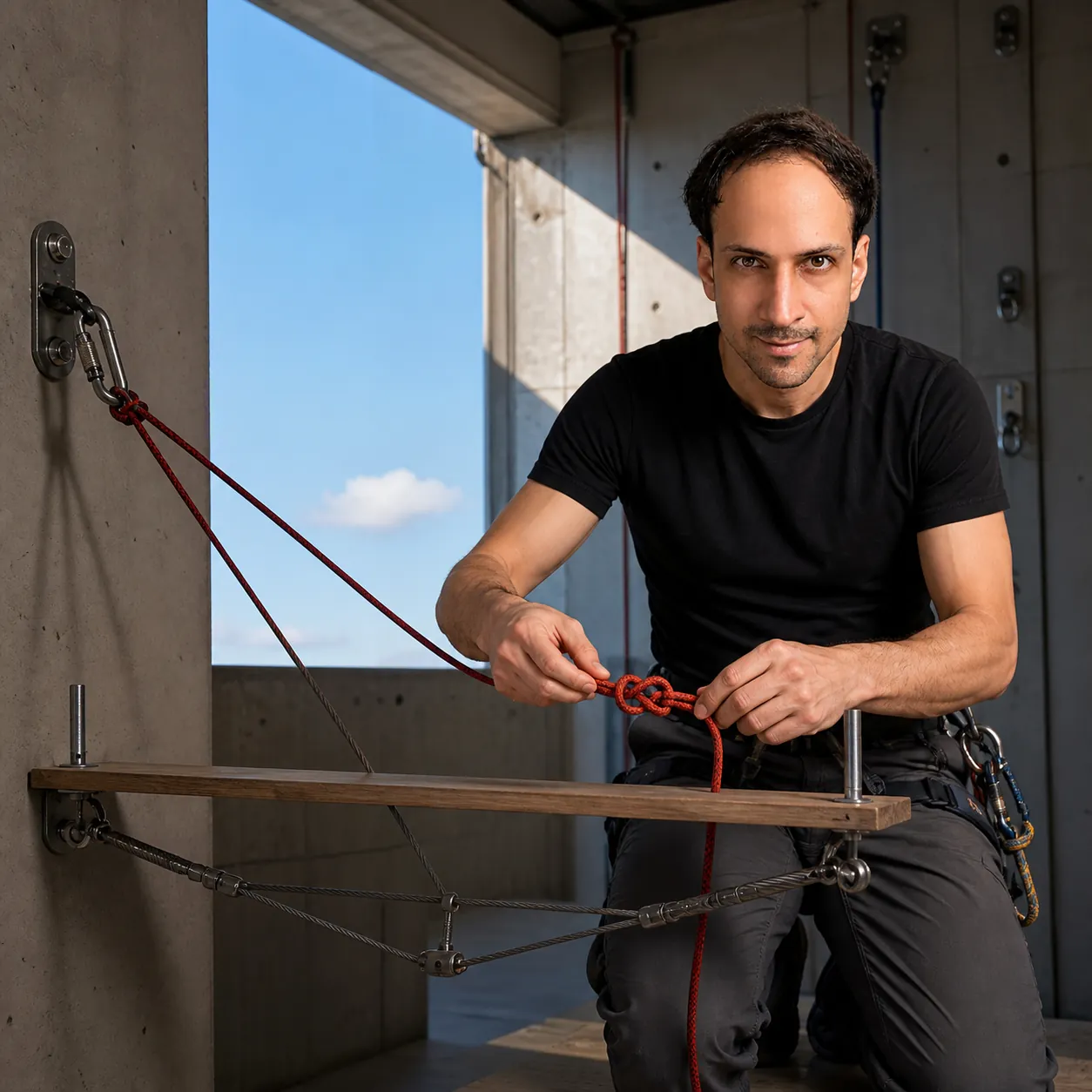
A Shelf Held by Tension
صورةAI Portraits

Create a square 1:1 museum-catalog frame with a strong first read and a slower second read at exactly 2880x2880 pixels. Location: a rope-access training bay...

من نص البرومبت

Use the attached reference photo as the identity reference: keep the same face, skin tone, hair and features as the person in that photo, without beautifying, aging or altering them. Create a square 1:1 museum-catalog frame with a strong first read and a slower second read at exactly 2880x2880 pixels. Location: a rope-access training bay with anchors bolted to a practice wall. Show them in a fitted black training shirt and grey climbing trousers, dressing a figure-eight knot flat with both thumbs. Build the artwork around this material rule: a thin shelf board that spans far beyond its own strength, kept dead flat by a shallow cable truss beneath replaces the eye's first guess about what holds it with a stranger truth. Explore whether stillness achieved by balanced opposition counts as rest or as work; direct expression and posture toward unhurried scrutiny, never melodrama or ad-like confidence. Frame level with the widest gap in the structure so clear daylight through it sits beside their face. Make the composition let one taut line lead the eye to their hands. Render it as exhibition-grade statics portraiture combining precise rigging detail, physically consistent shadows through open gaps, matte natural materials, and disciplined contemporary art direction, using first blue daylight with one warm tungsten pool held on the work and a palette of gallery white, ash wood, and one taut red cord. Photorealistic: this must read as a real photograph from a physical camera, never an illustration, painting, or 3D render. Resolve real surface detail: label-free packaging showing carton fibre, cardboard bruised at the corners, and tape lifting slightly at one end. Keep one identity-locked person, credible hands and fingers, natural fabric, and coherent scale, contact, reflections, shadows, airflow, deformation, and materials. Background people only when essential, always secondary and clearly different. Avoid floating objects with no visible cables, glowing wires, rubber-looking bent bars, and impossible knots. No text, labels, logos, signatures, watermarks, random symbols, plastic skin, excessive bloom, or glossy AI finish.
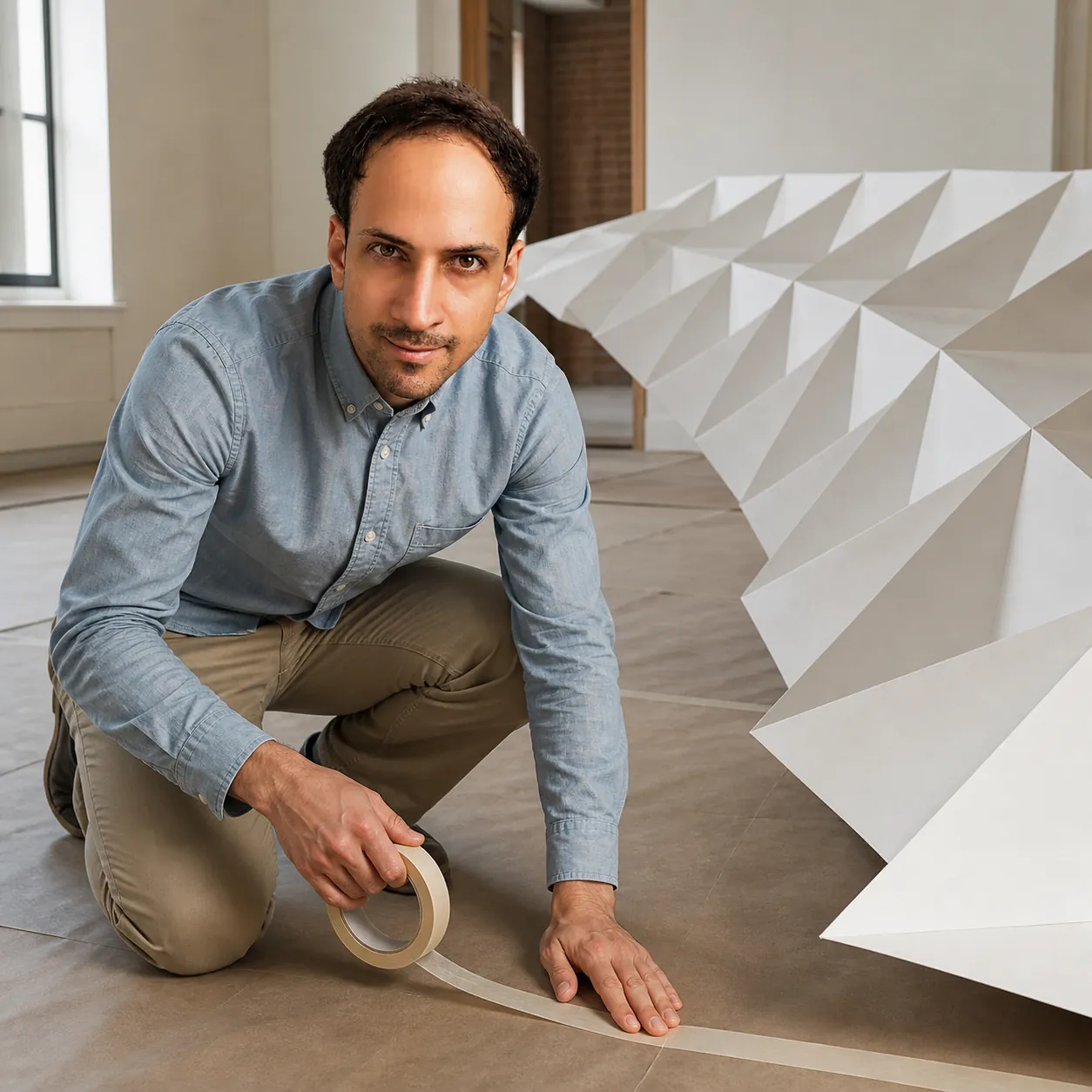
Unfolding in an Empty Apartment
صورةAI Portraits

Create a square 1:1 museum-catalog frame with a strong first read and a slower second read at exactly 2880x2880 pixels. Location: an unfurnished apartment...

من نص البرومبت

Use the attached reference photo as the identity reference: keep the same face, skin tone, hair and features as the person in that photo, without beautifying, aging or altering them. Create a square 1:1 museum-catalog frame with a strong first read and a slower second read at exactly 2880x2880 pixels. Location: an unfurnished apartment with floors papered over for the painters. Show them in a light chambray shirt buttoned to the collar over khaki chinos, taping down a lifted seam of floor paper. Make one rigorous physical condition the conceptual engine: a Miura-folded sheet that unfurls from a hand-width packet into a table-wide faceted canopy with one pull of two corners puts work the eye reserves for steel onto material sold by the ream. Explore why a cut, placed rightly, adds ability instead of taking it away; direct expression and posture toward gentle rigor, never melodrama or ad-like confidence. Use an eye-level 58mm medium-format viewpoint with natural perspective and honest paper texture. Make the composition give the load path one clean diagonal from burden to bearing. Render it as gallery-grade structural still-life portraiture built from real folded spans, matte paper materiality, unexaggerated shadow logic, and patient architectural composition, using even overhead workroom light shaped so white surfaces hold visible tone steps and a palette of pale card, graphite, and a narrow band of brick. Photorealistic: this must read as a real photograph from a physical camera, never an illustration, painting, or 3D render. Resolve real surface detail: fine lint on dark fabric, water spotting on steel, and the soft rounding of edges that have been used for years. Keep one identity-locked person, credible hands and fingers, natural fabric, and coherent scale, contact, reflections, shadows, airflow, deformation, and materials. Background people only when essential, always secondary and clearly different. Avoid origami cranes, glowing magical paper, floating confetti, printed lettering on sheets, and weightless CGI folds. No text, labels, logos, signatures, watermarks, random symbols, plastic skin, excessive bloom, or glossy AI finish.
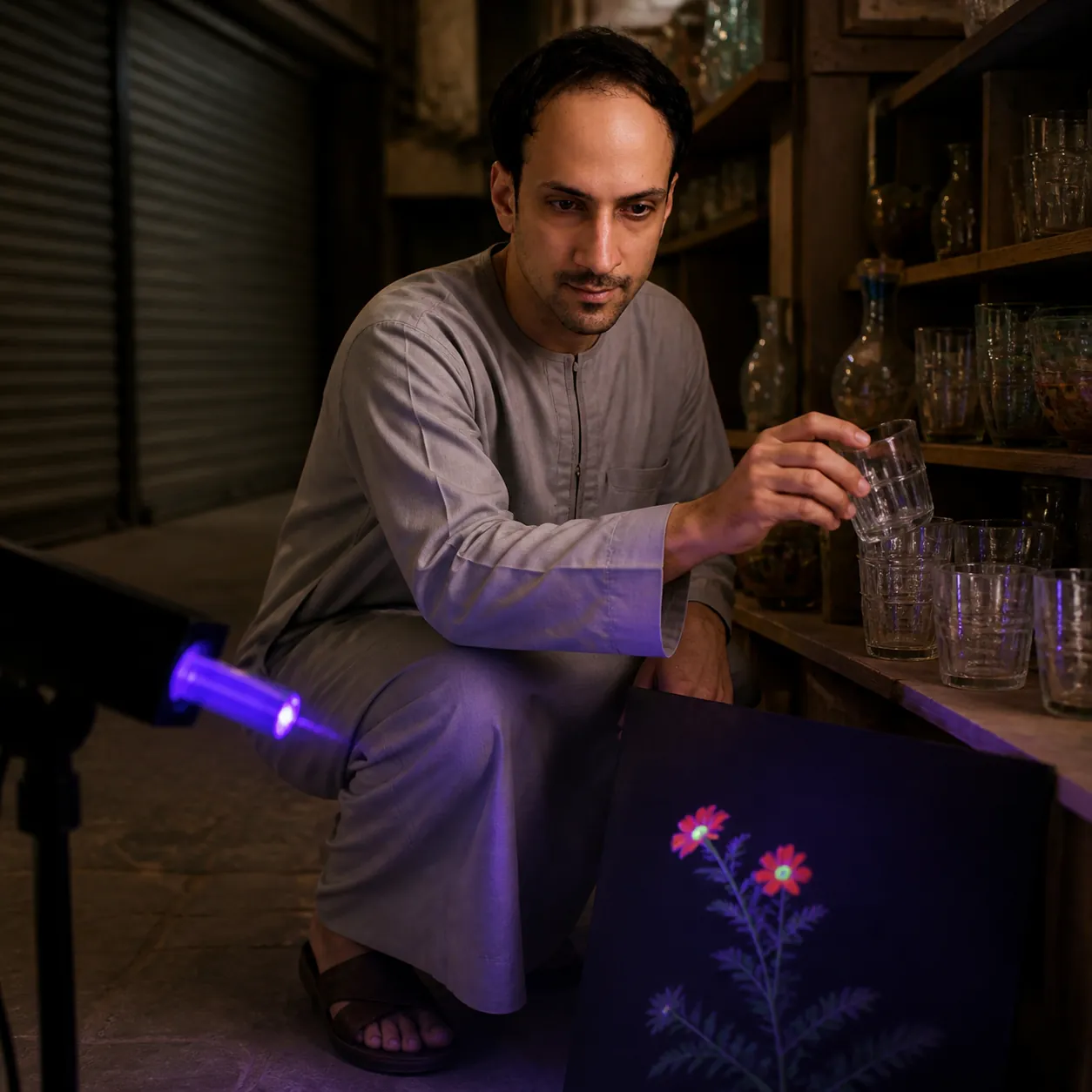
Souq Stall After Dark
صورةAI Portraits

Create a square 1:1 museum-catalog frame with a strong first read and a slower second read at exactly 2880x2880 pixels. Location: a shuttered souq glassware...

من نص البرومبت

Use the attached reference photo as the identity reference: keep the same face, skin tone, hair and features as the person in that photo, without beautifying, aging or altering them. Create a square 1:1 museum-catalog frame with a strong first read and a slower second read at exactly 2880x2880 pixels. Location: a shuttered souq glassware stall with the aisle lights already off. Show them in a lightweight grey traditional Gulf outfit worn with plain leather sandals, turning one stacked tumbler upright on the shelf. Use this advanced image-making device as the core logic: a sprig of desert wildflowers whose throats print a fluorescent bullseye that only pollinating insects and ultraviolet have ever read takes its second color from light nobody in the room can see. Explore whether seeing more makes the world stranger or only more accurately described; direct expression and posture toward cool fascination, never melodrama or ad-like confidence. Frame past a matte black card at the frame's edge, physical but never crossing their face. Make the composition place the brightest emission off-center and let their attention answer it. Render it as conceptual laboratory portraiture assembled from working ultraviolet apparatus, restrained editorial art direction, believable surface response, and quiet observational framing, using dim ambient light with a hard ultraviolet edge crossing the working surface and a palette of warm stone, walnut, and one flare of chlorophyll red. Photorealistic: this must read as a real photograph from a physical camera, never an illustration, painting, or 3D render. Resolve real surface detail: rubber gone chalky with age, painted metal chipped to primer, and plastic yellowed only where light reaches it. Keep one identity-locked person, credible hands and fingers, natural fabric, and coherent scale, contact, reflections, shadows, airflow, deformation, and materials. Background people only when essential, always secondary and clearly different. Avoid rave lighting rigs, uniform purple haze, CGI bioluminescent forests, and glowing eyes. No text, labels, logos, signatures, watermarks, random symbols, plastic skin, excessive bloom, or glossy AI finish.