تخطَّ إلى المحتوى

برومبتات الصور

برومبتات لمولدات الصور: بورتريهات وفن وتصوير.

تم العثور على 664
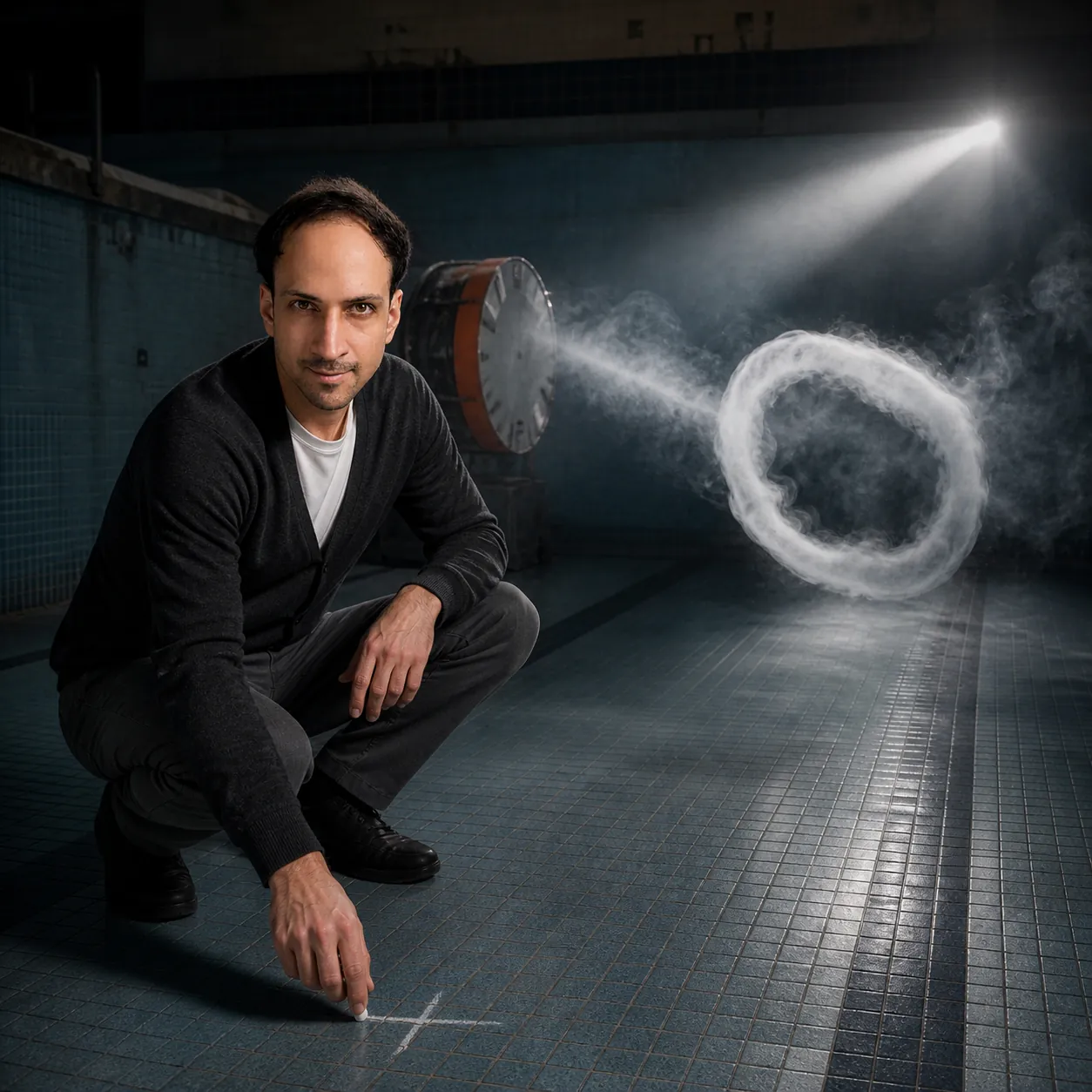
Smoke Ring in the Empty Pool
صورةAI Portraits

Create a square 1:1 museum-catalog frame with a strong first read and a slower second read at exactly 2880x2880 pixels. Location: the drained deep end of a...

من نص البرومبت

Use the attached reference photo as the identity reference: keep the same face, skin tone, hair and features as the person in that photo, without beautifying, aging or altering them. Create a square 1:1 museum-catalog frame with a strong first read and a slower second read at exactly 2880x2880 pixels. Location: the drained deep end of a hotel pool, tiles echoing. Show the subject in a graphite cardigan over a white crew-neck and grey trousers, chalking a small cross on the tile underfoot. Make one rigorous physical condition the conceptual engine: a drum launcher whose struck membrane rolls a slug of fogged air into a toroid that crosses the room intact gives empty air a body with edges, momentum, and somewhere to be. Explore why air with nothing to hold it can still hold itself together; direct expression and posture toward measured astonishment, never melodrama or ad-like confidence. Use an eye-level 85mm portrait view with natural perspective, the flight path held inside the frame. Make the composition leave open air ahead of the ring, promising travel. Render it as high-speed atmospheric portraiture built from real vortex dynamics, quiet documentary stillness, truthful volumetric haze, and emotionally restrained composition, using one narrow backlight beam that rims every fog contour without flaring and a palette of smoke grey, deep charcoal, and one ember-orange accent. Photorealistic: this must read as a real photograph from a physical camera, never an illustration, painting, or 3D render. Resolve real surface detail: true skin texture with pores and fine hair at the hairline, and fabric that creases where it is actually stressed. Keep one identity-locked person, credible hands and fingers, natural fabric, and coherent scale, contact, reflections, shadows, airflow, deformation, and materials. Background people only when essential, always secondary and clearly different. Avoid vape-trick theatrics, neon-glowing rings, CGI smoke tornadoes, wizard conjuring hands, and mouth-blown rings at camera. No text, labels, logos, signatures, watermarks, random symbols, plastic skin, excessive bloom, or glossy AI finish.
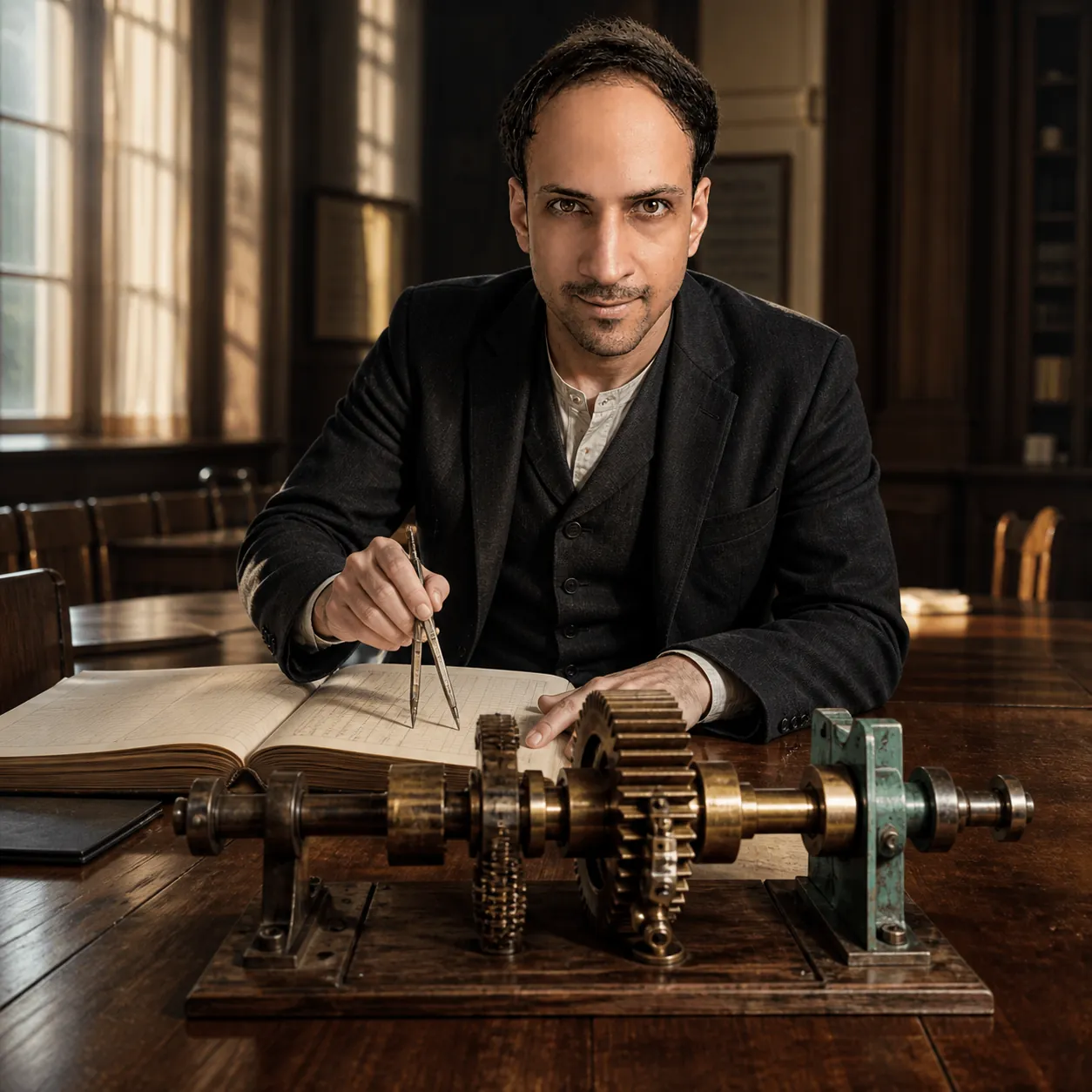
Averages in Turning Shafts
صورةAI Portraits

Create a square 1:1 museum-catalog frame with a strong first read and a slower second read at exactly 2880x2880 pixels. Location: an engineering society's...

من نص البرومبت

Use the attached reference photo as the identity reference: keep the same face, skin tone, hair and features as the person in that photo, without beautifying, aging or altering them. Create a square 1:1 museum-catalog frame with a strong first read and a slower second read at exactly 2880x2880 pixels. Location: an engineering society's committee room with a long teak table. Show them in charcoal suit trousers and a waistcoat over a collarless shirt, walking a pair of dividers across an open ledger. Treat this mechanism as the frame’s governing rule: a bench differential whose spider gear carries the average of two cranked shafts, geared double to show their sum stores its knowledge as shape that cannot crash, fade, or lie. Explore where the boundary lies between a tool that helps and a mind that hides; direct expression and posture toward calm precision, never melodrama or ad-like confidence. Use a composed 35mm environmental view placing them and the machine as equal patient subjects. Make the composition let the mechanism's longest line lead toward their steady hands. Render it as conceptual instrument portraiture uniting believable mechanical computation, machinist-level surface accuracy, warm archival print tonality, and quietly unhurried observational storytelling, using low raking window sun that carves each machined edge into readable shadow and a palette of aged brass, deep walnut, and one verdigris accent. Photorealistic: this must read as a real photograph from a physical camera, never an illustration, painting, or 3D render. Resolve real surface detail: floor finish worn along the walked line, skirting marked at shoe height, and corners darker than the open floor. Keep one identity-locked person, credible hands and fingers, natural fabric, and coherent scale, contact, reflections, shadows, airflow, deformation, and materials. Background people only when essential, always secondary and clearly different. Avoid floating weightless gears, sepia steampunk grading, cog-filled head silhouettes, Roman-numeral dials, and oversized watch-movement props. No text, labels, logos, signatures, watermarks, random symbols, plastic skin, excessive bloom, or glossy AI finish.
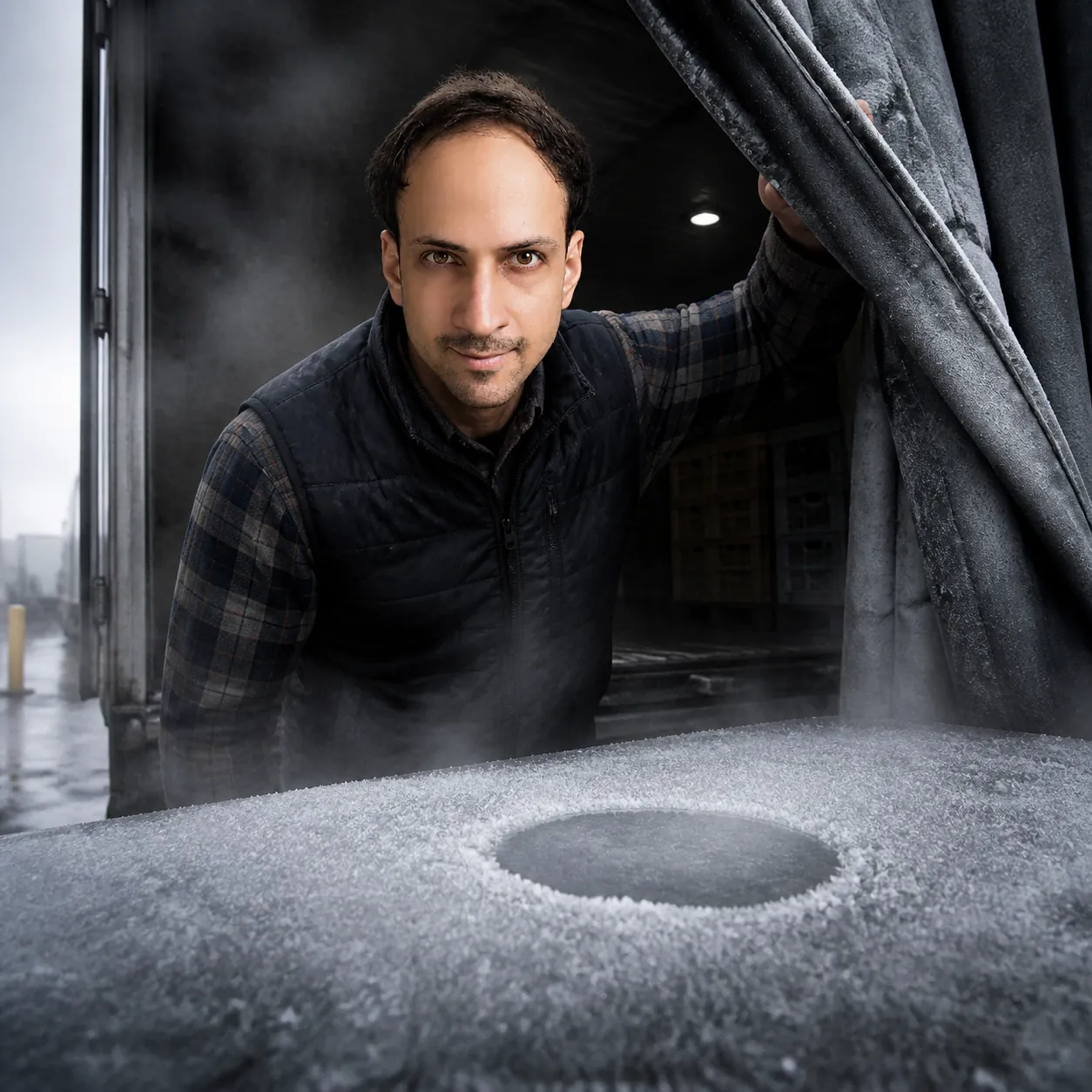
The Circle Where the Mug Stood
صورةAI Portraits

Create a square 1:1 museum-catalog frame with a strong first read and a slower second read at exactly 2880x2880 pixels. Location: the open rear of a...

من نص البرومبت

Use the attached reference photo as the identity reference: keep the same face, skin tone, hair and features as the person in that photo, without beautifying, aging or altering them. Create a square 1:1 museum-catalog frame with a strong first read and a slower second read at exactly 2880x2880 pixels. Location: the open rear of a refrigerated truck idling in a service lane. Show them in a quilted vest over a flannel shirt with sleeves left down, lifting the insulated curtain aside with one forearm. Use this advanced image-making device as the core logic: a frost-furred board that spent the night facing open sky, holding one bare circle where a mug stood till dawn shows the exact line where one state of matter surrenders to another. Explore why a temporary structure can still count as permanent evidence of law; direct expression and posture toward grounded astonishment, never melodrama or ad-like confidence. Frame from low beside the phenomenon with foreground vapor or frost present but never crossing the face. Make the composition hold clear space where the change has not arrived yet. Render it as cold-atmosphere documentary portraiture built from real phase-change phenomena, macro-true ice detail, restrained styling, and honest vapor behavior, using cold overhead worklight softened by drifting vapor into readable gradients and a palette of frost white, gunmetal, and one seam of glacial blue. Photorealistic: this must read as a real photograph from a physical camera, never an illustration, painting, or 3D render. Resolve real surface detail: wood grain read at honest scale, matte and gloss clearly separated, and no surface uniformly clean. Keep one identity-locked person, credible hands and fingers, natural fabric, and coherent scale, contact, reflections, shadows, airflow, deformation, and materials. Background people only when essential, always secondary and clearly different. Avoid glowing magic ice, snowflake clip-art overlays, superhero freeze beams, CGI shatter shards, and fairy-tale crystal palaces. No text, labels, logos, signatures, watermarks, random symbols, plastic skin, excessive bloom, or glossy AI finish.
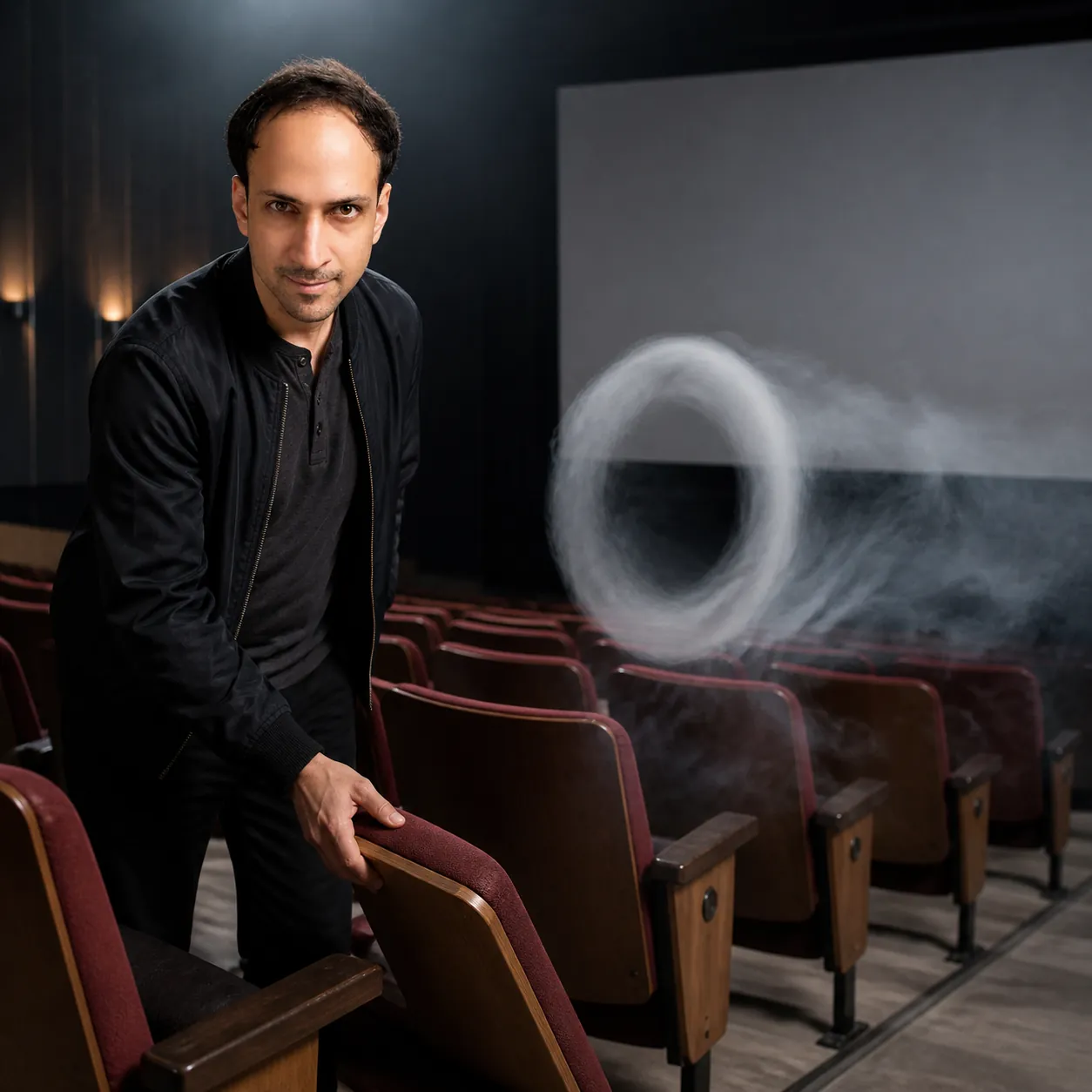
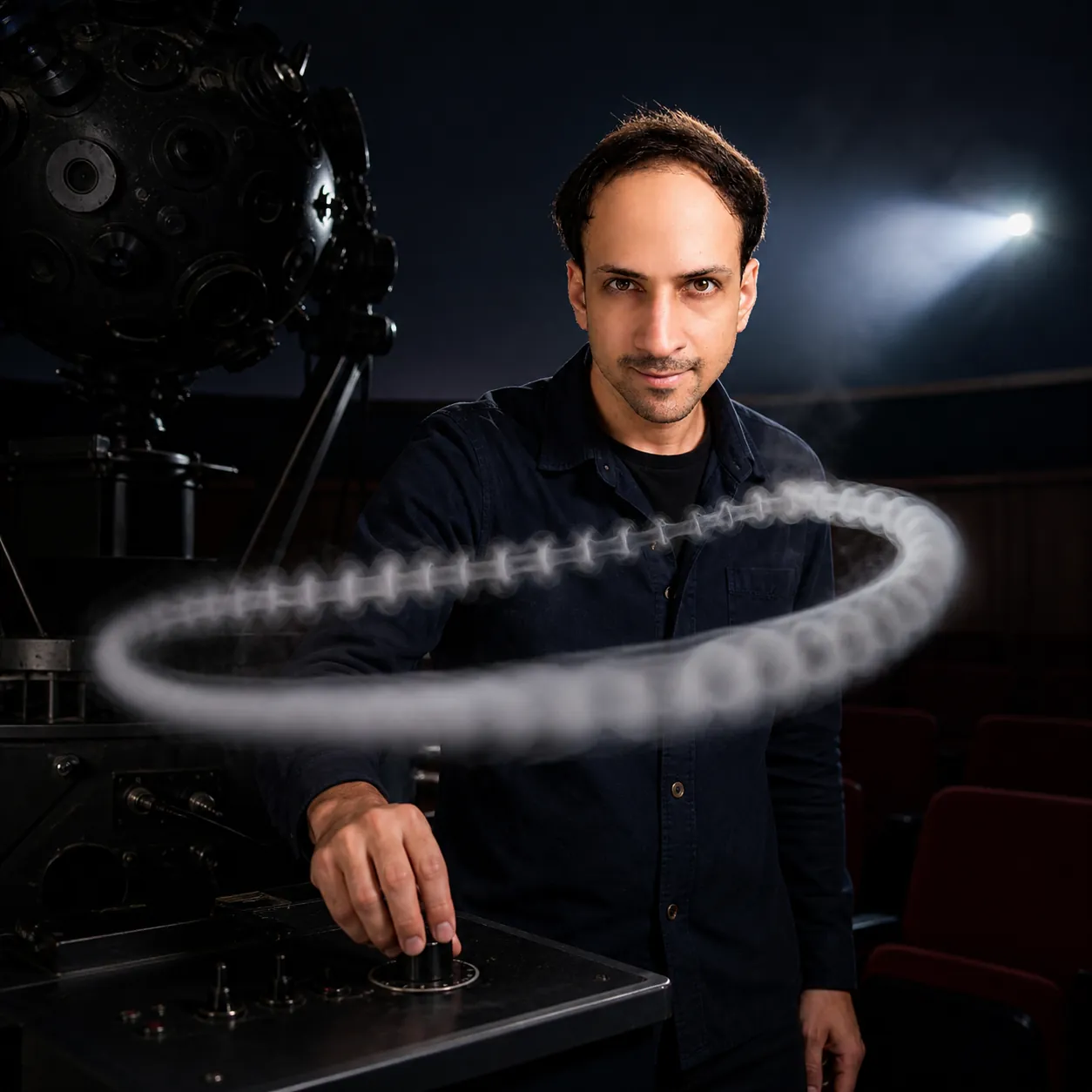
Trembling Ring Under the Dome
صورةAI Portraits

Create a square 1:1 museum-catalog frame with a strong first read and a slower second read at exactly 2880x2880 pixels. Location: a small planetarium under...

من نص البرومبت

Use the attached reference photo as the identity reference: keep the same face, skin tone, hair and features as the person in that photo, without beautifying, aging or altering them. Create a square 1:1 museum-catalog frame with a strong first read and a slower second read at exactly 2880x2880 pixels. Location: a small planetarium under its dark dome, projector idle between shows. Show the subject in a midnight-blue overshirt buttoned once over a plain black tee, dimming a rotary house-light knob to its last stop. The impossible-looking event must obey this clear system: a broad slow ring whose rim ripples into a countable standing wave in the moments before letting go gives empty air a body with edges, momentum, and somewhere to be. Explore whether momentum, given a body, is closer to matter or to intention; direct expression and posture toward composed fascination, never melodrama or ad-like confidence. Use a 50mm view square to the flight line so the toroid crosses the frame like a sentence. Make the composition keep the toroid sharp while the room softens into planes. Render it as high-speed atmospheric portraiture built from real vortex dynamics, quiet documentary stillness, truthful volumetric haze, and emotionally restrained composition, using one narrow backlight beam that rims every fog contour without flaring and a palette of slate blue-grey, unpainted timber, and muted brick red. Photorealistic: this must read as a real photograph from a physical camera, never an illustration, painting, or 3D render. Resolve real surface detail: brass darkened in the recesses and bright where thumbs land, and lacquer crazed rather than perfect. Keep one identity-locked person, credible hands and fingers, natural fabric, and coherent scale, contact, reflections, shadows, airflow, deformation, and materials. Background people only when essential, always secondary and clearly different. Avoid vape-trick theatrics, neon-glowing rings, CGI smoke tornadoes, wizard conjuring hands, and mouth-blown rings at camera. No text, labels, logos, signatures, watermarks, random symbols, plastic skin, excessive bloom, or glossy AI finish.
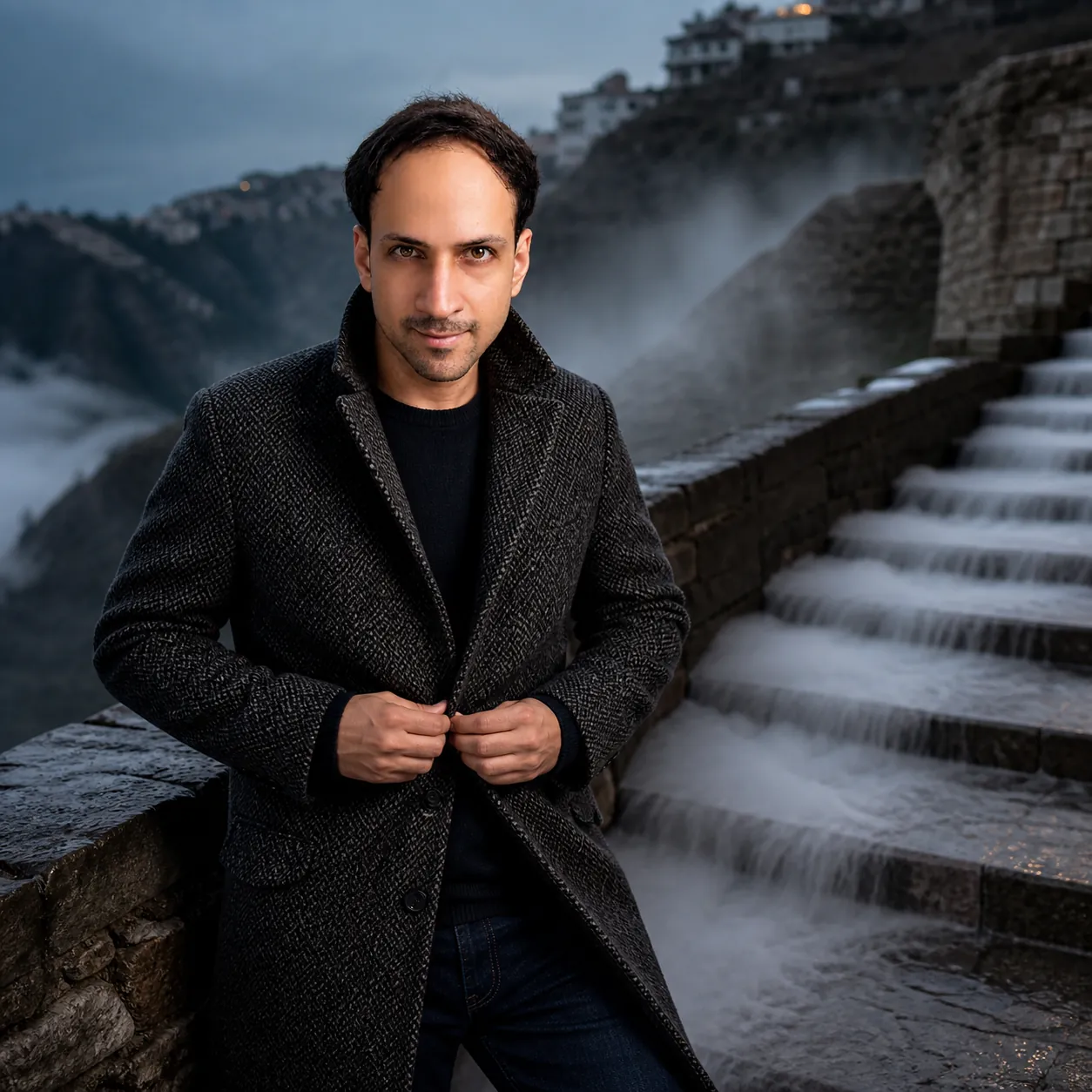
A Ring Revealed by Fog
صورةAI Portraits

Create a square 1:1 museum-catalog frame with a strong first read and a slower second read at exactly 2880x2880 pixels. Location: a small cinema an hour...

من نص البرومبت

Use the attached reference photo as the identity reference: keep the same face, skin tone, hair and features as the person in that photo, without beautifying, aging or altering them. Create a square 1:1 museum-catalog frame with a strong first read and a slower second read at exactly 2880x2880 pixels. Location: a small cinema an hour before opening, screen blank and pale. Show the subject in a dark bomber over a charcoal henley and black trousers, tipping one hinged seat down with a quiet hand. Make one rigorous physical condition the conceptual engine: a ring of plain air that turns visible only while threading a thin fog curtain stretched across its path gives empty air a body with edges, momentum, and somewhere to be. Explore where a body's boundary lies when the body is made of air; direct expression and posture toward composed fascination, never melodrama or ad-like confidence. Use an eye-level 85mm portrait view with natural perspective, the flight path held inside the frame. Make the composition leave open air ahead of the ring, promising travel. Render it as cinema-still realism assembled from practical vortex apparatus, subdued theatrical haze, physically true motion rendering, and dignified portrait craft, using soft top light at half power so the air itself stays legible and a palette of slate blue-grey, unpainted timber, and muted brick red. Photorealistic: this must read as a real photograph from a physical camera, never an illustration, painting, or 3D render. Resolve real surface detail: fine lint on dark fabric, water spotting on steel, and the soft rounding of edges that have been used for years. Keep one identity-locked person, credible hands and fingers, natural fabric, and coherent scale, contact, reflections, shadows, airflow, deformation, and materials. Background people only when essential, always secondary and clearly different. Avoid vape-trick theatrics, neon-glowing rings, CGI smoke tornadoes, wizard conjuring hands, and mouth-blown rings at camera. No text, labels, logos, signatures, watermarks, random symbols, plastic skin, excessive bloom, or glossy AI finish.
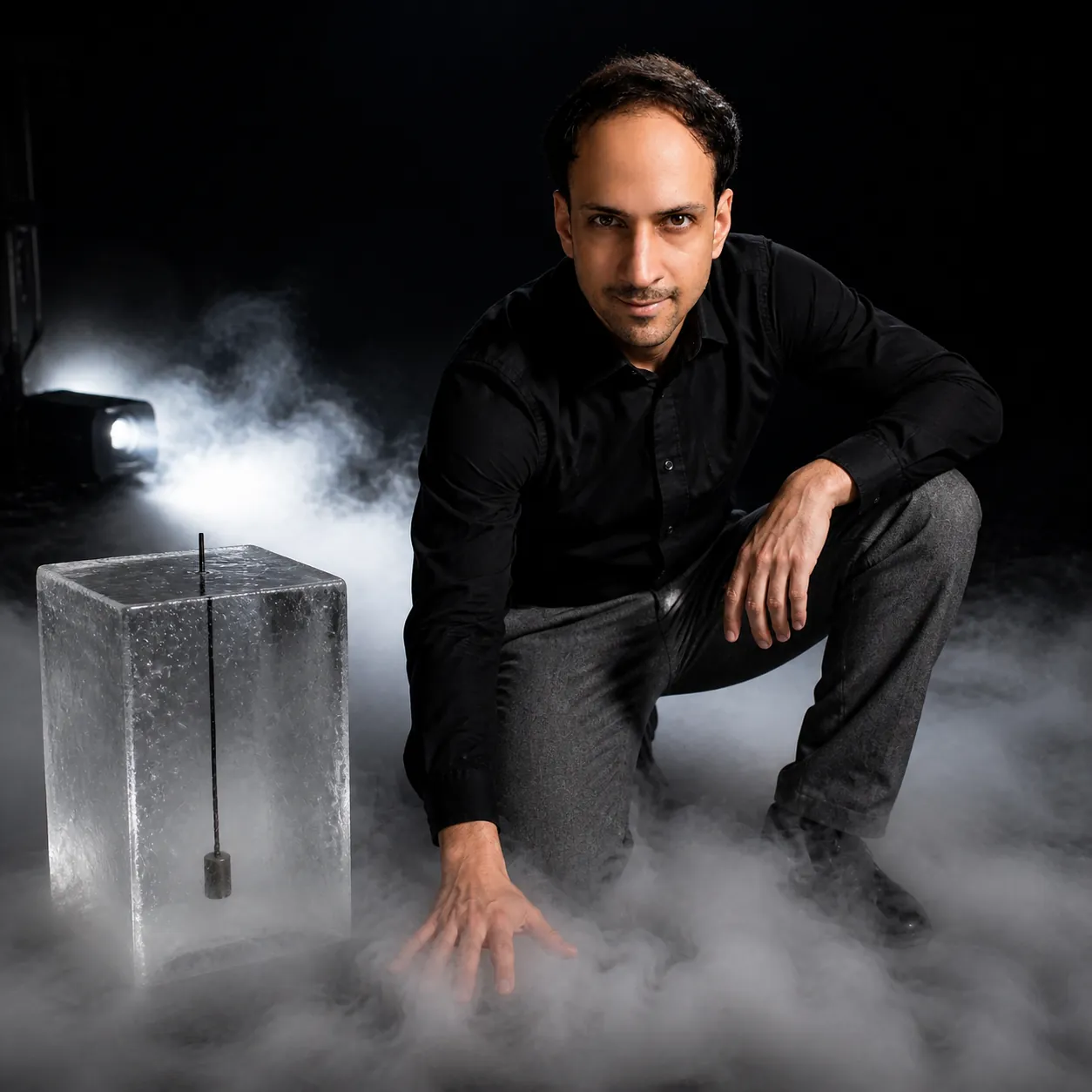
Mist Above Abha
صورةAI Portraits

Create a square 1:1 museum-catalog frame with a strong first read and a slower second read at exactly 2880x2880 pixels. Location: a stone terrace above Abha...

من نص البرومبت

Use the attached reference photo as the identity reference: keep the same face, skin tone, hair and features as the person in that photo, without beautifying, aging or altering them. Create a square 1:1 museum-catalog frame with a strong first read and a slower second read at exactly 2880x2880 pixels. Location: a stone terrace above Abha as cold valley mist climbs the escarpment. Show them in a herringbone wool overcoat over a plain sweater and dark denim, buttoning their top coat button against the damp. Make one rigorous physical condition the conceptual engine: a sheet of dry-ice fog that pours down a short staircase like slow water, hugging the full contour of every tread shows the exact line where one state of matter surrenders to another. Explore why watching a substance cross between states feels like being told a secret; direct expression and posture toward disciplined marvel, never melodrama or ad-like confidence. Use an eye-level 80mm medium-format view with quiet perspective and honest, shallow depth. Make the composition let the phase boundary cross the frame as one clean diagonal. Render it as gallery-grade cold-room photography built from genuine ice physics, sharply resolved frost microstructure, disciplined natural styling, and calm environmental storytelling, using low backlight that rims fog, frost, and breath in clean silver and a palette of clear-ice silver, charcoal, and one line of cold teal. Photorealistic: this must read as a real photograph from a physical camera, never an illustration, painting, or 3D render. Resolve real surface detail: fine lint on dark fabric, water spotting on steel, and the soft rounding of edges that have been used for years. Keep one identity-locked person, credible hands and fingers, natural fabric, and coherent scale, contact, reflections, shadows, airflow, deformation, and materials. Background people only when essential, always secondary and clearly different. Avoid glowing magic ice, snowflake clip-art overlays, superhero freeze beams, CGI shatter shards, and fairy-tale crystal palaces. No text, labels, logos, signatures, watermarks, random symbols, plastic skin, excessive bloom, or glossy AI finish.
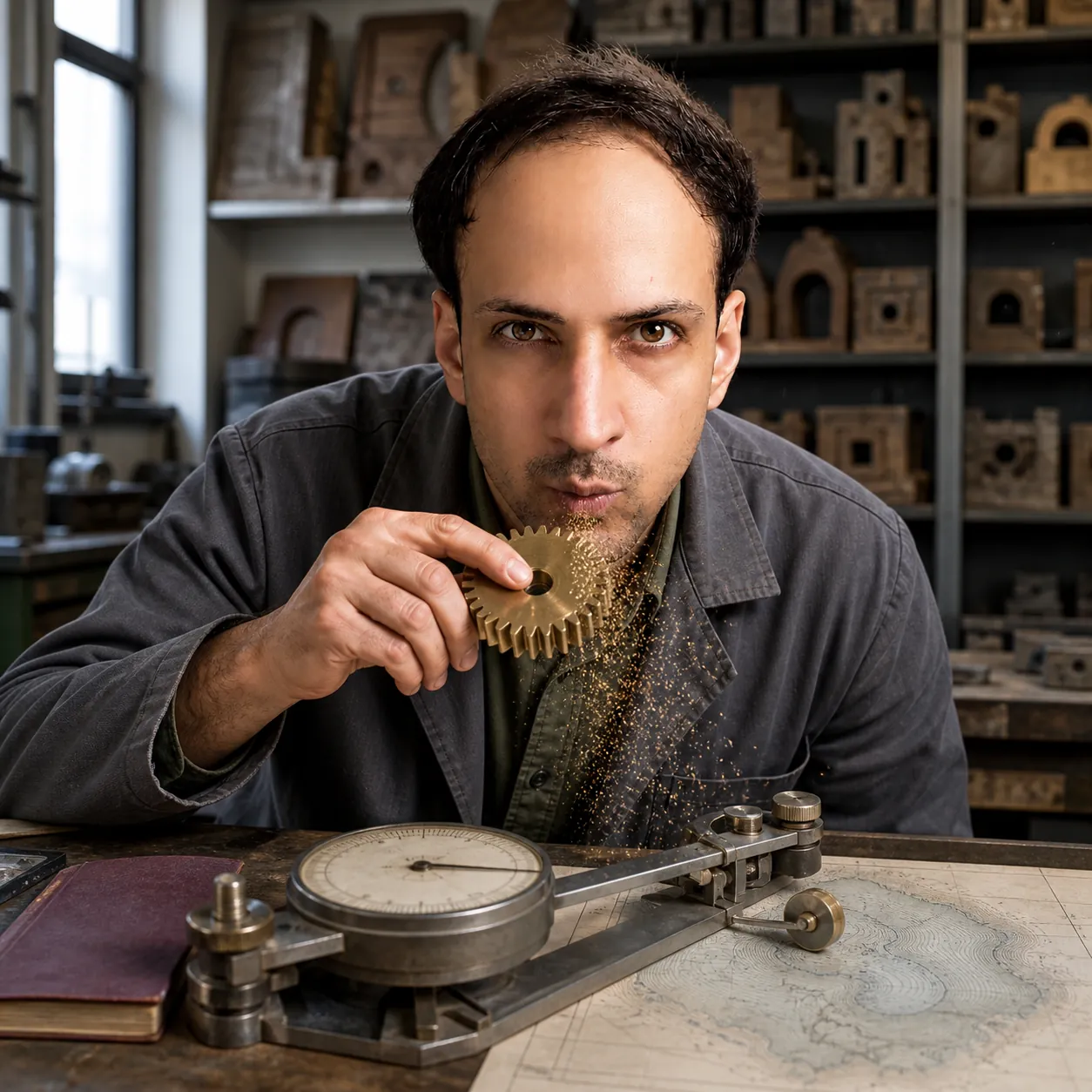
Wire Through the Ice
صورةAI Portraits

Create a square 1:1 museum-catalog frame with a strong first read and a slower second read at exactly 2880x2880 pixels. Location: an empty black-box theater...

من نص البرومبت

Use the attached reference photo as the identity reference: keep the same face, skin tone, hair and features as the person in that photo, without beautifying, aging or altering them. Create a square 1:1 museum-catalog frame with a strong first read and a slower second read at exactly 2880x2880 pixels. Location: an empty black-box theater with one fog machine cooling at stage left. Show them in a plain black shirt buttoned to the collar and grey wool trousers, sweeping one open palm slowly through knee-deep fog. Make one rigorous physical condition the conceptual engine: a weighted wire that sinks slowly through a solid ice block while the ice refreezes seamlessly closed above it shows the exact line where one state of matter surrenders to another. Explore how something can be lawful in every detail and still look impossible; direct expression and posture toward unhurried reverence, never melodrama or ad-like confidence. Use an eye-level 80mm medium-format view with quiet perspective and honest, shallow depth. Make the composition grant the smallest cold detail more acuity than any warm surface. Render it as cold-atmosphere documentary portraiture built from real phase-change phenomena, macro-true ice detail, restrained styling, and honest vapor behavior, using low backlight that rims fog, frost, and breath in clean silver and a palette of chalk white, deep graphite, and one warm lamp gold. Photorealistic: this must read as a real photograph from a physical camera, never an illustration, painting, or 3D render. Resolve real surface detail: the difference between a wiped surface and a clean one, faint tide marks on ceramic, and metal dulled unevenly by touch. Keep one identity-locked person, credible hands and fingers, natural fabric, and coherent scale, contact, reflections, shadows, airflow, deformation, and materials. Background people only when essential, always secondary and clearly different. Avoid glowing magic ice, snowflake clip-art overlays, superhero freeze beams, CGI shatter shards, and fairy-tale crystal palaces. No text, labels, logos, signatures, watermarks, random symbols, plastic skin, excessive bloom, or glossy AI finish.
Planimeter in the Pattern Shop
صورةAI Portraits

Create a square 1:1 museum-catalog frame with a strong first read and a slower second read at exactly 2880x2880 pixels. Location: a university pattern shop...

من نص البرومبت

Use the attached reference photo as the identity reference: keep the same face, skin tone, hair and features as the person in that photo, without beautifying, aging or altering them. Create a square 1:1 museum-catalog frame with a strong first read and a slower second read at exactly 2880x2880 pixels. Location: a university pattern shop lined with wooden casting molds on shelves. Show them in a grey twill shop coat over an olive cotton shirt, blowing brass filings from a fresh-cut gear blank. Use this advanced image-making device as the core logic: a polar planimeter whose small measuring wheel, dragged around a lake's mapped shoreline, totals the enclosed area on one dial stores its knowledge as shape that cannot crash, fade, or lie. Explore what trust means when every step of a computation stays visible; direct expression and posture toward unhurried certainty, never melodrama or ad-like confidence. Frame from a seated observer's eye height, close enough that machined texture stays tangibly present. Make the composition keep the answer's dial or mark small, sharp, and off-center. Render it as engineering-heritage photography combining working mechanical calculation, true kinematic detail, softly aged material finishes, and restrained human-centered contemporary framing, using diffuse overcast daylight held to gentle contrast so engravings stay legible and a palette of gunmetal grey, ivory paper, and one burgundy bookcloth accent. Photorealistic: this must read as a real photograph from a physical camera, never an illustration, painting, or 3D render. Resolve real surface detail: thread ends and slight pilling on worn cloth, hairline chips at every hard corner, and stone that is porous rather than smooth. Keep one identity-locked person, credible hands and fingers, natural fabric, and coherent scale, contact, reflections, shadows, airflow, deformation, and materials. Background people only when essential, always secondary and clearly different. Avoid floating weightless gears, sepia steampunk grading, cog-filled head silhouettes, Roman-numeral dials, and oversized watch-movement props. No text, labels, logos, signatures, watermarks, random symbols, plastic skin, excessive bloom, or glossy AI finish.
Nine Digits in One Turn
صورةAI Portraits

Create a square 1:1 museum-catalog frame with a strong first read and a slower second read at exactly 2880x2880 pixels. Location: a rare-instruments room...

من نص البرومبت

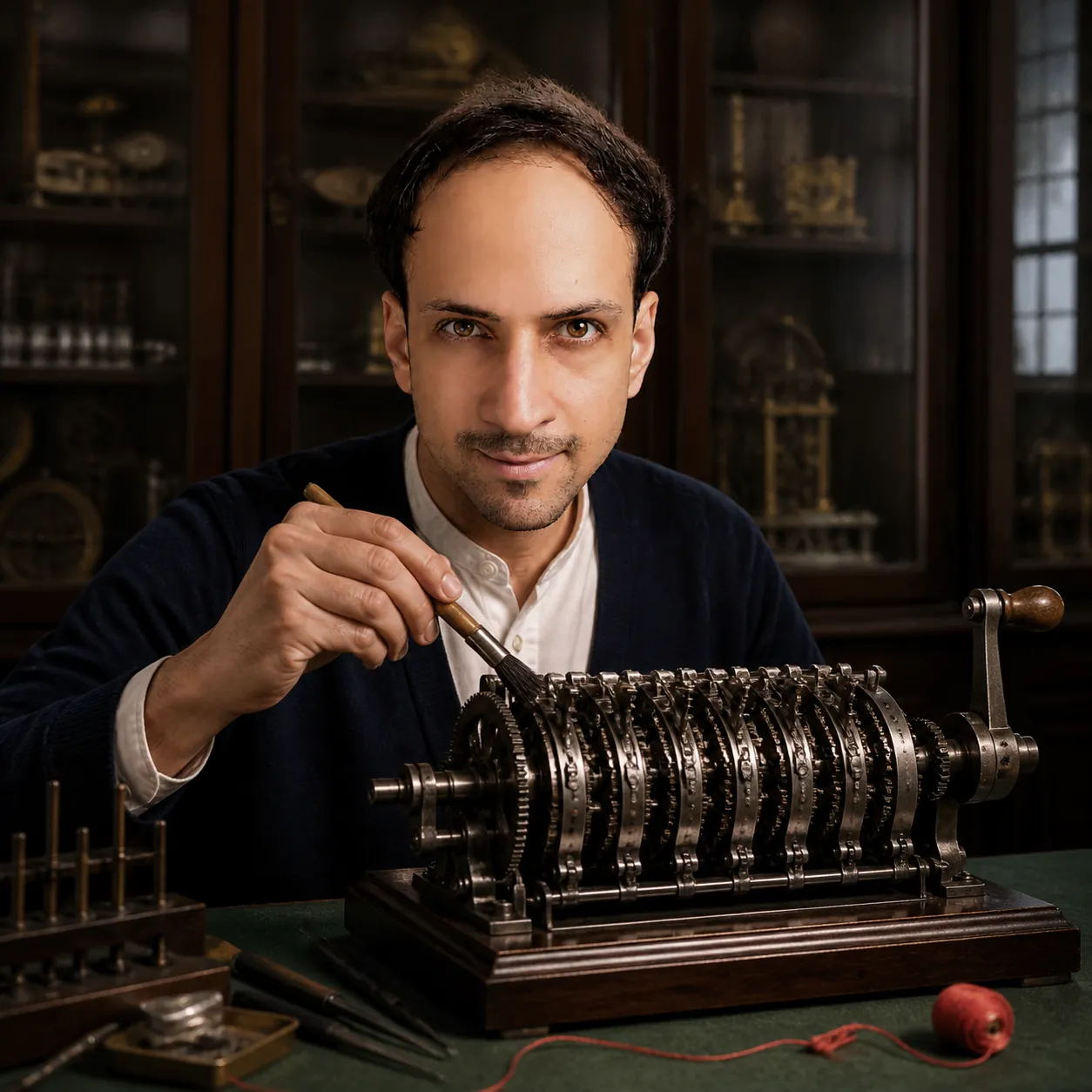
Use the attached reference photo as the identity reference: keep the same face, skin tone, hair and features as the person in that photo, without beautifying, aging or altering them. Create a square 1:1 museum-catalog frame with a strong first read and a slower second read at exactly 2880x2880 pixels. Location: a rare-instruments room with glass-fronted cabinets and one baize table. Show them in a midnight-blue cardigan over a band-collar white shirt, working a soft brush between two meshed teeth. Use this advanced image-making device as the core logic: a hand-cranked pinwheel calculator whose carry levers ripple a nine-digit sum across its result dials in one turn stores its knowledge as shape that cannot crash, fade, or lie. Explore what it costs to understand a machine completely, and what it repays; direct expression and posture toward unhurried certainty, never melodrama or ad-like confidence. Frame from a seated observer's eye height, close enough that machined texture stays tangibly present. Make the composition hold quiet empty space where the finished answer will arrive. Render it as conceptual instrument portraiture uniting believable mechanical computation, machinist-level surface accuracy, warm archival print tonality, and quietly unhurried observational storytelling, using cool north skylight fill with soft falloff into wood-paneled shadow and a palette of ebonized wood, dull steel, and one signal-red thread. Photorealistic: this must read as a real photograph from a physical camera, never an illustration, painting, or 3D render. Resolve real surface detail: rubber gone chalky with age, painted metal chipped to primer, and plastic yellowed only where light reaches it. Keep one identity-locked person, credible hands and fingers, natural fabric, and coherent scale, contact, reflections, shadows, airflow, deformation, and materials. Background people only when essential, always secondary and clearly different. Avoid floating weightless gears, sepia steampunk grading, cog-filled head silhouettes, Roman-numeral dials, and oversized watch-movement props. No text, labels, logos, signatures, watermarks, random symbols, plastic skin, excessive bloom, or glossy AI finish.
The Moon's Pace in Brass
صورةAI Portraits

Create a square 1:1 museum-catalog frame with a strong first read and a slower second read at exactly 2880x2880 pixels. Location: an old lecture theatre...

من نص البرومبت

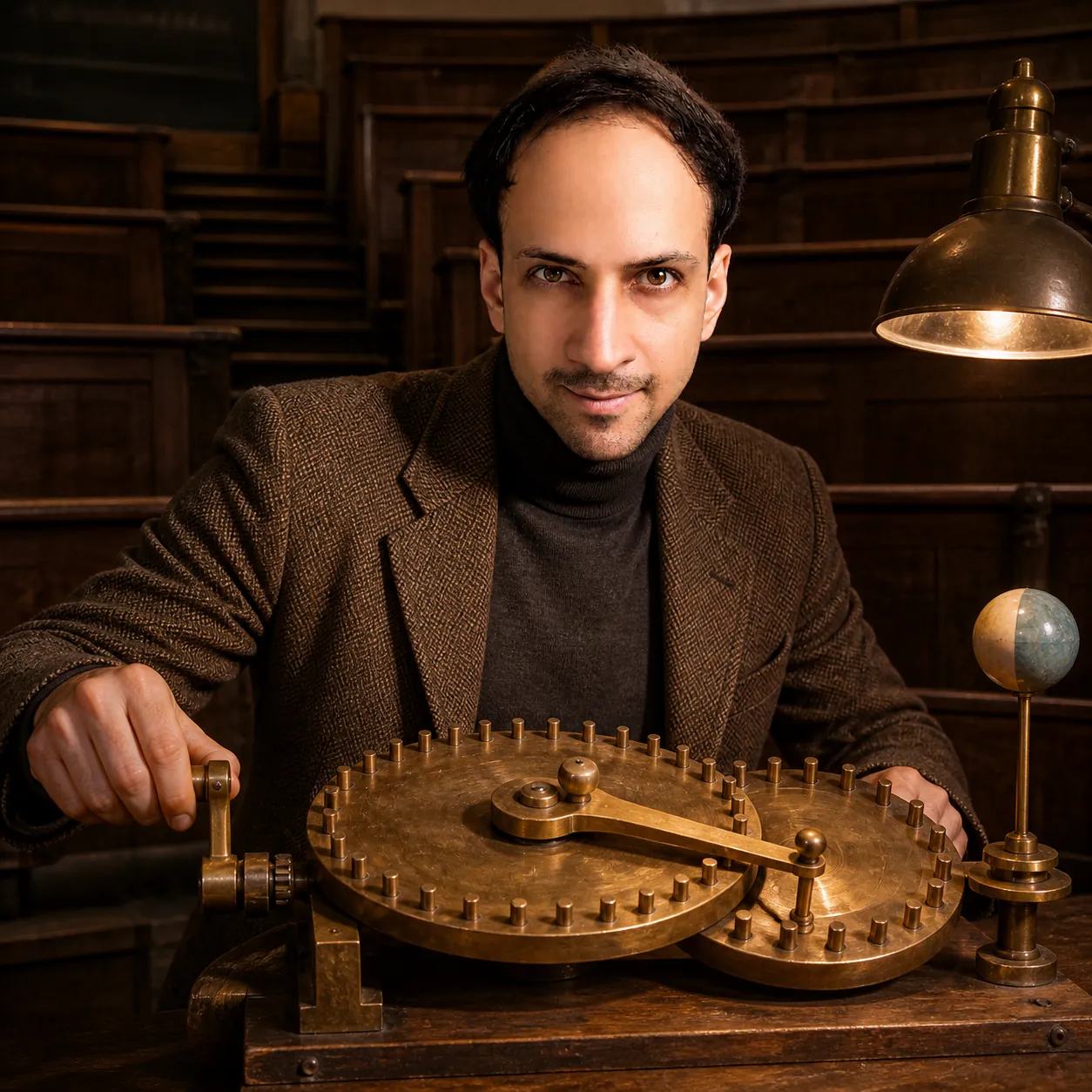
Use the attached reference photo as the identity reference: keep the same face, skin tone, hair and features as the person in that photo, without beautifying, aging or altering them. Create a square 1:1 museum-catalog frame with a strong first read and a slower second read at exactly 2880x2880 pixels. Location: an old lecture theatre with steep wooden seating and a demonstration bench. Show them in a brown herringbone jacket over a fine merino roll-neck, turning a demonstration handle one slow full revolution. Build the artwork around this material rule: a reconstructed pin-and-slot gear pair, modeled on ancient Greek gearwork, that reproduces the moon's speeding and slowing along its orbit stores its knowledge as shape that cannot crash, fade, or lie. Explore how patience became a component no modern computer bothers to include; direct expression and posture toward measured reverence, never melodrama or ad-like confidence. Frame level with the mechanism so its motion and their eyes share one focal plane. Make the composition keep every moving part inside the frame except one. Render it as conceptual instrument portraiture uniting believable mechanical computation, machinist-level surface accuracy, warm archival print tonality, and quietly unhurried observational storytelling, using one warm tungsten work lamp pooled tightly over the mechanism and hands and a palette of warm umber, pale vellum, and one muted teal accent. Photorealistic: this must read as a real photograph from a physical camera, never an illustration, painting, or 3D render. Resolve real surface detail: hair with individual strands catching light, fine hairs of uneven length, and skin oil giving a low uneven sheen. Keep one identity-locked person, credible hands and fingers, natural fabric, and coherent scale, contact, reflections, shadows, airflow, deformation, and materials. Background people only when essential, always secondary and clearly different. Avoid floating weightless gears, sepia steampunk grading, cog-filled head silhouettes, Roman-numeral dials, and oversized watch-movement props. No text, labels, logos, signatures, watermarks, random symbols, plastic skin, excessive bloom, or glossy AI finish.
Running Total on the Quay
صورةAI Portraits

Create a square 1:1 museum-catalog frame with a strong first read and a slower second read at exactly 2880x2880 pixels. Location: a stone quay at low tide...

من نص البرومبت

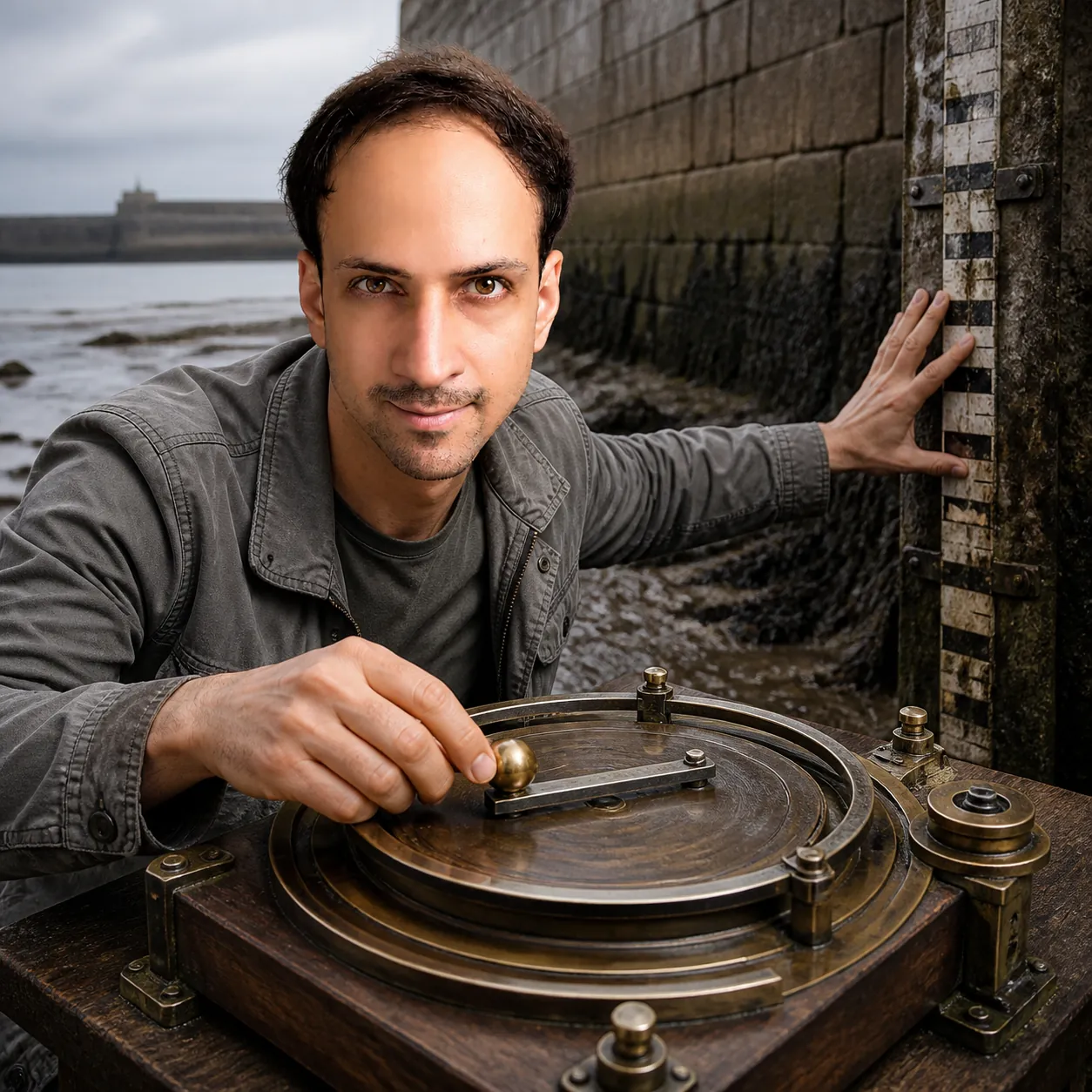
Use the attached reference photo as the identity reference: keep the same face, skin tone, hair and features as the person in that photo, without beautifying, aging or altering them. Create a square 1:1 museum-catalog frame with a strong first read and a slower second read at exactly 2880x2880 pixels. Location: a stone quay at low tide with a graduated tide pole nearby. Show them in a lightweight stone-grey field jacket over a plain shirt, measuring the wet tide line with a spread hand. Build the artwork around this material rule: a ball-and-disk integrator whose polished sphere, riding a spinning plate at a set radius, turns accumulated distance into a running total performs real mathematics through nothing but shaped matter and lawful motion. Explore whether an answer arrived at by hand carries more weight than one served instantly; direct expression and posture toward attentive humility, never melodrama or ad-like confidence. Frame level with the mechanism so its motion and their eyes share one focal plane. Make the composition grant old machined wear the same dignity as their face. Render it as gallery-grade technical realism built on lawful mechanism kinematics, precise engraved detail, tactile wood-and-metal textures, and emotionally intelligent portrait lighting, using cool north skylight fill with soft falloff into wood-paneled shadow and a palette of aged brass, deep walnut, and one verdigris accent. Photorealistic: this must read as a real photograph from a physical camera, never an illustration, painting, or 3D render. Resolve real surface detail: label-free packaging showing carton fibre, cardboard bruised at the corners, and tape lifting slightly at one end. Keep one identity-locked person, credible hands and fingers, natural fabric, and coherent scale, contact, reflections, shadows, airflow, deformation, and materials. Background people only when essential, always secondary and clearly different. Avoid steampunk goggles, glued-on decorative cogs, glowing holographic overlays, impossible gear meshes, and clock faces. No text, labels, logos, signatures, watermarks, random symbols, plastic skin, excessive bloom, or glossy AI finish.
Ring Train in the Hangar
صورةAI Portraits

Create a square 1:1 museum-catalog frame with a strong first read and a slower second read at exactly 2880x2880 pixels. Location: a swept private hangar,...

من نص البرومبت

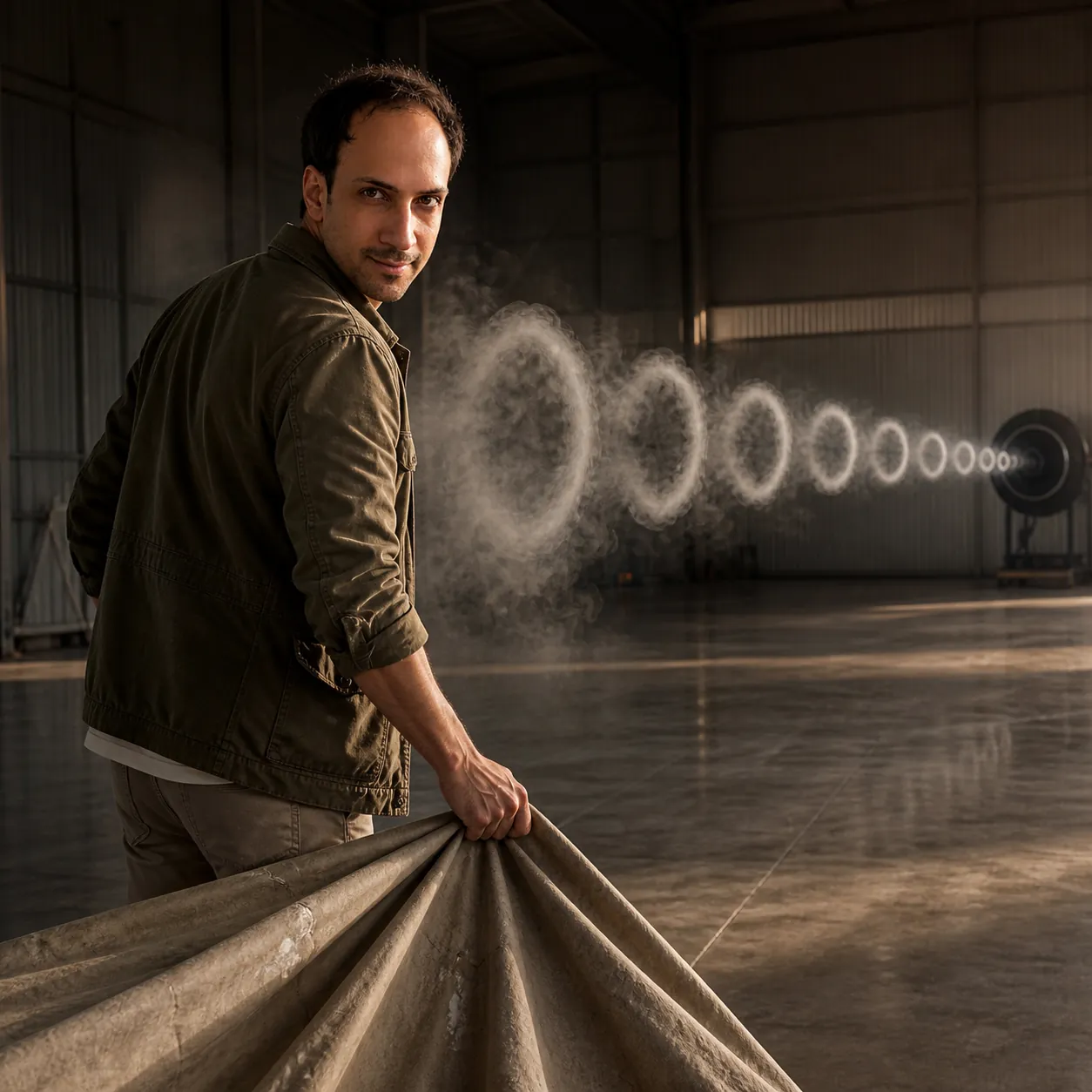
Use the attached reference photo as the identity reference: keep the same face, skin tone, hair and features as the person in that photo, without beautifying, aging or altering them. Create a square 1:1 museum-catalog frame with a strong first read and a slower second read at exactly 2880x2880 pixels. Location: a swept private hangar, doors rolled shut against the desert wind. Show the subject in an olive field jacket, white shirt, and stone chinos, dragging a canvas tarp clear of the open floor. Treat this mechanism as the frame’s governing rule: a subwoofer sealed behind a round collar that fires a metronomic train of identical fog rings down the room gives empty air a body with edges, momentum, and somewhere to be. Explore what the still air of a room can do when properly asked; direct expression and posture toward sober delight, never melodrama or ad-like confidence. Frame from just behind their shoulder down the launch line, their face turned enough to stay fully readable. Make the composition leave open air ahead of the ring, promising travel. Render it as high-speed atmospheric portraiture built from real vortex dynamics, quiet documentary stillness, truthful volumetric haze, and emotionally restrained composition, using low raking sidelight that gives drifting fog readable sculptural relief and a palette of warm plaster, iron grey, and a dusty teal band. Photorealistic: this must read as a real photograph from a physical camera, never an illustration, painting, or 3D render. Resolve real surface detail: grout darker than tile, sealant slightly yellowed, and every joint showing a real tolerance gap. Keep one identity-locked person, credible hands and fingers, natural fabric, and coherent scale, contact, reflections, shadows, airflow, deformation, and materials. Background people only when essential, always secondary and clearly different. Avoid vape-trick theatrics, neon-glowing rings, CGI smoke tornadoes, wizard conjuring hands, and mouth-blown rings at camera. No text, labels, logos, signatures, watermarks, random symbols, plastic skin, excessive bloom, or glossy AI finish.
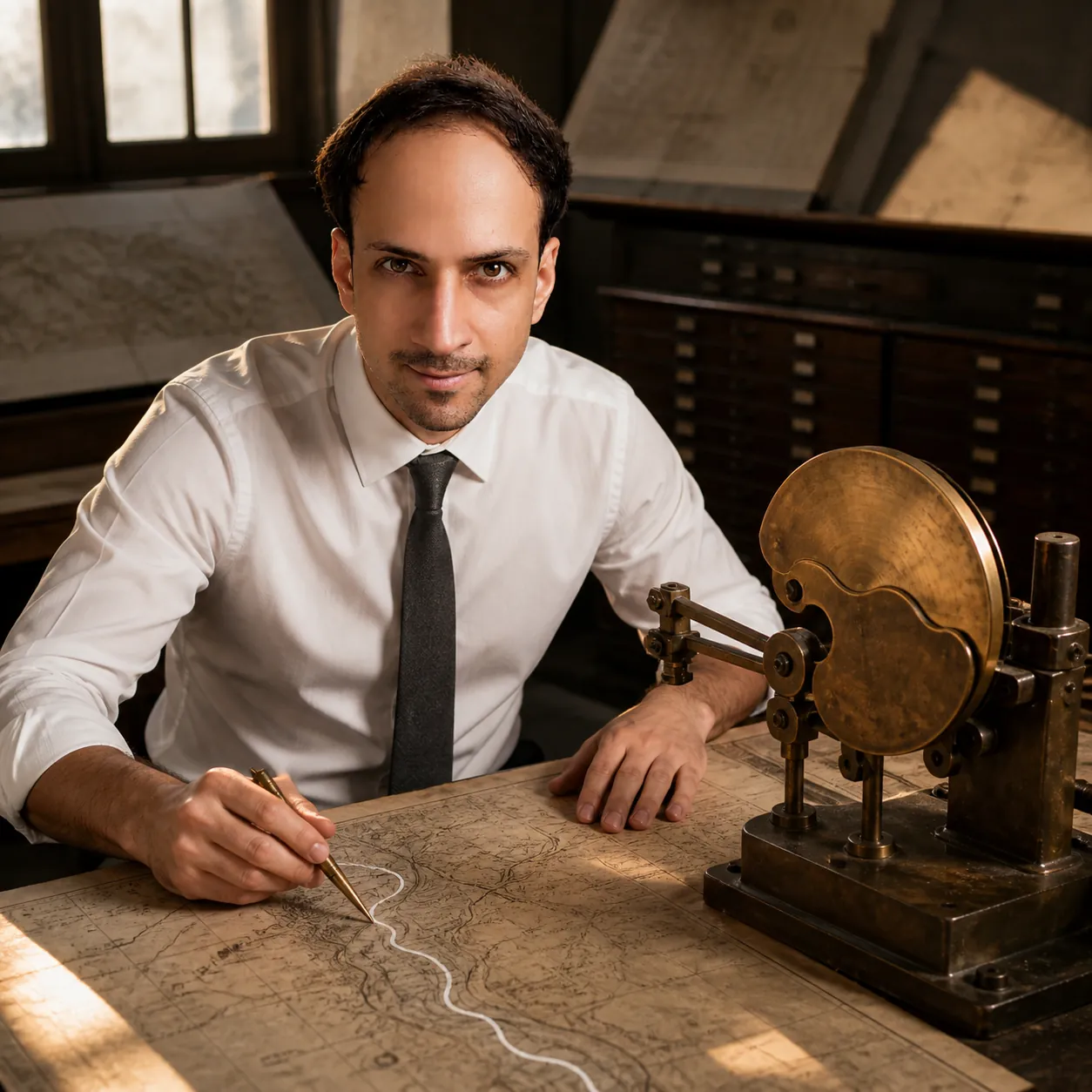
Curve Cut in Brass
صورةAI Portraits

Create a square 1:1 museum-catalog frame with a strong first read and a slower second read at exactly 2880x2880 pixels. Location: a national map room with a...

من نص البرومبت

Use the attached reference photo as the identity reference: keep the same face, skin tone, hair and features as the person in that photo, without beautifying, aging or altering them. Create a square 1:1 museum-catalog frame with a strong first read and a slower second read at exactly 2880x2880 pixels. Location: a national map room with a wide tilted table and drawer cabinets. Show them in a pressed white shirt with a slate wool tie, no jacket, tracing a wadi's outline with a steady stylus. Make one rigorous physical condition the conceptual engine: a machined brass cam whose milled edge encodes a full mathematical curve, read by a follower arm as it slowly rotates performs real mathematics through nothing but shaped matter and lawful motion. Explore how a century-old mechanism can still out-argue a glowing screen; direct expression and posture toward lucid respect, never melodrama or ad-like confidence. Use an eye-level 85mm portrait perspective with honest depth of field and no distortion. Make the composition grant old machined wear the same dignity as their face. Render it as engineering-heritage photography combining working mechanical calculation, true kinematic detail, softly aged material finishes, and restrained human-centered contemporary framing, using late golden hour entering low and level, gilding brass without glare and a palette of dark slate, oiled bronze, and one chalk-white line. Photorealistic: this must read as a real photograph from a physical camera, never an illustration, painting, or 3D render. Resolve real surface detail: fine grit in the texture of concrete, efflorescence at damp edges, and hairline cracks that follow stress. Keep one identity-locked person, credible hands and fingers, natural fabric, and coherent scale, contact, reflections, shadows, airflow, deformation, and materials. Background people only when essential, always secondary and clearly different. Avoid steampunk goggles, glued-on decorative cogs, glowing holographic overlays, impossible gear meshes, and clock faces. No text, labels, logos, signatures, watermarks, random symbols, plastic skin, excessive bloom, or glossy AI finish.
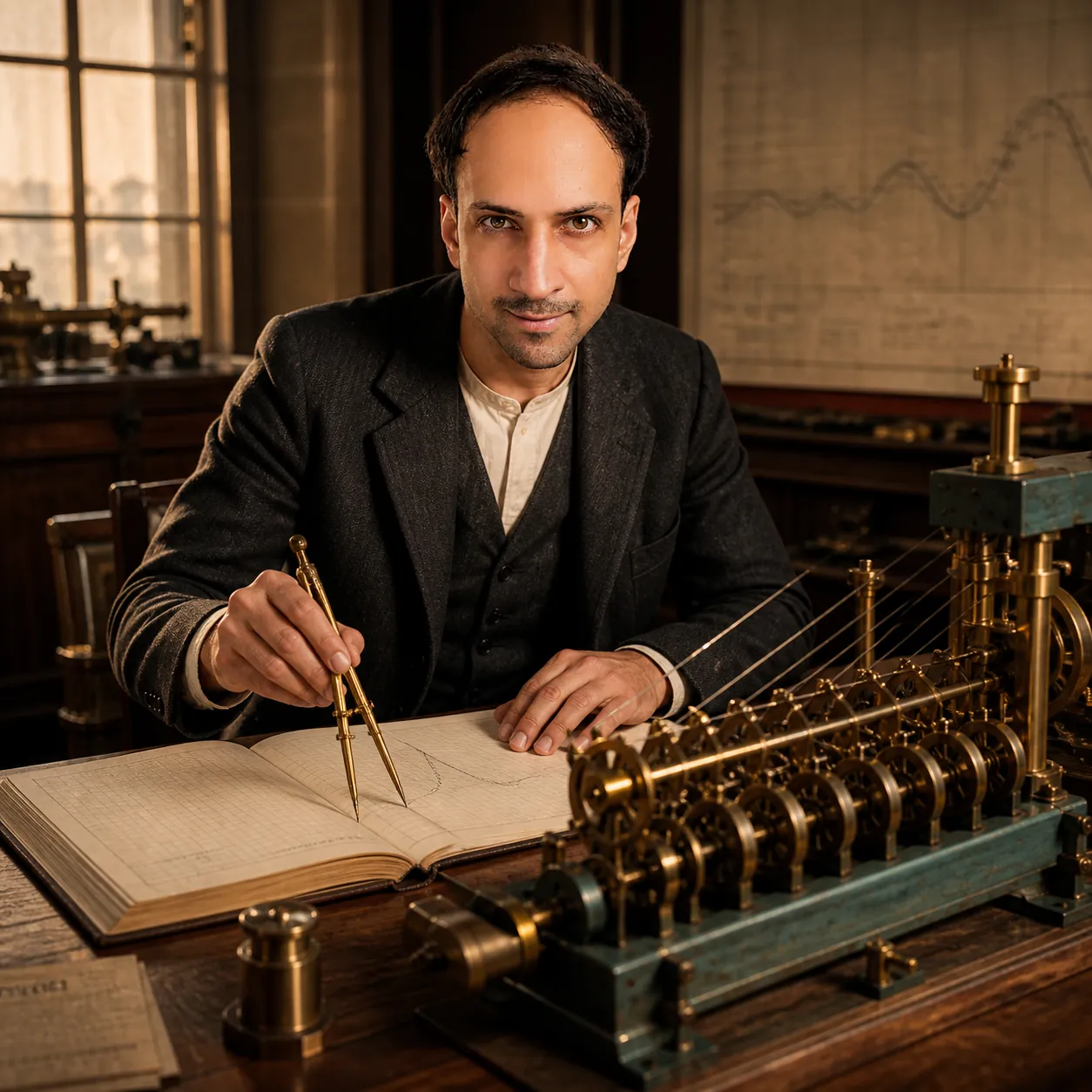
Tide Curves at the Teak Table
صورةAI Portraits

Create a square 1:1 museum-catalog frame with a strong first read and a slower second read at exactly 2880x2880 pixels. Location: an engineering society's...

من نص البرومبت

Use the attached reference photo as the identity reference: keep the same face, skin tone, hair and features as the person in that photo, without beautifying, aging or altering them. Create a square 1:1 museum-catalog frame with a strong first read and a slower second read at exactly 2880x2880 pixels. Location: an engineering society's committee room with a long teak table. Show them in charcoal suit trousers and a waistcoat over a collarless shirt, walking a pair of dividers across an open ledger. Use this advanced image-making device as the core logic: a tide-predicting machine whose fine wire, wrapped over a dozen geared pulleys, sums ocean harmonics into one drawn curve performs real mathematics through nothing but shaped matter and lawful motion. Explore how motion becomes arithmetic the moment its parts are shaped with intent; direct expression and posture toward sober delight, never melodrama or ad-like confidence. Frame from a seated observer's eye height, close enough that machined texture stays tangibly present. Make the composition keep the answer's dial or mark small, sharp, and off-center. Render it as gallery-grade technical realism built on lawful mechanism kinematics, precise engraved detail, tactile wood-and-metal textures, and emotionally intelligent portrait lighting, using late golden hour entering low and level, gilding brass without glare and a palette of warm umber, pale vellum, and one muted teal accent. Photorealistic: this must read as a real photograph from a physical camera, never an illustration, painting, or 3D render. Resolve real surface detail: visible weave in cloth, fine scratches on metal, and the faint unevenness of painted walls. Keep one identity-locked person, credible hands and fingers, natural fabric, and coherent scale, contact, reflections, shadows, airflow, deformation, and materials. Background people only when essential, always secondary and clearly different. Avoid steampunk goggles, glued-on decorative cogs, glowing holographic overlays, impossible gear meshes, and clock faces. No text, labels, logos, signatures, watermarks, random symbols, plastic skin, excessive bloom, or glossy AI finish.
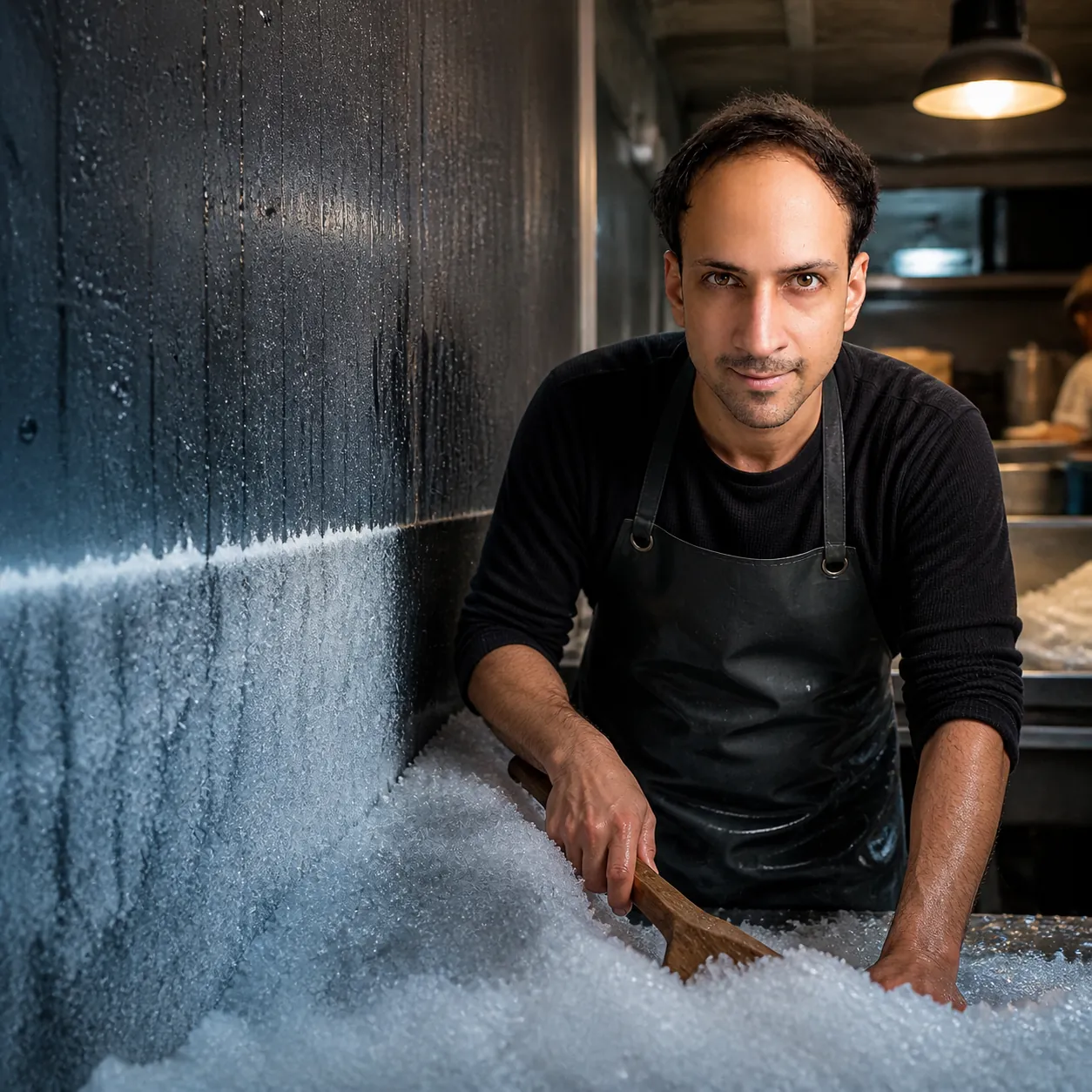
Condensation at the Fish Counter
صورةAI Portraits

Create a square 1:1 museum-catalog frame with a strong first read and a slower second read at exactly 2880x2880 pixels. Location: a fish market's back...

من نص البرومبت

Use the attached reference photo as the identity reference: keep the same face, skin tone, hair and features as the person in that photo, without beautifying, aging or altering them. Create a square 1:1 museum-catalog frame with a strong first read and a slower second read at exactly 2880x2880 pixels. Location: a fish market's back counter at closing, crushed ice still heaped. Show them in a rubberized apron over a pushed-up thermal shirt, raking crushed ice level with a short wooden paddle. Build the artwork around this material rule: a tall chilled panel whose condensation stops along one sharp horizontal line where the metal crosses the room's dew point shows the exact line where one state of matter surrenders to another. Explore whether a state of matter ends at a moment or at a place; direct expression and posture toward grounded astonishment, never melodrama or ad-like confidence. Frame level with the cold surface so the advancing boundary leads the eye to their steady gaze. Make the composition grant the smallest cold detail more acuity than any warm surface. Render it as gallery-grade cold-room photography built from genuine ice physics, sharply resolved frost microstructure, disciplined natural styling, and calm environmental storytelling, using blue pre-dawn ambience lifted by a single warm tungsten practical and a palette of frost white, gunmetal, and one seam of glacial blue. Photorealistic: this must read as a real photograph from a physical camera, never an illustration, painting, or 3D render. Resolve real surface detail: label-free packaging showing carton fibre, cardboard bruised at the corners, and tape lifting slightly at one end. Keep one identity-locked person, credible hands and fingers, natural fabric, and coherent scale, contact, reflections, shadows, airflow, deformation, and materials. Background people only when essential, always secondary and clearly different. Avoid glowing magic ice, snowflake clip-art overlays, superhero freeze beams, CGI shatter shards, and fairy-tale crystal palaces. No text, labels, logos, signatures, watermarks, random symbols, plastic skin, excessive bloom, or glossy AI finish.
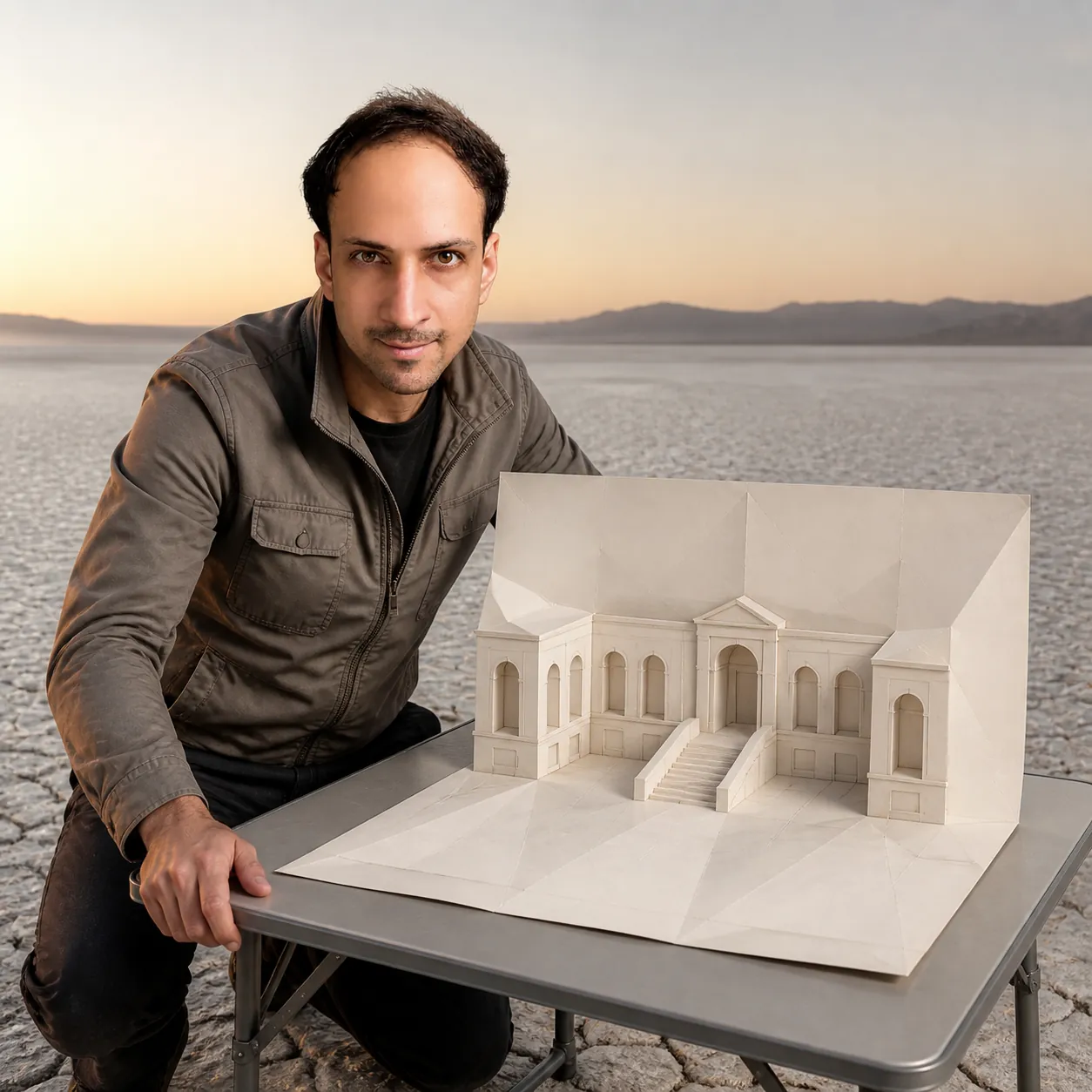
A Courtyard Rising from Paper
صورةAI Portraits

Create a square 1:1 museum-catalog frame with a strong first read and a slower second read at exactly 2880x2880 pixels. Location: the cracked bed of a dry...

من نص البرومبت

Use the attached reference photo as the identity reference: keep the same face, skin tone, hair and features as the person in that photo, without beautifying, aging or altering them. Create a square 1:1 museum-catalog frame with a strong first read and a slower second read at exactly 2880x2880 pixels. Location: the cracked bed of a dry salt flat at windless first light. Show them in a sand-grey field jacket zipped to mid-chest over dark trousers, bracing a folding camp table by one leg. Use this advanced image-making device as the core logic: a courtyard facade that rises fully formed, walls and stair together, as its folded base sheet opens to ninety degrees reads as an engineering proof while remaining an object of quiet beauty. Explore what it means that an entire building can wait inside a flat sheet; direct expression and posture toward unhurried focus, never melodrama or ad-like confidence. Frame from a low three-quarter angle so the paper structure gains quiet monumentality while their posture stays true. Make the composition keep every cut edge sharp while the room softens behind. Render it as museum-workshop realism combining honest fiber texture, accurate crease shadows, believable deflection under real weight, and restrained editorial lighting, using even overhead workroom light shaped so white surfaces hold visible tone steps and a palette of museum-board grey, soft ivory, and a single ochre accent. Photorealistic: this must read as a real photograph from a physical camera, never an illustration, painting, or 3D render. Resolve real surface detail: thread ends and slight pilling on worn cloth, hairline chips at every hard corner, and stone that is porous rather than smooth. Keep one identity-locked person, credible hands and fingers, natural fabric, and coherent scale, contact, reflections, shadows, airflow, deformation, and materials. Background people only when essential, always secondary and clearly different. Avoid greeting-card kitsch, torn-edge scrapbook collage, cartoon pop-up books, and burning paper drama. No text, labels, logos, signatures, watermarks, random symbols, plastic skin, excessive bloom, or glossy AI finish.
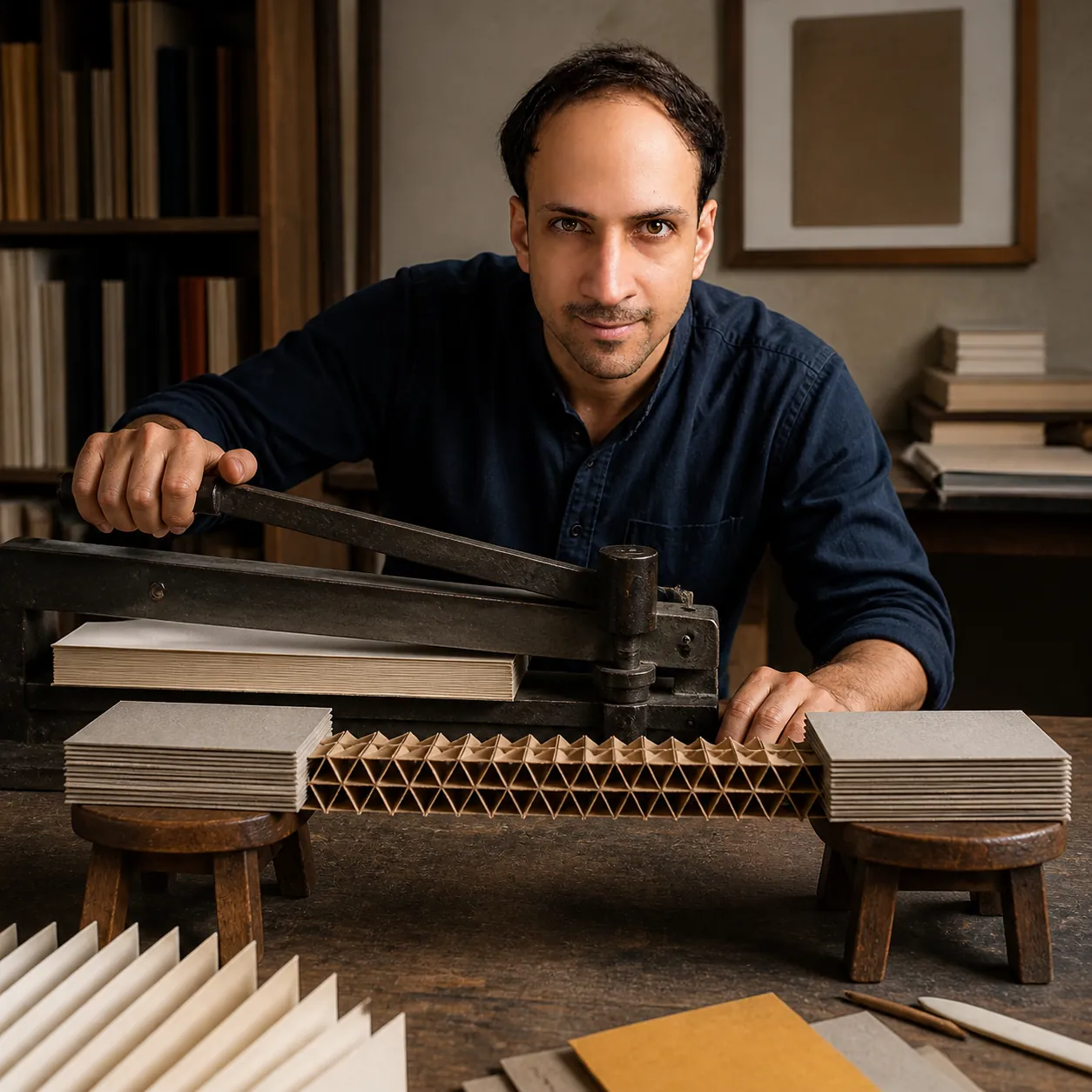
Honeycomb Beam in the Bindery
صورةAI Portraits

Create a square 1:1 museum-catalog frame with a strong first read and a slower second read at exactly 2880x2880 pixels. Location: a bookbinder's atelier...

من نص البرومبت

Use the attached reference photo as the identity reference: keep the same face, skin tone, hair and features as the person in that photo, without beautifying, aging or altering them. Create a square 1:1 museum-catalog frame with a strong first read and a slower second read at exactly 2880x2880 pixels. Location: a bookbinder's atelier with a hand guillotine and racked blank card. Show them in a collarless indigo work shirt with sleeves rolled past the elbow, settling the guillotine clamp onto a fresh stack of card. Build the artwork around this material rule: a honeycomb beam of glued kraft strips, expanded from a thin slab, that bridges two stools under stacked tiles reads as an engineering proof while remaining an object of quiet beauty. Explore how flatness can hold a finished structure the way a seed holds a tree; direct expression and posture toward attentive humility, never melodrama or ad-like confidence. Frame across the tabletop at the structure's own height so the span and their eyes share one focal plane. Make the composition place their hand near the structure without ever touching the load. Render it as gallery-grade structural still-life portraiture built from real folded spans, matte paper materiality, unexaggerated shadow logic, and patient architectural composition, using soft bounced daylight with one deeper shadow pocket beneath the structure and a palette of museum-board grey, soft ivory, and a single ochre accent. Photorealistic: this must read as a real photograph from a physical camera, never an illustration, painting, or 3D render. Resolve real surface detail: cotton that hangs by its own weight, seams that pucker very slightly, and collars softened by washing. Keep one identity-locked person, credible hands and fingers, natural fabric, and coherent scale, contact, reflections, shadows, airflow, deformation, and materials. Background people only when essential, always secondary and clearly different. Avoid greeting-card kitsch, torn-edge scrapbook collage, cartoon pop-up books, and burning paper drama. No text, labels, logos, signatures, watermarks, random symbols, plastic skin, excessive bloom, or glossy AI finish.
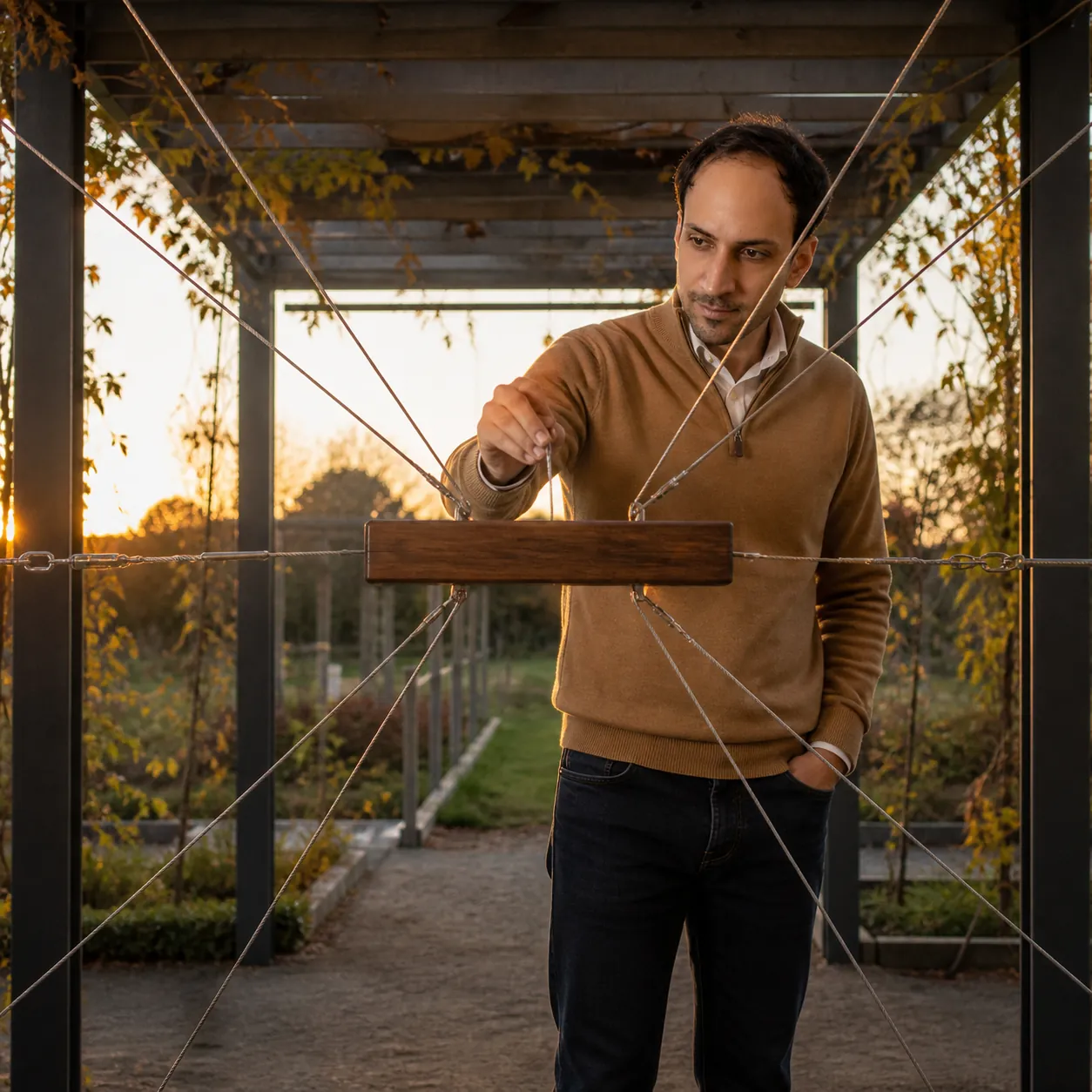
Oak Bar Held by Twelve Cables
صورةAI Portraits

Create a square 1:1 museum-catalog frame with a strong first read and a slower second read at exactly 2880x2880 pixels. Location: a public garden pergola...

من نص البرومبت

Use the attached reference photo as the identity reference: keep the same face, skin tone, hair and features as the person in that photo, without beautifying, aging or altering them. Create a square 1:1 museum-catalog frame with a strong first read and a slower second read at exactly 2880x2880 pixels. Location: a public garden pergola walk strung with training wires at dusk. Show them in a camel half-zip pullover with a white collar showing, plucking one training wire and feeling it settle. Treat this mechanism as the frame’s governing rule: a single oak bar that hangs motionless at the center of a steel frame, held by twelve cables pulling against one another reads as impossible from across the room and inevitable from a handspan. Explore how much of what anything carries is carried by preparation nobody sees; direct expression and posture toward earned ease, never melodrama or ad-like confidence. Frame from knee height looking gently upward so the load path and their face stack in one vertical. Make the composition give every load-bearing line one unbroken run between its anchors. Render it as documentary workshop realism built from believable joinery, taut-line specularity, accurate gravity in every hanging element, and unhurried craftsman-portrait framing, using late-afternoon window light crossing the frame low enough to pick out every cable and a palette of gallery white, ash wood, and one taut red cord. Photorealistic: this must read as a real photograph from a physical camera, never an illustration, painting, or 3D render. Resolve real surface detail: floor finish worn along the walked line, skirting marked at shoe height, and corners darker than the open floor. Keep one identity-locked person, credible hands and fingers, natural fabric, and coherent scale, contact, reflections, shadows, airflow, deformation, and materials. Background people only when essential, always secondary and clearly different. Avoid magician's-levitation staging, slack lines pretending to carry load, melted wood joints, and hovering furniture ads. No text, labels, logos, signatures, watermarks, random symbols, plastic skin, excessive bloom, or glossy AI finish.
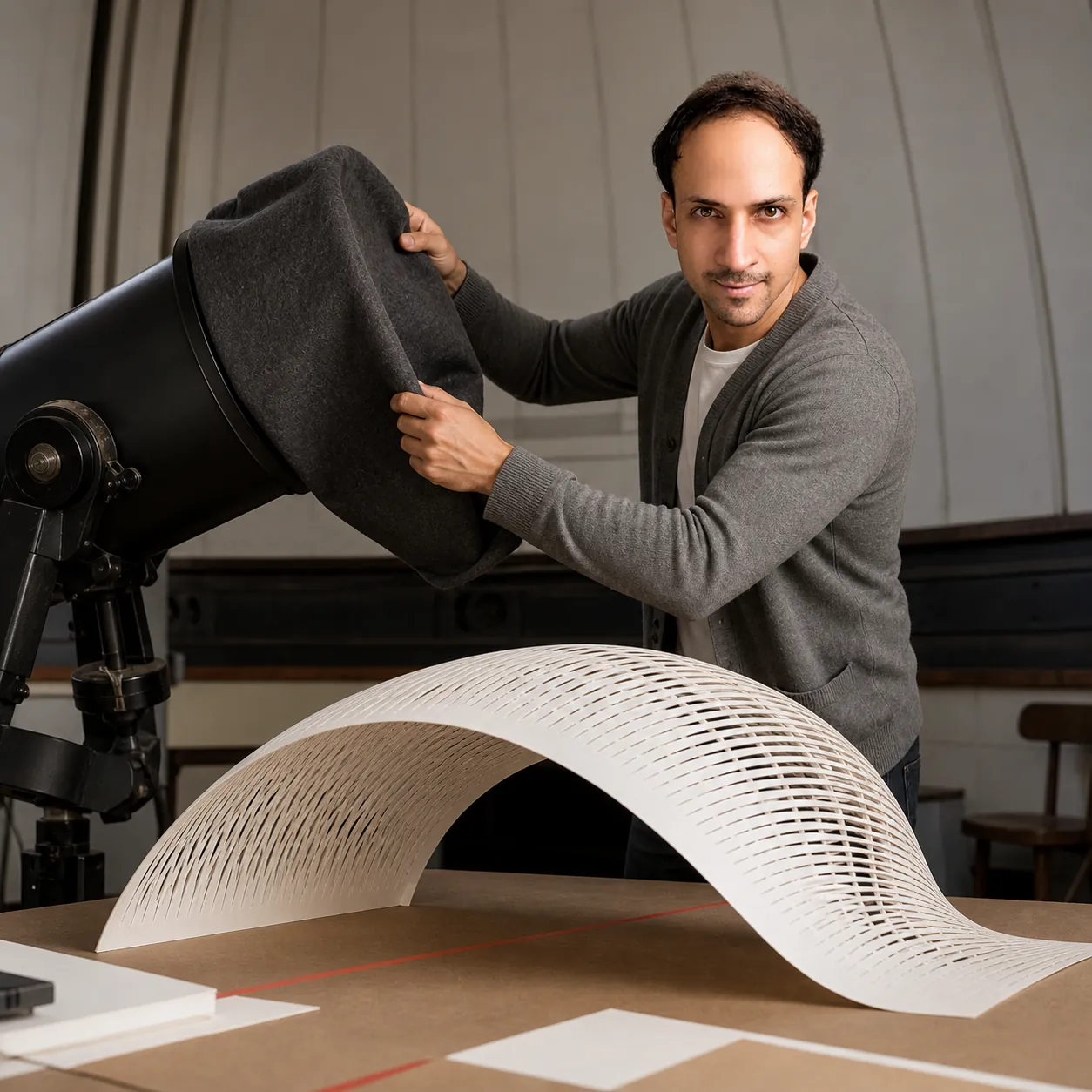
Paper Canopy in the Observatory
صورةAI Portraits

Create a square 1:1 museum-catalog frame with a strong first read and a slower second read at exactly 2880x2880 pixels. Location: a small university...

من نص البرومبت

Use the attached reference photo as the identity reference: keep the same face, skin tone, hair and features as the person in that photo, without beautifying, aging or altering them. Create a square 1:1 museum-catalog frame with a strong first read and a slower second read at exactly 2880x2880 pixels. Location: a small university observatory with its dome slit closed for daylight. Show them in a heather-grey cardigan over a white crew-neck and dark denim, fitting the felt-lined cover over the telescope tube. Build the artwork around this material rule: a flat white sheet whose staggered rows of fine slits let it stretch into a smoothly doubly curved canopy shell puts work the eye reserves for steel onto material sold by the ream. Explore whether strength lives in a material or in the pattern given to it; direct expression and posture toward earned confidence, never melodrama or ad-like confidence. Frame across the tabletop at the structure's own height so the span and their eyes share one focal plane. Make the composition let white paper carry the frame's brightest and quietest values. Render it as gallery-grade structural still-life portraiture built from real folded spans, matte paper materiality, unexaggerated shadow logic, and patient architectural composition, using soft bounced daylight with one deeper shadow pocket beneath the structure and a palette of unbleached kraft, bone white, and one line of vermilion. Photorealistic: this must read as a real photograph from a physical camera, never an illustration, painting, or 3D render. Resolve real surface detail: label-free packaging showing carton fibre, cardboard bruised at the corners, and tape lifting slightly at one end. Keep one identity-locked person, credible hands and fingers, natural fabric, and coherent scale, contact, reflections, shadows, airflow, deformation, and materials. Background people only when essential, always secondary and clearly different. Avoid origami cranes, glowing magical paper, floating confetti, printed lettering on sheets, and weightless CGI folds. No text, labels, logos, signatures, watermarks, random symbols, plastic skin, excessive bloom, or glossy AI finish.
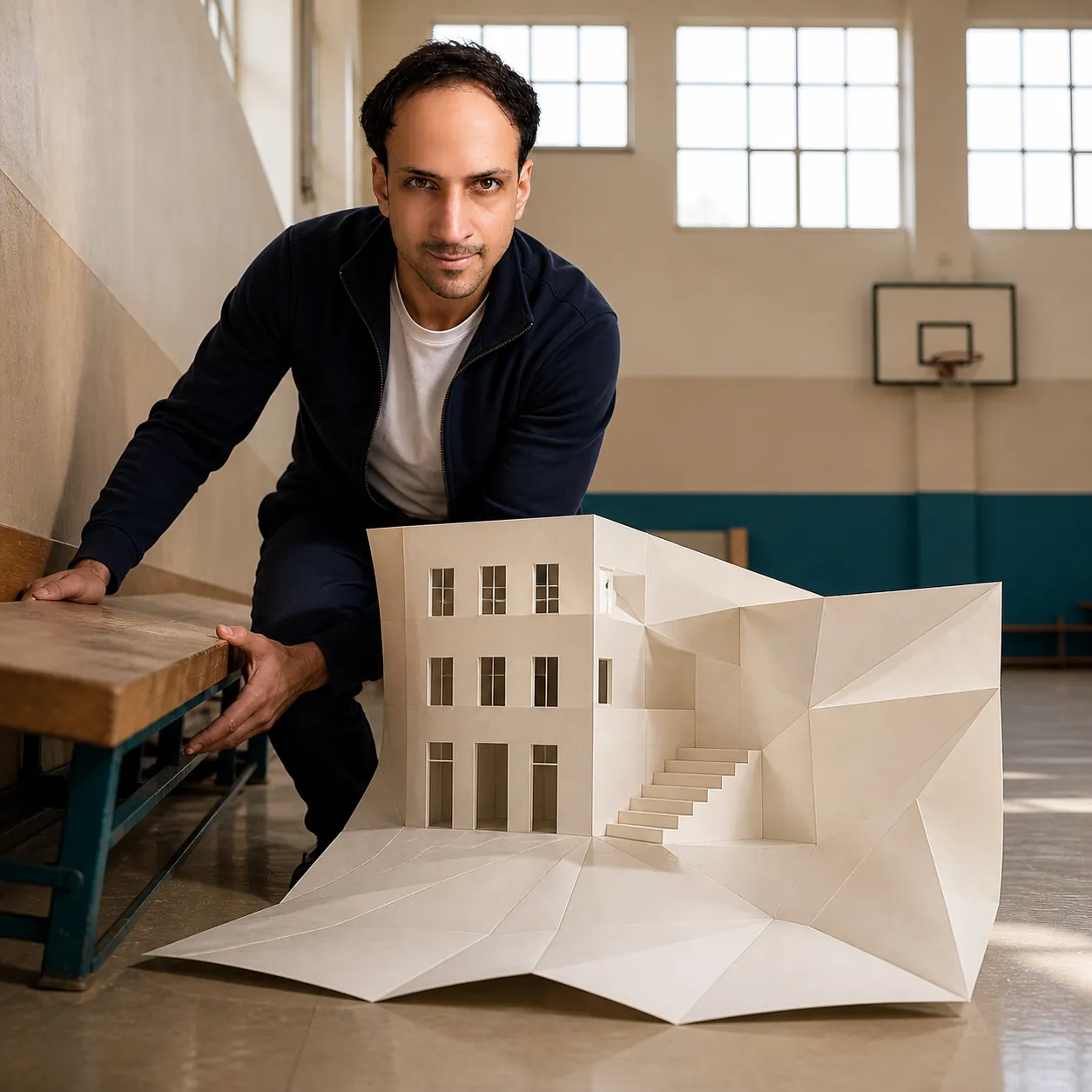
Pop-Up Courtyard in the Sports Hall
صورةAI Portraits

Create a square 1:1 museum-catalog frame with a strong first read and a slower second read at exactly 2880x2880 pixels. Location: an empty school sports...

من نص البرومبت

Use the attached reference photo as the identity reference: keep the same face, skin tone, hair and features as the person in that photo, without beautifying, aging or altering them. Create a square 1:1 museum-catalog frame with a strong first read and a slower second read at exactly 2880x2880 pixels. Location: an empty school sports hall under high morning windows. Show them in a zip-through navy track jacket over a plain white shirt, unstacking one low bench from the wall line. The impossible-looking event must obey this clear system: a courtyard facade that rises fully formed, walls and stair together, as its folded base sheet opens to ninety degrees puts work the eye reserves for steel onto material sold by the ream. Explore what it means that an entire building can wait inside a flat sheet; direct expression and posture toward quiet conviction, never melodrama or ad-like confidence. Use a 90mm close-portrait hybrid: one crease edge razor sharp near the lens, their face readable beyond it. Make the composition place their hand near the structure without ever touching the load. Render it as gallery-grade structural still-life portraiture built from real folded spans, matte paper materiality, unexaggerated shadow logic, and patient architectural composition, using flat north window light that keeps every crease edge legible and a palette of warm white, shadowed cream, and one edge of teal. Photorealistic: this must read as a real photograph from a physical camera, never an illustration, painting, or 3D render. Resolve real surface detail: glass with real thickness at its edge, reflections that carry the room's actual colour, and dust visible only at grazing angles. Keep one identity-locked person, credible hands and fingers, natural fabric, and coherent scale, contact, reflections, shadows, airflow, deformation, and materials. Background people only when essential, always secondary and clearly different. Avoid origami cranes, glowing magical paper, floating confetti, printed lettering on sheets, and weightless CGI folds. No text, labels, logos, signatures, watermarks, random symbols, plastic skin, excessive bloom, or glossy AI finish.
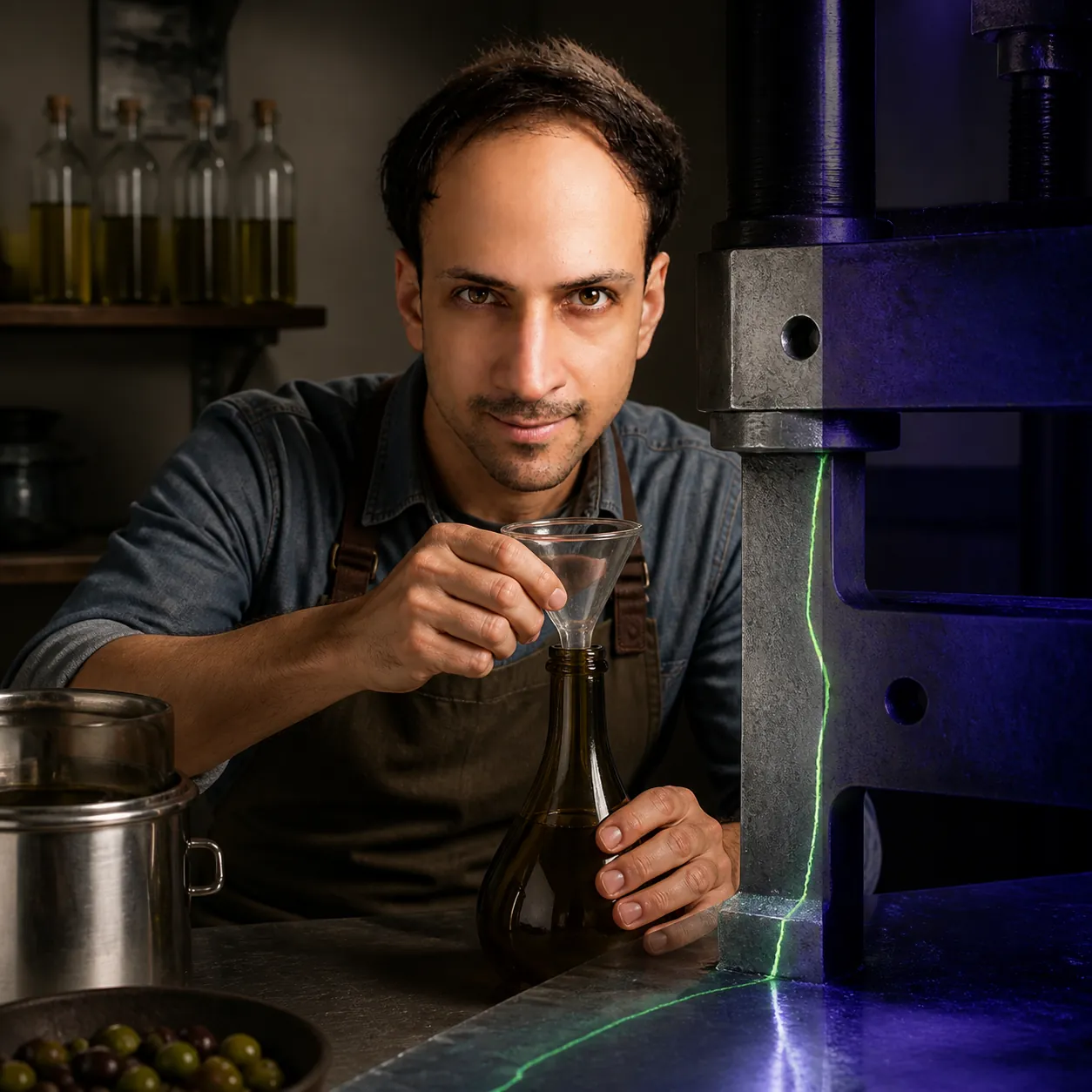
The Crack That Glows Green
صورةAI Portraits

Create a square 1:1 museum-catalog frame with a strong first read and a slower second read at exactly 2880x2880 pixels. Location: a small olive-pressing...

من نص البرومبت

Use the attached reference photo as the identity reference: keep the same face, skin tone, hair and features as the person in that photo, without beautifying, aging or altering them. Create a square 1:1 museum-catalog frame with a strong first read and a slower second read at exactly 2880x2880 pixels. Location: a small olive-pressing room with clean decanting bottles on a shelf. Show them in a heavy canvas apron over a rolled-sleeve chambray shirt, seating a glass funnel into a bottle's neck. Build the artwork around this material rule: a machined aluminum bracket whose hairline crack draws itself as a bright green thread under ultraviolet once fluorescent penetrant has seeped in divides one honest frame into an ordinary half and a luminous half. Explore whether a hidden property is real before anyone builds the lamp for it; direct expression and posture toward unhurried attention, never melodrama or ad-like confidence. Frame along the boundary of the ultraviolet light so both halves share one focal plane. Make the composition give the ordinary half as much space as the luminous half. Render it as gallery-grade specimen photography built from genuine luminescent materials, sober collection-room styling, accurate dim-light color, and patient portrait attention, using dim ambient light with a hard ultraviolet edge crossing the working surface and a palette of slate grey, pewter, and one seam of uranium green. Photorealistic: this must read as a real photograph from a physical camera, never an illustration, painting, or 3D render. Resolve real surface detail: label-free packaging showing carton fibre, cardboard bruised at the corners, and tape lifting slightly at one end. Keep one identity-locked person, credible hands and fingers, natural fabric, and coherent scale, contact, reflections, shadows, airflow, deformation, and materials. Background people only when essential, always secondary and clearly different. Avoid blacklight-party glow, neon signage, glowing body paint, radioactive-green fog, and cartoon toxic-waste barrels. No text, labels, logos, signatures, watermarks, random symbols, plastic skin, excessive bloom, or glossy AI finish.
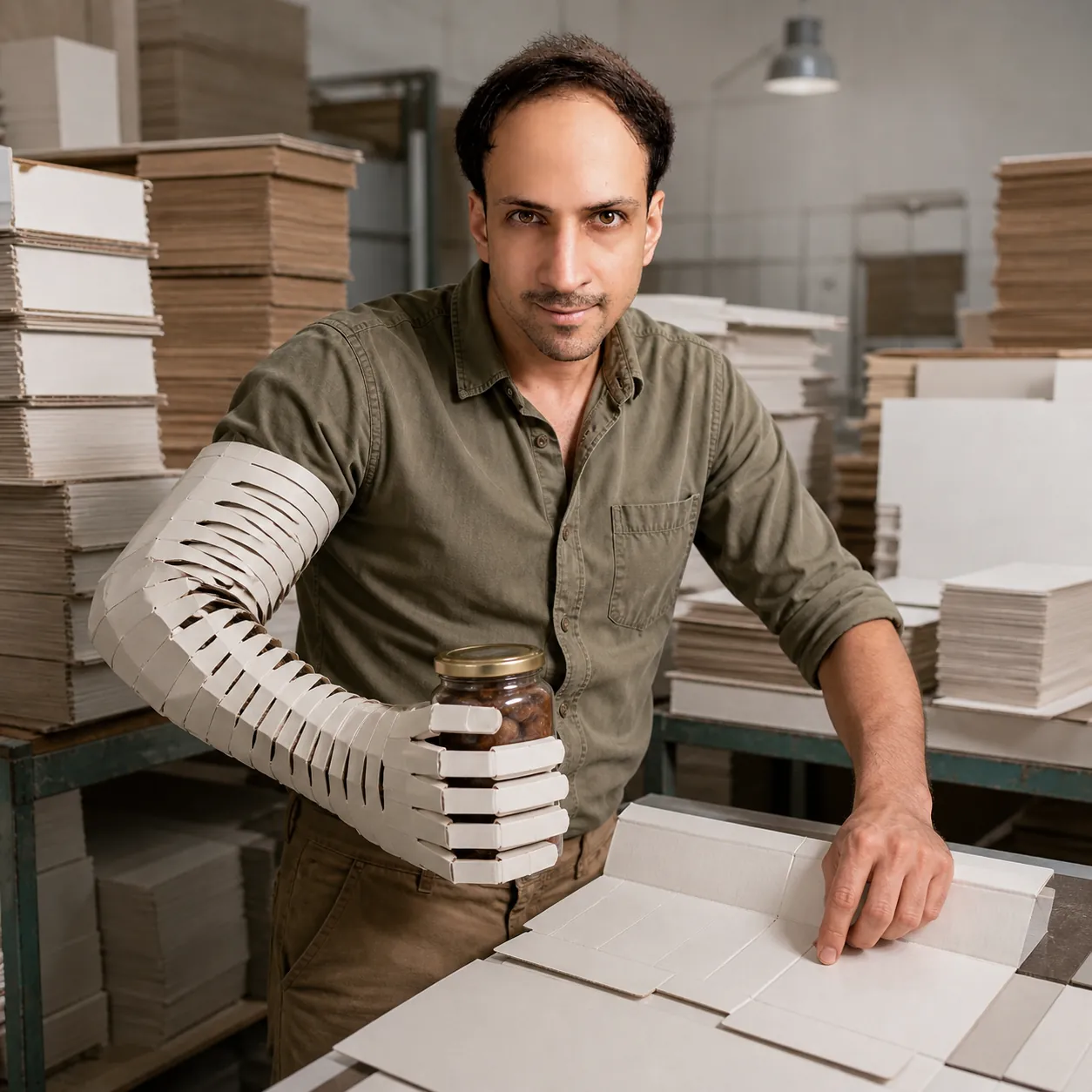
Paper Fingers Grip the Jar
صورةAI Portraits

Create a square 1:1 museum-catalog frame with a strong first read and a slower second read at exactly 2880x2880 pixels. Location: a date-packing shed...

من نص البرومبت

Use the attached reference photo as the identity reference: keep the same face, skin tone, hair and features as the person in that photo, without beautifying, aging or altering them. Create a square 1:1 museum-catalog frame with a strong first read and a slower second read at exactly 2880x2880 pixels. Location: a date-packing shed stacked chest-high with flattened new cartons. Show them in a washed olive utility shirt tucked into canvas work trousers, folding one carton up from flat with four practiced creases. Make one rigorous physical condition the conceptual engine: a kirigami sleeve whose parallel slits buckle into dozens of angled paper fingers that grip a filled glass jar puts work the eye reserves for steel onto material sold by the ream. Explore where the line runs between craft patience and structural engineering; direct expression and posture toward measured astonishment, never melodrama or ad-like confidence. Use an eye-level 58mm medium-format viewpoint with natural perspective and honest paper texture. Make the composition let white paper carry the frame's brightest and quietest values. Render it as high-concept paper-engineering portraiture built from working cut-and-fold structures, documentary realism, gallery-grade craft styling, and physically truthful load behavior, using even overhead workroom light shaped so white surfaces hold visible tone steps and a palette of oat paper, cool slate, and one restrained saffron thread. Photorealistic: this must read as a real photograph from a physical camera, never an illustration, painting, or 3D render. Resolve real surface detail: the difference between a wiped surface and a clean one, faint tide marks on ceramic, and metal dulled unevenly by touch. Keep one identity-locked person, credible hands and fingers, natural fabric, and coherent scale, contact, reflections, shadows, airflow, deformation, and materials. Background people only when essential, always secondary and clearly different. Avoid origami cranes, glowing magical paper, floating confetti, printed lettering on sheets, and weightless CGI folds. No text, labels, logos, signatures, watermarks, random symbols, plastic skin, excessive bloom, or glossy AI finish.
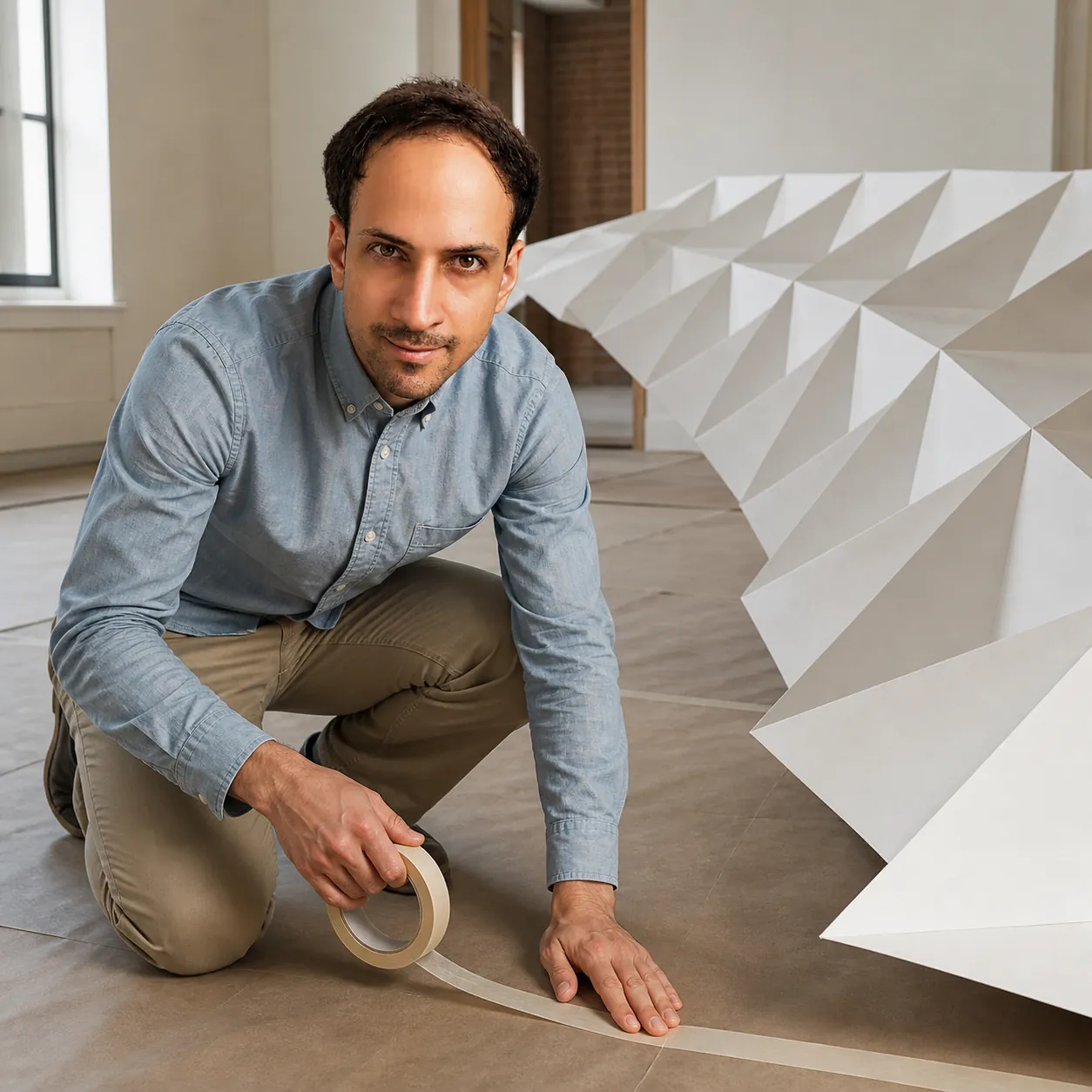
Unfolding in an Empty Apartment
صورةAI Portraits

Create a square 1:1 museum-catalog frame with a strong first read and a slower second read at exactly 2880x2880 pixels. Location: an unfurnished apartment...

من نص البرومبت

Use the attached reference photo as the identity reference: keep the same face, skin tone, hair and features as the person in that photo, without beautifying, aging or altering them. Create a square 1:1 museum-catalog frame with a strong first read and a slower second read at exactly 2880x2880 pixels. Location: an unfurnished apartment with floors papered over for the painters. Show them in a light chambray shirt buttoned to the collar over khaki chinos, taping down a lifted seam of floor paper. Make one rigorous physical condition the conceptual engine: a Miura-folded sheet that unfurls from a hand-width packet into a table-wide faceted canopy with one pull of two corners puts work the eye reserves for steel onto material sold by the ream. Explore why a cut, placed rightly, adds ability instead of taking it away; direct expression and posture toward gentle rigor, never melodrama or ad-like confidence. Use an eye-level 58mm medium-format viewpoint with natural perspective and honest paper texture. Make the composition give the load path one clean diagonal from burden to bearing. Render it as gallery-grade structural still-life portraiture built from real folded spans, matte paper materiality, unexaggerated shadow logic, and patient architectural composition, using even overhead workroom light shaped so white surfaces hold visible tone steps and a palette of pale card, graphite, and a narrow band of brick. Photorealistic: this must read as a real photograph from a physical camera, never an illustration, painting, or 3D render. Resolve real surface detail: fine lint on dark fabric, water spotting on steel, and the soft rounding of edges that have been used for years. Keep one identity-locked person, credible hands and fingers, natural fabric, and coherent scale, contact, reflections, shadows, airflow, deformation, and materials. Background people only when essential, always secondary and clearly different. Avoid origami cranes, glowing magical paper, floating confetti, printed lettering on sheets, and weightless CGI folds. No text, labels, logos, signatures, watermarks, random symbols, plastic skin, excessive bloom, or glossy AI finish.

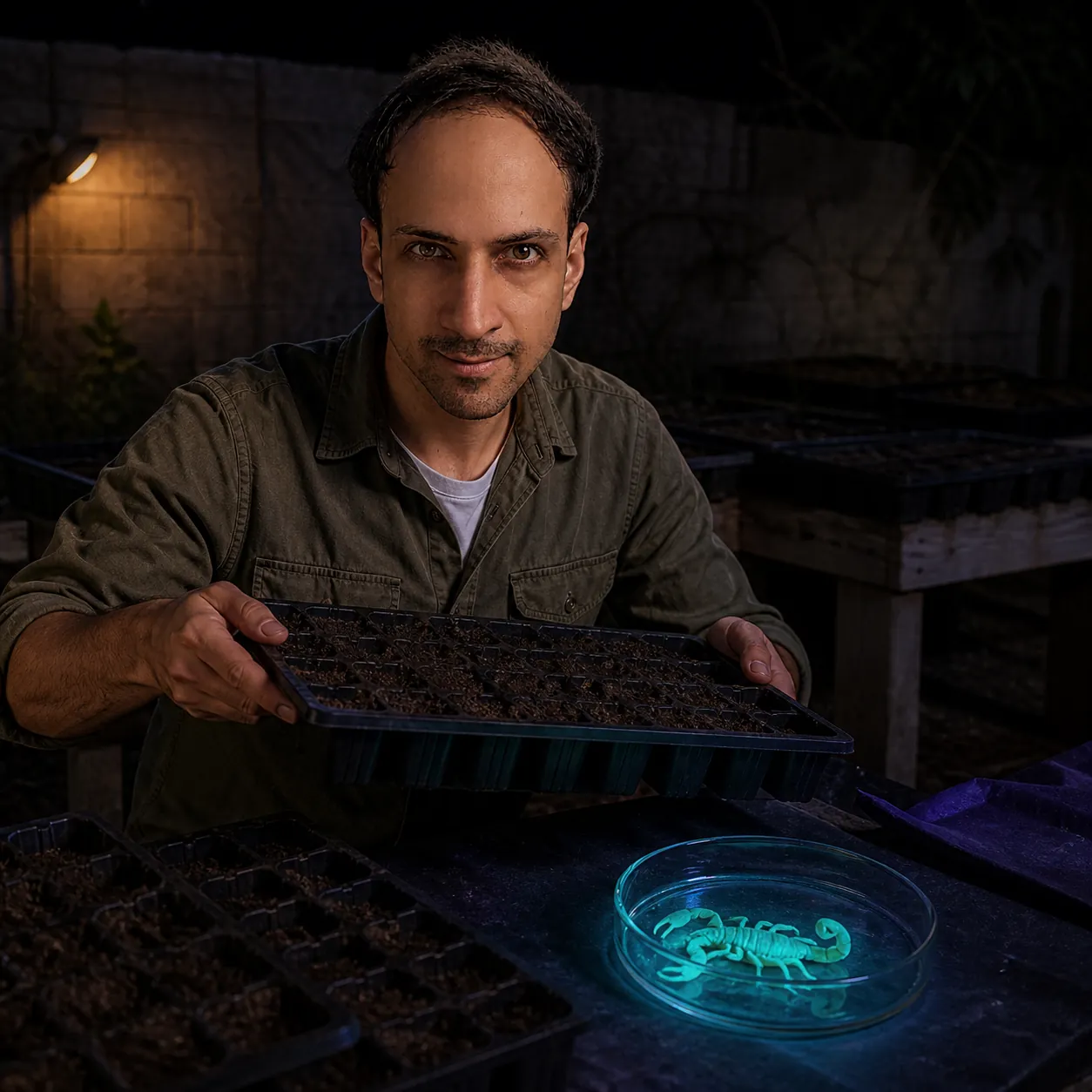
Glow Among the Seed Trays
صورةAI Portraits

Create a square 1:1 museum-catalog frame with a strong first read and a slower second read at exactly 2880x2880 pixels. Location: a walled nursery yard...

من نص البرومبت

Use the attached reference photo as the identity reference: keep the same face, skin tone, hair and features as the person in that photo, without beautifying, aging or altering them. Create a square 1:1 museum-catalog frame with a strong first read and a slower second read at exactly 2880x2880 pixels. Location: a walled nursery yard where seed trays wait on low trestles. Show them in a faded olive field shirt over a white undershirt, tipping a seed tray level with both hands. Make one rigorous physical condition the conceptual engine: a shed scorpion cuticle in a glass dish that answers ultraviolet with a cold cyan outline sharper than the animal ever looked divides one honest frame into an ordinary half and a luminous half. Explore what it means that the plainest surfaces keep the least expected secrets; direct expression and posture toward quiet astonishment, never melodrama or ad-like confidence. Use an eye-level 55mm viewpoint with natural perspective and shadows kept open enough to read their face. Make the composition give the ordinary half as much space as the luminous half. Render it as museum demonstration realism combining honest low-light photography, spectrally plausible glow, plain material texture, and unhurried human presence in frame, using near-darkness carried mostly by emitted light and one weak amber practical and a palette of cool black, ash grey, and a thread of violet-white. Photorealistic: this must read as a real photograph from a physical camera, never an illustration, painting, or 3D render. Resolve real surface detail: fine grit in the texture of concrete, efflorescence at damp edges, and hairline cracks that follow stress. Keep one identity-locked person, credible hands and fingers, natural fabric, and coherent scale, contact, reflections, shadows, airflow, deformation, and materials. Background people only when essential, always secondary and clearly different. Avoid blacklight-party glow, neon signage, glowing body paint, radioactive-green fog, and cartoon toxic-waste barrels. No text, labels, logos, signatures, watermarks, random symbols, plastic skin, excessive bloom, or glossy AI finish.