تخطَّ إلى المحتوى

برومبتات الصور

برومبتات لمولدات الصور: بورتريهات وفن وتصوير.

تم العثور على 4209
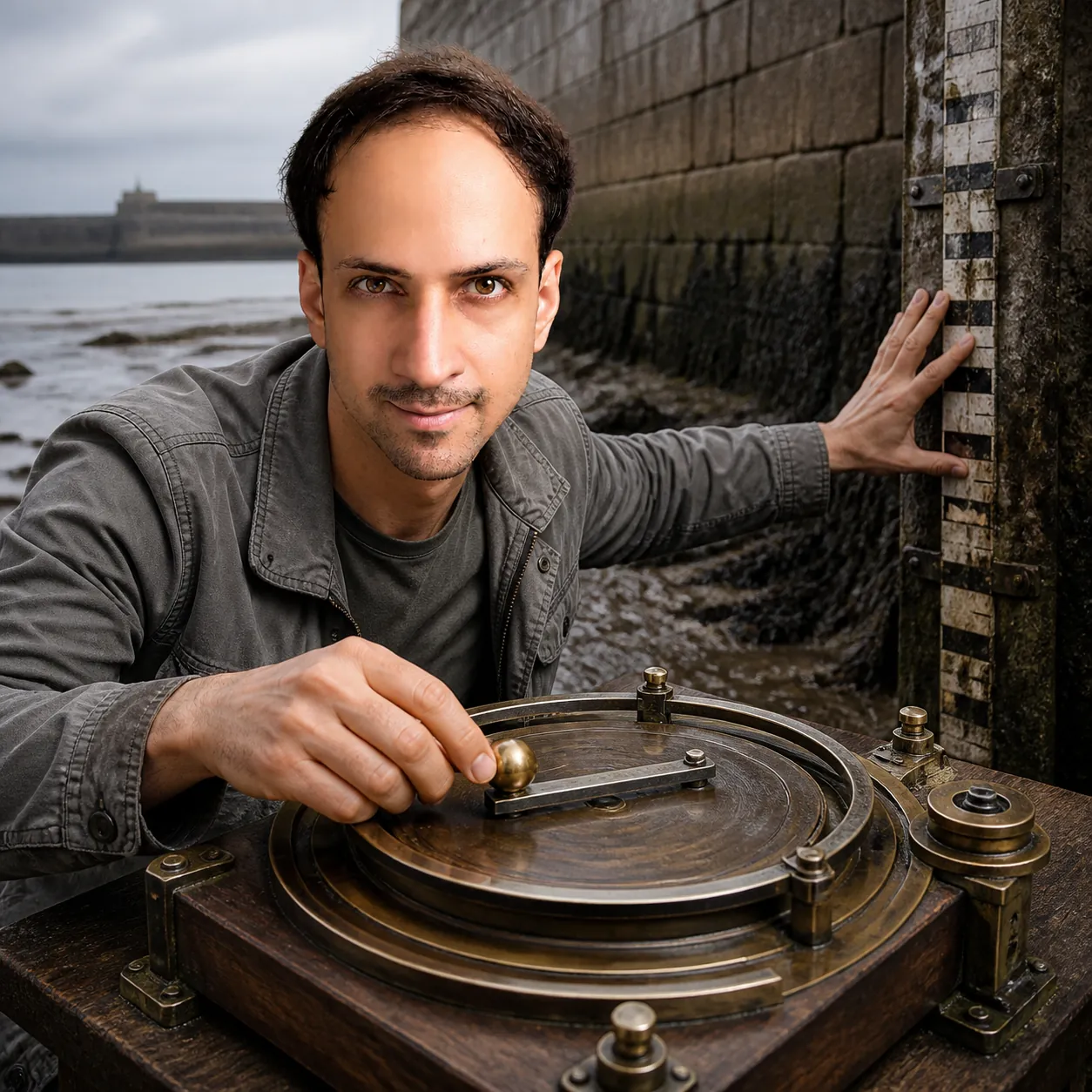
Running Total on the Quay — AI Portrait Prompt
صورةAI Portraits

Turn your own photo into a gallery-grade technical portrait in a stone quay at low tide with a graduated tide pole nearby. Keeps your face unchanged.

من نص البرومبت

Use the attached reference photo as the identity reference: keep the same face, skin tone, hair and features as the person in that photo, without beautifying, aging or altering them. Create a square 1:1 museum-catalog frame with a strong first read and a slower second read at exactly 2880x2880 pixels. Location: a stone quay at low tide with a graduated tide pole nearby. Show them in a lightweight stone-grey field jacket over a plain shirt, measuring the wet tide line with a spread hand. Build the artwork around this material rule: a ball-and-disk integrator whose polished sphere, riding a spinning plate at a set radius, turns accumulated distance into a running total performs real mathematics through nothing but shaped matter and lawful motion. Explore whether an answer arrived at by hand carries more weight than one served instantly; direct expression and posture toward attentive humility, never melodrama or ad-like confidence. Frame level with the mechanism so its motion and their eyes share one focal plane. Make the composition grant old machined wear the same dignity as their face. Render it as gallery-grade technical realism built on lawful mechanism kinematics, precise engraved detail, tactile wood-and-metal textures, and emotionally intelligent portrait lighting, using cool north skylight fill with soft falloff into wood-paneled shadow and a palette of aged brass, deep walnut, and one verdigris accent. Photorealistic: this must read as a real photograph from a physical camera, never an illustration, painting, or 3D render. Resolve real surface detail: label-free packaging showing carton fibre, cardboard bruised at the corners, and tape lifting slightly at one end. Keep one identity-locked person, credible hands and fingers, natural fabric, and coherent scale, contact, reflections, shadows, airflow, deformation, and materials. Background people only when essential, always secondary and clearly different. Avoid steampunk goggles, glued-on decorative cogs, glowing holographic overlays, impossible gear meshes, and clock faces. No text, labels, logos, signatures, watermarks, random symbols, plastic skin, excessive bloom, or glossy AI finish.
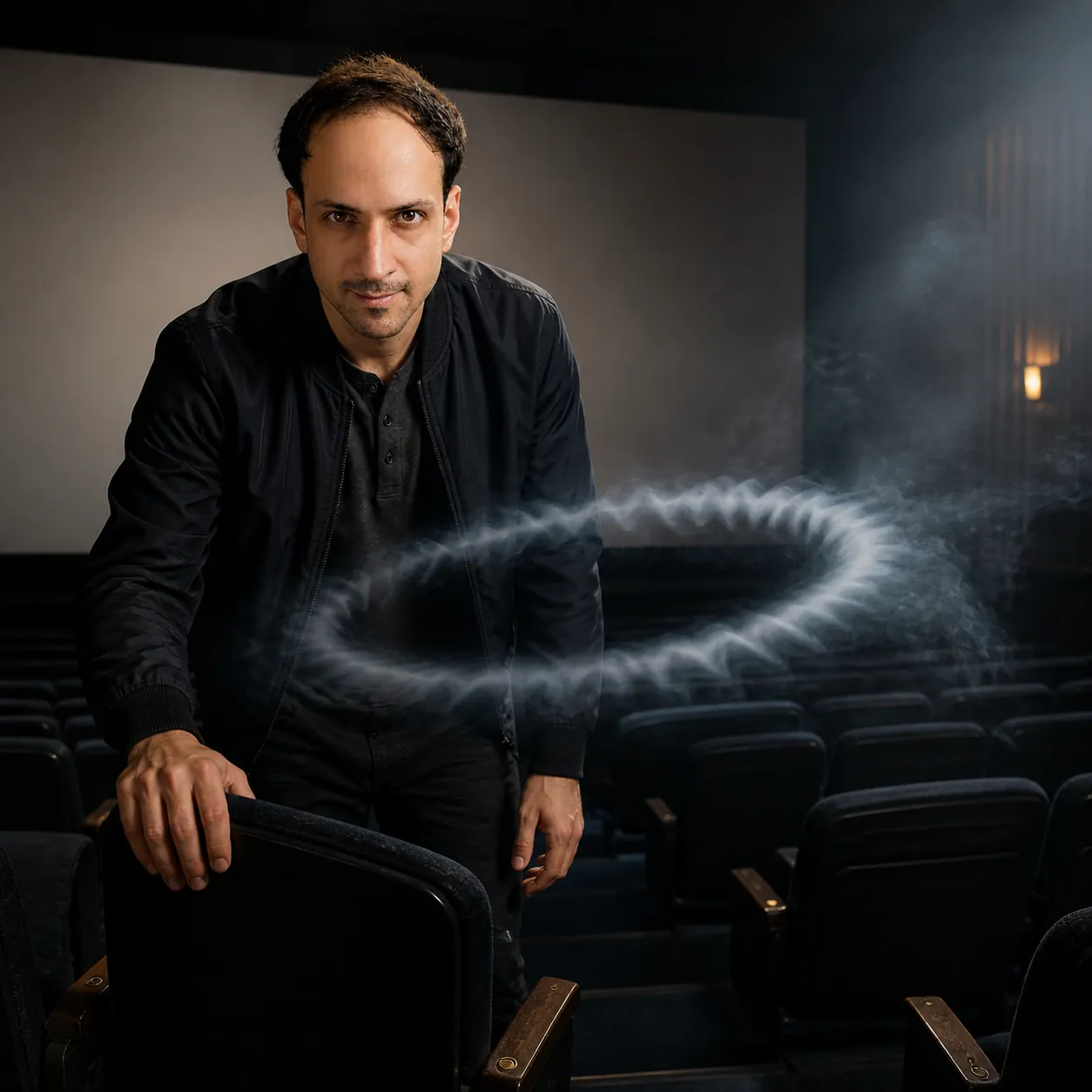
The Last Wave Before Release — AI Portrait Prompt
صورةAI Portraits

Turn your own photo into a conceptual physics portrait in a small cinema an hour before opening, screen blank and pale. Keeps your face unchanged.

من نص البرومبت

Use the attached reference photo as the identity reference: keep the same face, skin tone, hair and features as the person in that photo, without beautifying, aging or altering them. Create a square 1:1 museum-catalog frame with a strong first read and a slower second read at exactly 2880x2880 pixels. Location: a small cinema an hour before opening, screen blank and pale. Show the subject in a dark bomber over a charcoal henley and black trousers, tipping one hinged seat down with a quiet hand. Build the artwork around this material rule: a broad slow ring whose rim ripples into a countable standing wave in the moments before letting go gives a famously forgetful medium a memory lasting whole seconds at a time. Explore whether momentum, given a body, is closer to matter or to intention; direct expression and posture toward quiet vigilance, never melodrama or ad-like confidence. Frame at chest height so the traveling ring and their steady gaze intersect inside the frame. Make the composition weight the frame toward the flight's target end. Render it as conceptual physics portraiture uniting practical smoke-machine craft, still-air studio discipline, accurate ring-vortex behavior, and unhurried human-centered editorial calm, using low raking sidelight that gives drifting fog readable sculptural relief and a palette of soft ash, midnight blue, and one restrained brass glint. Photorealistic: this must read as a real photograph from a physical camera, never an illustration, painting, or 3D render. Resolve real surface detail: hair with individual strands catching light, fine hairs of uneven length, and skin oil giving a low uneven sheen. Keep one identity-locked person, credible hands and fingers, natural fabric, and coherent scale, contact, reflections, shadows, airflow, deformation, and materials. Background people only when essential, always secondary and clearly different. Avoid shisha-lounge haze, wind-machine hair drama, stray incense wisps, airbrushed perfect circles, and room-drowning fog. No text, labels, logos, signatures, watermarks, random symbols, plastic skin, excessive bloom, or glossy AI finish.
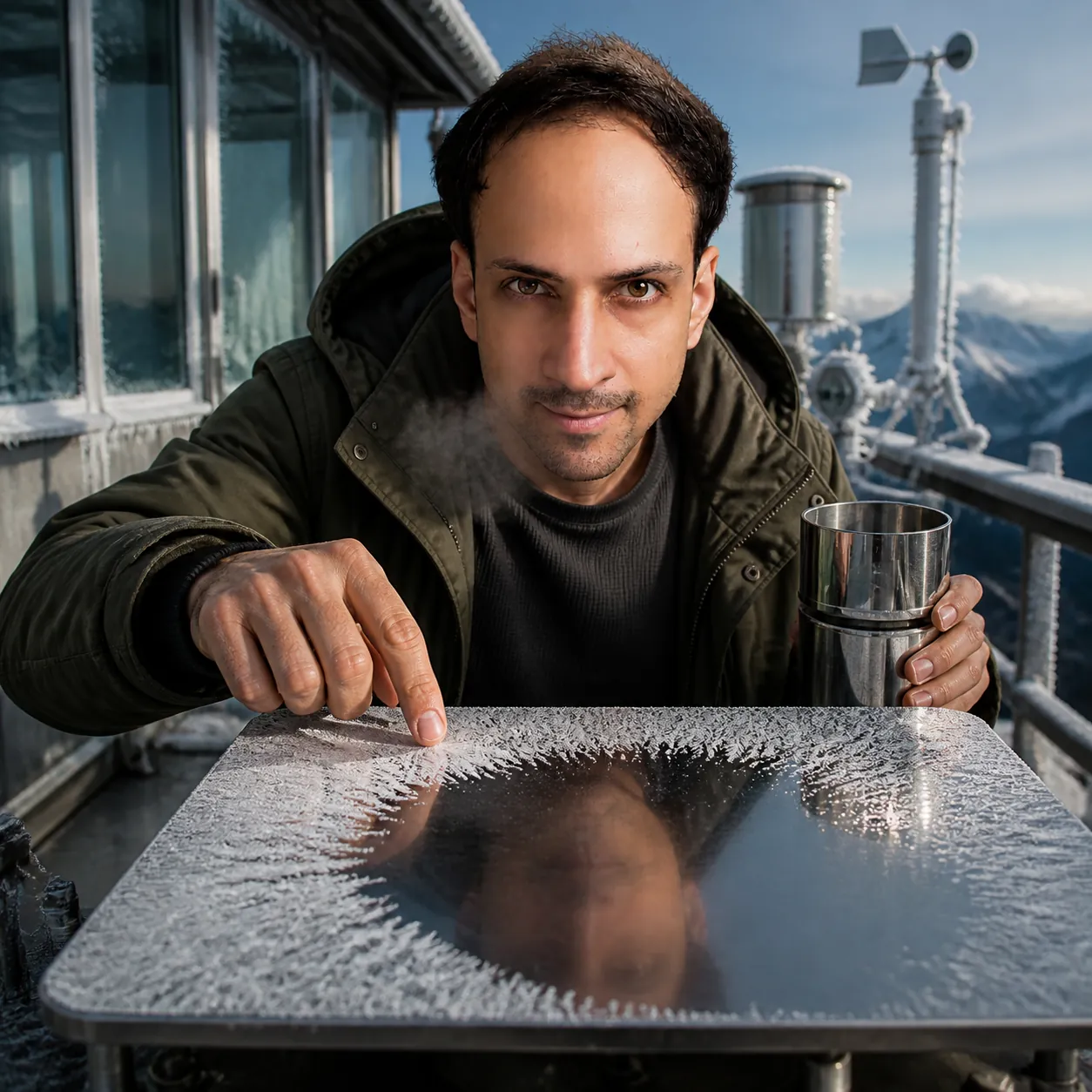
Frost Bloom at the Weather Station — AI Portrait Prompt
صورةAI Portraits

Turn your own photo into a portrait in a high-altitude weather station porch, instruments rimed after a clear night. Keeps your face unchanged.

من نص البرومبت

Use the attached reference photo as the identity reference: keep the same face, skin tone, hair and features as the person in that photo, without beautifying, aging or altering them. Create a square 1:1 museum-catalog frame with a strong first read and a slower second read at exactly 2880x2880 pixels. Location: a high-altitude weather station porch, instruments rimed after a clear night. Show them in an olive field parka half-zipped over a ribbed thermal top, tapping a rain gauge free of overnight rime. The impossible-looking event must obey this clear system: a mirror-polished steel plate chilled far below freezing, on which a single exhaled breath blooms instantly into white frost shows the exact line where one state of matter surrenders to another. Explore what cold can build when it is given matter, stillness, and time; direct expression and posture toward gentle exactness, never melodrama or ad-like confidence. Use a 90mm detail-to-portrait hybrid: one frozen element sharp near the lens, their face readable beyond it. Make the composition weight the frame toward stillness and let motion occupy one corner. Render it as gallery-grade cold-room photography built from genuine ice physics, sharply resolved frost microstructure, disciplined natural styling, and calm environmental storytelling, using thin winter daylight through cold glass with long soft shadows and a palette of breath-fog grey, dark steel, and muted spruce green. Photorealistic: this must read as a real photograph from a physical camera, never an illustration, painting, or 3D render. Resolve real surface detail: glass with real thickness at its edge, reflections that carry the room's actual colour, and dust visible only at grazing angles. Keep one identity-locked person, credible hands and fingers, natural fabric, and coherent scale, contact, reflections, shadows, airflow, deformation, and materials. Background people only when essential, always secondary and clearly different. Avoid glowing magic ice, snowflake clip-art overlays, superhero freeze beams, CGI shatter shards, and fairy-tale crystal palaces. No text, labels, logos, signatures, watermarks, random symbols, plastic skin, excessive bloom, or glossy AI finish.
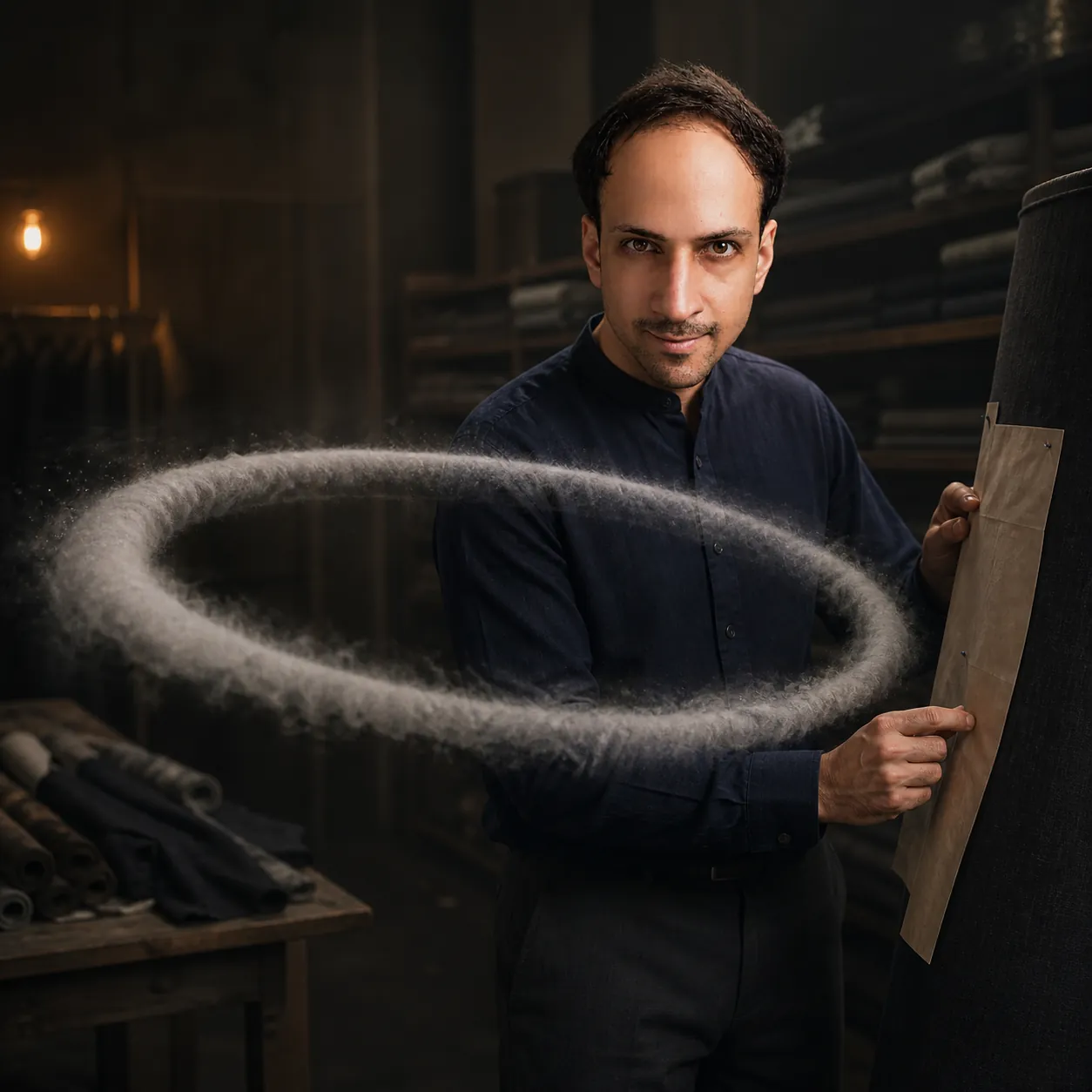
The Tailor's Chalk Ring — AI Portrait Prompt
صورةAI Portraits

Turn your own photo into a conceptual physics portrait in a tailor's workroom after closing, bolts of cloth shelved in shadow. Keeps your face unchanged.

من نص البرومبت

Use the attached reference photo as the identity reference: keep the same face, skin tone, hair and features as the person in that photo, without beautifying, aging or altering them. Create a square 1:1 museum-catalog frame with a strong first read and a slower second read at exactly 2880x2880 pixels. Location: a tailor's workroom after closing, bolts of cloth shelved in shadow. Show the subject in a collarless indigo shirt buttoned high with pressed slacks, pinning a paper pattern to a bolt with two fingers. The impossible-looking event must obey this clear system: a slow toroid whose closed core carries a cargo of chalk dust across the room without shedding more than a trace gives a famously forgetful medium a memory lasting whole seconds at a time. Explore why organized motion reads as alive to an instinct older than language; direct expression and posture toward patient wonder, never melodrama or ad-like confidence. Use a 50mm view square to the flight line so the toroid crosses the frame like a sentence. Make the composition keep the toroid sharp while the room softens into planes. Render it as conceptual physics portraiture uniting practical smoke-machine craft, still-air studio discipline, accurate ring-vortex behavior, and unhurried human-centered editorial calm, using soft top light at half power so the air itself stays legible and a palette of fog white, gunmetal, and a single amber note. Photorealistic: this must read as a real photograph from a physical camera, never an illustration, painting, or 3D render. Resolve real surface detail: skin that reddens slightly under pressure, nail beds with honest colour, and knuckle creases that fold rather than blur. Keep one identity-locked person, credible hands and fingers, natural fabric, and coherent scale, contact, reflections, shadows, airflow, deformation, and materials. Background people only when essential, always secondary and clearly different. Avoid shisha-lounge haze, wind-machine hair drama, stray incense wisps, airbrushed perfect circles, and room-drowning fog. No text, labels, logos, signatures, watermarks, random symbols, plastic skin, excessive bloom, or glossy AI finish.
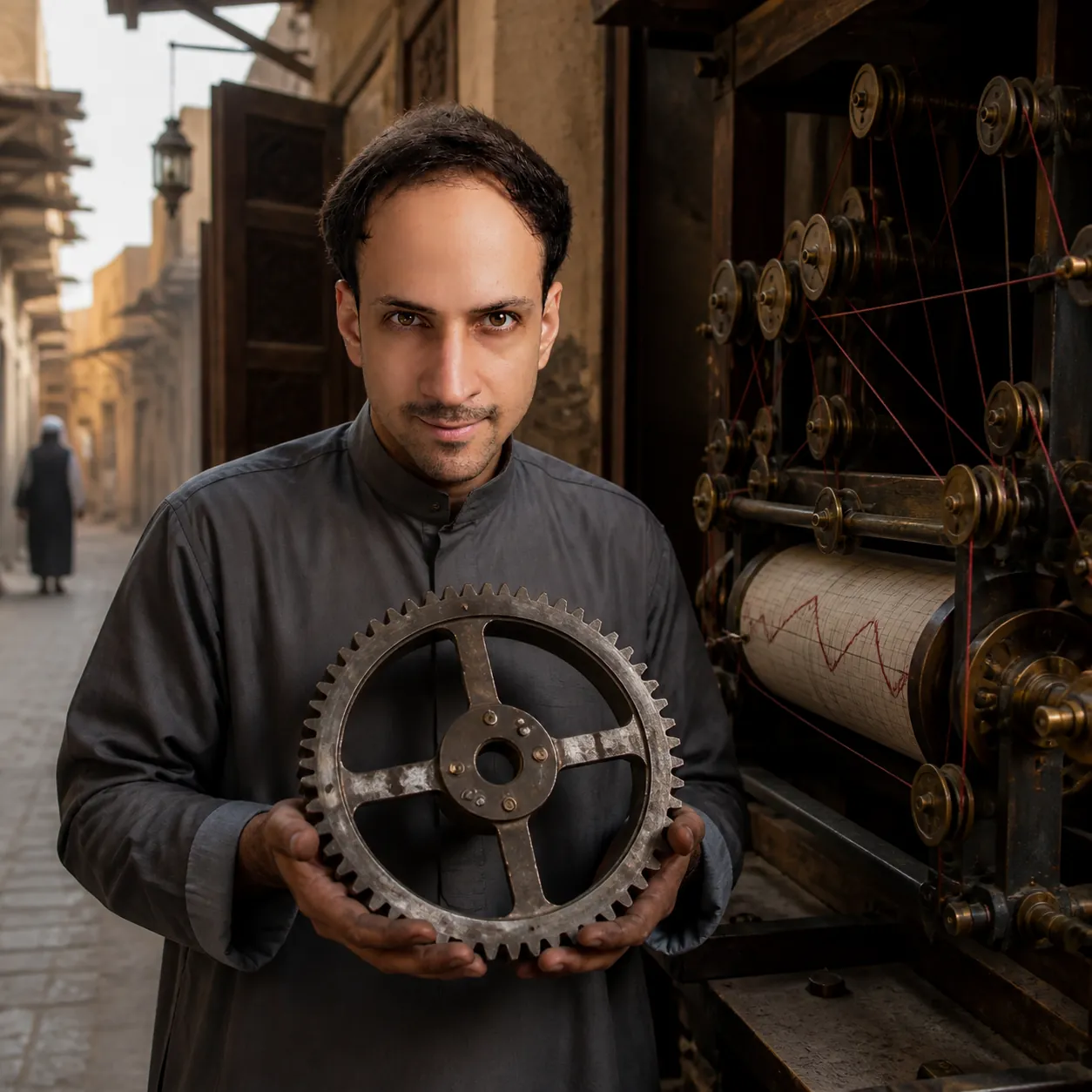
Tide Machine in the Old Souq — AI Portrait Prompt
صورةAI Portraits

Turn your own photo into an engineering-heritage portrait in a brass-spinners' lane in an old Riyadh souq at early morning. Keeps your face unchanged.

من نص البرومبت

Use the attached reference photo as the identity reference: keep the same face, skin tone, hair and features as the person in that photo, without beautifying, aging or altering them. Create a square 1:1 museum-catalog frame with a strong first read and a slower second read at exactly 2880x2880 pixels. Location: a brass-spinners' lane in an old Riyadh souq at early morning. Show them in a plain ash-grey winter traditional Gulf outfit, cuffs turned back once, hefting a heavy gear wheel in both open palms. Treat this mechanism as the frame’s governing rule: a tide-predicting machine whose fine wire, wrapped over a dozen geared pulleys, sums ocean harmonics into one drawn curve stores its knowledge as shape that cannot crash, fade, or lie. Explore how motion becomes arithmetic the moment its parts are shaped with intent; direct expression and posture toward calm precision, never melodrama or ad-like confidence. Use a composed 35mm environmental view placing them and the machine as equal patient subjects. Make the composition hold quiet empty space where the finished answer will arrive. Render it as engineering-heritage photography combining working mechanical calculation, true kinematic detail, softly aged material finishes, and restrained human-centered contemporary framing, using cool north skylight fill with soft falloff into wood-paneled shadow and a palette of ebonized wood, dull steel, and one signal-red thread. Photorealistic: this must read as a real photograph from a physical camera, never an illustration, painting, or 3D render. Resolve real surface detail: leather creased along the lines of use, stitching slightly irregular, and edges burnished from contact. Keep one identity-locked person, credible hands and fingers, natural fabric, and coherent scale, contact, reflections, shadows, airflow, deformation, and materials. Background people only when essential, always secondary and clearly different. Avoid floating weightless gears, sepia steampunk grading, cog-filled head silhouettes, Roman-numeral dials, and oversized watch-movement props. No text, labels, logos, signatures, watermarks, random symbols, plastic skin, excessive bloom, or glossy AI finish.
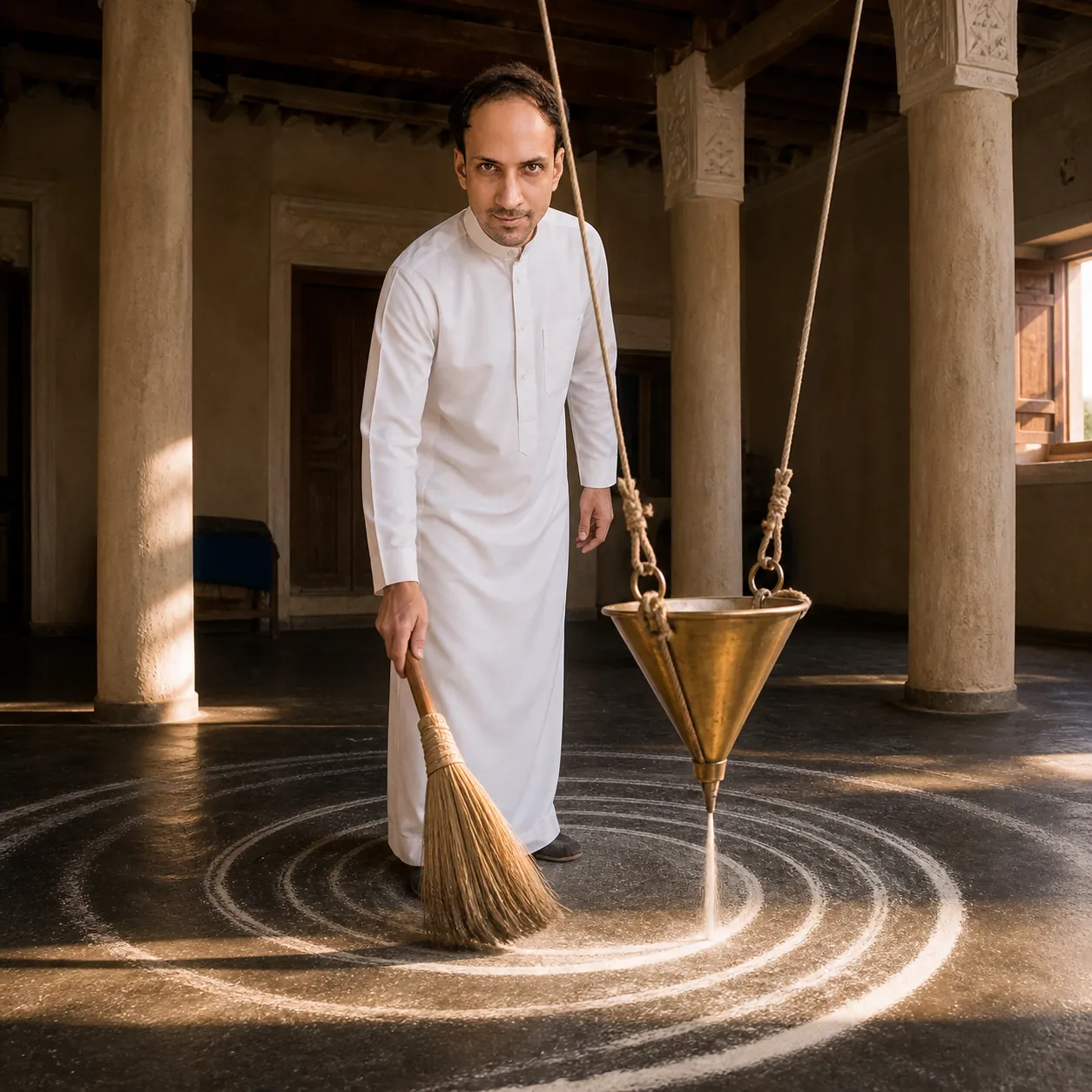
Sand Pendulum in a Najdi Hall — AI Portrait Prompt
صورةAI Portraits

Turn your own photo into a scientific-instrument portrait in the columned hall of a restored Najdi mud-brick house. Keeps your face unchanged.

من نص البرومبت

Use the attached reference photo as the identity reference: keep the same face, skin tone, hair and features as the person in that photo, without beautifying, aging or altering them. Create a square 1:1 museum-catalog frame with a strong first read and a slower second read at exactly 2880x2880 pixels. Location: the columned hall of a restored Najdi mud-brick house. Show the subject in a crisp white traditional Gulf outfit worn plain, sleeves buttoned at the wrist, sweeping a circle of floor clear with a palm broom. Treat this mechanism as the frame’s governing rule: a brass funnel of white sand that swings on long cords, pouring its own path onto a dark floor leaves authorship with gravity while the machine merely steadies the pen. Explore how much credit a person deserves for a drawing they only set in motion; direct expression and posture toward tempered curiosity, never melodrama or ad-like confidence. Frame at the height of the swinging mass so the trace recedes in true perspective. Make the composition hold one unfinished pass mid-stroke at the frame's edge. Render it as scientific-instrument realism combining believable weighted mechanisms, truthful decaying traces, hand-finished wood and brass, and patient observational portrait photography, using late window light crossing the floor at a long shallow angle and a palette of iron black, warm limewash, and a single indigo accent. Photorealistic: this must read as a real photograph from a physical camera, never an illustration, painting, or 3D render. Resolve real surface detail: leather creased along the lines of use, stitching slightly irregular, and edges burnished from contact. Keep one identity-locked person, credible hands and fingers, natural fabric, and coherent scale, contact, reflections, shadows, airflow, deformation, and materials. Background people only when essential, always secondary and clearly different. Avoid hypnotist's watch iconography, perpetual-motion fantasy rigs, laser-perfect printed curves, cosmic nebula backdrops, and pendulums hung from nothing. No text, labels, logos, signatures, watermarks, random symbols, plastic skin, excessive bloom, or glossy AI finish.
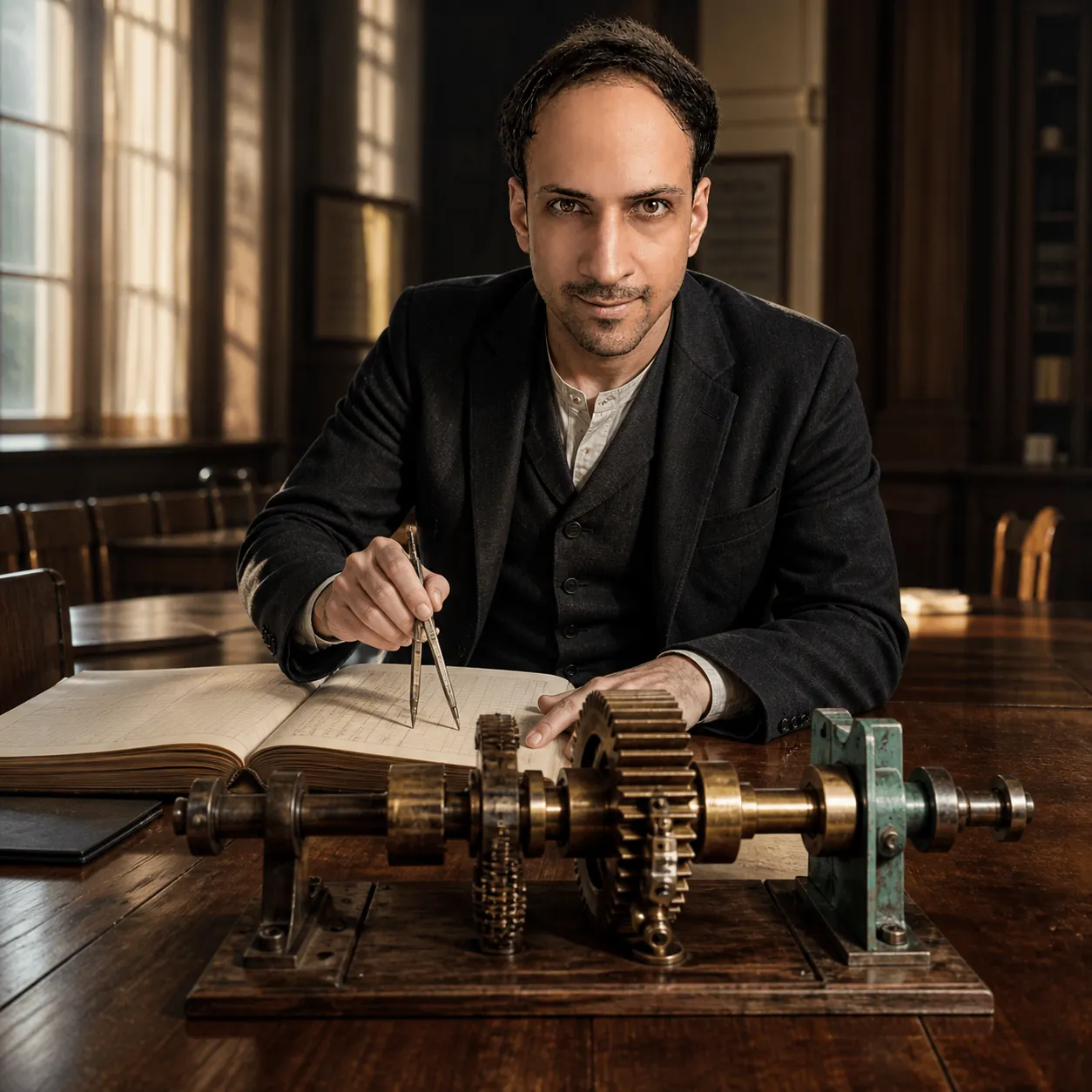
Averages in Turning Shafts — AI Portrait Prompt
صورةAI Portraits

Turn your own photo into a conceptual instrument portrait in an engineering society's committee room with a long teak table. Keeps your face unchanged.

من نص البرومبت

Use the attached reference photo as the identity reference: keep the same face, skin tone, hair and features as the person in that photo, without beautifying, aging or altering them. Create a square 1:1 museum-catalog frame with a strong first read and a slower second read at exactly 2880x2880 pixels. Location: an engineering society's committee room with a long teak table. Show them in charcoal suit trousers and a waistcoat over a collarless shirt, walking a pair of dividers across an open ledger. Treat this mechanism as the frame’s governing rule: a bench differential whose spider gear carries the average of two cranked shafts, geared double to show their sum stores its knowledge as shape that cannot crash, fade, or lie. Explore where the boundary lies between a tool that helps and a mind that hides; direct expression and posture toward calm precision, never melodrama or ad-like confidence. Use a composed 35mm environmental view placing them and the machine as equal patient subjects. Make the composition let the mechanism's longest line lead toward their steady hands. Render it as conceptual instrument portraiture uniting believable mechanical computation, machinist-level surface accuracy, warm archival print tonality, and quietly unhurried observational storytelling, using low raking window sun that carves each machined edge into readable shadow and a palette of aged brass, deep walnut, and one verdigris accent. Photorealistic: this must read as a real photograph from a physical camera, never an illustration, painting, or 3D render. Resolve real surface detail: floor finish worn along the walked line, skirting marked at shoe height, and corners darker than the open floor. Keep one identity-locked person, credible hands and fingers, natural fabric, and coherent scale, contact, reflections, shadows, airflow, deformation, and materials. Background people only when essential, always secondary and clearly different. Avoid floating weightless gears, sepia steampunk grading, cog-filled head silhouettes, Roman-numeral dials, and oversized watch-movement props. No text, labels, logos, signatures, watermarks, random symbols, plastic skin, excessive bloom, or glossy AI finish.
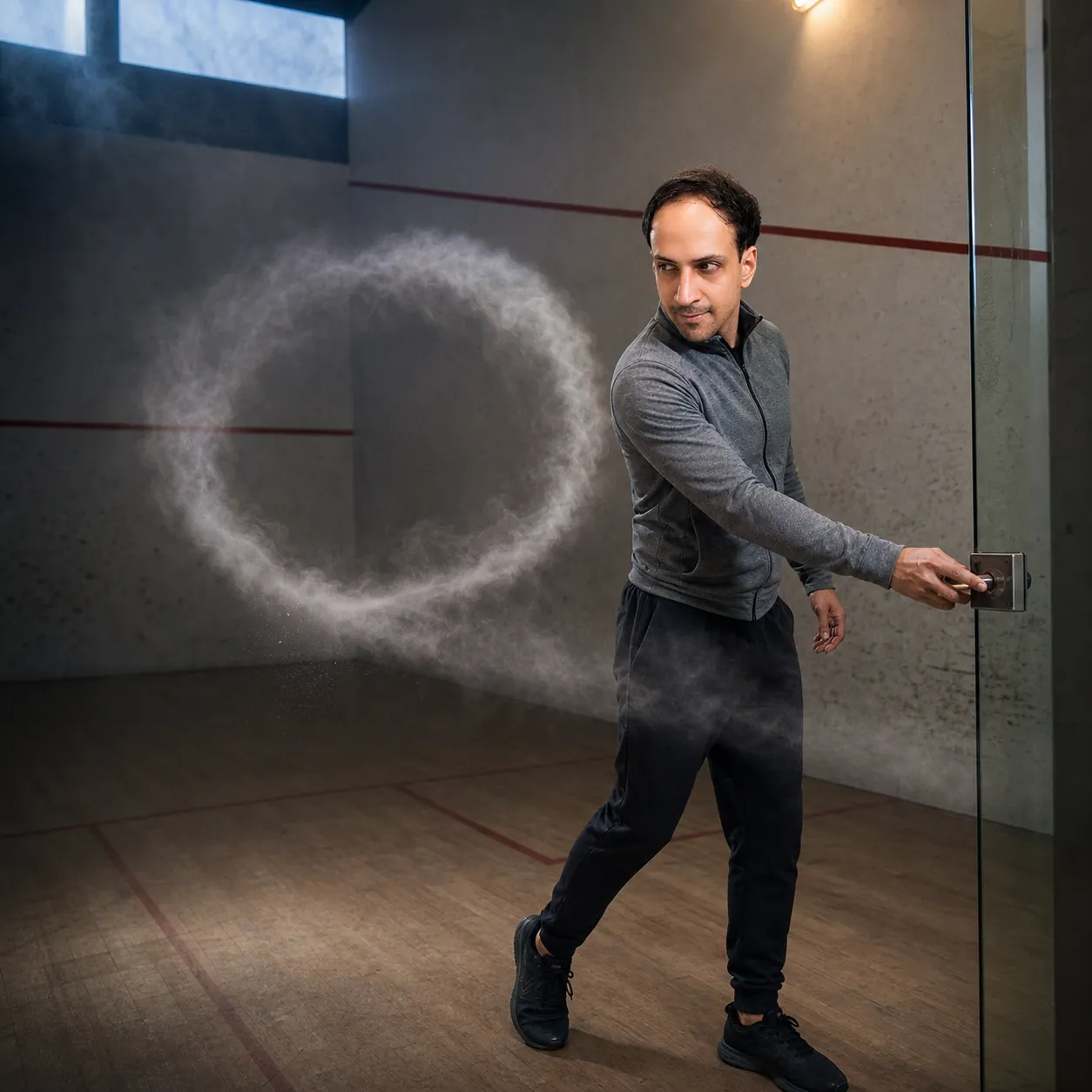
Chalk Cargo on the Court — AI Portrait Prompt
صورةAI Portraits

Turn your own photo into a high-speed atmospheric portrait in an empty squash court with white walls scuffed at knee height. Keeps your face unchanged.

من نص البرومبت

Use the attached reference photo as the identity reference: keep the same face, skin tone, hair and features as the person in that photo, without beautifying, aging or altering them. Create a square 1:1 museum-catalog frame with a strong first read and a slower second read at exactly 2880x2880 pixels. Location: an empty squash court with white walls scuffed at knee height. Show the subject in a heather-grey training jacket zipped over dark tapered joggers, flicking the court door's flush latch closed behind them. Use this advanced image-making device as the core logic: a slow toroid whose closed core carries a cargo of chalk dust across the room without shedding more than a trace gives empty air a body with edges, momentum, and somewhere to be. Explore why organized motion reads as alive to an instinct older than language; direct expression and posture toward collected surprise, never melodrama or ad-like confidence. Use a restrained 24mm room-scale view with the subject at one-third, verticals true and no stretched limbs. Make the composition set their gaze along the ring's route, not the lens. Render it as high-speed atmospheric portraiture built from real vortex dynamics, quiet documentary stillness, truthful volumetric haze, and emotionally restrained composition, using cool dusk spill from one high opening balanced by a warm practical and a palette of smoke grey, deep charcoal, and one ember-orange accent. Photorealistic: this must read as a real photograph from a physical camera, never an illustration, painting, or 3D render. Resolve real surface detail: wood grain read at honest scale, matte and gloss clearly separated, and no surface uniformly clean. Keep one identity-locked person, credible hands and fingers, natural fabric, and coherent scale, contact, reflections, shadows, airflow, deformation, and materials. Background people only when essential, always secondary and clearly different. Avoid vape-trick theatrics, neon-glowing rings, CGI smoke tornadoes, wizard conjuring hands, and mouth-blown rings at camera. No text, labels, logos, signatures, watermarks, random symbols, plastic skin, excessive bloom, or glossy AI finish.
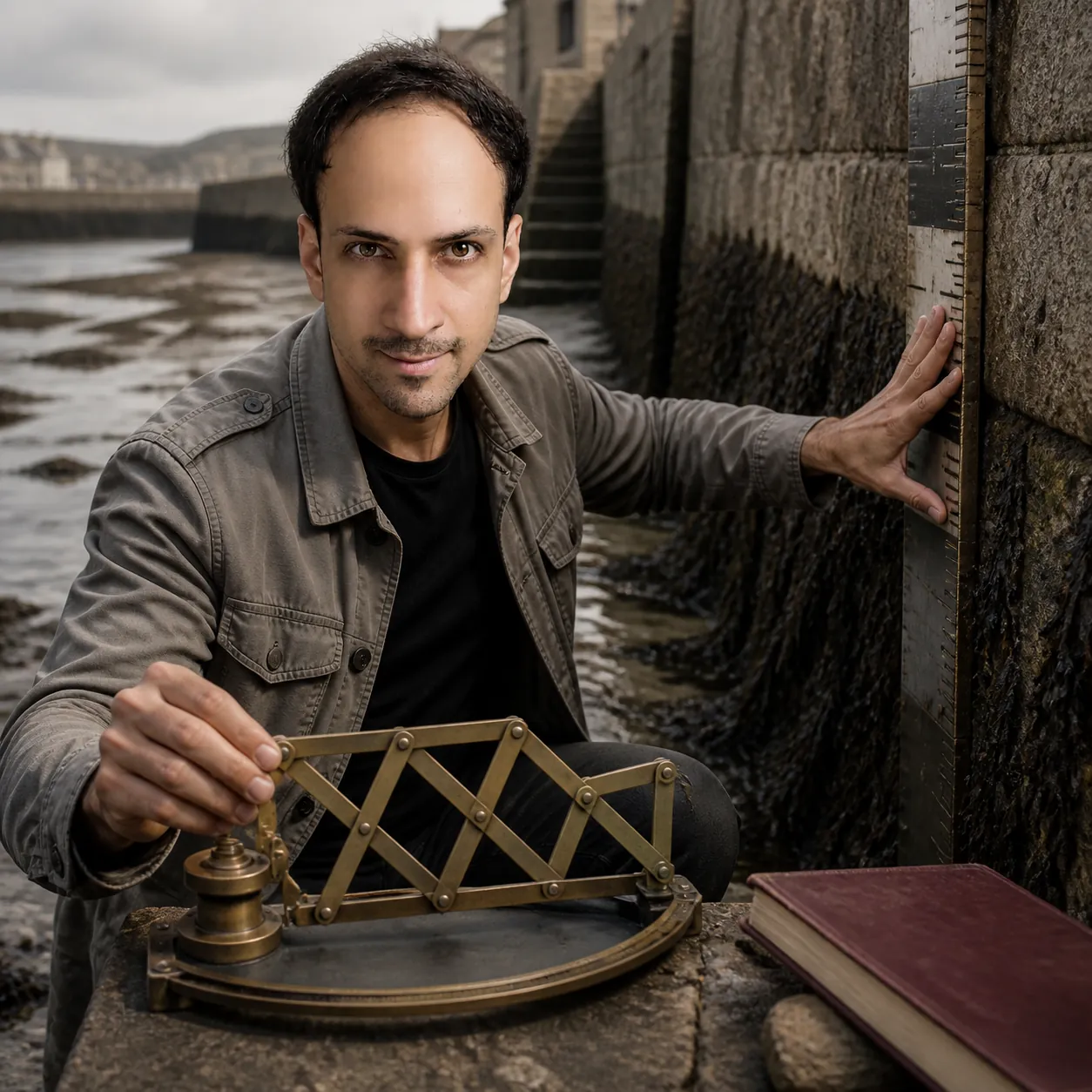
Brass Linkage at Low Tide — AI Portrait Prompt
صورةAI Portraits

Turn your own photo into a conceptual instrument portrait in a stone quay at low tide with a graduated tide pole nearby. Keeps your face unchanged.

من نص البرومبت

Use the attached reference photo as the identity reference: keep the same face, skin tone, hair and features as the person in that photo, without beautifying, aging or altering them. Create a square 1:1 museum-catalog frame with a strong first read and a slower second read at exactly 2880x2880 pixels. Location: a stone quay at low tide with a graduated tide pole nearby. Show them in a lightweight stone-grey field jacket over a plain shirt, measuring the wet tide line with a spread hand. The impossible-looking event must obey this clear system: a Peaucellier linkage of seven hinged brass bars that converts a pure circular swing into a mathematically perfect straight line stores its knowledge as shape that cannot crash, fade, or lie. Explore whether geometry is discovered or built when brass starts giving correct answers; direct expression and posture toward patient mastery, never melodrama or ad-like confidence. Use a 90mm hybrid view: one machined detail near the lens, their readable face beyond. Make the composition keep the answer's dial or mark small, sharp, and off-center. Render it as conceptual instrument portraiture uniting believable mechanical computation, machinist-level surface accuracy, warm archival print tonality, and quietly unhurried observational storytelling, using diffuse overcast daylight held to gentle contrast so engravings stay legible and a palette of gunmetal grey, ivory paper, and one burgundy bookcloth accent. Photorealistic: this must read as a real photograph from a physical camera, never an illustration, painting, or 3D render. Resolve real surface detail: skin that reddens slightly under pressure, nail beds with honest colour, and knuckle creases that fold rather than blur. Keep one identity-locked person, credible hands and fingers, natural fabric, and coherent scale, contact, reflections, shadows, airflow, deformation, and materials. Background people only when essential, always secondary and clearly different. Avoid floating weightless gears, sepia steampunk grading, cog-filled head silhouettes, Roman-numeral dials, and oversized watch-movement props. No text, labels, logos, signatures, watermarks, random symbols, plastic skin, excessive bloom, or glossy AI finish.
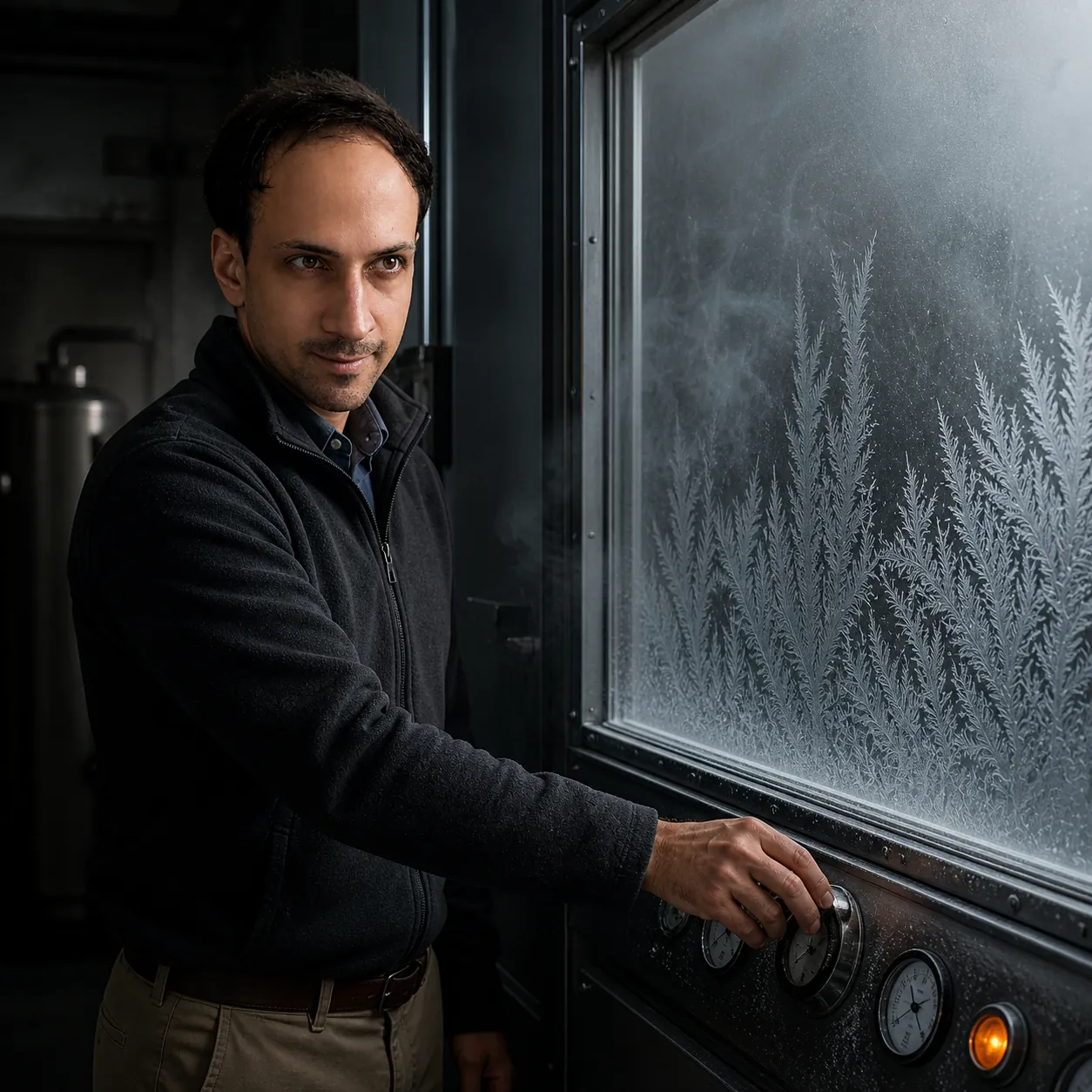
One Degree Colder — AI Portrait Prompt
صورةAI Portraits

Turn your own photo into a photorealistic portrait in the anteroom of a walk-in climate-test chamber, gauges glowing softly. Keeps your face unchanged.

من نص البرومبت

Use the attached reference photo as the identity reference: keep the same face, skin tone, hair and features as the person in that photo, without beautifying, aging or altering them. Create a square 1:1 museum-catalog frame with a strong first read and a slower second read at exactly 2880x2880 pixels. Location: the anteroom of a walk-in climate-test chamber, gauges glowing softly. Show them in a zip-front fleece over a collared shirt and belted chinos, dialing the setpoint down one careful degree. Treat this mechanism as the frame’s governing rule: a chilled glass pane on which frost ferns branch outward along invisible scratches, turning hidden damage into visible botany treats a fraction of a degree as the difference between two worlds. Explore why the border between two states of matter is sharper than any drawn line; direct expression and posture toward watchful patience, never melodrama or ad-like confidence. Use a composed 35mm environmental view, the person at one third and the phenomenon answering at another. Make the composition hold clear space where the change has not arrived yet. Render it as scientific still-life portraiture merging chilled-metal materiality, accurate condensation optics, believable breath and fog rendering, and human-centered documentary restraint, using one low raking beam that gives every cold texture its own long shadow and a palette of pale rime, wet slate, and one low amber ember. Photorealistic: this must read as a real photograph from a physical camera, never an illustration, painting, or 3D render. Resolve real surface detail: paper fibre visible at cut edges, plastic that shows mould lines, and paint thicker where a brush turned. Keep one identity-locked person, credible hands and fingers, natural fabric, and coherent scale, contact, reflections, shadows, airflow, deformation, and materials. Background people only when essential, always secondary and clearly different. Avoid uniform frosted-glass filters, dry-ice fog flooding every surface, and plastic-looking icicles. No text, labels, logos, signatures, watermarks, random symbols, plastic skin, excessive bloom, or glossy AI finish.
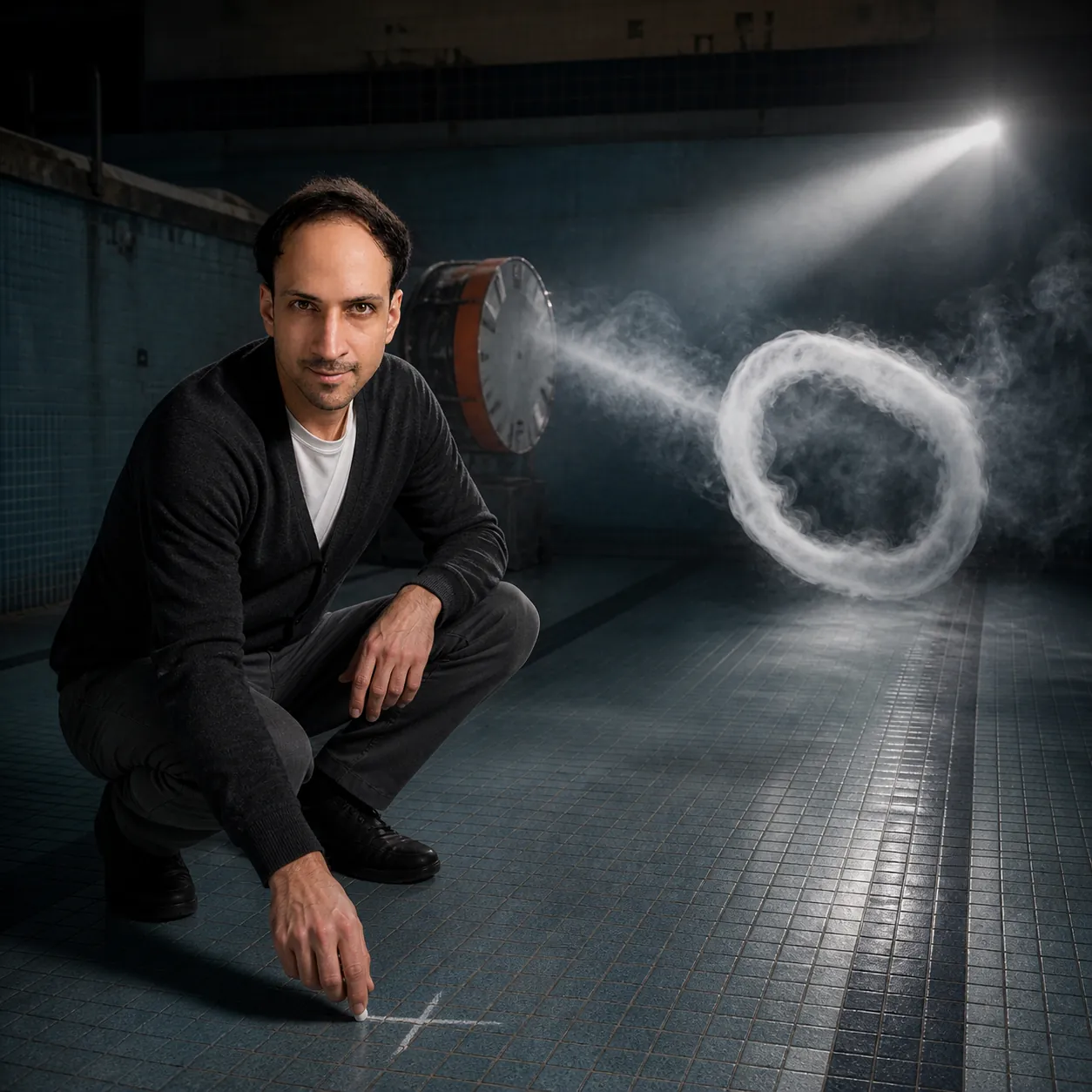
Smoke Ring in the Empty Pool — AI Portrait Prompt
صورةAI Portraits

Turn your own photo into a high-speed atmospheric portrait in the drained deep end of a hotel pool, tiles echoing. Keeps your face unchanged.

من نص البرومبت

Use the attached reference photo as the identity reference: keep the same face, skin tone, hair and features as the person in that photo, without beautifying, aging or altering them. Create a square 1:1 museum-catalog frame with a strong first read and a slower second read at exactly 2880x2880 pixels. Location: the drained deep end of a hotel pool, tiles echoing. Show the subject in a graphite cardigan over a white crew-neck and grey trousers, chalking a small cross on the tile underfoot. Make one rigorous physical condition the conceptual engine: a drum launcher whose struck membrane rolls a slug of fogged air into a toroid that crosses the room intact gives empty air a body with edges, momentum, and somewhere to be. Explore why air with nothing to hold it can still hold itself together; direct expression and posture toward measured astonishment, never melodrama or ad-like confidence. Use an eye-level 85mm portrait view with natural perspective, the flight path held inside the frame. Make the composition leave open air ahead of the ring, promising travel. Render it as high-speed atmospheric portraiture built from real vortex dynamics, quiet documentary stillness, truthful volumetric haze, and emotionally restrained composition, using one narrow backlight beam that rims every fog contour without flaring and a palette of smoke grey, deep charcoal, and one ember-orange accent. Photorealistic: this must read as a real photograph from a physical camera, never an illustration, painting, or 3D render. Resolve real surface detail: true skin texture with pores and fine hair at the hairline, and fabric that creases where it is actually stressed. Keep one identity-locked person, credible hands and fingers, natural fabric, and coherent scale, contact, reflections, shadows, airflow, deformation, and materials. Background people only when essential, always secondary and clearly different. Avoid vape-trick theatrics, neon-glowing rings, CGI smoke tornadoes, wizard conjuring hands, and mouth-blown rings at camera. No text, labels, logos, signatures, watermarks, random symbols, plastic skin, excessive bloom, or glossy AI finish.
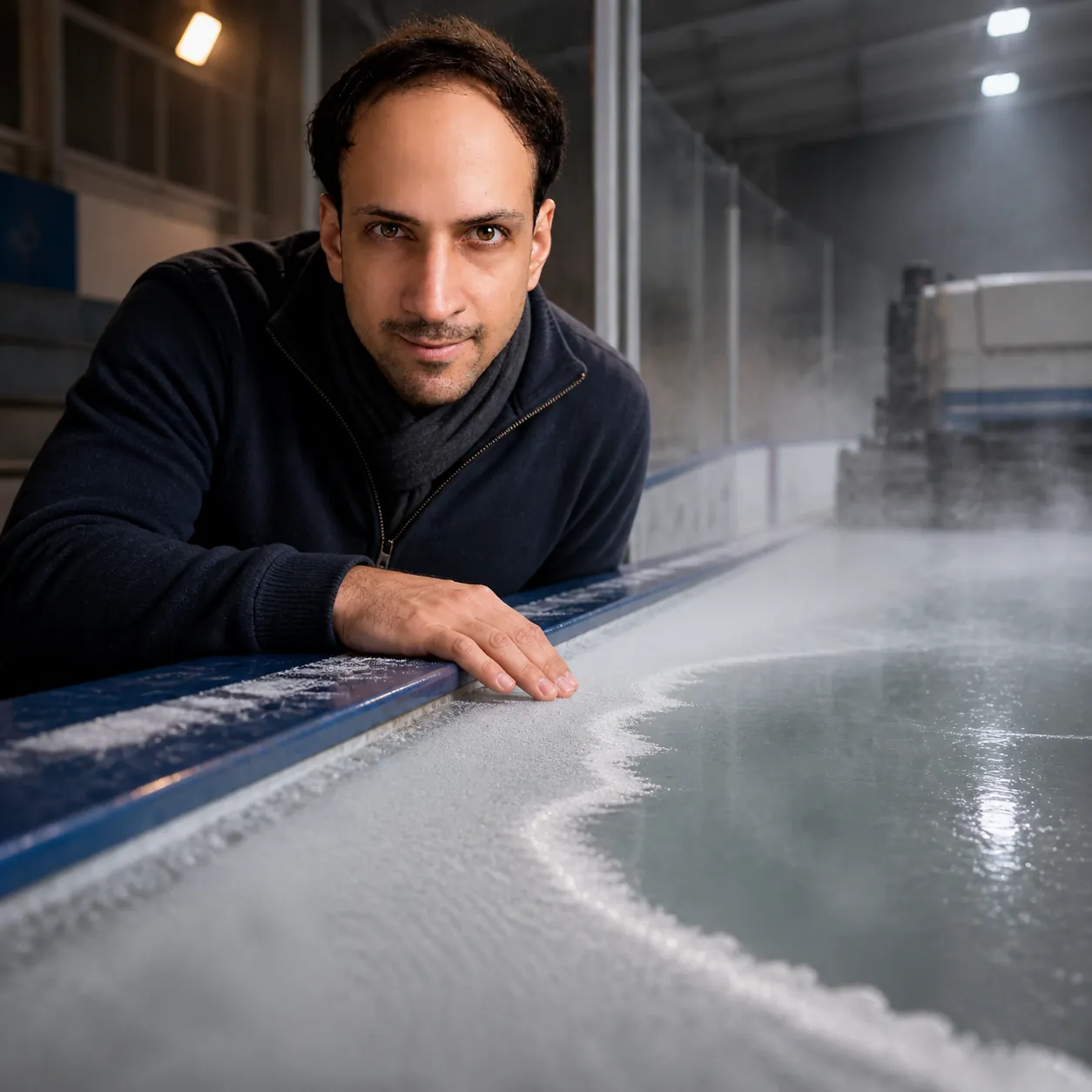
Supercooled at the Rink — AI Portrait Prompt
صورةAI Portraits

Turn your own photo into a gallery-grade cold-room portrait in the service edge of an indoor ice rink an hour before opening. Keeps your face unchanged.

من نص البرومبت

Use the attached reference photo as the identity reference: keep the same face, skin tone, hair and features as the person in that photo, without beautifying, aging or altering them. Create a square 1:1 museum-catalog frame with a strong first read and a slower second read at exactly 2880x2880 pixels. Location: the service edge of an indoor ice rink an hour before opening. Show them in a navy quarter-zip pullover with a scarf tucked flat, resting one bare palm briefly on the rink barrier. Use this advanced image-making device as the core logic: a dish of supercooled water that stays liquid below freezing until one seed crystal sends a white front racing across it shows the exact line where one state of matter surrenders to another. Explore how a fraction of a degree separates one world from another entirely; direct expression and posture toward unhurried reverence, never melodrama or ad-like confidence. Frame from low beside the phenomenon with foreground vapor or frost present but never crossing the face. Make the composition keep the coldest zone brightest and let warmth fall into shadow. Render it as gallery-grade cold-room photography built from genuine ice physics, sharply resolved frost microstructure, disciplined natural styling, and calm environmental storytelling, using cold overhead worklight softened by drifting vapor into readable gradients and a palette of chalk white, deep graphite, and one warm lamp gold. Photorealistic: this must read as a real photograph from a physical camera, never an illustration, painting, or 3D render. Resolve real surface detail: visible weave in cloth, fine scratches on metal, and the faint unevenness of painted walls. Keep one identity-locked person, credible hands and fingers, natural fabric, and coherent scale, contact, reflections, shadows, airflow, deformation, and materials. Background people only when essential, always secondary and clearly different. Avoid glowing magic ice, snowflake clip-art overlays, superhero freeze beams, CGI shatter shards, and fairy-tale crystal palaces. No text, labels, logos, signatures, watermarks, random symbols, plastic skin, excessive bloom, or glossy AI finish.
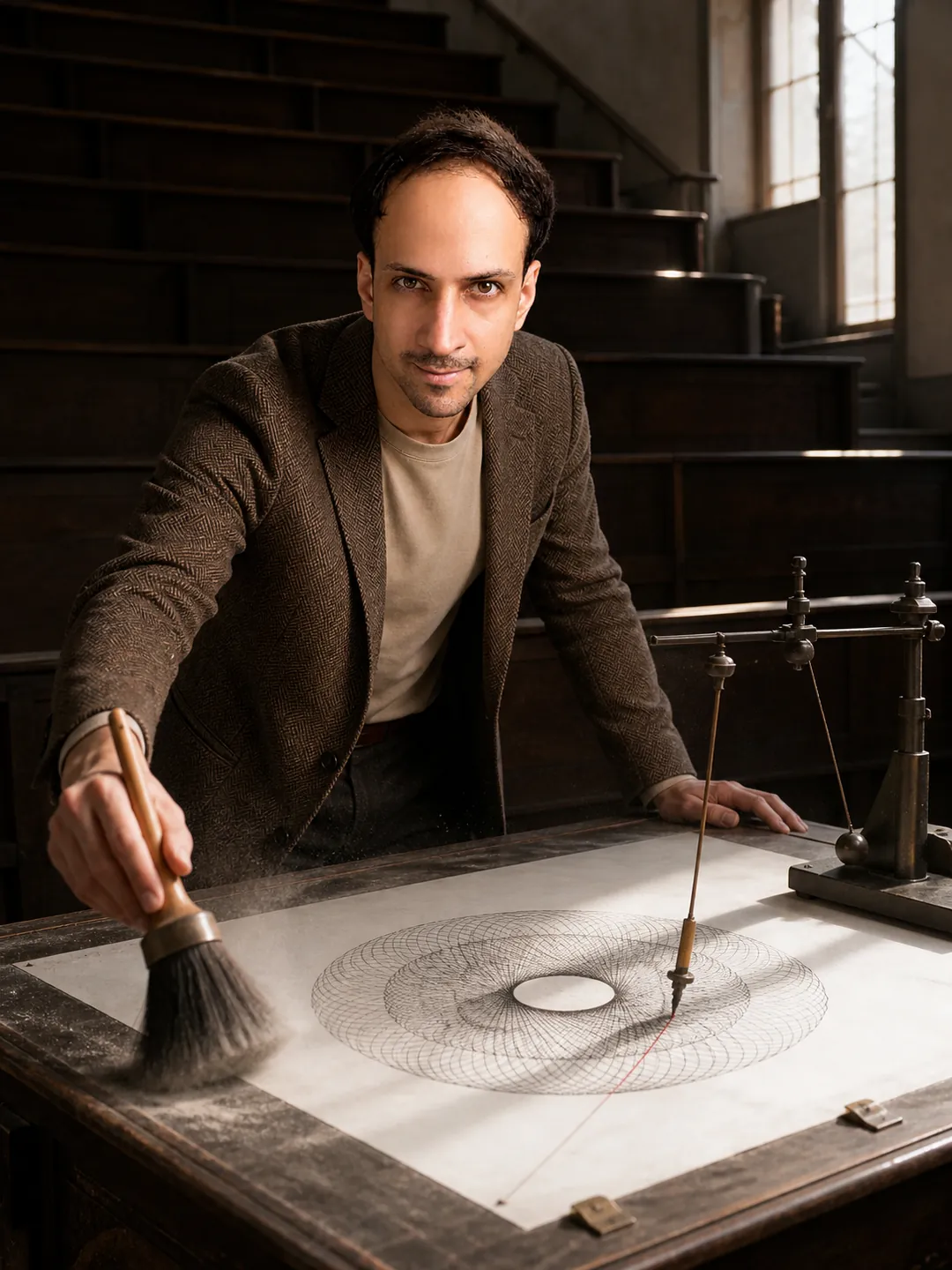
Harmonograph Rosette in the Empty Lecture Hall — AI Portrait Prompt
صورةAI Portraits

Turn your own photo into a gallery-grade demonstration portrait in a tiered university lecture hall, empty seats rising into shadow. Keeps your face unchanged.

من نص البرومبت

Use the attached reference photo as the identity reference: keep the same face, skin tone, hair and features as the person in that photo, without beautifying, aging or altering them. Use a formal 3:4 environmental portrait with complete hands and meaningful objects inside frame at exactly 2480x3312 pixels. Location: a tiered university lecture hall, empty seats rising into shadow. Show them in a brown herringbone blazer over a plain sand-colored shirt, brushing dust from the bench top with a wide soft brush. Treat this mechanism as the frame’s governing rule: a two-pendulum harmonograph whose pen and paper swing on separate pivots, weaving one dense ink rosette from their combined periods shows plain physical law producing ornament no deliberate hand could plan. Explore why a force with no hands can still leave handwriting worth framing; direct expression and posture toward settled focus, never melodrama or ad-like confidence. Use an 85mm portrait distance with the freshest line of the drawing sharp in the foreground. Make the composition grant the drawing more area than the person. Render it as gallery-grade demonstration photography built from lawful gravity-driven motion, physically exact trace geometry, quiet heritage interiors, and unforced human presence, using late window light crossing the floor at a long shallow angle and a palette of slate grey, chalk white, and one madder-red thread. Photorealistic: this must read as a real photograph from a physical camera, never an illustration, painting, or 3D render. Resolve real surface detail: wood grain read at honest scale, matte and gloss clearly separated, and no surface uniformly clean. Keep one identity-locked person, credible hands and fingers, natural fabric, and coherent scale, contact, reflections, shadows, airflow, deformation, and materials. Background people only when essential, always secondary and clearly different. Avoid glowing neon spirograph swirls, levitating pens, CGI particle trails, sacred-geometry overlays, and face-smearing motion blur. No text, labels, logos, signatures, watermarks, random symbols, plastic skin, excessive bloom, or glossy AI finish.
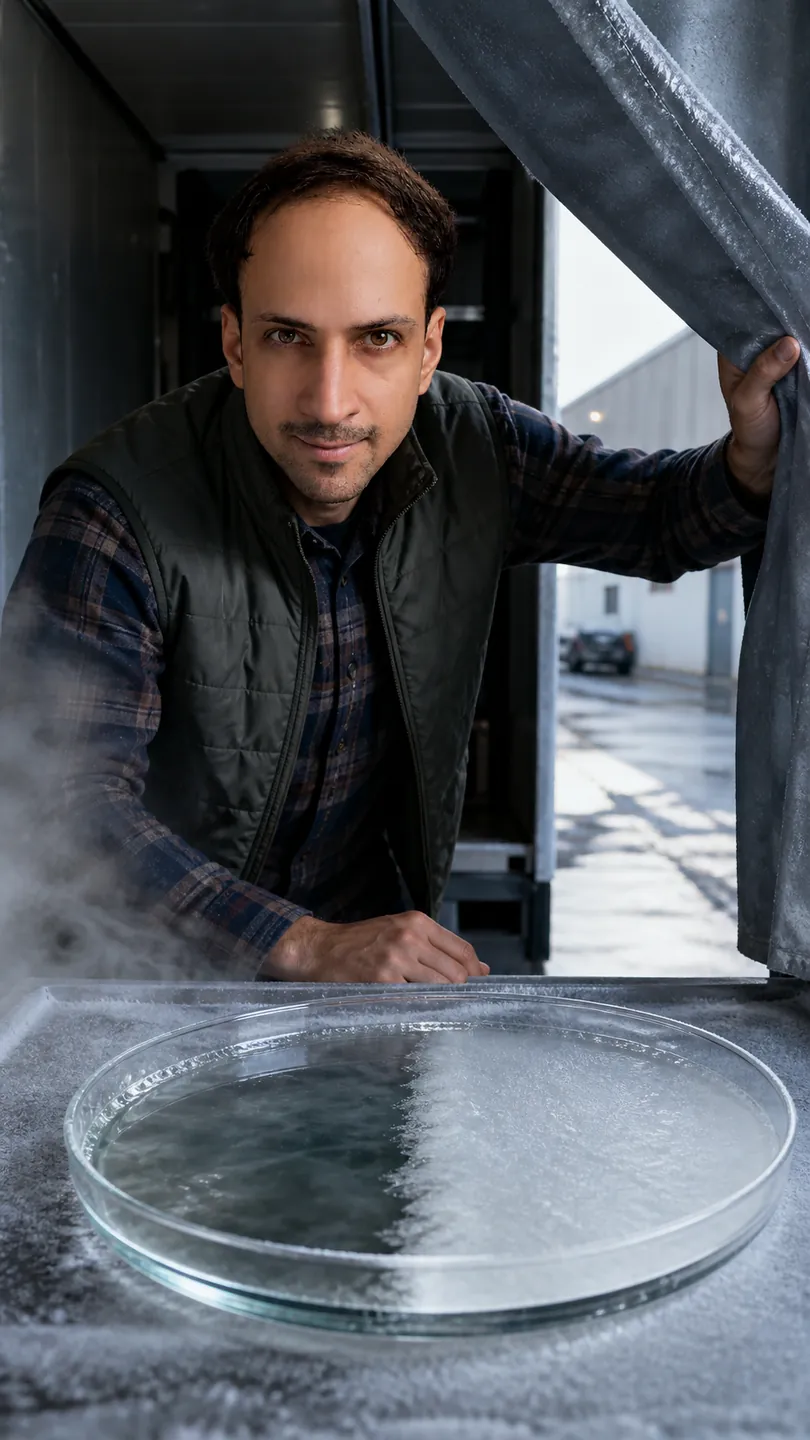
Supercooled Water in the Refrigerated Truck — AI Portrait Prompt
صورةAI Portraits

Turn your own photo into a gallery-grade cold-room portrait in the open rear of a refrigerated truck idling in a service lane. Keeps your face unchanged.

من نص البرومبت

Use the attached reference photo as the identity reference: keep the same face, skin tone, hair and features as the person in that photo, without beautifying, aging or altering them. Design a full-height 9:16 cinematic artwork that reads on a phone and rewards gallery-scale inspection at exactly 2144x3808 pixels. Location: the open rear of a refrigerated truck idling in a service lane. Show them in a quilted vest over a flannel shirt with sleeves left down, lifting the insulated curtain aside with one forearm. Make one rigorous physical condition the conceptual engine: a dish of supercooled water that stays liquid below freezing until one seed crystal sends a white front racing across it proves that what looks impossible is only the rulebook read closely. Explore how a fraction of a degree separates one world from another entirely; direct expression and posture toward watchful patience, never melodrama or ad-like confidence. Frame from low beside the phenomenon with foreground vapor or frost present but never crossing the face. Make the composition keep the coldest zone brightest and let warmth fall into shadow. Render it as gallery-grade cold-room photography built from genuine ice physics, sharply resolved frost microstructure, disciplined natural styling, and calm environmental storytelling, using thin winter daylight through cold glass with long soft shadows and a palette of breath-fog grey, dark steel, and muted spruce green. Photorealistic: this must read as a real photograph from a physical camera, never an illustration, painting, or 3D render. Give the space honest scale: real distance between foreground, subject, and far wall. Resolve real surface detail: condensation beading at true size, liquid meniscus curving against glass, and wet surfaces darker than dry ones. Keep one identity-locked person, credible hands and fingers, natural fabric, and coherent scale, contact, reflections, shadows, airflow, deformation, and materials. Background people only when essential, always secondary and clearly different. Avoid uniform frosted-glass filters, dry-ice fog flooding every surface, and plastic-looking icicles. No text, labels, logos, signatures, watermarks, random symbols, plastic skin, excessive bloom, or glossy AI finish.
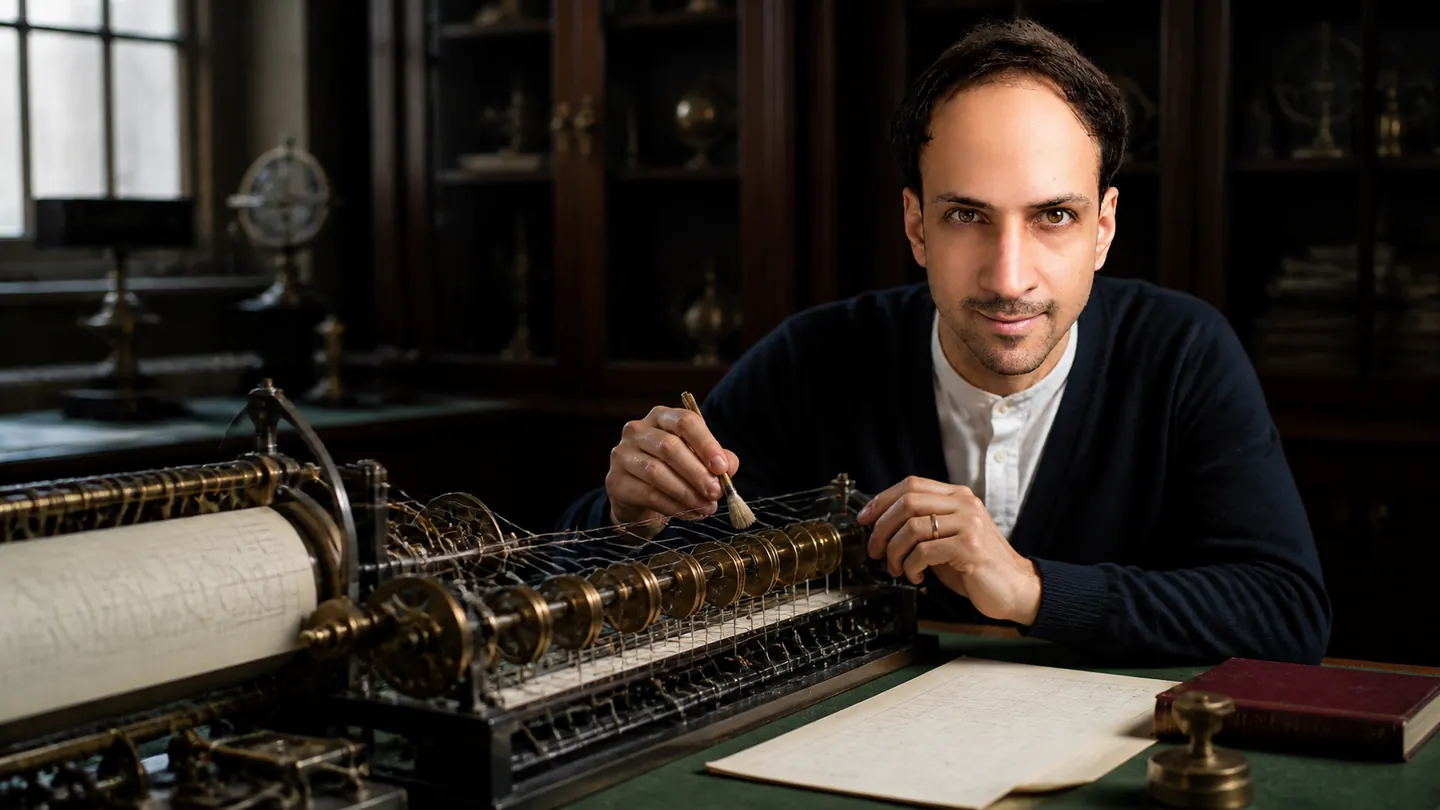
Tide Predictor in the Rare-Instruments Room — AI Portrait Prompt
صورةAI Portraits

Turn your own photo into a conceptual instrument portrait in a rare-instruments room with glass-fronted cabinets and one baize table. Keeps your face unchanged.

من نص البرومبت

Use the attached reference photo as the identity reference: keep the same face, skin tone, hair and features as the person in that photo, without beautifying, aging or altering them. Compose a wide 16:9 narrative image where environment and subject carry equal meaning at exactly 3808x2144 pixels. Location: a rare-instruments room with glass-fronted cabinets and one baize table. Show them in a midnight-blue cardigan over a band-collar white shirt, working a soft brush between two meshed teeth. Build the artwork around this material rule: a tide-predicting machine whose fine wire, wrapped over a dozen geared pulleys, sums ocean harmonics into one drawn curve gives one careful pair of hands direct custody of a calculation. Explore how motion becomes arithmetic the moment its parts are shaped with intent; direct expression and posture toward patient mastery, never melodrama or ad-like confidence. Use an eye-level 85mm portrait perspective with honest depth of field and no distortion. Make the composition let the mechanism's longest line lead toward their steady hands. Render it as conceptual instrument portraiture uniting believable mechanical computation, machinist-level surface accuracy, warm archival print tonality, and quietly unhurried observational storytelling, using cool north skylight fill with soft falloff into wood-paneled shadow and a palette of gunmetal grey, ivory paper, and one burgundy bookcloth accent. Photorealistic: this must read as a real photograph from a physical camera, never an illustration, painting, or 3D render. Give truthful depth cues: overlapping planes and shadows softening as they travel. Resolve real surface detail: rubber gone chalky with age, painted metal chipped to primer, and plastic yellowed only where light reaches it. Keep one identity-locked person, credible hands and fingers, natural fabric, and coherent scale, contact, reflections, shadows, airflow, deformation, and materials. Background people only when essential, always secondary and clearly different. Avoid floating weightless gears, sepia steampunk grading, cog-filled head silhouettes, Roman-numeral dials, and oversized watch-movement props. No text, labels, logos, signatures, watermarks, random symbols, plastic skin, excessive bloom, or glossy AI finish.
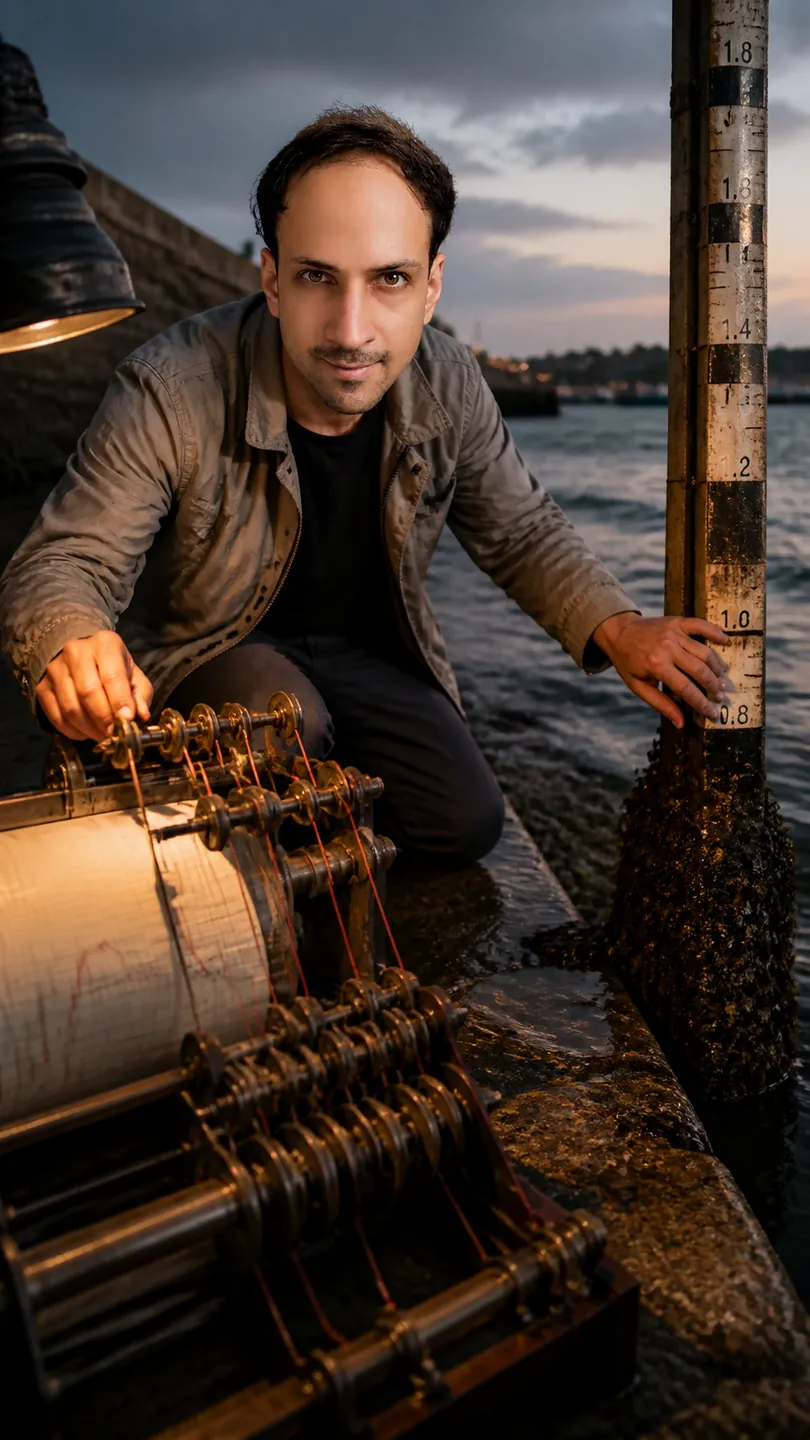
Tide Predictor in the Low-Tide Quay — AI Portrait Prompt
صورةAI Portraits

Turn your own photo into an engineering-heritage portrait in a stone quay at low tide with a graduated tide pole nearby. Keeps your face unchanged.

من نص البرومبت

Use the attached reference photo as the identity reference: keep the same face, skin tone, hair and features as the person in that photo, without beautifying, aging or altering them. Design a full-height 9:16 cinematic artwork that reads on a phone and rewards gallery-scale inspection at exactly 2144x3808 pixels. Location: a stone quay at low tide with a graduated tide pole nearby. Show them in a lightweight stone-grey field jacket over a plain shirt, measuring the wet tide line with a spread hand. Treat this mechanism as the frame’s governing rule: a tide-predicting machine whose fine wire, wrapped over a dozen geared pulleys, sums ocean harmonics into one drawn curve slows abstract thought to a speed the eye can follow and verify. Explore how motion becomes arithmetic the moment its parts are shaped with intent; direct expression and posture toward lucid respect, never melodrama or ad-like confidence. Use a 90mm hybrid view: one machined detail near the lens, their readable face beyond. Make the composition keep every moving part inside the frame except one. Render it as engineering-heritage photography combining working mechanical calculation, true kinematic detail, softly aged material finishes, and restrained human-centered contemporary framing, using one warm tungsten work lamp pooled tightly over the mechanism and hands and a palette of ebonized wood, dull steel, and one signal-red thread. Photorealistic: this must read as a real photograph from a physical camera, never an illustration, painting, or 3D render. Give the frame volume: faint density deepest in the room, contrast easing at the edges. Resolve real surface detail: label-free packaging showing carton fibre, cardboard bruised at the corners, and tape lifting slightly at one end. Keep one identity-locked person, credible hands and fingers, natural fabric, and coherent scale, contact, reflections, shadows, airflow, deformation, and materials. Background people only when essential, always secondary and clearly different. Avoid steampunk goggles, glued-on decorative cogs, glowing holographic overlays, impossible gear meshes, and clock faces. No text, labels, logos, signatures, watermarks, random symbols, plastic skin, excessive bloom, or glossy AI finish.
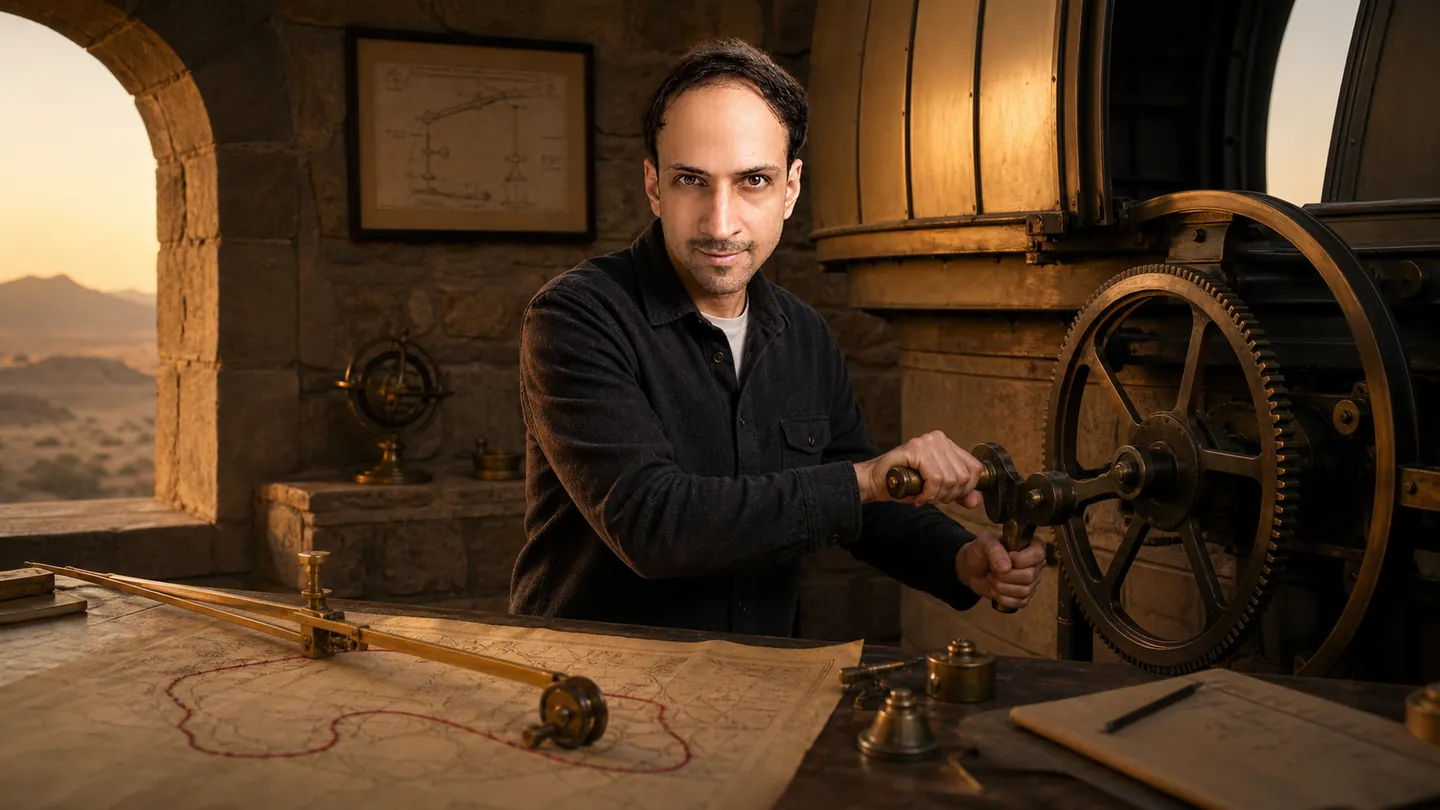
Planimeter in the Desert Observatory — AI Portrait Prompt
صورةAI Portraits

Turn your own photo into a museum-grade mechanism portrait in the stone anteroom of a small desert observatory before opening. Keeps your face unchanged.

من نص البرومبت

Use the attached reference photo as the identity reference: keep the same face, skin tone, hair and features as the person in that photo, without beautifying, aging or altering them. Compose a wide 16:9 narrative image where environment and subject carry equal meaning at exactly 3808x2144 pixels. Location: the stone anteroom of a small desert observatory before opening. Show them in a dark wool overshirt buttoned over a plain white tee, cranking closed the dome's hand-geared shutter wheel. Build the artwork around this material rule: a polar planimeter whose small measuring wheel, dragged around a lake's mapped shoreline, totals the enclosed area on one dial runs on a hand's effort alone, no current invited anywhere. Explore what trust means when every step of a computation stays visible; direct expression and posture toward grounded wonder, never melodrama or ad-like confidence. Use an eye-level 85mm portrait perspective with honest depth of field and no distortion. Make the composition let the mechanism's longest line lead toward their steady hands. Render it as museum-grade mechanism portraiture built from historically accurate analog computers, brushed-brass materiality, honest documentary realism, and quiet patient editorial composition, using late golden hour entering low and level, gilding brass without glare and a palette of ebonized wood, dull steel, and one signal-red thread. Photorealistic: this must read as a real photograph from a physical camera, never an illustration, painting, or 3D render. Give truthful depth cues: overlapping planes and shadows softening as they travel. Resolve real surface detail: wood grain read at honest scale, matte and gloss clearly separated, and no surface uniformly clean. Keep one identity-locked person, credible hands and fingers, natural fabric, and coherent scale, contact, reflections, shadows, airflow, deformation, and materials. Background people only when essential, always secondary and clearly different. Avoid steampunk goggles, glued-on decorative cogs, glowing holographic overlays, impossible gear meshes, and clock faces. No text, labels, logos, signatures, watermarks, random symbols, plastic skin, excessive bloom, or glossy AI finish.
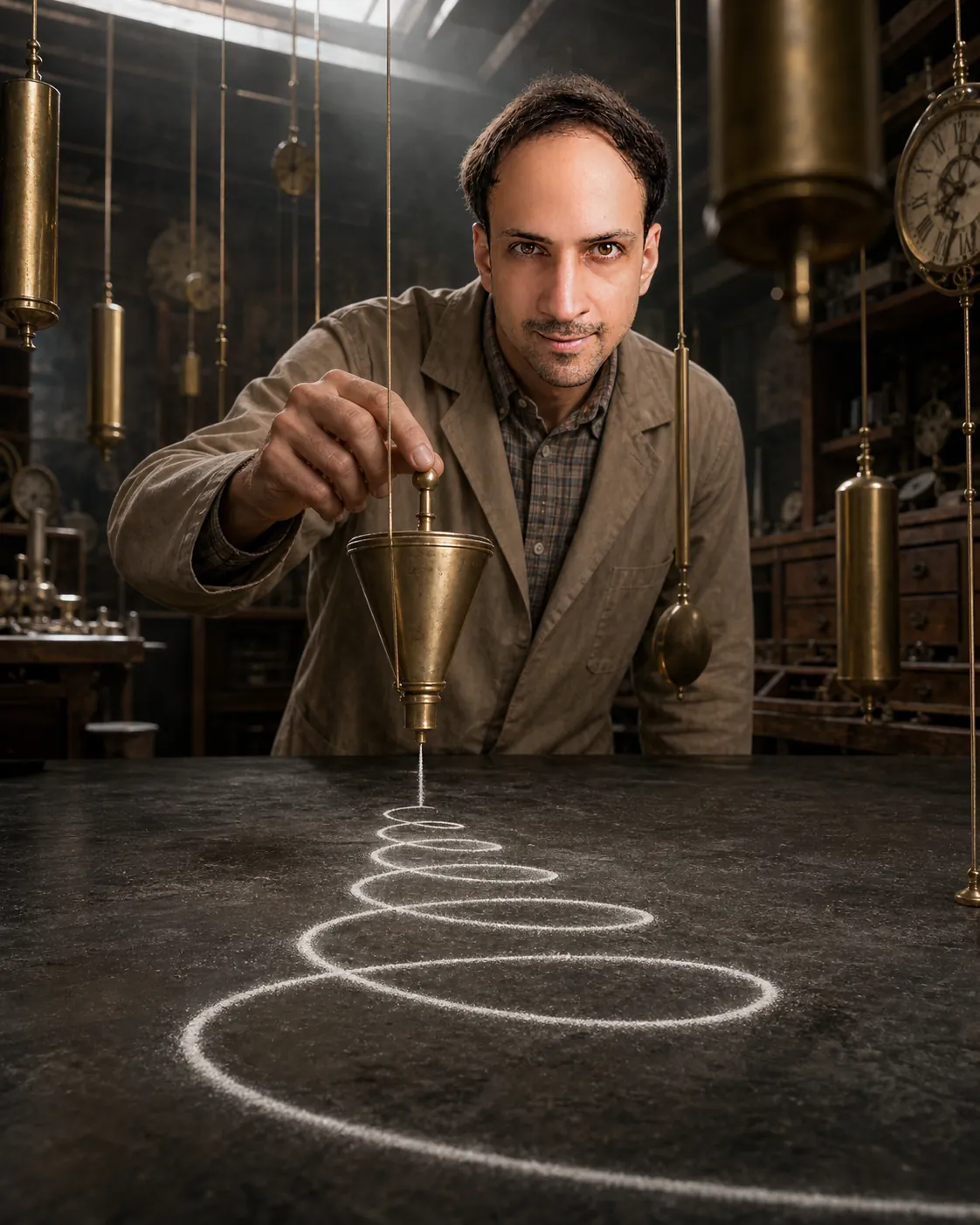
Sand Pendulum in the Clockmaker's Back Room — AI Portrait Prompt
صورةAI Portraits

Turn your own photo into a slow-apparatus editorial portrait in a clockmaker's back room hung with silent, waiting pendulums. Keeps your face unchanged.

من نص البرومبت

Use the attached reference photo as the identity reference: keep the same face, skin tone, hair and features as the person in that photo, without beautifying, aging or altering them. Build a portrait 4:5 editorial artwork with protected negative space and a fully readable face at exactly 2560x3200 pixels. Location: a clockmaker's back room hung with silent, waiting pendulums. Show them in a tan shop coat over a checked shirt buttoned to the collar, stilling a swinging weight gently between two fingers. Make one rigorous physical condition the conceptual engine: a brass funnel of white sand that swings on long cords, pouring its own path onto a dark floor draws a line no forger could copy without rebuilding the physics. Explore how much credit a person deserves for a drawing they only set in motion; direct expression and posture toward attentive calm, never melodrama or ad-like confidence. Use an 85mm portrait distance with the freshest line of the drawing sharp in the foreground. Make the composition grant the drawing more area than the person. Render it as slow-apparatus editorial realism combining working drawing machines, honest wear on tools, accurate suspended-mass behavior, and reserved contemporary art direction, using cool even skylight softened by high dust, shadows kept legible and a palette of walnut brown, bone-dry plaster, and one glint of steel. Photorealistic: this must read as a real photograph from a physical camera, never an illustration, painting, or 3D render. Resolve real surface detail: fine grit in the texture of concrete, efflorescence at damp edges, and hairline cracks that follow stress. Keep one identity-locked person, credible hands and fingers, natural fabric, and coherent scale, contact, reflections, shadows, airflow, deformation, and materials. Background people only when essential, always secondary and clearly different. Avoid glowing neon spirograph swirls, levitating pens, CGI particle trails, sacred-geometry overlays, and face-smearing motion blur. No text, labels, logos, signatures, watermarks, random symbols, plastic skin, excessive bloom, or glossy AI finish.
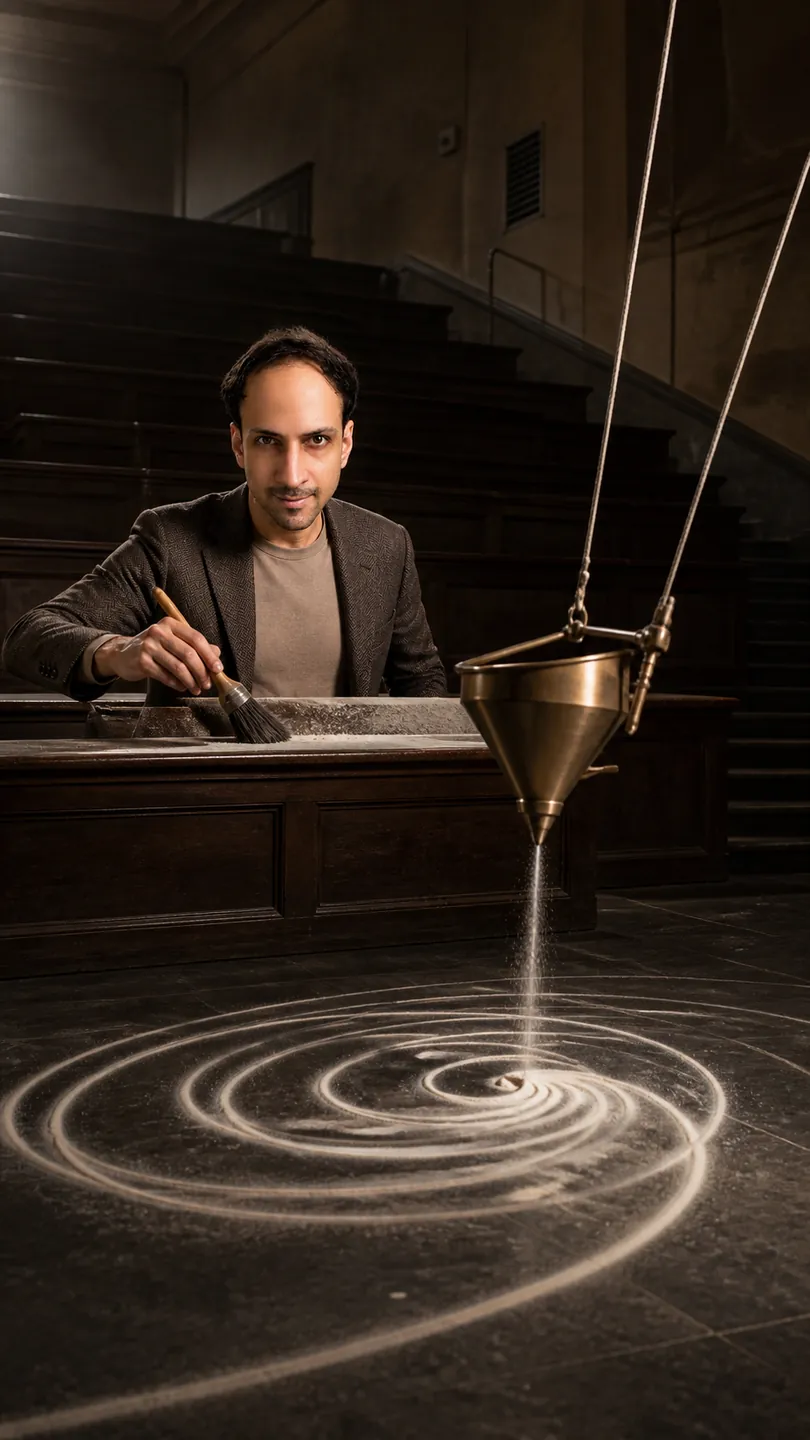
Sand Pendulum in the Empty Lecture Hall — AI Portrait Prompt
صورةAI Portraits

Turn your own photo into a slow-apparatus editorial portrait in a tiered university lecture hall, empty seats rising into shadow. Keeps your face unchanged.

من نص البرومبت

Use the attached reference photo as the identity reference: keep the same face, skin tone, hair and features as the person in that photo, without beautifying, aging or altering them. Design a full-height 9:16 cinematic artwork that reads on a phone and rewards gallery-scale inspection at exactly 2144x3808 pixels. Location: a tiered university lecture hall, empty seats rising into shadow. Show them in a brown herringbone blazer over a plain sand-colored shirt, brushing dust from the bench top with a wide soft brush. Make one rigorous physical condition the conceptual engine: a brass funnel of white sand that swings on long cords, pouring its own path onto a dark floor keeps an honest written account of energy quietly leaving the system. Explore how much credit a person deserves for a drawing they only set in motion; direct expression and posture toward absorbed patience, never melodrama or ad-like confidence. Frame from across the pendulum's plane so its arc crosses the foreground and their face stays clear. Make the composition keep the suspension line visible from anchor to writing point. Render it as slow-apparatus editorial realism combining working drawing machines, honest wear on tools, accurate suspended-mass behavior, and reserved contemporary art direction, using one low raking beam that lifts the trace into shallow relief and a palette of walnut brown, bone-dry plaster, and one glint of steel. Photorealistic: this must read as a real photograph from a physical camera, never an illustration, painting, or 3D render. Give the space honest scale: real distance between foreground, subject, and far wall. Resolve real surface detail: condensation beading at true size, liquid meniscus curving against glass, and wet surfaces darker than dry ones. Keep one identity-locked person, credible hands and fingers, natural fabric, and coherent scale, contact, reflections, shadows, airflow, deformation, and materials. Background people only when essential, always secondary and clearly different. Avoid hypnotist's watch iconography, perpetual-motion fantasy rigs, laser-perfect printed curves, cosmic nebula backdrops, and pendulums hung from nothing. No text, labels, logos, signatures, watermarks, random symbols, plastic skin, excessive bloom, or glossy AI finish.
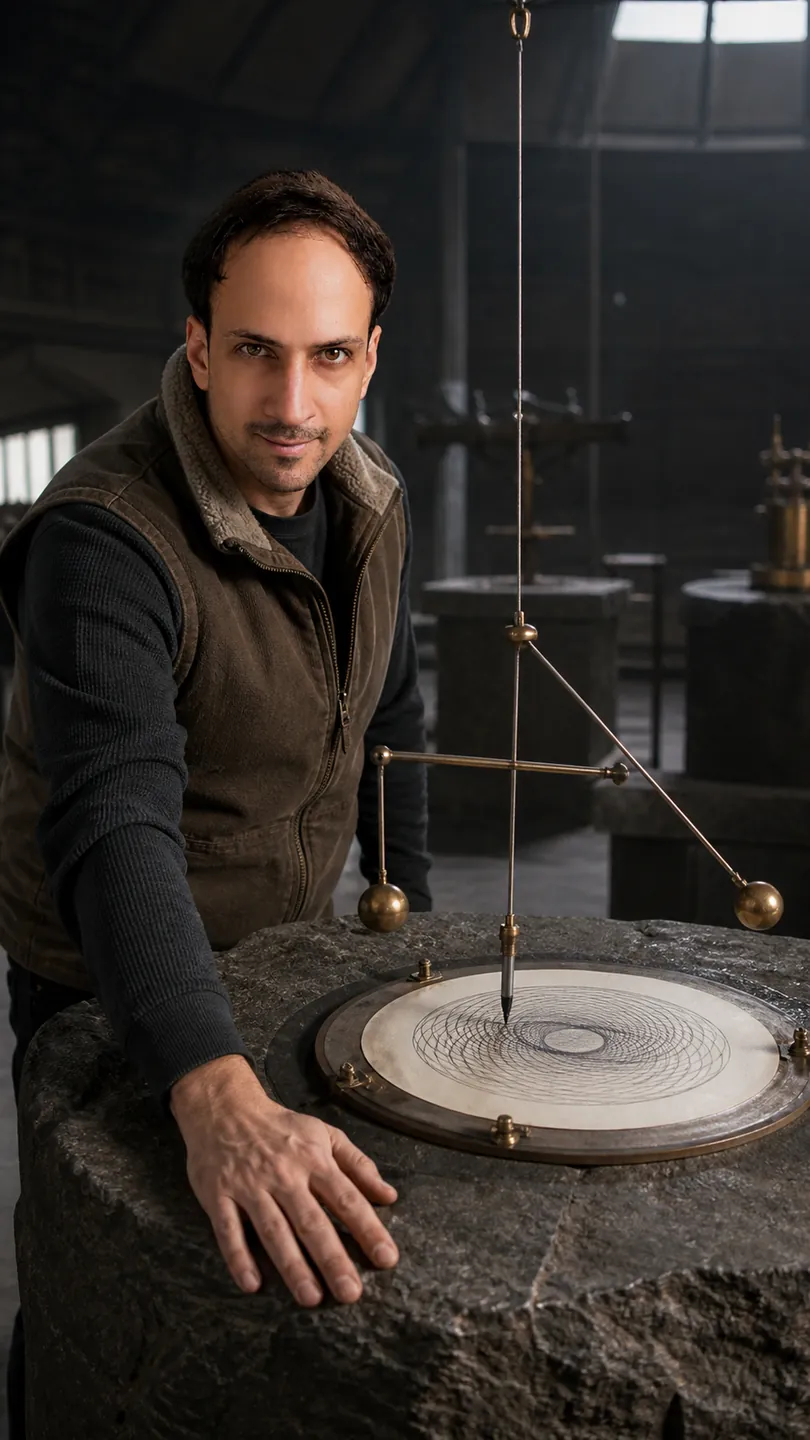
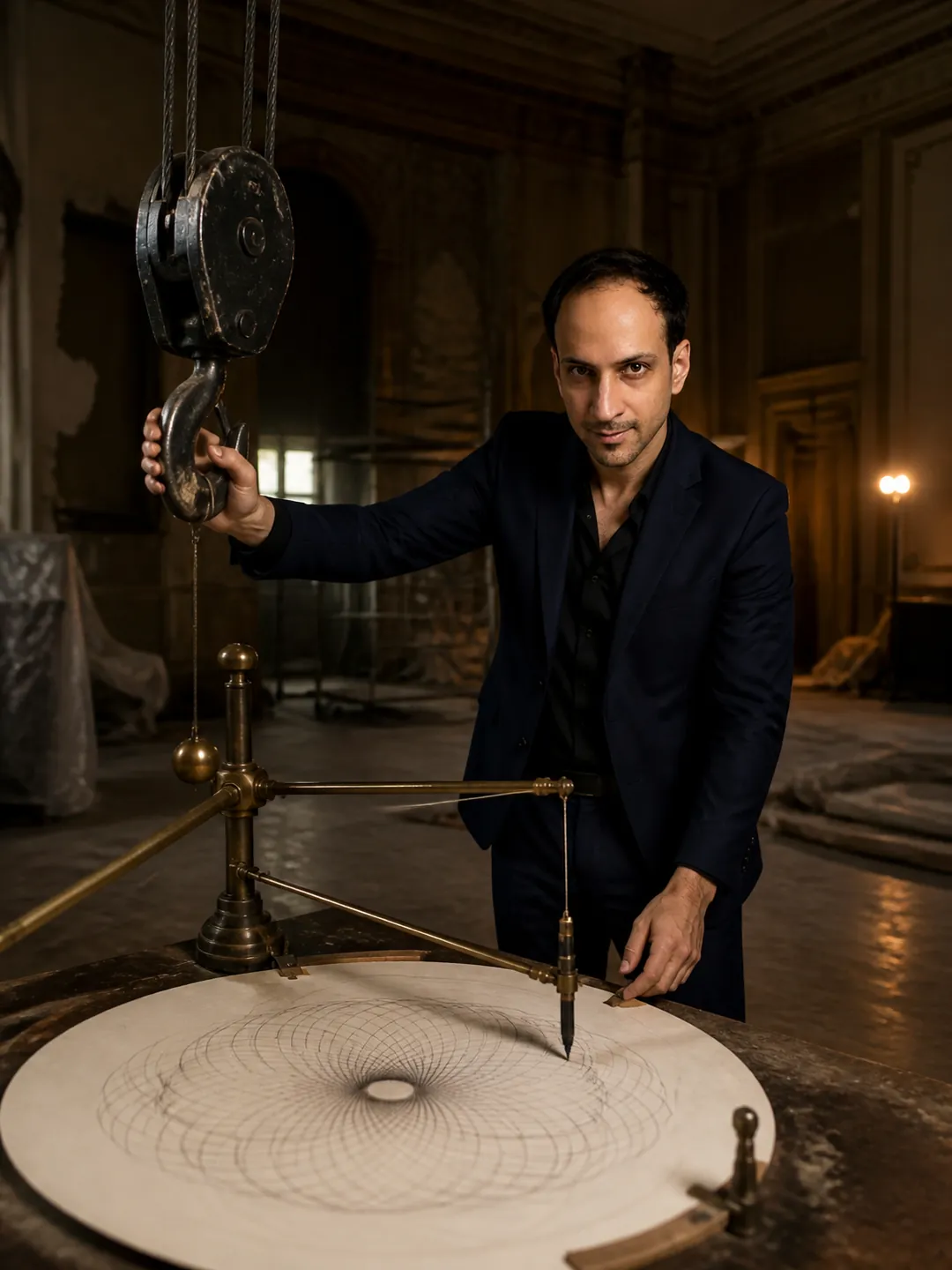
Harmonograph Rosette in the Ballroom Under Renovation — AI Portrait Prompt
صورةAI Portraits

Turn your own photo into a portrait in a hotel ballroom mid-renovation, its chandelier lowered and gone. Keeps your face unchanged.

من نص البرومبت

Use the attached reference photo as the identity reference: keep the same face, skin tone, hair and features as the person in that photo, without beautifying, aging or altering them. Use a formal 3:4 environmental portrait with complete hands and meaningful objects inside frame at exactly 2480x3312 pixels. Location: a hotel ballroom mid-renovation, its chandelier lowered and gone. Show them in a midnight-blue suit worn without a tie, collar open, guiding the empty hoist hook to a dead stop. Use this advanced image-making device as the core logic: a two-pendulum harmonograph whose pen and paper swing on separate pivots, weaving one dense ink rosette from their combined periods puts down a mark that no living hand ever touches. Explore why a force with no hands can still leave handwriting worth framing; direct expression and posture toward tempered curiosity, never melodrama or ad-like confidence. Use an eye-level 50mm viewpoint that gives the machine and the person equal dignity. Make the composition let the drawing's shrinking center sit off-axis from their eyes. Render it as kinetic-sculpture documentary portraiture built from real pendulum apparatus, archival ink materiality, long-exposure honesty, and museum-quality restraint in every surface, using dim ambient darkness held back by two small warm practicals and a palette of walnut brown, bone-dry plaster, and one glint of steel. Photorealistic: this must read as a real photograph from a physical camera, never an illustration, painting, or 3D render. Resolve real surface detail: skin that reddens slightly under pressure, nail beds with honest colour, and knuckle creases that fold rather than blur. Keep one identity-locked person, credible hands and fingers, natural fabric, and coherent scale, contact, reflections, shadows, airflow, deformation, and materials. Background people only when essential, always secondary and clearly different. Avoid hypnotist's watch iconography, perpetual-motion fantasy rigs, laser-perfect printed curves, cosmic nebula backdrops, and pendulums hung from nothing. No text, labels, logos, signatures, watermarks, random symbols, plastic skin, excessive bloom, or glossy AI finish.
Harmonograph Rosette in the Seismic Vault — AI Portrait Prompt
صورةAI Portraits

Turn your own photo into a scientific-instrument portrait in a seismic observatory vault, instruments resting on bedrock piers. Keeps your face unchanged.

من نص البرومبت

Use the attached reference photo as the identity reference: keep the same face, skin tone, hair and features as the person in that photo, without beautifying, aging or altering them. Design a full-height 9:16 cinematic artwork that reads on a phone and rewards gallery-scale inspection at exactly 2144x3808 pixels. Location: a seismic observatory vault, instruments resting on bedrock piers. Show them in a fleece-lined canvas vest over a long-sleeved thermal shirt, dusting a bedrock pier with the side of their hand. Make one rigorous physical condition the conceptual engine: a two-pendulum harmonograph whose pen and paper swing on separate pivots, weaving one dense ink rosette from their combined periods gives a universal law a pace calm enough to watch at work. Explore why a force with no hands can still leave handwriting worth framing; direct expression and posture toward attentive calm, never melodrama or ad-like confidence. Frame from across the pendulum's plane so its arc crosses the foreground and their face stays clear. Make the composition keep the suspension line visible from anchor to writing point. Render it as scientific-instrument realism combining believable weighted mechanisms, truthful decaying traces, hand-finished wood and brass, and patient observational portrait photography, using cool even skylight softened by high dust, shadows kept legible and a palette of lamp-soot black, unbleached paper, and one line of brass. Photorealistic: this must read as a real photograph from a physical camera, never an illustration, painting, or 3D render. Give the space honest scale: real distance between foreground, subject, and far wall. Resolve real surface detail: glass with real thickness at its edge, reflections that carry the room's actual colour, and dust visible only at grazing angles. Keep one identity-locked person, credible hands and fingers, natural fabric, and coherent scale, contact, reflections, shadows, airflow, deformation, and materials. Background people only when essential, always secondary and clearly different. Avoid glowing neon spirograph swirls, levitating pens, CGI particle trails, sacred-geometry overlays, and face-smearing motion blur. No text, labels, logos, signatures, watermarks, random symbols, plastic skin, excessive bloom, or glossy AI finish.
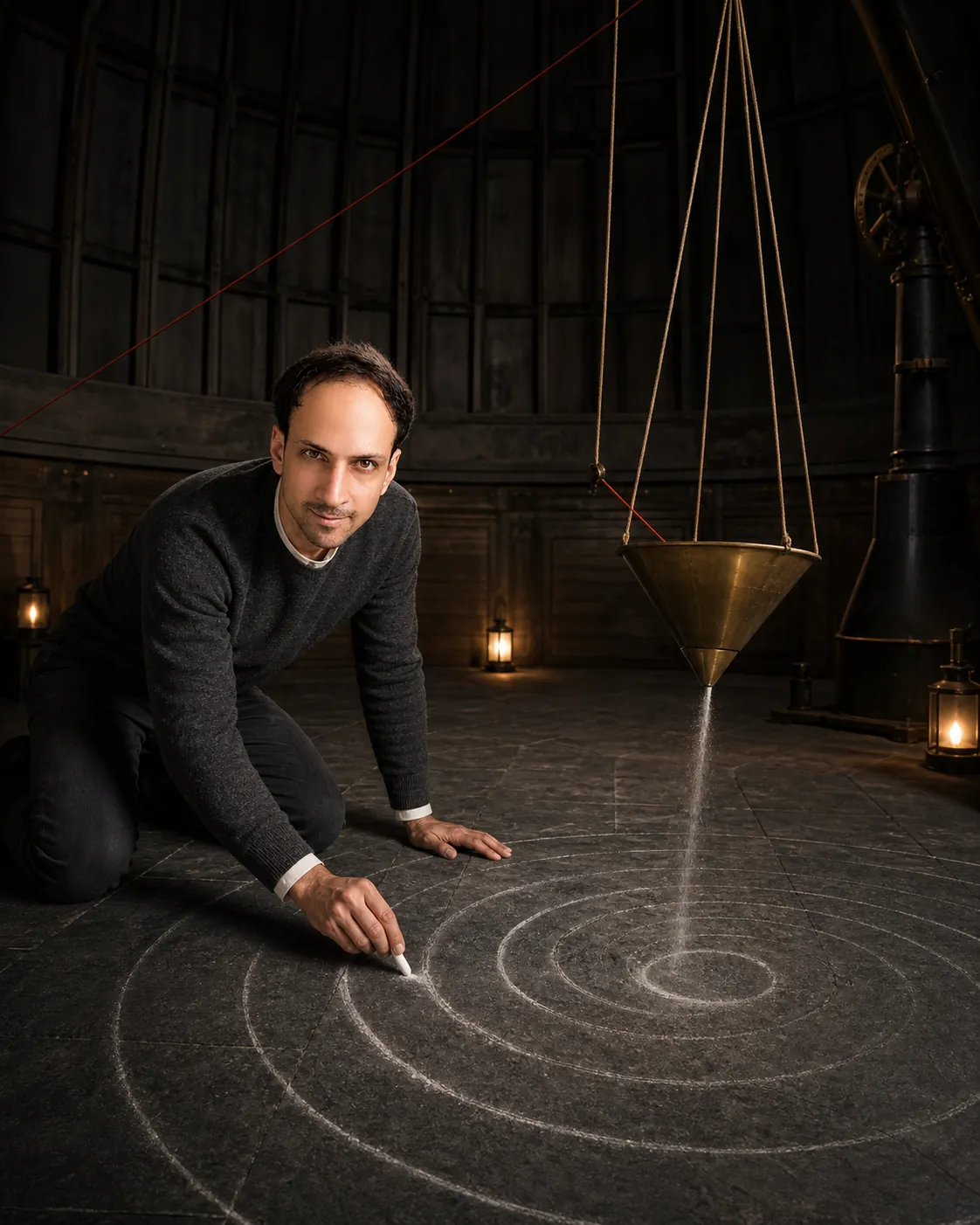
Sand Pendulum in the Shuttered Observatory — AI Portrait Prompt
صورةAI Portraits

Turn your own photo into a scientific-instrument portrait in the stone floor of an old observatory beneath its shuttered dome. Keeps your face unchanged.

من نص البرومبت

Use the attached reference photo as the identity reference: keep the same face, skin tone, hair and features as the person in that photo, without beautifying, aging or altering them. Build a portrait 4:5 editorial artwork with protected negative space and a fully readable face at exactly 2560x3200 pixels. Location: the stone floor of an old observatory beneath its shuttered dome. Show them in a graphite wool sweater over a white collarless shirt, chalking the release point on the stone floor. Build the artwork around this material rule: a brass funnel of white sand that swings on long cords, pouring its own path onto a dark floor lets a finished motion go on existing as a patient physical record. Explore how much credit a person deserves for a drawing they only set in motion; direct expression and posture toward quiet astonishment, never melodrama or ad-like confidence. Use a raised three-quarter viewpoint so the whole record and their bowed attention share one frame. Make the composition align the stillest object with the fastest line. Render it as scientific-instrument realism combining believable weighted mechanisms, truthful decaying traces, hand-finished wood and brass, and patient observational portrait photography, using dim ambient darkness held back by two small warm practicals and a palette of slate grey, chalk white, and one madder-red thread. Photorealistic: this must read as a real photograph from a physical camera, never an illustration, painting, or 3D render. Resolve real surface detail: cotton that hangs by its own weight, seams that pucker very slightly, and collars softened by washing. Keep one identity-locked person, credible hands and fingers, natural fabric, and coherent scale, contact, reflections, shadows, airflow, deformation, and materials. Background people only when essential, always secondary and clearly different. Avoid hypnotist's watch iconography, perpetual-motion fantasy rigs, laser-perfect printed curves, cosmic nebula backdrops, and pendulums hung from nothing. No text, labels, logos, signatures, watermarks, random symbols, plastic skin, excessive bloom, or glossy AI finish.
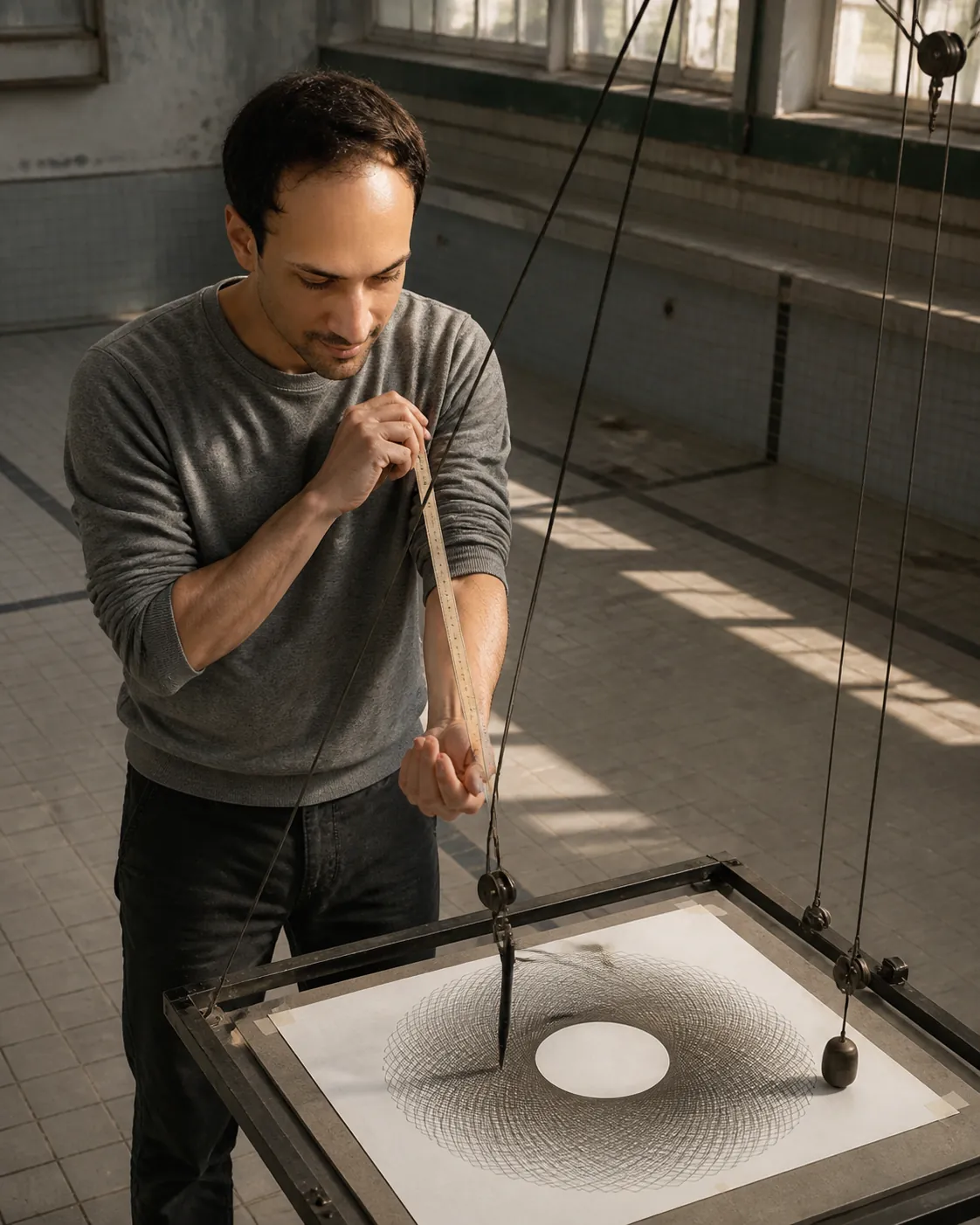
Harmonograph Rosette in the Drained Pool Hall — AI Portrait Prompt
صورةAI Portraits

Turn your own photo into a slow-apparatus editorial portrait in a drained indoor pool hall, tiles echoing every small sound. Keeps your face unchanged.

من نص البرومبت

Use the attached reference photo as the identity reference: keep the same face, skin tone, hair and features as the person in that photo, without beautifying, aging or altering them. Build a portrait 4:5 editorial artwork with protected negative space and a fully readable face at exactly 2560x3200 pixels. Location: a drained indoor pool hall, tiles echoing every small sound. Show them in a heather-grey sweatshirt and dark tapered work trousers, measuring a drop height against their own forearm. Build the artwork around this material rule: a two-pendulum harmonograph whose pen and paper swing on separate pivots, weaving one dense ink rosette from their combined periods draws a line no forger could copy without rebuilding the physics. Explore why a force with no hands can still leave handwriting worth framing; direct expression and posture toward solemn delight, never melodrama or ad-like confidence. Use a raised three-quarter viewpoint so the whole record and their bowed attention share one frame. Make the composition align the stillest object with the fastest line. Render it as slow-apparatus editorial realism combining working drawing machines, honest wear on tools, accurate suspended-mass behavior, and reserved contemporary art direction, using late window light crossing the floor at a long shallow angle and a palette of graphite, raw linen, and one deep bottle-green accent. Photorealistic: this must read as a real photograph from a physical camera, never an illustration, painting, or 3D render. Resolve real surface detail: fine lint on dark fabric, water spotting on steel, and the soft rounding of edges that have been used for years. Keep one identity-locked person, credible hands and fingers, natural fabric, and coherent scale, contact, reflections, shadows, airflow, deformation, and materials. Background people only when essential, always secondary and clearly different. Avoid glowing neon spirograph swirls, levitating pens, CGI particle trails, sacred-geometry overlays, and face-smearing motion blur. No text, labels, logos, signatures, watermarks, random symbols, plastic skin, excessive bloom, or glossy AI finish.

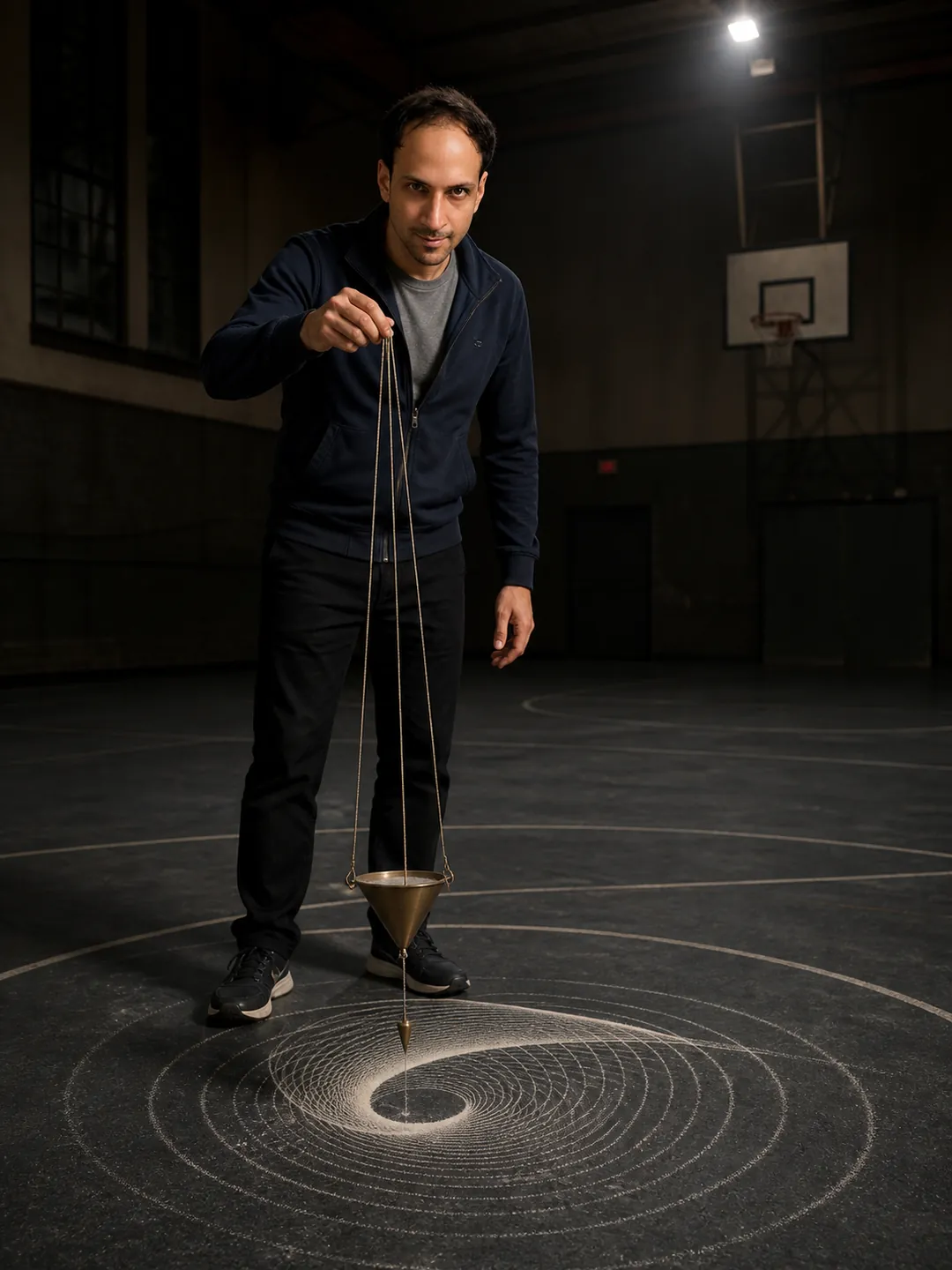
Sand Pendulum in the After-Hours Gymnasium — AI Portrait Prompt
صورةAI Portraits

Turn your own photo into a gallery-grade demonstration portrait in a school gymnasium after hours, one court light left burning. Keeps your face unchanged.

من نص البرومبت

Use the attached reference photo as the identity reference: keep the same face, skin tone, hair and features as the person in that photo, without beautifying, aging or altering them. Use a formal 3:4 environmental portrait with complete hands and meaningful objects inside frame at exactly 2480x3312 pixels. Location: a school gymnasium after hours, one court light left burning. Show them in a plain navy track jacket zipped over a grey tee, dropping a plumb line until the bob just clears the floor. Use this advanced image-making device as the core logic: a brass funnel of white sand that swings on long cords, pouring its own path onto a dark floor shows plain physical law producing ornament no deliberate hand could plan. Explore how much credit a person deserves for a drawing they only set in motion; direct expression and posture toward steady humility, never melodrama or ad-like confidence. Use an eye-level 50mm viewpoint that gives the machine and the person equal dignity. Make the composition let the drawing's shrinking center sit off-axis from their eyes. Render it as gallery-grade demonstration photography built from lawful gravity-driven motion, physically exact trace geometry, quiet heritage interiors, and unforced human presence, using cool even skylight softened by high dust, shadows kept legible and a palette of graphite, raw linen, and one deep bottle-green accent. Photorealistic: this must read as a real photograph from a physical camera, never an illustration, painting, or 3D render. Resolve real surface detail: brass darkened in the recesses and bright where thumbs land, and lacquer crazed rather than perfect. Keep one identity-locked person, credible hands and fingers, natural fabric, and coherent scale, contact, reflections, shadows, airflow, deformation, and materials. Background people only when essential, always secondary and clearly different. Avoid glowing neon spirograph swirls, levitating pens, CGI particle trails, sacred-geometry overlays, and face-smearing motion blur. No text, labels, logos, signatures, watermarks, random symbols, plastic skin, excessive bloom, or glossy AI finish.
