تخطَّ إلى المحتوى

برومبتات الصور

برومبتات لمولدات الصور: بورتريهات وفن وتصوير.

تم العثور على 4209
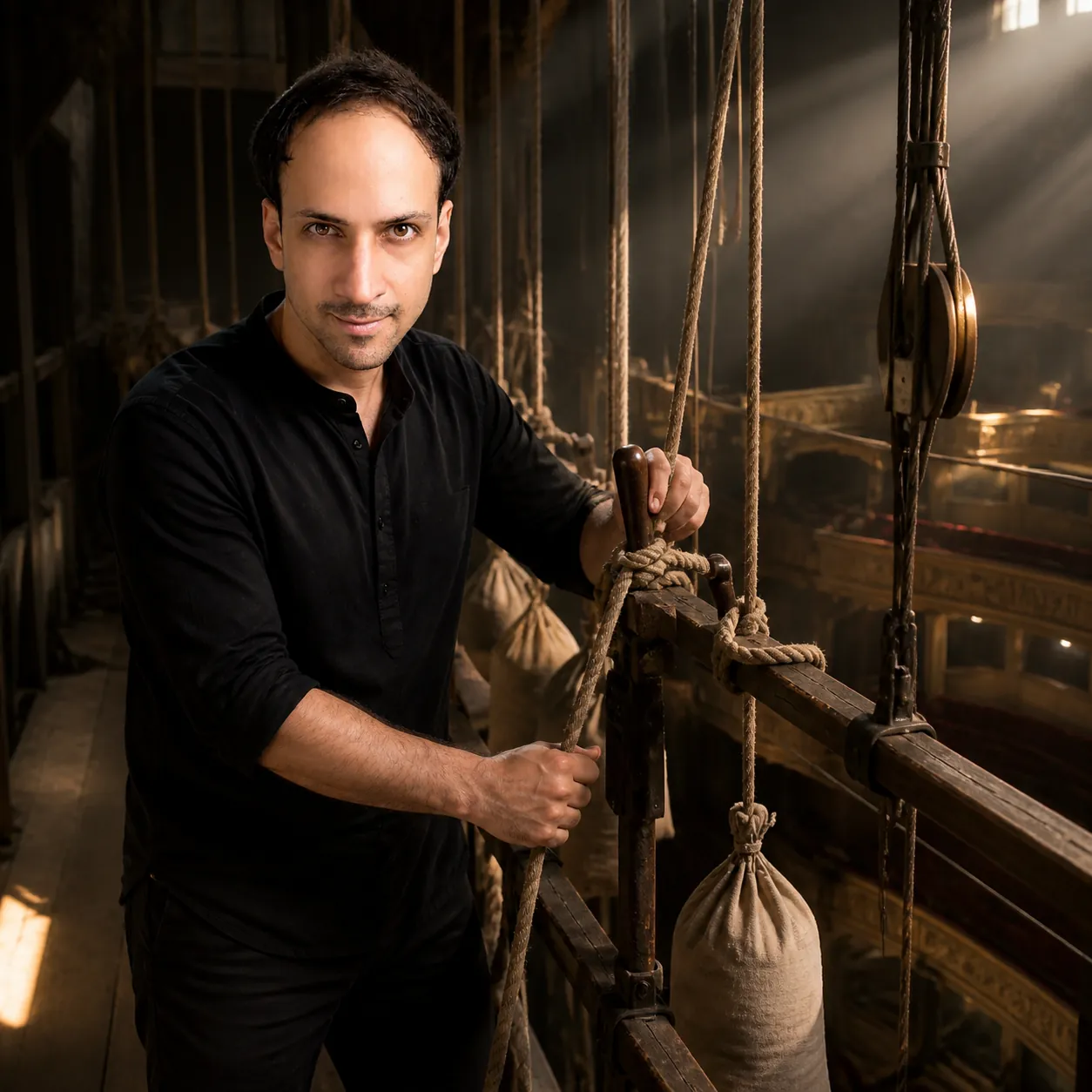
Weight Answered: High Fly Gallery of an Old Theater — AI Portrait Prompt
صورةAI Portraits

Turn your own photo into a museum-grade demonstration portrait in the high fly gallery of an old theater, hemp lines belayed. Keeps your face unchanged.

من نص البرومبت

Use the attached reference photo as the identity reference: keep the same face, skin tone, hair and features as the person in that photo, without beautifying, aging or altering them. Create a square 1:1 museum-catalog frame with a strong first read and a slower second read at exactly 2880x2880 pixels. Location: the high fly gallery of an old theater, hemp lines belayed. Show the subject in a collarless black cotton shirt with sleeves rolled past the forearm, easing one hemp line off its wooden belay pin. Build the artwork around this material rule: a rope-flown counterweight arbor they load one canvas sandbag at a time until a heavy timber batten floats weightless makes mechanical advantage visible enough to be read at a glance. Explore why the largest forces in the frame make the smallest visible show; direct expression and posture toward patient certainty, never melodrama or ad-like confidence. Frame across the apparatus at shoulder height so the working parts and their steady gaze hold equal sharpness. Make the composition give the load more frame and give them the light. Render it as museum-grade demonstration photography combining true static balance, believable rigging detail, honest load-bearing structure, and restrained human-scale art direction, using dusty shafts of high window light cut into slow diagonal beams and a palette of sandstone buff, rope-shadow grey, and a single indigo accent. Photorealistic: this must read as a real photograph from a physical camera, never an illustration, painting, or 3D render. Resolve real surface detail: dust settled where nobody wipes, fingerprint haze on glass, and edges rubbed pale by handling. Keep one identity-locked person, credible hands and fingers, natural fabric, and coherent scale, contact, reflections, shadows, airflow, deformation, and materials. Background people only when essential, always secondary and clearly different. Avoid neon fitness styling, sweat-spray action shots, cartoon oversized pulleys, crumbling CGI stone, and triumphant summit gestures. No text, labels, logos, signatures, watermarks, random symbols, plastic skin, excessive bloom, or glossy AI finish.
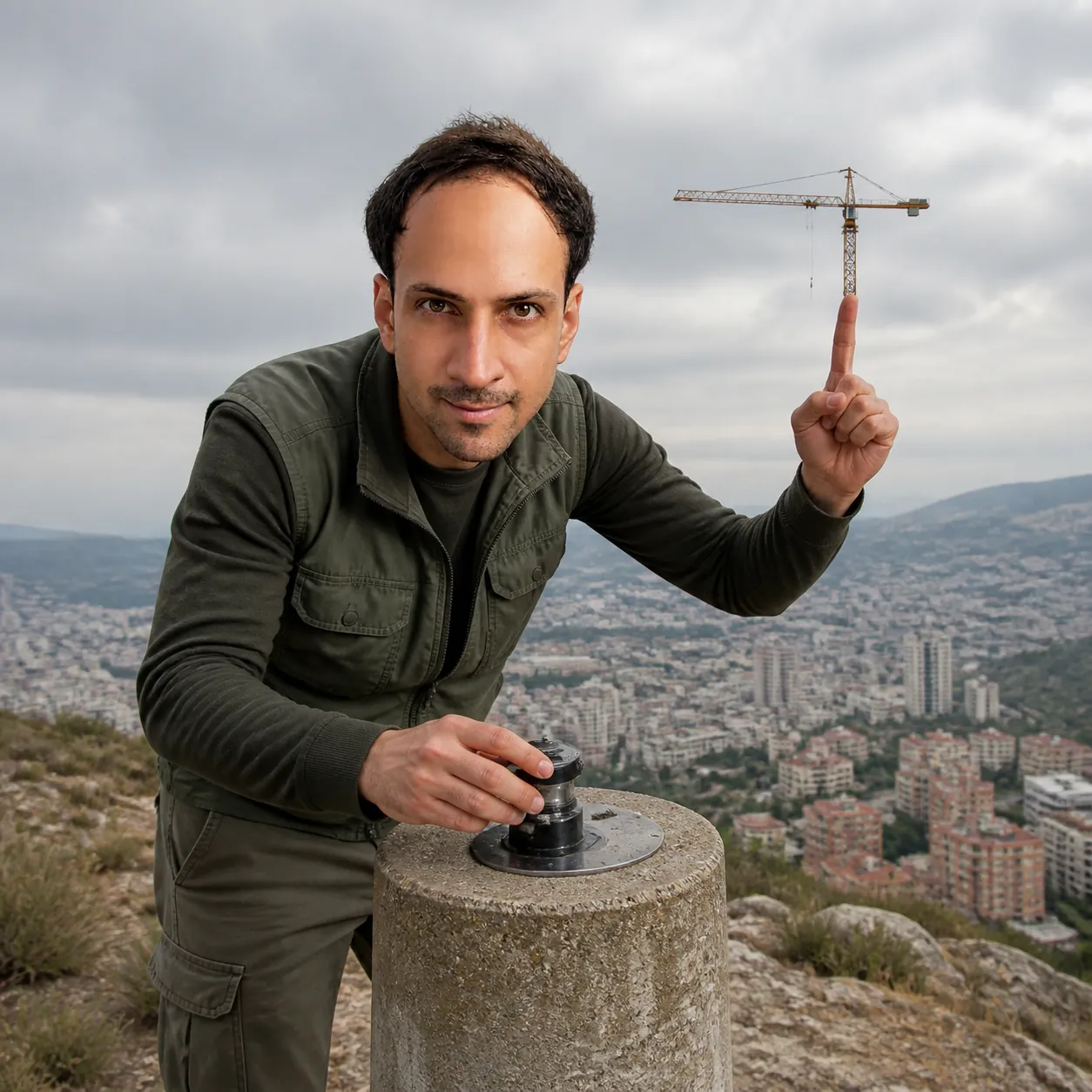
Scale Undone: Hilltop Triangulation Pillar — AI Portrait Prompt
صورةAI Portraits

Turn your own photo into a gallery-grade perspective portrait in a hilltop triangulation pillar above the city's northern districts. Keeps your face unchanged.

من نص البرومبت

Use the attached reference photo as the identity reference: keep the same face, skin tone, hair and features as the person in that photo, without beautifying, aging or altering them. Create a square 1:1 museum-catalog frame with a strong first read and a slower second read at exactly 2880x2880 pixels. Location: a hilltop triangulation pillar above the city's northern districts. Show the subject in an olive utility vest over a long-sleeve base layer and cargo trousers, screwing a panoramic head onto the pillar's center bolt. Use this advanced image-making device as the core logic: a distant tower crane that settles weightlessly onto their raised fingertip when the camera holds one surveyed vantage defeats the eye's scale instinct with nothing but honest, lawful geometry. Explore how a viewpoint can rebuild the world without moving a single object; direct expression and posture toward sober curiosity, never melodrama or ad-like confidence. Frame at the demonstration's own height so the optical event and their eyes share one axis. Make the composition seat the illusion dead center and let them stand off-axis. Render it as gallery-grade perspective photography built from real sightline alignments, measured camera placement, physically accurate focus falloff, and unhurried dignified portrait values, using a single practical lamp held low, its beam spreading lawfully with distance and a palette of overcast silver, limestone buff, and one dark cedar green. Photorealistic: this must read as a real photograph from a physical camera, never an illustration, painting, or 3D render. Resolve real surface detail: visible weave in cloth, fine scratches on metal, and the faint unevenness of painted walls. Keep one identity-locked person, credible hands and fingers, natural fabric, and coherent scale, contact, reflections, shadows, airflow, deformation, and materials. Background people only when essential, always secondary and clearly different. Avoid shrunken-person composites, giant-monster posing, fake miniature blur filters, candy-toy oversaturation, and warped fisheye streets. No text, labels, logos, signatures, watermarks, random symbols, plastic skin, excessive bloom, or glossy AI finish.
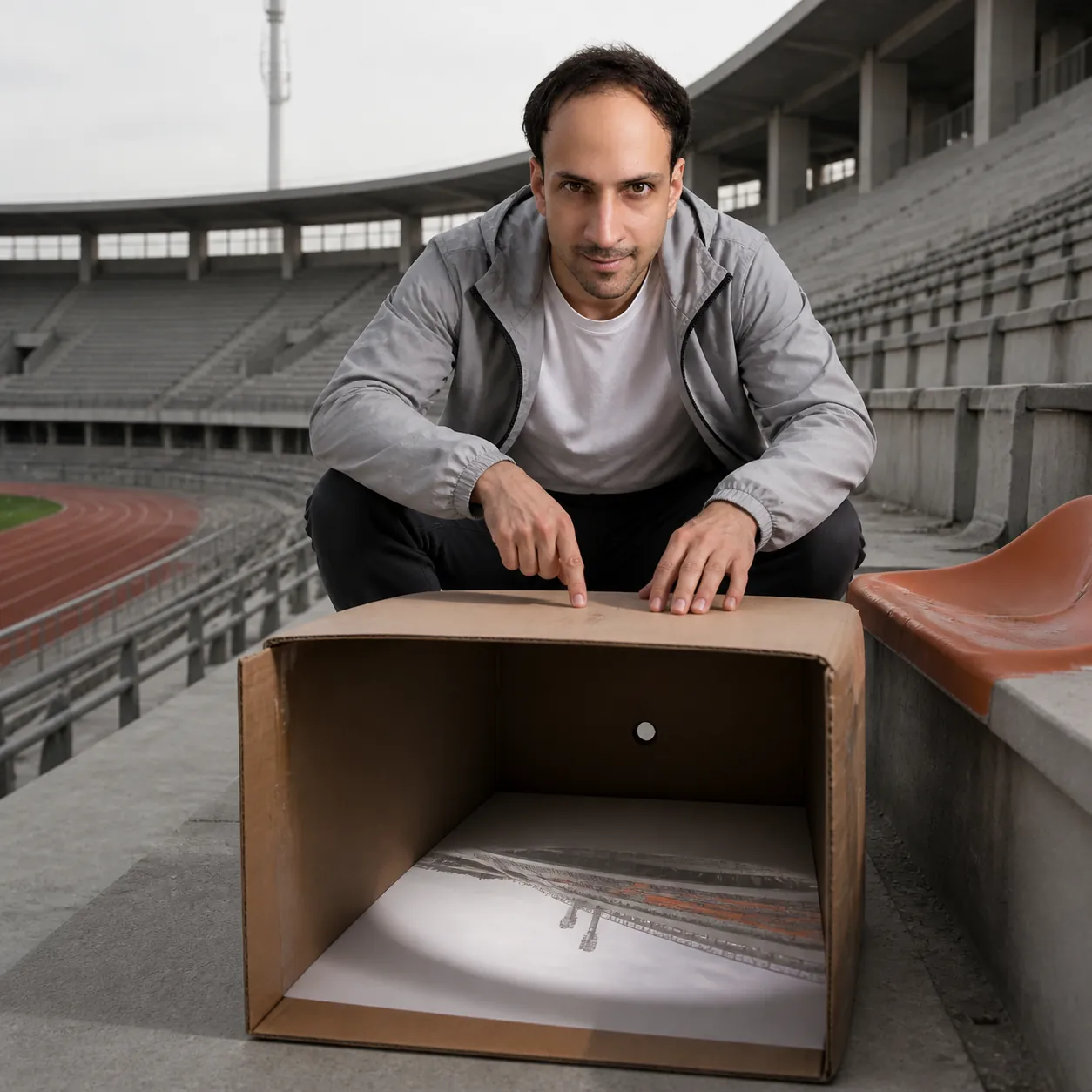
Distance Negotiates: Empty Upper Tier of a Small Stadium — AI Portrait Prompt
صورةAI Portraits

Turn your own photo into a gallery-grade perspective portrait in the empty upper tier of a small stadium before morning training. Keeps your face unchanged.

من نص البرومبت

Use the attached reference photo as the identity reference: keep the same face, skin tone, hair and features as the person in that photo, without beautifying, aging or altering them. Create a square 1:1 museum-catalog frame with a strong first read and a slower second read at exactly 2880x2880 pixels. Location: the empty upper tier of a small stadium before morning training. Show the subject in a light athletic shell jacket over a plain cotton tee and joggers, counting seat rows below with one slow pointed finger. Build the artwork around this material rule: a table-sized obscura box whose pinhole lays the sunlit surroundings, inverted and alive, across its white floor defeats the eye's scale instinct with nothing but honest, lawful geometry. Explore what remains of certainty when the eye's oldest ruler fails politely; direct expression and posture toward steady disbelief, never melodrama or ad-like confidence. Use a long 200mm compression view across open distance, keeping them and the far structure equally sharp. Make the composition hold near and far in equal sharpness against the eye's expectation. Render it as gallery-grade perspective photography built from real sightline alignments, measured camera placement, physically accurate focus falloff, and unhurried dignified portrait values, using flat overcast daylight that removes haze cues and levels every distance and a palette of warm grey concrete, pale haze, and one signal orange. Photorealistic: this must read as a real photograph from a physical camera, never an illustration, painting, or 3D render. Resolve real surface detail: label-free packaging showing carton fibre, cardboard bruised at the corners, and tape lifting slightly at one end. Keep one identity-locked person, credible hands and fingers, natural fabric, and coherent scale, contact, reflections, shadows, airflow, deformation, and materials. Background people only when essential, always secondary and clearly different. Avoid shrunken-person composites, giant-monster posing, fake miniature blur filters, candy-toy oversaturation, and warped fisheye streets. No text, labels, logos, signatures, watermarks, random symbols, plastic skin, excessive bloom, or glossy AI finish.
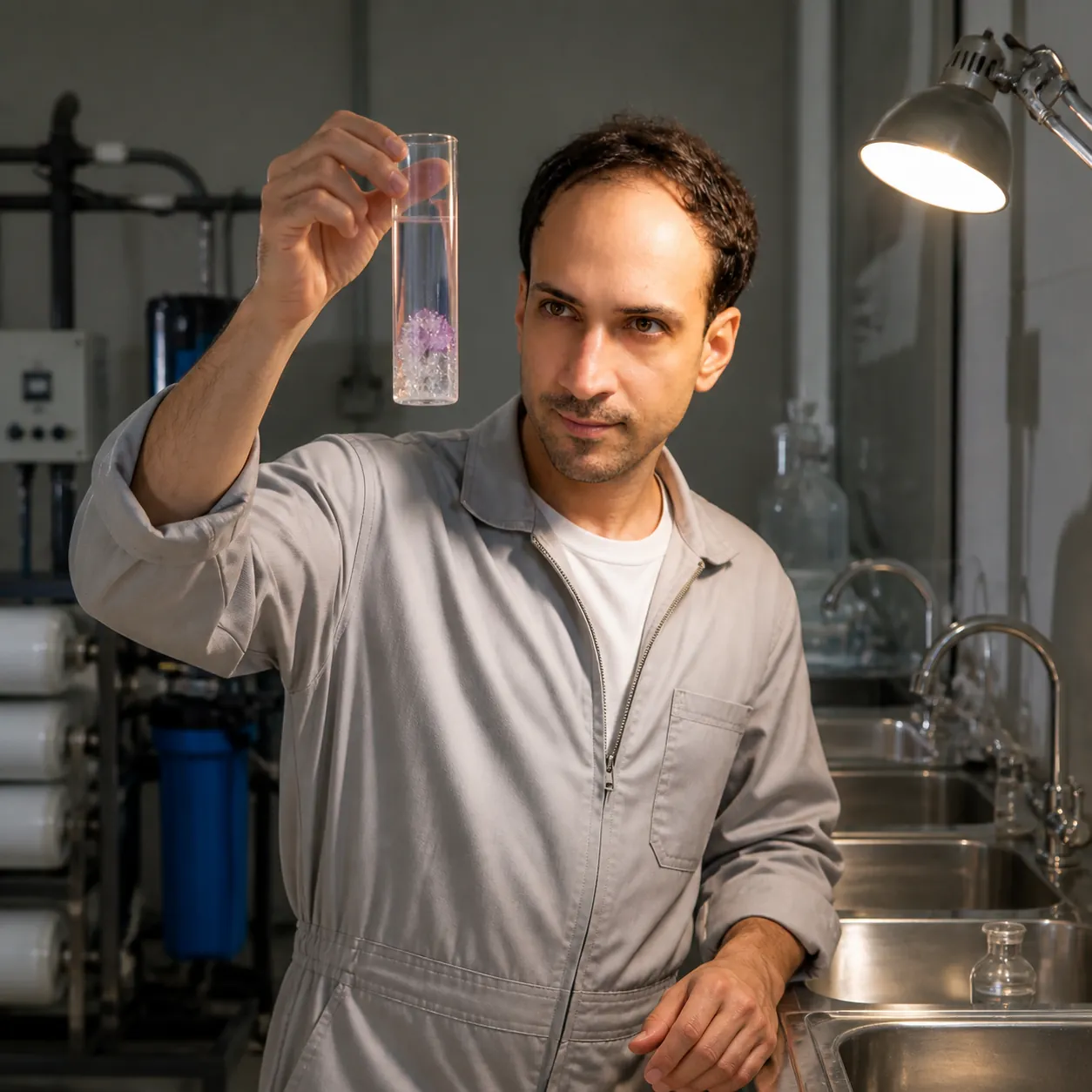
Out of Solution: Sampling Room — AI Portrait Prompt
صورةAI Portraits

Turn your own photo into a portrait in the sampling room of a small desalination plant, steel sinks gleaming. Keeps your face unchanged.

من نص البرومبت

Use the attached reference photo as the identity reference: keep the same face, skin tone, hair and features as the person in that photo, without beautifying, aging or altering them. Treat that reference as the character anchor and change only the scene. Create a square 1:1 museum-catalog frame with a strong first read and a slower second read at exactly 2880x2880 pixels. Location: the sampling room of a small desalination plant, steel sinks gleaming. Show the subject in a light grey coverall unzipped to a clean white crew-neck, raising a clear sample cylinder to eye level. Build the artwork around this material rule: a two-tone crystal with a violet chrome-alum heart jacketed in clear potassium alum, one lattice continued across two different chemistries produces confident geometry in a place where nobody asked for any. Explore how much of building is simply removing the reasons not to begin; direct expression and posture toward measured reverence, never melodrama or ad-like confidence. Use a measured 32mm wide view from respectful distance with all verticals kept straight. Make the composition hold one large calm emptiness against the crowded crystalline detail. Render it as conceptual bench-science photography combining believable grown geometry, honest hand-and-glass interaction, precise material response, and quiet contemporary gallery restraint, using one raking bench lamp that turns every crystal edge into a drawn line and a palette of raw cotton, dim pewter, and clear sugar amber. Photorealistic: this must read as a real photograph from a physical camera, never an illustration, painting, or 3D render. Resolve real surface detail: hair with individual strands catching light, fine hair of uneven length, and skin oil giving a low uneven sheen. Keep one identity-locked person, credible hands and fingers, natural fabric, and coherent scale, contact, reflections, shadows, airflow, deformation, and materials. Background people only when essential, always secondary and clearly different. Avoid wizard-laboratory props, neon translucent minerals, floating crystal shards, motion-smeared growth trails, and jewelry-advert sparkle. No text, labels, logos, signatures, watermarks, random symbols, plastic skin, excessive bloom, or glossy AI finish.
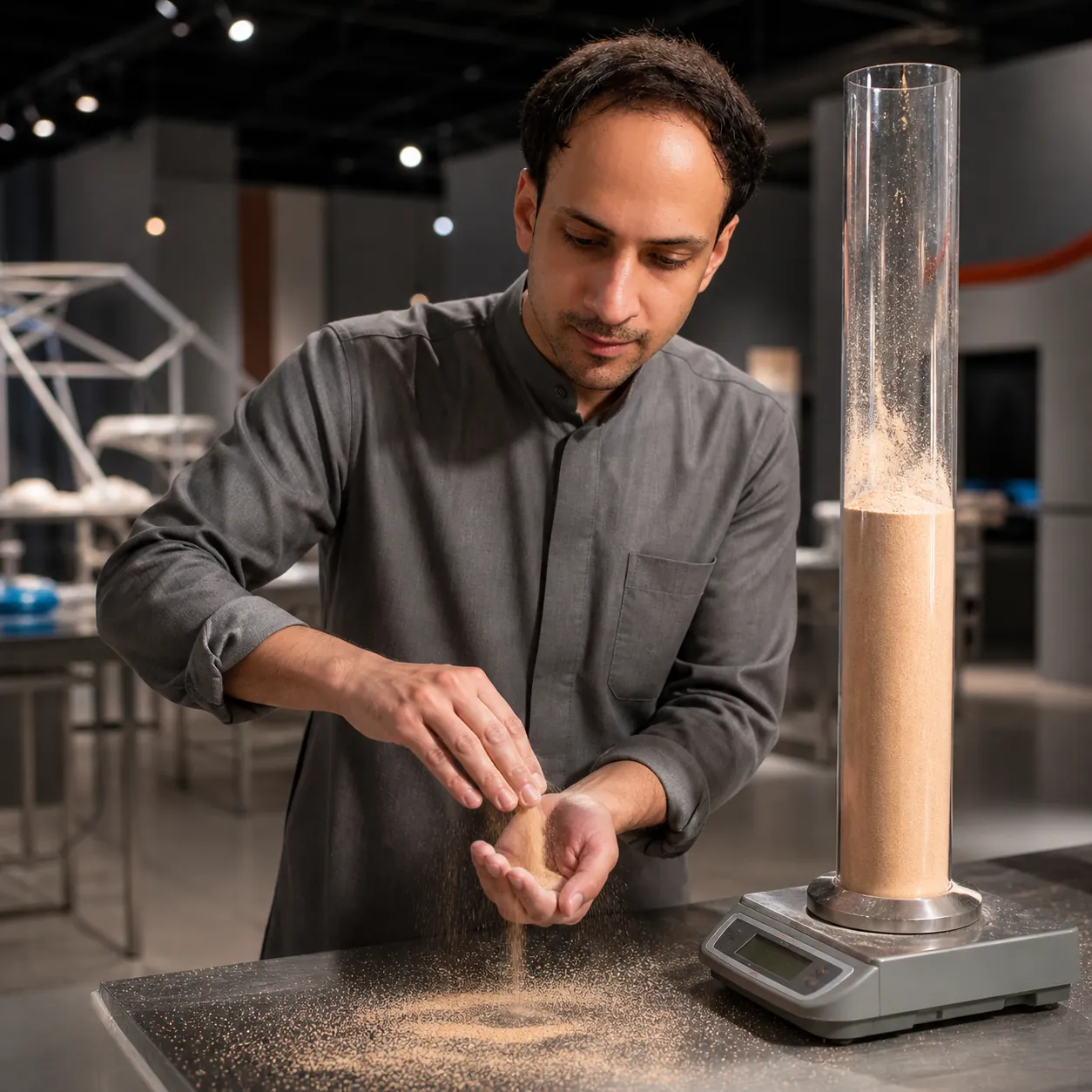
Shear Song: Science-Center Demonstration Hall — AI Portrait Prompt
صورةAI Portraits

Turn your own photo into a gallery-grade experimental portrait in a science-center demonstration hall an hour before the doors open. Keeps your face unchanged.

من نص البرومبت

Use the attached reference photo as the identity reference: keep the same face, skin tone, hair and features as the person in that photo, without beautifying, aging or altering them. Create a square 1:1 museum-catalog frame with a strong first read and a slower second read at exactly 2880x2880 pixels. Location: a science-center demonstration hall an hour before the doors open. Show the subject in a pressed grey traditional Gulf outfit with sleeves folded once at the wrists, brushing stray grains from the benchtop into one cupped hand. Make one rigorous physical condition the conceptual engine: a tall glass tube of sand standing on a scale that reads only a fraction of what they poured in shows dry grains refusing to be fully solid or fully liquid. Explore why the simplest materials hide the physics that resists every clean equation; direct expression and posture toward unhurried awe, never melodrama or ad-like confidence. Use an eye-level 50mm view with natural perspective and both of their hands kept readable. Make the composition render grains near the action sharper than their skin. Render it as gallery-grade experimental photography built from working sand demonstrations, sun-bleached field styling, honest grain-level physics, and calm scientific candor, using clean directional laboratory light shaped to keep single falling grains visible and a palette of bleached bone, shadow grey, and one line of terracotta. Photorealistic: this must read as a real photograph from a physical camera, never an illustration, painting, or 3D render. Resolve real surface detail: fine lint on dark fabric, water spotting on steel, and the soft rounding of edges that have been used for years. Keep one identity-locked subject, credible hands and fingers, natural fabric, and coherent scale, contact, reflections, shadows, airflow, deformation, and materials. Background people only when essential, always secondary and clearly different. Avoid swirling sandstorm vortices, glowing hourglass fantasy, levitating sand spirals, cymatic pattern plates, and heroic dune-top silhouettes. No text, labels, logos, signatures, watermarks, random symbols, plastic skin, excessive bloom, or glossy AI finish.
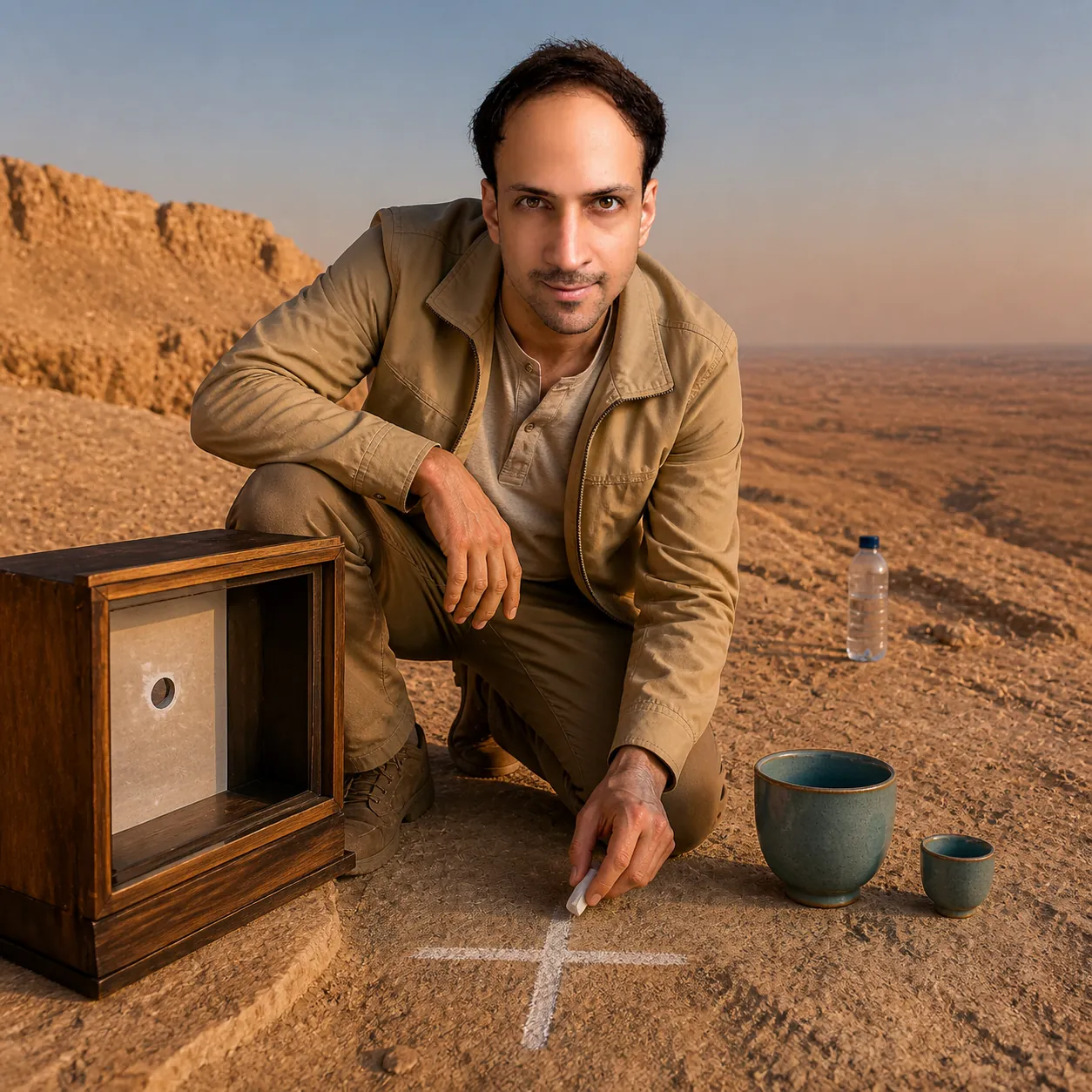
Second Look: Limestone Escarpment Edge Northwest — AI Portrait Prompt
صورةAI Portraits

Turn your own photo into a high-concept optical portrait in the limestone escarpment edge northwest of Riyadh in late amber light. Keeps your face unchanged.

من نص البرومبت

Use the attached reference photo as the identity reference: keep the same face, skin tone, hair and features as the person in that photo, without beautifying, aging or altering them. Create a square 1:1 museum-catalog frame with a strong first read and a slower second read at exactly 2880x2880 pixels. Location: the limestone escarpment edge northwest of Riyadh in late amber light. Show the subject in a sand-toned windbreaker zipped over a stone henley and canvas trousers, chalking a small cross on the rock at their feet. Treat this mechanism as the frame’s governing rule: a waist-high skewed room model whose drilled peephole makes two identical cups read as giant and dwarf defeats the eye's scale instinct with nothing but honest, lawful geometry. Explore what becomes of grandeur when distance can quietly negotiate its size; direct expression and posture toward grounded awe, never melodrama or ad-like confidence. Frame from one marked standing position so the alignment lands exactly and their face stays readable. Make the composition keep one honest scale reference standing quietly inside the frame. Render it as high-concept optical portraiture built from lawful lens geometry, documentary street realism, model-shop craft fidelity, and patient editorial composition, using one collimated key with crisp parallel shadows and soft neutral fill and a palette of bone white, deep umber, and one restrained teal. Photorealistic: this must read as a real photograph from a physical camera, never an illustration, painting, or 3D render. Resolve real surface detail: grout darker than tile, sealant slightly yellowed, and every joint showing a real tolerance gap. Keep one identity-locked person, credible hands and fingers, natural fabric, and coherent scale, contact, reflections, shadows, airflow, deformation, and materials. Background people only when essential, always secondary and clearly different. Avoid shrunken-person composites, giant-monster posing, fake miniature blur filters, candy-toy oversaturation, and warped fisheye streets. No text, labels, logos, signatures, watermarks, random symbols, plastic skin, excessive bloom, or glossy AI finish.
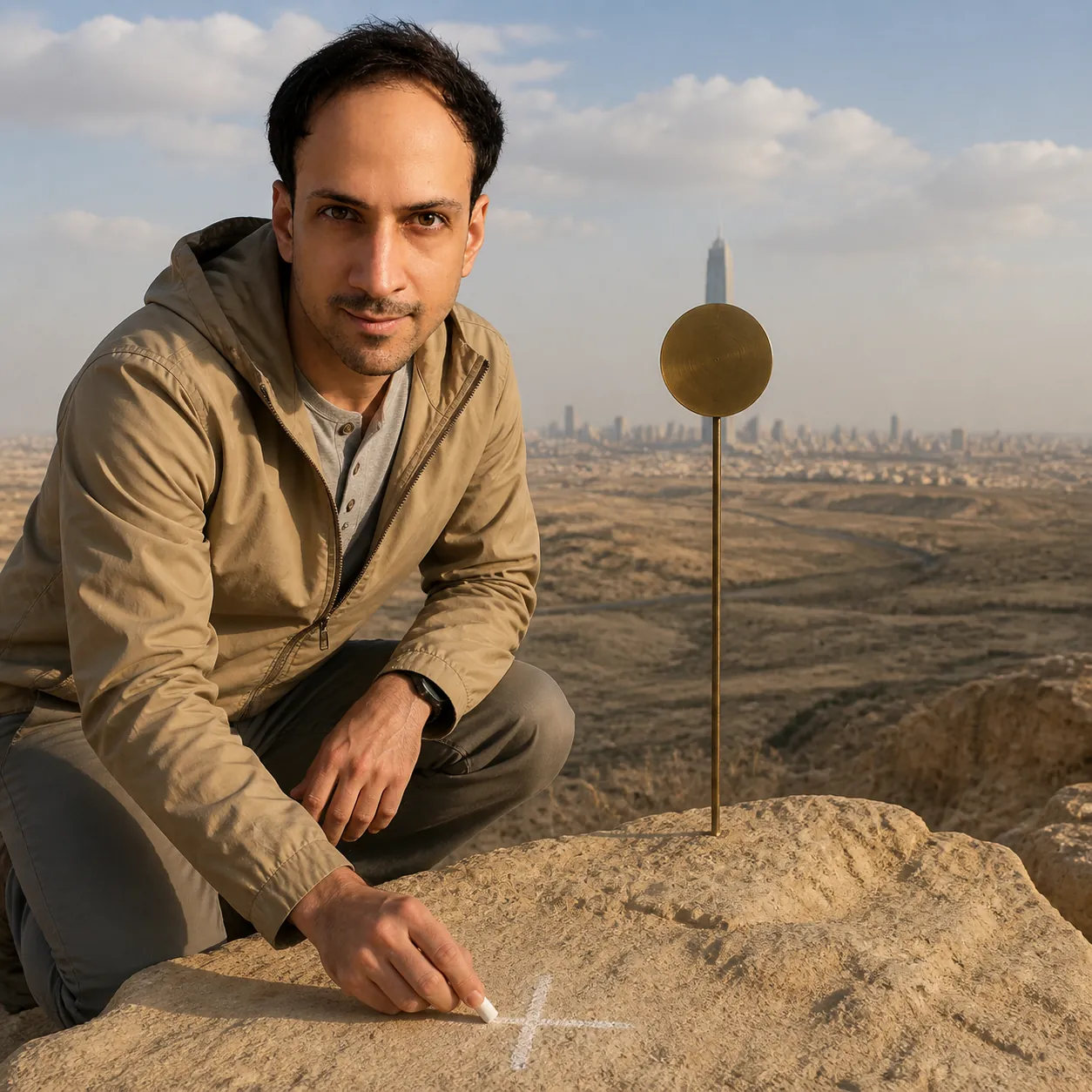
The Eye's Ruler: Limestone Escarpment Edge Northwest — AI Portrait Prompt
صورةAI Portraits

Turn your own photo into a portrait in the limestone escarpment edge northwest of Riyadh in late amber light. Keeps your face unchanged.

من نص البرومبت

Use the attached reference photo as the identity reference: keep the same face, skin tone, hair and features as the person in that photo, without beautifying, aging or altering them. Create a square 1:1 museum-catalog frame with a strong first read and a slower second read at exactly 2880x2880 pixels. Location: the limestone escarpment edge northwest of Riyadh in late amber light. Show the subject in a sand-toned windbreaker zipped over a stone henley and canvas trousers, chalking a small cross on the rock at their feet. Use this advanced image-making device as the core logic: a polished brass disc on a slender stand that exactly eclipses the tallest distant high-rise from the lens's fixed station achieves its entire effect without altering a single object it shows. Explore whether size is something objects own or something distances lend them; direct expression and posture toward attentive calm, never melodrama or ad-like confidence. Frame at the demonstration's own height so the optical event and their eyes share one axis. Make the composition seat the illusion dead center and let them stand off-axis. Render it as museum-grade demonstration photography combining true forced-perspective staging, honest depth-of-field behavior, believable material scale cues, and restrained contemporary art direction, using clean window daylight falling across near objects and far ground alike and a palette of dust beige, asphalt grey, and a single brick red. Photorealistic: this must read as a real photograph from a physical camera, never an illustration, painting, or 3D render. Resolve real surface detail: thread ends and slight pilling on worn cloth, hairline chips at every hard corner, and stone that is porous rather than smooth. Keep one identity-locked person, credible hands and fingers, natural fabric, and coherent scale, contact, reflections, shadows, airflow, deformation, and materials. Background people only when essential, always secondary and clearly different. Avoid surreal scale collage, floating figures, painted anamorphic pavement, and dollhouse cartoon styling. No text, labels, logos, signatures, watermarks, random symbols, plastic skin, excessive bloom, or glossy AI finish.
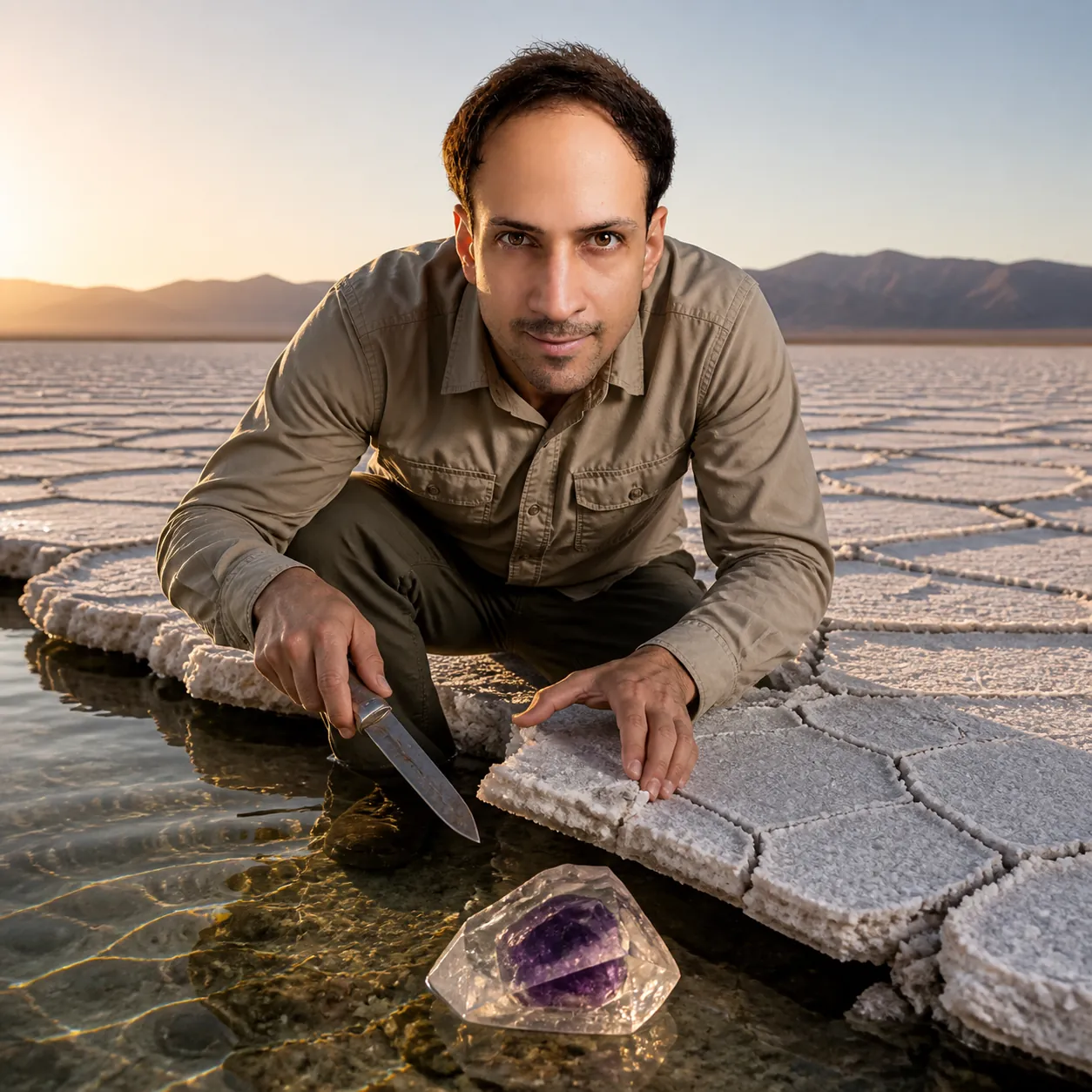
Out of Solution: Cracked White Edge — AI Portrait Prompt
صورةAI Portraits

Turn your own photo into a high-concept chemistry portrait in the cracked white edge of a sabkha salt flat at low sun. Keeps your face unchanged.

من نص البرومبت

Use the attached reference photo as the identity reference: keep the same face, skin tone, hair and features as the person in that photo, without beautifying, aging or altering them. Treat that reference as the character anchor and change only the scene. Create a square 1:1 museum-catalog frame with a strong first read and a slower second read at exactly 2880x2880 pixels. Location: the cracked white edge of a sabkha salt flat at low sun. Show the subject in a dust-toned field shirt with sleeves buttoned at the wrist, crouching to free one salt plate with a flat knife. The impossible-looking event must obey this clear system: a two-tone crystal with a violet chrome-alum heart jacketed in clear potassium alum, one lattice continued across two different chemistries turns a liquid's dissolved cargo into architecture a hand could rest on. Explore how much of building is simply removing the reasons not to begin; direct expression and posture toward unhurried focus, never melodrama or ad-like confidence. Use a 90mm framing that holds the grown geometry and their face in one plane of focus. Make the composition set liquid and solid on opposite sides of one clean diagonal. Render it as high-concept chemistry portraiture built from real supersaturation phenomena, true laboratory-glass materiality, restrained documentary honesty, and quietly monumental still-life composition, using hard low window sun refracted through glassware into small honest caustics and a palette of putty, brushed steel, and one violet chrome-alum note. Photorealistic: this must read as a real photograph from a physical camera, never an illustration, painting, or 3D render. Resolve real surface detail: brass darkened in the recesses and bright where thumbs land, and lacquer crazed rather than perfect. Keep one identity-locked person, credible hands and fingers, natural fabric, and coherent scale, contact, reflections, shadows, airflow, deformation, and materials. Background people only when essential, always secondary and clearly different. Avoid glowing magic crystals, amethyst geode caves, gemstone treasure piles, frosted window fakery, and CGI diamond shards. No text, labels, logos, signatures, watermarks, random symbols, plastic skin, excessive bloom, or glossy AI finish.
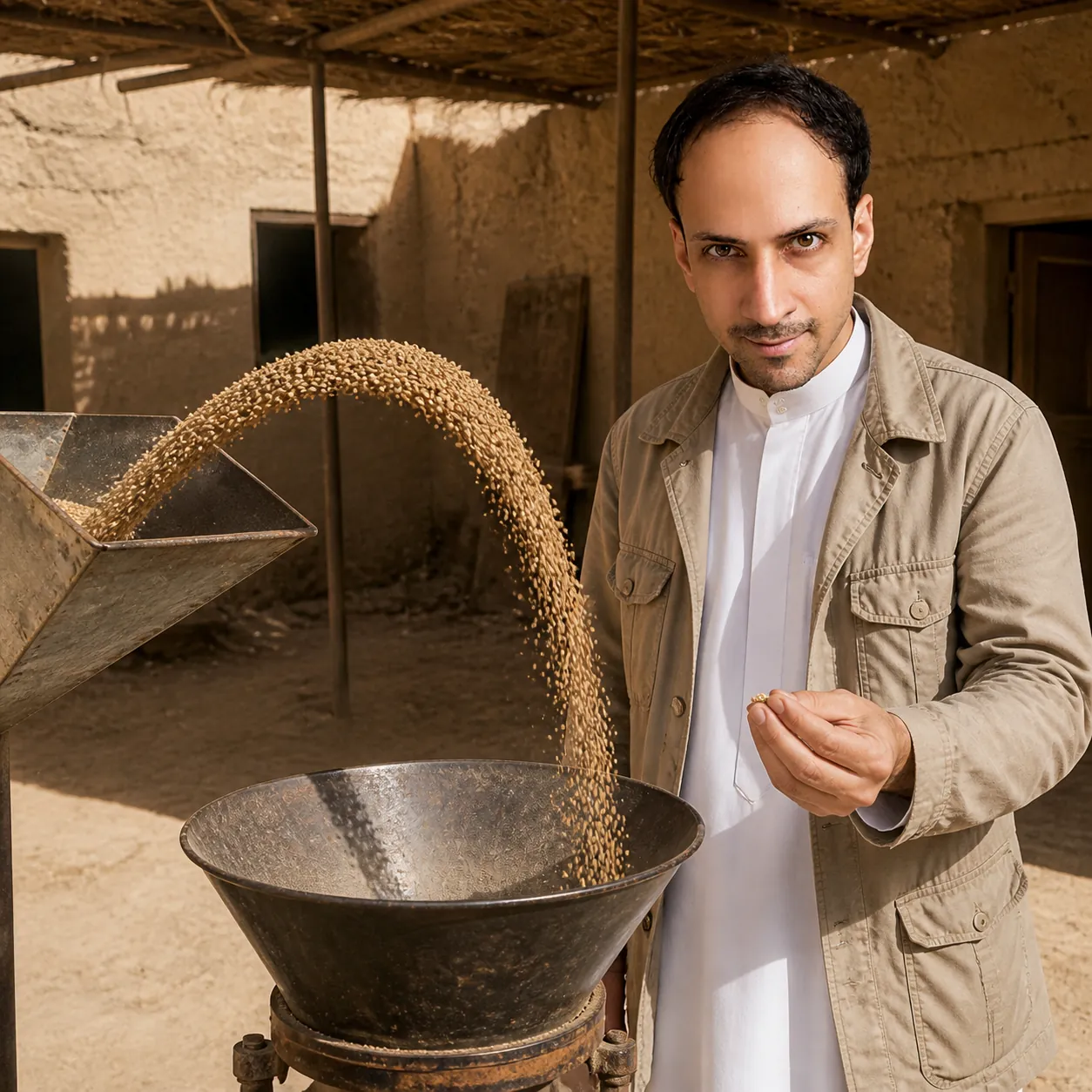
Grains Deciding: Swept Courtyard — AI Portrait Prompt
صورةAI Portraits

Turn your own photo into a gallery-grade experimental portrait in the swept courtyard of a mud-brick farmhouse at the desert's edge. Keeps your face unchanged.

من نص البرومبت

Use the attached reference photo as the identity reference: keep the same face, skin tone, hair and features as the person in that photo, without beautifying, aging or altering them. Create a square 1:1 museum-catalog frame with a strong first read and a slower second read at exactly 2880x2880 pixels. Location: the swept courtyard of a mud-brick farmhouse at the desert's edge. Show the subject in a plain white traditional Gulf outfit under a light tan field jacket, rolling three test grains between thumb and forefinger. Build the artwork around this material rule: a clear funnel of coarse grains whose pour has locked itself into a stable arch bridging the open throat shows dry grains refusing to be fully solid or fully liquid. Explore what the desert has been quietly demonstrating beside every road for centuries; direct expression and posture toward earned familiarity, never melodrama or ad-like confidence. Use a composed 35mm environmental view that gives the apparatus and the subject equal standing. Make the composition keep the background silent so the grains do the talking. Render it as gallery-grade experimental photography built from working sand demonstrations, sun-bleached field styling, honest grain-level physics, and calm scientific candor, using soft canvas-filtered shade cut by one hard sliver of noon and a palette of warm quartz beige, gunmetal grey, and one oxide-red seam. Photorealistic: this must read as a real photograph from a physical camera, never an illustration, painting, or 3D render. Resolve real surface detail: label-free packaging showing carton fibre, cardboard bruised at the corners, and tape lifting slightly at one end. Keep one identity-locked subject, credible hands and fingers, natural fabric, and coherent scale, contact, reflections, shadows, airflow, deformation, and materials. Background people only when essential, always secondary and clearly different. Avoid swirling sandstorm vortices, glowing hourglass fantasy, levitating sand spirals, cymatic pattern plates, and heroic dune-top silhouettes. No text, labels, logos, signatures, watermarks, random symbols, plastic skin, excessive bloom, or glossy AI finish.
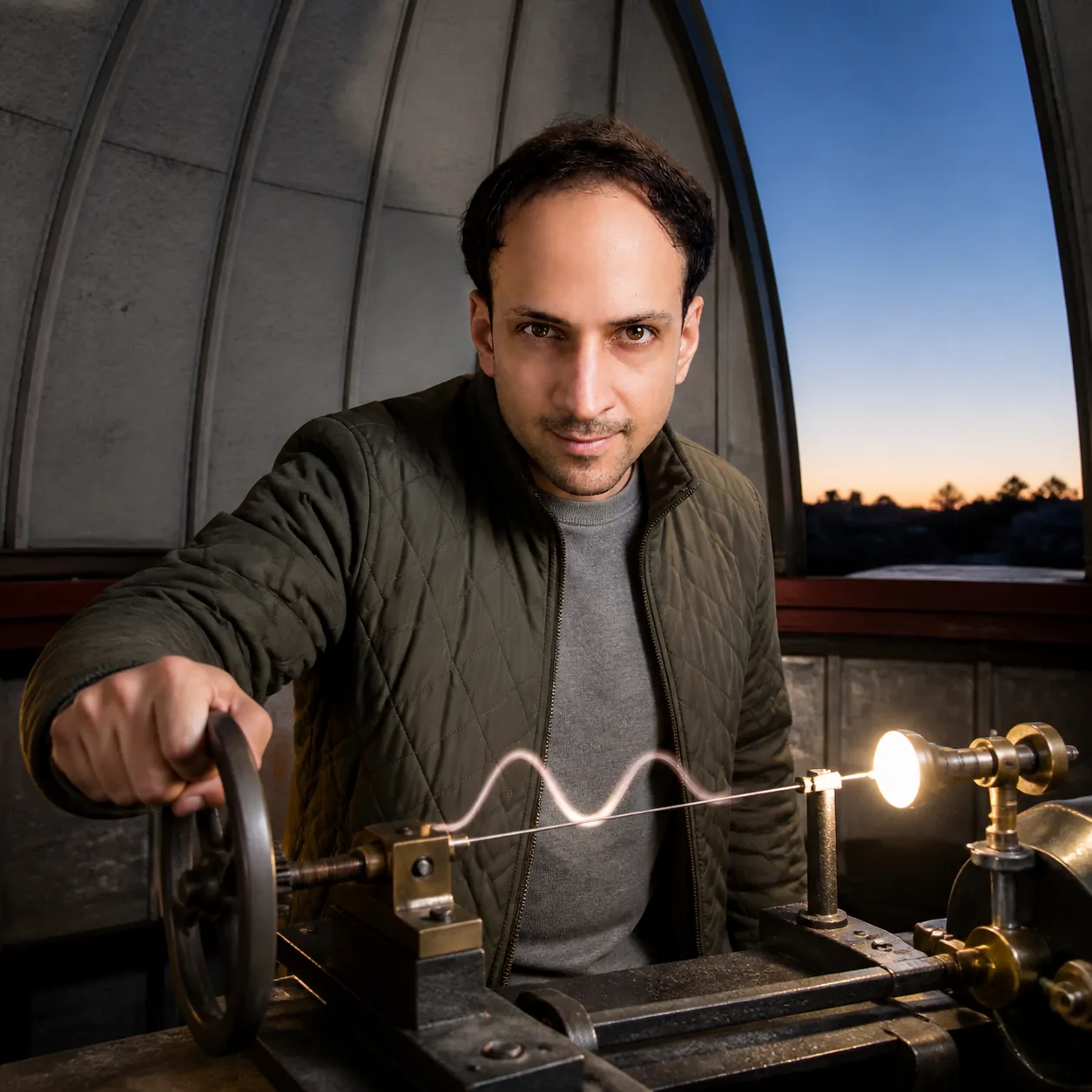
The Turned Instant: Small Teaching Observatory — AI Portrait Prompt
صورةAI Portraits

Turn your own photo into a museum-demonstration portrait in a small teaching observatory under its half-open dome before dawn. Keeps your face unchanged.

من نص البرومبت

Use the attached reference photo as the identity reference: keep the same face, skin tone, hair and features as the person in that photo, without beautifying, aging or altering them. Create a square 1:1 museum-catalog frame with a strong first read and a slower second read at exactly 2880x2880 pixels. Location: a small teaching observatory under its half-open dome before dawn. Show the subject in a quilted olive liner jacket zipped over a grey sweatshirt, cranking the dome shutter one hand-width wider. Make one rigorous physical condition the conceptual engine: a clamped steel tine ringing far too fast to see until a strobe slows its blur into one lazily waving curve recruits the viewer's own persistence of vision as its final moving part. Explore why a full lawful explanation enlarges the astonishment instead of spending it; direct expression and posture toward quiet astonishment, never melodrama or ad-like confidence. Use an eye-level 85mm portrait view with the apparatus sharing their focal plane at honest scale. Make the composition give their hand, the mechanism, and their gaze one connected diagonal. Render it as museum-demonstration realism combining hand-finished brass and tin surfaces, physically exact motion sampling, readable human presence, and restrained curatorial styling, using cool dusk ambience balanced by a single warm practical near the machine and a palette of soot grey, unpainted card, and one band of vermilion. Photorealistic: this must read as a real photograph from a physical camera, never an illustration, painting, or 3D render. Resolve real surface detail: fine grit in the texture of concrete, efflorescence at damp edges, and hairline cracks that follow stress. Keep one identity-locked subject, credible hands and fingers, natural fabric, and coherent scale, contact, reflections, shadows, airflow, deformation, and materials. Background people only when essential, always secondary and clearly different. Avoid film-strip borders, cartoon motion lines, ghosted multiple faces, glowing hologram spin, and sparks flying off machinery. No text, labels, logos, signatures, watermarks, random symbols, plastic skin, excessive bloom, or glossy AI finish.
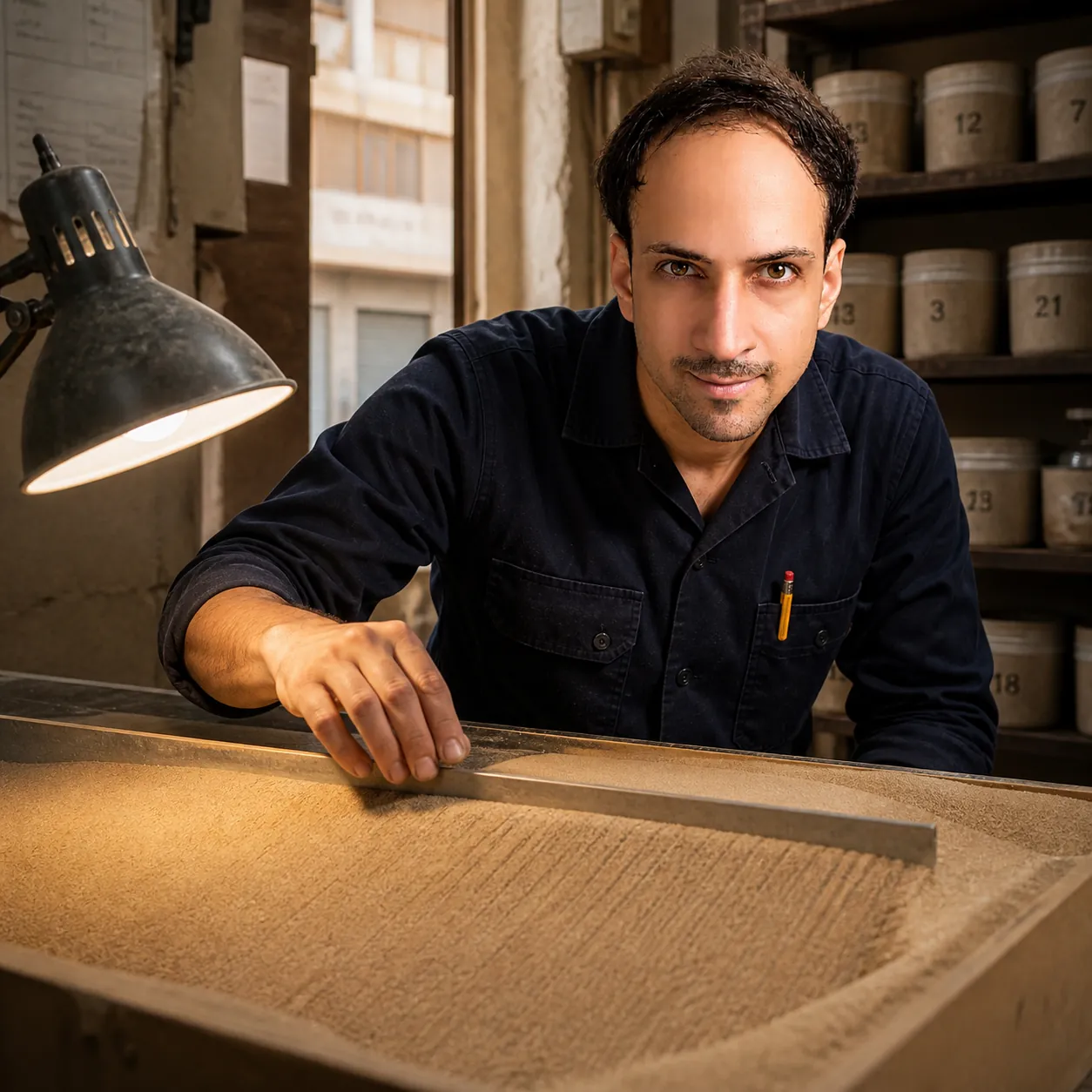
Fifth State: Back-Street Riyadh Workshop — AI Portrait Prompt
صورةAI Portraits

Turn your own photo into a conceptual earth-science portrait in a back-street Riyadh workshop with sand samples in numbered tins. Keeps your face unchanged.

من نص البرومبت

Use the attached reference photo as the identity reference: keep the same face, skin tone, hair and features as the person in that photo, without beautifying, aging or altering them. Treat that reference as the character anchor and change only the scene. Create a square 1:1 museum-catalog frame with a strong first read and a slower second read at exactly 2880x2880 pixels. Location: a back-street Riyadh workshop with sand samples in numbered tins. Show the subject in a navy work shirt with a pencil clipped at the chest, drawing a straightedge slowly across a bed of grains. Treat this mechanism as the frame’s governing rule: a booming dune face whose sheared upper layer they release with one slow hand-drag, avalanching as a single humming sheet gives the desert's most ordinary material the standing of an exact instrument. Explore why a material older than the mountains still refuses to pick a state; direct expression and posture toward attentive calm, never melodrama or ad-like confidence. Frame from just above the sand's surface so its grain-scale horizon leads to their level gaze. Make the composition let one sharp edge of settled grains cross the frame diagonally. Render it as conceptual earth-science portraiture combining tactile working apparatus, believable granular flow, restrained contemporary art direction, and unhurried human presence, using one bare work lamp angled low across the sand's textured surface and a palette of dune ivory, matte charcoal, and one indigo band. Photorealistic: this must read as a real photograph from a physical camera, never an illustration, painting, or 3D render. Resolve real surface detail: paper fibre visible at cut edges, plastic that shows mould lines, and paint thicker where a brush turned. Keep one identity-locked person, credible hands and fingers, natural fabric, and coherent scale, contact, reflections, shadows, airflow, deformation, and materials. Background people only when essential, always secondary and clearly different. Avoid falconry props, camel caravans, CGI sand tornadoes, face-morphing sand sculptures, and endless untouched postcard dunes. No text, labels, logos, signatures, watermarks, random symbols, plastic skin, excessive bloom, or glossy AI finish.
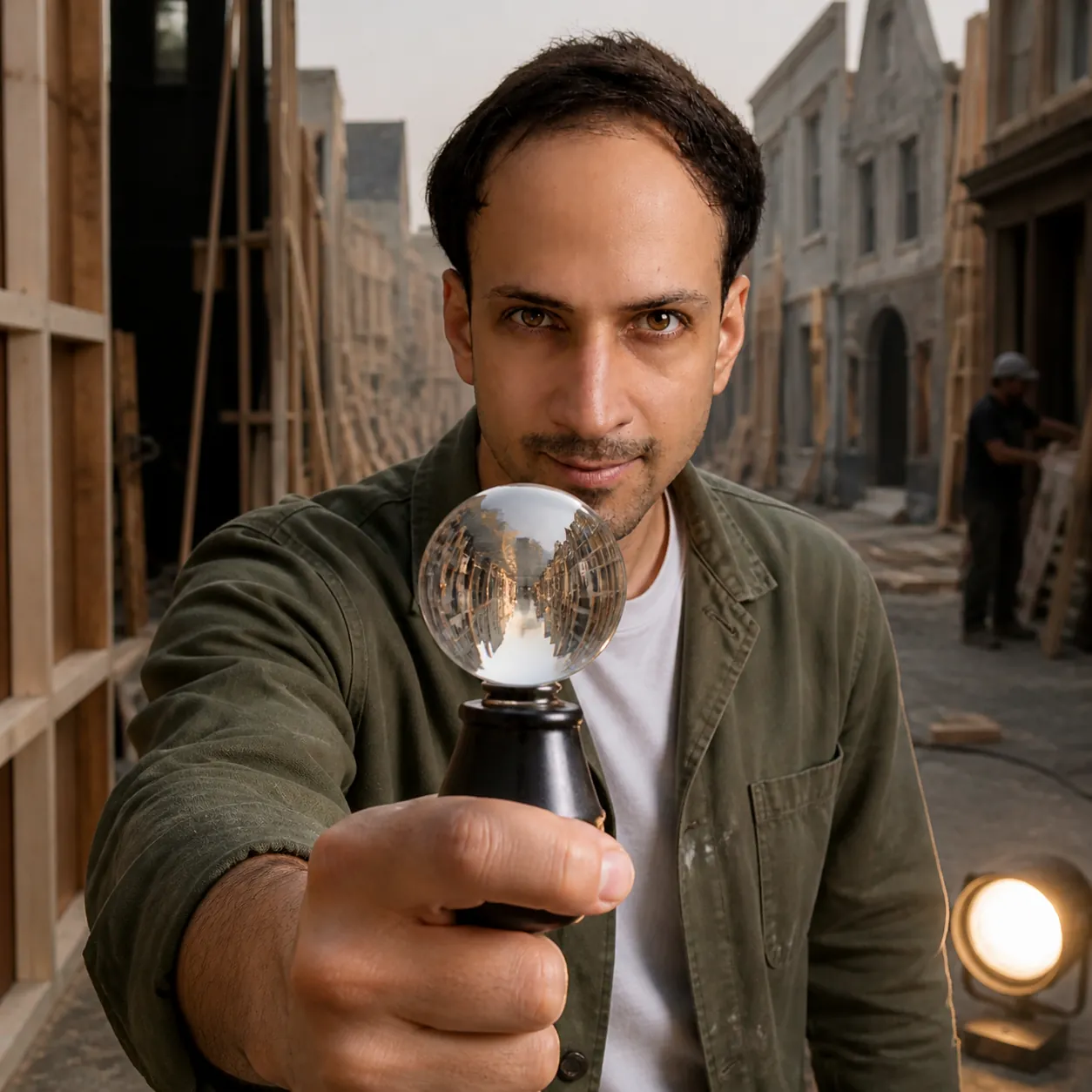
One Vantage: Film Studio's Backlot Lane — AI Portrait Prompt
صورةAI Portraits

Turn your own photo into a high-concept optical portrait in a film studio's backlot lane of half-built facade fronts. Keeps your face unchanged.

من نص البرومبت

Use the attached reference photo as the identity reference: keep the same face, skin tone, hair and features as the person in that photo, without beautifying, aging or altering them. Create a square 1:1 museum-catalog frame with a strong first read and a slower second read at exactly 2880x2880 pixels. Location: a film studio's backlot lane of half-built facade fronts. Show the subject in a canvas shop coat in faded olive over a white tee, sighting down their extended thumb toward the facade fronts. Use this advanced image-making device as the core logic: a clear glass sphere on a black stand that folds everything around it into one inverted thumb-sized world defeats the eye's scale instinct with nothing but honest, lawful geometry. Explore whether wonder needs mystery or survives the full disclosure of its method; direct expression and posture toward steady disbelief, never melodrama or ad-like confidence. Frame at the demonstration's own height so the optical event and their eyes share one axis. Make the composition align their gaze with the exact line the illusion depends on. Render it as high-concept optical portraiture built from lawful lens geometry, documentary street realism, model-shop craft fidelity, and patient editorial composition, using a single practical lamp held low, its beam spreading lawfully with distance and a palette of warm grey concrete, pale haze, and one signal orange. Photorealistic: this must read as a real photograph from a physical camera, never an illustration, painting, or 3D render. Resolve real surface detail: wood grain read at honest scale, matte and gloss clearly separated, and no surface uniformly clean. Keep one identity-locked person, credible hands and fingers, natural fabric, and coherent scale, contact, reflections, shadows, airflow, deformation, and materials. Background people only when essential, always secondary and clearly different. Avoid shrunken-person composites, giant-monster posing, fake miniature blur filters, candy-toy oversaturation, and warped fisheye streets. No text, labels, logos, signatures, watermarks, random symbols, plastic skin, excessive bloom, or glossy AI finish.
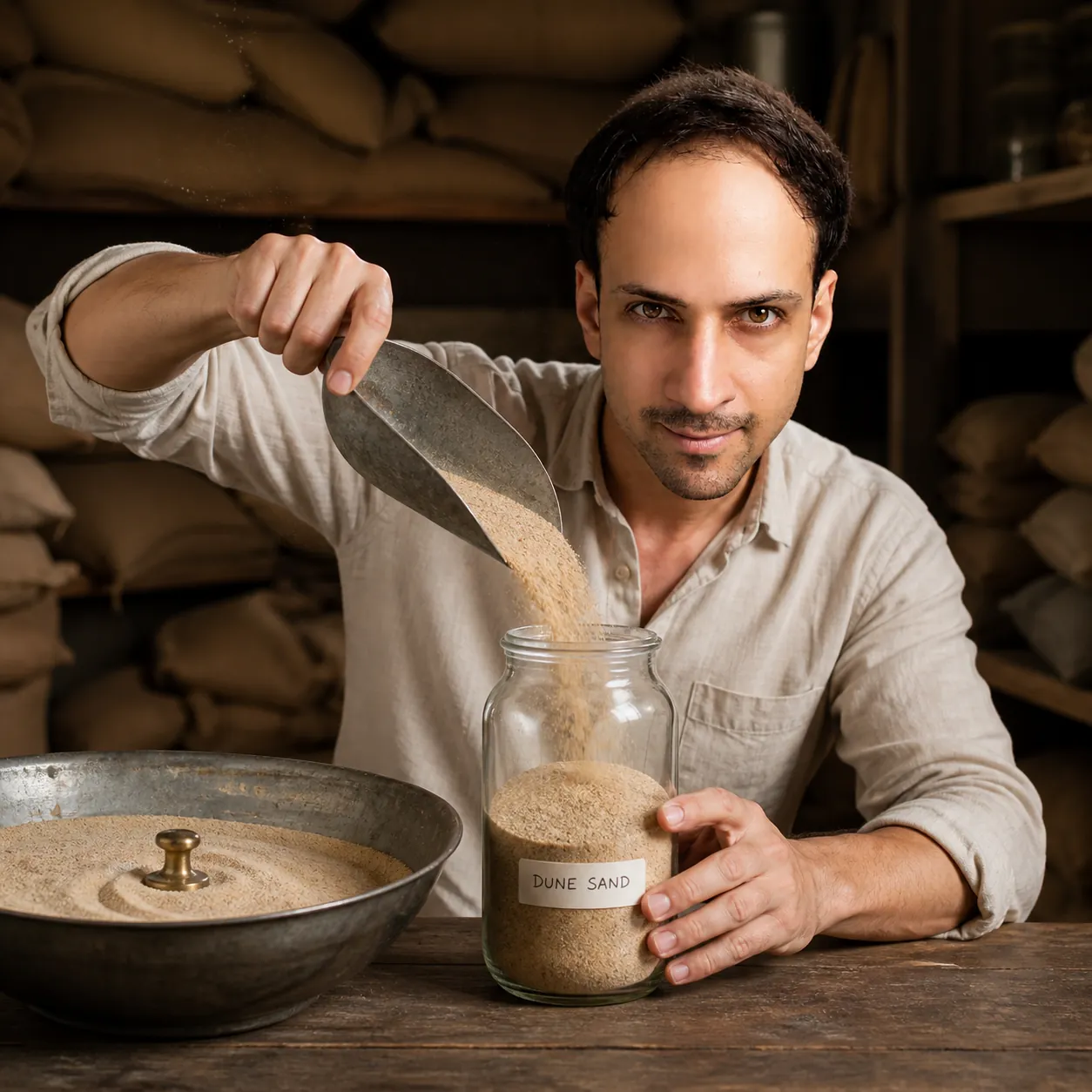
The Dry Tide: Date-Farm Storehouse — AI Portrait Prompt
صورةAI Portraits

Turn your own photo into a portrait in a date-farm storehouse with burlap sacks and one cleared plank table. Keeps your face unchanged.

من نص البرومبت

Use the attached reference photo as the identity reference: keep the same face, skin tone, hair and features as the person in that photo, without beautifying, aging or altering them. Create a square 1:1 museum-catalog frame with a strong first read and a slower second read at exactly 2880x2880 pixels. Location: a date-farm storehouse with burlap sacks and one cleared plank table. Show the subject in an oatmeal linen shirt buttoned to one below the collar, funneling dune sand into a labeled glass jar. The impossible-looking event must obey this clear system: a basin of dune sand fed by hidden air through its floor, simmering like a liquid a brass weight sinks into shows dry grains refusing to be fully solid or fully liquid. Explore whether a heap that sorts, sings, and locks deserves the word inert; direct expression and posture toward quiet reckoning, never melodrama or ad-like confidence. Use a 90mm close-portrait framing where single airborne grains near the lens stay physically plausible against their focused face. Make the composition place their hands and the demonstration inside one unbroken triangle. Render it as gallery-grade experimental photography built from working sand demonstrations, sun-bleached field styling, honest grain-level physics, and calm scientific candor, using low raking desert sun that turns every ridge of grains into relief and a palette of sifted taupe, worn steel, and a low amber accent. Photorealistic: this must read as a real photograph from a physical camera, never an illustration, painting, or 3D render. Resolve real surface detail: glass with real thickness at its edge, reflections that carry the room's actual colour, and dust visible only at grazing angles. Keep one identity-locked subject, credible hands and fingers, natural fabric, and coherent scale, contact, reflections, shadows, airflow, deformation, and materials. Background people only when essential, always secondary and clearly different. Avoid swirling sandstorm vortices, glowing hourglass fantasy, levitating sand spirals, cymatic pattern plates, and heroic dune-top silhouettes. No text, labels, logos, signatures, watermarks, random symbols, plastic skin, excessive bloom, or glossy AI finish.
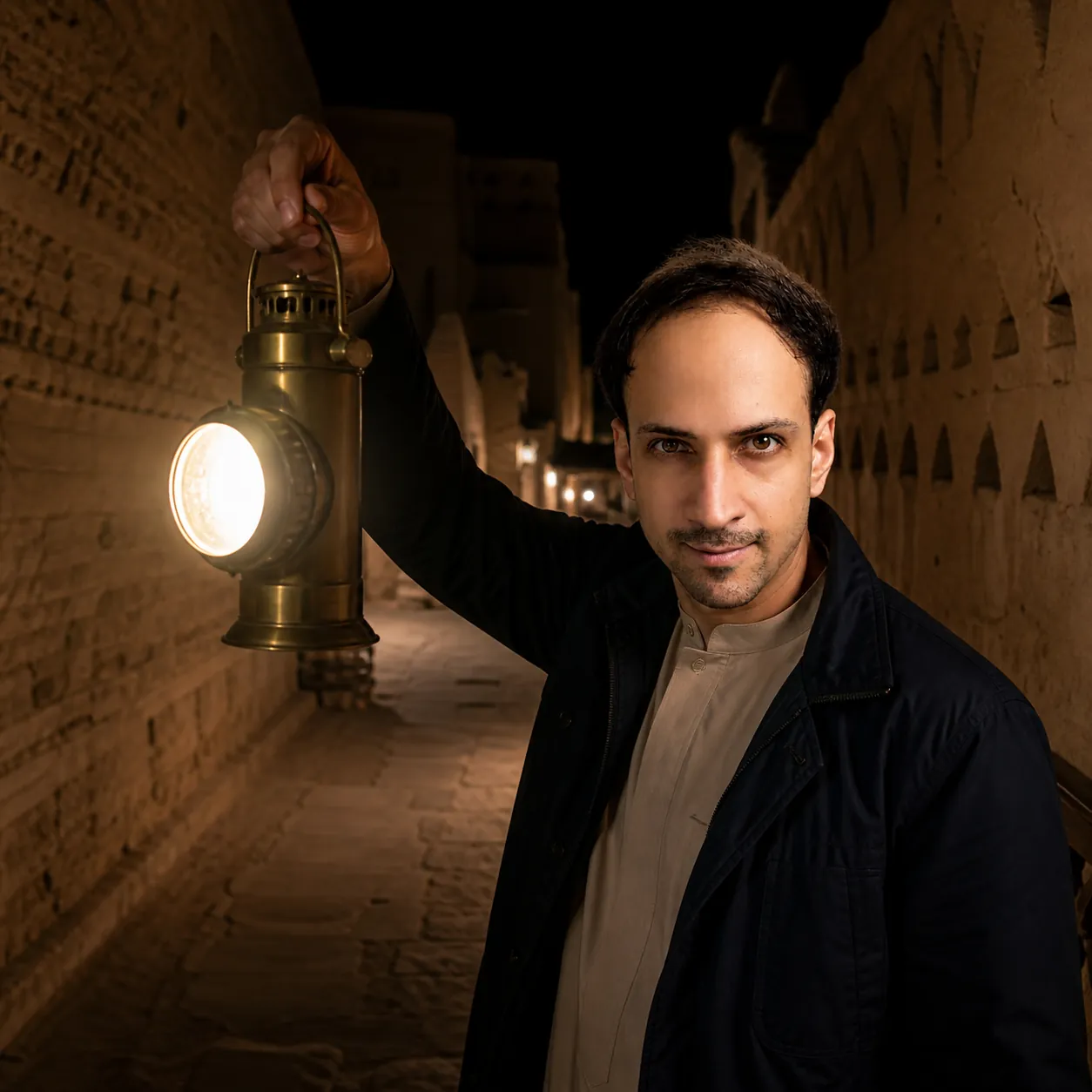
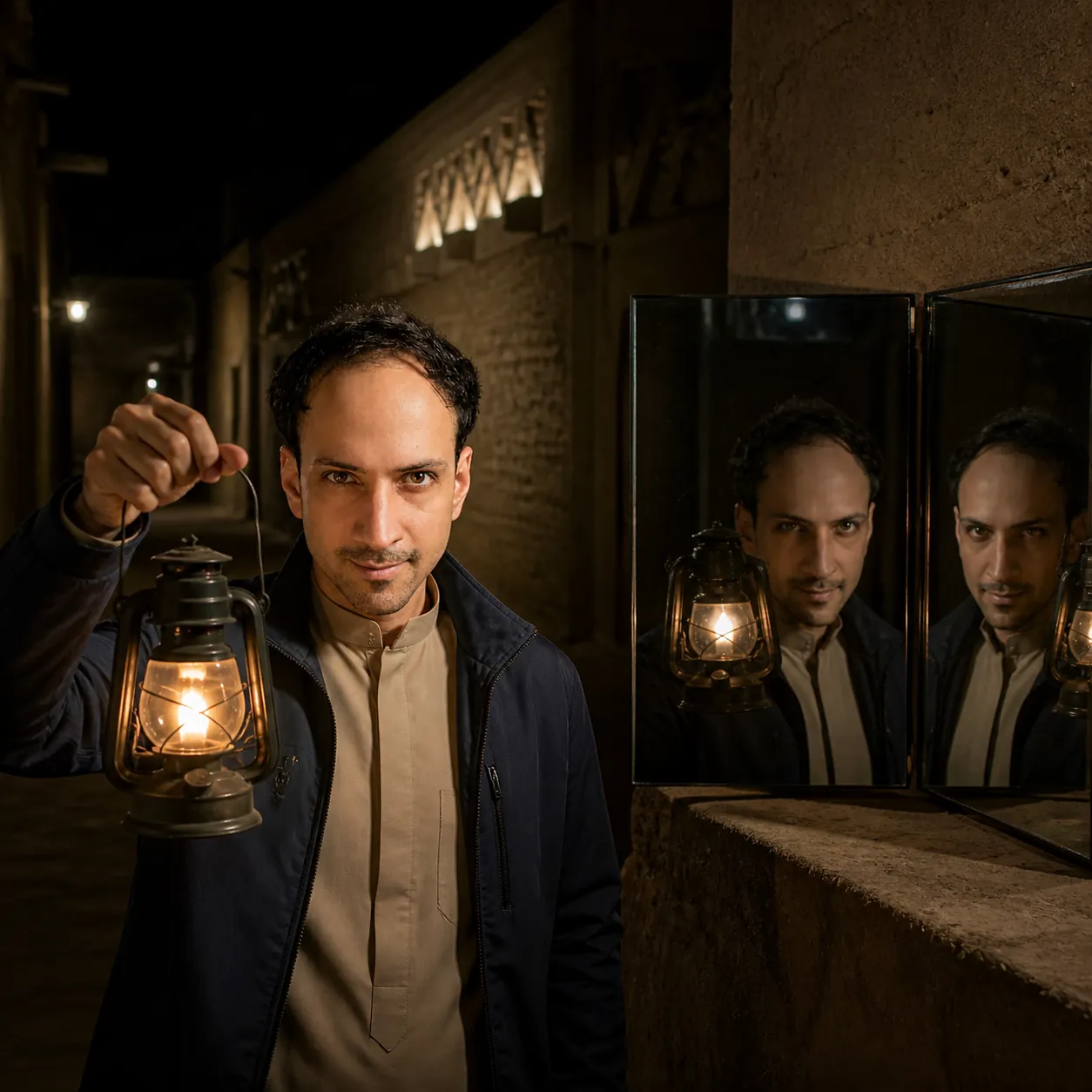
One Witness: Mud-Brick Alley — AI Portrait Prompt
صورةAI Portraits

Turn your own photo into a conceptual field-optics portrait in a mud-brick alley in old Diriyah after nightfall. Keeps your face unchanged.

من نص البرومبت

Use the attached reference photo as the identity reference: keep the same face, skin tone, hair and features as the person in that photo, without beautifying, aging or altering them. Create a square 1:1 museum-catalog frame with a strong first read and a slower second read at exactly 2880x2880 pixels. Location: a mud-brick alley in old Diriyah after nightfall. Show the subject in a light navy jacket worn open over a sand-toned traditional Gulf outfit, raising a hand lantern slowly to shoulder height. Treat this mechanism as the frame’s governing rule: a brass cat's-eye cell, a lens over a mirror, that keeps sending their beam home even as they tilt it turns the open air into a private channel between lamp and eye. Explore where the boundary lies between observing a phenomenon and being part of its optics; direct expression and posture toward collected surprise, never melodrama or ad-like confidence. Frame in half-profile at chest height so the subject and the answering light stay equally readable. Make the composition point the strongest return at the lens, their face kept quiet. Render it as conceptual field-optics realism blending honest low-light exposure, physically accurate retroreflection, quiet darkened-space atmosphere, and calm human-scale editorial framing, using one small practical held near the lens axis with the room falling dark and a palette of lamp black, slate grey, and one pale-fire cone. Photorealistic: this must read as a real photograph from a physical camera, never an illustration, painting, or 3D render. Resolve real surface detail: floor finish worn along the walked line, skirting marked at shoe height, and corners darker than the open floor. Keep one identity-locked subject, credible hands and fingers, natural fabric, and coherent scale, contact, reflections, shadows, airflow, deformation, and materials. Background people only when essential, always secondary and clearly different. Avoid laser-show haze walls, glowing animal eyes, CGI light tunnels, painted halos, and highway signage. No text, labels, logos, signatures, watermarks, random symbols, plastic skin, excessive bloom, or glossy AI finish.
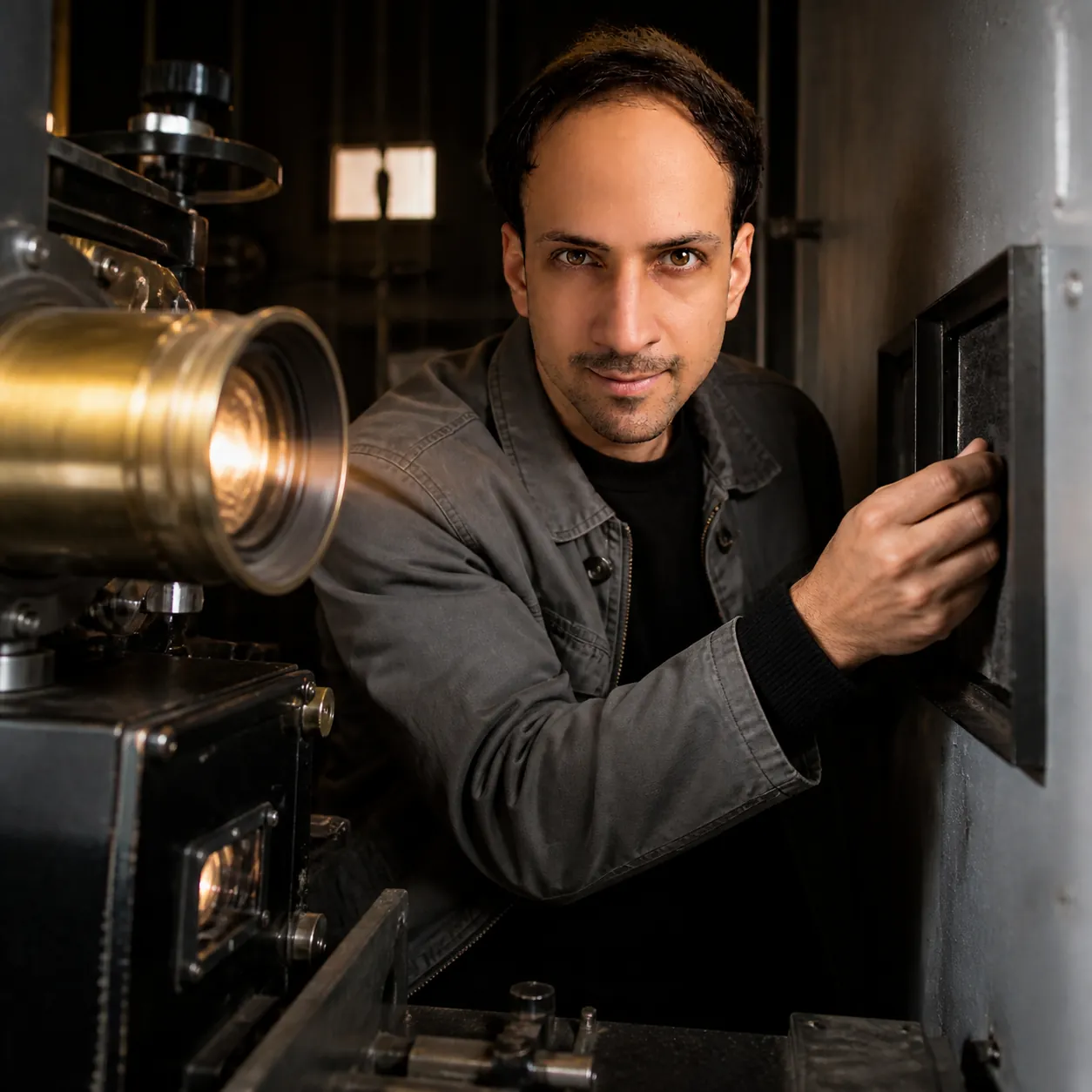
One Witness: Projection Booth — AI Portrait Prompt
صورةAI Portraits

Turn your own photo into a high-concept optical portrait in the projection booth of a shuttered single-screen cinema. Keeps your face unchanged.

من نص البرومبت

Use the attached reference photo as the identity reference: keep the same face, skin tone, hair and features as the person in that photo, without beautifying, aging or altering them. Create a square 1:1 museum-catalog frame with a strong first read and a slower second read at exactly 2880x2880 pixels. Location: the projection booth of a shuttered single-screen cinema. Show the subject in a black crew-neck sweater under an open grey utility jacket, pressing the felt door seal flat with one thumb. Make one rigorous physical condition the conceptual engine: a brass cat's-eye cell, a lens over a mirror, that keeps sending their beam home even as they tilt it keeps its full brightness for the one standing at the light's source. Explore where the boundary lies between observing a phenomenon and being part of its optics; direct expression and posture toward sober delight, never melodrama or ad-like confidence. Use an eye-level 80mm medium-format viewpoint with natural perspective and deep honest blacks. Make the composition align lamp, eye, and return along one legible line. Render it as high-concept optical portraiture built from real return-path geometry, documentary night realism, precision lamp discipline, and emotionally restrained composition, using late window light kept low so on-axis return outshines every ordinary reflection and a palette of graphite, dusty sand, and one pale gold star. Photorealistic: this must read as a real photograph from a physical camera, never an illustration, painting, or 3D render. Resolve real surface detail: the difference between a wiped surface and a clean one, faint tide marks on ceramic, and metal dulled unevenly by touch. Keep one identity-locked subject, credible hands and fingers, natural fabric, and coherent scale, contact, reflections, shadows, airflow, deformation, and materials. Background people only when essential, always secondary and clearly different. Avoid glowing sci-fi visors, hi-vis vest advertising poses, lens-flare starbursts, and neon cyberpunk streets. No text, labels, logos, signatures, watermarks, random symbols, plastic skin, excessive bloom, or glossy AI finish.
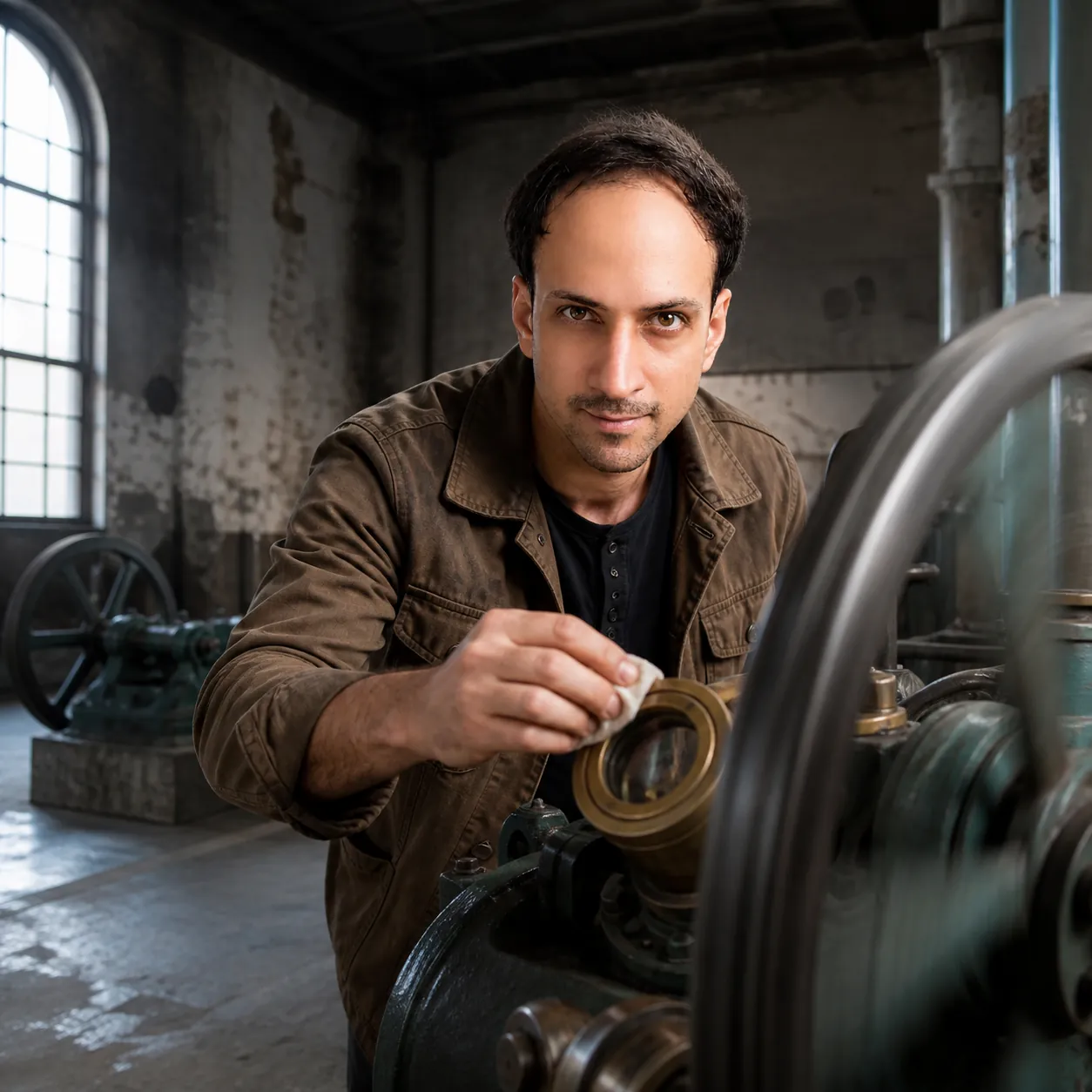
Between Frames: Decommissioned Pump Hall — AI Portrait Prompt
صورةAI Portraits

Turn your own photo into a portrait in a decommissioned pump hall, its painted machinery bolted to concrete plinths. Keeps your face unchanged.

من نص البرومبت

Use the attached reference photo as the identity reference: keep the same face, skin tone, hair and features as the person in that photo, without beautifying, aging or altering them. Create a square 1:1 museum-catalog frame with a strong first read and a slower second read at exactly 2880x2880 pixels. Location: a decommissioned pump hall, its painted machinery bolted to concrete plinths. Show the subject in a brown canvas jacket over a faded black henley, polishing a brass sight-glass clear with one slow thumb. Treat this mechanism as the frame’s governing rule: a spoked flywheel spinning at full speed that their strobe knob walks from a standstill into slow, deliberate reverse turns strict mechanical repetition into one seamless appearance the eye trusts. Explore how strict repetition can impersonate growth while nothing on the table grows; direct expression and posture toward collected surprise, never melodrama or ad-like confidence. Frame past the working apparatus from slightly behind it, keeping their attentive face sharp beyond the blur. Make the composition oppose the machine's blur against their perfectly still attention. Render it as kinetic-sculpture photography grounded in believable machinery, honest depth of field, accurate frozen-motion physics, and unhurried editorial portrait craft, using one cool low-angle key with soft continuous fill and honest shadows and a palette of lamp black, worn tin, and one arc of verdigris. Photorealistic: this must read as a real photograph from a physical camera, never an illustration, painting, or 3D render. Resolve real surface detail: floor finish worn along the walked line, skirting marked at shoe height, and corners darker than the open floor. Keep one identity-locked subject, credible hands and fingers, natural fabric, and coherent scale, contact, reflections, shadows, airflow, deformation, and materials. Background people only when essential, always secondary and clearly different. Avoid steampunk goggles and gears, CGI slow-motion splashes, projected film beams, carnival colors, and duplicated human figures. No text, labels, logos, signatures, watermarks, random symbols, plastic skin, excessive bloom, or glossy AI finish.
The Way Home: Mud-Brick Alley — AI Portrait Prompt
صورةAI Portraits

Turn your own photo into a quiet experimental gallery portrait in a mud-brick alley in old Diriyah after nightfall. Keeps your face unchanged.

من نص البرومبت

Use the attached reference photo as the identity reference: keep the same face, skin tone, hair and features as the person in that photo, without beautifying, aging or altering them. Create a square 1:1 museum-catalog frame with a strong first read and a slower second read at exactly 2880x2880 pixels. Location: a mud-brick alley in old Diriyah after nightfall. Show the subject in a light navy jacket worn open over a sand-toned traditional Gulf outfit, raising a hand lantern slowly to shoulder height. Use this advanced image-making device as the core logic: a hollow corner of three mirrors that pins their reflected gaze to its apex no matter where they move their head keeps its full brightness for the one standing at the light's source. Explore how a surface can be truthfully dark and truthfully blazing in the same minute; direct expression and posture toward sober delight, never melodrama or ad-like confidence. Frame from slightly low in the dark, their face lit by spill rather than beam. Make the composition hold the dark version and the blazing version inside one frame. Render it as quiet experimental gallery photography built around one working retroreflector, disciplined single-source lighting, true-to-life surface response, and patient observational framing, using cool moonless darkness broken by one narrow torch beam and faint spill and a palette of graphite, dusty sand, and one pale gold star. Photorealistic: this must read as a real photograph from a physical camera, never an illustration, painting, or 3D render. Resolve real surface detail: visible weave in cloth, fine scratches on metal, and the faint unevenness of painted walls. Keep one identity-locked subject, credible hands and fingers, natural fabric, and coherent scale, contact, reflections, shadows, airflow, deformation, and materials. Background people only when essential, always secondary and clearly different. Avoid glowing sci-fi visors, hi-vis vest advertising poses, lens-flare starbursts, and neon cyberpunk streets. No text, labels, logos, signatures, watermarks, random symbols, plastic skin, excessive bloom, or glossy AI finish.
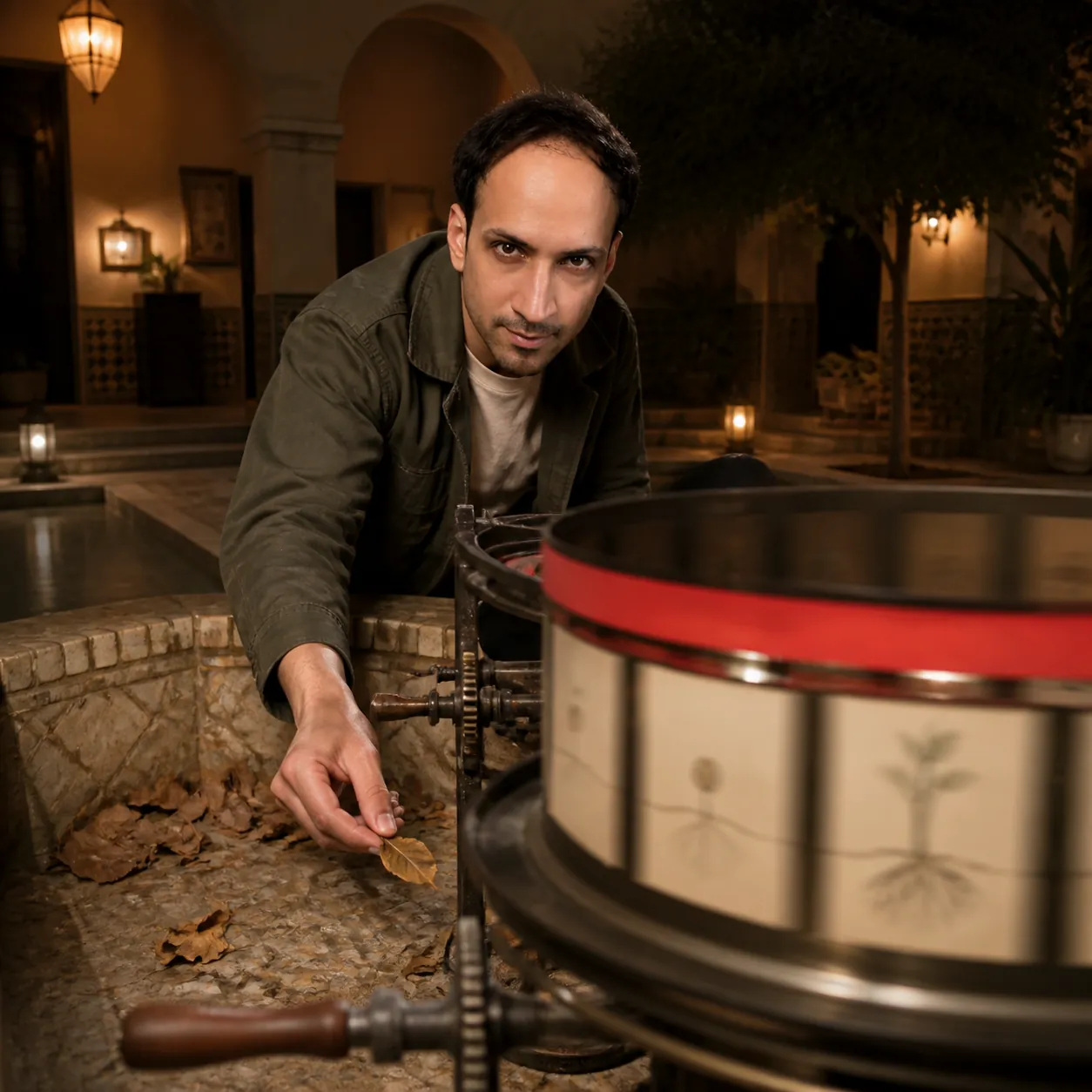
Strict Rhythm: Tiled Hotel Courtyard Whose Fountain — AI Portrait Prompt
صورةAI Portraits

Turn your own photo into a pre-cinema apparatus portrait in a tiled hotel courtyard whose fountain is switched off for the night. Keeps your face unchanged.

من نص البرومبت

Use the attached reference photo as the identity reference: keep the same face, skin tone, hair and features as the person in that photo, without beautifying, aging or altering them. Create a square 1:1 museum-catalog frame with a strong first read and a slower second read at exactly 2880x2880 pixels. Location: a tiled hotel courtyard whose fountain is switched off for the night. Show the subject in a dark olive field jacket over an off-white crew-neck, lifting a fallen leaf from the dry fountain basin. Treat this mechanism as the frame’s governing rule: a hand-cranked mutoscope drum whose ring of ink-drawn cards flips a single seed through its whole germination in seconds recruits the viewer's own persistence of vision as its final moving part. Explore whether an illusion that confesses its whole mechanism still deserves the name; direct expression and posture toward grounded wonder, never melodrama or ad-like confidence. Frame past the working apparatus from slightly behind it, keeping their attentive face sharp beyond the blur. Make the composition oppose the machine's blur against their perfectly still attention. Render it as pre-cinema apparatus portraiture built from working persistence-of-vision machines, archival mechanical detail, truthful motion blur, and calm documentary observation, using dim amber house light holding steady while the mechanism supplies all urgency and a palette of soot grey, unpainted card, and one band of vermilion. Photorealistic: this must read as a real photograph from a physical camera, never an illustration, painting, or 3D render. Resolve real surface detail: grout darker than tile, sealant slightly yellowed, and every joint showing a real tolerance gap. Keep one identity-locked subject, credible hands and fingers, natural fabric, and coherent scale, contact, reflections, shadows, airflow, deformation, and materials. Background people only when essential, always secondary and clearly different. Avoid film-strip borders, cartoon motion lines, ghosted multiple faces, glowing hologram spin, and sparks flying off machinery. No text, labels, logos, signatures, watermarks, random symbols, plastic skin, excessive bloom, or glossy AI finish.
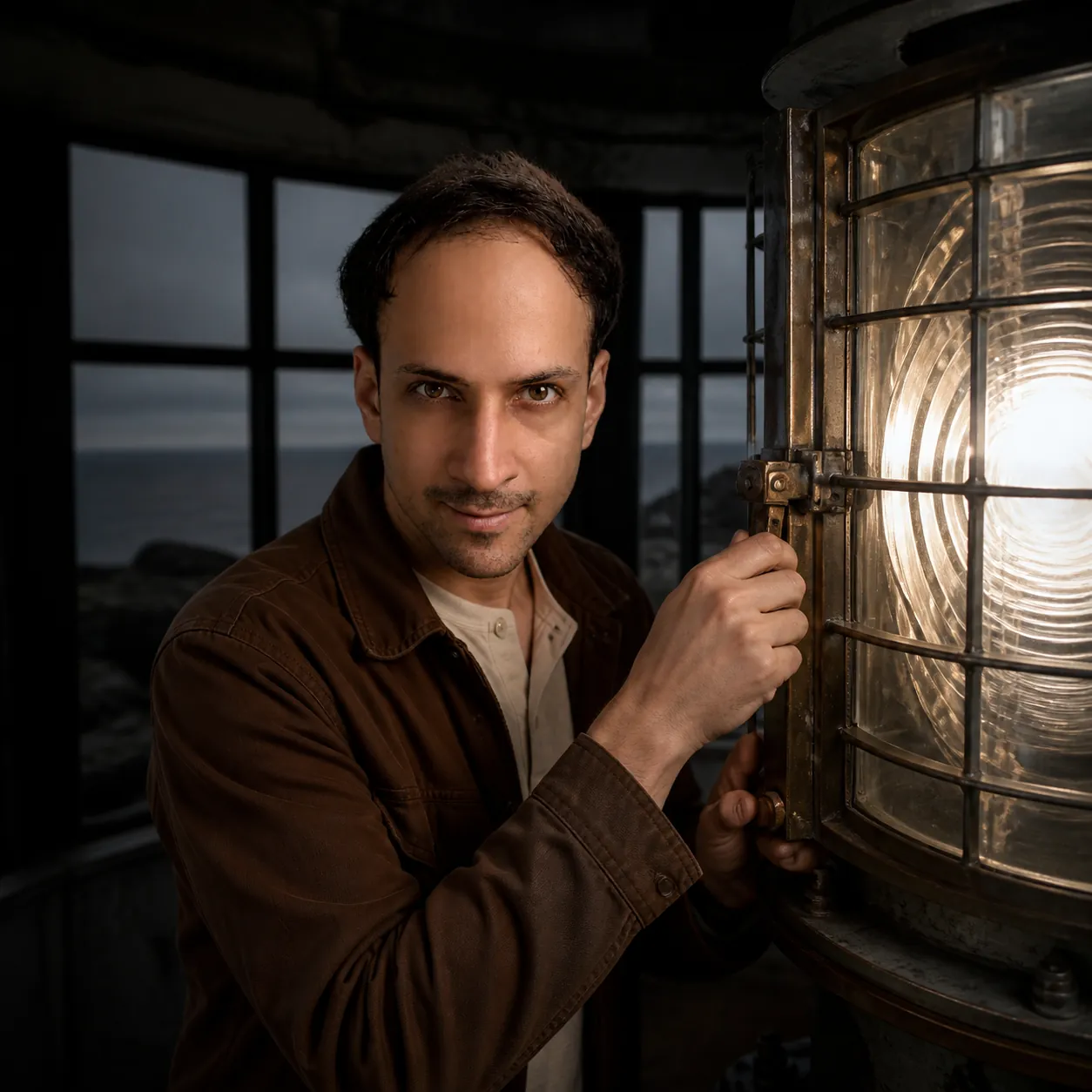
Asked and Answered: Lamp Room — AI Portrait Prompt
صورةAI Portraits

Turn your own photo into a quiet experimental gallery portrait in the lamp room of a decommissioned coastal lighthouse. Keeps your face unchanged.

من نص البرومبت

Use the attached reference photo as the identity reference: keep the same face, skin tone, hair and features as the person in that photo, without beautifying, aging or altering them. Create a square 1:1 museum-catalog frame with a strong first read and a slower second read at exactly 2880x2880 pixels. Location: the lamp room of a decommissioned coastal lighthouse. Show the subject in a rust-brown chore coat over a cream henley, latching the brass door of the lamp cage shut. The impossible-looking event must obey this clear system: a glass-bead screen that blazes furnace-bright along their lamp's axis and shows dull grey one step aside keeps its full brightness for the one standing at the light's source. Explore what it means to receive back exactly what was sent and nothing else; direct expression and posture toward steady curiosity, never melodrama or ad-like confidence. Use a 90mm portrait lens with a small lamp rigged tight beside it so the return blazes lawfully at the camera. Make the composition let the off-axis dullness occupy most of the frame. Render it as quiet experimental gallery photography built around one working retroreflector, disciplined single-source lighting, true-to-life surface response, and patient observational framing, using one small practical held near the lens axis with the room falling dark and a palette of asphalt grey, faded canvas, and one amber thread. Photorealistic: this must read as a real photograph from a physical camera, never an illustration, painting, or 3D render. Resolve real surface detail: glass with real thickness at its edge, reflections that carry the room's actual colour, and dust visible only at grazing angles. Keep one identity-locked subject, credible hands and fingers, natural fabric, and coherent scale, contact, reflections, shadows, airflow, deformation, and materials. Background people only when essential, always secondary and clearly different. Avoid glowing sci-fi visors, hi-vis vest advertising poses, lens-flare starbursts, and neon cyberpunk streets. No text, labels, logos, signatures, watermarks, random symbols, plastic skin, excessive bloom, or glossy AI finish.
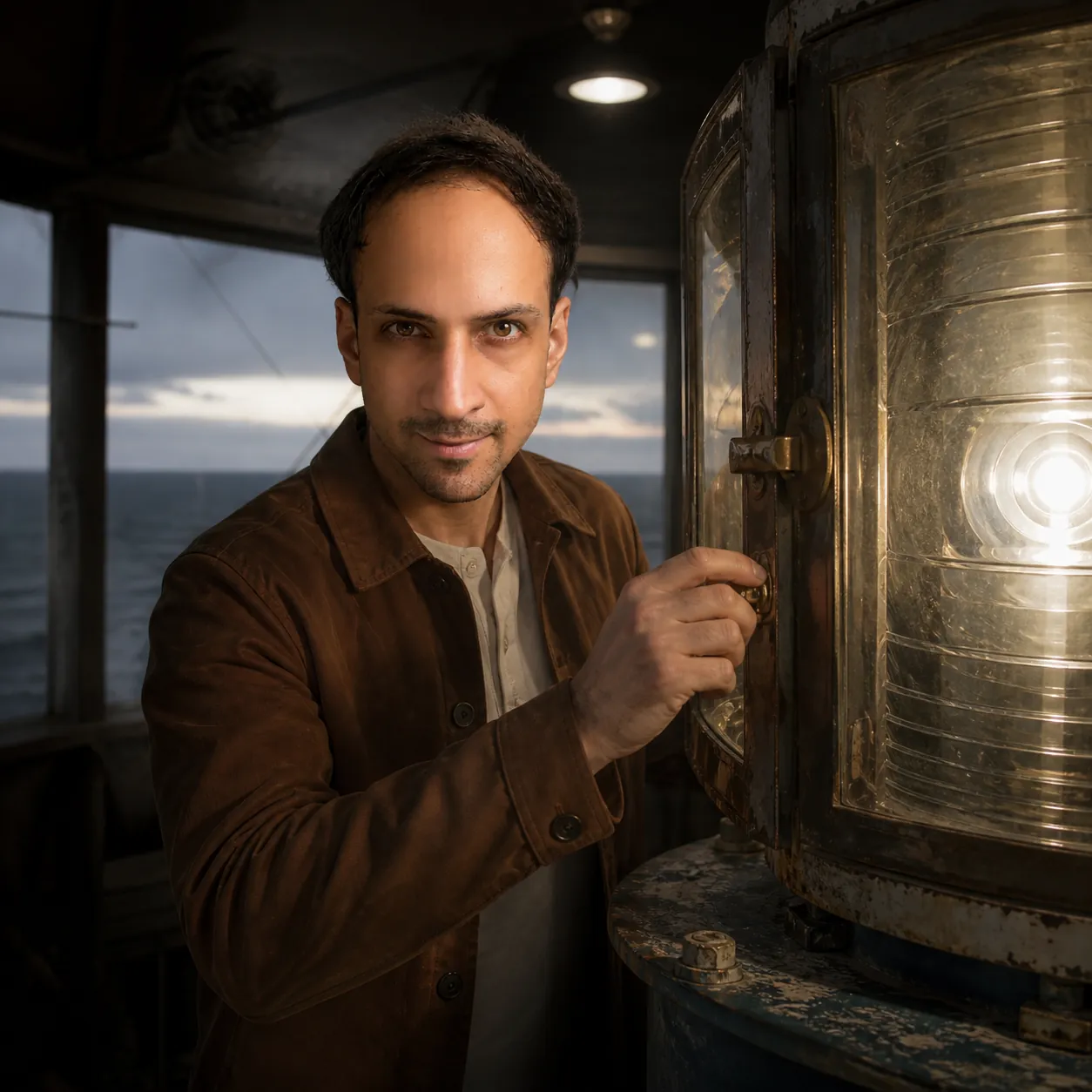
Sent Back: Lamp Room — AI Portrait Prompt
صورةAI Portraits

Turn your own photo into a conceptual field-optics portrait in the lamp room of a decommissioned coastal lighthouse. Keeps your face unchanged.

من نص البرومبت

Use the attached reference photo as the identity reference: keep the same face, skin tone, hair and features as the person in that photo, without beautifying, aging or altering them. Create a square 1:1 museum-catalog frame with a strong first read and a slower second read at exactly 2880x2880 pixels. Location: the lamp room of a decommissioned coastal lighthouse. Show the subject in a rust-brown chore coat over a cream henley, latching the brass door of the lamp cage shut. Use this advanced image-making device as the core logic: a shallow tray of dull volcanic dust that surges visibly brighter the instant their lamp is raised beside their eye turns the open air into a private channel between lamp and eye. Explore why distance loses its power over light that refuses to scatter on the way; direct expression and posture toward watchful calm, never melodrama or ad-like confidence. Frame from slightly low in the dark, their face lit by spill rather than beam. Make the composition surround one small blaze with generous, honest darkness. Render it as conceptual field-optics realism blending honest low-light exposure, physically accurate retroreflection, quiet darkened-space atmosphere, and calm human-scale editorial framing, using soft overhead work light dimmed until the answering shine can dominate honestly and a palette of night blue, bone grey, and one silver pinprick. Photorealistic: this must read as a real photograph from a physical camera, never an illustration, painting, or 3D render. Resolve real surface detail: rubber gone chalky with age, painted metal chipped to primer, and plastic yellowed only where light reaches it. Keep one identity-locked subject, credible hands and fingers, natural fabric, and coherent scale, contact, reflections, shadows, airflow, deformation, and materials. Background people only when essential, always secondary and clearly different. Avoid laser-show haze walls, glowing animal eyes, CGI light tunnels, painted halos, and highway signage. No text, labels, logos, signatures, watermarks, random symbols, plastic skin, excessive bloom, or glossy AI finish.
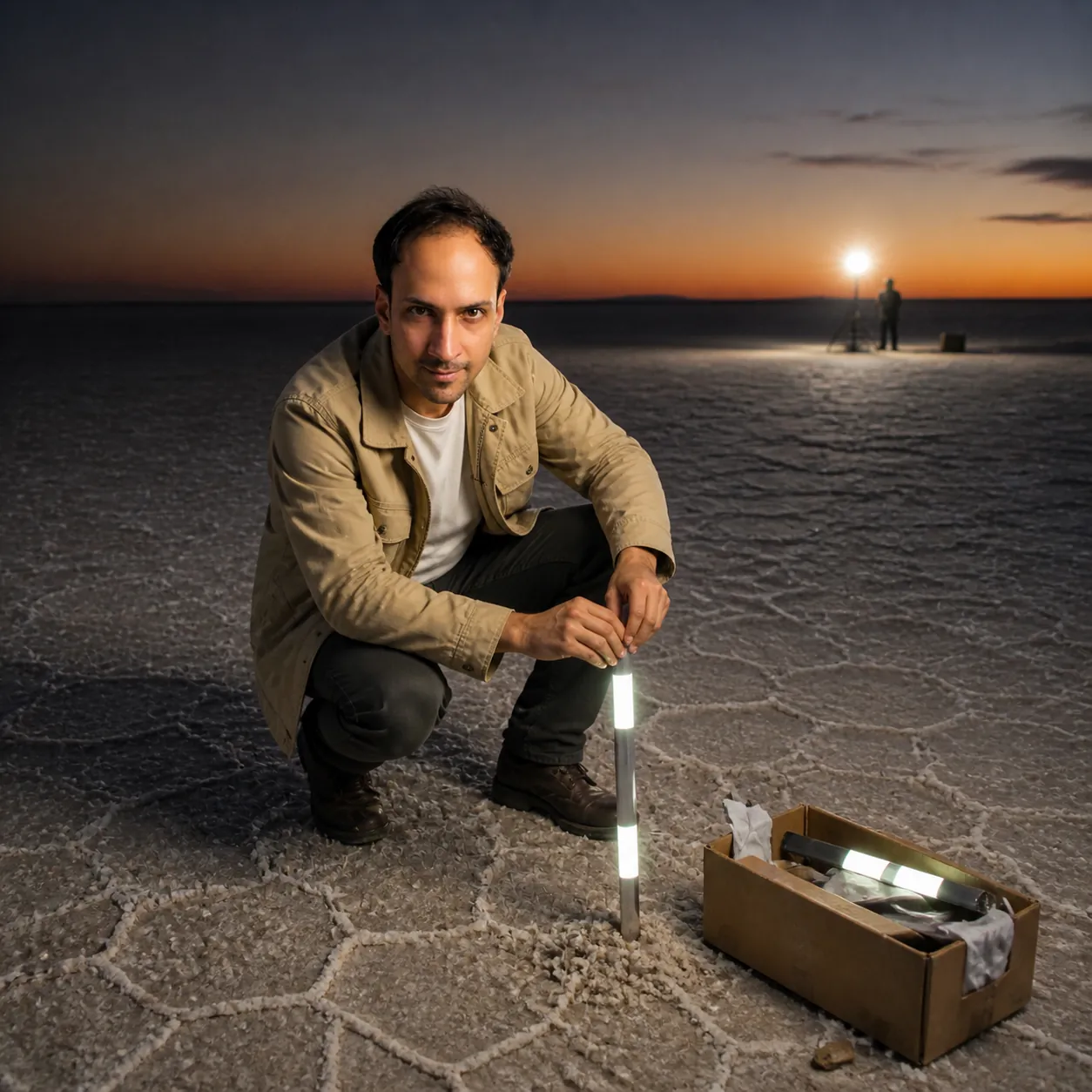
Private Fire: Sabkha Salt Flat — AI Portrait Prompt
صورةAI Portraits

Turn your own photo into a quiet experimental gallery portrait in a sabkha salt flat at dusk, horizon one unbroken line. Keeps your face unchanged.

من نص البرومبت

Use the attached reference photo as the identity reference: keep the same face, skin tone, hair and features as the person in that photo, without beautifying, aging or altering them. Create a square 1:1 museum-catalog frame with a strong first read and a slower second read at exactly 2880x2880 pixels. Location: a sabkha salt flat at dusk, horizon one unbroken line. Show the subject in a beige field jacket over a white tee, pressing a survey stake flush with the crust. Build the artwork around this material rule: a swatch of retroreflective cloth that photographs as grey fabric or white fire depending on where the flash stands keeps its full brightness for the one standing at the light's source. Explore whether an answer that only the asker can see still counts as public truth; direct expression and posture toward humbled precision, never melodrama or ad-like confidence. Use a measured 35mm environmental view, the subject at one-third, the returning light deeper in frame. Make the composition align lamp, eye, and return along one legible line. Render it as quiet experimental gallery photography built around one working retroreflector, disciplined single-source lighting, true-to-life surface response, and patient observational framing, using soft overhead work light dimmed until the answering shine can dominate honestly and a palette of lamp black, slate grey, and one pale-fire cone. Photorealistic: this must read as a real photograph from a physical camera, never an illustration, painting, or 3D render. Resolve real surface detail: label-free packaging showing carton fibre, cardboard bruised at the corners, and tape lifting slightly at one end. Keep one identity-locked subject, credible hands and fingers, natural fabric, and coherent scale, contact, reflections, shadows, airflow, deformation, and materials. Background people only when essential, always secondary and clearly different. Avoid glowing sci-fi visors, hi-vis vest advertising poses, lens-flare starbursts, and neon cyberpunk streets. No text, labels, logos, signatures, watermarks, random symbols, plastic skin, excessive bloom, or glossy AI finish.
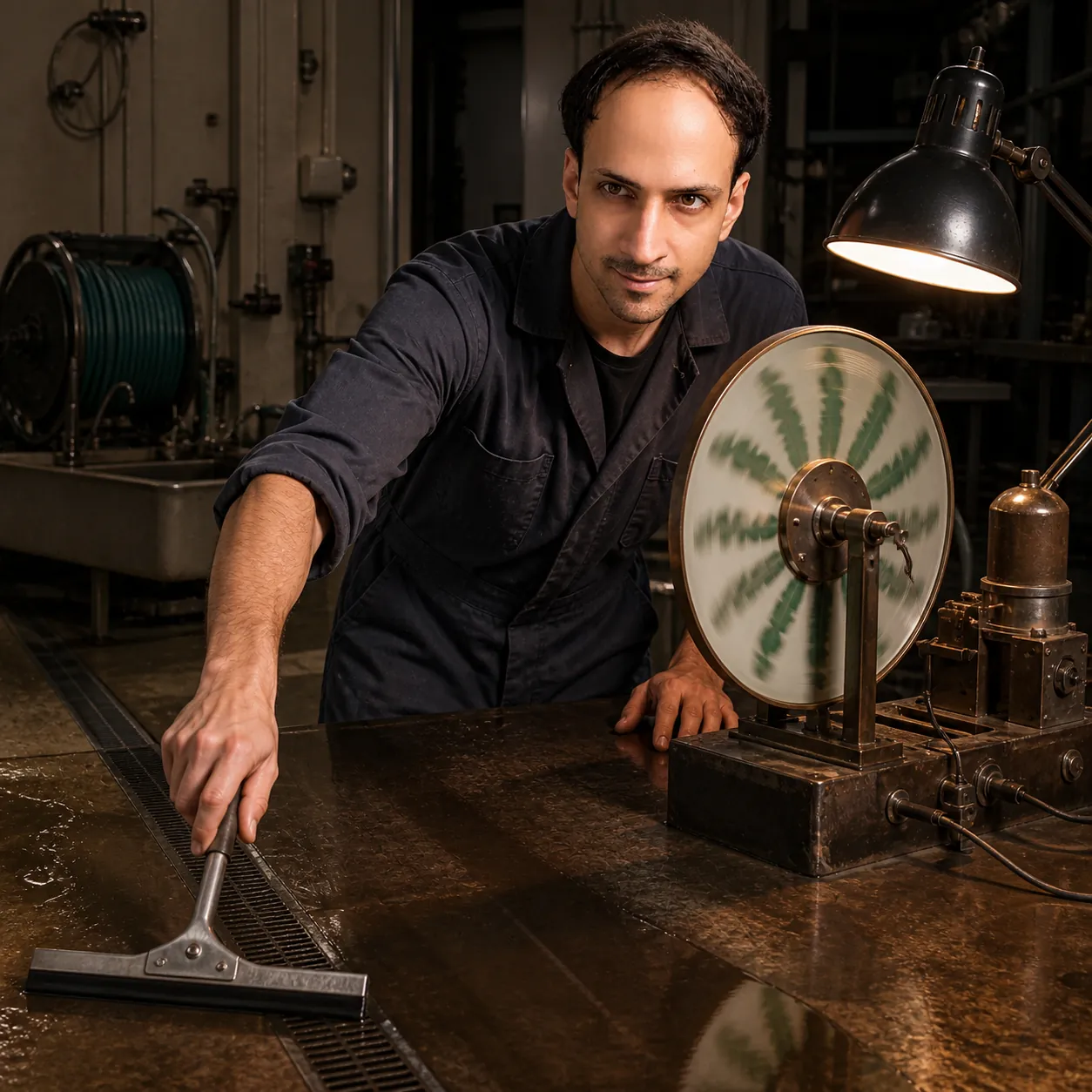
The Eye Finishes: Hydraulics Teaching Lab — AI Portrait Prompt
صورةAI Portraits

Turn your own photo into a photorealistic portrait in a hydraulics teaching lab with floor drains and coiled hose reels. Keeps your face unchanged.

من نص البرومبت

Use the attached reference photo as the identity reference: keep the same face, skin tone, hair and features as the person in that photo, without beautifying, aging or altering them. Create a square 1:1 museum-catalog frame with a strong first read and a slower second read at exactly 2880x2880 pixels. Location: a hydraulics teaching lab with floor drains and coiled hose reels. Show the subject in a slate work coverall with sleeves rolled past the elbow, squeegeeing a narrow path of water off the bench. Build the artwork around this material rule: a hand-cranked phenakistoscope disk whose printed palm frond unfolds smoothly the instant a synced flash begins sampling its spin recruits the viewer's own persistence of vision as its final moving part. Explore what the viewer contributes when the mechanism only supplies interrupted glimpses; direct expression and posture toward unhurried awe, never melodrama or ad-like confidence. Use a shutter just slow enough that moving parts blur truthfully while their face stays sharp. Make the composition give their hand, the mechanism, and their gaze one connected diagonal. Render it as workshop-theater realism made of practical light, era-true optical instruments, credible material wear, and quietly composed human-scale theatrical staging, using one shaded work lamp over the apparatus and darkness kept honest beyond and a palette of lamp black, worn tin, and one arc of verdigris. Photorealistic: this must read as a real photograph from a physical camera, never an illustration, painting, or 3D render. Resolve real surface detail: label-free packaging showing carton fibre, cardboard bruised at the corners, and tape lifting slightly at one end. Keep one identity-locked subject, credible hands and fingers, natural fabric, and coherent scale, contact, reflections, shadows, airflow, deformation, and materials. Background people only when essential, always secondary and clearly different. Avoid film-strip borders, cartoon motion lines, ghosted multiple faces, glowing hologram spin, and sparks flying off machinery. No text, labels, logos, signatures, watermarks, random symbols, plastic skin, excessive bloom, or glossy AI finish.
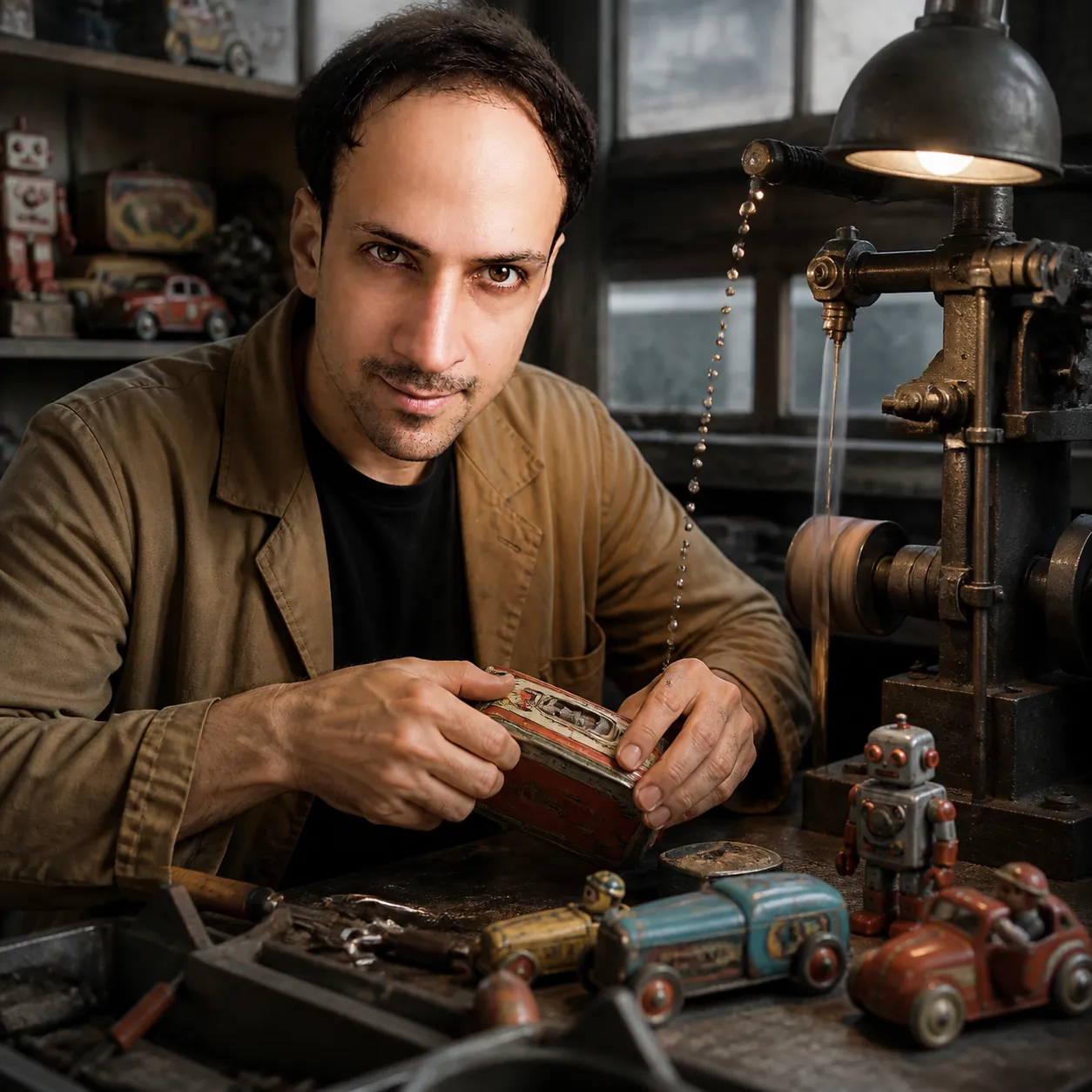
Lawful Illusion: Tin-Toy Restorer's Bench — AI Portrait Prompt
صورةAI Portraits

Turn your own photo into a museum-demonstration portrait in a tin-toy restorer's bench crowded with wind-up toys awaiting repair. Keeps your face unchanged.

من نص البرومبت

Use the attached reference photo as the identity reference: keep the same face, skin tone, hair and features as the person in that photo, without beautifying, aging or altering them. Create a square 1:1 museum-catalog frame with a strong first read and a slower second read at exactly 2880x2880 pixels. Location: a tin-toy restorer's bench crowded with wind-up toys awaiting repair. Show the subject in a khaki shop coat unbuttoned over a plain black tee, easing a dented tin panel true with both thumbs. Build the artwork around this material rule: a thin pumped water stream that a tuned strobe resolves into a chain of separate beads standing motionless in mid-air turns strict mechanical repetition into one seamless appearance the eye trusts. Explore where the seen motion actually lives when no single part performs it; direct expression and posture toward steady fascination, never melodrama or ad-like confidence. Use a shutter just slow enough that moving parts blur truthfully while their face stays sharp. Make the composition give their hand, the mechanism, and their gaze one connected diagonal. Render it as museum-demonstration realism combining hand-finished brass and tin surfaces, physically exact motion sampling, readable human presence, and restrained curatorial styling, using cool dusk ambience balanced by a single warm practical near the machine and a palette of soot grey, unpainted card, and one band of vermilion. Photorealistic: this must read as a real photograph from a physical camera, never an illustration, painting, or 3D render. Resolve real surface detail: dust settled where nobody wipes, fingerprint haze on glass, and edges rubbed pale by handling. Keep one identity-locked subject, credible hands and fingers, natural fabric, and coherent scale, contact, reflections, shadows, airflow, deformation, and materials. Background people only when essential, always secondary and clearly different. Avoid steampunk goggles and gears, CGI slow-motion splashes, projected film beams, carnival colors, and duplicated human figures. No text, labels, logos, signatures, watermarks, random symbols, plastic skin, excessive bloom, or glossy AI finish.

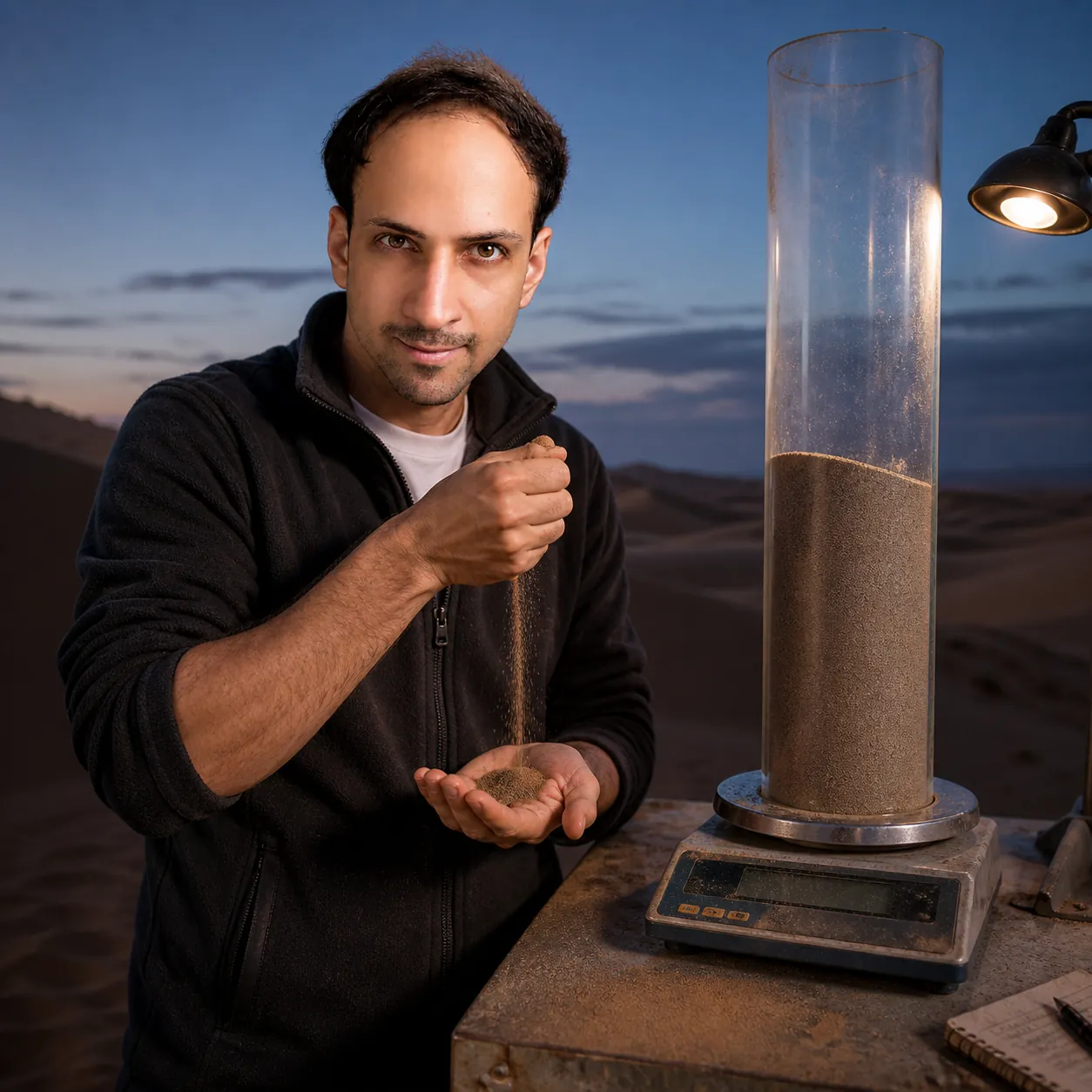
Shear Song: Firm Interdune Corridor — AI Portrait Prompt
صورةAI Portraits

Turn your own photo into a portrait in a firm interdune corridor at dawn, its ripples still holding shadow. Keeps your face unchanged.

من نص البرومبت

Use the attached reference photo as the identity reference: keep the same face, skin tone, hair and features as the person in that photo, without beautifying, aging or altering them. Create a square 1:1 museum-catalog frame with a strong first read and a slower second read at exactly 2880x2880 pixels. Location: a firm interdune corridor at dawn, its ripples still holding shadow. Show the subject in a charcoal fleece zipped over a plain white base layer, sifting a slow handful of grains from fist to palm. Build the artwork around this material rule: a tall glass tube of sand standing on a scale that reads only a fraction of what they poured in gives the desert's most ordinary material the standing of an exact instrument. Explore why the simplest materials hide the physics that resists every clean equation; direct expression and posture toward steady curiosity, never melodrama or ad-like confidence. Use a composed 35mm environmental view that gives the apparatus and the subject equal standing. Make the composition keep the background silent so the grains do the talking. Render it as museum-grade demonstration realism combining truthful sand behavior, high-fidelity portrait photography, weathered field-equipment materiality, and physically exact grain-scale detail, using cool pre-sunrise sky light balanced against one warm tungsten practical and a palette of sifted taupe, worn steel, and a low amber accent. Photorealistic: this must read as a real photograph from a physical camera, never an illustration, painting, or 3D render. Resolve real surface detail: dust settled where nobody wipes, fingerprint haze on glass, and edges rubbed pale by handling. Keep one identity-locked subject, credible hands and fingers, natural fabric, and coherent scale, contact, reflections, shadows, airflow, deformation, and materials. Background people only when essential, always secondary and clearly different. Avoid falconry props, camel caravans, CGI sand tornadoes, face-morphing sand sculptures, and endless untouched postcard dunes. No text, labels, logos, signatures, watermarks, random symbols, plastic skin, excessive bloom, or glossy AI finish.
