قمت باعداد خطة زيارات ميدانية بناءا على استراتيجية المبيعات
من نص البرومبت
قمت باعداد خطة زيارات ميدانية بناءا على استراتيجية المبيعات لمنصة axislearn واريد كتابة التقرير
جاري التحميل...


اكتشاف مركّز
اختر طريقة العرض وشاهد اثني عشر برومبتًا فقط، مرتبة لتسهيل القرار.
قمت باعداد خطة زيارات ميدانية بناءا على استراتيجية المبيعات
من نص البرومبت
قمت باعداد خطة زيارات ميدانية بناءا على استراتيجية المبيعات لمنصة axislearn واريد كتابة التقرير
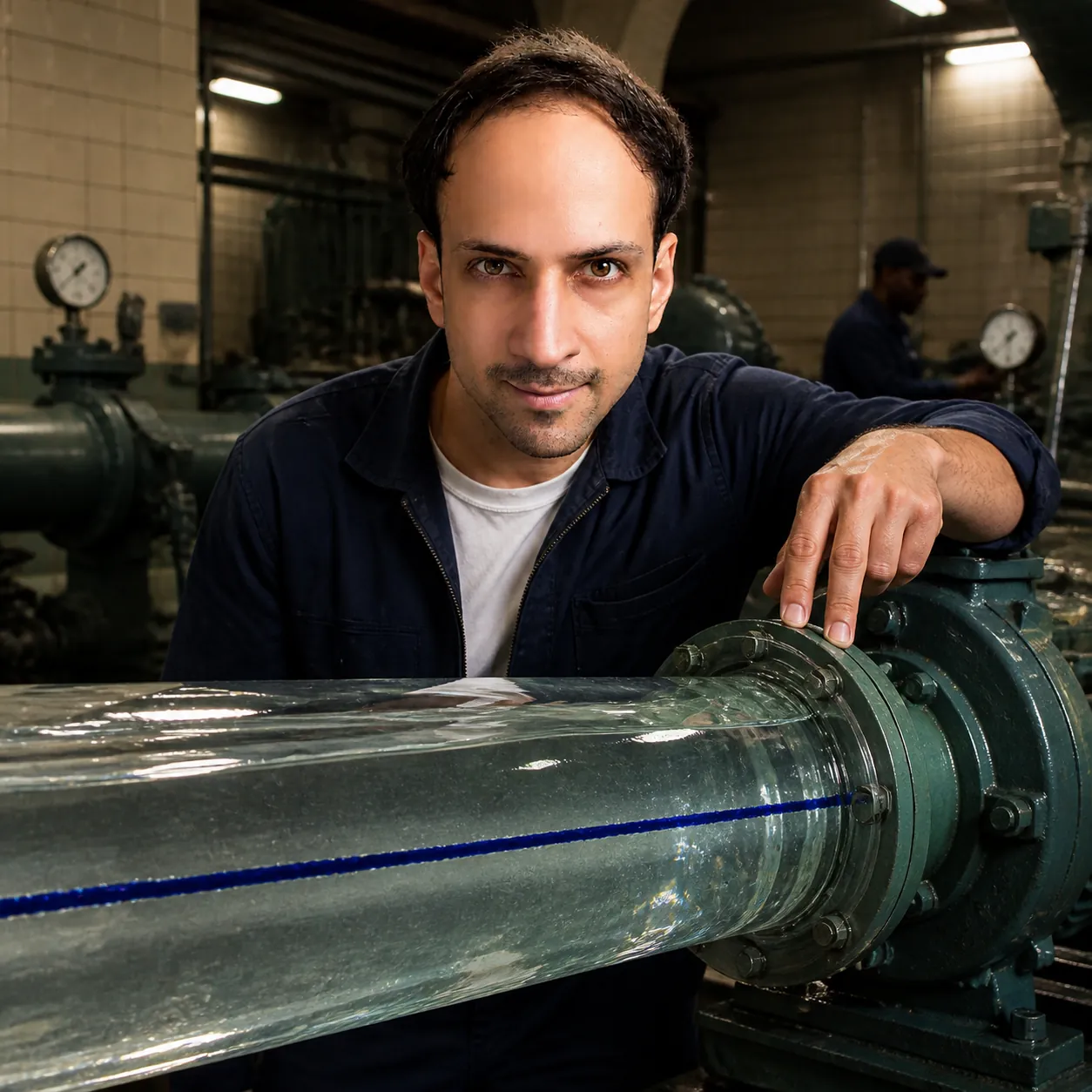
Create a square 1:1 museum-catalog frame with a strong first read and a slower second read at exactly 2880x2880 pixels. Location: the tiled pump room...
من نص البرومبت
Use the attached reference photo as the identity reference: keep the same face, skin tone, hair and features as the person in that photo, without beautifying, aging or altering them. Create a square 1:1 museum-catalog frame with a strong first read and a slower second read at exactly 2880x2880 pixels. Location: the tiled pump room beneath a public fountain, gauges faintly lit. Show the subject in a navy coverall unzipped over a clean white undershirt, resting two fingers on a humming pump casing. Build the artwork around this material rule: a single thread of dye that holds one straight, unbroken line down the whole length of a clear water-filled pipe puts continuous motion through a form that never once looks hurried. Explore how a liquid chooses between order and chaos at one measurable threshold; direct expression and posture toward steady reverence, never melodrama or ad-like confidence. Frame along the water's surface at forearm height so the flow's edge and their gaze share one plane. Make the composition rhyme the water's curve with the line of their shoulders. Render it as museum-scale demonstration realism combining faithful portrait photography, glass-smooth water rendered without exaggeration, machined hydraulic hardware, and physically exact reflections, using even overhead lab light shaped by baffles into calm directional zones and a palette of bone white, clear-water celadon, and a line of indigo. Photorealistic: this must read as a real photograph from a physical camera, never an illustration, painting, or 3D render. Resolve real surface detail: dust settled where nobody wipes, fingerprint haze on glass, and edges rubbed pale by handling. Keep one identity-locked person, credible hands and fingers, natural fabric, and coherent scale, contact, reflections, shadows, airflow, deformation, and materials. Background people only when essential, always secondary and clearly different. Avoid stock waterfall mist, whirlpool vortices, ripple-covered surfaces, levitating water spheres, and dramatic slow-motion splash photography. No text, labels, logos, signatures, watermarks, random symbols, plastic skin, excessive bloom, or glossy AI finish.
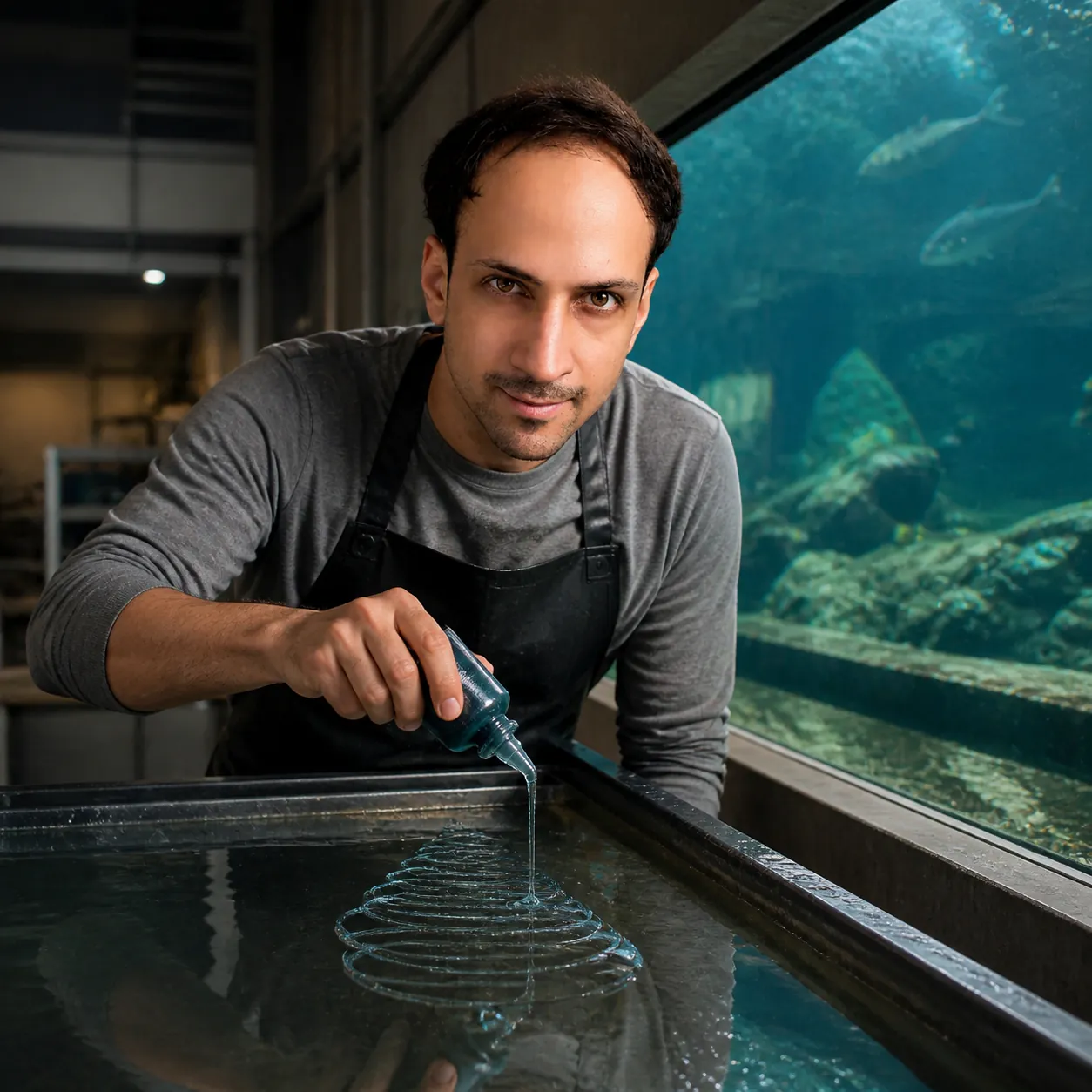
Create a square 1:1 museum-catalog frame with a strong first read and a slower second read at exactly 2880x2880 pixels. Location: a service gallery behind...
من نص البرومبت
Use the attached reference photo as the identity reference: keep the same face, skin tone, hair and features as the person in that photo, without beautifying, aging or altering them. Create a square 1:1 museum-catalog frame with a strong first read and a slower second read at exactly 2880x2880 pixels. Location: a service gallery behind an aquarium's tall acrylic viewing wall. Show the subject in a dark rubberized apron over a heather-grey long-sleeve tee, steadying a small dye bottle above a filling trough. Build the artwork around this material rule: a thin stream of clear glycerin that lays itself down in an even, patient coil like rope fed from above puts continuous motion through a form that never once looks hurried. Explore how transparency turns a demonstration into something close to a quiet confession; direct expression and posture toward steady reverence, never melodrama or ad-like confidence. Frame along the water's surface at forearm height so the flow's edge and their gaze share one plane. Make the composition give the dye's edge more acuity than any highlight. Render it as quiet kinetic-art portraiture combining working flow sculpture, honest wet-surface materiality, calm controlled studio styling, and unforced human presence, using one low raking beam that turns every smooth surface into readable contour and a palette of soft pewter, unglazed clay, and a cold aqua accent. Photorealistic: this must read as a real photograph from a physical camera, never an illustration, painting, or 3D render. Resolve real surface detail: hair with individual strands catching light, fine hairs of uneven length, and skin oil giving a low uneven sheen. Keep one identity-locked person, credible hands and fingers, natural fabric, and coherent scale, contact, reflections, shadows, airflow, deformation, and materials. Background people only when essential, always secondary and clearly different. Avoid stock waterfall mist, whirlpool vortices, ripple-covered surfaces, levitating water spheres, and dramatic slow-motion splash photography. No text, labels, logos, signatures, watermarks, random symbols, plastic skin, excessive bloom, or glossy AI finish.
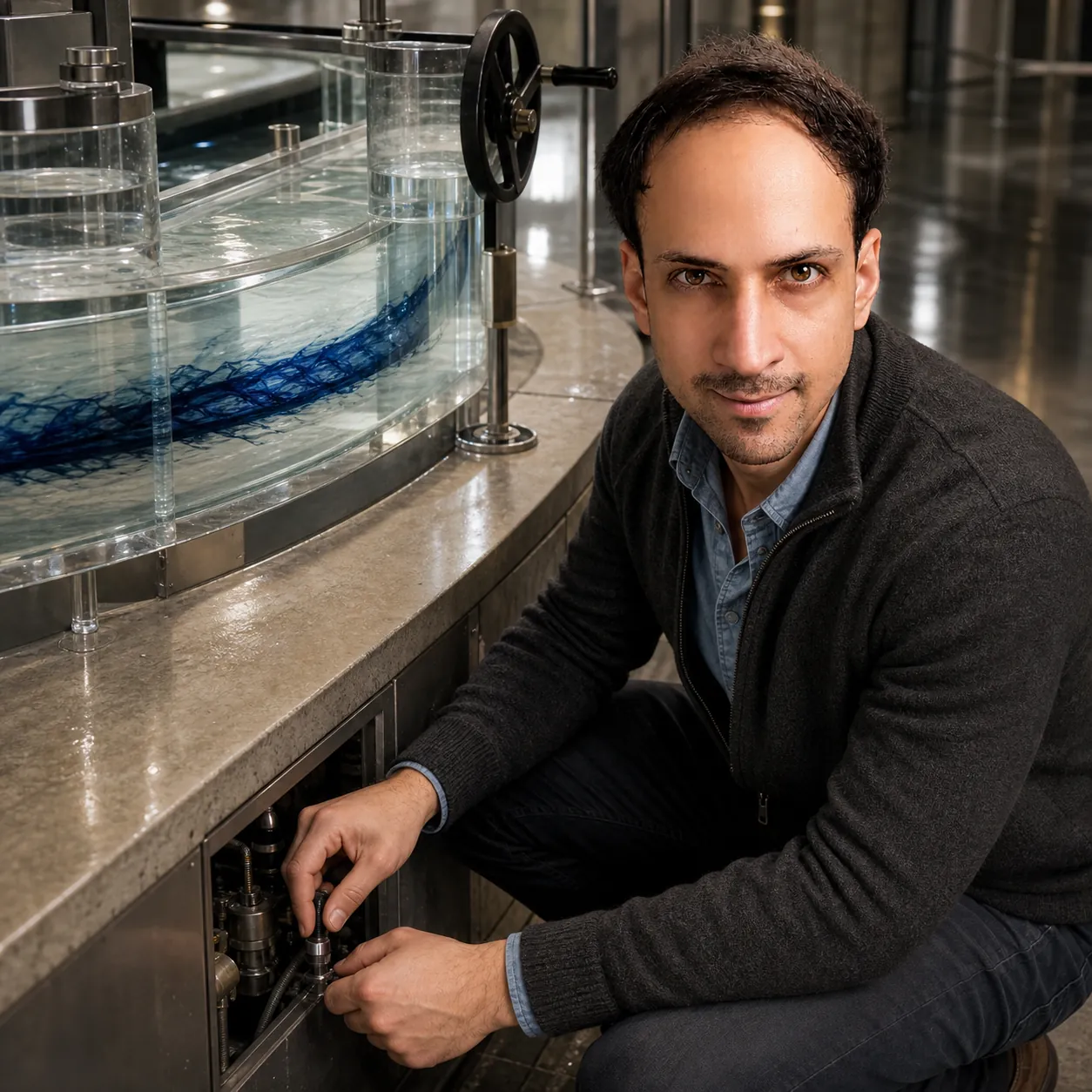
Create a square 1:1 museum-catalog frame with a strong first read and a slower second read at exactly 2880x2880 pixels. Location: a science-center water...
من نص البرومبت
Use the attached reference photo as the identity reference: keep the same face, skin tone, hair and features as the person in that photo, without beautifying, aging or altering them. Create a square 1:1 museum-catalog frame with a strong first read and a slower second read at exactly 2880x2880 pixels. Location: a science-center water gallery after closing, one exhibit left running. Show the subject in a charcoal zip cardigan over an open-collar chambray shirt, keying open a low service panel beside the exhibit. The impossible-looking event must obey this clear system: a ring of dye in glycerin that is stirred into a full blur between clear cylinders and cranked back into a ring gives a normally chaotic process one legible, patient, watchable form. Explore whether mixing truly destroys order or only hides it from impatient eyes; direct expression and posture toward collected curiosity, never melodrama or ad-like confidence. Use a 90mm close-portrait hybrid: one smooth stream sharp near the lens and their face readable beyond it. Make the composition give the dye's edge more acuity than any highlight. Render it as large-format hydro-engineering portraiture built from real channel flows, precise wet-metal detailing, truthful surface optics, and patient documentary framing, using clean skylight softly refracted through moving water onto pale stone and a palette of bone white, clear-water celadon, and a line of indigo. Photorealistic: this must read as a real photograph from a physical camera, never an illustration, painting, or 3D render. Resolve real surface detail: glass with real thickness at its edge, reflections that carry the room's actual colour, and dust visible only at grazing angles. Keep one identity-locked person, credible hands and fingers, natural fabric, and coherent scale, contact, reflections, shadows, airflow, deformation, and materials. Background people only when essential, always secondary and clearly different. Avoid splash crowns, suspended droplet sprays, chrome CGI liquid, neon glowing water, and fantasy water-bending gestures. No text, labels, logos, signatures, watermarks, random symbols, plastic skin, excessive bloom, or glossy AI finish.
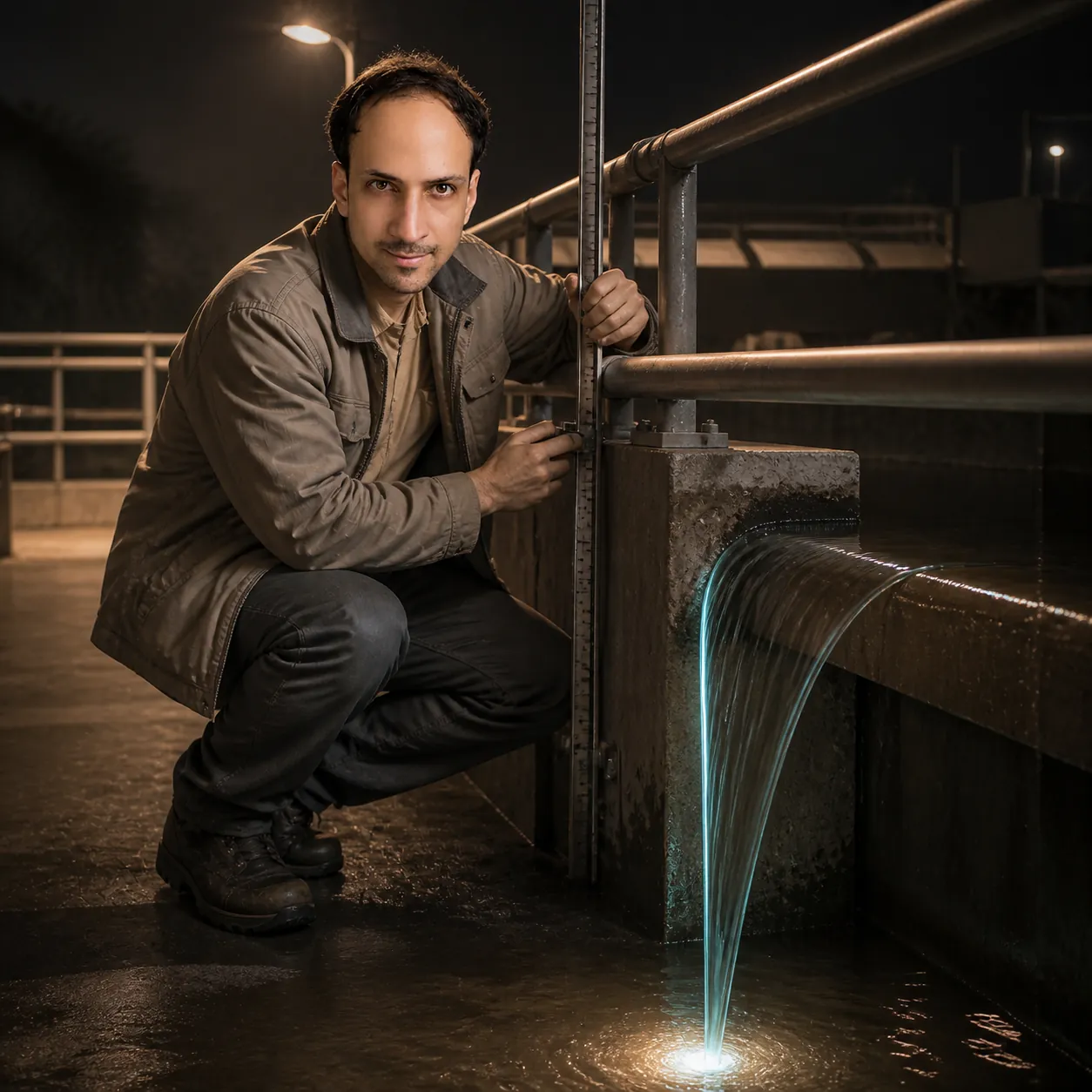
Create a square 1:1 museum-catalog frame with a strong first read and a slower second read at exactly 2880x2880 pixels. Location: a maintenance walkway...
من نص البرومبت
Use the attached reference photo as the identity reference: keep the same face, skin tone, hair and features as the person in that photo, without beautifying, aging or altering them. Create a square 1:1 museum-catalog frame with a strong first read and a slower second read at exactly 2880x2880 pixels. Location: a maintenance walkway beside a low Wadi Hanifah check weir. Show the subject in a sand-grey field jacket over a tan shirt and dark workwear trousers, hooking a measuring staff onto the parapet rail. The impossible-looking event must obey this clear system: a smooth descending stream that traps lamplight inside itself by total internal reflection and glows only where it finally lands puts continuous motion through a form that never once looks hurried. Explore what stillness means when real mass is passing through it every second; direct expression and posture toward unhurried attention, never melodrama or ad-like confidence. Use a 90mm close-portrait hybrid: one smooth stream sharp near the lens and their face readable beyond it. Make the composition give the dye's edge more acuity than any highlight. Render it as museum-scale demonstration realism combining faithful portrait photography, glass-smooth water rendered without exaggeration, machined hydraulic hardware, and physically exact reflections, using one low raking beam that turns every smooth surface into readable contour and a palette of soft pewter, unglazed clay, and a cold aqua accent. Photorealistic: this must read as a real photograph from a physical camera, never an illustration, painting, or 3D render. Resolve real surface detail: condensation beading at true size, liquid meniscus curving against glass, and wet surfaces darker than dry ones. Keep one identity-locked person, credible hands and fingers, natural fabric, and coherent scale, contact, reflections, shadows, airflow, deformation, and materials. Background people only when essential, always secondary and clearly different. Avoid stock waterfall mist, whirlpool vortices, ripple-covered surfaces, levitating water spheres, and dramatic slow-motion splash photography. No text, labels, logos, signatures, watermarks, random symbols, plastic skin, excessive bloom, or glossy AI finish.
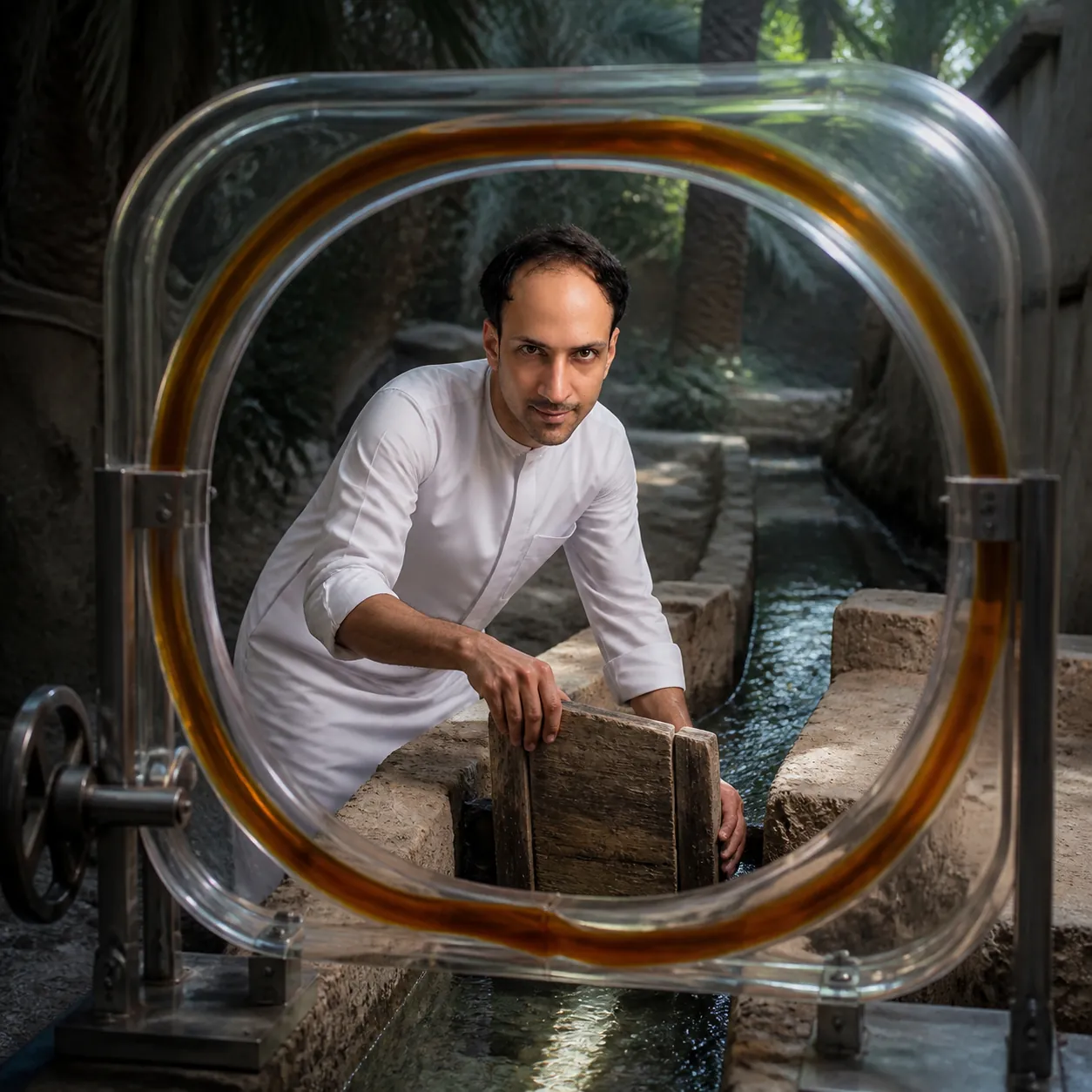
Create a square 1:1 museum-catalog frame with a strong first read and a slower second read at exactly 2880x2880 pixels. Location: a restored stone falaj...
من نص البرومبت
Use the attached reference photo as the identity reference: keep the same face, skin tone, hair and features as the person in that photo, without beautifying, aging or altering them. Create a square 1:1 museum-catalog frame with a strong first read and a slower second read at exactly 2880x2880 pixels. Location: a restored stone falaj channel running clear through shaded farmland. Show the subject in a plain white traditional Gulf outfit with sleeves folded clear of the water, seating a worn wooden flow gate into its stone slots. Use this advanced image-making device as the core logic: a ring of dye in glycerin that is stirred into a full blur between clear cylinders and cranked back into a ring puts continuous motion through a form that never once looks hurried. Explore whether mixing truly destroys order or only hides it from impatient eyes; direct expression and posture toward composed fascination, never melodrama or ad-like confidence. Frame through the clear apparatus itself, refraction bending the background while their face stays undistorted and sharp. Make the composition keep the flow's stillest passage sharpest and the room soft. Render it as museum-scale demonstration realism combining faithful portrait photography, glass-smooth water rendered without exaggeration, machined hydraulic hardware, and physically exact reflections, using early blue ambient light with one narrow beam threading the water and a palette of brushed steel, water grey, and one amber gleam. Photorealistic: this must read as a real photograph from a physical camera, never an illustration, painting, or 3D render. Resolve real surface detail: thread ends and slight pilling on worn cloth, hairline chips at every hard corner, and stone that is porous rather than smooth. Keep one identity-locked person, credible hands and fingers, natural fabric, and coherent scale, contact, reflections, shadows, airflow, deformation, and materials. Background people only when essential, always secondary and clearly different. Avoid stock waterfall mist, whirlpool vortices, ripple-covered surfaces, levitating water spheres, and dramatic slow-motion splash photography. No text, labels, logos, signatures, watermarks, random symbols, plastic skin, excessive bloom, or glossy AI finish.
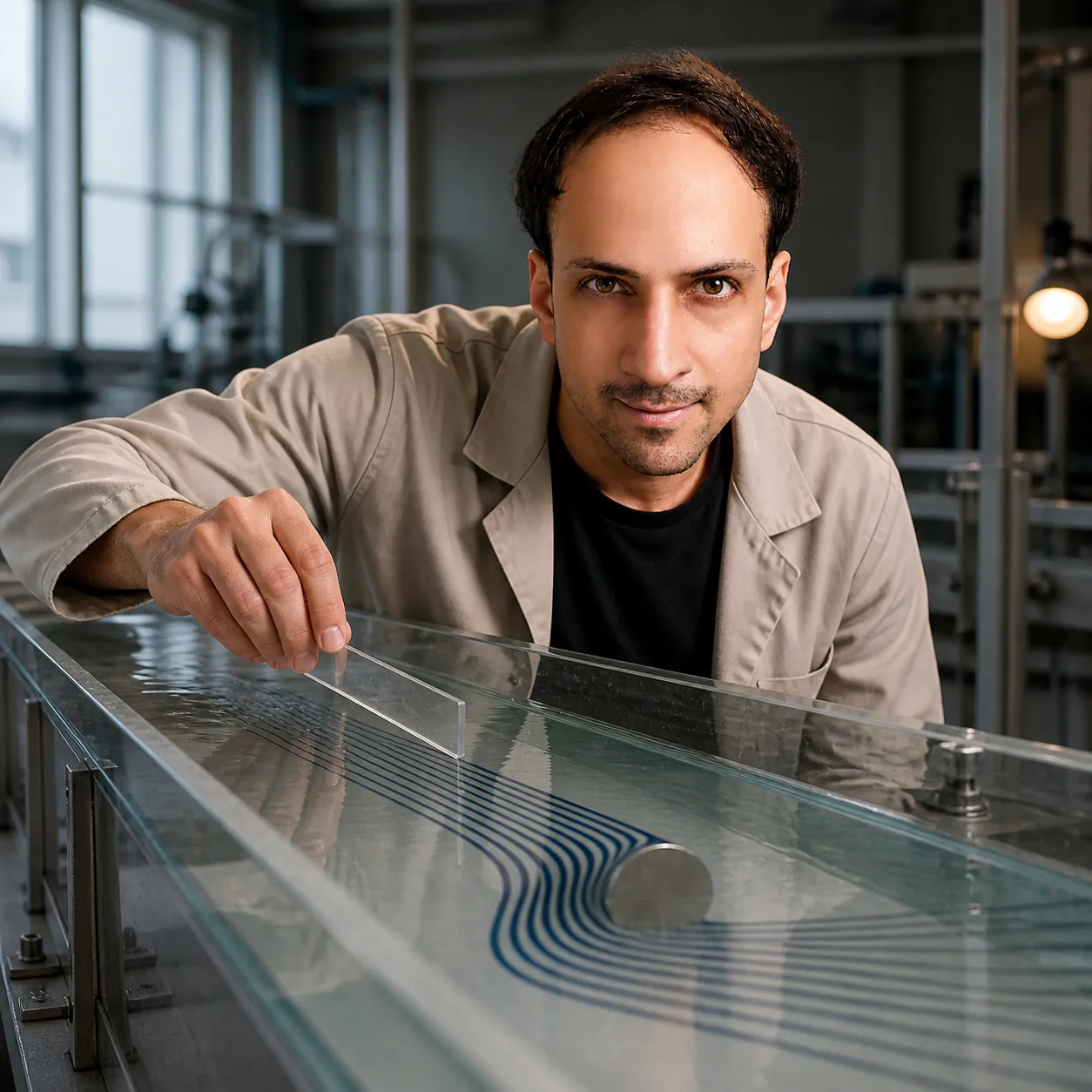
Create a square 1:1 museum-catalog frame with a strong first read and a slower second read at exactly 2880x2880 pixels. Location: a fluid-dynamics teaching...
من نص البرومبت
Use the attached reference photo as the identity reference: keep the same face, skin tone, hair and features as the person in that photo, without beautifying, aging or altering them. Create a square 1:1 museum-catalog frame with a strong first read and a slower second read at exactly 2880x2880 pixels. Location: a fluid-dynamics teaching lab built around one long clear flume. Show the subject in a putty-colored lab coat open over a plain black tee, skimming the flume's surface with a clear acrylic straightedge. Build the artwork around this material rule: a fan of parallel dye lines between two close glass plates that parts around a steel disc and closes seamlessly behind it puts continuous motion through a form that never once looks hurried. Explore why the eye trusts glass more readily than it trusts obedient water; direct expression and posture toward gentle vigilance, never melodrama or ad-like confidence. Frame along the water's surface at forearm height so the flow's edge and their gaze share one plane. Make the composition give the dye's edge more acuity than any highlight. Render it as large-format hydro-engineering portraiture built from real channel flows, precise wet-metal detailing, truthful surface optics, and patient documentary framing, using cool diffuse daylight with a single warm practical reflected in wet metal and a palette of brushed steel, water grey, and one amber gleam. Photorealistic: this must read as a real photograph from a physical camera, never an illustration, painting, or 3D render. Resolve real surface detail: cotton that hangs by its own weight, seams that pucker very slightly, and collars softened by washing. Keep one identity-locked person, credible hands and fingers, natural fabric, and coherent scale, contact, reflections, shadows, airflow, deformation, and materials. Background people only when essential, always secondary and clearly different. Avoid stock waterfall mist, whirlpool vortices, ripple-covered surfaces, levitating water spheres, and dramatic slow-motion splash photography. No text, labels, logos, signatures, watermarks, random symbols, plastic skin, excessive bloom, or glossy AI finish.
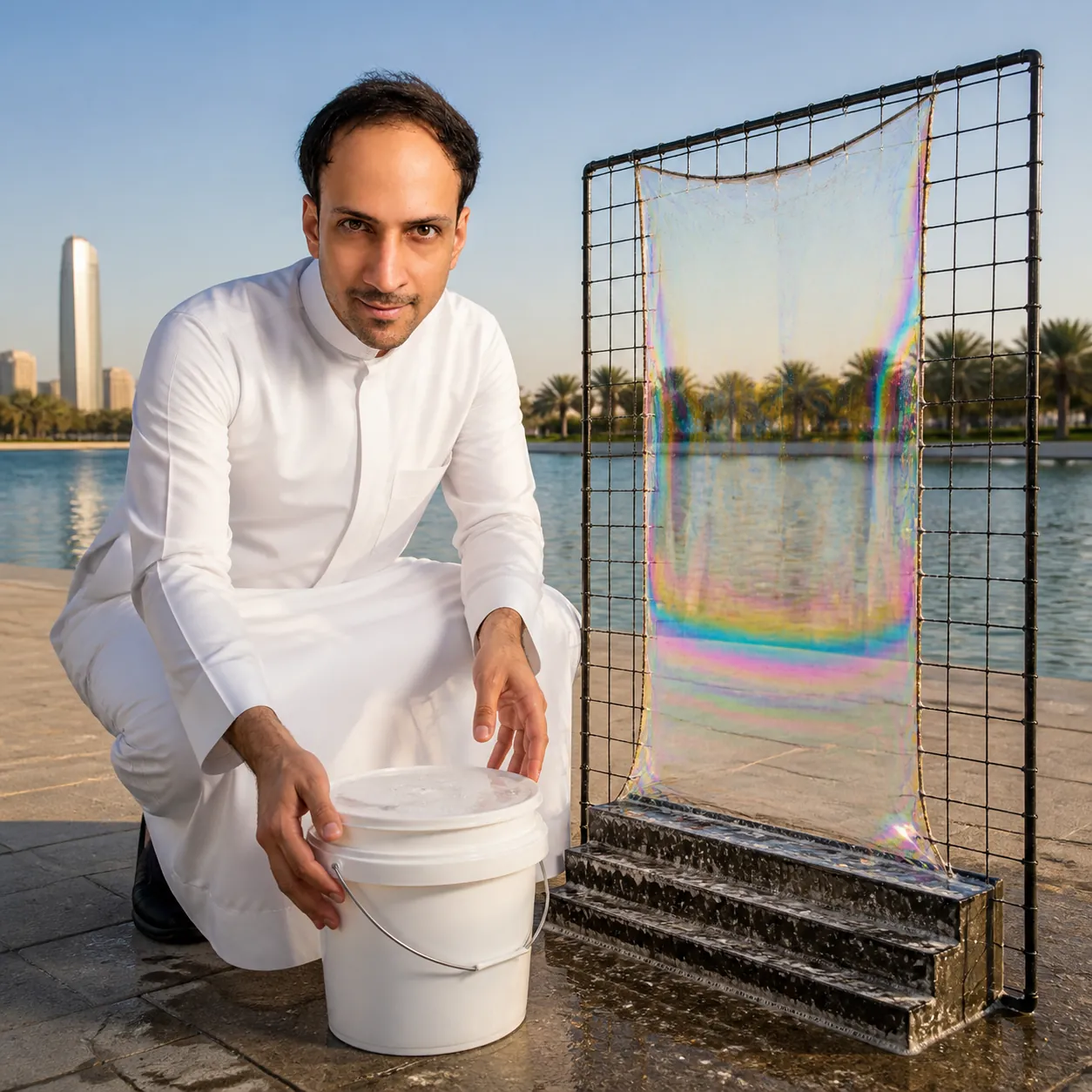
Create a square 1:1 museum-catalog frame with a strong first read and a slower second read at exactly 2880x2880 pixels. Location: the paved edge of a Riyadh...
من نص البرومبت
Use the attached reference photo as the identity reference: keep the same face, skin tone, hair and features as the person in that photo, without beautifying, aging or altering them. Create a square 1:1 museum-catalog frame with a strong first read and a slower second read at exactly 2880x2880 pixels. Location: the paved edge of a Riyadh park lake just after sunrise. Show the subject in a crisp white traditional Gulf outfit with the sleeves left unrolled, lowering a covered pail gently to the paving. Treat this mechanism as the frame’s governing rule: a doorway-tall soap film on a welded wire frame that drains under gravity into a level staircase of interference color keeps its composure while thinning lawfully toward a collapse it cannot refuse. Explore why nature, given every possible shape, keeps choosing the cheapest one; direct expression and posture toward quiet astonishment, never melodrama or ad-like confidence. Use a 24mm environmental view with true verticals, placing them beside the apparatus rather than behind it. Make the composition hold their hands and the fragile surface in one patient plane. Render it as conceptual physics portraiture blending exact interference color, honest wet materiality, unhurried editorial framing, and quietly human-scale scientific staging, using low side daylight kept off the background so the colors read true and a palette of bone white, dark zinc, and one thin teal seam. Photorealistic: this must read as a real photograph from a physical camera, never an illustration, painting, or 3D render. Resolve real surface detail: paper fibre visible at cut edges, plastic that shows mould lines, and paint thicker where a brush turned. Keep one identity-locked person, credible hands and fingers, natural fabric, and coherent scale, contact, reflections, shadows, airflow, deformation, and materials. Background people only when essential, always secondary and clearly different. Avoid psychedelic color grading, floating foam confetti, glassy chrome bubbles, dish-soap advertising gloss, and impossible unbroken membranes. No text, labels, logos, signatures, watermarks, random symbols, plastic skin, excessive bloom, or glossy AI finish.
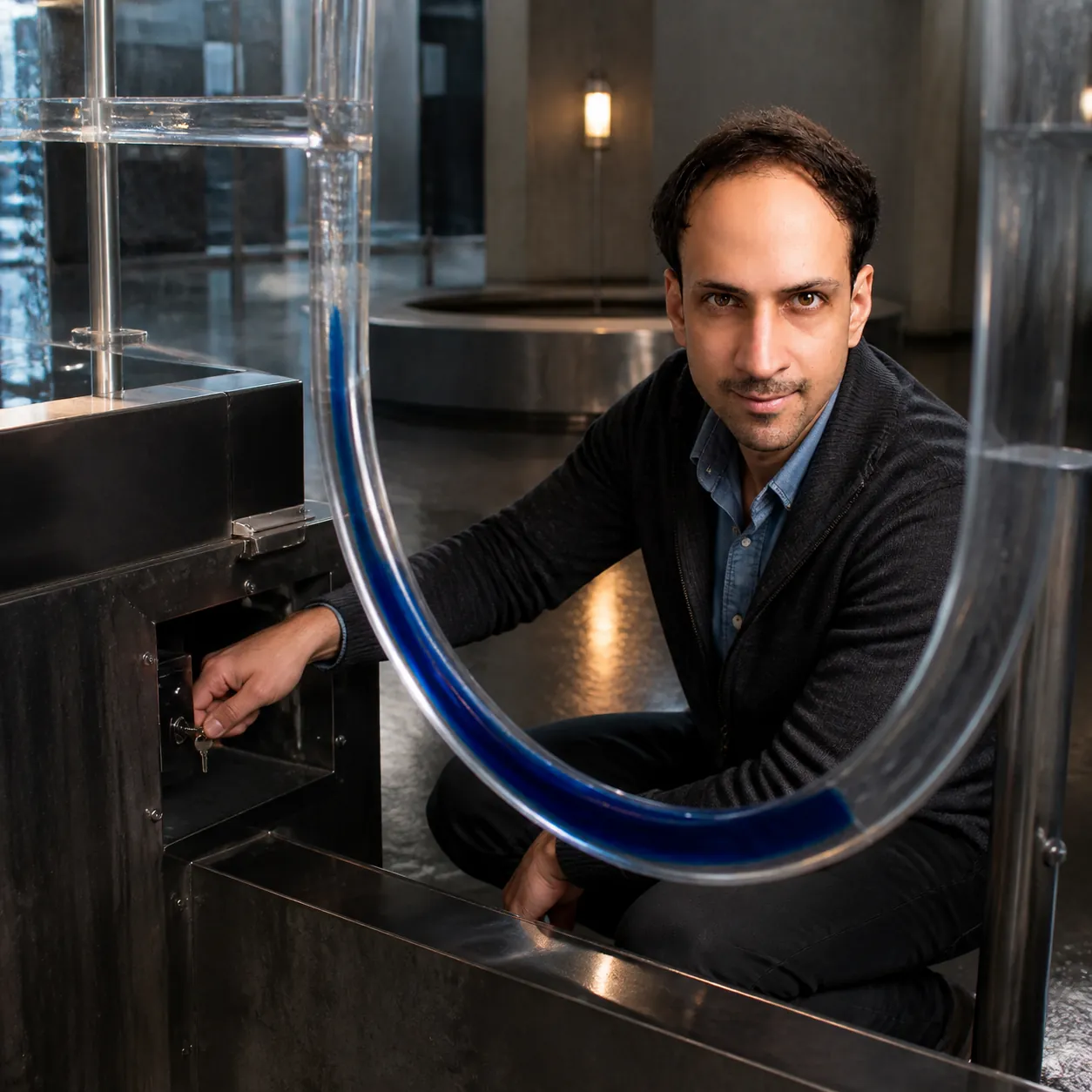
Create a square 1:1 museum-catalog frame with a strong first read and a slower second read at exactly 2880x2880 pixels. Location: a science-center water...
من نص البرومبت
Use the attached reference photo as the identity reference: keep the same face, skin tone, hair and features as the person in that photo, without beautifying, aging or altering them. Create a square 1:1 museum-catalog frame with a strong first read and a slower second read at exactly 2880x2880 pixels. Location: a science-center water gallery after closing, one exhibit left running. Show the subject in a charcoal zip cardigan over an open-collar chambray shirt, keying open a low service panel beside the exhibit. Use this advanced image-making device as the core logic: a flat stripe of dye in a wide clear tube that the moving water stretches into one clean, deepening parabola puts continuous motion through a form that never once looks hurried. Explore where the boundary lies between a working flow and the sculpture it resembles; direct expression and posture toward composed fascination, never melodrama or ad-like confidence. Frame through the clear apparatus itself, refraction bending the background while their face stays undistorted and sharp. Make the composition hold clean empty space where turbulence would have been. Render it as quiet kinetic-art portraiture combining working flow sculpture, honest wet-surface materiality, calm controlled studio styling, and unforced human presence, using cool diffuse daylight with a single warm practical reflected in wet metal and a palette of dark basalt, damp concrete, and one seam of copper. Photorealistic: this must read as a real photograph from a physical camera, never an illustration, painting, or 3D render. Resolve real surface detail: rubber gone chalky with age, painted metal chipped to primer, and plastic yellowed only where light reaches it. Keep one identity-locked person, credible hands and fingers, natural fabric, and coherent scale, contact, reflections, shadows, airflow, deformation, and materials. Background people only when essential, always secondary and clearly different. Avoid stock waterfall mist, whirlpool vortices, ripple-covered surfaces, levitating water spheres, and dramatic slow-motion splash photography. No text, labels, logos, signatures, watermarks, random symbols, plastic skin, excessive bloom, or glossy AI finish.
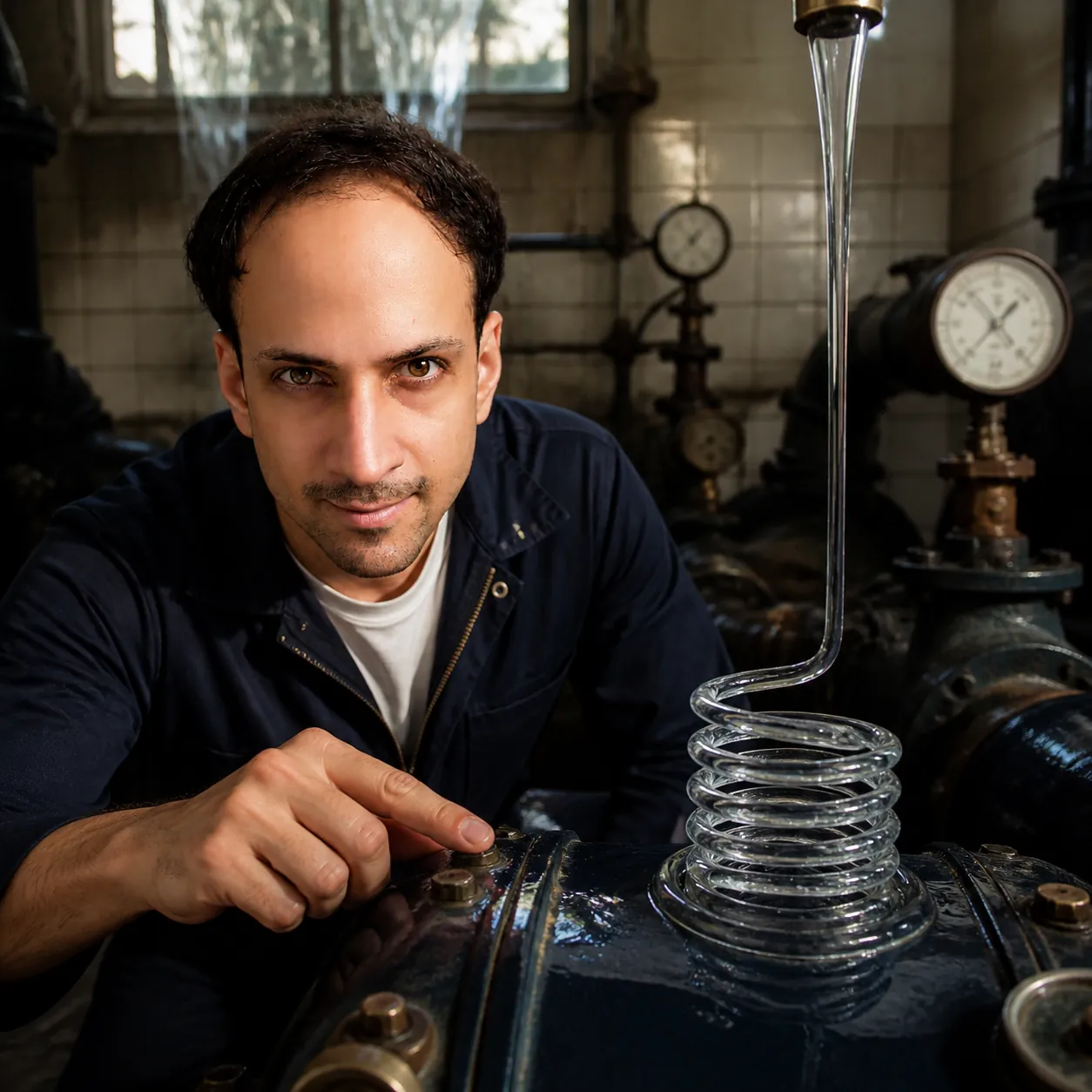
Create a square 1:1 museum-catalog frame with a strong first read and a slower second read at exactly 2880x2880 pixels. Location: the tiled pump room...
من نص البرومبت
Use the attached reference photo as the identity reference: keep the same face, skin tone, hair and features as the person in that photo, without beautifying, aging or altering them. Create a square 1:1 museum-catalog frame with a strong first read and a slower second read at exactly 2880x2880 pixels. Location: the tiled pump room beneath a public fountain, gauges faintly lit. Show the subject in a navy coverall unzipped over a clean white undershirt, resting two fingers on a humming pump casing. The impossible-looking event must obey this clear system: a thin stream of clear glycerin that lays itself down in an even, patient coil like rope fed from above gives a normally chaotic process one legible, patient, watchable form. Explore how transparency turns a demonstration into something close to a quiet confession; direct expression and posture toward absorbed respect, never melodrama or ad-like confidence. Use a 90mm close-portrait hybrid: one smooth stream sharp near the lens and their face readable beyond it. Make the composition keep the flow's stillest passage sharpest and the room soft. Render it as high-concept flow portraiture staged with real laminar apparatus, calibrated documentary lighting, optically true refraction, and quietly intelligent restraint, using clean skylight softly refracted through moving water onto pale stone and a palette of dark basalt, damp concrete, and one seam of copper. Photorealistic: this must read as a real photograph from a physical camera, never an illustration, painting, or 3D render. Resolve real surface detail: brass darkened in the recesses and bright where thumbs land, and lacquer crazed rather than perfect. Keep one identity-locked person, credible hands and fingers, natural fabric, and coherent scale, contact, reflections, shadows, airflow, deformation, and materials. Background people only when essential, always secondary and clearly different. Avoid splash crowns, suspended droplet sprays, chrome CGI liquid, neon glowing water, and fantasy water-bending gestures. No text, labels, logos, signatures, watermarks, random symbols, plastic skin, excessive bloom, or glossy AI finish.
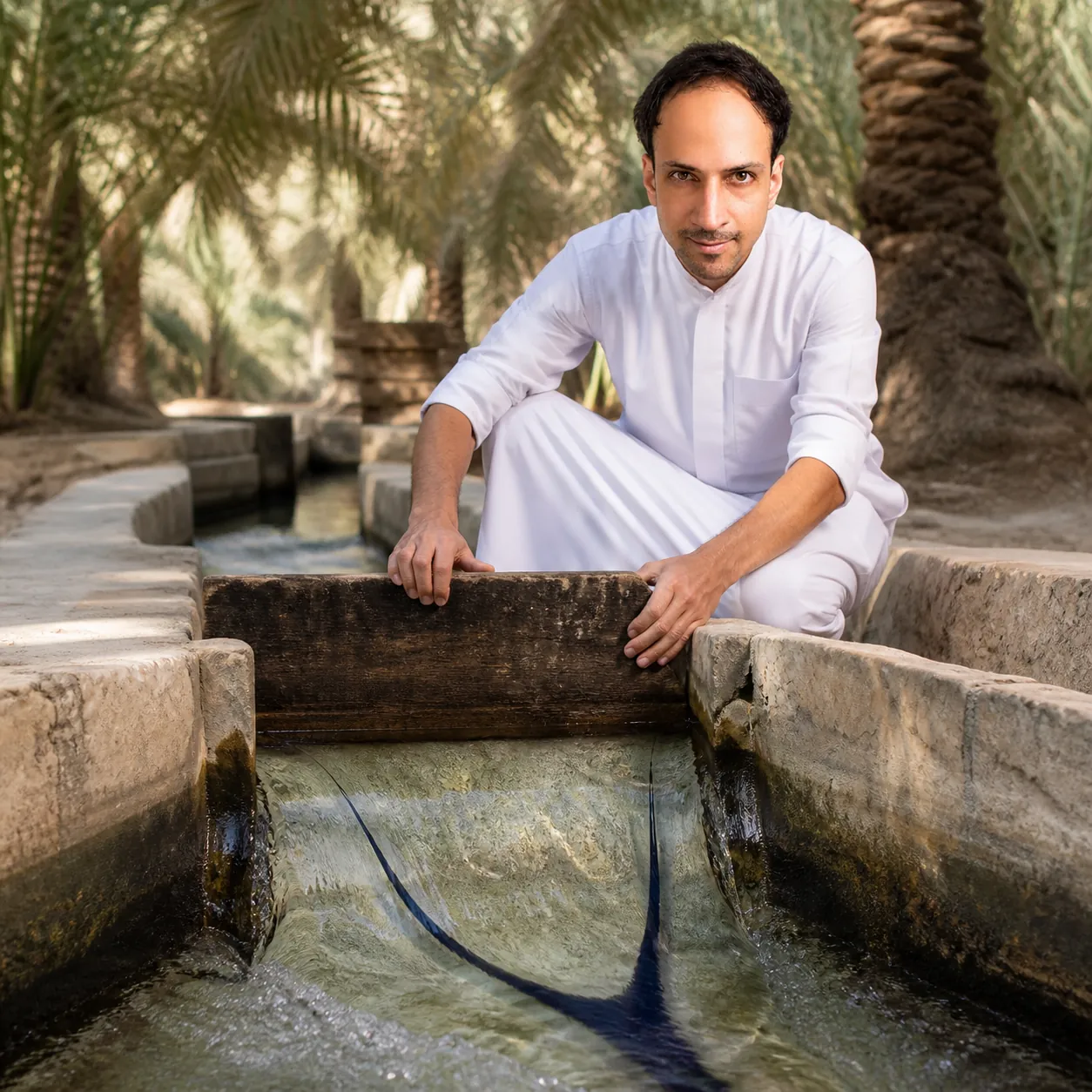
Create a square 1:1 museum-catalog frame with a strong first read and a slower second read at exactly 2880x2880 pixels. Location: a restored stone falaj...
من نص البرومبت
Use the attached reference photo as the identity reference: keep the same face, skin tone, hair and features as the person in that photo, without beautifying, aging or altering them. Create a square 1:1 museum-catalog frame with a strong first read and a slower second read at exactly 2880x2880 pixels. Location: a restored stone falaj channel running clear through shaded farmland. Show the subject in a plain white traditional Gulf outfit with sleeves folded clear of the water, seating a worn wooden flow gate into its stone slots. Treat this mechanism as the frame’s governing rule: a flat stripe of dye in a wide clear tube that the moving water stretches into one clean, deepening parabola gives a normally chaotic process one legible, patient, watchable form. Explore where the boundary lies between a working flow and the sculpture it resembles; direct expression and posture toward collected curiosity, never melodrama or ad-like confidence. Use a calm wide 35mm view that keeps verticals true and places them just off the flow's axis. Make the composition let one unbroken waterline run the frame's full width. Render it as high-concept flow portraiture staged with real laminar apparatus, calibrated documentary lighting, optically true refraction, and quietly intelligent restraint, using one low raking beam that turns every smooth surface into readable contour and a palette of bone white, clear-water celadon, and a line of indigo. Photorealistic: this must read as a real photograph from a physical camera, never an illustration, painting, or 3D render. Resolve real surface detail: grout darker than tile, sealant slightly yellowed, and every joint showing a real tolerance gap. Keep one identity-locked person, credible hands and fingers, natural fabric, and coherent scale, contact, reflections, shadows, airflow, deformation, and materials. Background people only when essential, always secondary and clearly different. Avoid splash crowns, suspended droplet sprays, chrome CGI liquid, neon glowing water, and fantasy water-bending gestures. No text, labels, logos, signatures, watermarks, random symbols, plastic skin, excessive bloom, or glossy AI finish.
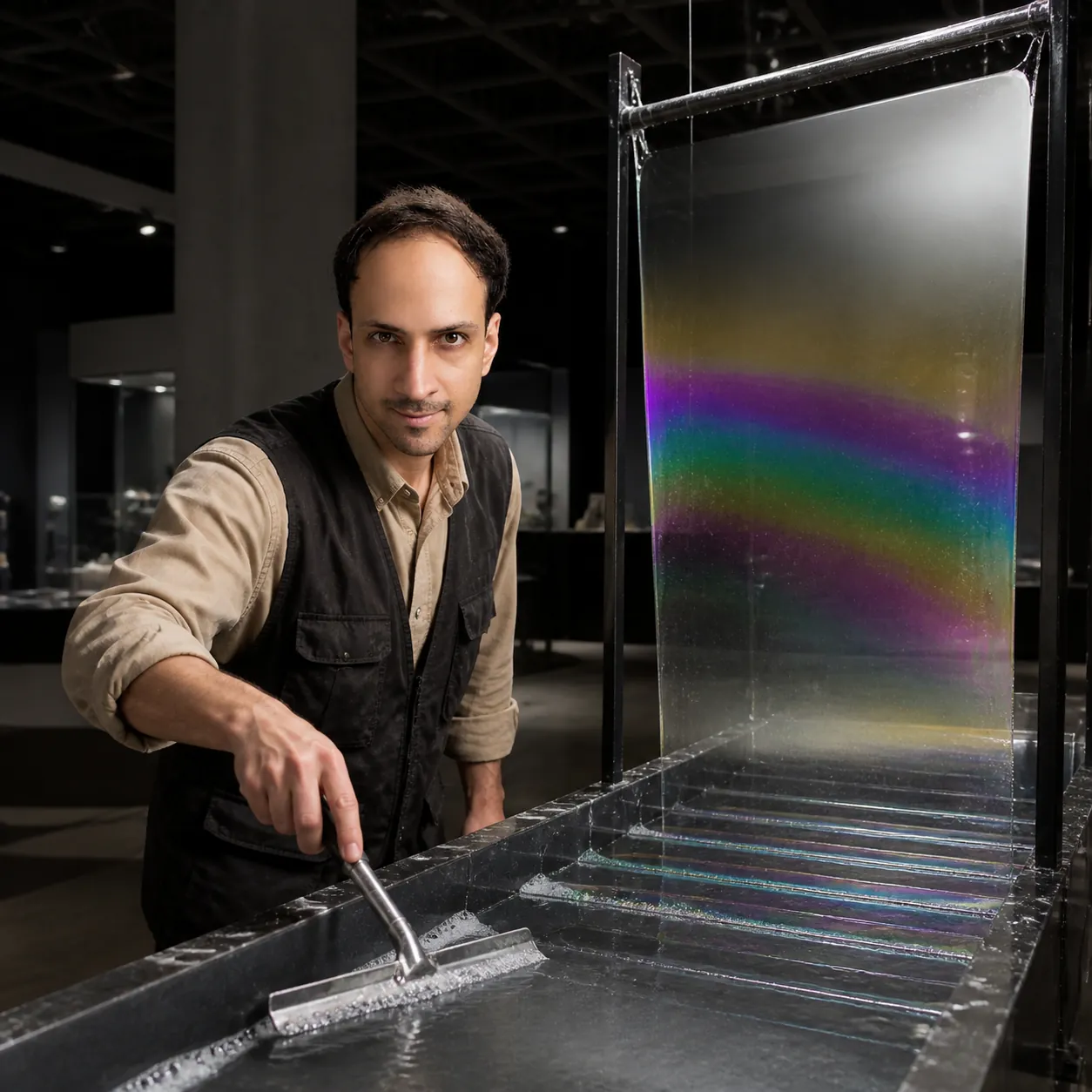
Create a square 1:1 museum-catalog frame with a strong first read and a slower second read at exactly 2880x2880 pixels. Location: the empty demonstration...
من نص البرومبت
Use the attached reference photo as the identity reference: keep the same face, skin tone, hair and features as the person in that photo, without beautifying, aging or altering them. Create a square 1:1 museum-catalog frame with a strong first read and a slower second read at exactly 2880x2880 pixels. Location: the empty demonstration hall of a science center before opening. Show the subject in a pressed sand-beige shirt under a dark utility vest, skimming stray suds from a dip trough with a squeegee. Make one rigorous physical condition the conceptual engine: a doorway-tall soap film on a welded wire frame that drains under gravity into a level staircase of interference color catches mathematics choosing the least surface right in front of them. Explore why nature, given every possible shape, keeps choosing the cheapest one; direct expression and posture toward hushed precision, never melodrama or ad-like confidence. Use an eye-level 80mm medium-format viewpoint with gentle depth of field and no forced drama. Make the composition give the film's colored bands more resolution than their clothing. Render it as high-concept surface-tension portraiture built from real minimal-surface demonstrations, documentary realism, laboratory-grade wire craft, and emotionally restrained human composition, using one broad diffused panel reflected in the film against a darkened room and a palette of wet slate, pearl grey, and one drifting magenta band. Photorealistic: this must read as a real photograph from a physical camera, never an illustration, painting, or 3D render. Resolve real surface detail: true skin texture with pores and fine hair at the hairline, and fabric that creases where it is actually stressed. Keep one identity-locked person, credible hands and fingers, natural fabric, and coherent scale, contact, reflections, shadows, airflow, deformation, and materials. Background people only when essential, always secondary and clearly different. Avoid party-bubble clusters, rainbow oil-slick swirls, CGI-perfect spheres, sparkle overlays, and any child-with-wand whimsy. No text, labels, logos, signatures, watermarks, random symbols, plastic skin, excessive bloom, or glossy AI finish.