تخطَّ إلى المحتوى
جميع التصنيفات

AI Portraits

Portrait prompts you can use with your own photo.

3845 برومبتات•0 مشتركين
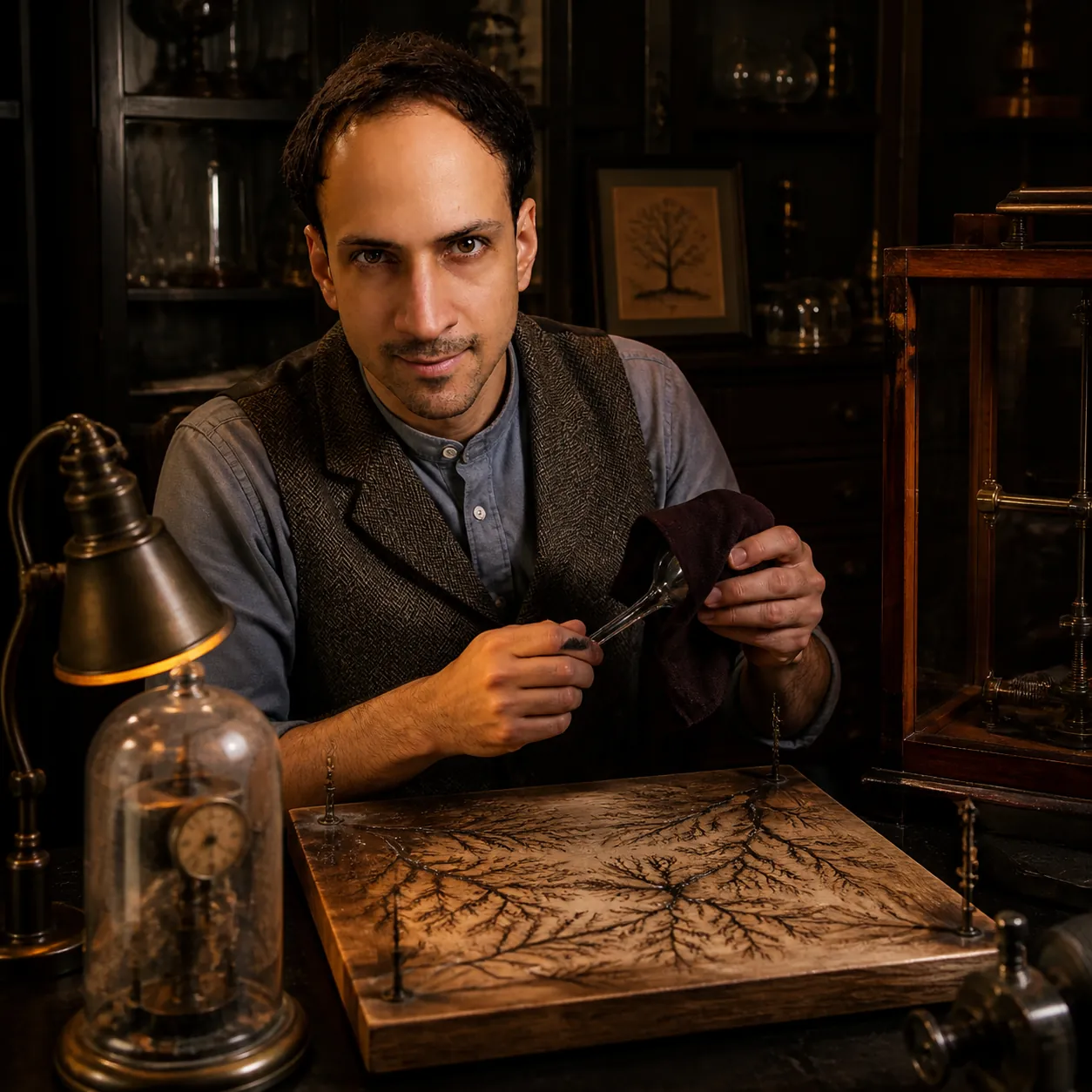
The Fast Hand: Back Room — AI Portrait Prompt
صورةAI Portraits

Turn your own photo into a low-light demonstration portrait in the back room of a scientific-antiques dealer, cabinets unlocked. Keeps your face unchanged.

من نص البرومبت

Use the attached reference photo as the identity reference: keep the same face, skin tone, hair and features as the person in that photo, without beautifying, aging or altering them. Create a square 1:1 museum-catalog frame with a strong first read and a slower second read at exactly 2880x2880 pixels. Location: the back room of a scientific-antiques dealer, cabinets unlocked. Show them in a herringbone wool vest over a band-collar shirt, folding a felt square around a glass stem. The impossible-looking event must obey this clear system: a prepared oak panel, powered down and cool, carrying a river-delta of charred branches a guided discharge etched days before brings a feared force close enough to study without any bravado. Explore what electricity's handwriting reveals that no diagram of it ever could; direct expression and posture toward steady curiosity, never melodrama or ad-like confidence. Use a 50mm view at bench height so apparatus and face carry equal optical weight. Make the composition hold the apparatus, their hands, and their gaze in one triangle. Render it as low-light demonstration realism combining true plasma color science, patient long-exposure discipline, tactile bench materiality, and dignified editorial portrait craft, using one low practical lamp with the room allowed to fall away dark and a palette of soot black, aged bakelite brown, and dim neon amber. Photorealistic: this must read as a real photograph from a physical camera, never an illustration, painting, or 3D render. Resolve real surface detail: condensation beading at true size, liquid meniscus curving against glass, and wet surfaces darker than dry ones. Keep one identity-locked person, credible hands and fingers, natural fabric, and coherent scale, contact, reflections, shadows, airflow, deformation, and materials. Background people only when essential, always secondary and clearly different. Avoid sci-fi energy balls, fractal screen-saver overlays, sparks showering from hands, wizard-lightning fingertips, and ultraviolet glow gimmicks. No text, labels, logos, signatures, watermarks, random symbols, plastic skin, excessive bloom, or glossy AI finish.
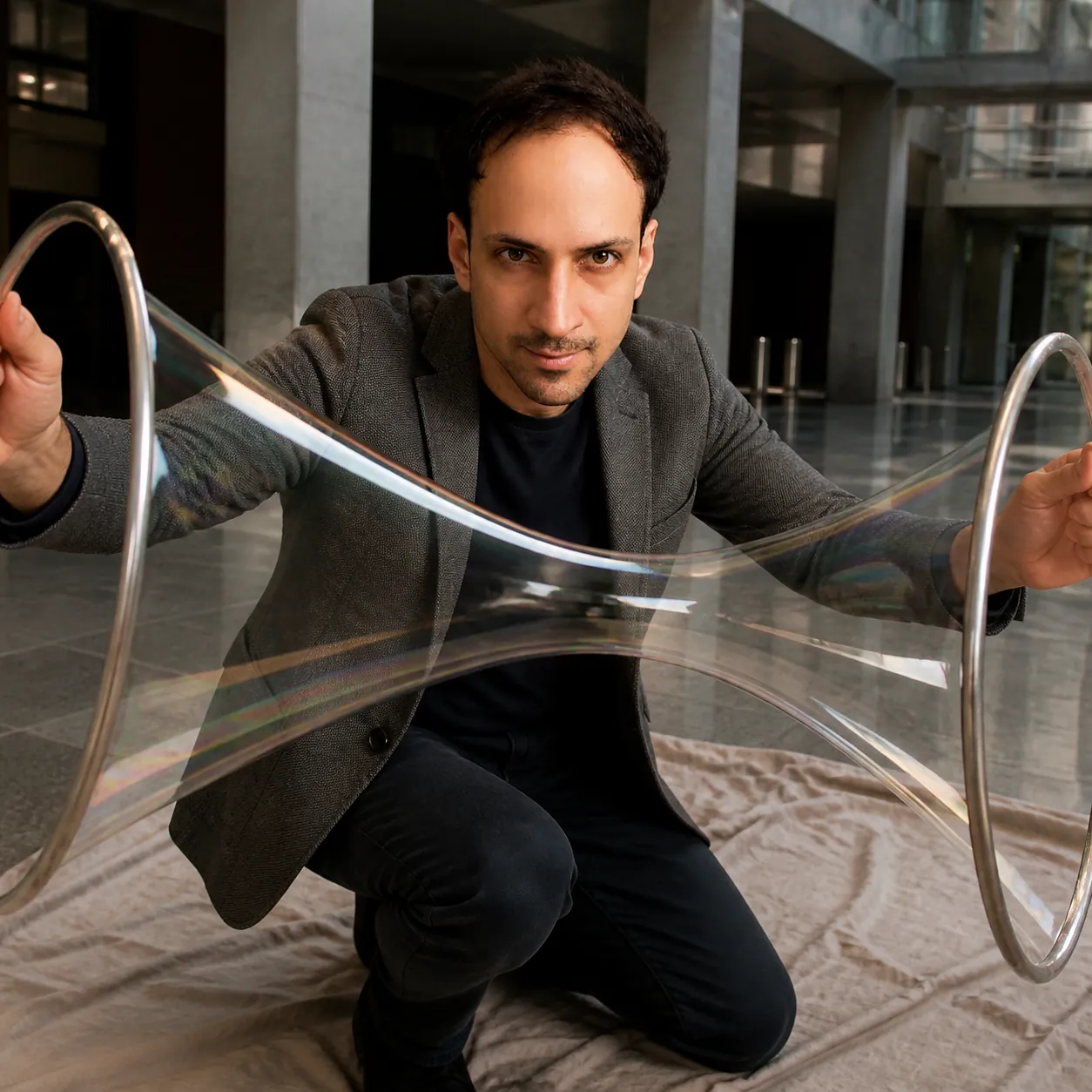
The Thin Answer: Daylit Atrium — AI Portrait Prompt
صورةAI Portraits

Turn your own photo into a large-format wet-lab portrait in the daylit atrium of a quiet office building on a Friday. Keeps your face unchanged.

من نص البرومبت

Use the attached reference photo as the identity reference: keep the same face, skin tone, hair and features as the person in that photo, without beautifying, aging or altering them. Create a square 1:1 museum-catalog frame with a strong first read and a slower second read at exactly 2880x2880 pixels. Location: the daylit atrium of a quiet office building on a Friday. Show them in an unstructured stone-grey blazer over a fine navy knit, unfolding a drop cloth across the stone floor. The impossible-looking event must obey this clear system: a soap catenoid stretched between two steel rings that necks toward a waist as they draw the rings apart catches mathematics choosing the least surface right in front of them. Explore what color means when it is a measurement rather than a choice; direct expression and posture toward careful wonder, never melodrama or ad-like confidence. Frame them partly through a soap membrane so the view and its faint colored reflection share one plane. Make the composition leave generous still air above the thinnest part of the surface. Render it as large-format wet-lab photography built from working soap-film apparatus, accurate reflection physics, restrained studio styling, and calm observational distance, using one broad diffused panel reflected in the film against a darkened room and a palette of warm concrete, soap-water grey, and a low gold shimmer. Photorealistic: this must read as a real photograph from a physical camera, never an illustration, painting, or 3D render. Resolve real surface detail: glass with real thickness at its edge, reflections that carry the room's actual colour, and dust visible only at grazing angles. Keep one identity-locked person, credible hands and fingers, natural fabric, and coherent scale, contact, reflections, shadows, airflow, deformation, and materials. Background people only when essential, always secondary and clearly different. Avoid party-bubble clusters, rainbow oil-slick swirls, CGI-perfect spheres, sparkle overlays, and any child-with-wand whimsy. No text, labels, logos, signatures, watermarks, random symbols, plastic skin, excessive bloom, or glossy AI finish.
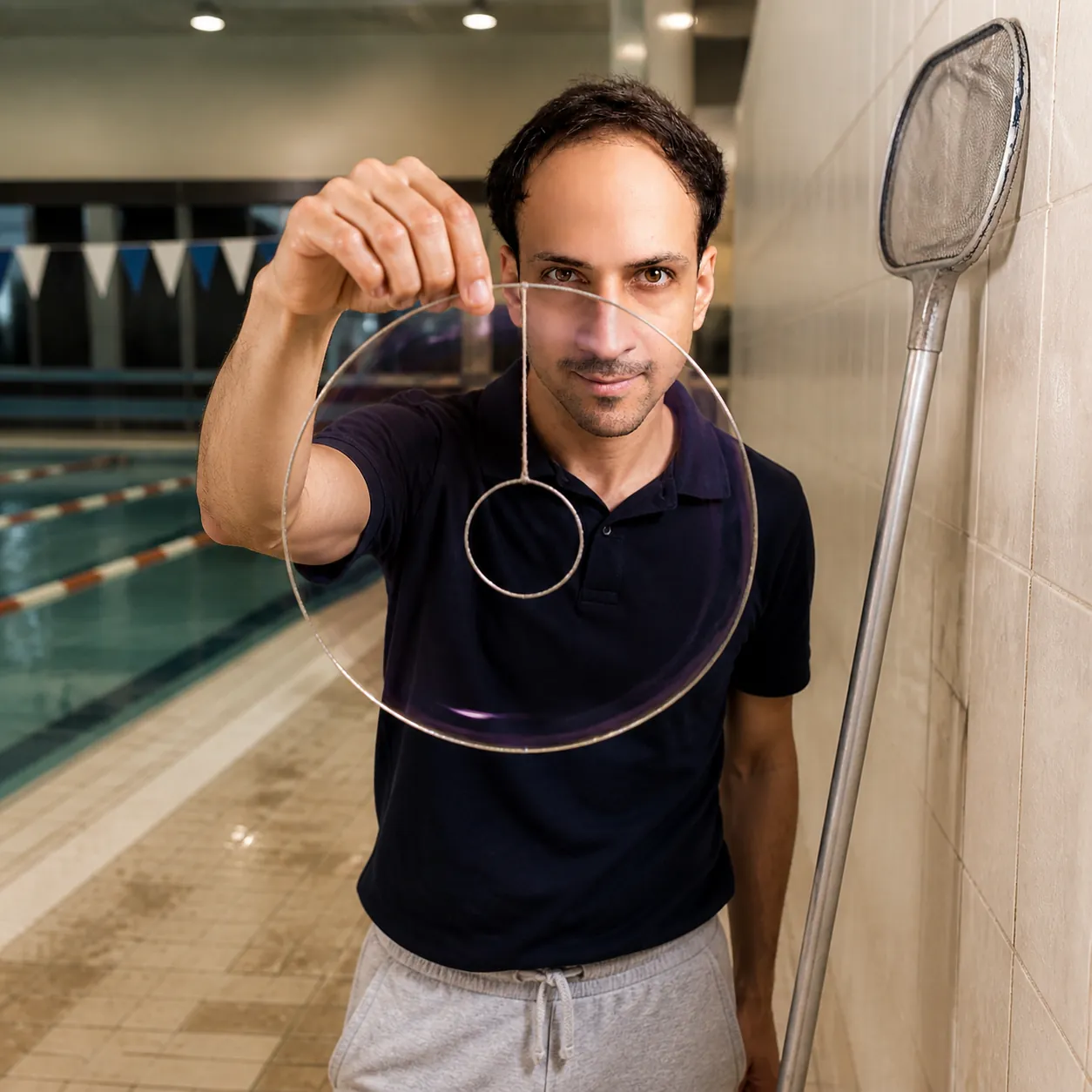
Brief Geometry: Tiled Surround of an Indoor Lap Pool — AI Portrait Prompt
صورةAI Portraits

Turn your own photo into a high-concept surface-tension portrait in the tiled surround of an indoor lap pool at rest. Keeps your face unchanged.

من نص البرومبت

Use the attached reference photo as the identity reference: keep the same face, skin tone, hair and features as the person in that photo, without beautifying, aging or altering them. Create a square 1:1 museum-catalog frame with a strong first read and a slower second read at exactly 2880x2880 pixels. Location: the tiled surround of an indoor lap pool at rest. Show them in a plain navy polo and light grey drawstring trousers, leaning a long-handled skimmer against the tile wall. Make one rigorous physical condition the conceptual engine: a flat soap film carrying a slack cotton loop that snaps the loop into a perfect circle when punctured inside it catches mathematics choosing the least surface right in front of them. Explore how much structure a surface with almost no substance can honestly carry; direct expression and posture toward measured delight, never melodrama or ad-like confidence. Use an eye-level 80mm medium-format viewpoint with gentle depth of field and no forced drama. Make the composition let the membrane's boundary draw a second frame inside the photograph. Render it as high-concept surface-tension portraiture built from real minimal-surface demonstrations, documentary realism, laboratory-grade wire craft, and emotionally restrained human composition, using quiet overhead bounce shaped so skin stays honest and reflections stay legible and a palette of pale limestone, dim pewter, and a single violet gleam. Photorealistic: this must read as a real photograph from a physical camera, never an illustration, painting, or 3D render. Resolve real surface detail: the difference between a wiped surface and a clean one, faint tide marks on ceramic, and metal dulled unevenly by touch. Keep one identity-locked person, credible hands and fingers, natural fabric, and coherent scale, contact, reflections, shadows, airflow, deformation, and materials. Background people only when essential, always secondary and clearly different. Avoid party-bubble clusters, rainbow oil-slick swirls, CGI-perfect spheres, sparkle overlays, and any child-with-wand whimsy. No text, labels, logos, signatures, watermarks, random symbols, plastic skin, excessive bloom, or glossy AI finish.
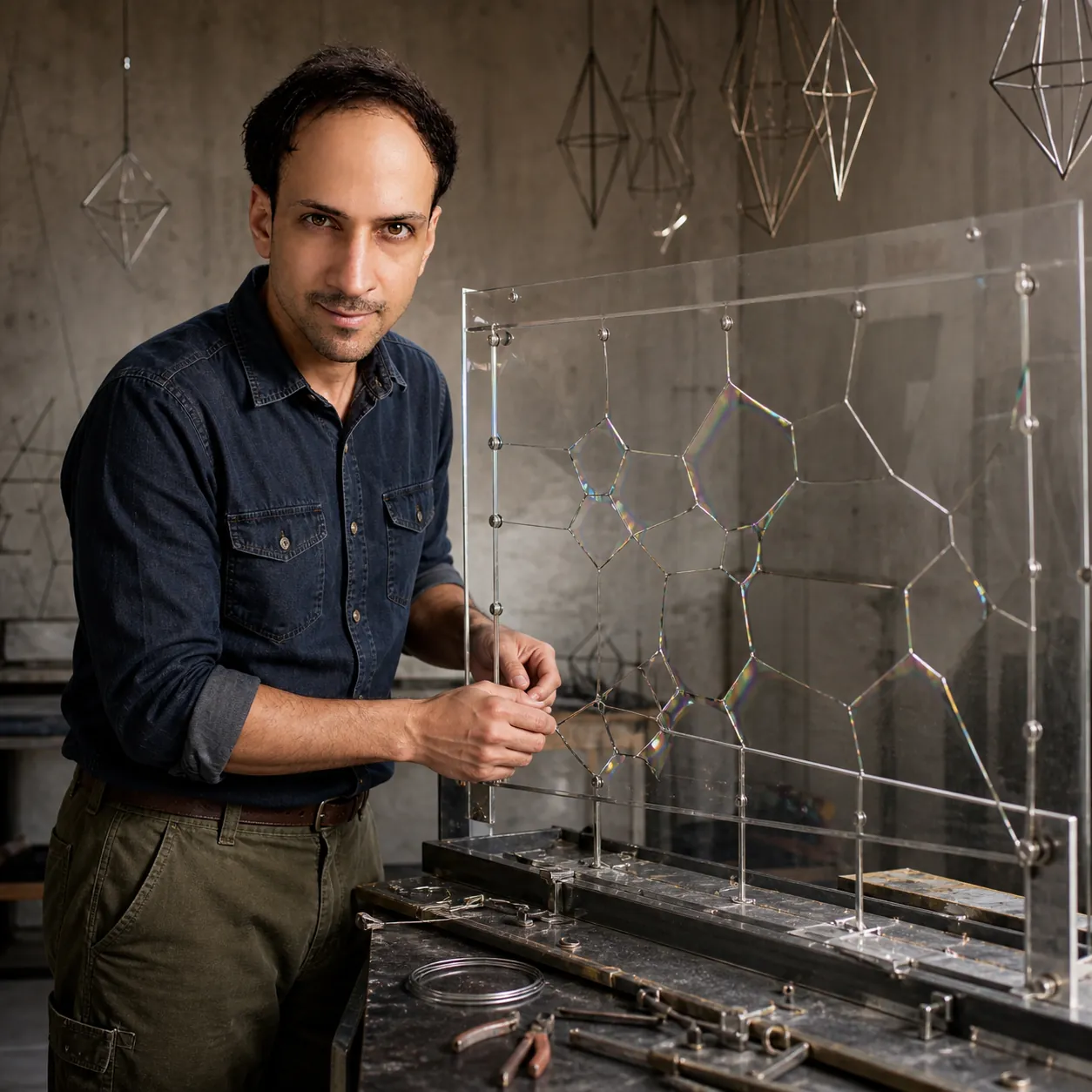
Iridescent Proof: Wire Artist's Studio — AI Portrait Prompt
صورةAI Portraits

Turn your own photo into a high-concept surface-tension portrait in a wire artist's studio hung with bent geometric frames. Keeps your face unchanged.

من نص البرومبت

Use the attached reference photo as the identity reference: keep the same face, skin tone, hair and features as the person in that photo, without beautifying, aging or altering them. Create a square 1:1 museum-catalog frame with a strong first read and a slower second read at exactly 2880x2880 pixels. Location: a wire artist's studio hung with bent geometric frames. Show them in a dark denim work shirt tucked into olive canvas trousers, easing a fresh bend into a length of wire. Treat this mechanism as the frame’s governing rule: a soap network between two clear plates and steel pins that links every pin with the shortest possible roads catches mathematics choosing the least surface right in front of them. Explore whether watching a problem solve itself can count as understanding it; direct expression and posture toward careful wonder, never melodrama or ad-like confidence. Use a 24mm environmental view with true verticals, placing them beside the apparatus rather than behind it. Make the composition give the film's colored bands more resolution than their clothing. Render it as high-concept surface-tension portraiture built from real minimal-surface demonstrations, documentary realism, laboratory-grade wire craft, and emotionally restrained human composition, using low side daylight kept off the background so the colors read true and a palette of warm concrete, soap-water grey, and a low gold shimmer. Photorealistic: this must read as a real photograph from a physical camera, never an illustration, painting, or 3D render. Resolve real surface detail: grout darker than tile, sealant slightly yellowed, and every joint showing a real tolerance gap. Keep one identity-locked person, credible hands and fingers, natural fabric, and coherent scale, contact, reflections, shadows, airflow, deformation, and materials. Background people only when essential, always secondary and clearly different. Avoid party-bubble clusters, rainbow oil-slick swirls, CGI-perfect spheres, sparkle overlays, and any child-with-wand whimsy. No text, labels, logos, signatures, watermarks, random symbols, plastic skin, excessive bloom, or glossy AI finish.
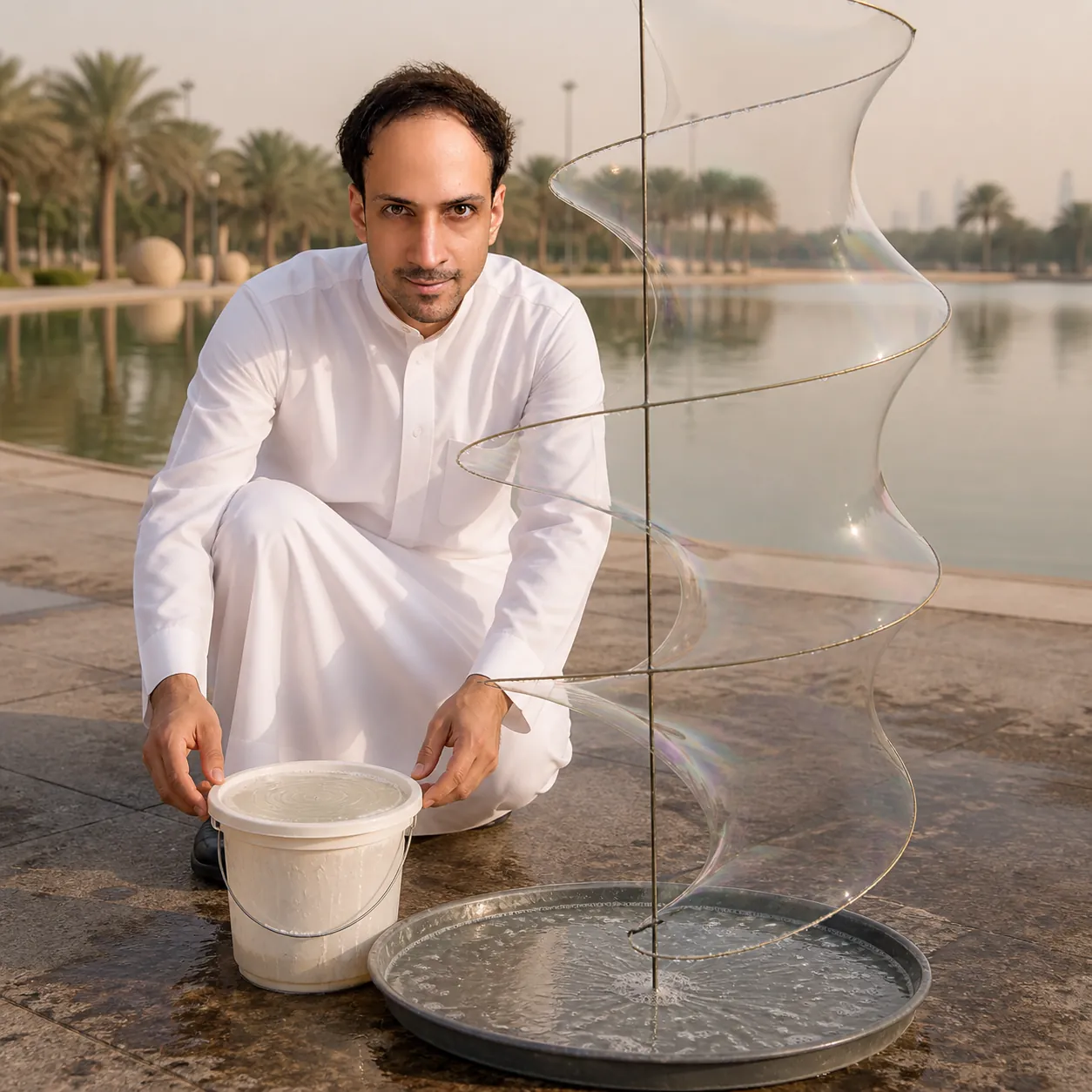
Soft Mathematics: Paved Edge of a Riyadh Park Lake — AI Portrait Prompt
صورةAI Portraits

Turn your own photo into a gallery-hall demonstration portrait in the paved edge of a Riyadh park lake just after sunrise. Keeps your face unchanged.

من نص البرومبت

Use the attached reference photo as the identity reference: keep the same face, skin tone, hair and features as the person in that photo, without beautifying, aging or altering them. Create a square 1:1 museum-catalog frame with a strong first read and a slower second read at exactly 2880x2880 pixels. Location: the paved edge of a Riyadh park lake just after sunrise. Show them in a crisp white traditional Gulf outfit with the sleeves left unrolled, lowering a covered pail gently to the paving. Make one rigorous physical condition the conceptual engine: a soap film spanning a helical wire that resolves into a smooth spiral ramp turning around its straight axis catches mathematics choosing the least surface right in front of them. Explore why the thinnest possible thing in the room is the most disciplined; direct expression and posture toward hushed precision, never melodrama or ad-like confidence. Use an eye-level 80mm medium-format viewpoint with gentle depth of field and no forced drama. Make the composition let the membrane's boundary draw a second frame inside the photograph. Render it as gallery-hall demonstration realism uniting true thin-film optics, believable soap chemistry, patient portrait photography, and quiet contemporary exhibit design, using cool morning ambience with one warm lamp held well away from the membrane and a palette of warm concrete, soap-water grey, and a low gold shimmer. Photorealistic: this must read as a real photograph from a physical camera, never an illustration, painting, or 3D render. Resolve real surface detail: fine grit in the texture of concrete, efflorescence at damp edges, and hairline cracks that follow stress. Keep one identity-locked person, credible hands and fingers, natural fabric, and coherent scale, contact, reflections, shadows, airflow, deformation, and materials. Background people only when essential, always secondary and clearly different. Avoid party-bubble clusters, rainbow oil-slick swirls, CGI-perfect spheres, sparkle overlays, and any child-with-wand whimsy. No text, labels, logos, signatures, watermarks, random symbols, plastic skin, excessive bloom, or glossy AI finish.
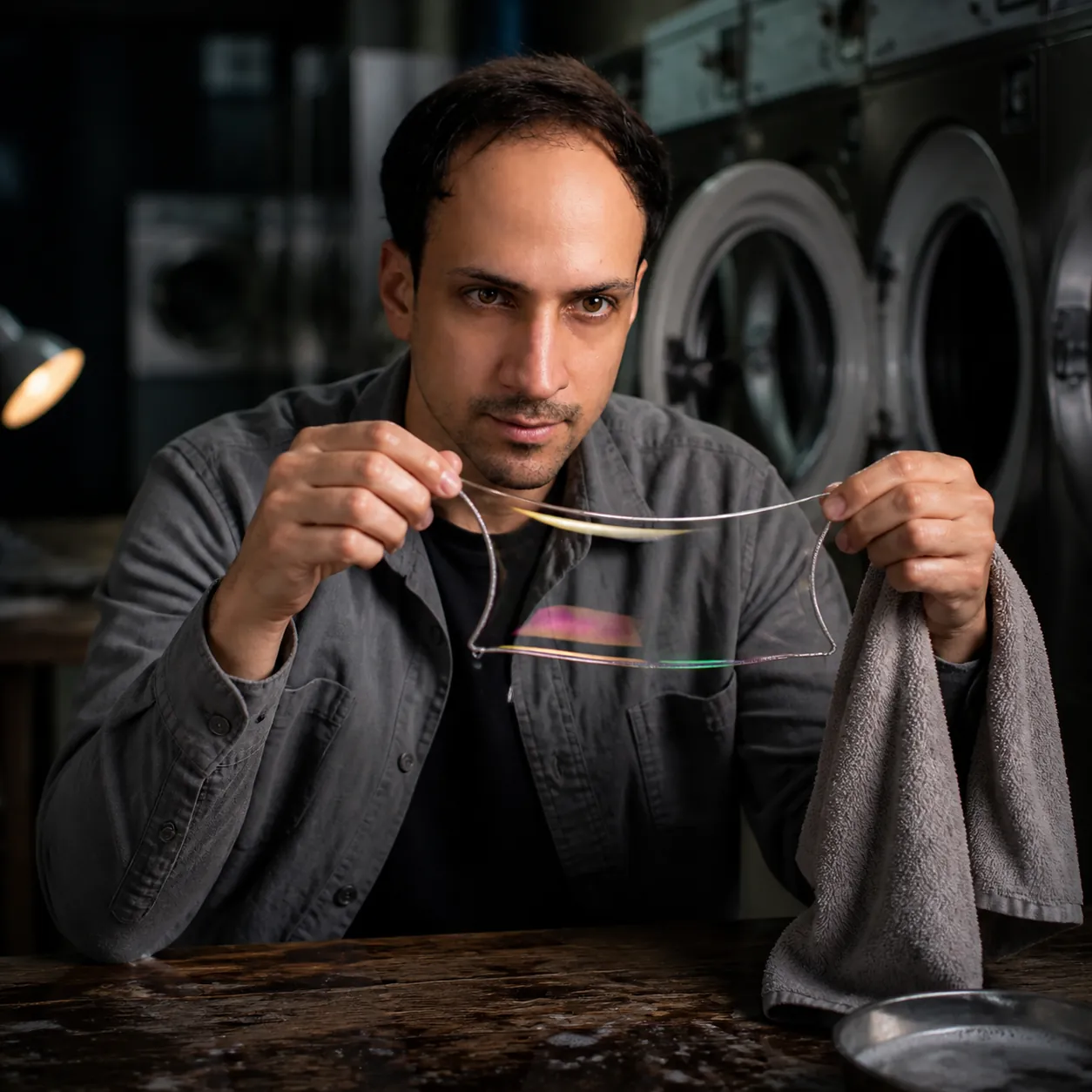
Tension Holds: Small Neighborhood Laundromat — AI Portrait Prompt
صورةAI Portraits

Turn your own photo into a portrait in a small neighborhood laundromat after closing, machines standing open. Keeps your face unchanged.

من نص البرومبت

Use the attached reference photo as the identity reference: keep the same face, skin tone, hair and features as the person in that photo, without beautifying, aging or altering them. Create a square 1:1 museum-catalog frame with a strong first read and a slower second read at exactly 2880x2880 pixels. Location: a small neighborhood laundromat after closing, machines standing open. Show them in a soft grey overshirt with both cuffs buttoned at the wrist, draping a damp towel over one forearm. Use this advanced image-making device as the core logic: a soap film on a doubly looped wire that closes into a single one-sided surface with no second face catches mathematics choosing the least surface right in front of them. Explore what patience owes to a structure that is already scheduled to vanish; direct expression and posture toward absorbed calm, never melodrama or ad-like confidence. Use a 105mm near-macro portrait blend, one iridescent border sharp near the lens and their attentive face readable beyond. Make the composition hold their hands and the fragile surface in one patient plane. Render it as high-concept surface-tension portraiture built from real minimal-surface demonstrations, documentary realism, laboratory-grade wire craft, and emotionally restrained human composition, using cool morning ambience with one warm lamp held well away from the membrane and a palette of wet slate, pearl grey, and one drifting magenta band. Photorealistic: this must read as a real photograph from a physical camera, never an illustration, painting, or 3D render. Resolve real surface detail: wood grain read at honest scale, matte and gloss clearly separated, and no surface uniformly clean. Keep one identity-locked person, credible hands and fingers, natural fabric, and coherent scale, contact, reflections, shadows, airflow, deformation, and materials. Background people only when essential, always secondary and clearly different. Avoid party-bubble clusters, rainbow oil-slick swirls, CGI-perfect spheres, sparkle overlays, and any child-with-wand whimsy. No text, labels, logos, signatures, watermarks, random symbols, plastic skin, excessive bloom, or glossy AI finish.
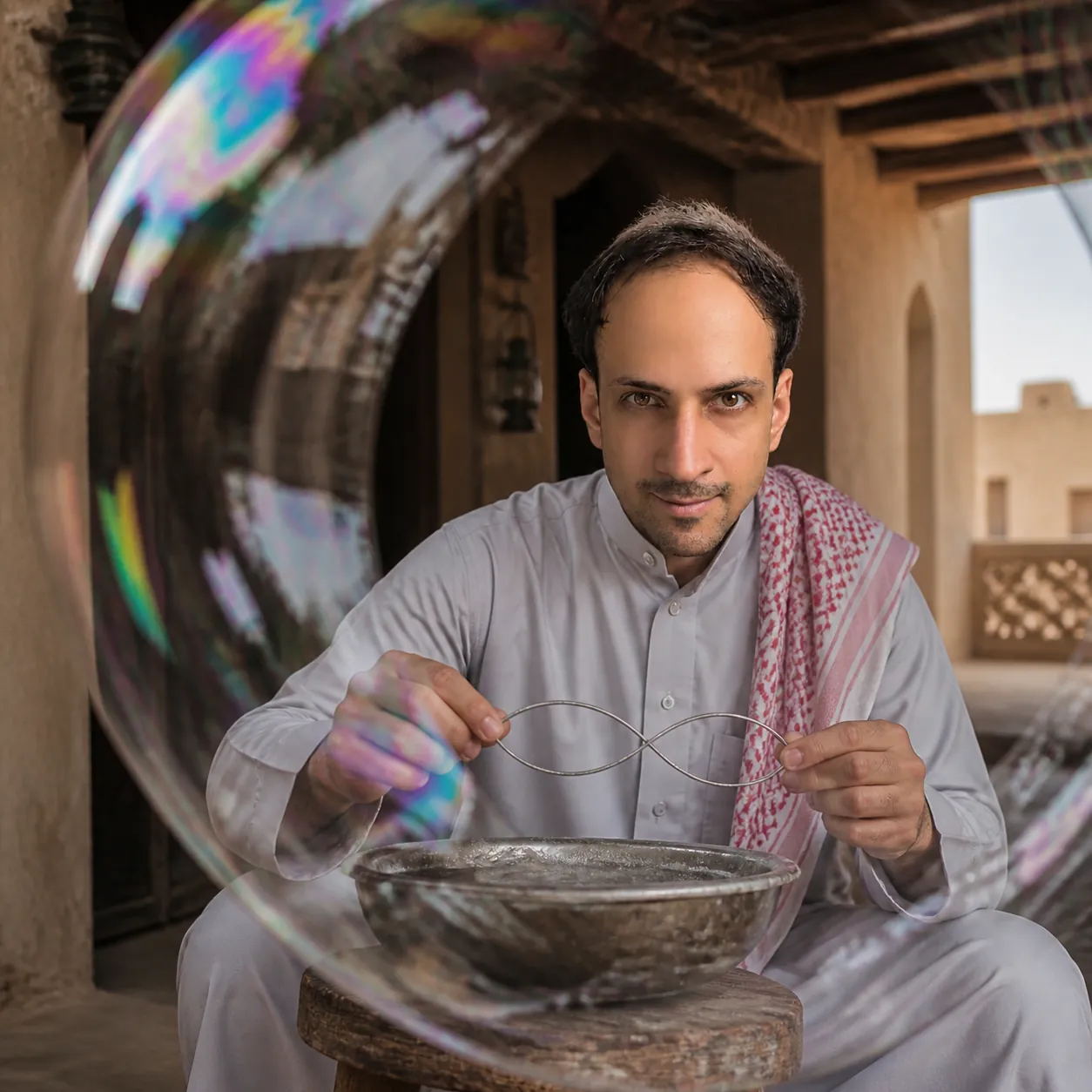
Tension Holds: Shaded Veranda — AI Portrait Prompt
صورةAI Portraits

Turn your own photo into a conceptual physics portrait in the shaded veranda of a Diriyah mud-brick house at midmorning. Keeps your face unchanged.

من نص البرومبت

Use the attached reference photo as the identity reference: keep the same face, skin tone, hair and features as the person in that photo, without beautifying, aging or altering them. Create a square 1:1 museum-catalog frame with a strong first read and a slower second read at exactly 2880x2880 pixels. Location: the shaded veranda of a Diriyah mud-brick house at midmorning. Show them in a pale grey traditional Gulf outfit with a folded shemagh over one shoulder, centering a shallow basin on a low wooden stool. The impossible-looking event must obey this clear system: a soap film on a doubly looped wire that closes into a single one-sided surface with no second face keeps its composure while thinning lawfully toward a collapse it cannot refuse. Explore what patience owes to a structure that is already scheduled to vanish; direct expression and posture toward tender vigilance, never melodrama or ad-like confidence. Frame them partly through a soap membrane so the view and its faint colored reflection share one plane. Make the composition keep one dark, quiet ground behind every iridescent passage. Render it as conceptual physics portraiture blending exact interference color, honest wet materiality, unhurried editorial framing, and quietly human-scale scientific staging, using quiet overhead bounce shaped so skin stays honest and reflections stay legible and a palette of bone white, dark zinc, and one thin teal seam. Photorealistic: this must read as a real photograph from a physical camera, never an illustration, painting, or 3D render. Resolve real surface detail: skin that reddens slightly under pressure, nail beds with honest colour, and knuckle creases that fold rather than blur. Keep one identity-locked person, credible hands and fingers, natural fabric, and coherent scale, contact, reflections, shadows, airflow, deformation, and materials. Background people only when essential, always secondary and clearly different. Avoid psychedelic color grading, floating foam confetti, glassy chrome bubbles, dish-soap advertising gloss, and impossible unbroken membranes. No text, labels, logos, signatures, watermarks, random symbols, plastic skin, excessive bloom, or glossy AI finish.
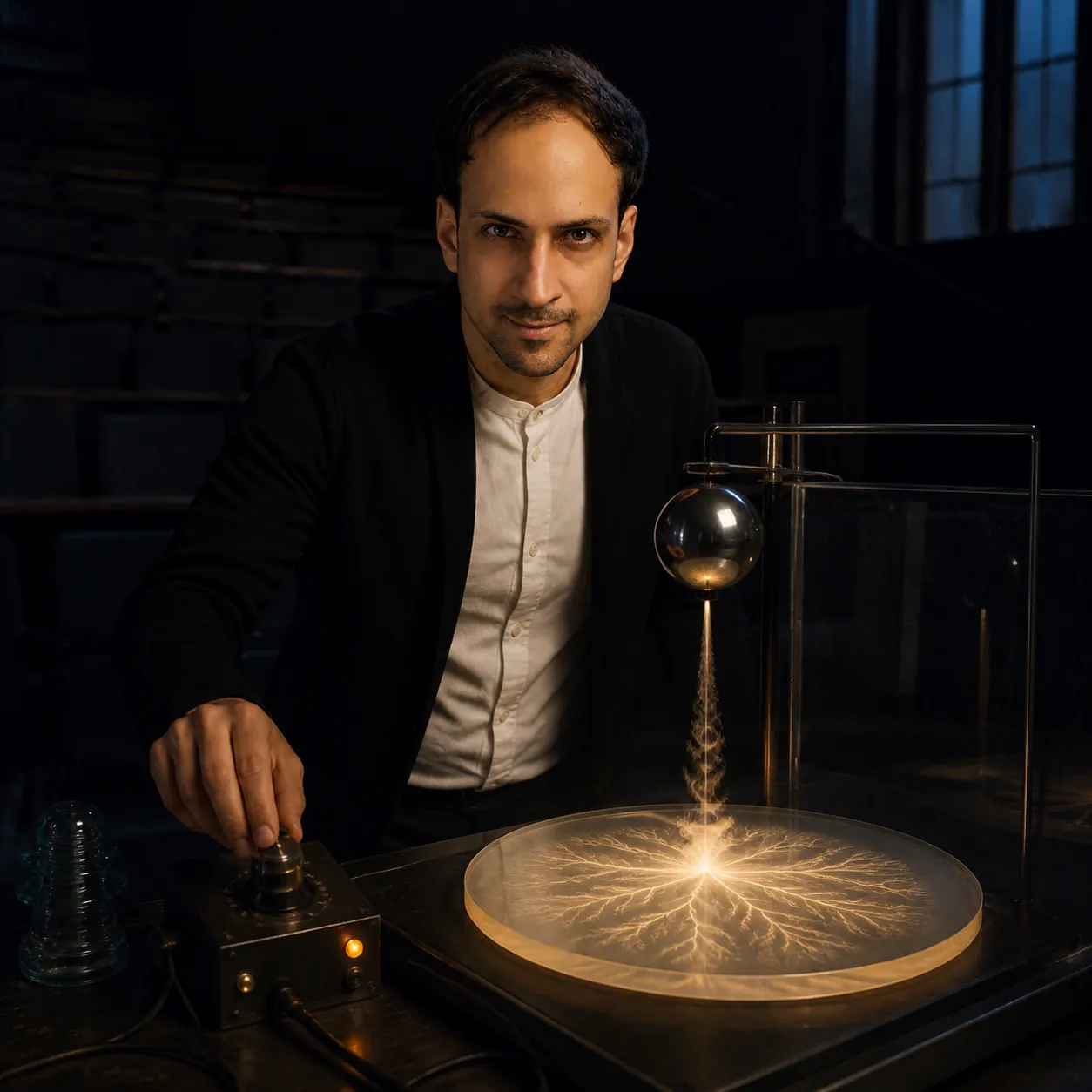
Charge Confesses: Empty Science-Museum Demonstration — AI Portrait Prompt
صورةAI Portraits

Turn your own photo into a low-light demonstration portrait in an empty science-museum demonstration theater, house lights taken low. Keeps your face unchanged.

من نص البرومبت

Use the attached reference photo as the identity reference: keep the same face, skin tone, hair and features as the person in that photo, without beautifying, aging or altering them. Create a square 1:1 museum-catalog frame with a strong first read and a slower second read at exactly 2880x2880 pixels. Location: an empty science-museum demonstration theater, house lights taken low. Show them in a soft black cardigan over a white collarless shirt, dimming a rotary dimmer to its last warm step. Build the artwork around this material rule: a resin plate over which sifted pale powder settles into a branching star, mapping charge left by one earlier spark brings a feared force close enough to study without any bravado. Explore how one force can write so differently across glass, wood, and air; direct expression and posture toward unhurried scrutiny, never melodrama or ad-like confidence. Use a restrained 35mm environmental view with the subject anchored off-center and hands never distorted. Make the composition keep their face half a stop dimmer than the demonstration. Render it as low-light demonstration realism combining true plasma color science, patient long-exposure discipline, tactile bench materiality, and dignified editorial portrait craft, using late blue window light mixed with one warm low-wattage source and a palette of midnight blue-black, brushed nickel, and one phosphor-green line. Photorealistic: this must read as a real photograph from a physical camera, never an illustration, painting, or 3D render. Resolve real surface detail: dust settled where nobody wipes, fingerprint haze on glass, and edges rubbed pale by handling. Keep one identity-locked person, credible hands and fingers, natural fabric, and coherent scale, contact, reflections, shadows, airflow, deformation, and materials. Background people only when essential, always secondary and clearly different. Avoid sci-fi energy balls, fractal screen-saver overlays, sparks showering from hands, wizard-lightning fingertips, and ultraviolet glow gimmicks. No text, labels, logos, signatures, watermarks, random symbols, plastic skin, excessive bloom, or glossy AI finish.
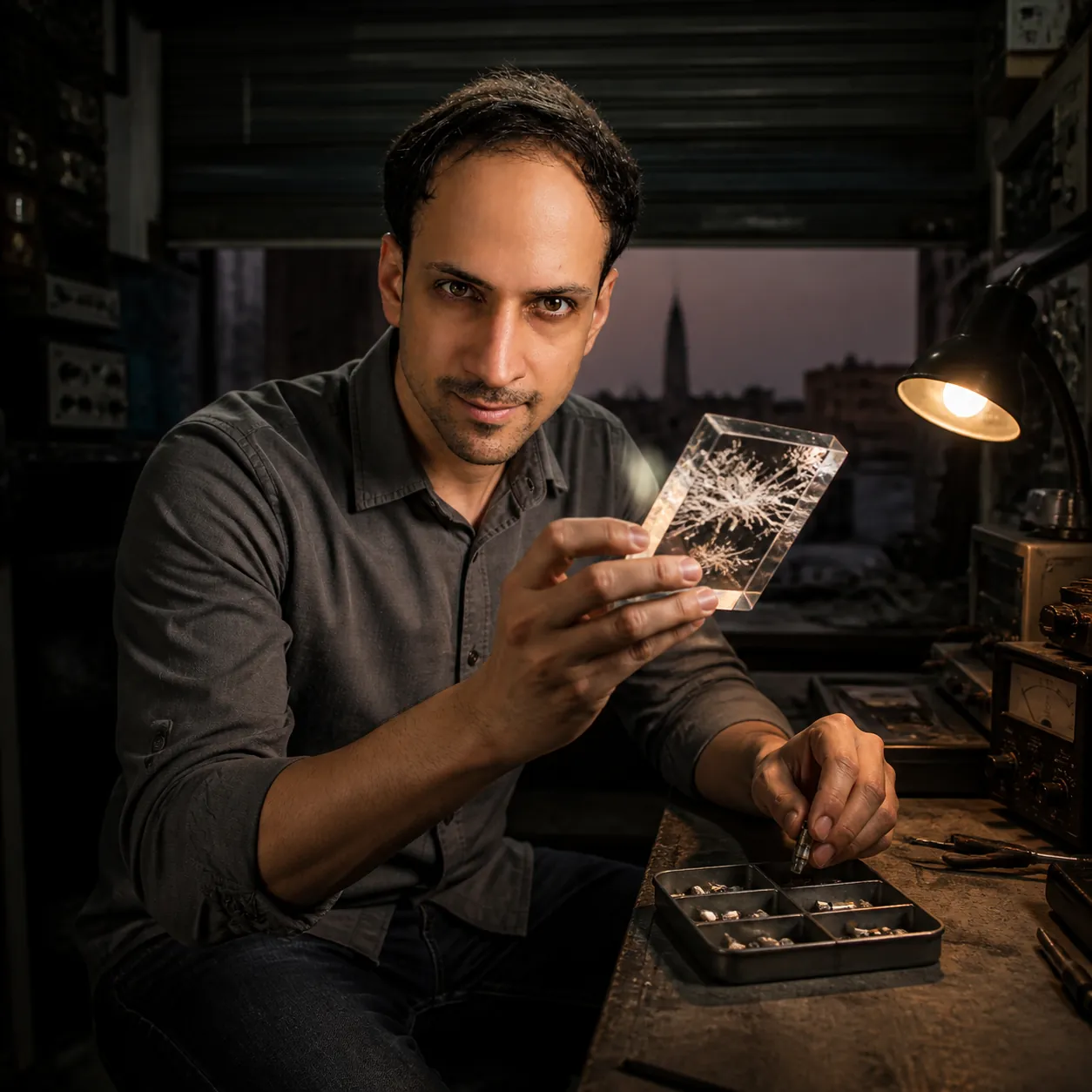
Lightning's Autograph: Narrow Electronics Repair Shop — AI Portrait Prompt
صورةAI Portraits

Turn your own photo into a high-voltage archival portrait in a narrow electronics repair shop in Riyadh, shutters half down at dusk. Keeps your face unchanged.

من نص البرومبت

Use the attached reference photo as the identity reference: keep the same face, skin tone, hair and features as the person in that photo, without beautifying, aging or altering them. Create a square 1:1 museum-catalog frame with a strong first read and a slower second read at exactly 2880x2880 pixels. Location: a narrow electronics repair shop in Riyadh, shutters half down at dusk. Show them in a graphite-grey service shirt with a folded cuff and dark jeans, sorting three cold fuses into a partitioned tin. Make one rigorous physical condition the conceptual engine: a clear acrylic block they tilt toward a lamp, holding a frozen white fern of fractures where a trapped charge once escaped turns activity far too fast to witness into a form calm enough to study. Explore why the fastest events in nature can leave the most patient evidence; direct expression and posture toward hushed reverence, never melodrama or ad-like confidence. Use an eye-level 85mm portrait view with honest perspective and one plane of disciplined focus. Make the composition let the brightest point be the smallest thing in frame. Render it as high-voltage archival portraiture built from sealed and lawful apparatus, deep-shadow documentary realism, physically true glass reflections, and museum-label restraint, using near-darkness held back by one small tungsten lamp at the bench and a palette of deep charcoal, gunmetal grey, and one violet whisper. Photorealistic: this must read as a real photograph from a physical camera, never an illustration, painting, or 3D render. Resolve real surface detail: true skin texture with pores and fine hair at the hairline, and fabric that creases where it is actually stressed. Keep one identity-locked person, credible hands and fingers, natural fabric, and coherent scale, contact, reflections, shadows, airflow, deformation, and materials. Background people only when essential, always secondary and clearly different. Avoid Tesla-coil showmanship, storm lightning skies, arcs crawling on skin, glowing superhero eyes, and cyberpunk neon haze. No text, labels, logos, signatures, watermarks, random symbols, plastic skin, excessive bloom, or glossy AI finish.
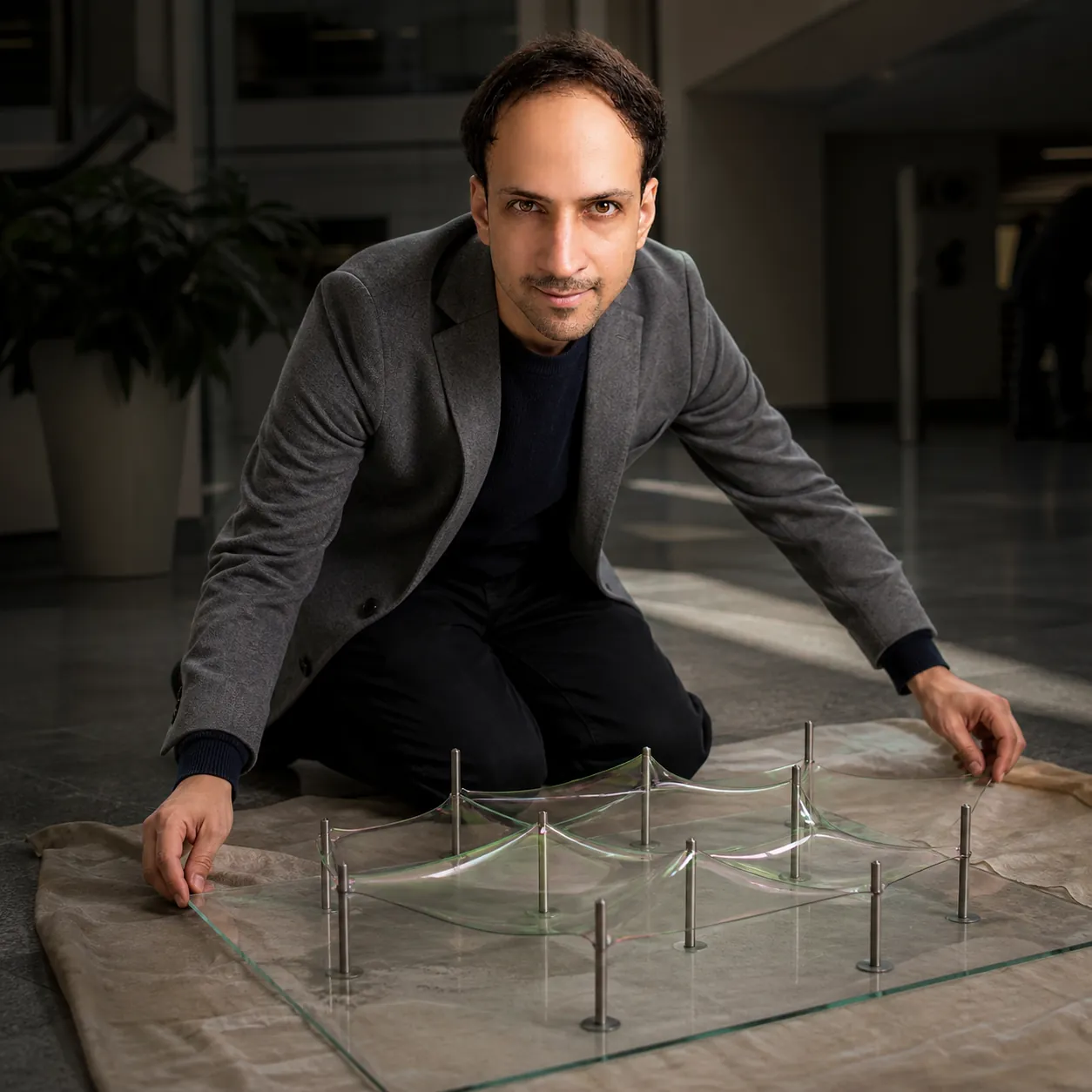
Iridescent Proof: Daylit Atrium — AI Portrait Prompt
صورةAI Portraits

Turn your own photo into a conceptual physics portrait in the daylit atrium of a quiet office building on a Friday. Keeps your face unchanged.

من نص البرومبت

Use the attached reference photo as the identity reference: keep the same face, skin tone, hair and features as the person in that photo, without beautifying, aging or altering them. Create a square 1:1 museum-catalog frame with a strong first read and a slower second read at exactly 2880x2880 pixels. Location: the daylit atrium of a quiet office building on a Friday. Show them in an unstructured stone-grey blazer over a fine navy knit, unfolding a drop cloth across the stone floor. Use this advanced image-making device as the core logic: a soap network between two clear plates and steel pins that links every pin with the shortest possible roads keeps its composure while thinning lawfully toward a collapse it cannot refuse. Explore whether watching a problem solve itself can count as understanding it; direct expression and posture toward unhurried attention, never melodrama or ad-like confidence. Use a 105mm near-macro portrait blend, one iridescent border sharp near the lens and their attentive face readable beyond. Make the composition hold their hands and the fragile surface in one patient plane. Render it as conceptual physics portraiture blending exact interference color, honest wet materiality, unhurried editorial framing, and quietly human-scale scientific staging, using a single softened practical raking the surface with the room falling dark and a palette of deep charcoal, unpolished tin, and one green interference stripe. Photorealistic: this must read as a real photograph from a physical camera, never an illustration, painting, or 3D render. Resolve real surface detail: rubber gone chalky with age, painted metal chipped to primer, and plastic yellowed only where light reaches it. Keep one identity-locked person, credible hands and fingers, natural fabric, and coherent scale, contact, reflections, shadows, airflow, deformation, and materials. Background people only when essential, always secondary and clearly different. Avoid psychedelic color grading, floating foam confetti, glassy chrome bubbles, dish-soap advertising gloss, and impossible unbroken membranes. No text, labels, logos, signatures, watermarks, random symbols, plastic skin, excessive bloom, or glossy AI finish.
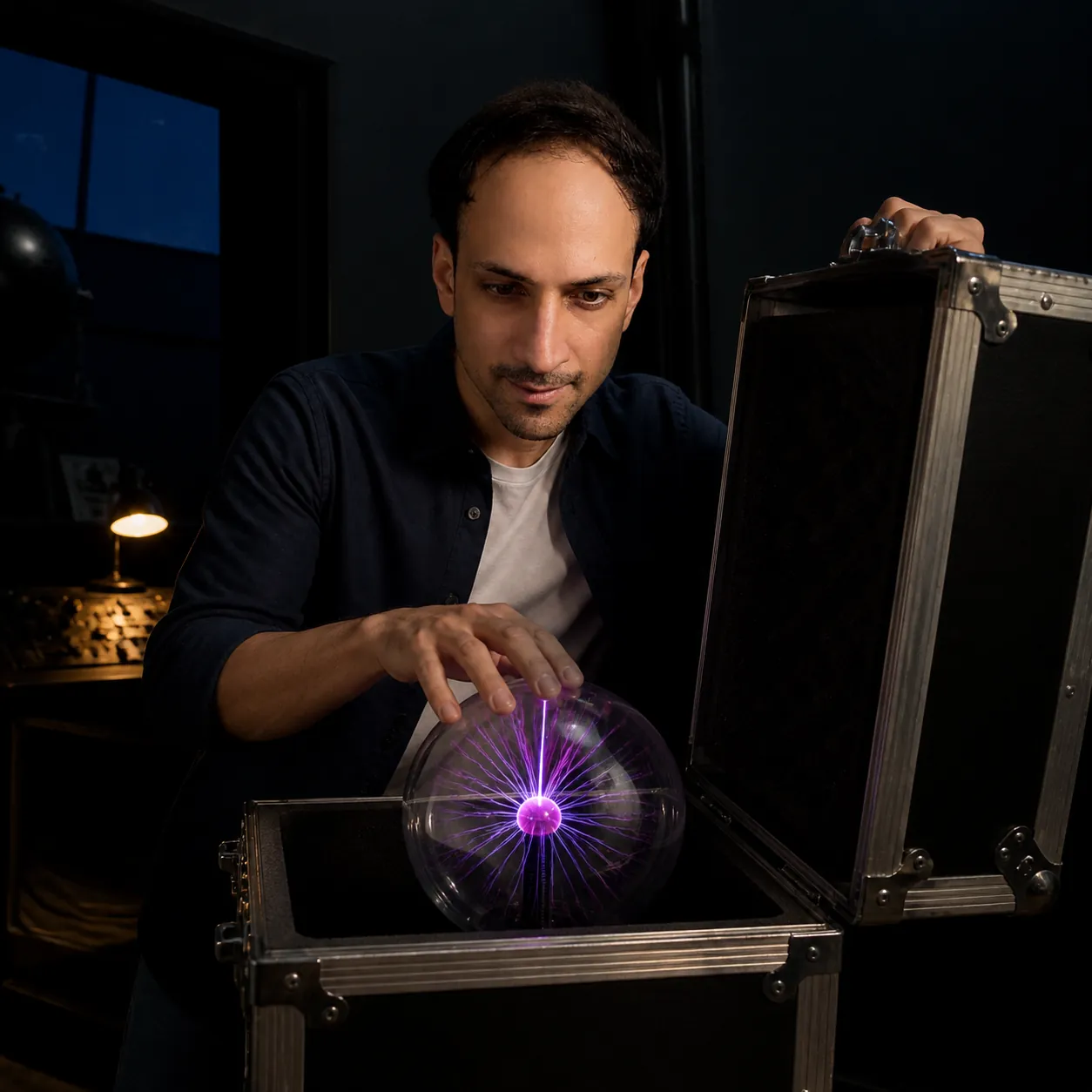
Branching Verdict: Control Alcove — AI Portrait Prompt
صورةAI Portraits

Turn your own photo into a photorealistic portrait in the control alcove of a small planetarium between shows. Keeps your face unchanged.

من نص البرومبت

Use the attached reference photo as the identity reference: keep the same face, skin tone, hair and features as the person in that photo, without beautifying, aging or altering them. Create a square 1:1 museum-catalog frame with a strong first read and a slower second read at exactly 2880x2880 pixels. Location: the control alcove of a small planetarium between shows. Show them in a midnight-blue overshirt buttoned once over a white tee, unlatching a flight case and lifting its lid upright. Use this advanced image-making device as the core logic: a sealed plasma globe whose slender violet filaments abandon their drift and gather beneath their fingertip resting on the cold glass turns activity far too fast to witness into a form calm enough to study. Explore how a discharge decides its path when every option looks identical; direct expression and posture toward guarded wonder, never melodrama or ad-like confidence. Frame from a low three-quarter angle so the demonstration sits between the lens and their attention. Make the composition surround the lit evidence with generous, honest darkness. Render it as gallery-caliber physics portraiture merging real electrical signatures, charcoal-dark tonal control, precise glass-and-char material rendering, and steady observational calm, using late blue window light mixed with one warm low-wattage source and a palette of soot black, aged bakelite brown, and dim neon amber. Photorealistic: this must read as a real photograph from a physical camera, never an illustration, painting, or 3D render. Resolve real surface detail: visible weave in cloth, fine scratches on metal, and the faint unevenness of painted walls. Keep one identity-locked person, credible hands and fingers, natural fabric, and coherent scale, contact, reflections, shadows, airflow, deformation, and materials. Background people only when essential, always secondary and clearly different. Avoid Tesla-coil showmanship, storm lightning skies, arcs crawling on skin, glowing superhero eyes, and cyberpunk neon haze. No text, labels, logos, signatures, watermarks, random symbols, plastic skin, excessive bloom, or glossy AI finish.
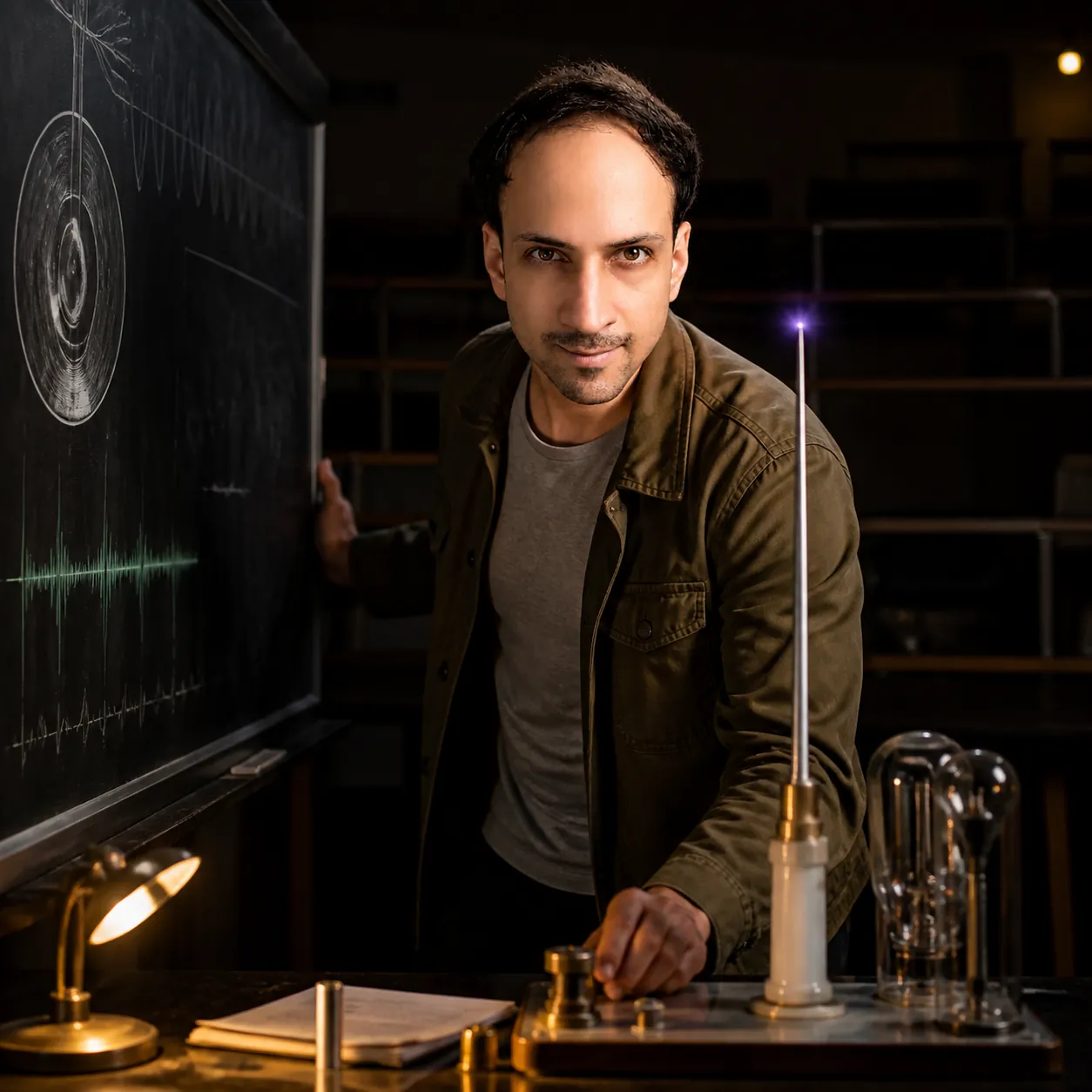
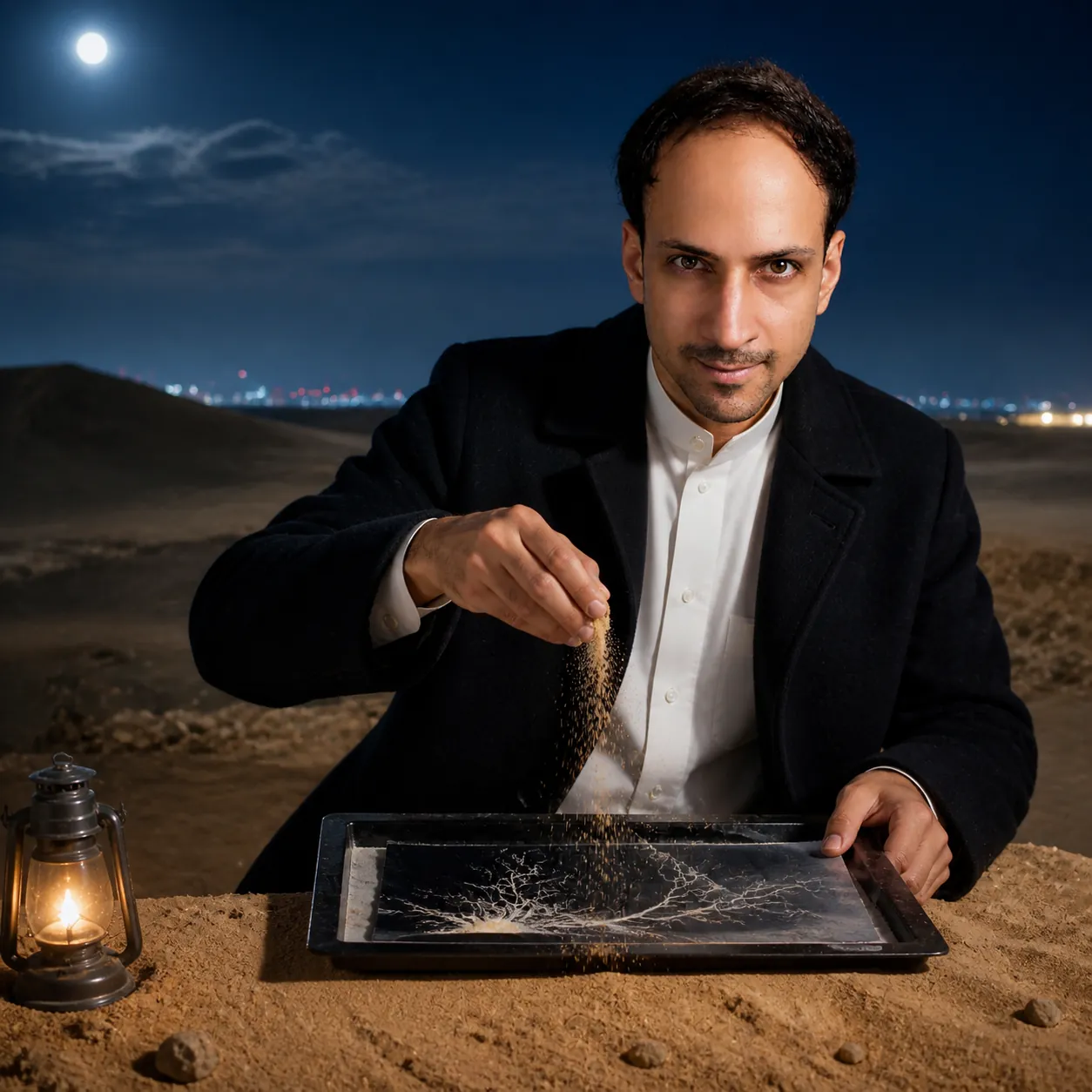
Quiet Kilovolts: Moonlit Sand Rise — AI Portrait Prompt
صورةAI Portraits

Turn your own photo into a low-light demonstration portrait in a moonlit sand rise at the desert's edge outside Riyadh. Keeps your face unchanged.

من نص البرومبت

Use the attached reference photo as the identity reference: keep the same face, skin tone, hair and features as the person in that photo, without beautifying, aging or altering them. Create a square 1:1 museum-catalog frame with a strong first read and a slower second read at exactly 2880x2880 pixels. Location: a moonlit sand rise at the desert's edge outside Riyadh. Show them in a dark wool overcoat over a plain white traditional Gulf outfit, sifting a palmful of cool sand back onto the rise. Make one rigorous physical condition the conceptual engine: a developed sheet-film photogram they lift from a blotter, blackened in feathery branches where a surface discharge exposed it directly turns activity far too fast to witness into a form calm enough to study. Explore whether danger observed lawfully becomes knowledge or remains a dare; direct expression and posture toward hushed reverence, never melodrama or ad-like confidence. Use an eye-level 85mm portrait view with honest perspective and one plane of disciplined focus. Make the composition keep their face half a stop dimmer than the demonstration. Render it as low-light demonstration realism combining true plasma color science, patient long-exposure discipline, tactile bench materiality, and dignified editorial portrait craft, using late blue window light mixed with one warm low-wattage source and a palette of midnight blue-black, brushed nickel, and one phosphor-green line. Photorealistic: this must read as a real photograph from a physical camera, never an illustration, painting, or 3D render. Resolve real surface detail: fine grit in the texture of concrete, efflorescence at damp edges, and hairline cracks that follow stress. Keep one identity-locked person, credible hands and fingers, natural fabric, and coherent scale, contact, reflections, shadows, airflow, deformation, and materials. Background people only when essential, always secondary and clearly different. Avoid Tesla-coil showmanship, storm lightning skies, arcs crawling on skin, glowing superhero eyes, and cyberpunk neon haze. No text, labels, logos, signatures, watermarks, random symbols, plastic skin, excessive bloom, or glossy AI finish.
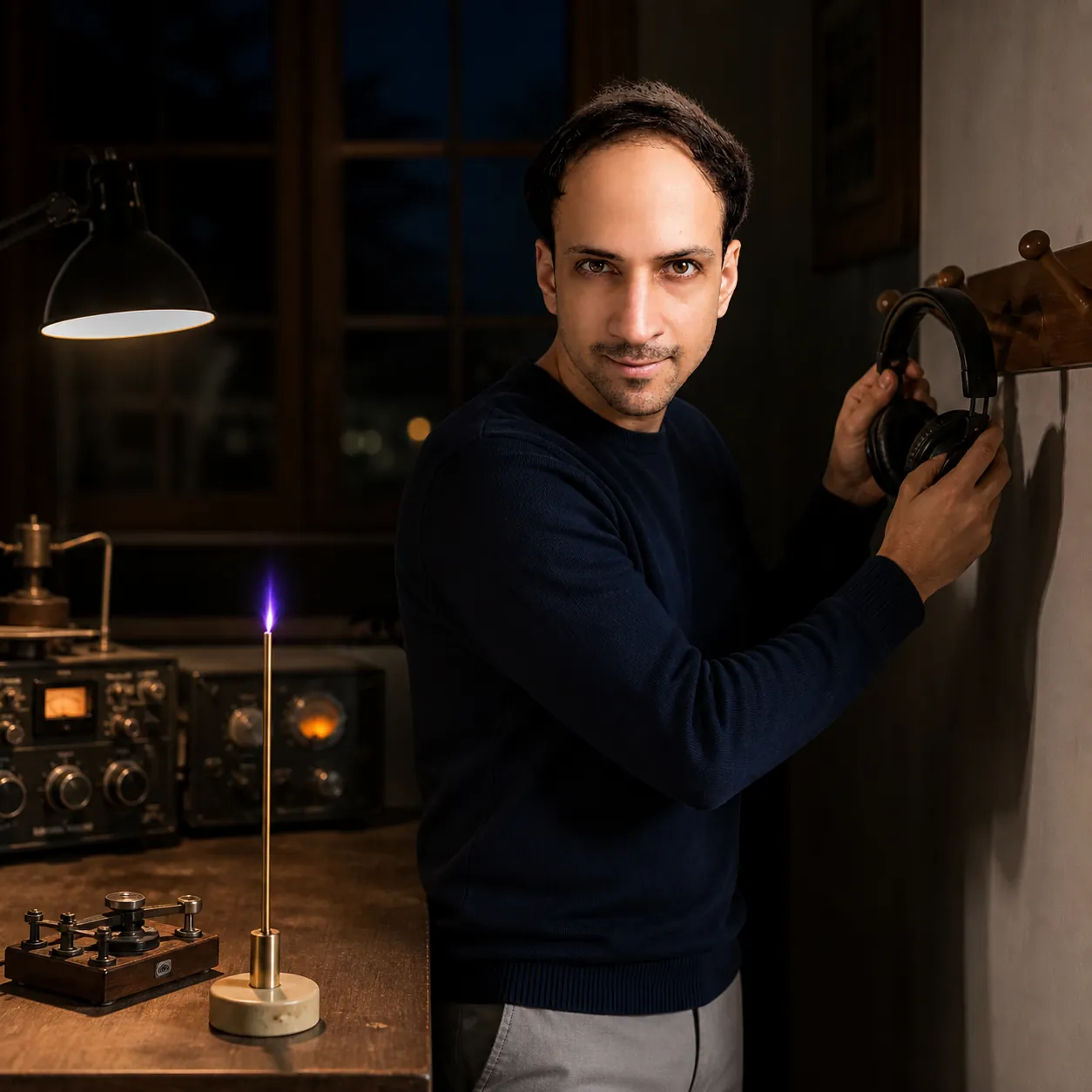
Written Once: Raked Lecture Hall — AI Portrait Prompt
صورةAI Portraits

Turn your own photo into a photorealistic portrait in a raked lecture hall in a Riyadh university at night. Keeps your face unchanged.

من نص البرومبت

Use the attached reference photo as the identity reference: keep the same face, skin tone, hair and features as the person in that photo, without beautifying, aging or altering them. Create a square 1:1 museum-catalog frame with a strong first read and a slower second read at exactly 2880x2880 pixels. Location: a raked lecture hall in a Riyadh university at night. Show them in an olive field jacket over a plain heather-grey tee, wheeling a rolling blackboard flush against the side wall. The impossible-looking event must obey this clear system: a polished brass needle on an insulated stand that wears a faint violet sheath of corona only at its sharpest point turns activity far too fast to witness into a form calm enough to study. Explore whether a record written by physics can count as a signature; direct expression and posture toward grounded awe, never melodrama or ad-like confidence. Use a 50mm view at bench height so apparatus and face carry equal optical weight. Make the composition hold the apparatus, their hands, and their gaze in one triangle. Render it as gallery-caliber physics portraiture merging real electrical signatures, charcoal-dark tonal control, precise glass-and-char material rendering, and steady observational calm, using near-darkness held back by one small tungsten lamp at the bench and a palette of midnight blue-black, brushed nickel, and one phosphor-green line. Photorealistic: this must read as a real photograph from a physical camera, never an illustration, painting, or 3D render. Resolve real surface detail: glass with real thickness at its edge, reflections that carry the room's actual colour, and dust visible only at grazing angles. Keep one identity-locked person, credible hands and fingers, natural fabric, and coherent scale, contact, reflections, shadows, airflow, deformation, and materials. Background people only when essential, always secondary and clearly different. Avoid Tesla-coil showmanship, storm lightning skies, arcs crawling on skin, glowing superhero eyes, and cyberpunk neon haze. No text, labels, logos, signatures, watermarks, random symbols, plastic skin, excessive bloom, or glossy AI finish.
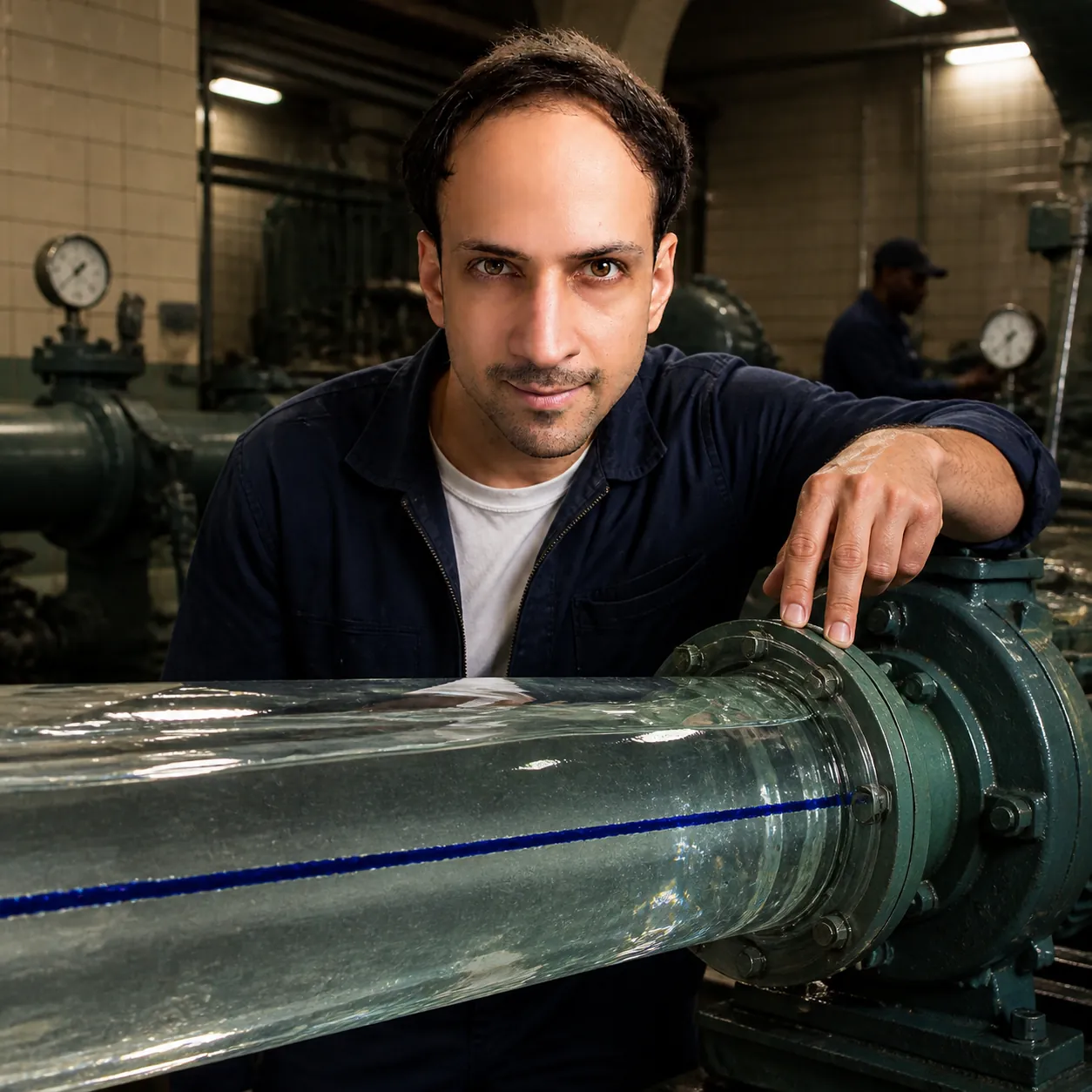
Written Once: Tidy Amateur-Radio Room — AI Portrait Prompt
صورةAI Portraits

Turn your own photo into a low-light demonstration portrait in a tidy amateur-radio room at night, panel lamps glowing faintly. Keeps your face unchanged.

من نص البرومبت

Use the attached reference photo as the identity reference: keep the same face, skin tone, hair and features as the person in that photo, without beautifying, aging or altering them. Create a square 1:1 museum-catalog frame with a strong first read and a slower second read at exactly 2880x2880 pixels. Location: a tidy amateur-radio room at night, panel lamps glowing faintly. Show them in a fine-gauge navy sweater and pressed pale-grey trousers, hanging a pair of headphones on a wooden peg. Use this advanced image-making device as the core logic: a polished brass needle on an insulated stand that wears a faint violet sheath of corona only at its sharpest point brings a feared force close enough to study without any bravado. Explore whether a record written by physics can count as a signature; direct expression and posture toward quiet conviction, never melodrama or ad-like confidence. Frame from a low three-quarter angle so the demonstration sits between the lens and their attention. Make the composition surround the lit evidence with generous, honest darkness. Render it as low-light demonstration realism combining true plasma color science, patient long-exposure discipline, tactile bench materiality, and dignified editorial portrait craft, using deep dusk ambience shaped by one hooded lamp aimed at the work and a palette of charred oak, pale ivory, and one ember-orange thread. Photorealistic: this must read as a real photograph from a physical camera, never an illustration, painting, or 3D render. Resolve real surface detail: thread ends and slight pilling on worn cloth, hairline chips at every hard corner, and stone that is porous rather than smooth. Keep one identity-locked person, credible hands and fingers, natural fabric, and coherent scale, contact, reflections, shadows, airflow, deformation, and materials. Background people only when essential, always secondary and clearly different. Avoid sci-fi energy balls, fractal screen-saver overlays, sparks showering from hands, wizard-lightning fingertips, and ultraviolet glow gimmicks. No text, labels, logos, signatures, watermarks, random symbols, plastic skin, excessive bloom, or glossy AI finish.
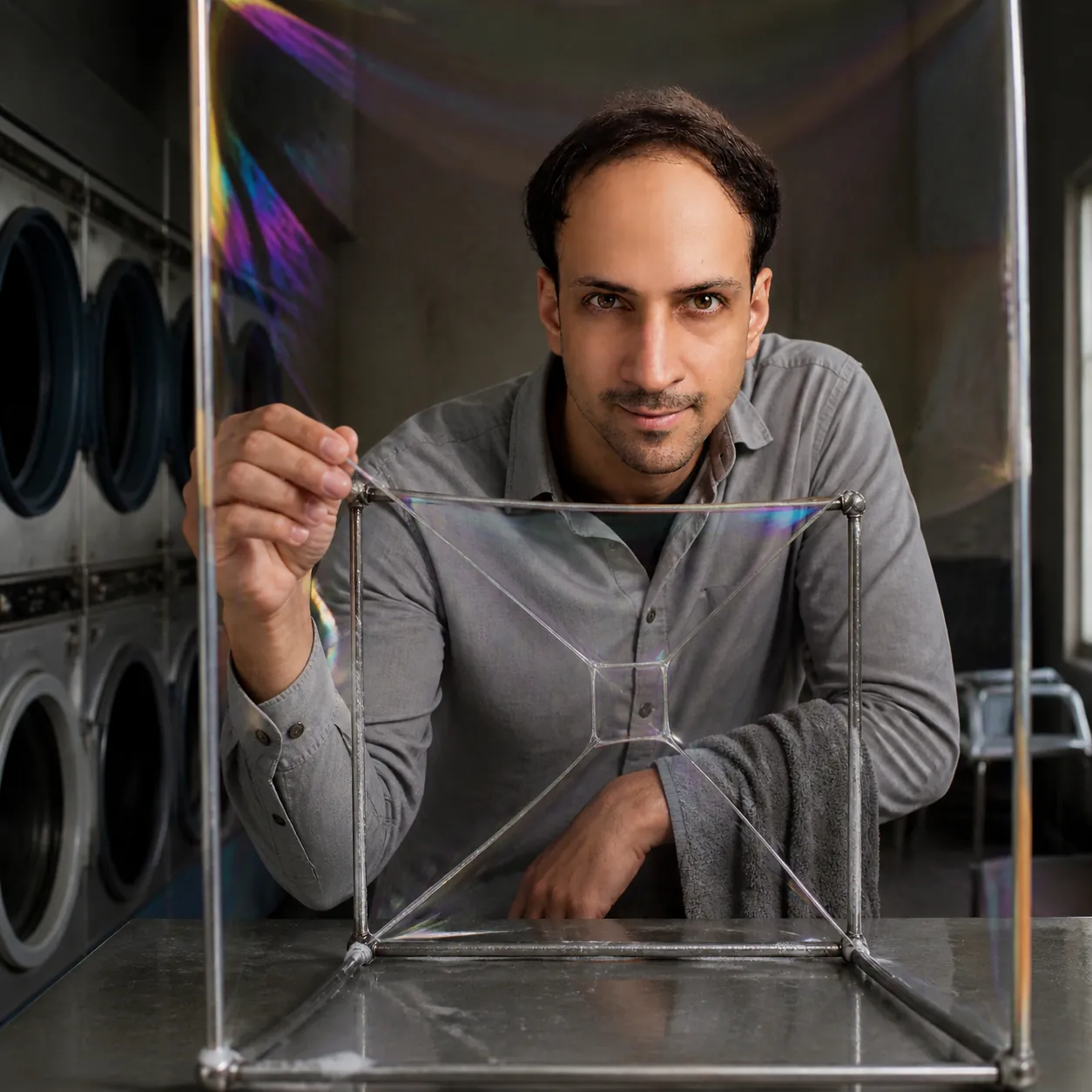
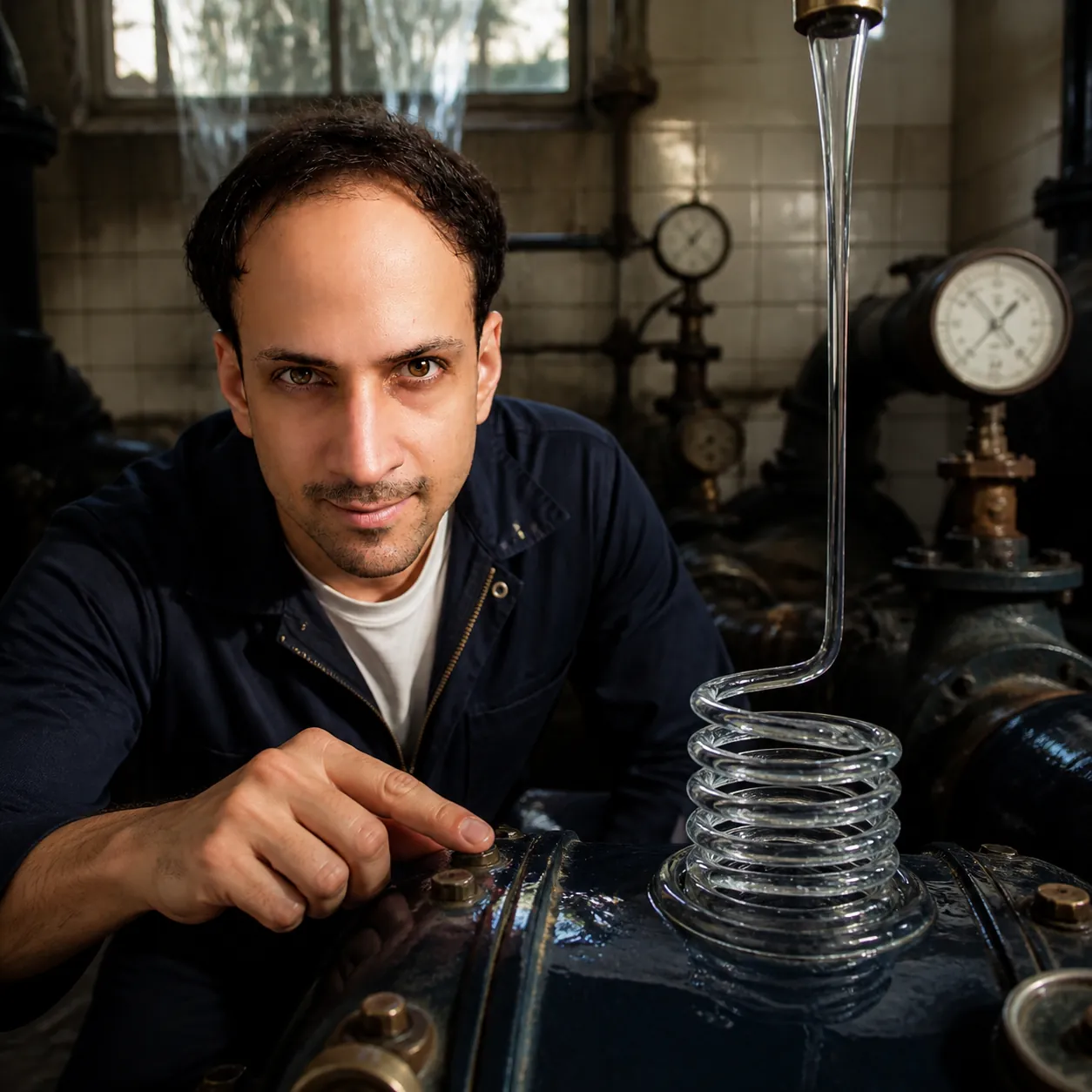
Unbroken Dye Thread in the Pump Room — AI Portrait Prompt
صورةAI Portraits

Turn your own photo into a museum-scale demonstration portrait in the tiled pump room beneath a public fountain, gauges faintly lit. Keeps your face unchanged.

من نص البرومبت

Use the attached reference photo as the identity reference: keep the same face, skin tone, hair and features as the person in that photo, without beautifying, aging or altering them. Create a square 1:1 museum-catalog frame with a strong first read and a slower second read at exactly 2880x2880 pixels. Location: the tiled pump room beneath a public fountain, gauges faintly lit. Show the subject in a navy coverall unzipped over a clean white undershirt, resting two fingers on a humming pump casing. Build the artwork around this material rule: a single thread of dye that holds one straight, unbroken line down the whole length of a clear water-filled pipe puts continuous motion through a form that never once looks hurried. Explore how a liquid chooses between order and chaos at one measurable threshold; direct expression and posture toward steady reverence, never melodrama or ad-like confidence. Frame along the water's surface at forearm height so the flow's edge and their gaze share one plane. Make the composition rhyme the water's curve with the line of their shoulders. Render it as museum-scale demonstration realism combining faithful portrait photography, glass-smooth water rendered without exaggeration, machined hydraulic hardware, and physically exact reflections, using even overhead lab light shaped by baffles into calm directional zones and a palette of bone white, clear-water celadon, and a line of indigo. Photorealistic: this must read as a real photograph from a physical camera, never an illustration, painting, or 3D render. Resolve real surface detail: dust settled where nobody wipes, fingerprint haze on glass, and edges rubbed pale by handling. Keep one identity-locked person, credible hands and fingers, natural fabric, and coherent scale, contact, reflections, shadows, airflow, deformation, and materials. Background people only when essential, always secondary and clearly different. Avoid stock waterfall mist, whirlpool vortices, ripple-covered surfaces, levitating water spheres, and dramatic slow-motion splash photography. No text, labels, logos, signatures, watermarks, random symbols, plastic skin, excessive bloom, or glossy AI finish.
Chosen Economy: Small Neighborhood Laundromat — AI Portrait Prompt
صورةAI Portraits

Turn your own photo into a portrait in a small neighborhood laundromat after closing, machines standing open. Keeps your face unchanged.

من نص البرومبت

Use the attached reference photo as the identity reference: keep the same face, skin tone, hair and features as the person in that photo, without beautifying, aging or altering them. Create a square 1:1 museum-catalog frame with a strong first read and a slower second read at exactly 2880x2880 pixels. Location: a small neighborhood laundromat after closing, machines standing open. Show them in a soft grey overshirt with both cuffs buttoned at the wrist, draping a damp towel over one forearm. The impossible-looking event must obey this clear system: a family of films inside a cubic wire frame that meets in a small, perfectly suspended central square face keeps its composure while thinning lawfully toward a collapse it cannot refuse. Explore whether a proof becomes less true for lasting only a few minutes; direct expression and posture toward tender vigilance, never melodrama or ad-like confidence. Frame them partly through a soap membrane so the view and its faint colored reflection share one plane. Make the composition leave generous still air above the thinnest part of the surface. Render it as gallery-hall demonstration realism uniting true thin-film optics, believable soap chemistry, patient portrait photography, and quiet contemporary exhibit design, using low side daylight kept off the background so the colors read true and a palette of pale limestone, dim pewter, and a single violet gleam. Photorealistic: this must read as a real photograph from a physical camera, never an illustration, painting, or 3D render. Resolve real surface detail: condensation beading at true size, liquid meniscus curving against glass, and wet surfaces darker than dry ones. Keep one identity-locked person, credible hands and fingers, natural fabric, and coherent scale, contact, reflections, shadows, airflow, deformation, and materials. Background people only when essential, always secondary and clearly different. Avoid psychedelic color grading, floating foam confetti, glassy chrome bubbles, dish-soap advertising gloss, and impossible unbroken membranes. No text, labels, logos, signatures, watermarks, random symbols, plastic skin, excessive bloom, or glossy AI finish.
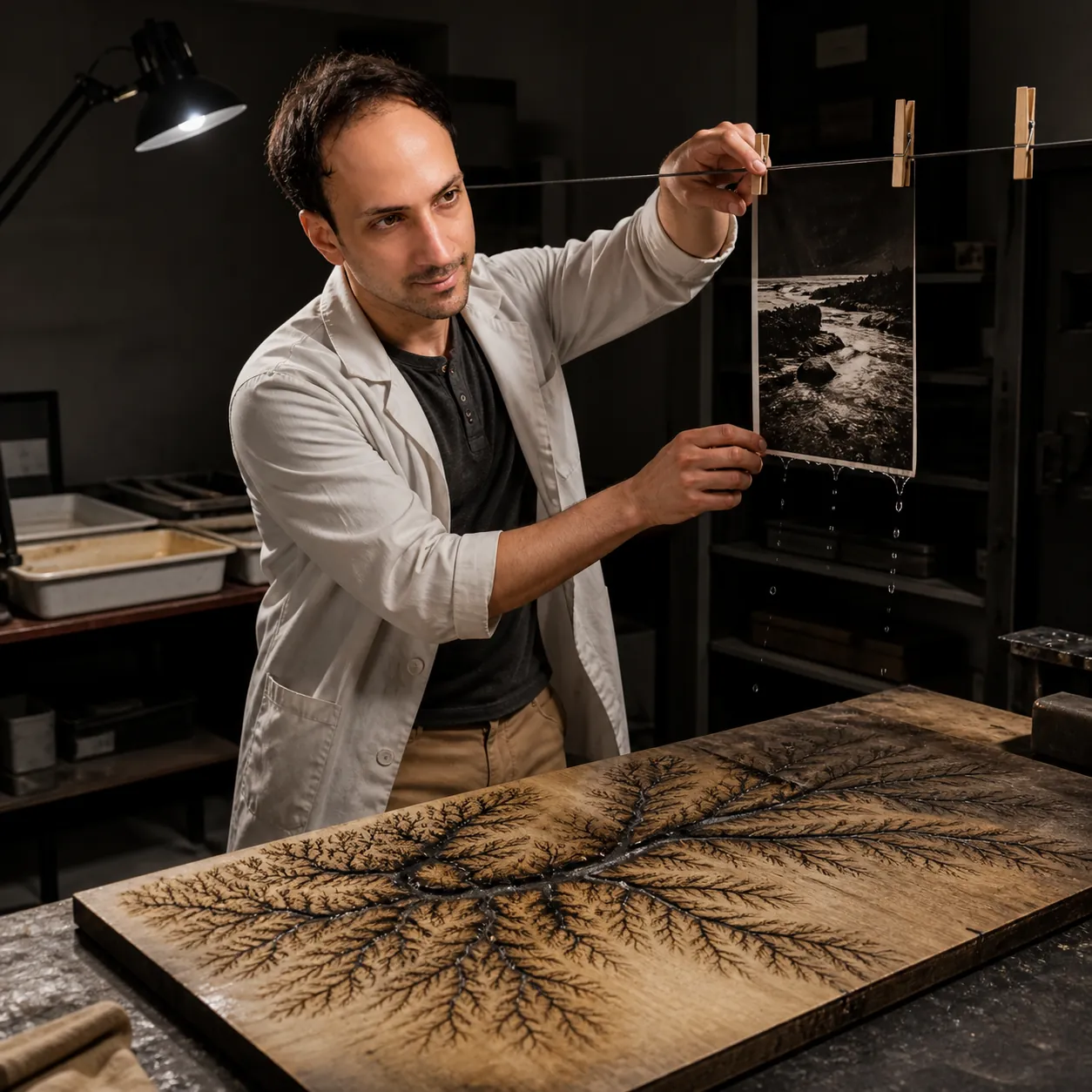
The Fast Hand: Photographic Darkroom — AI Portrait Prompt
صورةAI Portraits

Turn your own photo into a photorealistic portrait in a photographic darkroom, safelight off and one work lamp on. Keeps your face unchanged.

من نص البرومبت

Use the attached reference photo as the identity reference: keep the same face, skin tone, hair and features as the person in that photo, without beautifying, aging or altering them. Create a square 1:1 museum-catalog frame with a strong first read and a slower second read at exactly 2880x2880 pixels. Location: a photographic darkroom, safelight off and one work lamp on. Show them in a lab coat left open over a slate henley and chinos, pegging a dripping print to a taut line. Build the artwork around this material rule: a prepared oak panel, powered down and cool, carrying a river-delta of charred branches a guided discharge etched days before turns activity far too fast to witness into a form calm enough to study. Explore what electricity's handwriting reveals that no diagram of it ever could; direct expression and posture toward reverent precision, never melodrama or ad-like confidence. Use a restrained 35mm environmental view with the subject anchored off-center and hands never distorted. Make the composition keep their face half a stop dimmer than the demonstration. Render it as gallery-caliber physics portraiture merging real electrical signatures, charcoal-dark tonal control, precise glass-and-char material rendering, and steady observational calm, using a single backlight through frosted glass, edges kept in soft shadow and a palette of deep charcoal, gunmetal grey, and one violet whisper. Photorealistic: this must read as a real photograph from a physical camera, never an illustration, painting, or 3D render. Resolve real surface detail: label-free packaging showing carton fibre, cardboard bruised at the corners, and tape lifting slightly at one end. Keep one identity-locked person, credible hands and fingers, natural fabric, and coherent scale, contact, reflections, shadows, airflow, deformation, and materials. Background people only when essential, always secondary and clearly different. Avoid Tesla-coil showmanship, storm lightning skies, arcs crawling on skin, glowing superhero eyes, and cyberpunk neon haze. No text, labels, logos, signatures, watermarks, random symbols, plastic skin, excessive bloom, or glossy AI finish.
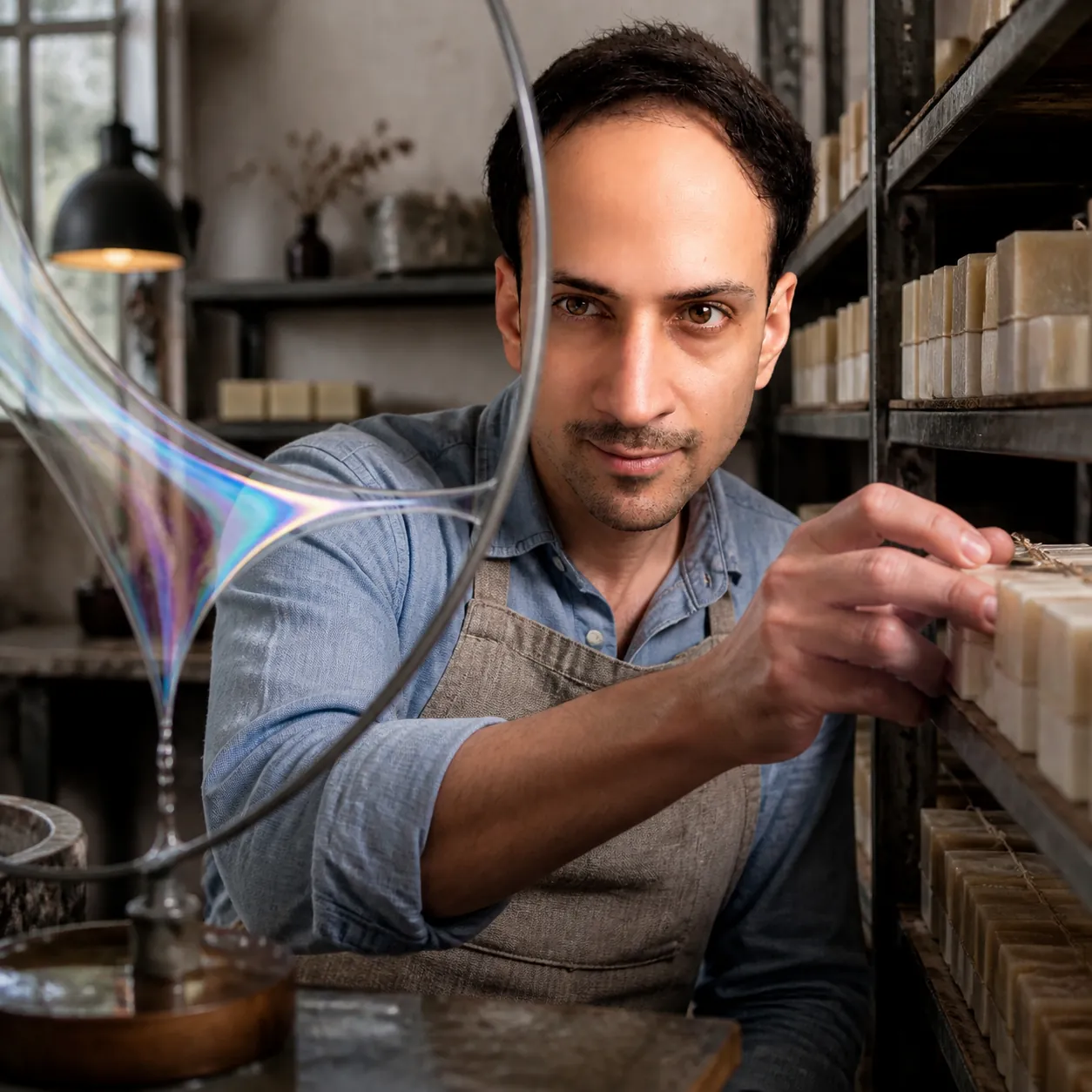
Lawful Color: Small Soap-Maker's Atelier — AI Portrait Prompt
صورةAI Portraits

Turn your own photo into a large-format wet-lab portrait in a small soap-maker's atelier with curing bars racked in rows. Keeps your face unchanged.

من نص البرومبت

Use the attached reference photo as the identity reference: keep the same face, skin tone, hair and features as the person in that photo, without beautifying, aging or altering them. Create a square 1:1 museum-catalog frame with a strong first read and a slower second read at exactly 2880x2880 pixels. Location: a small soap-maker's atelier with curing bars racked in rows. Show them in a natural linen apron over a washed-out chambray shirt, nudging wrapped bars flush along a shelf edge. Use this advanced image-making device as the core logic: a patch of common black film at a soap wall's top edge that has thinned until it reflects almost no light catches mathematics choosing the least surface right in front of them. Explore how a liquid film outruns calculation while obeying it perfectly; direct expression and posture toward measured delight, never melodrama or ad-like confidence. Use a 105mm near-macro portrait blend, one iridescent border sharp near the lens and their attentive face readable beyond. Make the composition keep one dark, quiet ground behind every iridescent passage. Render it as large-format wet-lab photography built from working soap-film apparatus, accurate reflection physics, restrained studio styling, and calm observational distance, using cool morning ambience with one warm lamp held well away from the membrane and a palette of pale limestone, dim pewter, and a single violet gleam. Photorealistic: this must read as a real photograph from a physical camera, never an illustration, painting, or 3D render. Resolve real surface detail: visible weave in cloth, fine scratches on metal, and the faint unevenness of painted walls. Keep one identity-locked person, credible hands and fingers, natural fabric, and coherent scale, contact, reflections, shadows, airflow, deformation, and materials. Background people only when essential, always secondary and clearly different. Avoid party-bubble clusters, rainbow oil-slick swirls, CGI-perfect spheres, sparkle overlays, and any child-with-wand whimsy. No text, labels, logos, signatures, watermarks, random symbols, plastic skin, excessive bloom, or glossy AI finish.
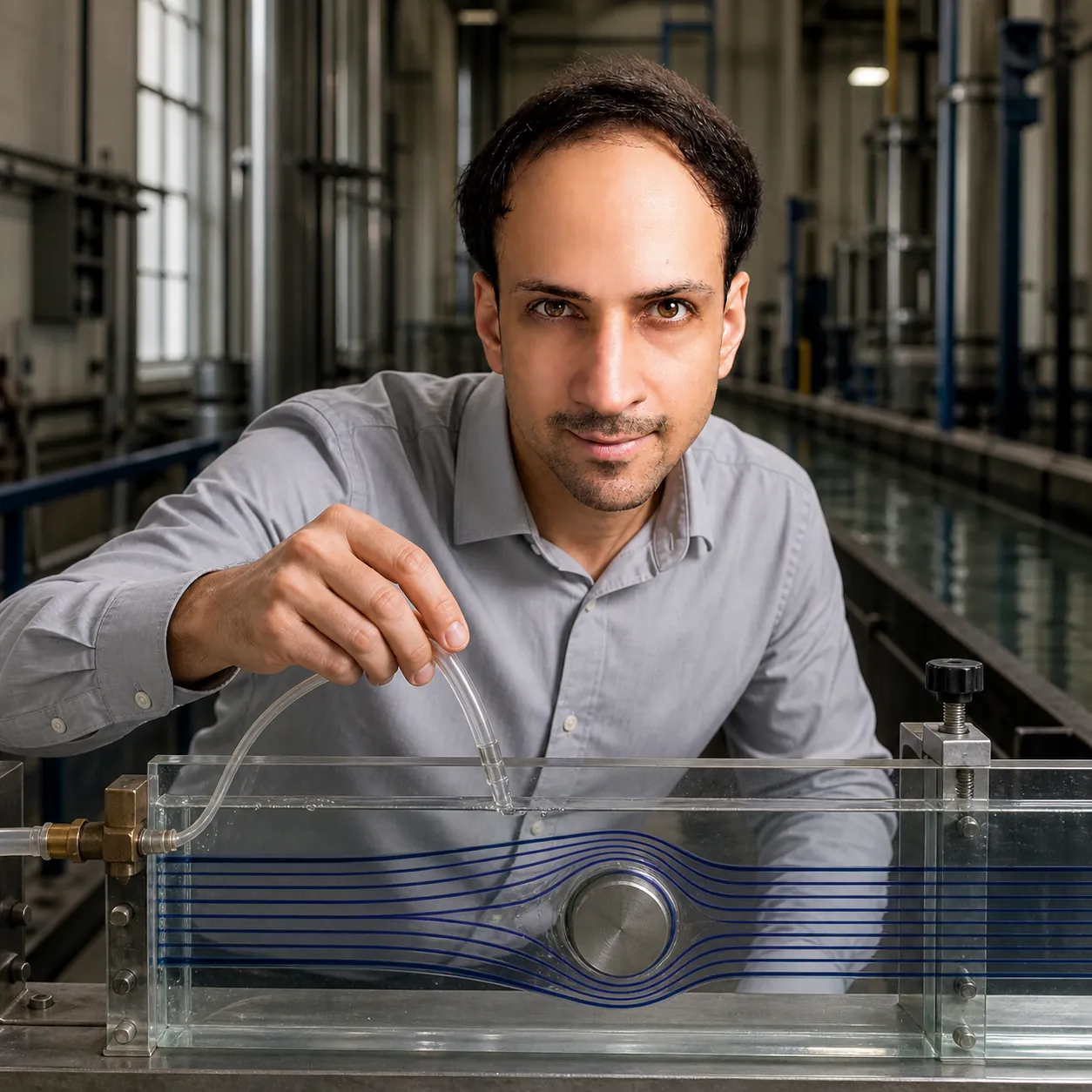
Dye Lines Parting Around a Disc — AI Portrait Prompt
صورةAI Portraits

Turn your own photo into a portrait in a university hydraulics hall of tall standpipes and long still channels. Keeps your face unchanged.

من نص البرومبت

Use the attached reference photo as the identity reference: keep the same face, skin tone, hair and features as the person in that photo, without beautifying, aging or altering them. Create a square 1:1 museum-catalog frame with a strong first read and a slower second read at exactly 2880x2880 pixels. Location: a university hydraulics hall of tall standpipes and long still channels. Show the subject in a pressed pale-grey shirt with sleeves buttoned at the wrist, bleeding one air bubble from a clear manifold line. Make one rigorous physical condition the conceptual engine: a fan of parallel dye lines between two close glass plates that parts around a steel disc and closes seamlessly behind it gives a normally chaotic process one legible, patient, watchable form. Explore why the eye trusts glass more readily than it trusts obedient water; direct expression and posture toward level wonder, never melodrama or ad-like confidence. Use an eye-level 60mm medium-format viewpoint with honest perspective and gently limited depth of field. Make the composition rhyme the water's curve with the line of their shoulders. Render it as museum-scale demonstration realism combining faithful portrait photography, glass-smooth water rendered without exaggeration, machined hydraulic hardware, and physically exact reflections, using even overhead lab light shaped by baffles into calm directional zones and a palette of bone white, clear-water celadon, and a line of indigo. Photorealistic: this must read as a real photograph from a physical camera, never an illustration, painting, or 3D render. Resolve real surface detail: fine grit in the texture of concrete, efflorescence at damp edges, and hairline cracks that follow stress. Keep one identity-locked person, credible hands and fingers, natural fabric, and coherent scale, contact, reflections, shadows, airflow, deformation, and materials. Background people only when essential, always secondary and clearly different. Avoid splash crowns, suspended droplet sprays, chrome CGI liquid, neon glowing water, and fantasy water-bending gestures. No text, labels, logos, signatures, watermarks, random symbols, plastic skin, excessive bloom, or glossy AI finish.
Unbroken Stream: Tiled Pump Room — AI Portrait Prompt
صورةAI Portraits

Turn your own photo into a portrait in the tiled pump room beneath a public fountain, gauges faintly lit. Keeps your face unchanged.

من نص البرومبت

Use the attached reference photo as the identity reference: keep the same face, skin tone, hair and features as the person in that photo, without beautifying, aging or altering them. Create a square 1:1 museum-catalog frame with a strong first read and a slower second read at exactly 2880x2880 pixels. Location: the tiled pump room beneath a public fountain, gauges faintly lit. Show the subject in a navy coverall unzipped over a clean white undershirt, resting two fingers on a humming pump casing. The impossible-looking event must obey this clear system: a thin stream of clear glycerin that lays itself down in an even, patient coil like rope fed from above gives a normally chaotic process one legible, patient, watchable form. Explore how transparency turns a demonstration into something close to a quiet confession; direct expression and posture toward absorbed respect, never melodrama or ad-like confidence. Use a 90mm close-portrait hybrid: one smooth stream sharp near the lens and their face readable beyond it. Make the composition keep the flow's stillest passage sharpest and the room soft. Render it as high-concept flow portraiture staged with real laminar apparatus, calibrated documentary lighting, optically true refraction, and quietly intelligent restraint, using clean skylight softly refracted through moving water onto pale stone and a palette of dark basalt, damp concrete, and one seam of copper. Photorealistic: this must read as a real photograph from a physical camera, never an illustration, painting, or 3D render. Resolve real surface detail: brass darkened in the recesses and bright where thumbs land, and lacquer crazed rather than perfect. Keep one identity-locked person, credible hands and fingers, natural fabric, and coherent scale, contact, reflections, shadows, airflow, deformation, and materials. Background people only when essential, always secondary and clearly different. Avoid splash crowns, suspended droplet sprays, chrome CGI liquid, neon glowing water, and fantasy water-bending gestures. No text, labels, logos, signatures, watermarks, random symbols, plastic skin, excessive bloom, or glossy AI finish.
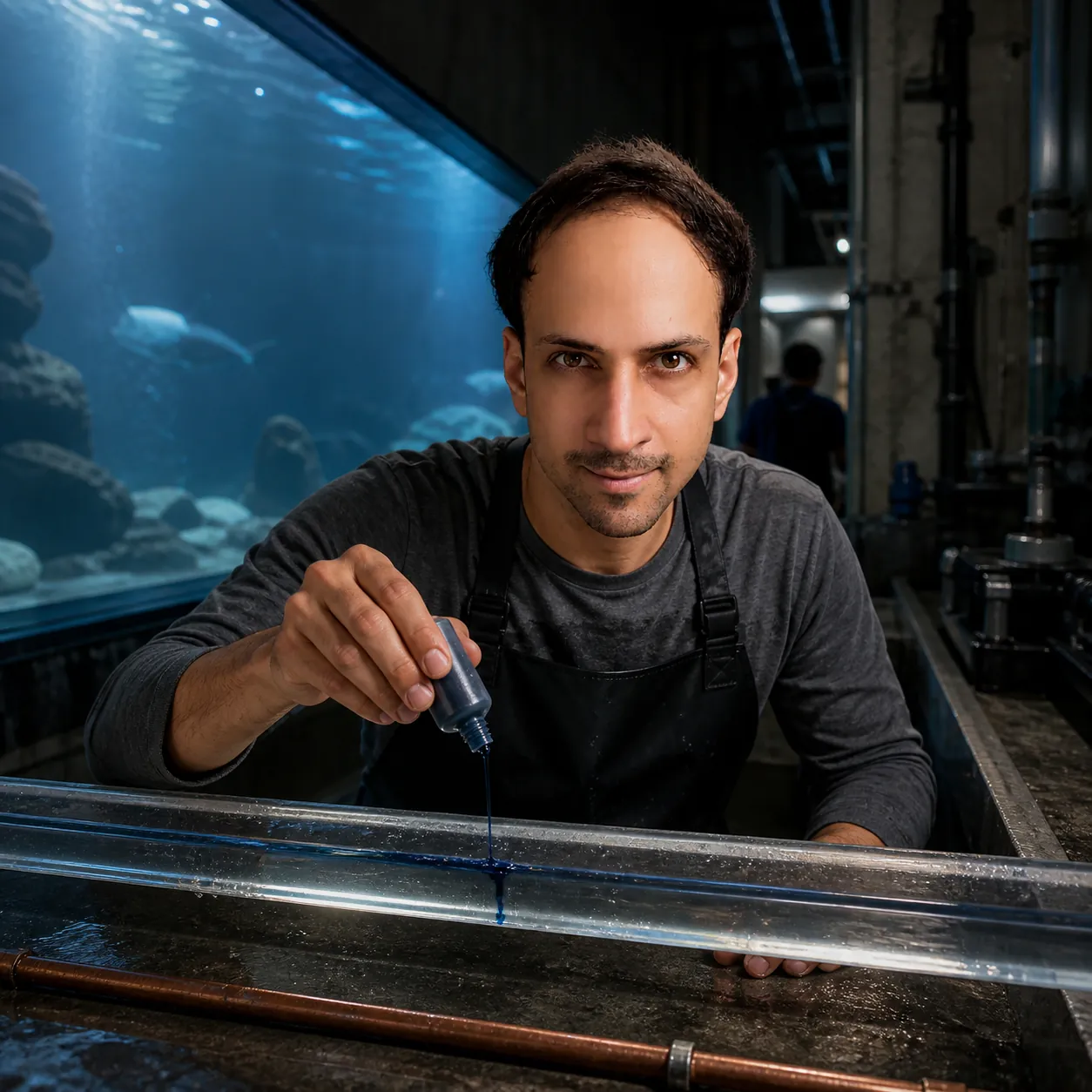
Straight Dye Line Behind the Aquarium — AI Portrait Prompt
صورةAI Portraits

Turn your own photo into a portrait in a service gallery behind an aquarium's tall acrylic viewing wall. Keeps your face unchanged.

من نص البرومبت

Use the attached reference photo as the identity reference: keep the same face, skin tone, hair and features as the person in that photo, without beautifying, aging or altering them. Create a square 1:1 museum-catalog frame with a strong first read and a slower second read at exactly 2880x2880 pixels. Location: a service gallery behind an aquarium's tall acrylic viewing wall. Show the subject in a dark rubberized apron over a heather-grey long-sleeve tee, steadying a small dye bottle above a filling trough. Make one rigorous physical condition the conceptual engine: a single thread of dye that holds one straight, unbroken line down the whole length of a clear water-filled pipe gives a normally chaotic process one legible, patient, watchable form. Explore how a liquid chooses between order and chaos at one measurable threshold; direct expression and posture toward absorbed respect, never melodrama or ad-like confidence. Use an eye-level 60mm medium-format viewpoint with honest perspective and gently limited depth of field. Make the composition let one unbroken waterline run the frame's full width. Render it as large-format hydro-engineering portraiture built from real channel flows, precise wet-metal detailing, truthful surface optics, and patient documentary framing, using early blue ambient light with one narrow beam threading the water and a palette of dark basalt, damp concrete, and one seam of copper. Photorealistic: this must read as a real photograph from a physical camera, never an illustration, painting, or 3D render. Resolve real surface detail: fine lint on dark fabric, water spotting on steel, and the soft rounding of edges that have been used for years. Keep one identity-locked person, credible hands and fingers, natural fabric, and coherent scale, contact, reflections, shadows, airflow, deformation, and materials. Background people only when essential, always secondary and clearly different. Avoid splash crowns, suspended droplet sprays, chrome CGI liquid, neon glowing water, and fantasy water-bending gestures. No text, labels, logos, signatures, watermarks, random symbols, plastic skin, excessive bloom, or glossy AI finish.
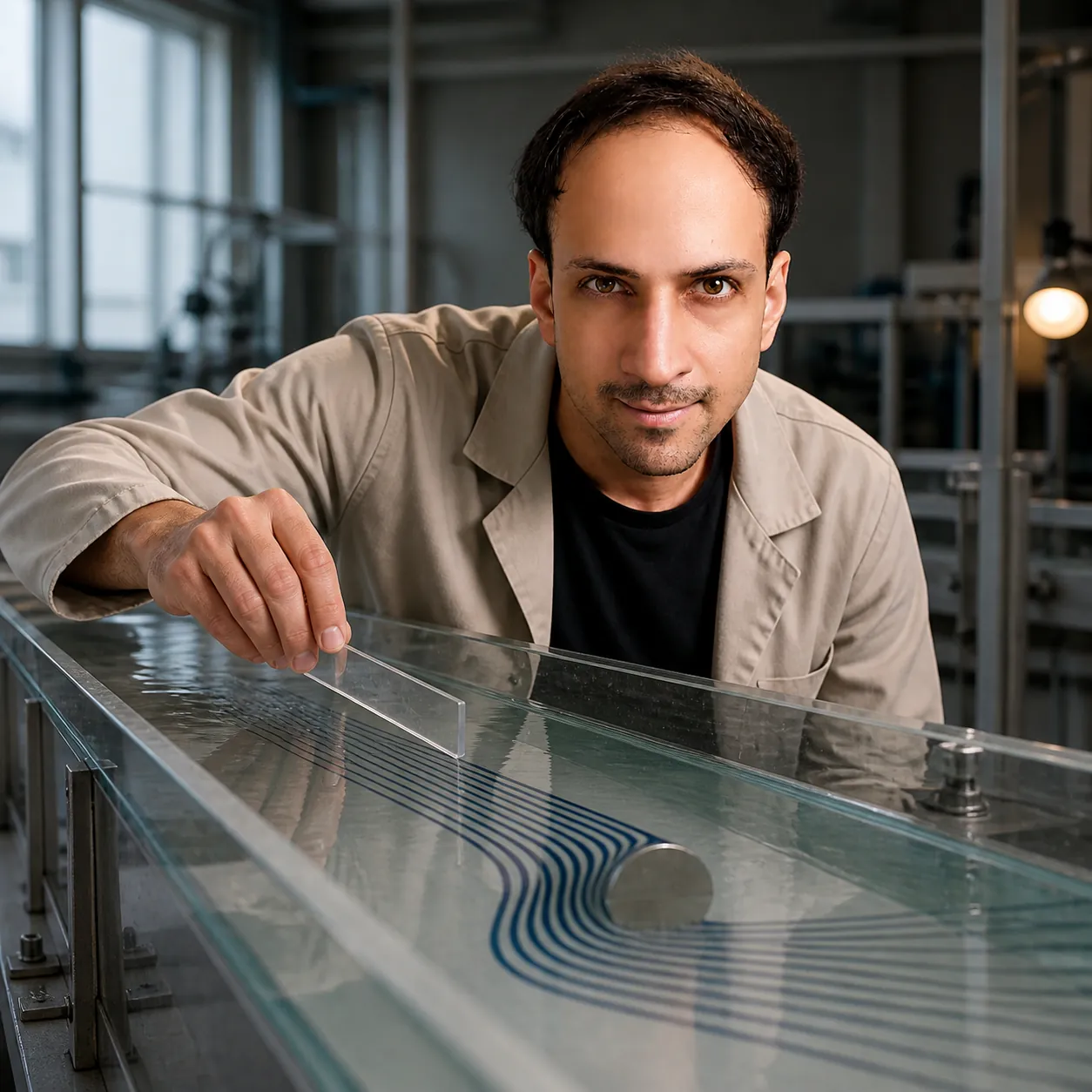
Parted Dye Lines in the Flume Lab — AI Portrait Prompt
صورةAI Portraits

Turn your own photo into a portrait in a fluid-dynamics teaching lab built around one long clear flume. Keeps your face unchanged.

من نص البرومبت

Use the attached reference photo as the identity reference: keep the same face, skin tone, hair and features as the person in that photo, without beautifying, aging or altering them. Create a square 1:1 museum-catalog frame with a strong first read and a slower second read at exactly 2880x2880 pixels. Location: a fluid-dynamics teaching lab built around one long clear flume. Show the subject in a putty-colored lab coat open over a plain black tee, skimming the flume's surface with a clear acrylic straightedge. Build the artwork around this material rule: a fan of parallel dye lines between two close glass plates that parts around a steel disc and closes seamlessly behind it puts continuous motion through a form that never once looks hurried. Explore why the eye trusts glass more readily than it trusts obedient water; direct expression and posture toward gentle vigilance, never melodrama or ad-like confidence. Frame along the water's surface at forearm height so the flow's edge and their gaze share one plane. Make the composition give the dye's edge more acuity than any highlight. Render it as large-format hydro-engineering portraiture built from real channel flows, precise wet-metal detailing, truthful surface optics, and patient documentary framing, using cool diffuse daylight with a single warm practical reflected in wet metal and a palette of brushed steel, water grey, and one amber gleam. Photorealistic: this must read as a real photograph from a physical camera, never an illustration, painting, or 3D render. Resolve real surface detail: cotton that hangs by its own weight, seams that pucker very slightly, and collars softened by washing. Keep one identity-locked person, credible hands and fingers, natural fabric, and coherent scale, contact, reflections, shadows, airflow, deformation, and materials. Background people only when essential, always secondary and clearly different. Avoid stock waterfall mist, whirlpool vortices, ripple-covered surfaces, levitating water spheres, and dramatic slow-motion splash photography. No text, labels, logos, signatures, watermarks, random symbols, plastic skin, excessive bloom, or glossy AI finish.
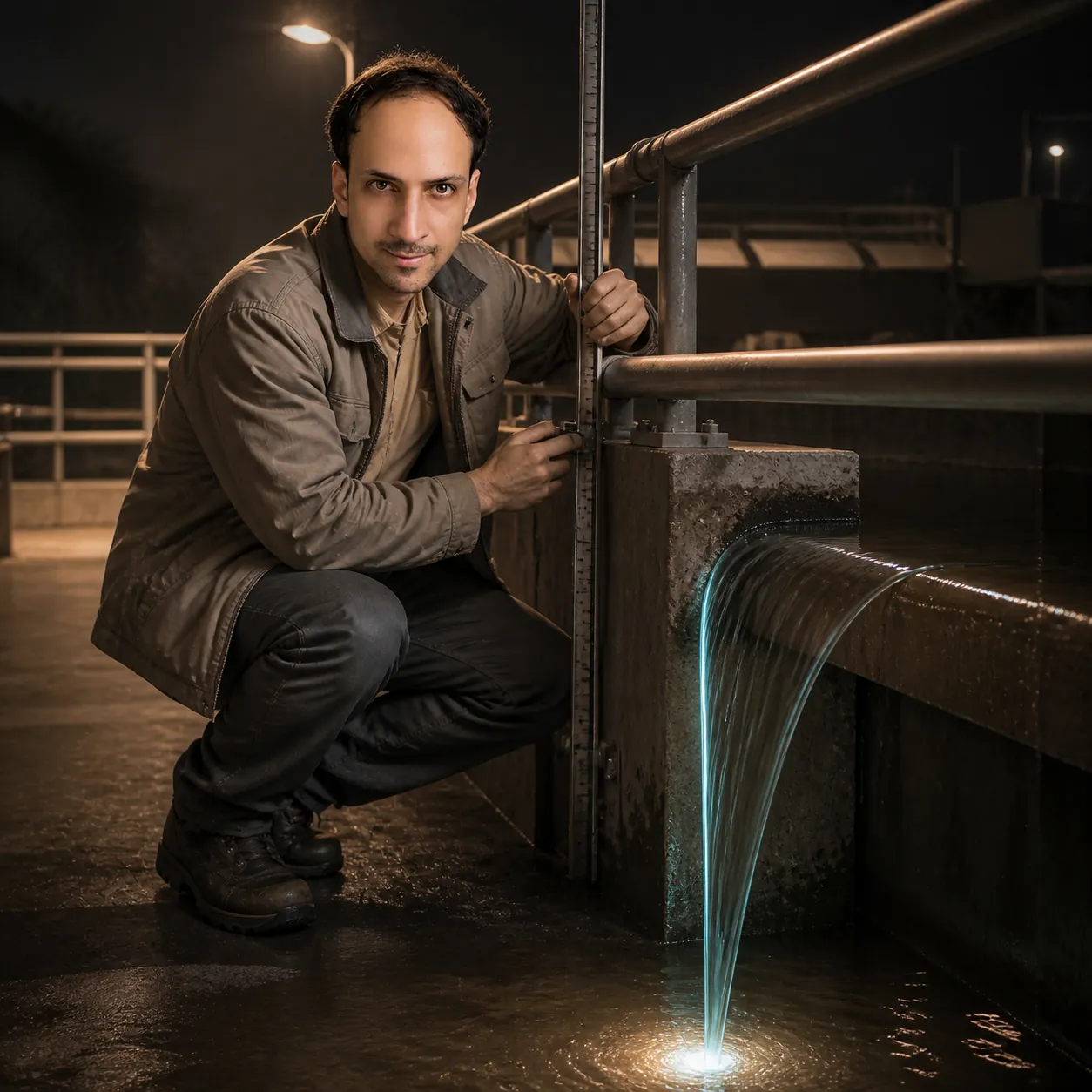
Glowing Stream at Wadi Hanifah — AI Portrait Prompt
صورةAI Portraits

Turn your own photo into a museum-scale demonstration portrait in a maintenance walkway beside a low Wadi Hanifah check weir. Keeps your face unchanged.

من نص البرومبت

Use the attached reference photo as the identity reference: keep the same face, skin tone, hair and features as the person in that photo, without beautifying, aging or altering them. Create a square 1:1 museum-catalog frame with a strong first read and a slower second read at exactly 2880x2880 pixels. Location: a maintenance walkway beside a low Wadi Hanifah check weir. Show the subject in a sand-grey field jacket over a tan shirt and dark workwear trousers, hooking a measuring staff onto the parapet rail. The impossible-looking event must obey this clear system: a smooth descending stream that traps lamplight inside itself by total internal reflection and glows only where it finally lands puts continuous motion through a form that never once looks hurried. Explore what stillness means when real mass is passing through it every second; direct expression and posture toward unhurried attention, never melodrama or ad-like confidence. Use a 90mm close-portrait hybrid: one smooth stream sharp near the lens and their face readable beyond it. Make the composition give the dye's edge more acuity than any highlight. Render it as museum-scale demonstration realism combining faithful portrait photography, glass-smooth water rendered without exaggeration, machined hydraulic hardware, and physically exact reflections, using one low raking beam that turns every smooth surface into readable contour and a palette of soft pewter, unglazed clay, and a cold aqua accent. Photorealistic: this must read as a real photograph from a physical camera, never an illustration, painting, or 3D render. Resolve real surface detail: condensation beading at true size, liquid meniscus curving against glass, and wet surfaces darker than dry ones. Keep one identity-locked person, credible hands and fingers, natural fabric, and coherent scale, contact, reflections, shadows, airflow, deformation, and materials. Background people only when essential, always secondary and clearly different. Avoid stock waterfall mist, whirlpool vortices, ripple-covered surfaces, levitating water spheres, and dramatic slow-motion splash photography. No text, labels, logos, signatures, watermarks, random symbols, plastic skin, excessive bloom, or glossy AI finish.
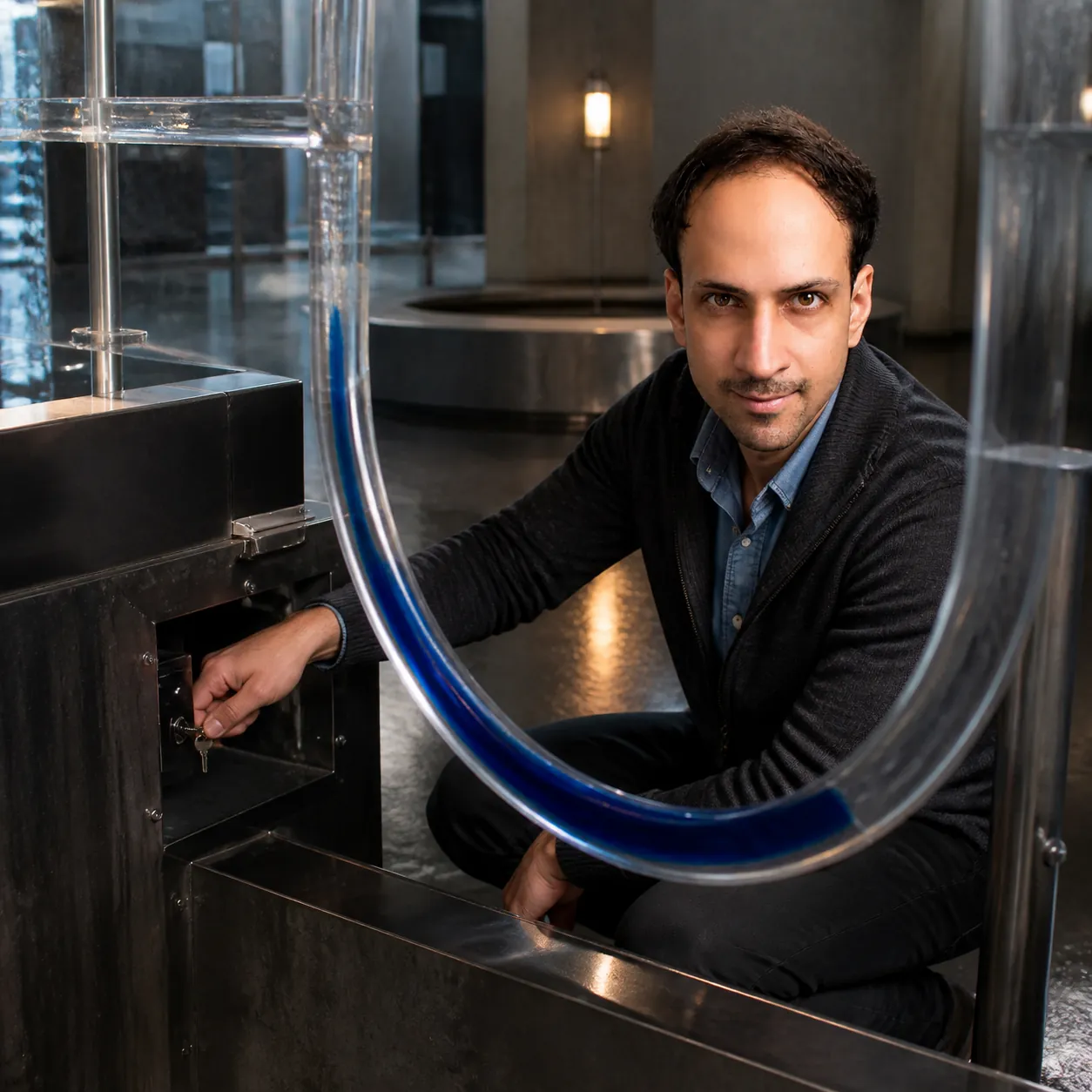
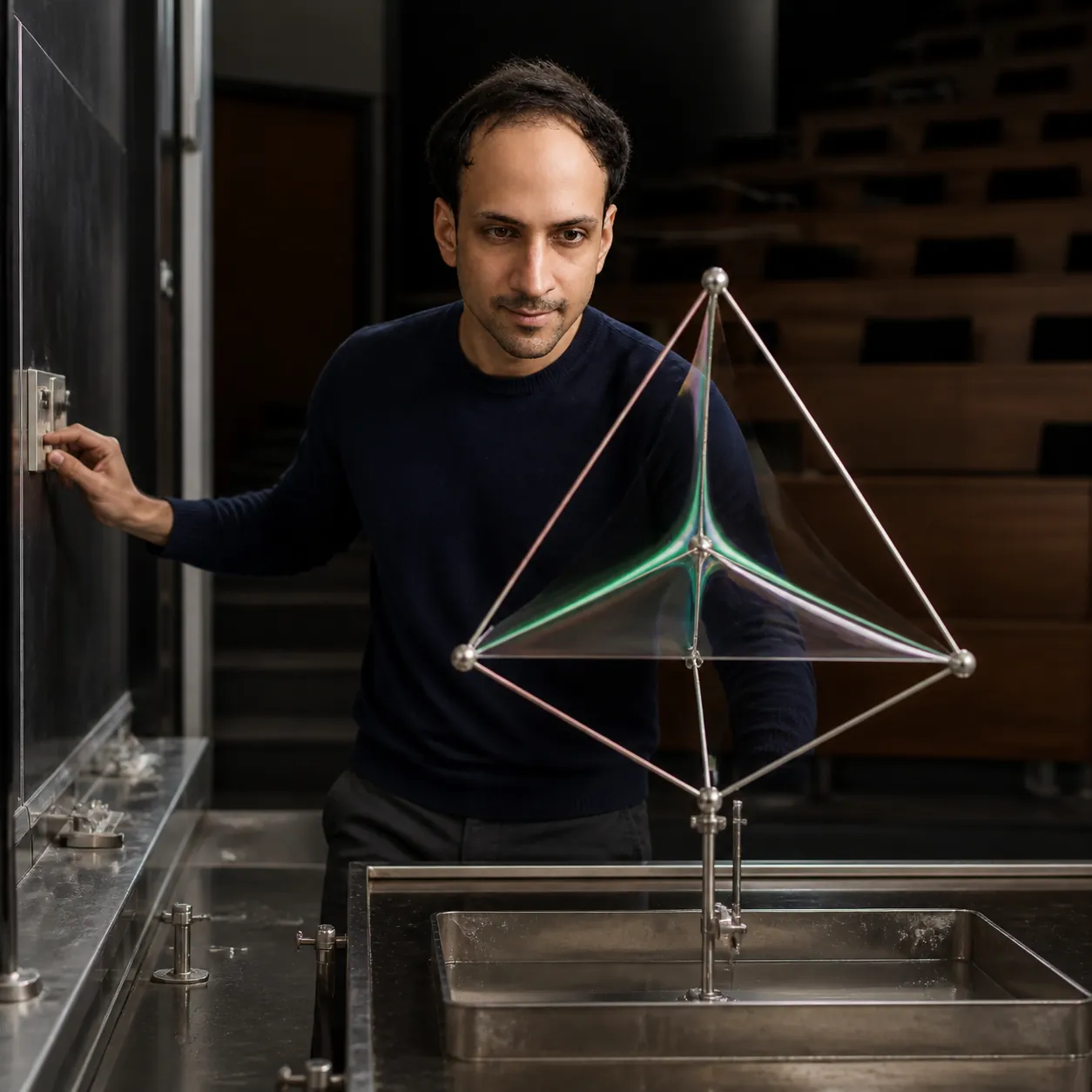
Membrane Logic: Steep Empty Lecture Theatre — AI Portrait Prompt
صورةAI Portraits

Turn your own photo into a large-format wet-lab portrait in a steep empty lecture theatre with its long demonstration bench. Keeps your face unchanged.

من نص البرومبت

Use the attached reference photo as the identity reference: keep the same face, skin tone, hair and features as the person in that photo, without beautifying, aging or altering them. Create a square 1:1 museum-catalog frame with a strong first read and a slower second read at exactly 2880x2880 pixels. Location: a steep empty lecture theatre with its long demonstration bench. Show them in a midnight-blue crew-neck sweater over pressed charcoal trousers, dimming the house lights from a wall panel. Make one rigorous physical condition the conceptual engine: a set of six films in a tetrahedral wire frame whose liquid seams meet at one perfect central point catches mathematics choosing the least surface right in front of them. Explore where the boundary ends and the surface's own decision begins; direct expression and posture toward composed marvel, never melodrama or ad-like confidence. Use an eye-level 80mm medium-format viewpoint with gentle depth of field and no forced drama. Make the composition give the film's colored bands more resolution than their clothing. Render it as large-format wet-lab photography built from working soap-film apparatus, accurate reflection physics, restrained studio styling, and calm observational distance, using quiet overhead bounce shaped so skin stays honest and reflections stay legible and a palette of deep charcoal, unpolished tin, and one green interference stripe. Photorealistic: this must read as a real photograph from a physical camera, never an illustration, painting, or 3D render. Resolve real surface detail: fine lint on dark fabric, water spotting on steel, and the soft rounding of edges that have been used for years. Keep one identity-locked person, credible hands and fingers, natural fabric, and coherent scale, contact, reflections, shadows, airflow, deformation, and materials. Background people only when essential, always secondary and clearly different. Avoid party-bubble clusters, rainbow oil-slick swirls, CGI-perfect spheres, sparkle overlays, and any child-with-wand whimsy. No text, labels, logos, signatures, watermarks, random symbols, plastic skin, excessive bloom, or glossy AI finish.
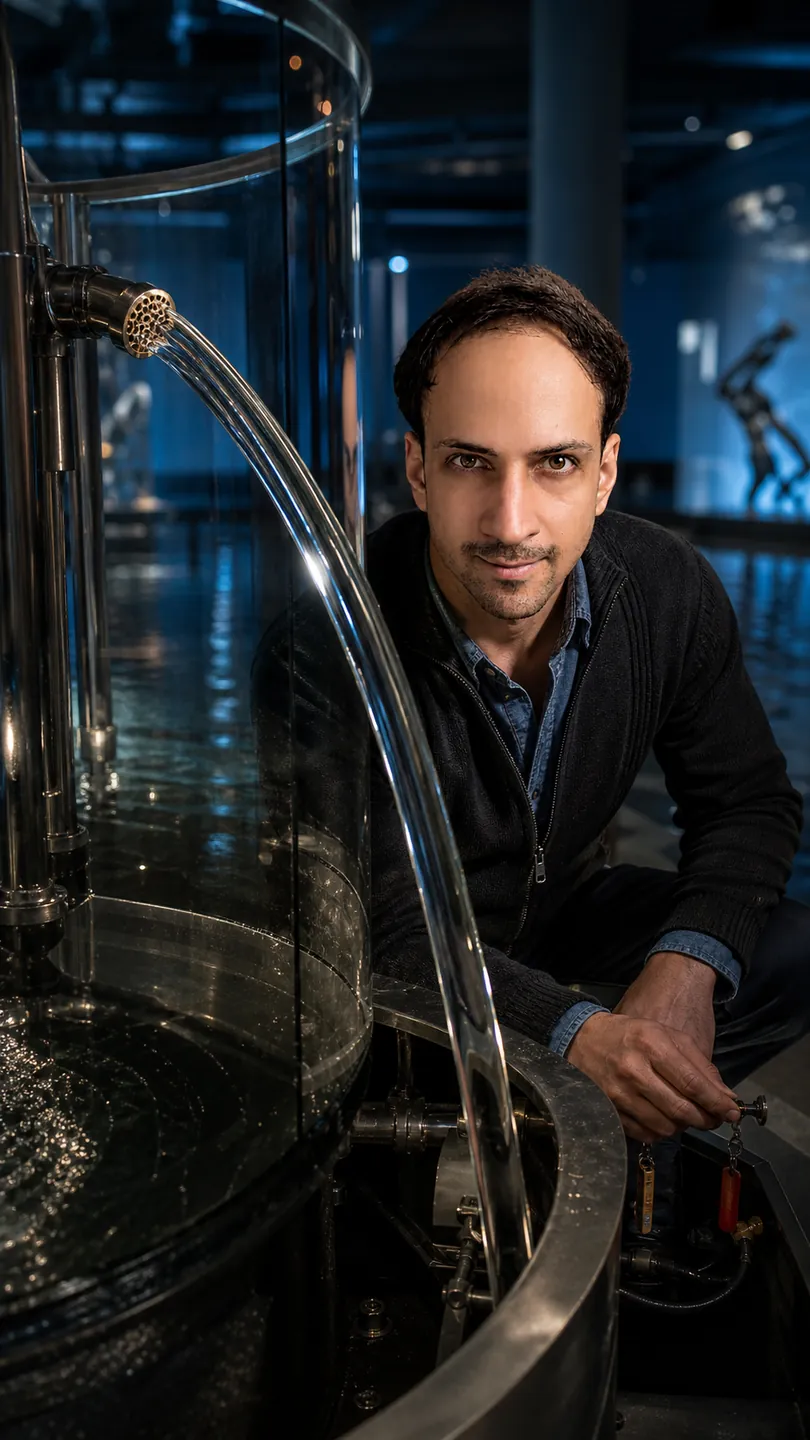
Laminar Calm: Science-Center Water Gallery — AI Portrait Prompt
صورةAI Portraits

Turn your own photo into a quiet kinetic-art portrait in a science-center water gallery after closing, one exhibit left running. Keeps your face unchanged.

من نص البرومبت

Use the attached reference photo as the identity reference: keep the same face, skin tone, hair and features as the person in that photo, without beautifying, aging or altering them. Create a square 1:1 museum-catalog frame with a strong first read and a slower second read at exactly 2880x2880 pixels. Location: a science-center water gallery after closing, one exhibit left running. Show the subject in a charcoal zip cardigan over an open-collar chambray shirt, keying open a low service panel beside the exhibit. Use this advanced image-making device as the core logic: a flat stripe of dye in a wide clear tube that the moving water stretches into one clean, deepening parabola puts continuous motion through a form that never once looks hurried. Explore where the boundary lies between a working flow and the sculpture it resembles; direct expression and posture toward composed fascination, never melodrama or ad-like confidence. Frame through the clear apparatus itself, refraction bending the background while their face stays undistorted and sharp. Make the composition hold clean empty space where turbulence would have been. Render it as quiet kinetic-art portraiture combining working flow sculpture, honest wet-surface materiality, calm controlled studio styling, and unforced human presence, using cool diffuse daylight with a single warm practical reflected in wet metal and a palette of dark basalt, damp concrete, and one seam of copper. Photorealistic: this must read as a real photograph from a physical camera, never an illustration, painting, or 3D render. Resolve real surface detail: rubber gone chalky with age, painted metal chipped to primer, and plastic yellowed only where light reaches it. Keep one identity-locked person, credible hands and fingers, natural fabric, and coherent scale, contact, reflections, shadows, airflow, deformation, and materials. Background people only when essential, always secondary and clearly different. Avoid stock waterfall mist, whirlpool vortices, ripple-covered surfaces, levitating water spheres, and dramatic slow-motion splash photography. No text, labels, logos, signatures, watermarks, random symbols, plastic skin, excessive bloom, or glossy AI finish.
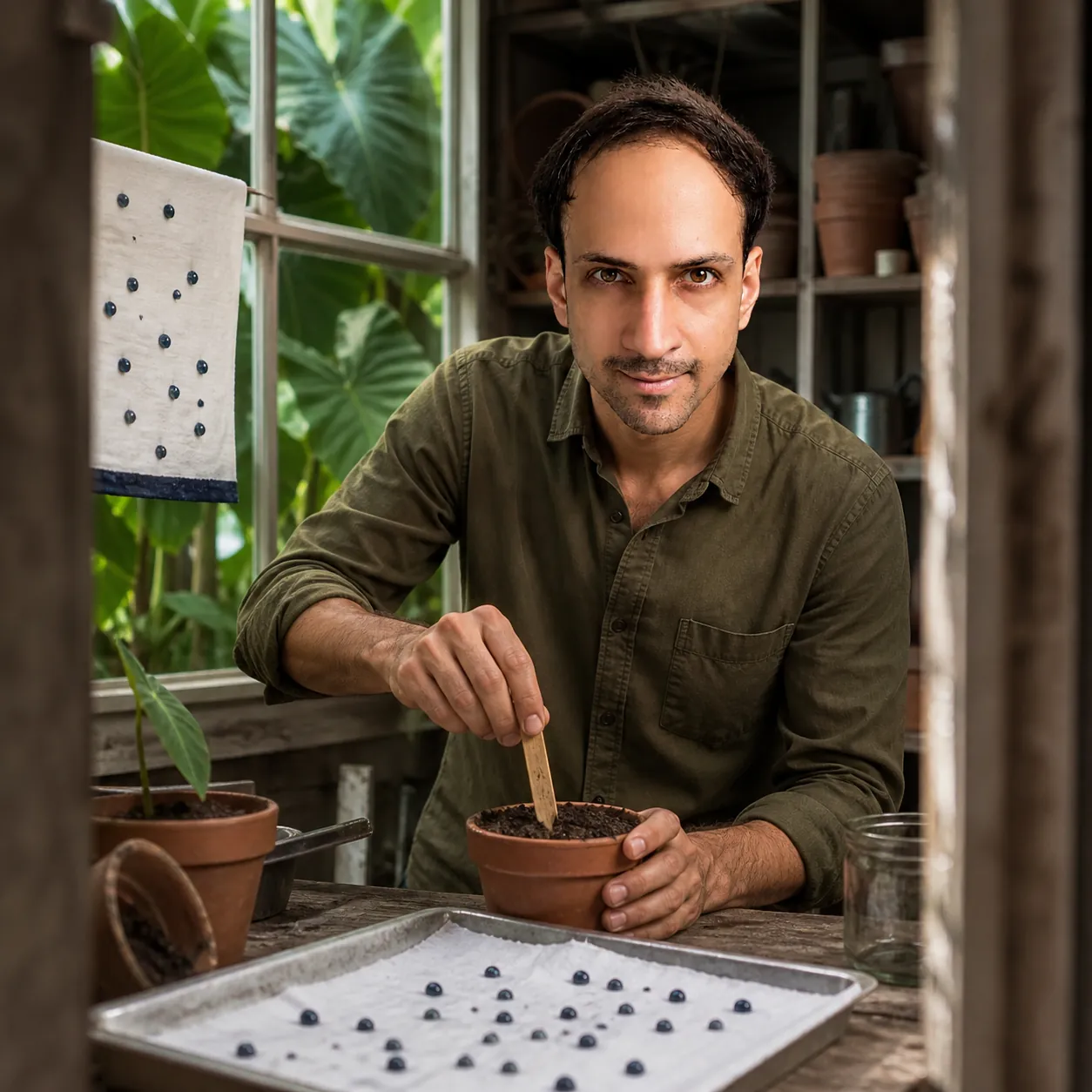
After-Hours Water Gallery — AI Portrait Prompt
صورةAI Portraits

Turn your own photo into a portrait in a science-center water gallery after closing, one exhibit left running. Keeps your face unchanged.

من نص البرومبت

Use the attached reference photo as the identity reference: keep the same face, skin tone, hair and features as the person in that photo, without beautifying, aging or altering them. Design a full-height 9:16 cinematic artwork that reads on a phone and rewards gallery-scale inspection at exactly 2144x3808 pixels. Location: a science-center water gallery after closing, one exhibit left running. Show the subject in a charcoal zip cardigan over an open-collar chambray shirt, keying open a low service panel beside the exhibit. Make one rigorous physical condition the conceptual engine: an arc of water from a honeycomb-straightened nozzle that stands so clear and still it reads as a rod of bent glass lends moving liquid the finish and patience of exhibited sculpture. Explore why water that keeps perfect order looks more impossible than water in chaos; direct expression and posture toward absorbed respect, never melodrama or ad-like confidence. Frame through the clear apparatus itself, refraction bending the background while their face stays undistorted and sharp. Make the composition keep the flow's stillest passage sharpest and the room soft. Render it as museum-scale demonstration realism combining faithful portrait photography, glass-smooth water rendered without exaggeration, machined hydraulic hardware, and physically exact reflections, using early blue ambient light with one narrow beam threading the water and a palette of wet slate, glass green, and one crimson thread. Photorealistic: this must read as a real photograph from a physical camera, never an illustration, painting, or 3D render. Give the space honest scale: real distance between foreground, subject, and far wall. Resolve real surface detail: glass with real thickness at its edge, reflections that carry the room's actual colour, and dust visible only at grazing angles. Keep one identity-locked person, credible hands and fingers, natural fabric, and coherent scale, contact, reflections, shadows, airflow, deformation, and materials. Background people only when essential, always secondary and clearly different. Avoid splash crowns, suspended droplet sprays, chrome CGI liquid, neon glowing water, and fantasy water-bending gestures. No text, labels, logos, signatures, watermarks, random symbols, plastic skin, excessive bloom, or glossy AI finish.
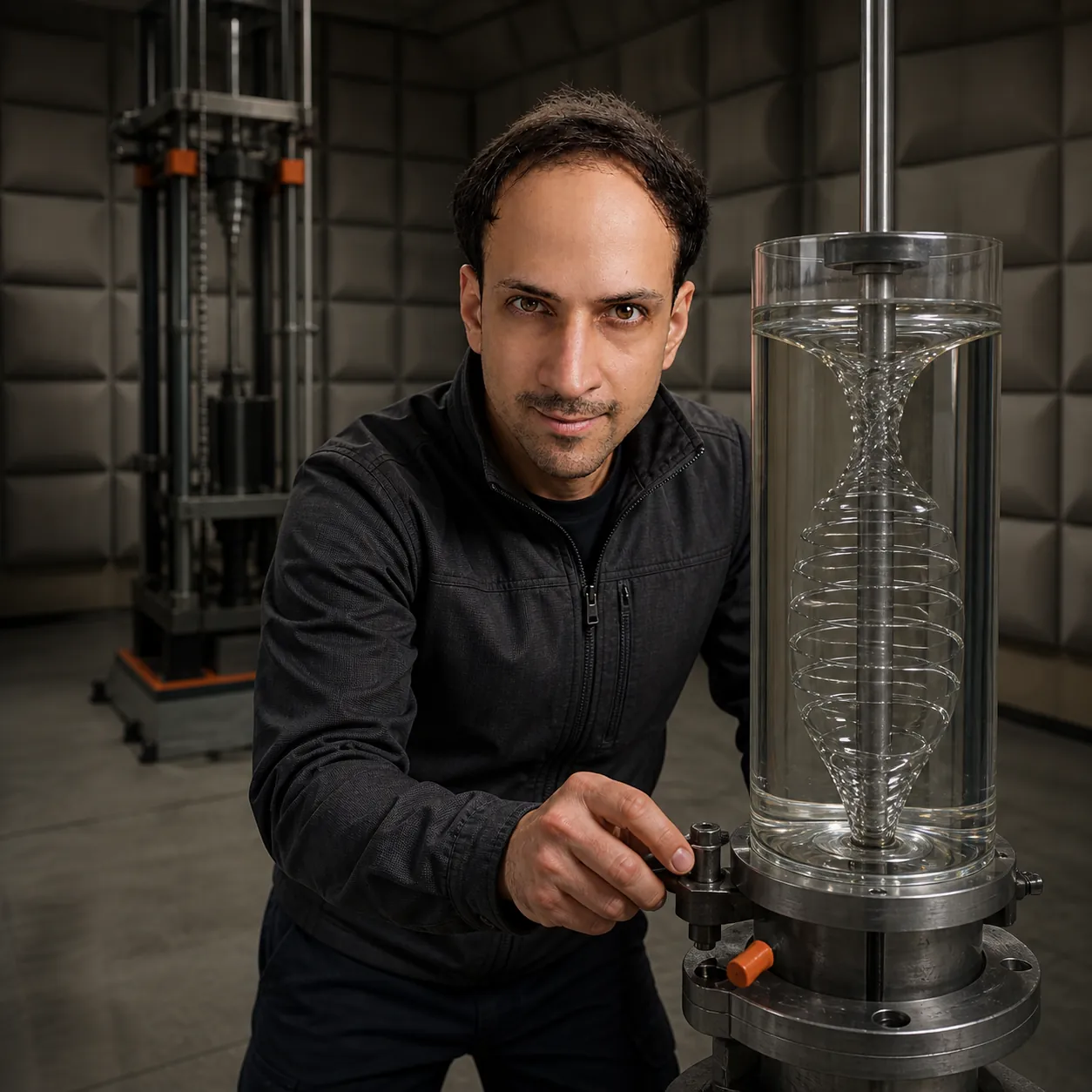
Dry Cotton in the Potting Shed — AI Portrait Prompt
صورةAI Portraits

Turn your own photo into a museum-grade demonstration portrait in a nursery potting shed with taro leaves crowding one window. Keeps your face unchanged.

من نص البرومبت

Use the attached reference photo as the identity reference: keep the same face, skin tone, hair and features as the person in that photo, without beautifying, aging or altering them. Create a square 1:1 museum-catalog frame with a strong first read and a slower second read at exactly 2880x2880 pixels. Location: a nursery potting shed with taro leaves crowding one window. Show the subject in an olive canvas shirt with sleeves rolled past the wrist, tucking a wooden plant label into fresh soil. Use this advanced image-making device as the core logic: a panel of white cotton whose treated weave sheds ink-dark droplets whole and stays bone dry beneath them proves that texture too small to see decides what water may touch. Explore what water becomes in a world where nothing will absorb it; direct expression and posture toward studied stillness, never melodrama or ad-like confidence. Frame through a real doorway or shelf edge, foreground soft, the person and the water both sharp. Make the composition let matte dryness dominate and glints stay few and earned. Render it as museum-grade demonstration realism combining faithful contact-angle physics, tactile fabric and metal surfaces, honest water optics, and unhurried portrait photography, using gentle backlight that turns the water's curved surfaces into small honest lenses and a palette of brushed aluminum, bone linen, and one line of indigo. Photorealistic: this must read as a real photograph from a physical camera, never an illustration, painting, or 3D render. Resolve real surface detail: thread ends and slight pilling on worn cloth, hairline chips at every hard corner, and stone that is porous rather than smooth. Keep one identity-locked person, credible hands and fingers, natural fabric, and coherent scale, contact, reflections, shadows, airflow, deformation, and materials. Background people only when essential, always secondary and clearly different. Avoid cartoon dewdrop gloss, rainbow refraction overload, levitating water blobs, spiritual lotus kitsch, and hoses spraying dramatic mist. No text, labels, logos, signatures, watermarks, random symbols, plastic skin, excessive bloom, or glossy AI finish.
The Rod-Climbing Polymer — AI Portrait Prompt
صورةAI Portraits

Turn your own photo into a museum-grade demonstration portrait in a padded impact-test room with a guided drop rig standing idle. Keeps your face unchanged.

من نص البرومبت

Use the attached reference photo as the identity reference: keep the same face, skin tone, hair and features as the person in that photo, without beautifying, aging or altering them. Create a square 1:1 museum-catalog frame with a strong first read and a slower second read at exactly 2880x2880 pixels. Location: a padded impact-test room with a guided drop rig standing idle. Show the subject in a zipped charcoal technical jacket over dark work trousers, setting the release catch with one deliberate thumb. Make one rigorous physical condition the conceptual engine: a glass cylinder of clear polymer solution that climbs the spinning stir rod against every instinct a centrifuge ever taught answers the manner of a force rather than its size. Explore how memory can live in a substance with no fixed shape; direct expression and posture toward measured astonishment, never melodrama or ad-like confidence. Use an eye-level 80mm medium-format viewpoint with honest perspective and gentle depth of field. Make the composition keep every contour of the fluid sharper than the room behind. Render it as museum-grade demonstration realism combining faithful fluid behavior, tactile material surfaces, patient observational portrait photography, and physically accurate weight and reflection, using diffused overhead panels dimmed low enough to keep every reflection readable and a palette of wet cement, ivory, and one line of safety orange. Photorealistic: this must read as a real photograph from a physical camera, never an illustration, painting, or 3D render. Resolve real surface detail: fine grit in the texture of concrete, efflorescence at damp edges, and hairline cracks that follow stress. Keep one identity-locked person, credible hands and fingers, natural fabric, and coherent scale, contact, reflections, shadows, airflow, deformation, and materials. Background people only when essential, always secondary and clearly different. Avoid rainbow slime aesthetics, splattered goo on skin, speaker-driven paint splashes, and ASMR dripping close-ups. No text, labels, logos, signatures, watermarks, random symbols, plastic skin, excessive bloom, or glossy AI finish.
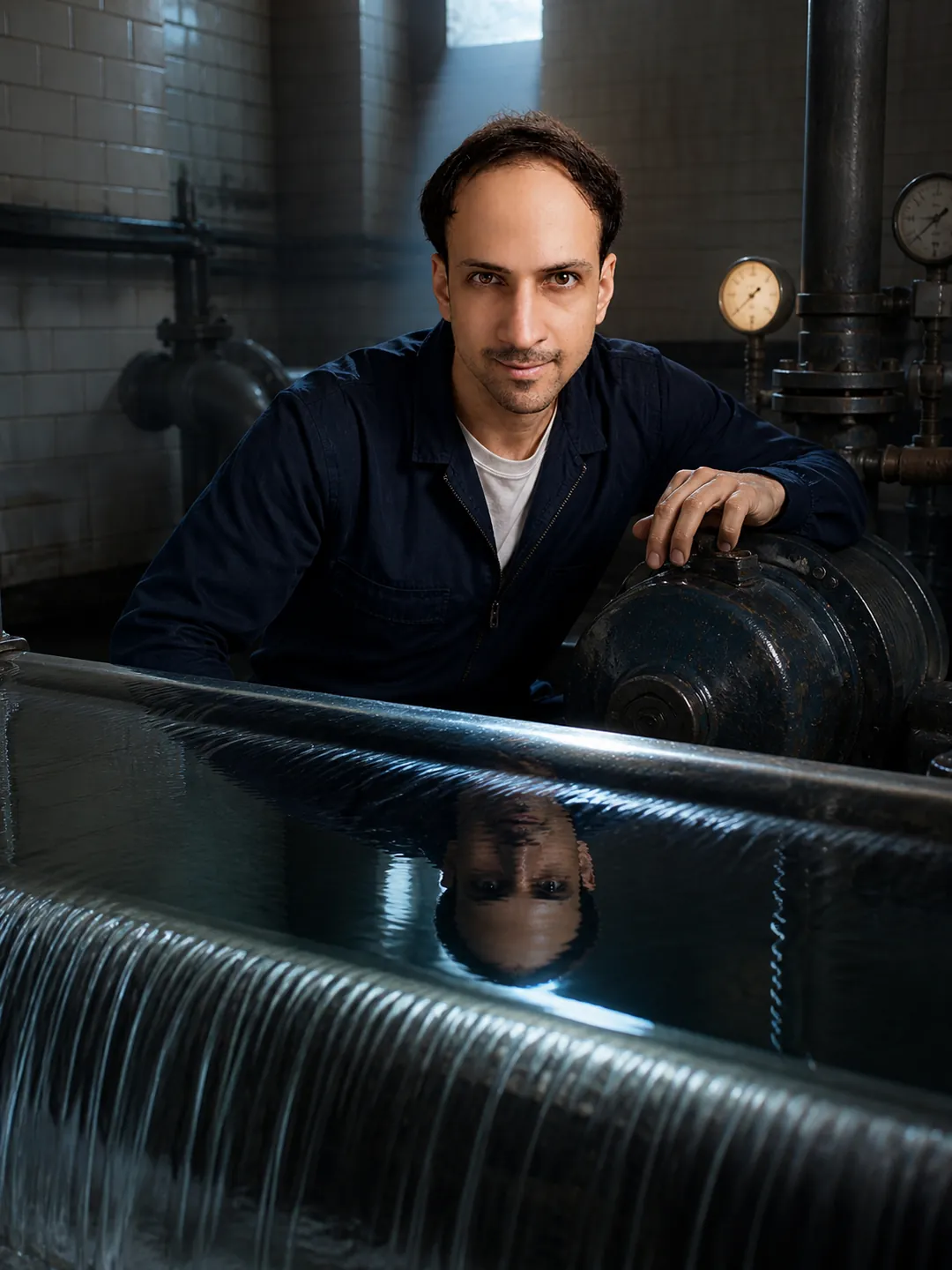
Weir Reflection Below the Fountain — AI Portrait Prompt
صورةAI Portraits

Turn your own photo into a quiet kinetic-art portrait in the tiled pump room beneath a public fountain, gauges faintly lit. Keeps your face unchanged.

من نص البرومبت

Use the attached reference photo as the identity reference: keep the same face, skin tone, hair and features as the person in that photo, without beautifying, aging or altering them. Use a formal 3:4 environmental portrait with complete hands and meaningful objects inside frame at exactly 2480x3312 pixels. Location: the tiled pump room beneath a public fountain, gauges faintly lit. Show the subject in a navy coverall unzipped over a clean white undershirt, resting two fingers on a humming pump casing. Use this advanced image-making device as the core logic: a sheet of water that slides over a machined weir crest so evenly it holds one unbroken, believable reflection lets neighboring layers slide past one another without ever trading places. Explore how a moving surface can hold an image that refuses to move; direct expression and posture toward collected curiosity, never melodrama or ad-like confidence. Use an eye-level 60mm medium-format viewpoint with honest perspective and gently limited depth of field. Make the composition let one unbroken waterline run the frame's full width. Render it as quiet kinetic-art portraiture combining working flow sculpture, honest wet-surface materiality, calm controlled studio styling, and unforced human presence, using early blue ambient light with one narrow beam threading the water and a palette of soft pewter, unglazed clay, and a cold aqua accent. Photorealistic: this must read as a real photograph from a physical camera, never an illustration, painting, or 3D render. Resolve real surface detail: brass darkened in the recesses and bright where thumbs land, and lacquer crazed rather than perfect. Keep one identity-locked person, credible hands and fingers, natural fabric, and coherent scale, contact, reflections, shadows, airflow, deformation, and materials. Background people only when essential, always secondary and clearly different. Avoid splash crowns, suspended droplet sprays, chrome CGI liquid, neon glowing water, and fantasy water-bending gestures. No text, labels, logos, signatures, watermarks, random symbols, plastic skin, excessive bloom, or glossy AI finish.

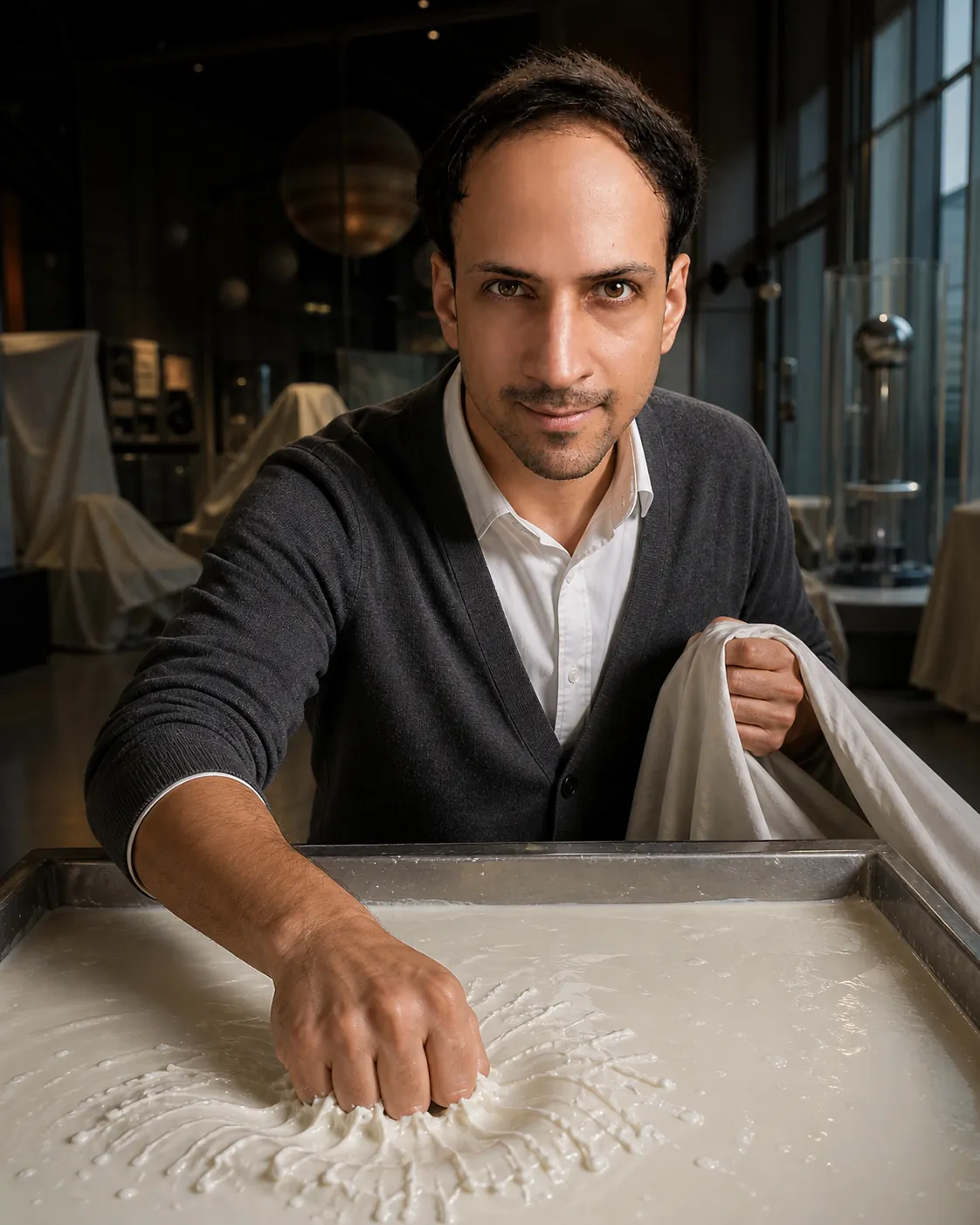
Unveiling the Cornstarch Demonstration — AI Portrait Prompt
صورةAI Portraits

Turn your own photo into a portrait in a science-center demonstration hall before opening, its exhibits still sheeted. Keeps your face unchanged.

من نص البرومبت

Use the attached reference photo as the identity reference: keep the same face, skin tone, hair and features as the person in that photo, without beautifying, aging or altering them. Build a portrait 4:5 editorial artwork with protected negative space and a fully readable face at exactly 2560x3200 pixels. Location: a science-center demonstration hall before opening, its exhibits still sheeted. Show the subject in a slate cardigan over a pressed white shirt, folding one dust sheet back over their forearm. Build the artwork around this material rule: a wide steel tray of dense cornstarch suspension that carries their struck knuckles like pavement yet swallows their resting hand lets one quiet demonstration overturn an intuition older than language. Explore why a liquid is entitled to behave like stone when questioned rudely; direct expression and posture toward grounded wonder, never melodrama or ad-like confidence. Use a 90mm close-working lens: the fluid's response sharp near the frame's base and their attentive face readable above it. Make the composition anchor the brightest highlight on the material, never on them. Render it as quiet kinetic still-life portraiture built from genuine non-Newtonian samples, honest studio texture, believable hand-scale staging, and patient documentary framing, using cool window daylight from one side, balanced by a warm bench lamp and a palette of mud brown, brushed steel, and muted glass green. Photorealistic: this must read as a real photograph from a physical camera, never an illustration, painting, or 3D render. Resolve real surface detail: fine lint on dark fabric, water spotting on steel, and the soft rounding of edges that have been used for years. Keep one identity-locked person, credible hands and fingers, natural fabric, and coherent scale, contact, reflections, shadows, airflow, deformation, and materials. Background people only when essential, always secondary and clearly different. Avoid rainbow slime aesthetics, splattered goo on skin, speaker-driven paint splashes, and ASMR dripping close-ups. No text, labels, logos, signatures, watermarks, random symbols, plastic skin, excessive bloom, or glossy AI finish.
