جاري التحميل...


جاري التحميل...
Turn your own photo into a low-light demonstration portrait in a tidy amateur-radio room at night, panel lamps glowing faintly. Keeps your face unchanged.
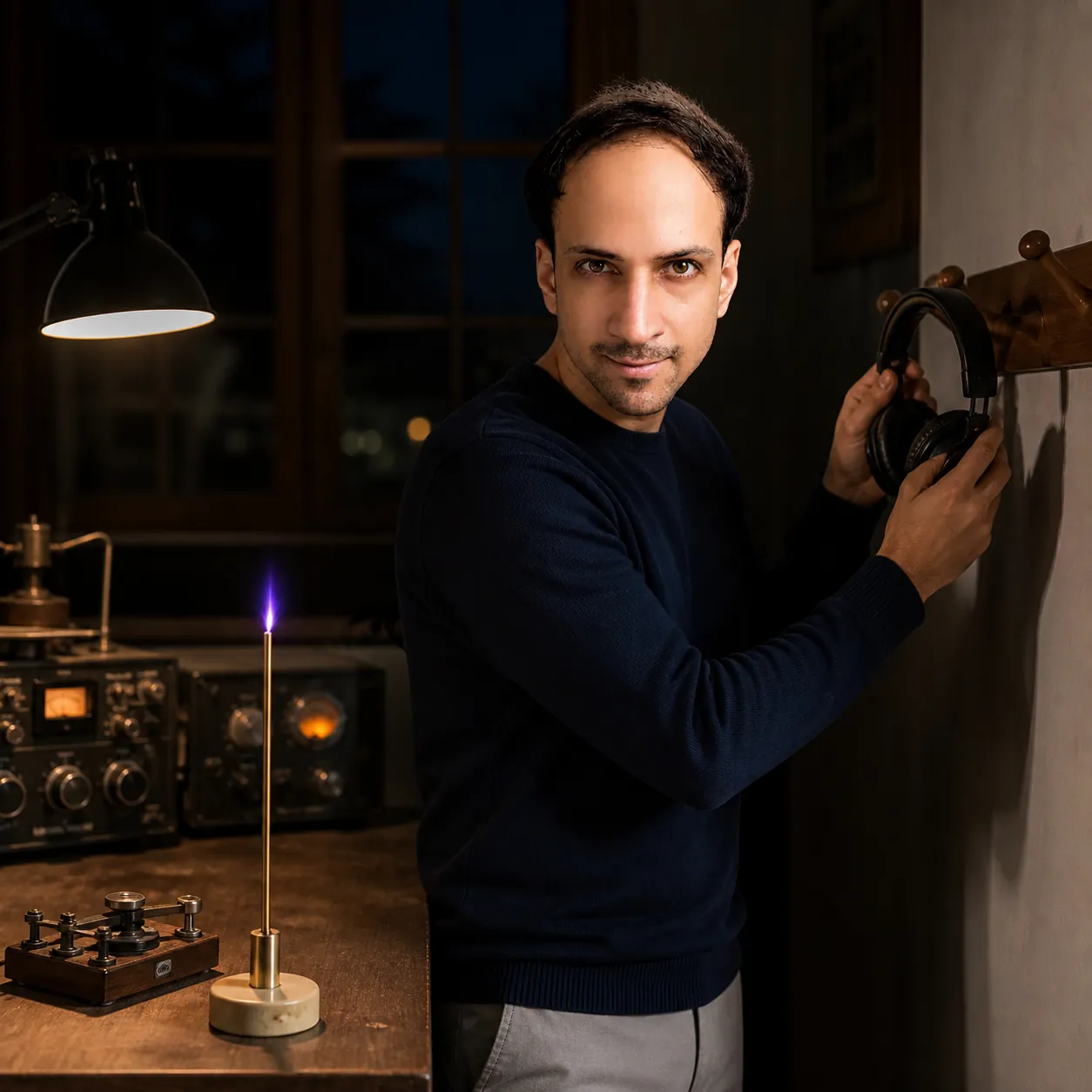
Use the attached reference photo as the identity reference: keep the same face, skin tone, hair and features as the person in that photo, without beautifying, aging or altering them. Create a square 1:1 museum-catalog frame with a strong first read and a slower second read at exactly 2880x2880 pixels. Location: a tidy amateur-radio room at night, panel lamps glowing faintly. Show them in a fine-gauge navy sweater and pressed pale-grey trousers, hanging a pair of headphones on a wooden peg. Use this advanced image-making device as the core logic: a polished brass needle on an insulated stand that wears a faint violet sheath of corona only at its sharpest point brings a feared force close enough to study without any bravado. Explore whether a record written by physics can count as a signature; direct expression and posture toward quiet conviction, never melodrama or ad-like confidence. Frame from a low three-quarter angle so the demonstration sits between the lens and their attention. Make the composition surround the lit evidence with generous, honest darkness. Render it as low-light demonstration realism combining true plasma color science, patient long-exposure discipline, tactile bench materiality, and dignified editorial portrait craft, using deep dusk ambience shaped by one hooded lamp aimed at the work and a palette of charred oak, pale ivory, and one ember-orange thread. Photorealistic: this must read as a real photograph from a physical camera, never an illustration, painting, or 3D render. Resolve real surface detail: thread ends and slight pilling on worn cloth, hairline chips at every hard corner, and stone that is porous rather than smooth. Keep one identity-locked person, credible hands and fingers, natural fabric, and coherent scale, contact, reflections, shadows, airflow, deformation, and materials. Background people only when essential, always secondary and clearly different. Avoid sci-fi energy balls, fractal screen-saver overlays, sparks showering from hands, wizard-lightning fingertips, and ultraviolet glow gimmicks. No text, labels, logos, signatures, watermarks, random symbols, plastic skin, excessive bloom, or glossy AI finish.
Turn your own photo into a photorealistic portrait in the family farm gate, its latch bright and its chain thinned link by link. Keeps your face unchanged.
Turn your own photo into a photorealistic portrait in the flat roof of the family house as the last daylight drains. Keeps your face unchanged.
Turn your own photo into a photorealistic portrait in your old school's corridor where the banister ends in a shine every pupil made. Keeps your face unchanged.
Turn your own photo into a quiet cinematic portrait in a gym bench between sets with a towel folded over the bar. Keeps your face unchanged.
Turn your own photo into a quiet observational portrait in a low majlis table where a brass tray gathers glasses and dallah. Keeps your face unchanged.
Turn your own photo into a candid reflex-moment portrait in a supermarket aisle stacked to the ceiling under flat white light. Keeps your face unchanged.
Turn your own photo into an understated editorial portrait in the driver's seat of a parked family car with the engine off. Keeps your face unchanged.
Turn your own photo into a quiet observational portrait in a small residential lift with another person's shoulder at the frame edge. Keeps your face unchanged.
Turn your own photo into a photorealistic portrait in a small tailor's shop while a hem is finished somewhere behind the counter. Keeps your face unchanged.
Turn your own photo into a portrait in the corner of your kitchen where the kettle sits between window and sink. Keeps your face unchanged.
Turn your own photo into a patient observational portrait in a bus shelter's strip of shade on a wide afternoon road. Keeps your face unchanged.
Turn your own photo into a gallery-scale documentary portrait in an office floor at the end of the day, most desks dark. Keeps your face unchanged.