تخطَّ إلى المحتوى
جميع التصنيفات

AI Portraits

Portrait prompts you can use with your own photo.

3845 برومبتات•0 مشتركين
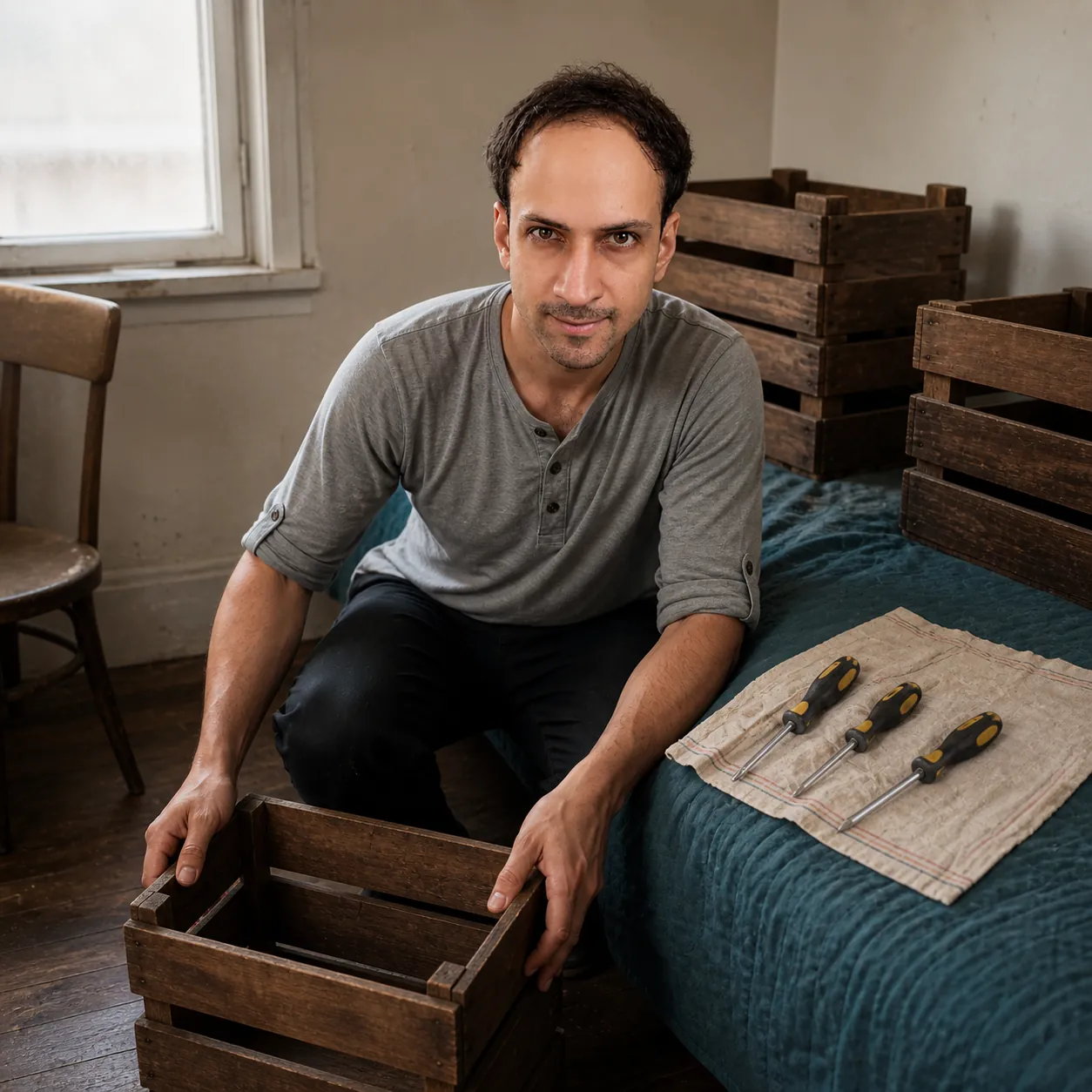
The Crate With Worn Handles — AI Portrait Prompt
صورةAI Portraits

Turn your own photo into an archival still-life portrait in a guest room where the spare bed carries stacked crates. Keeps your face unchanged.

من نص البرومبت

Use the attached reference photo as the identity reference: keep the same face, skin tone, hair and features as the person in that photo, without beautifying, aging or altering them. Create a square 1:1 museum-catalog frame with a strong first read and a slower second read at exactly 2880x2880 pixels. Location: a guest room where the spare bed carries stacked crates. Show the subject in a soft grey henley with sleeves at the elbow, lowering one crate from the bed to the floor. Make this piece of unglamorous evidence the whole argument: a row of three identical screwdrivers on a cloth, each bought on a day the others could not be found shows care and accumulation arriving from exactly the same impulse. Explore why an object with a use left in it refuses to become rubbish; expression occupied, not expressive, carrying sober economy, difficulty stated in the register of ordinary work. Use an 85mm portrait length compressing the kept things gently behind their shoulder. Make the composition give the kept object more definition than the surrounding room. Render it as archival still-life portraiture combining catalogue-clear object rendering, believable domestic wear, controlled neutral colour, and patient unstyled editorial realism, using flat overcast daylight through a dusty window with soft, even falloff and a palette of kraft brown, plaster white, and one faded teal. Photorealistic: this must read as a real photograph from a physical camera, never an illustration, painting, or 3D render. Resolve real surface detail: floor finish worn along the walked line, skirting marked at shoe height, and corners darker than the open floor. Keep one identity-locked person, credible hands and fingers, natural fabric, and coherent scale, contact, reflections, shadows, airflow, deformation, and materials. Background people only when essential, always secondary and clearly different. Avoid clear-out crews, shame poses, posing at camera, teetering junk towers, and melancholy without labour. No text, labels, logos, signatures, watermarks, random symbols, plastic skin, excessive bloom, or glossy AI finish.
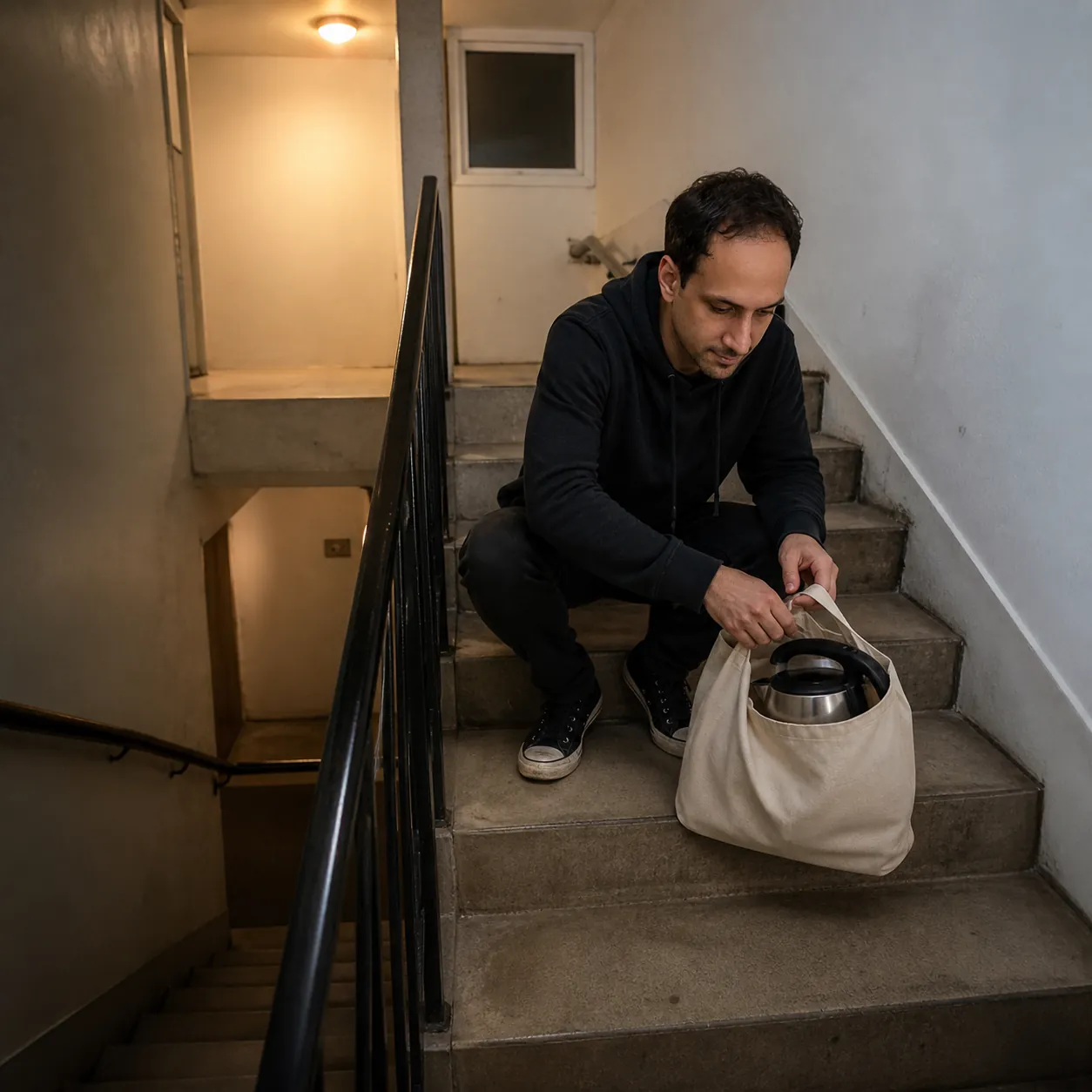
The Kettle That Clicks Too Soon — AI Portrait Prompt
صورةAI Portraits

Turn your own photo into a quiet domestic documentary portrait in a concrete apartment stairwell landing between two upper floors. Keeps your face unchanged.

من نص البرومبت

Use the attached reference photo as the identity reference: keep the same face, skin tone, hair and features as the person in that photo, without beautifying, aging or altering them. Create a square 1:1 museum-catalog frame with a strong first read and a slower second read at exactly 2880x2880 pixels. Location: a concrete apartment stairwell landing between two upper floors. Show the subject in a dark hooded sweatshirt over plain trousers and canvas shoes, setting a full carrier bag down on the step. Make this piece of unglamorous evidence the whole argument: a replacement kettle that cuts out at a different moment, leaving the routine around the old click without an anchor turns a five-minute job into an hour of starting the order again. Explore how a private ordering system earns its keep on a difficult day; expression occupied, not expressive, carrying unhurried recalculation, difficulty stated without inviting pity. Use a slightly high 40mm angle that shows the whole interrupted arrangement at once. Make the composition give the unfinished part more frame than the finished. Render it as quiet domestic documentary realism built from unposed observation, honest household materials, accurate skin rendering, and restrained contemporary art direction, using one ceiling fitting doing all the work, shadows soft and low and a palette of concrete grey, bone white, and one amber lamp glow. Photorealistic: this must read as a real photograph from a physical camera, never an illustration, painting, or 3D render. Resolve real surface detail: grout darker than tile, sealant slightly yellowed, and every joint showing a real tolerance gap. Keep one identity-locked person, credible hands and fingers, natural fabric, and coherent scale, contact, reflections, shadows, airflow, deformation, and materials. Background people only when essential, always secondary and clearly different. Avoid hero poses, golden-hour wellness glow, eye contact with the lens, minimalist styling, and puzzle-piece symbolism. No text, labels, logos, signatures, watermarks, random symbols, plastic skin, excessive bloom, or glossy AI finish.
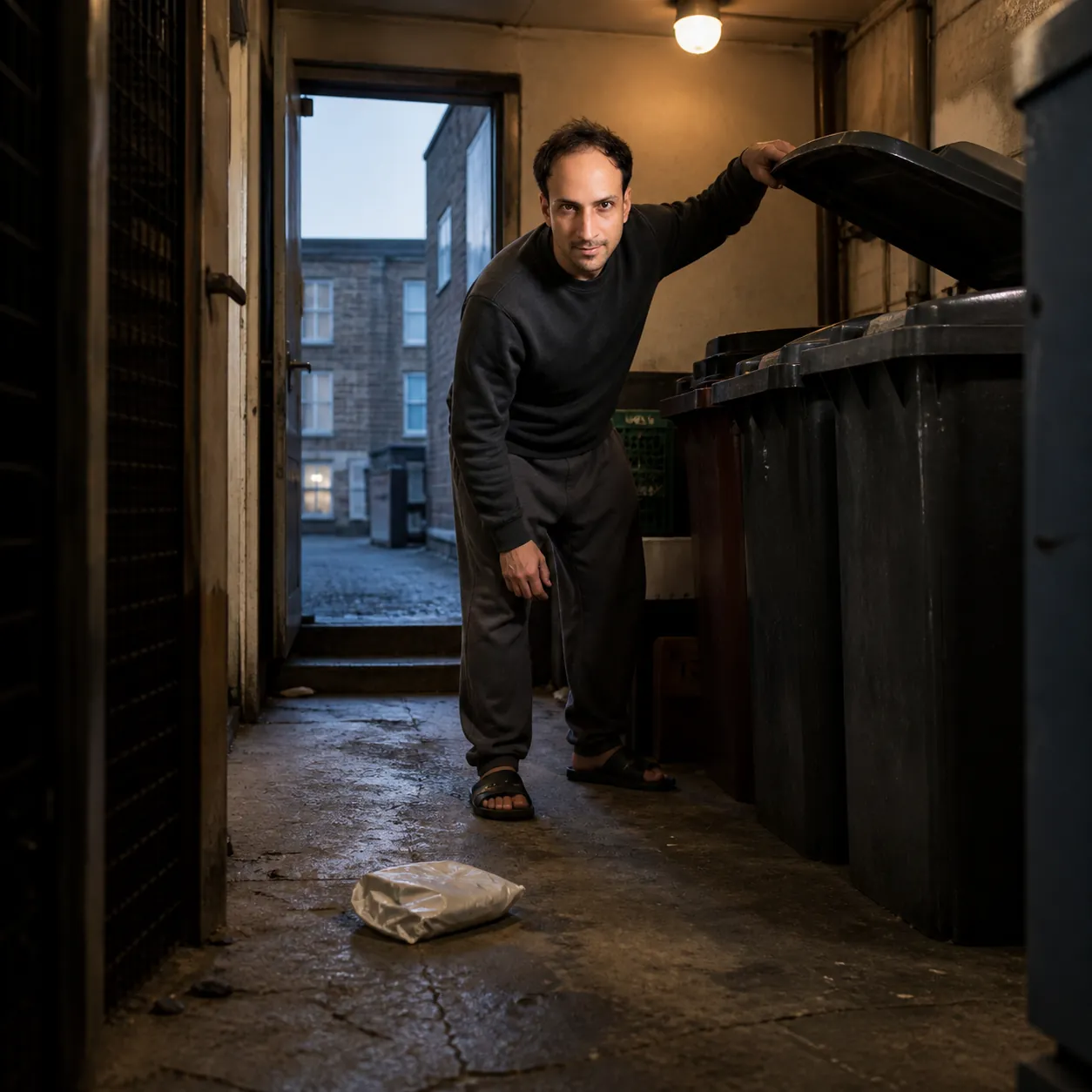
The Bin Store Under One Bulb — AI Portrait Prompt
صورةAI Portraits

Turn your own photo into a museum-grade domestic portrait in a building's ground-floor bin store lit by one bare fitting. Keeps your face unchanged.

من نص البرومبت

Use the attached reference photo as the identity reference: keep the same face, skin tone, hair and features as the person in that photo, without beautifying, aging or altering them. Create a square 1:1 museum-catalog frame with a strong first read and a slower second read at exactly 2880x2880 pixels. Location: a building's ground-floor bin store lit by one bare fitting. Show the subject in a dark grey sweatshirt over loose cotton trousers and slip-on sandals, tipping a lid open with the back of one wrist. Anchor the frame to this piece of ordinary evidence: a single bought item in a bag folded small, carried from a shop that was entered and left inside its quietest minutes spends a whole morning's calculation on something a neighbour does absently. Explore why an exit has to be located before an errand can begin; expression occupied, not expressive, carrying flat determination, difficulty stated in plain working terms. Place the camera low at bag height so the floor and the threshold dominate. Make the composition hold measurable distance between their hands and the open air. Render it as museum-grade domestic realism combining high-fidelity portrait photography, plain hardware detail, accurate low-light response, and restrained editorial art direction, using pale pre-dawn daylight through a doorway, balanced by one weak interior lamp and a palette of matte navy, unbleached paper, and a single tile green. Photorealistic: this must read as a real photograph from a physical camera, never an illustration, painting, or 3D render. Resolve real surface detail: dust settled where nobody wipes, fingerprint haze on glass, and edges rubbed pale by handling. Keep one identity-locked person, credible hands and fingers, natural fabric, and coherent scale, contact, reflections, shadows, airflow, deformation, and materials. Background people only when essential, always secondary and clearly different. Avoid rain-streaked window sorrow, huddled foetal poses, blurred crowd chaos, and curtain-peeking paranoia. No text, labels, logos, signatures, watermarks, random symbols, plastic skin, excessive bloom, or glossy AI finish.
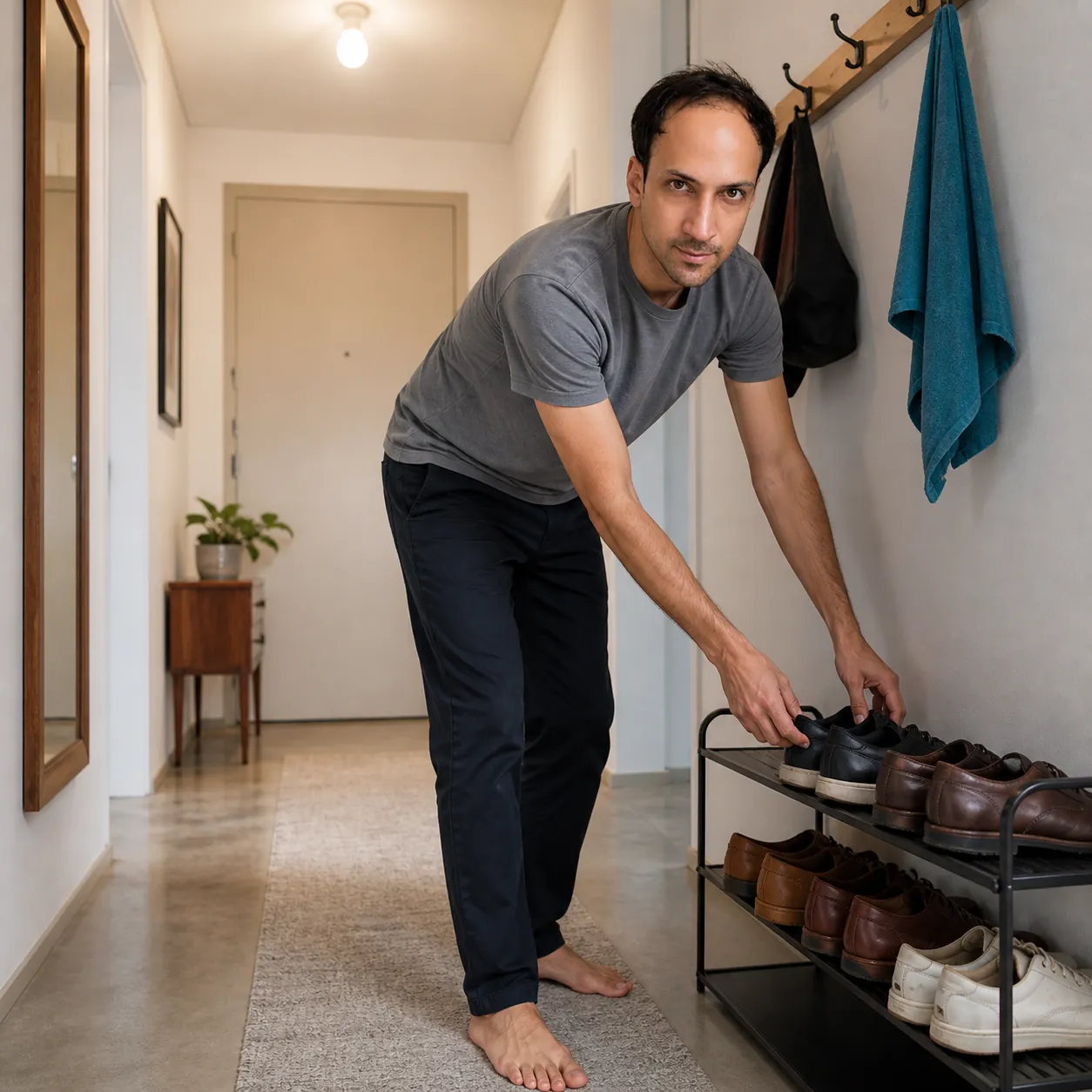
A Bulb Left Burning — AI Portrait Prompt
صورةAI Portraits

Turn your own photo into an observational domestic portrait in a flat's entrance hall with a shoe rack and a hook rail. Keeps your face unchanged.

من نص البرومبت

Use the attached reference photo as the identity reference: keep the same face, skin tone, hair and features as the person in that photo, without beautifying, aging or altering them. Create a square 1:1 museum-catalog frame with a strong first read and a slower second read at exactly 2880x2880 pixels. Location: a flat's entrance hall with a shoe rack and a hook rail. Show them in a plain grey crew-neck, dark cotton trousers, and bare feet, straightening a row of shoes along the rack. Anchor the frame to this piece of ordinary evidence: a corridor bulb left burning all through a bright afternoon, its switch passed again and again and never touched holds an ordinary task open a moment longer than the task requires. Explore how a private precaution turns into ordinary housekeeping without anyone noticing; expression occupied, not expressive, carrying unhurried caution, difficulty stated in the geometry alone. Place the lens beside the task at working height with the far wall sharp. Make the composition show the extra distance their arrangement adds. Render it as observational domestic portraiture built from truthful chore staging, exact material texture, ordinary architectural geometry, and quietly unsentimental framing, using even ceiling light with a second lamp filling the far end and a palette of sand beige, concrete grey, and one teal towel. Photorealistic: this must read as a real photograph from a physical camera, never an illustration, painting, or 3D render. Resolve real surface detail: cotton that hangs by its own weight, seams that pucker very slightly, and collars softened by washing. Keep one identity-locked person, credible hands and fingers, natural fabric, and coherent scale, contact, reflections, shadows, airflow, deformation, and materials. Background people only when essential, always secondary and clearly different. Avoid thriller shadows, keyhole peering, weapons or uniforms, and staged startle reactions. No text, labels, logos, signatures, watermarks, random symbols, plastic skin, excessive bloom, or glossy AI finish.
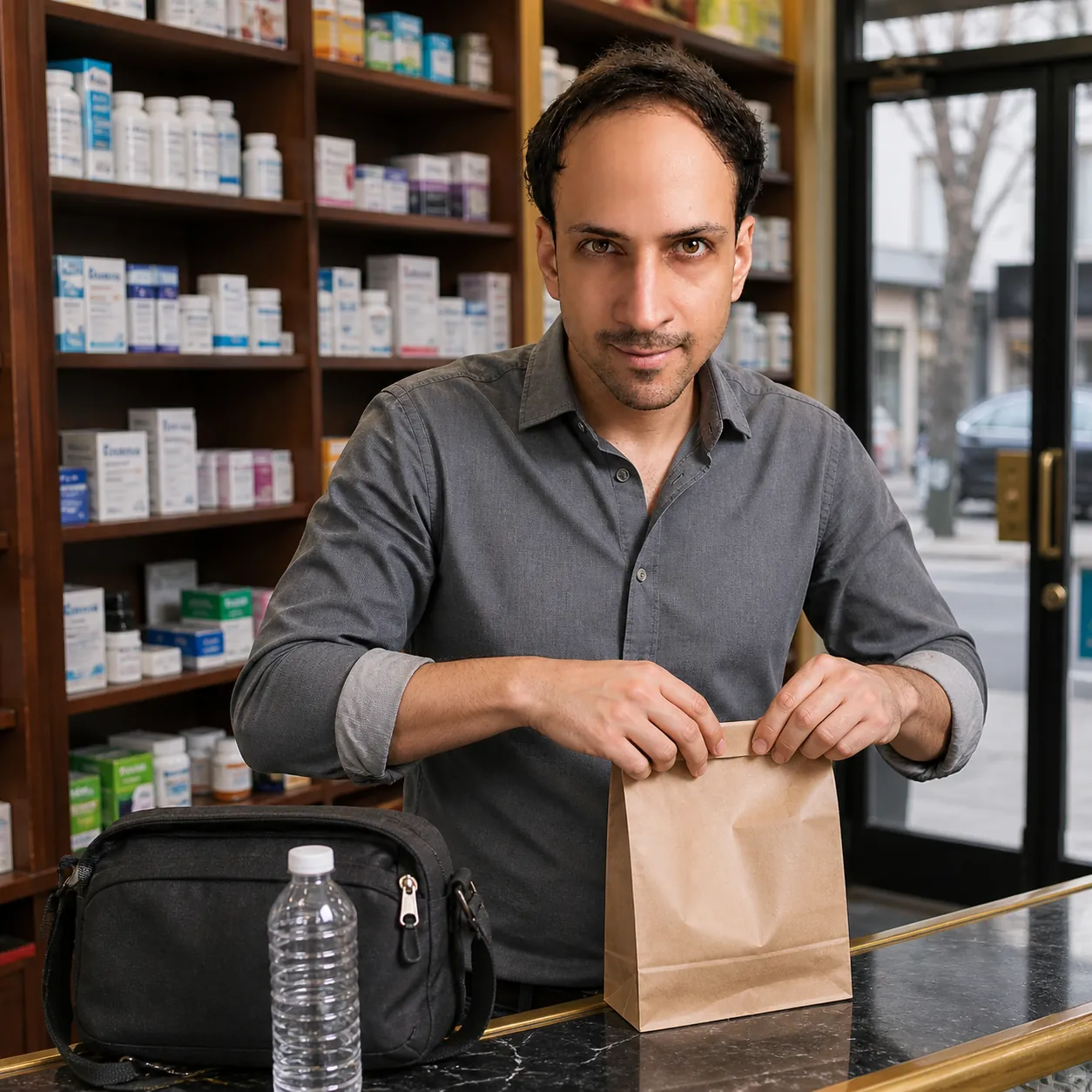
Pharmacy Bag at Chest Height — AI Portrait Prompt
صورةAI Portraits

Turn your own photo into a portrait in a neighbourhood pharmacy's collection end, shelves ranked behind the counter. Keeps your face unchanged.

من نص البرومبت

Use the attached reference photo as the identity reference: keep the same face, skin tone, hair and features as the person in that photo, without beautifying, aging or altering them. Create a square 1:1 museum-catalog frame with a strong first read and a slower second read at exactly 2880x2880 pixels. Location: a neighbourhood pharmacy's collection end, shelves ranked behind the counter. Show the subject in a stone-grey button-down with cuffs turned back twice, creasing a paper pharmacy bag shut along its fold. Build the image around this small, exact tableau: a small shoulder bag that is packed for twelve minutes outside as though for a journey, its water and keys checked twice spends a whole morning's calculation on something a neighbour does absently. Explore how a win too small to mention still costs an entire day; expression occupied, not expressive, carrying worn competence, difficulty stated as logistics rather than lament. Frame at chest height so their hands and their eyes sit on one focal plane. Make the composition keep the way out visible without letting it dominate. Render it as reportage-grade threshold photography built from ordinary retail surfaces, credible packaging materials, physically correct shadow behaviour, and patient non-theatrical staging, using even overcast daylight entering a shopfront with no warm colour push and a palette of warm plaster, dark walnut, and one band of brass. Photorealistic: this must read as a real photograph from a physical camera, never an illustration, painting, or 3D render. Resolve real surface detail: skin that reddens slightly under pressure, nail beds with honest colour, and knuckle creases that fold rather than blur. Keep one identity-locked person, credible hands and fingers, natural fabric, and coherent scale, contact, reflections, shadows, airflow, deformation, and materials. Background people only when essential, always secondary and clearly different. Avoid rain-streaked window sorrow, huddled foetal poses, blurred crowd chaos, and curtain-peeking paranoia. No text, labels, logos, signatures, watermarks, random symbols, plastic skin, excessive bloom, or glossy AI finish.
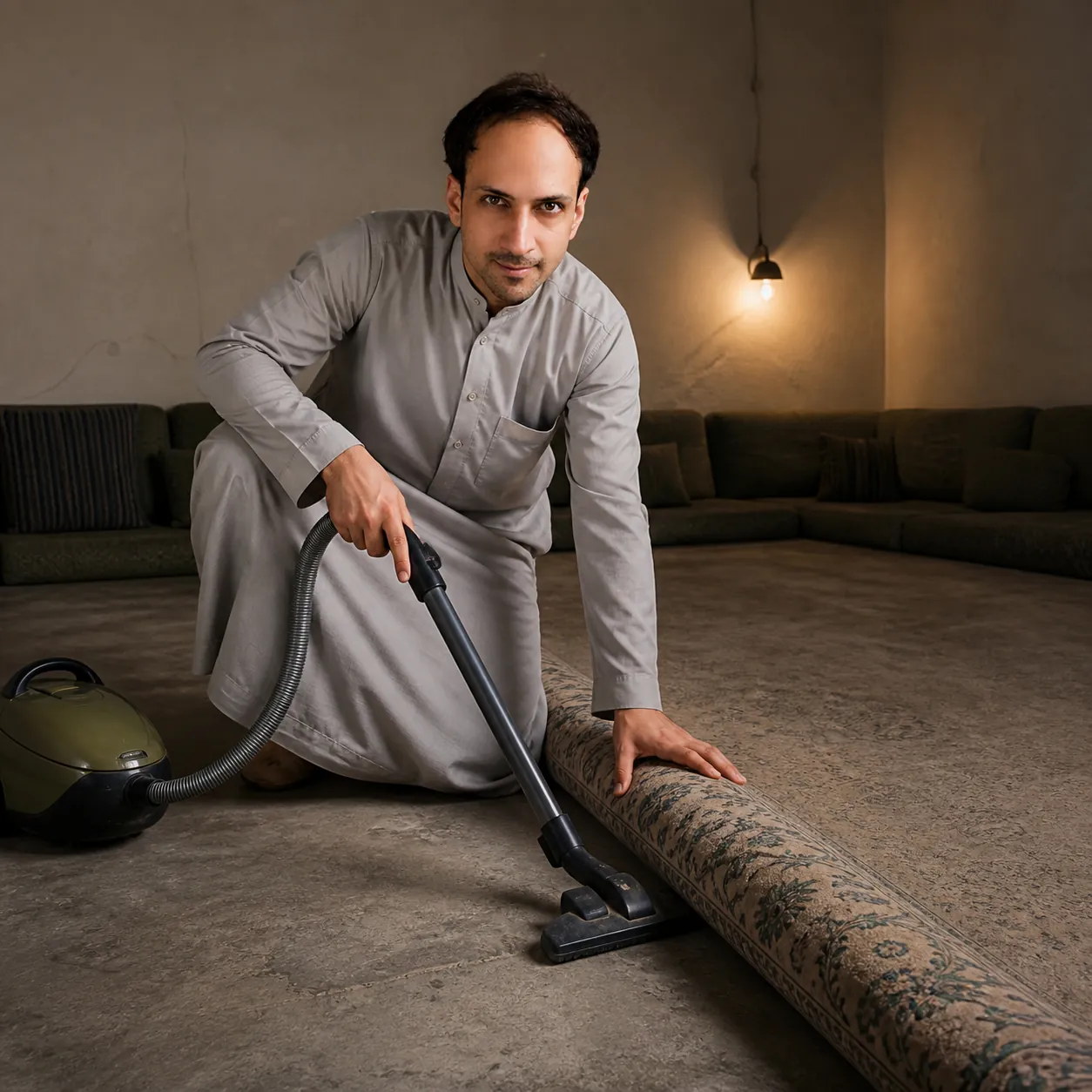
Vacuuming the Majlis Floor — AI Portrait Prompt
صورةAI Portraits

Turn your own photo into a museum-grade observational portrait in a majlis floor mid-clean with its long rug rolled back. Keeps your face unchanged.

من نص البرومبت

Use the attached reference photo as the identity reference: keep the same face, skin tone, hair and features as the person in that photo, without beautifying, aging or altering them. Create a square 1:1 museum-catalog frame with a strong first read and a slower second read at exactly 2880x2880 pixels. Location: a majlis floor mid-clean with its long rug rolled back. Show the subject in a light grey traditional Gulf outfit with the hem gathered clear, guiding a vacuum head along one rolled-back rug edge. Let one honest object carry what the face will not: a ceiling tube whose stutter arrives as rhythm rather than glow, timed around by a person who has learned its interval makes the cost of an ordinary chore visible without making it a complaint. Explore how competence looks when it has to route around a texture nobody else notices; expression occupied, not expressive, carrying working patience, difficulty stated as one more logistical fact. Use a 50mm eye-level view at working distance, the nearest object rendered as plainly as their hands. Make the composition let one unfinished half of the task stay honestly in frame. Render it as museum-grade observational portraiture built from ordinary domestic labour, accurate surface texture, plain interior architecture, and restrained contemporary art direction, using a single low lamp against an otherwise dim room and a palette of unbleached cotton, dull steel, and one olive note. Photorealistic: this must read as a real photograph from a physical camera, never an illustration, painting, or 3D render. Resolve real surface detail: fine grit in the texture of concrete, efflorescence at damp edges, and hairline cracks that follow stress. Keep one identity-locked person, credible hands and fingers, natural fabric, and coherent scale, contact, reflections, shadows, airflow, deformation, and materials. Background people only when essential, always secondary and clearly different. Avoid hands clamped over ears, meltdown theatrics, and hero poses at camera. No text, labels, logos, signatures, watermarks, random symbols, plastic skin, excessive bloom, or glossy AI finish.
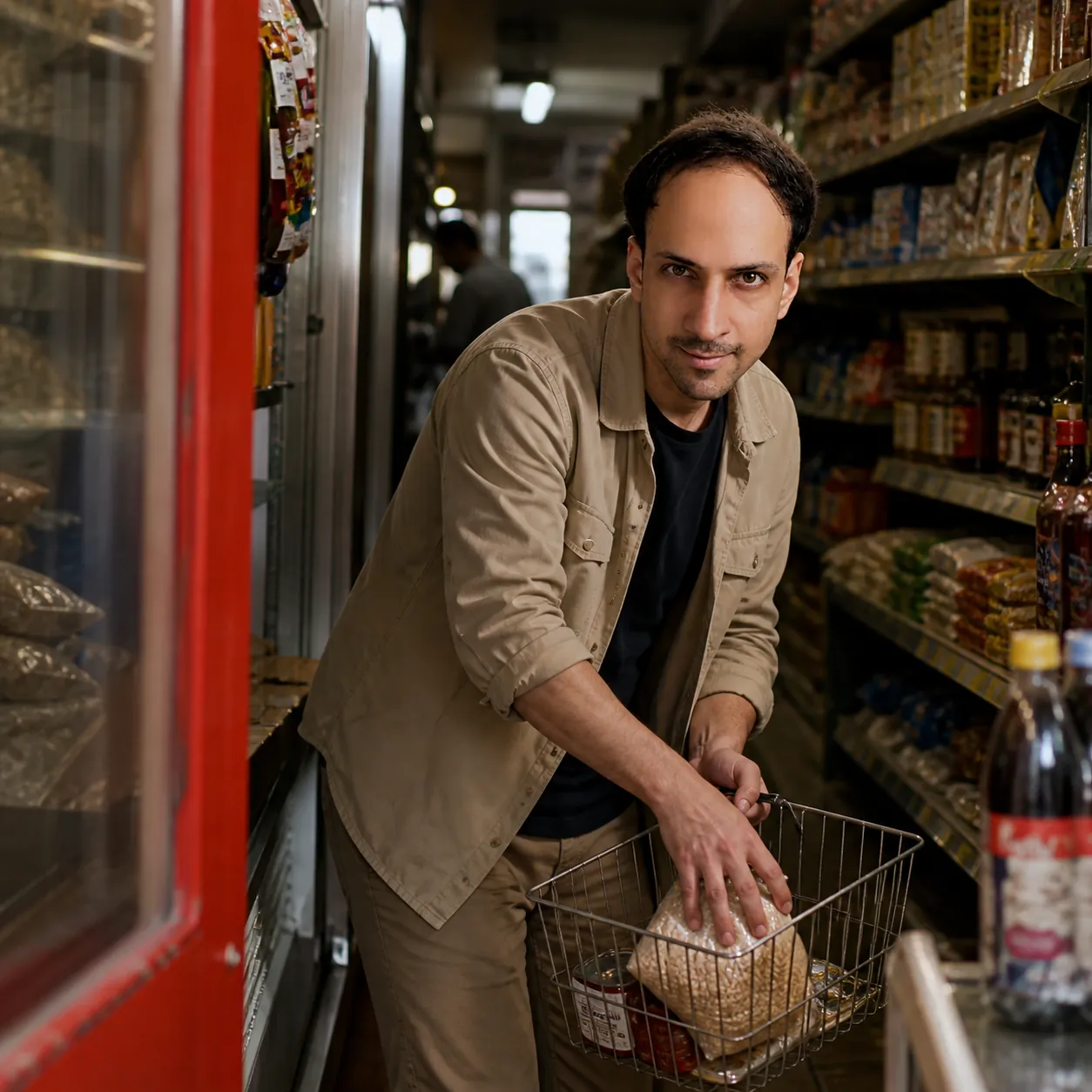
One Item Before the Rush — AI Portrait Prompt
صورةAI Portraits

Turn your own photo into a museum-grade domestic portrait in a corner grocery's narrow aisle twenty minutes before its evening rush. Keeps your face unchanged.

من نص البرومبت

Use the attached reference photo as the identity reference: keep the same face, skin tone, hair and features as the person in that photo, without beautifying, aging or altering them. Create a square 1:1 museum-catalog frame with a strong first read and a slower second read at exactly 2880x2880 pixels. Location: a corner grocery's narrow aisle twenty minutes before its evening rush. Show the subject in a sand-coloured overshirt over a dark tee and canvas trousers, lowering one item into a wire hand basket. Make this piece of unglamorous evidence the whole argument: a tied refuse sack set down inside their own doorway at the hour when the street finally empties of people spends a whole morning's calculation on something a neighbour does absently. Explore how much invisible work sits behind a chore other people do absently; expression occupied, not expressive, carrying practical wariness, difficulty stated as cost, never as complaint. Use an 85mm view from just off their shoulder, keeping the face readable in three-quarter turn. Make the composition let the prepared object outweigh the unfinished journey behind it. Render it as museum-grade domestic realism combining high-fidelity portrait photography, plain hardware detail, accurate low-light response, and restrained editorial art direction, using a single hallway fitting with the rest of the flat unlit and a palette of smoke grey, bone white, and one faded shopfront red. Photorealistic: this must read as a real photograph from a physical camera, never an illustration, painting, or 3D render. Resolve real surface detail: leather creased along the lines of use, stitching slightly irregular, and edges burnished from contact. Keep one identity-locked person, credible hands and fingers, natural fabric, and coherent scale, contact, reflections, shadows, airflow, deformation, and materials. Background people only when essential, always secondary and clearly different. Avoid rain-streaked window sorrow, huddled foetal poses, blurred crowd chaos, and curtain-peeking paranoia. No text, labels, logos, signatures, watermarks, random symbols, plastic skin, excessive bloom, or glossy AI finish.
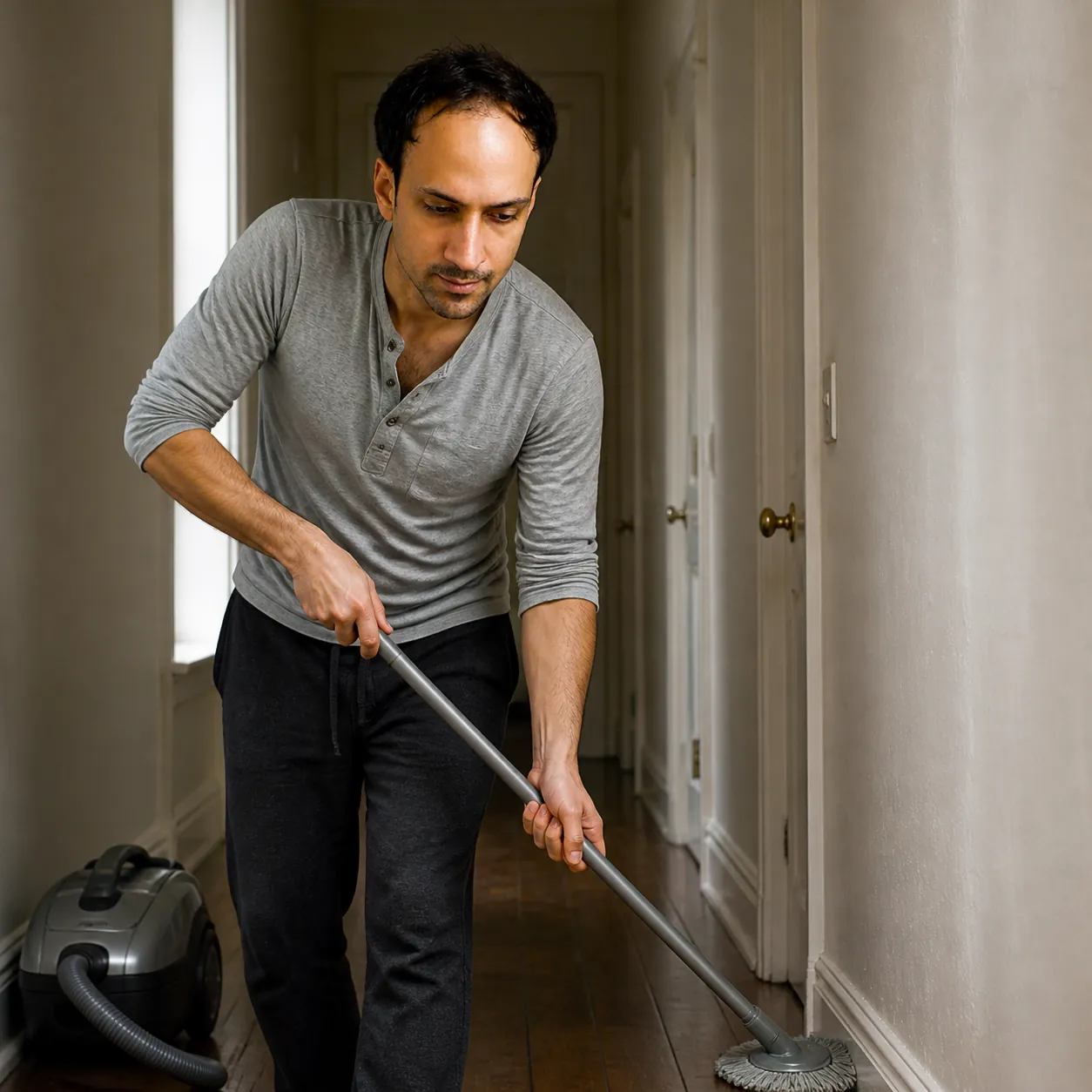
Mopping the Long Corridor — AI Portrait Prompt
صورةAI Portraits

Turn your own photo into an observational domestic portrait in a long inner corridor of the flat with doors along one side. Keeps your face unchanged.

من نص البرومبت

Use the attached reference photo as the identity reference: keep the same face, skin tone, hair and features as the person in that photo, without beautifying, aging or altering them. Create a square 1:1 museum-catalog frame with a strong first read and a slower second read at exactly 2880x2880 pixels. Location: a long inner corridor of the flat with doors along one side. Show them in a heather-grey henley with the sleeves shoved to the elbow, trailing a dust mop along the base of the wall. The difficulty must be visible in this, not in their expression: a vacuum cleaner switched off mid-strip while they identify a sound that turned out to be the building itself turns an ordinary chore into a problem of position and sound. Explore how much extra walking one unbroken sightline is worth to them; expression occupied, not expressive, carrying quiet stubbornness, difficulty stated in the geometry alone. Frame from the near corner at standing height with their hands closest to camera. Make the composition let their standing position read before the chore does. Render it as observational domestic portraiture built from truthful chore staging, exact material texture, ordinary architectural geometry, and quietly unsentimental framing, using overcast daylight from one side with no fill on the other and a palette of off-white paint, brushed steel, and dull brass fittings. Photorealistic: this must read as a real photograph from a physical camera, never an illustration, painting, or 3D render. Resolve real surface detail: visible weave in cloth, fine scratches on metal, and the faint unevenness of painted walls. Keep one identity-locked person, credible hands and fingers, natural fabric, and coherent scale, contact, reflections, shadows, airflow, deformation, and materials. Background people only when essential, always secondary and clearly different. Avoid hero poses, golden-hour wellness glow, eye contact with the lens, and tear-streaked faces. No text, labels, logos, signatures, watermarks, random symbols, plastic skin, excessive bloom, or glossy AI finish.
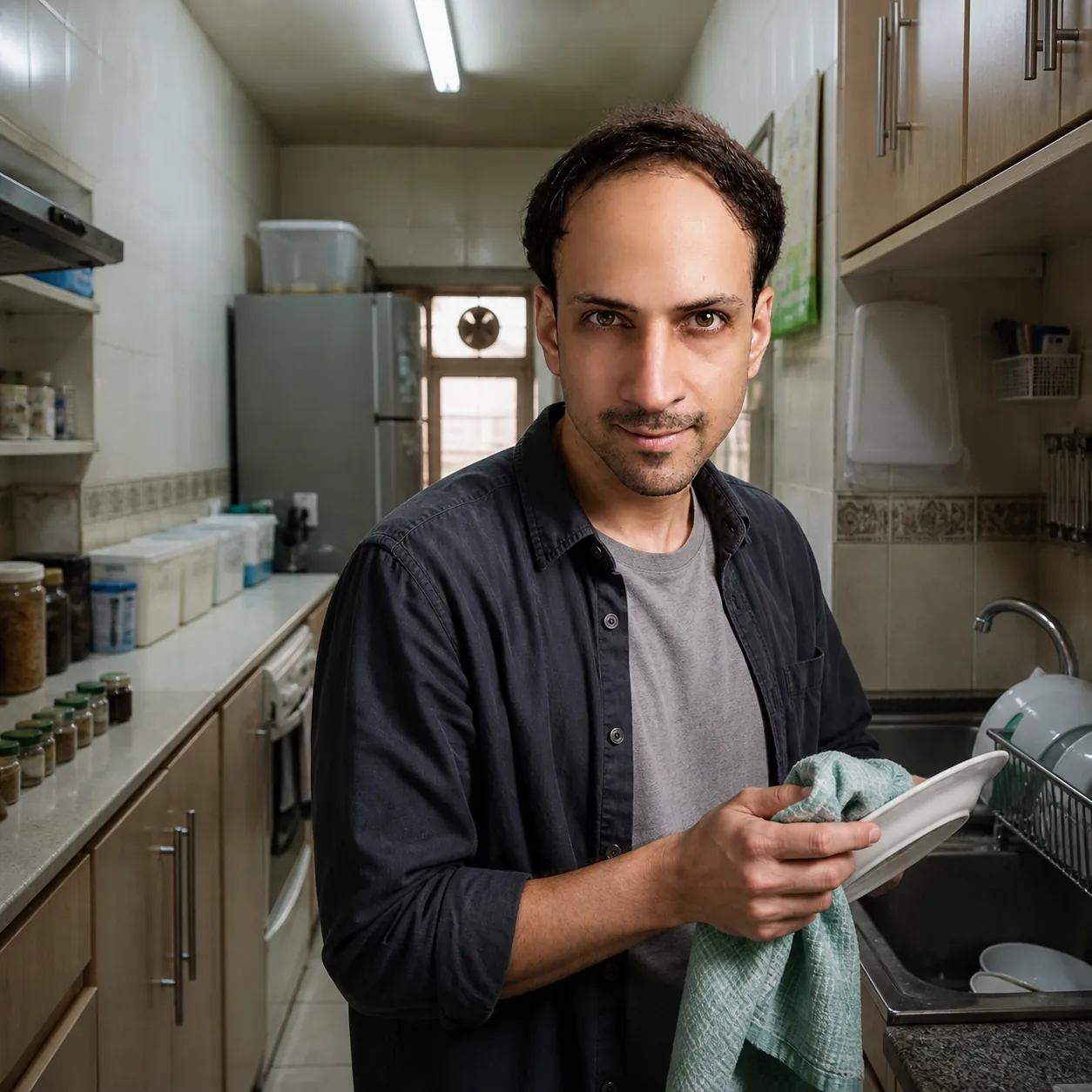
The Missing Jar — AI Portrait Prompt
صورةAI Portraits

Turn your own photo into a photorealistic portrait in a narrow galley kitchen in a Riyadh apartment block, mid-morning. Keeps your face unchanged.

من نص البرومبت

Use the attached reference photo as the identity reference: keep the same face, skin tone, hair and features as the person in that photo, without beautifying, aging or altering them. Create a square 1:1 museum-catalog frame with a strong first read and a slower second read at exactly 2880x2880 pixels. Location: a narrow galley kitchen in a Riyadh apartment block, mid-morning. Show the subject in a plain grey t-shirt under an unbuttoned cotton overshirt, drying one plate with slow even strokes. Anchor the frame to this piece of ordinary evidence: a row of ingredients set out in strict order of use, with a space that is one missing jar wide carries a whole routine on one part that nobody outside would notice. Explore why a small change is never a small problem to solve; expression occupied, not expressive, carrying practical stubbornness, difficulty stated without making it a story. Place the camera at standing height, close enough that one arm's reach fills it. Make the composition weight the small object above the whole room. Render it as restrained editorial realism assembled from ordinary interiors, credible domestic clutter, exact material weight, and composition that refuses to dramatize, using cool fluorescent tube light with honest color and visible skin texture and a palette of pale sand, soft charcoal, and faded plastic green. Photorealistic: this must read as a real photograph from a physical camera, never an illustration, painting, or 3D render. Resolve real surface detail: cotton that hangs by its own weight, seams that pucker very slightly, and collars softened by washing. Keep one identity-locked person, credible hands and fingers, natural fabric, and coherent scale, contact, reflections, shadows, airflow, deformation, and materials. Background people only when essential, always secondary and clearly different. Avoid melancholy posed at windows, showroom kitchens, hands clutching the head, inspirational lighting, and clockwork-brain imagery. No text, labels, logos, signatures, watermarks, random symbols, plastic skin, excessive bloom, or glossy AI finish.
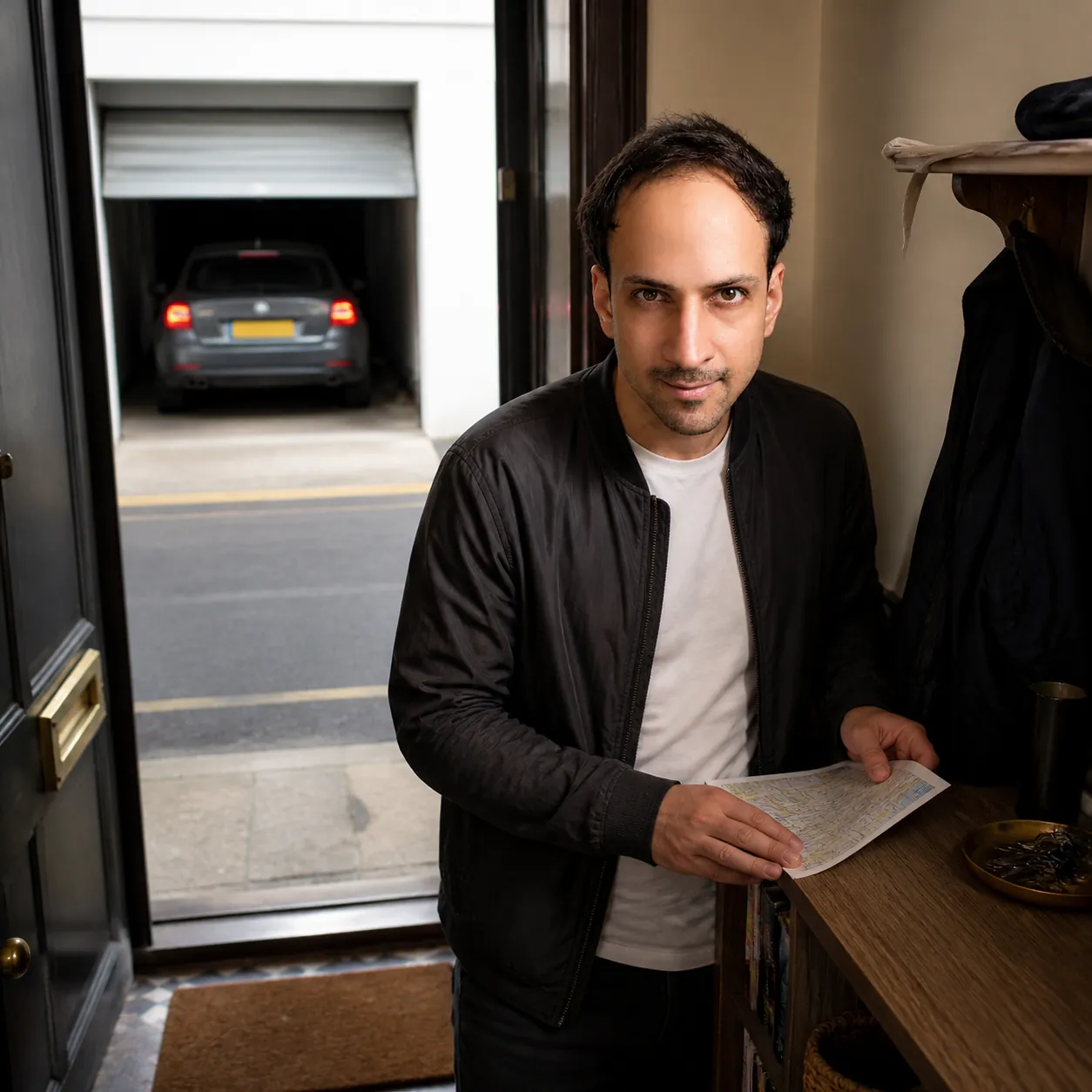
Rehearsing the Route Indoors — AI Portrait Prompt
صورةAI Portraits

Turn your own photo into a gallery-scale observational portrait in a narrow apartment entrance hall with a shelf beside the door. Keeps your face unchanged.

من نص البرومبت

Use the attached reference photo as the identity reference: keep the same face, skin tone, hair and features as the person in that photo, without beautifying, aging or altering them. Create a square 1:1 museum-catalog frame with a strong first read and a slower second read at exactly 2880x2880 pixels. Location: a narrow apartment entrance hall with a shelf beside the door. Show the subject in a charcoal zip-front jacket over a plain white tee, unfolding a route card flat on the hall shelf. Anchor the frame to this piece of ordinary evidence: a car left idling inside a garage whose door is raised on an empty street, the handbrake still up under one hand spends a whole morning's calculation on something a neighbour does absently. Explore how a wanted task and an impossible crossing occupy the same afternoon; expression occupied, not expressive, carrying unhurried stubbornness, difficulty stated in plain working terms. Place the camera low at bag height so the floor and the threshold dominate. Make the composition treat the threshold itself as the picture's structural spine. Render it as gallery-scale observational realism combining tactile household objects, truthful stairwell and forecourt materials, natural fabric behaviour, and calm human-centred composition, using a single hallway fitting with the rest of the flat unlit and a palette of warm plaster, dark walnut, and one band of brass. Photorealistic: this must read as a real photograph from a physical camera, never an illustration, painting, or 3D render. Resolve real surface detail: cotton that hangs by its own weight, seams that pucker very slightly, and collars softened by washing. Keep one identity-locked person, credible hands and fingers, natural fabric, and coherent scale, contact, reflections, shadows, airflow, deformation, and materials. Background people only when essential, always secondary and clearly different. Avoid rain-streaked window sorrow, huddled foetal poses, blurred crowd chaos, and curtain-peeking paranoia. No text, labels, logos, signatures, watermarks, random symbols, plastic skin, excessive bloom, or glossy AI finish.
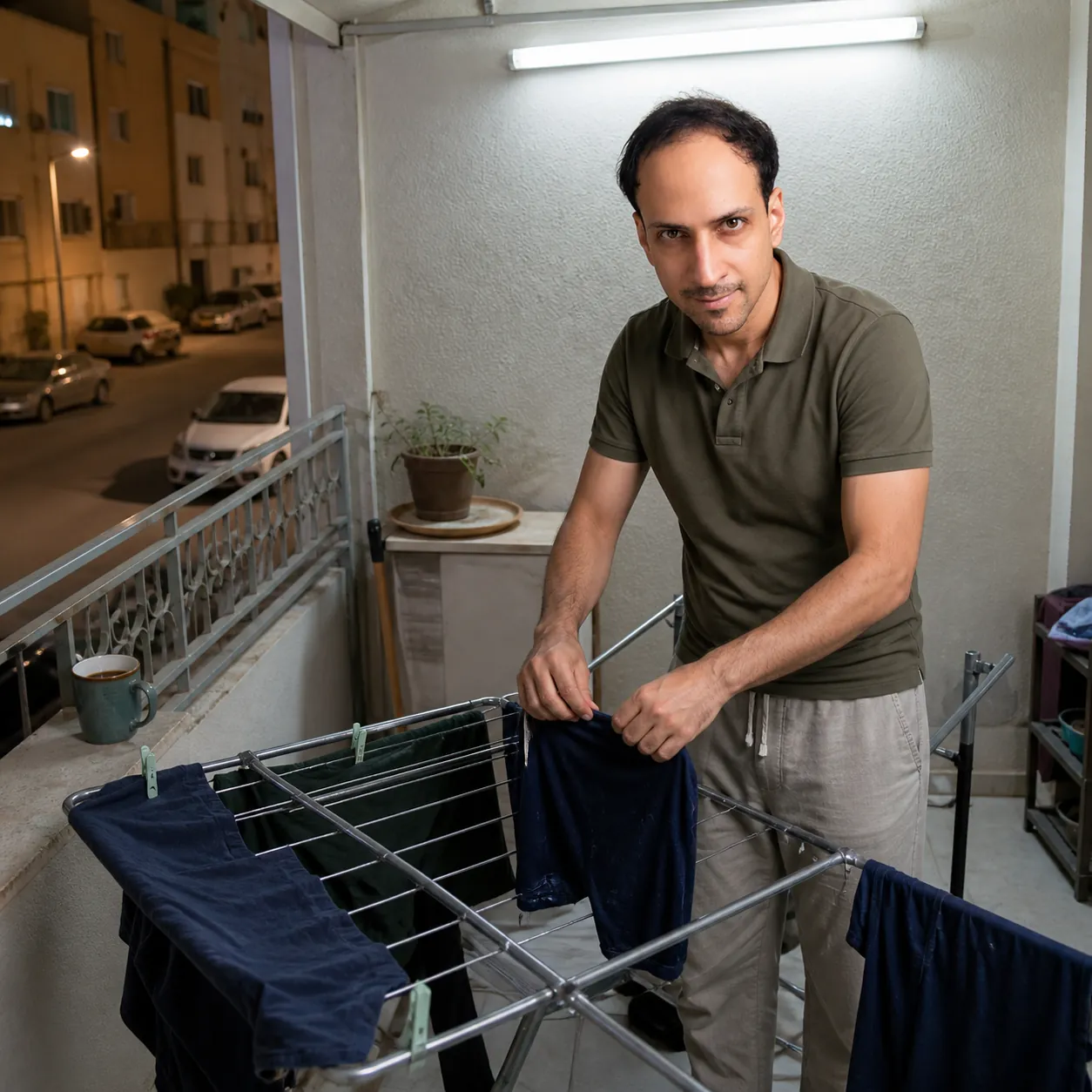
The Mug in the Wrong Slot — AI Portrait Prompt
صورةAI Portraits

Turn your own photo into a museum-grade domestic portrait in a shaded apartment balcony overlooking a quiet Riyadh side street. Keeps your face unchanged.

من نص البرومبت

Use the attached reference photo as the identity reference: keep the same face, skin tone, hair and features as the person in that photo, without beautifying, aging or altering them. Create a square 1:1 museum-catalog frame with a strong first read and a slower second read at exactly 2880x2880 pixels. Location: a shaded apartment balcony overlooking a quiet Riyadh side street. Show the subject in a faded olive polo and soft drawstring trousers, clipping a damp shirt onto a folding rack. Make this piece of unglamorous evidence the whole argument: a mug that sits in the wrong slot, a clean ring in the dust still holding its true position carries a whole routine on one part that nobody outside would notice. Explore how much unseen structure a routine holds before anyone notices; expression occupied, not expressive, carrying sober adaptation, difficulty stated without inviting pity. Use a slightly high 40mm angle that shows the whole interrupted arrangement at once. Make the composition let the routine's line visibly break at one point. Render it as museum-grade domestic portraiture combining plain reportage framing, truthful worn surfaces, physically correct contact shadows, and unhurried everyday staging, using cool fluorescent tube light with honest color and visible skin texture and a palette of muted olive, chalk white, and dulled brushed steel. Photorealistic: this must read as a real photograph from a physical camera, never an illustration, painting, or 3D render. Resolve real surface detail: leather creased along the lines of use, stitching slightly irregular, and edges burnished from contact. Keep one identity-locked person, credible hands and fingers, natural fabric, and coherent scale, contact, reflections, shadows, airflow, deformation, and materials. Background people only when essential, always secondary and clearly different. Avoid melancholy posed at windows, showroom kitchens, hands clutching the head, inspirational lighting, and clockwork-brain imagery. No text, labels, logos, signatures, watermarks, random symbols, plastic skin, excessive bloom, or glossy AI finish.
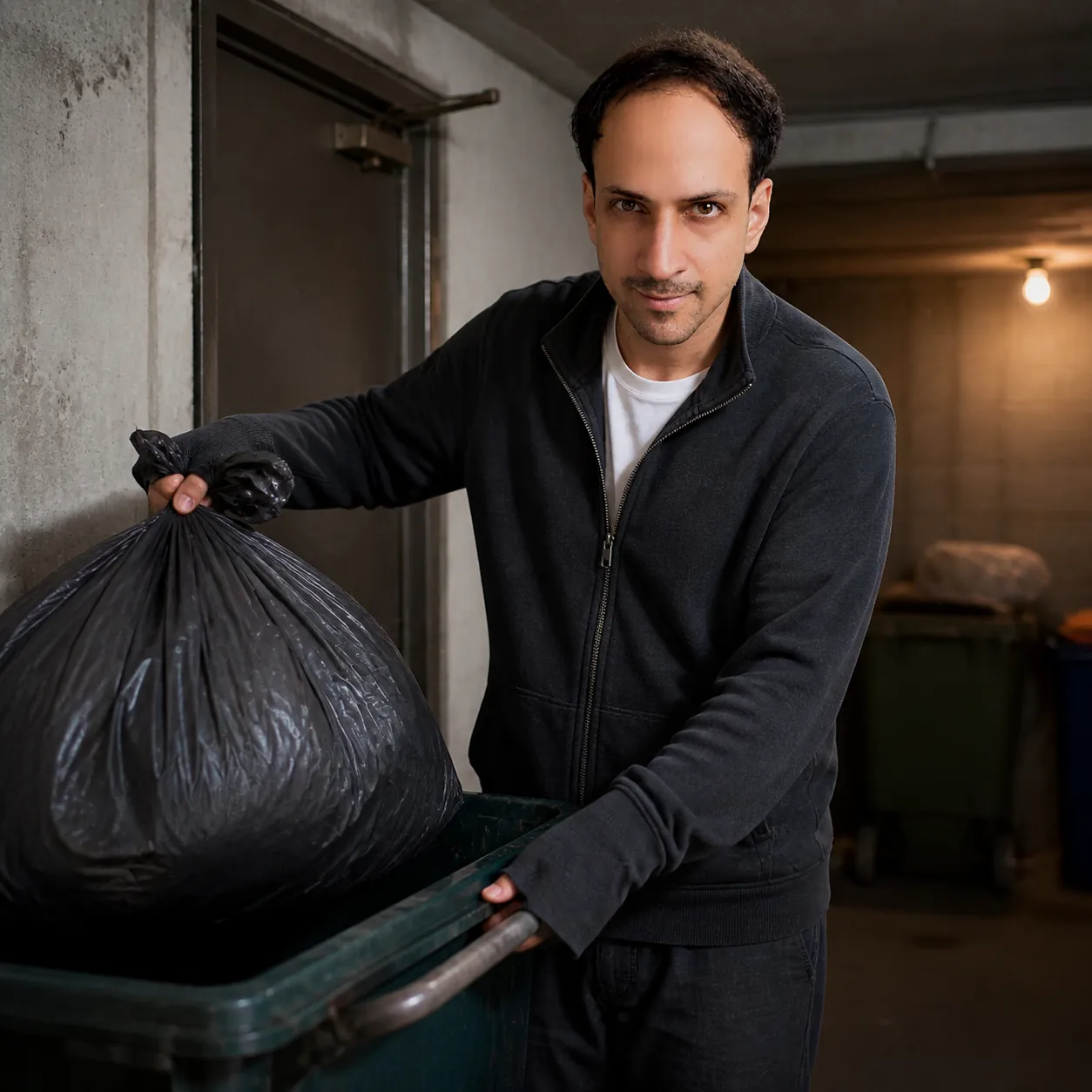
A Sleeve Over the Palm — AI Portrait Prompt
صورةAI Portraits

Turn your own photo into a quiet domestic documentary portrait in a ground-floor bin store behind an apartment block's rear door. Keeps your face unchanged.

من نص البرومبت

Use the attached reference photo as the identity reference: keep the same face, skin tone, hair and features as the person in that photo, without beautifying, aging or altering them. Create a square 1:1 museum-catalog frame with a strong first read and a slower second read at exactly 2880x2880 pixels. Location: a ground-floor bin store behind an apartment block's rear door. Show the subject in a dark grey zip-front sweatshirt over a white tee, setting a knotted liner down beside the wheeled bin. The difficulty must be visible in this, not in their expression: a sleeve pulled down over the palm before a cold metal handle is taken, cotton standing in for bare skin makes the cost of an ordinary chore visible without making it a complaint. Explore whether the work should be measured by its result or by its price; expression occupied, not expressive, carrying measured endurance, difficulty stated as one more logistical fact. Use a 35mm standing viewpoint with true proportions and no wide-angle distortion at the edges. Make the composition weight the near object heavier than the room behind it. Render it as quiet domestic documentary realism combining unstyled interior photography, tactile household materials, honest working light, and unhurried observational framing, using a single low lamp against an otherwise dim room and a palette of cool white, pale concrete, and one muted teal. Photorealistic: this must read as a real photograph from a physical camera, never an illustration, painting, or 3D render. Resolve real surface detail: wood grain read at honest scale, matte and gloss clearly separated, and no surface uniformly clean. Keep one identity-locked person, credible hands and fingers, natural fabric, and coherent scale, contact, reflections, shadows, airflow, deformation, and materials. Background people only when essential, always secondary and clearly different. Avoid hands clamped over ears, meltdown theatrics, and hero poses at camera. No text, labels, logos, signatures, watermarks, random symbols, plastic skin, excessive bloom, or glossy AI finish.
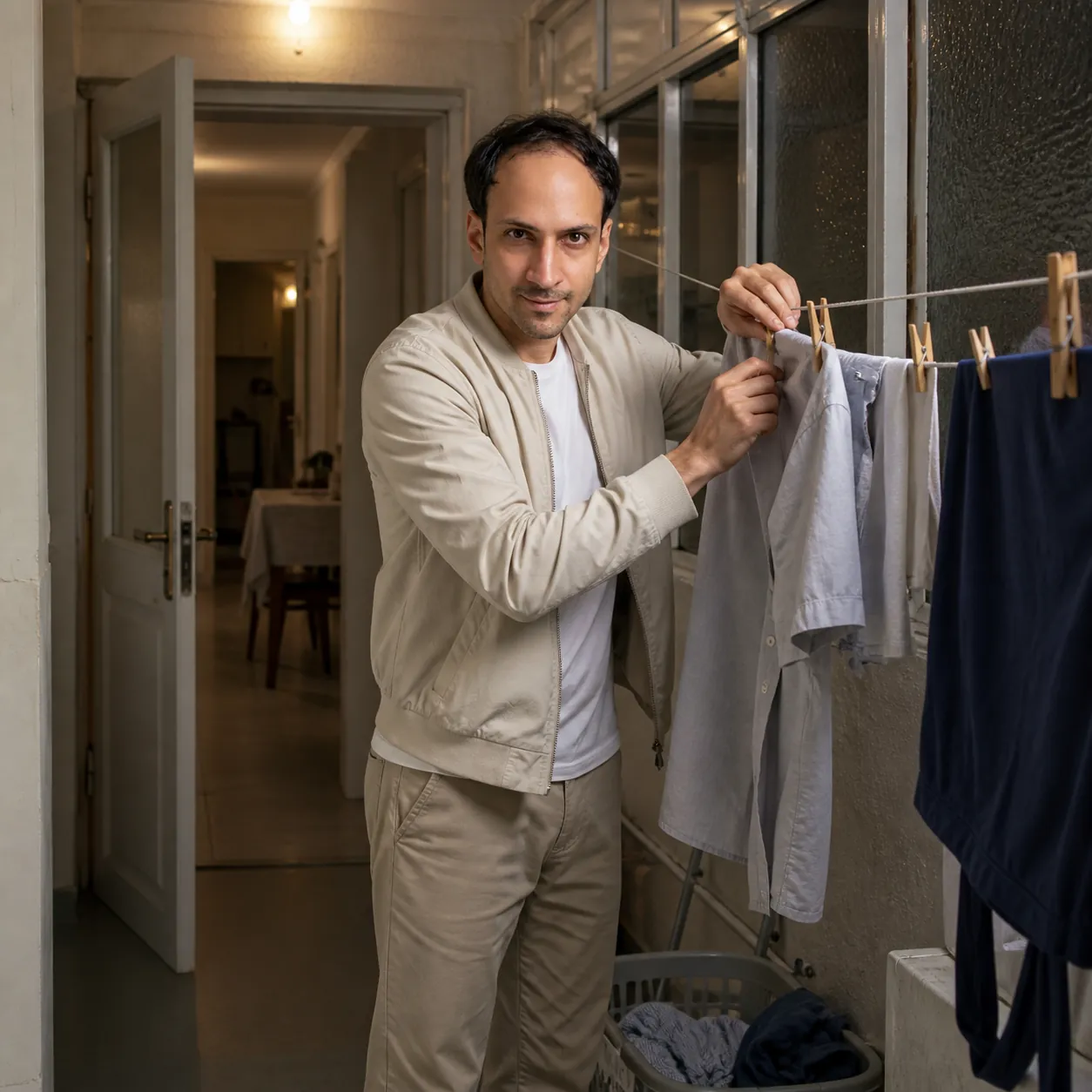
Laundry With the Rooms Behind — AI Portrait Prompt
صورةAI Portraits

Turn your own photo into a gallery-scale everyday portrait in an enclosed balcony with a washing line and the flat behind. Keeps your face unchanged.

من نص البرومبت

Use the attached reference photo as the identity reference: keep the same face, skin tone, hair and features as the person in that photo, without beautifying, aging or altering them. Create a square 1:1 museum-catalog frame with a strong first read and a slower second read at exactly 2880x2880 pixels. Location: an enclosed balcony with a washing line and the flat behind. Show them in a light zip-up jacket over a plain tee and canvas trousers, pegging a shirt to the line one corner at a time. Anchor the frame to this piece of ordinary evidence: an outer door propped wide in cold weather so the rooms behind them are never shut out holds an ordinary task open a moment longer than the task requires. Explore how one small allowance can cost more than the whole precaution; expression occupied, not expressive, carrying worn resolve, difficulty stated the way furniture states itself. Place the lens beside the task at working height with the far wall sharp. Make the composition show the extra distance their arrangement adds. Render it as gallery-scale everyday realism combining high-fidelity portrait photography, working household objects, and physically accurate shadow and reflection, using one corridor bulb doing most of the work with soft ambient spill and a palette of off-white paint, brushed steel, and dull brass fittings. Photorealistic: this must read as a real photograph from a physical camera, never an illustration, painting, or 3D render. Resolve real surface detail: hair with individual strands catching light, short facial hair of uneven length, and skin oil giving a low uneven sheen. Keep one identity-locked person, credible hands and fingers, natural fabric, and coherent scale, contact, reflections, shadows, airflow, deformation, and materials. Background people only when essential, always secondary and clearly different. Avoid thriller shadows, keyhole peering, weapons or uniforms, and staged startle reactions. No text, labels, logos, signatures, watermarks, random symbols, plastic skin, excessive bloom, or glossy AI finish.
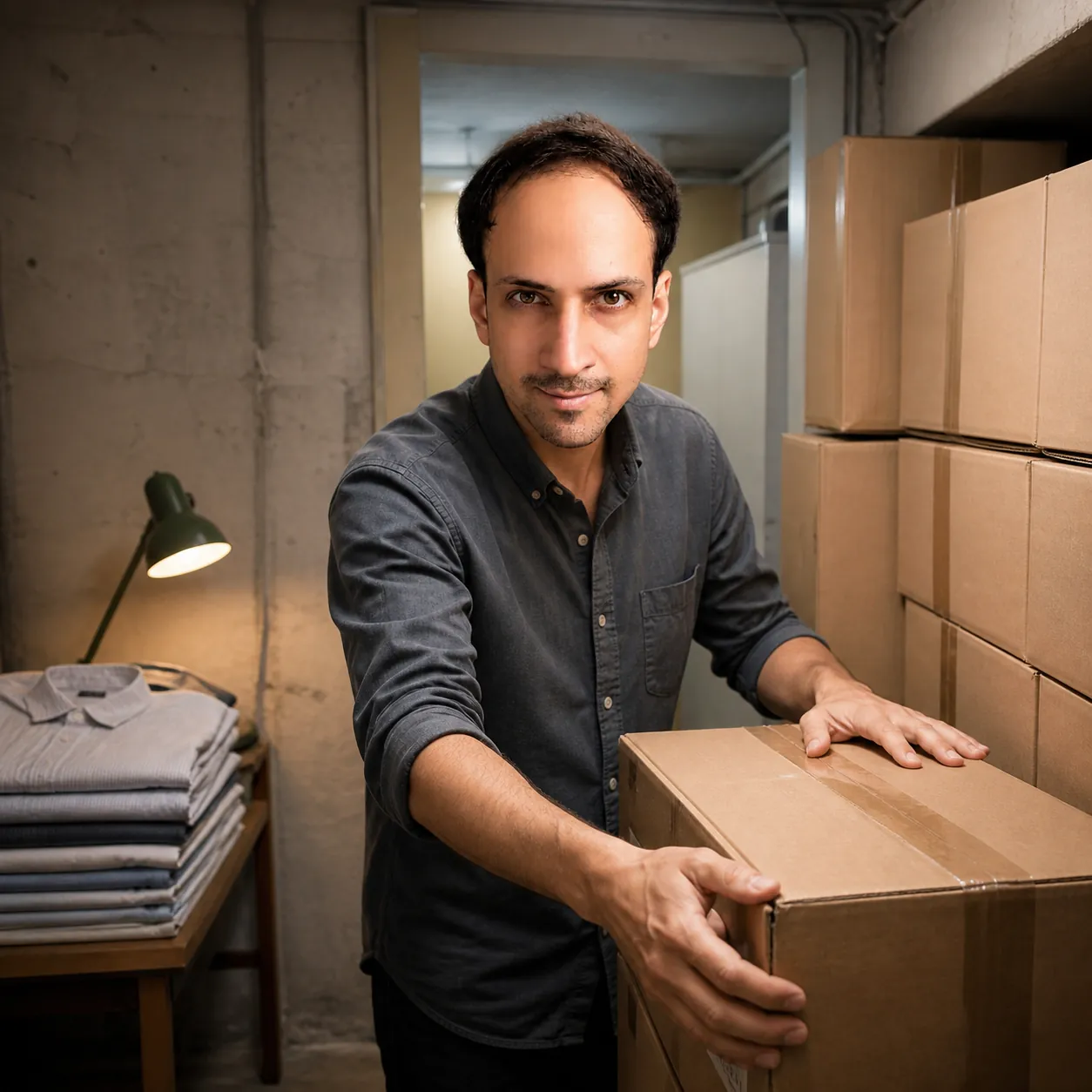
Three Identical Screwdrivers — AI Portrait Prompt
صورةAI Portraits

Turn your own photo into a museum-grade domestic portrait in a small back room stacked shoulder-high with taped cardboard boxes. Keeps your face unchanged.

من نص البرومبت

Use the attached reference photo as the identity reference: keep the same face, skin tone, hair and features as the person in that photo, without beautifying, aging or altering them. Create a square 1:1 museum-catalog frame with a strong first read and a slower second read at exactly 2880x2880 pixels. Location: a small back room stacked shoulder-high with taped cardboard boxes. Show the subject in a charcoal work shirt buttoned to the second button, sliding one taped box forward on the stack. Let one honest object carry what the face will not: a folded stack of pressed shirts kept in a size that will come back, squared and faced one way turns a small errand into the longest decision of the week. Explore what a room owes to the future it has been furnished for; expression occupied, not expressive, carrying steady thrift, difficulty stated quietly enough to be missed once. Use an eye-level 50mm view with kept objects and hands on one plane. Make the composition keep every stacked edge parallel and every surface visibly clean. Render it as museum-grade domestic portraiture built from plain-room reportage, accurate cardboard and glass materiality, restrained art direction, and unsentimental observation, using a low domestic lamp plus spill from the corridor, both plainly motivated and a palette of bleached linen, concrete grey, and a single olive accent. Photorealistic: this must read as a real photograph from a physical camera, never an illustration, painting, or 3D render. Resolve real surface detail: fine grit in the texture of concrete, efflorescence at damp edges, and hairline cracks that follow stress. Keep one identity-locked person, credible hands and fingers, natural fabric, and coherent scale, contact, reflections, shadows, airflow, deformation, and materials. Background people only when essential, always secondary and clearly different. Avoid squalor, vermin, rotting food, hero-poster staging, and any wellness-aesthetic glow that replaces visible work. No text, labels, logos, signatures, watermarks, random symbols, plastic skin, excessive bloom, or glossy AI finish.
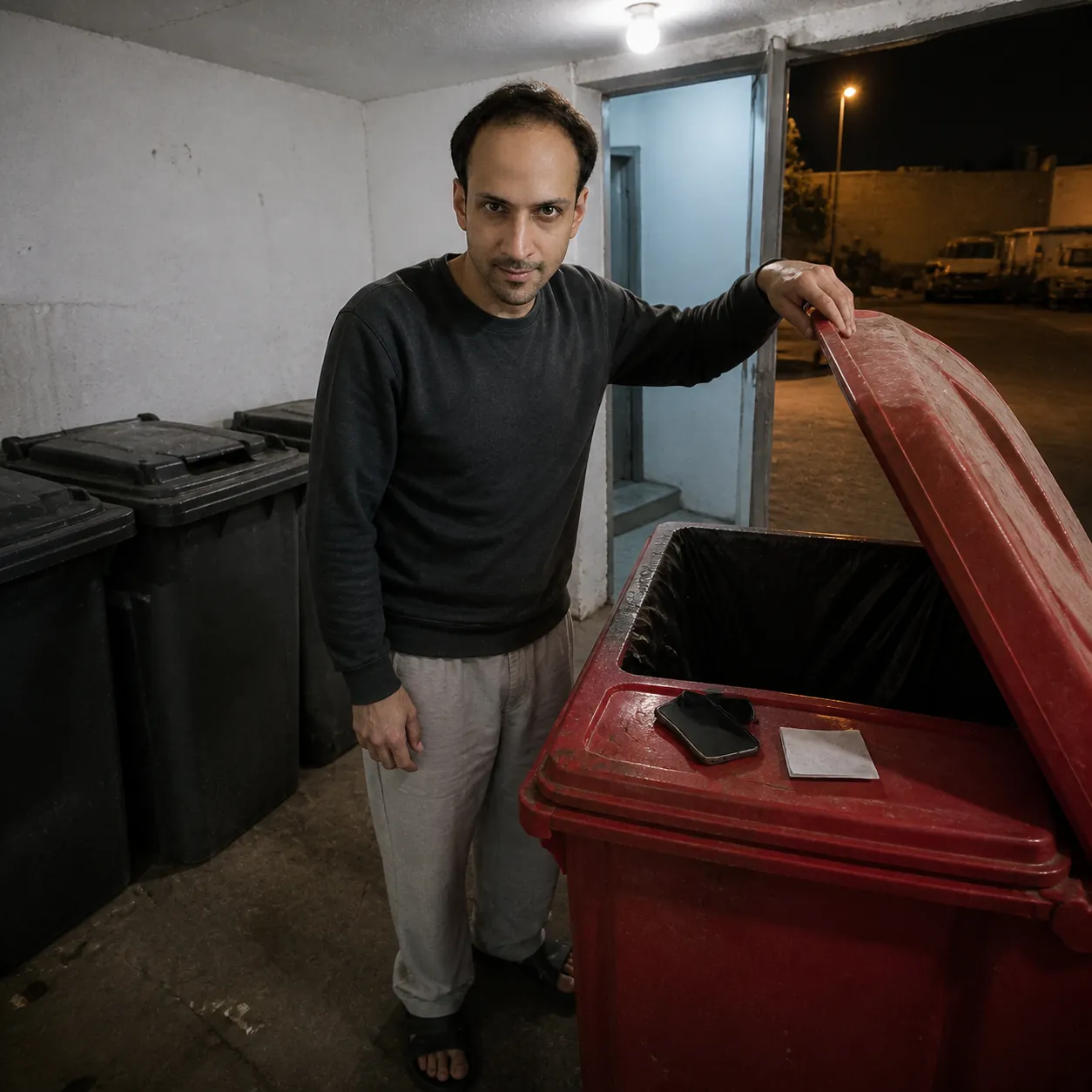
Bin Store After the Call — AI Portrait Prompt
صورةAI Portraits

Turn your own photo into a quiet civic-documentary portrait in a building's ground-floor bin store lit by one bare fitting. Keeps your face unchanged.

من نص البرومبت

Use the attached reference photo as the identity reference: keep the same face, skin tone, hair and features as the person in that photo, without beautifying, aging or altering them. Create a square 1:1 museum-catalog frame with a strong first read and a slower second read at exactly 2880x2880 pixels. Location: a building's ground-floor bin store lit by one bare fitting. Show the subject in a dark grey sweatshirt over loose cotton trousers and slip-on sandals, tipping a lid open with the back of one wrist. Build the image around this small, exact tableau: a pharmacy collection slip that lies face-down beside a silent phone, the call already made so the counter visit stays brief turns an ordinary errand into the day's largest piece of engineering. Explore whether timing a chore to an empty street is strategy or surrender; expression occupied, not expressive, carrying earned matter-of-factness, difficulty stated with the flatness of routine. Frame at chest height so their hands and their eyes sit on one focal plane. Make the composition keep the way out visible without letting it dominate. Render it as quiet civic-documentary portraiture built from real errand logistics, contemporary Saudi street texture, honest domestic materials, and unhurried observational framing, using one sodium streetlight reaching a doorway with cool interior spill behind them and a palette of smoke grey, bone white, and one faded shopfront red. Photorealistic: this must read as a real photograph from a physical camera, never an illustration, painting, or 3D render. Resolve real surface detail: brass darkened in the recesses and bright where thumbs land, and lacquer crazed rather than perfect. Keep one identity-locked person, credible hands and fingers, natural fabric, and coherent scale, contact, reflections, shadows, airflow, deformation, and materials. Background people only when essential, always secondary and clearly different. Avoid hero-poster stances, golden-hour wellness glow, posing at camera, and chest-clutching gestures. No text, labels, logos, signatures, watermarks, random symbols, plastic skin, excessive bloom, or glossy AI finish.
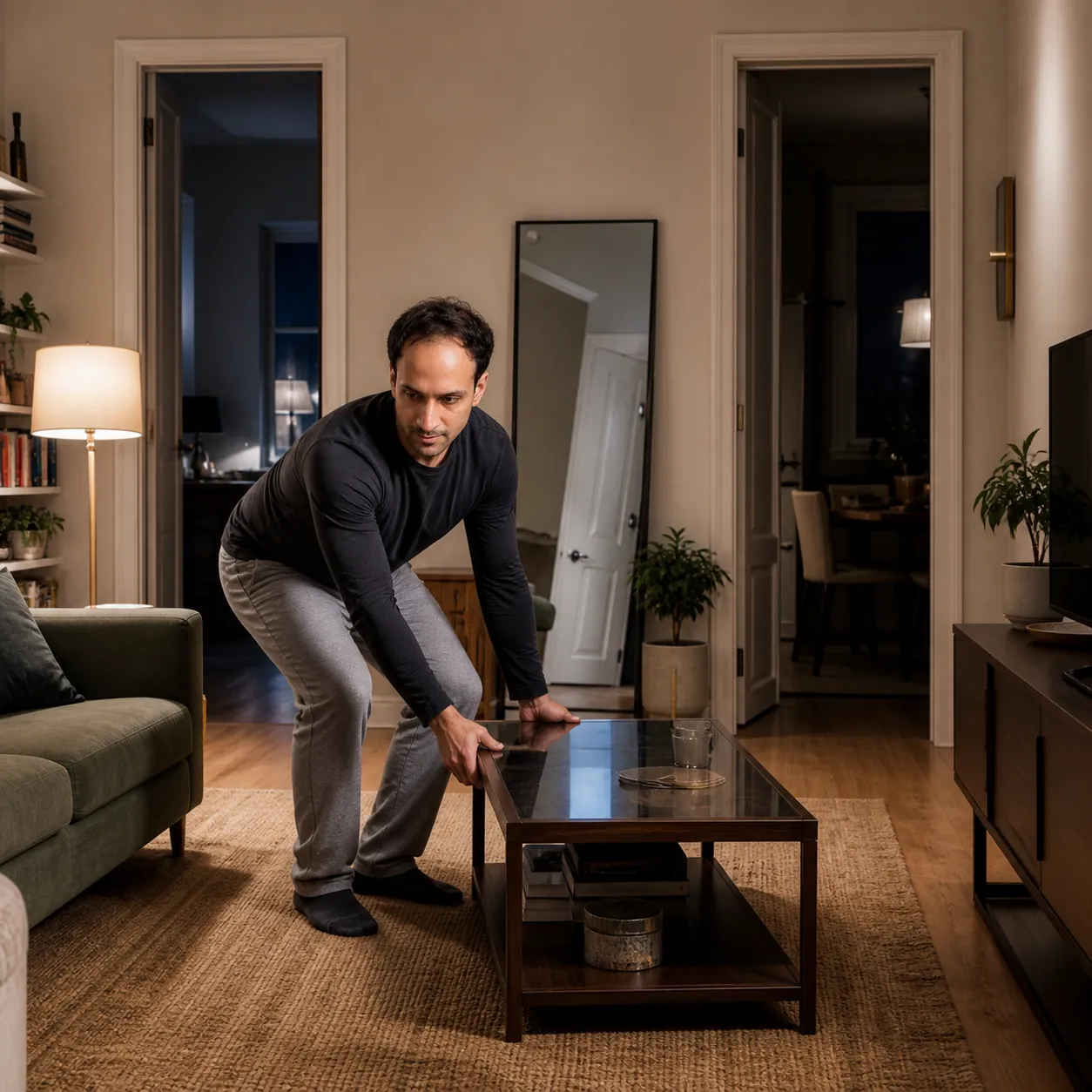
The Off-Square Mirror — AI Portrait Prompt
صورةAI Portraits

Turn your own photo into a quiet domestic documentary portrait in a sitting room where two doorways face each other across the rug. Keeps your face unchanged.

من نص البرومبت

Use the attached reference photo as the identity reference: keep the same face, skin tone, hair and features as the person in that photo, without beautifying, aging or altering them. Create a square 1:1 museum-catalog frame with a strong first read and a slower second read at exactly 2880x2880 pixels. Location: a sitting room where two doorways face each other across the rug. Show them in a charcoal long-sleeve tee and soft grey lounge trousers, nudging a low table back onto its floor marks. Let one honest object carry what the face will not: a shaving mirror turned off-square to the wall so the open door stays in the glass beside their jaw turns an ordinary chore into a problem of position and sound. Explore what it costs to keep a whole flat accounted for while working; expression occupied, not expressive, carrying quiet stubbornness, difficulty stated as arrangement rather than distress. Use a 50mm eye-level view from the side of the room they left open. Make the composition keep the far end as legible as their hands. Render it as quiet domestic documentary realism combining unposed portrait photography, honest interior materials, accurate household light, and unhurried observational framing, using low evening interior light with the far rooms left dimmer and a palette of off-white paint, brushed steel, and dull brass fittings. Photorealistic: this must read as a real photograph from a physical camera, never an illustration, painting, or 3D render. Resolve real surface detail: the difference between a wiped surface and a clean one, faint tide marks on ceramic, and metal dulled unevenly by touch. Keep one identity-locked person, credible hands and fingers, natural fabric, and coherent scale, contact, reflections, shadows, airflow, deformation, and materials. Background people only when essential, always secondary and clearly different. Avoid hero poses, golden-hour wellness glow, eye contact with the lens, and tear-streaked faces. No text, labels, logos, signatures, watermarks, random symbols, plastic skin, excessive bloom, or glossy AI finish.
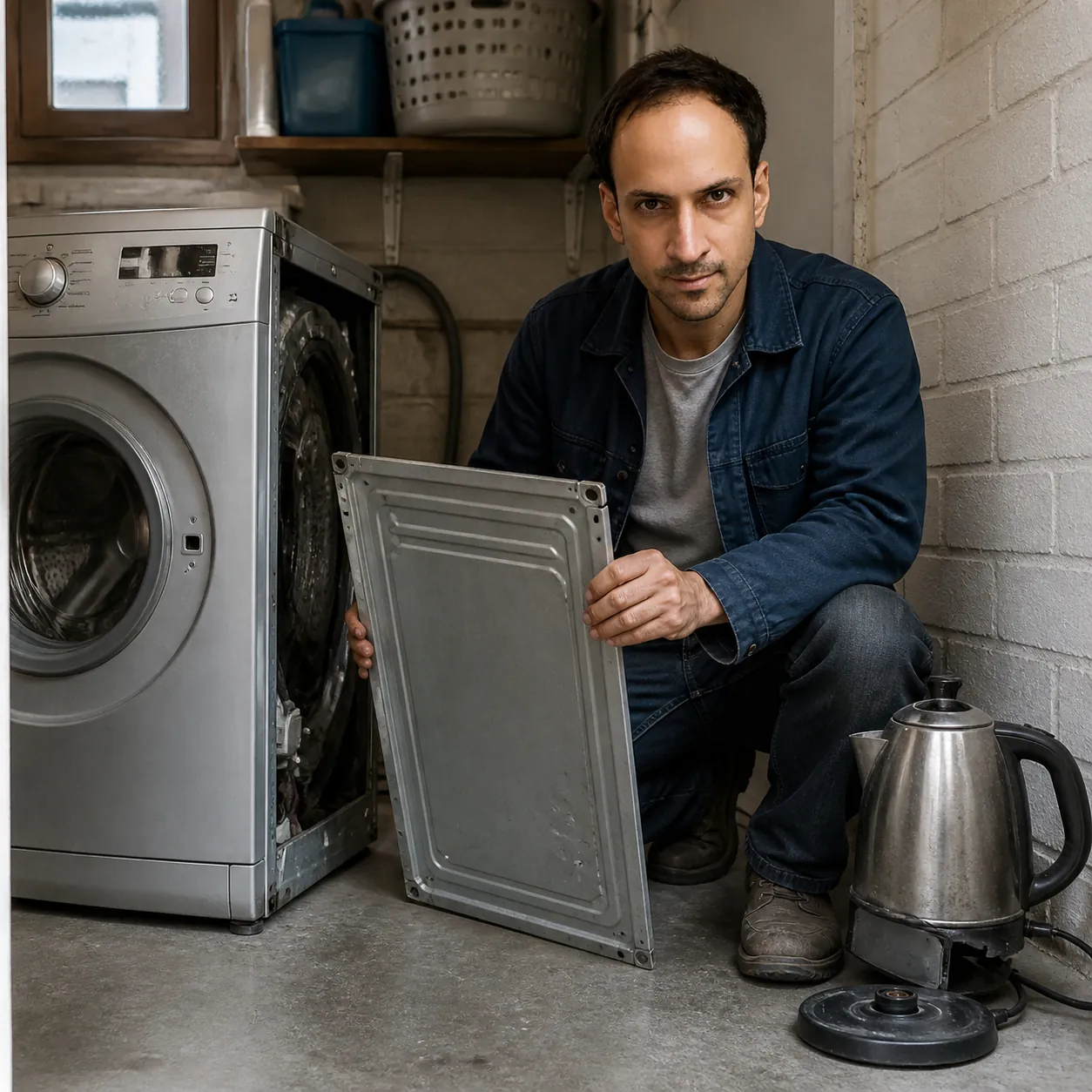
The Unplugged Washing Machine — AI Portrait Prompt
صورةAI Portraits

Turn your own photo into a photorealistic portrait in a laundry corner where a stopped washing machine stands unplugged. Keeps your face unchanged.

من نص البرومبت

Use the attached reference photo as the identity reference: keep the same face, skin tone, hair and features as the person in that photo, without beautifying, aging or altering them. Create a square 1:1 museum-catalog frame with a strong first read and a slower second read at exactly 2880x2880 pixels. Location: a laundry corner where a stopped washing machine stands unplugged. Show the subject in a worn indigo chore jacket over a grey tee, leaning a removed back panel against the wall. Let one honest object carry what the face will not: a stopped electric kettle whose base plate is off because the element inside it is still a perfectly good element turns a small errand into the longest decision of the week. Explore how carrying, re-shelving, and re-deciding can fill an afternoon and leave no trace; expression occupied, not expressive, carrying occupied deliberation, difficulty stated quietly enough to be missed once. Use an eye-level 50mm view with kept objects and hands on one plane. Make the composition give the kept object more definition than the surrounding room. Render it as level-headed household realism assembled from working-storage photography, truthful stacking physics, matte everyday surfaces, and dignified full-length human presence, using unglamorous garage strip lighting balanced by pale daylight at the entrance and a palette of dust beige, cold steel, and one worn indigo note. Photorealistic: this must read as a real photograph from a physical camera, never an illustration, painting, or 3D render. Resolve real surface detail: fine lint on dark fabric, water spotting on steel, and the soft rounding of edges that have been used for years. Keep one identity-locked person, credible hands and fingers, natural fabric, and coherent scale, contact, reflections, shadows, airflow, deformation, and materials. Background people only when essential, always secondary and clearly different. Avoid squalor, vermin, rotting food, hero-poster staging, and any wellness-aesthetic glow that replaces visible work. No text, labels, logos, signatures, watermarks, random symbols, plastic skin, excessive bloom, or glossy AI finish.
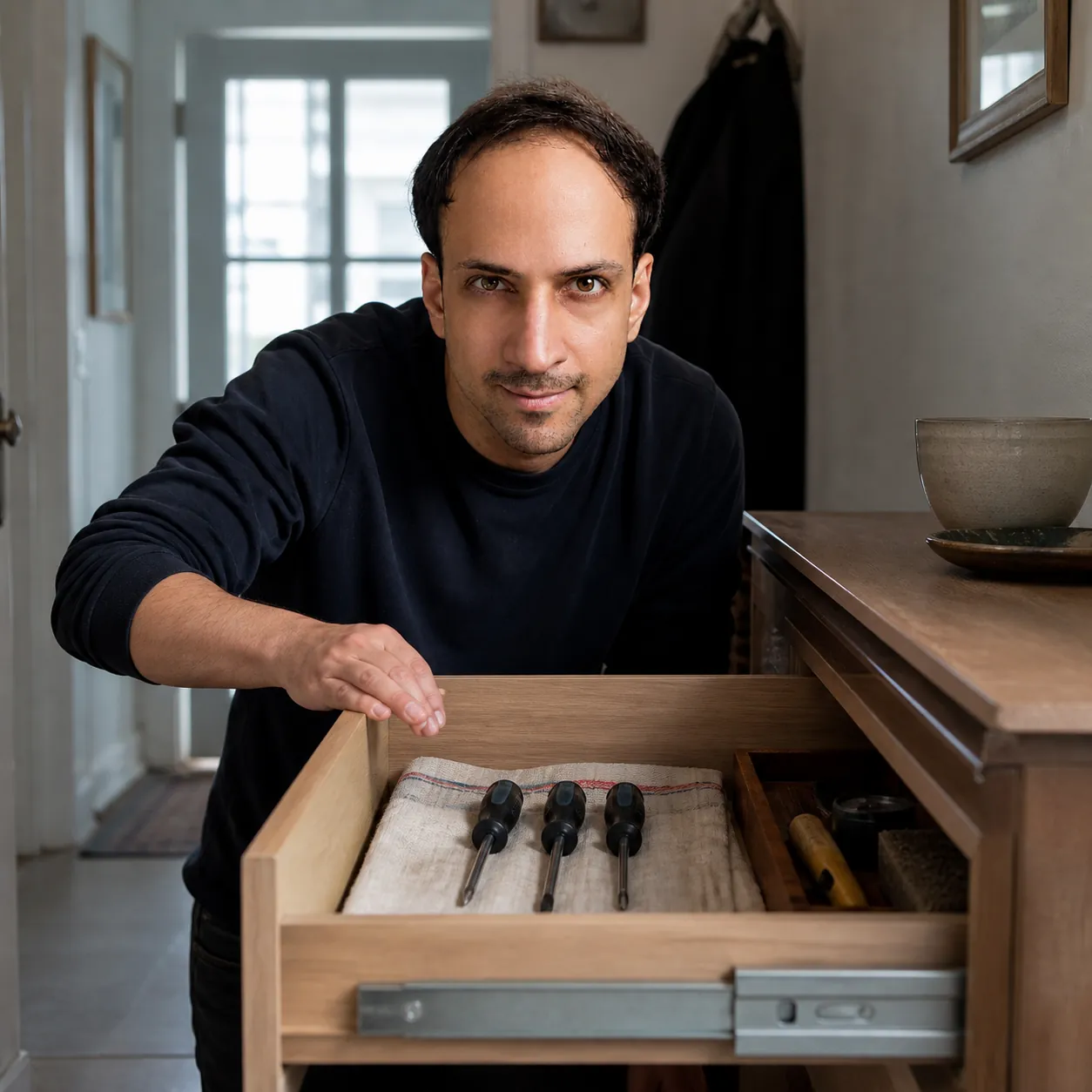
Screwdrivers on a Cloth — AI Portrait Prompt
صورةAI Portraits

Turn your own photo into a quiet domestic documentary portrait in a hallway console drawer pulled right out onto its runners. Keeps your face unchanged.

من نص البرومبت

Use the attached reference photo as the identity reference: keep the same face, skin tone, hair and features as the person in that photo, without beautifying, aging or altering them. Create a square 1:1 museum-catalog frame with a strong first read and a slower second read at exactly 2880x2880 pixels. Location: a hallway console drawer pulled right out onto its runners. Show the subject in a dark navy sweatshirt with the sleeves pushed up, steadying the open drawer with one flat hand. Let one honest object carry what the face will not: a row of three identical screwdrivers on a cloth, each bought on a day the others could not be found turns a small errand into the longest decision of the week. Explore why an object with a use left in it refuses to become rubbish; expression occupied, not expressive, carrying careful reckoning, difficulty stated as household fact. Use an eye-level 50mm view with kept objects and hands on one plane. Make the composition keep every stacked edge parallel and every surface visibly clean. Render it as quiet domestic documentary realism combining unstyled interior photography, honest household materials, precise object description, and unhurried observational framing, using unglamorous garage strip lighting balanced by pale daylight at the entrance and a palette of pale gypsum, tea-stained paper, and a narrow rust accent. Photorealistic: this must read as a real photograph from a physical camera, never an illustration, painting, or 3D render. Resolve real surface detail: the difference between a wiped surface and a clean one, faint tide marks on ceramic, and metal dulled unevenly by touch. Keep one identity-locked person, credible hands and fingers, natural fabric, and coherent scale, contact, reflections, shadows, airflow, deformation, and materials. Background people only when essential, always secondary and clearly different. Avoid squalor, vermin, rotting food, hero-poster staging, and any wellness-aesthetic glow that replaces visible work. No text, labels, logos, signatures, watermarks, random symbols, plastic skin, excessive bloom, or glossy AI finish.
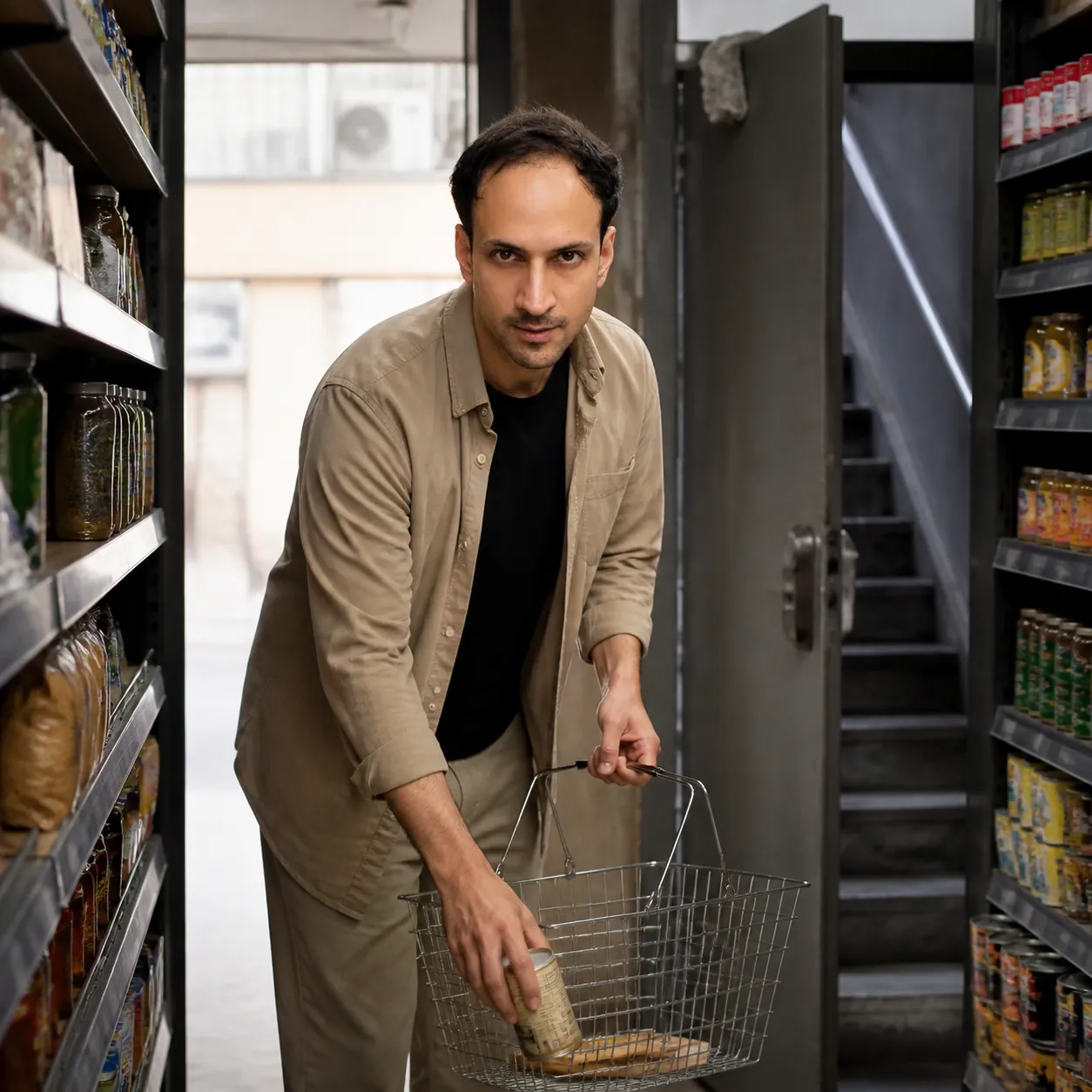
The Basket and the Back Door — AI Portrait Prompt
صورةAI Portraits

Turn your own photo into a portrait in a corner grocery's narrow aisle twenty minutes before its evening rush. Keeps your face unchanged.

من نص البرومبت

Use the attached reference photo as the identity reference: keep the same face, skin tone, hair and features as the person in that photo, without beautifying, aging or altering them. Create a square 1:1 museum-catalog frame with a strong first read and a slower second read at exactly 2880x2880 pixels. Location: a corner grocery's narrow aisle twenty minutes before its evening rush. Show the subject in a sand-coloured overshirt over a dark tee and canvas trousers, lowering one item into a wire hand basket. Let one honest object carry what the face will not: a stairwell fire door that is held open a hand's width by a folded cloth, the lift's call button passed unpressed turns an ordinary errand into the day's largest piece of engineering. Explore what an ordinary threshold weighs once it has been measured this carefully; expression occupied, not expressive, carrying rehearsed steadiness, difficulty stated as logistics rather than lament. Use a 50mm eye-level view from inside the room with the doorway kept at the edge. Make the composition hold measurable distance between their hands and the open air. Render it as quiet civic-documentary portraiture built from real errand logistics, contemporary Saudi street texture, honest domestic materials, and unhurried observational framing, using even overcast daylight entering a shopfront with no warm colour push and a palette of sand beige, iron grey, and one fluorescent blue-white. Photorealistic: this must read as a real photograph from a physical camera, never an illustration, painting, or 3D render. Resolve real surface detail: the difference between a wiped surface and a clean one, faint tide marks on ceramic, and metal dulled unevenly by touch. Keep one identity-locked person, credible hands and fingers, natural fabric, and coherent scale, contact, reflections, shadows, airflow, deformation, and materials. Background people only when essential, always secondary and clearly different. Avoid hero-poster stances, golden-hour wellness glow, posing at camera, and chest-clutching gestures. No text, labels, logos, signatures, watermarks, random symbols, plastic skin, excessive bloom, or glossy AI finish.
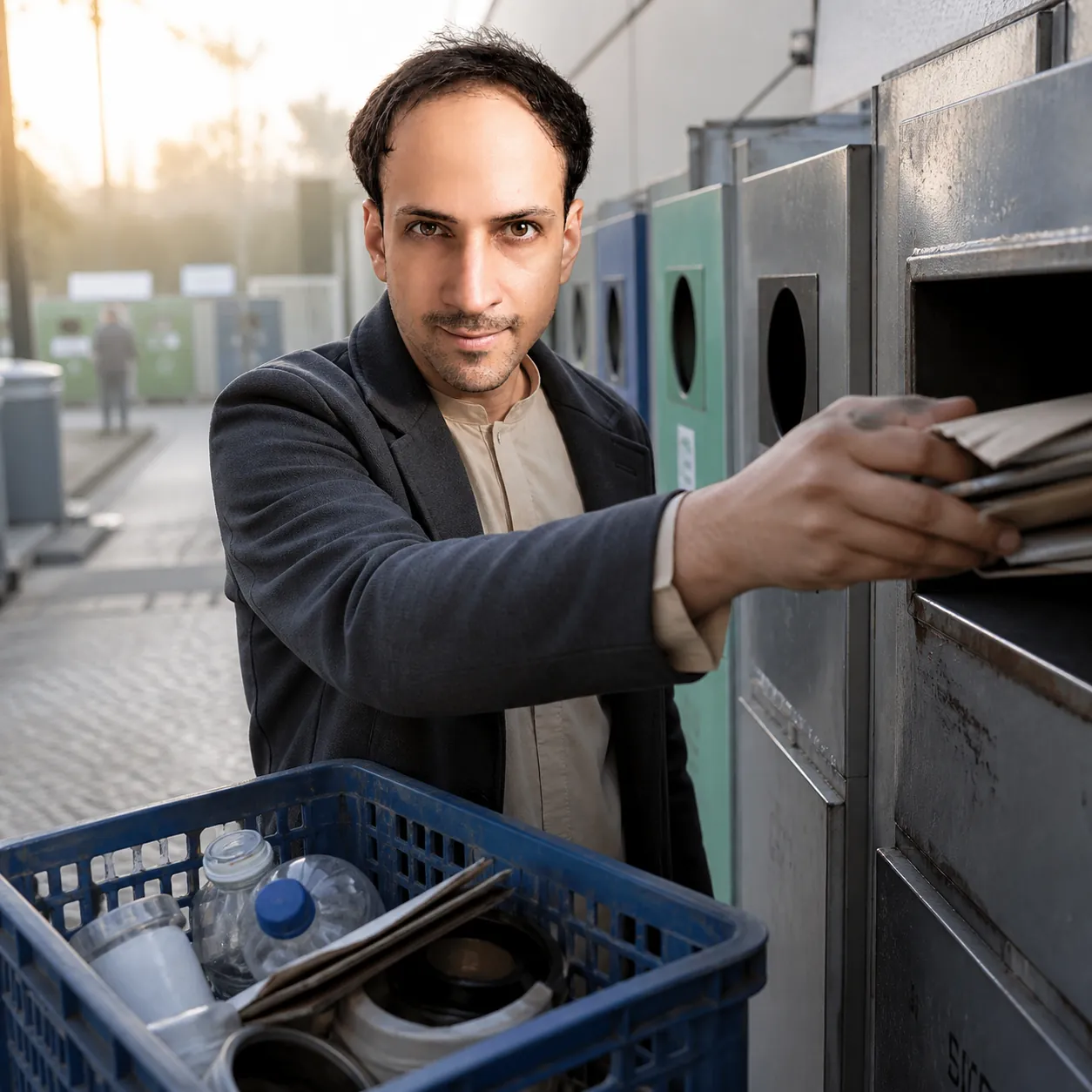
The Bag Not to Be Reopened — AI Portrait Prompt
صورةAI Portraits

Turn your own photo into an archival still-life portrait in a neighbourhood recycling bay at early morning, bins in line. Keeps your face unchanged.

من نص البرومبت

Use the attached reference photo as the identity reference: keep the same face, skin tone, hair and features as the person in that photo, without beautifying, aging or altering them. Create a square 1:1 museum-catalog frame with a strong first read and a slower second read at exactly 2880x2880 pixels. Location: a neighbourhood recycling bay at early morning, bins in line. Show the subject in a plain beige traditional Gulf outfit under a thin dark overcoat, posting a folded bundle through a steel hatch. The difficulty must be visible in this, not in their expression: a plastic crate of things still to be sorted, its handles worn smooth from being carried into a fourth room shows care and accumulation arriving from exactly the same impulse. Explore how order can grow steadily heavier without ever becoming any kind of mess; expression occupied, not expressive, carrying plain persistence, difficulty stated without any note of shame. Hold a static 40mm frame at standing height with their working hand visible. Make the composition put their working hand nearer the lens than their face. Render it as archival still-life portraiture combining catalogue-clear object rendering, believable domestic wear, controlled neutral colour, and patient unstyled editorial realism, using cool morning ambience from an open door, warmed slightly by interior walls and a palette of dust beige, cold steel, and one worn indigo note. Photorealistic: this must read as a real photograph from a physical camera, never an illustration, painting, or 3D render. Resolve real surface detail: rubber gone chalky with age, painted metal chipped to primer, and plastic yellowed only where light reaches it. Keep one identity-locked person, credible hands and fingers, natural fabric, and coherent scale, contact, reflections, shadows, airflow, deformation, and materials. Background people only when essential, always secondary and clearly different. Avoid clear-out crews, shame poses, posing at camera, teetering junk towers, and melancholy without labour. No text, labels, logos, signatures, watermarks, random symbols, plastic skin, excessive bloom, or glossy AI finish.
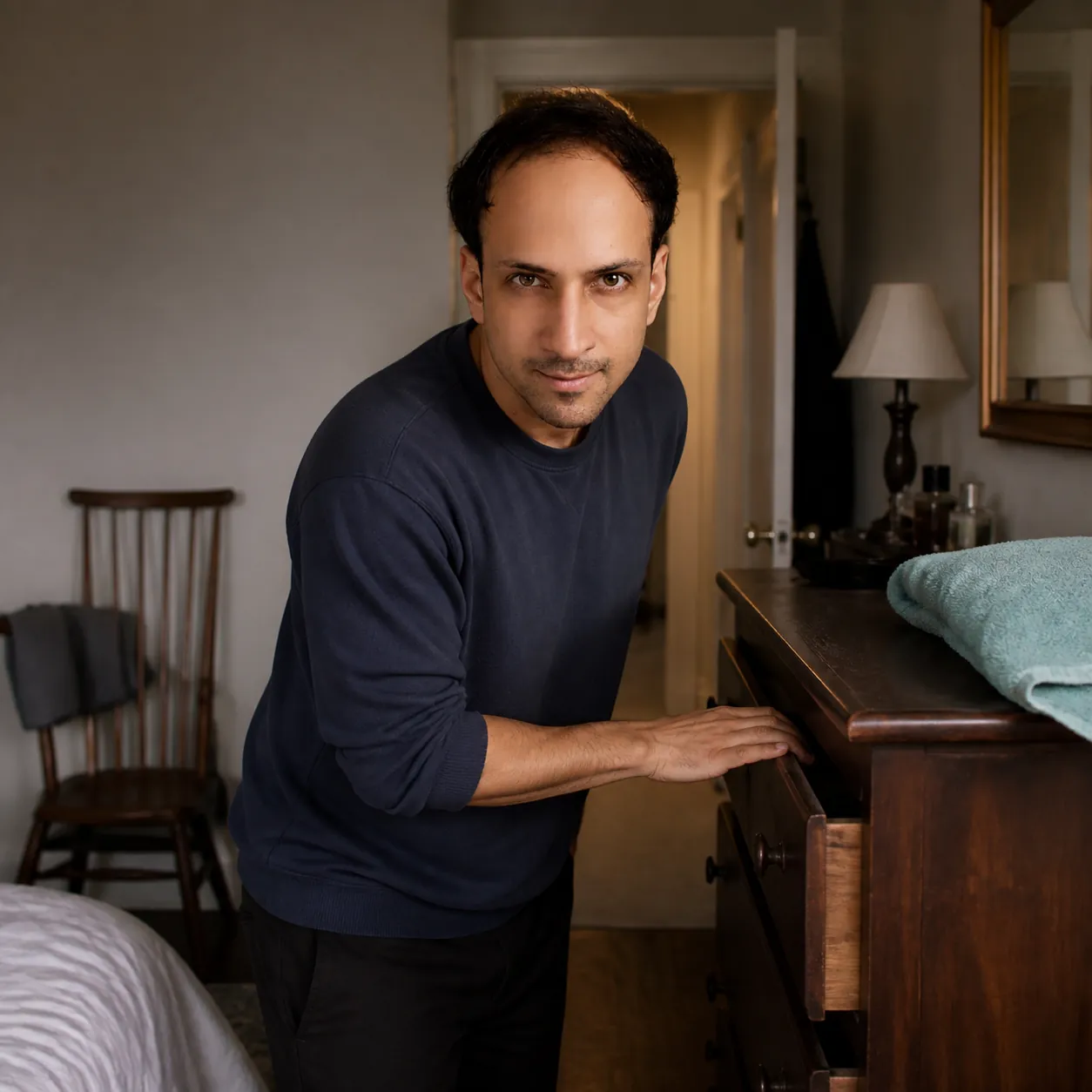
Closing the Drawer by the Door — AI Portrait Prompt
صورةAI Portraits

Turn your own photo into a gallery-scale everyday portrait in a bedroom corner with a chest of drawers beside the door. Keeps your face unchanged.

من نص البرومبت

Use the attached reference photo as the identity reference: keep the same face, skin tone, hair and features as the person in that photo, without beautifying, aging or altering them. Create a square 1:1 museum-catalog frame with a strong first read and a slower second read at exactly 2880x2880 pixels. Location: a bedroom corner with a chest of drawers beside the door. Show them in a faded navy sweatshirt with the cuffs pushed up, closing a drawer with the flat of one palm. Make this piece of unglamorous evidence the whole argument: a chair carried the long way round the table so the room's one way in never falls behind them holds an ordinary task open a moment longer than the task requires. Explore why an ordinary chore has to be solved as a geometry problem first; expression occupied, not expressive, carrying unhurried caution, difficulty stated as a bill quietly paid. Use a 40mm chest-height viewpoint that includes the room's depth without dramatizing it. Make the composition place the one opening off-center without letting it dominate. Render it as gallery-scale everyday realism combining high-fidelity portrait photography, working household objects, and physically accurate shadow and reflection, using one corridor bulb doing most of the work with soft ambient spill and a palette of sand beige, concrete grey, and one teal towel. Photorealistic: this must read as a real photograph from a physical camera, never an illustration, painting, or 3D render. Resolve real surface detail: paper fibre visible at cut edges, plastic that shows mould lines, and paint thicker where a brush turned. Keep one identity-locked person, credible hands and fingers, natural fabric, and coherent scale, contact, reflections, shadows, airflow, deformation, and materials. Background people only when essential, always secondary and clearly different. Avoid thriller shadows, keyhole peering, weapons or uniforms, and staged startle reactions. No text, labels, logos, signatures, watermarks, random symbols, plastic skin, excessive bloom, or glossy AI finish.
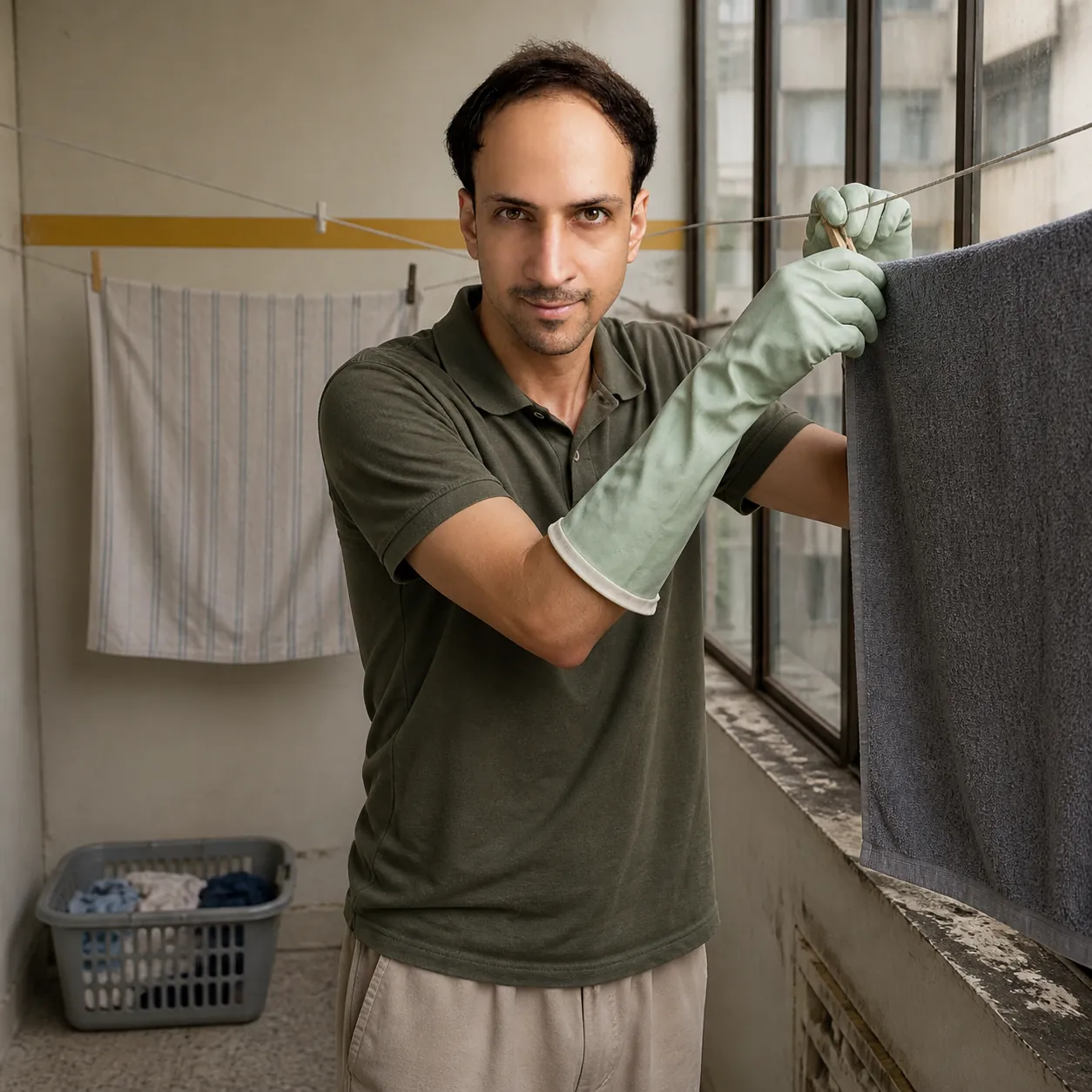
The Heavy Towel on the Line — AI Portrait Prompt
صورةAI Portraits

Turn your own photo into a portrait in an enclosed service balcony where a washing line crosses at head height. Keeps your face unchanged.

من نص البرومبت

Use the attached reference photo as the identity reference: keep the same face, skin tone, hair and features as the person in that photo, without beautifying, aging or altering them. Create a square 1:1 museum-catalog frame with a strong first read and a slower second read at exactly 2880x2880 pixels. Location: an enclosed service balcony where a washing line crosses at head height. Show them in a faded olive polo shirt and loose cotton trousers, pegging one heavy towel along the line's near end. The difficulty must be visible in this, not in their expression: a pair of long rubber gloves pulled on for a job that does not need them, cuffs turned back at the forearm shows competence and difficulty occupying the same square metre of floor. Explore what a completed chore is worth when the route to it was expensive; expression occupied, not expressive, carrying sober persistence, difficulty stated as one more logistical fact. Use a 35mm standing viewpoint with true proportions and no wide-angle distortion at the edges. Make the composition keep the finished part of the chore visible at one edge. Render it as museum-grade observational portraiture built from ordinary domestic labour, accurate surface texture, plain interior architecture, and restrained contemporary art direction, using even overcast light with accurate skin tone and no bloom and a palette of soap grey, warm plaster, and one ochre band. Photorealistic: this must read as a real photograph from a physical camera, never an illustration, painting, or 3D render. Resolve real surface detail: thread ends and slight pilling on worn cloth, hairline chips at every hard corner, and stone that is porous rather than smooth. Keep one identity-locked person, credible hands and fingers, natural fabric, and coherent scale, contact, reflections, shadows, airflow, deformation, and materials. Background people only when essential, always secondary and clearly different. Avoid glowing sound waves, sensory-overload blur effects, and mood portraits without labour. No text, labels, logos, signatures, watermarks, random symbols, plastic skin, excessive bloom, or glossy AI finish.
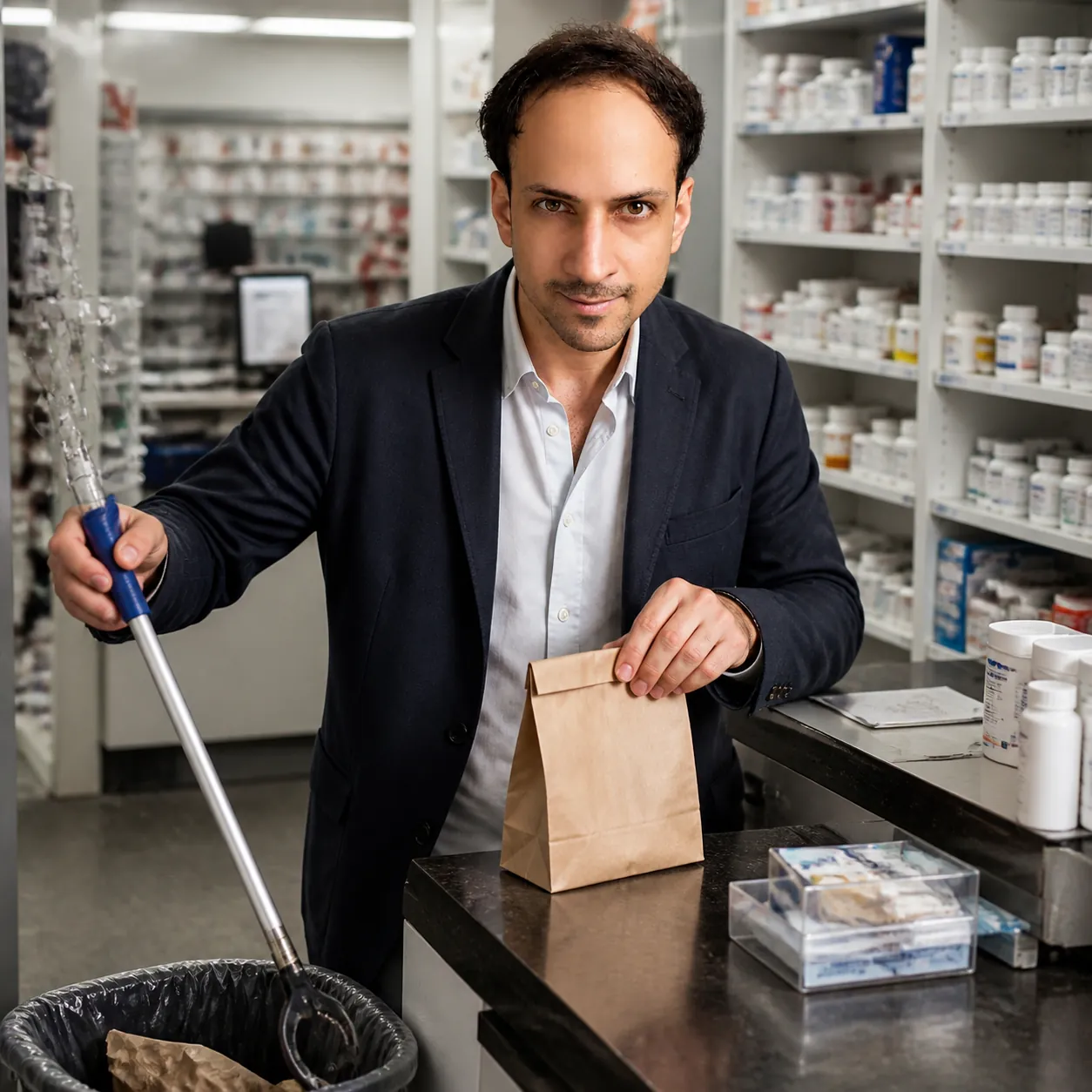
Folding the Pharmacy Bag — AI Portrait Prompt
صورةAI Portraits

Turn your own photo into a portrait in a neighbourhood pharmacy's side counter under unbroken ceiling light. Keeps your face unchanged.

من نص البرومبت

Use the attached reference photo as the identity reference: keep the same face, skin tone, hair and features as the person in that photo, without beautifying, aging or altering them. Create a square 1:1 museum-catalog frame with a strong first read and a slower second read at exactly 2880x2880 pixels. Location: a neighbourhood pharmacy's side counter under unbroken ceiling light. Show the subject in a navy unstructured jacket over an open-collar pale shirt, folding a paper pharmacy bag closed along its crease. Let one honest object carry what the face will not: a long-handled implement gripped at its very end so wet waste never reaches skin, the job finished at that distance makes the cost of an ordinary chore visible without making it a complaint. Explore why the cheapest fix is often a thirty-second adjustment made before starting; expression occupied, not expressive, carrying practical stubbornness, difficulty stated as ordinary upkeep. Use a 50mm eye-level view at working distance, the nearest object rendered as plainly as their hands. Make the composition let one unfinished half of the task stay honestly in frame. Render it as quiet domestic documentary realism combining unstyled interior photography, tactile household materials, honest working light, and unhurried observational framing, using even overcast light with accurate skin tone and no bloom and a palette of chalk white, deep charcoal, and one faded indigo. Photorealistic: this must read as a real photograph from a physical camera, never an illustration, painting, or 3D render. Resolve real surface detail: the difference between a wiped surface and a clean one, faint tide marks on ceramic, and metal dulled unevenly by touch. Keep one identity-locked person, credible hands and fingers, natural fabric, and coherent scale, contact, reflections, shadows, airflow, deformation, and materials. Background people only when essential, always secondary and clearly different. Avoid hands clamped over ears, meltdown theatrics, and hero poses at camera. No text, labels, logos, signatures, watermarks, random symbols, plastic skin, excessive bloom, or glossy AI finish.
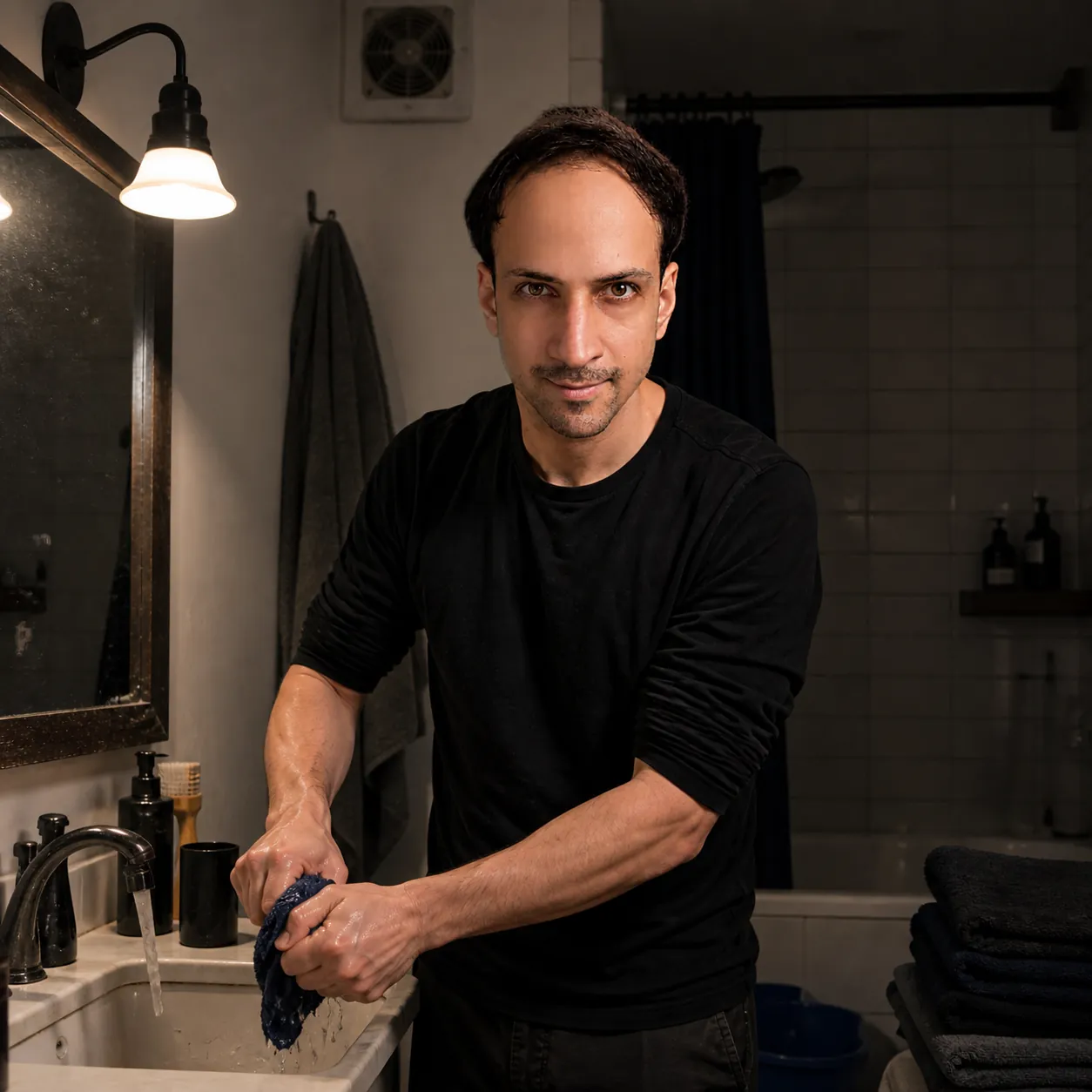
Wringing Out the Cloth — AI Portrait Prompt
صورةAI Portraits

Turn your own photo into a restrained editorial portrait in an apartment bathroom mid-clean with the extractor fan still running. Keeps your face unchanged.

من نص البرومبت

Use the attached reference photo as the identity reference: keep the same face, skin tone, hair and features as the person in that photo, without beautifying, aging or altering them. Create a square 1:1 museum-catalog frame with a strong first read and a slower second read at exactly 2880x2880 pixels. Location: an apartment bathroom mid-clean with the extractor fan still running. Show them in a plain black tee with sleeves pushed above the elbow, wringing a cloth out over the running tap. The difficulty must be visible in this, not in their expression: a shirt collar whose stitched label has been cut away, leaving two short threads standing at the inside seam makes the cost of an ordinary chore visible without making it a complaint. Explore how a room's light and sound become physical obstacles between them and the work; expression occupied, not expressive, carrying practical stubbornness, difficulty stated in the flattest possible voice. Use a 35mm standing viewpoint with true proportions and no wide-angle distortion at the edges. Make the composition keep the finished part of the chore visible at one edge. Render it as restrained editorial realism built from real chore apparatus, believable domestic wear, exact fabric and metal texture, and unsentimental framing, using a single low lamp against an otherwise dim room and a palette of chalk white, deep charcoal, and one faded indigo. Photorealistic: this must read as a real photograph from a physical camera, never an illustration, painting, or 3D render. Resolve real surface detail: visible weave in cloth, fine scratches on metal, and the faint unevenness of painted walls. Keep one identity-locked person, credible hands and fingers, natural fabric, and coherent scale, contact, reflections, shadows, airflow, deformation, and materials. Background people only when essential, always secondary and clearly different. Avoid hands clamped over ears, meltdown theatrics, and hero poses at camera. No text, labels, logos, signatures, watermarks, random symbols, plastic skin, excessive bloom, or glossy AI finish.
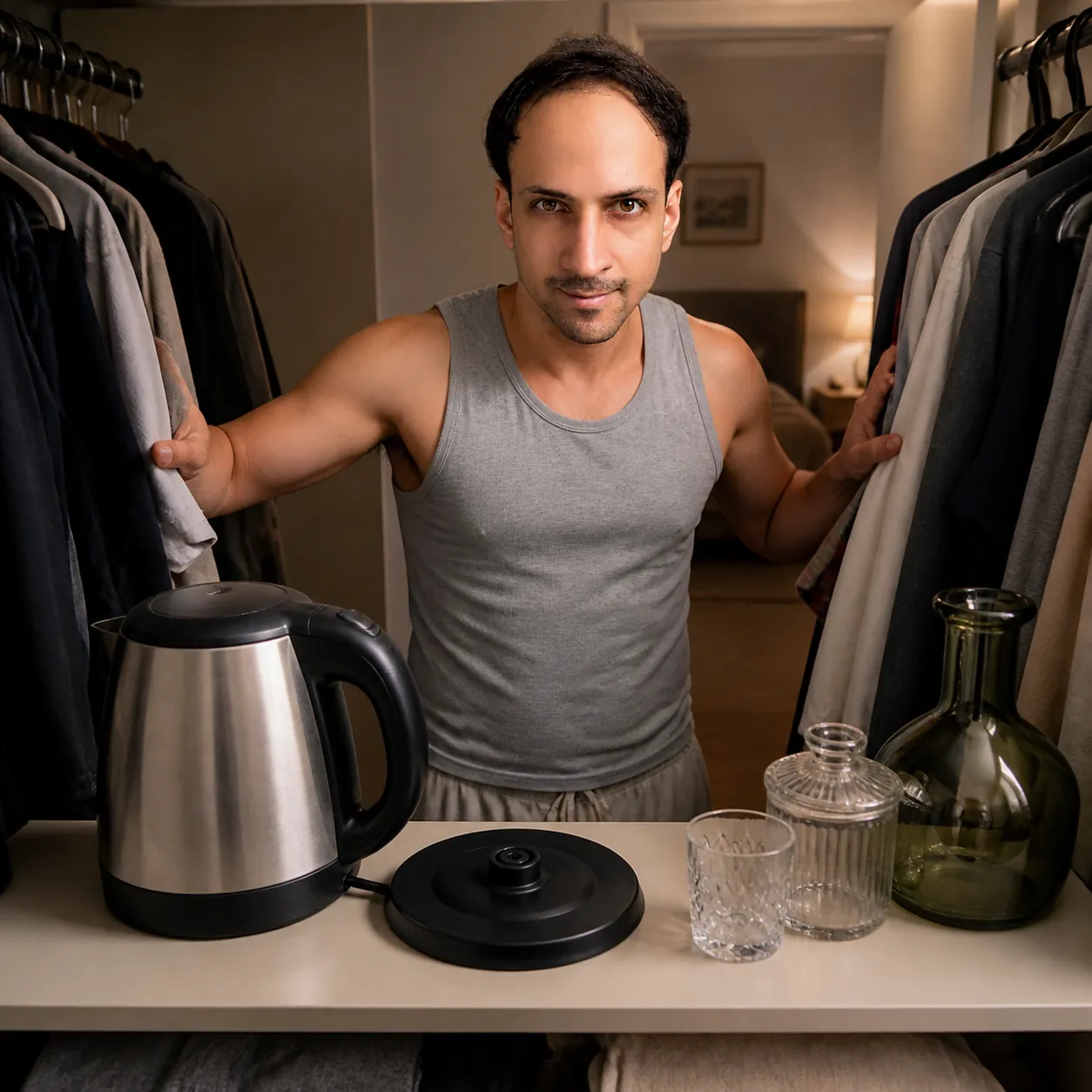
The Kettle Kept for Its Element — AI Portrait Prompt
صورةAI Portraits

Turn your own photo into a museum-grade domestic portrait in a bedroom wardrobe standing open on its two hanging rails. Keeps your face unchanged.

من نص البرومبت

Use the attached reference photo as the identity reference: keep the same face, skin tone, hair and features as the person in that photo, without beautifying, aging or altering them. Create a square 1:1 museum-catalog frame with a strong first read and a slower second read at exactly 2880x2880 pixels. Location: a bedroom wardrobe standing open on its two hanging rails. Show the subject in a grey cotton undershirt and loose drawstring house trousers, sliding hangers apart to reach the shelf behind. Anchor the frame to this piece of ordinary evidence: a stopped electric kettle whose base plate is off because the element inside it is still a perfectly good element shows care and accumulation arriving from exactly the same impulse. Explore how carrying, re-shelving, and re-deciding can fill an afternoon and leave no trace; expression occupied, not expressive, carrying worn diligence, difficulty stated without any note of shame. Place the camera at shelf height so held objects meet the lens squarely. Make the composition keep every stacked edge parallel and every surface visibly clean. Render it as museum-grade domestic portraiture built from plain-room reportage, accurate cardboard and glass materiality, restrained art direction, and unsentimental observation, using a low domestic lamp plus spill from the corridor, both plainly motivated and a palette of bleached linen, concrete grey, and a single olive accent. Photorealistic: this must read as a real photograph from a physical camera, never an illustration, painting, or 3D render. Resolve real surface detail: dust settled where nobody wipes, fingerprint haze on glass, and edges rubbed pale by handling. Keep one identity-locked person, credible hands and fingers, natural fabric, and coherent scale, contact, reflections, shadows, airflow, deformation, and materials. Background people only when essential, always secondary and clearly different. Avoid clear-out crews, shame poses, posing at camera, teetering junk towers, and melancholy without labour. No text, labels, logos, signatures, watermarks, random symbols, plastic skin, excessive bloom, or glossy AI finish.
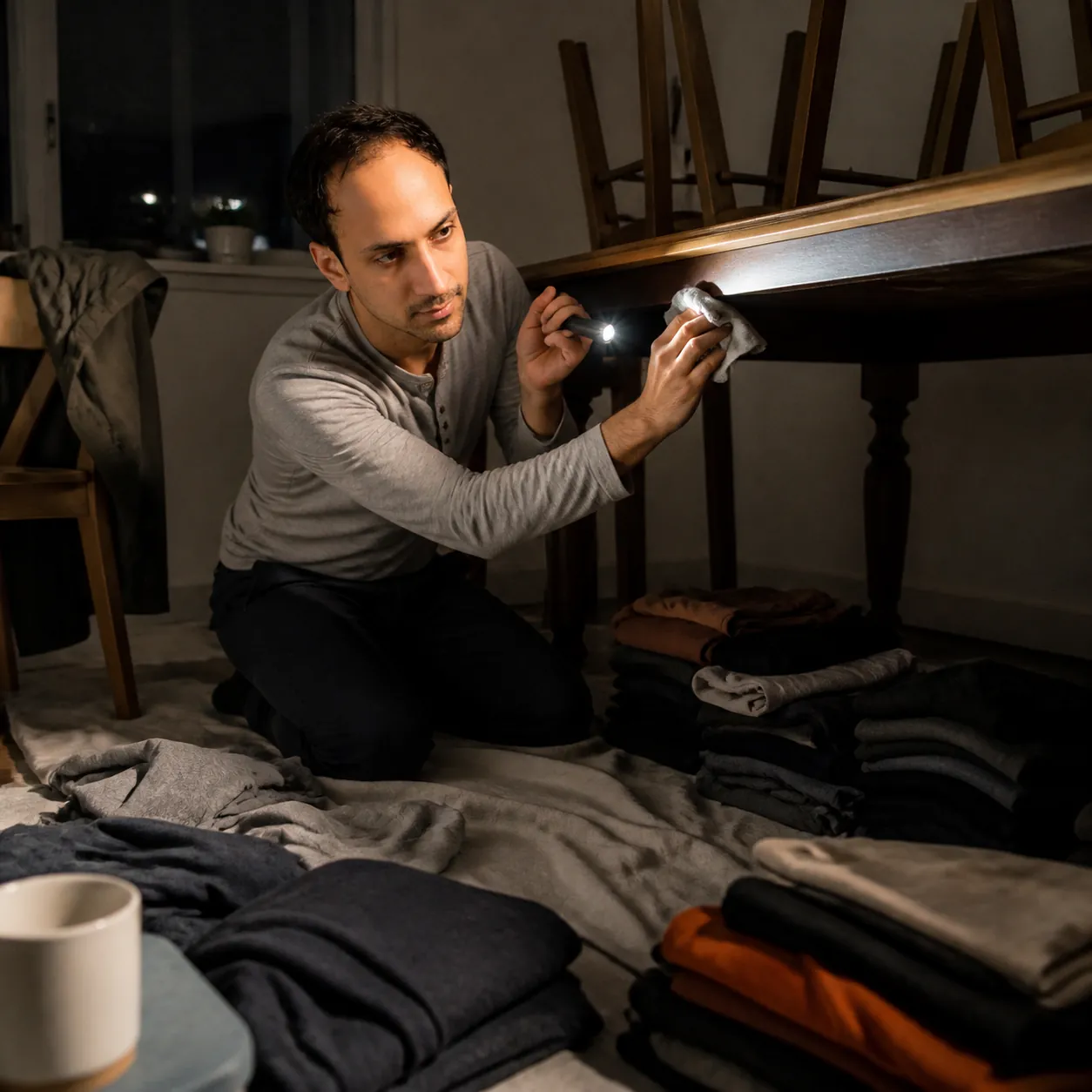
Sleeves Up: Dining Nook — AI Portrait Prompt
صورةAI Portraits

Turn your own photo into a portrait in a dining nook with its table cleared and its chairs upended. Keeps your face unchanged.

من نص البرومبت

Use the attached reference photo as the identity reference: keep the same face, skin tone, hair and features as the person in that photo, without beautifying, aging or altering them. Create a square 1:1 museum-catalog frame with a strong first read and a slower second read at exactly 2880x2880 pixels. Location: a dining nook with its table cleared and its chairs upended. Show the subject in a soft grey henley and plain dark cotton trousers, running a cloth along the underside of the table. The difficulty must be visible in this, not in their expression: a rail of clothing emptied onto a spread blanket and re-sorted into piles that agree on sleeve length and colour makes the scale of the night's work impossible to mistake for tidying. Explore how much real work one elevated night can absorb before its size shows; expression occupied, not expressive, carrying brisk composure, difficulty stated in the plainest terms available. Use a 35mm three-quarter view with one near object kept physically convincing. Make the composition let the untouched object rest quietly at one edge. Render it as museum-scale portraiture of household work built from truthful low-light colour, tactile everyday objects, and unglamorised interiors, using a hand torch plus weak ambient, both sources clearly accounted for and a palette of graphite shadow, oatmeal linen, and low sodium orange. Photorealistic: this must read as a real photograph from a physical camera, never an illustration, painting, or 3D render. Resolve real surface detail: visible weave in cloth, fine scratches on metal, and the faint unevenness of painted walls. Keep one identity-locked person, credible hands and fingers, natural fabric, and coherent scale, contact, reflections, shadows, airflow, deformation, and materials. Background people only when essential, always secondary and clearly different. Avoid heroic poster poses, glowing wellness interiors, and staring into the lens. No text, labels, logos, signatures, watermarks, random symbols, plastic skin, excessive bloom, or glossy AI finish.
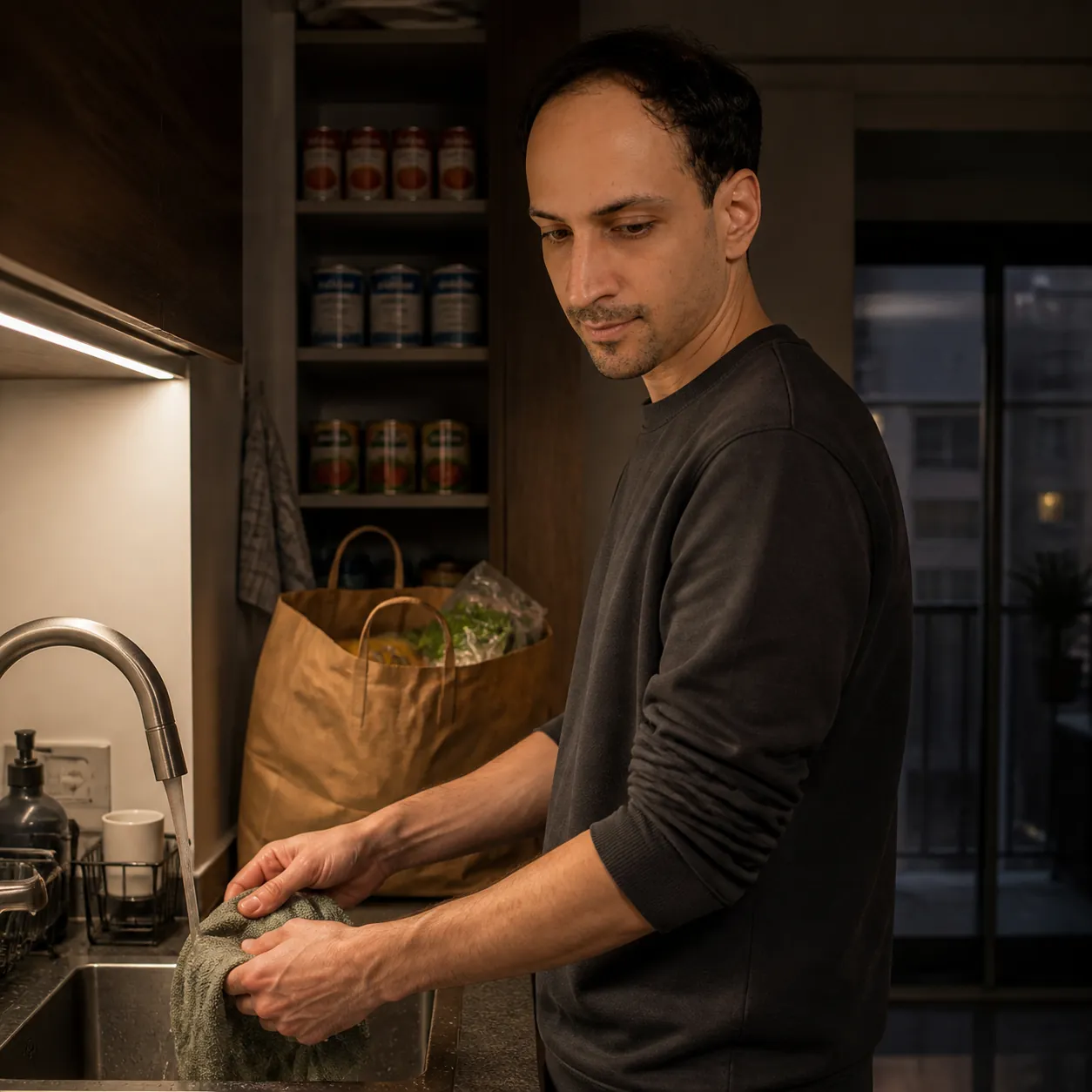
Just Right: Kitchen Worktop — AI Portrait Prompt
صورةAI Portraits

Turn your own photo into an understated chore-portrait portrait in a kitchen worktop under a strip light left on past midnight. Keeps your face unchanged.

من نص البرومبت

Use the attached reference photo as the identity reference: keep the same face, skin tone, hair and features as the person in that photo, without beautifying, aging or altering them. Create a square 1:1 museum-catalog frame with a strong first read and a slower second read at exactly 2880x2880 pixels. Location: a kitchen worktop under a strip light left on past midnight. Show the subject in a thin charcoal sweatshirt with cuffs shoved to mid-forearm, rinsing a folded cloth out under the tap. Make this piece of unglamorous evidence the whole argument: a cupboard shelf of tins whose labels have all been squared to the front, the shopping bag still half unpacked shows care and compulsion using exactly the same pair of hands. Explore why a task with no finish line must still be finished; expression occupied, not expressive, carrying unhurried insistence, difficulty stated quietly enough to be missed once. Use an 85mm side view, hands sharp and the room falling gently soft. Make the composition place the corrected half beside the uncorrected half. Render it as understated chore-portrait realism combining high-fidelity cloth rendering, real domestic surfaces, truthful contact shadows, and unhurried editorial calm, using flat overcast daylight through a balcony door, no direct sun and a palette of unbleached cotton, dark walnut, and an enamel-blue accent. Photorealistic: this must read as a real photograph from a physical camera, never an illustration, painting, or 3D render. Resolve real surface detail: paper fibre visible at cut edges, plastic that shows mould lines, and paint thicker where a brush turned. Keep one identity-locked person, credible hands and fingers, natural fabric, and coherent scale, contact, reflections, shadows, airflow, deformation, and materials. Background people only when essential, always secondary and clearly different. Avoid decorative symmetry, tidiness memes, gleaming surfaces, anguished faces, and pinned clinical checklists. No text, labels, logos, signatures, watermarks, random symbols, plastic skin, excessive bloom, or glossy AI finish.

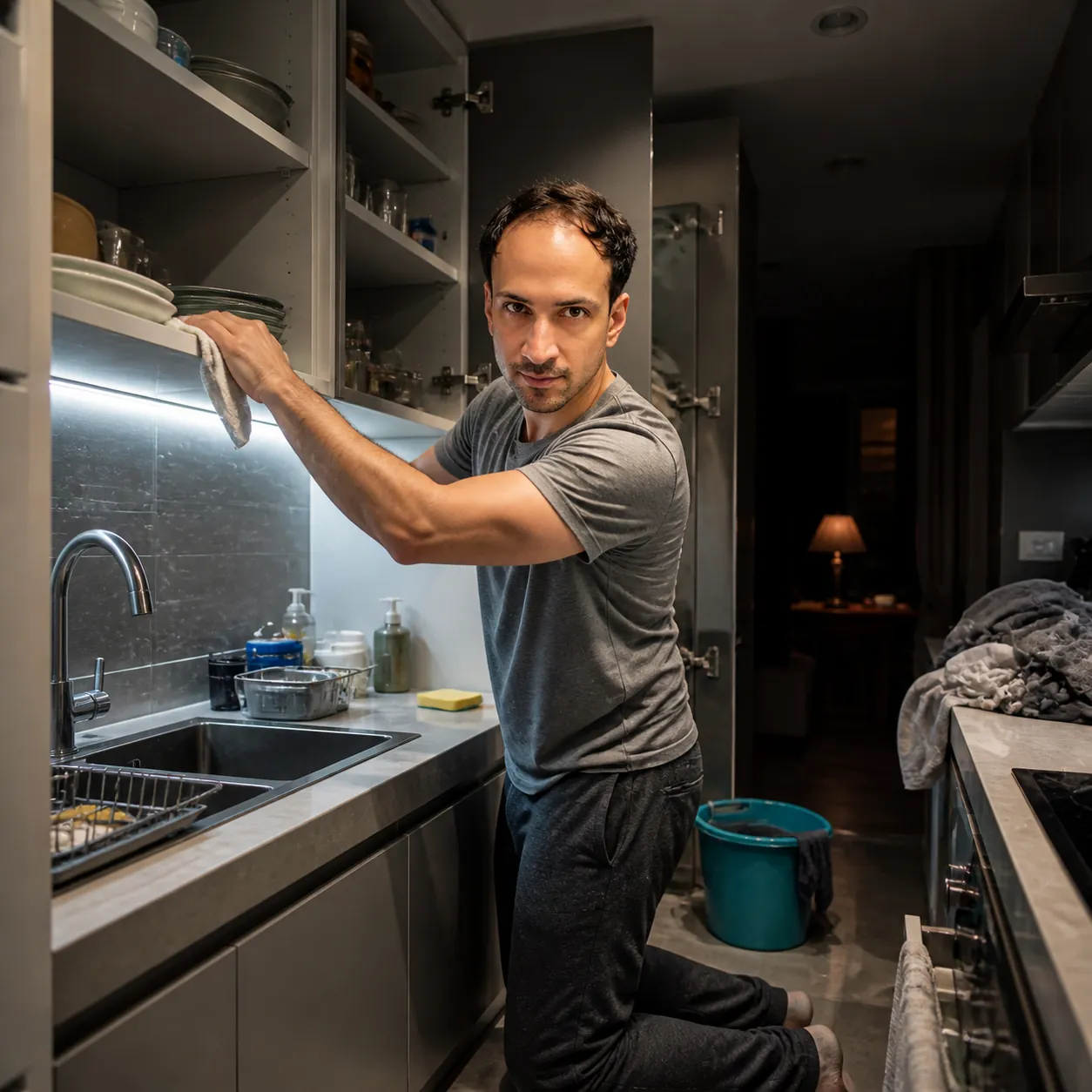
Real Progress: Galley Kitchen — AI Portrait Prompt
صورةAI Portraits

Turn your own photo into a portrait in a galley kitchen with every upper cupboard standing open at three. Keeps your face unchanged.

من نص البرومبت

Use the attached reference photo as the identity reference: keep the same face, skin tone, hair and features as the person in that photo, without beautifying, aging or altering them. Create a square 1:1 museum-catalog frame with a strong first read and a slower second read at exactly 2880x2880 pixels. Location: a galley kitchen with every upper cupboard standing open at three. Show the subject in a grey cotton tee, drawstring trousers, and bare working forearms, kneeling to wipe the last shelf edge dry. Anchor the frame to this piece of ordinary evidence: a room where four separate jobs stand half-done at once with none of them anywhere near finished keeps the labour honest while quietly naming what it is costing. Explore how a household benefits from labour its owner cannot quite stop giving; expression occupied, not expressive, carrying task-bound calm, difficulty stated in the plainest terms available. Frame slightly above the tableau so their forearms and the surface share focus. Make the composition leave the room beyond the lamp completely unlit. Render it as museum-scale portraiture of household work built from truthful low-light colour, tactile everyday objects, and unglamorised interiors, using a cold strip fitting bouncing evenly off wet tile and damp cloth and a palette of grey concrete, unbleached cotton, and a single teal bucket. Photorealistic: this must read as a real photograph from a physical camera, never an illustration, painting, or 3D render. Resolve real surface detail: cotton that hangs by its own weight, seams that pucker very slightly, and collars softened by washing. Keep one identity-locked person, credible hands and fingers, natural fabric, and coherent scale, contact, reflections, shadows, airflow, deformation, and materials. Background people only when essential, always secondary and clearly different. Avoid manic-eyed expressions, mess staged as spectacle, triumphant before-and-after framing, and golden window haze. No text, labels, logos, signatures, watermarks, random symbols, plastic skin, excessive bloom, or glossy AI finish.
The Quiet Hours: Open Side of a Goat-Hair Tent — AI Portrait Prompt
صورةAI Portraits

Turn your own photo into a gallery-grade domestic still portrait in the open side of a goat-hair tent at dusk, cushions laid within. Keeps your face unchanged.

من نص البرومبت

Use the attached reference photo as the identity reference: keep the same face, skin tone, hair and features as the person in that photo, without beautifying, aging or altering them. Create a square 1:1 museum-catalog frame with a strong first read and a slower second read at exactly 2880x2880 pixels. Location: the open side of a goat-hair tent at dusk, cushions laid within. Show the subject in a heavy oatmeal jumper over dark canvas trousers, pressing a tent stake deeper with the heel of their hand. Use this advanced image-making device as the core logic: a stovetop kettle at its loud murmuring stage, when collapsing steam bubbles ring the water hardest just before the boil rewards the kind of attention that cannot be paid in passing. Explore why an evening feels longer when everything in it moves at hand speed; direct expression and posture toward companionable quiet, never melodrama or ad-like confidence. Frame along the table edge at forearm height so their hands and gaze read together without distortion. Make the composition angle any written page so no single word stays legible. Render it as gallery-grade domestic still photography built from truthful household physics, restrained art direction, deep readable shadow, and companionable observational framing, using a single lantern's white core softened by distance into readable half-tones and a palette of dusk blue, sand plaster, and a single brass gleam. Photorealistic: this must read as a real photograph from a physical camera, never an illustration, painting, or 3D render. Resolve real surface detail: visible weave in cloth, fine scratches on metal, and the faint unevenness of painted walls. Keep one identity-locked person, credible hands and fingers, natural fabric, and coherent scale, contact, reflections, shadows, airflow, deformation, and materials. Background people only when essential, always secondary and clearly different. Avoid sepia nostalgia filters, costume-drama props, candlelit romance styling, and staged rustic clutter. No text, labels, logos, signatures, watermarks, random symbols, plastic skin, excessive bloom, or glossy AI finish.

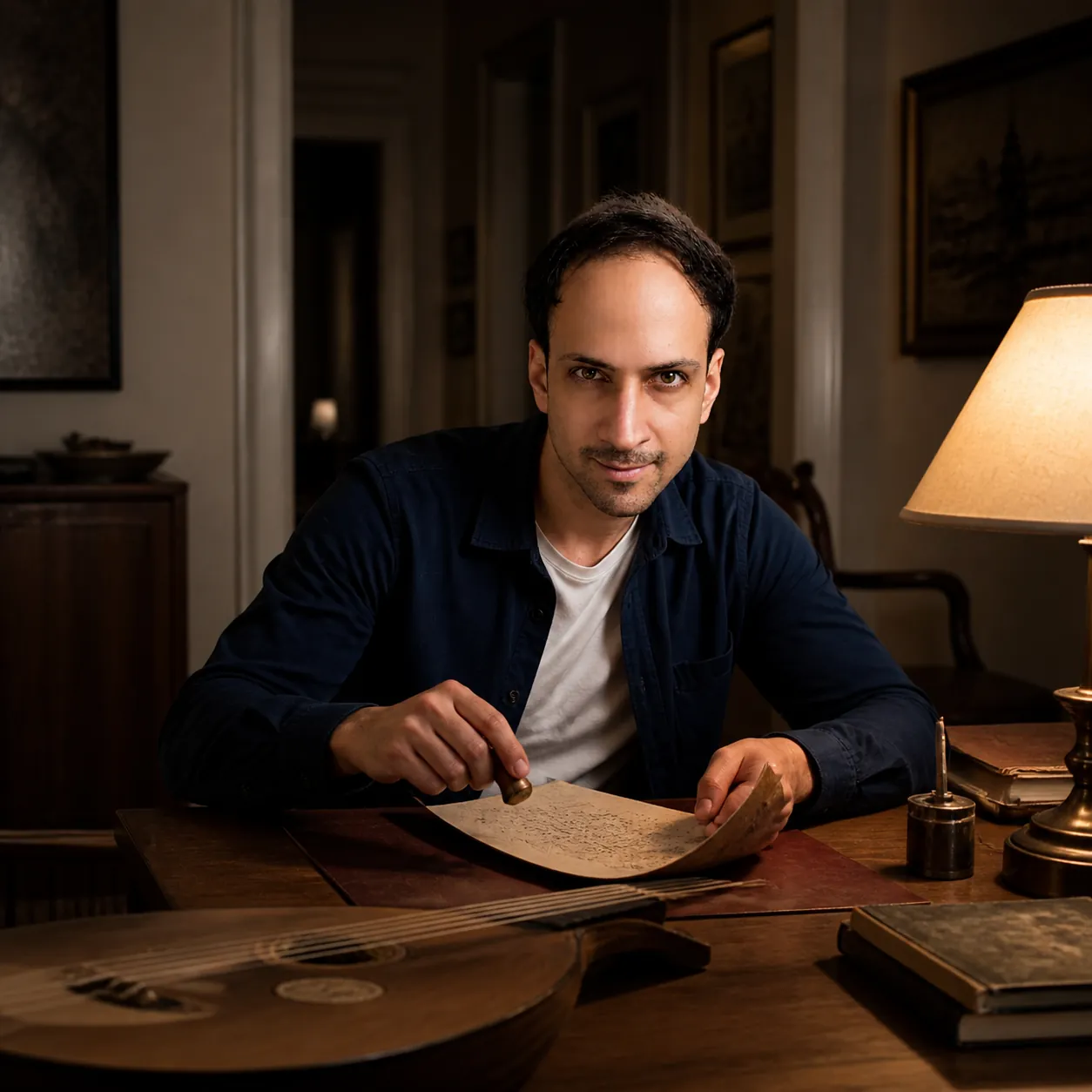
Kept Company: Walnut Writing Desk — AI Portrait Prompt
صورةAI Portraits

Turn your own photo into a quiet domestic portrait in a walnut writing desk in a widened hallway, lit by one lamp. Keeps your face unchanged.

من نص البرومبت

Use the attached reference photo as the identity reference: keep the same face, skin tone, hair and features as the person in that photo, without beautifying, aging or altering them. Create a square 1:1 museum-catalog frame with a strong first read and a slower second read at exactly 2880x2880 pixels. Location: a walnut writing desk in a widened hallway, lit by one lamp. Show the subject in a midnight-blue overshirt buttoned over a plain white tee, rocking a curved blotter once across the drying line. Treat this mechanism as the frame’s governing rule: an oud at rest whose untouched high string hums audibly when its matching octave is plucked on the string below rewards the kind of attention that cannot be paid in passing. Explore where fascination goes when spectacle is subtracted from a family's evening; direct expression and posture toward patient relish, never melodrama or ad-like confidence. Frame from the empty chair opposite them, the lens at a seated guest's eye height. Make the composition let lamplight falloff decide what the frame may keep. Render it as quiet domestic realism built from believable flame-lit exposure, tactile wood and wool surfaces, documentary patience, and museum-grade portrait restraint, using low tungsten-warm practicals kept below the eye line, shadows left generous and a palette of charcoal, aged brass, and one band of brick red. Photorealistic: this must read as a real photograph from a physical camera, never an illustration, painting, or 3D render. Resolve real surface detail: grout darker than tile, sealant slightly yellowed, and every joint showing a real tolerance gap. Keep one identity-locked person, credible hands and fingers, natural fabric, and coherent scale, contact, reflections, shadows, airflow, deformation, and materials. Background people only when essential, always secondary and clearly different. Avoid sepia nostalgia filters, costume-drama props, candlelit romance styling, and staged rustic clutter. No text, labels, logos, signatures, watermarks, random symbols, plastic skin, excessive bloom, or glossy AI finish.
