تخطَّ إلى المحتوى
جميع التصنيفات

AI Portraits

Portrait prompts you can use with your own photo.

3845 برومبتات•0 مشتركين
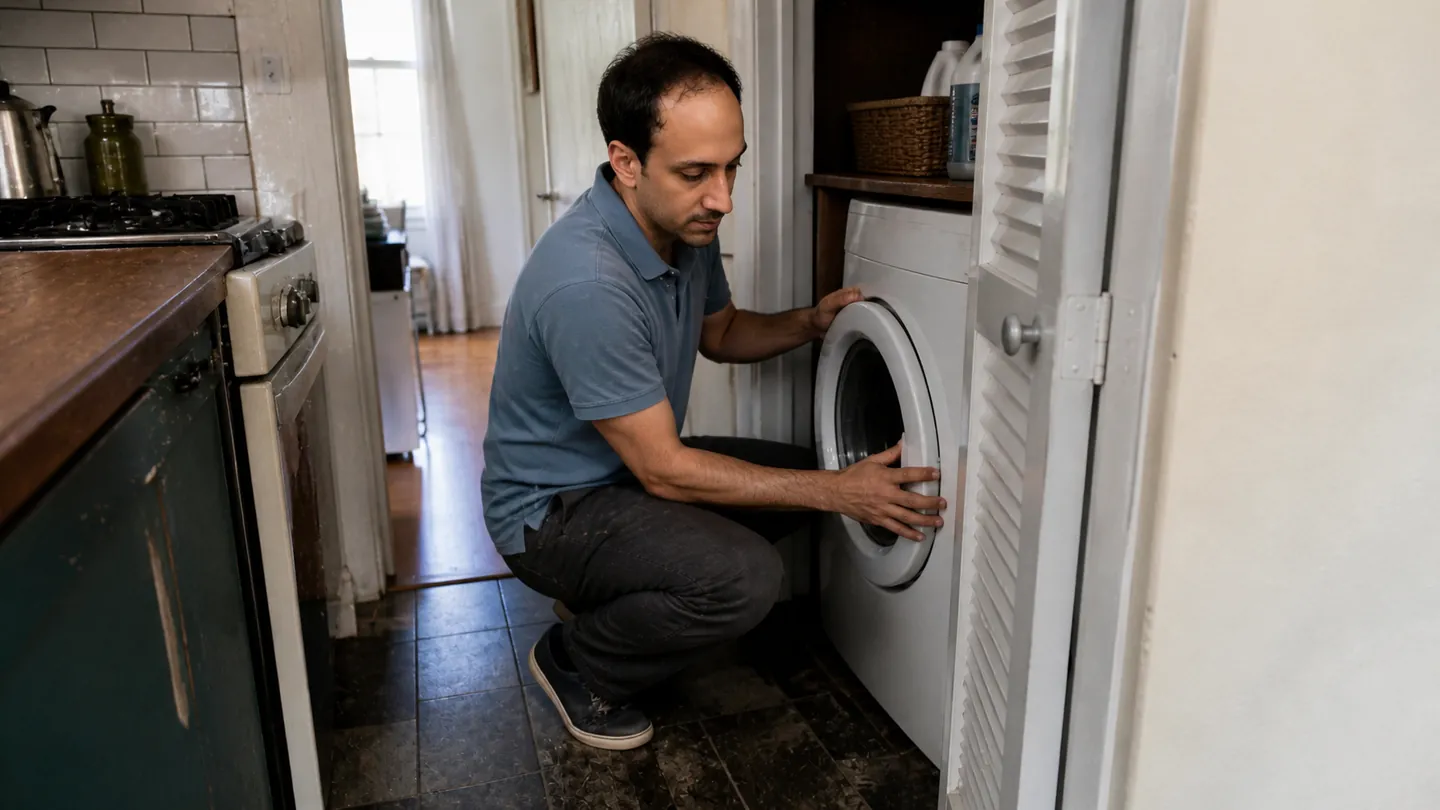
Checked Again: Small Laundry Alcove Off the Kitchen — AI Portrait Prompt
صورةAI Portraits

Turn your own photo into an unsentimental domestic portrait in a small laundry alcove off the kitchen behind a folding door. Keeps your face unchanged.

من نص البرومبت

Use the attached reference photo as the identity reference: keep the same face, skin tone, hair and features as the person in that photo, without beautifying, aging or altering them. Treat that reference as the character anchor: change only the scene. Compose a wide 16:9 narrative image where environment and subject carry equal meaning at exactly 3808x2144 pixels. Location: a small laundry alcove off the kitchen behind a folding door. Show the subject in a faded blue polo shirt and plain cotton trousers, pressing the machine door shut against its seal. The difficulty must be visible in this, not in their expression: a stove dial at off whose plastic collar has gone pale under a thumb coming back for a fourth turn holds the gap between a task finished and a task felt finished. Explore why a job done on the first pass still refuses to release them; expression occupied, not expressive, carrying rationed calm, difficulty stated without inviting sympathy. Frame from waist height so the floor and their shoes hold the lower third. Make the composition let the tidiest area read as the least settled. Render it as unsentimental domestic realism built from documentary portrait photography, honest household materials, restrained art direction, and patient observational timing, using even overcast daylight through a doorway with mild interior fill and a palette of chalk white, dark olive, and a muted teal. Photorealistic: this must read as a real photograph from a physical camera, never an illustration, painting, or 3D render. Give the space honest scale: real distance between foreground, subject, and far wall. Resolve real surface detail: the difference between a wiped surface and a clean one, faint tide marks on ceramic, and metal dulled unevenly by touch. Keep one identity-locked person, credible hands and fingers, natural fabric, and coherent scale, contact, reflections, shadows, airflow, deformation, and materials. Background people only when essential, always secondary and clearly different. Avoid hand-washing imagery, tally marks, symmetrical object grids, hero poses at camera, and wellness glow. No text, labels, logos, signatures, watermarks, random symbols, plastic skin, excessive bloom, or glossy AI finish.
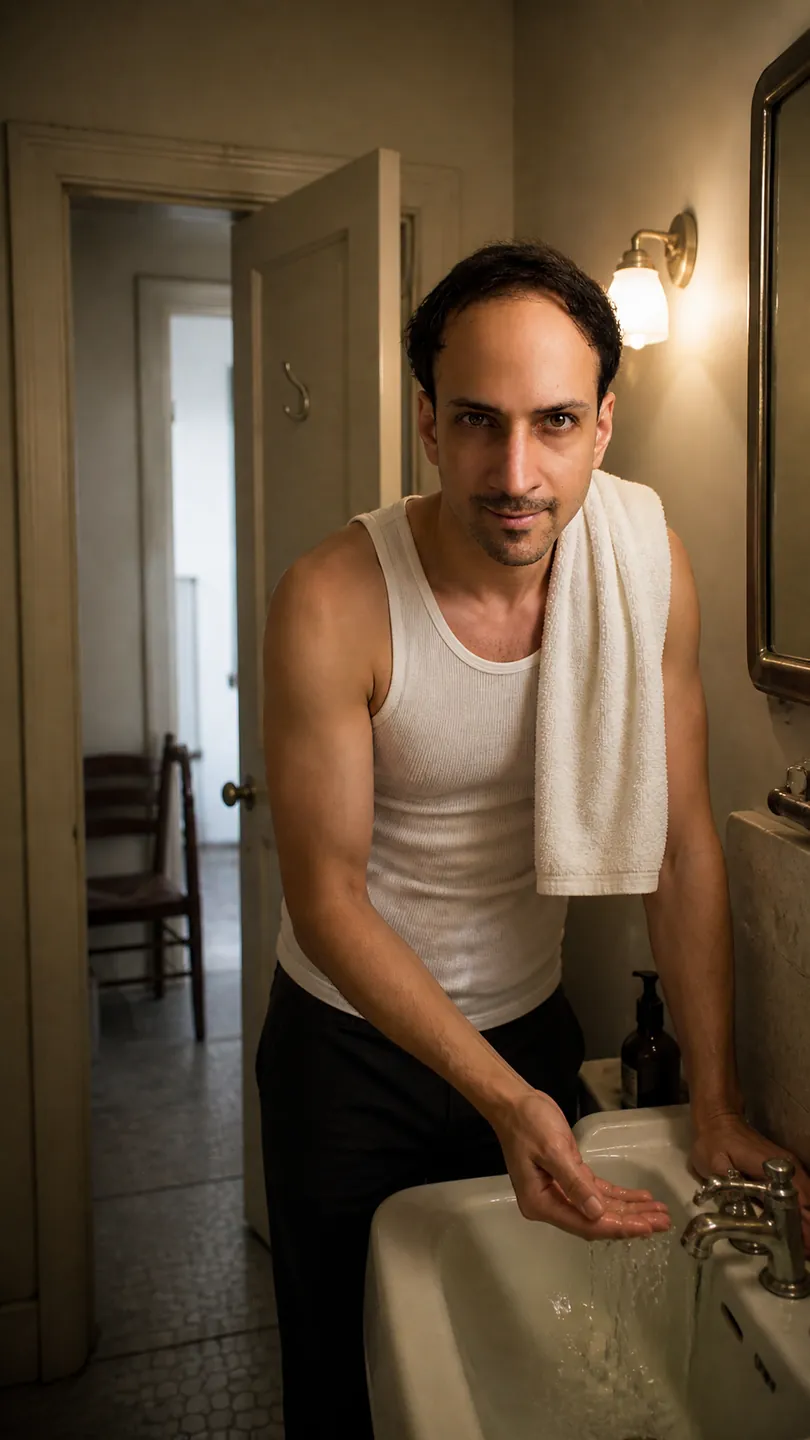
Rinsing the Basin by One Wall Lamp — AI Portrait Prompt
صورةAI Portraits

Turn your own photo into an observational domestic portrait in a bathroom lit by one wall lamp, its door hooked open. Keeps your face unchanged.

من نص البرومبت

Use the attached reference photo as the identity reference: keep the same face, skin tone, hair and features as the person in that photo, without beautifying, aging or altering them. Design a full-height 9:16 cinematic artwork that reads on a phone and rewards gallery-scale inspection at exactly 2144x3808 pixels. Location: a bathroom lit by one wall lamp, its door hooked open. Show the subject in a plain white undershirt with a towel across one shoulder, rinsing the basin down with one cupped hand. Anchor the frame to this piece of ordinary evidence: a chair carried the long way round the table so the room's one way in never falls behind them costs them a small tax they have agreed to pay daily. Explore why an ordinary chore has to be solved as a geometry problem first; expression occupied, not expressive, carrying worn resolve, difficulty stated the way furniture states itself. Use a 40mm chest-height viewpoint that includes the room's depth without dramatizing it. Make the composition place the one opening off-center without letting it dominate. Render it as observational domestic portraiture built from truthful chore staging, exact material texture, ordinary architectural geometry, and quietly unsentimental framing, using overcast daylight from one side with no fill on the other and a palette of off-white paint, brushed steel, and dull brass fittings. Photorealistic: this must read as a real photograph from a physical camera, never an illustration, painting, or 3D render. Give the air depth: falloff with distance and no artificial clarity far back. Resolve real surface detail: thread ends and slight pilling on worn cloth, hairline chips at every hard corner, and stone that is porous rather than smooth. Keep one identity-locked person, credible hands and fingers, natural fabric, and coherent scale, contact, reflections, shadows, airflow, deformation, and materials. Background people only when essential, always secondary and clearly different. Avoid thriller shadows, keyhole peering, weapons or uniforms, and staged startle reactions. No text, labels, logos, signatures, watermarks, random symbols, plastic skin, excessive bloom, or glossy AI finish.
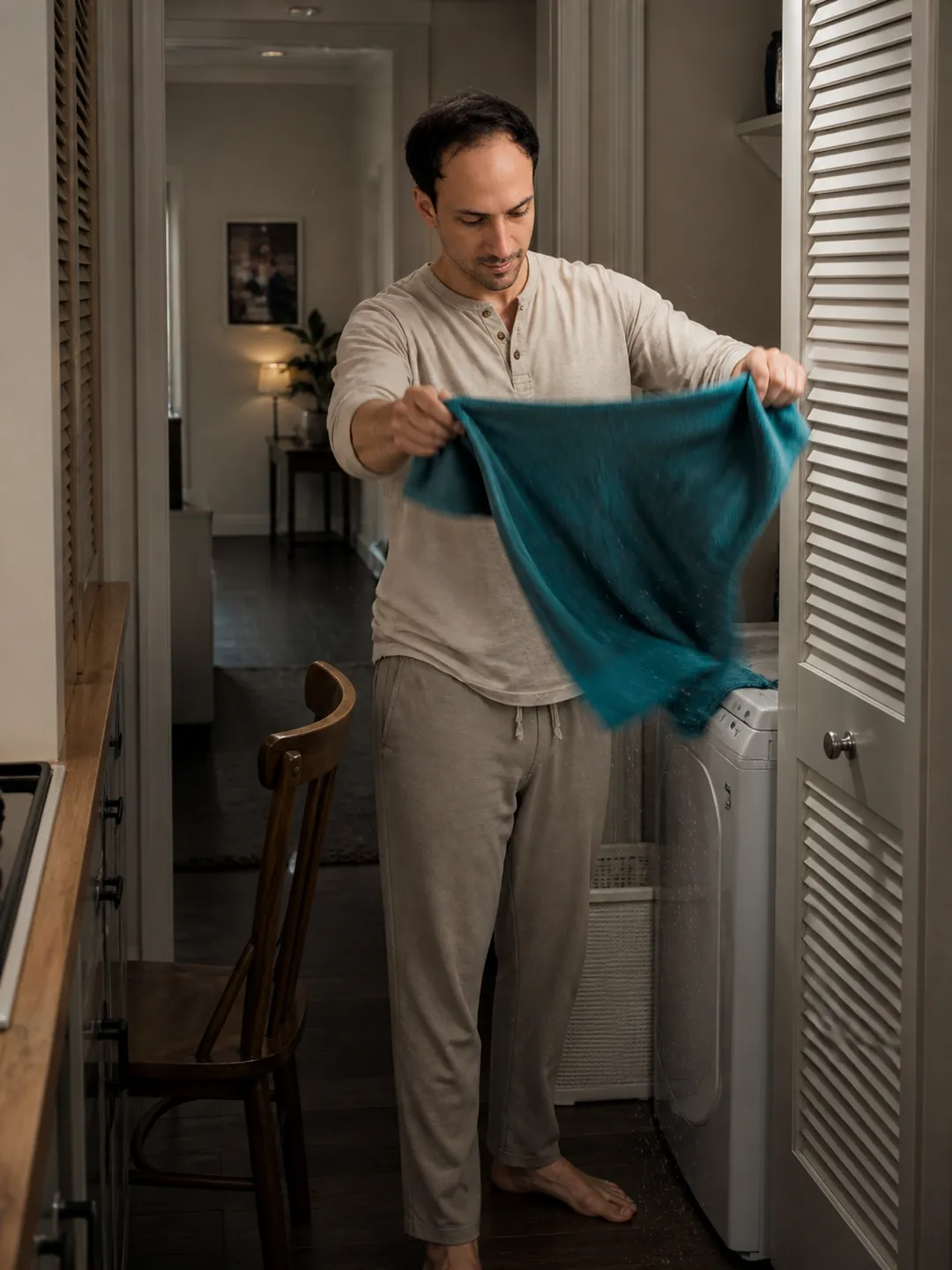
A Towel Snapped in the Laundry Alcove — AI Portrait Prompt
صورةAI Portraits

Turn your own photo into a gallery-scale everyday portrait in a laundry alcove off the kitchen behind a folding louvered door. Keeps your face unchanged.

من نص البرومبت

Use the attached reference photo as the identity reference: keep the same face, skin tone, hair and features as the person in that photo, without beautifying, aging or altering them. Use a formal 3:4 environmental portrait with complete hands and meaningful objects inside frame at exactly 2480x3312 pixels. Location: a laundry alcove off the kitchen behind a folding louvered door. Show the subject in a loose cotton house shirt and soft drawstring trousers, shaking a wet towel out with one sharp snap. Make this piece of unglamorous evidence the whole argument: a chair carried the long way round the table so the room's one way in never falls behind them arranges the room before it arranges the task, every single time. Explore why an ordinary chore has to be solved as a geometry problem first; expression occupied, not expressive, carrying quiet stubbornness, difficulty stated in the geometry alone. Place the lens beside the task at working height with the far wall sharp. Make the composition keep the far end as legible as their hands. Render it as gallery-scale everyday realism combining high-fidelity portrait photography, working household objects, and physically accurate shadow and reflection, using even ceiling light with a second lamp filling the far end and a palette of sand beige, concrete grey, and one teal towel. Photorealistic: this must read as a real photograph from a physical camera, never an illustration, painting, or 3D render. Resolve real surface detail: wood grain read at honest scale, matte and gloss clearly separated, and no surface uniformly clean. Keep one identity-locked person, credible hands and fingers, natural fabric, and coherent scale, contact, reflections, shadows, airflow, deformation, and materials. Background people only when essential, always secondary and clearly different. Avoid hero poses, golden-hour wellness glow, eye contact with the lens, and tear-streaked faces. No text, labels, logos, signatures, watermarks, random symbols, plastic skin, excessive bloom, or glossy AI finish.
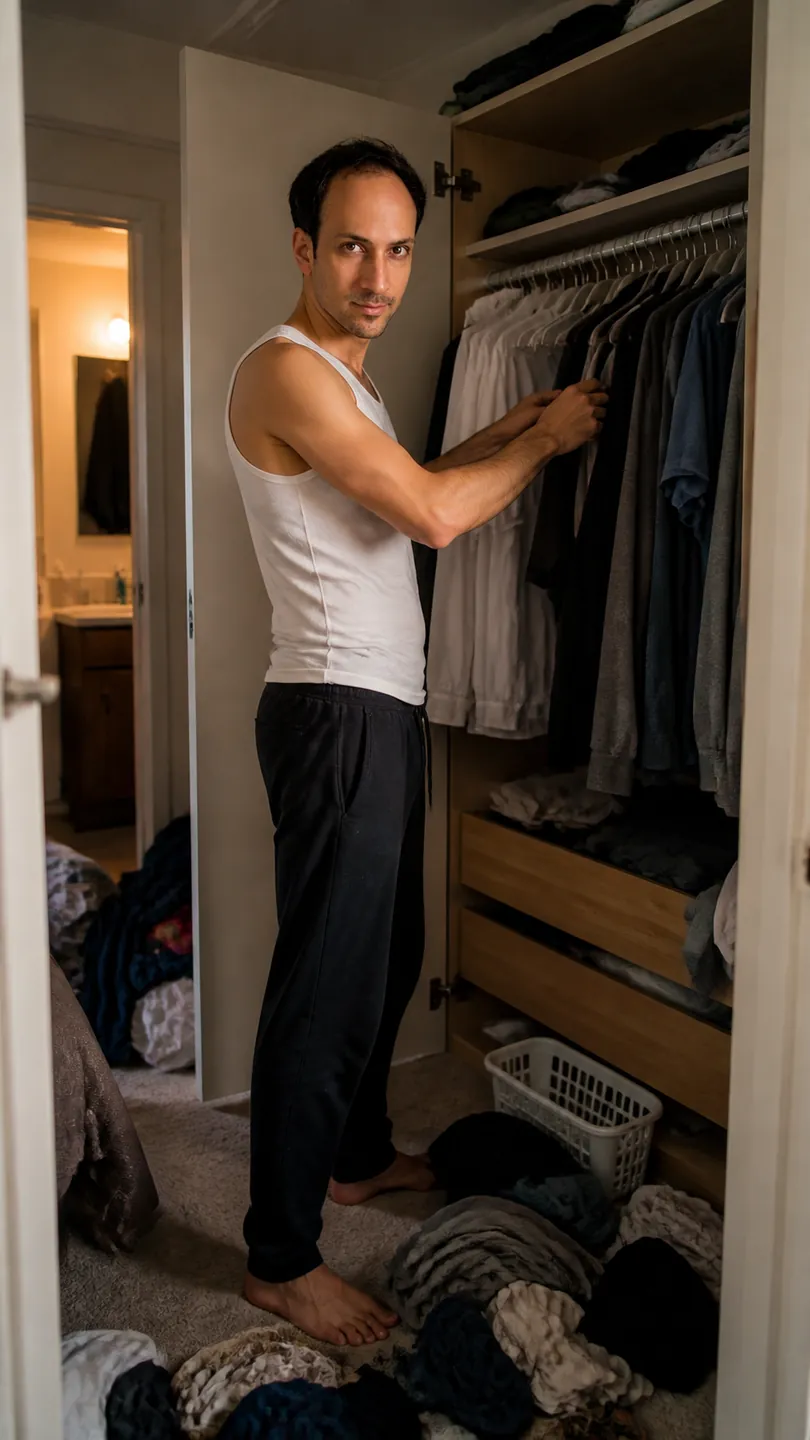
The Wardrobe Rail Left Half-Sorted — AI Portrait Prompt
صورةAI Portraits

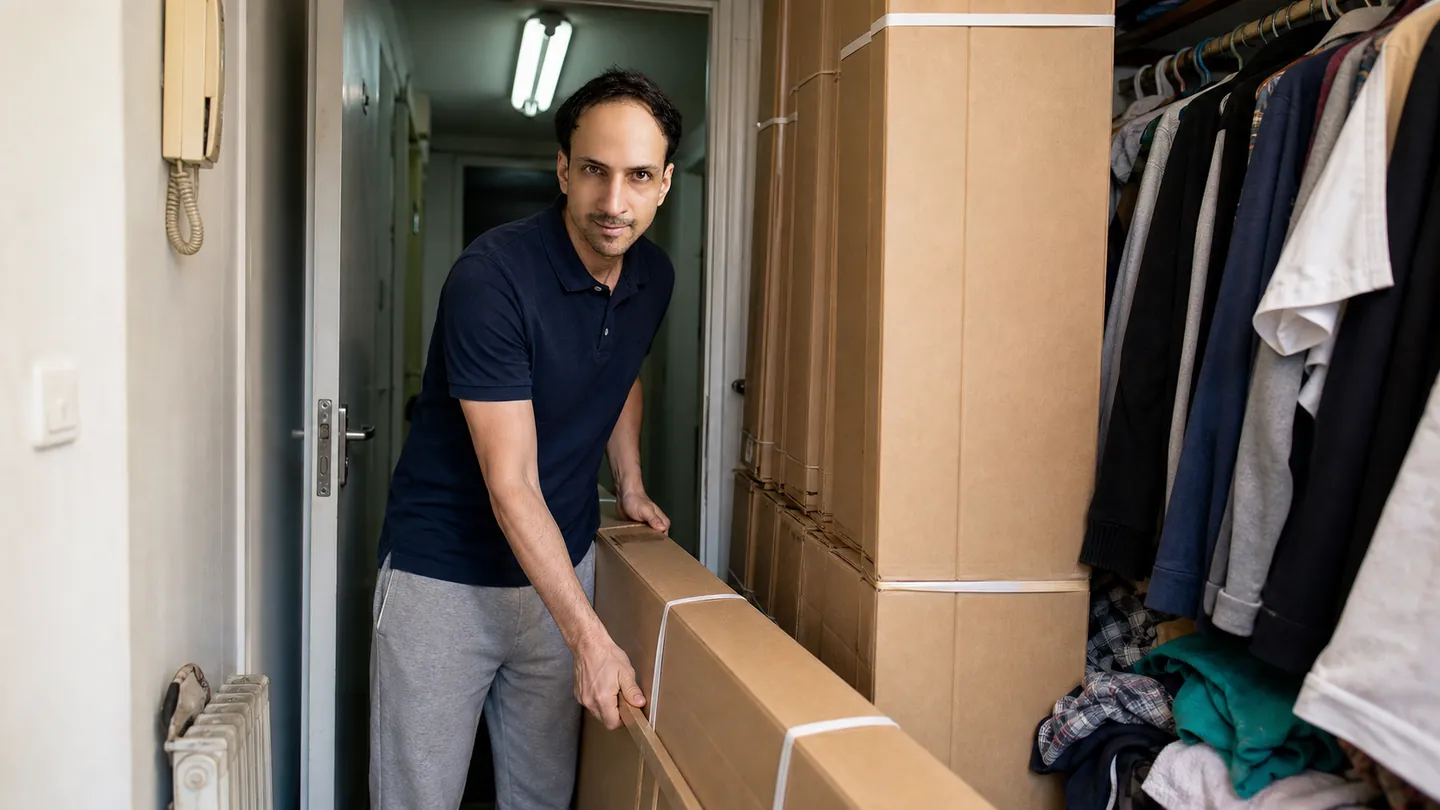
Turn your own photo into a photorealistic portrait in a bedroom whose wardrobe doors have stood open for eleven days. Keeps your face unchanged.

من نص البرومبت

Use the attached reference photo as the identity reference: keep the same face, skin tone, hair and features as the person in that photo, without beautifying, aging or altering them. Design a full-height 9:16 cinematic artwork that reads on a phone and rewards gallery-scale inspection at exactly 2144x3808 pixels. Location: a bedroom whose wardrobe doors have stood open for eleven days. Show the subject in a plain white undershirt and dark drawstring trousers, feet bare, sliding a bank of hangers along the rail. Make this piece of unglamorous evidence the whole argument: a wardrobe rail sorted by sleeve length for one arm's width, then given over to the week's unsorted washing measures the distance between who started this and who finishes it. Explore what it takes to finish one item from another week's list; expression occupied, not expressive, carrying measured effort, difficulty stated without inviting anyone to comfort them. Frame at chest height so their hands and the waiting object share one plane. Make the composition treat the floor as the honest record of the fortnight. Render it as understated contemporary realism drawn from ordinary maintenance labour, precise everyday objects, believable dust, and sober editorial restraint, using overcast window light with one warm bulb left on next door and a palette of warm plaster, pale birch, and one strip of masking-tape yellow. Photorealistic: this must read as a real photograph from a physical camera, never an illustration, painting, or 3D render. Give the frame volume: faint density deepest in the room, contrast easing at the edges. Resolve real surface detail: dust settled where nobody wipes, fingerprint haze on glass, and edges rubbed pale by handling. Keep one identity-locked person, credible hands and fingers, natural fabric, and coherent scale, contact, reflections, shadows, airflow, deformation, and materials. Background people only when essential, always secondary and clearly different. Avoid mood without labour, styled hoarder chaos, golden-hour comfort, and bedside sorrow. No text, labels, logos, signatures, watermarks, random symbols, plastic skin, excessive bloom, or glossy AI finish.
Clearing the Hall One Bundle at a Time — AI Portrait Prompt
صورةAI Portraits

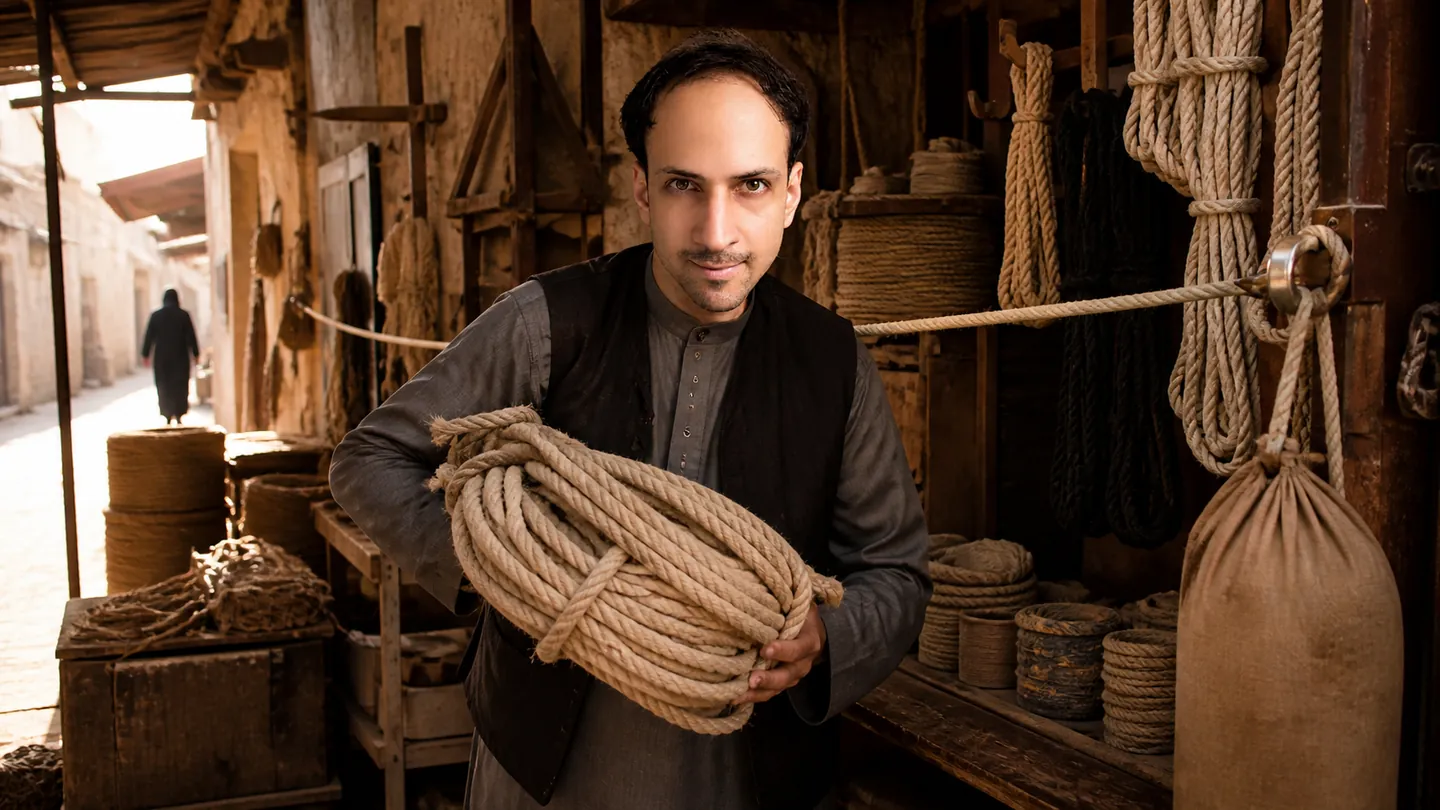
Turn your own photo into a portrait in an entrance hall narrowed by strapped bundles of flat-packed cartons. Keeps your face unchanged.

من نص البرومبت

Use the attached reference photo as the identity reference: keep the same face, skin tone, hair and features as the person in that photo, without beautifying, aging or altering them. Compose a wide 16:9 narrative image where environment and subject carry equal meaning at exactly 3808x2144 pixels. Location: an entrance hall narrowed by strapped bundles of flat-packed cartons. Show the subject in a faded navy polo shirt over grey track trousers, dragging one strapped bundle clear of the doorway. Anchor the frame to this piece of ordinary evidence: a wardrobe rail sorted by sleeve length for one arm's width, then given over to the week's unsorted washing asks them for one decision rather than the entire plan again. Explore what it takes to finish one item from another week's list; expression occupied, not expressive, carrying plain persistence, difficulty stated as maintenance rather than confession. Use a 40mm eye-level view with the unfinished half nearer the lens. Make the composition divide finished from waiting along one clear line. Render it as quiet domestic documentary portraiture built from unstyled household reality, restrained framing, truthful material wear, and patient observational timing, using cool fluorescent tube light from a utility fitting, honest and undramatic and a palette of dust white, olive shadow, and a band of cardboard brown. Photorealistic: this must read as a real photograph from a physical camera, never an illustration, painting, or 3D render. Give truthful depth cues: overlapping planes and shadows softening as they travel. Resolve real surface detail: wood grain read at honest scale, matte and gloss clearly separated, and no surface uniformly clean. Keep one identity-locked person, credible hands and fingers, natural fabric, and coherent scale, contact, reflections, shadows, airflow, deformation, and materials. Background people only when essential, always secondary and clearly different. Avoid hero poses, wellness-catalogue serenity, head-in-hands despair, meaningful gazes at camera, and before-and-after staging. No text, labels, logos, signatures, watermarks, random symbols, plastic skin, excessive bloom, or glossy AI finish.
The New Route: Rope-Seller's Stall Deep — AI Portrait Prompt
صورةAI Portraits

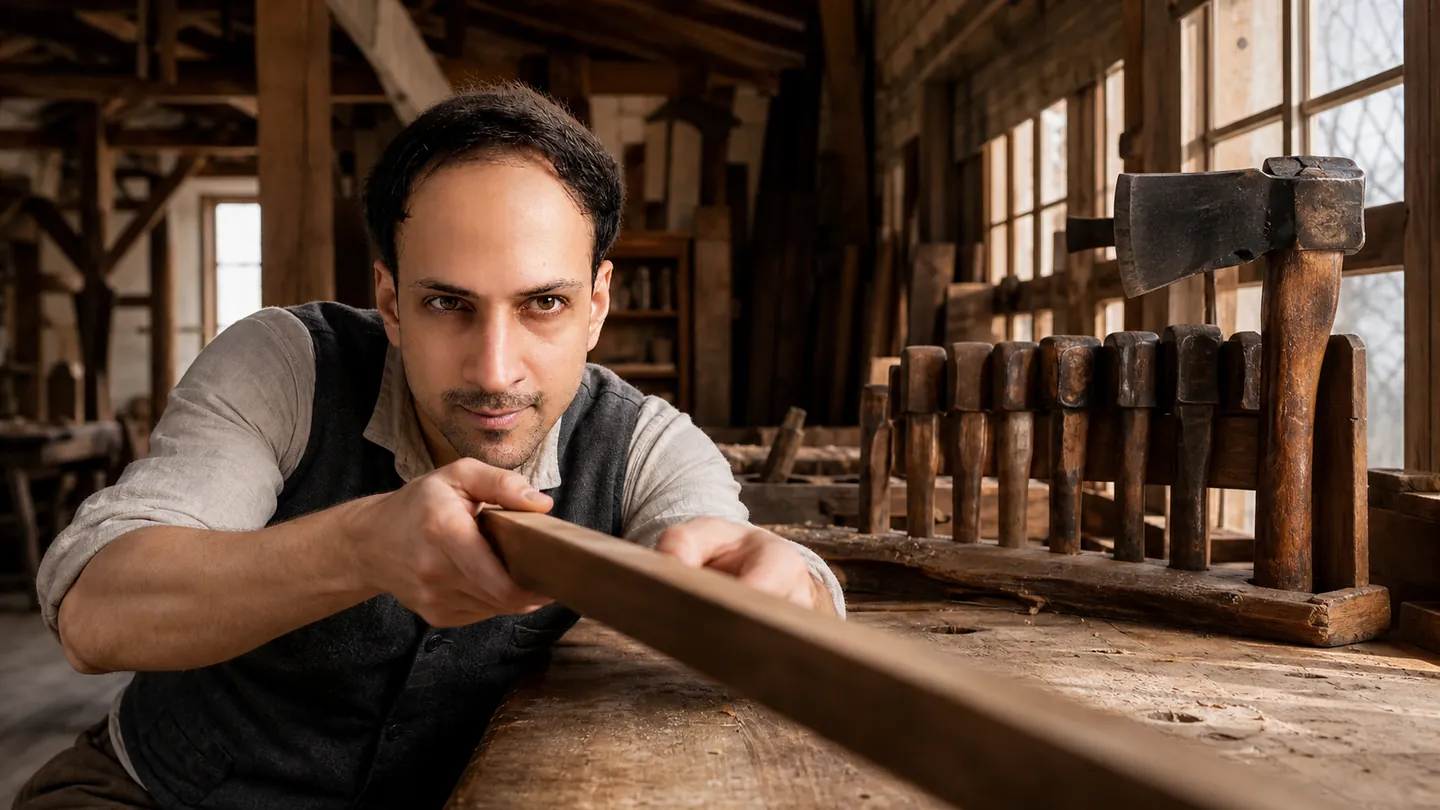
Turn your own photo into a craft-documentary portrait in a rope-seller's stall deep in an old Riyadh souq at opening hour. Keeps your face unchanged.

من نص البرومبت

Use the attached reference photo as the identity reference: keep the same face, skin tone, hair and features as the person in that photo, without beautifying, aging or altering them. Compose a wide 16:9 narrative image where environment and subject carry equal meaning at exactly 3808x2144 pixels. Location: a rope-seller's stall deep in an old Riyadh souq at opening hour. Show the subject in a plain grey winter traditional Gulf outfit with a dark sleeveless vest, weighing a coil of new rope across both forearms. Build the artwork around this material rule: a taut rope span between two shop anchors, renewed strand by strand while a hung sandbag keeps the whole line working gives repetition the power to deepen a path until it looks inevitable. Explore what repetition is quietly building on days when nothing seems to improve; direct expression and posture toward workmanlike reverence, never melodrama or ad-like confidence. Use an eye-level 55mm perspective that keeps their hands and the work equally credible. Make the composition let one bright new line cross a field of dulled ones. Render it as craft-documentary portraiture built from real fiber mechanics, patient workshop realism, archival material fidelity, and emotionally restrained editorial composition, using low golden-hour sun crossing the space in one honest band and a palette of rope-tar black, pale dust grey, and warm ochre. Photorealistic: this must read as a real photograph from a physical camera, never an illustration, painting, or 3D render. Give truthful depth cues: overlapping planes and shadows softening as they travel. Resolve real surface detail: wood grain read at honest scale, matte and gloss clearly separated, and no surface uniformly clean. Keep one identity-locked person, credible hands and fingers, natural fabric, and coherent scale, contact, reflections, shadows, airflow, deformation, and materials. Background people only when essential, always secondary and clearly different. Avoid glowing neural filaments, brain-shaped tangles, circuit-board overlays, holographic wiring diagrams, and sparks jumping between cables. No text, labels, logos, signatures, watermarks, random symbols, plastic skin, excessive bloom, or glossy AI finish.
Time As Polish: Timber-Framed Joinery Loft — AI Portrait Prompt
صورةAI Portraits

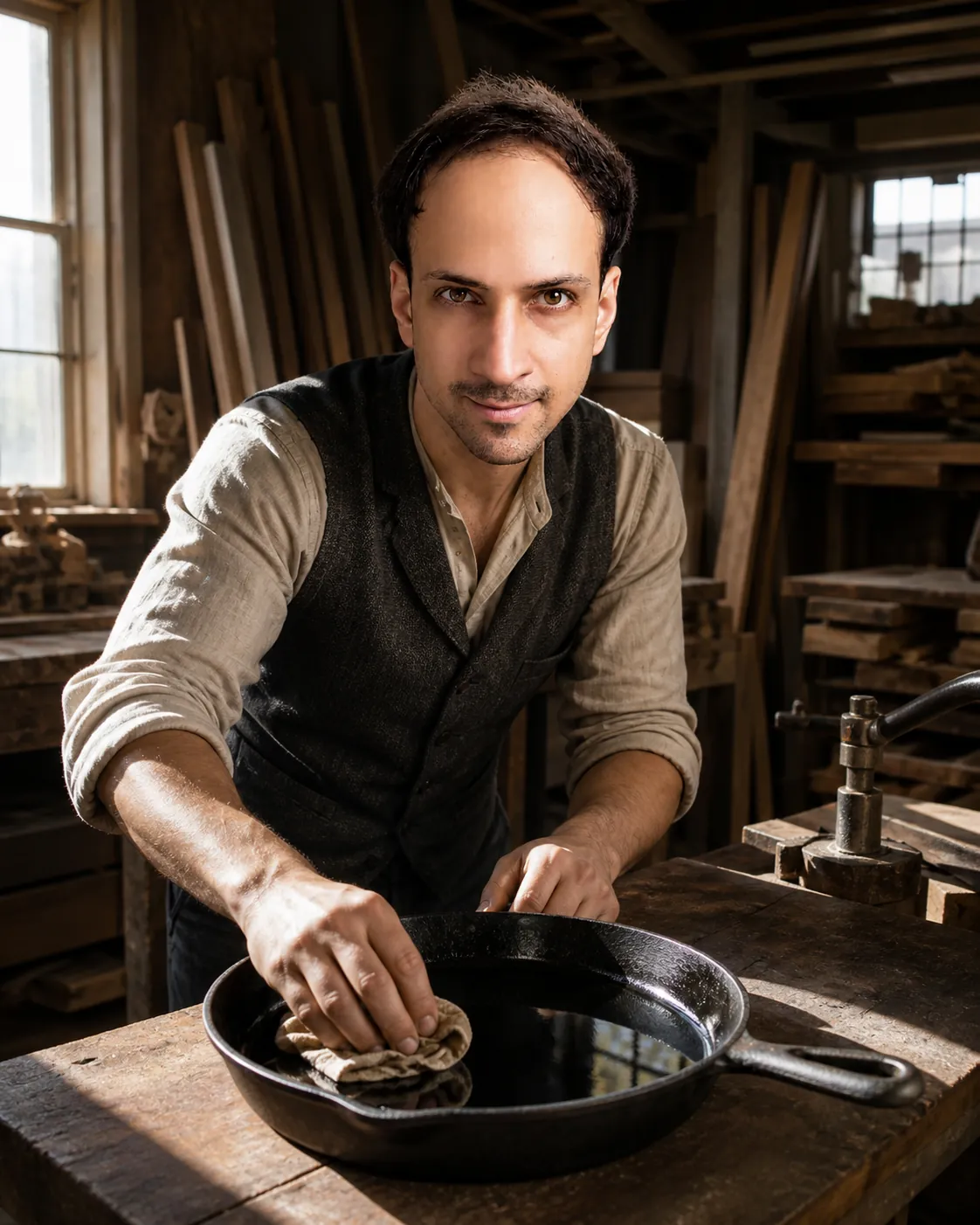
Turn your own photo into a portrait in a timber-framed joinery loft where afternoon light crosses stacked rough boards. Keeps your face unchanged.

من نص البرومبت

Use the attached reference photo as the identity reference: keep the same face, skin tone, hair and features as the person in that photo, without beautifying, aging or altering them. Compose a wide 16:9 narrative image where environment and subject carry equal meaning at exactly 3808x2144 pixels. Location: a timber-framed joinery loft where afternoon light crosses stacked rough boards. Show the subject in a collarless linen shirt under a grey wool vest, sleeves rolled twice, sighting along a straight batten toward the window light. Use this advanced image-making device as the core logic: an axe head on its seventh handle that outlasted the six retired handles racked beneath it, each darkened at the grip outlives its first owner, then its second, without ever leaving service. Explore why a tool kept for a century looks finished rather than worn; direct expression and posture toward attentive stillness, never melodrama or ad-like confidence. Use a 90mm close-working lens: the cared-for surface sharp near the glass, their face readable just beyond it. Make the composition hold empty bench space where a finished tool will rest. Render it as heritage-craft documentary portraiture built from truthful tool wear, oiled-wood and carbon-steel materiality, museum-conservation lighting discipline, and unhurried editorial composition, using late slanting sun that grazes every polished wear point into quiet highlights and a palette of bone-white stone, deep hickory, and a thread of amber. Photorealistic: this must read as a real photograph from a physical camera, never an illustration, painting, or 3D render. Give the space honest scale: real distance between foreground, subject, and far wall. Keep one identity-locked person, credible hands and fingers, natural fabric, and coherent scale, contact, reflections, shadows, airflow, deformation, and materials. Background people only when essential, always secondary and clearly different. Avoid rusty antique-shop clutter, sepia nostalgia filters, cobwebbed barn walls, staged distressed props, and heroic blacksmith sparks. No text, labels, logos, signatures, watermarks, random symbols, plastic skin, excessive bloom, or glossy AI finish.

Second Century: Timber-Framed Joinery Loft — AI Portrait Prompt
صورةAI Portraits

Turn your own photo into a portrait in a timber-framed joinery loft where afternoon light crosses stacked rough boards. Keeps your face unchanged.

من نص البرومبت

Use the attached reference photo as the identity reference: keep the same face, skin tone, hair and features as the person in that photo, without beautifying, aging or altering them. Treat that reference as the character anchor: change only the scene. Build a portrait 4:5 editorial artwork with protected negative space and a fully readable face at exactly 2560x3200 pixels. Location: a timber-framed joinery loft where afternoon light crosses stacked rough boards. Show the subject in a collarless linen shirt under a grey wool vest, sleeves rolled twice, sighting along a straight batten toward the window light. Make one rigorous physical condition the conceptual engine: a cast-iron skillet whose cooking face has been seasoned over decades into a black glass that carries a true reflection repays minutes of ritual care with another decade of true work. Explore what an object records about the hands that refused to let it fail; direct expression and posture toward unhurried reverence, never melodrama or ad-like confidence. Use a restrained 35mm environmental view, the subject at one-third and the workspace honest around them. Make the composition keep their hands nearer the light than their face. Render it as material-culture documentary photography combining believable century-old tools, honest maintenance evidence, restrained contemporary art direction, and calm human-scale observational framing, using one low window key raking across worn surfaces with soft paper-bounce fill and a palette of seasoned black, beeswax cream, and a gleam of pewter. Photorealistic: this must read as a real photograph from a physical camera, never an illustration, painting, or 3D render. Resolve real surface detail: the difference between a wiped surface and a clean one, faint tide marks on ceramic, and metal dulled unevenly by touch. Keep one identity-locked person, credible hands and fingers, natural fabric, and coherent scale, contact, reflections, shadows, airflow, deformation, and materials. Background people only when essential, always secondary and clearly different. Avoid rusty antique-shop clutter, sepia nostalgia filters, cobwebbed barn walls, staged distressed props, and heroic blacksmith sparks. No text, labels, logos, signatures, watermarks, random symbols, plastic skin, excessive bloom, or glossy AI finish.
Furnished Presence: Najdi Coffee-Hearth Room — AI Portrait Prompt
صورةAI Portraits

Turn your own photo into a quiet domestic portrait in a Najdi coffee-hearth room, its sunken fire pit swept and ready. Keeps your face unchanged.

من نص البرومبت

Use the attached reference photo as the identity reference: keep the same face, skin tone, hair and features as the person in that photo, without beautifying, aging or altering them. Treat that reference as the character anchor: change only the scene. Use a formal 3:4 environmental portrait with complete hands and meaningful objects inside frame at exactly 2480x3312 pixels. Location: a Najdi coffee-hearth room, its sunken fire pit swept and ready. Show the subject in a winter-weight brown traditional Gulf outfit with a grey wool shoulder wrap, ranging three brass coffee pots by size along the hearthstone. Use this advanced image-making device as the core logic: a brass oil lamp whose flat cotton wick lifts fuel silently against gravity into a flame that never consumes the wick itself makes the quietest thing in the room the one worth watching. Explore how a room becomes louder in attention by holding fewer claims on it; direct expression and posture toward attentive ease, never melodrama or ad-like confidence. Use an eye-level 50mm viewpoint at seated height with natural perspective and restrained depth of field. Make the composition let lamplight falloff decide what the frame may keep. Render it as quiet domestic realism built from believable flame-lit exposure, tactile wood and wool surfaces, documentary patience, and museum-grade portrait restraint, using a single lantern's white core softened by distance into readable half-tones and a palette of charcoal, aged brass, and one band of brick red. Photorealistic: this must read as a real photograph from a physical camera, never an illustration, painting, or 3D render. Resolve real surface detail: skin that reddens slightly under pressure, nail beds with honest colour, and knuckle creases that fold rather than blur. Keep one identity-locked person, credible hands and fingers, natural fabric, and coherent scale, contact, reflections, shadows, airflow, deformation, and materials. Background people only when essential, always secondary and clearly different. Avoid orientalist lantern fantasies, floating dust-mote sunbeam overload, plastic-perfect wax flames, museum-diorama stiffness, and greeting-card coziness. No text, labels, logos, signatures, watermarks, random symbols, plastic skin, excessive bloom, or glossy AI finish.
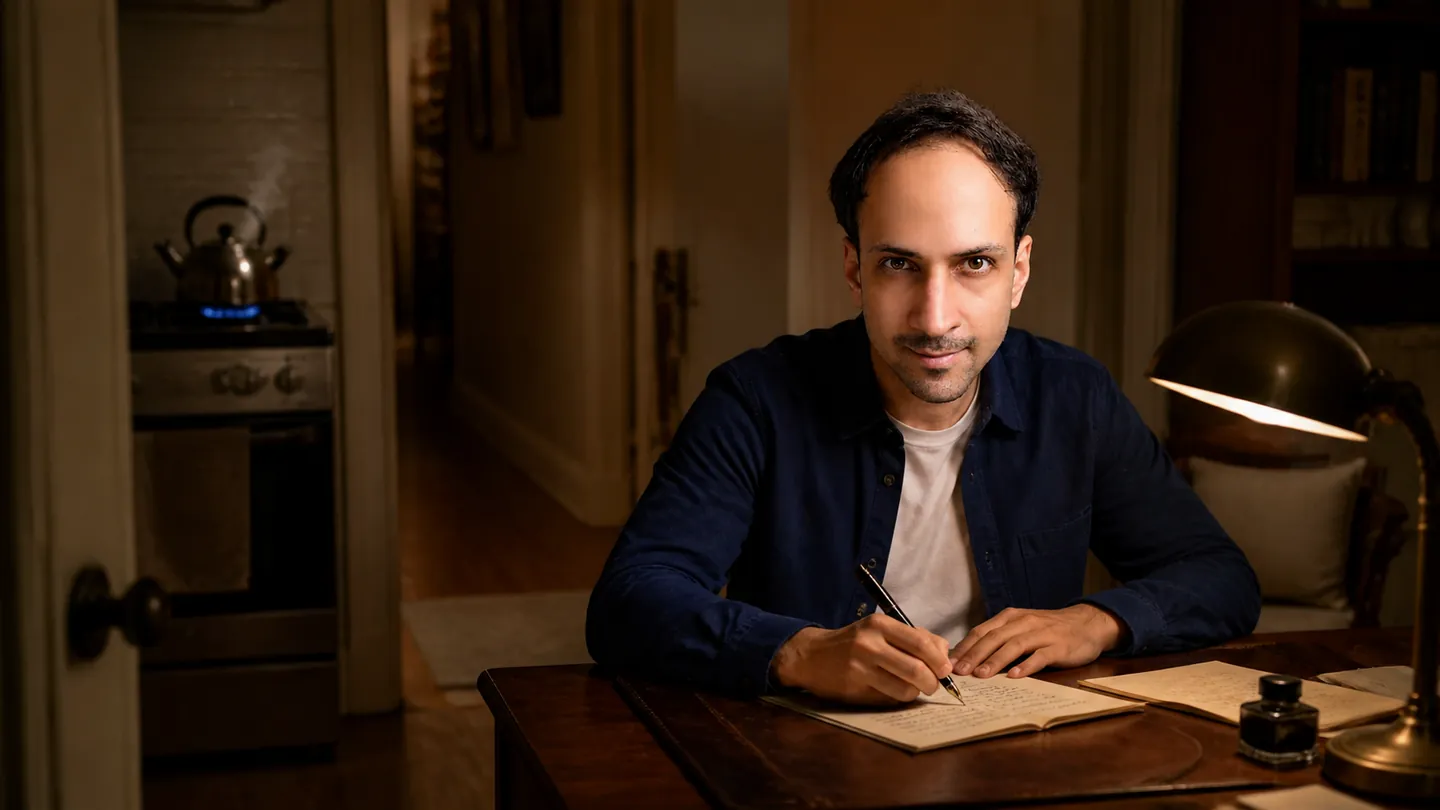
The Quiet Hours: Walnut Writing Desk — AI Portrait Prompt
صورةAI Portraits

Turn your own photo into a quiet domestic portrait in a walnut writing desk in a widened hallway, lit by one lamp. Keeps your face unchanged.

من نص البرومبت

Use the attached reference photo as the identity reference: keep the same face, skin tone, hair and features as the person in that photo, without beautifying, aging or altering them. Treat that reference as the character anchor: change only the scene. Compose a wide 16:9 narrative image where environment and subject carry equal meaning at exactly 3808x2144 pixels. Location: a walnut writing desk in a widened hallway, lit by one lamp. Show the subject in a midnight-blue overshirt buttoned over a plain white tee, rocking a curved blotter once across the drying line. The impossible-looking event must obey this clear system: a stovetop kettle at its loud murmuring stage, when collapsing steam bubbles ring the water hardest just before the boil holds the evening at the pace of conversation, never any faster. Explore why an evening feels longer when everything in it moves at hand speed; direct expression and posture toward gentle absorption, never melodrama or ad-like confidence. Use a 35mm doorway view with the room's single pool of light placed off-center and their figure inside it. Make the composition include one empty cushion or chair implying expected company. Render it as quiet domestic realism built from believable flame-lit exposure, tactile wood and wool surfaces, documentary patience, and museum-grade portrait restraint, using low tungsten-warm practicals kept below the eye line, shadows left generous and a palette of walnut, warm plaster, and one seam of lamp amber. Photorealistic: this must read as a real photograph from a physical camera, never an illustration, painting, or 3D render. Give the frame volume: faint density deepest in the room, contrast easing at the edges. Resolve real surface detail: grout darker than tile, sealant slightly yellowed, and every joint showing a real tolerance gap. Keep one identity-locked person, credible hands and fingers, natural fabric, and coherent scale, contact, reflections, shadows, airflow, deformation, and materials. Background people only when essential, always secondary and clearly different. Avoid sepia nostalgia filters, costume-drama props, candlelit romance styling, and staged rustic clutter. No text, labels, logos, signatures, watermarks, random symbols, plastic skin, excessive bloom, or glossy AI finish.
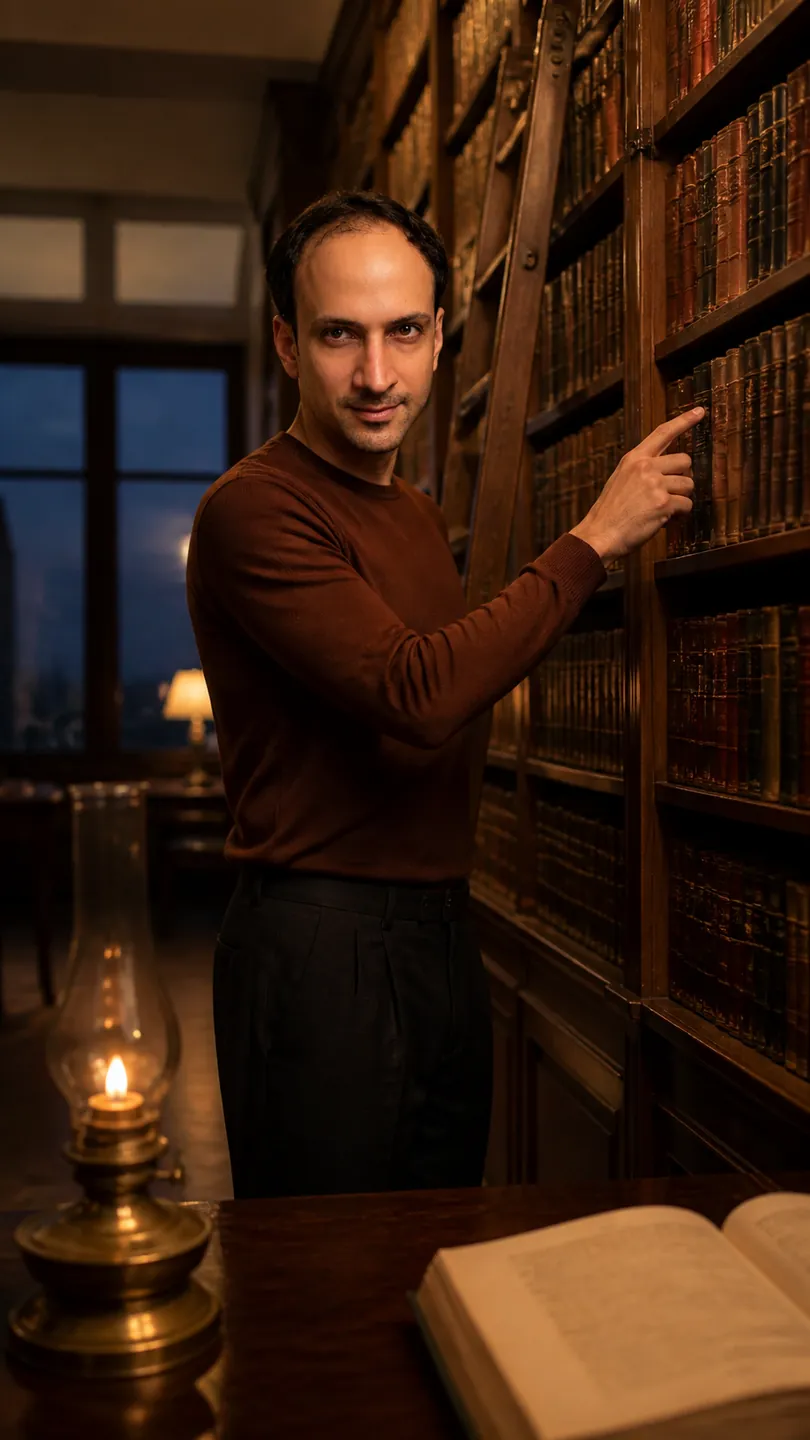
Furnished Presence: Floor-To-Ceiling Home Library Wall — AI Portrait Prompt
صورةAI Portraits

Turn your own photo into a portrait in a floor-to-ceiling home library wall with a wheeled ladder, early evening. Keeps your face unchanged.

من نص البرومبت

Use the attached reference photo as the identity reference: keep the same face, skin tone, hair and features as the person in that photo, without beautifying, aging or altering them. Treat that reference as the character anchor: change only the scene. Design a full-height 9:16 cinematic artwork that reads on a phone and rewards gallery-scale inspection at exactly 2144x3808 pixels. Location: a floor-to-ceiling home library wall with a wheeled ladder, early evening. Show the subject in a rust-brown fine-knit shirt and pleated charcoal trousers, running one finger along the spines to a stopping place. Make one rigorous physical condition the conceptual engine: a brass oil lamp whose flat cotton wick lifts fuel silently against gravity into a flame that never consumes the wick itself repays unhurried attention with detail no quick glance could collect. Explore how a room becomes louder in attention by holding fewer claims on it; direct expression and posture toward quiet hospitality, never melodrama or ad-like confidence. Frame along the table edge at forearm height so their hands and gaze read together without distortion. Make the composition angle any written page so no single word stays legible. Render it as contemporary interior portraiture combining honest low-light photography, physically accurate flame behavior, lived-in Saudi domestic detail, and unhurried editorial composure, using small honest flame light with steep falloff and skin texture kept visible and a palette of walnut, warm plaster, and one seam of lamp amber. Photorealistic: this must read as a real photograph from a physical camera, never an illustration, painting, or 3D render. Give the space honest scale: real distance between foreground, subject, and far wall. Resolve real surface detail: glass with real thickness at its edge, reflections that carry the room's actual colour, and dust visible only at grazing angles. Keep one identity-locked person, credible hands and fingers, natural fabric, and coherent scale, contact, reflections, shadows, airflow, deformation, and materials. Background people only when essential, always secondary and clearly different. Avoid sepia nostalgia filters, costume-drama props, candlelit romance styling, and staged rustic clutter. No text, labels, logos, signatures, watermarks, random symbols, plastic skin, excessive bloom, or glossy AI finish.
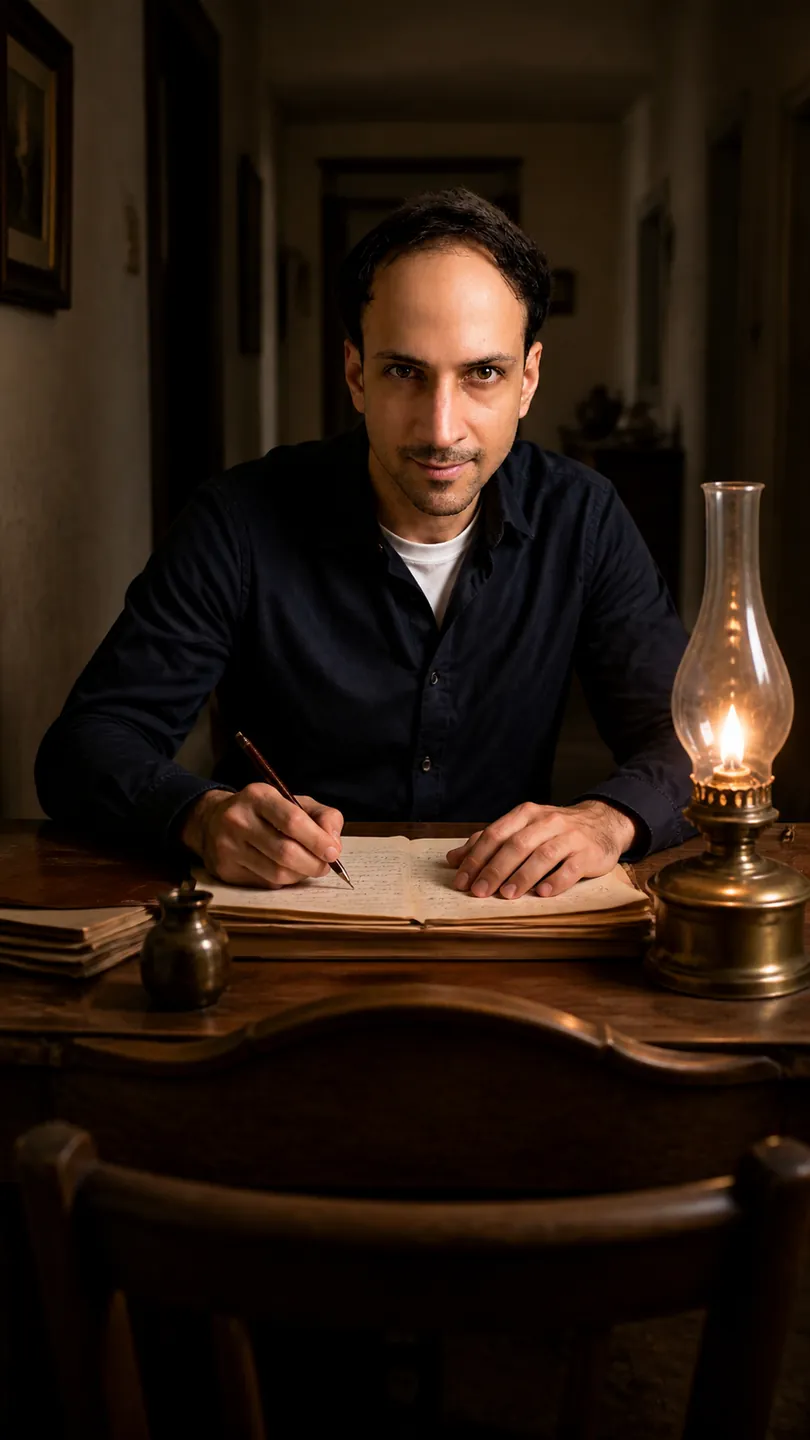
Furnished Presence: Walnut Writing Desk — AI Portrait Prompt
صورةAI Portraits

Turn your own photo into a gallery-grade domestic still portrait in a walnut writing desk in a widened hallway, lit by one lamp. Keeps your face unchanged.

من نص البرومبت

Use the attached reference photo as the identity reference: keep the same face, skin tone, hair and features as the person in that photo, without beautifying, aging or altering them. Treat that reference as the character anchor: change only the scene. Design a full-height 9:16 cinematic artwork that reads on a phone and rewards gallery-scale inspection at exactly 2144x3808 pixels. Location: a walnut writing desk in a widened hallway, lit by one lamp. Show the subject in a midnight-blue overshirt buttoned over a plain white tee, rocking a curved blotter once across the drying line. Build the artwork around this material rule: a brass oil lamp whose flat cotton wick lifts fuel silently against gravity into a flame that never consumes the wick itself gives the room one calm center that every seat quietly faces. Explore how a room becomes louder in attention by holding fewer claims on it; direct expression and posture toward warm concentration, never melodrama or ad-like confidence. Frame from the empty chair opposite them, the lens at a seated guest's eye height. Make the composition keep every working surface honest, worn, and unstyled. Render it as gallery-grade domestic still photography built from truthful household physics, restrained art direction, deep readable shadow, and companionable observational framing, using a single lantern's white core softened by distance into readable half-tones and a palette of dusk blue, sand plaster, and a single brass gleam. Photorealistic: this must read as a real photograph from a physical camera, never an illustration, painting, or 3D render. Give the air depth: falloff with distance and no artificial clarity far back. Resolve real surface detail: thread ends and slight pilling on worn cloth, hairline chips at every hard corner, and stone that is porous rather than smooth. Keep one identity-locked person, credible hands and fingers, natural fabric, and coherent scale, contact, reflections, shadows, airflow, deformation, and materials. Background people only when essential, always secondary and clearly different. Avoid orientalist lantern fantasies, floating dust-mote sunbeam overload, plastic-perfect wax flames, museum-diorama stiffness, and greeting-card coziness. No text, labels, logos, signatures, watermarks, random symbols, plastic skin, excessive bloom, or glossy AI finish.
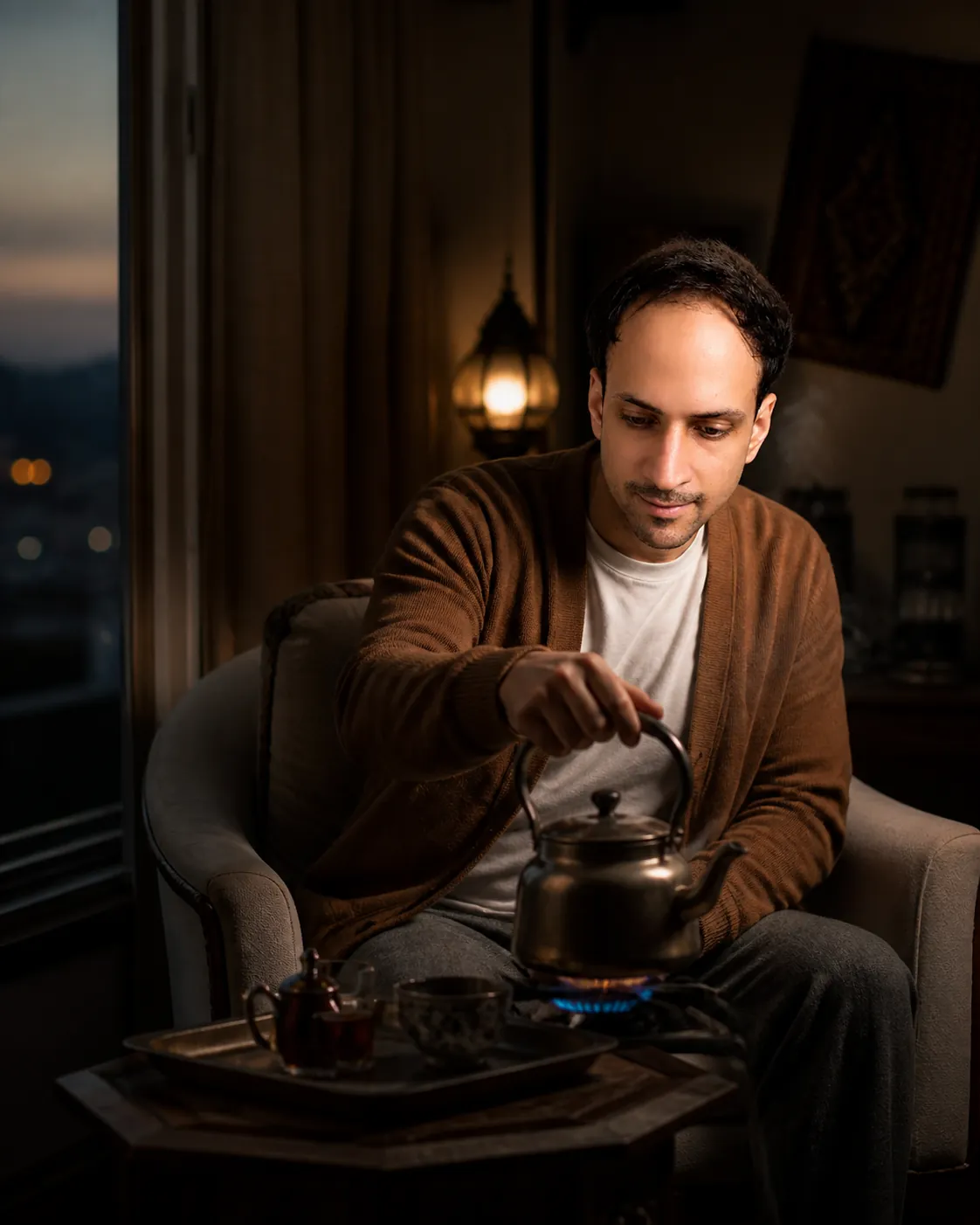
The Quiet Hours: Reading Nook — AI Portrait Prompt
صورةAI Portraits

Turn your own photo into a contemporary interior portrait in a reading nook with one armchair angled to the window's last light. Keeps your face unchanged.

من نص البرومبت

Use the attached reference photo as the identity reference: keep the same face, skin tone, hair and features as the person in that photo, without beautifying, aging or altering them. Treat that reference as the character anchor: change only the scene. Build a portrait 4:5 editorial artwork with protected negative space and a fully readable face at exactly 2560x3200 pixels. Location: a reading nook with one armchair angled to the window's last light. Show the subject in a camel-brown cardigan over a white crew-neck and grey wool trousers, drawing the armchair a hand-width closer to the window. Build the artwork around this material rule: a stovetop kettle at its loud murmuring stage, when collapsing steam bubbles ring the water hardest just before the boil gathers their hands and their attention into the same small territory. Explore why an evening feels longer when everything in it moves at hand speed; direct expression and posture toward warm concentration, never melodrama or ad-like confidence. Use an 85mm view from across the room, the evening's object resting in the same focal plane as their face. Make the composition surround the action with generous, untroubled evening shadow. Render it as contemporary interior portraiture combining honest low-light photography, physically accurate flame behavior, lived-in Saudi domestic detail, and unhurried editorial composure, using a single lantern's white core softened by distance into readable half-tones and a palette of tea brown, raw linen, and one saffron thread. Photorealistic: this must read as a real photograph from a physical camera, never an illustration, painting, or 3D render. Resolve real surface detail: cotton that hangs by its own weight, seams that pucker very slightly, and collars softened by washing. Keep one identity-locked person, credible hands and fingers, natural fabric, and coherent scale, contact, reflections, shadows, airflow, deformation, and materials. Background people only when essential, always secondary and clearly different. Avoid orientalist lantern fantasies, floating dust-mote sunbeam overload, plastic-perfect wax flames, museum-diorama stiffness, and greeting-card coziness. No text, labels, logos, signatures, watermarks, random symbols, plastic skin, excessive bloom, or glossy AI finish.
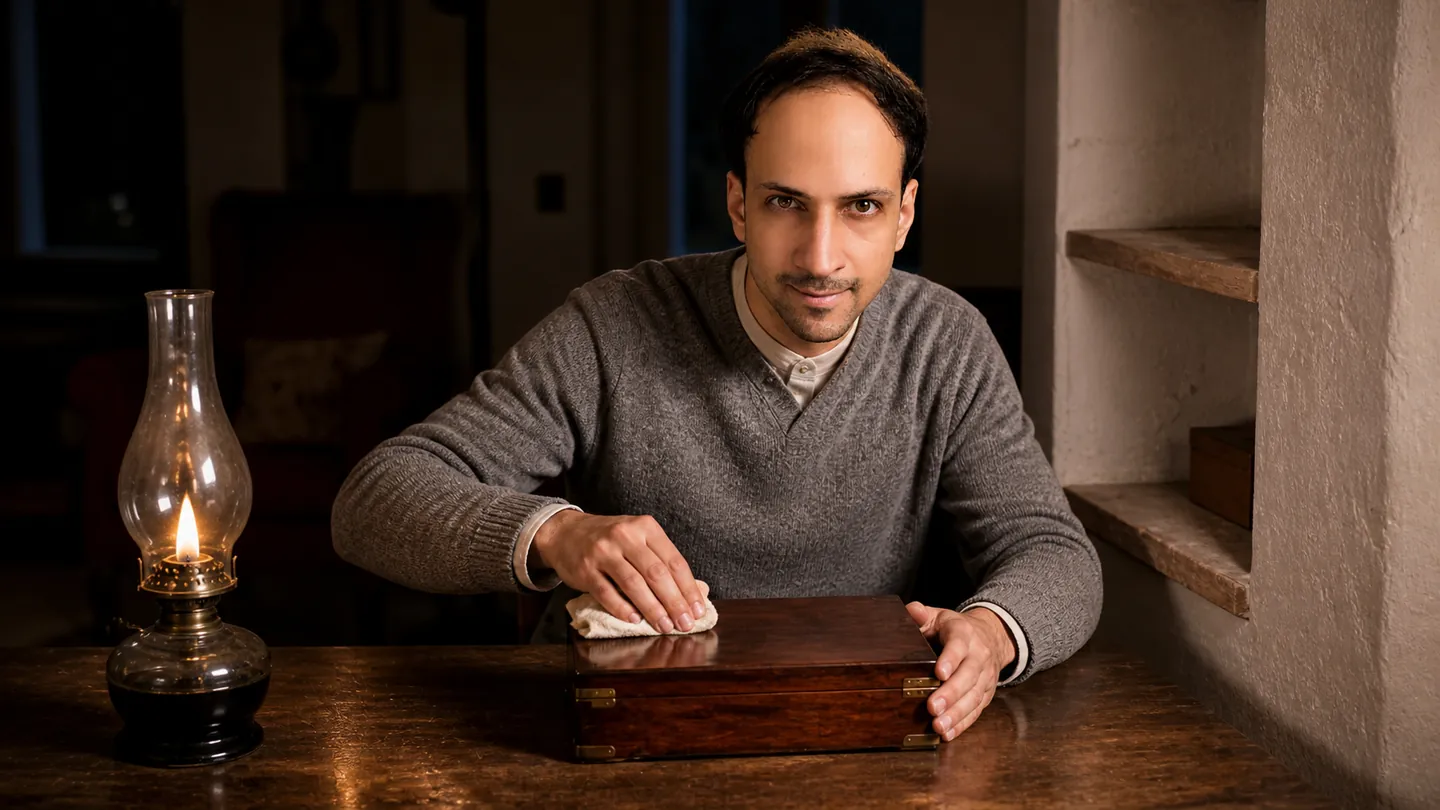
Furnished Presence: Wall Niche — AI Portrait Prompt
صورةAI Portraits

Turn your own photo into a quiet domestic portrait in a wall niche holding one closed walnut case between bare plaster shelves. Keeps your face unchanged.

من نص البرومبت

Use the attached reference photo as the identity reference: keep the same face, skin tone, hair and features as the person in that photo, without beautifying, aging or altering them. Treat that reference as the character anchor: change only the scene. Compose a wide 16:9 narrative image where environment and subject carry equal meaning at exactly 3808x2144 pixels. Location: a wall niche holding one closed walnut case between bare plaster shelves. Show the subject in a heather-grey sweater with a band-collar shirt beneath it, buffing the case's lid along its grain with a soft cloth. Use this advanced image-making device as the core logic: a brass oil lamp whose flat cotton wick lifts fuel silently against gravity into a flame that never consumes the wick itself holds the evening at the pace of conversation, never any faster. Explore how a room becomes louder in attention by holding fewer claims on it; direct expression and posture toward patient relish, never melodrama or ad-like confidence. Use an 85mm view from across the room, the evening's object resting in the same focal plane as their face. Make the composition surround the action with generous, untroubled evening shadow. Render it as quiet domestic realism built from believable flame-lit exposure, tactile wood and wool surfaces, documentary patience, and museum-grade portrait restraint, using small honest flame light with steep falloff and skin texture kept visible and a palette of charcoal, aged brass, and one band of brick red. Photorealistic: this must read as a real photograph from a physical camera, never an illustration, painting, or 3D render. Give the space honest scale: real distance between foreground, subject, and far wall. Keep one identity-locked person, credible hands and fingers, natural fabric, and coherent scale, contact, reflections, shadows, airflow, deformation, and materials. Background people only when essential, always secondary and clearly different. Avoid sepia nostalgia filters, costume-drama props, candlelit romance styling, and staged rustic clutter. No text, labels, logos, signatures, watermarks, random symbols, plastic skin, excessive bloom, or glossy AI finish.

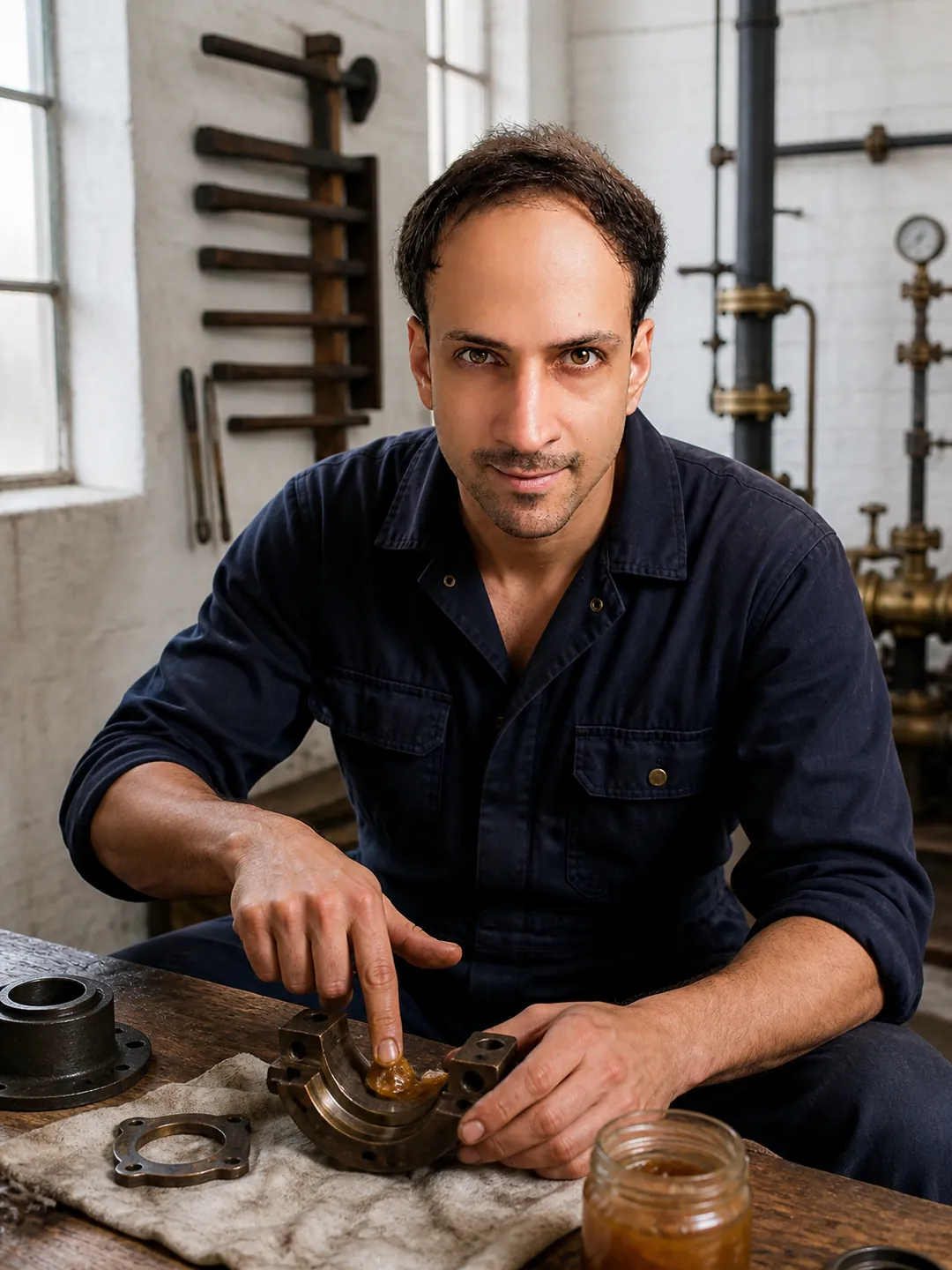
Time As Polish: Whitewashed Pump-House Machine Room — AI Portrait Prompt
صورةAI Portraits

Turn your own photo into a portrait in a whitewashed pump-house machine room, brass fittings dulled to honey. Keeps your face unchanged.

من نص البرومبت

Use the attached reference photo as the identity reference: keep the same face, skin tone, hair and features as the person in that photo, without beautifying, aging or altering them. Use a formal 3:4 environmental portrait with complete hands and meaningful objects inside frame at exactly 2480x3312 pixels. Location: a whitewashed pump-house machine room, brass fittings dulled to honey. Show the subject in clean indigo coveralls folded open at the collar, cupping fresh grease onto a bearing cap with two fingers. Use this advanced image-making device as the core logic: an axe head on its seventh handle that outlasted the six retired handles racked beneath it, each darkened at the grip carries its wear like grammar, every mark placed by repetition. Explore why a tool kept for a century looks finished rather than worn; direct expression and posture toward measured devotion, never melodrama or ad-like confidence. Use an eye-level 80mm portrait view with honest perspective and shallow, disciplined focus. Make the composition give the brightest polish the smallest area of the frame. Render it as heritage-craft documentary portraiture built from truthful tool wear, oiled-wood and carbon-steel materiality, museum-conservation lighting discipline, and unhurried editorial composition, using north daylight through a dusty pane, contrast held gentle and true and a palette of bone-white stone, deep hickory, and a thread of amber. Photorealistic: this must read as a real photograph from a physical camera, never an illustration, painting, or 3D render. Resolve real surface detail: skin that reddens slightly under pressure, nail beds with honest colour, and knuckle creases that fold rather than blur. Keep one identity-locked person, credible hands and fingers, natural fabric, and coherent scale, contact, reflections, shadows, airflow, deformation, and materials. Background people only when essential, always secondary and clearly different. Avoid glowing forge montages, artificially weathered wood grain, hipster workshop styling, floating tool arrangements, and varnish-shiny fake patina. No text, labels, logos, signatures, watermarks, random symbols, plastic skin, excessive bloom, or glossy AI finish.
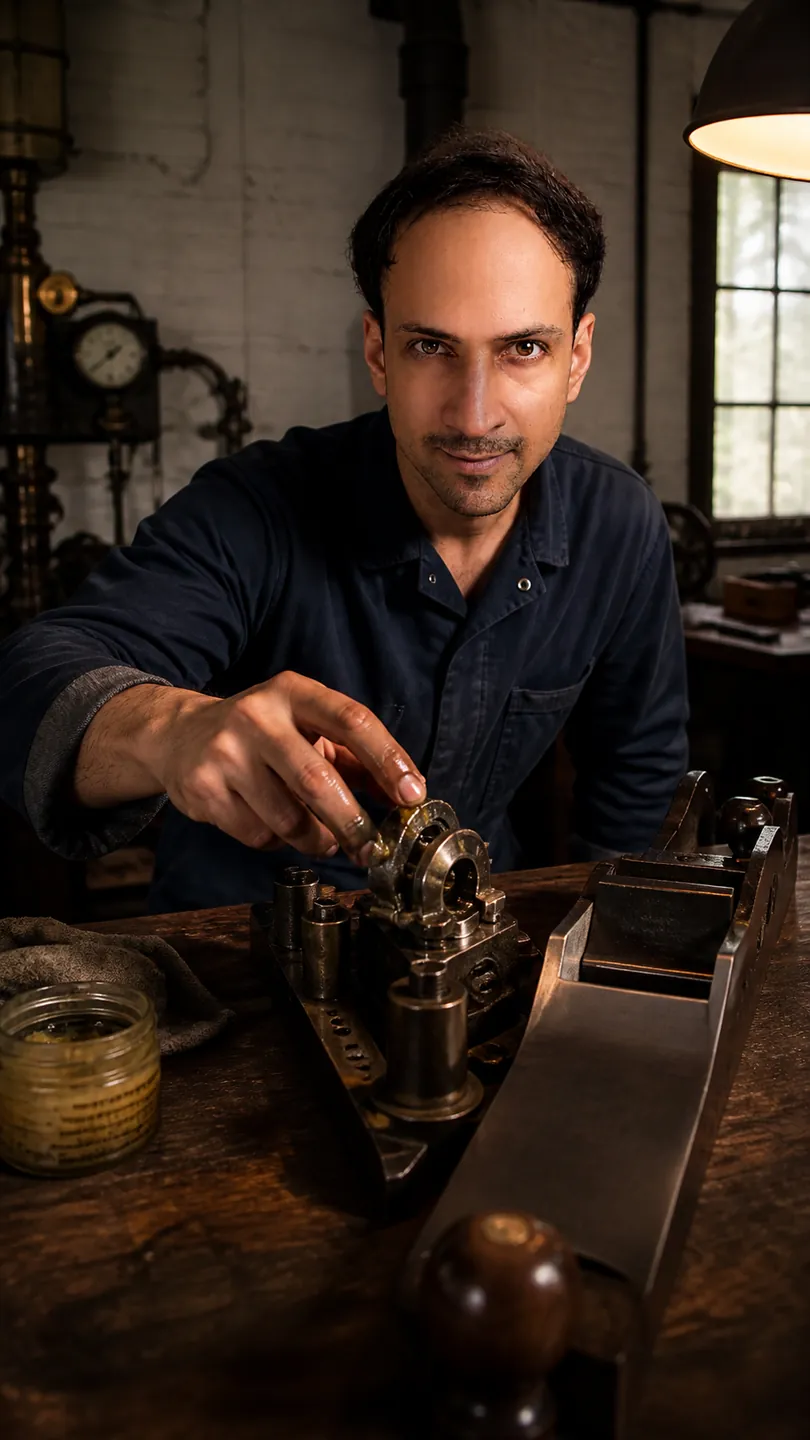
Kept Not Replaced: Dim Dhow-Repair Shed — AI Portrait Prompt
صورةAI Portraits

Turn your own photo into a heritage-craft documentary portrait in a dim dhow-repair shed on the Gulf shore, tide sounding outside. Keeps your face unchanged.

من نص البرومبت

Use the attached reference photo as the identity reference: keep the same face, skin tone, hair and features as the person in that photo, without beautifying, aging or altering them. Treat that reference as the character anchor: change only the scene. Use a formal 3:4 environmental portrait with complete hands and meaningful objects inside frame at exactly 2480x3312 pixels. Location: a dim dhow-repair shed on the Gulf shore, tide sounding outside. Show the subject in a salt-faded blue overshirt with sleeves rolled past the elbow, pressing warmed wax into a seam with one thumb. The impossible-looking event must obey this clear system: a hundred-year-old smoothing plane that still lifts one unbroken shaving thin enough to read the window's light through its curl carries its wear like grammar, every mark placed by repetition. Explore how minutes of ritual care can outweigh decades of neglect; direct expression and posture toward practical tenderness, never melodrama or ad-like confidence. Frame level with the benchtop so the tool's brightest wear and their steady gaze share focus. Make the composition let repetition read as rhythm across the tool's wear. Render it as heritage-craft documentary portraiture built from truthful tool wear, oiled-wood and carbon-steel materiality, museum-conservation lighting discipline, and unhurried editorial composition, using one low window key raking across worn surfaces with soft paper-bounce fill and a palette of worn steel, oiled walnut, and one line of brass. Photorealistic: this must read as a real photograph from a physical camera, never an illustration, painting, or 3D render. Resolve real surface detail: hair with individual strands catching light, fine hairs of uneven length, and skin oil giving a low uneven sheen. Keep one identity-locked person, credible hands and fingers, natural fabric, and coherent scale, contact, reflections, shadows, airflow, deformation, and materials. Background people only when essential, always secondary and clearly different. Avoid glowing forge montages, artificially weathered wood grain, hipster workshop styling, floating tool arrangements, and varnish-shiny fake patina. No text, labels, logos, signatures, watermarks, random symbols, plastic skin, excessive bloom, or glossy AI finish.
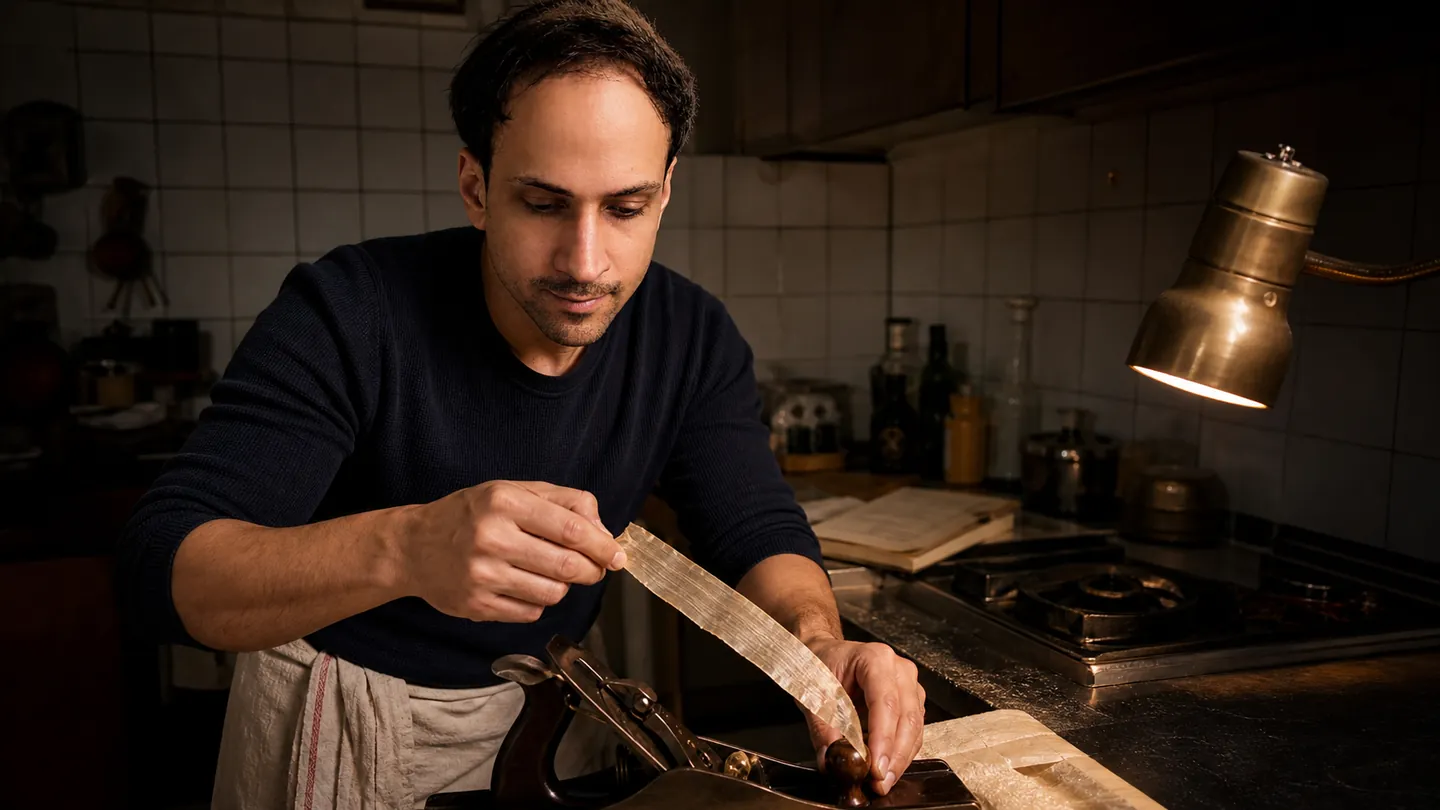
Kept Not Replaced: Whitewashed Pump-House Machine Room — AI Portrait Prompt
صورةAI Portraits

Turn your own photo into a photorealistic portrait in a whitewashed pump-house machine room, brass fittings dulled to honey. Keeps your face unchanged.

من نص البرومبت

Use the attached reference photo as the identity reference: keep the same face, skin tone, hair and features as the person in that photo, without beautifying, aging or altering them. Treat that reference as the character anchor: change only the scene. Design a full-height 9:16 cinematic artwork that reads on a phone and rewards gallery-scale inspection at exactly 2144x3808 pixels. Location: a whitewashed pump-house machine room, brass fittings dulled to honey. Show the subject in clean indigo coveralls folded open at the collar, cupping fresh grease onto a bearing cap with two fingers. Treat this mechanism as the frame’s governing rule: a hundred-year-old smoothing plane that still lifts one unbroken shaving thin enough to read the window's light through its curl recruits whoever maintains it into a relay older than any keeper. Explore how minutes of ritual care can outweigh decades of neglect; direct expression and posture toward unhurried reverence, never melodrama or ad-like confidence. Use a 90mm close-working lens: the cared-for surface sharp near the glass, their face readable just beyond it. Make the composition hold empty bench space where a finished tool will rest. Render it as workshop still-life realism joining high-fidelity portrait photography, accurate patina and polish, shallow tactile depth, and quiet archival grading, using a single warm workbench lamp pooled tight, the room falling to umber and a palette of graphite, unbleached canvas, and one band of forge blue. Photorealistic: this must read as a real photograph from a physical camera, never an illustration, painting, or 3D render. Give the frame volume: faint density deepest in the room, contrast easing at the edges. Resolve real surface detail: label-free packaging showing carton fibre, cardboard bruised at the corners, and tape lifting slightly at one end. Keep one identity-locked person, credible hands and fingers, natural fabric, and coherent scale, contact, reflections, shadows, airflow, deformation, and materials. Background people only when essential, always secondary and clearly different. Avoid rusty antique-shop clutter, sepia nostalgia filters, cobwebbed barn walls, staged distressed props, and heroic blacksmith sparks. No text, labels, logos, signatures, watermarks, random symbols, plastic skin, excessive bloom, or glossy AI finish.

Kept Not Replaced: Small Tiled Kitchen — AI Portrait Prompt
صورةAI Portraits

Turn your own photo into a heritage-craft documentary portrait in a small tiled kitchen before dawn, one burner ring still cooling. Keeps your face unchanged.

من نص البرومبت

Use the attached reference photo as the identity reference: keep the same face, skin tone, hair and features as the person in that photo, without beautifying, aging or altering them. Treat that reference as the character anchor: change only the scene. Compose a wide 16:9 narrative image where environment and subject carry equal meaning at exactly 3808x2144 pixels. Location: a small tiled kitchen before dawn, one burner ring still cooling. Show the subject in a navy waffle-knit shirt with a plain towel tucked at the waist, wiping a thin sheen of oil across black iron. The impossible-looking event must obey this clear system: a hundred-year-old smoothing plane that still lifts one unbroken shaving thin enough to read the window's light through its curl outlives its first owner, then its second, without ever leaving service. Explore how minutes of ritual care can outweigh decades of neglect; direct expression and posture toward patient custodianship, never melodrama or ad-like confidence. Use a restrained 35mm environmental view, the subject at one-third and the workspace honest around them. Make the composition keep their hands nearer the light than their face. Render it as heritage-craft documentary portraiture built from truthful tool wear, oiled-wood and carbon-steel materiality, museum-conservation lighting discipline, and unhurried editorial composition, using a single warm workbench lamp pooled tight, the room falling to umber and a palette of worn steel, oiled walnut, and one line of brass. Photorealistic: this must read as a real photograph from a physical camera, never an illustration, painting, or 3D render. Give the frame volume: faint density deepest in the room, contrast easing at the edges. Resolve real surface detail: grout darker than tile, sealant slightly yellowed, and every joint showing a real tolerance gap. Keep one identity-locked person, credible hands and fingers, natural fabric, and coherent scale, contact, reflections, shadows, airflow, deformation, and materials. Background people only when essential, always secondary and clearly different. Avoid rusty antique-shop clutter, sepia nostalgia filters, cobwebbed barn walls, staged distressed props, and heroic blacksmith sparks. No text, labels, logos, signatures, watermarks, random symbols, plastic skin, excessive bloom, or glossy AI finish.
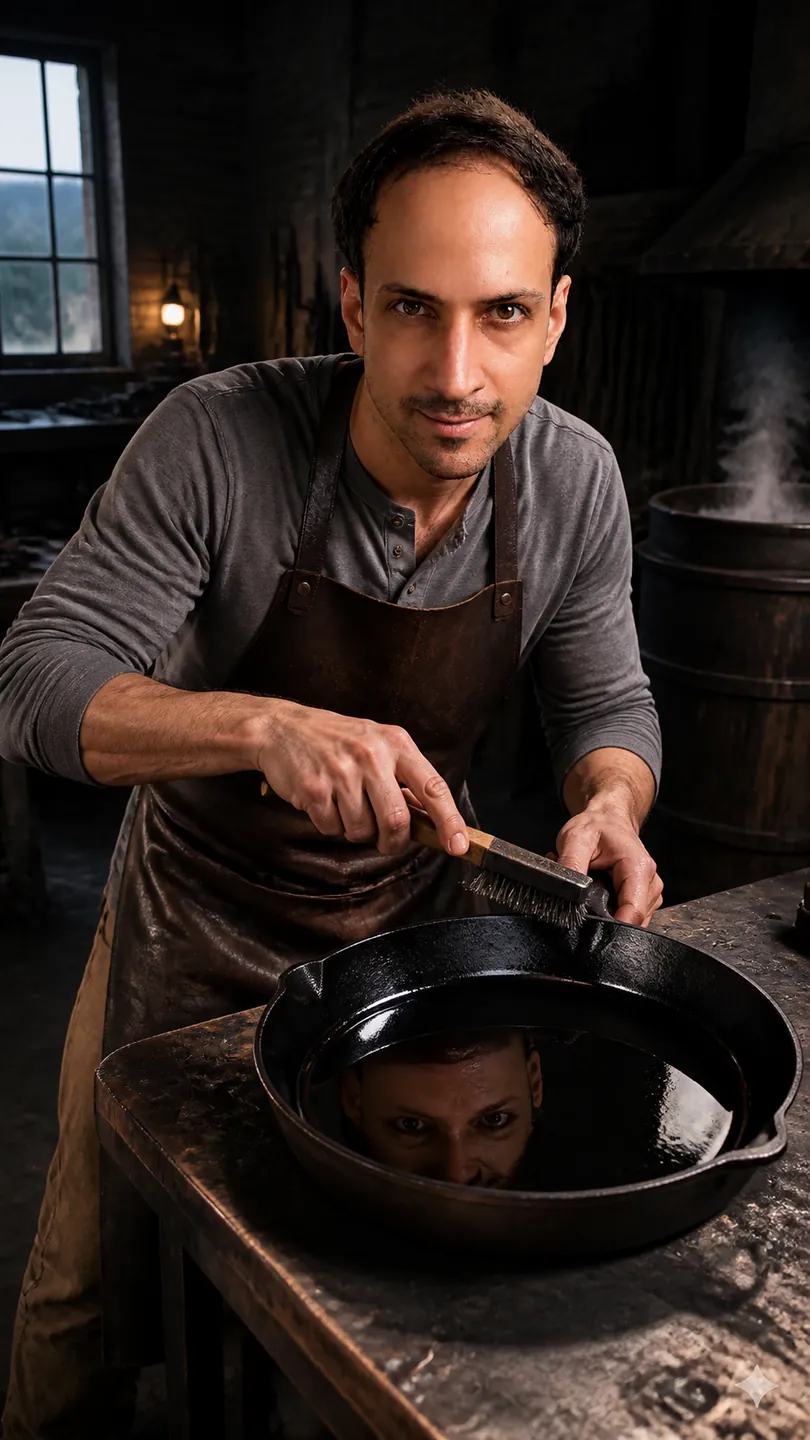
Kept Not Replaced: Swept Brick Yard of a Small Forge — AI Portrait Prompt
صورةAI Portraits

Turn your own photo into a portrait in the swept brick yard of a small forge, quench barrel steaming faintly. Keeps your face unchanged.

من نص البرومبت

Use the attached reference photo as the identity reference: keep the same face, skin tone, hair and features as the person in that photo, without beautifying, aging or altering them. Treat that reference as the character anchor: change only the scene. Use a formal 3:4 environmental portrait with complete hands and meaningful objects inside frame at exactly 2480x3312 pixels. Location: the swept brick yard of a small forge, quench barrel steaming faintly. Show the subject in a leather smith's apron over a heather-grey henley and canvas trousers, carding scale off a blade's spine with a wire brush. Use this advanced image-making device as the core logic: a hundred-year-old smoothing plane that still lifts one unbroken shaving thin enough to read the window's light through its curl keeps a legible record of every hand that ever kept it. Explore how minutes of ritual care can outweigh decades of neglect; direct expression and posture toward attentive stillness, never melodrama or ad-like confidence. Use an eye-level 80mm portrait view with honest perspective and shallow, disciplined focus. Make the composition give the brightest polish the smallest area of the frame. Render it as material-culture documentary photography combining believable century-old tools, honest maintenance evidence, restrained contemporary art direction, and calm human-scale observational framing, using late slanting sun that grazes every polished wear point into quiet highlights and a palette of seasoned black, beeswax cream, and a gleam of pewter. Photorealistic: this must read as a real photograph from a physical camera, never an illustration, painting, or 3D render. Resolve real surface detail: brass darkened in the recesses and bright where thumbs land, and lacquer crazed rather than perfect. Keep one identity-locked person, credible hands and fingers, natural fabric, and coherent scale, contact, reflections, shadows, airflow, deformation, and materials. Background people only when essential, always secondary and clearly different. Avoid rusty antique-shop clutter, sepia nostalgia filters, cobwebbed barn walls, staged distressed props, and heroic blacksmith sparks. No text, labels, logos, signatures, watermarks, random symbols, plastic skin, excessive bloom, or glossy AI finish.
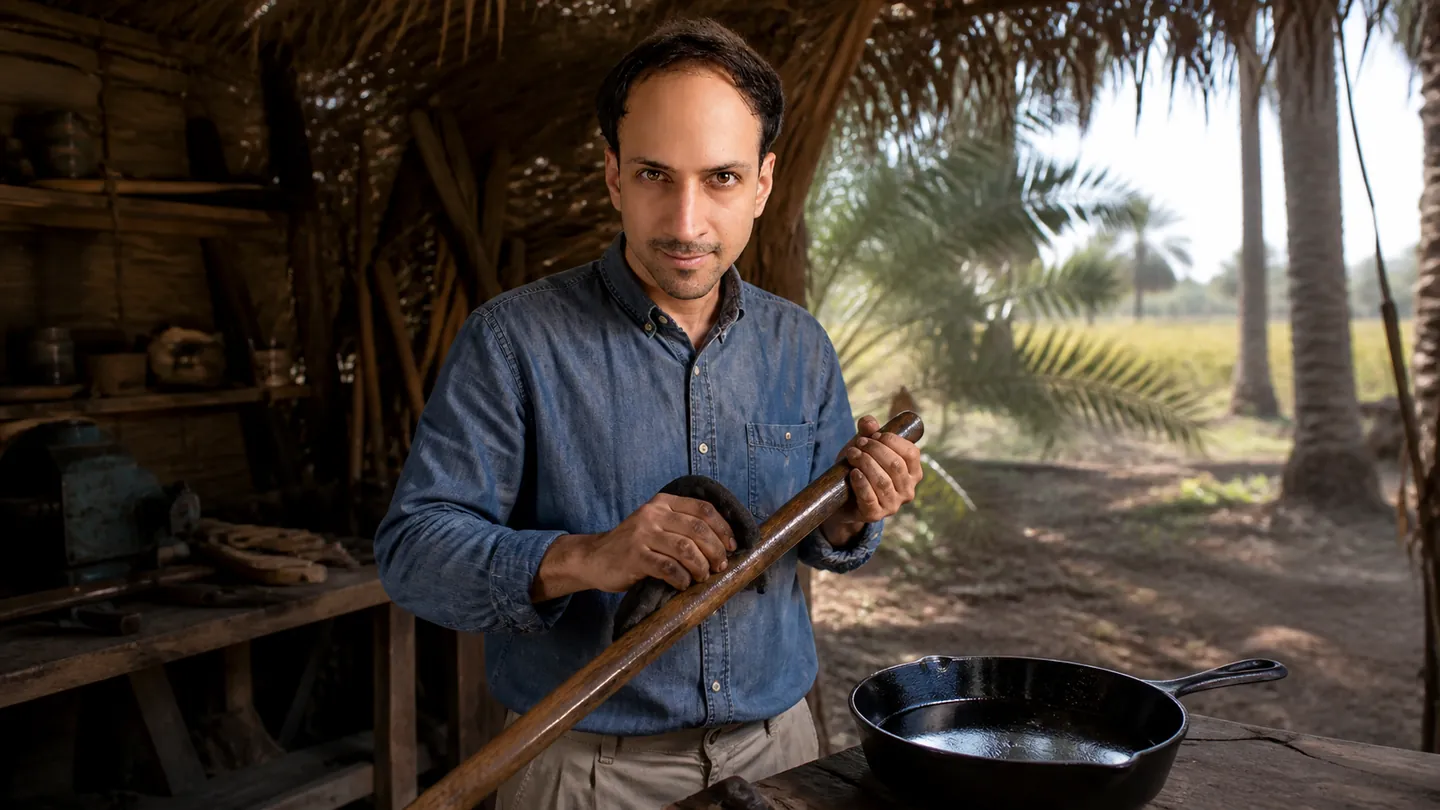
Second Century: Palm-Frond-Shaded Implement Shed — AI Portrait Prompt
صورةAI Portraits

Turn your own photo into a portrait in a palm-frond-shaded implement shed at the working edge of a date farm. Keeps your face unchanged.

من نص البرومبت

Use the attached reference photo as the identity reference: keep the same face, skin tone, hair and features as the person in that photo, without beautifying, aging or altering them. Treat that reference as the character anchor: change only the scene. Compose a wide 16:9 narrative image where environment and subject carry equal meaning at exactly 3808x2144 pixels. Location: a palm-frond-shaded implement shed at the working edge of a date farm. Show the subject in a sun-faded chambray shirt buttoned to the wrist over cotton trousers, rubbing an oiled rag down a long wooden haft. Build the artwork around this material rule: a cast-iron skillet whose cooking face has been seasoned over decades into a black glass that carries a true reflection outlives its first owner, then its second, without ever leaving service. Explore what an object records about the hands that refused to let it fail; direct expression and posture toward settled respect, never melodrama or ad-like confidence. Use an eye-level 80mm portrait view with honest perspective and shallow, disciplined focus. Make the composition give the brightest polish the smallest area of the frame. Render it as heritage-craft documentary portraiture built from truthful tool wear, oiled-wood and carbon-steel materiality, museum-conservation lighting discipline, and unhurried editorial composition, using north daylight through a dusty pane, contrast held gentle and true and a palette of graphite, unbleached canvas, and one band of forge blue. Photorealistic: this must read as a real photograph from a physical camera, never an illustration, painting, or 3D render. Give truthful depth cues: overlapping planes and shadows softening as they travel. Resolve real surface detail: wood grain read at honest scale, matte and gloss clearly separated, and no surface uniformly clean. Keep one identity-locked person, credible hands and fingers, natural fabric, and coherent scale, contact, reflections, shadows, airflow, deformation, and materials. Background people only when essential, always secondary and clearly different. Avoid rusty antique-shop clutter, sepia nostalgia filters, cobwebbed barn walls, staged distressed props, and heroic blacksmith sparks. No text, labels, logos, signatures, watermarks, random symbols, plastic skin, excessive bloom, or glossy AI finish.
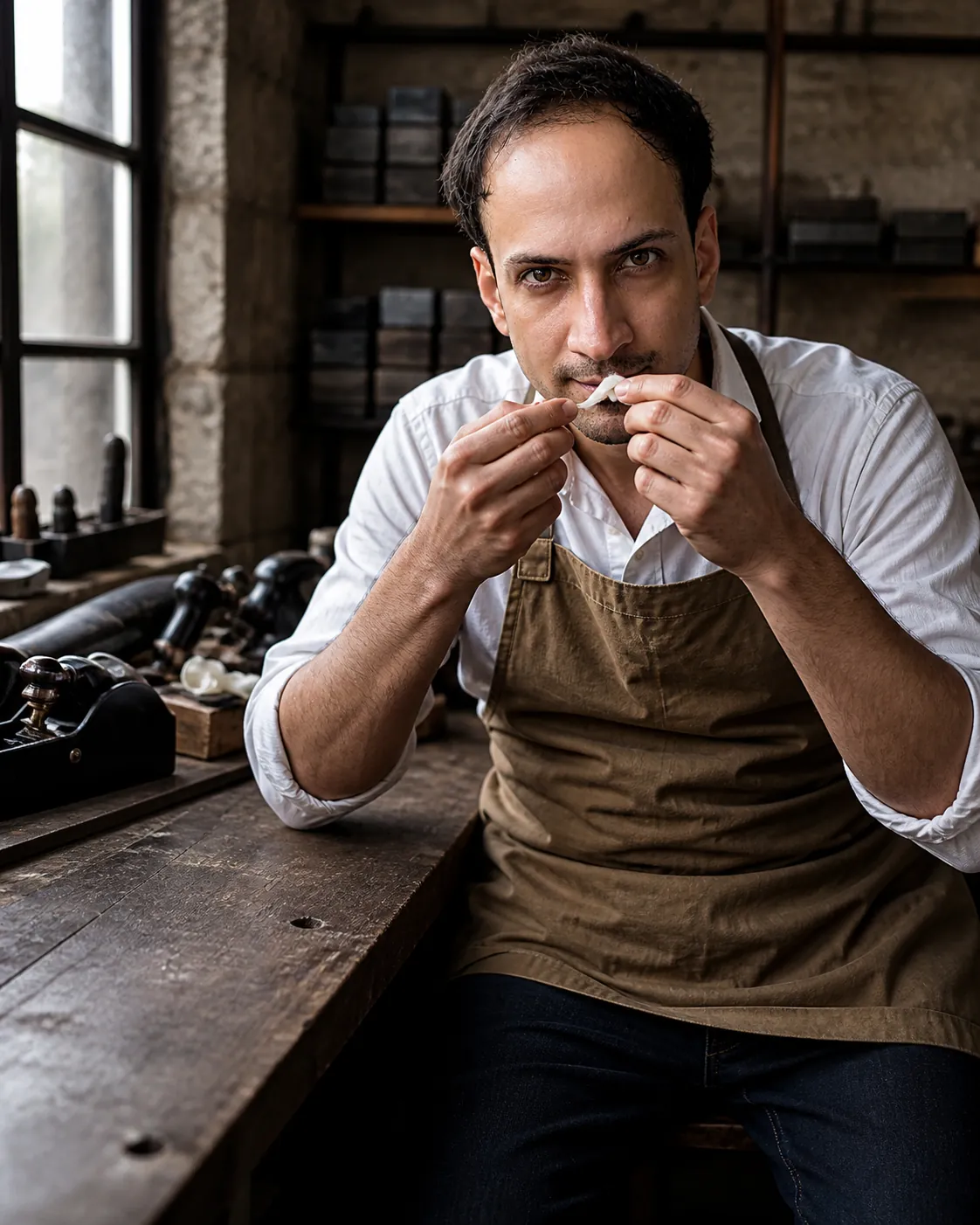
Kept Not Replaced: Narrow Sharpening Room — AI Portrait Prompt
صورةAI Portraits

Turn your own photo into a photorealistic portrait in a narrow sharpening room with stones racked by grit under one window. Keeps your face unchanged.

من نص البرومبت

Use the attached reference photo as the identity reference: keep the same face, skin tone, hair and features as the person in that photo, without beautifying, aging or altering them. Treat that reference as the character anchor: change only the scene. Build a portrait 4:5 editorial artwork with protected negative space and a fully readable face at exactly 2560x3200 pixels. Location: a narrow sharpening room with stones racked by grit under one window. Show the subject in a tan waxed-canvas apron over rolled white shirtsleeves and dark denim, trailing an edge across their thumbnail to feel its bite. Build the artwork around this material rule: a hundred-year-old smoothing plane that still lifts one unbroken shaving thin enough to read the window's light through its curl passes a plain working test any patient eye can score. Explore how minutes of ritual care can outweigh decades of neglect; direct expression and posture toward sober gratitude, never melodrama or ad-like confidence. Use a 90mm close-working lens: the cared-for surface sharp near the glass, their face readable just beyond it. Make the composition hold empty bench space where a finished tool will rest. Render it as workshop still-life realism joining high-fidelity portrait photography, accurate patina and polish, shallow tactile depth, and quiet archival grading, using north daylight through a dusty pane, contrast held gentle and true and a palette of lampblack, waxed leather, and one glint of copper. Photorealistic: this must read as a real photograph from a physical camera, never an illustration, painting, or 3D render. Resolve real surface detail: cotton that hangs by its own weight, seams that pucker very slightly, and collars softened by washing. Keep one identity-locked person, credible hands and fingers, natural fabric, and coherent scale, contact, reflections, shadows, airflow, deformation, and materials. Background people only when essential, always secondary and clearly different. Avoid glowing forge montages, artificially weathered wood grain, hipster workshop styling, floating tool arrangements, and varnish-shiny fake patina. No text, labels, logos, signatures, watermarks, random symbols, plastic skin, excessive bloom, or glossy AI finish.
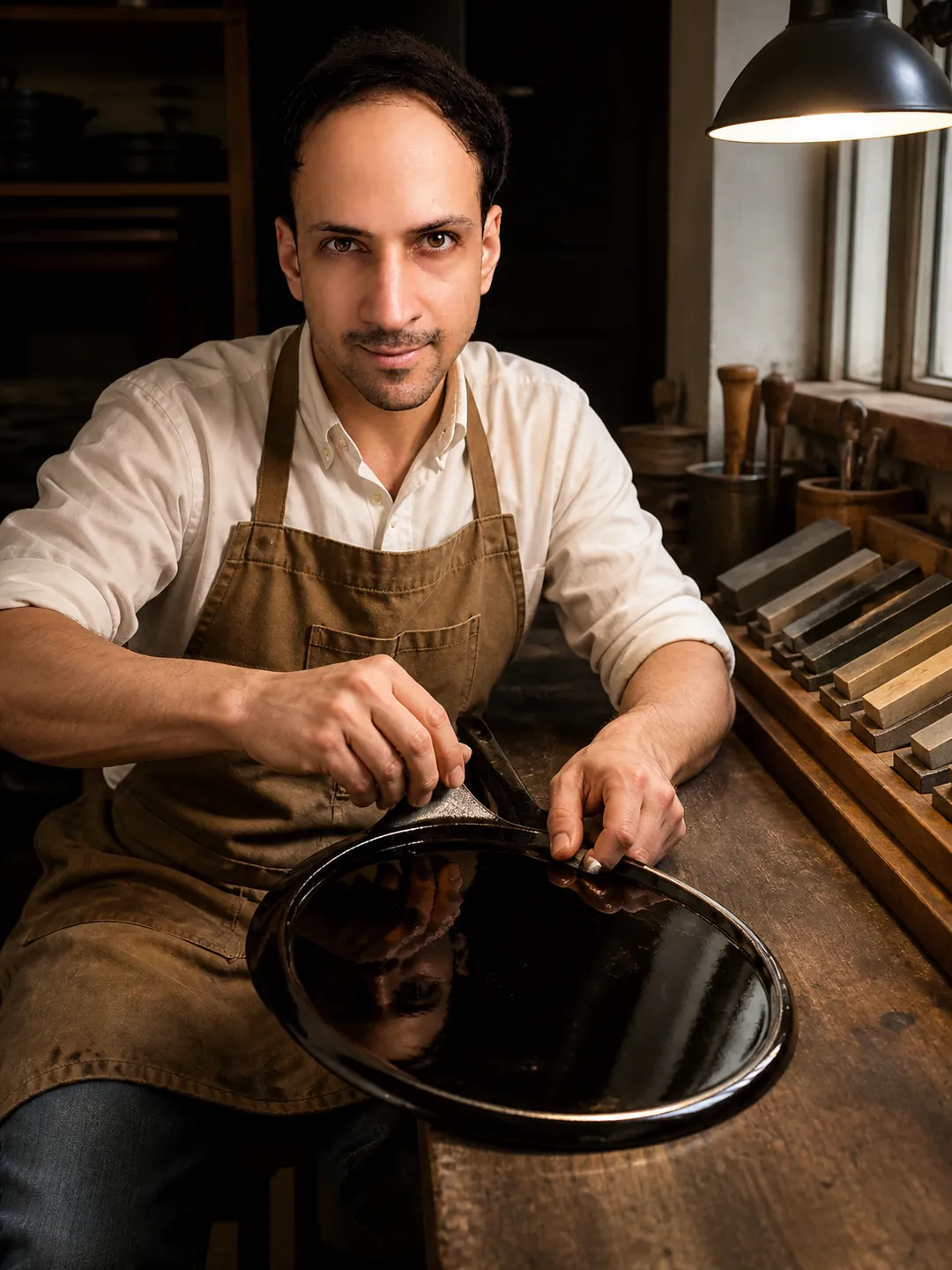
Second Century: Swept Brick Yard of a Small Forge — AI Portrait Prompt
صورةAI Portraits

Turn your own photo into a portrait in the swept brick yard of a small forge, quench barrel steaming faintly. Keeps your face unchanged.

من نص البرومبت

Use the attached reference photo as the identity reference: keep the same face, skin tone, hair and features as the person in that photo, without beautifying, aging or altering them. Treat that reference as the character anchor: change only the scene. Design a full-height 9:16 cinematic artwork that reads on a phone and rewards gallery-scale inspection at exactly 2144x3808 pixels. Location: the swept brick yard of a small forge, quench barrel steaming faintly. Show the subject in a leather smith's apron over a heather-grey henley and canvas trousers, carding scale off a blade's spine with a wire brush. Treat this mechanism as the frame’s governing rule: a cast-iron skillet whose cooking face has been seasoned over decades into a black glass that carries a true reflection makes deep time readable at a glance without any caption. Explore what an object records about the hands that refused to let it fail; direct expression and posture toward measured devotion, never melodrama or ad-like confidence. Use a 90mm close-working lens: the cared-for surface sharp near the glass, their face readable just beyond it. Make the composition hold empty bench space where a finished tool will rest. Render it as conservation-grade craft portraiture built from real working tools, truthful wear mapping, warm low-key lighting, and precise, respectful editorial realism, using cool pre-dawn ambience lifted by one small tungsten practical near the hands and a palette of worn steel, oiled walnut, and one line of brass. Photorealistic: this must read as a real photograph from a physical camera, never an illustration, painting, or 3D render. Give the frame volume: faint density deepest in the room, contrast easing at the edges. Keep one identity-locked person, credible hands and fingers, natural fabric, and coherent scale, contact, reflections, shadows, airflow, deformation, and materials. Background people only when essential, always secondary and clearly different. Avoid glowing forge montages, artificially weathered wood grain, hipster workshop styling, floating tool arrangements, and varnish-shiny fake patina. No text, labels, logos, signatures, watermarks, random symbols, plastic skin, excessive bloom, or glossy AI finish.
Second Century: Narrow Sharpening Room — AI Portrait Prompt
صورةAI Portraits

Turn your own photo into a portrait in a narrow sharpening room with stones racked by grit under one window. Keeps your face unchanged.

من نص البرومبت

Use the attached reference photo as the identity reference: keep the same face, skin tone, hair and features as the person in that photo, without beautifying, aging or altering them. Treat that reference as the character anchor: change only the scene. Use a formal 3:4 environmental portrait with complete hands and meaningful objects inside frame at exactly 2480x3312 pixels. Location: a narrow sharpening room with stones racked by grit under one window. Show the subject in a tan waxed-canvas apron over rolled white shirtsleeves and dark denim, trailing an edge across their thumbnail to feel its bite. The impossible-looking event must obey this clear system: a cast-iron skillet whose cooking face has been seasoned over decades into a black glass that carries a true reflection keeps a legible record of every hand that ever kept it. Explore what an object records about the hands that refused to let it fail; direct expression and posture toward patient custodianship, never melodrama or ad-like confidence. Frame level with the benchtop so the tool's brightest wear and their steady gaze share focus. Make the composition let repetition read as rhythm across the tool's wear. Render it as material-culture documentary photography combining believable century-old tools, honest maintenance evidence, restrained contemporary art direction, and calm human-scale observational framing, using a single warm workbench lamp pooled tight, the room falling to umber and a palette of bone-white stone, deep hickory, and a thread of amber. Photorealistic: this must read as a real photograph from a physical camera, never an illustration, painting, or 3D render. Resolve real surface detail: true skin texture with pores and fine hair at the hairline, and fabric that creases where it is actually stressed. Keep one identity-locked person, credible hands and fingers, natural fabric, and coherent scale, contact, reflections, shadows, airflow, deformation, and materials. Background people only when essential, always secondary and clearly different. Avoid rusty antique-shop clutter, sepia nostalgia filters, cobwebbed barn walls, staged distressed props, and heroic blacksmith sparks. No text, labels, logos, signatures, watermarks, random symbols, plastic skin, excessive bloom, or glossy AI finish.
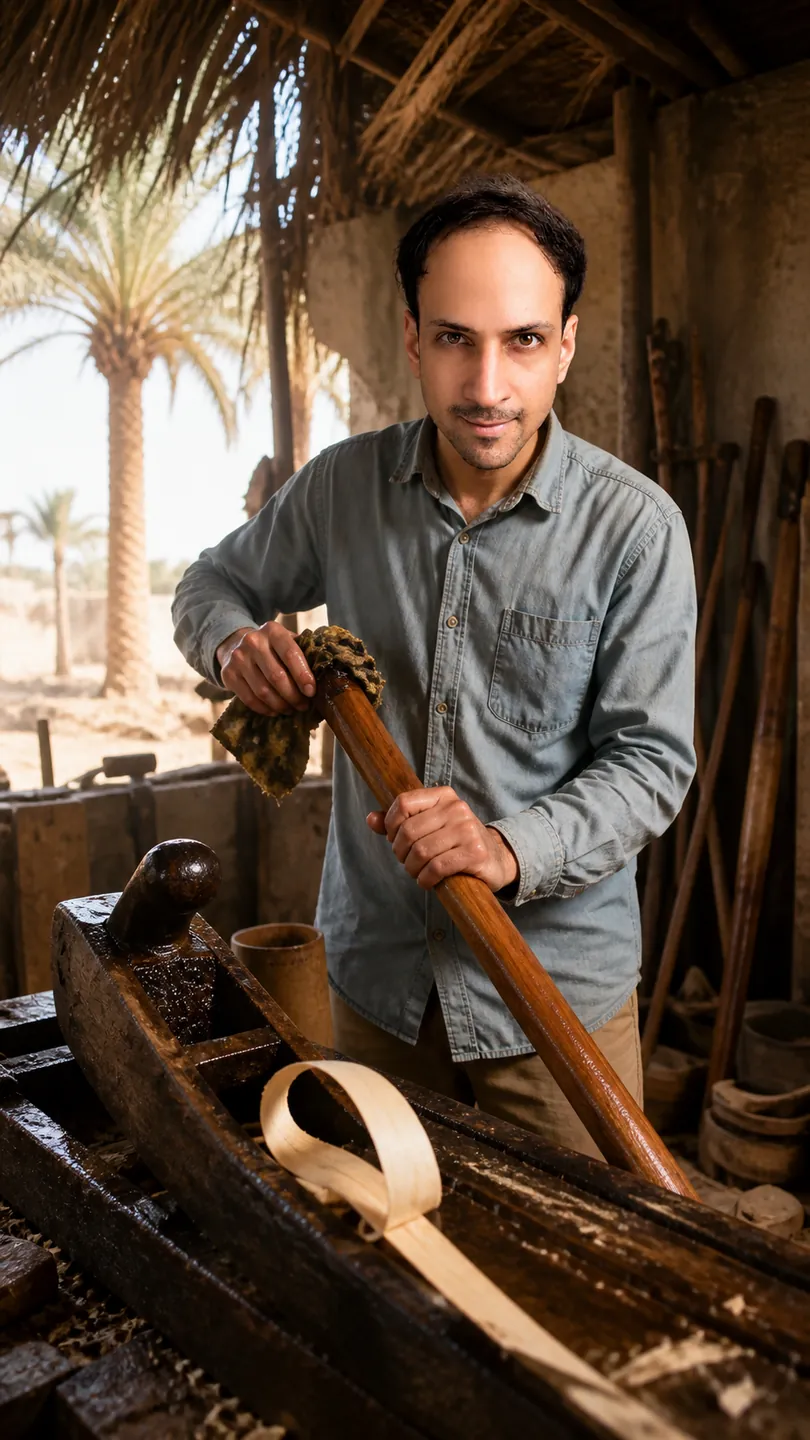
Kept Not Replaced: Palm-Frond-Shaded Implement Shed — AI Portrait Prompt
صورةAI Portraits

Turn your own photo into a portrait in a palm-frond-shaded implement shed at the working edge of a date farm. Keeps your face unchanged.

من نص البرومبت

Use the attached reference photo as the identity reference: keep the same face, skin tone, hair and features as the person in that photo, without beautifying, aging or altering them. Treat that reference as the character anchor: change only the scene. Design a full-height 9:16 cinematic artwork that reads on a phone and rewards gallery-scale inspection at exactly 2144x3808 pixels. Location: a palm-frond-shaded implement shed at the working edge of a date farm. Show the subject in a sun-faded chambray shirt buttoned to the wrist over cotton trousers, rubbing an oiled rag down a long wooden haft. Make one rigorous physical condition the conceptual engine: a hundred-year-old smoothing plane that still lifts one unbroken shaving thin enough to read the window's light through its curl makes deep time readable at a glance without any caption. Explore how minutes of ritual care can outweigh decades of neglect; direct expression and posture toward earned familiarity, never melodrama or ad-like confidence. Frame past the object in the extreme foreground, letting its most worn surface stay tangible without covering their face. Make the composition pair one worn surface with one fresh mark of care. Render it as conservation-grade craft portraiture built from real working tools, truthful wear mapping, warm low-key lighting, and precise, respectful editorial realism, using one low window key raking across worn surfaces with soft paper-bounce fill and a palette of bone-white stone, deep hickory, and a thread of amber. Photorealistic: this must read as a real photograph from a physical camera, never an illustration, painting, or 3D render. Give the space honest scale: real distance between foreground, subject, and far wall. Resolve real surface detail: condensation beading at true size, liquid meniscus curving against glass, and wet surfaces darker than dry ones. Keep one identity-locked person, credible hands and fingers, natural fabric, and coherent scale, contact, reflections, shadows, airflow, deformation, and materials. Background people only when essential, always secondary and clearly different. Avoid glowing forge montages, artificially weathered wood grain, hipster workshop styling, floating tool arrangements, and varnish-shiny fake patina. No text, labels, logos, signatures, watermarks, random symbols, plastic skin, excessive bloom, or glossy AI finish.
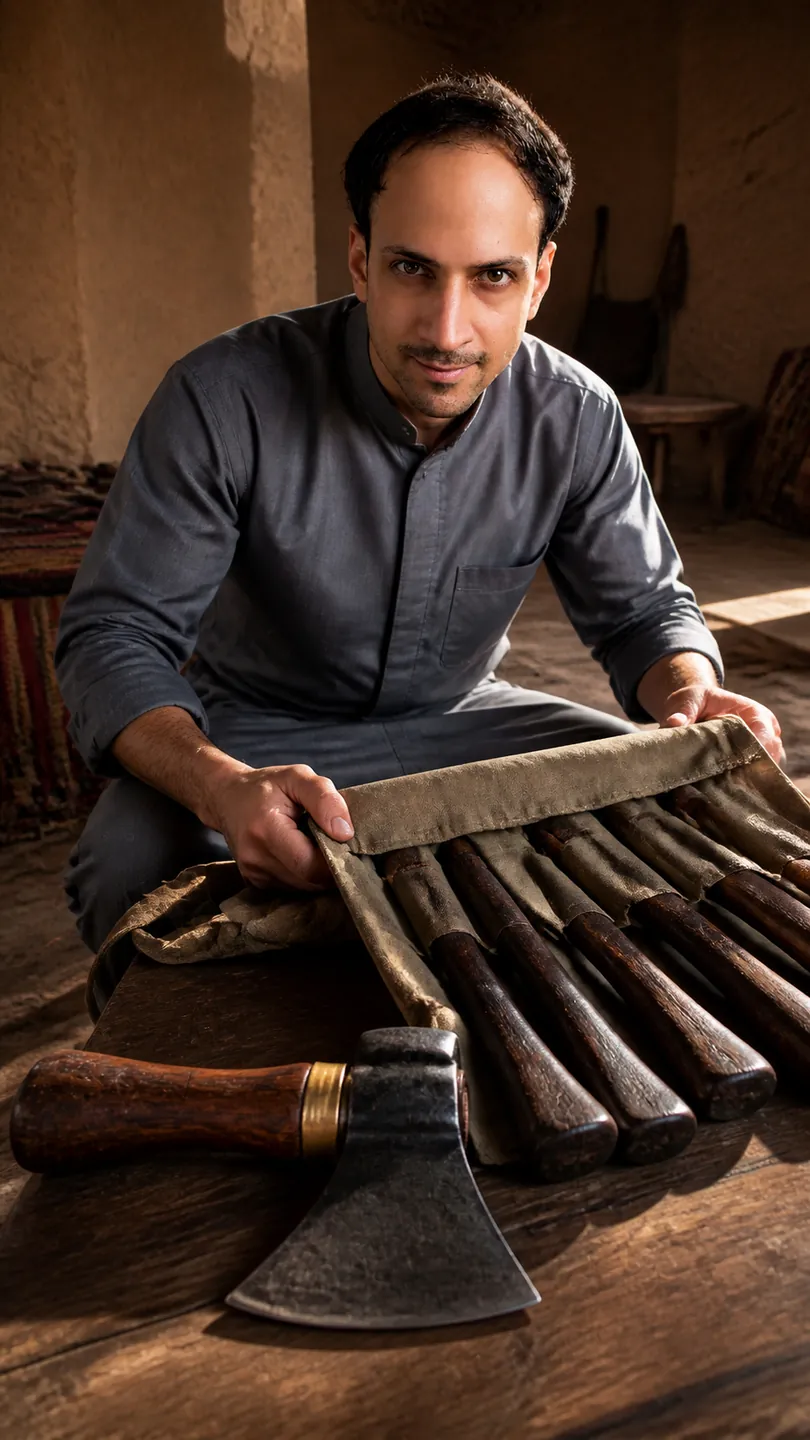
Time As Polish: Restored Mud-Brick Workroom — AI Portrait Prompt
صورةAI Portraits

Turn your own photo into a photorealistic portrait in a restored mud-brick workroom in old Diriyah, walls cool and windowless. Keeps your face unchanged.

من نص البرومبت

Use the attached reference photo as the identity reference: keep the same face, skin tone, hair and features as the person in that photo, without beautifying, aging or altering them. Treat that reference as the character anchor: change only the scene. Design a full-height 9:16 cinematic artwork that reads on a phone and rewards gallery-scale inspection at exactly 2144x3808 pixels. Location: a restored mud-brick workroom in old Diriyah, walls cool and windowless. Show the subject in a plain ash-grey traditional Gulf outfit with both sleeves folded back once, spreading a canvas tool roll open across a low table. Make one rigorous physical condition the conceptual engine: an axe head on its seventh handle that outlasted the six retired handles racked beneath it, each darkened at the grip recruits whoever maintains it into a relay older than any keeper. Explore why a tool kept for a century looks finished rather than worn; direct expression and posture toward settled respect, never melodrama or ad-like confidence. Frame past the object in the extreme foreground, letting its most worn surface stay tangible without covering their face. Make the composition pair one worn surface with one fresh mark of care. Render it as workshop still-life realism joining high-fidelity portrait photography, accurate patina and polish, shallow tactile depth, and quiet archival grading, using late slanting sun that grazes every polished wear point into quiet highlights and a palette of worn steel, oiled walnut, and one line of brass. Photorealistic: this must read as a real photograph from a physical camera, never an illustration, painting, or 3D render. Give the space honest scale: real distance between foreground, subject, and far wall. Keep one identity-locked person, credible hands and fingers, natural fabric, and coherent scale, contact, reflections, shadows, airflow, deformation, and materials. Background people only when essential, always secondary and clearly different. Avoid rusty antique-shop clutter, sepia nostalgia filters, cobwebbed barn walls, staged distressed props, and heroic blacksmith sparks. No text, labels, logos, signatures, watermarks, random symbols, plastic skin, excessive bloom, or glossy AI finish.
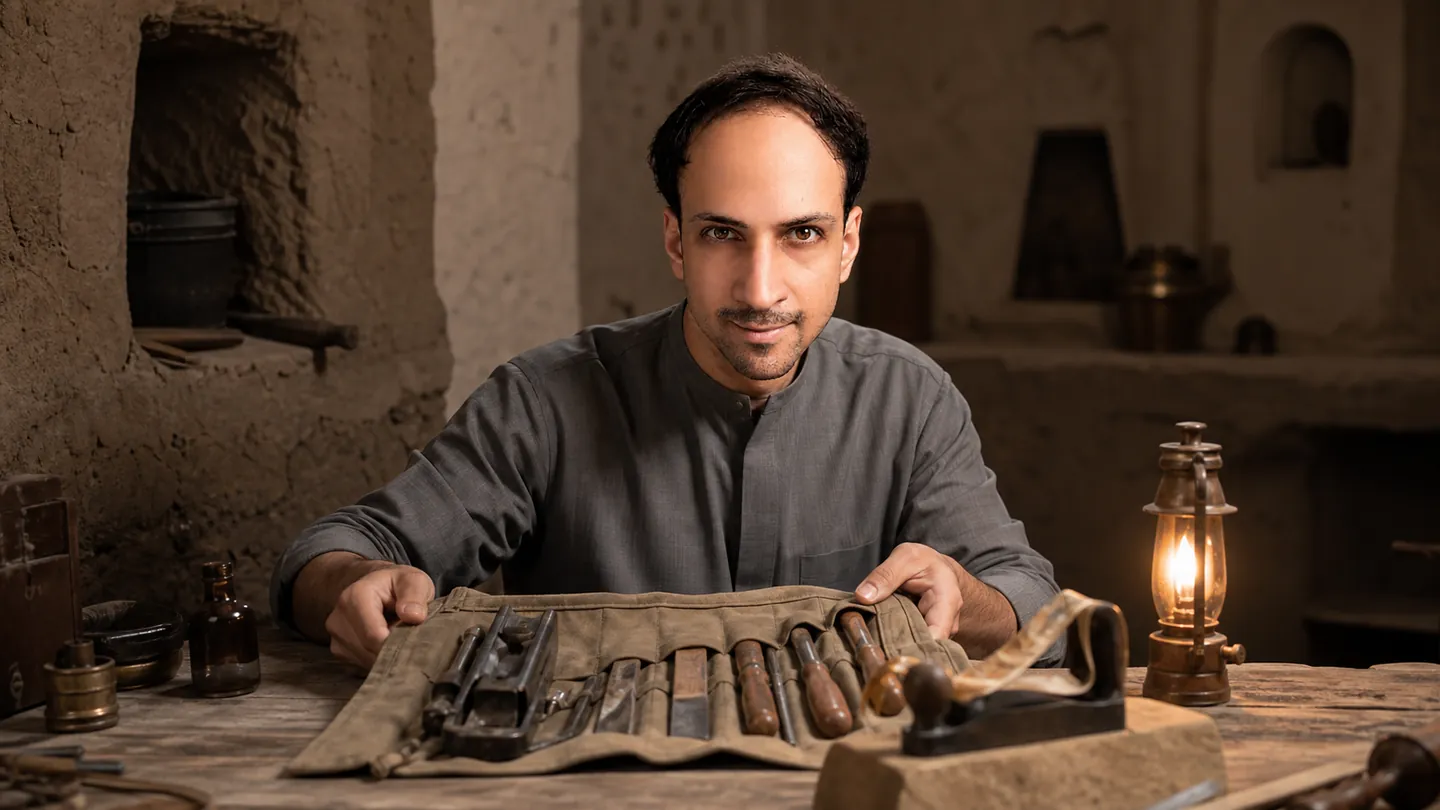
Kept Not Replaced: Restored Mud-Brick Workroom — AI Portrait Prompt
صورةAI Portraits

Turn your own photo into a portrait in a restored mud-brick workroom in old Diriyah, walls cool and windowless. Keeps your face unchanged.

من نص البرومبت

Use the attached reference photo as the identity reference: keep the same face, skin tone, hair and features as the person in that photo, without beautifying, aging or altering them. Treat that reference as the character anchor: change only the scene. Compose a wide 16:9 narrative image where environment and subject carry equal meaning at exactly 3808x2144 pixels. Location: a restored mud-brick workroom in old Diriyah, walls cool and windowless. Show the subject in a plain ash-grey traditional Gulf outfit with both sleeves folded back once, spreading a canvas tool roll open across a low table. Build the artwork around this material rule: a hundred-year-old smoothing plane that still lifts one unbroken shaving thin enough to read the window's light through its curl stands as quiet rebuttal to everything built to be discarded. Explore how minutes of ritual care can outweigh decades of neglect; direct expression and posture toward steward's calm, never melodrama or ad-like confidence. Use an eye-level 80mm portrait view with honest perspective and shallow, disciplined focus. Make the composition give the brightest polish the smallest area of the frame. Render it as material-culture documentary photography combining believable century-old tools, honest maintenance evidence, restrained contemporary art direction, and calm human-scale observational framing, using cool pre-dawn ambience lifted by one small tungsten practical near the hands and a palette of lampblack, waxed leather, and one glint of copper. Photorealistic: this must read as a real photograph from a physical camera, never an illustration, painting, or 3D render. Give truthful depth cues: overlapping planes and shadows softening as they travel. Resolve real surface detail: rubber gone chalky with age, painted metal chipped to primer, and plastic yellowed only where light reaches it. Keep one identity-locked person, credible hands and fingers, natural fabric, and coherent scale, contact, reflections, shadows, airflow, deformation, and materials. Background people only when essential, always secondary and clearly different. Avoid glowing forge montages, artificially weathered wood grain, hipster workshop styling, floating tool arrangements, and varnish-shiny fake patina. No text, labels, logos, signatures, watermarks, random symbols, plastic skin, excessive bloom, or glossy AI finish.
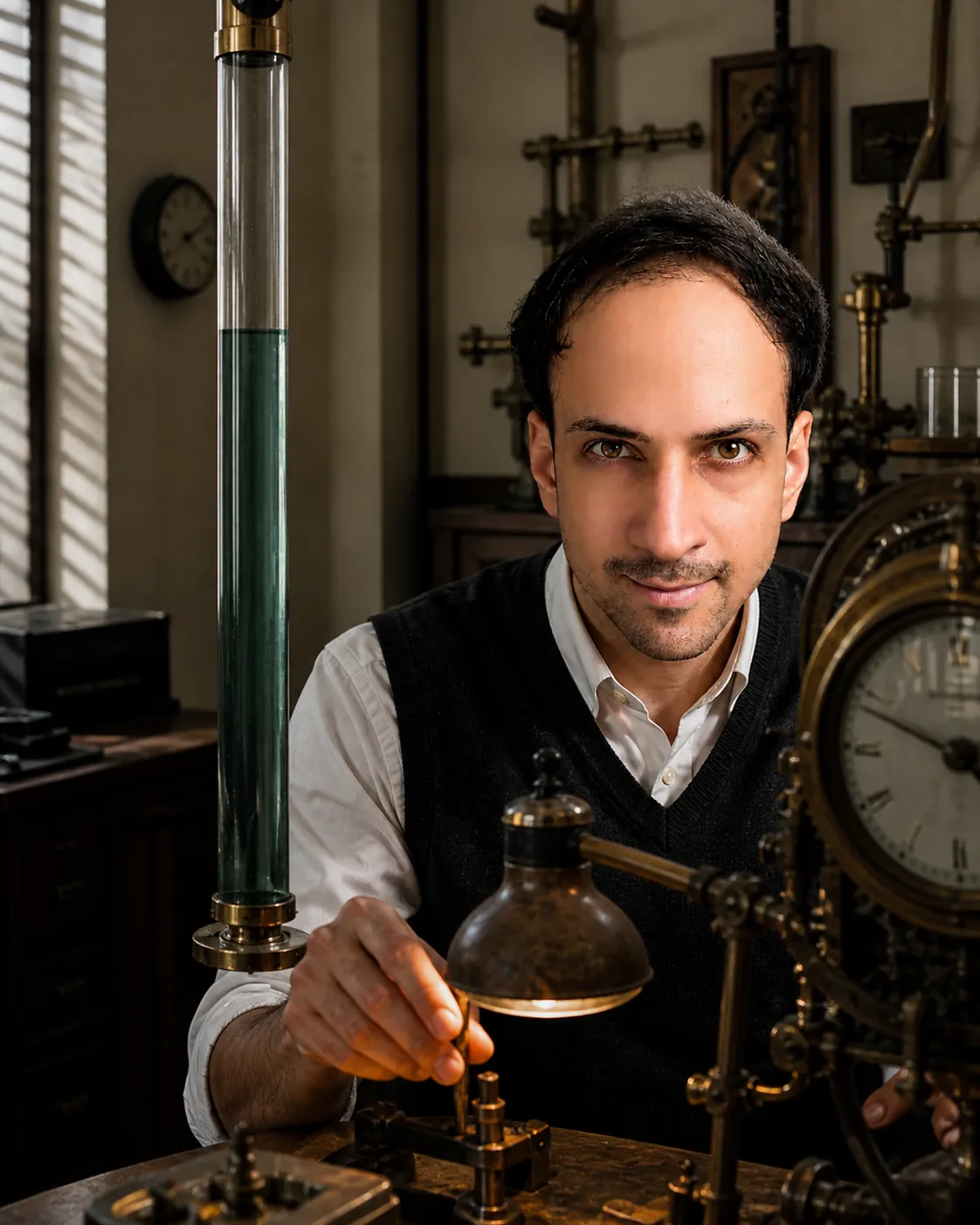
Second Signals: Clockmaker's Repair Room — AI Portrait Prompt
صورةAI Portraits

Turn your own photo into a gallery-grade documentary imagery portrait in a clockmaker's repair room with the bench light drawn low. Keeps your face unchanged.

من نص البرومبت

Use the attached reference photo as the identity reference: keep the same face, skin tone, hair and features as the person in that photo, without beautifying, aging or altering them. Build a portrait 4:5 editorial artwork with protected negative space and a fully readable face at exactly 2560x3200 pixels. Location: a clockmaker's repair room with the bench light drawn low. Show the subject in a charcoal knit vest over one rolled white shirtsleeve, drawing the bench light down to a hand's height. Build the artwork around this material rule: a slender sealed water column, tall as two floors, that settles wherever the day's air pressure lets it stand lets a distant condition arrive as a signal rather than an interruption. Explore why the quietest signal in a house is usually the one worth routing; direct expression and posture toward attentive calm, never melodrama or ad-like confidence. Use an 85mm portrait length so one instrument face and their eyes stay equally readable. Make the composition let one connecting line leave the frame without resolving. Render it as gallery-grade documentary imagery built from real pneumatic linkages, believable wear on brass, low-drama interior lighting, and patient human presence, using late-afternoon light entering through louvers as thin parallel bands and a palette of pale limestone, smoke grey, and one bottle-green band. Photorealistic: this must read as a real photograph from a physical camera, never an illustration, painting, or 3D render. Resolve real surface detail: fine lint on dark fabric, water spotting on steel, and the soft rounding of edges that have been used for years. Keep one identity-locked person, credible hands and fingers, natural fabric, and coherent scale, contact, reflections, shadows, airflow, deformation, and materials. Background people only when essential, always secondary and clearly different. Avoid steampunk goggles, glowing holograms, dripping food props, anatomical organ diagrams, and legible dial lettering anywhere. No text, labels, logos, signatures, watermarks, random symbols, plastic skin, excessive bloom, or glossy AI finish.
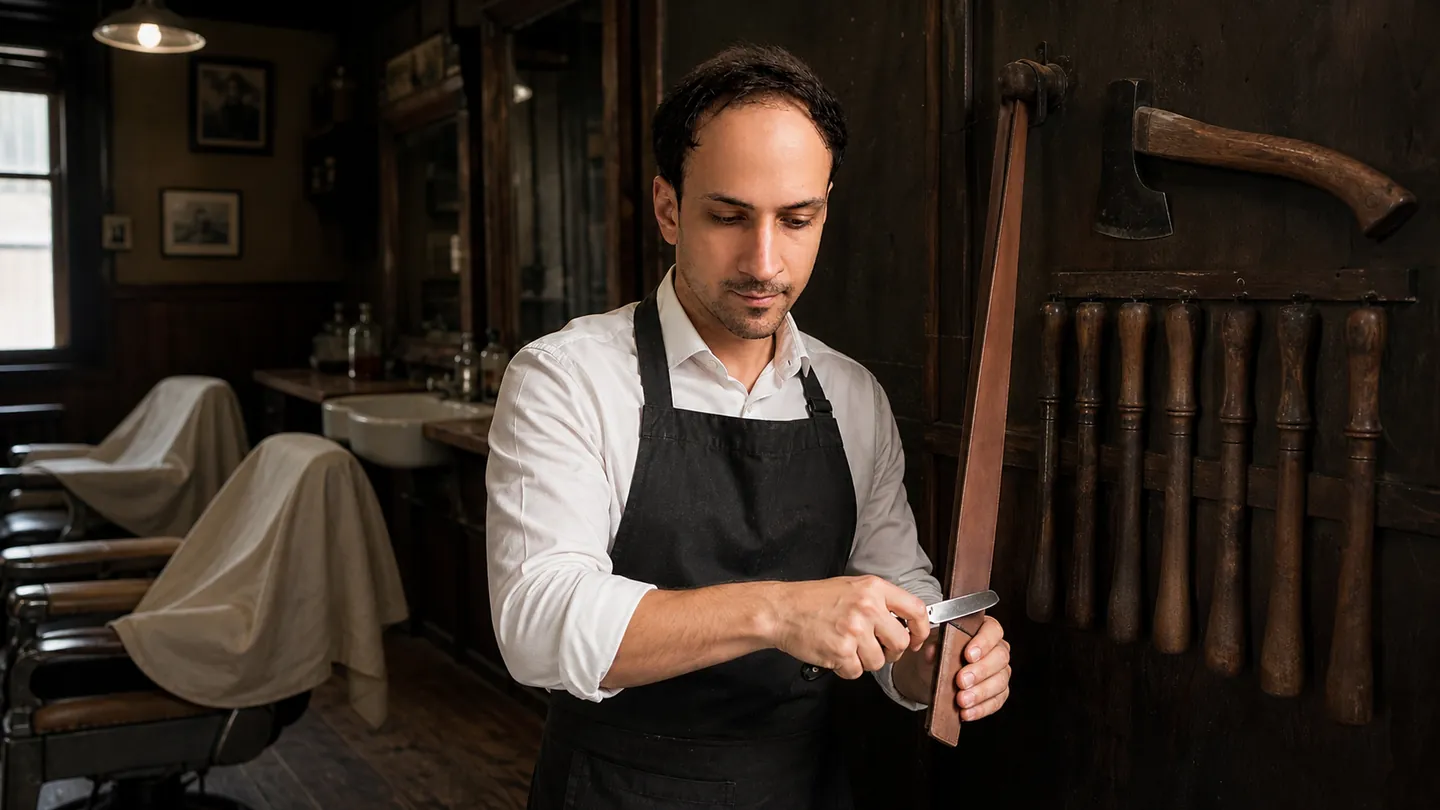
Time As Polish: Back Room of an Old Barbershop — AI Portrait Prompt
صورةAI Portraits

Turn your own photo into a material-culture documentary portrait in the back room of an old barbershop, chairs sheeted for the night. Keeps your face unchanged.

من نص البرومبت

Use the attached reference photo as the identity reference: keep the same face, skin tone, hair and features as the person in that photo, without beautifying, aging or altering them. Treat that reference as the character anchor: change only the scene. Compose a wide 16:9 narrative image where environment and subject carry equal meaning at exactly 3808x2144 pixels. Location: the back room of an old barbershop, chairs sheeted for the night. Show the subject in a black service apron over a pressed white shirt, cuffs turned back, drawing a blade flat along a hanging leather strop. The impossible-looking event must obey this clear system: an axe head on its seventh handle that outlasted the six retired handles racked beneath it, each darkened at the grip stands as quiet rebuttal to everything built to be discarded. Explore why a tool kept for a century looks finished rather than worn; direct expression and posture toward practical tenderness, never melodrama or ad-like confidence. Use a restrained 35mm environmental view, the subject at one-third and the workspace honest around them. Make the composition keep their hands nearer the light than their face. Render it as material-culture documentary photography combining believable century-old tools, honest maintenance evidence, restrained contemporary art direction, and calm human-scale observational framing, using one low window key raking across worn surfaces with soft paper-bounce fill and a palette of graphite, unbleached canvas, and one band of forge blue. Photorealistic: this must read as a real photograph from a physical camera, never an illustration, painting, or 3D render. Give the frame volume: faint density deepest in the room, contrast easing at the edges. Resolve real surface detail: floor finish worn along the walked line, skirting marked at shoe height, and corners darker than the open floor. Keep one identity-locked person, credible hands and fingers, natural fabric, and coherent scale, contact, reflections, shadows, airflow, deformation, and materials. Background people only when essential, always secondary and clearly different. Avoid glowing forge montages, artificially weathered wood grain, hipster workshop styling, floating tool arrangements, and varnish-shiny fake patina. No text, labels, logos, signatures, watermarks, random symbols, plastic skin, excessive bloom, or glossy AI finish.
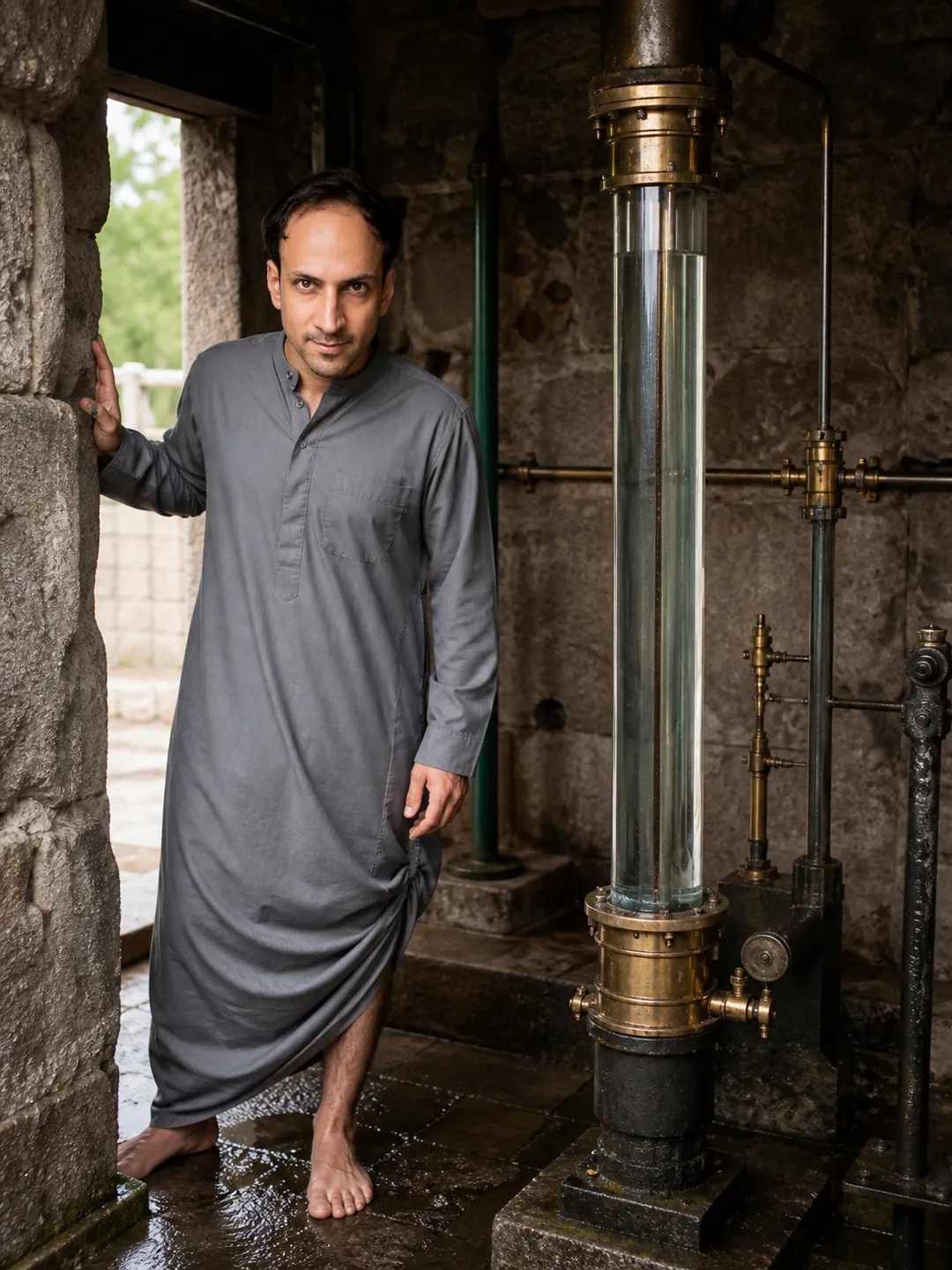
Second Signals: Farm Well House of Stone — AI Portrait Prompt
صورةAI Portraits

Turn your own photo into a portrait in a farm well house of stone where daylight stops inside the door. Keeps your face unchanged.

من نص البرومبت

Use the attached reference photo as the identity reference: keep the same face, skin tone, hair and features as the person in that photo, without beautifying, aging or altering them. Use a formal 3:4 environmental portrait with complete hands and meaningful objects inside frame at exactly 2480x3312 pixels. Location: a farm well house of stone where daylight stops inside the door. Show the subject in a plain grey traditional Gulf outfit with the hem gathered above wet stone, resting one hand on the cool stone jamb. Use this advanced image-making device as the core logic: a slender sealed water column, tall as two floors, that settles wherever the day's air pressure lets it stand proves information can be plumbed through a house as plainly as water. Explore why the quietest signal in a house is usually the one worth routing; direct expression and posture toward grave interest, never melodrama or ad-like confidence. Use an eye-level 50mm viewpoint with natural perspective and one plane of critical focus. Make the composition follow the signal's path from its source to their eyes. Render it as museum-grade signaling-instrument portraiture combining genuine pressure and gravity mechanisms, documentary photographic realism, honest machined brass materiality, and unhurried human framing, using flat overcast illumination that keeps every glass column readable without glare and a palette of lead grey, unpolished tin, and one stripe of verdigris. Photorealistic: this must read as a real photograph from a physical camera, never an illustration, painting, or 3D render. Resolve real surface detail: skin that reddens slightly under pressure, nail beds with honest colour, and knuckle creases that fold rather than blur. Keep one identity-locked person, credible hands and fingers, natural fabric, and coherent scale, contact, reflections, shadows, airflow, deformation, and materials. Background people only when essential, always secondary and clearly different. Avoid brass-gear collage backdrops, cartoon telegraph keys, neon signal beams, mercury spills, and floating typographic message overlays. No text, labels, logos, signatures, watermarks, random symbols, plastic skin, excessive bloom, or glossy AI finish.

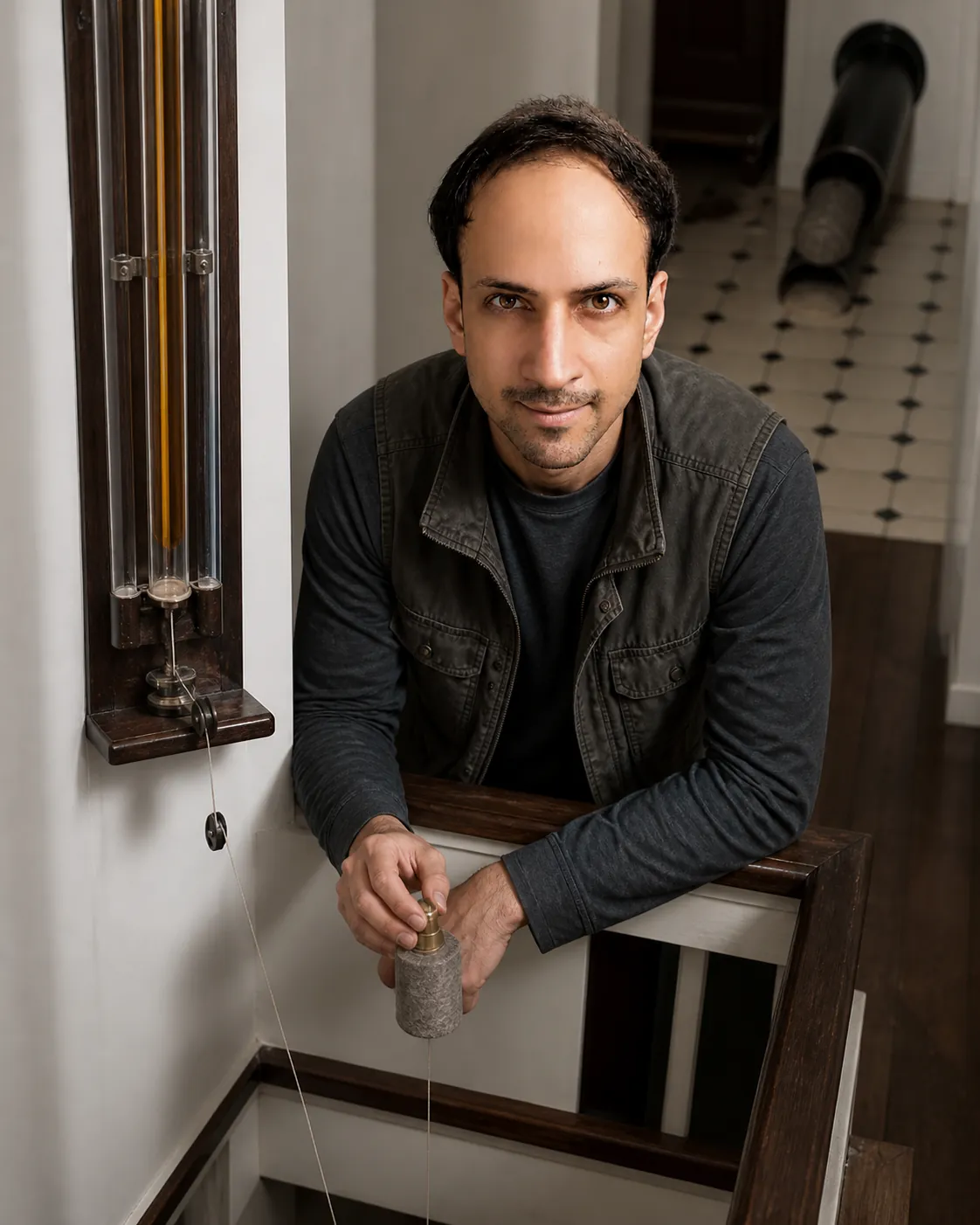
Interior Weather: Open Shaft of a Two-Storey Stairwell — AI Portrait Prompt
صورةAI Portraits

Turn your own photo into a conceptual house-systems portrait in the open shaft of a two-storey stairwell above a tiled floor. Keeps your face unchanged.

من نص البرومبت

Use the attached reference photo as the identity reference: keep the same face, skin tone, hair and features as the person in that photo, without beautifying, aging or altering them. Build a portrait 4:5 editorial artwork with protected negative space and a fully readable face at exactly 2560x3200 pixels. Location: the open shaft of a two-storey stairwell above a tiled floor. Show the subject in a graphite crewneck under a lightweight canvas work vest, paying a plumb line down through the open shaft. Build the artwork around this material rule: a felt-bodied carrier capsule that arrives with one soft thump after crossing the house inside a tube on pressure alone delivers what one room needs to know without anyone raising a voice. Explore how a message can be complete without containing a single readable word; direct expression and posture toward quiet stewardship, never melodrama or ad-like confidence. Use an 85mm portrait length so one instrument face and their eyes stay equally readable. Make the composition let one connecting line leave the frame without resolving. Render it as conceptual house-systems photography built from functioning telegraph hardware, accurate liquid-column behavior, restrained interior direction, and editorial portrait fidelity, using flat overcast illumination that keeps every glass column readable without glare and a palette of chalk white, dark walnut, and a single amber column. Photorealistic: this must read as a real photograph from a physical camera, never an illustration, painting, or 3D render. Resolve real surface detail: cotton that hangs by its own weight, seams that pucker very slightly, and collars softened by washing. Keep one identity-locked person, credible hands and fingers, natural fabric, and coherent scale, contact, reflections, shadows, airflow, deformation, and materials. Background people only when essential, always secondary and clearly different. Avoid brass-gear collage backdrops, cartoon telegraph keys, neon signal beams, mercury spills, and floating typographic message overlays. No text, labels, logos, signatures, watermarks, random symbols, plastic skin, excessive bloom, or glossy AI finish.
